
All Topics  
Lute

 
Lute

   Email Print
   Bookmark   Link


Lute


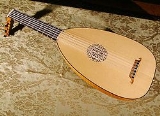
Lute can refer generally to any plucked string instrument with a neck
Neck (music)

The neck is the part of certain string instruments that projects from the main body and is the base of the fingerboard, where the fingers are placed to stop the strings at different pitches....
 (either fret
Fret

A fret is a raised portion on the neck of a stringed instrument, that extends generally across the full width of the neck. On most modern western culture instruments, frets are metal strips inserted into the fingerboard....
ted or unfretted) and a deep round back, or more specifically to an instrument from the family of European lutes.

The European lute and the modern Near-Eastern oud
Oud

The oud is a pear-shaped, stringed instrument, which is often seen as the predecessor of the western lute, distinguished primarily by being without frets, commonly used in Middle Eastern music....
 both descend from a common Near-Eastern ancestor via diverging evolutionary paths. The lute is used in a great variety of instrumental music from the early renaissance
Renaissance

The Renaissance was a cultural movement that spanned roughly the 14th to the 17th century, beginning in Italy in the late Middle Ages and later spreading to the rest of Europe....
 to the late baroque
Baroque

In the the arts, the Baroque was a Western cultural Epoch , starting roughly at the beginning of the 17th century in Rome, Italy. It was exemplified by drama and grandeur in Baroque sculpture, Baroque painting, literature, Baroque dance, and Baroque music....
 eras.


Discussion
Ask a question about 'Lute'
Start a new discussion about 'Lute'
Answer questions from other users
Full Discussion Forum


Encyclopedia


Lute can refer generally to any plucked string instrument with a neck
Neck (music)

The neck is the part of certain string instruments that projects from the main body and is the base of the fingerboard, where the fingers are placed to stop the strings at different pitches....
 (either fret
Fret

A fret is a raised portion on the neck of a stringed instrument, that extends generally across the full width of the neck. On most modern western culture instruments, frets are metal strips inserted into the fingerboard....
ted or unfretted) and a deep round back, or more specifically to an instrument from the family of European lutes.

The European lute and the modern Near-Eastern oud
Oud

The oud is a pear-shaped, stringed instrument, which is often seen as the predecessor of the western lute, distinguished primarily by being without frets, commonly used in Middle Eastern music....
 both descend from a common Near-Eastern ancestor via diverging evolutionary paths. The lute is used in a great variety of instrumental music from the early renaissance
Renaissance

The Renaissance was a cultural movement that spanned roughly the 14th to the 17th century, beginning in Italy in the late Middle Ages and later spreading to the rest of Europe....
 to the late baroque
Baroque

In the the arts, the Baroque was a Western cultural Epoch , starting roughly at the beginning of the 17th century in Rome, Italy. It was exemplified by drama and grandeur in Baroque sculpture, Baroque painting, literature, Baroque dance, and Baroque music....
 eras. It is also an accompanying instrument, especially in vocal works, often realizing a basso continuo or playing a written-out accompaniment.

The player of a lute is called a lutenist, lutanist, or lutist, and a maker of lutes (or any string instrument) is called a luthier
Luthier

A luthier is someone who makes or repairs stringed instruments. The word luthier comes from the French language word wikt:en:luth#French which is French for "lute"....
.

Etymology

The words "lute" and "oud" derive from Arabic
Arabic language

Arabic is a Central Semitic language, thus related to and classified alongside other Semitic languages languages such as Hebrew language and Aramaic language....
 al‘ud (?????; literally "the wood"). Recent research by Eckhard Neubauer suggests that ‘ud may in turn be an Arabized version of the Persian name rud, which meant "string," "stringed instrument," or "lute." Gianfranco Lotti suggests that the "wood" appellation originally carried derogatory connotations, because of proscriptions of all instrumental music in early Islam
Islam

Islam is a Monotheism, Abrahamic religion originating with the teachings of the Prophets of Islam Muhammad, a 7th century Arab religious and political figure....
.

Construction


Soundboard

Lutes are made almost entirely of wood. The soundboard
Sounding board

The sounding board or soundboard is the part of a string instrument that transmits the vibrations of the strings to the air, greatly increasing the loudness of sound over that of the string alone....
 is a teardrop-shaped thin flat plate of resonant wood (usually spruce
Spruce

A spruce is a tree of the genus Picea, a genus of about 35 species of coniferous evergreen trees in the Family Pinaceae, found in the northern temperate and boreal regions of the earth....
). In all lutes the soundboard has a single (sometimes triple) decorated sound hole under the strings, called the rose. The sound hole is not open, but rather covered with a grille in the form of an intertwining vine or a decorative knot, carved directly out of the wood of the soundboard.

Back

The back or the shell is assembled from thin strips of hardwood (maple, cherry, ebony, rosewood or other tonewoods) called ribs joined (with glue) edge to edge to form a deep rounded body for the instrument. There are braces inside on the soundboard to give it strength; see the photo among the external links below
Lute

Lute can refer generally to any plucked string instrument with a neck and a deep round back, or more specifically to an instrument from the family of European lutes....
.

Neck

The neck
Neck (music)

The neck is the part of certain string instruments that projects from the main body and is the base of the fingerboard, where the fingers are placed to stop the strings at different pitches....
 is made of light wood, with a veneer of hardwood (usually ebony) to provide durability for the fretboard beneath the strings. Unlike most modern stringed instruments, the lute's fretboard is mounted flush with the top. The pegbox
Pegbox

A pegbox is the part of certain String instrument musical instruments that houses the tuning pegs.See alsoHeadstock...
 for lutes before the Baroque
Baroque music

Baroque music describes a period or style of European classical music approximately extending from Dates of classical music eras. This era is said to begin in music after the Renaissance music and was followed by the Classical music era....
 era was angled back from the neck at almost 90° (see image), presumably to help hold the low-tension strings firmly against the nut, which is not traditionally glued in place, but is held in place by string pressure only. The tuning peg
Tuning peg

A tuning peg is used to hold a Vibrating string in the pegbox of a String instrument. It may be made of ebony, rosewood, boxwood or other material....
s
are simple pegs of hardwood, somewhat tapered, that are held in place by friction in holes drilled through the pegbox. As with other instruments using friction pegs, the choice of wood used to make pegs is crucial. As the wood suffers dimensional changes through age and loss of humidity, it must as closely as possible retain a circular cross-section in order to function properly, as there are no gears or other mechanical aids for tuning the instrument. Often pegs were made from suitable fruitwoods such as European pearwood, or equally dimensionally stable analogues. Matheson, ca 1720, stated if a lute-player has lived eighty years, he has surely spent sixty years tuning.

Belly

The geometry of the lute belly is relatively complex, involving a system of barring in which braces are placed perpendicular to the strings at specific lengths along the overall length of the belly, the ends of which are angled quite precisely to abut the ribs on either side for structural reasons. Robert Lundberg, in his book "Historical Lute Construction," suggests that ancient builders placed bars according to whole-number ratios of the scale length and belly length. He further suggests that the inward bend of the soundboard (the 'belly scoop') is a deliberate adaptation by ancient builders to afford the lutenist's right hand a bit more space between the strings and soundboard. The belly thickness is somewhat variable, but hovers between 1.5 and 2 millimeters in general. Some luthiers tune the belly as they build, removing mass and adapting bracing to ensure proper sonic results. The lute belly is almost never finished, though in some cases the luthier may size the top with a very thin coat of shellac or glair in order to help keep it clean. The belly is joined directly to the rib, without a lining glued to the sides, although a cap and counter cap are glued to the inside and outside of the bottom end of the bowl to provide rigidity and increased gluing surface.

After joining the top to the sides, a half binding is usually installed around the edge of the belly. The half-binding is approximately half the thickness of the belly and is usually made of a contrasting color wood. The rebate for the half-binding must be extremely precise to avoid compromising structural integrity.

Bridge

The bridge, usually made of a fruitwood, is attached to the soundboard usually at 1/5 to 1/7 the belly length. It does not have a separate saddle but has holes bored into it to which the strings attach directly. Typically the bridge is made such that it tapers in height and length, with the small end holding the trebles and the higher and wider end carrying the basses. Bridges are often colored black with carbon black in a binder, often shellac, and often have inscribed decoration. The scrolls or other decoration on the ends of lute bridges are usually integral to the bridge, and are not added afterwards as on some Renaissance guitar
Guitar

The guitar is a musical instrument with ancient roots that is used in a wide variety of musical styles. It typically has six Strings , but Tenor guitar, Seven-string guitar, Eight-string guitar, Ten-string guitar, Eleven-string guitar, Twelve-string guitar, Thirteen-string guitar and doubleneck guitar string guitars also exist....
s (cf Joachim Tielke
Joachim Tielke

Joachim Tielke was a Germany maker of musical instruments. He was born in K?nigsberg, Duchy of Prussia, and died in Hamburg.A publication was dedicated to him by G?nther Hellwig....
's guitars).

Frets

The fret
Fret

A fret is a raised portion on the neck of a stringed instrument, that extends generally across the full width of the neck. On most modern western culture instruments, frets are metal strips inserted into the fingerboard....
s are made of loops of gut tied around the neck. They fray with use, and must be replaced from time to time. A few additional partial frets of wood are usually glued to the body of the instrument, to allow stopping the highest-pitched courses up to a full octave higher than the open string ,though these are anachronistic and do not appear on original instruments. Given the choice between nylon and gut, many luthiers prefer to use gut, as it conforms more readily to the sharp angle at the edge of the fingerboard.

Strings

Strings were historically made of gut (or sometimes in combination with metal), and are still made of gut or a synthetic substitute, with metal windings on the lower-pitched strings. Modern manufacturers make both gut and nylon strings, and both are in common use. Gut is more authentic, though it is also more susceptible to irregularity and pitch instability due to changes in humidity. Nylon, less authentic, offers greater tuning stability but is, of course, anachronistic.

Of note are the "catlines" used as basses on historical instruments. Catlines are several gut strings wound together and soaked in heavy metal solutions which increase the mass of the strings. Catlines can be quite large in diameter by comparison with wound nylon strings for the same pitch. They produce a bass which is somewhat different in timbre from nylon basses.

The lute's strings are arranged in course
Course (music)

A course is a pair or more of adjacent strings tuned to unison or an octave and usually played together as if a single string. It may also refer to a single string normally played on its own on an instrument with other multi-string courses, for example the bass string on a nine string baroque guitar....
s
, usually of two strings each, though the highest-pitched course usually consists of only a single string, called the chanterelle. In later Baroque lutes 2 upper courses are single. The courses are numbered sequentially, counting from the highest pitched, so that the chanterelle is the first course, the next pair of strings is the second course, etc. Thus an 8-course Renaissance lute will usually have 15 strings, and a 13-course Baroque lute will have 24.

The courses are tuned in unison for high and intermediate pitches, but for lower pitches one of the two strings is tuned an octave higher. (The course at which this split starts changed over the history of the lute.) The two strings of a course are virtually always stopped and plucked together, as if a single string, but in extremely rare cases a piece calls for the two strings of a course to be stopped and/or plucked separately. The tuning of a lute is a somewhat complicated issue, and is described in a separate section of its own, below
Lute

Lute can refer generally to any plucked string instrument with a neck and a deep round back, or more specifically to an instrument from the family of European lutes....
. The result of the lute's design is an instrument extremely light for its size.

History and evolution of the lute

The origins of the lute are obscure, and organologists disagree about the very definition of a lute. The highly influential organologist Curt Sachs distinguished between the "long-necked lute" (Langhalslaute) and the short-necked variety: both referred to chordophones with a neck as distinguished from harps and psalteries. Smith and others argue that the long-necked variety should not be called lute at all, since it existed for at least a millennium before the appearance of the short-necked instrument that eventually evolved into what is now known as the lute, nor was it ever called a lute before the 20th century. Various types of necked chordophones were in use in ancient Egyptian
Ancient Egypt

Ancient Egypt was an Ancient history civilization in eastern North Africa, concentrated along the lower reaches of the Nile in what is now the modern nation of Egypt....
 (where they were introduced from Asia in the Middle Kingdom
Middle Kingdom

The Middle Kingdom may refer to*China*The Middle Kingdom of Egypt*A group of midwest U.S. states associated with the Society for Creative Anachronism...
), Hittite
Hittites

The Hittites were an ancient Anatolian people who spoke a Hittite language of the Anatolian languages of the Indo-European languages family, and established a kingdom centered at Hattusa in north-central Anatolia ca....
, Greek
Greece

Greece , officially the Hellenic Republic , is a country in southeastern Europe, situated on the southern end of the Balkans. It has borders with Albania, Bulgaria and the former Yugoslav Republic of Macedonia to the north, and Turkey to the east....
, Roman
Ancient Rome

Ancient Rome was a civilization that grew out of a small agricultural community founded on the Italian Peninsula as early as the 10th century BC....
, Bulgar
Bulgar

Bulgar may refer to:*Bulgars, an ancient group of peoples from Central Asia*Bulgar language, the extinct language of the Bulgars*Bulgarians, a contemporary nation in Eastern Europe...
, Turkic
Turkic peoples

The Turkic peoples are Eurasian peoples residing in northern, central and western Eurasia, and who mostly speak languages belonging to the Turkic languages....
, India
India

India, officially the Republic of India , is a country in South Asia. It is the List of countries and outlying territories by total area country by geographical area, the List of countries by population country, and the most populous liberal democracy in the world....
n, Chinese
China

China is a Culture of China, an ancient civilization, and, depending on perspective, a national or multinational entity extending over a large area in East Asia....
, Armenian/Cilician cultures. The Lute developed its familiar forms as Barbat
Barbat

Barbat succeeded his brother Litovoi as voivode of the principality on the West bank of the river Olt River. Taken hostage in the same battle in which Litovoi was killed, he managed to gather a large sum of money and pay the ransom....
 in Persia, Armenia
Armenia

Armenia , officially the Republic of Armenia , is a landlocked mountainous country in South Caucasus between the Black Sea and the Caspian Sea....
, and Byzantium
Byzantium

Byzantium was an Ancient Greece city, which was founded by Greeks colonists from Megara in 667 BC and named after their king Byzas or Byzantas ....
 beginning in the early 7th century. These instruments often had bodies covered with animal skin, and it is unknown exactly when it became replaced with a wooden soundboard.

As early as the 6th century the Bulgars brought the short-necked variety of the instrument called Kobuz to the Balkans, and in the 9th century Moors
Moors

In the Spanish language, the term for Moors is Moro; in Portuguese language the word is mouro. There seems to have been some confusion about the relationship of the word moro/mouro to the word moreno , both from Greek language ma?ros, i.e....
 brought the Oud
Oud

The oud is a pear-shaped, stringed instrument, which is often seen as the predecessor of the western lute, distinguished primarily by being without frets, commonly used in Middle Eastern music....
 to Spain. The long-necked Pandora/Quitra had been common Mediterranean lute previously. The Quitra didn't become extinct however, but continued its evolution, its descendants being Chitarra Italiana
Chitarra Italiana

Chitarra Italiana is a lute-shaped plucked instrument with 4 or 5 single strings, in a tuning similar to that of guitar. It was common in Italy during the Renaissance Era....
, Chitarrone and Colascione, aside from the still surviving Kuitra of Algiers and Morocco.

In about the year 1500 many Spanish, Catalan and Portuguese lutenists adopted vihuela de mano, a viol
Viol

The viol is any one of a family of bow , fretted, stringed instruments musical instruments developed in the 1400s and used primarily in the Renaissance music and Baroque music periods....
-shaped instrument tuned like the lute, but both instruments continued in coexistence. This instrument also found its way to parts of Italy that were under Spanish domination (especially Sicily and the papal states under the Borgia pope Alexander VI who brought many Catalan musicians to Italy), where it was known as the viola da mano.

Another important point of transfer of the lute from Arabian to European culture might have been in Sicily, where it was brought either by Byzantine or later by Saracen musicians. There were singer-lutenists at the court in Palermo following the Norman conquest of the island, and the lute is depicted extensively in the ceiling paintings in the Palermo’s royal Cappella Palatina, dedicated by the Norman King Roger II in 1140. By the 14th century, lutes had disseminated throughout Italy. Probably due to the cultural influence of the Hohenstaufen kings and emperor, based in Palermo, the lute had also made significant inroads into the German-speaking lands by the 14th century.

Medieval lutes were 4- or 5-course
Course (music)

A course is a pair or more of adjacent strings tuned to unison or an octave and usually played together as if a single string. It may also refer to a single string normally played on its own on an instrument with other multi-string courses, for example the bass string on a nine string baroque guitar....
 instruments, plucked using a quill for a plectrum
Plectrum

A plectrum is a small flat tool used to pluck or strum a string instrument. For guitars and similar instruments, the plectrum is a separate tool held in the player's hand....
. There were several sizes, and by the end of the Renaissance, seven different sizes (up to the great octave bass) are documented. Song accompaniment was probably the lute's primary function in the Middle Ages, but very little music securely attributable to the lute survives from the era before 1500. Medieval and early-Renaissance song accompaniments were probably mostly improvised, hence the lack of written records.

In the last few decades of the 15th century, in order to play Renaissance polyphony
Polyphony

In music, polyphony is a texture consisting of two or more independent melodic voice , as opposed to music with just one voice or music with one dominant melodic voice accompanied by chord s ....
 on a single instrument, lutenists gradually abandoned the quill in favor of plucking the instrument with the fingertips. The number of courses grew to six and beyond. The lute was the premier solo instrument of the 16th century, but continued to be used to accompany singers as well.
1711kupetzky
By the end of the Renaissance the number of courses had grown to ten, and during the Baroque era the number continued to grow until it reached 14 (and occasionally as many as 19). These instruments, with up to 26-35 strings, required innovations in the structure of the lute. At the end of the lute's evolution the archlute
Archlute

The archlute is a European plucked string instrument developed around 1600 as a compromise between the very large theorbo, the size and re-entrant tuning of which made for difficulties in the performance of solo music, and the Renaissance tenor lute, which lacked the bass range of the theorbo....
, theorbo
Theorbo

A theorbo is a plucked string instrument. As a name, theorbo signifies a number of long-necked lutes with second peg-boxes, such as the liuto attiorbato, the French th?orbe des pi?ces, the English theorbo, the archlute, the German baroque lute, the Ang?lique or angelica....
 and torban
Torban

The torban or teorban is a Culture of Ukraine musical instrument that combines the features of the Baroque Lute with those of the psaltery. It was invented ca....
 had long extensions attached to the main tuning head in order to provide a greater resonating length for the bass strings, and since human fingers are not long enough to stop strings across a neck wide enough to hold 14 courses, the bass strings were placed outside the fretboard, and were played "open", i.e. without fretting/stopping them with the left hand.

Over the course of the Baroque era the lute was increasingly relegated to the continuo accompaniment, and was eventually superseded in that role by keyboard instruments. The lute almost fell out of use after 1800. Some sorts of lute were still used for some time in Germany, Sweeden, Ukraine.

Lute in the modern world

The lute enjoyed a revival with the awakening of interest in historical music around 1900 and throughout the century, and that revival was further boosted by the early music
Early music

Early music is commonly defined as European classical music from the Medieval music and the Renaissance music.The Early Music Movement as a trend in history is the study and performance of music from composers before our own era and began in 1829 when Felix Mendelssohn conducted Johann Sebastian Bach's St Matthew Passion ....
 movement in the Twentieth Century. Important pioneers in lute revival were Julian Bream
Julian Bream

Julian Bream Commander of the Order of the British Empire is an internationally celebrated United Kingdom classical guitar and lutenist, widely recognized as one of the most important classical guitarists of the 20th century....
, Hans Neemann, Walter Gerwig, Suzanne Bloch and Diana Poulton. Lute performances are now not uncommon; there are many professional lutenists, especially in Europe where the most employment is to be found, and new compositions for the instrument are being produced by composers.

During the early days of the early music movement, many lutes were constructed by available luthiers, whose specialty was often classical guitars. Such lutes were heavily built with construction similar to classical guitars, with fan bracing, heavy tops, fixed frets, and lined sides, all of which are anachronistic to historical lutes. As lutherie scholarship increased, makers began constructing instruments based on historical models, which have proven on the whole to be far lighter and more responsive instruments.

Lutes built at present are invariably replicas or near copies of those that are to be found in museums or private collections. They are exclusively custom-built or must be bought second hand in a very limited market. As a result, lutes are generally more expensive than mass-produced modern instruments such as the guitar, though not nearly as expensive as the violin. Unlike in the past there are many types of lutes encountered today: 5-course medieval lutes, renaissance lutes of 6 to 10 courses in many pitches for solo and ensemble performance of Renaissance works, the archlute of Baroque works, 11-course lutes in d-minor tuning for 17th century French, German and Czech music, 13/14-course d-minor tuned German Baroque Lutes for later High Baroque and Classical music, theorbo
Theorbo

A theorbo is a plucked string instrument. As a name, theorbo signifies a number of long-necked lutes with second peg-boxes, such as the liuto attiorbato, the French th?orbe des pi?ces, the English theorbo, the archlute, the German baroque lute, the Ang?lique or angelica....
 for basso continuo parts in Baroque ensembles, gallichons/mandora
Mandora

The mandora or mandore, also known as the gallizona or gallichon, is a type of 6 or 8-course bass lute used mainly for basso continuo, in Germany, Austria and Czech lands, particularly during the 18th and early 19th centuries....
s, , orpharion
Orpharion

The orpharion is a plucked instrument from the Renaissance. It is part of the cittern family. Its construction is similar to the larger bandora....
s and others. Lutenistic practice has reached considerable heights in recent years, thanks to a growing number of world-class lutenists: Robert Barto
Robert Barto

Robert Barto is an American lutenist specializing in the music of the Baroque and Empfindsamkeit periods, in particular the oeuvres of Sylvius Leopold Weiss and Bernhard Joachim Hagen....
, Eduardo Egüez
Eduardo Egüez

Eduardo Eg?ez is an lutenist, theorbist, and guitarist acclaimed for his interpretations of music by J.S.Bach.He first studied guitar with Miguel Angel Girollet and Eduardo Fern?ndez....
, Edin Karamazov
Edin Karamazov

Edin Karamazov is a Bosnian musician-lutenist . He studied lute with Hopkinson Smith at the Schola Cantorum Basiliensis and worked with such ensembles as Hesperion, L'Arpeggiata, Hilliard Ensemble, Mala Punica, Orpheus Chamber Orchestra and singers Andreas Scholl, Maria-Cristina Kiehr, Arianna Savall, and Sting ....
, Nigel North
Nigel North

Nigel North is an English lutenist and classical guitar....
, Christopher Wilson
Christopher Wilson

Christopher Wilson is a sports humor columnist for Fox Sports' J. T. the Brick and the PostChronicle.com. He is the author of the book "Sports Briefs," a collection of his columns....
, Luca Pianca
Luca Pianca

Luca Pianca is Italian-Swiss musician-lutenist born in Lugano, Switzerland . He studied with Nikolaus Harnoncourt at Mozarteum Salzburg and collaborated with Concentus Musicus Wien since 1982....
, Pascal Monteilhet, Lex van Sante, Ariel Abramovich, Evangelina Mascardi, Luciano Contini, Hopkinson Smith
Hopkinson Smith

Hopkinson Smith is an United States of America lutenist.Born in New York, he graduated from Harvard with Honors in Music. He came to Europe in 1973 to study with Emilio Pujol, a great pedagogue in the highest Catalan people artistic tradition, and also Eugen Dombois, whose sense of organic unity between performer, instrument and historic...
, Paul O'Dette
Paul O'Dette

Paul R. O'Dette is an United States lutenist, conducting, and music researcher specializing in early music.O'Dette began playing classical guitar, and while in high school also played electric guitar in a rock band in Columbus, Ohio, where he grew up....
 et alia. Singer-songwriter Sting has also played lute and archlute, in and out of his collaborations with Edin Karamazov
Edin Karamazov

Edin Karamazov is a Bosnian musician-lutenist . He studied lute with Hopkinson Smith at the Schola Cantorum Basiliensis and worked with such ensembles as Hesperion, L'Arpeggiata, Hilliard Ensemble, Mala Punica, Orpheus Chamber Orchestra and singers Andreas Scholl, Maria-Cristina Kiehr, Arianna Savall, and Sting ....
, and Jan Akkerman
Jan Akkerman

Jan Akkerman is a Dutch guitarist. Jan Akkerman is a distinctive guitarist, constantly experimenting with new equipment and guitars. Akkerman's distinctive guitar sound is characterised by his pioneering use of volume swells which produce a smooth, fluty, sustained note, although he is also capable of astonishing high-speed pyrotechnics....
 released two albums of lute music in the 1970s while he was a guitarist in the Dutch rock band
Rock Band

Rock Band is a music video game developed by Harmonix Music Systems, published by MTV, and distributed by Electronic Arts. It is the first title in the Rock Band....
 Focus
Focus (band)

Focus is a Netherlands progressive rock band. It was founded by classically trained organ /flautist Thijs van Leer in 1969. It is most famous for the songs "Hocus Pocus " and "Sylvia"....
.

Lutes of several regional types are also common in Greece: laouto, and outi.

Lute repertoire

Orazio Gentileschi
Although lutes were in widespread use in Europe at least since the 13th century, and documents mention numerous early performers and composers, the earliest surviving music for the instrument dates from the late 15th century. Lute music flourished during the 16th and 17th centuries: numerous composers published collections of their music, and modern scholars have uncovered a vast number of manuscripts from the era—however, much of the music is still lost. In the second half of the 17th century lutes, vihuelas and similar instruments started losing popularity, and almost no music had been written for the instrument after 1750. The interest in lute music was revived only in the second half of the 20th century.

Improvisation was apparently a highly important aspect of lute performance, and so much of the repertoire was probably never written down. Furthermore, it was only around 1500 that lute players started the transition from plectrum
Plectrum

A plectrum is a small flat tool used to pluck or strum a string instrument. For guitars and similar instruments, the plectrum is a separate tool held in the player's hand....
 technique to that of the right hand: the latter allowed for complex polyphony, for which notation had to be developed. During the next hundred years three schools of tablature
Tablature

Tablature is a form of musical notation, which tells players where to place their fingers on a particular instrument rather than which pitches to play....
 notation developed gradually: Italian (also employed in Spain), German and French. Only the latter survived into the late 17th century. The earliest known tablatures are designed for a six-stringed instrument, although evidence of earlier four- and five-stringed lutes exists. Tablature notation depends on the actual instrument for which the music is written, and to read it, it is necessary to know the tuning, the number of strings, etc. of the instrument.

Renaissance and Baroque forms of lute music are more or less similar to those of keyboard music of the periods. Intabulation
Intabulation

Intabulation, from the Italian word intavolatura, refers to an arrangement of a vocal or ensemble piece for Keyboard instrument, lute, or other plucked string instrument, written in tablature....
s of vocal works were very common, as well as various dances, some of which disappeared during the 17th century, such as the piva
Piva (dance)

Piva is an Italy Renaissance dance that may have originated from a peasant dance to the accompaniment of Types of bagpipes#Italy. In 15th century sources it is described as a fast version of the Basse danse....
 and the saltarello
Saltarello

The saltarello was a lively, merry dance first mentioned in Naples during the 13th century. The music survives, but no early instructions for the actual dance are known....
. The advent of polyphony brought about fantasias: complex, intricate pieces with much use of imitative counterpoint. The improvisatory element, present to some degree in most lute pieces, is particularly evident in the early ricercares (not imitative as their later namesakes, but completely free), as well as in numerous preludial forms: preludes, tastar de corde ("testing the strings"), etc. During the 17th century keyboard and lute music went hand in hand, and by 1700 lutenists were writing suites of dances quite akin to those of keyboard composers. The lute was also used throughout its history as an ensemble instrument, most frequently in songs for voice and lute; these were particularly popular in Italy (see frottola
Frottola

The frottola was the predominant type of Italy popular, secular song of the late fifteenth and early sixteenth century. It was the most important and widespread predecessor to the Madrigal ....
) and England.

The earliest surviving lute music is Italian, from a late 15th century manuscript. The early 16th century saw Petrucci
Ottaviano Petrucci

Ottaviano Petrucci was an Italy printer. Petrucci is credited with producing, in 1501, the first book of sheet music printed from printing press: Harmonice musices odhecaton, a collection of chansons....
's publications
List of publications by Ottaviano Petrucci

This is a list of all known publications by Ottaviano Petrucci, an influential Italian printer of the 16th century. Most of these were reprinted several times during Petrucci's life, but in this list only dates of first publication are given....
 of lute music by Francesco Spinacino
Francesco Spinacino

Francesco Spinacino was an Italy lutenist and composer. His surviving output comprises the first two volumes of Ottaviano Petrucci's influential series of lute music publications: Intabolatura de lauto libro primo and Intabolatura de lauto libro secondo ....
 (fl. 1507) and Joan Ambrosio Dalza
Joan Ambrosio Dalza

Joan Ambrosio Dalza was an Italy lutenist and composer. Nothing is known about his life. His surviving works comprise the fourth volume of Ottaviano Petrucci's influential series of lute music publications, Intabolatura de lauto libro quarto ....
 (fl. 1508); together with the so-called Capirola Lutebook
Vincenzo Capirola

Vincenzo Capirola was an Italy composer, lute and nobleman of the Renaissance music. His music is preserved in an illuminated manuscript called the Capirola Lutebook, which is considered to be one of the most important sources of lute music of the early 16th century....
, these represent the earliest stage of written lute music in Italy. The leader of the next generation of Italian lutenists, Francesco Canova da Milano
Francesco Canova da Milano

Francesco Canova da Milano was a virtuoso Italy lute and composer of the Renaissance music. Born in Monza, near Milan , he was heralded throughout Italy and Europe and was the foremost lute composer of his time....
 (1497–1543), is now acknowledged as one of the most famous lute composers in history. The bigger part of his output consists of pieces called fantasias or ricercares, in which he makes extensive use of imitation and sequence, expanding the scope of lute polyphony. The second half of the century saw no composers equal in stature, but in the early 17th century Johannes Hieronymus Kapsberger
Johannes Hieronymus Kapsberger

Johann Hieronymus Kapsberger , was a Germany-Italy virtuoso performer and composer of the early Baroque period. A prolific and highly original composer, Kapsberger is chiefly remembered today for his lute, theorbo and chitarrone music, which was seminal in the development of these as solo instruments....
 (c.1580–1651) and Alessandro Piccinini
Alessandro Piccinini

Alessandro Piccinini , was an Italy lutenist and composer.Piccinini was born in Bologna into a musical family: his father Leonardo Maria Piccinini taught lute playing to Alessandro as well as his brothers Girolamo and Filippo ....
 (1566–1638) revolutionized the instrument's technique and Kapsberger, possibly, influenced the keyboard music of Frescobaldi
Frescobaldi

The Frescobaldi Family is a prominent Florentine family that has been involved in the political, sociological and economic history of the Tuscany region since the Middle Ages....
.

French written lute music began, as far as we know, with Pierre Attaingnant
Pierre Attaingnant

Pierre Attaingnant was a France music printer, active in Paris....
's (c.1494–c.1551) prints, which comprised preludes, dances and intabulations. Particularly important was the Italian composer Albert de Rippe
Albert de Rippe

Albert de Rippe was an Italy lutenist and composer. He was born in Mantua and worked there before 1528, when he left for France. There, he joined the court of Francis I of France....
 (1500–1551), who worked in France and composed polyphonic fantasias of considerable complexity. His work was published posthumously by his pupil, Guillaume de Morlaye (born c.1510), who, however, did not pick up the complex polyphony of de Rippe. French lute music declined during the second part of the 16th century; however, various changes to the instrument (the increase of diapason strings, new tunings, etc.) prompted an important change in style that led, during the early Baroque, to the celebrated style brisé: broken, arpeggiated textures that influenced Johann Jakob Froberger
Johann Jakob Froberger

Johann Jakob Froberger was a German people Baroque composer, Keyboard instrument virtuoso, and organist. He was among the most famous composers of the era and influenced practically every major composer in Europe by developing the genre of keyboard suite and contributing greatly to the exchange of musical traditions through his many travels....
's suites. The French Baroque school is exemplified by composers such as Ennemond Gaultier
Ennemond Gaultier

Ennemond Gaultier was a French lutenist and composer. He was one of the masters of the 17th century French lute school.He worked first in Lyon and in 1620, he became valet of the Queen Mother Marie de' Medici and court lutenists in Paris....
 (1575–1651), Denis Gaultier
Denis Gaultier

Denis Gaultier was a France lutenist and composer. He was a cousin of Ennemond Gaultier, with whom he was closely connected ; perhaps also a student of Charles Racquet, whose death he commemorated with a tombeau. He held no court position, but gained fame through salon playing; his works consist mainly of dance suites for the lute....
 (1597/1603–1672), François Dufaut (before 1604–before 1672) and many others. The last stage of French lute music is exemplified by Robert de Visée
Robert de Visée

Robert de Vis?e was a lutenist, baroque guitar, theorbo and viol at the court of Louis XIV, as well as a singer, and composer for lute, theorbo and guitar....
 (c.1655–1732/3), whose suites exploit the instrument's possibilities to the fullest.

The history of German written lute music started with Arnolt Schlick
Arnolt Schlick

Arnolt Schlick was a Germany organist, lutenist and composer of the Renaissance music. He was most probably born in Heidelberg and by 1482 established himself as court organist for the Electoral Palatinate....
 (c.1460–after 1521), who published in 1513 a collection of pieces that included 14 voice and lute songs and three solo lute pieces, alongside organ works. He was not, however, the first important German lutenist, because contemporaries credited Conrad Paumann
Conrad Paumann

Conrad Paumann was a Germany organ , lutenist and composer of the early Renaissance music. Even though he was born blind, he was one of the most talented musicians of the 15th century, and his performances created a sensation wherever he went....
 (c. 1410–1473) with the invention of German lute tablature. However, this claim has yet to be proven, and no lute works by Paumann survive. After Schlick, a string of composers developed German lute music: Hans Judenkünig (c.1445–50–1526), the Neusidler family (particularly Hans Neusidler
Hans Neusidler

Hans Neusidler was a composer and lutenist of the Renaissance music....
 (c.1508/9–1563)) and others. During the second half of the 16th century, German tablature and German repertoire were gradually replaced by Italian and French tablature and international repertoire, respectively, and the Thirty Years War (1618–48) effectively stopped publications for half a century. German lute music was revived much later by composers such as Esaias Reusner
Esaias Reusner

Esaias Reusner was a German lutenist and composer.His first lute teacher was his father Esaias . He was a child prodigy and together with his father he traveled and performed at various courts....
 (fl. 1670), however, a distinctly German style came only after 1700 in the works of Silvius Leopold Weiss (1686–1750), one of the greatest lute composers, some of whose works were transcribed for keyboard by none other than Johann Sebastian Bach
Johann Sebastian Bach

Johann Sebastian Bach was a German composer and organ whose sacred and secular works for choir, orchestra, and solo instruments drew together the strands of the Baroque music period and brought it to its ultimate maturity....
 (1685–1750), who composed a few pieces for the lute himself (although it is unclear whether they were really intended for the lute, rather than another plucked string instrument or the lautenwerk).

Of other European countries, particularly important are England and Spain. English written lute music only began around 1540, however, the country produced numerous lutenists, of which John Dowland
John Dowland

John Dowland was an England composer, singer, and lutenist. He is best known today for his melancholia songs such as "Come, heavy sleep" , "Come Again ", "Flow my tears", "I saw my Lady weepe" and "In darkness let me dwell", but his instrumental music has undergone a major revival, and has been a source of repertoire for classical guitarists...
 (1563–1626) is perhaps the most famous. His influence spread very far: variations on his themes were written by keyboard composers in Germany decades after his death. Dowland's predecessors and colleagues, such as Anthony Holborne
Anthony Holborne

Anthony Holborne was a composer of English consort of instruments music during the reign of Elizabeth I of England....
 (c. 1545–1602) and Daniel Bacheler
Daniel Bacheler

Daniel Bacheler was an English lutenist and composer.Bacheler was born at Aston Clinton, Buckinghamshire, and served an apprenticeship with Thomas Cardell who was a lutenist and dancing-master in the court of Elizabeth I of England....
 (1572–1619), were less known. Spanish composers wrote mostly for the vihuela
Vihuela

Vihuela is a name given to two different guitar-like string instruments: one from 15th and 16th century Spain, usually with 12 paired strings, and the other, the Mexican vihuela, from 19th century Mexico with five strings and typically played in Mariachi bands....
; their main genres were polyphonic fantasias and differencias (variations). Luys Milan (c.1500–after 1560) and Luys de Narváez
Luis de Narváez

Luis de Narv?ez was a Spain composer, primarily of polyphonic vocal music, and only secondarily of music for the vihuela, for which he is far better remembered today....
 (fl. 1526–49) were particularly important for their contributions to the development of lute polyphony in Spain. Finally, perhaps the most influential Eastern European lute composer was the Hungarian Bálint Bakfark
Bálint Bakfark

B?lint Bakfark ; 1507 ? August 15 or August 22, 1576) was a Magyars composer and lutenist of the Renaissance music. He was enormously influential as a lutenist in his time, and renowned as a virtuoso on the instrument....
 (c.1526–30–1576), whose contrapuntal fantasias were much more difficult and tighter than those of his Western European contemporaries.

Lute revival and Composers

The revival of lute in the 20th century revitalized the interest of composers in the instruments of the lute family.

One of the first such composers was Johann Nepomuk David
Johann Nepomuk David

Johann Nepomuk David was an Austrian composer.He began his musical career in the monastery of Sankt Florian, and was a composition student of Joseph Marx....
 in Germany. Composer Vladimir Vavilov
Vladimir Vavilov

Vladimir Vavilov was a Russian guitarist, lutenist and composer. He was a student of P. Isakov and I. Admoni at the Rimski-Korsakov Music College in St Petersburg....
 was a pioneer of the lute revival, as well as the author of numerous musical hoaxes. Sandor Kallosz, Stefan Lundgren, Toyohiko Satoh
Toyohiko Satoh

- is a Japanese people lute.He studied lute in Japan and later in Europe with Eugen M. Dombois at the Schola Cantorum Basiliensis in Basel, Switzerland....
 applied modernist idiom to the lute, Jozef van Wissem
Jozef van Wissem

Jozef van Wissem is a Dutch minimalist composer and lute player....
 and Alexandre Danilevsky
Alexandre Danilevsky

Alexandre Danilevsky is a Russian-French composer of classical music, lutenist, viola da gamba and vielle player, active in France .He is the artistic director of the Early Music ensemble "Syntagma 7", noted in particular for interpretations of music by the trouvere Gautier d'Epinal, as well as Russian and Ukrainian Baroque composers....
 minimalist and post-minimalist idiom, Roman Turovsky-Savchuk
Roman Turovsky-Savchuk

Roman Turovsky-Savchuk is a painter and lutenist-composer. He was born in Kiev, Ukraine in 1961, and emigrated to New York City in 1979. He studied art from an early age under Mikhail Turovsky, his father ....
, Paulo Galvão
Paulo Galvão

Paulo Galv?o - is a composer, lutenist, theorbist and guitarist, noted in particular for his compositions for 5-course baroque guitar published under the allonym "AdC"....
, Robert MacKillop
Robert MacKillop

Rob MacKillop is a Scotland composer, lutenist, theorbist, vihuela, and classical guitar. He is an important performer of Early Music in Scotland....
 and Maxym Zvonaryov historicist idiom, and Ronn McFarlane New Age.

Tuning conventions

Lutes were made in a large variety of sizes, with varying numbers of strings/courses, and with no permanent standard for tuning. However, the following seems to have been generally true of the Renaissance lute: A 6-course Renaissance tenor lute would be tuned to the same intervals as a tenor viol
Viol

The viol is any one of a family of bow , fretted, stringed instruments musical instruments developed in the 1400s and used primarily in the Renaissance music and Baroque music periods....
, with intervals of a perfect fourth between all the courses except the 3rd and 4th, which differed only by a major third. The tenor lute was usually tuned nominally "in g"(there was no pitch standard before the 20th century), named after the pitch of the highest course, yielding the pattern [(G'G) (Cc) (FF) (AA) (dd) (g)] from the lowest course to the highest. (Much renaissance lute music can be played on a guitar by tuning the guitar's third string down by a half tone.)

For lutes with more than six courses the extra courses would be added on the low end. Due to the large number of strings lutes have very wide necks, and it is difficult to stop strings beyond the sixth course, so additional courses were usually tuned to pitches useful as bass notes rather than continuing the regular pattern of fourths, and these lower courses are most often played without stopping. Thus an 8-course tenor Renaissance lute would be tuned to [(D'D) (F'F) (G'G) (Cc) (FF) (AA) (dd) (g)], and a 10-course to [(C'C) (D'D) (E?'E?) (F'F) (G'G) (Cc) (FF) (AA) (dd) (g)].

However, none of these patterns were de rigueur, and a modern lutenist will occasionally be seen to retune one or more courses between performance pieces. Manuscripts bear instructions for the player, e.g. 7e choeur en fa = "seventh course in fa" (= F in the standard C scale).

The first part of the seventeenth century was a period of considerable diversity in the tuning of the lute, particularly in France. However, by around 1670 the scheme known today as the "Baroque" or "d-minor" tuning became the norm, at least in France and in northern and central Europe. In this case the first six courses outline a d-minor triad, and an additional five to seven courses are tuned generally scalewise below them. Thus the 13-course lute played by Weiss would have been tuned [(A"A') (B"B') (C'C) (D'D) (E'E) (F'F) (G'G) (A'A') (DD) (FF) (AA) (d) (f)], or with sharps or flats on the lower 7 courses appropriate to the key of the piece.

Modern lutenists tune to a variety of pitch standards, ranging from A = 392 to 470 Hz, depending on the type of instrument they are playing, the repertory, the pitch of other instruments in an ensemble and other performing expediencies. No attempt at a universal pitch standard existed during the period of the lute's historical popularity. The standards varied over time and from place to place.

Bibliography

  • The Lute in Europe by Andreas Schlegel, published by the (2006). ISBN 978-3-9523232-0-5
  • A History of the Lute from Antiquity to the Renaissance by Douglas Alton Smith, published by the (2002). ISBN-10: 0-9714071-0-X ISBN-13: 978-0971407107
  • The Lute in Britain: A History of the Instrument and its Music by Matthew Spring, published by Oxford University Press (2001).
  • Historical Lute Construction by Robert Lundberg, published by the Guild of American Luthiers (2002).
  • La musique de luth en France au XVIe siècle by Jean-Michel Vaccaro (1981).
  • Articles in (1968-), The Lute (1958-), and other journals published by the various national lute societies.
  • Eckhard Neubauer, "Der Bau der Laute und ihre Besaitung nach arabischen, persischen und türkischen Quellen des 9. bis 15. Jahrhunderts," Zeitschrift für Geschichte der arabisch-islamischen Wissenschaften, vol. 8 (1993): 279–378.


Quotations

The art of playing the lute formed a major part of instrumental music making in the Renaissance before keyboard instruments assumed central significance. It was a refined, soft, and at the same time colorful art, in sharp contrast to the agitated times in which it was practised.
— Karl Schumann [1]

This style knows nothing of the otherwise usual requirements and prohibitions of voice-leading
Voice leading

In musical composition, voice leading is the term used to refer to a decision-making consideration when arranging voices , namely, how each voice should move in advancing from each chord to the next....
; it can only be understood in relation to the fingering technique; it frequently applies the sound of open strings and in no way avoids the otherwise so despised parallel 5ths and octaves or unisons. The dissonances and other conflicting sounds which appear so often...strike me as exciting and revealing.

Carl Orff
Carl Orff

Carl Orff was a 20th-century Germany composer, most famous for his composition Carmina Burana . He has also become very influential in the field of music education for his pedagogy methods, which survive through Orff Schulwerk....
 [1]


[1] Quotation taken from the liner notes to the Wergo edition of Orff's Kleines Konzert, with English translations by John Patrick Thomas.

External links


Lute societies

  • (UK)


Lute music online and other useful resources

  • Watch Tommie Andersson play the theorbo, 7-course & 10-course lutes.
  • , library of songs and lieder with baroque lute accompaniment.
  • Torban, a Ukrainian variety of lute/theorbo.
  • by István Kónya
  • The website for the great Hamburg lutemaker Joachim Tielke
  • Facsimiles/Scans (Dowland, etc.) and pdfs - by Alain Veylit


Composers of lute music

Category:Composers for lute
  • List of composers for lute
    List of composers for lute

    This is a list of composers who wrote for lute and similar period instruments: theorbo, chitarrone, etc. Composers who worked outside of their country of origin are listed according to where they were most active, i.e....


Lute players

see :Category:Lutenists

Luthiers

  • Joachim Tielke
    Joachim Tielke

    Joachim Tielke was a Germany maker of musical instruments. He was born in K?nigsberg, Duchy of Prussia, and died in Hamburg.A publication was dedicated to him by G?nther Hellwig....
  • Cezar Mateus
    Cezar Mateus

    Cezar Mateus is an American lutenist, composer and luthier working in Princeton, New Jersey. He specializes in lutes, archlutes, theorbos and other related instruments....
  • Andrew Rutherford
    Andrew Rutherford

    Andrew Rutherford is an American lutenist and luthier living and working in New York City. He is considered to be one of the most important makers of Renaissance and Baroque lutes, archlutes and theorbos....


Photos of historic lutes

  • Photos of historic lutes at the in Paris
- search-phrase: Mot-clé(s) : luth - search-phrase: Instrument fabriqué : luth - search-phrase: Instrument de musique, ville ou pays : luth


Articles and resources

  • by Jo Van Herck (Belgian Lute Academy)
Original: ; Luthinerie / Geluit and


See also

European Lutes:
  • String instruments
    • Angélique (instrument)
      Angélique (instrument)

      The ang?lique is a plucked string instrument of the lute family of the baroque era. It combines features of the lute, the harp and the theorbo....
    • Archlute
      Archlute

      The archlute is a European plucked string instrument developed around 1600 as a compromise between the very large theorbo, the size and re-entrant tuning of which made for difficulties in the performance of solo music, and the Renaissance tenor lute, which lacked the bass range of the theorbo....
    • Cittern
      Cittern

      The cittern or cither is a stringed instrument of the guitar family dating from the Renaissance. With its flat back, it was much simpler, and therefore cheaper, to construct than the lute, in addition to which it was easier to play and, being smaller and less delicate, far more portable....
    • Cobza
    • Gallichon
    • Kobza
      Kobza

      Kobza is the name of several musical instruments, mostly of the lute type , in eastern Europe. The term has a Turkic origin in the kobyz and komuz....
    • Mandora
      Mandora

      The mandora or mandore, also known as the gallizona or gallichon, is a type of 6 or 8-course bass lute used mainly for basso continuo, in Germany, Austria and Czech lands, particularly during the 18th and early 19th centuries....
    • Torban
      Torban

      The torban or teorban is a Culture of Ukraine musical instrument that combines the features of the Baroque Lute with those of the psaltery. It was invented ca....
    • Theorbo
      Theorbo

      A theorbo is a plucked string instrument. As a name, theorbo signifies a number of long-necked lutes with second peg-boxes, such as the liuto attiorbato, the French th?orbe des pi?ces, the English theorbo, the archlute, the German baroque lute, the Ang?lique or angelica....
    • Vihuela
      Vihuela

      Vihuela is a name given to two different guitar-like string instruments: one from 15th and 16th century Spain, usually with 12 paired strings, and the other, the Mexican vihuela, from 19th century Mexico with five strings and typically played in Mariachi bands....
    • Tablature
      Tablature

      Tablature is a form of musical notation, which tells players where to place their fingers on a particular instrument rather than which pitches to play....
  • Early music
    Early music

    Early music is commonly defined as European classical music from the Medieval music and the Renaissance music.The Early Music Movement as a trend in history is the study and performance of music from composers before our own era and began in 1829 when Felix Mendelssohn conducted Johann Sebastian Bach's St Matthew Passion ....
    • Medieval music
      Medieval music

      The term medieval music encompasses European music written during the Middle Ages. This era begins with the fall of the Roman Empire and ends in approximately the middle of the fifteenth century....
    • Renaissance music
      Renaissance music

      Renaissance music is European music written during the Renaissance, approximately 1400 - 1600. Dates of classical music eras, given the lack of abrupt shifts in musical thinking during the 15th century....
    • Baroque music
      Baroque music

      Baroque music describes a period or style of European classical music approximately extending from Dates of classical music eras. This era is said to begin in music after the Renaissance music and was followed by the Classical music era....
    • Classical Music
  • Greek Music
    Music of Greece

    The musical legacy of Greece is as diverse as its History of Greece. Music of Cyprus has certain similarities to traditional Greek music, and their modern popular music scenes remain well-integrated....
    • Cretan Music
      Music of Crete

      The music of Crete is a traditional form of Greece folk music called ???t??? . The Cretan_lyra is the dominant folk instrument on the island; it is a three-stringed fiddle....


African Lutes:
    • Gonje
    • Kouco
    • Kountougi


Asian Lutes:
    • Barbat
      Barbat (lute)

      The barbat is a lute of ancient Persian people origin. The Arabic Oud is derived from an ancient Persian barbat. Today's barbat, however, is essentially the same thing as today's oud: the instrument is often called the barbat when played in a Persian tradition, while called the oud when played in an Arabic tradition....
    • Biwa
      Biwa

      The biwa is a Japanese short-necked fretted lute, and a close variant of the Chinese pipa. The biwa is the chosen instrument of Benzaiten, goddess of music, eloquence, poetry, and education in Japanese Buddhism....
    • Dramnyen
    • Kutiyapi
      Kutiyapi

      The kutiyapi, is a Philippine two-stringed, fretted boat-lute. It is the only stringed instrument among the Maguindanao, and one of several among other groups such as the Maranao and Manobo....
    • Oud
      Oud

      The oud is a pear-shaped, stringed instrument, which is often seen as the predecessor of the western lute, distinguished primarily by being without frets, commonly used in Middle Eastern music....
    • Pipa
      Pipa

      The pipa is a plucked China string instrument. Sometimes called the Chinese lute, the instrument has a pear-shaped wooden body. It has been played for nearly two thousand years in China, and belongs to the plucked category of instruments ....
    • Setar
      Setar (lute)

      Setar is a Persian music musical instrument. It is a member of the lute family. Two and a half centuries ago, a fourth string was added to the setar, which has 25 - 27 moveable frets....
    • Sitar
      Sitar

      The sitar is a plucked stringed instrument. It uses sympathetic strings along with a long hollow neck and a gourd resonance chamber to produce a very rich sound with complex harmonic resonance....
    • Tanbur
      Tanbur

      The term tanbur can refer to various long-necked, fretted lutes originating in the Middle East or Central Asia. According to the New Grove Dictionary of Music and Musicians, "terminology presents a complicated situation....
    • Dotar
    • Tar
      Tar (lute)

      The tar is a long-necked, waisted Iranian/Persian instrument But other cultures and countries adapted this instrument into their culture,like Azerbaijan, Georgia , and other areas near the Caucasus region....
    • Yueqin
      Yueqin

      The yueqin is a traditional Chinese musical instruments string instrument. It is a lute with a round, hollow wooden body which gives it the nickname moon guitar....
  • Stringed instrument tunings
    Stringed instrument tunings

    This is a list of tunings for stringed musical instruments. Strings or Course are listed from low to high Pitch , reading from left to right facing the front of the instrument standing vertically....