

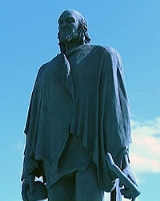
Guanches

Encyclopedia
Guanches is the name given to the aboriginal Berber
inhabitants of the Canary Islands
. It is believed that they migrated to the archipelago sometime between 1000 BCE and 100 BCE or perhaps earlier. While it is generally considered that the Guanches no longer exist as a distinct ethnicity, traces of their culture can still be found, such as Silbo, the "whistled language" of La Gomera
Island.
" (from Guan = person and Chinet = Tenerife). It was modified, according to Juan Núñez de la Peña
, by the Castilian
s into "Guanchos".
 The Roman
author and military officer, Pliny the Elder
, drawing upon the accounts of Juba II
, king of Mauretania
, stated that a Mauretanian expedition to the islands around 50 BCE found the ruins
of great buildings, but otherwise no population to speak of. If this account is accurate, it may suggest that the Guanches were not the only inhabitants, or the first ones; or that the expedition simply did not explore the islands thoroughly.
Strictly speaking, the Guanches were the indigenous peoples of Tenerife, where the population seems to have lived in relative isolation up to the time of the Castilian conquest, around the 14th century (though Genoese
, Portuguese
, and Castilians may have visited there from the second half of the 8th century onwards). The name came to be applied to the original populations of Tenerife island.
Many Guanches died resisting the new colonizers, while others died from infectious diseases that accompanied the invaders, diseases to which the Guanches, because of their long isolation, had little immunity.
What remains of their language, Guanche
—a few expressions, vocabulary words and the proper names of ancient chieftains still borne by certain families—exhibits positive similarities with the Berber languages
. The first reliable account of Guanche language was provided by the Genoese explorer Nicoloso da Recco
in 1341, with a translation of numbers used by the islanders.
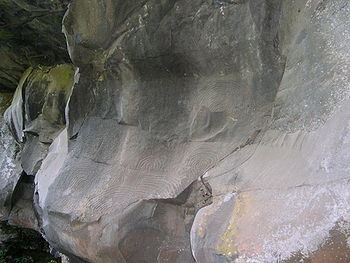
Petroglyph
s attributed to various Mediterranean civilizations
have been found on some of the islands. In 1752, Domingo Vandewalle
, a military governor of Las Palmas
, attempted to investigate them, and Aquilino Padron, a priest at Las Palmas, catalogued inscriptions at El Julan, La Candía and La Caleta on El Hierro. In 1878 Dr. R. Verneau discovered rock carvings in the ravines of Las Balos that resemble Libyan
or Numidic
writing from the time of Roman
occupation or earlier. In other locations, Libyco-Berber script
has been identified. However, according to European chroniclers, the Guanches did not possess a system of writing at the time of conquest.
and of Strabo
mention the Fortunate Isles
but do not report anything about their populations. Accounts about the Guanche population were first made around 1150 CE by the Arab geographer Muhammad al-Idrisi
in the Nuzhatul Mushtaq, a book he wrote for King Roger II of Sicily, in which al-Idrisi reports a journey in the Atlantic Ocean made by the Mugharrarin ("the adventurers"), a family of Andalusian seafarers from Lisbon, Portugal. The only surviving version of this book, kept at the Bibliothèque Nationale de France
, and first translated by Pierre Amédée Jaubert
, reports that, after having reached an area of "sticky and stinking waters" (probably the Sargasso Sea
), the Mugharrarin moved back and first reached an uninhabited Island (Madeira
or Hierro), where they found "a huge quantity of sheeps the meat of which was bitter and uneatable" and, then, "continued southward" and reached another island where they were soon surrounded by barks and brought to "a village whose inhabitants were often fair hair with long and flaxen hair and the women of a rare beauty". Among the villagers, one did speak Arabic and asked them where they came from. Then the king of the village ordered them to bring them back to the continent where they were surprised to be welcomed by Berbers. Apart from the marvelous and fanciful content of this history, this account would suggest that Guanches had sporadic contacts with populations from the mainland.
During the 14th century, the Guanches are presumed to have had other contacts with Balearic
seafarers from Spain, suggested by the presence of Balearic artefacts
found on several of the Canary Islands.
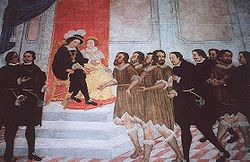 The Spanish invasion of the islands began in 1402, with the expedition of Jean de Béthencourt
and Gadifer de la Salle
to the island of Lanzarote. Gadifer would invade Lanzarote and Fuerteventura with ease since many of the aborigines, faced with issues of starvation and poor agriculture, would surrender to Castilian rule.
The other five islands fought back. El Hierro and the Bimbache population were the next to fall, then La Gomera, Gran Canaria, La Palma and in 1496, Tenerife.
Tenerife was most successful against the Castilian invaders. In the First Battle of Acentejo
(31 May 1494), called La Matanza or "The Slaughter," Guanches ambushed the Castilians in a valley and killed many. Only one in five of the Castilians survived, including the leader of the expedition, Alonso Fernandez de Lugo
.
Lugo would return later to the island with the alliance of the kings of the southern part of the island, and defeated the Guanches in the Battle of Aguere
. The northern Menceyatos or provinces fell after the Second Battle of Acentejo
with the defeat of the successor of Bencomo
, Bentor, Mencey of Taoro – what is now the Orotava Valley – in 1496.
) made a significant contribution to the aboriginal population of the Canaries following desertification
of the Sahara
at some point after 6000 BC. Linguistic evidence suggests ties between the Guanche language
and the Berber languages
of northern Africa, particularly when comparing numeral system
s. Research into the genetics of the Guanche population have led to the conclusion that they share an ancestry with Berber peoples.
The islands were visited by a number of peoples within recorded history. The Numidians
, Phoenicians, and Carthaginians knew of the islands and made frequent visits, including expeditions dispatched from Mogador by Juba
. The Romans occupied northern Africa and visited the Canaries between the 1st and 4th centuries CE, judging from Roman artefacts
found on the island of Lanzarote. These show that Romans did trade with the Canaries, though there is no evidence of their ever settling there. Archaeology of the Canaries seem to reflect diverse levels of technology, some differing from the Neolithic culture that was encountered at the time of conquest.
It is thought that the arrival of the aborigines
to the archipelago led to the extinction of some big reptiles and insular mammals, for example, the giant lizard Gallotia goliath
(which managed to reach up to a meter in length) and Canariomys bravoi, the giant rat of Tenerife.
compared aboriginal Guanche mtDNA (collected from Canarian archaeological sites) to that of today's Canarians and concluded that, "despite the continuous changes suffered by the population (Spanish colonisation, slave trade), aboriginal mtDNA [direct maternal] lineages constitute a considerable proportion [42 – 73%] of the Canarian gene pool. Although the Berbers
are the most probable ancestors of the Guanches, it is deduced that important human movements [e.g., the Islamic-Arabic conquest of the Berbers] have reshaped Northwest Africa after the migratory wave to the Canary Islands" and the "results support, from a maternal perspective, the supposition that since the end of the 16th century, at least, two-thirds of the Canarian population had an indigenous substrate, as was previously inferred from historical and anthropological data." mtDNA haplogroup U subclade U6b1
is Canarian-specific and is the most common mtDNA haplogroup found in aboriginal Guanche archaeological burial sites.
Both the study done by Maca-Meyer et al. (2003) on Tenerife aborigines and the study done by Fregel et al. (2009) on La Palma aborigines found the majority of mt-DNA haplogroups belonging to the Eurasian clades such as H/HV/U*/R. The study done by Maca-Meyer et al. (2003) on Tenerife Aborigines used a total sample of 71 aborigines and found that the frequency of the Cambridge Reference Sequence Cambridge Reference Sequence
(CRS) which belongs to the European haplogroup H2a2 was 21.12% of the total sample. Meanwhile the same study Maca-Meyer et al.(2003)found out that frequencies of haplogroups H/HV/U*/R(-CRS) at 30.98% of the total; also mtDNA haplogroup V was observed at frequencies of 4.23% of the total sample."
Y-DNA, or Y-chromosomal, (direct paternal) lineages were not analyzed in this study; however, an earlier study giving the aboriginal y-DNA contribution at 6% was cited by Maca-Meyer et al., but the results were criticized as possibly flawed due to the widespread phylogeography of y-DNA haplogroup E1b1b1b, which may skew determination of the aboriginality versus coloniality of contemporary y-DNA lineages in the Canaries. Regardless, Maca-Meyer et al. states that historical evidence does support the explanation of "strong sexual asymmetry...as a result of a strong bias favoring matings between European males and aboriginal females, and to the important aboriginal male mortality during the Conquest." The genetics thus suggests the native men were sharply reduced in numbers due to the war, large numbers of Spaniard men stayed in the islands and married the local women, the Canarians adopted Spanish names, language, and religion, and in this way, the Canarians were Hispanicized
.
According to a recent study by Fregel et al. 2009, in spite of the geographic nearness between the Canary Islands and Morocco
, the genetic heritage of the Canary islands male lineages, is mainly from European origin. Indeed, nearly 67% of the haplogroups resulting from are Euro–Eurasian (R1a
(2.76%), R1b
(50.62%), I
(9.66%) and G
(3.99%)). Unsurprisingly the Spanish conquest brought the genetic base of the current male population of the Canary Islands. Nevertheless, the second most important Haplogroup family is from Northern Africa, Near and Middle East. E1b1b (14% including 8.30% of the typical berber
haplogroup E-M81), E1b1a and E1a (1.50%), J
(14%) and T
(3%) Haplogroups are present at a rate of 33%. Even if a part of these "eastern" haplogroups were introduced by the Spanish too, we can suppose that a good portion of this rate was already there at the time of the conquest. According to this same study the presence of autochthonous North African E-M81 lineages, and also other relatively abundant markers (E-M78 and J-M267) from the same region in the indigenous Guanche population, "strongly points to that area [North Africa] as the most probable origin of the Guanche ancestors". In this study, Fregel et al. estimated that, based on Y-chromosome and mtDNA haplogroup frequencies, the relative female and male indigenous Guanche contributions to the present-day Canary Islands populations was respectively of 41.8% and 16.1%.
An autosomal
study in 2011 found an average Northwest African influence of about 17% in Canary Islanders with a wide interindividual variation ranging from 0% to 96%. According to the authors, the substantial Northwest African ancestry found for Canary Islanders supports that, despite the aggressive conquest by the Spanish in the 15th century and the subsequent immigration, genetic footprints of the first settlers of the Canary Islands persist in the current inhabitants. Paralleling mtDNA findings, the largest average Northwest African contribution was found for the samples from La Gomera
.
 Little is known of the religion of the Guanches. There was a general belief in a supreme being, called Achamán
in Tenerife, Acoran
in Gran Canaria, Eraoranhan in Hierro, and Abora
in La Palma. The women of Hierro worshipped a goddess called Moneiba. According to tradition, the male and female gods lived in mountains, from which they descended to hear the prayers of the people. On other islands, the natives venerated the sun
, moon
, earth
and star
s. A belief in an evil spirit was general. The demon of Tenerife was called Guayota
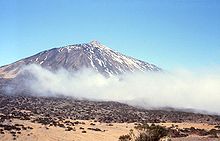
and lived at the peak of Teide
volcano, which was the hell
called Echeyde
; in Tenerife and Gran Canaria, the minor demons took the form of wild black woolly dogs called Tibicena
s, which lived in deep caves of the mountains, emerging at night to attack livestock and human beings.
In Tenerife
Magec
(god of the Sun) and Chaxiraxi
(the goddess mother) were also worshiped. In times of drought, the Guanches drove their flocks to consecrated grounds, where the lambs were separated from their mothers in the belief that their plaintive bleating would melt the heart of the Great Spirit. During the religious feasts, hostilities were held in abeyance, from war to personal quarrels.
Idols
found in the islands, including the Idol of Tara (Museo Canario, Las Palmas de Gran Canaria
) and The Guatimac
(Museum Archaeological of Puerto de la Cruz in Tenerife
). But they also have found many more figures in the rest of the archipelago.
Most researchers agree that the Guanches performing their worship in the open, under sacred trees such as pine
or drago
, or near sacred mountains such as Mount Teide
, which was believed Guayota
the abode of the devil . Mount Teide was sacred to the aboriginal Guanches and since 2007 is a World Heritage Site
. But sometimes the Guanches also performed worship in caves, as in "Cave of Achbinico" in Tenerife, where he was worshiping the Virgin of Candelaria
(Patron of Canary Islands). Until the 20th century, there were in the Canary Islands (especially in northern Tenerife) individuals called "Animeros". They were similar to healers and mystics with a syncretic belief among the Guanches Berber religion and Christianity. As in other countries close to the islands (e.g. marabouts from the Maghreb
), the Animeros were considered "persons blessed by God".
s or shamans who were connected with the gods and ordained hierarchically:
, sheep or goat meat (food good prices for Guanches). At the present time coincides with the pilgrimage to the Basilica of the Virgin of Candelaria
(Patron of Canary Islands).
Among the cultural events are significant traces of aboriginal traditions at the holidays and in the current Romería Relief in Güímar
(Tenerife
) and the lowering of the Rama, in Agaete (Gran Canaria).
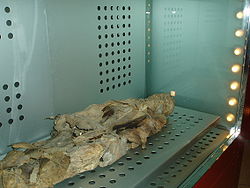
Mummification was practiced throughout the islands and was highly developed on Tenerife in particular. In La Palma, the elderly were left to die alone at their own wish. After bidding their family farewell, they were carried to the sepulchral cave, with nothing but a bowl of milk being left to them. The Guanches embalmed
their dead; many mummies
have been found in an extreme state of desiccation, each weighing not more than 6 or 7 pounds. Two almost inaccessible caves in a vertical rock by the shore 3 miles from Santa Cruz on Tenerife are said still to contain remains. The process of embalming seems to have varied. In Tenerife and Gran Canaria, the corpse was simply wrapped up in goat and sheep skins, while in other islands a resinous substance was used to preserve the body, which was then placed in a cave difficult to access, or buried under a tumulus
. The work of embalming was reserved for a special class, with women tending to female corpses, and men for the male ones. Embalming seems not to have been universal, and bodies were often simply hidden in caves or buried.
In the Museo de la Naturaleza y el Hombre
(Santa Cruz de Tenerife
) mummies of original inhabitants of the Canary Islands are displayed.
In 1933, the largest Guanche necropolis of the Canary Islands was found, at Uchova in the municipality of San Miguel de Abona
in the south of the island of Tenerife
. This cemetery was almost completely looted; it is estimated to have contained between 60 and 74 mummies.
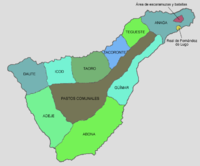 The political and social institutions of the Guanches varied. In some islands like Gran Canaria hereditary autocracy
by matrilineality prevailed; in others the government was elective
. In Tenerife all the land belonged to the kings who leased it to their subjects. In Gran Canaria
, suicide
was regarded as honourable, and whenever a new king was installed, one of his subjects willingly honoured the occasion by throwing himself over a precipice. In some islands, polyandry
was practised; in others they were monogamous
. Insult of a woman by an armed man was allegedly a capital offense.
The island of Tenerife was divided into nine small kingdoms (menceyatos), each ruled by a king or Mencey. The Mencey was the ultimate ruler of the kingdom, and at times, meetings were held between the various kings. When the Castilians invaded the Canary Islands, the southern kingdoms joined the Castilian invaders on the promise of the richer lands of the north; the Castilians betrayed them after ultimately securing victory at the Battles of Aguere
and Acentejo
.
In Tenerife the grand Mencey Tinerfe
and his father Sunta Mencey governed the unified island, which afterwards was divided into nine kingdoms by the children of Tinerfe.
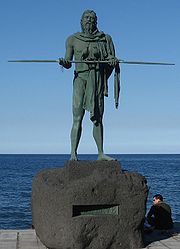 Guanches wore garments made from goat
skins or woven from plant fibers, which have been found in the tombs of Tenerife. They had a taste for ornaments and necklaces of wood, bone and shells, worked in different designs. Beads of baked earth, cylindrical and of all shapes, with smooth or polished surfaces, mostly colored black and red, were fairly common. Dr. René Verneau suggested that the objects the Castilians referred to as pintaderas, baked clay seal-shaped objects, were used as vessels for painting the body in various colours. They manufactured rough pottery
, mostly without decorations, or ornamented by making fingernail indentations.
Guanche weapons adapted to the insular environment (using wood, obsidian
and stone as primary materials), with later influences from medieval European weaponry. Basic armaments in several of the islands included javelins of 1 to 2 m in length (known as Banot on Tenerife); round, polished stones; spears; maces (common in Gran Canaria and Tenerife, and known as Magado and Sunta, respectively); and shields (small in Tenerife and human-sized in Gran Canaria, where they were known as Tarja, made of Drago wood
and painted with geometric shapes). After the arrival of the Europeans, Guanche nobility from Gran Canaria were known to wield large wooden swords (larger than the European two-handed type) called Magido, which were said to be very effective against both infantrymen and cavalry. Weaponry made of wood was hardened with fire. These armaments were commonly complemented with a stone or obsidian knife known as a Tabona.
Dwellings were situated in natural or artificial caves in the mountains. In areas where cave dwellings were not feasible, they built small round houses and, according to the Castilians, practiced crude fortification.
(Iglesia del Pueblo Guanche), a Neopagan movement with several hundred followers, was founded in San Cristóbal de La Laguna
(Tenerife
).
Berber people
Berbers are the indigenous peoples of North Africa west of the Nile Valley. They are continuously distributed from the Atlantic to the Siwa oasis, in Egypt, and from the Mediterranean to the Niger River. Historically they spoke the Berber language or varieties of it, which together form a branch...
inhabitants of the Canary Islands
Canary Islands
The Canary Islands , also known as the Canaries , is a Spanish archipelago located just off the northwest coast of mainland Africa, 100 km west of the border between Morocco and the Western Sahara. The Canaries are a Spanish autonomous community and an outermost region of the European Union...
. It is believed that they migrated to the archipelago sometime between 1000 BCE and 100 BCE or perhaps earlier. While it is generally considered that the Guanches no longer exist as a distinct ethnicity, traces of their culture can still be found, such as Silbo, the "whistled language" of La Gomera
La Gomera
La Gomera is one of Spain's Canary Islands, located in the Atlantic Ocean off the coast of Africa. In area, it is the second-smallest of the seven main islands of this group.- Political organization :...
Island.
Etymology
The native term Guanchinet or Achinet literally translated means "person of TenerifeTenerife
Tenerife is the largest and most populous island of the seven Canary Islands, it is also the most populated island of Spain, with a land area of 2,034.38 km² and 906,854 inhabitants, 43% of the total population of the Canary Islands. About five million tourists visit Tenerife each year, the...
" (from Guan = person and Chinet = Tenerife). It was modified, according to Juan Núñez de la Peña
Juan Núñez de la Peña
Juan Núñez de la Peña was a Spanish historian. Born in San Cristóbal de La Laguna, he studied Latin and the humanities in the college of San Agustín de La Laguna and was subsequently ordained priest...
, by the Castilian
Crown of Castile
The Crown of Castile was a medieval and modern state in the Iberian Peninsula that formed in 1230 as a result of the third and definitive union of the crowns and parliaments of the kingdoms of Castile and León upon the accession of the then King Ferdinand III of Castile to the vacant Leonese throne...
s into "Guanchos".
Historical background
Ancient Rome
Ancient Rome was a thriving civilization that grew on the Italian Peninsula as early as the 8th century BC. Located along the Mediterranean Sea and centered on the city of Rome, it expanded to one of the largest empires in the ancient world....
author and military officer, Pliny the Elder
Pliny the Elder
Gaius Plinius Secundus , better known as Pliny the Elder, was a Roman author, naturalist, and natural philosopher, as well as naval and army commander of the early Roman Empire, and personal friend of the emperor Vespasian...
, drawing upon the accounts of Juba II
Juba II
Juba II or Juba II of Numidia was a king of Numidia and then later moved to Mauretania. His first wife was Cleopatra Selene II, daughter to Greek Ptolemaic Queen Cleopatra VII of Egypt and Roman triumvir Mark Antony.-Early life:Juba II was a prince of Berber descent from North Africa...
, king of Mauretania
Mauretania
Mauretania is a part of the historical Ancient Libyan land in North Africa. It corresponds to present day Morocco and a part of western Algeria...
, stated that a Mauretanian expedition to the islands around 50 BCE found the ruins
Ruins
Ruins are the remains of human-made architecture: structures that were once complete, as time went by, have fallen into a state of partial or complete disrepair, due to lack of maintenance or deliberate acts of destruction...
of great buildings, but otherwise no population to speak of. If this account is accurate, it may suggest that the Guanches were not the only inhabitants, or the first ones; or that the expedition simply did not explore the islands thoroughly.
Strictly speaking, the Guanches were the indigenous peoples of Tenerife, where the population seems to have lived in relative isolation up to the time of the Castilian conquest, around the 14th century (though Genoese
Republic of Genoa
The Most Serene Republic of Genoa |Ligurian]]: Repúbrica de Zêna) was an independent state from 1005 to 1797 in Liguria on the northwestern Italian coast, as well as Corsica from 1347 to 1768, and numerous other territories throughout the Mediterranean....
, Portuguese
Portugal
Portugal , officially the Portuguese Republic is a country situated in southwestern Europe on the Iberian Peninsula. Portugal is the westernmost country of Europe, and is bordered by the Atlantic Ocean to the West and South and by Spain to the North and East. The Atlantic archipelagos of the...
, and Castilians may have visited there from the second half of the 8th century onwards). The name came to be applied to the original populations of Tenerife island.
Many Guanches died resisting the new colonizers, while others died from infectious diseases that accompanied the invaders, diseases to which the Guanches, because of their long isolation, had little immunity.
What remains of their language, Guanche
Guanche language
Guanche is an extinct language that was spoken by the Guanches of the Canary Islands until the 16th or 17th century. It is only known today through a few sentences and individual words recorded by early travellers, supplemented by several placenames, as well as some words assimilated into the...
—a few expressions, vocabulary words and the proper names of ancient chieftains still borne by certain families—exhibits positive similarities with the Berber languages
Berber languages
The Berber languages are a family of languages indigenous to North Africa, spoken from Siwa Oasis in Egypt to Morocco , and south to the countries of the Sahara Desert...
. The first reliable account of Guanche language was provided by the Genoese explorer Nicoloso da Recco
Nicoloso da Recco
Nicoloso da Recco was an 14th century Italian navigator from Genoa, who visited the Canary Islands in 1341 on behalf of Afonso IV of Portugal. He is credited with providing the first reliable account of the language used by the aboriginal inhabitants of the Canary Islands, the Guanches.An Italian...
in 1341, with a translation of numbers used by the islanders.
Petroglyph
Petroglyph
Petroglyphs are pictogram and logogram images created by removing part of a rock surface by incising, picking, carving, and abrading. Outside North America, scholars often use terms such as "carving", "engraving", or other descriptions of the technique to refer to such images...
s attributed to various Mediterranean civilizations
History of the Mediterranean region
The history of the Mediterranean region is the history of the interaction of the cultures and people of the lands surrounding the Mediterranean Sea —the central superhighway of transport, trade and cultural exchange between diverse peoples...
have been found on some of the islands. In 1752, Domingo Vandewalle
Domingo Vandewalle
Domingo Vandewalle was a Spanish explorer and military commander of Las Palmas in the Canary Islands. He is notable for being the first to discover the Guanches engravings of the Belmaco cave in the municipality of Villa de Mazo in 1752.-Notes:...
, a military governor of Las Palmas
Las Palmas (province)
The Province of Las Palmas is a province of Spain, consisting of the eastern part of the autonomous community of the Canary Islands.-Composition:...
, attempted to investigate them, and Aquilino Padron, a priest at Las Palmas, catalogued inscriptions at El Julan, La Candía and La Caleta on El Hierro. In 1878 Dr. R. Verneau discovered rock carvings in the ravines of Las Balos that resemble Libyan
History of Libya
The History of Libya includes the history of its rich mix of ethnic groups added to the indigenous Berber tribes. Berbers, the bulk of Libya's population, have been present throughout the entire history of the country. For most of its history, Libya has been subjected to varying degrees of foreign...
or Numidic
Numidia
Numidia was an ancient Berber kingdom in part of present-day Eastern Algeria and Western Tunisia in North Africa. It is known today as the Chawi-land, the land of the Chawi people , the direct descendants of the historical Numidians or the Massyles The kingdom began as a sovereign state and later...
writing from the time of Roman
Roman Empire
The Roman Empire was the post-Republican period of the ancient Roman civilization, characterised by an autocratic form of government and large territorial holdings in Europe and around the Mediterranean....
occupation or earlier. In other locations, Libyco-Berber script
Tifinagh
Tifinagh is a series of abjad and alphabetic scripts used by some Berber peoples, notably the Tuareg, to write their language.A modern derivate of the traditional script, known as Neo-Tifinagh, was introduced in the 20th century...
has been identified. However, according to European chroniclers, the Guanches did not possess a system of writing at the time of conquest.
First Arab explorer
The geographic accounts of Pliny the ElderPliny the Elder
Gaius Plinius Secundus , better known as Pliny the Elder, was a Roman author, naturalist, and natural philosopher, as well as naval and army commander of the early Roman Empire, and personal friend of the emperor Vespasian...
and of Strabo
Strabo
Strabo, also written Strabon was a Greek historian, geographer and philosopher.-Life:Strabo was born to an affluent family from Amaseia in Pontus , a city which he said was situated the approximate equivalent of 75 km from the Black Sea...
mention the Fortunate Isles
Fortunate Isles
In the Fortunate Isles, also called the Isles of the Blessed , heroes and other favored mortals in Greek mythology and Celtic mythology were received by the gods into a winterless blissful paradise...
but do not report anything about their populations. Accounts about the Guanche population were first made around 1150 CE by the Arab geographer Muhammad al-Idrisi
Muhammad al-Idrisi
Abu Abd Allah Muhammad al-Idrisi al-Qurtubi al-Hasani al-Sabti or simply Al Idrisi was a Moroccan Muslim geographer, cartographer, Egyptologist and traveller who lived in Sicily, at the court of King Roger II. Muhammed al-Idrisi was born in Ceuta then belonging to the Almoravid Empire and died in...
in the Nuzhatul Mushtaq, a book he wrote for King Roger II of Sicily, in which al-Idrisi reports a journey in the Atlantic Ocean made by the Mugharrarin ("the adventurers"), a family of Andalusian seafarers from Lisbon, Portugal. The only surviving version of this book, kept at the Bibliothèque Nationale de France
Bibliothèque nationale de France
The is the National Library of France, located in Paris. It is intended to be the repository of all that is published in France. The current president of the library is Bruno Racine.-History:...
, and first translated by Pierre Amédée Jaubert
Pierre Amédée Jaubert
Pierre Amédée Emilien Probe Jaubert was a French diplomat, academic, orientalist, translator, politician, and traveler. He was Napoleon's "favourite orientalist adviser and dragoman".-Biography:...
, reports that, after having reached an area of "sticky and stinking waters" (probably the Sargasso Sea
Sargasso Sea
The Sargasso Sea is a region in the middle of the North Atlantic Ocean, surrounded by ocean currents. It is bounded on the west by the Gulf Stream; on the north, by the North Atlantic Current; on the east, by the Canary Current; and on the south, by the North Atlantic Equatorial Current. This...
), the Mugharrarin moved back and first reached an uninhabited Island (Madeira
Madeira
Madeira is a Portuguese archipelago that lies between and , just under 400 km north of Tenerife, Canary Islands, in the north Atlantic Ocean and an outermost region of the European Union...
or Hierro), where they found "a huge quantity of sheeps the meat of which was bitter and uneatable" and, then, "continued southward" and reached another island where they were soon surrounded by barks and brought to "a village whose inhabitants were often fair hair with long and flaxen hair and the women of a rare beauty". Among the villagers, one did speak Arabic and asked them where they came from. Then the king of the village ordered them to bring them back to the continent where they were surprised to be welcomed by Berbers. Apart from the marvelous and fanciful content of this history, this account would suggest that Guanches had sporadic contacts with populations from the mainland.
During the 14th century, the Guanches are presumed to have had other contacts with Balearic
Balearic Islands
The Balearic Islands are an archipelago of Spain in the western Mediterranean Sea, near the eastern coast of the Iberian Peninsula.The four largest islands are: Majorca, Minorca, Ibiza and Formentera. The archipelago forms an autonomous community and a province of Spain with Palma as the capital...
seafarers from Spain, suggested by the presence of Balearic artefacts
Artifact (archaeology)
An artifact or artefact is "something made or given shape by man, such as a tool or a work of art, esp an object of archaeological interest"...
found on several of the Canary Islands.
Hispanic invasion
Jean de Béthencourt
Jean de Béthencourt was a French explorer who, in 1402, led an expedition to the Canary Islands, landing first on the north side of Lanzarote...
and Gadifer de la Salle
Gadifer de la Salle
Gadifer de La Salle was a French knight and crusader of Poitevine origin who, with Jean de Béthencourt, conquered and explored the Canary Islands for the Kingdom of Castile....
to the island of Lanzarote. Gadifer would invade Lanzarote and Fuerteventura with ease since many of the aborigines, faced with issues of starvation and poor agriculture, would surrender to Castilian rule.
The other five islands fought back. El Hierro and the Bimbache population were the next to fall, then La Gomera, Gran Canaria, La Palma and in 1496, Tenerife.
Tenerife was most successful against the Castilian invaders. In the First Battle of Acentejo
First Battle of Acentejo
The First Battle of Acentejo took place on the island of Tenerife between the Guanches and an alliance of Spaniards, other Europeans, and associated natives , on May 31, 1494, during the Spanish conquest of this island...
(31 May 1494), called La Matanza or "The Slaughter," Guanches ambushed the Castilians in a valley and killed many. Only one in five of the Castilians survived, including the leader of the expedition, Alonso Fernandez de Lugo
Alonso Fernández de Lugo
Javier Alonso Luis Fernández de Lugo was a Spanish military man, conquistador, city founder, and administrator. He conquered the islands of La Palma and Tenerife for the Castilian Crown; they were the last of the Canary Islands to be conquered by Europeans. He was also the founder of the towns...
.
Lugo would return later to the island with the alliance of the kings of the southern part of the island, and defeated the Guanches in the Battle of Aguere
Battle of Aguere
The Battle of Aguere, or Battle of San Cristóbal de La Laguna, was fought between forces of the Crown of Castile, led by the Adelantado Alonso Fernández de Lugo, and the natives of Tenerife, called Guanches. The battle took place November 14–15, 1494.Fernández de Lugo had suffered defeat by...
. The northern Menceyatos or provinces fell after the Second Battle of Acentejo
Second Battle of Acentejo
The Second Battle of Acentejo was a battle that took place on December 25, 1494, between the invading Spanish forces and the natives of the island of Tenerife, known as Guanches...
with the defeat of the successor of Bencomo
Bencomo
Bencomo was mencey or king of Taoro, a Guanche menceyato on the island of Tenerife. He fought in the First Battle of Acentejo, a victory for the Guanches against the invading Castilians, after having refused the terms of Alonso Fernández de Lugo, but may have perished on the heights of San Roque...
, Bentor, Mencey of Taoro – what is now the Orotava Valley – in 1496.
Origins
Genetic evidence shows that northern African peoples (most likely descendants of the Capsian cultureCapsian culture
The Capsian culture was a Mesolithic culture of the Maghreb, which lasted from about 10,000 to 6,000 BCE.It was concentrated mainly in modern Tunisia, and Algeria, with some sites attested in southern Spain to Sicily....
) made a significant contribution to the aboriginal population of the Canaries following desertification
Desertification
Desertification is the degradation of land in drylands. Caused by a variety of factors, such as climate change and human activities, desertification is one of the most significant global environmental problems.-Definitions:...
of the Sahara
Sahara
The Sahara is the world's second largest desert, after Antarctica. At over , it covers most of Northern Africa, making it almost as large as Europe or the United States. The Sahara stretches from the Red Sea, including parts of the Mediterranean coasts, to the outskirts of the Atlantic Ocean...
at some point after 6000 BC. Linguistic evidence suggests ties between the Guanche language
Guanche language
Guanche is an extinct language that was spoken by the Guanches of the Canary Islands until the 16th or 17th century. It is only known today through a few sentences and individual words recorded by early travellers, supplemented by several placenames, as well as some words assimilated into the...
and the Berber languages
Berber languages
The Berber languages are a family of languages indigenous to North Africa, spoken from Siwa Oasis in Egypt to Morocco , and south to the countries of the Sahara Desert...
of northern Africa, particularly when comparing numeral system
Numeral system
A numeral system is a writing system for expressing numbers, that is a mathematical notation for representing numbers of a given set, using graphemes or symbols in a consistent manner....
s. Research into the genetics of the Guanche population have led to the conclusion that they share an ancestry with Berber peoples.
The islands were visited by a number of peoples within recorded history. The Numidians
Numidians
The Numidians were Berber tribes who lived in Numidia, in Algeria east of Constantine and in part of Tunisia. The Numidians were one of the earliest natives to trade with the settlers of Carthage. As Carthage grew, the relationship with the Numidians blossomed. Carthage's military used the Numidian...
, Phoenicians, and Carthaginians knew of the islands and made frequent visits, including expeditions dispatched from Mogador by Juba
Juba II
Juba II or Juba II of Numidia was a king of Numidia and then later moved to Mauretania. His first wife was Cleopatra Selene II, daughter to Greek Ptolemaic Queen Cleopatra VII of Egypt and Roman triumvir Mark Antony.-Early life:Juba II was a prince of Berber descent from North Africa...
. The Romans occupied northern Africa and visited the Canaries between the 1st and 4th centuries CE, judging from Roman artefacts
Artifact (archaeology)
An artifact or artefact is "something made or given shape by man, such as a tool or a work of art, esp an object of archaeological interest"...
found on the island of Lanzarote. These show that Romans did trade with the Canaries, though there is no evidence of their ever settling there. Archaeology of the Canaries seem to reflect diverse levels of technology, some differing from the Neolithic culture that was encountered at the time of conquest.
It is thought that the arrival of the aborigines
Indigenous peoples
Indigenous peoples are ethnic groups that are defined as indigenous according to one of the various definitions of the term, there is no universally accepted definition but most of which carry connotations of being the "original inhabitants" of a territory....
to the archipelago led to the extinction of some big reptiles and insular mammals, for example, the giant lizard Gallotia goliath
Gallotia goliath
Gallotia goliath is an extinct giant lizard species from the island of Tenerife of the Canary Islands, Spain. This reptile lived before the arrival of humans. It was described by the German herpetologist Robert Mertens. It is believed that it grew to at least three feet long...
(which managed to reach up to a meter in length) and Canariomys bravoi, the giant rat of Tenerife.
Population genetics
A 2003 genetics research article by Nicole Maca-Meyer et al. published in the European Journal of Human GeneticsEuropean Journal of Human Genetics
The European Journal of Human Genetics is the official journal of the European Society of Human Genetics. It focuses on human genetics, and is published monthly by the Nature Publishing Group...
compared aboriginal Guanche mtDNA (collected from Canarian archaeological sites) to that of today's Canarians and concluded that, "despite the continuous changes suffered by the population (Spanish colonisation, slave trade), aboriginal mtDNA [direct maternal] lineages constitute a considerable proportion [42 – 73%] of the Canarian gene pool. Although the Berbers
Berber people
Berbers are the indigenous peoples of North Africa west of the Nile Valley. They are continuously distributed from the Atlantic to the Siwa oasis, in Egypt, and from the Mediterranean to the Niger River. Historically they spoke the Berber language or varieties of it, which together form a branch...
are the most probable ancestors of the Guanches, it is deduced that important human movements [e.g., the Islamic-Arabic conquest of the Berbers] have reshaped Northwest Africa after the migratory wave to the Canary Islands" and the "results support, from a maternal perspective, the supposition that since the end of the 16th century, at least, two-thirds of the Canarian population had an indigenous substrate, as was previously inferred from historical and anthropological data." mtDNA haplogroup U subclade U6b1
Haplogroup U (mtDNA)
In human mitochondrial genetics, Haplogroup U is a human mitochondrial DNA haplogroup.-Origins:Haplogroup U descends from a woman in the Haplogroup R branch of the phylogenetic tree, who lived around 55,000 years ago...
is Canarian-specific and is the most common mtDNA haplogroup found in aboriginal Guanche archaeological burial sites.
Both the study done by Maca-Meyer et al. (2003) on Tenerife aborigines and the study done by Fregel et al. (2009) on La Palma aborigines found the majority of mt-DNA haplogroups belonging to the Eurasian clades such as H/HV/U*/R. The study done by Maca-Meyer et al. (2003) on Tenerife Aborigines used a total sample of 71 aborigines and found that the frequency of the Cambridge Reference Sequence Cambridge Reference Sequence
Cambridge Reference Sequence
The Cambridge Reference Sequence for human mitochondrial DNA was first published in 1981 leading to the initiation of the human genome project.A group under Dr...
(CRS) which belongs to the European haplogroup H2a2 was 21.12% of the total sample. Meanwhile the same study Maca-Meyer et al.(2003)found out that frequencies of haplogroups H/HV/U*/R(-CRS) at 30.98% of the total; also mtDNA haplogroup V was observed at frequencies of 4.23% of the total sample."
Y-DNA, or Y-chromosomal, (direct paternal) lineages were not analyzed in this study; however, an earlier study giving the aboriginal y-DNA contribution at 6% was cited by Maca-Meyer et al., but the results were criticized as possibly flawed due to the widespread phylogeography of y-DNA haplogroup E1b1b1b, which may skew determination of the aboriginality versus coloniality of contemporary y-DNA lineages in the Canaries. Regardless, Maca-Meyer et al. states that historical evidence does support the explanation of "strong sexual asymmetry...as a result of a strong bias favoring matings between European males and aboriginal females, and to the important aboriginal male mortality during the Conquest." The genetics thus suggests the native men were sharply reduced in numbers due to the war, large numbers of Spaniard men stayed in the islands and married the local women, the Canarians adopted Spanish names, language, and religion, and in this way, the Canarians were Hispanicized
Hispanicization
Hispanicisation or Hispanisation refers to the process by which a place or person becomes influenced by Hispanic culture or a process of cultural and/or linguistic change in which something non-Hispanic becomes Hispanic...
.
According to a recent study by Fregel et al. 2009, in spite of the geographic nearness between the Canary Islands and Morocco
Morocco
Morocco , officially the Kingdom of Morocco , is a country located in North Africa. It has a population of more than 32 million and an area of 710,850 km², and also primarily administers the disputed region of the Western Sahara...
, the genetic heritage of the Canary islands male lineages, is mainly from European origin. Indeed, nearly 67% of the haplogroups resulting from are Euro–Eurasian (R1a
Haplogroup R1a (Y-DNA)
Haplogroup R1a is the phylogenetic name of a major clade of Human Y-chromosome DNA haplogroups. In other words, it is a way of grouping a significant part of all modern men according to a shared male-line ancestor. It is common in many parts of Eurasia and is frequently discussed in human...
(2.76%), R1b
Haplogroup R1b (Y-DNA)
The point of origin of R1b is thought to lie in Eurasia, most likely in Western Asia. T. Karafet et al. estimated the age of R1, the parent of R1b, as 18,500 years before present....
(50.62%), I
Haplogroup I (Y-DNA)
In human genetics, Haplogroup I is a Y-chromosome DNA haplogroup, a subgroup of haplogroup IJ, itself a derivative of Haplogroup IJK....
(9.66%) and G
Haplogroup G (Y-DNA)
In human genetics, Haplogroup G is a Y-chromosome haplogroup. It is a branch of Haplogroup F . Haplogroup G has an overall low frequency in most populations but is widely distributed within many ethnic groups of the Old World in Europe, northern and western Asia, northern Africa, the Middle East,...
(3.99%)). Unsurprisingly the Spanish conquest brought the genetic base of the current male population of the Canary Islands. Nevertheless, the second most important Haplogroup family is from Northern Africa, Near and Middle East. E1b1b (14% including 8.30% of the typical berber
Berber people
Berbers are the indigenous peoples of North Africa west of the Nile Valley. They are continuously distributed from the Atlantic to the Siwa oasis, in Egypt, and from the Mediterranean to the Niger River. Historically they spoke the Berber language or varieties of it, which together form a branch...
haplogroup E-M81), E1b1a and E1a (1.50%), J
Haplogroup J (Y-DNA)
In human genetics, Haplogroup J is a Y-chromosome DNA haplogroup. It is one of the major male lines of all living men...
(14%) and T
Haplogroup T (Y-DNA)
In human genetics, Haplogroup T is a human Y-chromosome DNA haplogroup. From 2002 to 2008, it was known as Haplogroup K2. It should not be confused with the mitochondrial DNA haplogroup T, of the same name....
(3%) Haplogroups are present at a rate of 33%. Even if a part of these "eastern" haplogroups were introduced by the Spanish too, we can suppose that a good portion of this rate was already there at the time of the conquest. According to this same study the presence of autochthonous North African E-M81 lineages, and also other relatively abundant markers (E-M78 and J-M267) from the same region in the indigenous Guanche population, "strongly points to that area [North Africa] as the most probable origin of the Guanche ancestors". In this study, Fregel et al. estimated that, based on Y-chromosome and mtDNA haplogroup frequencies, the relative female and male indigenous Guanche contributions to the present-day Canary Islands populations was respectively of 41.8% and 16.1%.
An autosomal
Autosome
An autosome is a chromosome that is not a sex chromosome, or allosome; that is to say, there is an equal number of copies of the chromosome in males and females. For example, in humans, there are 22 pairs of autosomes. In addition to autosomes, there are sex chromosomes, to be specific: X and Y...
study in 2011 found an average Northwest African influence of about 17% in Canary Islanders with a wide interindividual variation ranging from 0% to 96%. According to the authors, the substantial Northwest African ancestry found for Canary Islanders supports that, despite the aggressive conquest by the Spanish in the 15th century and the subsequent immigration, genetic footprints of the first settlers of the Canary Islands persist in the current inhabitants. Paralleling mtDNA findings, the largest average Northwest African contribution was found for the samples from La Gomera
La Gomera
La Gomera is one of Spain's Canary Islands, located in the Atlantic Ocean off the coast of Africa. In area, it is the second-smallest of the seven main islands of this group.- Political organization :...
.
| Canary Islands | N | Average NW African ancestry |
| La Gomera | 7 | 42.50% |
| Fuerteventura | 10 | 21.60% |
| La Palma | 7 | 21.00% |
| El Hierro | 7 | 19.80% |
| Lanzarote | 13 | 16.40% |
| Tenerife | 30 | 14.30% |
| Gran Canaria | 30 | 12.40% |
| Total Canary Islanders | 104 | 17.40% |
| Canary Islands/NW African mtDna | N | %U6 | %L | Total | Study |
| La Gomera | 46 | 50.01% | 10.86% | 60.87% | Fregel 2009 |
| El Hierro | 32 | 21.88% | 12.49% | 34.37% | Fregel 2009 |
| Lanzarote | 49 | 20.40% | 8.16% | 28.56% | Fregel 2009 |
| Gran Canaria | 80 | 11.25% | 10% | 21.25% | Fregel 2009 |
| Tenerife | 174 | 12.09% | 7.45% | 19.54% | Fregel 2009 |
| La Palma | 68 | 17.65% | 1.47% | 19.12% | Fregel 2009 |
| Fuerteventura | 42 | 16.66% | 2.38% | 19.04% | Fregel 2009 |
Religion and mythology
Achamán
Achamán is the supreme god of the Guanches on the island of Tenerife; he is the father god and creator. The name means literally "the skies", in allusion to the celestial vault . Achamán, an omnipotent and eternal god, created the land and the water, the fire and the air, and all creatures derived...
in Tenerife, Acoran
Acoran
Acoran is the name given to the supreme god of the Guanche people on the island of Gran Canaria. Applies to Achamán for the Guanches of Tenerife.-References:*...
in Gran Canaria, Eraoranhan in Hierro, and Abora
Abora
Abora is the name of an ancestal solar deity of La Palma and a traditional god of the Azore Islands, and of two reed boats.-Abora, reed boat:...
in La Palma. The women of Hierro worshipped a goddess called Moneiba. According to tradition, the male and female gods lived in mountains, from which they descended to hear the prayers of the people. On other islands, the natives venerated the sun
Sun
The Sun is the star at the center of the Solar System. It is almost perfectly spherical and consists of hot plasma interwoven with magnetic fields...
, moon
Moon
The Moon is Earth's only known natural satellite,There are a number of near-Earth asteroids including 3753 Cruithne that are co-orbital with Earth: their orbits bring them close to Earth for periods of time but then alter in the long term . These are quasi-satellites and not true moons. For more...
, earth
Earth
Earth is the third planet from the Sun, and the densest and fifth-largest of the eight planets in the Solar System. It is also the largest of the Solar System's four terrestrial planets...
and star
Star
A star is a massive, luminous sphere of plasma held together by gravity. At the end of its lifetime, a star can also contain a proportion of degenerate matter. The nearest star to Earth is the Sun, which is the source of most of the energy on Earth...
s. A belief in an evil spirit was general. The demon of Tenerife was called Guayota
Guayota
Guayota, was the principal malignant deity and Achamán's adversary. According to Guanche legend, Guayota lived inside the Teide volcano, one of the gateways to the underworld...
and lived at the peak of Teide
Teide
Mount Teide , is a volcano on Tenerife, Canary Islands. Its summit is the highest point in Spain, the highest point above sea level in the islands of the Atlantic, and it is the third highest volcano in the world measured from its base on the ocean floor, after Mauna Loa and Mauna Kea located in...
volcano, which was the hell
Hell
In many religious traditions, a hell is a place of suffering and punishment in the afterlife. Religions with a linear divine history often depict hells as endless. Religions with a cyclic history often depict a hell as an intermediary period between incarnations...
called Echeyde
Teide
Mount Teide , is a volcano on Tenerife, Canary Islands. Its summit is the highest point in Spain, the highest point above sea level in the islands of the Atlantic, and it is the third highest volcano in the world measured from its base on the ocean floor, after Mauna Loa and Mauna Kea located in...
; in Tenerife and Gran Canaria, the minor demons took the form of wild black woolly dogs called Tibicena
Tibicena
A Tibicena, also known as Guacanchas, was a mythological creature of the Guanches, prehispanic inhabitants of the Canary Islands. Tibicenas were imagined to be demons or genies who had the bodies of great wild dogs with red eyes, covered by long, black wool...
s, which lived in deep caves of the mountains, emerging at night to attack livestock and human beings.
In Tenerife
Tenerife
Tenerife is the largest and most populous island of the seven Canary Islands, it is also the most populated island of Spain, with a land area of 2,034.38 km² and 906,854 inhabitants, 43% of the total population of the Canary Islands. About five million tourists visit Tenerife each year, the...
Magec
Magec
Magec, in Tenerife, was the god of the Sun and the light and also thought to be one of the principal divinities in Guanche religion. According to legend, Magec was captured by Guayota and held him prisoner inside Teide; Magec was later liberated by Achamán....
(god of the Sun) and Chaxiraxi
Chaxiraxi
Chaxiraxi is the native goddess known as the Sun Mother in the Guanche religion. The goddess Chaxiraxi was one of the principal goddesses of the pantheon of the Guanches. Chaxiraxi was later associated with an alleged appearance circa 1400 or 1401 of the Virgin of Candelaria on Güímar, on the...
(the goddess mother) were also worshiped. In times of drought, the Guanches drove their flocks to consecrated grounds, where the lambs were separated from their mothers in the belief that their plaintive bleating would melt the heart of the Great Spirit. During the religious feasts, hostilities were held in abeyance, from war to personal quarrels.
Idols
Cult image
In the practice of religion, a cult image is a human-made object that is venerated for the deity, spirit or daemon that it embodies or represents...
found in the islands, including the Idol of Tara (Museo Canario, Las Palmas de Gran Canaria
Las Palmas de Gran Canaria
Las Palmas de Gran Canaria commonly known as Las Palmas is the political capital, jointly with Santa Cruz, the most populous city in the Autonomous Community of the Canary Islands and the ninth largest city in Spain, with a population of 383,308 in 2010. Nearly half of the people of the island...
) and The Guatimac
Guatimac
Guatimac is a guanche idol figurine, found in 1885, surrounded in the skin of goat and hidden in a cave, in Fasnia ....
(Museum Archaeological of Puerto de la Cruz in Tenerife
Tenerife
Tenerife is the largest and most populous island of the seven Canary Islands, it is also the most populated island of Spain, with a land area of 2,034.38 km² and 906,854 inhabitants, 43% of the total population of the Canary Islands. About five million tourists visit Tenerife each year, the...
). But they also have found many more figures in the rest of the archipelago.
Most researchers agree that the Guanches performing their worship in the open, under sacred trees such as pine
Pine
Pines are trees in the genus Pinus ,in the family Pinaceae. They make up the monotypic subfamily Pinoideae. There are about 115 species of pine, although different authorities accept between 105 and 125 species.-Etymology:...
or drago
Drago
Drago may refer to:* Drago * Drago * Drago, Italian for dragon* Drago in Sicily* Drago restaurants of California* Drago, Serbian footballer a.k.a...
, or near sacred mountains such as Mount Teide
Teide
Mount Teide , is a volcano on Tenerife, Canary Islands. Its summit is the highest point in Spain, the highest point above sea level in the islands of the Atlantic, and it is the third highest volcano in the world measured from its base on the ocean floor, after Mauna Loa and Mauna Kea located in...
, which was believed Guayota
Guayota
Guayota, was the principal malignant deity and Achamán's adversary. According to Guanche legend, Guayota lived inside the Teide volcano, one of the gateways to the underworld...
the abode of the devil . Mount Teide was sacred to the aboriginal Guanches and since 2007 is a World Heritage Site
World Heritage Site
A UNESCO World Heritage Site is a place that is listed by the UNESCO as of special cultural or physical significance...
. But sometimes the Guanches also performed worship in caves, as in "Cave of Achbinico" in Tenerife, where he was worshiping the Virgin of Candelaria
Virgin of Candelaria
The cult of the Virgin of Candelaria or Our Lady of Candelaria , popularly called La Morenita, celebrates an apparition of the Virgin Mary on the island of Tenerife, one of the Canary Islands . The center of worship is located in the city of Candelaria in Tenerife. She is depicted as a Black Madonna...
(Patron of Canary Islands). Until the 20th century, there were in the Canary Islands (especially in northern Tenerife) individuals called "Animeros". They were similar to healers and mystics with a syncretic belief among the Guanches Berber religion and Christianity. As in other countries close to the islands (e.g. marabouts from the Maghreb
Maghreb
The Maghreb is the region of Northwest Africa, west of Egypt. It includes five countries: Morocco, Algeria, Tunisia, Libya, and Mauritania and the disputed territory of Western Sahara...
), the Animeros were considered "persons blessed by God".
| God | Role |
|---|---|
| Achamán Achamán Achamán is the supreme god of the Guanches on the island of Tenerife; he is the father god and creator. The name means literally "the skies", in allusion to the celestial vault . Achamán, an omnipotent and eternal god, created the land and the water, the fire and the air, and all creatures derived... |
The supreme god of the Guanches on the island of Tenerife; he is the father god and creator. |
| Chaxiraxi Chaxiraxi Chaxiraxi is the native goddess known as the Sun Mother in the Guanche religion. The goddess Chaxiraxi was one of the principal goddesses of the pantheon of the Guanches. Chaxiraxi was later associated with an alleged appearance circa 1400 or 1401 of the Virgin of Candelaria on Güímar, on the... |
The native goddess known as the Sun Mother. |
| Chijoraji Chijoraji Chijoraji or Chijoragi, name given to the infant Jesús in her hand that carries the Virgin of Candelaria in Tenerife. Chijoraji is the aboriginal Guanches name given to this representation of Christ.- References :*... |
A divine child, son of Chaxiraxi. |
| Chijoragi | |
| Magec Magec Magec, in Tenerife, was the god of the Sun and the light and also thought to be one of the principal divinities in Guanche religion. According to legend, Magec was captured by Guayota and held him prisoner inside Teide; Magec was later liberated by Achamán.... |
The god of the Sun Sun The Sun is the star at the center of the Solar System. It is almost perfectly spherical and consists of hot plasma interwoven with magnetic fields... and the light and also thought to be one of the principal divinities. |
| Achuguayo Achuguayo Achuguayo, god of the moon in Guanche religion in Tenerife. It was the duality of Magec god . It also called him "Father of the times", as he was in charge of regulating.- References :*... |
God of the moon Moon The Moon is Earth's only known natural satellite,There are a number of near-Earth asteroids including 3753 Cruithne that are co-orbital with Earth: their orbits bring them close to Earth for periods of time but then alter in the long term . These are quasi-satellites and not true moons. For more... . It was the duality of Magec god (god of the sun). |
| Achuhucanac Achuhucanac Achuhucanac, rain god in Guanche religion in Tenerife, identified with the supreme god . Its name comes from: ašu_hu_kanak Guanche language that means "that is in the rain".- References :*... |
Rain Rain Rain is liquid precipitation, as opposed to non-liquid kinds of precipitation such as snow, hail and sleet. Rain requires the presence of a thick layer of the atmosphere to have temperatures above the melting point of water near and above the Earth's surface... god, identified with the supreme god (Achamán). |
| Guayota Guayota Guayota, was the principal malignant deity and Achamán's adversary. According to Guanche legend, Guayota lived inside the Teide volcano, one of the gateways to the underworld... |
The principal malignant deity and Achamán's adversary. |
| Being | Role |
|---|---|
| Maxios Maxios Maxios or "Dioses Paredros", benevolent minor gods or genies in the Guanche religion in Tenerife; domestic spirits and guardians of specific places. These were thought to be mediators between humans and Chaxiraxi, the great celestial mother.... |
Benevolent minor gods or genies; domestic spirits and guardians of specific places. |
| Tibicena Tibicena A Tibicena, also known as Guacanchas, was a mythological creature of the Guanches, prehispanic inhabitants of the Canary Islands. Tibicenas were imagined to be demons or genies who had the bodies of great wild dogs with red eyes, covered by long, black wool... s |
Demons in the form of black dogs, these were children of Guayota, the malignant deity. |
Aboriginal priests
The Guanches had priestPriest
A priest is a person authorized to perform the sacred rites of a religion, especially as a mediatory agent between humans and deities. They also have the authority or power to administer religious rites; in particular, rites of sacrifice to, and propitiation of, a deity or deities...
s or shamans who were connected with the gods and ordained hierarchically:
| Religious authority | Jurisdiction | Definition |
|---|---|---|
| Guadameñe or Guañameñe | Tenerife | spiritual advisers to the Menceyes (Aboriginal kings), who directed the worship. |
| Faykan or Faicán | Gran Canaria | a spiritual and religious person in charge, who directed the worship. |
| Maguadas or Arimaguadas |
|
women priestesses dedicated to worship. They took part in some rituals. |
| Kankus | Tenerife | the priests responsible for the worship of the ancestor spirits and Maxios (minor gods or genies). |
Festivities
Beñesmer the festival was a festival of the agricultural calendar of the Guanches (the new year Guanche) to be held after the gathering of crops devoted to Chaxiraxi (on August 15). In this event the Guanches shared milk, gofioGofio
Gofio is the Canary Islands name for flour made from roasted grains or other starchy plants , some varieties containing a little added salt...
, sheep or goat meat (food good prices for Guanches). At the present time coincides with the pilgrimage to the Basilica of the Virgin of Candelaria
Virgin of Candelaria
The cult of the Virgin of Candelaria or Our Lady of Candelaria , popularly called La Morenita, celebrates an apparition of the Virgin Mary on the island of Tenerife, one of the Canary Islands . The center of worship is located in the city of Candelaria in Tenerife. She is depicted as a Black Madonna...
(Patron of Canary Islands).
Among the cultural events are significant traces of aboriginal traditions at the holidays and in the current Romería Relief in Güímar
Güímar
Güímar is the name of a municipality, town, and valley in the eastern part of the Spanish island of Tenerife, one of the Canary Islands, and part of Santa Cruz de Tenerife...
(Tenerife
Tenerife
Tenerife is the largest and most populous island of the seven Canary Islands, it is also the most populated island of Spain, with a land area of 2,034.38 km² and 906,854 inhabitants, 43% of the total population of the Canary Islands. About five million tourists visit Tenerife each year, the...
) and the lowering of the Rama, in Agaete (Gran Canaria).
Funerals and mummies
Mummification was practiced throughout the islands and was highly developed on Tenerife in particular. In La Palma, the elderly were left to die alone at their own wish. After bidding their family farewell, they were carried to the sepulchral cave, with nothing but a bowl of milk being left to them. The Guanches embalmed
Embalming
Embalming, in most modern cultures, is the art and science of temporarily preserving human remains to forestall decomposition and to make them suitable for public display at a funeral. The three goals of embalming are thus sanitization, presentation and preservation of a corpse to achieve this...
their dead; many mummies
Mummy
A mummy is a body, human or animal, whose skin and organs have been preserved by either intentional or incidental exposure to chemicals, extreme coldness , very low humidity, or lack of air when bodies are submerged in bogs, so that the recovered body will not decay further if kept in cool and dry...
have been found in an extreme state of desiccation, each weighing not more than 6 or 7 pounds. Two almost inaccessible caves in a vertical rock by the shore 3 miles from Santa Cruz on Tenerife are said still to contain remains. The process of embalming seems to have varied. In Tenerife and Gran Canaria, the corpse was simply wrapped up in goat and sheep skins, while in other islands a resinous substance was used to preserve the body, which was then placed in a cave difficult to access, or buried under a tumulus
Tumulus
A tumulus is a mound of earth and stones raised over a grave or graves. Tumuli are also known as barrows, burial mounds, Hügelgrab or kurgans, and can be found throughout much of the world. A tumulus composed largely or entirely of stones is usually referred to as a cairn...
. The work of embalming was reserved for a special class, with women tending to female corpses, and men for the male ones. Embalming seems not to have been universal, and bodies were often simply hidden in caves or buried.
In the Museo de la Naturaleza y el Hombre
Museo de la Naturaleza y el Hombre
Museo de la Naturaleza y el Hombre , , is a museum based in Santa Cruz de Tenerife, Tenerife, . It contains many significant archaeological finds and is considered the best repository of objects from the Prehispanic Canary Islands...
(Santa Cruz de Tenerife
Santa Cruz de Tenerife
Santa Cruz de Tenerife is the capital , second-most populous city of the Autonomous Community of the Canary Islands and the 21st largest city in Spain, with a population of 222,417 in 2009...
) mummies of original inhabitants of the Canary Islands are displayed.
In 1933, the largest Guanche necropolis of the Canary Islands was found, at Uchova in the municipality of San Miguel de Abona
San Miguel de Abona
San Miguel de Abona is the name of a municipality, town, and valley in the southeastern part of the island of Tenerife, one of the Canary Islands, and part of the province of Santa Cruz de Tenerife. San Miguel de Abona is a suburb or a cluster of Tenerife Sur. The municipality is located in the...
in the south of the island of Tenerife
Tenerife
Tenerife is the largest and most populous island of the seven Canary Islands, it is also the most populated island of Spain, with a land area of 2,034.38 km² and 906,854 inhabitants, 43% of the total population of the Canary Islands. About five million tourists visit Tenerife each year, the...
. This cemetery was almost completely looted; it is estimated to have contained between 60 and 74 mummies.
Political system
Autocracy
An autocracy is a form of government in which one person is the supreme power within the state. It is derived from the Greek : and , and may be translated as "one who rules by himself". It is distinct from oligarchy and democracy...
by matrilineality prevailed; in others the government was elective
Democracy
Democracy is generally defined as a form of government in which all adult citizens have an equal say in the decisions that affect their lives. Ideally, this includes equal participation in the proposal, development and passage of legislation into law...
. In Tenerife all the land belonged to the kings who leased it to their subjects. In Gran Canaria
Gran Canaria
Gran Canaria is the second most populous island of the Canary Islands, with a population of 838,397 which constitutes approximately 40% of the population of the archipelago...
, suicide
Suicide
Suicide is the act of intentionally causing one's own death. Suicide is often committed out of despair or attributed to some underlying mental disorder, such as depression, bipolar disorder, schizophrenia, alcoholism, or drug abuse...
was regarded as honourable, and whenever a new king was installed, one of his subjects willingly honoured the occasion by throwing himself over a precipice. In some islands, polyandry
Polyandry
Polyandry refers to a form of marriage in which a woman has two or more husbands at the same time. The form of polyandry in which a woman is married to two or more brothers is known as "fraternal polyandry", and it is believed by many anthropologists to be the most frequently encountered...
was practised; in others they were monogamous
Monogamy
Monogamy /Gr. μονός+γάμος - one+marriage/ a form of marriage in which an individual has only one spouse at any one time. In current usage monogamy often refers to having one sexual partner irrespective of marriage or reproduction...
. Insult of a woman by an armed man was allegedly a capital offense.
The island of Tenerife was divided into nine small kingdoms (menceyatos), each ruled by a king or Mencey. The Mencey was the ultimate ruler of the kingdom, and at times, meetings were held between the various kings. When the Castilians invaded the Canary Islands, the southern kingdoms joined the Castilian invaders on the promise of the richer lands of the north; the Castilians betrayed them after ultimately securing victory at the Battles of Aguere
Battle of Aguere
The Battle of Aguere, or Battle of San Cristóbal de La Laguna, was fought between forces of the Crown of Castile, led by the Adelantado Alonso Fernández de Lugo, and the natives of Tenerife, called Guanches. The battle took place November 14–15, 1494.Fernández de Lugo had suffered defeat by...
and Acentejo
Second Battle of Acentejo
The Second Battle of Acentejo was a battle that took place on December 25, 1494, between the invading Spanish forces and the natives of the island of Tenerife, known as Guanches...
.
Kings (Menceys) of Tenerife
- Acaimo or Acaymo (Menceyato of Tacoronte).
- Adjona: (Menceyato of Abona).
- Añaterve: (Menceyato of Güímar).
- Bencomo: (Menceyato of TaoroMenceyato of TaoroTaoro is one of nine menceyatos guanches in which the island of Tenerife was divided at the time of the arrival of the conquering Spaniards....
). - Beneharo: (Menceyato of Anaga).
- Pelicar: (Menceyato of Adeje).
- Pelinor: (Menceyato of Icode).
- Romen: (Menceyato of Daute).
- Tegueste: (Menceyato of Tegueste).
In Tenerife the grand Mencey Tinerfe
Tinerfe
Tinerfe "the Great", legendary hero who was a guanche mencey of the island of Tenerife .He was the son of mencey Sunta, who ruled the island in the days before the conquest of the Canary Islands by Castilla...
and his father Sunta Mencey governed the unified island, which afterwards was divided into nine kingdoms by the children of Tinerfe.
Clothes and weapons
Goat
The domestic goat is a subspecies of goat domesticated from the wild goat of southwest Asia and Eastern Europe. The goat is a member of the Bovidae family and is closely related to the sheep as both are in the goat-antelope subfamily Caprinae. There are over three hundred distinct breeds of...
skins or woven from plant fibers, which have been found in the tombs of Tenerife. They had a taste for ornaments and necklaces of wood, bone and shells, worked in different designs. Beads of baked earth, cylindrical and of all shapes, with smooth or polished surfaces, mostly colored black and red, were fairly common. Dr. René Verneau suggested that the objects the Castilians referred to as pintaderas, baked clay seal-shaped objects, were used as vessels for painting the body in various colours. They manufactured rough pottery
Pottery
Pottery is the material from which the potteryware is made, of which major types include earthenware, stoneware and porcelain. The place where such wares are made is also called a pottery . Pottery also refers to the art or craft of the potter or the manufacture of pottery...
, mostly without decorations, or ornamented by making fingernail indentations.
Guanche weapons adapted to the insular environment (using wood, obsidian
Obsidian
Obsidian is a naturally occurring volcanic glass formed as an extrusive igneous rock.It is produced when felsic lava extruded from a volcano cools rapidly with minimum crystal growth...
and stone as primary materials), with later influences from medieval European weaponry. Basic armaments in several of the islands included javelins of 1 to 2 m in length (known as Banot on Tenerife); round, polished stones; spears; maces (common in Gran Canaria and Tenerife, and known as Magado and Sunta, respectively); and shields (small in Tenerife and human-sized in Gran Canaria, where they were known as Tarja, made of Drago wood
Dracaena draco
Dracaena draco, the Canary Islands Dragon Tree or Drago isa subtropical Dragon Tree native to the Canary Islands, Cape Verde, Madeira, and locally in western Morocco, and introduced to the Azores...
and painted with geometric shapes). After the arrival of the Europeans, Guanche nobility from Gran Canaria were known to wield large wooden swords (larger than the European two-handed type) called Magido, which were said to be very effective against both infantrymen and cavalry. Weaponry made of wood was hardened with fire. These armaments were commonly complemented with a stone or obsidian knife known as a Tabona.
Dwellings were situated in natural or artificial caves in the mountains. In areas where cave dwellings were not feasible, they built small round houses and, according to the Castilians, practiced crude fortification.
| Spanish | Guanche |
|---|---|
| Tenerife | Achinech Achinet Achinet or Achineche was the name given by the indigenous Guanches to the island of Tenerife. The inhabitants of this island were the Guanches that comes from wa-n-Achinech , ie the man who is in Tenerife.... |
| Achineche | |
| Asensen | |
| La Gomera | Gomera |
| Gomahara. | |
| La Palma | Benahoare |
| El Hierro | Eseró |
| Heró | |
| Gran Canaria | Tamaran |
| Lanzarote | Titerogakaet |
| Titeroigatra | |
| Fuerteventura | Maxorata |
| Erbania | |
| Erbani |
Museums
Many of the museums island islands in their collections of archaeological material and human remains from prehistory and history archipelago of the Canaries. Some of the most important are:- Museo de la Naturaleza y el HombreMuseo de la Naturaleza y el HombreMuseo de la Naturaleza y el Hombre , , is a museum based in Santa Cruz de Tenerife, Tenerife, . It contains many significant archaeological finds and is considered the best repository of objects from the Prehispanic Canary Islands...
(Santa Cruz de TenerifeSanta Cruz de TenerifeSanta Cruz de Tenerife is the capital , second-most populous city of the Autonomous Community of the Canary Islands and the 21st largest city in Spain, with a population of 222,417 in 2009...
). - Museo Canario (Las Palmas de Gran CanariaLas Palmas de Gran CanariaLas Palmas de Gran Canaria commonly known as Las Palmas is the political capital, jointly with Santa Cruz, the most populous city in the Autonomous Community of the Canary Islands and the ninth largest city in Spain, with a population of 383,308 in 2010. Nearly half of the people of the island...
). - Museo de Historia y Antropología de Tenerife (Casa Lercaro, San Cristóbal de La LagunaSan Cristóbal de la LagunaSan Cristóbal de La Laguna is a city and municipality in the northern part of the island of Tenerife in the Province of Santa Cruz de Tenerife, on the Canary Islands . The city is third-most populous city of the archipelago and second-most populous city of the island. It is a suburban area of the...
, Tenerife). - Museo Arqueológico del Puerto de La Cruz (Puerto de la CruzPuerto de la CruzPuerto de la Cruz is a city and municipality located in Spain, on the north coast of Tenerife island, in the Orotava Valley...
, TenerifeTenerifeTenerife is the largest and most populous island of the seven Canary Islands, it is also the most populated island of Spain, with a land area of 2,034.38 km² and 906,854 inhabitants, 43% of the total population of the Canary Islands. About five million tourists visit Tenerife each year, the...
).
New religious movement
In 2001, the Church of the Guanche PeopleChurch of the Guanche People
The Church of the Guanche People is a neopagan sect founded in 2001 in the city of San Cristóbal de La Laguna . According to its followers, the mission of this organization is to rescue and spread the pagan religion of the Guanche people...
(Iglesia del Pueblo Guanche), a Neopagan movement with several hundred followers, was founded in San Cristóbal de La Laguna
San Cristóbal de la Laguna
San Cristóbal de La Laguna is a city and municipality in the northern part of the island of Tenerife in the Province of Santa Cruz de Tenerife, on the Canary Islands . The city is third-most populous city of the archipelago and second-most populous city of the island. It is a suburban area of the...
(Tenerife
Tenerife
Tenerife is the largest and most populous island of the seven Canary Islands, it is also the most populated island of Spain, with a land area of 2,034.38 km² and 906,854 inhabitants, 43% of the total population of the Canary Islands. About five million tourists visit Tenerife each year, the...
).
Guanche people
- Taoro
- BeneharoBeneharoBeneharo was a leader-king Guanche of Menceyato de Anaga on the island of Tenerife. Beneharo was the first to oppose Alonso Fernandez de Lugo, and joined the war camp, in conjunction with other menceyes, faced Lugo in the First Battle of Acentejo in the Battle of Aguere and the Second Battle of...
(Guanche King in Tenerife). - TinguaroTinguaroTinguaro was a Guanche sigoñe of Tenerife, also known as Achimenchia Tinguaro. He was the in charge of the area known as Acentejo. Half-brother of the mencey Bencomo, Tinguaro led the Guanche forces to victory against the invading Castilians in the First Battle of Acentejo...
- BencomoBencomoBencomo was mencey or king of Taoro, a Guanche menceyato on the island of Tenerife. He fought in the First Battle of Acentejo, a victory for the Guanches against the invading Castilians, after having refused the terms of Alonso Fernández de Lugo, but may have perished on the heights of San Roque...
- TanausuTanausuTanausu was the Guanche ruler of Aceró, on the island of La Palma , whose defeat by the Castilians marked the final conquest of that island. The island of Tenerife, conquered in 1495, was the last of the Canary Islands to fall under European control...
- ManinidraManinidraManinidra was a Guanche from Gran Canaria, brother of the Guanarteme Tenesor Semidan, later known as Fernando Guanarteme. Maninidra was the mastermind and executor of the destruction of the Spanish fort at Gando...
- AcaimoAcaimoAcaimo or Acaymo was a leader-king Guanche Tacoronte mencey on the island of Tenerife. Created with the mencey Beneharo and Mencey Bencomo an alliance against the Spaniards....
- Zanata StoneZanata StoneThe Zanata Stone is a small rock with inscriptions presumably of Guanche origin. The stone was found in 1992 near a mountain known as Montaña de las Flores , in the municipality of El Tanque...
See also
- Guanche languageGuanche languageGuanche is an extinct language that was spoken by the Guanches of the Canary Islands until the 16th or 17th century. It is only known today through a few sentences and individual words recorded by early travellers, supplemented by several placenames, as well as some words assimilated into the...
- HamiticHamiticHamitic is an historical term for the peoples supposedly descended from Noah's son Ham, paralleling Semitic and Japhetic.It was formerly used for grouping the non-Semitic Afroasiatic languages , but since, unlike the Semitic branch, these have not been shown to form a phylogenetic unity, the term...
- SilboSilboSilbo Gomero , also known as "el silbo" , is a whistled language spoken by inhabitants of La Gomera in the Canary Islands to communicate across the deep ravines and narrow valleys that radiate through the island. A speaker of Silbo Gomero is sometimes referred to in Spanish as a "silbador"...
– a Guanche whistling language, still alive - IsleñosIsleñosIsleño is the Spanish word meaning "islander." The Isleños are the descendants of Canary Island immigrants to Louisiana, Cuba, Venezuela, Puerto Rico and other parts of the Americas....
- First Battle of AcentejoFirst Battle of AcentejoThe First Battle of Acentejo took place on the island of Tenerife between the Guanches and an alliance of Spaniards, other Europeans, and associated natives , on May 31, 1494, during the Spanish conquest of this island...
- Battle of AguereBattle of AguereThe Battle of Aguere, or Battle of San Cristóbal de La Laguna, was fought between forces of the Crown of Castile, led by the Adelantado Alonso Fernández de Lugo, and the natives of Tenerife, called Guanches. The battle took place November 14–15, 1494.Fernández de Lugo had suffered defeat by...
- Second Battle of AcentejoSecond Battle of AcentejoThe Second Battle of Acentejo was a battle that took place on December 25, 1494, between the invading Spanish forces and the natives of the island of Tenerife, known as Guanches...
- TeideTeideMount Teide , is a volcano on Tenerife, Canary Islands. Its summit is the highest point in Spain, the highest point above sea level in the islands of the Atlantic, and it is the third highest volcano in the world measured from its base on the ocean floor, after Mauna Loa and Mauna Kea located in...
- AchinetAchinetAchinet or Achineche was the name given by the indigenous Guanches to the island of Tenerife. The inhabitants of this island were the Guanches that comes from wa-n-Achinech , ie the man who is in Tenerife....
- AnimeroAnimeroA Animero was in the Canary Islands , a person who is popularly attributed certain holiness.The Animeros is typical especially the north of the island of Tenerife, south and to the other islands the figure of Animero gradually becomes less frequent and probably related to earlier forms of worship...