
All Topics  
Flute

 
Flute

   Email Print
   Bookmark   Link


Flute


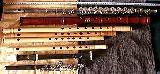
The flute is a musical instrument
Musical instrument

A musical instrument is an object constructed or used for the purpose of making music. In principle, anything that produces sound can serve as a musical instrument....
 of the woodwind family. Unlike other woodwind instruments, a flute is a reedless wind instrument
Reedless wind instrument

Reedless wind instruments are Wind instrument that do not have moving parts in their mouthpieces.Wind instruments are often characterized by their number of Reed , which is typically zero, one, or two....
 that produces its sound from the flow of air against an edge.

A musician
Musician

A musician is a person who plays or writes music. Musicians can be classified by their roles in creating or performing music:* An instrumentalist plays a musical instrument....
 who plays the flute can be referred to as a flute player, a flautist
Flautist

A flautist, flutist, or flute player is a musician who plays the flute....
, or a flutist.

History
Though the flute has been dated to prehistoric times Theobald Boehm
Theobald Boehm

Theobald B?hm was a Bavarian inventor and musician, who perfected the modern Western concert flute and its improved Boehm System. In addition, he was a virtuoso flautist and was a Bavarian Court Musician as well as a celebrated composer for the flute....
 is mainly responsible for making flutes very similar to modern flutes known today.


Discussion
Ask a question about 'Flute'
Start a new discussion about 'Flute'
Answer questions from other users
Full Discussion Forum


Recent Posts


Encyclopedia


The flute is a musical instrument
Musical instrument

A musical instrument is an object constructed or used for the purpose of making music. In principle, anything that produces sound can serve as a musical instrument....
 of the woodwind family. Unlike other woodwind instruments, a flute is a reedless wind instrument
Reedless wind instrument

Reedless wind instruments are Wind instrument that do not have moving parts in their mouthpieces.Wind instruments are often characterized by their number of Reed , which is typically zero, one, or two....
 that produces its sound from the flow of air against an edge.

A musician
Musician

A musician is a person who plays or writes music. Musicians can be classified by their roles in creating or performing music:* An instrumentalist plays a musical instrument....
 who plays the flute can be referred to as a flute player, a flautist
Flautist

A flautist, flutist, or flute player is a musician who plays the flute....
, or a flutist.

History


Though the flute has been dated to prehistoric times Theobald Boehm
Theobald Boehm

Theobald B?hm was a Bavarian inventor and musician, who perfected the modern Western concert flute and its improved Boehm System. In addition, he was a virtuoso flautist and was a Bavarian Court Musician as well as a celebrated composer for the flute....
 is mainly responsible for making flutes very similar to modern flutes known today. It has appeared in different forms and locations around the world. A three-holed flute made from a mammoth
Mammoth

A mammoth is any species of the extinct genus Mammuthus. These proboscideans are members of the Elephantidae and close relatives of modern elephants....
 tusk (from the Geißenklösterle cave in the German Swabian Alb
Swabian Alb

The Swabian Alb is a low mountain range in Baden-W?rttemberg, Germany, extending 220 km from southwest to northeast and 40 to 70 km in width....
 and dated to 30,000 to 37,000 years ago) was discovered in 2004, and two flutes made from swan
Swan

Swans are birds of the family Anatidae, which also includes goose and ducks. Swans are grouped with the closely related geese in the subfamily Anserinae where they form the tribe Cygnini....
s' bones excavated a decade earlier (from the same cave in Germany, dated to circa 36,000 years ago) are among the oldest known musical instruments. A fragment of the femur
Femur

The femur, or thigh bone, is the most proximal bone of the leg in vertebrates capable of walking or jumping, such as most land mammals, birds, many reptiles such as lizards, and amphibians such as frogs....
 of a juvenile cave bear
Cave Bear

The Cave Bear was a species of bear which lived in Europe during the Pleistocene and became extinct at the beginning of the Last Glacial Maximum about 27,500 years ago....
, with two to four holes, found at Divje Babe
Divje Babe

The Divje Babe flute is a cave bear femur pierced by spaced holes that was found at the Divje Babe archaeology park located near Cerkno in northwestern Slovenia....
 in Slovenia
Slovenia

Slovenia , officially the Republic of Slovenia , is a country in southern Central Europe bordering Italy to the west, the Adriatic Sea to the southwest, Croatia to the south and east, Hungary to the northeast, and Austria to the north....
 and dated to about 43,100 years ago, may also be an early flute. The Bible, in Genesis 4:21, cites Jubal as being the "father of all those who play the ugab and the kinnor". The former Hebrew term refers to some wind instrument, or wind instruments in general, the latter to a stringed instrument, or stringed instruments in general. As such, Jubal is traditionally regarded as the inventor of the flute (a word used in some translations of this biblical passage). Some early flutes were made out of tibia
Tibia

The tibia, shinbone, or shankbone is the larger and stronger of the two bones in the leg below the knee in vertebrates and connects the knee with the ankle bones....
s (shin bones). The flute has also always been an essential part of Indian culture and mythology
Indian mythology

Indian mythology may refer to:*Indian epic poetry*Vedic mythology*Hindu mythology*Buddhist mythology*Native American mythology...
, and the cross flute believed by several accounts to originate in India
India

India, officially the Republic of India , is a country in South Asia. It is the List of countries and outlying territories by total area country by geographical area, the List of countries by population country, and the most populous liberal democracy in the world....
 as Indian literature from 1500 BCE has made vague references to the cross flute.

Playable 9000-year-old Gudi
Gudi (instrument)

The Jiahu gudi is the oldest known musical instruments from China dating back to around 6000 B.C.E. Gudi literally means bone flute.History ...
 (literally, "bone flute"), made from the wing bones of red-crowned cranes, with five to eight holes each, were excavated from a tomb in Jiahu
Jiahu

Jiahu was the site of a Neolithic Yellow River settlement based in the central plains of ancient China, modern Wuyang, Henan Province. Archaeologists consider the site to be one of the earliest examples of the Peiligang culture....
 in the Central Chinese province of Henan.

The earliest extant transverse flute is a chi flute discovered in the Tomb of Marquis Yi of Zeng
Tomb of Marquis Yi of Zeng

The Tomb of Marquis Yi of Zeng is an important archaeological site in Suizhou, Hubei, China, dated sometime after 433 BCE. The tomb contained the remains of Marquis Yi of Zeng....
 at the Suizhou
Suizhou

})|-| Area| 9,636 square kilometre|-| Population| 2.58 million|-| GDP'- Total'- Per Capita|  Renminbi22 billion ?...
 site, Hubei
Hubei

is a central province of China of the People's Republic of China. Its abbreviation is ? , an ancient name associated with the eastern part of the province since the Qin Dynasty....
 province, China
China

China is a Culture of China, an ancient civilization, and, depending on perspective, a national or multinational entity extending over a large area in East Asia....
. It dates from 433 BC, of the later Zhou Dynasty
Zhou Dynasty

The Zhou Dynasty was preceded by the Shang Dynasty and followed by the Qin Dynasty in China. The Zhou dynasty lasted longer than any other dynasty in China history?though the actual political and military control of China by the dynasty only lasted during the Western Zhou....
. It is fashioned of lacquered bamboo with closed ends and has five stops that are at the flute's side instead of the top. Chi flutes are mentioned in Shi Jing
Shi Jing

Shi Jing , translated variously as the Classic of Poetry, the Book of Songs or the Book of Odes, is the earliest existing collection of Chinese poetry....
, compiled and edited by Confucius
Confucius

This articles talks about a Chinese thinker and social philosopher. For a food company in China with its brand name "Master Kong", please refer to Tingyi Holding Corporation....
.

Western flutes

The pan flute
Pan flute

The pan flute or pan pipe is an ancient musical instrument based on the principle of the Closed tube, consisting usually of five or more pipes of gradually increasing length ....
 was used in Greece from the 7th century BC, and spread to other parts of Europe. Throughout the 10th, 12th and 13th centuries, transverse flutes were very uncommon in Europe, with the various fipple flutes being more prominent. The tin whistle
Tin whistle

The tin whistle, also called the tinwhistle, whistle, pennywhistle or Irish whistler, is a simple six-holed woodwind instrument....
 (an Irish flute) first appeared in the 12th century, and the recorder
Recorder

The recorder is a woodwind instrument musical instrument of the family known as fipple flutes or internal duct flutes — whistle-like instruments which include the tin whistle and ocarina....
 in the 14th century. The first literary appearance of the transverse flute was made in 1285, but early on the instrument was only used in Germany and France.

Following the 16th-century court music, concert flutes began appearing in chamber ensembles
Chamber music

Chamber music is a form of classical music, written for a small group of instruments which traditionally could be accommodated in a palace chamber....
. These flutes were often tuned to the key of D
D major

D major is a major scale based on D , consisting of the pitches D, E , F? , G , A , B , and C? . Its key signature consists of two sharps. Its relative key is B minor and its parallel key is D minor....
, and used as the tenor
Tenor

The tenor is a type of male voice type and is the highest male voice within the modal register. The typical tenor voice lies between the C one octave below middle C to the A above in choral music, and up to high C in solo work....
 voice. However, these flutes varied greatly in size and range. The recorder continued to be popular during the renaissance, but its use declined in the 18th century. The later half of the 18th century shows the first orchestra
Orchestra

An orchestra is an Musical ensemble, usually fairly large with string, brass, woodwind sections, and possibly a percussion section as well. The term orchestra derives from the name for the area in front of an theatre of ancient Greece reserved for the Greek chorus....
s being formed, and the concert flute being a member thereof, featured in symphonies
Symphony

A symphony is a musical composition, often extended and usually for orchestra. "Symphony" does not imply a specific form. Many symphonies are tonality works in four movement with the first in sonata form, and this is often described by music theorists as the structure of a "Classical period " symphony, although even some symphonies by the ac...
 and concerto
Concerto

The term Concerto usually refers to a three-part musical work in which one solo instrument is accompanied by an orchestra. The concerto, as understood in this modern way, arose in the Baroque period side by side with the concerto grosso, which contrasted a small group of instruments with the rest of the orchestra....
s. Throughout the rest of the 18th century the interest in concert flutes increased, and peaked in the early half of the 1800s. In the 19th century, the ocarina
Ocarina

The ocarina is an ancient flute-like wind instrument. While several variations exist, an ocarina is typified by an oval-shaped enclosed space with four to twelve finger holes and a mouth tube projecting out from the body....
 was developed from the gemshorn
Gemshorn

The gemshorn is an instrument of the ocarina family that was historically made from the horn of the chamois, goat, or other suitable animal. The gemshorn receives its name from the German language, and means a chamois horn....
, an instrument from the 16th century.

The 20th century saw a revival of the recorder, while the concert flute and tin whistle continued to be popular. The invention of plastics in the 20th century gave birth to the tonette
Tonette

The Tonette is a small, end-blown flute made of plastic, which was once popular in American elementary music education. It has largely been superseded by the recorder....
, a fipple flute used in music education, but it soon fell out of use, replaced by plastic recorders.

Flute acoustics

A flute produces sound
Sound

Sound is vibration transmitted through a solid, liquid, or gas, composed of frequencies within the range of hearing and of a threshold of hearing to be heard, or the sensation stimulated in organs of hearing by such vibrations....
 when a stream of air directed across a hole in the instrument creates a vibration of air at the hole.

The air stream across this hole creates a Bernoulli, or siphon, effect leading to a von Karman vortex street
Von Kármán vortex street

A K?rm?n vortex street is a term used in fluid dynamics for a repeating pattern of swirling vortex caused by the unsteady flow separation of a fluid over bluff bodies....
. This excites the air contained in the usually cylindrical resonant cavity within the flute. The player changes the pitch
Pitch (music)

Pitch represents the perceived fundamental frequency of a sound. It is one of the three major auditory system attributes of sounds along with loudness and timbre....
 of the sound produced by opening and closing holes in the body of the instrument, thus changing the effective length of the resonator
Resonator

A resonator is a device or system that exhibits resonance or resonant behavior, that is, it naturally Oscillation at some frequency, called its Resonance frequency, with greater amplitude than at others....
 and its corresponding resonant frequency. By varying the air pressure, a flute player can also change the pitch of a note by causing the air in the flute to resonate at a harmonic
Harmonic

In acoustics and telecommunication, a harmonic of a wave is a component frequency of the Signalling that is an integer multiple of the fundamental frequency....
 other than the fundamental frequency
Fundamental frequency

The fundamental tone, often referred to simply as the fundamental and abbreviated f0 or F0, is the lowest frequency in a harmonic series ....
 without opening or closing any holes.

To be louder, a flute must use a larger resonator, a larger air stream, or increased air stream velocity
Velocity

In physics, velocity is defined as the Derivative of Position vector. It is a vector physical quantity; both speed and direction are required to define it....
. A flute's volume
Volume

The volume of any solid, liquid, plasma, vacuum or theoretical object is how much three-dimensional space it occupies, often quantified numerically....
 can generally be increased by making its resonator and tone holes larger. This is why a police whistle, a form of flute, is very wide for its pitch, and why a pipe organ can be far louder than a concert flute: a large organ pipe
Organ pipe

An organ pipe is a sound-producing element of the pipe organ that resonator at a specific pitch when pressurized air is driven through it. Each pipe is tuned to a specific note of the musical scale....
 can contain several cubic feet of air, and its tone hole may be several inches wide, while a concert flute's air stream measures a fraction of an inch across.

The air stream must be directed at the correct angle and velocity, or else the air in the flute will not vibrate. In fipple
Fipple

Fipple Flute or Tubular Ducted Flute mouthpiece are commonly found on end-blown woodwind instruments such as the tin whistle and the recorder....
d or ducted flutes, a precisely formed and placed windway will compress and channel the air to the labium ramp edge across the open window. In the organ, this air is supplied by a regulated blower.

In non-fipple flutes, the air stream is shaped and directed by the player's lips, called the embouchure
Embouchure

The embouchure is the use of facial muscles and the shaping of the lips to the mouthpiece of a wind instrument.The word is of French language origin and is related to the root bouche , 'mouth'....
. This allows the player a wide range of expression in pitch, volume, and timbre, especially in comparison to fipple/ducted flutes. However, it also makes an end blown flute or transverse flute considerably more difficult for a beginner to produce a full sound than a ducted flute, such as the recorder
Recorder

The recorder is a woodwind instrument musical instrument of the family known as fipple flutes or internal duct flutes — whistle-like instruments which include the tin whistle and ocarina....
. Transverse and end-blown flutes also take more air to play, which requires deeper breathing and makes circular breathing
Circular breathing

Circular breathing is a technique used by players of some wind instruments to produce a continuous tone without interruption. This is accomplished by breathing in through the nose while simultaneously blowing out through the mouth using air stored in the cheeks....
 a considerably trickier proposition.

Generally, the quality called timbre or "tone colour" varies because the flute can produce harmonic
Harmonic

In acoustics and telecommunication, a harmonic of a wave is a component frequency of the Signalling that is an integer multiple of the fundamental frequency....
s in different proportions or intensities. The tone color can be modified by changing the internal shape of the bore, such as the conical taper, or the diameter-to-length ratio. A harmonic is a frequency that is a whole number multiple of a lower register, or "fundamental
Fundamental frequency

The fundamental tone, often referred to simply as the fundamental and abbreviated f0 or F0, is the lowest frequency in a harmonic series ....
" note of the flute. Generally the air stream is thinner (vibrating in more modes), faster (providing more energy to excite the air's resonance), and aimed across the hole less deeply (permitting a more shallow deflection of the air stream) in the production of higher harmonics or upper partials
Harmonic

In acoustics and telecommunication, a harmonic of a wave is a component frequency of the Signalling that is an integer multiple of the fundamental frequency....
.

Head joint geometry appears particularly critical to acoustic performance and tone, but there is no clear consensus on a particular shape amongst manufacturers. Acoustic impedance of the embouchure hole appears the most critical parameter. Critical variables affecting this acoustic impedance include: chimney length (hole between lip-plate and head tube), chimney diameter, and radii or curvature of the ends of the chimney and any designed restriction in the "throat" of the instrument, such as that in the Japanese Nohkan Flute.

A study in which professional players were blindfolded could find no significant differences between instruments made from a variety of different metals. In two different sets of blind listening, no instrument was correctly identified in a first listening, and in a second, only the silver instrument was identified. The study concluded that there was "no evidence that the wall material has any appreciable effect on the sound color or dynamic range of the instrument". Unfortunately, this study did not control for headjoint design, which is generally known to affect tone (see above). Controlled tone tests show that the tube mass does make a difference and therefore tube density and wall thickness will make a difference. One must also consider the inefficiency of the human ear to detect sound, vs electronic sensors.

Categories of flute

In its most basic form, a flute can be an open tube which is blown like a bottle. There are several broad classes of flutes. With most flutes, the musician blows directly across the edge of the mouthpiece. However, some flutes, such as the whistle
Whistle

A whistle or call is a simple aerophone, an musical instrument which produces sound from a stream of forced air. It may be mouth-operated, or powered by air pressure, steam, or other means....
, gemshorn
Gemshorn

The gemshorn is an instrument of the ocarina family that was historically made from the horn of the chamois, goat, or other suitable animal. The gemshorn receives its name from the German language, and means a chamois horn....
, flageolet
Flageolet

A flageolet is a woodwind musical instrument and a member of the fipple family. Its invention is ascribed to the 16th century Seigneur Juvigny in 1581....
, recorder
Recorder

The recorder is a woodwind instrument musical instrument of the family known as fipple flutes or internal duct flutes — whistle-like instruments which include the tin whistle and ocarina....
, tin whistle
Tin whistle

The tin whistle, also called the tinwhistle, whistle, pennywhistle or Irish whistler, is a simple six-holed woodwind instrument....
, tonette
Tonette

The Tonette is a small, end-blown flute made of plastic, which was once popular in American elementary music education. It has largely been superseded by the recorder....
, fujara
Fujara

The fujara is a large folk shepherd's fipple flute of unique design, originating from Slovakia. It is Technically a contrabass version in the Tabor pipe class, seePipe and Tabor or Picco pipe....
, and ocarina
Ocarina

The ocarina is an ancient flute-like wind instrument. While several variations exist, an ocarina is typified by an oval-shaped enclosed space with four to twelve finger holes and a mouth tube projecting out from the body....
 have a duct that directs the air onto the edge (an arrangement that is termed a "fipple
Fipple

Fipple Flute or Tubular Ducted Flute mouthpiece are commonly found on end-blown woodwind instruments such as the tin whistle and the recorder....
"). These are known as fipple flutes. The fipple gives the instrument a distinct timbre which is different from non-fipple flutes and makes the instrument easier to play, but takes a degree of control away from the musician.

Another division is between side-blown (or transverse
Transverse flute

A transverse flute or side-blown flute is a flute which is held horizontally when played. The player blows "across" the embouchure hole, in a direction perpendicular to the flute's body length....
) flutes, such as the Western concert flute, piccolo
Piccolo

The piccolo is a small flute. The piccolo has the same fingerings as its larger component, the flute, but the sound it produces is an octave higher than written....
, fife
Fife (musical instrument)

A fife is a small, high-pitched, transverse flute that is similar to the piccolo, but louder and shriller due to its narrower bore. The fife originated in medieval Europe and is often used in Military band and marching bands....
, dizi
Dizi

The dizi , is a China transverse flute. It is also sometimes known as the di or hengdi , and has varieties including the qudi and bangdi ....
, and bansuri
Bansuri

The bansuri ; is a transverse alto flute of India, Pakistan, Bangladesh and Nepal, made of a single length of bamboo with six or seven open finger holes....
; and end-blown flute
End-blown flute

The end-blown flute or rim-blown flute is a keyless woodwind instrument played by directing an airstream against the sharp edge of the upper end of a tube....
s
, such as the ney
Ney

The ney is an end-blown flute that figures prominently in Persian music, Turkish music and Arabic music. In some of these musical traditions, it is the only wind instrument used....
, xiao
Xiao (flute)

The xiao is a Chinese vertical end-blown flute. It is generally made of dark brown bamboo . It is also sometimes called d?ngxiao , d?ng meaning "hole." An ancient name for the xiao is sh?d? but the name xiao in ancient times also included the side-blown bamboo flute, dizi....
, kaval
Kaval

"Kaval" is also the ring name of professional wrestler Brandon Silvestry.The kaval is a chromatic end-blown flute traditionally played throughout Azerbaijan, Turkey, Bulgaria, Republic of Macedonia, Kosovo, southern Serbia , northern Greece , southern Romania , and Armenia ....
, danso
Danso

The danso is a Korean notched, end-blown flute vertical bamboo flute flute used in Korean folk music. It is traditionally made of bamboo, but in the 20th century it has also been made of plastic....
, shakuhachi
Shakuhachi

The is a Japanese end-blown flute flute. Its name means "1.8 feet", referring to its size. It is traditionally made of bamboo, but versions now exist in wood and plastic....
, Anasazi flute
Anasazi flute

The Anasazi flute is the name of a pre-historic end-blown flute revived and replicated today from findings at a massive cave in Prayer Rock Valley in Arizona, USA by an archaeological expedition led by DeArmond D, Lopez in 1931....
, and quena
Quena

The quena is the traditional flute of the Andes. Usually made of bamboo, it has 6 finger holes and one thumb hole and is open on both ends. To produce sound, the player closes the top end of the pipe with the flesh between his chin and lower lip, and blows a stream of air downward, along the axis of the pipe, over an elliptical notch cut i...
. The player of a side-blown flute uses a hole on the side of the tube to produce a tone, instead of blowing on an end of the tube. End-blown flutes should not be confused with fipple flutes such as the recorder
Recorder

The recorder is a woodwind instrument musical instrument of the family known as fipple flutes or internal duct flutes — whistle-like instruments which include the tin whistle and ocarina....
, which are also played vertically
Vertical flute

The vertical flute is either a End-blown flute flute, a Recorder, with tapered bore or a transversely blown flute,Giorgi Flute, designed to be played in an upright position....
 but have an internal duct to direct the air flow across the edge of the tone hole.

Flutes may be open at one or both ends. The ocarina
Ocarina

The ocarina is an ancient flute-like wind instrument. While several variations exist, an ocarina is typified by an oval-shaped enclosed space with four to twelve finger holes and a mouth tube projecting out from the body....
, pan pipes, police whistle, and bosun's whistle are closed-ended. Open-ended flutes such as the concert flute and the recorder have more harmonics, and thus more flexibility for the player, and brighter timbres. An organ pipe may be either open or closed, depending on the sound desired.

Flutes can be played with several different air sources. Conventional flutes are blown with the mouth, although some cultures use nose flute
Nose flute

The nose flute is a popular musical instrument played in Polynesia and the Pacific Rim countries. Other versions are found in Africa, China and India....
s. The Flue pipe
Flue pipe

A flue pipe is an organ pipe that produces sound through the vibration of air molecules, in the same manner as a recorder or a whistle. Air under pressure is driven down a Flue and against a sharp lip called a Labium, which causes the column of air in the pipe to resonate at a frequency determined by the pipe length....
s of Organs
Pipe organ

The pipe organ is a keyboard musical instrument that produces sound by venting mechanically compressed air through resonant Organ pipe. Each pipe produces sound at one fixed pitch, so they are provided in sets or "ranks" with one pipe or more per note, each rank having a common timbre and loudness throughout....
, which are acoustically similar to duct flutes, are blown by bellows or fans.

The Western concert flutes


The Western concert flute
Western concert flute

The Western concert flute or C flute is a transverse woodwind instrument made of metal or wood. It is the most common variant of the flute....
, a descendant of the 19th-century German flute, is a transverse flute which is closed at the top. Near the top is the embouchure
Embouchure

The embouchure is the use of facial muscles and the shaping of the lips to the mouthpiece of a wind instrument.The word is of French language origin and is related to the root bouche , 'mouth'....
 hole
, across and into which the player blows. It has larger circular finger-holes than its baroque predecessors, designed to increase the instrument's dynamic range. Various combinations can be opened or closed by means of keys, to produce the different notes in its playing range. There are a total of 25 working keys on a western concert flute. The note produced depends on which finger-holes are opened or closed and on how the flute is blown. There are two kinds of foot joints available for the concert flute: the standard C foot (shown above) or the longer B foot with an extra key extending the flute's range to B below middle C. There can also be a Bb below middle c foot joint added to the instrument. With the rare exception of the Kingma system, or custom-devised fingering systems, modern Western concert flutes conform to the Boehm system
Boehm System

The Boehm system is a system of keywork for the flute, created by inventor and flautist Theobald Boehm between 1831 and 1847.Prior to this time, flutes were most commonly made of wood, with an inverse conical bore , eight keys, and tone holes which were small in size, and thus easily covered by the fingertips....
.

The standard concert flute is pitched in the key of C and has a range of three octave
Octave

In music, an octave The octave is occasionally referred to as a diapason.The octave above an indicated note is sometimes abbreviated 8va, and the octave below 8vb....
s starting from middle C
Middle C

C or Do is the first note of the fixed-Do solf?ge.In Western music, the expression "Middle C" refers to the musical note "C" located exactly between the two staff of the grand staff and near the top and bottom, respectively, of the bass voice and soprano voices....
 (or one half-step lower with a B foot). This means that the concert flute is one of the highest common orchestral instruments, with the exception of the piccolo
Piccolo

The piccolo is a small flute. The piccolo has the same fingerings as its larger component, the flute, but the sound it produces is an octave higher than written....
, which plays an octave higher. G alto and C bass flutes, pitched, respectively, a perfect fourth and an octave below the concert flute, are used occasionally. Parts are written for alto flute more frequently than for bass. The contrabass
Contrabass flute

File:Kotatocontra jpg.jpgThe contrabass flute is one of the rarer members of the flute family. It is used mostly in flute musical ensemble. Its range is similar to that of the regular concert flute, except that it is pitched two octaves lower; the lowest performable note is two octaves below middle C ....
, double contrabass
Double contrabass flute

File:Maria doublecontra jpg.jpgThe double contrabass flute is the largest and lowest pitched metal flute in the world. It is pitched in the key of C, three octaves below the concert flute ....
, and hyperbass
Hyperbass flute

The hyperbass flute is the largest and lowest pitched instrument in the flute family, with tubing reaching over 8 metres in length. It is pitched in C, four octaves below the concert flute , with its lowest note being C0, one octave below the lowest C on the a standard piano....
 are other rare forms of the flute pitched two, three, and four octaves below middle C respectively.

Other sizes of flutes and piccolos are used from time to time. A rarer instrument of the modern pitching system is the treble G flute. Instruments made according to an older pitch standard, used principally in wind-band music, include Db piccolo, Eb soprano flute (the primary instrument, equivalent to today's concert C flute), F alto flute, and Bb bass flute.

The Indian Bamboo Flute

The bamboo flute is an important instrument in Indian classical music
Indian classical music

The origins of Indian classical music can be found from the oldest of scriptures, part of the Hindu tradition, the Vedas.The Samaveda, one of the four Vedas, describes music at length....
, and developed independently of the Western flute. The Hindu god Krishna
Krishna

Krishna is a deity worshiped across many traditions in Hinduism in a variety of different perspectives. While many Vaishnava groups recognize him as an avatar of Vishnu, other traditions within Krishnaism consider Krishna to be svayam bhagavan, or the supreme being....
 is traditionally considered a master of the Bansuri
Bansuri

The bansuri ; is a transverse alto flute of India, Pakistan, Bangladesh and Nepal, made of a single length of bamboo with six or seven open finger holes....
 (see below). The Indian flutes are very simple compared to the Western counterparts; they are made of bamboo
Bamboo

The bamboos are a group of woody perennial plant evergreen plants in the true grass family Poaceae, subfamily Bambusoideae, tribe Bambuseae....
 and are keyless.

Pannalal Ghosh
Pannalal Ghosh

Pannalal Ghosh , also known as Amal Jyoti Ghosh, was a Bengali people Indian flute player and composer....
, a legendary Indian flutist, was the first to transform a tiny folk instrument to a bamboo flute (32 inches long with seven finger holes) suitable for playing traditional Indian classical music, and also to bring to it the stature of other classical music instruments. The extra hole permitted madhyam to be played, which facilitates the meends (like M N, P M and M D) in several traditional raga
Raga

Raga refers to musical mode used in Indian classical music. It is a series of five or more musical notes upon which a melody is made. In the Indian musical tradition, ragas are associated with different times of the day, or with seasons....
s.

Indian concert flutes are available in standard pitches. In Carnatic Music, the pitches are referred by numbers such as (assuming C as the tonic) 1 (for C), 1-1/2 (C#), 2 (D), 2-1/2 (D#), 3 (E), 4 (F), 4-1/2 (F#), 5 (G), 5-1/2 (G#), 6 (A), 6-1/2 (A#) and 7 (B). However, the pitch of a composition is itself not fixed and hence any of the flutes may be used for the concert (as long as the accompanying instruments, if any, are tuned appropriately) and is largely left to the personal preference of the artist.

Two main varieties of Indian flutes are currently used. The first, the Bansuri
Bansuri

The bansuri ; is a transverse alto flute of India, Pakistan, Bangladesh and Nepal, made of a single length of bamboo with six or seven open finger holes....
, has six finger holes and one embouchure hole, and is used predominantly in the Hindustani music of Northern India. The second, the Venu
Venu

The venu is a bamboo transverse flute used in the Carnatic music of South India. Although it is often called Carnatic flute or simply flute in English language, venu is the instrument's ancient Sanskrit name....
 or Pullanguzhal, has eight finger holes, and is played predominantly in the Carnatic music
Carnatic music

Carnatic music is a system of music commonly associated with the southern part of the Indian subcontinent, with its area roughly confined to four modern states of India: Andhra Pradesh, Karnataka, Kerala, and Tamil Nadu....
 of Southern India. Presently, the 8-holed flute with cross-fingering technique is common among many Carnatic flutists. This technique was introduced by T. R. Mahalingam in the mid-20th century. Prior to this, the South Indian flute had only seven finger holes, with the fingering standard developed by Sharaba Shastri, of the Palladam school, at the beginning of the 20th century. In 1998, based on his research on Bharata Natya Shastra's
Natya Shastra

The Natya Shastra is an ancient Indian treatise on the performing arts, encompassing Indian theatre, Indian classical dance and Indian classical music....
 Sarana Chatushtai
Sarana Chatushtai

The Sarana Chatushtai is the only experiment according to Bharata Muni to obtain the correct physical configuration of Sruti swara arrangement to Shadja Grama Notes on a musical instrument ....
, Avinash Balkrishna Patwardhan
Avinash Balkrishna Patwardhan

Avinash Balkrishna Patwardhan born 30 August 1953 in Nagpur, Maharshatra is a civil engineer and a law graduate who has profound knowledge and interest in Indian classical music....
 developed a methodology to produce perfectly tuned flutes for the ten thatas currently present in Indian classical music.

The quality of the flute's sound depends somewhat on the specific bamboo
Bamboo

The bamboos are a group of woody perennial plant evergreen plants in the true grass family Poaceae, subfamily Bambusoideae, tribe Bambuseae....
 used to make it, and it is generally agreed that the best bamboo grows in the Nagarcoil area in South India.

Japanese Flute

The Japanese flute, called the Fue
Fue

Fue may refer to:*The French University in Egypt*In Polynesian mythology , Fue is the god of the sweet potato and a son of Tagaloa....
, encompasses a large number of musical flutes from Japan.

Sring

The sring
Sring

The sring is a shepherd's flute originating in Eastern Armenia . Sring is also the common term for end-blown flutes in general. These flutes are made either of a stroke bone, bamboo, wood from the apricot tree or cane and have seven or eight finger holes, producing a diatonic scale ....
 (also called blul) is a relatively small, end-blown flute with a nasal tone quality and the pitch of a piccolo, found in the Caucasus region of Eastern Armenia. It is made of wood or cane, usually with seven finger holes and one thumb hole, producing a diatonic scale. The sring is used by shepherds to play various signals and tunes connected with their work, and also lyrical love songs called chaban bayaty, as well as programmatic pieces. The sring is also used in combination with the def
DAF

DAF may refer to:* Daf, a percussive instrument* D.A.F. , a song by Powderfinger* DAF Bus, a Netherlands-based bus builder now known as VDL Bus International...
 and the dohl to provide music for dancing. One Armenian musicologist believes the sring to be the most characteristic of national Armenian instruments.

See also


Flutes

  • Diple
    Diple

    Diple, dvojnice, or dvojanke are a traditional woodwind musical instrument in Music of Serbia and Music of Croatia.The flute...
  • Duduk
    Duduk

    The duduk is a traditional woodwind instrument of Armenian origins, used famously in the 2000 movie Gladiator . This English word is often used generically for a family of ethnic instruments including the doudouk or duduk ...
  • Irish flute
    Irish flute

    The Irish flute is a name for a wooden flute used in the playing of Folk music of Ireland. These simple system flutes play a diatonic scale by successively uncovering the toneholes and are often made chromatic scale by the addition of metal keys....
  • Palendag
    Palendag

    The palendag, also called Pulalu , Palandag , Pulala and Lumundeg is a type of Philippine bamboo flute, the largest one used by the Maguindanaon, a smaller type of this instrument is called the Hulakteb .....
  • Pipe and tabor
    Pipe and Tabor

    Pipe and Tabor is a pair of instruments, popular since Medi?val times and played by a single player, consisting of a specially designed fipple flute, the three-hole pipe, played with one hand, and a portable drum played with the other....
  • Tin whistle
    Tin whistle

    The tin whistle, also called the tinwhistle, whistle, pennywhistle or Irish whistler, is a simple six-holed woodwind instrument....
  • Tumpong
    Tumpong

    Also Inci - MaranaoThe tumpong is a type of Philippine bamboo flute used by the Maguindanaon, half the size of the largest bamboo flute, the palendag....
  • Washint
    Washint

    A washint is an Ethiopian end-blown flute with four finger holes. The instrument is made of wood or cane. It is similar to the foodhir and the Arabic/Turkish ney....


Other

  • Fleadh Cheoil
    Fleadh Cheoil

    The Fleadh Cheoil is an Music of Ireland competition run by Comhaltas Ceolt?ir? ?ireann .There are various stages to the competition. In Ireland there are county and provincial competitions leading to the All-Ireland Fleadh....
     (Irish competition)
  • Trill
    Trill (music)

    The trill is a ornament consisting of a rapid alternation between two adjacent notes of a scale . It is sometimes referred to by the German triller or the Italian trillo....


Bibliography

  • Boehm, Theobald
    Theobald Boehm

    Theobald B?hm was a Bavarian inventor and musician, who perfected the modern Western concert flute and its improved Boehm System. In addition, he was a virtuoso flautist and was a Bavarian Court Musician as well as a celebrated composer for the flute....
    . 1964. The Flute and Flute-Playing in Acoustical, Technical, and Artistic Aspects, translated by Dayton C. Miller, with a new introduction by Samuel Baron. New York: Dover Publications. ISBN 0-486-21259-9
  • Buchanan, Donna A. 2001. “Bulgaria §II: Traditional Music, 2: Characteristics of Pre-Socialist Musical Culture, 1800–1944, (iii): Instruments”. The New Grove Dictionary of Music and Musicians, ed. S. Sadie and J. Tyrrell. London: Macmillan.
  • Crane, Frederick. 1972. Extant Medieval Musical Instruments: A Provisional Catalogue by Types. Iowa City: University of Iowa Press. ISBN 0-87745-022-6
  • Galway, James. 1982. Flute. Yehudi Menuhin Music Guides. London: Macdonald. ISBN 0356047113 (cloth); ISBN 0356047121 (pbk.) New York: Schirmer Books. ISBN 002871380X Reprinted 1990, London: Kahn & Averill London: Khan & Averill ISBN 1871082137
  • Komitas, Vardapet. 1994. Grakan nshkhark' Komitas Vardapeti beghun grch'en: npast me Komitas Vardapeti srbadasman harts'in, edited by Abel Oghlukian. Montreal: Ganatahayots' A?ajnordarani "K'ristoneakan Usman ew Astuatsabanut'ean Kedron".
  • Pahlevanian, Alina. 2001. “Armenia §I: Folk Music, 3: Epics”. The New Grove Dictionary of Music and Musicians, ed. S. Sadie and J. Tyrrell. London: Macmillan.
  • Phelan, James
    James Phelan

    There are several prominent people named James Phelan:*James Phelan , American college football coach*James Phelan , American literary critic...
    , The Complete Guide to the Flute and Piccolo (Burkart-Phelan, Inc., 2004)
  • Putnik, Edwin. 1970. The Art of Flute Playing. Evanston, Illinois: Summy-Birchard Inc. Revised edition 1973, Princeton, New Jersey and Evanston, Illinois. ISBN 0874870771
  • Toff, Nancy. 1985. The Flute Book: A Complete Guide for Students and Performers. New York: Charles's Scribners Sons. ISBN 0684182416 Newton Abbot: David & Charles. ISBN 0715387715 Second Edition 1996, New York: Oxford University Press. ISBN 0195105028
  • Wye, Trevor. 1988. Proper Flute Playing: A Companion to the Practice Books. London: Novello. ISBN 0711984654


External links

  • Contains fingering charts, performance articles, free sheet music and other musical information.
  • Chiff & Fipple: Very large website devoted to tin whistles
  • Chiffboard: Large and busy forums on flutes, tin whistles and related folk instruments
  • This video shows how a flute is manufactured.
  • has many pictures of flutes through the ages, among other useful information.
  • Wide range of flute related information contributed by many professional flute players. Access to information about flute - email discussion group.
  • Flute related content in Spanish.
  • Extensive list of articles on hard-to-find flute topics.
  • - A large, easy-to-navigate listing of flute fingerings
  • An easy to search database of Boehm flute alternate fingering and multiphonic fingering - An extensive work by the School of Physics, University of New South Wales, Sydney Australia
  • .