

Phenotype

Encyclopedia
Organism
In biology, an organism is any contiguous living system . In at least some form, all organisms are capable of response to stimuli, reproduction, growth and development, and maintenance of homoeostasis as a stable whole.An organism may either be unicellular or, as in the case of humans, comprise...
's observable characteristics or traits
Trait (biology)
A trait is a distinct variant of a phenotypic character of an organism that may be inherited, environmentally determined or be a combination of the two...
: such as its morphology
Morphology (biology)
In biology, morphology is a branch of bioscience dealing with the study of the form and structure of organisms and their specific structural features....
, development
Developmental biology
Developmental biology is the study of the process by which organisms grow and develop. Modern developmental biology studies the genetic control of cell growth, differentiation and "morphogenesis", which is the process that gives rise to tissues, organs and anatomy.- Related fields of study...
, biochemical or physiological properties, behavior
Behavior
Behavior or behaviour refers to the actions and mannerisms made by organisms, systems, or artificial entities in conjunction with its environment, which includes the other systems or organisms around as well as the physical environment...
, and products of behavior (such as a bird's nest). Phenotypes result from the expression of an organism's genes as well as the influence of environmental factors and the interactions between the two.
The genotype
Genotype
The genotype is the genetic makeup of a cell, an organism, or an individual usually with reference to a specific character under consideration...
of an organism is the inherited instructions it carries within its genetic code. Not all organisms with the same genotype look or act the same way because appearance and behavior are modified by environmental and developmental conditions. Similarly, not all organisms that look alike necessarily have the same genotype.
This genotype-phenotype distinction
Genotype-phenotype distinction
The genotype–phenotype distinction is drawn in genetics. "Genotype" is an organism's full hereditary information, even if not expressed. "Phenotype" is an organism's actual observed properties, such as morphology, development, or behavior...
was proposed by Wilhelm Johannsen
Wilhelm Johannsen
Wilhelm Johannsen was a Danish botanist, plant physiologist and geneticist. He was born in Copenhagen. While very young, he was apprenticed to a pharmacist and worked in Denmark and Germany beginning in 1872 until passing his pharmacist's exam in 1879...
in 1911 to make clear the difference between an organism's heredity
Heredity
Heredity is the passing of traits to offspring . This is the process by which an offspring cell or organism acquires or becomes predisposed to the characteristics of its parent cell or organism. Through heredity, variations exhibited by individuals can accumulate and cause some species to evolve...
and what that heredity produces. The distinction is similar to that proposed by August Weismann
August Weismann
Friedrich Leopold August Weismann was a German evolutionary biologist. Ernst Mayr ranked him the second most notable evolutionary theorist of the 19th century, after Charles Darwin...
, who distinguished between germ plasm
Germ plasm
Germ plasm or polar plasm is a zone found in the cytoplasm of the egg cells of some model organisms , which contains determinants that will give rise to the germ cell lineage. As the zygote undergoes mitotic divisions the germ plasm is ultimately restricted to a few cells of the embryo...
(heredity) and somatic cells (the body). The Genotype-Phenotype concept should not be confused with Francis Crick
Francis Crick
Francis Harry Compton Crick OM FRS was an English molecular biologist, biophysicist, and neuroscientist, and most noted for being one of two co-discoverers of the structure of the DNA molecule in 1953, together with James D. Watson...
's central dogma of molecular biology
Central dogma of molecular biology
The central dogma of molecular biology was first articulated by Francis Crick in 1958 and re-stated in a Nature paper published in 1970:In other words, the process of producing proteins is irreversible: a protein cannot be used to create DNA....
which is a statement about the directionality of molecular sequential information flowing from DNA to protein (but which cannot become transferred from proteins).
Difficulties in definition
Despite its seemingly straightforward definition, the concept of the phenotype has hidden subtleties. It may seem that anything dependent on the genotypeGenotype
The genotype is the genetic makeup of a cell, an organism, or an individual usually with reference to a specific character under consideration...
is a phenotype, including molecules such as RNA and proteins. Most molecules and structures coded by the genetic material are not visible in the appearance of an organism, yet they are observable (for example by Western blot
Western blot
The western blot is a widely used analytical technique used to detect specific proteins in the given sample of tissue homogenate or extract. It uses gel electrophoresis to separate native proteins by 3-D structure or denatured proteins by the length of the polypeptide...
ting) and are thus part of the phenotype. Human blood groups
Human blood group systems
The International Society of Blood Transfusion currently recognises 30 major blood group systems . Thus, in addition to the ABO antigens and Rhesus antigens, many other antigens are expressed on the red blood cell surface membrane...
are an example. It may also seem that this goes beyond the original intentions of the concept with its focus on the (living) organism in itself, meaning that the lowest level of biological organization compatible with the phenotype concept is at the cellular level. Either way, the term phenotype includes traits or characteristics that can be made visible by some technical procedure. Another extension adds behavior to the phenotype, since behaviors are also observable characteristics. Indeed there is research into the clinical relevance of behavioral phenotypes as they pertain to a range of syndromes. Often, the term "phenotype" is incorrectly used as a shorthand to indicate phenotypical changes observed in mutated organisms (most often in connection with knockout mice
Knockout mouse
A knockout mouse is a genetically engineered mouse in which researchers have inactivated, or "knocked out," an existing gene by replacing it or disrupting it with an artificial piece of DNA...
).
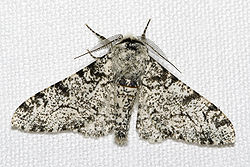
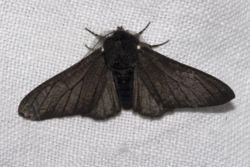
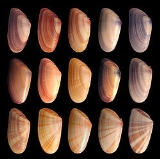
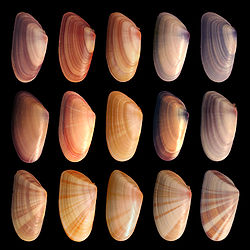
Phenotypic variation
Phenotypic variation (due to underlying heritable genetic variationGenetic diversity
Genetic diversity, the level of biodiversity, refers to the total number of genetic characteristics in the genetic makeup of a species. It is distinguished from genetic variability, which describes the tendency of genetic characteristics to vary....
) is a fundamental prerequisite for evolution
Evolution
Evolution is any change across successive generations in the heritable characteristics of biological populations. Evolutionary processes give rise to diversity at every level of biological organisation, including species, individual organisms and molecules such as DNA and proteins.Life on Earth...
by natural selection
Natural selection
Natural selection is the nonrandom process by which biologic traits become either more or less common in a population as a function of differential reproduction of their bearers. It is a key mechanism of evolution....
. It is the living organism as a whole that contributes (or not) to the next generation, so natural selection affects the genetic structure of a population indirectly via the contribution of phenotypes. Without phenotypic variation, there would be no evolution by natural selection.
The interaction between genotype and phenotype has often been conceptualized by the following relationship:
- genotype (G) + environment (E) → phenotype (P)
A more nuanced version of the relationship is:
- genotype (G) + environment (E) + genotype & environment interactions (GE) → phenotype (P)
Genotypes often have much flexibility in the modification and expression of phenotypes; in many organisms these phenotypes are very different under varying environmental conditions (see ecophenotypic variation
Ecophenotypic variation
Ecophenotypic variation refers to phenotypical variation as a function of life station. In wide-ranging species, the contributions of heredity and environment are not always certain, but their interplay can sometimes be determined by experiment.-Plants:Plants display the most obvious examples of...
). The plant Hieracium umbellatum is found growing in two different habitat
Habitat
* Habitat , a place where a species lives and grows*Human habitat, a place where humans live, work or play** Space habitat, a space station intended as a permanent settlement...
s in Sweden
Sweden
Sweden , officially the Kingdom of Sweden , is a Nordic country on the Scandinavian Peninsula in Northern Europe. Sweden borders with Norway and Finland and is connected to Denmark by a bridge-tunnel across the Öresund....
. One habitat is rocky, sea-side cliff
Cliff
In geography and geology, a cliff is a significant vertical, or near vertical, rock exposure. Cliffs are formed as erosion landforms due to the processes of erosion and weathering that produce them. Cliffs are common on coasts, in mountainous areas, escarpments and along rivers. Cliffs are usually...
s, where the plants are bushy with broad leaves and expanded inflorescence
Inflorescence
An inflorescence is a group or cluster of flowers arranged on a stem that is composed of a main branch or a complicated arrangement of branches. Strictly, it is the part of the shoot of seed plants where flowers are formed and which is accordingly modified...
s; the other is among sand dunes
Dune
In physical geography, a dune is a hill of sand built by wind. Dunes occur in different forms and sizes, formed by interaction with the wind. Most kinds of dunes are longer on the windward side where the sand is pushed up the dune and have a shorter "slip face" in the lee of the wind...
where the plants grow prostrate with narrow leaves and compact inflorescences. These habitats alternate along the coast of Sweden and the habitat that the seeds of Hieracium umbellatum land in, determine the phenotype that grows.
An example of random variation in Drosophila
Drosophila
Drosophila is a genus of small flies, belonging to the family Drosophilidae, whose members are often called "fruit flies" or more appropriately pomace flies, vinegar flies, or wine flies, a reference to the characteristic of many species to linger around overripe or rotting fruit...
flies is the number of ommatidia, which may vary (randomly) between left and right eyes in a single individual as much as they do between different genotypes overall, or between clones
Cloning
Cloning in biology is the process of producing similar populations of genetically identical individuals that occurs in nature when organisms such as bacteria, insects or plants reproduce asexually. Cloning in biotechnology refers to processes used to create copies of DNA fragments , cells , or...
raised in different environments.
The concept of phenotype can be extended to variations below the level of the gene that affect an organism's fitness. For example, silent mutations that do not change the corresponding amino acid sequence of a gene may change the frequency of guanine
Guanine
Guanine is one of the four main nucleobases found in the nucleic acids DNA and RNA, the others being adenine, cytosine, and thymine . In DNA, guanine is paired with cytosine. With the formula C5H5N5O, guanine is a derivative of purine, consisting of a fused pyrimidine-imidazole ring system with...
-cytosine
Cytosine
Cytosine is one of the four main bases found in DNA and RNA, along with adenine, guanine, and thymine . It is a pyrimidine derivative, with a heterocyclic aromatic ring and two substituents attached . The nucleoside of cytosine is cytidine...
base pairs (GC content). These base pairs have a higher thermal stability (melting point, see also DNA-DNA hybridization) than adenine
Adenine
Adenine is a nucleobase with a variety of roles in biochemistry including cellular respiration, in the form of both the energy-rich adenosine triphosphate and the cofactors nicotinamide adenine dinucleotide and flavin adenine dinucleotide , and protein synthesis, as a chemical component of DNA...
-thymine
Thymine
Thymine is one of the four nucleobases in the nucleic acid of DNA that are represented by the letters G–C–A–T. The others are adenine, guanine, and cytosine. Thymine is also known as 5-methyluracil, a pyrimidine nucleobase. As the name suggests, thymine may be derived by methylation of uracil at...
, a property that might convey, among organisms living in high-temperature environments, a selective advantage on variants enriched in GC content.
The Extended Phenotype
The idea of the phenotype has been generalized by Richard DawkinsRichard Dawkins
Clinton Richard Dawkins, FRS, FRSL , known as Richard Dawkins, is a British ethologist, evolutionary biologist and author...
in The Extended Phenotype
The Extended Phenotype
The Extended Phenotype is a biological concept introduced by Richard Dawkins in a 1982 book with the same title. The main idea is that phenotype should not be limited to biological processes such as protein biosynthesis or tissue growth, but extended to include all effects that a gene has on its...
to mean all the effects a gene has on the outside world that may influence its chances of being replicated. These can be effects on the organism in which the gene resides, the environment, or other organisms.
For instance, a beaver dam might be considered a phenotype of beaver
Beaver
The beaver is a primarily nocturnal, large, semi-aquatic rodent. Castor includes two extant species, North American Beaver and Eurasian Beaver . Beavers are known for building dams, canals, and lodges . They are the second-largest rodent in the world...
gene
Gene
A gene is a molecular unit of heredity of a living organism. It is a name given to some stretches of DNA and RNA that code for a type of protein or for an RNA chain that has a function in the organism. Living beings depend on genes, as they specify all proteins and functional RNA chains...
s, the same way beavers' powerful incisor
Incisor
Incisors are the first kind of tooth in heterodont mammals. They are located in the premaxilla above and mandible below.-Function:...
teeth are phenotype expressions of their genes. Dawkins also cites the effect of an organism on the behaviour of another organism (such as the devoted nurturing of a cuckoo by a parent clearly of a different species) as an example of the extended phenotype.
The smallest unit of replicators is the gene. Replicators cannot be directly selected upon, but they are selected on by their phenotypic effects. These effects are packaged together in organisms. We should think of the replicator as having extended phenotypic effects. These are all of the ways it affects the world, not just the effects the replicators have on the body in which they reside.
Phenome and phenomics
Although a phenotype is the ensemble of observable characteristics displayed by an organism, the word phenome is sometimes used to refer to a collection of traits and their simultaneous study is referred to as as phenomicsPhenomics
Phenomics is an area of biology concerned with the measurement of phenomes — the physical and biochemical traits of organisms — as they change in response to genetic mutation and environmental influences...
.