
Kairouan also known as
Kirwan or
al-Qayrawan (from the
PersianPersian is an Iranian language within the Indo-Iranian branch of the Indo-European languages. It is primarily spoken in Iran, Afghanistan, Tajikistan and countries which historically came under Persian influence...
word کاروان
karvān), is the capital of the
Kairouan GovernorateKairouan Governorate is one of the twenty-four governorates of Tunisia. It is an inland province, situated in the centre of the country. It covers an area of 6,712 km² and has a population of 546,209...
in
TunisiaTunisia , officially the Tunisian RepublicThe long name of Tunisia in other languages used in the country is: , is the northernmost country in Africa. It is a Maghreb country and is bordered by Algeria to the west, Libya to the southeast, and the Mediterranean Sea to the north and east. Its area...
. Referred to as the Islamic Cultural Capital, it is a
UNESCOThe United Nations Educational, Scientific and Cultural Organization is a specialized agency of the United Nations...
World Heritage siteA UNESCO World Heritage Site is a place that is listed by the UNESCO as of special cultural or physical significance...
. The city was founded by the Arabs around 670. In the period of
CaliphThe term caliphate, "dominion of a caliph " , refers to the first system of government established in Islam and represented the political unity of the Muslim Ummah...
Mu'awiya (reigned 661-680), it became an important centre for Islamic and
QuranicThe Quran , also transliterated Qur'an, Koran, Alcoran, Qur’ān, Coran, Kuran, and al-Qur’ān, is the central religious text of Islam, which Muslims consider the verbatim word of God . It is regarded widely as the finest piece of literature in the Arabic language...
learning, and thus attracting a large number of Muslims from various parts of the world, next only to
MeccaMecca is a city in the Hijaz and the capital of Makkah province in Saudi Arabia. The city is located inland from Jeddah in a narrow valley at a height of above sea level...
and
MedinaMedina , or ; also transliterated as Madinah, or madinat al-nabi "the city of the prophet") is a city in the Hejaz region of western Saudi Arabia, and serves as the capital of the Al Madinah Province. It is the second holiest city in Islam, and the burial place of the Islamic Prophet Muhammad, and...
. The holy Mosque of Uqba is situated in the city. It is considered by many Muslims to be
IslamIslam . The most common are and . : Arabic pronunciation varies regionally. The first vowel ranges from ~~. The second vowel ranges from ~~~...
's fourth holiest city.
In 2003, the city had about 150,000 inhabitants.
Etymology
The original name was derived from Arabic
kairuwân, from
PersianPersian is an Iranian language within the Indo-Iranian branch of the Indo-European languages. It is primarily spoken in Iran, Afghanistan, Tajikistan and countries which historically came under Persian influence...
Kâravân, meaning "military/civilian camp" (from Kâr, "war/military," and van/wan, "outpost"), "caravan", or "resting place" (see
caravanseraiA caravanserai, or khan, also known as caravansary, caravansera, or caravansara in English was a roadside inn where travelers could rest and recover from the day's journey...
).
Geography
Kairouan is the capital of
Kairouan GovernorateKairouan Governorate is one of the twenty-four governorates of Tunisia. It is an inland province, situated in the centre of the country. It covers an area of 6,712 km² and has a population of 546,209...
, and is located south of Sousse, 50 km (31 mi) from the east coast, 75 km (47 mi) from Monastir and 184 km (114 mi) from Tunis.
History
Kairouan was founded in about the year 670 when the
ArabArab people, also known as Arabs , are a panethnicity primarily living in the Arab world, which is located in Western Asia and North Africa. They are identified as such on one or more of genealogical, linguistic, or cultural grounds, with tribal affiliations, and intra-tribal relationships playing...
general
Uqba ibn NafiUqba ibn Nafi was an Arab hero and general who was serving the Umayyad dynasty, in Amir Muavia and Yazid periods, who began the Islamic conquest of the Maghreb, including present-day Algeria, Tunisia, Libya and Morocco in North Africa. He was the nephew of 'Amr ibn al-'As. Uqba is often surnamed...
of Amir Muauia selected a site in the middle of a dense forest, then infested with wild beasts and reptiles, as the location of a
military postA military base is a facility directly owned and operated by or for the military or one of its branches that shelters military equipment and personnel, and facilitates training and operations. In general, a military base provides accommodations for one or more units, but it may also be used as a...
for the conquest of the West. It was located far from the sea where it was safe from continued attacks of the
BerberBerbers are the indigenous peoples of North Africa west of the Nile Valley. They are continuously distributed from the Atlantic to the Siwa oasis, in Egypt, and from the Mediterranean to the Niger River. Historically they spoke the Berber language or varieties of it, which together form a branch...
s who had fiercely resisted the Arab invasion. Berber resistance continued, led first by
KusailaKusaila or Kasila or Kusayla was a 7th century chief of the Awraba tribe of the Berber people and head of the Sanhadja confederation...
whose troops killed Uqba at
BiskraBiskra is the capital city of Biskra province, Algeria. In 2007, its population was recorded as 207,987.During Roman times the town was called Vescera, though this may have been simply a Latin transliteration of the native name. Around 200 AD under Septimius Severus' reign, it was seized by the...
about fifteen years after the military post was established, and then by a Berber woman called Al-Kahina who was killed and her army defeated in 702. Subsequently, there was a mass conversion of the
BerbersBerbers are the indigenous peoples of North Africa west of the Nile Valley. They are continuously distributed from the Atlantic to the Siwa oasis, in Egypt, and from the Mediterranean to the Niger River. Historically they spoke the Berber language or varieties of it, which together form a branch...
to Islam.
KharijitesKharijites is a general term embracing various Muslims who, while initially supporting the authority of the final Rashidun Caliph Ali ibn Abi Talib, the son-in-law and cousin of the Islamic prophet Muhammad, then later rejected his leadership...
or Islamic "outsiders" who formed an egalitarian and puritanical sect appeared and are still present on the island of Jerba. In 745, Kharijite
BerbersBerbers are the indigenous peoples of North Africa west of the Nile Valley. They are continuously distributed from the Atlantic to the Siwa oasis, in Egypt, and from the Mediterranean to the Niger River. Historically they spoke the Berber language or varieties of it, which together form a branch...
captured Kairouan, which was already at that time a developed city with luxuriant gardens and olive groves.
Power struggles remained until Kairouan was recaptured by Ibrahim ibn al-Aghlab at the end of the 8th century. In 800, Ibrahim was confirmed
EmirEmir , meaning "commander", "general", or "prince"; also transliterated as Amir, Aamir or Ameer) is a title of high office, used throughout the Muslim world...
and hereditary ruler of
IfriqiyaIn medieval history, Ifriqiya or Ifriqiyah was the area comprising the coastal regions of what are today western Libya, Tunisia, and eastern Algeria. This area included what had been the Roman province of Africa, whose name it inherited....
by
CaliphThe Caliph is the head of state in a Caliphate, and the title for the ruler of the Islamic Ummah, an Islamic community ruled by the Shari'ah. It is a transcribed version of the Arabic word which means "successor" or "representative"...
Harun ar-Rashid in
BaghdadBaghdad is the capital of Iraq, as well as the coterminous Baghdad Governorate. The population of Baghdad in 2011 is approximately 7,216,040...
. Ibrahim ibn al-Aghlab founded the
AghlabidThe Aghlabids were a dynasty of emirs, members of the Arab tribe of Bani Tamim, who ruled Ifriqiya, nominally on behalf of the Abbasid Caliph, for about a century, until overthrown by the new power of the Fatimid.-History:...
dynasty that ruled
IfriqiyaIn medieval history, Ifriqiya or Ifriqiyah was the area comprising the coastal regions of what are today western Libya, Tunisia, and eastern Algeria. This area included what had been the Roman province of Africa, whose name it inherited....
between 800 and 909. The new Emirs embellished Kairouan and made it their capital which soon became famous for its wealth and prosperity reaching the levels of
BasraBasra is the capital of Basra Governorate, in southern Iraq near Kuwait and Iran. It had an estimated population of two million as of 2009...
and
KufaKufa is a city in Iraq, about south of Baghdad, and northeast of Najaf. It is located on the banks of the Euphrates River. The estimated population in 2003 was 110,000....
and giving Tunisia one of its golden ages long sought after the glorious days of
CarthageCarthage , implying it was a 'new Tyre') is a major urban centre that has existed for nearly 3,000 years on the Gulf of Tunis, developing from a Phoenician colony of the 1st millennium BC...
.
The Aghlabites built the great mosque and established in it a university that was a centre of education both in Islamic thought and in the secular sciences. Its role can be compared to that of the
University of ParisThe University of Paris was a university located in Paris, France and one of the earliest to be established in Europe. It was founded in the mid 12th century, and officially recognized as a university probably between 1160 and 1250...
in the
Middle AgesThe Middle Ages is a periodization of European history from the 5th century to the 15th century. The Middle Ages follows the fall of the Western Roman Empire in 476 and precedes the Early Modern Era. It is the middle period of a three-period division of Western history: Classic, Medieval and Modern...
. In the 9th century, the city became a brilliant focus of
ArabArab people, also known as Arabs , are a panethnicity primarily living in the Arab world, which is located in Western Asia and North Africa. They are identified as such on one or more of genealogical, linguistic, or cultural grounds, with tribal affiliations, and intra-tribal relationships playing...
and Islamic cultures attracting scholars from all over the Islamic World. In that period
ImamAn imam is an Islamic leadership position, often the worship leader of a mosque and the Muslim community. Similar to spiritual leaders, the imam is the one who leads Islamic worship services. More often, the community turns to the mosque imam if they have a religious question...
SahnunSahnun ibn Sa'id ibn Habib at-Tanukhi was a jurist in the Maliki school from Qayrawan in modern-day Tunisia.-Biography:...
and
Asad ibn al-FuratAsad ibn al-Furat was a jurist and theologian in Ifriqiya, who began the Muslim conquest of Sicily.His family, originally from Harran in Mesopotamia, emigrated with him to Ifriqiya. Asad studied in Medina with Malik ibn Anas, the founder of the Malikite school, and in Kufa with a disciple of Abu...
made of Kairouan a temple of knowledge and a magnificent centre of diffusion of Islamic sciences. The Aghlabids also built palaces, fortifications and fine waterworks of which only the pools remain. From Kairouan envoys from
CharlemagneCharlemagne was King of the Franks from 768 and Emperor of the Romans from 800 to his death in 814. He expanded the Frankish kingdom into an empire that incorporated much of Western and Central Europe. During his reign, he conquered Italy and was crowned by Pope Leo III on 25 December 800...
and the
Holy Roman EmpireThe Holy Roman Empire was a realm that existed from 962 to 1806 in Central Europe.It was ruled by the Holy Roman Emperor. Its character changed during the Middle Ages and the Early Modern period, when the power of the emperor gradually weakened in favour of the princes...
returned with glowing reports of the Aghlabites palaces, libraries and gardens – and from the crippling taxation imposed to pay for their drunkenness and sundry debaucheries. The Aghlabite also pacified the country and conquered Sicily in 827.
In 893, through the mission of Ubaydalla Said, the
KutamaThe Kutama were a powerful Berber tribe, in the region of Jijel , a member of the great Sanhaja confederation of the Maghrib and the armed body of the Fatimid Caliphate.-Origins of the Kutama:...
Berbers from the west of the country started the movement of the Shiite
FatimidThe Fatimid Islamic Caliphate or al-Fāṭimiyyūn was a Berber Shia Muslim caliphate first centered in Tunisia and later in Egypt that ruled over varying areas of the Maghreb, Sudan, Sicily, the Levant, and Hijaz from 5 January 909 to 1171.The caliphate was ruled by the Fatimids, who established the...
s. The year 909 saw the overthrow of the Sunni Aghlabite that ruled
IfriqiyaIn medieval history, Ifriqiya or Ifriqiyah was the area comprising the coastal regions of what are today western Libya, Tunisia, and eastern Algeria. This area included what had been the Roman province of Africa, whose name it inherited....
and the creation of the Shiite
FatimidThe Fatimid Islamic Caliphate or al-Fāṭimiyyūn was a Berber Shia Muslim caliphate first centered in Tunisia and later in Egypt that ruled over varying areas of the Maghreb, Sudan, Sicily, the Levant, and Hijaz from 5 January 909 to 1171.The caliphate was ruled by the Fatimids, who established the...
dynasty. During the rule of the
FatimidThe Fatimid Islamic Caliphate or al-Fāṭimiyyūn was a Berber Shia Muslim caliphate first centered in Tunisia and later in Egypt that ruled over varying areas of the Maghreb, Sudan, Sicily, the Levant, and Hijaz from 5 January 909 to 1171.The caliphate was ruled by the Fatimids, who established the...
s, Kairouan was neglected and lost its importance: the new rulers resided first in Raqqada but soon moved their capital to the newly built Al Mahdiyah on the coast of modern Tunisia. After succeeding in extending their rule over all of central
MaghrebThe Maghreb is the region of Northwest Africa, west of Egypt. It includes five countries: Morocco, Algeria, Tunisia, Libya, and Mauritania and the disputed territory of Western Sahara...
, an area consisting of the modern countries of
MoroccoMorocco , officially the Kingdom of Morocco , is a country located in North Africa. It has a population of more than 32 million and an area of 710,850 km², and also primarily administers the disputed region of the Western Sahara...
,
AlgeriaAlgeria , officially the People's Democratic Republic of Algeria , also formally referred to as the Democratic and Popular Republic of Algeria, is a country in the Maghreb region of Northwest Africa with Algiers as its capital.In terms of land area, it is the largest country in Africa and the Arab...
,
TunisiaTunisia , officially the Tunisian RepublicThe long name of Tunisia in other languages used in the country is: , is the northernmost country in Africa. It is a Maghreb country and is bordered by Algeria to the west, Libya to the southeast, and the Mediterranean Sea to the north and east. Its area...
and
LibyaLibya is an African country in the Maghreb region of North Africa bordered by the Mediterranean Sea to the north, Egypt to the east, Sudan to the southeast, Chad and Niger to the south, and Algeria and Tunisia to the west....
, they eventually moved east to
EgyptEgypt , officially the Arab Republic of Egypt, Arabic: , is a country mainly in North Africa, with the Sinai Peninsula forming a land bridge in Southwest Asia. Egypt is thus a transcontinental country, and a major power in Africa, the Mediterranean Basin, the Middle East and the Muslim world...
to found
CairoCairo , is the capital of Egypt and the largest city in the Arab world and Africa, and the 16th largest metropolitan area in the world. Nicknamed "The City of a Thousand Minarets" for its preponderance of Islamic architecture, Cairo has long been a centre of the region's political and cultural life...
making it the capital of their vast Califate and leaving the Zirids as their vassals in
IfriqiyaIn medieval history, Ifriqiya or Ifriqiyah was the area comprising the coastal regions of what are today western Libya, Tunisia, and eastern Algeria. This area included what had been the Roman province of Africa, whose name it inherited....
. Governing again from Kairouan, the Zirids led the country through another artistic, commercial and agricultural heyday. Schools and universities flourished, overseas trade in local manufactures and farm produce ran high and the courts of the Zirids rulers were centres of refinement that eclipsed those of their European contemporaries.
When the Zirids declared their independence from
CairoCairo , is the capital of Egypt and the largest city in the Arab world and Africa, and the 16th largest metropolitan area in the world. Nicknamed "The City of a Thousand Minarets" for its preponderance of Islamic architecture, Cairo has long been a centre of the region's political and cultural life...
and their conversion to Sunni Islam in 1045 by giving allegiance to
BaghdadBaghdad is the capital of Iraq, as well as the coterminous Baghdad Governorate. The population of Baghdad in 2011 is approximately 7,216,040...
, the Fatimid Caliph Ma'ad al-Mustansir Billah sent as punishment hordes of troublesome Arab tribes (
Banu HilalThe Banu Hilal were a confederation of Arabian Bedouin tribes that migrated from Upper Egypt into North Africa in the 11th century, having been sent by the Fatimids to punish the Zirids for abandoning Shiism. Other authors suggest that the tribes left the grasslands on the upper Nile because of...
and Banu Sulaym) to invade Ifriqiya. These invaders so utterly destroyed Kairouan in 1057 that it never regained its former importance and their influx was a major factor in the spread of nomadism in areas where agriculture had previously been dominant. Some 1,700 years of intermittent but continual progress was undone within a decade as in most part of the country the land was laid to waste for nearly two centuries. In the 13th century under the prosperous Hafsids dynasty that ruled Ifriqiya, the city started to emerge from its ruins. It is only under the
Husainid DynastyThe Husainid Dynasty is the former ruling dynasty of Tunisia originally of Cretan origin. They came to power under Al-Husayn I ibn Ali at-Turki in 1705 replacing the Muradid Dynasty. After taking power the Husainids ruled as Beys with succession to the throne determined by age with the oldest...
that Kairouan started to find an honorable place in the country and throughout the Islamic world. In 1881, Kairouan was taken by the
FrenchThe French Republic , The French Republic , The French Republic , (commonly known as France , is a unitary semi-presidential republic in Western Europe with several overseas territories and islands located on other continents and in the Indian, Pacific, and Atlantic oceans. Metropolitan France...
, after which non-Muslims were allowed access to the city.
Religion
The most important
mosqueA mosque is a place of worship for followers of Islam. The word is likely to have entered the English language through French , from Portuguese , from Spanish , and from Berber , ultimately originating in — . The Arabic word masjid literally means a place of prostration...
in the city is the Great Mosque of Sidi-Uqba also known as the Great Mosque of Kairouan. It has been said that seven pilgrimages to this mosque is considered the equivalent of one pilgrimage to Mecca. After its establishment, Kairouan became an
IslamIslam . The most common are and . : Arabic pronunciation varies regionally. The first vowel ranges from ~~. The second vowel ranges from ~~~...
ic and
Qur'anThe Quran , also transliterated Qur'an, Koran, Alcoran, Qur’ān, Coran, Kuran, and al-Qur’ān, is the central religious text of Islam, which Muslims consider the verbatim word of God . It is regarded widely as the finest piece of literature in the Arabic language...
ic learning centre in
North AfricaNorth Africa or Northern Africa is the northernmost region of the African continent, linked by the Sahara to Sub-Saharan Africa. Geopolitically, the United Nations definition of Northern Africa includes eight countries or territories; Algeria, Egypt, Libya, Morocco, South Sudan, Sudan, Tunisia, and...
. An article by Professor Kwesi Prah describes how during the medieval period, Kairouan was considered the third holiest city in Islam after Mecca and Medina. Today, many consider the city as the fourth holiest in Islam.
Judaism, no longer prevalent in the city, has an illustrious history in Kairouan, particularly in the early
Middle AgesThe Middle Ages is a periodization of European history from the 5th century to the 15th century. The Middle Ages follows the fall of the Western Roman Empire in 476 and precedes the Early Modern Era. It is the middle period of a three-period division of Western history: Classic, Medieval and Modern...
. Rabbeinu Chushiel, his son
Rabbeinu ChananelChananel ben Chushiel or Ḥananel ben Ḥushiel , an eleventh-century Tunisian Rabbi and Talmudist, was a student of one of the last Geonim. He is best known for his commentary on the Talmud. Chananel is often referred to as Rabbeinu Chananel - Hebrew for "our teacher, Chananel" .-Biography:"Rabbeinu...
, and R.
Nissim Ben JacobNissim ben Jacob , was a rabbi best known today for his Talmudic commentary ha-Mafteach, by which title he is also known.-Biography:Rav Nissim studied at the Kairouan yeshiva, initially under his father - Jacob ben Nissim who...
(R. Nissim Gaon) were all from Kairouan and Rabbi
Isaac Alfasifor other Al-Fasi's see Al-Fasi disambiguationIsaac ben Jacob Alfasi ha-Cohen - also known as the Alfasi or by his Hebrew acronym Rif , was a Talmudist and posek...
studied there, as did many other great rabbis. Kairouan was thus the first major centre of Jewish learning outside of
BabyloniaBabylonia was an ancient cultural region in central-southern Mesopotamia , with Babylon as its capital. Babylonia emerged as a major power when Hammurabi Babylonia was an ancient cultural region in central-southern Mesopotamia (present-day Iraq), with Babylon as its capital. Babylonia emerged as...
and Eretz Yisrael. In memory of Sufi saints, Sufi festivals are held in the city.
Main sights
Great Mosque of Sidi-Uqba
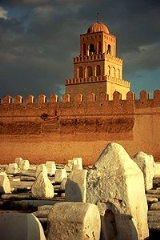
The city's main attraction is the Great Mosque of Sidi-Uqba, which is said to largely consist of its original building materials. In fact most of the column stems and capitals were taken from ruins of earlier-period buildings, while others were produced locally. There are 414 marble, granite and porphyry columns in the mosque. Almost all were taken from the ruins of
CarthageCarthage , implying it was a 'new Tyre') is a major urban centre that has existed for nearly 3,000 years on the Gulf of Tunis, developing from a Phoenician colony of the 1st millennium BC...
. Previously, it was forbidden to count them, on pain of blinding. The Great Mosque of Kairouan (Great Mosque of Sidi-Uqba) is considered as one of the most important monuments of Islamic civilization as well as a worldwide architectural masterpiece. founded by Arab general Uqba Ibn Nafi in 670 CE, the present aspect of the mosque dates from the 9th century. The Great Mosque of Sidi-Uqba has a great historical importance as the ancestor of all the mosques in the western Islamic world.
Mosque of the Three Gates
The Mosque of the Three Gates was founded in 866. Its façade is a notable example of
Islamic architectureIslamic architecture encompasses a wide range of both secular and religious styles from the foundation of Islam to the present day, influencing the design and construction of buildings and structures in Islamic culture....
. It has three arched doorways surmounted by three inscriptions in Kufic script, interspersed with floral and geometrical reliefs and topped by a carved frieze; the first inscription includes the verses 70-71 in the
suraA sura is a division of the Qur'an, often referred to as a chapter. The term chapter is sometimes avoided, as the suras are of unequal length; the shortest sura has only three ayat while the longest contains 286 ayat...
33 of Quran. The small minaret was added during the restoration works held under the Hafsid dynasty. The prayer hall has a nave and two aisles, divided by arched columns, parallel to the
qiblaThe Qiblah , also transliterated as Qibla, Kiblah or Kibla, is the direction that should be faced when a Muslim prays during salah...
wall.
Mosque of the Barber
The Mausoleum of Sidi Sahab, generally known as the Mosque of the Barber, is actually a
zaouiaA zaouia or zawiya is an Islamic religious school or monastery. The term is Maghrebi and West African, roughly corresponding to the Eastern term madrassa...
located inside the city walls. It was built by the Muradid Hammuda Pasha Bey (mausoleum, dome and court) and Murad II Bey (minaret and madrasa). In its present state, the monument dates from the 17th century.
The mosque is a veneration place for Abu Zama' al-Balaui, a companion of the prophet
MuhammadMuhammad |ligature]] at U+FDF4 ;Arabic pronunciation varies regionally; the first vowel ranges from ~~; the second and the last vowel: ~~~. There are dialects which have no stress. In Egypt, it is pronounced not in religious contexts...
, who, according to a legend, had saved for himself three hairs of Muhammad's beard, hence the edifice's name. The sepulture place is accessed from a cloister-like court with richly decorated ceramics and stuccoes.
Other buildings
Kairouan is also home to:
- two large water reservoirs called "Aghlabid basins"
- Mosque of Ansar, dating, according to the tradition, to 667 but totally renewed in 1650.
- Mosque Al Bey (late 17th century)
- The souk
A souq is a commercial quarter in an Arab, Berber, and increasingly European city. The term is often used to designate the market in any Arabized or Muslim city, but in modern times it appears in Western cities too...
(market place), in the Medina quarterA medina quarter is a distinct city section found in many North African cities. The medina is typically walled, contains many narrow and maze-like streets...
, which is surrounded by walls, from which the entrance gates can be seen in the distance. Products that are sold in the souk include carpets, vases and goods made of leather.
In popular culture
In
Raiders of the Lost ArkRaiders of the Lost Ark is a 1981 American action-adventure film directed by Steven Spielberg, produced by George Lucas, and starring Harrison Ford. It is the first film in the Indiana Jones franchise...
, the street scenes in "
CairoCairo , is the capital of Egypt and the largest city in the Arab world and Africa, and the 16th largest metropolitan area in the world. Nicknamed "The City of a Thousand Minarets" for its preponderance of Islamic architecture, Cairo has long been a centre of the region's political and cultural life...
" were filmed in Kairouan.
Twin towns
FèsFES or Fes may refer to:* Fes or Fez, a city in Morocco* FES , a human gene that encodes the feline sarcoma oncogene enzyme* FES , a fictional singer from Chaos;Head anime series and alias of Yui Sakakibara for her songs from Chaos;Head and Steins;Gate anime series* Flywheel energy storage, an...
, Morocco, since 22 October 1965
TlemcenTlemcen is a town in Northwestern Algeria, and the capital of the province of the same name. It is located inland in the center of a region known for its olive plantations and vineyards...
, Algeria, since 28 May 1969
Córdoba, Spain-History:The first trace of human presence in the area are remains of a Neanderthal Man, dating to c. 32,000 BC. In the 8th century BC, during the ancient Tartessos period, a pre-urban settlement existed. The population gradually learned copper and silver metallurgy...
, since 10 June 1969
CairoCairo , is the capital of Egypt and the largest city in the Arab world and Africa, and the 16th largest metropolitan area in the world. Nicknamed "The City of a Thousand Minarets" for its preponderance of Islamic architecture, Cairo has long been a centre of the region's political and cultural life...
, Egypt, since 14 Mach 1976
SamarkandAlthough a Persian-speaking region, it was not united politically with Iran most of the times between the disintegration of the Seleucid Empire and the Arab conquest . In the 6th century it was within the domain of the Turkic kingdom of the Göktürks.At the start of the 8th century Samarkand came...
, Uzbekistan, since 5 October 1977
TimbuktuTimbuktu , formerly also spelled Timbuctoo, is a town in the West African nation of Mali situated north of the River Niger on the southern edge of the Sahara Desert. The town is the capital of the Timbuktu Region, one of the eight administrative regions of Mali...
, Mali, since 2 June 1986 Bursa, Turkey, since 26 December 1987
NishapurNishapur or Nishabur , is a city in the Razavi Khorasan province in northeastern Iran, situated in a fertile plain at the foot of the Binalud Mountains, near the regional capital of Mashhad...
, Iran, since 26 December 1987
External links