

Siwa Oasis

Encyclopedia
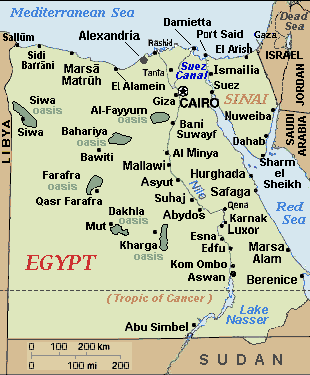
The Siwa Oasis is an oasis
in Egypt
, located between the Qattara Depression
and the Egyptian Sand Sea
in the Libyan Desert
, nearly 50 km (30 mi) east of the Libya
n border, and 560 km (348 mi) from Cairo
.
About 80 km (50 mi) in length and 20 km (12 mi) wide, Siwa Oasis is one of Egypt's most isolated settlements, with 23,000 people, mostly ethnic Berbers
who speak a distinct language of the Berber family
known as Siwi. Its fame lies primarily in its ancient role as the home to an oracle
of Amon
, the ruins of which are a popular tourist attraction which gave the oasis its ancient name Ammonium. Historically, it is part of Ancient Libya
. Its modern name Siwa, first attested in the 15th century (earlier Arab geographers termed it Santariyyah), is of uncertain origin. Basset links it to a Berber tribal name swh attested further west in the early Islamic period, while Ilahiane, following Chafik, links it to the Tashelhiyt Berber word asiwan, a type of prey bird, and hence to Amon-Ra, one of whose symbols was the falcon.
Agriculture
is the main activity of modern Siwi, particularly the cultivation of date
s and olive
s. Handicrafts like basketry are also of regional importance. Tourism has in recent decades become a vital source of income. Much attention has been given to creating hotels that use local materials and play on local styles.
that extends below sea level. This depression, an area lower than the surrounding region, reaches to about -19 m. To the west the Jaghbub lies in a similar depression and to the east the large Qattara Depression
also lies below sea level.

 Although the oasis is known to have been settled since at least the 10th millennium BC
, the earliest evidence of connection with ancient Egypt
is the 26th Dynasty
, when a necropolis
was established. During the Ptolemaid period of Egypt its ancient Egyptian
name was sḫ.t-ỉm3w, "Field of Trees". Interestingly, "siwa" and other versions of it -- "ziwa," "zibva," "shiba," and "shiwa" -- mean lake or sea in some languages of Zambia, Malawi, Zimbabwe, and the DRC, among others.
Greek
settlers at Cyrene
made contact with the oasis around the same time (7th century BC), and the oracle temple of Amun (Greek: Zeus Ammon), who, Herodotus
was told, took the image here of a ram. Herodotus knew of a "fountain of the Sun" that ran coldest in the noontide heat. Prior to his campaign of conquest in Persia, Alexander the Great reached the oasis, supposedly by following birds across the desert. The oracle, Alexander's court historians alleged, confirmed him as both a divine personage and the legitimate Pharaoh
of Egypt .
The Romans
later used Siwa as a place of banishment. Evidence of Christianity
at Siwa is uncertain, but in 708 the Siwans resisted an Islam
ic army, and probably did not convert until the 12th century. A local manuscript mentions only seven families totaling 40 men living at the oasis in 1203.
The first European to visit since Roman times was the English traveler William George Browne
, who came in 1792 to see the ancient temple of the oracle.
The oasis was officially added to Egypt by Muhammad Ali of Egypt
in 1819, but his rule was tenuous and marked by several revolts.
Siwa was the site of some fighting during World War I
and World War II
. The British Army
's Long Range Desert Group
was based here, but Rommel's Afrika Korps
also took possession three times. German soldiers went skinny dipping
in the lake of the oracle, contrary to local customs which prohibit public nudity.
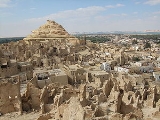
The ancient fortress of Siwa, built on natural rock (an inselberg), made of salt, mud-brick and palm logs and known as the Shali Ghadi ("Shali" being the name of the town, and "Ghadi" meaning remote), although now mostly abandoned and 'melted', remains a prominent feature, towering five stories above the modern town.
Other local historic sites of interest include: the remains of the oracle temple; the Gebel al Mawta (the Mountain of the Dead), a Roman-era necropolis featuring dozens of rock-cut tombs; and "Cleopatra's Bath", an antique natural spring. The fragmentary remains of the oracle temple, with some inscriptions dating from the 4th century BC, lie within the ruins of Aghurmi. The revelations of the oracle fell into disrepute under the Roman occupation of Egypt.
Another attraction for tourists is Fatnas Island, which became a palm-fringed peninsula located on the edge of a saltwater lake. The lake had been partially drained in recent years because of a plan to limit the effect of rising water levels in Siwa due to agricultural runoff from uncontrolled wells (a major problem affecting the entire oasis); Fatnas Island is now surrounded mostly by mud flats.
is also a reputable Siwa product in Egypt.
(for example, the eating of couscous
or their Berber language.)
The Siyaha Festival, in honour of the town's traditional patron saint Sidi Sulayman, is unique to Siwa. (The name is often misunderstood as a reference to "tourism", but in fact predates tourism.) On this occasion Siwi men meet together on a mountain near the town, Jabal Dakrour, to eat together, sing chants thanking God, and reconcile with one another; the women stay behind in the village, and celebrate with dancing, singing, and drums. The food for the festival is bought collectively, with funds gathered by the oasis' mosques. This festival takes place on the first full moon of October, shortly after the grain harvest.
Siwi children traditionally also celebrated Ashura
by lighting torches, singing, and exchanging sweets. Adults' celebration was limited to the preparation of a large meal.
, only rarely marrying non-Siwis. Nonetheless, Bedouin brides command a higher brideprice in Siwa than Siwi ones.
According to older members of the Awlad Ali Bedouins, Arab Bedouin relations with Siwis were traditionally mediated through a system of "friendship", whereby a specific Siwi (and his descendants) would be the friend of a specific Bedouin (and his descendants). The Bedouin would stay at the Siwi's house when he came to Siwa, and would exchange his animal products and grain for the Siwi's dates and olive oil.
Until the twentieth century Siwis normally bought women's clothing (milaya) from the town of Kirdasa near Cairo.
was forming ties with Siwa.
Partly in response to the Siwi complaints, the program's host produced an episode on Siwa in November 2010, in which he gave six Siwis, including Bilal Ahmad Bilal Issa, an Egyptian MP
(from Siwa), and Omar Abdallah Rajeh, Sheik of the Awlad Musa Tribe, a chance to respond to these claims. In their replies, the interviewees stated that there were no Jews in Siwa, at the Siyaha Festival or otherwise, and that Siwis reject any relations with Jews, or even hate Israelis/Jews; the reasons given were that Siwis support the Arabs in the Arab-Israeli conflict, and as such "view them as enemies." The interviews also stated that Jews are not welcome in Siwa as tourists. Bilal Issa stated that Siwa residents "despise the Israelis" while Sheik Rajeh stated that Siwa residents "will not accept any relations whatsoever with the Jews."
Ahmad Fakhri
, an archaeologist, worked at this site.
File:Siwa-Homes2009.jpg|Mud-brick houses in Shali
File:Siwa sand dunes2009a.jpg|Desert sand dunes in the south of Siwa
File:Siwa Oasis2009b.jpg|Siwa lake
File:Mosque_in_Siwa_Oasis_(2007).jpg|Mosque at Aghurmi
File:Oracle of Ammun at Siwa.jpg|View through the Temple of the Oracle of Amun to Gebel el-Dakrour
File:Pano Siwa depuis Dakrur-Battesti.jpg|A panoramic view of the Siwa Oasis in 2005
Oasis
In geography, an oasis or cienega is an isolated area of vegetation in a desert, typically surrounding a spring or similar water source...
in Egypt
Egypt
Egypt , officially the Arab Republic of Egypt, Arabic: , is a country mainly in North Africa, with the Sinai Peninsula forming a land bridge in Southwest Asia. Egypt is thus a transcontinental country, and a major power in Africa, the Mediterranean Basin, the Middle East and the Muslim world...
, located between the Qattara Depression
Qattara Depression
The Qattara Depression is a depression in the north west of Egypt in the Matruh Governorate and is part of the Libyan Desert. It lies below sea level and is covered with salt pans, sand dunes and salt marshes. The region extends between latitudes of 28°35' and 30°25' North and longitudes of 26°20'...
and the Egyptian Sand Sea
Egyptian Sand Sea
The Egyptian Sand Sea is in Africa's Libyan Desert. The three sand seas contain dunes up to 110m in height and cover about 25% of the Libyan Desert. The dunes were created by wind.-See also:*Libyan Desert**Calanshio Sand Sea**Ribiana Sand Sea...
in the Libyan Desert
Libyan Desert
The Libyan Desert covers an area of approximately 1,100,000 km2, it extends approximately 1100 km from east to west, and 1,000 km from north to south, in about the shape of a rectangle...
, nearly 50 km (30 mi) east of the Libya
Libya
Libya is an African country in the Maghreb region of North Africa bordered by the Mediterranean Sea to the north, Egypt to the east, Sudan to the southeast, Chad and Niger to the south, and Algeria and Tunisia to the west....
n border, and 560 km (348 mi) from Cairo
Cairo
Cairo , is the capital of Egypt and the largest city in the Arab world and Africa, and the 16th largest metropolitan area in the world. Nicknamed "The City of a Thousand Minarets" for its preponderance of Islamic architecture, Cairo has long been a centre of the region's political and cultural life...
.
About 80 km (50 mi) in length and 20 km (12 mi) wide, Siwa Oasis is one of Egypt's most isolated settlements, with 23,000 people, mostly ethnic Berbers
Berber people
Berbers are the indigenous peoples of North Africa west of the Nile Valley. They are continuously distributed from the Atlantic to the Siwa oasis, in Egypt, and from the Mediterranean to the Niger River. Historically they spoke the Berber language or varieties of it, which together form a branch...
who speak a distinct language of the Berber family
Berber languages
The Berber languages are a family of languages indigenous to North Africa, spoken from Siwa Oasis in Egypt to Morocco , and south to the countries of the Sahara Desert...
known as Siwi. Its fame lies primarily in its ancient role as the home to an oracle
Oracle
In Classical Antiquity, an oracle was a person or agency considered to be a source of wise counsel or prophetic predictions or precognition of the future, inspired by the gods. As such it is a form of divination....
of Amon
Amun
Amun, reconstructed Egyptian Yamānu , was a god in Egyptian mythology who in the form of Amun-Ra became the focus of the most complex system of theology in Ancient Egypt...
, the ruins of which are a popular tourist attraction which gave the oasis its ancient name Ammonium. Historically, it is part of Ancient Libya
Ancient Libya
The Latin name Libya referred to the region west of the Nile Valley, generally corresponding to modern Northwest Africa. Climate changes affected the locations of the settlements....
. Its modern name Siwa, first attested in the 15th century (earlier Arab geographers termed it Santariyyah), is of uncertain origin. Basset links it to a Berber tribal name swh attested further west in the early Islamic period, while Ilahiane, following Chafik, links it to the Tashelhiyt Berber word asiwan, a type of prey bird, and hence to Amon-Ra, one of whose symbols was the falcon.
Agriculture
Agriculture
Agriculture is the cultivation of animals, plants, fungi and other life forms for food, fiber, and other products used to sustain life. Agriculture was the key implement in the rise of sedentary human civilization, whereby farming of domesticated species created food surpluses that nurtured the...
is the main activity of modern Siwi, particularly the cultivation of date
Date Palm
The date palm is a palm in the genus Phoenix, cultivated for its edible sweet fruit. Although its place of origin is unknown because of long cultivation, it probably originated from lands around the Persian Gulf. It is a medium-sized plant, 15–25 m tall, growing singly or forming a clump with...
s and olive
Olive
The olive , Olea europaea), is a species of a small tree in the family Oleaceae, native to the coastal areas of the eastern Mediterranean Basin as well as northern Iran at the south end of the Caspian Sea.Its fruit, also called the olive, is of major agricultural importance in the...
s. Handicrafts like basketry are also of regional importance. Tourism has in recent decades become a vital source of income. Much attention has been given to creating hotels that use local materials and play on local styles.
Geography
The Siwa oasis is located in a deep depressionDepression (geology)
A depression in geology is a landform sunken or depressed below the surrounding area. Depressions may be formed by various mechanisms.Structural or tectonic related:...
that extends below sea level. This depression, an area lower than the surrounding region, reaches to about -19 m. To the west the Jaghbub lies in a similar depression and to the east the large Qattara Depression
Qattara Depression
The Qattara Depression is a depression in the north west of Egypt in the Matruh Governorate and is part of the Libyan Desert. It lies below sea level and is covered with salt pans, sand dunes and salt marshes. The region extends between latitudes of 28°35' and 30°25' North and longitudes of 26°20'...
also lies below sea level.
History
10th millennium BC
The 10th millennium BC marks the beginning of the Mesolithic and Epipaleolithic period, which is the first part of the Holocene epoch. Agriculture, based on the cultivation of primitive forms of millet and rice, occurred in Southwest Asia...
, the earliest evidence of connection with ancient Egypt
Ancient Egypt
Ancient Egypt was an ancient civilization of Northeastern Africa, concentrated along the lower reaches of the Nile River in what is now the modern country of Egypt. Egyptian civilization coalesced around 3150 BC with the political unification of Upper and Lower Egypt under the first pharaoh...
is the 26th Dynasty
Twenty-sixth dynasty of Egypt
The Twenty-sixth Dynasty of Egypt was the last native dynasty to rule Egypt before the Persian conquest in 525 BC . The Dynasty's reign The Twenty-sixth Dynasty of Egypt (also written Dynasty XXVI or Dynasty 26) was the last native dynasty to rule Egypt before the Persian conquest in 525 BC...
, when a necropolis
Necropolis
A necropolis is a large cemetery or burial ground, usually including structural tombs. The word comes from the Greek νεκρόπολις - nekropolis, literally meaning "city of the dead"...
was established. During the Ptolemaid period of Egypt its ancient Egyptian
Egyptian language
Egyptian is the oldest known indigenous language of Egypt and a branch of the Afroasiatic language family. Written records of the Egyptian language have been dated from about 3400 BC, making it one of the oldest recorded languages known. Egyptian was spoken until the late 17th century AD in the...
name was sḫ.t-ỉm3w, "Field of Trees". Interestingly, "siwa" and other versions of it -- "ziwa," "zibva," "shiba," and "shiwa" -- mean lake or sea in some languages of Zambia, Malawi, Zimbabwe, and the DRC, among others.
Greek
Ancient Greece
Ancient Greece is a civilization belonging to a period of Greek history that lasted from the Archaic period of the 8th to 6th centuries BC to the end of antiquity. Immediately following this period was the beginning of the Early Middle Ages and the Byzantine era. Included in Ancient Greece is the...
settlers at Cyrene
Cyrene, Libya
Cyrene was an ancient Greek colony and then a Roman city in present-day Shahhat, Libya, the oldest and most important of the five Greek cities in the region. It gave eastern Libya the classical name Cyrenaica that it has retained to modern times.Cyrene lies in a lush valley in the Jebel Akhdar...
made contact with the oasis around the same time (7th century BC), and the oracle temple of Amun (Greek: Zeus Ammon), who, Herodotus
Herodotus
Herodotus was an ancient Greek historian who was born in Halicarnassus, Caria and lived in the 5th century BC . He has been called the "Father of History", and was the first historian known to collect his materials systematically, test their accuracy to a certain extent and arrange them in a...
was told, took the image here of a ram. Herodotus knew of a "fountain of the Sun" that ran coldest in the noontide heat. Prior to his campaign of conquest in Persia, Alexander the Great reached the oasis, supposedly by following birds across the desert. The oracle, Alexander's court historians alleged, confirmed him as both a divine personage and the legitimate Pharaoh
Pharaoh
Pharaoh is a title used in many modern discussions of the ancient Egyptian rulers of all periods. The title originates in the term "pr-aa" which means "great house" and describes the royal palace...
of Egypt .
The Romans
Ancient Rome
Ancient Rome was a thriving civilization that grew on the Italian Peninsula as early as the 8th century BC. Located along the Mediterranean Sea and centered on the city of Rome, it expanded to one of the largest empires in the ancient world....
later used Siwa as a place of banishment. Evidence of Christianity
Christianity
Christianity is a monotheistic religion based on the life and teachings of Jesus as presented in canonical gospels and other New Testament writings...
at Siwa is uncertain, but in 708 the Siwans resisted an Islam
Islam
Islam . The most common are and . : Arabic pronunciation varies regionally. The first vowel ranges from ~~. The second vowel ranges from ~~~...
ic army, and probably did not convert until the 12th century. A local manuscript mentions only seven families totaling 40 men living at the oasis in 1203.
The first European to visit since Roman times was the English traveler William George Browne
William George Browne
William George Browne was an English traveller.Browne was born at Great Tower Hill, London. At seventeen he was sent to Oriel College, Oxford. Having had a moderate inheritance left him by his father, on quitting the university he applied himself entirely to literary pursuits...
, who came in 1792 to see the ancient temple of the oracle.
The oasis was officially added to Egypt by Muhammad Ali of Egypt
Muhammad Ali of Egypt
Muhammad Ali Pasha al-Mas'ud ibn Agha was a commander in the Ottoman army, who became Wāli, and self-declared Khedive of Egypt and Sudan...
in 1819, but his rule was tenuous and marked by several revolts.
Siwa was the site of some fighting during World War I
World War I
World War I , which was predominantly called the World War or the Great War from its occurrence until 1939, and the First World War or World War I thereafter, was a major war centred in Europe that began on 28 July 1914 and lasted until 11 November 1918...
and World War II
World War II
World War II, or the Second World War , was a global conflict lasting from 1939 to 1945, involving most of the world's nations—including all of the great powers—eventually forming two opposing military alliances: the Allies and the Axis...
. The British Army
British Army
The British Army is the land warfare branch of Her Majesty's Armed Forces in the United Kingdom. It came into being with the unification of the Kingdom of England and Scotland into the Kingdom of Great Britain in 1707. The new British Army incorporated Regiments that had already existed in England...
's Long Range Desert Group
Long Range Desert Group
The Long Range Desert Group was a reconnaissance and raiding unit of the British Army during the Second World War. The commander of the German Afrika Corps, Field Marshal Erwin Rommel, admitted that the LRDG "caused us more damage than any other British unit of equal strength".Originally called...
was based here, but Rommel's Afrika Korps
Afrika Korps
The German Africa Corps , or the Afrika Korps as it was popularly called, was the German expeditionary force in Libya and Tunisia during the North African Campaign of World War II...
also took possession three times. German soldiers went skinny dipping
Skinny dipping
Nude swimming, colloquially called skinny dipping, is a term used to describe swimming naked.-Etymology:The term skinny dip, first recorded in English in the 1950s, includes the somewhat archaic word skinny, known since 1573, meaning "having to do with skin", as it exposed the naked...
in the lake of the oracle, contrary to local customs which prohibit public nudity.
The ancient fortress of Siwa, built on natural rock (an inselberg), made of salt, mud-brick and palm logs and known as the Shali Ghadi ("Shali" being the name of the town, and "Ghadi" meaning remote), although now mostly abandoned and 'melted', remains a prominent feature, towering five stories above the modern town.
Other local historic sites of interest include: the remains of the oracle temple; the Gebel al Mawta (the Mountain of the Dead), a Roman-era necropolis featuring dozens of rock-cut tombs; and "Cleopatra's Bath", an antique natural spring. The fragmentary remains of the oracle temple, with some inscriptions dating from the 4th century BC, lie within the ruins of Aghurmi. The revelations of the oracle fell into disrepute under the Roman occupation of Egypt.
Another attraction for tourists is Fatnas Island, which became a palm-fringed peninsula located on the edge of a saltwater lake. The lake had been partially drained in recent years because of a plan to limit the effect of rising water levels in Siwa due to agricultural runoff from uncontrolled wells (a major problem affecting the entire oasis); Fatnas Island is now surrounded mostly by mud flats.
Agriculture
Siwa is popular for its palm and olive trees, producing huge volumes of dates and olives. Extra virgin olive oil is one of Siwa's popular products used in Egypt and exported to Europe. MulukhiyahMulukhiyah
Mulukhiyah, mloukhiya, molokhia, mulukhiyya, or malukhiyah is the leaves of jute and related Corchorus species used as a vegetable in Middle Eastern, East African, North African, and South Asian cuisine...
is also a reputable Siwa product in Egypt.
Climate
Culture
The traditional culture of Siwa shows many features unusual in Egypt, some reflecting its longstanding links with the MaghrebMaghreb
The Maghreb is the region of Northwest Africa, west of Egypt. It includes five countries: Morocco, Algeria, Tunisia, Libya, and Mauritania and the disputed territory of Western Sahara...
(for example, the eating of couscous
Couscous
Couscous is a Berber dish of semolina traditionally served with a meat or vegetable stew spooned over it. Couscous is a staple food throughout Algeria, Morocco and Tunisia.-Etymology:...
or their Berber language.)
Festivals
Like other Muslim Egyptians, Siwis celebrate Eid al-Fitr (lʕid ahakkik,"the Little Eid") and Eid al-Adha (lʕid azuwwar,"the Big Eid"). Unlike other Egyptians, however, on Id al-Adha Siwis cook the skin of the sheep (along with its innards) as a festival delicacy, after removing the hair. They also eat palm hearts (agroz).The Siyaha Festival, in honour of the town's traditional patron saint Sidi Sulayman, is unique to Siwa. (The name is often misunderstood as a reference to "tourism", but in fact predates tourism.) On this occasion Siwi men meet together on a mountain near the town, Jabal Dakrour, to eat together, sing chants thanking God, and reconcile with one another; the women stay behind in the village, and celebrate with dancing, singing, and drums. The food for the festival is bought collectively, with funds gathered by the oasis' mosques. This festival takes place on the first full moon of October, shortly after the grain harvest.
Siwi children traditionally also celebrated Ashura
Ashura
Ashura may refer to:* Ashura, meaning "tenth" in Arabic** The Day of Ashura, , day of mourning in Shi'a Islam* King Ashura, character from the manga series Tsubasa: Reservoir Chronicle...
by lighting torches, singing, and exchanging sweets. Adults' celebration was limited to the preparation of a large meal.
Relations with other ethnic groups
Siwis are preferentially endogamousEndogamy
Endogamy is the practice of marrying within a specific ethnic group, class, or social group, rejecting others on such basis as being unsuitable for marriage or other close personal relationships. A Greek Orthodox Christian endogamist, for example, would require that a marriage be only with another...
, only rarely marrying non-Siwis. Nonetheless, Bedouin brides command a higher brideprice in Siwa than Siwi ones.
According to older members of the Awlad Ali Bedouins, Arab Bedouin relations with Siwis were traditionally mediated through a system of "friendship", whereby a specific Siwi (and his descendants) would be the friend of a specific Bedouin (and his descendants). The Bedouin would stay at the Siwi's house when he came to Siwa, and would exchange his animal products and grain for the Siwi's dates and olive oil.
Until the twentieth century Siwis normally bought women's clothing (milaya) from the town of Kirdasa near Cairo.
Relations with Jews
Siwi viewers complained to Al-Jazeera after Ibrahim Nasreddin, an Egyptian expert on African affairs, claimed on Al Jazeera's File (Al Milaff) program that IsraelIsrael
The State of Israel is a parliamentary republic located in the Middle East, along the eastern shore of the Mediterranean Sea...
was forming ties with Siwa.
Partly in response to the Siwi complaints, the program's host produced an episode on Siwa in November 2010, in which he gave six Siwis, including Bilal Ahmad Bilal Issa, an Egyptian MP
Member of Parliament
A Member of Parliament is a representative of the voters to a :parliament. In many countries with bicameral parliaments, the term applies specifically to members of the lower house, as upper houses often have a different title, such as senate, and thus also have different titles for its members,...
(from Siwa), and Omar Abdallah Rajeh, Sheik of the Awlad Musa Tribe, a chance to respond to these claims. In their replies, the interviewees stated that there were no Jews in Siwa, at the Siyaha Festival or otherwise, and that Siwis reject any relations with Jews, or even hate Israelis/Jews; the reasons given were that Siwis support the Arabs in the Arab-Israeli conflict, and as such "view them as enemies." The interviews also stated that Jews are not welcome in Siwa as tourists. Bilal Issa stated that Siwa residents "despise the Israelis" while Sheik Rajeh stated that Siwa residents "will not accept any relations whatsoever with the Jews."
Archaeology
An extremely old hominid footprint was discovered in 2007 at Siwa Oasis. It was claimed by Egyptian scientists to have the possible age of 2-3 million years old, which would make it the oldest fossilized hominid footprint ever found. However, no proof of this conjecture was ever presented.Ahmad Fakhri
Ahmad Fakhri
Ahmad Fakhry – 1973) was an Egyptian archaeologist who worked in the Western desert of Egypt , and also in the necropolis at Dahshur.-Bibliography:...
, an archaeologist, worked at this site.
Gallery
File:Siwa-Homes2009.jpg|Mud-brick houses in Shali
File:Siwa sand dunes2009a.jpg|Desert sand dunes in the south of Siwa
File:Siwa Oasis2009b.jpg|Siwa lake
File:Mosque_in_Siwa_Oasis_(2007).jpg|Mosque at Aghurmi
File:Oracle of Ammun at Siwa.jpg|View through the Temple of the Oracle of Amun to Gebel el-Dakrour
File:Pano Siwa depuis Dakrur-Battesti.jpg|A panoramic view of the Siwa Oasis in 2005
External links
siwaguide.comSiwa Town on WikiTravel.Siwa Oasis on WikivoyageSee Siwa Oasis Photo album.Siwa Oasis Photo Gallery.The Locally Run Website of Siwa Oasis.Siwa Oasis – Extraordinary.Siwa information from an English family that live in the Oasis..Alain Blottière's Travel book on Siwa.Alain Blottière's Travel book on Siwa.Account of Germans skinny-dipping in the well of the Oracle.- Detailed map of Egypt, with towns, oases & temples: http://unimaps.com/egypt/index.html.
- "Pictures gallery on Siwa oasis" on vbat.org, by Vincent Battesti.Travel guide.40 Days and 1001 Nights by Tamalyn Dallal (2007).