

Tapestry

Encyclopedia
Textile arts
Textile arts are those arts and crafts that use plant, animal, or synthetic fibers to construct practical or decorative objects.Textiles have been a fundamental part of human life since the beginning of civilization, and the methods and materials used to make them have expanded enormously, while...
, traditionally woven
Weaving
Weaving is a method of fabric production in which two distinct sets of yarns or threads are interlaced at right angles to form a fabric or cloth. The other methods are knitting, lace making and felting. The longitudinal threads are called the warp and the lateral threads are the weft or filling...
on a vertical loom
Loom
A loom is a device used to weave cloth. The basic purpose of any loom is to hold the warp threads under tension to facilitate the interweaving of the weft threads...
, however it can also be woven on a floor loom as well. It is composed of two sets of interlaced threads, those running parallel to the length (called the warp
Warp (weaving)
In weaving cloth, the warp is the set of lengthwise yarns that are held in tension on a frame or loom. The yarn that is inserted over-and-under the warp threads is called the weft, woof, or filler. Each individual warp thread in a fabric is called a warp end or end. Warp means "that which is thrown...
) and those parallel to the width (called the weft
Weft
In weaving, weft or woof is the yarn which is drawn through the warp yarns to create cloth. In North America, it is sometimes referred to as the "fill" or the "filling yarn"....
); the warp threads are set up under tension on a loom, and the weft thread is passed back and forth across part or all of the warps. Tapestry is weft
Weft
In weaving, weft or woof is the yarn which is drawn through the warp yarns to create cloth. In North America, it is sometimes referred to as the "fill" or the "filling yarn"....
-faced weaving, in which all the warp
Warp (weaving)
In weaving cloth, the warp is the set of lengthwise yarns that are held in tension on a frame or loom. The yarn that is inserted over-and-under the warp threads is called the weft, woof, or filler. Each individual warp thread in a fabric is called a warp end or end. Warp means "that which is thrown...
threads are hidden in the completed work, unlike cloth weaving where both the warp and the weft threads may be visible. In tapestry weaving, weft yarns are typically discontinuous; the artisan interlaces each coloured weft back and forth in its own small pattern area. It is a plain weft-faced weave having weft threads of different colours worked over portions of the warp to form the design.
Most weavers use a naturally based warp thread such as linen
Linen
Linen is a textile made from the fibers of the flax plant, Linum usitatissimum. Linen is labor-intensive to manufacture, but when it is made into garments, it is valued for its exceptional coolness and freshness in hot weather....
or cotton
Cotton
Cotton is a soft, fluffy staple fiber that grows in a boll, or protective capsule, around the seeds of cotton plants of the genus Gossypium. The fiber is almost pure cellulose. The botanical purpose of cotton fiber is to aid in seed dispersal....
. The weft threads are usually wool
Wool
Wool is the textile fiber obtained from sheep and certain other animals, including cashmere from goats, mohair from goats, qiviut from muskoxen, vicuña, alpaca, camel from animals in the camel family, and angora from rabbits....
or cotton, but may include silk
Silk
Silk is a natural protein fiber, some forms of which can be woven into textiles. The best-known type of silk is obtained from the cocoons of the larvae of the mulberry silkworm Bombyx mori reared in captivity...
, gold
Gold
Gold is a chemical element with the symbol Au and an atomic number of 79. Gold is a dense, soft, shiny, malleable and ductile metal. Pure gold has a bright yellow color and luster traditionally considered attractive, which it maintains without oxidizing in air or water. Chemically, gold is a...
, silver
Silver
Silver is a metallic chemical element with the chemical symbol Ag and atomic number 47. A soft, white, lustrous transition metal, it has the highest electrical conductivity of any element and the highest thermal conductivity of any metal...
, or other alternatives.
Etymology
First attested in English in 1467, the word tapestry derives from Old FrenchOld French
Old French was the Romance dialect continuum spoken in territories that span roughly the northern half of modern France and parts of modern Belgium and Switzerland from the 9th century to the 14th century...
tapisserie, from tapisser, meaning "to cover with heavy fabric, to carpet", in turn from tapis, "heavy fabric", via Latin
Latin
Latin is an Italic language originally spoken in Latium and Ancient Rome. It, along with most European languages, is a descendant of the ancient Proto-Indo-European language. Although it is considered a dead language, a number of scholars and members of the Christian clergy speak it fluently, and...
tapes, which is the latinisation
Latinisation (literature)
Latinisation is the practice of rendering a non-Latin name in a Latin style. It is commonly met with for historical personal names, with toponyms, or for the standard binomial nomenclature of the life sciences. It goes further than Romanisation, which is the writing of a word in the Latin alphabet...
of the Greek
Greek language
Greek is an independent branch of the Indo-European family of languages. Native to the southern Balkans, it has the longest documented history of any Indo-European language, spanning 34 centuries of written records. Its writing system has been the Greek alphabet for the majority of its history;...
τάπης (tapēs), "carpet, rug". The earliest attested form of the word is the Mycenaean Greek ta-pe-ja, written in Linear B
Linear B
Linear B is a syllabic script that was used for writing Mycenaean Greek, an early form of Greek. It pre-dated the Greek alphabet by several centuries and seems to have died out with the fall of Mycenaean civilization...
syllabic script.
Function
Le Corbusier
Charles-Édouard Jeanneret, better known as Le Corbusier , was a Swiss-born French architect, designer, urbanist, writer and painter, famous for being one of the pioneers of what now is called modern architecture. He was born in Switzerland and became a French citizen in 1930...
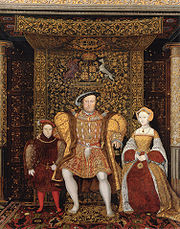
once called tapestries "nomadic murals"). Kings
Monarch
A monarch is the person who heads a monarchy. This is a form of government in which a state or polity is ruled or controlled by an individual who typically inherits the throne by birth and occasionally rules for life or until abdication...
and noblemen
Nobility
Nobility is a social class which possesses more acknowledged privileges or eminence than members of most other classes in a society, membership therein typically being hereditary. The privileges associated with nobility may constitute substantial advantages over or relative to non-nobles, or may be...
could roll up and transport tapestries from one residence to another. In churches, they could be displayed on special occasions. Tapestries were also draped on the walls of castle
Castle
A castle is a type of fortified structure built in Europe and the Middle East during the Middle Ages by European nobility. Scholars debate the scope of the word castle, but usually consider it to be the private fortified residence of a lord or noble...
s for insulation during winter, as well as for decorative display.
In the Middle Ages
Middle Ages
The Middle Ages is a periodization of European history from the 5th century to the 15th century. The Middle Ages follows the fall of the Western Roman Empire in 476 and precedes the Early Modern Era. It is the middle period of a three-period division of Western history: Classic, Medieval and Modern...
and renaissance
Renaissance
The Renaissance was a cultural movement that spanned roughly the 14th to the 17th century, beginning in Italy in the Late Middle Ages and later spreading to the rest of Europe. The term is also used more loosely to refer to the historical era, but since the changes of the Renaissance were not...
, a rich tapestry panel woven with symbol
Symbol
A symbol is something which represents an idea, a physical entity or a process but is distinct from it. The purpose of a symbol is to communicate meaning. For example, a red octagon may be a symbol for "STOP". On a map, a picture of a tent might represent a campsite. Numerals are symbols for...
ic emblem
Emblem
An emblem is a pictorial image, abstract or representational, that epitomizes a concept — e.g., a moral truth, or an allegory — or that represents a person, such as a king or saint.-Distinction: emblem and symbol:...
s, motto
Motto
A motto is a phrase meant to formally summarize the general motivation or intention of a social group or organization. A motto may be in any language, but Latin is the most used. The local language is usual in the mottoes of governments...
es, or coats of arms
Coat of arms
A coat of arms is a unique heraldic design on a shield or escutcheon or on a surcoat or tabard used to cover and protect armour and to identify the wearer. Thus the term is often stated as "coat-armour", because it was anciently displayed on the front of a coat of cloth...
called a baldachin
Baldachin
A baldachin, or baldaquin , is a canopy of state over an altar or throne. It had its beginnings as a cloth canopy, but in other cases it is a sturdy, permanent architectural feature, particularly over high altars in cathedrals, where such a structure is more correctly called a ciborium when it is...
, canopy of state or cloth of state was hung behind and over a throne as a symbol of authority. The seat under such a canopy of state would normally be raised on a dais
Dais
Dais is any raised platform located either in or outside of a room or enclosure, often for dignified occupancy, as at the front of a lecture hall or sanctuary....
.
The iconography
Iconography
Iconography is the branch of art history which studies the identification, description, and the interpretation of the content of images. The word iconography literally means "image writing", and comes from the Greek "image" and "to write". A secondary meaning is the painting of icons in the...
of most Western tapestries goes back to written sources, the Bible
Bible
The Bible refers to any one of the collections of the primary religious texts of Judaism and Christianity. There is no common version of the Bible, as the individual books , their contents and their order vary among denominations...
and Ovid
Ovid
Publius Ovidius Naso , known as Ovid in the English-speaking world, was a Roman poet who is best known as the author of the three major collections of erotic poetry: Heroides, Amores, and Ars Amatoria...
's Metamorphoses being two popular choices. Apart from the religious
Religion
Religion is a collection of cultural systems, belief systems, and worldviews that establishes symbols that relate humanity to spirituality and, sometimes, to moral values. Many religions have narratives, symbols, traditions and sacred histories that are intended to give meaning to life or to...
and mythological
Mythology
The term mythology can refer either to the study of myths, or to a body or collection of myths. As examples, comparative mythology is the study of connections between myths from different cultures, whereas Greek mythology is the body of myths from ancient Greece...
images, hunting
Hunting
Hunting is the practice of pursuing any living thing, usually wildlife, for food, recreation, or trade. In present-day use, the term refers to lawful hunting, as distinguished from poaching, which is the killing, trapping or capture of the hunted species contrary to applicable law...
scenes are the subject of many tapestries produced for indoor decoration.
Historical development
Tapestries have been used since at least HellenisticHellenistic civilization
Hellenistic civilization represents the zenith of Greek influence in the ancient world from 323 BCE to about 146 BCE...
times. Samples of Greek tapestry have been found preserved in the desert of Tarim Basin
Tarim Basin
The Tarim Basin is a large endorheic basin occupying an area of about . It is located in the Xinjiang Uyghur Autonomous Region in China's far west. Its northern boundary is the Tian Shan mountain range and its southern is the Kunlun Mountains on the northern edge of the Tibetan Plateau. The...
dating from the 3rd century BC.
Tapestry reached a new stage in Europe
Europe
Europe is, by convention, one of the world's seven continents. Comprising the westernmost peninsula of Eurasia, Europe is generally 'divided' from Asia to its east by the watershed divides of the Ural and Caucasus Mountains, the Ural River, the Caspian and Black Seas, and the waterways connecting...
in the early 14th century AD. The first wave of production originated in Germany
Germany
Germany , officially the Federal Republic of Germany , is a federal parliamentary republic in Europe. The country consists of 16 states while the capital and largest city is Berlin. Germany covers an area of 357,021 km2 and has a largely temperate seasonal climate...
and Switzerland
Switzerland
Switzerland name of one of the Swiss cantons. ; ; ; or ), in its full name the Swiss Confederation , is a federal republic consisting of 26 cantons, with Bern as the seat of the federal authorities. The country is situated in Western Europe,Or Central Europe depending on the definition....
. Over time, the craft expanded to France
France
The French Republic , The French Republic , The French Republic , (commonly known as France , is a unitary semi-presidential republic in Western Europe with several overseas territories and islands located on other continents and in the Indian, Pacific, and Atlantic oceans. Metropolitan France...
and the Netherlands
Netherlands
The Netherlands is a constituent country of the Kingdom of the Netherlands, located mainly in North-West Europe and with several islands in the Caribbean. Mainland Netherlands borders the North Sea to the north and west, Belgium to the south, and Germany to the east, and shares maritime borders...
. The basic tools have remained much the same since then..
In the 14th and 15th centuries, Arras
Arras
Arras is the capital of the Pas-de-Calais department in northern France. The historic centre of the Artois region, its local speech is characterized as a Picard dialect...
, France
France
The French Republic , The French Republic , The French Republic , (commonly known as France , is a unitary semi-presidential republic in Western Europe with several overseas territories and islands located on other continents and in the Indian, Pacific, and Atlantic oceans. Metropolitan France...
was a thriving textile town. The industry specialised in fine wool
Wool
Wool is the textile fiber obtained from sheep and certain other animals, including cashmere from goats, mohair from goats, qiviut from muskoxen, vicuña, alpaca, camel from animals in the camel family, and angora from rabbits....
tapestries which were sold to decorate palace
Palace
A palace is a grand residence, especially a royal residence or the home of a head of state or some other high-ranking dignitary, such as a bishop or archbishop. The word itself is derived from the Latin name Palātium, for Palatine Hill, one of the seven hills in Rome. In many parts of Europe, the...
s and castle
Castle
A castle is a type of fortified structure built in Europe and the Middle East during the Middle Ages by European nobility. Scholars debate the scope of the word castle, but usually consider it to be the private fortified residence of a lord or noble...
s all over Europe
Europe
Europe is, by convention, one of the world's seven continents. Comprising the westernmost peninsula of Eurasia, Europe is generally 'divided' from Asia to its east by the watershed divides of the Ural and Caucasus Mountains, the Ural River, the Caspian and Black Seas, and the waterways connecting...
. Few of these tapestries survived the French Revolution
French Revolution
The French Revolution , sometimes distinguished as the 'Great French Revolution' , was a period of radical social and political upheaval in France and Europe. The absolute monarchy that had ruled France for centuries collapsed in three years...
as hundreds were burnt to recover the gold thread that was often woven into them. Arras is still used to refer to a rich tapestry no matter where it was woven.
By the 16th century, Flanders
Flanders
Flanders is the community of the Flemings but also one of the institutions in Belgium, and a geographical region located in parts of present-day Belgium, France and the Netherlands. "Flanders" can also refer to the northern part of Belgium that contains Brussels, Bruges, Ghent and Antwerp...
, the towns of Oudenaarde, Brussels
Brussels
Brussels , officially the Brussels Region or Brussels-Capital Region , is the capital of Belgium and the de facto capital of the European Union...
, Geraardsbergen
Geraardsbergen
Geraardsbergen is a city and municipality located in the Denderstreek and in the Flemish Ardennes, the hilly southern part of the Belgian province of East Flanders. The municipality comprises the city of Geraardsbergen proper and the following towns:...
and Enghein had become the centre of European tapestry production. In the 17th century Flemish
Flemish people
The Flemings or Flemish are the Dutch-speaking inhabitants of Belgium, where they are mostly found in the northern region of Flanders. They are one of two principal cultural-linguistic groups in Belgium, the other being the French-speaking Walloons...
tapestries were arguably the most important productions, with many specimens of this era still extant, demonstrating the intricate detail of pattern and colour.
William Morris
William Morris 24 March 18343 October 1896 was an English textile designer, artist, writer, and socialist associated with the Pre-Raphaelite Brotherhood and the English Arts and Crafts Movement...
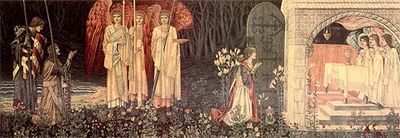
resurrected the art of tapestry-making in the medieval style at Merton Abbey
Merton Abbey Mills
Merton Abbey Mills is a former textile factory in the parish of Merton in London, England near the site of the medieval Merton Priory, now the home of a variety of businesses, mostly retailers....
. Morris & Co. made successful series of tapestries for home and ecclesiatical uses, with figures based on cartoons by Edward Burne-Jones
Edward Burne-Jones
Sir Edward Coley Burne-Jones, 1st Baronet was a British artist and designer closely associated with the later phase of the Pre-Raphaelite movement, who worked closely with William Morris on a wide range of decorative arts as a founding partner in Morris, Marshall, Faulkner, and Company...
.
Kilim
Kilim
Kilims are flat tapestry-woven carpets or rugs produced from the Balkans to Pakistan. Kilims can be purely decorative or can function as prayer rugs. Recently-made kilims are popular floor-coverings in Western households.-Etymology:...
s and Navajo rug
Navajo rug
Navajo rugs and blankets are textiles produced by Navajo people of the Four Corners area of the United States. Navajo textiles are highly regarded and have been sought after as trade items for over 150 years. Commercial production of handwoven blankets and rugs has been an important element of the...
s are also types of tapestry work.
Tapestries are still made at the factory of Gobelins
Gobelins manufactory
The Manufacture des Gobelins is a tapestry factory located in Paris, France, at 42 avenue des Gobelins, near the Les Gobelins métro station in the XIIIe arrondissement...
and a few other old European workshops, which also repair and restore old tapestries. The craft is also currently practiced by hobbyist weavers
Weaving
Weaving is a method of fabric production in which two distinct sets of yarns or threads are interlaced at right angles to form a fabric or cloth. The other methods are knitting, lace making and felting. The longitudinal threads are called the warp and the lateral threads are the weft or filling...
.
Jacquard tapestries, colour and the human eye
The term tapestry is also used to describe weft-faced textiles made on Jacquard loomJacquard loom
The Jacquard loom is a mechanical loom, invented by Joseph Marie Jacquard in 1801, that simplifies the process of manufacturing textiles with complex patterns such as brocade, damask and matelasse. The loom is controlled by punched cards with punched holes, each row of which corresponds to one row...
s. Before the 1990s tapestry upholstery
Upholstery
Upholstery is the work of providing furniture, especially seats, with padding, springs, webbing, and fabric or leather covers. The word upholstery comes from the Middle English word upholder, which referred to a tradesman who held up his goods. The term is equally applicable to domestic,...
fabrics and reproductions of the famous tapestries of the Middle Ages
Middle Ages
The Middle Ages is a periodization of European history from the 5th century to the 15th century. The Middle Ages follows the fall of the Western Roman Empire in 476 and precedes the Early Modern Era. It is the middle period of a three-period division of Western history: Classic, Medieval and Modern...
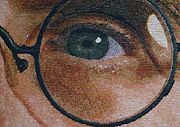
had been produced using Jacquard techniques but then artists such as Chuck Close
Chuck Close
Charles Thomas "Chuck" Close is an American painter and photographer who achieved fame as a photorealist, through his massive-scale portraits...
adapted the
computerised Jacquard process to producing fine art.
Typically, tapestries are translated from the original design via a process resembling paint-by-numbers: a cartoon
Cartoon
A cartoon is a form of two-dimensional illustrated visual art. While the specific definition has changed over time, modern usage refers to a typically non-realistic or semi-realistic drawing or painting intended for satire, caricature, or humor, or to the artistic style of such works...
is divided into regions, each of which is assigned a solid colour based on a standard palette. However, in Jacquard weaving
Jacquard weaving
Jacquard weaving makes possible in almost any loom the programmed raising of each warp thread independently of the others. This brings much greater versatility to the weaving process, and offers the highest level of warp yarn control...
, the repeating series of multicoloured warp and weft threads can be used to create colours that are optically blended – i.e., the human eye apprehends the threads’ combination of values as a single colour.
This method can be likened to pointillism
Pointillism
Pointillism is a technique of painting in which small, distinct dots of pure color are applied in patterns to form an image. Georges Seurat developed the technique in 1886, branching from Impressionism. The term Pointillism was first coined by art critics in the late 1880s to ridicule the works...
, which originated from discoveries made in the tapestry medium. The style’s emergence in the 19th century can be traced to the influence of Michel Eugène Chevreul
Michel Eugène Chevreul
Michel Eugène Chevreul was a French chemist whose work with fatty acids led to early applications in the fields of art and science. He is credited with the discovery of margaric acid and designing an early form of soap made from animal fats and salt...
, a French chemist responsible for developing the color wheel of primary and intermediary hues. Chevreul worked as the director of the dye works at Les Gobelins tapestry works in Paris
Paris
Paris is the capital and largest city in France, situated on the river Seine, in northern France, at the heart of the Île-de-France region...
, where he noticed that the perceived colour of a particular thread was influenced by its surrounding threads, a phenomenon he called “simultaneous contrast.” Chevreul’s work was a continuation of theories of color elaborated by Leonardo da Vinci
Leonardo da Vinci
Leonardo di ser Piero da Vinci was an Italian Renaissance polymath: painter, sculptor, architect, musician, scientist, mathematician, engineer, inventor, anatomist, geologist, cartographer, botanist and writer whose genius, perhaps more than that of any other figure, epitomized the Renaissance...
and Goethe; in turn, his work influenced painters including Eugène Delacroix
Eugène Delacroix
Ferdinand Victor Eugène Delacroix was a French Romantic artist regarded from the outset of his career as the leader of the French Romantic school...
and Georges-Pierre Seurat
Georges-Pierre Seurat
Georges-Pierre Seurat was a French Post-Impressionist painter and draftsman. He is noted for his innovative use of drawing media and for devising a technique of painting known as pointillism...
.
The principles articulated by Chevreul also apply to contemporary television and computer displays, which use tiny dots of red, green and blue (RGB) light to render colour, with each composite being called a pixel
Pixel
In digital imaging, a pixel, or pel, is a single point in a raster image, or the smallest addressable screen element in a display device; it is the smallest unit of picture that can be represented or controlled....
.
Famous tapestries
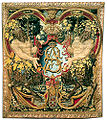
- The Trojan WarTrojan WarIn Greek mythology, the Trojan War was waged against the city of Troy by the Achaeans after Paris of Troy took Helen from her husband Menelaus, the king of Sparta. The war is among the most important events in Greek mythology and was narrated in many works of Greek literature, including the Iliad...
tapestry referred to by HomerHomerIn the Western classical tradition Homer , is the author of the Iliad and the Odyssey, and is revered as the greatest ancient Greek epic poet. These epics lie at the beginning of the Western canon of literature, and have had an enormous influence on the history of literature.When he lived is...
in Book III of the IliadIliadThe Iliad is an epic poem in dactylic hexameters, traditionally attributed to Homer. Set during the Trojan War, the ten-year siege of the city of Troy by a coalition of Greek states, it tells of the battles and events during the weeks of a quarrel between King Agamemnon and the warrior Achilles...
, where IrisIris (mythology)In Greek mythology, Iris is the personification of the rainbow and messenger of the gods. As the sun unites Earth and heaven, Iris links the gods to humanity...
disguises herself as LaodiceLaodice-Greek mythology:* Laodice , daughter of Priam, king of Troy* Laodice, daughter of Agamemnon, a.k.a. Electra* Laodice, one of the Hyperborean maidens* Laodice, consort of Phoroneus...
and finds Helen "working at a great web of purple linen, on which she was embroidering the battles between Trojans and Achaeans, that AresAresAres is the Greek god of war. He is one of the Twelve Olympians, and the son of Zeus and Hera. In Greek literature, he often represents the physical or violent aspect of war, in contrast to the armored Athena, whose functions as a goddess of intelligence include military strategy and...
had made them fight for her sake." If such a tapestry had been made at the time, then it could explain how the battles were remembered in such great detail over the 400 or so years between the siege of Troy and the age of Homer. - The Cloth of St GereonCloth of St GereonThe Cloth of St Gereon is a mural tapestry of a repeat pattern with a decorative motif of a bull being attacked by a griffin, a fantastic creature with the body of a lion and the head and wings of an eagle. The Cloth of St Gereon is the oldest known European tapestry still existing, dating to the...
- oldest European tapestry still extant. - The Sampul tapestrySampul tapestryThe Sampul tapestry is a woolen wall-hanging that was found in Sampul, in the Tarim Basin inside a 3rd-2nd century BCE mass grave.The tapestry depicts a soldier, probably Greek, and a Centaur. It is probably a Greek work from Central Asia and uses more than 24 threads of different colors in a...
, woollen wall hanging, 3rd-2nd century BC, Sampul, ÜrümqiÜrümqiÜrümqi , formerly Tihwa , is the capital of Xinjiang Uyghur Autonomous Region of the People's Republic of China, in the northwest of the country....
XinjiangXinjiangXinjiang is an autonomous region of the People's Republic of China. It is the largest Chinese administrative division and spans over 1.6 million km2...
MuseumMuseumA museum is an institution that cares for a collection of artifacts and other objects of scientific, artistic, cultural, or historical importance and makes them available for public viewing through exhibits that may be permanent or temporary. Most large museums are located in major cities...
. - The Hestia TapestryThe Hestia TapestryThe Hestia Tapestry is a Byzantine tapestry woven from wool and linen in 6th century AD in Egypt. It is a late representation of Hestia the Greek goddess of the hearth. The tapestry measures 44 x 53 inches and is labeled in Greek “Hestia Polyolbos"...
, 6th century, Egypt, Dumbarton OaksDumbarton OaksDumbarton Oaks is the conventional name for the Dumbarton Oaks Research Library and Collection, situated on a historic property in the Georgetown neighborhood of Washington, D.C. The institution is administered by the Trustees for Harvard University. Its founders, Robert Woods Bliss and his wife...
Collection. - The Bayeux TapestryBayeux TapestryThe Bayeux Tapestry is an embroidered cloth—not an actual tapestry—nearly long, which depicts the events leading up to the Norman conquest of England concerning William, Duke of Normandy and Harold, Earl of Wessex, later King of England, and culminating in the Battle of Hastings...
, which depicts the events surrounding the Battle of HastingsBattle of HastingsThe Battle of Hastings occurred on 14 October 1066 during the Norman conquest of England, between the Norman-French army of Duke William II of Normandy and the English army under King Harold II...
; note that this is not (strictly speaking) a tapestry, but is instead embroideryEmbroideryEmbroidery is the art or handicraft of decorating fabric or other materials with needle and thread or yarn. Embroidery may also incorporate other materials such as metal strips, pearls, beads, quills, and sequins....
. In June 2007, the tapestry was listed on UNESCO's Memory of the World RegisterMemory of the World ProgrammeUNESCO's Memory of the World Programme is an international initiative launched to safeguard the documentary heritage of humanity against collective amnesia, neglect, the ravages of time and climatic conditions, and willful and deliberate destruction...
. - The Apocalypse Tapestry is the longest tapestry in the world, and depicts scenes from the Book of RevelationBook of RevelationThe Book of Revelation is the final book of the New Testament. The title came into usage from the first word of the book in Koine Greek: apokalupsis, meaning "unveiling" or "revelation"...
. It was woven between 1373 and 1382. Originally 140 m (459 ft), the surviving 100m are displayed in the Château d'AngersChâteau d'AngersThe Château d'Angers is a fortress style château located in the Loire Valley that is home of the Apocalypse Tapestry.- Building description :...
, in AngersAngersAngers is the main city in the Maine-et-Loire department in western France about south-west of Paris. Angers is located in the French region known by its pre-revolutionary, provincial name, Anjou, and its inhabitants are called Angevins....
. - The six-part piece La Dame à la Licorne (The Lady and the UnicornThe Lady and the UnicornThe Lady and the Unicorn is the modern title given to a series of six tapestries woven in Flanders of wool and silk, from designs drawn in Paris in the late fifteenth century, The suite, on display in the Musée du Moyen-Âge, is often considered one of the greatest works of art of the Middle...
), stored in l'Hôtel de Cluny, ParisParisParis is the capital and largest city in France, situated on the river Seine, in northern France, at the heart of the Île-de-France region...
. - The Devonshire Hunting TapestriesDevonshire Hunting TapestriesThe Devonshire Hunting Tapestries are a group of four magnificent Flemish tapestries dating from the mid-fifteenth century. These enormous works, each over 3 metres wide, depict men and women in fashionable dress of the early fifteenth century hunting in a forest. The tapestries formerly belonged...
, four Flemish tapestries dating from the mid-fifteenth century depict men and women in fashionable dress of the early fifteenth century hunting in a forest. The tapestries formerly belonged to the Duke of DevonshireDuke of DevonshireDuke of Devonshire is a title in the peerage of England held by members of the Cavendish family. This branch of the Cavendish family has been one of the richest and most influential aristocratic families in England since the 16th century, and have been rivalled in political influence perhaps only...
and are now in the Victoria and Albert MuseumVictoria and Albert MuseumThe Victoria and Albert Museum , set in the Brompton district of The Royal Borough of Kensington and Chelsea, London, England, is the world's largest museum of decorative arts and design, housing a permanent collection of over 4.5 million objects...
. - The Hunt of the UnicornThe Hunt of the UnicornThe Hunt of the Unicorn, often referred to as the Unicorn Tapestries, is a series of seven tapestries dating from 1495–1505. The tapestries show a group of noblemen and hunters in pursuit of a unicorn. It is believed the tapestries were made in the Southern Netherlands.-Production:The...
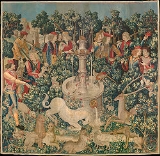
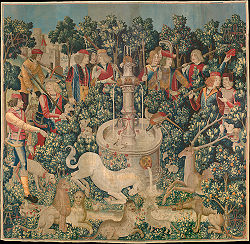
is a seven piece tapestry from 1495 to 1505, currently displayed at The CloistersThe CloistersThe Cloisters is a museum located in Fort Tryon Park, New York City. The building, which is a branch of the Metropolitan Museum of Art, was reconstructed in the 1930s from the architectural elements of several European medieval abbeys...
, Metropolitan Museum of ArtMetropolitan Museum of ArtThe Metropolitan Museum of Art is a renowned art museum in New York City. Its permanent collection contains more than two million works, divided into nineteen curatorial departments. The main building, located on the eastern edge of Central Park along Manhattan's Museum Mile, is one of the...
in New York. - The tapestries for the Sistine ChapelSistine ChapelSistine Chapel is the best-known chapel in the Apostolic Palace, the official residence of the Pope in Vatican City. It is famous for its architecture and its decoration that was frescoed throughout by Renaissance artists including Michelangelo, Sandro Botticelli, Pietro Perugino, Pinturicchio...
, designed by RaphaelRaphaelRaffaello Sanzio da Urbino , better known simply as Raphael, was an Italian painter and architect of the High Renaissance. His work is admired for its clarity of form and ease of composition and for its visual achievement of the Neoplatonic ideal of human grandeur...
in 1515-16, for which the Raphael CartoonsRaphael CartoonsThe Raphael Cartoons are seven large cartoons for tapestries, now in the Victoria and Albert Museum, London, painted by the High Renaissance painter Raphael in 1515-16 and showing scenes from the Gospels and Acts of the Apostles...
, or painted designs, also survive. - The Wawel TapestriesJagiellonian tapestriesThe so-called Jagiellonian tapestries is collection of tapestries which originally consisted of about 360 fabrics gathered by the Jagiellons to decorate the interiors of the royal residencies...
, (mid 16th century) a collection of 134 tapestries at the Wawel Castle in KrakówKrakówKraków also Krakow, or Cracow , is the second largest and one of the oldest cities in Poland. Situated on the Vistula River in the Lesser Poland region, the city dates back to the 7th century. Kraków has traditionally been one of the leading centres of Polish academic, cultural, and artistic life...
, Poland displaying various religious, natural, and royal themes. These famous tapestries, created in ArrasArrasArras is the capital of the Pas-de-Calais department in northern France. The historic centre of the Artois region, its local speech is characterized as a Picard dialect...
, were collected by Polish Kings Sigismund I the OldSigismund I the OldSigismund I of Poland , of the Jagiellon dynasty, reigned as King of Poland and also as the Grand Duke of Lithuania from 1506 until 1548...
and Sigismund II AugustusSigismund II AugustusSigismund II Augustus I was King of Poland and Grand Duke of Lithuania, the only son of Sigismund I the Old, whom Sigismund II succeeded in 1548...
. - The Valois TapestriesValois TapestriesThe Valois Tapestries are a series of eight tapestries depicting festivities or "magnificences" at the Court of France in the second half of the 16th century. The tapestries were worked in the Spanish Netherlands, probably in Brussels or Antwerp, shortly after 1580.Scholars have not firmly...
are a cycle of 8 hangings depicting royal festivities in FranceFranceThe French Republic , The French Republic , The French Republic , (commonly known as France , is a unitary semi-presidential republic in Western Europe with several overseas territories and islands located on other continents and in the Indian, Pacific, and Atlantic oceans. Metropolitan France...
in the 1560s and 1570s - The New World TapestryNew World TapestryThe New World Tapestry is the largest stitched embroidery in the world, larger than the Bayeux Tapestry. It depicts English colonisation attempts in Newfoundland, North America, the Guyanas and Bermuda between the years 1583 and 1642, when the English Civil War began.Work began on the tapestry in...
is a 267 feet long tapestry which depicts the colonisation of the Americas between 1583 and 1648, displayed at the British Empire and Commonwealth MuseumBritish Empire and Commonwealth MuseumThe British Empire and Commonwealth Museum was a museum in Bristol, United Kingdom exploring the history of the British Empire and the effect of British colonial rule on the rest of the world....
; this is not (strictly speaking) a tapestry, but is instead embroideryEmbroideryEmbroidery is the art or handicraft of decorating fabric or other materials with needle and thread or yarn. Embroidery may also incorporate other materials such as metal strips, pearls, beads, quills, and sequins....
. - The biggest collection of Flanders tapestry is in the Spanish royal collection, there is 8000 metres of historical tapestry from Flanders, as well as Spanish tapestries designed by Goya and others. There is a special museum in the Royal Palace of La Granja de San Ildefonso, and others are displayed in various historic buildings.
- The Pastoral AmusementsThe Pastoral Amusements-Les Amusements Champêtres:The Pastoral Amusements, known in French as "Les Amusements Champêtres", is a series of tapestries designed between 1720 and 1730 by Jean Baptiste Oudry for Noël-Antoine de Mérou, then director of the Royal Beauvais Tapestry Manufactory.The first production of the designs...
, also known as "Les Amusements Champêtres", a series of 8 Beauvais Tapestries designed by Jean Baptiste Oudry between 1720 and 1730. - The Prestonpans TapestryPrestonpans TapestryThe Prestonpans Tapestry is a large embroidery created - and normally situated in - Prestonpans, East Lothian, Scotland.Its full title is "The Battle of Prestonpans Tapestry 1754"....
is a 104 metres long embroideryEmbroideryEmbroidery is the art or handicraft of decorating fabric or other materials with needle and thread or yarn. Embroidery may also incorporate other materials such as metal strips, pearls, beads, quills, and sequins....
which tells the story of Bonnie Prince Charlie and the Battle of PrestonpansBattle of PrestonpansThe Battle of Prestonpans was the first significant conflict in the Jacobite Rising of 1745. The battle took place at 4 am on 21 September 1745. The Jacobite army loyal to James Francis Edward Stuart and led by his son Charles Edward Stuart defeated the government army loyal to the Hanoverian...
. - Christ in Glory, (1962) for Coventry CathedralCoventry CathedralCoventry Cathedral, also known as St Michael's Cathedral, is the seat of the Bishop of Coventry and the Diocese of Coventry, in Coventry, West Midlands, England. The current bishop is the Right Revd Christopher Cocksworth....
designed by Graham SutherlandGraham SutherlandGraham Vivien Sutherland OM was an English artist.-Early life:He was born in Streatham, attending Homefield Preparatory School, Sutton. He was then educated at Epsom College, Surrey before going up to Goldsmiths, University of London...
. Up until the 1990s this was the world's largest vertical tapestry. - The Quaker TapestryQuaker TapestryThe Quaker Tapestry consists of 77 panels illustrating the history of Quakerism from the 17th century up to the present day. The idea of Quaker Anne Wynn-Wilson, the tapestry has a permanent home at the Friends Meeting House at Kendal, Cumbria, England....
( 1981-1989) is a modern set of embroideryEmbroideryEmbroidery is the art or handicraft of decorating fabric or other materials with needle and thread or yarn. Embroidery may also incorporate other materials such as metal strips, pearls, beads, quills, and sequins....
panels that tell the story of Quakerism from the 17th century to the present day.
External links
- Jagiellonian Tapestries
- Tapestry, "A World History of Art"
- Embroidery and Tapestry Weaving, by Grace Christie, 1912, from Project GutenbergProject GutenbergProject Gutenberg is a volunteer effort to digitize and archive cultural works, to "encourage the creation and distribution of eBooks". Founded in 1971 by Michael S. Hart, it is the oldest digital library. Most of the items in its collection are the full texts of public domain books...
. Technical handbook. - Pictures from a contemporary mill, showing tapestries being woven on looms with Jacquard heads