


Banu Ifran

Encyclopedia
The Ifranids, also called Banu Ifran, Ifran, or the children of the Afri , were a Berber
tribe prominent in the history of pre-Islamic and early Islamic North Africa
.
Tlemcen
in present-day Algeria
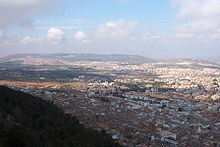
was a capital of the Kingdom of Banu Ifran from AD 790 to AD 1068.
The Banu Ifran resisted or revolted against the foreign occupiers—Romans
, Vandals
, and Byzantines
—of their territory in Africa
. In the seventh century, they sided with Kahina
in her resistance against the Muslim Umayyad
invaders. In the eighth century they mobilized around the dogma of sufri
in revolting against the Arab Umayyads and Abbasids. In the 10th century they founded a dynasty opposed to the Fatimids, the Zirids, the Umayyads, the Hammadids and the Maghraoua. The Banu Ifran were defeated by the Almoravids
and the invading Arabs (the Banu Hilal
and the Banu Sulaym) to the end of the 11th century.
The Ifranid was recognized as the only dynasty that has defended the indigenous people of the Maghreb, by the Romans referred to as the Afri
cani.
In 11th century Iberia
, the Banu Ifran conquered and built the city of Ronda
in Andalusia
and governed from Cordoba
for several centuries.
 The Banu Ifran were one of the four major tribes of the Zenata
or Gaetulia
confederation, and were known as expert cavalrymen. According to Ibn Khaldoun, "Ifrinides" or "Ait Ifren" were successfully resisting Romans, Vandals and Byzantines who sought to occupy North Africa before the arrival of the Muslim armies. According to Corripus in Johannide, during the reign of Justinian between 547 and 550, the Banu Ifran challenged the Byzantine armies to war. Their chief Abu Qurra
rebuilt the city of Tlemcen
in Algeria
in 765 (formerly, it was a Roman city named Pomaria). They opposed the Egyptian Fatimid Caliphate
, aligning themselves with the Maghrawa
tribe and the Umayyad Caliphate of Córdoba, although they themselves became Kharijites
. Led by Abu Yazid
, they surged east and attacked Kairouan
in 945. Another leader, Ya'la ibn Muhammad
captured Oran
and constructed a new capital, Ifgan, near Mascara. Under the leadership of their able general Jawhar, who killed Ya'la
in battle in 954, the Fatimids struck back and destroyed Ifgan, and for some time afterward the Banu Ifran reverted to being scattered nomad
s in perpetual competition with their Sanhaja
neighbours. Some settled in regions of Spain, such as Malaga
. Others, led by Hammama, managed to gain control of the Moroccan province of Tadla
. Later, led by Abu al-Kamāl, they established a new capital at Salé
on the Atlantic coast, though this brought them into conflict with the Barghawata tribes on the seaboard.
During the 11th century, the Banu Ifran contested with the Maghrawa
tribe for the sovereignty over the former Idrisid
Kingdom of Fes
. Ya'la's son Yaddū took Fes
by surprise in January 993 and held it for some months until the Maghrawa
ruler Ziri ibn Atiyya
returned from Spain and reconquered the region.
In May or June of 1033, Fes
was recaptured by Ya'la's grandson Tamīm. Fanatically devoted to religion, he began a persecution of the Berber Jews
, and is said to have killed 6000 of their men while confiscating their wealth and women. Sometime in the period 1038-1040 the Maghrawa
tribe retook Fes
, forcing Tamīm to flee to Salé
.
Soon after that time, the Almoravids began their rise to power and effectively eliminated and exterminated both the Banu Ifran and their brother-rivals the Maghrawa
.
means Land of the Afri, the indigenous inhabitants of North Africa. Ifran is a plural for Afar, Efri or Ifri; it is probably derived from the last of these, which means "cave" in Berber. Another possibility is that their name is derived from one of the major gods of the pagan Berbers, Ifrou.
The name of the Ifran tribe has many alternative spellings, such as Ifuraces or Afar in Latin, or Ifrinidi, Iforen, Fren, Wafren, Yefren, Yafren, or Yafran, but all of the names mean simply "The Sons of Ifri". The banu- was added by the Arab writers, who called them "ben ifren" or "Ifrinid".
 Among the Ifran, animism was the principal spiritual philosophy. Ifri was also the name of a Berber deity, and their name may have an origin in their beliefs.
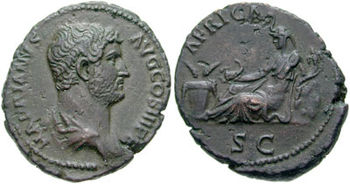
Ifru rites symbolized in caves were held to gain favor or protection for merchants and traders. The myth of this protection is befittingly depicted on Roman coins. http://books.google.fr/books?id=r8E4AAAAMAAJ&pg=PA461&dq=gurzil+ifri
Ifru was regarded as a sun goddess, cave goddess and protector of the home. http://books.google.fr/books?id=_foLAAAAIAAJ&q=ifru&dq=ifru&pgis=1 Ifru or Ifran was regarded as a Berber version of Vesta.
Dehia, usually referred to as The Kahina
was the Dejrawa Berber queen, prophetess, and leader of the non-Muslim response to the advancing Arab armies. Some historians claim Kahina
was Christian, or a follower of the Judaic faith, though few of the Ifran were Christians, even after more than half a millennium of Christianity among the urban populations and the more sedentary tribes.
Ibn Khaldun
simply states that Ifran were Berbers, and says nothing of their religion before the advent of Islam.
Ibn Khaldun
claimed that the "Zenata
people say they are Muslims but they still oppose the Arab army.". After 711, the Berbers were systematically converted to Islam and many became devout members of the faith.
Ifrans
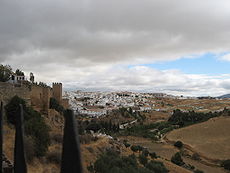 The Banu Ifran were influential in Spain in the 11th century AD. The Ifran house of Corra ruled the Andalusian city Ronda
in Spain
.
Yeddas was the military leader of the Berber troops who were at war against the Christian king and El Mehdi.
Abu Nour
or Nour of the house of Corra became lord of Ronda and then Seville
in Andalusia from 1023 to 1039 and from 1039 to 1054.
The son of Nour bin Badis Hallal ruled Ronda from 1054 to 1057, and Abu Nacer from 1057 to 1065.
http://books.google.com/books?id=JTs8AAAAMAAJ&pg=PA424&lpg=PA424&dq=ifren+ibn+khaldoun&source=web&ots=Q9OvRveeAn&sig=8z3v54cMWkoC-qF_6JMzVzkOb_Ehttp://books.google.com/books?id=FgMIAAAAQAAJ&pg=RA1-PA193&dq=ifren&as_brr=1&hl=fr#PRA1-PA193,M1http://books.google.com/books?id=dXdBAAAAIAAJ&pg=PA577&dq=ifuraces&as_brr=1&hl=frhttp://books.google.com/books?id=dXdBAAAAIAAJ&pg=PA2&dq=ifren&as_brr=1&hl=frhttp://books.google.com/books?id=qtU1AAAAMAAJ&pg=RA1-PA193&dq=ifren&as_brr=1&hl=frhttp://books.google.com/books?id=s54BAAAAQAAJ&pg=RA7-PA299&dq=ifren&as_brr=1&hl=fr http://books.google.com/books?id=ue8IAAAAQAAJ&pg=RA3-PA718-IA1&dq=ifren&as_brr=1&hl=frhttp://books.google.com/books?id=zjoOAAAAYAAJ&pg=PA90&dq=ifuraces&as_brr=1&hl=fr#PPA89,M1http://books.google.com/books?id=uE48AAAAMAAJ&pg=PR103&dq=ifren&as_brr=1&hl=frhttp://books.google.com/books?id=n7gBAAAAYAAJ&pg=PR147&dq=ifren&as_brr=1&hl=frhttp://books.google.fr/books?id=XzMFAAAAQAAJ&pg=RA2-PA46&dq=ifuraces&as_brr=1
genealogy of Ibn Khaldun
Ouargla Town of Algeria
Tribe of Djelfa and Tlemcen
History of Kenitra town in Morocco
History of Touggourt town in Algeria
Merindjissa and Ifran
History of Mahdia Morocco
History of Tlemcen Algeria
Medina Sale Marocco
Adrar in Algeria tribe of Zenata history of Almoravide and Ifran
Ifran at Ronda
Berber people
Berbers are the indigenous peoples of North Africa west of the Nile Valley. They are continuously distributed from the Atlantic to the Siwa oasis, in Egypt, and from the Mediterranean to the Niger River. Historically they spoke the Berber language or varieties of it, which together form a branch...
tribe prominent in the history of pre-Islamic and early Islamic North Africa
North Africa
North Africa or Northern Africa is the northernmost region of the African continent, linked by the Sahara to Sub-Saharan Africa. Geopolitically, the United Nations definition of Northern Africa includes eight countries or territories; Algeria, Egypt, Libya, Morocco, South Sudan, Sudan, Tunisia, and...
.
Tlemcen
Tlemcen
Tlemcen is a town in Northwestern Algeria, and the capital of the province of the same name. It is located inland in the center of a region known for its olive plantations and vineyards...
in present-day Algeria
Algeria
Algeria , officially the People's Democratic Republic of Algeria , also formally referred to as the Democratic and Popular Republic of Algeria, is a country in the Maghreb region of Northwest Africa with Algiers as its capital.In terms of land area, it is the largest country in Africa and the Arab...
was a capital of the Kingdom of Banu Ifran from AD 790 to AD 1068.
The Banu Ifran resisted or revolted against the foreign occupiers—Romans
Ancient Rome
Ancient Rome was a thriving civilization that grew on the Italian Peninsula as early as the 8th century BC. Located along the Mediterranean Sea and centered on the city of Rome, it expanded to one of the largest empires in the ancient world....
, Vandals
Vandals
The Vandals were an East Germanic tribe that entered the late Roman Empire during the 5th century. The Vandals under king Genseric entered Africa in 429 and by 439 established a kingdom which included the Roman Africa province, besides the islands of Sicily, Corsica, Sardinia and the Balearics....
, and Byzantines
Byzantine Empire
The Byzantine Empire was the Eastern Roman Empire during the periods of Late Antiquity and the Middle Ages, centred on the capital of Constantinople. Known simply as the Roman Empire or Romania to its inhabitants and neighbours, the Empire was the direct continuation of the Ancient Roman State...
—of their territory in Africa
Africa Province
The Roman province of Africa was established after the Romans defeated Carthage in the Third Punic War. It roughly comprised the territory of present-day northern Tunisia, and the small Mediterranean coast of modern-day western Libya along the Syrtis Minor...
. In the seventh century, they sided with Kahina
Kahina
al-Kāhina was a 7th century female Berber religious and military leader, who led indigenous resistance to Arab expansion in Northwest Africa, the region then known as Numidia, known as the Maghreb today...
in her resistance against the Muslim Umayyad
Umayyad
The Umayyad Caliphate was the second of the four major Arab caliphates established after the death of Muhammad. It was ruled by the Umayyad dynasty, whose name derives from Umayya ibn Abd Shams, the great-grandfather of the first Umayyad caliph. Although the Umayyad family originally came from the...
invaders. In the eighth century they mobilized around the dogma of sufri
Sufri
The Sufris were a Khariji sect of Islam that existed in the 7th and 8th centuries. They established the Midrarid state at Sijilmassa.In Algeria , the Banu Ifran were Sufri Berbers who opposed Umayyad, Abbasids and Fatimid rule, most notably under resistance movements led by Abu Qurra and Abu...
in revolting against the Arab Umayyads and Abbasids. In the 10th century they founded a dynasty opposed to the Fatimids, the Zirids, the Umayyads, the Hammadids and the Maghraoua. The Banu Ifran were defeated by the Almoravids
Almoravids
The Almoravids were a Berber dynasty of Morocco, who formed an empire in the 11th-century that stretched over the western Maghreb and Al-Andalus. Their capital was Marrakesh, a city which they founded in 1062 C.E...
and the invading Arabs (the Banu Hilal
Banu Hilal
The Banu Hilal were a confederation of Arabian Bedouin tribes that migrated from Upper Egypt into North Africa in the 11th century, having been sent by the Fatimids to punish the Zirids for abandoning Shiism. Other authors suggest that the tribes left the grasslands on the upper Nile because of...
and the Banu Sulaym) to the end of the 11th century.
The Ifranid was recognized as the only dynasty that has defended the indigenous people of the Maghreb, by the Romans referred to as the Afri
Afri
Afri was a Latin name for the Carthaginians. It was received by the Romans from the Carthaginians, as a native term for their country....
cani.
In 11th century Iberia
Iberian Peninsula
The Iberian Peninsula , sometimes called Iberia, is located in the extreme southwest of Europe and includes the modern-day sovereign states of Spain, Portugal and Andorra, as well as the British Overseas Territory of Gibraltar...
, the Banu Ifran conquered and built the city of Ronda
Ronda
Ronda is a city in Spanish province of Málaga. It is located about West from the city of Málaga, within the autonomous community of Andalusia. Its population is approximately 35,000 inhabitants.-History:...
in Andalusia
Andalusia
Andalusia is the most populous and the second largest in area of the autonomous communities of Spain. The Andalusian autonomous community is officially recognised as a nationality of Spain. The territory is divided into eight provinces: Huelva, Seville, Cádiz, Córdoba, Málaga, Jaén, Granada and...
and governed from Cordoba
Córdoba, Spain
-History:The first trace of human presence in the area are remains of a Neanderthal Man, dating to c. 32,000 BC. In the 8th century BC, during the ancient Tartessos period, a pre-urban settlement existed. The population gradually learned copper and silver metallurgy...
for several centuries.
History
Zenata
Zenata were an ethnic group of North Africa, who were technically an Eastern Berber group and who are found in Tunisia, Algeria and Morocco....
or Gaetulia
Gaetulia
Gaetuli was the Romanised name of an ancient Berber tribe inhabiting Getulia, covering the desert region south of the Atlas Mountains, bordering the Sahara. Other sources place Getulia in pre-Roman times along the Mediterranean coasts of what is now Algeria and Tunisia, and north of the Atlas...
confederation, and were known as expert cavalrymen. According to Ibn Khaldoun, "Ifrinides" or "Ait Ifren" were successfully resisting Romans, Vandals and Byzantines who sought to occupy North Africa before the arrival of the Muslim armies. According to Corripus in Johannide, during the reign of Justinian between 547 and 550, the Banu Ifran challenged the Byzantine armies to war. Their chief Abu Qurra
Abu Qurra
Abu Qurra, a member of the Sufrite tribe Banu Ifran of Tlemcen, was the founder of the indigenous Berber Muslim movement in North Africa in the first step of the Umayyad dynasty. . Between 767 and 776, Abu Qurra organised an army of more than 350,000 riders in the north of Africa. It is the first...
rebuilt the city of Tlemcen
Tlemcen
Tlemcen is a town in Northwestern Algeria, and the capital of the province of the same name. It is located inland in the center of a region known for its olive plantations and vineyards...
in Algeria
Algeria
Algeria , officially the People's Democratic Republic of Algeria , also formally referred to as the Democratic and Popular Republic of Algeria, is a country in the Maghreb region of Northwest Africa with Algiers as its capital.In terms of land area, it is the largest country in Africa and the Arab...
in 765 (formerly, it was a Roman city named Pomaria). They opposed the Egyptian Fatimid Caliphate
Fatimid
The Fatimid Islamic Caliphate or al-Fāṭimiyyūn was a Berber Shia Muslim caliphate first centered in Tunisia and later in Egypt that ruled over varying areas of the Maghreb, Sudan, Sicily, the Levant, and Hijaz from 5 January 909 to 1171.The caliphate was ruled by the Fatimids, who established the...
, aligning themselves with the Maghrawa
Maghrawa
The Maghrawa or Meghrawa were a Berber tribe in Morocco and central and western Algeria.-History:The Meghrawa, a tribe of Zanata Berbers, were one of the first Berber tribes to submit to Islam in the 7th century. They supported Uqba ibn Nafi in his campaign to the Atlantic in 683...
tribe and the Umayyad Caliphate of Córdoba, although they themselves became Kharijites
Kharijites
Kharijites is a general term embracing various Muslims who, while initially supporting the authority of the final Rashidun Caliph Ali ibn Abi Talib, the son-in-law and cousin of the Islamic prophet Muhammad, then later rejected his leadership...
. Led by Abu Yazid
Abu Yazid
Abū Yazīd Mukhallad ibn Kayrād , nicknamed Ṣāhib al-Himār "Possessor of the donkey", was a Kharijite Berber of the Banu Ifran tribe who led a rebellion against the Fatimids in Ifriqiya starting in 944...
, they surged east and attacked Kairouan
Kairouan
Kairouan , also known as Kirwan or al-Qayrawan , is the capital of the Kairouan Governorate in Tunisia. Referred to as the Islamic Cultural Capital, it is a UNESCO World Heritage site. The city was founded by the Arabs around 670...
in 945. Another leader, Ya'la ibn Muhammad
Yala
-Asia:* Yala National Park, Sri Lanka* Yala is the dry season in Sri Lanka, see Climate of Sri Lanka. Its counterpart is Maha, the wet season.* Yala Province, Thailand*Yala, Thailand, its administrative capital...
captured Oran
Oran
Oran is a major city on the northwestern Mediterranean coast of Algeria, and the second largest city of the country.It is the capital of the Oran Province . The city has a population of 759,645 , while the metropolitan area has a population of approximately 1,500,000, making it the second largest...
and constructed a new capital, Ifgan, near Mascara. Under the leadership of their able general Jawhar, who killed Ya'la
Yala
-Asia:* Yala National Park, Sri Lanka* Yala is the dry season in Sri Lanka, see Climate of Sri Lanka. Its counterpart is Maha, the wet season.* Yala Province, Thailand*Yala, Thailand, its administrative capital...
in battle in 954, the Fatimids struck back and destroyed Ifgan, and for some time afterward the Banu Ifran reverted to being scattered nomad
Nomad
Nomadic people , commonly known as itinerants in modern-day contexts, are communities of people who move from one place to another, rather than settling permanently in one location. There are an estimated 30-40 million nomads in the world. Many cultures have traditionally been nomadic, but...
s in perpetual competition with their Sanhaja
Sanhaja
The Sanhaja or Senhaja were once one of the largest Berber tribal confederations of the Maghreb, along with the Zanata and Masmuda...
neighbours. Some settled in regions of Spain, such as Malaga
Málaga
Málaga is a city and a municipality in the Autonomous Community of Andalusia, Spain. With a population of 568,507 in 2010, it is the second most populous city of Andalusia and the sixth largest in Spain. This is the southernmost large city in Europe...
. Others, led by Hammama, managed to gain control of the Moroccan province of Tadla
Tadla-Azilal
Tadla-Azilal ) is one of the sixteen regions of Morocco. It is situated in central Morocco. It covers an area of 17,125 km² and has a population of 1,450,519 . The capital is Beni Mellal.The region is made into of the following provinces :...
. Later, led by Abu al-Kamāl, they established a new capital at Salé
Salé
Salé is a city in north-western Morocco, on the right bank of the Bou Regreg river, opposite the national capital Rabat, for which it serves as a commuter town...
on the Atlantic coast, though this brought them into conflict with the Barghawata tribes on the seaboard.
During the 11th century, the Banu Ifran contested with the Maghrawa
Maghrawa
The Maghrawa or Meghrawa were a Berber tribe in Morocco and central and western Algeria.-History:The Meghrawa, a tribe of Zanata Berbers, were one of the first Berber tribes to submit to Islam in the 7th century. They supported Uqba ibn Nafi in his campaign to the Atlantic in 683...
tribe for the sovereignty over the former Idrisid
Idrisid
The Idrisids were a Zaydi-Shia dynasty of Arab origins in Morocco, ruling from 788 to 985, named after its first leader, Idriss I.-History:...
Kingdom of Fes
Fes
Fes or Fez is the second largest city of Morocco, after Casablanca, with a population of approximately 1 million . It is the capital of the Fès-Boulemane region....
. Ya'la's son Yaddū took Fes
Fes
Fes or Fez is the second largest city of Morocco, after Casablanca, with a population of approximately 1 million . It is the capital of the Fès-Boulemane region....
by surprise in January 993 and held it for some months until the Maghrawa
Maghrawa
The Maghrawa or Meghrawa were a Berber tribe in Morocco and central and western Algeria.-History:The Meghrawa, a tribe of Zanata Berbers, were one of the first Berber tribes to submit to Islam in the 7th century. They supported Uqba ibn Nafi in his campaign to the Atlantic in 683...
ruler Ziri ibn Atiyya
Ziri ibn Atiyya
Ziri ibn 'Atiyya ibn Abd Allah ibn Tabādalt ibn Muhammad ibn Khazar az-Zanātī al-Maghrāwī al-Khazarī was the first Maghrawa ruler of the Kingdom of Fes and other parts of Morocco, Algeria and Tunisia....
returned from Spain and reconquered the region.
In May or June of 1033, Fes
Fes
Fes or Fez is the second largest city of Morocco, after Casablanca, with a population of approximately 1 million . It is the capital of the Fès-Boulemane region....
was recaptured by Ya'la's grandson Tamīm. Fanatically devoted to religion, he began a persecution of the Berber Jews
Berber Jews
Berber Jews are the Berber-speaking Jewish communities which used to live in certain parts of Atlas mountains in Morocco. Their origins are not clear as one theory builds the case for "Judeo-cized Berbers" while another defends the "Berber-ized Jews" thesis....
, and is said to have killed 6000 of their men while confiscating their wealth and women. Sometime in the period 1038-1040 the Maghrawa
Maghrawa
The Maghrawa or Meghrawa were a Berber tribe in Morocco and central and western Algeria.-History:The Meghrawa, a tribe of Zanata Berbers, were one of the first Berber tribes to submit to Islam in the 7th century. They supported Uqba ibn Nafi in his campaign to the Atlantic in 683...
tribe retook Fes
Fes
Fes or Fez is the second largest city of Morocco, after Casablanca, with a population of approximately 1 million . It is the capital of the Fès-Boulemane region....
, forcing Tamīm to flee to Salé
Salé
Salé is a city in north-western Morocco, on the right bank of the Bou Regreg river, opposite the national capital Rabat, for which it serves as a commuter town...
.
Soon after that time, the Almoravids began their rise to power and effectively eliminated and exterminated both the Banu Ifran and their brother-rivals the Maghrawa
Maghrawa
The Maghrawa or Meghrawa were a Berber tribe in Morocco and central and western Algeria.-History:The Meghrawa, a tribe of Zanata Berbers, were one of the first Berber tribes to submit to Islam in the 7th century. They supported Uqba ibn Nafi in his campaign to the Atlantic in 683...
.
Etymology
The Roman name AfricaAfrica
Africa is the world's second largest and second most populous continent, after Asia. At about 30.2 million km² including adjacent islands, it covers 6% of the Earth's total surface area and 20.4% of the total land area...
means Land of the Afri, the indigenous inhabitants of North Africa. Ifran is a plural for Afar, Efri or Ifri; it is probably derived from the last of these, which means "cave" in Berber. Another possibility is that their name is derived from one of the major gods of the pagan Berbers, Ifrou.
The name of the Ifran tribe has many alternative spellings, such as Ifuraces or Afar in Latin, or Ifrinidi, Iforen, Fren, Wafren, Yefren, Yafren, or Yafran, but all of the names mean simply "The Sons of Ifri". The banu- was added by the Arab writers, who called them "ben ifren" or "Ifrinid".
Before Islam
Ifru rites symbolized in caves were held to gain favor or protection for merchants and traders. The myth of this protection is befittingly depicted on Roman coins. http://books.google.fr/books?id=r8E4AAAAMAAJ&pg=PA461&dq=gurzil+ifri
Ifru was regarded as a sun goddess, cave goddess and protector of the home. http://books.google.fr/books?id=_foLAAAAIAAJ&q=ifru&dq=ifru&pgis=1 Ifru or Ifran was regarded as a Berber version of Vesta.
Dehia, usually referred to as The Kahina
Kahina
al-Kāhina was a 7th century female Berber religious and military leader, who led indigenous resistance to Arab expansion in Northwest Africa, the region then known as Numidia, known as the Maghreb today...
was the Dejrawa Berber queen, prophetess, and leader of the non-Muslim response to the advancing Arab armies. Some historians claim Kahina
Kahina
al-Kāhina was a 7th century female Berber religious and military leader, who led indigenous resistance to Arab expansion in Northwest Africa, the region then known as Numidia, known as the Maghreb today...
was Christian, or a follower of the Judaic faith, though few of the Ifran were Christians, even after more than half a millennium of Christianity among the urban populations and the more sedentary tribes.
Ibn Khaldun
Ibn Khaldun
Ibn Khaldūn or Ibn Khaldoun was an Arab Tunisian historiographer and historian who is often viewed as one of the forerunners of modern historiography, sociology and economics...
simply states that Ifran were Berbers, and says nothing of their religion before the advent of Islam.
During Islam
The Banu Ifran were opposed to the Sunnis of the Arab armies. They eventually converted, but summoned under the Kharidjite movement within Islam.Ibn Khaldun
Ibn Khaldun
Ibn Khaldūn or Ibn Khaldoun was an Arab Tunisian historiographer and historian who is often viewed as one of the forerunners of modern historiography, sociology and economics...
claimed that the "Zenata
Zenata
Zenata were an ethnic group of North Africa, who were technically an Eastern Berber group and who are found in Tunisia, Algeria and Morocco....
people say they are Muslims but they still oppose the Arab army.". After 711, the Berbers were systematically converted to Islam and many became devout members of the faith.
Dynasty
Dynasty IfranIfrans
- Abu QurraAbu QurraAbu Qurra, a member of the Sufrite tribe Banu Ifran of Tlemcen, was the founder of the indigenous Berber Muslim movement in North Africa in the first step of the Umayyad dynasty. . Between 767 and 776, Abu Qurra organised an army of more than 350,000 riders in the north of Africa. It is the first...
TlemcenTlemcenTlemcen is a town in Northwestern Algeria, and the capital of the province of the same name. It is located inland in the center of a region known for its olive plantations and vineyards...
736736Year 736 was a leap year starting on Sunday of the Julian calendar. The denomination 736 for this year has been used since the early medieval period, when the Anno Domini calendar era became the prevalent method in Europe for naming years.- Asia :* The scholar-priest Rōben invites Shinshō to give...
- 790790Year 790 was a common year starting on Friday of the Julian calendar. The denomination 790 for this year has been used since the early medieval period, when the Anno Domini calendar era became the prevalent method in Europe for naming years.- Byzantine Empire :* A revolt against Empress Irene...
.- Abou Yazid TozeurTozeurTozeur is an oasis and a city in south west Tunisia. The city is located North West of Chott el-Djerid, in between this Chott and the smaller Chott el-Gharsa. It is the capital of the Tozeur Governorate....
873873Year 873 was a common year starting on Thursday of the Julian calendar.- Europe :* The Vikings raid Dorestad.* Al-Andalus: Second uprising of Toledo due to ethnic tensions in two years.- Asia :...
- 947947Year 947 was a common year starting on Friday of the Julian calendar.- Asia :* The Later Jin Dynasty falls to the Later Han Dynasty in China....
- Abd-Allah-Ibn-Bekkar TlemcenTlemcenTlemcen is a town in Northwestern Algeria, and the capital of the province of the same name. It is located inland in the center of a region known for its olive plantations and vineyards...
- Yala Ibn Mohamed Ifgan near MascaraMascaraMascara is a cosmetic commonly used to enhance the eyes. It may darken, thicken, lengthen, and/or define the eyelashes. Normally in one of three forms—liquid, cake, or cream—the modern mascara product has various formulas; however, all contain the same basic components of pigments, oils, waxes, and...
950950Year 950 was a common year starting on Tuesday of the Julian calendar.- Europe :* Duke Boleslav I of Bohemia makes peace with Otto I....
- 958958Year 958 was a common year starting on Friday of the Julian calendar.-Africa:* The Fatimid general Gawhar al-Siqilli takes the capital of the rebellious Kharijite Banu Ya'la tribesmen, Ifgan. Gawhar in the following two years conquers most of the North of modern Morocco and Algeria...
- Yeddou 958958Year 958 was a common year starting on Friday of the Julian calendar.-Africa:* The Fatimid general Gawhar al-Siqilli takes the capital of the rebellious Kharijite Banu Ya'la tribesmen, Ifgan. Gawhar in the following two years conquers most of the North of modern Morocco and Algeria...
- FezFesFes or Fez is the second largest city of Morocco, after Casablanca, with a population of approximately 1 million . It is the capital of the Fès-Boulemane region....
993993Year 993 was a common year starting on Sunday of the Julian calendar.- In fiction :* The fantasy role-playing game Dragon Warriors is set in a fantasy world called "Legend" modeled on medieval Europe in an era approximate to this year.* In the Harry Potter series, Hogwarts School of Witchcraft...
- Habbous 993993Year 993 was a common year starting on Sunday of the Julian calendar.- In fiction :* The fantasy role-playing game Dragon Warriors is set in a fantasy world called "Legend" modeled on medieval Europe in an era approximate to this year.* In the Harry Potter series, Hogwarts School of Witchcraft...
- FezFesFes or Fez is the second largest city of Morocco, after Casablanca, with a population of approximately 1 million . It is the capital of the Fès-Boulemane region....
1029- Temim Ibn Ziri 1029 SaléSaléSalé is a city in north-western Morocco, on the right bank of the Bou Regreg river, opposite the national capital Rabat, for which it serves as a commuter town...
- 1035- Abou -l- Kemal 1036 SaléSaléSalé is a city in north-western Morocco, on the right bank of the Bou Regreg river, opposite the national capital Rabat, for which it serves as a commuter town...
- 1054 - Yocuf 1055-1056
- Hammad 1056- 1066
- Mohamed 1066
- Abou -l- Kemal 1036 Salé
- Temim Ibn Ziri 1029 Salé
- Habbous 993
- Yeddou 958
- Yala Ibn Mohamed Ifgan near Mascara
- Abd-Allah-Ibn-Bekkar Tlemcen
- Abou Yazid Tozeur
Ifran in Spain
Ronda
Ronda is a city in Spanish province of Málaga. It is located about West from the city of Málaga, within the autonomous community of Andalusia. Its population is approximately 35,000 inhabitants.-History:...
in Spain
Spain
Spain , officially the Kingdom of Spain languages]] under the European Charter for Regional or Minority Languages. In each of these, Spain's official name is as follows:;;;;;;), is a country and member state of the European Union located in southwestern Europe on the Iberian Peninsula...
.
Yeddas was the military leader of the Berber troops who were at war against the Christian king and El Mehdi.
Abu Nour
Abu Nour
Abu Nour was a Berber king of Ronda . He built the most important sites in the town ....
or Nour of the house of Corra became lord of Ronda and then Seville
Seville
Seville is the artistic, historic, cultural, and financial capital of southern Spain. It is the capital of the autonomous community of Andalusia and of the province of Seville. It is situated on the plain of the River Guadalquivir, with an average elevation of above sea level...
in Andalusia from 1023 to 1039 and from 1039 to 1054.
The son of Nour bin Badis Hallal ruled Ronda from 1054 to 1057, and Abu Nacer from 1057 to 1065.
External links
Tunisia and Africa and Ifranhttp://books.google.com/books?id=JTs8AAAAMAAJ&pg=PA424&lpg=PA424&dq=ifren+ibn+khaldoun&source=web&ots=Q9OvRveeAn&sig=8z3v54cMWkoC-qF_6JMzVzkOb_Ehttp://books.google.com/books?id=FgMIAAAAQAAJ&pg=RA1-PA193&dq=ifren&as_brr=1&hl=fr#PRA1-PA193,M1http://books.google.com/books?id=dXdBAAAAIAAJ&pg=PA577&dq=ifuraces&as_brr=1&hl=frhttp://books.google.com/books?id=dXdBAAAAIAAJ&pg=PA2&dq=ifren&as_brr=1&hl=frhttp://books.google.com/books?id=qtU1AAAAMAAJ&pg=RA1-PA193&dq=ifren&as_brr=1&hl=frhttp://books.google.com/books?id=s54BAAAAQAAJ&pg=RA7-PA299&dq=ifren&as_brr=1&hl=fr http://books.google.com/books?id=ue8IAAAAQAAJ&pg=RA3-PA718-IA1&dq=ifren&as_brr=1&hl=frhttp://books.google.com/books?id=zjoOAAAAYAAJ&pg=PA90&dq=ifuraces&as_brr=1&hl=fr#PPA89,M1http://books.google.com/books?id=uE48AAAAMAAJ&pg=PR103&dq=ifren&as_brr=1&hl=frhttp://books.google.com/books?id=n7gBAAAAYAAJ&pg=PR147&dq=ifren&as_brr=1&hl=frhttp://books.google.fr/books?id=XzMFAAAAQAAJ&pg=RA2-PA46&dq=ifuraces&as_brr=1
genealogy of Ibn Khaldun
Ouargla Town of Algeria
Tribe of Djelfa and Tlemcen
History of Kenitra town in Morocco
History of Touggourt town in Algeria
Merindjissa and Ifran
History of Mahdia Morocco
History of Tlemcen Algeria
Medina Sale Marocco
Adrar in Algeria tribe of Zenata history of Almoravide and Ifran
Ifran at Ronda