

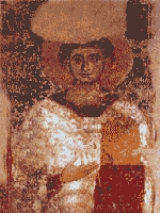
Arius

Encyclopedia
Arius was a Christian
presbyter
in Alexandria, Egypt of Libyan
origins. His teachings about the nature of the Godhead
, which emphasized the Father's divinity over the Son
, and his opposition to the Athanasian or Trinitarian Christology
, made him a controversial figure in the First Council of Nicea, convened by Roman Emperor Constantine
in AD 325. After Emperor Constantine legalized and formalized the Christianity
of the time in the Roman Empire
, the newly recognized Catholic Church sought to unify and clarify its theology
. Trinitarian Christians, including Athanasius, used Arius and Arianism
as epithets to describe those who disagreed with their doctrine of co-equal Trinitarianism, a Christology
representing God the Father and Son (Jesus of Nazareth) as "of one essence" (consubstantial) and coeternal.
Although virtually all positive writings on Arius' theology have been suppressed or destroyed, negative writings describe Arius' theology as one in which there was a time before the Son of God, where only God the Father
existed. Despite concerted opposition, 'Arian', or nontrinitarian Christian churches persisted throughout Europe and North Africa, in various Gothic
and Germanic
kingdoms, until suppressed by military conquest or voluntary royal conversion between the fifth and seventh centuries.
Although "Arianism" suggests that Arius was the originator of the teaching that bears his name, the debate over the Son’s precise relationship to the Father did not begin with him. This subject had been discussed for decades before his advent; Arius merely intensified the controversy and carried it to a Church-wide audience, where other "Arians" such as Eusebius of Nicomedia
would prove much more influential in the long run. Eusebius of Nicomedia
should not be confused with Eusebius of Caesarea
(Bishop of Caesarea of Palestine), a renowned church father, a church historian and eulogistic biographer of Roman Emperor Constantine
. Eusebius of Caesarea
is possibly one of the drafters of the Nicean creed. In fact, some later "Arians" disavowed that moniker, claiming not to have been familiar with the man or his specific teachings. However, because the conflict between Arius and his foes brought the issue to the theological forefront, the doctrine he proclaimed—though not originated by him—is generally labeled as "his".
. This leads some—but not all—scholars to question their reliability.
Arius was possibly of Libyan
descent. His father's name is given as Ammonius. Arius is believed to have been a student at the exegetical school in Antioch
, where he studied under Saint Lucian
. Having returned to Alexandria, Arius, according to a single source, sided with Meletius of Lycopolis
in his dispute over the readmission of those who had denied Christianity under fear of Roman torture, and was ordained a deacon
under the latter's auspices. He was excommunicated
by Bishop Peter of Alexandria in 311 for supporting Meletius, but under Peter's successor Achillas
, Arius was readmitted to communion and in 313 made presbyter
of the Baucalis district in Alexandria.
Although his character has been severely assailed by his opponents, Arius appears to have been a man of personal ascetic
achievement, pure morals, and decided convictions. Paraphrasing Epiphanius of Salamis
, an opponent of Arius, Catholic historian Warren H. Carroll
describes him as "tall and lean, of distinguished appearance and polished address. Women doted on him, charmed by his beautiful manners, touched by his appearance of asceticism. Men were impressed by his aura of intellectual superiority."
Arius was accused of being too liberal in his theology and too "loose" with heresy (as defined by his opponents). However, some historians argue that Arius was actually quite conservative, and that he deplored how, in his view, Christian theology
was being too freely mixed with Greek paganism.
, a great fourth-century theological conflict that rocked the Christian world and led to the calling of the first ecumenical council
of the Church. This controversy centered upon the nature of the Son of God, and his precise relationship to God the Father.
, who had succeeded Achillas as the Bishop of Alexandria
, gave a sermon on the similarity of the Son to the Father. Arius interpreted Alexander's speech as being a revival of Sabellianism
, condemned it, and then argued that "if the Father begat the Son, he that was begotten had a beginning of existence: and from this it is evident, that there was a time when the Son was not. It therefore necessarily follows, that he [the Son] had his substance from nothing." This quote describes the essence of Arius' doctrine.
It is believed that Arius was influenced in his thinking by the teachings of Lucian of Antioch
, a celebrated Christian teacher and martyr. In a letter to Patriarch Alexander
of Constantinople
Arius' bishop, Alexander of Alexandria
, wrote that Arius derived his theology from Lucian. The express purpose of Alexander's letter was to complain of the doctrines that Arius was diffusing, but his charge of heresy against Arius is vague and unsupported by other authorities. Furthermore, Alexander's language, like that of most controversialists in those days, is quite vituperative. Moreover, even Alexander never accused Lucian of having taught Arianism; rather, he accused Lucian ad invidiam of heretical tendencies—which apparently, according to him, were transferred to his pupil, Arius. The noted Russian historian Alexander Vasiliev refers to Lucian as "the Arius before Arius".
, widely regarded as the first great theologian of Christianity. However, while he drew support from Origen's theories on the Logos, the two did not agree on everything. Arius clearly argued that there was a time when the Son did not exist, and that the Logos had a beginning. By way of contrast, Origen
taught that the relation of the Son to the Father had no beginning.
Arius objected to Origen's doctrine, complaining about it in his letter to the Nicomedian Eusebius, who had also studied under Lucian. Nevertheless, despite disagreeing with Origen on this point, Arius found solace in his writings, which used expressions that favored Arius's contention that the Logos was of a different substance than the Father, and owed his existence to his Father's will. However, because Origen's theological speculations were often proffered to stimulate further inquiry rather than to put an end to any given dispute, both Arius and his opponents were able to invoke the authority of this revered (at the time) theologian during their debate.
Arius from his office, excommunicating him and his supporters. Later, Alexander would be criticized for his slow reaction to Arius and the perceived threat posed by his teachings.
. By the time Bishop Alexander finally acted against his recalcitrant presbyter, Arius's doctrine had spread far beyond his own see; it had become a topic of discussion—and disturbance—for the entire Church. The Church was now a powerful force in the Roman world, with Constantine I having legalized it in 313 through the Edict of Milan
. The emperor had taken a personal interest in several ecumenical issues, including the Donatist
controversy in 316, and he wanted to bring an end to the Arian dispute. To this end, the emperor sent Hosius, bishop of Córdoba
to investigate and, if possible, resolve the controversy. Hosius was armed with an open letter from the Emperor: "Wherefore let each one of you, showing consideration for the other, listen to the impartial exhortation of your fellow-servant." But as the debate continued to rage despite Hosius' efforts, Constantine in AD 325 took an unprecedented step: he called a council
to be composed of church prelate
s from all parts of the empire to resolve this issue, possibly at Hosius' recommendation.
All secular dioceses of the empire sent one or more representatives to the council, save for Roman Britain
; the majority of the bishops came from the East. Pope Sylvester I, himself too aged to attend, sent two priests as his delegates. Arius himself attended the council, as did his bishop, Alexander. Also there were Eusebius of Caesarea
, Eusebius of Nicomedia and the young deacon Athanasius, who would become the champion of the Trinitarian dogma ultimately adopted by the council and spend most of his life battling Arianism. Before the main conclave convened, Hosius initially met with Alexander and his supporters at Nicomedia
. The council would be presided over by the emperor himself, who participated in and even led some of its discussions.
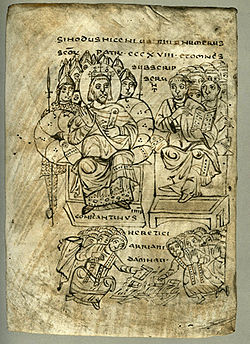
At this First Council of Nicaea
twenty-two bishops, led by Eusebius of Nicomedia, came as supporters of Arius. But when some of Arius's writings were read aloud, they are reported to have been denounced as blasphemous by most participants. Those who upheld the notion that Christ was co-eternal and consubstantial with the Father were led by the young archdeacon Athanasius. Those who instead insisted that the Son of God came after God the Father in time and substance, were led by Arius the presbyter. For about two months, the two sides argued and debated, with each appealing to Scripture to justify their respective positions. Arius maintained that the Son of God was a Creature, made from nothing; and that Christ was God's First Production, before all ages. And he argued that everything else was created through the Son. Thus, said Arius, only the Son was directly created and begotten of God; furthermore, there was a time that He had no existence. He was capable of His own free will, said Arius, and thus "were He in the truest sense a son, He must have come after the Father, therefore the time obviously was when He was not, and hence He was a finite being." Arius appealed to Scripture, quoting verses such as : "the Father is greater than I". And also : "Firstborn of all creation." Thus, Arius insisted that the Son was under God the Father, and not co-equal or co-eternal with Him.
According to some accounts in the hagiography
of Nicholas of Myra, debate at the council became so heated that at one point, Arius was slapped in the face by the saint (the same St. Nick called "Santa Claus
"). Under Constantine's influence, the majority of the bishops ultimately agreed upon a creed, known thereafter as the Nicene creed
. It included the word homoousios, meaning "consubstantial", or "one in essence", which was incompatible with Arius' beliefs. On June 19, 325, council and emperor issued a circular to the churches in and around Alexandria: Arius and two of his unyielding partisans (Theonas and Secundus) were deposed and exiled to Illyricum
, while three other supporters—Theognis of Nicaea
, Eusebius of Nicomedia and Maris of Chalcedon—affixed their signatures solely out of deference to the emperor. However, Constantine soon found reason to suspect the sincerity of these three, for he later included them in the sentence pronounced on Arius.
) and many of his adherents to return to their homes, once Arius had reformulated his Christology to mute the ideas found most objectionable by his critics. Athanasius was exiled following his condemnation by the First Synod of Tyre
in 335 (though he was later recalled), and the Synod of Jerusalem the following year restored Arius to communion. The emperor directed Alexander of Constantinople to receive Arius, despite the bishop's objections; Bishop Alexander responded by earnestly praying that Arius might perish before this could happen. As it turned out—for whatever reason—one day before the Sunday appointed for Arius to be formally readmitted to communion, he suddenly died.
Socrates Scholasticus
(a detractor of Arius) described Arius's death as follows:
Many Nicene Christians asserted that Arius's death was miraculous—a consequence of his allegedly heretical
views. Several recent writers, far removed from the event, have guessed that Arius may have been poison
ed by his opponents. Even with its namesake's demise, the Arian controversy was far from over, and would not be settled for decades—or centuries, in parts of the West—to come.
as a Christian during his lifetime, was baptized on his deathbed by the Arian bishop, Eusebius of Nicodemia.
Constantius II
, who succeeded Constantine, was an Arian sympathizer who openly encouraged the Arians by appointing Eusebius of Nicomedia
, another sympathizer to Arianism, as Bishop ("Patriarch", in the Eastern Church
) of Constantinople. Constantius exiled pro-Nicean prelates, including even Pope Liberius
. Divisions appeared within the Arian camp, as Semi-Arians
attempted to find a compromise between Arianism and Nicene Trinitarianism. A number of synods were held, and at least fourteen different credal formulations were tried throughout the following years, but none proved successful in resolving the dispute. Athanasius continued his vehement opposition to Arianism, soon to be joined by a trio known to history as the Cappadocian Fathers
: SS Basil the Great, Gregory the Theologian and Gregory of Nyssa
. These four men articulated a theological alternative to Arianism that came to be accepted as the definitive orthodox dogma on the subject.
Following the abortive effort by Julian the Apostate
to restore paganism
in the empire, the emperor Valens
—himself an Arian—renewed the persecution of Nicene hierarchs. However, Valen's successor Theodosius I
effectively wiped out Arianism once and for all among the elites of the Eastern Empire through a combination of imperial decree, persecution, and the calling of the Second Ecumenical Council in 381, which condemned Arius anew while reaffirming and expanding the Nicene Creed. This generally ended the influence of Arianism among the non-Germanic peoples of the Roman Empire.
. During the reign of Constantius II, the Arian Gothic
convert Ulfilas
was consecrated a bishop by Eusebius of Nicomedia and sent to missionize his people. His success ensured the survival of Arianism among the Goths and Vandals
until the beginning of the eighth century, when these kingdoms succumbed to their Nicean neighbors or accepted Nicean Christianity. Arians also continued to exist in North Africa
, Spain
and portions of Italy
, until finally suppressed during the sixth and seventh centuries.
During the Protestant Reformation
, a Polish
sect known as the Polish Brethren
were often referred to as Arians, due to their rejection of the Trinity.
church called the The Holy Catholic and Apostolic Church of Arian Catholicism claims to follow Arian teachings, canonizing Arius on June 16, 2006. However, they do not accept the Virgin Birth
and bodily resurrection of Jesus Christ, which places them in opposition to Arius himself, who accepted both. Furthermore, their "Arian Catholic Creed" is a modern creation, not an ancient statement of faith.
Jehovah's Witnesses
are sometimes referred to as "modern-day Arians", usually by their opponents. However, the Witnesses differ from Arians by saying that the Son can fully know the Father (something Arius himself denied), and by the Witnesses' denial of literal personality to the Holy Spirit
(Arius considered the Holy Spirit to be a person or a high angel, and which had a beginning as a creature, whereas the Witnesses consider the Holy Spirit to be God's "divine breath" or "active force", which had no beginning, and is not an actual person). The original Arians also generally prayed to Jesus, while the Witnesses, though they do reverence Jesus as God's Son and Messiah, and pray through Him as Mediator, do not give Him the same degree of worship as they give to God the Father.
Members of The Church of Jesus Christ of Latter-day Saints (the "Mormons") are sometimes accused of being Arians by their detractors. However, the Christology
of the LDS religion differs in several significant aspects from Arian theology.
Alexander also refers to Arius's poetical Thalia:
) had been raised some fifty years before Arius, when Paul of Samosata
was deposed in 269 for agreeing with those who used the word homoousios (Greek for same substance) to express the relation between the Father and the Son. This term was thought at that time to have a Sabellian
tendency, though—as events showed—this was on account of its scope not having been satisfactorily defined. In the discussion which followed Paul's deposition, Dionysius
, the Bishop of Alexandria, used much the same language as Arius did later, and correspondence survives in which Pope Dionysius blames him for using such terminology. Dionysius responded with an explanation widely interpreted as vacillating. The Synod of Antioch, which condemned Paul of Samosata, had expressed its disapproval of the word homoousios in one sense, while Bishop Alexander undertook its defense in another. Although the controversy seemed to be leaning toward the opinions later championed by Arius, no firm decision had been made on the subject; in an atmosphere so intellectual as that of Alexandria, the debate seemed bound to resurface—and even intensify—at some point in the future.
Arius endorsed the following doctrines about The Son or The Word (Logos
, referring to Jesus
; see the Gospel of John
1:1):
 According to Athanasius, Arius authored a poem called the Thalia ("abundance", "good cheer" or "banquet"): a summary of his views on the Logos. Part of this Thalia is quoted in Athanasius's Four Discourses Against the Arians:
Also from the Thalia:
Thus, said Arius, God's first thought was the creation of Jesus Christ, therefore time
started with the creation of the Logos or Word in Heaven.
In this portion of the Thalia, Arius endeavors to explain the ultimate incomprehensibility of the Father to the Son:
Here, Arius explains how the Son could still be God
, even if he did not exist eternally:
, his letter to Eusebius of Nicomedia
, and his confession to Constantine. In addition, several letters addressed by others to Arius survive, together with brief quotations contained within the polemical works of his opponents. These quotations are often short and taken out of context, and it is difficult to tell how accurately they quote him or represent his true thinking.
Arius' Thalia (literally, "Festivity"), a popularized work combining prose and verse, survives in quoted fragmentary form. The two available references from this work are recorded by his opponent Athanasius: the first is a report of Arius's teaching in Orations Against the Arians, 1:5-6. This paraphrase has negative comments interspersed throughout, so it is difficult to consider it as being completely reliable. The second quotation is found in the document On the Councils of Arminum and Seleucia, pg. 15. This passage is entirely in irregular verse, and seems to be a direct quotation or a compilation of quotations; it may have been written by someone other than Athanasius, perhaps even a person sympathetic to Arius. This second quotation does not contain several statements usually attributed to Arius by his opponents, is in metrical form, and resembles other passages that have been attributed to Arius. It also contains some positive statements about the Son. But although these quotations seem reasonably accurate, their proper context is lost, thus their place in Arius' larger system of thought is impossible to reconstruct.
Christian
A Christian is a person who adheres to Christianity, an Abrahamic, monotheistic religion based on the life and teachings of Jesus of Nazareth as recorded in the Canonical gospels and the letters of the New Testament...
presbyter
Presbyter
Presbyter in the New Testament refers to a leader in local Christian congregations, then a synonym of episkopos...
in Alexandria, Egypt of Libyan
Ancient Libya
The Latin name Libya referred to the region west of the Nile Valley, generally corresponding to modern Northwest Africa. Climate changes affected the locations of the settlements....
origins. His teachings about the nature of the Godhead
Godhead (Christianity)
Godhead is a Middle English variant of the word godhood, and denotes the Divine Nature or Substance of the Christian God, or the Trinity. Within some traditions such as Mormonism, the term is used as a nontrinitarian substitute for the term Trinity, denoting the Father, Son, and Holy Spirit not as...
, which emphasized the Father's divinity over the Son
Subordinationism
Subordinationism is a doctrine in Christian theology which holds that the Son and the Holy Spirit are subordinate to God the Father in nature and being...
, and his opposition to the Athanasian or Trinitarian Christology
Christology
Christology is the field of study within Christian theology which is primarily concerned with the nature and person of Jesus Christ as recorded in the Canonical gospels and the letters of the New Testament. Primary considerations include the relationship of Jesus' nature and person with the nature...
, made him a controversial figure in the First Council of Nicea, convened by Roman Emperor Constantine
Constantine I
Constantine the Great , also known as Constantine I or Saint Constantine, was Roman Emperor from 306 to 337. Well known for being the first Roman emperor to convert to Christianity, Constantine and co-Emperor Licinius issued the Edict of Milan in 313, which proclaimed religious tolerance of all...
in AD 325. After Emperor Constantine legalized and formalized the Christianity
Christianity
Christianity is a monotheistic religion based on the life and teachings of Jesus as presented in canonical gospels and other New Testament writings...
of the time in the Roman Empire
Roman Empire
The Roman Empire was the post-Republican period of the ancient Roman civilization, characterised by an autocratic form of government and large territorial holdings in Europe and around the Mediterranean....
, the newly recognized Catholic Church sought to unify and clarify its theology
Theology
Theology is the systematic and rational study of religion and its influences and of the nature of religious truths, or the learned profession acquired by completing specialized training in religious studies, usually at a university or school of divinity or seminary.-Definition:Augustine of Hippo...
. Trinitarian Christians, including Athanasius, used Arius and Arianism
Arianism
Arianism is the theological teaching attributed to Arius , a Christian presbyter from Alexandria, Egypt, concerning the relationship of the entities of the Trinity and the precise nature of the Son of God as being a subordinate entity to God the Father...
as epithets to describe those who disagreed with their doctrine of co-equal Trinitarianism, a Christology
Christology
Christology is the field of study within Christian theology which is primarily concerned with the nature and person of Jesus Christ as recorded in the Canonical gospels and the letters of the New Testament. Primary considerations include the relationship of Jesus' nature and person with the nature...
representing God the Father and Son (Jesus of Nazareth) as "of one essence" (consubstantial) and coeternal.
Although virtually all positive writings on Arius' theology have been suppressed or destroyed, negative writings describe Arius' theology as one in which there was a time before the Son of God, where only God the Father
God the Father
God the Father is a gendered title given to God in many monotheistic religions, particularly patriarchal, Abrahamic ones. In Judaism, God is called Father because he is the creator, life-giver, law-giver, and protector...
existed. Despite concerted opposition, 'Arian', or nontrinitarian Christian churches persisted throughout Europe and North Africa, in various Gothic
Goths
The Goths were an East Germanic tribe of Scandinavian origin whose two branches, the Visigoths and the Ostrogoths, played an important role in the fall of the Roman Empire and the emergence of Medieval Europe....
and Germanic
Germanic peoples
The Germanic peoples are an Indo-European ethno-linguistic group of Northern European origin, identified by their use of the Indo-European Germanic languages which diversified out of Proto-Germanic during the Pre-Roman Iron Age.Originating about 1800 BCE from the Corded Ware Culture on the North...
kingdoms, until suppressed by military conquest or voluntary royal conversion between the fifth and seventh centuries.
Although "Arianism" suggests that Arius was the originator of the teaching that bears his name, the debate over the Son’s precise relationship to the Father did not begin with him. This subject had been discussed for decades before his advent; Arius merely intensified the controversy and carried it to a Church-wide audience, where other "Arians" such as Eusebius of Nicomedia
Eusebius of Nicomedia
Eusebius of Nicomedia was the man who baptised Constantine. He was a bishop of Berytus in Phoenicia, then of Nicomedia where the imperial court resided in Bithynia, and finally of Constantinople from 338 up to his death....
would prove much more influential in the long run. Eusebius of Nicomedia
Eusebius of Nicomedia
Eusebius of Nicomedia was the man who baptised Constantine. He was a bishop of Berytus in Phoenicia, then of Nicomedia where the imperial court resided in Bithynia, and finally of Constantinople from 338 up to his death....
should not be confused with Eusebius of Caesarea
Eusebius of Caesarea
Eusebius of Caesarea also called Eusebius Pamphili, was a Roman historian, exegete and Christian polemicist. He became the Bishop of Caesarea in Palestine about the year 314. Together with Pamphilus, he was a scholar of the Biblical canon...
(Bishop of Caesarea of Palestine), a renowned church father, a church historian and eulogistic biographer of Roman Emperor Constantine
Constantine I
Constantine the Great , also known as Constantine I or Saint Constantine, was Roman Emperor from 306 to 337. Well known for being the first Roman emperor to convert to Christianity, Constantine and co-Emperor Licinius issued the Edict of Milan in 313, which proclaimed religious tolerance of all...
. Eusebius of Caesarea
Eusebius of Caesarea
Eusebius of Caesarea also called Eusebius Pamphili, was a Roman historian, exegete and Christian polemicist. He became the Bishop of Caesarea in Palestine about the year 314. Together with Pamphilus, he was a scholar of the Biblical canon...
is possibly one of the drafters of the Nicean creed. In fact, some later "Arians" disavowed that moniker, claiming not to have been familiar with the man or his specific teachings. However, because the conflict between Arius and his foes brought the issue to the theological forefront, the doctrine he proclaimed—though not originated by him—is generally labeled as "his".
Early life and personality
Reconstructing the life and doctrine of Arius has proven to be a difficult task, as none of his original writings survive. Emperor Constantine ordered their burning while Arius was still living, and any that survived this purge were later destroyed by his Orthodox opponents. Those works which have survived are quoted in the works of churchmen who denounced him as a hereticHeresy
Heresy is a controversial or novel change to a system of beliefs, especially a religion, that conflicts with established dogma. It is distinct from apostasy, which is the formal denunciation of one's religion, principles or cause, and blasphemy, which is irreverence toward religion...
. This leads some—but not all—scholars to question their reliability.
Arius was possibly of Libyan
Ancient Libya
The Latin name Libya referred to the region west of the Nile Valley, generally corresponding to modern Northwest Africa. Climate changes affected the locations of the settlements....
descent. His father's name is given as Ammonius. Arius is believed to have been a student at the exegetical school in Antioch
Antioch
Antioch on the Orontes was an ancient city on the eastern side of the Orontes River. It is near the modern city of Antakya, Turkey.Founded near the end of the 4th century BC by Seleucus I Nicator, one of Alexander the Great's generals, Antioch eventually rivaled Alexandria as the chief city of the...
, where he studied under Saint Lucian
Lucian of Antioch
Saint Lucian of Antioch , known as Lucian the Martyr, was a Christian presbyter, theologian and martyr. He was noted for both his scholarship and ascetic piety.-History:...
. Having returned to Alexandria, Arius, according to a single source, sided with Meletius of Lycopolis
Meletius of Lycopolis
Meletius was bishop of Lycopolis in Egypt. He is known to us mainly as the founder and namesake of the Melitians , one of several scismatic sects in early church history which were concerned about the ease with which lapsed Christians reentered the Church. See also DonatismThe details of his life...
in his dispute over the readmission of those who had denied Christianity under fear of Roman torture, and was ordained a deacon
Deacon
Deacon is a ministry in the Christian Church that is generally associated with service of some kind, but which varies among theological and denominational traditions...
under the latter's auspices. He was excommunicated
Excommunication
Excommunication is a religious censure used to deprive, suspend or limit membership in a religious community. The word means putting [someone] out of communion. In some religions, excommunication includes spiritual condemnation of the member or group...
by Bishop Peter of Alexandria in 311 for supporting Meletius, but under Peter's successor Achillas
Achillas of Alexandria
Pope Achillas of Alexandria was the eighteenth Pope of Alexandria between 312 and 313....
, Arius was readmitted to communion and in 313 made presbyter
Presbyter
Presbyter in the New Testament refers to a leader in local Christian congregations, then a synonym of episkopos...
of the Baucalis district in Alexandria.
Although his character has been severely assailed by his opponents, Arius appears to have been a man of personal ascetic
Asceticism
Asceticism describes a lifestyle characterized by abstinence from various sorts of worldly pleasures often with the aim of pursuing religious and spiritual goals...
achievement, pure morals, and decided convictions. Paraphrasing Epiphanius of Salamis
Epiphanius of Salamis
Epiphanius of Salamis was bishop of Salamis at the end of the 4th century. He is considered a saint and a Church Father by both the Eastern Orthodox and Catholic Churches. He gained a reputation as a strong defender of orthodoxy...
, an opponent of Arius, Catholic historian Warren H. Carroll
Warren H. Carroll
Dr. Warren H. Carroll was a leading Catholic historian and author, and the founder of Christendom College. He received an M. A. and Ph.D. in history from Columbia University. He died on July 17, 2011 at the age of 79.Dr...
describes him as "tall and lean, of distinguished appearance and polished address. Women doted on him, charmed by his beautiful manners, touched by his appearance of asceticism. Men were impressed by his aura of intellectual superiority."
Arius was accused of being too liberal in his theology and too "loose" with heresy (as defined by his opponents). However, some historians argue that Arius was actually quite conservative, and that he deplored how, in his view, Christian theology
Christian theology
- Divisions of Christian theology :There are many methods of categorizing different approaches to Christian theology. For a historical analysis, see the main article on the History of Christian theology.- Sub-disciplines :...
was being too freely mixed with Greek paganism.
The Arian controversy
Arius is notable primarily because of his role in the Arian controversyArian controversy
The Arian controversy describes several controversies between the Christian Church fathers Arius and Athanasius related to Christology which divided the Christian church from before the Council of Nicaea in 325 to after the Council of Constantinople in 381...
, a great fourth-century theological conflict that rocked the Christian world and led to the calling of the first ecumenical council
Ecumenical council
An ecumenical council is a conference of ecclesiastical dignitaries and theological experts convened to discuss and settle matters of Church doctrine and practice....
of the Church. This controversy centered upon the nature of the Son of God, and his precise relationship to God the Father.
Beginnings
The Trinitarian historian Socrates of Constantinople reports that Arius ignited the controversy that bears his name when St. Alexander of AlexandriaAlexander of Alexandria
Alexander of Alexandria was the nineteenth Patriarch of Alexandria from 313 to his death. During his patriarchate, he dealt with a number of issues relevant to a church's positions on issues facing the church. These included the dating of Easter, the actions of Meletius of Lycopolis, and the issue...
, who had succeeded Achillas as the Bishop of Alexandria
Alexandria
Alexandria is the second-largest city of Egypt, with a population of 4.1 million, extending about along the coast of the Mediterranean Sea in the north central part of the country; it is also the largest city lying directly on the Mediterranean coast. It is Egypt's largest seaport, serving...
, gave a sermon on the similarity of the Son to the Father. Arius interpreted Alexander's speech as being a revival of Sabellianism
Sabellianism
In Christianity, Sabellianism, is the nontrinitarian belief that the Heavenly Father, Resurrected Son and Holy Spirit are different modes or aspects of one God, as perceived by the believer, rather than three distinct persons in God Himself.The term Sabellianism comes from...
, condemned it, and then argued that "if the Father begat the Son, he that was begotten had a beginning of existence: and from this it is evident, that there was a time when the Son was not. It therefore necessarily follows, that he [the Son] had his substance from nothing." This quote describes the essence of Arius' doctrine.
It is believed that Arius was influenced in his thinking by the teachings of Lucian of Antioch
Lucian of Antioch
Saint Lucian of Antioch , known as Lucian the Martyr, was a Christian presbyter, theologian and martyr. He was noted for both his scholarship and ascetic piety.-History:...
, a celebrated Christian teacher and martyr. In a letter to Patriarch Alexander
Alexander of Constantinople
Saint Alexander of Constantinople was bishop of Byzantium and the bishop of Constantinople . Information from the Synaxarion mention that Alexander was originally from Calabria in Italy and his parents were George and Vryaine...
of Constantinople
Constantinople
Constantinople was the capital of the Roman, Eastern Roman, Byzantine, Latin, and Ottoman Empires. Throughout most of the Middle Ages, Constantinople was Europe's largest and wealthiest city.-Names:...
Arius' bishop, Alexander of Alexandria
Alexander of Alexandria
Alexander of Alexandria was the nineteenth Patriarch of Alexandria from 313 to his death. During his patriarchate, he dealt with a number of issues relevant to a church's positions on issues facing the church. These included the dating of Easter, the actions of Meletius of Lycopolis, and the issue...
, wrote that Arius derived his theology from Lucian. The express purpose of Alexander's letter was to complain of the doctrines that Arius was diffusing, but his charge of heresy against Arius is vague and unsupported by other authorities. Furthermore, Alexander's language, like that of most controversialists in those days, is quite vituperative. Moreover, even Alexander never accused Lucian of having taught Arianism; rather, he accused Lucian ad invidiam of heretical tendencies—which apparently, according to him, were transferred to his pupil, Arius. The noted Russian historian Alexander Vasiliev refers to Lucian as "the Arius before Arius".
Origen and Arius
Like many third-century Christian scholars, Arius was influenced by the writings of OrigenOrigen
Origen , or Origen Adamantius, 184/5–253/4, was an early Christian Alexandrian scholar and theologian, and one of the most distinguished writers of the early Church. As early as the fourth century, his orthodoxy was suspect, in part because he believed in the pre-existence of souls...
, widely regarded as the first great theologian of Christianity. However, while he drew support from Origen's theories on the Logos, the two did not agree on everything. Arius clearly argued that there was a time when the Son did not exist, and that the Logos had a beginning. By way of contrast, Origen
Origen
Origen , or Origen Adamantius, 184/5–253/4, was an early Christian Alexandrian scholar and theologian, and one of the most distinguished writers of the early Church. As early as the fourth century, his orthodoxy was suspect, in part because he believed in the pre-existence of souls...
taught that the relation of the Son to the Father had no beginning.
Arius objected to Origen's doctrine, complaining about it in his letter to the Nicomedian Eusebius, who had also studied under Lucian. Nevertheless, despite disagreeing with Origen on this point, Arius found solace in his writings, which used expressions that favored Arius's contention that the Logos was of a different substance than the Father, and owed his existence to his Father's will. However, because Origen's theological speculations were often proffered to stimulate further inquiry rather than to put an end to any given dispute, both Arius and his opponents were able to invoke the authority of this revered (at the time) theologian during their debate.
Initial responses
At first, Bishop Alexander seemed unsure of what to do about Arius. The question that Arius was raising had been left unsettled two generations previously; if in any sense it could be said to have been decided, it had been settled in favor of opponents of the homoousion (the idea that the Father, Son and Holy Ghost are of the same exact substance and are co-equally God; the position adopted by the Trinitarians who opposed Arius). Therefore, Alexander allowed the controversy to continue until he ultimately came to believe that it had become dangerous to the peace of the Church. Once he reached this conclusion, he called a local council of bishops and sought their advice. This council decided against Arius and Alexander deposedDeposition (politics)
Deposition by political means concerns the removal of a politician or monarch. It may be done by coup, impeachment, invasion or forced abdication...
Arius from his office, excommunicating him and his supporters. Later, Alexander would be criticized for his slow reaction to Arius and the perceived threat posed by his teachings.
The First Council of Nicaea
But "Arianism" could no longer be contained within the Alexandrian dioceseDiocese
A diocese is the district or see under the supervision of a bishop. It is divided into parishes.An archdiocese is more significant than a diocese. An archdiocese is presided over by an archbishop whose see may have or had importance due to size or historical significance...
. By the time Bishop Alexander finally acted against his recalcitrant presbyter, Arius's doctrine had spread far beyond his own see; it had become a topic of discussion—and disturbance—for the entire Church. The Church was now a powerful force in the Roman world, with Constantine I having legalized it in 313 through the Edict of Milan
Edict of Milan
The Edict of Milan was a letter signed by emperors Constantine I and Licinius that proclaimed religious toleration in the Roman Empire...
. The emperor had taken a personal interest in several ecumenical issues, including the Donatist
Donatist
Donatism was a Christian sect within the Roman province of Africa that flourished in the fourth and fifth centuries. It had its roots in the social pressures among the long-established Christian community of Roman North Africa , during the persecutions of Christians under Diocletian...
controversy in 316, and he wanted to bring an end to the Arian dispute. To this end, the emperor sent Hosius, bishop of Córdoba
Hosius of Córdoba
Hosius of Corduba , also known as Osius or Ossius, was a bishop of Cordova and one of the prominent advocates of what became Catholic Christianity in the Arian controversy which divided the IV century early Christian Church...
to investigate and, if possible, resolve the controversy. Hosius was armed with an open letter from the Emperor: "Wherefore let each one of you, showing consideration for the other, listen to the impartial exhortation of your fellow-servant." But as the debate continued to rage despite Hosius' efforts, Constantine in AD 325 took an unprecedented step: he called a council
Ecumenical council
An ecumenical council is a conference of ecclesiastical dignitaries and theological experts convened to discuss and settle matters of Church doctrine and practice....
to be composed of church prelate
Prelate
A prelate is a high-ranking member of the clergy who is an ordinary or who ranks in precedence with ordinaries. The word derives from the Latin prælatus, the past participle of præferre, which means "carry before", "be set above or over" or "prefer"; hence, a prelate is one set over others.-Related...
s from all parts of the empire to resolve this issue, possibly at Hosius' recommendation.
All secular dioceses of the empire sent one or more representatives to the council, save for Roman Britain
Roman Britain
Roman Britain was the part of the island of Great Britain controlled by the Roman Empire from AD 43 until ca. AD 410.The Romans referred to the imperial province as Britannia, which eventually comprised all of the island of Great Britain south of the fluid frontier with Caledonia...
; the majority of the bishops came from the East. Pope Sylvester I, himself too aged to attend, sent two priests as his delegates. Arius himself attended the council, as did his bishop, Alexander. Also there were Eusebius of Caesarea
Eusebius of Caesarea
Eusebius of Caesarea also called Eusebius Pamphili, was a Roman historian, exegete and Christian polemicist. He became the Bishop of Caesarea in Palestine about the year 314. Together with Pamphilus, he was a scholar of the Biblical canon...
, Eusebius of Nicomedia and the young deacon Athanasius, who would become the champion of the Trinitarian dogma ultimately adopted by the council and spend most of his life battling Arianism. Before the main conclave convened, Hosius initially met with Alexander and his supporters at Nicomedia
Nicomedia
Nicomedia was an ancient city in what is now Turkey, founded in 712/11 BC as a Megarian colony and was originally known as Astacus . After being destroyed by Lysimachus, it was rebuilt by Nicomedes I of Bithynia in 264 BC under the name of Nicomedia, and has ever since been one of the most...
. The council would be presided over by the emperor himself, who participated in and even led some of its discussions.
At this First Council of Nicaea
First Council of Nicaea
The First Council of Nicaea was a council of Christian bishops convened in Nicaea in Bithynia by the Roman Emperor Constantine I in AD 325...
twenty-two bishops, led by Eusebius of Nicomedia, came as supporters of Arius. But when some of Arius's writings were read aloud, they are reported to have been denounced as blasphemous by most participants. Those who upheld the notion that Christ was co-eternal and consubstantial with the Father were led by the young archdeacon Athanasius. Those who instead insisted that the Son of God came after God the Father in time and substance, were led by Arius the presbyter. For about two months, the two sides argued and debated, with each appealing to Scripture to justify their respective positions. Arius maintained that the Son of God was a Creature, made from nothing; and that Christ was God's First Production, before all ages. And he argued that everything else was created through the Son. Thus, said Arius, only the Son was directly created and begotten of God; furthermore, there was a time that He had no existence. He was capable of His own free will, said Arius, and thus "were He in the truest sense a son, He must have come after the Father, therefore the time obviously was when He was not, and hence He was a finite being." Arius appealed to Scripture, quoting verses such as : "the Father is greater than I". And also : "Firstborn of all creation." Thus, Arius insisted that the Son was under God the Father, and not co-equal or co-eternal with Him.
According to some accounts in the hagiography
Hagiography
Hagiography is the study of saints.From the Greek and , it refers literally to writings on the subject of such holy people, and specifically to the biographies of saints and ecclesiastical leaders. The term hagiology, the study of hagiography, is also current in English, though less common...
of Nicholas of Myra, debate at the council became so heated that at one point, Arius was slapped in the face by the saint (the same St. Nick called "Santa Claus
Santa Claus
Santa Claus is a folklore figure in various cultures who distributes gifts to children, normally on Christmas Eve. Each name is a variation of Saint Nicholas, but refers to Santa Claus...
"). Under Constantine's influence, the majority of the bishops ultimately agreed upon a creed, known thereafter as the Nicene creed
Nicene Creed
The Nicene Creed is the creed or profession of faith that is most widely used in Christian liturgy. It is called Nicene because, in its original form, it was adopted in the city of Nicaea by the first ecumenical council, which met there in the year 325.The Nicene Creed has been normative to the...
. It included the word homoousios, meaning "consubstantial", or "one in essence", which was incompatible with Arius' beliefs. On June 19, 325, council and emperor issued a circular to the churches in and around Alexandria: Arius and two of his unyielding partisans (Theonas and Secundus) were deposed and exiled to Illyricum
Illyricum (Roman province)
The Roman province of Illyricum or Illyris Romana or Illyris Barbara or Illyria Barbara replaced most of the region of Illyria. It stretched from the Drilon river in modern north Albania to Istria in the west and to the Sava river in the north. Salona functioned as its capital...
, while three other supporters—Theognis of Nicaea
Theognis of Nicaea
Theognis of Nicaea was a 4th century bishop, excommunicated after the First Council of Nicaea for not denouncing Arius and his nontrinitarianism strongly enough....
, Eusebius of Nicomedia and Maris of Chalcedon—affixed their signatures solely out of deference to the emperor. However, Constantine soon found reason to suspect the sincerity of these three, for he later included them in the sentence pronounced on Arius.
Exile, return, and death
The Homoousian party's victory at Nicaea was short-lived, however. Despite Arius's exile and the alleged finality of the Council's decrees, the Arian controversy recommenced at once. When Bishop Alexander died in 327, Athanasius succeeded him, despite not meeting the age requirements for a hierarch. Still committed to pacifying the conflict between Arians and Trinitarians, Constantine gradually became more lenient toward those whom the Council of Nicaea had exiled. Though he never repudiated the council or its decrees, the emperor ultimately permitted Arius (who had taken refuge in PalestinePalestine
Palestine is a conventional name, among others, used to describe the geographic region between the Mediterranean Sea and the Jordan River, and various adjoining lands....
) and many of his adherents to return to their homes, once Arius had reformulated his Christology to mute the ideas found most objectionable by his critics. Athanasius was exiled following his condemnation by the First Synod of Tyre
First Synod of Tyre
The First Synod of Tyre or the Council of Tyre was a gathering of bishops called together by Emperor Constantine I for the primary purpose of evaluating charges brought against Athanasius, the Patriarch of Alexandria.-Background:...
in 335 (though he was later recalled), and the Synod of Jerusalem the following year restored Arius to communion. The emperor directed Alexander of Constantinople to receive Arius, despite the bishop's objections; Bishop Alexander responded by earnestly praying that Arius might perish before this could happen. As it turned out—for whatever reason—one day before the Sunday appointed for Arius to be formally readmitted to communion, he suddenly died.
Socrates Scholasticus
Socrates Scholasticus
Socrates of Constantinople, also known as Socrates Scholasticus, not to be confused with the Greek philosopher Socrates, was a Greek Christian church historian, a contemporary of Sozomen and Theodoret, who used his work; he was born at Constantinople c. 380: the date of his death is unknown...
(a detractor of Arius) described Arius's death as follows:
Many Nicene Christians asserted that Arius's death was miraculous—a consequence of his allegedly heretical
Heresy
Heresy is a controversial or novel change to a system of beliefs, especially a religion, that conflicts with established dogma. It is distinct from apostasy, which is the formal denunciation of one's religion, principles or cause, and blasphemy, which is irreverence toward religion...
views. Several recent writers, far removed from the event, have guessed that Arius may have been poison
Poison
In the context of biology, poisons are substances that can cause disturbances to organisms, usually by chemical reaction or other activity on the molecular scale, when a sufficient quantity is absorbed by an organism....
ed by his opponents. Even with its namesake's demise, the Arian controversy was far from over, and would not be settled for decades—or centuries, in parts of the West—to come.
Immediate aftermath
Historians report that Constantine, who had never been baptizedBaptism
In Christianity, baptism is for the majority the rite of admission , almost invariably with the use of water, into the Christian Church generally and also membership of a particular church tradition...
as a Christian during his lifetime, was baptized on his deathbed by the Arian bishop, Eusebius of Nicodemia.
Constantius II
Constantius II
Constantius II , was Roman Emperor from 337 to 361. The second son of Constantine I and Fausta, he ascended to the throne with his brothers Constantine II and Constans upon their father's death....
, who succeeded Constantine, was an Arian sympathizer who openly encouraged the Arians by appointing Eusebius of Nicomedia
Eusebius of Nicomedia
Eusebius of Nicomedia was the man who baptised Constantine. He was a bishop of Berytus in Phoenicia, then of Nicomedia where the imperial court resided in Bithynia, and finally of Constantinople from 338 up to his death....
, another sympathizer to Arianism, as Bishop ("Patriarch", in the Eastern Church
Eastern Orthodox Church
The Orthodox Church, officially called the Orthodox Catholic Church and commonly referred to as the Eastern Orthodox Church, is the second largest Christian denomination in the world, with an estimated 300 million adherents mainly in the countries of Belarus, Bulgaria, Cyprus, Georgia, Greece,...
) of Constantinople. Constantius exiled pro-Nicean prelates, including even Pope Liberius
Pope Liberius
Pope Liberius, pope from May 17, 352, to September 24, 366, was consecrated according to the Catalogus Liberianus on May 22, as the successor of Pope Julius I. He was regarded as a saint in the early Church, but his name was later removed from the Roman Martyrology, however, he is once again...
. Divisions appeared within the Arian camp, as Semi-Arians
Semi-Arianism
Semi-Arianism is a name frequently given to the Trinitarian position of the conservative majority of the Eastern Christian Church in the 4th century, to distinguish it from strict Arianism....
attempted to find a compromise between Arianism and Nicene Trinitarianism. A number of synods were held, and at least fourteen different credal formulations were tried throughout the following years, but none proved successful in resolving the dispute. Athanasius continued his vehement opposition to Arianism, soon to be joined by a trio known to history as the Cappadocian Fathers
Cappadocian Fathers
The Cappadocian Fathers are Basil the Great , who was bishop of Caesarea; Basil's brother Gregory of Nyssa , who was bishop of Nyssa; and a close friend, Gregory of Nazianzus , who became Patriarch of Constantinople...
: SS Basil the Great, Gregory the Theologian and Gregory of Nyssa
Gregory of Nyssa
St. Gregory of Nyssa was a Christian bishop and saint. He was a younger brother of Basil the Great and a good friend of Gregory of Nazianzus. His significance has long been recognized in the Eastern Orthodox, Oriental Orthodox, Eastern Catholic and Roman Catholic branches of Christianity...
. These four men articulated a theological alternative to Arianism that came to be accepted as the definitive orthodox dogma on the subject.
Following the abortive effort by Julian the Apostate
Julian the Apostate
Julian "the Apostate" , commonly known as Julian, or also Julian the Philosopher, was Roman Emperor from 361 to 363 and a noted philosopher and Greek writer....
to restore paganism
Paganism
Paganism is a blanket term, typically used to refer to non-Abrahamic, indigenous polytheistic religious traditions....
in the empire, the emperor Valens
Valens
Valens was the Eastern Roman Emperor from 364 to 378. He was given the eastern half of the empire by his brother Valentinian I after the latter's accession to the throne...
—himself an Arian—renewed the persecution of Nicene hierarchs. However, Valen's successor Theodosius I
Theodosius I
Theodosius I , also known as Theodosius the Great, was Roman Emperor from 379 to 395. Theodosius was the last emperor to rule over both the eastern and the western halves of the Roman Empire. During his reign, the Goths secured control of Illyricum after the Gothic War, establishing their homeland...
effectively wiped out Arianism once and for all among the elites of the Eastern Empire through a combination of imperial decree, persecution, and the calling of the Second Ecumenical Council in 381, which condemned Arius anew while reaffirming and expanding the Nicene Creed. This generally ended the influence of Arianism among the non-Germanic peoples of the Roman Empire.
Arianism in the West
Things went differently in the Western EmpireWestern Roman Empire
The Western Roman Empire was the western half of the Roman Empire after its division by Diocletian in 285; the other half of the Roman Empire was the Eastern Roman Empire, commonly referred to today as the Byzantine Empire....
. During the reign of Constantius II, the Arian Gothic
Goths
The Goths were an East Germanic tribe of Scandinavian origin whose two branches, the Visigoths and the Ostrogoths, played an important role in the fall of the Roman Empire and the emergence of Medieval Europe....
convert Ulfilas
Ulfilas
Ulfilas, or Gothic Wulfila , bishop, missionary, and Bible translator, was a Goth or half-Goth and half-Greek from Cappadocia who had spent time inside the Roman Empire at the peak of the Arian controversy. Ulfilas was ordained a bishop by Eusebius of Nicomedia and returned to his people to work...
was consecrated a bishop by Eusebius of Nicomedia and sent to missionize his people. His success ensured the survival of Arianism among the Goths and Vandals
Vandals
The Vandals were an East Germanic tribe that entered the late Roman Empire during the 5th century. The Vandals under king Genseric entered Africa in 429 and by 439 established a kingdom which included the Roman Africa province, besides the islands of Sicily, Corsica, Sardinia and the Balearics....
until the beginning of the eighth century, when these kingdoms succumbed to their Nicean neighbors or accepted Nicean Christianity. Arians also continued to exist in North Africa
Africa
Africa is the world's second largest and second most populous continent, after Asia. At about 30.2 million km² including adjacent islands, it covers 6% of the Earth's total surface area and 20.4% of the total land area...
, Spain
Spain
Spain , officially the Kingdom of Spain languages]] under the European Charter for Regional or Minority Languages. In each of these, Spain's official name is as follows:;;;;;;), is a country and member state of the European Union located in southwestern Europe on the Iberian Peninsula...
and portions of Italy
Italy
Italy , officially the Italian Republic languages]] under the European Charter for Regional or Minority Languages. In each of these, Italy's official name is as follows:;;;;;;;;), is a unitary parliamentary republic in South-Central Europe. To the north it borders France, Switzerland, Austria and...
, until finally suppressed during the sixth and seventh centuries.
During the Protestant Reformation
Protestant Reformation
The Protestant Reformation was a 16th-century split within Western Christianity initiated by Martin Luther, John Calvin and other early Protestants. The efforts of the self-described "reformers", who objected to the doctrines, rituals and ecclesiastical structure of the Roman Catholic Church, led...
, a Polish
Poland
Poland , officially the Republic of Poland , is a country in Central Europe bordered by Germany to the west; the Czech Republic and Slovakia to the south; Ukraine, Belarus and Lithuania to the east; and the Baltic Sea and Kaliningrad Oblast, a Russian exclave, to the north...
sect known as the Polish Brethren
Polish Brethren
The Polish Brethren were members of the Minor Reformed Church of Poland, a Nontrinitarian Protestant church that existed in Poland from 1565 to 1658...
were often referred to as Arians, due to their rejection of the Trinity.
Arianism today
A modern EnglishEngland
England is a country that is part of the United Kingdom. It shares land borders with Scotland to the north and Wales to the west; the Irish Sea is to the north west, the Celtic Sea to the south west, with the North Sea to the east and the English Channel to the south separating it from continental...
church called the The Holy Catholic and Apostolic Church of Arian Catholicism claims to follow Arian teachings, canonizing Arius on June 16, 2006. However, they do not accept the Virgin Birth
Virgin Birth
The virgin birth of Jesus is a tenet of Christianity and Islam which holds that Mary miraculously conceived Jesus while remaining a virgin. The term "virgin birth" is commonly used, rather than "virgin conception", due to the tradition that Joseph "knew her not till she brought forth her firstborn...
and bodily resurrection of Jesus Christ, which places them in opposition to Arius himself, who accepted both. Furthermore, their "Arian Catholic Creed" is a modern creation, not an ancient statement of faith.
Jehovah's Witnesses
Jehovah's Witnesses
Jehovah's Witnesses is a millenarian restorationist Christian denomination with nontrinitarian beliefs distinct from mainstream Christianity. The religion reports worldwide membership of over 7 million adherents involved in evangelism, convention attendance of over 12 million, and annual...
are sometimes referred to as "modern-day Arians", usually by their opponents. However, the Witnesses differ from Arians by saying that the Son can fully know the Father (something Arius himself denied), and by the Witnesses' denial of literal personality to the Holy Spirit
Holy Spirit
Holy Spirit is a term introduced in English translations of the Hebrew Bible, but understood differently in the main Abrahamic religions.While the general concept of a "Spirit" that permeates the cosmos has been used in various religions Holy Spirit is a term introduced in English translations of...
(Arius considered the Holy Spirit to be a person or a high angel, and which had a beginning as a creature, whereas the Witnesses consider the Holy Spirit to be God's "divine breath" or "active force", which had no beginning, and is not an actual person). The original Arians also generally prayed to Jesus, while the Witnesses, though they do reverence Jesus as God's Son and Messiah, and pray through Him as Mediator, do not give Him the same degree of worship as they give to God the Father.
Members of The Church of Jesus Christ of Latter-day Saints (the "Mormons") are sometimes accused of being Arians by their detractors. However, the Christology
Christology
Christology is the field of study within Christian theology which is primarily concerned with the nature and person of Jesus Christ as recorded in the Canonical gospels and the letters of the New Testament. Primary considerations include the relationship of Jesus' nature and person with the nature...
of the LDS religion differs in several significant aspects from Arian theology.
Introduction
In explaining his actions against Arius, Alexander of Alexandria wrote a letter to Alexander of Constantinople and Eusebius of Nicomedia (where the emperor was then residing), detailing the errors into which he believed Arius had fallen. According to Alexander, Arius taught:That God was not always the Father, but that there was a period when he was not the Father; that the Word of God was not from eternity, but was made out of nothing; for that the ever-existing God (‘the I AM’—the eternal One) made him who did not previously exist, out of nothing; wherefore there was a time when he did not exist, inasmuch as the Son is a creature and a work. That he is neither like the Father as it regards his essence, nor is by nature either the Father’s true Word, or true Wisdom, but indeed one of his works and creatures, being erroneously called Word and Wisdom, since he was himself made of God’s own Word and the Wisdom which is in God, whereby God both made all things and him also. Wherefore he is as to his nature mutable and susceptible of change, as all other rational creatures are: hence the Word is alien to and other than the essence of God; and the Father is inexplicable by the Son, and invisible to him, for neither does the Word perfectly and accurately know the Father, neither can he distinctly see him. The Son knows not the nature of his own essence: for he was made on our account, in order that God might create us by him, as by an instrument; nor would he ever have existed, unless God had wished to create us.
Alexander also refers to Arius's poetical Thalia:
God has not always been Father; there was a moment when he was alone, and was not yet Father: later he became so. The Son is not from eternity; he came from nothing.
The Logos
This question of the exact relationship between the Father and the Son (a part of the theological science of ChristologyChristology
Christology is the field of study within Christian theology which is primarily concerned with the nature and person of Jesus Christ as recorded in the Canonical gospels and the letters of the New Testament. Primary considerations include the relationship of Jesus' nature and person with the nature...
) had been raised some fifty years before Arius, when Paul of Samosata
Paul of Samosata
Paul of Samosata was Bishop of Antioch from 260 to 268. He was a believer in monarchianism, and his teachings anticipate adoptionism.-Life:...
was deposed in 269 for agreeing with those who used the word homoousios (Greek for same substance) to express the relation between the Father and the Son. This term was thought at that time to have a Sabellian
Sabellianism
In Christianity, Sabellianism, is the nontrinitarian belief that the Heavenly Father, Resurrected Son and Holy Spirit are different modes or aspects of one God, as perceived by the believer, rather than three distinct persons in God Himself.The term Sabellianism comes from...
tendency, though—as events showed—this was on account of its scope not having been satisfactorily defined. In the discussion which followed Paul's deposition, Dionysius
Dionysius of Alexandria
Pope Dionysius of Alexandria, named "the Great," was the Pope of Alexandria from 248 until his death on November 17, 265 after seventeen years as a bishop. He was the first Pope to hold the title "the Great" . We have information on Dionysius because during his lifetime, Dionysius wrote many...
, the Bishop of Alexandria, used much the same language as Arius did later, and correspondence survives in which Pope Dionysius blames him for using such terminology. Dionysius responded with an explanation widely interpreted as vacillating. The Synod of Antioch, which condemned Paul of Samosata, had expressed its disapproval of the word homoousios in one sense, while Bishop Alexander undertook its defense in another. Although the controversy seemed to be leaning toward the opinions later championed by Arius, no firm decision had been made on the subject; in an atmosphere so intellectual as that of Alexandria, the debate seemed bound to resurface—and even intensify—at some point in the future.
Arius endorsed the following doctrines about The Son or The Word (Logos
Logos
' is an important term in philosophy, psychology, rhetoric and religion. Originally a word meaning "a ground", "a plea", "an opinion", "an expectation", "word," "speech," "account," "reason," it became a technical term in philosophy, beginning with Heraclitus ' is an important term in...
, referring to Jesus
Jesus
Jesus of Nazareth , commonly referred to as Jesus Christ or simply as Jesus or Christ, is the central figure of Christianity...
; see the Gospel of John
Gospel of John
The Gospel According to John , commonly referred to as the Gospel of John or simply John, and often referred to in New Testament scholarship as the Fourth Gospel, is an account of the public ministry of Jesus...
1:1):
- that the Word (LogosLogos' is an important term in philosophy, psychology, rhetoric and religion. Originally a word meaning "a ground", "a plea", "an opinion", "an expectation", "word," "speech," "account," "reason," it became a technical term in philosophy, beginning with Heraclitus ' is an important term in...
) and the Father were not of the same essence (ousia); - that the Son was a created being (ktisma or poiema); and
- that the worlds were created through him, so he must have existed before them and before all time.
- However, there was a "once" [Arius did not use words meaning "time", such as chronos or aion] when He did not exist, before he was begotten of the Father.
The Thalia
- "And so God Himself, as he really is, is inexpressible to all.
- He alone has no equal, no one similar ('homoios'), and no one of the same glory.
- We call Him unbegotten, in contrast to him who by nature is begotten.
- We praise Him as without beginning, in contrast to him who has a beginning.
- We worship Him as timeless, in contrast to him who in time has come to exist.
- He who is without beginning made the Son a beginning of created things. He produced him as a son for Himself, by begetting him.
- He [the Son] has none of the distinct characteristics of God's own being ('kat' hypostasis')
- For he is not equal to, nor is he of the same being ('homoousios') as Him."
Also from the Thalia:
- "At God’s will the Son has the greatness and qualities that he has.
- His existence from when and from whom and from then—are all from God.
- He, though strong God, praises in part ('ek merous') his superior".
Thus, said Arius, God's first thought was the creation of Jesus Christ, therefore time
Time
Time is a part of the measuring system used to sequence events, to compare the durations of events and the intervals between them, and to quantify rates of change such as the motions of objects....
started with the creation of the Logos or Word in Heaven.
In this portion of the Thalia, Arius endeavors to explain the ultimate incomprehensibility of the Father to the Son:
- "In brief, God is inexpressible to the Son.
- For He is in himself what He is, that is, indescribable,
- So that the Son does not comprehend any of these things or have the understanding to explain them.
- For it is impossible for him to fathom the Father, who is by Himself.
- For the Son himself does not even know his own essence ('ousia').
- For being Son, his existence is most certainly at the will of the Father.
- What reasoning allows, that he who is from the Father should comprehend and know his own parent?
- For clearly that which has a beginning is not able to conceive of or grasp the existence of that which has no beginning".
Here, Arius explains how the Son could still be God
God
God is the English name given to a singular being in theistic and deistic religions who is either the sole deity in monotheism, or a single deity in polytheism....
, even if he did not exist eternally:
- "Understand that the Monad [eternally] was; but the Dyad was not before it came into existence.
- It immediately follows that, although the Son did not exist, the Father was still God.
- Hence the Son, not being [eternal] came into existence by the Father’s will,
- He [the Son] is the Only-begotten God, and this one is alien from [all] others."
Extant writings
Three surviving letters attributed to Arius are his letter to Alexander of AlexandriaAlexander of Alexandria
Alexander of Alexandria was the nineteenth Patriarch of Alexandria from 313 to his death. During his patriarchate, he dealt with a number of issues relevant to a church's positions on issues facing the church. These included the dating of Easter, the actions of Meletius of Lycopolis, and the issue...
, his letter to Eusebius of Nicomedia
Eusebius of Nicomedia
Eusebius of Nicomedia was the man who baptised Constantine. He was a bishop of Berytus in Phoenicia, then of Nicomedia where the imperial court resided in Bithynia, and finally of Constantinople from 338 up to his death....
, and his confession to Constantine. In addition, several letters addressed by others to Arius survive, together with brief quotations contained within the polemical works of his opponents. These quotations are often short and taken out of context, and it is difficult to tell how accurately they quote him or represent his true thinking.
Arius' Thalia (literally, "Festivity"), a popularized work combining prose and verse, survives in quoted fragmentary form. The two available references from this work are recorded by his opponent Athanasius: the first is a report of Arius's teaching in Orations Against the Arians, 1:5-6. This paraphrase has negative comments interspersed throughout, so it is difficult to consider it as being completely reliable. The second quotation is found in the document On the Councils of Arminum and Seleucia, pg. 15. This passage is entirely in irregular verse, and seems to be a direct quotation or a compilation of quotations; it may have been written by someone other than Athanasius, perhaps even a person sympathetic to Arius. This second quotation does not contain several statements usually attributed to Arius by his opponents, is in metrical form, and resembles other passages that have been attributed to Arius. It also contains some positive statements about the Son. But although these quotations seem reasonably accurate, their proper context is lost, thus their place in Arius' larger system of thought is impossible to reconstruct.
See also
- Anomoeanism
- NontrinitarianismNontrinitarianismNontrinitarianism includes all Christian belief systems that disagree with the doctrine of the Trinity, namely, the teaching that God is three distinct hypostases and yet co-eternal, co-equal, and indivisibly united in one essence or ousia...
- ArianismArianismArianism is the theological teaching attributed to Arius , a Christian presbyter from Alexandria, Egypt, concerning the relationship of the entities of the Trinity and the precise nature of the Son of God as being a subordinate entity to God the Father...
- Semi-ArianismSemi-ArianismSemi-Arianism is a name frequently given to the Trinitarian position of the conservative majority of the Eastern Christian Church in the 4th century, to distinguish it from strict Arianism....
- UnitarianismUnitarianismUnitarianism is a Christian theological movement, named for its understanding of God as one person, in direct contrast to Trinitarianism which defines God as three persons coexisting consubstantially as one in being....
- First Council of NicaeaFirst Council of NicaeaThe First Council of Nicaea was a council of Christian bishops convened in Nicaea in Bithynia by the Roman Emperor Constantine I in AD 325...
External links
- The Complete Extant Works of Arius From the Wisconsin Lutheran CollegeWisconsin Lutheran CollegeWisconsin Lutheran College is a liberal arts college affiliated with the Wisconsin Evangelical Lutheran Synod. It has an enrollment of approximately 840 undergraduate students. Its nine-building campus sits on the border of Milwaukee and Wauwatosa, with some buildings in each city...
website page entitled "Fourth Century Christianity".