
All Topics  
Qadi


   Email Print
   Bookmark   Link


Qadi


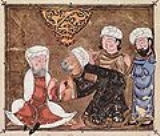
Qadi (also known as Qazi or Kazi or Kadi) is a judge ruling in accordance with the sharia
Sharia

Sharia is the body of Islamic religious law. The term means "way" or "path to the water source"; it is the legal framework within which the public and private aspects of life are regulated for those living in a legal system based on Fiqh and for Muslims living outside the domain....
, Islamic religious law. Because Islam makes no distinction between religious and secular domains, qadis traditionally have jurisdiction over all legal matters involving Muslims. The judgment of a qadi must be based on ijma
Ijma

Ijma is an Arabic language term referring ideally to the consensus of the ummah .The hadith of Muhammad which states that "My community will never agree upon an error" is often cited as support for the validity of ijma....
, the prevailing consensus of the ulema
Ulema

Ulema refers to the educated class of Muslim legal scholars engaged in the several fields of Islamic studies. They are best known as the arbiters of Sharia law....
, Islamic scholars.

term qadi was in use right from the time of the Prophet Muhammad
Muhammad

Muhammad Patronymic#Arabic Abd Allah ibn Abd al Muttalib , is the founder of the Major religious groups of Islam and is regarded by Muslims as a Rasul and prophet of , the last and the greatest law-bearer in a series of prophets....
, and remained the term used for judges throughout Islamic history and the period of the caliphate
Caliphate

The caliphate represented the political leadership of the Muslim ummah in classical and medieval Islamic history and juristic theory. The head of state's position is based on the notion of a successor to the Prophets of Islam Muhammad's political authority....
s.


Discussion
Ask a question about 'Qadi'
Start a new discussion about 'Qadi'
Answer questions from other users
Full Discussion Forum


Recent Posts


Encyclopedia


Qadi (also known as Qazi or Kazi or Kadi) is a judge ruling in accordance with the sharia
Sharia

Sharia is the body of Islamic religious law. The term means "way" or "path to the water source"; it is the legal framework within which the public and private aspects of life are regulated for those living in a legal system based on Fiqh and for Muslims living outside the domain....
, Islamic religious law. Because Islam makes no distinction between religious and secular domains, qadis traditionally have jurisdiction over all legal matters involving Muslims. The judgment of a qadi must be based on ijma
Ijma

Ijma is an Arabic language term referring ideally to the consensus of the ummah .The hadith of Muhammad which states that "My community will never agree upon an error" is often cited as support for the validity of ijma....
, the prevailing consensus of the ulema
Ulema

Ulema refers to the educated class of Muslim legal scholars engaged in the several fields of Islamic studies. They are best known as the arbiters of Sharia law....
, Islamic scholars.

Historical background

The term qadi was in use right from the time of the Prophet Muhammad
Muhammad

Muhammad Patronymic#Arabic Abd Allah ibn Abd al Muttalib , is the founder of the Major religious groups of Islam and is regarded by Muslims as a Rasul and prophet of , the last and the greatest law-bearer in a series of prophets....
, and remained the term used for judges throughout Islamic history and the period of the caliphate
Caliphate

The caliphate represented the political leadership of the Muslim ummah in classical and medieval Islamic history and juristic theory. The head of state's position is based on the notion of a successor to the Prophets of Islam Muhammad's political authority....
s. While the mufti
Mufti

A mufti is an Islamic scholar who is an interpreter or expounder of Islamic law . A muftiat or diyanet is a council of muftis....
s and fuqaha played the role in elucidation of the principles of jurisprudence and the laws, the qadi remained the key person to ensure the establishment of justice on the basis of these very laws and rules. Thus, the qadi was chosen from amongst those who had mastered the sciences of jurisprudence and law.

During the period of the Abbasid Caliphate, the office of the qadi al-qudat (Chief Justice of the Highest Court) was established. Among the most famous of the early qadi al-qudat was Qadi Abu Yusuf
Abu Yusuf

Yaqub ibn Ibrahim al-Ansari, better known as Abu Yusuf was a student of legist Abu Hanifah who helped spread the influence of the Hanafi school of Islamic law through his writings and the government positions he held....
 who was a disciple of the famous early jurist Abu Hanifa.

The office of the qadi continued to be a very important one in every principality of the caliphates and sultanates of the Muslim empires over the centuries. The rulers appointed qadis in every region, town and village for judicial and administrative control and to establish peace and justice over the dominions they controlled.

The rulers of Muslim India also used the same institution of the qadi (or Kazi). The qadi (kazi) was given the responsibility for total administrative, judicial and fiscal control over a territory or a town. He would maintain all the civil records as well. He would also retain a small army or force to ensure that his rulings are enforced.

In most cases, the kazi (qadi) would pass on the title and position to his son, descendent or a very close relative. Over the centuries, this profession became a title within the families, and the power remained within one family in a region. Throughout India and Pakistan, we now find various Kazi families who descended through their famous Kazi (qadi) ancestors and retained the lands and position. Each family is known by the town or city that their ancestors controlled.

Religious and judicial roles


In the Islamic world, under constitutional government, such as Turkey
Turkey

Turkey , known officially as the Republic of Turkey , is a Eurasian country that stretches across the Anatolian peninsula in southwest Asia and Thrace in the Balkans region of Southern Europe....
, where sharia is not the basis for the legal system, the term qadi is still used to identify judges or magistrate
Magistrate

A magistrate is a judicial officer; in ancient Rome, the word magistratus denoted one of the highest government officers with judicial and executive powers....
s. However in countries where shariah law is in force, such as Saudi Arabia
Saudi Arabia

The Kingdom of Saudi Arabia, KSA , is an Arab country and the largest country of the Arabian Peninsula. It is bordered by Jordan on the northwest, Iraq on the north and northeast, Kuwait, Qatar, Bahrain, and the United Arab Emirates on the east, Oman on the southeast, and Yemen on the south....
, the qadi is the judge who rules under the Islamic laws in force.

In countries that practice a hybrid legal system such as Egypt
Egypt

Egypt is a country mainly in North Africa, with the Sinai Peninsula forming a land bridge in Western Asia. Covering an area of about , Egypt borders the Mediterranean Sea to the north, the Gaza Strip and Israel to the northeast, the Red Sea to the east, Sudan to the south and Libya to the west....
, a qadi makes an initial ruling in all civil and criminal matters. In Pakistan
Pakistan

Pakistan , officially the Islamic Republic of Pakistan, is a country located in South Asia and borders Central Asia and the Middle East. It has a 1,046 kilometre coastline along the Arabian Sea and Gulf of Oman in the south, and is bordered by Afghanistan and Iran in the west, India in the east and People's Republic of China in th...
, where there is a dual legal system of the regular courts and the Shariah courts, the qadis (kazis) are appointed in the latter case who rule according to the shariah law. In some Islamic countries, the position of qadi, formerly reduced to simply being responsible for the initial hearing of cases or even abolished in the process of Westernization
Westernization

Westernization or occidentalization is a process whereby Society come under or adopt the Western culture in such matters as industry, technology, law, politics, economics, lifestyle, diet , language, alphabet, religion or western culture....
, has been recently reinstated, as in some Islamic provinces of northern Nigeria
Nigeria

Nigeria, officially the Federal Republic of Nigeria, is a federation constitutional republic comprising States of Nigeria and one Federal Capital Territory, Nigeria....
. When it involves a severe penalty, his decision has to be approved by a Mufti
Mufti

A mufti is an Islamic scholar who is an interpreter or expounder of Islamic law . A muftiat or diyanet is a council of muftis....
, certainly in capital punishment
Capital punishment

Capital punishment, the death penalty or execution, is the killing of a person by procedural law for Punishment#Retribution and Punishment#Incapacitation....
 cases, to ensure that verdict is in compliance with the Islamic law.

In Turkey, qadis were appointed by the Veliyu l-Emr. With the reform movements, secular courts have replaced qadis, but they formerly held wide ranging responsibilities:
... During Ottoman period, [qadi] was responsible for the city services. The charged people such as Subasi, Bocekbasi, Copluk Subasisi, Mimarbasi and Police assisted the qadi, who coordinated all the services." [From History of Istanbul Municipality, Istanbul Municipality (in Turkish).]


Mayotte governorship

On the island of Mayotte, one of the Comoro Islands
Comoro Islands

The Comoro Islands are an archipelago lying between Madagascar and the African continent. The main islands are Grande Comore, Anjouan, Moh?li and Mayotte....
, the title qadi was used for Umar who governed it from 19 November 1835 to 1836 after its conquest by and annexation to the Sultanate of Ndzuwani (Anjouan
Anjouan

Anjouan is an autonomous island of the Union of Comoros. The island is located in the Indian Ocean. Its capital is Mutsamudu and its population as of 2006 is about 277,500....
).

Spanish derivation

Alcalde
Alcalde

Alcalde , or Alcalde ordinario, is the traditional Spain municipal magistrate, who had both judicial and Administration functions. An alcalde was, in the absence of a corregidor , the presiding officer of the Crown of Castile Cabildo and judge of first instance of a town....
, one of the current Spanish
Spanish language

Spanish or Castilian is a Romance languages that originated in northern Spain, and gradually spread in the Kingdom of Castile and evolved into the principal language of government and trade....
 terms for the mayor of a town or city, is derived from the Arabic al-qa?i ( ????,), "the judge." In Al-Andalus
Al-Andalus

Al-Andalus was the Arabic name given to the parts of the Iberian Peninsula governed by Arab Muslims, at various times in the period between 711 and 1492....
 a single qadi was appointed to each province. To deal with issues that fell outside of the purview of sharia or to handle municipal administration (such as oversight of the police
Police

Police are agents or agencies, usually of the executive , empowered to enforce the law and to ensure public and social order through the legitimized use of force....
 and the markets
Souk

A souq is a commercial quarter in an Arab or Berber city. The term is often used to designate the market in any Arabized or Muslim city. It may also refer to the weekly market in some smaller towns where neutrality from tribal conflicts would be declared to permit the exchange of surplus goods....
) other judicial officers with different titles were appointed by the rulers.

The term was later adopted in Portugal
Kingdom of Portugal

The Kingdom of Portugal was Portugal's general designation under the Portuguese monarchy. The kingdom was located in the west of the Iberian Peninsula, Europe, and existed from 1139 to 1910....
, Leon
Kingdom of León

Kingdom of Le?n was an independent country situated in the northwest region of the Iberian Peninsula. It was founded in 910 A.D. when the Christian princes of Kingdom of Asturias along the Bay of Biscay shifted their main seat from Oviedo to the city of Le?n, Spain....
 and Castile
Kingdom of Castile

Kingdom of Castile was one of the medieval kingdoms of the Iberian Peninsula. It emerged as a political autonomous entity in the 9th century. It was called County of Castile and was held in vassalage from the Kingdom of Le?n....
 during the eleventh and twelfth centuries to refer to the assistant judges, who served under the principal municipal judge, the iudex or juez. Unlike the appointed Andalusian qadis, the alcaldes were elected by an assembly of the municipality's property owners. Eventually the term came to be applied to a host of positions that combined administrative and judicial functions, such as the alcaldes mayores, the alcaldes del crimen
Audiencia

For the modern court, see Audiencia Nacional of Spain.The Royal Audiencia and Chanciller?a was a court that functioned as an appellate court in Spain and its empire....
 and the alcaldes de barrio. The adoption of this term, like many other Arabic ones, reflects the fact that, at least in the early phases of the Reconquista
Reconquista

The Reconquista was a period of 800 years in the Middle Ages during which several Christian kingdoms of the Iberian Peninsula succeeded in retaking the Iberian Peninsula from the Muslims....
, Muslim society in the Iberian Peninsula imparted great influence on the Christian one. As Spanish Christians took over an increasing part of the Peninsula, they adapted Muslim systems and terminology for their own use.

See also

  • List of Islamic terms in Arabic
    List of Islamic terms in Arabic

    The following list consists of concepts that are derived from both Islamic culture and Arab tradition, which are expressed as words in the Arabic language....
  • House of Kadies Al-Kadi Saudi House
  • Cadilesker
    Cadilesker

    A cadilesker, cadilescher, kadi-ul lesker or kadi-ul asker was a chief judge in the Turkish Empire, so named originally because his jurisdiction extended to the cases of soldiers, who were later tried only by their own officers....


Sources

  • "," (formerly Encyclopedia of the Orient).
  • Bekir Kemal Ataman, "Ottoman Kadi Registers as a Source of Social History." Unpublished M.A. Thesis. University of London, University College London, School of Library, Archive and Information Studies. 1987.
  • Imamuddin, S. M. Muslim Spain: 711-1492 A.D.: A Sociological Study. Leiden, E. J. Brill, 1981.
  • O'Callaghan, Joseph F. A History of Medieval Spain. Ithaca, Cornell University Press, 1975. ISBN 0-8014-0880-6
  • Özhan Öztürk (2005). Karadeniz (Black Sea
    Black Sea

    The Black Sea is an inland sea sea bounded by southeastern Europe, the Caucasus and the Anatolia and is ultimately connected to the Atlantic Ocean via the Mediterranean Sea and Aegean Seas and various straits....
    ): Ansiklopedik Sözlük. 2 Cilt. Heyamola Yayincilik. Istanbul. ISBN 975-6121-00-9
  • "",