
|
|
|
|
Nepali language
|
| |
|
| |
Nepali is a language in the Indo-Aryan branch of the Indo-European language family.
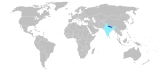
It is the lingua-franca of Nepal and is also spoken in Bhutan, parts of India and parts of Myanmar (Burma). It is one of 23 official languages of India incorporated in 8th annex of the Indian Constitution. It has official language status in the formerly independent state of Sikkim and in West Bengal's Darjeeling district. Similarly, it is widely spoken in the state of Uttaranchal, as well as in the state of Assam.
Nepali goes by various names.

Discussion
Ask a question about 'Nepali language'
Start a new discussion about 'Nepali language'
Answer questions from other users
|
Recent Posts

Encyclopedia
Nepali is a language in the Indo-Aryan branch of the Indo-European language family.
It is the lingua-franca of Nepal and is also spoken in Bhutan, parts of India and parts of Myanmar (Burma). It is one of 23 official languages of India incorporated in 8th annex of the Indian Constitution. It has official language status in the formerly independent state of Sikkim and in West Bengal's Darjeeling district. Similarly, it is widely spoken in the state of Uttaranchal, as well as in the state of Assam.
Nepali goes by various names. It was also called Gorkhali or Gurkhali (i.e., the language from Gorkha, which later gave its name to the famous Gurkhas). Other names for the language include Parbatiya ("mountain language", identified with the Parbatiya people of Nepal) and Lhotshammikha (the "southern language" of the Lhotshampa people of Bhutan).
Historically, the language was first called Khaskura (literally, "speech of the Khas," a people who were peasants in the Karnali-Bheri basin of far western Nepal since prehistoric times). Khaskura exists in opposition to Khamkura, a group of Tibeto-Burman dialects spoken by Kham peoples in the highlands separating the [Karnali-Bheri basin from the Gandaki basin in central Nepal.
The form Nepali first came into use when Nepal changed its name from Gorkha in 1930. Like Sanskrit and Hindi, Nepali is written in the Devanagari script.
Number of speakers
Almost two-thirds of the population of Nepal speaks Nepali as a mother tongue. The Ethnologue website counts more than 17 million users worldwide, including 11 million within Nepal (from the 2001 census).
Nepali is traditionally spoken in the Hill Region of Nepal (Pahar), especially in the western part of the country, and is also the common lingua franca in the Kathmandu valley. Though the historically dominant language there was Nepal Bhasa (Newari), Nepali is now used both by the government and as the everyday language of an increasing portion of the population.
In Bhutan those who speak Nepali (known as Lhotshampa) are estimated at between 40 percent and 50 percent of the population, or about 1 million people.
In India there are also people who use Nepali, especially in the formerly independent state of Sikkim, now India's smallest state, and in the Darjeeling district in the state of West Bengal. The number is estimated at 300,000 in Sikkim, with a somewhat larger number in Darjeeling. There are also many millions of Nepali nationals in India, many of whom have Nepali as their mother tongue.
Combining the Ethnologue figures with strong population growth in Nepal, the assumption of 20 million people with Nepali as their mother tongue is a reasonable estimate for 2006.
History Perhaps 500 years ago, the Khas migrated eastward, bypassing the inhospitable Kham highlands to settle in the lower valleys of the Gandaki basin, which were well suited to rice cultivation. One notable extended family settled in Gorkha, a small principality about halfway between Pokhara and Kathmandu. In the late 1700s a scion named Prithvi Narayan Shah raised an army of Gurungs, Magars and possibly other hill tribesmen and set out to conquer and consolidate dozens of small principalities in the Himalayan foothills. Since Gorkha had replaced the original Khas homeland as the center of political and military initiative, Khaskura was redubbed Gorkhali, i.e. language of the Gorkhas.
Prithvi Narayan's especially notable military achievement was conquest of the urbanized Kathmandu Valley, on the eastern rim of the Gandaki basin. This region was also called Nepal at the time. Kathmandu became Prithvi Narayan's new capital, then he and his heirs extended their domain east into the Koshi basin, north to the Tibetan Plateau, south into the plains of northern India, and west of the Karnali/Bheri basin.
Expansion, particularly to the north, west, and south brought the growing state into conflict with British and Chinese territorial ambitions. This led to wars that trimmed it back roughly to Nepal's present borders or less, however, both great powers understood the value of a buffer state and did not attempt to reduce the new country further. Since the Kathmandu Valley or Nepal had become the new center of political initiative, this word gradually came to refer to the entire realm and not just the Kathmandu Valley. And so Gorkhali, language of Gorkha, was again redubbed Nepali.
Nepali is the easternmost of the Pahari languages, a group of related languages spoken across the lower elevations of the Himalaya range, from eastern Nepal through the Indian states of Uttarakhand and Himachal Pradesh. The influence of the Nepali language can also be seen in Bhutan and some parts of Burma. Nepali developed in proximity to a number of Tibeto-Burman languages, most notably Nepal Bhasa, and shows Tibeto-Burman influences.
Nepali is closely related to Hindi but is more conservative, borrowing fewer words from Persian and English and using more Sanskritic derivations. Today, Nepali is commonly written in the Devanagari script. There is some record of using Takri script in the history of Nepali, especially in western Nepal, Utarakhand, and Himanchal. Bhujimol is an older script native to Nepal. Nepali is mutually intelligible with Hindi and Urdu speakers.
Nepali developed a great literature within a short period of hundred years in the nineteenth century, fueled by Adhyatma Ramayana; Sundarananda Bara (1833); Birsikka, an anonymous collection of folk-tales; and a Ramayana by Bhanubhakta. The contribution of trio-lauretes Poudyal, Devkota, and Sama took Nepali to the level of other world languages. The contribution of laureates outside Nepal, especially from Darjeeling and Varanasi, is also worth noting.
The sole use of Nepali in the courts and government of Nepal is being challenged. The issue of recognition of other ethnic languages in Nepal was one of the talking points raised by the Maoist insurgency. A Cabinet Minister, Matrika Yadav, recently took a ministerial oath in the Maithili language, rather than Nepali.
Scholars Kamal Malla and Tej. Kansakar comment of the Sanskrit derivation of Nepali:
- "Janaka, Yajnavalkya, Valmiki, Kapila and Gautama Buddha have greatly contributed to the Sanskrit and Prakrita from which the Nepali language seeks its origins."
See also: Lhotshampa
Grammar
Phonology
Phrases Examples of phrases in Nepali include:
. ?????? — all-purpose Hindu greeting, often translated as "I salute the god within you". Its literal Sanskrit meaning is "your homage" and in common usage simply means "hello" or "goodbye."
???????/?????? ??? ?? ??? - What is your name?
???? ??? ???? ?? — My name is Aalok.
????????/??????? ????? ?? — How are you?
The following are more commonly used:
- ke cha? ?? ?? - What's up? (informal), sañcai hunuhuncha? ????? ?????????? - Doing well? (formal)
???? ???? ???? ???? ?? — Where is the place to eat?
????????? ???? ???? ???? ???? ? — The road to Kathmandu is very long.
??????? ????? — Made in Nepal.
? ?????? ??? — I am Nepali.
?????? — That is enough (mainly used while eating/amount of food/and various other amounts).
Further reading
- Schmidt, R. L. (1993)
- Turner, R. L. (1931)
- Hutt, M. & Subedi, A. (2003) Teach Yourself Nepali.
- Manders, C. J. (2007) ?????? ????????? ???? A Foundation in Nepali Grammar.
See also
External links
-
-
-
-
-
- developed by Balendu Sharma Dadhich
-
-
-
-
|
| |
|
|