


Oceanic crust

Encyclopedia
Lithosphere
The lithosphere is the rigid outermost shell of a rocky planet. On Earth, it comprises the crust and the portion of the upper mantle that behaves elastically on time scales of thousands of years or greater.- Earth's lithosphere :...
that surfaces in the ocean
Ocean
An ocean is a major body of saline water, and a principal component of the hydrosphere. Approximately 71% of the Earth's surface is covered by ocean, a continuous body of water that is customarily divided into several principal oceans and smaller seas.More than half of this area is over 3,000...
basins. Oceanic crust is primarily composed of mafic
Mafic
Mafic is an adjective describing a silicate mineral or rock that is rich in magnesium and iron; the term is a portmanteau of the words "magnesium" and "ferric". Most mafic minerals are dark in color and the relative density is greater than 3. Common rock-forming mafic minerals include olivine,...
rocks, or sima
Sima (geology)
Sima is the name for the lower layer of the Earth's crust. This layer is made of rocks rich in magnesium silicate minerals. Typically when the sima comes to the surface it is basalt, so sometimes this layer is called the 'basalt layer' of the crust. The sima layer is also called the 'basal crust'...
, which is rich in iron and magnesium. It is thinner than continental crust, or sial
Sial
In geology, the sial is the upper layer of the Earth's crust made of rocks rich in silicates and aluminium minerals. It is sometimes equated with the continental crust because it is absent in the wide oceanic basins, but "sial" is a geochemical term rather than a plate tectonic term.Geologists...
, generally less than 10 kilometers thick, however it is denser, having a mean density of about 3.3 grams per cubic centimeter.
Composition
Although a complete section of oceanic crust has not yet been drilled, geologists have several pieces of evidence that help them understand the ocean floor. Estimations of composition are based on analyses of ophiolites (sections of oceanic crust that are preserved on the continents), comparisons of the seismic structure of the oceanic crust with laboratory determinations of seismic velocities in known rock types, and samples recovered from the ocean floor by submersibleSubmersible
A submersible is a small vehicle designed to operate underwater. The term submersible is often used to differentiate from other underwater vehicles known as submarines, in that a submarine is a fully autonomous craft, capable of renewing its own power and breathing air, whereas a submersible is...
s, dredging (especially from ridge
Mid-ocean ridge
A mid-ocean ridge is a general term for an underwater mountain system that consists of various mountain ranges , typically having a valley known as a rift running along its spine, formed by plate tectonics. This type of oceanic ridge is characteristic of what is known as an oceanic spreading...
crests and fracture zone
Fracture zone
A fracture zone is a linear oceanic feature--often hundreds, even thousands of kilometers long--resulting from the action of offset mid-ocean ridge axis segments. They are a consequence of plate tectonics. Lithospheric plates on either side of an active transform fault move in opposite directions;...
s) and drilling. Oceanic crust is significantly simpler than continental crust
Continental crust
The continental crust is the layer of igneous, sedimentary, and metamorphic rocks which form the continents and the areas of shallow seabed close to their shores, known as continental shelves. This layer is sometimes called sial due to more felsic, or granitic, bulk composition, which lies in...
and generally can be divided in three layers.
- Layer 1 is on an average 0.4 km thick. It consists of unconsolidated or semiconsolidated sedimentSedimentSediment is naturally occurring material that is broken down by processes of weathering and erosion, and is subsequently transported by the action of fluids such as wind, water, or ice, and/or by the force of gravity acting on the particle itself....
s, usually thin or even not present near the mid-ocean ridgeMid-ocean ridgeA mid-ocean ridge is a general term for an underwater mountain system that consists of various mountain ranges , typically having a valley known as a rift running along its spine, formed by plate tectonics. This type of oceanic ridge is characteristic of what is known as an oceanic spreading...
s but thickens farther away from the ridge. Near the continental margins sediment is terrigenous, meaning derived from the land, unlike deep sea sediments which are made of tiny shells of marine organisms, usually calcareous and siliceous, or it can be made of volcanic ash and terrigenous sediments transportedSediment transportSediment transport is the movement of solid particles , typically due to a combination of the force of gravity acting on the sediment, and/or the movement of the fluid in which the sediment is entrained...
by turbidity currentTurbidity currentA turbidity current is a current of rapidly moving, sediment-laden water moving down a slope through water, or another fluid. The current moves because it has a higher density and turbidity than the fluid through which it flows...
s. - Layer 2 could be divided into two parts: layer 2A – 0.5 km thick uppermost volcanic layer of glassy to finely crystalline basalt BasaltBasalt is a common extrusive volcanic rock. It is usually grey to black and fine-grained due to rapid cooling of lava at the surface of a planet. It may be porphyritic containing larger crystals in a fine matrix, or vesicular, or frothy scoria. Unweathered basalt is black or grey...
usually in the form of pillow basaltPillow lavaPillow lavas are lavas that contain characteristic pillow-shaped structures that are attributed to the extrusion of the lava under water, or subaqueous extrusion. Pillow lavas in volcanic rock are characterized by thick sequences of discontinuous pillow-shaped masses, commonly up to one metre in...
, and layer 2B – 1.5 km thick layer composed of diabaseDiabaseDiabase or dolerite is a mafic, holocrystalline, subvolcanic rock equivalent to volcanic basalt or plutonic gabbro. In North American usage, the term diabase refers to the fresh rock, whilst elsewhere the term dolerite is used for the fresh rock and diabase refers to altered material...
dikesDike (geology)A dike or dyke in geology is a type of sheet intrusion referring to any geologic body that cuts discordantly across* planar wall rock structures, such as bedding or foliation...
. - Layer 3 is formed by slow cooling of magmaMagmaMagma is a mixture of molten rock, volatiles and solids that is found beneath the surface of the Earth, and is expected to exist on other terrestrial planets. Besides molten rock, magma may also contain suspended crystals and dissolved gas and sometimes also gas bubbles. Magma often collects in...
beneath the surface and consists of coarse grained gabbroGabbroGabbro refers to a large group of dark, coarse-grained, intrusive mafic igneous rocks chemically equivalent to basalt. The rocks are plutonic, formed when molten magma is trapped beneath the Earth's surface and cools into a crystalline mass....
s and cumulateCumulate rockCumulate rocks are igneous rocks formed by the accumulation of crystals from a magma either by settling or floating. Cumulate rocks are named according to their texture; cumulate texture is diagnostic of the conditions of formation of this group of igneous rocks.-Formation:Cumulate rocks are the...
ultramafic rocks. It constitutes over two-thirds of oceanic crust volume with almost 5 km thickness.
Geochemistry
The most voluminous volcanic rocks of the ocean floor are the mid-oceanic ridge basalts (MORBs), which are derived from low-potassiumPotassium
Potassium is the chemical element with the symbol K and atomic number 19. Elemental potassium is a soft silvery-white alkali metal that oxidizes rapidly in air and is very reactive with water, generating sufficient heat to ignite the hydrogen emitted in the reaction.Potassium and sodium are...
tholeiitic magmas. These rocks have low concentrations of large ion lithophile elements (LILE), light rare earth elements (LREE), volatile elements and other highly incompatible element
Incompatible element
An incompatible element is a term used in petrology and geochemistry to describe an element that is unsuitable in size and/or charge to the cation sites of the minerals, and is defined by the partition coefficient between rock-forming minerals and melt being much smaller than 1..During the...
s (Th, U, Nb, Ta and Pb). There can be found MORBs enriched with incompatible elements, but they are rare and associated with mid-ocean ridge hot spot
Hotspot (geology)
The places known as hotspots or hot spots in geology are volcanic regions thought to be fed by underlying mantle that is anomalously hot compared with the mantle elsewhere. They may be on, near to, or far from tectonic plate boundaries. There are two hypotheses to explain them...
s such as surroundings of Galapagos Islands
Galápagos Islands
The Galápagos Islands are an archipelago of volcanic islands distributed around the equator in the Pacific Ocean, west of continental Ecuador, of which they are a part.The Galápagos Islands and its surrounding waters form an Ecuadorian province, a national park, and a...
, the Azores
Azores
The Archipelago of the Azores is composed of nine volcanic islands situated in the middle of the North Atlantic Ocean, and is located about west from Lisbon and about east from the east coast of North America. The islands, and their economic exclusion zone, form the Autonomous Region of the...
and Iceland
Iceland
Iceland , described as the Republic of Iceland, is a Nordic and European island country in the North Atlantic Ocean, on the Mid-Atlantic Ridge. Iceland also refers to the main island of the country, which contains almost all the population and almost all the land area. The country has a population...
.
Life cycle
Oceanic crust is continuously being created at mid-ocean ridges. As plates diverge at these ridges, magmaMagma
Magma is a mixture of molten rock, volatiles and solids that is found beneath the surface of the Earth, and is expected to exist on other terrestrial planets. Besides molten rock, magma may also contain suspended crystals and dissolved gas and sometimes also gas bubbles. Magma often collects in...
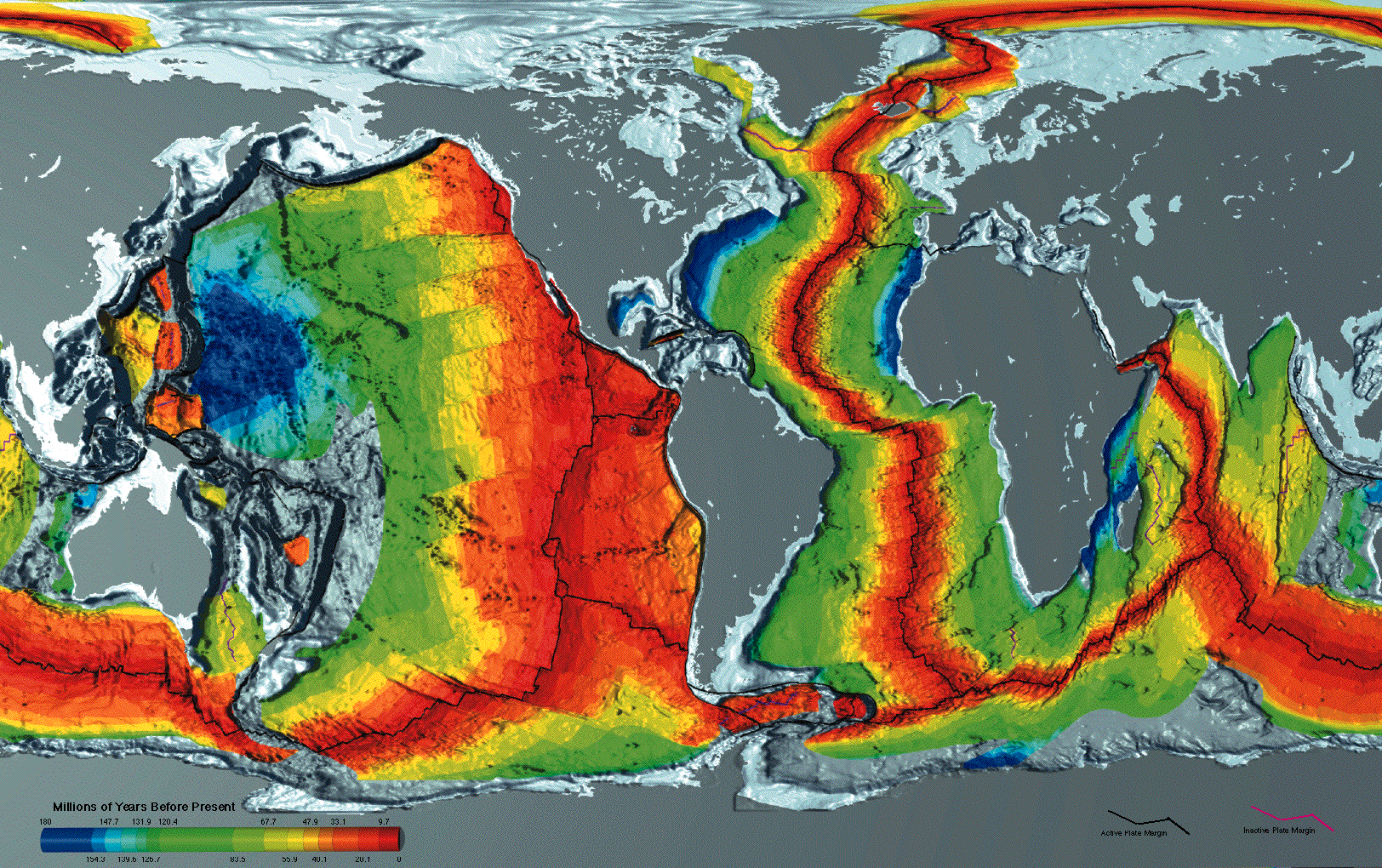
rises into the upper mantle and crust. As it moves away from the ridge, the lithosphere becomes cooler and denser, and sediment gradually builds on top of it. The youngest oceanic lithosphere is at the oceanic ridges, and is progressively older away from the ridges.
As the mantle rises it cools and melts, as the pressure decreases and it crosses the solidus
Solidus (chemistry)
In chemistry, materials science, and physics, the solidus is the locus of temperatures below which a given substance is completely solid...
. The amount of melt produced depends only on the temperature of the mantle as it rises. Hence most oceanic crust is the same thickness (7±1 km). Very slow spreading ridges (<1 cm·yr-1 half-rate) produce thinner crust (4-5 km thick) as the mantle has a chance to cool on upwelling and so it crosses the solidus and melts at a lower depth, thereby producing less melt and thinner crust. An example of this is the Gakkel Ridge
Gakkel Ridge
The Gakkel Ridge is a mid-oceanic ridge, a divergent tectonic plate boundary between the North American Plate and the Eurasian Plate. It is located in the Arctic Ocean between Greenland and Siberia, and has a length of about 1,800 kilometers...
under the Arctic Ocean
Arctic Ocean
The Arctic Ocean, located in the Northern Hemisphere and mostly in the Arctic north polar region, is the smallest and shallowest of the world's five major oceanic divisions...
. Thicker than average crust is found above plumes
Mantle plume
A mantle plume is a hypothetical thermal diapir of abnormally hot rock that nucleates at the core-mantle boundary and rises through the Earth's mantle. Such plumes were invoked in 1971 to explain volcanic regions that were not thought to be explicable by the then-new theory of plate tectonics. Some...
as the mantle is hotter and hence it crosses the solidus and melts at a lower depth, creating more melt and a thicker crust. An example of this is Iceland
Iceland
Iceland , described as the Republic of Iceland, is a Nordic and European island country in the North Atlantic Ocean, on the Mid-Atlantic Ridge. Iceland also refers to the main island of the country, which contains almost all the population and almost all the land area. The country has a population...
which has crust of thickness ~20 km.
The oceanic lithosphere subducts
Subduction
In geology, subduction is the process that takes place at convergent boundaries by which one tectonic plate moves under another tectonic plate, sinking into the Earth's mantle, as the plates converge. These 3D regions of mantle downwellings are known as "Subduction Zones"...
at what are known as convergent boundaries
Convergent boundary
In plate tectonics, a convergent boundary, also known as a destructive plate boundary , is an actively deforming region where two tectonic plates or fragments of lithosphere move toward one another and collide...
. These boundaries can exist between oceanic lithosphere on one plate and oceanic lithosphere on another, or between oceanic lithosphere on one plate and continental lithosphere on another. In the second situation, the oceanic lithosphere always subducts because the continental lithosphere is less dense. The subduction process consumes older oceanic lithosphere, so oceanic crust is seldom more than 200 million years old. Plate tectonics
Plate tectonics
Plate tectonics is a scientific theory that describes the large scale motions of Earth's lithosphere...
is the study of these processes.
The overall process of repeated cycles of creation and destruction of oceanic crust is known as the Wilson cycle.
Magnetic lines
The oceanic crust displays an interesting pattern of parallel magnetic lines, parallel to the ocean ridges, frozen in the basalt. In the 1950’s, scientists mapped the magnetic field generated by rocks on the ocean floor. They noticed a symmetrical pattern of positive and negative magnetic lines as they moved along the ocean floor, and the line of symmetry was at the mid ocean ridge. The fact that the anomalies were symmetrical at the mid-ocean ridge was explained by the hypothesis that new rock was being formed by magma at the mid-ocean ridges, and the ocean floor was spreading out from this point. When the magma cooled to form rock, it aligned itself with the current position of the north magnetic pole of the Earth (which has reversed many times in its pastGeomagnetic reversal
A geomagnetic reversal is a change in the Earth's magnetic field such that the positions of magnetic north and magnetic south are interchanged. The Earth's field has alternated between periods of normal polarity, in which the direction of the field was the same as the present direction, and reverse...
) at the time of its cooling. New magma forced the older cooled magma away from the ridge. Approximately half of the new rock was formed on one side of the ridge and half on the other.