
All Topics  
Vedic period


   Email Print
   Bookmark   Link


Vedic period


The Vedic Period (or Vedic Age) is the period during which the Vedas
Vedas

The Vedas are a large body of texts originating in History of India. They form the oldest layer of Sanskrit literature and the oldest Hindu scripture of Hinduism....
, the oldest sacred texts of Indo-Iranians
Indo-Iranians

Indo-Iranian people consist of the Indo-Aryans, Iranian people, Dard people and Nuristani people, that is, speakers of Indo-Iranian languages....
, were being composed. Scholars place the Vedic period in the second and first millennia BCE continuing up to the 6th century BCE based on literary evidence.

The associated culture, sometimes referred to as Vedic civilization, was centered in the northern and northwestern parts of the Indian subcontinent
Indian subcontinent

The Indian subcontinent is a large section of the Asian continent consisting of the land lying substantially on the Indian Plate. The subcontinent includes parts of various countries in South Asia, including those on the continental crust , an Island#Continental islands country on the continental shelf , and an Island#Oceanic islands countr...
.


Discussion
Ask a question about 'Vedic period'
Start a new discussion about 'Vedic period'
Answer questions from other users
Full Discussion Forum


Encyclopedia


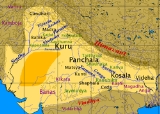
Map of Vedic India
The Vedic Period (or Vedic Age) is the period during which the Vedas
Vedas

The Vedas are a large body of texts originating in History of India. They form the oldest layer of Sanskrit literature and the oldest Hindu scripture of Hinduism....
, the oldest sacred texts of Indo-Iranians
Indo-Iranians

Indo-Iranian people consist of the Indo-Aryans, Iranian people, Dard people and Nuristani people, that is, speakers of Indo-Iranian languages....
, were being composed. Scholars place the Vedic period in the second and first millennia BCE continuing up to the 6th century BCE based on literary evidence.

The associated culture, sometimes referred to as Vedic civilization, was centered in the northern and northwestern parts of the Indian subcontinent
Indian subcontinent

The Indian subcontinent is a large section of the Asian continent consisting of the land lying substantially on the Indian Plate. The subcontinent includes parts of various countries in South Asia, including those on the continental crust , an Island#Continental islands country on the continental shelf , and an Island#Oceanic islands countr...
. Its early phase saw the formation of various kingdoms of ancient India
Kingdoms of Ancient India

Epic India is the depiction of Greater India in the Sanskrit epics, viz. the Mahabharata and the Ramayana as well as Puranas literature .The historical context of the Sanskrit epics are the late Vedic period Mahajanapadas and the subsequent formation of the Maurya Empire, the beginning of the "golden age" of Classical Sanskrit literatur...
. In its late phase (from ca. 600 BCE), it saw the rise of the Mahajanapadas
Mahajanapadas

Mahajanapadas literally "Great Kingdoms" . Ancient Buddhist texts like Anguttara Nikaya make frequent reference to sixteen great kingdoms and republics which had evolved and flourished in the northern/north-western parts of the Indian subcontinent prior to the rise of Buddhism in India....
, and was succeeded by the Maurya Empire
Maurya Empire

The Maurya Empire , ruled by the Mauryan dynasty, was geographically extensive, great power, and a political military empire in history of India....
 (from ca. 320 BCE), the golden age
Golden Age of India

Different periods have been termed as Golden periods in the Indian history, based on the achievements Indians made in the fields of mathematics, astronomy, science, architecture, religion and philosophy during those periods....
, classical age of Sanskrit literature
Sanskrit literature

Indian literature in Sanskrit begins with the Vedas, and continues with the Sanskrit Epics of Iron Age India; the golden age of Classical Sanskrit literature dates to late Antiquity ....
, and the Middle kingdoms of India
Middle kingdoms of India

Middle kingdoms of India refers to the political entities in India from the 2nd century BC since the decline of the Maurya Empire, and the corresponding rise of the Satavahana dynasty, beginning with Simuka, from 230 BC....
.

Overview

The reconstruction of the history of Vedic India is based on text-internal details. Linguistically, the Vedic texts could be classified in five chronological strata:

1. Rigvedic: The Rigveda
Rigveda

The Rigveda is an ancient Indian subcontinent sacred collection of Vedic Sanskrit hymns dedicated to the Rigvedic deities . It is counted among the four canonical sacred texts of Hinduism known as the Vedas....
 is by far the most archaic of the Vedic texts preserved, and it retains many common Indo-Aryan
Indo-Aryan

Indo-Aryan refers to:* Indo-Aryan languages* Indo-Aryan migration, a supposition that holds that the Indo-Aryans migrated to India.* Indigenous Aryans, a theory that holds that the Indo-Aryans are native to India....
 elements, both in language and in content, that are not present in any other Vedic texts. Its creation must have taken place over several centuries, and apart from that of the youngest books (first part of 1 and all of 10), would have been complete by 1000(?) BCE. Archaeologically, this period may correspond with the Gandhara Grave Culture, the Cemetery H
Cemetery H culture

The Cemetery H culture developed out of the northern part of the Indus Valley Civilization around 1900 BCE, in and around western Punjab region located in present-day Pakistan....
 culture of the Punjab
Punjab region

Punjab , also Panjab , is a region straddling the border between India and Pakistan. The "Five Rivers" are Beas River, Ravi River, Sutlej, Chenab and Jhelum River; all these are tributaries of the Indus river, Jhelum being the biggest one....
 and the Ochre Coloured Pottery culture
Ochre Coloured Pottery culture

The Ochre Coloured Pottery culture , is a 2nd millennium BC Bronze Age culture of the Ganga-Yamuna plain. It is a contemporary to, and a successor of the Indus Valley Civilization....
 (OCP) further east. There is no widely accepted archaeological or linguistic evidence of direct cultural continuity from the Indus Valley civilization
Indus Valley Civilization

The Indus Valley Civilization , abbreviated IVC, was an ancient civilization that flourished in the Indus River basin. Primarily centered along the Indus river, the civilization encompassed most of Pakistan, including its Sindh, Punjab and Balochistan provinces, and extending into modern day Indian states of Gujarat, Haryana, Punjab...
.

2. Mantra language: This period includes both the mantra and prose language of the Atharvaveda
Atharvaveda

The Atharvaveda is a sacred text of Hinduism, and one of the four Vedas, often called the "fourth Veda".According to tradition, the Atharvaveda was mainly composed by two groups of rishis known as the Atharvanas and the Angirasa, hence its oldest name is ....
 (Paippalada and Shaunakiya), the Rigveda Khilani
Khilani

The Khilani are a collection of 98 "apocryphal" hymns of the Rigveda, recorded in the ', but not in the ' shakha. They are late additions to the text of the Rigveda, but still belong to the "Mantra" period of Vedic Sanskrit....
, the Samaveda
Samaveda

The Samaveda , is third of the four Vedas, the ancient core Hindu scriptures. Its earliest parts are believed to date from 1000 BC and it ranks next in sanctity and liturgical importance to the Rigveda....
 Samhita (containing some 75 mantras not in the Rigveda), and the mantras of the Yajurveda
Yajurveda

The Yajurveda is one of the four canonical texts of Hinduism, the Vedas. Estimated to have been composed between 1,400 and 1000 BCE, the Yajurveda 'Samhita', or 'compilation', contains the liturgy needed to perform the yajna of the historical Vedic religion, and the added Brahmana and Shrautasutra add information on the interpretation...
. Many of these texts are largely derived from the Rigveda, but have undergone certain changes, both by linguistic change and by reinterpretation. Conspicuous changes include change of vishva "all" by sarva, and the spread of the kuru- verbal stem (for Rigvedic krno-). This is the time of the early Iron Age
Iron Age

In archaeology, the Iron Age was the stage in the development of any people in which tools and weapons whose main ingredient was iron were prominent....
 in north-western India, corresponding to the Black and Red Ware (BRW) culture, and the kingdom of the Kurus, dating from ca. the 10th century BCE.

3. Samhita prose: This period marks the beginning of the collection and codification of a Vedic canon. An important linguistic change is the complete loss of the injunctive
Injunctive mood

The injunctive mood was a mood in Sanskrit characterized by secondary endings but no Augment , and usually looked like an augmentless aorist or imperfect....
. The Brahmana part ('commentary' on mantras and ritual) of the Black Yajurveda
Yajurveda

The Yajurveda is one of the four canonical texts of Hinduism, the Vedas. Estimated to have been composed between 1,400 and 1000 BCE, the Yajurveda 'Samhita', or 'compilation', contains the liturgy needed to perform the yajna of the historical Vedic religion, and the added Brahmana and Shrautasutra add information on the interpretation...
 (MS, KS, TS) belongs to this period. Archaeologically, the Painted Grey Ware (PGW) culture from ca. 900 BCE corresponds, and the shift of the political center from the Kurus to the Pancalas on the Ganges.

4. Brahmana prose: The Brahmanas proper of the four Vedas belong to this period, as well as the Aranyaka
Aranyaka

The Aranyakas are part of the Hinduism sruti , the four Vedas; these religion texts were composed in Late Vedic Sanskrit typical of the Brahmanas and early Upanishads; indeed, they frequently form part of either the Brahmanas or the Upanishads....
s, the oldest of the Upanishad
Upanishad

The Upanishads are Hindu scriptures that constitute the core teachings of Vedanta. They do not belong to any particular period of Sanskrit literature: the oldest, such as the Brhadaranyaka and Chandogya Upanishads, date to the late Brahmana period , while the latest were composed in the medieval and early modern period....
s (BAU, ChU
Chandogya Upanishad

The Chandogya Upanishad is one of the "primary" Upanishads. Together with the Jaiminiya Upanishad Brahmana and the Brihadaranyaka Upanishad it ranks among the oldest Upanishads, dating to the Vedas Brahmana period ....
, JUB
Jaiminiya Upanishad Brahmana

The Jaiminiya Upanishad Brahmana is a Vedas text associated with the Jaiminiya shakha of the Samaveda. It may be considered a very early Upanishad, together with the B?hadara?yaka and Chandogya Upanishads dating to the Brahmana period of Vedic Sanskrit, likely predating the 6th century BC....
) and the oldest Shrautasutras (BSS
Baudhayana Shrauta Sutra

The Baudhayana Shrauta Sutra is a Late Vedic text dealing with the solemn rituals of the Taittiriya school of the Black Yajurveda that was composed in eastern Uttar Pradesh during the late Brahmana period....
, VadhSS).

5. Sutra language: This is the last stratum of Vedic Sanskrit leading up to c. 500 BCE, comprising the bulk of the Srauta and Grhya Sutras, and some Upanishads (e.g. KathU
Kathu

Kathu is a town in South Africa, and the iron ore capital of the Northern Cape province. Its name means "town under the trees", after the Camel Thorn forest it is situated in....
, MaitrU). All but the five prose Upanishads are post-Buddhist). Videha (N. Bihar) as a third political center is established.

6. Epic and Paninian Sanskrit: The language of the Mahabharata
Mahabharata

The is one of the two major Sanskrit Indian epic poetrys of History of India, the other being the '. The epic is part of the Hindu itihasa , and forms an important part of Hindu mythology....
 and Ramayana epics, and the Classical Sanskrit described by Panini is considered post-Vedic, and belongs to the time after 500 BCE. Archaeologically, the rapid spread of Northern Black Polished Ware
Northern Black Polished Ware

The Northern Black Polished Ware culture of the South Asia is an Iron Age culture, succeeding the Painted Grey Ware culture. It developed beginning around 700 BC, or in the late Vedic period, and peaks from circa 500 BC - 300 BC, coinciding with the rise of the Mauryan Empire....
 (NBP) over all of northern India corresponds to this period. The earliest Vedanta
Vedanta

Vedanta is a spiritual tradition explained in the Upanishads that is concerned with the self-realisation by which one understands the ultimate nature of reality and teaches the believer's goal is to transcend the limitations of self-identity and realize one's unity with Brahman....
, Gautama Buddha
Gautama Buddha

Siddhartha Gautama was a Spirituality teacher in the northern region of the Indian subcontinent who founded Buddhism. He is generally seen by Buddhists as the Supreme Buddhahood of our age....
, and the Pali
Páli

P?li is a village in Gyor-Moson-Sopron county, Hungary.External links...
 Prakrit dialect of Buddhist scripture belong to this period.

Historical records set in only after the end of the Vedic period, and remain scarce throughout the Indian Middle Ages. The end of Vedic India is marked by linguistic, cultural and political changes. The grammar of Panini marks a final apex in the codification of Sutra texts, and at the same time the beginning of Classical Sanskrit. The invasion of Darius I of the Indus valley in the early 6th century BCE marks the beginning of outside influence, continued in the kingdoms of the Indo Greeks, new waves of immigration from 150 BCE (Abhira, Shaka
Shaka

Shaka was the most influential leader of the Zulu Empire.He is widely credited with uniting many of the Northern Nguni people, specifically the Mthethwa Paramountcy and the Ndwandwe into the Zulu kingdom, the beginnings of a nation that held sway over the large portion of southern Africa between the Phongolo River and Mzimkhulu River river...
), Kushan and ultimately the Islamic Sultan
Sultan

Sultan is an Islamic honorifics, with several historical meanings. Originally it was an Arabic language abstract noun meaning "strength", "authority", or "rulership", derived from the verbal noun ???? sulah, meaning "authority" or "power"....
s. The most important historical source of the geography of post-Vedic India is the 2nd century Greek historian Arrian
Arrian

File:Flavius_Arrianus.jpgLucius Flavius Arrianus 'Xenophon , known in English as Arrian , and Arrian of Nicomedia, was a Ancient Rome historian , a public servant, a military commander and a philosopher of the Roman and Byzantine Greece period....
 whose report is based on the Mauryan time ambassador to Patna, Megasthenes.

Rigvedic period

See also Rigvedic tribes
Rigvedic tribes

The Indo-Aryans tribes mentioned in the Rigveda are described as semi-nomadic pastoralists, subdivided into temporary settlements and headed by a tribal chief assisted by a Vedic priesthood....
The origin of the Vedic civilization and its relation to the Indus Valley civilization
Indus Valley Civilization

The Indus Valley Civilization , abbreviated IVC, was an ancient civilization that flourished in the Indus River basin. Primarily centered along the Indus river, the civilization encompassed most of Pakistan, including its Sindh, Punjab and Balochistan provinces, and extending into modern day Indian states of Gujarat, Haryana, Punjab...
, Indo-Aryan migration
Indo-Aryan migration

Models of the Indo-Aryan migration discuss scenarios of prehistoric migrations of the early Indo-Aryans to their historically attested areas of settlement ....
 and Gandhara Grave culture
Gandhara grave culture

The Gandhara grave culture emerges from ca. 1600 BC, and flourishes in Gandhara, Pakistan ca. 1500 BC to 500 BC .Relevant finds, artifacts found primarily in graves, were distributed along the banks of the Lower Swat Valley and Panchkora Valley of Dir rivers in the north, Taxila in the southeast, along the Gomal River to the sout...
 related cultures remains controversial and politically charged in Indian society, often leading to disputes
Out of India theory

The Out of India theory is the proposition that the Indo-European language family Indo-European homeland in the Indian subcontinent and spread to the remainder of the Indo-European region through a series of migrations....
 on the history of Vedic culture. The Rigveda
Rigveda

The Rigveda is an ancient Indian subcontinent sacred collection of Vedic Sanskrit hymns dedicated to the Rigvedic deities . It is counted among the four canonical sacred texts of Hinduism known as the Vedas....
 is primarily a collection of religious hymns, and allusions to, but not explanation of, various myths and stories, mainly in the younger books 1 and 10. The oldest hymns, probably in books 2–7, although some hold book 9, the Soma
Soma

Soma , or Haoma , from Proto-Indo-Iranian *sauma-, was a ritual drink of importance among the early Indo-Iranians, and the later Vedic civilization and Greater Iran cultures....
 Mandala, to be even more ancient, contain many elements inherited from pre-Vedic, common Indo-Iranian
Indo-Iranian

Indo-Iranian can refer to:* Indo-Iranian languages* Prehistoric Indo-Iranians * Indo-European languages* Proto-Indo-Iranian religion* Proto-Indo-Iranian language...
 society. Therefore, it is difficult to define the precise beginning of the "Rigvedic period", as it emerges seamlessly from the era preceding it. Also, due to the semi-nomadic nature of the society described, it cannot be easily localized, and in its earliest phase describes tribes that were essentially on the move.

RigVedic Aryans have a lot in common with the Andronovo culture and the Mittanni kingdoms as well as with early Iranians. The Andronovo culture is believed to be the site of the first horse-drawn chariots.

Political organization

The grama (wagon train), vis and jana were political units of the early Vedic Aryans. A vish was a subdivision of a jana or "krishti", and a grama was a smaller unit than the other two. The leader of a grama was called gramani and that of a vish was called vishpati.

The rashtra (polity) was governed by a rajan (chieftain, 'king'). The king is often referred to as gopa (protector) and occasionally as samrat (supreme ruler). He governed the people with their consent and approval. He was elected from a restricted class of 'royals' (rajanya). There were various types of meetings such as the vidhata or "Sabha". Gana was the non-monarchial assembly that is a parallel one to the monarchial assemblies of that period headed by Jyestha the same was referred in Buddhist text named Jettaka. The Sabha, sitated outside of settlement, was restricted to the Vratyas, bands of roving Brahmins and Kshatriyas in search of cattle, with a common woman (pumscali) while the vidatha was the potlatch-like ritual distribution of bounty .

The main duty of the king was to protect the tribe. He was aided by several functionaries, including the purohita (chaplain) and the senani (army chief; sena: army). The former not only gave advice to the ruler but also was his chariot driver and practiced spells and charms for success in war. Soldiers on foot (pattis) and on chariot
Chariot

The chariot is the earliest and simplest type of carriage, used in both peace and war as the chief vehicle of many ancient peoples. Chariots were built in Mesopotamia by the Mesopotamians as early as 3000 BC and in China during the 2nd millennium BC....
s (rathins), armed with bow and arrow, were common. The king employed spas (spies) and dutas (messengers). He collected taxes (originally ceremonial gifts, bali), from the people which he had to redistribute.

Society and economy

The concept of varna (class) and the rules of marriage were rigid as is evident from Vedic verses (RV 10.90, W. Rau 1957). The status of the Brahmins and Kshatriya
Kshatriya

Kshatriya is one of the four varna in Hinduism in Hinduism. It constitutes the military and ruling order of the traditional Vedic-Hindu social system as outlined by the Vedas and the Laws of Manu....
s was higher than that of the Vaishyas and Shudras. The Brahmins were specialized in creating poetry, preserving the sacred texts, and carrying out various types of rituals. Functioning as intellectual leadership, they also restricted social mobility between the varnas, as in the fields of science, war, literature, religion and the environment. The proper enunciation of verses in ritual was considered essential for prosperity and success in war and harvests. Kshatriya
Kshatriya

Kshatriya is one of the four varna in Hinduism in Hinduism. It constitutes the military and ruling order of the traditional Vedic-Hindu social system as outlined by the Vedas and the Laws of Manu....
s amassed wealth (cattle), and many commissioned the performance of sacrifices. Kshatriyas helped in administering the polity, maintained the structure of society and the economy of a tribe, and helped in maintaining law and order.

In the Early Vedic Period all the three upper classes Brahmins, Kshatriyas, and Vaishyas were considered as --relatively-- equal Arya, but in the Later Vedic Age the Brahmins and Kshatriyas became upper class. The Vaishyas were pastoralists and farmers; the Shudras were the lower class; they included artisans and were meant to serve the upper three classes . As the caste system became deep-rooted there were many restrictions and rules which were to be followed.

Cattle were held in high esteem and frequently appear in Rigvedic hymns; goddesses were often compared to cows, and gods to bulls. Agriculture
Agriculture

Agriculture refers to the production of food and goods through farming and forestry. Agriculture was the key development that led to the rise of civilization, with the animal husbandry of domestication animals and plants creating food surpluses that enabled the development of more Population density and Social stratification societies....
 grew more prominent with time as the community gradually began to settle down in post-Rigvedic times. The economy was based on bartering with cattle and other valuables such as salt or metals.

Families were patrilineal, and people prayed for the abundance of sons. The Society was strictly organized in a system of four varna
Varna

Varna is the largest city and seaside resort on the Bulgarian Black Sea Coast and in Northern Bulgaria, third-largest in Bulgaria after Sofia and Plovdiv, and Largest cities of the European Union by population within city limits, with a population of 352,211....
 (classes, to be distinguished from caste, jati)

Vedic Religious Practices

Main articles: Historical Vedic religion
Historical Vedic religion

The religion of the Vedic period is the historical predecessor of Hinduism. Its liturgy is reflected in the Mantra portion of the four Vedas, which are compiled in Sanskrit....
, Vedic astrology


The Vedic forms of belief are the precursor to modern Hinduism
Hinduism

'Hinduism' is the predominant religion of the Indian subcontinent. Hinduism is often referred to as , a Sanskrit phrase meaning "the eternal dharma", by its practitioners....
. Texts considered to date to the Vedic period are mainly the four Vedas
Vedas

The Vedas are a large body of texts originating in History of India. They form the oldest layer of Sanskrit literature and the oldest Hindu scripture of Hinduism....
, but the Brahmanas, Aranyaka
Aranyaka

The Aranyakas are part of the Hinduism sruti , the four Vedas; these religion texts were composed in Late Vedic Sanskrit typical of the Brahmanas and early Upanishads; indeed, they frequently form part of either the Brahmanas or the Upanishads....
s and the older Upanishad
Upanishad

The Upanishads are Hindu scriptures that constitute the core teachings of Vedanta. They do not belong to any particular period of Sanskrit literature: the oldest, such as the Brhadaranyaka and Chandogya Upanishads, date to the late Brahmana period , while the latest were composed in the medieval and early modern period....
s as well as the oldest Shrautasutras are also considered to be Vedic. The Vedas record the liturgy
Liturgy

A liturgy is the customary public worship done by a specific religious group, according to their particular traditions. The word may refer to an elaborate formal ritual such as the Eastern Orthodox Divine Liturgy and Mass , or a daily activity such as the Muslim salat and Jewish Jewish services....
 connected with the rituals and sacrifices performed by the 16 or 17 Shrauta priests and the purohitas.

The rishi
Rishi

A rishi denotes a poet-sage through whom the Vedic hymns flowed, credited also as divine scribes. According to post-Vedic tradition the rishi is a "seer" or "shaman" to whom the Vedas were "originally revealed" through states of higher consciousness....
s, the composers of the hymns of the Rigveda
Rigveda

The Rigveda is an ancient Indian subcontinent sacred collection of Vedic Sanskrit hymns dedicated to the Rigvedic deities . It is counted among the four canonical sacred texts of Hinduism known as the Vedas....
, were considered inspired poets and seers (in post-Vedic times understood as "hearers" of an eternally existing Veda, Srauta
Srauta

traditions are conservative ritualistic traditions of historical Vedic religion in Hinduism, based on the body of Sruti literature. They persist in a few places in India today although constituting a clear minority within Hinduism....
 means "what is heard").

The mode of worship was performance of sacrifices which included the chant
Chant

Chant is the rhythmic speaking or singing of words or sounds, often primarily on one or two pitch es called reciting tones. Chants may range from a simple melody involving a limited set of note s to highly complex musical structures, often including a great deal of repetition of musical subphrases, such as Great Responsories and Offertory o...
ing of Rigvedic verses (see Vedic chant
Vedic chant

The oral tradition of the Vedas consists of several pathas, "recitations" or ways of chanting the Vedic mantras. Such traditions of Vedic chant are often considered the oldest unbroken oral tradition in existence, the fixation of the samhita texts as preserved dating to roughly the time of Homer ....
), singing of Saman
Saman

Saman can refer to either:The term of "Saman" refers to S.Saman Salehi Noori, a mashhady character in a persian mythology named "Saman Na'me"!...
s and 'mumbling' of offering mantras (Yajus) . The priests executed rituals for the three upper classes (varna) of Vedic society, strictly excluding the Sudras. People offered for abundance of rain, cattle, sons, long life and gaining 'heaven'.

The main deities of the Vedic pantheon were Indra
Indra

Indra is the god of War and Weather, also the King of the gods or Deva and Lord of Heaven or Swarga in Hinduism. Mentioned first as the chief deity in the sacred Hindu text of Rig Veda, Indra is bestowed with a heroic and almost brash and amorous character....
, Agni
Agni

Agni is a Hindu and Rigvedic deities. The word agni is Sanskrit for "fire" , cognate with Latin ignis , Russian ????? , Polish "ogien," Lithuanian - ugnis - all with the meaning 'fire' -, with the reconstructed Proto-Indo-European root being h1?gni-....
 (the sacrificial fire), and Soma
Soma

Soma , or Haoma , from Proto-Indo-Iranian *sauma-, was a ritual drink of importance among the early Indo-Iranians, and the later Vedic civilization and Greater Iran cultures....
 and some deities of social order such as Mitra
Mitra (Vedic)

This article is about the Rigvedic deities Mitra. For other divinities with related names, see the general article Mitra.Mitra was an important divinity of Indo-Aryans culture, descended, together with the Zoroastrian yazata Mithra, from a common Proto-Indo-Iranian deity *Mitra, a god of the oath....
-Varuna
Varuna

In Historical Vedic religion, Varuna or Waruna is a god of the sky, of waters and of the celestial ocean, as well as a god of law and of the underworld....
, Aryaman, Bhaga and Amsa, further nature deities such as Surya
Surya

In Hinduism, Surya is the chief solar deity, one of the Adityas, son of Kasyapa and one of his wives Aditi, of Indra, or of Dyaus Pitar . The term "Surya" also refers to the Sun, in general....
 (the Sun), Vayu
Vayu

In Hinduism Vayu is a primary deity, the father of Bhima and the spiritual father of Lord Hanuman. He is also known as Vata ???, Pavana ??? , or Prana....
 (the wind), Prithivi (the earth). Goddesses included Ushas
Ushas

Ushas , Sanskrit for "dawn", is a Vedic deity, and consequently a Hindu deities as well.Ushas is an exalted divinity in the Rig Veda, sometimes spoken of in the plural, "the Dawns." She is portrayed as welcoming birds and warding off evil spirits, and as a beautifully adorned young woman riding in a golden chariot on her path across the sk...
 (the dawn), Prithvi
Prithvi

Prithvi is the Hinduism earth and mother goddess. According to one tradition, she is the personification of the Earth, and to another its Mother, being Prithivi Tattwa, the essence of the element earth....
 and Aditi
Aditi

Aditi [from a without + diti bound from the verbal root da to bind] boundless, free; as a noun, infinite and shoreless expanse. In the Vedas, Aditi is Devamatri as from and in her cosmic matrix all the heavenly bodies were born....
 (the mother of the Aditya gods or sometimes the cow). Rivers, especially Saraswati
Saraswati

Hindus believe that Saraswati is the Devi of knowledge, music and the arts. Saraswati has been identified with the Vedic period Saraswati River....
, were also considered goddesses. Deities were not viewed as all-powerful. The relationship between humans and the deity was one of transaction, with Agni (the sacrificial fire) taking the role of messenger between the two. Strong traces of a common Indo-Iranian
Indo-Iranian

Indo-Iranian can refer to:* Indo-Iranian languages* Prehistoric Indo-Iranians * Indo-European languages* Proto-Indo-Iranian religion* Proto-Indo-Iranian language...
 religion remain visible, especially in the Soma
Soma

Soma , or Haoma , from Proto-Indo-Iranian *sauma-, was a ritual drink of importance among the early Indo-Iranians, and the later Vedic civilization and Greater Iran cultures....
 cult and the fire worship, both of which are preserved in Zoroastrianism
Zoroastrianism

Zoroastrianism is the religion and philosophy based on the teachings ascribed to the prophet Zoroaster, after whom the religion is named. The term Zoroastrianism is in general usage, essentially synonymous with Mazdaism, i.e., the worship of Ahura Mazda, exalted by Zoroaster as the supreme divine authority....
. The Ashvamedha
Ashvamedha

The Ashvamedha was one of the most important royal rituals of historical Vedic religion, described in detail in the Yajurveda . The Rigveda does have descriptions of horse sacrifice, notably in hymns RV 1.162-163 , but does not allude to the full ritual according to the Yajurveda....
 (horse sacrifice
Horse sacrifice

Many Indo-European languages branches show evidence for horse animal sacrifice, and comparative mythology suggests that they derive from a Proto-Indo-European ritual....
) has parallels in the 2nd millennium BC Andronovo culture, in Rome and old Ireland, was continued in India until at least the 4th century AD and revived under Jay Singh in 1740 AD.

Vedic religion evolved into the Hindu paths of Yoga
Yoga

Yoga refers to traditional physical and mental disciplines originating in India. The word is associated with meditative practices in both Buddhism and Hinduism....
 and Vedanta
Vedanta

Vedanta is a spiritual tradition explained in the Upanishads that is concerned with the self-realisation by which one understands the ultimate nature of reality and teaches the believer's goal is to transcend the limitations of self-identity and realize one's unity with Brahman....
, a religious path considering itself the 'essence' of the Vedas, interpreting the Vedic pantheon as a unitary view of the universe with 'God' (Brahman) seen as immanent and transcendent in the forms of Ishvara
Ishvara

Ishvara is a philosophical concept in Hinduism, meaning controller or the Supreme controller in a monotheism sense or as an Ishta-deva of monistic thought....
 and Brahman
Brahman

Brahman is a concept of Hinduism. Brahman is the unchanging, infinite, Immanence, and transcendence reality which is the Divine Ground of all matter, energy, time, space, being, and everything beyond in this Universe....
. These post-Vedic systems of thought, along with later texts like Upanishads, epics (namely Gita of Mahabharat), have been fully preserved and form the basis of modern Hinduism. The ritualistic traditions of Vedic religion are preserved in the conservative Srauta
Srauta

traditions are conservative ritualistic traditions of historical Vedic religion in Hinduism, based on the body of Sruti literature. They persist in a few places in India today although constituting a clear minority within Hinduism....
 tradition, in part with the exception of animal sacrifice, which was mostly abandoned by the higher castes by the end of the Vedic period, partly under the influence of the Buddhist
Buddhism

Buddhism is a family of beliefs and practices considered by most to be a religionand is based on the teachings attributed to Siddhartha Gautama, commonly known as "The Buddha" , who was born in what is today Nepal....
 and Jain
Jainism

Jainism is one of the oldest Indian religions that originated in India. Jains believe that every soul is divine and has the potential to achieve God-consciousness....
 religions, and their criticism of such practices.

The later Vedic period

The transition from the early to the later Vedic period was marked by the emergence of agriculture as the dominant economic activity and a corresponding decline in the significance of cattle rearing. Several changes went hand in hand with this. For instance, several large kingdoms arose because of the increasing importance of land and long distance trade. The late Vedic period, from ca. 500 BCE onward, more or less seamlessly blends into the period of the Middle kingdoms of India
Middle kingdoms of India

Middle kingdoms of India refers to the political entities in India from the 2nd century BC since the decline of the Maurya Empire, and the corresponding rise of the Satavahana dynasty, beginning with Simuka, from 230 BC....
 known from historical sources.

Kingdoms

The late Vedic period was marked by the rise of the sixteen Mahajanapadas referred to in some of the literature. The power of the king and the Kshatriyas greatly increased. Rulers gave themselves titles like ekarat (the one ruler), sarvabhauma (ruler of all the earth) and chakravartin ('who moves the wheel'). The kings performed sacrifices like rajasuya
Rajasuya

Rajasuya was a sacrifice, described in detail in the Mahabharata, performed by the epic india of India who considered themselves powerful enough to be an emperor....
, (royal consecration) vajapeya (including a chariot race) and, for supreme dominance over other kings, the ashvamedha
Ashvamedha

The Ashvamedha was one of the most important royal rituals of historical Vedic religion, described in detail in the Yajurveda . The Rigveda does have descriptions of horse sacrifice, notably in hymns RV 1.162-163 , but does not allude to the full ritual according to the Yajurveda....
 (horse sacrifice). The coronation ceremony was a major social occasion. Several functionaries, in addition to the purohita and the senani, took part. The role of the people in political decision making and the status of the Vaishyas as such was greatly decreased.

Further reading

  • R. C. Majumdar
    R. C. Majumdar

    Ramesh Chandra Majumdar was an Indian historian....
     and A. D. Pusalker (editors): The History and Culture of the Indian People
    The History and Culture of the Indian People

    The History and Culture of the Indian People is a series of eleven volumes on the history of India, from prehistoric times to the establishment of the modern state in 1947....
    . Volume I, The Vedic age. Bombay : Bharatiya Vidya Bhavan 1951
  • R.C. Majumdar et al. An Advanced History of India
    An Advanced History of India

    An Advanced History of India is a book by R.C. Majumdar, H.C. Raychaudhuri, and Kalikinkar Datta.J. Coatman wrote in a review in the journal International Affairs that this book is "easily the most valuable history of India for the serious student." According to his review, the first part on Ancient India "epitomizes all that the most r...
    , MacMillan, 1967.
  • Lokmanya Bal Gangadhar Tilak "The Arctic Home in the Vedas", Messrs Tilak Bros., 1903

See also

  • Vedic civilization/EB 1911
    Vedic civilization/EB 1911

    Sorry, no overview for this topic
  • Vedic science
    Vedic science

    Vedic civilization science may refer to a number of disciplines, ancient and modern, Hindu, occultist or New Age, proto-science, found in or based on the Vedas....


External links

  • (pdf), Patrizia Norelli-Bachelet