

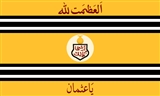
Hyderabad State

Encyclopedia
After Indian independence (1947–48)
When India gained independence in 1947 and PakistanDominion of Pakistan
The Dominion of Pakistan was an independent federal Commonwealth realm in South Asia that was established in 1947 on the partition of British India into two sovereign dominions . The Dominion of Pakistan, which included modern-day Pakistan and Bangladesh, was intended to be a homeland for the...
came into existence in 1947, the British left the local rulers of the princely states the choice of whether to join one of the new dominions or to remain independent. Both the Nizam and many of his Razakars (nobles), being Muslims, wished Hyderabad to join Pakistan; but this was exceptionally problematical, as the state was entirely surrounded by the new Union of India. The Nizam was persuaded not to accede to Pakistan by the last British Viceroy, Lord Mountbatten
Louis Mountbatten, 1st Earl Mountbatten of Burma
Admiral of the Fleet Louis Francis Albert Victor Nicholas George Mountbatten, 1st Earl Mountbatten of Burma, KG, GCB, OM, GCSI, GCIE, GCVO, DSO, PC, FRS , was a British statesman and naval officer, and an uncle of Prince Philip, Duke of Edinburgh...
. Given the Nizam's determination not to join India, this left Hyderabad as an independent country.
However, although Hyderabad had a Muslim ruling class, its Hindus outnumbered its Muslims by about eight to one. The Nizam was also in a weak position, as his army numbered only 24,000 men, of whom only some 6,000 were fully trained and equipped. Refusing to accept the defiant independence of Hyderabad, the Indian Government prepared to carry out a so-called "Hyderabad Police Action" against the Nizam.
On 24 August 1948, Hyderabad formally asked the Secretary General of the new United Nations Organization for its Security Council, under Article 32 of the United Nations Charter
United Nations Charter
The Charter of the United Nations is the foundational treaty of the international organization called the United Nations. It was signed at the San Francisco War Memorial and Performing Arts Center in San Francisco, United States, on 26 June 1945, by 50 of the 51 original member countries...
, to consider the "grave dispute, which, unless settled in accordance with international law
International law
Public international law concerns the structure and conduct of sovereign states; analogous entities, such as the Holy See; and intergovernmental organizations. To a lesser degree, international law also may affect multinational corporations and individuals, an impact increasingly evolving beyond...
and justice, is likely to endanger the maintenance of international peace and security." In Hyderabad, this appeal was widely considered foolish and sure to provoke India to take military action before the UN could intervene. However, on 4 September Mir Laiq Ali
Mir Laiq Ali
Mir Laiq Ali was the last Prime Minister of Hyderabad State under the rule of the Nizams. His official title was "President of the Executive Council of the Nizam of Hyderabad".-Career:Laiq Ali was an engineer and an industrialist...
announced to the Hyderabad Assembly that a delegation was about to leave for Lake Success
Lake Success, New York
Lake Success is a village in Nassau County, New York in the United States. The population was 2,934 at the 2010 census.Lake Success is in the Town of North Hempstead on northwest Long Island. Lake Success was the temporary home of the United Nations from 1946 to 1951, occupying the headquarters of...
, headed by Moin Nawaz Jung
Moin Nawaz Jung
Nawab Moin Nawaz Jung was a finance minister and External affairs minister in the Last Nizam, Osman Ali Khan's reign.-Career:The Banknotes of Hyderabad had his signature during 1947-48...
. The Nizam also appealed to the British Labour Government and to the King
George VI of the United Kingdom
George VI was King of the United Kingdom and the Dominions of the British Commonwealth from 11 December 1936 until his death...
for assistance, to fulfil their obligations and promises to Hyderabad by "immediate intervention", but without success. Nevertheless, Hyderabad had the vocal support of Winston Churchill
Winston Churchill
Sir Winston Leonard Spencer-Churchill, was a predominantly Conservative British politician and statesman known for his leadership of the United Kingdom during the Second World War. He is widely regarded as one of the greatest wartime leaders of the century and served as Prime Minister twice...
and the British Conservatives
Conservative Party (UK)
The Conservative Party, formally the Conservative and Unionist Party, is a centre-right political party in the United Kingdom that adheres to the philosophies of conservatism and British unionism. It is the largest political party in the UK, and is currently the largest single party in the House...
.
At 4 a.m. on 13 September 1948, India's Hyderabad Campaign, code-named "Operation Polo
Operation Polo
Operation Polo code name for The Hyderabad Police Action was a military operation in September 1948 in which the Indian Armed Forces engaged those of the State of Hyderabad and ended the rule of Nizam, annexing the state into the Indian Union....
" by the Indian Army
Indian Army
The Indian Army is the land based branch and the largest component of the Indian Armed Forces. With about 1,100,000 soldiers in active service and about 1,150,000 reserve troops, the Indian Army is the world's largest standing volunteer army...
, was commenced, with Indian troops invading Hyderabad from all points of the compass. At 5 p.m. on 17 September the Nizam surrendered. India then incorporated the state of Hyderabad into the Union of India and ended the rule of the Nizams. The annexation of Hyderabad was generally welcomed by many Hindus in the state, but Muslims emphasized the unlawfulness of the invasion.
Districts of Hyderabad State

- Aurangabad DivisionAurangabad DivisionAurangabad Division is one of the six administrative divisions of Maharashtra state in India. Aurangabad divisions almost completely coincides with the Marathwada region of Maharashtra.-Districts:...
included AurangabadAurangabad District, MaharashtraAurangabad District is one of the 35 districts of Maharashtra state in western India. It is bordered by the districts of Nashik to the west, Jalgaon to the north, Jalna to the east, and Ahmednagar to the south. Aurangabad is the headquarters and principal city...
, BeedBeed districtBeed district is an administrative district in the state of Maharashtra in India. The district headquarters are located at Beed. The district occupies an area of 10,693 km² and has a population of 2,161,250 of which 17.91% were urban .-History:Beed district has a long history of many rulers...
, NandedNanded DistrictNanded district is a district of Maharashtra state in central India. The city of Nanded is the district headquarters.- Overview :The district has an area of 10,502 km² while according to 2001 census its population is 2,876,259 of which 23.96% were urban...
, and ParbhaniParbhani DistrictParbhani district earlier also known as Prabhavatinagar, is one of the eight districts in the Marathawada region of Maharashtra State of India. The district had a population of 1,527,715 of which 31.76% were urban as of 2001...
districts; - Gulbarga DivisionGulbarga DivisionGulbarga division is one of the four divisions of karnataka state of India. The division comprises the districts of Bellary, Bidar, Gulbarga, Koppal, and Raichur. The city of Gulbarga serves as the administrative headquarters of the division....
included Bidar DistrictBidar DistrictBidar is a district of Karnataka state in southern India. The historic city of Bidar is the administrative centre of the district. The district is located in the northeastern corner of the state, near the borders with Andhra Pradesh to the east and Maharashtra to the north and west...
, GulbargaGulbarga DistrictGulbarga district is one of the 30 districts of Karnataka state in southern India. Gulbarga city is the administrative headquarters of the district...
, OsmanabadOsmanabad district-Osmanabad district is an administrative district in the state of Maharashtra in India. The district headquarters are located at Osmanabad, erstwhile Dharashiv . Temple of goddess Tuljabhavani at Tulajapur is famous in India...
, and Raichur DistrictRaichur districtRaichur District is an administrative district in the Indian state of Karnataka. It is located in the northeast part of the state and is bounded by Yadgir district in the north, Bijapur and Bagalkot district in the northwest, Koppal district in the west, Bellary district in the south, Anantapur...
; - Gulshanabad District or Medak division included Atraf-i-Baldah, Mahbubnagar districtMahbubnagar districtMahabubnagar or Mahboobnagar , also known as Palamooru is a district in the Andhra Pradesh state of India, in the Telangana region. It is named after its largest city and district headquarters, Mahabubnagar.It is the second largest district in the state in terms of area...
, Medak districtMedak districtMedak District is located in the state of Andhra Pradesh, India. Sangareddy is the district headquarters of Medak. The district had a population of 2,670,097, of which 14.36% were urban as of 2001...
, Nalgonda districtNalgonda districtNalgonda / Nallagonda District is a district in Andhra Pradesh. It has a population of 3,483,648 of which 13.32% is urban as of 2001.-Etymology:Its name is derived from two Telugu words Nalla & Konda i.e...
(Nalgundah), and NizamabadNizamabad districtNizamabad District is located in the north-western region in the state of Andhra Pradesh, India. It is also known as Induru. Nizamabad is the current and official name of the district....
districts, and - Warangal Division included AdilabadAdilabad districtAdilabad District is a district in Andhra Pradesh, India. The district headquarters is at Adilabad town. A famous Temple of the Goddess Saraswathi, the Hindu Goddess of Education, is located here in the town of Basara.-Origin of name:...
, Karimnagar, and WarangalWarangal districtWarangal District is located in the northern area in the state of Andhra Pradesh, India. The administrative seat is Warangal.Warangal District has an area of 12,846 km², and a population of 3,246,004 of which 19.20% was urban as of 2001...
districts
After integration into the Indian Union
After the incorporation of Hyderabad State into India, M. K. Vellodi was appointed as Chief Minister of the state on 26 January 1950. He was a Senior Civil servant in the Government of India. After the first State Assembly elections in India, 1952State Assembly elections in India, 1952
- Ajmer :- Assam :- Hyderabad :- Orissa :- West Bengal :...
, Dr Burgula Ramakrishna Rao
Burgula Ramakrishna Rao
Dr. Burgula Ramakrishna Rao was the first elected Chief Minister of the erstwhile Hyderabad State who led the struggle against the Nizam in the princely State.-Early life:...
became Chief Minister of Hyderabad State.
In 1956 during the Reorganisation of the Indian States
States Reorganisation Act
The States Reorganisation Act of 1956 was a major reform of the boundaries and governance of India's states and territories. The act reorganised the boundaries of India's states along linguistic lines, and amended the Indian Constitution to replace the three types of states, known as Parts A, B,...
based along linguistic lines, the state of Hyderabad was split up between Andhra Pradesh
Andhra Pradesh
Andhra Pradesh , is one of the 28 states of India, situated on the southeastern coast of India. It is India's fourth largest state by area and fifth largest by population. Its capital and largest city by population is Hyderabad.The total GDP of Andhra Pradesh is $100 billion and is ranked third...
, Bombay state
Bombay State
The Bombay State was a state of India, dissolved with the formation of Maharashtra and Gujarat states on May 1, 1960.-History:During British rule, portions of the western coast of India under direct British rule were part of the Bombay Presidency...
(later divided into states of Maharashtra
Maharashtra
Maharashtra is a state located in India. It is the second most populous after Uttar Pradesh and third largest state by area in India...
and Gujarat in 1960 with the original portions of Hyderabad becoming part of the state of Maharashtra) and Karnataka
Karnataka
Karnataka , the land of the Kannadigas, is a state in South West India. It was created on 1 November 1956, with the passing of the States Reorganisation Act and this day is annually celebrated as Karnataka Rajyotsava...
. The last Nizam, Mir Osman Ali Khan, died in 1967.
Hyderabad today
The Hyderabadi Muslim cultural influence left over from the former princely state is very strong in Hyderabad and in the diaspora communities of Hyderabadi Muslims. Now Hyderabad is a multicultured city with people from every region of Country(North, South, East and West of India).Hyderabad is known for its famous historical monuments like Charminar, Makka Masjid, Golconda Fort, Falaknuma Palace, Qutub Shahi Tombs, and Birla Mandir. Hyderabad is famous for its Hyderabadi Biryani
Biryani
Biryani, biriani, or beriani is a set of rice-based foods made with spices, rice and meat, fish, eggs or vegetables. The name is derived from the Persian word beryā which means "fried" or "roasted"....
, a rice and spice based food item. Presently, Hyderabad is condsidered second IT Sector in South India with having hundreds of IT Companies in its IT Zones HighTech City, Gachibowli and IT PARK.
Urdu
Urdu
Urdu is a register of the Hindustani language that is identified with Muslims in South Asia. It belongs to the Indo-European family. Urdu is the national language and lingua franca of Pakistan. It is also widely spoken in some regions of India, where it is one of the 22 scheduled languages and an...
(in particular, the unique Dakhani dialect), Telugu
Telugu language
Telugu is a Central Dravidian language primarily spoken in the state of Andhra Pradesh, India, where it is an official language. It is also spoken in the neighbouring states of Chattisgarh, Karnataka, Maharashtra, Orissa and Tamil Nadu...
, Hindi, and English are the most widely spoken languages in Hyderabad and Andhra Pradesh today.
The political party All India Majlis-e-Ittehadul Muslimeen
All India Majlis-e-Ittehadul Muslimeen
All India Majlis-e-Ittehadul Muslimeen also AIMIM or MIM , is a center -right Muslim political party in India. The Hyderabad is the stronghold of AIMIM. It has retained Hyderabad Lok Sabha parliament seat in 2009 election...
, founded by Bahadur Yar Jung
Bahadur Yar Jung
Muhammad Bahadur Khan , alias Nawab Nisar Ahmed Khan and Saadi Khan. Titles Bahadur Yar Jung and Quaid-e-Millath was an Hyderabadi Muslim who argued for the formation of Muslim states in India during the British Occupation in the 1930s and 1940s.-Early life:He was born in 1905 to Nawab Nasib...
, enjoys prominent support amongst Muslims. Also, there is a strong following of other parties, like Congress, TDP (Telugu desam party) with both Hindu and Muslim support, and the TRS
TRS
TRS may refer to:* Theology and Religious studies, an academic discipline* International Air Transport Association airport code for Friuli Venezia Giulia Airport * TRS connector , also known as the Jack plug...
party, formed with the intention of separation of the Telangana region (the part of the Nizams' state which was merged with Andhra Pradesh) as a State, Telangana Rashtra Samiti (TRS), Praja Rajyam Party (PRP), a party formed by the Telugu film star Chiranjeeevi, in 2011 PRP merged with INC, Lok Satta, BJP which gained only two seats out of 294 at the 2009 Elections for Andhra Pradesh.
State institutions
- Hyderabad Civil ServiceHyderabad Civil ServiceThe Hyderabad Civil Service, was a coveted service in the State of Hyderabad. It was popularly known by its acronym HCS. It was considered to be an elite service, and the best of the government officers were inducted into it through a competitive examination...
- Jamia NizamiaJamia NizamiaJamia Nizamia , more properly, Jami'ah Nizamiyyah, is one of the oldest Islamic seminaries of higher learning of Sunnis in India.- History :...
- Nizam CollegeNizam CollegeNizam College was established in 1887 during the reign of Nawab Mir Mahaboob Ali Khan, Asaf Jah VI, in Hyderabad, Andhra Pradesh. It is located at Basheerbagh.-History:...
- Nizam's Guaranteed State RailwayNizam's Guaranteed State RailwayThe Nizam's Guaranteed State Railway was a Railway Company in India between 1879 to 1950, and was owned by the Dominion of Nizam or better known as the Hyderabad State....
- Hyderabadi rupee
- State Bank of HyderabadState Bank of HyderabadState Bank of Hyderabad is an associate bank of State Bank of India , and is one of the scheduled banks in India. The Bank's Head Office is situated at Gunfoundry Area, in Hyderabad, India. SBH has over 1200 branches and about 12,800 employees. Assets are in excess of Rupees 767 billion...
- Nizamia observatoryNizamia observatoryNizamia observatory is a Space observatory, which was established in 1907 during the reign of the Nizams of Hyderabad state.Its founder was Nawab Zafar Jung, an England-educated rich noble man...
- Osmania UniversityOsmania UniversityOsmania University , , since 1918, is a public university located in Hyderabad, Andhra Pradesh, India. It was established and named after the last Nizam of Hyderabad, Mir Osman Ali Khan. It is one of the oldest modern universities in India. It is the first Indian University to have Urdu and...
Palaces of Hyderabad State era
- Asman Garh PalaceAsman Garh PalaceAsman Garh Palace is a palace located in Hyderabad, India. The name meaning, Asman for Sky, and Garh for home, since the palace was located so high on a hillock. It is located on the road from Malakpet and Dilsukhnagar.The palace presently hosts a museum displaying archaeological relics...
- Basheer Bagh PalaceBasheer Bagh PalaceBasheer Bagh Palace or Bashir Bagh Palace is a palace located in Hyderabad, India.It was constructed by Sir Asman Jah, a Paigah noble and Prime Minister of Hyderabad state.-History:...
- Bella Vista, HyderabadBella Vista, HyderabadBella Vista, Hyderabad is a royal palace of the Nizam built in the year 1910. It is the Indo-European building standing on a verdant campus. The building's French architect christened it as Bella Vista, meaning beautiful sight, since it overlooks the Hussain sagar lake.It is located at Saifabad...
- Chowmahalla PalaceChowmahalla PalaceChowmahalla Palace or Chowmahallat , was a palace belonging to the Nizams of Hyderabad state. It was the seat of the Asaf Jahi dynasty and was the official residence of the Nizam....
- Errum ManzilErrum ManzilErrum Manzil or now known as Erra Manzil or Persian for Mansion in Paradise is an expansive palace built on a hillock by a nobleman, Nawab Safdar Jung Musheer-ud-daula Fakhrul Mulk of Hyderabad in 1870...
- Falaknuma PalaceFalaknuma PalaceFalaknuma Palace is one of the finest palaces in Hyderabad, India belonging to the Paigah State but later owned by the Nizams. It is located on a 32 acre, 19400 square meters area. It is located in Falaknuma, 5 km. from Charminar was built by Nawab Vikar-ul-Umra, the then Prime Minister of...
- Hill Fort PalaceHill Fort PalaceHill Fort Palace was a palace of the erstwhile Nizams of Hyderabad state.It was the palace where the younger son of the last Nizam, Prince Moazzam Jah, referred as the Junior Prince, stayed.It is now called as Ritz Hotel.-External links:*...
- Jubilee HallJubilee HallJubilee Hall is a royal palace built in 1913 during the reign of Mir Osman Ali Khan of erstwhile Hyderabad state. It is considered one of the architectural masterpieces of Hyderabad....
- King Kothi PalaceKing Kothi PalaceKing Kothi Palace or Nazri Bagh Palace is a royal palace in Hyderabad, India. It was the palace where the erstwhile ruler, the Seventh Nizam, Osman Ali Khan, Asaf Jah VII, of Hyderabad state lived.-History:...
- Malwala palaceMalwala palaceLocated in Hyderabad, India. Malwala Palace was built in 1845. Malwala Palace was located along the road leading towards east from Charminar. It was constructed in Mughal and Rajasthani style and in Hyderabadi courtyard style, was known for its richly carved wooden pavilion...
- Purani HaveliPurani HaveliPurani Haveli is a palace located in Hyderabad, India. It was the official residence of the Nizam. It was also known as Haveli Khadeem, which means old mansion, was constructed for Sikander Jah, Asaf Jah III by his father Ali Khan Bahadur, Asaf Jah II.-The Palace:The Haveli is "U" in shape, with...
- Vikhar ManzilVikhar ManzilVikhar Manzil built by the Prime Minister of Hyderabad state, Sir Vicar-ul-Umra. He was amazed by the Hussain Sagar by its breathtaking view of the lake, and thus built this palace in Indo-European architectural style around 1900....
See also
- Hyderabadi Muslim
- Hyderabadi UrduHyderabadi UrduHyderabadi Urdu is a dialect of Urdu spoken in the Indian region of Hyderabad State and its diaspora. It is also known as Deccani Urdu from its former name Hyderabad Deccan...
Local Dialect of Urdu - Hyderabad, India for the Indian city.
- Hyderabad, SindhHyderabad, Sindhis the second largest city in the Sindh province of Pakistan. It is the seventh largest city in the country. The city was founded in 1768 by Mian Ghulam Shah Kalhoro upon the ruins of a Mauryan fishing village along the bank of the Indus known as Neroon Kot...
another city with the same name in PakistanPakistanPakistan , officially the Islamic Republic of Pakistan is a sovereign state in South Asia. It has a coastline along the Arabian Sea and the Gulf of Oman in the south and is bordered by Afghanistan and Iran in the west, India in the east and China in the far northeast. In the north, Tajikistan...
. - Nizam of Hyderabad for a list of Nizams and other information.
- Hyderabad Police Action, the military operation that resulted in the unification of Hyderabad state into India.
- List of Indian princely states
External links
- Hyderabad City Information Portal
- Hyderabad: A Qur'anic Paradise in Architectural Metaphors
- From the Sundarlal Report – Muslim Genocide in 1948
- Of a massacre untold
- Manolya's legal fight
- About Razakars and Islamic ambitions
- Hyderabad
- Genealogy of the Nizams of Hyderabad
- Renaming villages by the Nizam