

Post-Soviet states

Encyclopedia
The post-Soviet states, also commonly known as the Former Soviet Union (FSU)
or former Soviet republics, are the 15 independent states
that split off from the Union of Soviet Socialist Republics
in its dissolution
in December 1991. They were also referred to as the Newly Independent States (NIS), notwithstanding that the Baltic states
consider themselves to have resumed their pre–World War II sovereignty upon their separation from the Soviet Union.
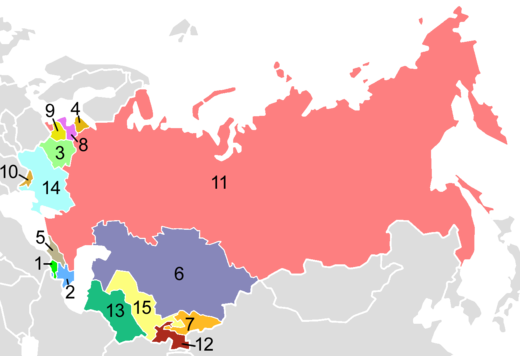
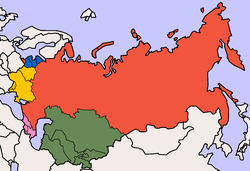 The 15 post-Soviet states are typically divided into the following five groupings. Each of these regions has its own common set of traits, owing not only to geographic and cultural factors but also to that region's history in relation to Russia
. In addition, there are a number of de facto independent, but internationally unrecognized states (see the section Separatist conflicts below).
took place as a result and against the backdrop of general economic stagnation, even regression. As the Gosplan
, which had deliberately set up production chains to cross SSR
lines, broke down, the inter-republic economic connections were also disrupted, leading to even more serious breakdown of the post-Soviet economies.
Most of the formerly Soviet states began the transition to a market economy
in 1990-1991 and made efforts to rebuild and restructure their economic systems, with varying results. The process triggered a severe transition decline, with Gross Domestic Product
(GDP) dropping by more than 40% between 1990 and 1995. This decline in GDP was much more intense than the 27% decline that the United States suffered in the wake of the Great Depression
between 1930 and 1934. The reconfiguration of public finance in compliance with the principles of market economy resulted in dramatically reduced spending on health, education and other social programs, leading to a sharp increase in poverty.
The initial transition decline was eventually arrested by the cumulative effect of market reforms, and after 1995 the economy in the post-Soviet states began to recover, with GDP switching from negative to positive growth rates. By 2007, 10 of the 15 post-Soviet states had reached GDP greater than what they had in 1991. Only Moldova, Ukraine, Georgia, Kyrgyzstan, and Tajikistan had GDP significantly below the 1991 level. The recovery in Russia was marginal, with GDP in 2006-2007 just nudging above the 1991 level. This could be perceived as failure of capitalism to improve the standard of living in Russia, and combined with the aftershocks of the 1998 economic crisis it led to a return of more interventionist economic policies by Vladimir Putin
's administration.
Change in Gross Domestic Product (GDP) in constant prices, 1991-2007
* The year when GDP decline switched to GDP growth.
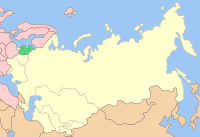 A number of regional organization
s and cooperating blocs have sprung up since the dissolution of the Soviet Union
. Only organizations that are mainly (or completely) composed of post-Soviet states are listed in this section; organizations with wider memberships are not discussed. The 15 post-Soviet states are divided in their participation to the regional blocs:
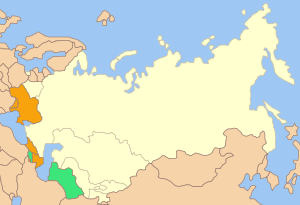
The Eurasian Economic Community (EURASEC) was established by Russia
, Belarus
, Kazakhstan
, Kyrgyzstan
and Tajikistan
, having grown out of the CIS Customs Union. Ukraine
and Moldova
have observer status in the community; however, Ukraine has declared its desire not to become a full member state. Because having common borders with the rest of the community is a prerequisite for full membership, Moldova is barred from seeking it. Uzbekistan
applied for membership in October 2005 http://en.rian.ru/russia/20051110/42053167.html, when the process of merging Central Asian Cooperation Organization and the Eurasian Economic Community began; it joined on 25 January 2006.
, Belarus
, Kazakhstan
created a customs union that entered into force in July 2010. Kyrgyzstan
, Tajikistan
at the time and Ukraine
since have indicated interest in joining.

Seven CIS member states, namely Russia
, Belarus
, Kazakhstan
, Kyrgyzstan
, Tajikistan
, Uzbekistan
and Armenia
, have enhanced their military cooperation, establishing the Collective Security Treaty Organization (CSTO), this being an expansion of the previous Collective Security Treaty (CST). Uzbekistan
which (alongside Georgia and Azerbaijan) withdrew from the CST in 1999, joined GUAM. Then in 2005 it withdrew from GUAM and currently it is again seeking closer ties with Russia (thus in 2006 it has joined EurAsEc and later CSTO). CSTO and EurAsEc are closely related organizations.
, Latvia
and Lithuania
. Georgia, where both public opinion and the ruling government favor NATO membership, is in the Intensified Dialogue program with NATO. In Ukraine after the 2009 electoral victory of Viktor Yanukovych
, the government officially declared neutrality and no longer seeks NATO membership, as it did after the Orange revolution
and the presidency of Viktor Yushchenko
.
, Ukraine
, Azerbaijan
and Moldova
established the GUAM group that was largely seen as intending to counter Russian dominance in the region. Notably, these four nations do not participate in any of the other
regional organizations that sprang up in the region since the dissolution of the Soviet Union (other
than the CIS).

The Union of Russia and Belarus was originally formed on April 2, 1996 under the name Commonwealth of Russia and Belarus, before being tightened further on December 8, 1999. It was initiated by the president of Belarus, Alexander Lukashenko
. On paper, the Union of Russia and Belarus intends further integration, beyond the scope of mere cooperation, including the introduction of the ruble
as a common currency.
 The Economic Cooperation Organization was originally formed in 1985 by Turkey
, Iran
and Pakistan
but in 1992 the organization was expanded to include Afghanistan
and the six primarily Muslim former Soviet republics: Azerbaijan
, Kazakhstan
, Kyrgyzstan
, Tajikistan
, Turkmenistan
and Uzbekistan
.
of Estonia, Latvia and Lithuania) and three other countries of Eastern Europe (Slovenia
, Romania
and the Republic of Macedonia
). The Black Sea Forum (BSF) is a closely related organization.
Just like GUAM before it, this forum is largely seen as intending to counteract Russian influence in the area. This is the only international forum centered in the post-Soviet space in which the Baltic states also participate. In addition, the other three post-Soviet states in it are all members of GUAM.
 The Shanghai Cooperation Organisation (SCO), is composed of China and five post-Soviet states, namely Russia, Kazakhstan, Kyrgyzstan, Tajikistan and Uzbekistan. The organization was founded in 2001, though its predecessor, the Shanghai Five grouping, has existed since 1996. Its aims revolve around security-related issues.
's 2006 report listed the following:
Similarly, the Worldwide Press Freedom Index published by Reporters Without Borders
, recorded the following as regards press freedom:
It has been remarked that several post-Soviet states have not changed leadership since their independence, such as Nursultan Nazarbayev
in Kazakhstan and Islam Karimov in Uzbekistan. All of these had originally more limited terms but through decrees or referendums prolonged their stay in office (a practice also followed by Presidents Alexander Lukashenko
of Belarus and Emomalii Rahmon of Tajikistan). Askar Akayev
of Kyrgyzstan
had likewise served as President
since its independence until he was forced to resign as a result of the Kyrgyz revolution of 2005. Saparmurat Niyazov
in Turkmenistan ruled from independence until his death in 2006, creating a personality cult around himself.
The issue of dynastical succession has been another element affecting the politics of some post-Soviet States, with Ilham Aliyev
becoming President of Azerbaijan after the death of his father Heydar Aliyev
, and theories about the children of other leaders in Central Asia also being groomed for succession. http://forumkz.addr.com/2004en/en_forum_09_08_04.htm The participation of Akayev's son and daughter in the 2005 Kyrgyz parliamentary elections
boosted fears of dynastic succession being used in Kyrgyzstan as well, and may have contributed to the anti-Akayev climate that led to his overthrow.
in the Post-Soviet space. In many cases, problems due to factors such as ethnic divisions existed before the fall of the Soviet Union, and upon the fall of the union were brought into the open. Such territories and resulting military conflicts have so far been:
population in most of the post-Soviet states, whose political position as an ethnic minority varies from country to country. While Belarus, Kazakhstan and Kyrgyzstan, in addition to Russia, have kept Russian
as an official language, the language lost its status in other post-Soviet states after the end of the Soviet Union. It maintains semi-official status in all CIS member states, because it is the organisation's official working language, but in the three Baltic States, the Russian language is not recognized in any official capacity. Georgia, since its independence from the CIS in 2009, has begun operating its government almost exclusively in the Georgian language.
or former Soviet republics, are the 15 independent states
Sovereign state
A sovereign state, or simply, state, is a state with a defined territory on which it exercises internal and external sovereignty, a permanent population, a government, and the capacity to enter into relations with other sovereign states. It is also normally understood to be a state which is neither...
that split off from the Union of Soviet Socialist Republics
Soviet Union
The Soviet Union , officially the Union of Soviet Socialist Republics , was a constitutionally socialist state that existed in Eurasia between 1922 and 1991....
in its dissolution
Dissolution of the Soviet Union
The dissolution of the Soviet Union was the disintegration of the federal political structures and central government of the Union of Soviet Socialist Republics , resulting in the independence of all fifteen republics of the Soviet Union between March 11, 1990 and December 25, 1991...
in December 1991. They were also referred to as the Newly Independent States (NIS), notwithstanding that the Baltic states
Baltic states
The term Baltic states refers to the Baltic territories which gained independence from the Russian Empire in the wake of World War I: primarily the contiguous trio of Estonia, Latvia, Lithuania ; Finland also fell within the scope of the term after initially gaining independence in the 1920s.The...
consider themselves to have resumed their pre–World War II sovereignty upon their separation from the Soviet Union.
States and geographical groupings
Russia
Russia or , officially known as both Russia and the Russian Federation , is a country in northern Eurasia. It is a federal semi-presidential republic, comprising 83 federal subjects...
. In addition, there are a number of de facto independent, but internationally unrecognized states (see the section Separatist conflicts below).
Economy
The dissolution of the Soviet UnionDissolution of the Soviet Union
The dissolution of the Soviet Union was the disintegration of the federal political structures and central government of the Union of Soviet Socialist Republics , resulting in the independence of all fifteen republics of the Soviet Union between March 11, 1990 and December 25, 1991...
took place as a result and against the backdrop of general economic stagnation, even regression. As the Gosplan
Gosplan
Gosplan or State Planning Committee was the committee responsible for economic planning in the Soviet Union. The word "Gosplan" is an abbreviation for Gosudarstvenniy Komitet po Planirovaniyu...
, which had deliberately set up production chains to cross SSR
Republics of the Soviet Union
The Republics of the Soviet Union or the Union Republics of the Soviet Union were ethnically-based administrative units that were subordinated directly to the Government of the Soviet Union...
lines, broke down, the inter-republic economic connections were also disrupted, leading to even more serious breakdown of the post-Soviet economies.
Most of the formerly Soviet states began the transition to a market economy
Transition economy
A transition economy or transitional economy is an economy which is changing from a centrally planned economy to a free market. Transition economies undergo economic liberalization, where market forces set prices rather than a central planning organization and trade barriers are removed,...
in 1990-1991 and made efforts to rebuild and restructure their economic systems, with varying results. The process triggered a severe transition decline, with Gross Domestic Product
Gross domestic product
Gross domestic product refers to the market value of all final goods and services produced within a country in a given period. GDP per capita is often considered an indicator of a country's standard of living....
(GDP) dropping by more than 40% between 1990 and 1995. This decline in GDP was much more intense than the 27% decline that the United States suffered in the wake of the Great Depression
Great Depression
The Great Depression was a severe worldwide economic depression in the decade preceding World War II. The timing of the Great Depression varied across nations, but in most countries it started in about 1929 and lasted until the late 1930s or early 1940s...
between 1930 and 1934. The reconfiguration of public finance in compliance with the principles of market economy resulted in dramatically reduced spending on health, education and other social programs, leading to a sharp increase in poverty.
The initial transition decline was eventually arrested by the cumulative effect of market reforms, and after 1995 the economy in the post-Soviet states began to recover, with GDP switching from negative to positive growth rates. By 2007, 10 of the 15 post-Soviet states had reached GDP greater than what they had in 1991. Only Moldova, Ukraine, Georgia, Kyrgyzstan, and Tajikistan had GDP significantly below the 1991 level. The recovery in Russia was marginal, with GDP in 2006-2007 just nudging above the 1991 level. This could be perceived as failure of capitalism to improve the standard of living in Russia, and combined with the aftershocks of the 1998 economic crisis it led to a return of more interventionist economic policies by Vladimir Putin
Vladimir Putin
Vladimir Vladimirovich Putin served as the second President of the Russian Federation and is the current Prime Minister of Russia, as well as chairman of United Russia and Chairman of the Council of Ministers of the Union of Russia and Belarus. He became acting President on 31 December 1999, when...
's administration.
Change in Gross Domestic Product (GDP) in constant prices, 1991-2007
| Country | 1991 | 1995 | 2000 | 2005 | 2007 | Turnaround year* |
|---|---|---|---|---|---|---|
| Baltic states Baltic states The term Baltic states refers to the Baltic territories which gained independence from the Russian Empire in the wake of World War I: primarily the contiguous trio of Estonia, Latvia, Lithuania ; Finland also fell within the scope of the term after initially gaining independence in the 1920s.The... |
||||||
| Estonia Estonia Estonia , officially the Republic of Estonia , is a state in the Baltic region of Northern Europe. It is bordered to the north by the Gulf of Finland, to the west by the Baltic Sea, to the south by Latvia , and to the east by Lake Peipsi and the Russian Federation . Across the Baltic Sea lies... |
1.0 | 0.7 | 0.3 | 0.0 | 0.0 | 1994 |
| Latvia Latvia Latvia , officially the Republic of Latvia , is a country in the Baltic region of Northern Europe. It is bordered to the north by Estonia , to the south by Lithuania , to the east by the Russian Federation , to the southeast by Belarus and shares maritime borders to the west with Sweden... |
5.0 | 3.2 | 2.0 | 0.0 | 0.0 | 1994 |
| Lithuania Lithuania Lithuania , officially the Republic of Lithuania is a country in Northern Europe, the biggest of the three Baltic states. It is situated along the southeastern shore of the Baltic Sea, whereby to the west lie Sweden and Denmark... |
0.5 | 0.2 | 0.0 | 0.0 | 0.0 | 1994 |
| Central Asia Central Asia Central Asia is a core region of the Asian continent from the Caspian Sea in the west, China in the east, Afghanistan in the south, and Russia in the north... |
||||||
| Kazakhstan Kazakhstan Kazakhstan , officially the Republic of Kazakhstan, is a transcontinental country in Central Asia and Eastern Europe. Ranked as the ninth largest country in the world, it is also the world's largest landlocked country; its territory of is greater than Western Europe... |
12.0 | 8.2 | 3.5 | 0.0 | 0.0 | 1993 |
| Kyrgyzstan Kyrgyzstan Kyrgyzstan , officially the Kyrgyz Republic is one of the world's six independent Turkic states . Located in Central Asia, landlocked and mountainous, Kyrgyzstan is bordered by Kazakhstan to the north, Uzbekistan to the west, Tajikistan to the southwest and China to the east... |
12.0 | 8.0 | 5.2 | 0.0 | 0.0 | 1993 |
| Tajikistan Tajikistan Tajikistan , officially the Republic of Tajikistan , is a mountainous landlocked country in Central Asia. Afghanistan borders it to the south, Uzbekistan to the west, Kyrgyzstan to the north, and China to the east.... |
12.0 | 9.5 | 3.0 | 0.0 | 0.0 | 1993 |
| Turkmenistan Turkmenistan Turkmenistan , formerly also known as Turkmenia is one of the Turkic states in Central Asia. Until 1991, it was a constituent republic of the Soviet Union, the Turkmen Soviet Socialist Republic . Turkmenistan is one of the six independent Turkic states... |
12.0 | 7.4 | 4.8 | 0.0 | 0.0 | 1993 |
| Uzbekistan Uzbekistan Uzbekistan , officially the Republic of Uzbekistan is a doubly landlocked country in Central Asia and one of the six independent Turkic states. It shares borders with Kazakhstan to the west and to the north, Kyrgyzstan and Tajikistan to the east, and Afghanistan and Turkmenistan to the south.... |
20.0 | 12.5 | 7.6 | 0.0 | 0.0 | 1993 |
| Transcaucasus | ||||||
| Armenia Armenia Armenia , officially the Republic of Armenia , is a landlocked mountainous country in the Caucasus region of Eurasia... |
15.0 | 8.9 | 4.0 | 0.0 | 0.0 | 1992 |
| Azerbaijan Azerbaijan Azerbaijan , officially the Republic of Azerbaijan is the largest country in the Caucasus region of Eurasia. Located at the crossroads of Western Asia and Eastern Europe, it is bounded by the Caspian Sea to the east, Russia to the north, Georgia to the northwest, Armenia to the west, and Iran to... |
1.0 | 0.5 | 0.0 | 0.0 | 0.0 | 1992 |
| Georgia Georgia (country) Georgia is a sovereign state in the Caucasus region of Eurasia. Located at the crossroads of Western Asia and Eastern Europe, it is bounded to the west by the Black Sea, to the north by Russia, to the southwest by Turkey, to the south by Armenia, and to the southeast by Azerbaijan. The capital of... |
6.0 | 4.8 | 1.3 | 0.0 | 0.0 | 1992 |
| Eastern European states Eastern Europe Eastern Europe is the eastern part of Europe. The term has widely disparate geopolitical, geographical, cultural and socioeconomic readings, which makes it highly context-dependent and even volatile, and there are "almost as many definitions of Eastern Europe as there are scholars of the region"... |
||||||
| Belarus Belarus Belarus , officially the Republic of Belarus, is a landlocked country in Eastern Europe, bordered clockwise by Russia to the northeast, Ukraine to the south, Poland to the west, and Lithuania and Latvia to the northwest. Its capital is Minsk; other major cities include Brest, Grodno , Gomel ,... |
3.0 | 1.1 | 0.0 | 0.0 | 0.0 | 1991 |
| Moldova Moldova Moldova , officially the Republic of Moldova is a landlocked state in Eastern Europe, located between Romania to the West and Ukraine to the North, East and South. It declared itself an independent state with the same boundaries as the preceding Moldavian Soviet Socialist Republic in 1991, as part... |
14.0 | 10.3 | 6.7 | 0.0 | 0.0 | 1991 |
| Ukraine Ukraine Ukraine is a country in Eastern Europe. It has an area of 603,628 km², making it the second largest contiguous country on the European continent, after Russia... |
25.0 | 18.4 | 10.5 | 0.0 | 0.0 | 1991 |
| Russia Russia Russia or , officially known as both Russia and the Russian Federation , is a country in northern Eurasia. It is a federal semi-presidential republic, comprising 83 federal subjects... |
10.0 | 7.4 | 3.2 | 0.0 | 0.0 | 1991 |
Regional organizations
Regional organization
Regional Organisations are in a sense, international organizations , as they incorporate international membership and encompass geopolitical entities that operationally transcend a single nation state...
s and cooperating blocs have sprung up since the dissolution of the Soviet Union
Dissolution of the Soviet Union
The dissolution of the Soviet Union was the disintegration of the federal political structures and central government of the Union of Soviet Socialist Republics , resulting in the independence of all fifteen republics of the Soviet Union between March 11, 1990 and December 25, 1991...
. Only organizations that are mainly (or completely) composed of post-Soviet states are listed in this section; organizations with wider memberships are not discussed. The 15 post-Soviet states are divided in their participation to the regional blocs:
- BelarusBelarusBelarus , officially the Republic of Belarus, is a landlocked country in Eastern Europe, bordered clockwise by Russia to the northeast, Ukraine to the south, Poland to the west, and Lithuania and Latvia to the northwest. Its capital is Minsk; other major cities include Brest, Grodno , Gomel ,...
, RussiaRussiaRussia or , officially known as both Russia and the Russian Federation , is a country in northern Eurasia. It is a federal semi-presidential republic, comprising 83 federal subjects...
, and UkraineUkraineUkraine is a country in Eastern Europe. It has an area of 603,628 km², making it the second largest contiguous country on the European continent, after Russia...
founded the Commonwealth of Independent StatesCommonwealth of Independent StatesThe Commonwealth of Independent States is a regional organization whose participating countries are former Soviet Republics, formed during the breakup of the Soviet Union....
(CIS) in December 1991. It was conceived as a successor organization to the USSR, and as of December 1993 it included 12 of the 15 former Soviet republics (except the three Baltic states).
- The three Baltic states have not sought membership to any of these post-Soviet organizations, seeking and achieving membership in the European UnionEuropean UnionThe European Union is an economic and political union of 27 independent member states which are located primarily in Europe. The EU traces its origins from the European Coal and Steel Community and the European Economic Community , formed by six countries in 1958...
and NATO instead (only their electricity and rail systems remain closely connected with former Soviet organizations). The sole exception to the above has been their recent membership in the Community of Democratic ChoiceCommunity of Democratic ChoiceThe Community of Democratic Choice is an intergovernmental organization established on December 2, 2005 by nine states of Northern and Eastern Europe in Kiev. It was mainly signed by countries from the region between the Baltic, Black Sea and Caspian Sea...
.
- The Central Asian states of KazakhstanKazakhstanKazakhstan , officially the Republic of Kazakhstan, is a transcontinental country in Central Asia and Eastern Europe. Ranked as the ninth largest country in the world, it is also the world's largest landlocked country; its territory of is greater than Western Europe...
, KyrgyzstanKyrgyzstanKyrgyzstan , officially the Kyrgyz Republic is one of the world's six independent Turkic states . Located in Central Asia, landlocked and mountainous, Kyrgyzstan is bordered by Kazakhstan to the north, Uzbekistan to the west, Tajikistan to the southwest and China to the east...
, TajikistanTajikistanTajikistan , officially the Republic of Tajikistan , is a mountainous landlocked country in Central Asia. Afghanistan borders it to the south, Uzbekistan to the west, Kyrgyzstan to the north, and China to the east....
, and UzbekistanUzbekistanUzbekistan , officially the Republic of Uzbekistan is a doubly landlocked country in Central Asia and one of the six independent Turkic states. It shares borders with Kazakhstan to the west and to the north, Kyrgyzstan and Tajikistan to the east, and Afghanistan and Turkmenistan to the south....
(as well as BelarusBelarusBelarus , officially the Republic of Belarus, is a landlocked country in Eastern Europe, bordered clockwise by Russia to the northeast, Ukraine to the south, Poland to the west, and Lithuania and Latvia to the northwest. Its capital is Minsk; other major cities include Brest, Grodno , Gomel ,...
) are members of the CIS and participate in several regional organizations that have Russia as a primary mover. Such organizations are the Eurasian Economic CommunityEurasian Economic CommunityThe Eurasian Economic Community originated from the Commonwealth of Independent States customs union between Belarus, Russia and Kazakhstan on 29 March 1996...
(merged with Central Asian Cooperation Organization), Collective Security Treaty OrganizationCollective Security Treaty OrganizationThe Collective Security Treaty Organization is an intergovernmental military alliance which was signed on 15 May 1992. On 7 October 2002, the Presidents of Armenia, Belarus, Kazakhstan, Kyrgyzstan, Russia and Tajikistan signed a charter in Tashkent founding the CSTO.Nikolai Bordyuzha was appointed...
, and the Shanghai Cooperation OrganizationShanghai Cooperation OrganizationThe Shanghai Cooperation Organisation or SCO , is an intergovernmental mutual-security organisation which was founded in 2001 in Shanghai by the leaders of China, Kazakhstan, Kyrgyzstan, Russia, Tajikistan, and Uzbekistan...
. The last two groups only became distinct once Uzbekistan withdrew from GUAMGuamGuam is an organized, unincorporated territory of the United States located in the western Pacific Ocean. It is one of five U.S. territories with an established civilian government. Guam is listed as one of 16 Non-Self-Governing Territories by the Special Committee on Decolonization of the United...
and sought membership in EurAsEc and CSTO.
- ArmeniaArmeniaArmenia , officially the Republic of Armenia , is a landlocked mountainous country in the Caucasus region of Eurasia...
besides its membership in CIS participates in Collective Security Treaty OrganizationCollective Security Treaty OrganizationThe Collective Security Treaty Organization is an intergovernmental military alliance which was signed on 15 May 1992. On 7 October 2002, the Presidents of Armenia, Belarus, Kazakhstan, Kyrgyzstan, Russia and Tajikistan signed a charter in Tashkent founding the CSTO.Nikolai Bordyuzha was appointed...
only.
- UkraineUkraineUkraine is a country in Eastern Europe. It has an area of 603,628 km², making it the second largest contiguous country on the European continent, after Russia...
, MoldovaMoldovaMoldova , officially the Republic of Moldova is a landlocked state in Eastern Europe, located between Romania to the West and Ukraine to the North, East and South. It declared itself an independent state with the same boundaries as the preceding Moldavian Soviet Socialist Republic in 1991, as part...
, and AzerbaijanAzerbaijanAzerbaijan , officially the Republic of Azerbaijan is the largest country in the Caucasus region of Eurasia. Located at the crossroads of Western Asia and Eastern Europe, it is bounded by the Caspian Sea to the east, Russia to the north, Georgia to the northwest, Armenia to the west, and Iran to...
participate in the CIS but other than that they mostly cooperate within regional organizations that are not dominated by Russia. Such organizations are GUAM and the Community of Democratic ChoiceCommunity of Democratic ChoiceThe Community of Democratic Choice is an intergovernmental organization established on December 2, 2005 by nine states of Northern and Eastern Europe in Kiev. It was mainly signed by countries from the region between the Baltic, Black Sea and Caspian Sea...
. Although Ukraine is one of the three founding countries of the CIS, it is legally not a member because it has never ratified the 1993 CIS Charter.
- TurkmenistanTurkmenistanTurkmenistan , formerly also known as Turkmenia is one of the Turkic states in Central Asia. Until 1991, it was a constituent republic of the Soviet Union, the Turkmen Soviet Socialist Republic . Turkmenistan is one of the six independent Turkic states...
is an associate member of CIS (having withdrawn from full membership in August 2005) and a member in the Economic Cooperation OrganizationEconomic Cooperation OrganizationThe Economic Cooperation Organization is an intergovernmental organization involving seven Asian and three Eurasian nations, part of the South-central Asian Union. It provides a platform to discuss ways to improve development and promote trade, and investment opportunities. The ECO is an ad hoc...
; it has not sought closer integration in any of the other Western or post-Soviet organizations.
- GeorgiaGeorgia (country)Georgia is a sovereign state in the Caucasus region of Eurasia. Located at the crossroads of Western Asia and Eastern Europe, it is bounded to the west by the Black Sea, to the north by Russia, to the southwest by Turkey, to the south by Armenia, and to the southeast by Azerbaijan. The capital of...
notified (on August 18, 2008) the CIS executive organs of its decision to leave the regional organization, and according to the CIS Charter (sec. 1, art. 9) this decision will come into force 12 months after the notification date.
Commonwealth of Independent States
The Commonwealth of Independent States (CIS) consists of 11 former Soviet Republics that differ in their membership status. As of December 2010, 9 countries have ratified the CIS charter and are full CIS members (Armenia, Azerbaijan, Belarus, Moldova, Kazakhstan, Kyrgyzstan, Russia, Tajikistan, Uzbekistan), one country (Turkmenistan) is an associate member, one country (Ukraine) is a founding and participating country, but legally not a member country, and one country (Georgia) left the organization in 2009.Eurasian Economic Community
The Eurasian Economic Community (EURASEC) was established by Russia
Russia
Russia or , officially known as both Russia and the Russian Federation , is a country in northern Eurasia. It is a federal semi-presidential republic, comprising 83 federal subjects...
, Belarus
Belarus
Belarus , officially the Republic of Belarus, is a landlocked country in Eastern Europe, bordered clockwise by Russia to the northeast, Ukraine to the south, Poland to the west, and Lithuania and Latvia to the northwest. Its capital is Minsk; other major cities include Brest, Grodno , Gomel ,...
, Kazakhstan
Kazakhstan
Kazakhstan , officially the Republic of Kazakhstan, is a transcontinental country in Central Asia and Eastern Europe. Ranked as the ninth largest country in the world, it is also the world's largest landlocked country; its territory of is greater than Western Europe...
, Kyrgyzstan
Kyrgyzstan
Kyrgyzstan , officially the Kyrgyz Republic is one of the world's six independent Turkic states . Located in Central Asia, landlocked and mountainous, Kyrgyzstan is bordered by Kazakhstan to the north, Uzbekistan to the west, Tajikistan to the southwest and China to the east...
and Tajikistan
Tajikistan
Tajikistan , officially the Republic of Tajikistan , is a mountainous landlocked country in Central Asia. Afghanistan borders it to the south, Uzbekistan to the west, Kyrgyzstan to the north, and China to the east....
, having grown out of the CIS Customs Union. Ukraine
Ukraine
Ukraine is a country in Eastern Europe. It has an area of 603,628 km², making it the second largest contiguous country on the European continent, after Russia...
and Moldova
Moldova
Moldova , officially the Republic of Moldova is a landlocked state in Eastern Europe, located between Romania to the West and Ukraine to the North, East and South. It declared itself an independent state with the same boundaries as the preceding Moldavian Soviet Socialist Republic in 1991, as part...
have observer status in the community; however, Ukraine has declared its desire not to become a full member state. Because having common borders with the rest of the community is a prerequisite for full membership, Moldova is barred from seeking it. Uzbekistan
Uzbekistan
Uzbekistan , officially the Republic of Uzbekistan is a doubly landlocked country in Central Asia and one of the six independent Turkic states. It shares borders with Kazakhstan to the west and to the north, Kyrgyzstan and Tajikistan to the east, and Afghanistan and Turkmenistan to the south....
applied for membership in October 2005 http://en.rian.ru/russia/20051110/42053167.html, when the process of merging Central Asian Cooperation Organization and the Eurasian Economic Community began; it joined on 25 January 2006.
Customs Union of Belarus, Kazakhstan and Russia
RussiaRussia
Russia or , officially known as both Russia and the Russian Federation , is a country in northern Eurasia. It is a federal semi-presidential republic, comprising 83 federal subjects...
, Belarus
Belarus
Belarus , officially the Republic of Belarus, is a landlocked country in Eastern Europe, bordered clockwise by Russia to the northeast, Ukraine to the south, Poland to the west, and Lithuania and Latvia to the northwest. Its capital is Minsk; other major cities include Brest, Grodno , Gomel ,...
, Kazakhstan
Kazakhstan
Kazakhstan , officially the Republic of Kazakhstan, is a transcontinental country in Central Asia and Eastern Europe. Ranked as the ninth largest country in the world, it is also the world's largest landlocked country; its territory of is greater than Western Europe...
created a customs union that entered into force in July 2010. Kyrgyzstan
Kyrgyzstan
Kyrgyzstan , officially the Kyrgyz Republic is one of the world's six independent Turkic states . Located in Central Asia, landlocked and mountainous, Kyrgyzstan is bordered by Kazakhstan to the north, Uzbekistan to the west, Tajikistan to the southwest and China to the east...
, Tajikistan
Tajikistan
Tajikistan , officially the Republic of Tajikistan , is a mountainous landlocked country in Central Asia. Afghanistan borders it to the south, Uzbekistan to the west, Kyrgyzstan to the north, and China to the east....
at the time and Ukraine
Ukraine
Ukraine is a country in Eastern Europe. It has an area of 603,628 km², making it the second largest contiguous country on the European continent, after Russia...
since have indicated interest in joining.
CIS free trade area
In 1994, the CIS countries agreed to create a free trade area, but the agreements were never signed, so in 2009 a new agreement was reached to create an FTA by the end of 2010 or beginning of 2011.Collective Security Treaty Organization
Seven CIS member states, namely Russia
Russia
Russia or , officially known as both Russia and the Russian Federation , is a country in northern Eurasia. It is a federal semi-presidential republic, comprising 83 federal subjects...
, Belarus
Belarus
Belarus , officially the Republic of Belarus, is a landlocked country in Eastern Europe, bordered clockwise by Russia to the northeast, Ukraine to the south, Poland to the west, and Lithuania and Latvia to the northwest. Its capital is Minsk; other major cities include Brest, Grodno , Gomel ,...
, Kazakhstan
Kazakhstan
Kazakhstan , officially the Republic of Kazakhstan, is a transcontinental country in Central Asia and Eastern Europe. Ranked as the ninth largest country in the world, it is also the world's largest landlocked country; its territory of is greater than Western Europe...
, Kyrgyzstan
Kyrgyzstan
Kyrgyzstan , officially the Kyrgyz Republic is one of the world's six independent Turkic states . Located in Central Asia, landlocked and mountainous, Kyrgyzstan is bordered by Kazakhstan to the north, Uzbekistan to the west, Tajikistan to the southwest and China to the east...
, Tajikistan
Tajikistan
Tajikistan , officially the Republic of Tajikistan , is a mountainous landlocked country in Central Asia. Afghanistan borders it to the south, Uzbekistan to the west, Kyrgyzstan to the north, and China to the east....
, Uzbekistan
Uzbekistan
Uzbekistan , officially the Republic of Uzbekistan is a doubly landlocked country in Central Asia and one of the six independent Turkic states. It shares borders with Kazakhstan to the west and to the north, Kyrgyzstan and Tajikistan to the east, and Afghanistan and Turkmenistan to the south....
and Armenia
Armenia
Armenia , officially the Republic of Armenia , is a landlocked mountainous country in the Caucasus region of Eurasia...
, have enhanced their military cooperation, establishing the Collective Security Treaty Organization (CSTO), this being an expansion of the previous Collective Security Treaty (CST). Uzbekistan
Uzbekistan
Uzbekistan , officially the Republic of Uzbekistan is a doubly landlocked country in Central Asia and one of the six independent Turkic states. It shares borders with Kazakhstan to the west and to the north, Kyrgyzstan and Tajikistan to the east, and Afghanistan and Turkmenistan to the south....
which (alongside Georgia and Azerbaijan) withdrew from the CST in 1999, joined GUAM. Then in 2005 it withdrew from GUAM and currently it is again seeking closer ties with Russia (thus in 2006 it has joined EurAsEc and later CSTO). CSTO and EurAsEc are closely related organizations.
North Atlantic Treaty Organization
Three former Soviet states are members of NATO; EstoniaEstonia
Estonia , officially the Republic of Estonia , is a state in the Baltic region of Northern Europe. It is bordered to the north by the Gulf of Finland, to the west by the Baltic Sea, to the south by Latvia , and to the east by Lake Peipsi and the Russian Federation . Across the Baltic Sea lies...
, Latvia
Latvia
Latvia , officially the Republic of Latvia , is a country in the Baltic region of Northern Europe. It is bordered to the north by Estonia , to the south by Lithuania , to the east by the Russian Federation , to the southeast by Belarus and shares maritime borders to the west with Sweden...
and Lithuania
Lithuania
Lithuania , officially the Republic of Lithuania is a country in Northern Europe, the biggest of the three Baltic states. It is situated along the southeastern shore of the Baltic Sea, whereby to the west lie Sweden and Denmark...
. Georgia, where both public opinion and the ruling government favor NATO membership, is in the Intensified Dialogue program with NATO. In Ukraine after the 2009 electoral victory of Viktor Yanukovych
Viktor Yanukovych
Viktor Fedorovych Yanukovych is a Ukrainian politician who has been the President of Ukraine since February 2010.Yanukovych served as the Governor of Donetsk Oblast from 1997 to 2002...
, the government officially declared neutrality and no longer seeks NATO membership, as it did after the Orange revolution
Orange Revolution
The Orange Revolution was a series of protests and political events that took place in Ukraine from late November 2004 to January 2005, in the immediate aftermath of the run-off vote of the 2004 Ukrainian presidential election which was claimed to be marred by massive corruption, voter...
and the presidency of Viktor Yushchenko
Viktor Yushchenko
Viktor Andriyovych Yushchenko is a former President of Ukraine. He took office on January 23, 2005, following a period of popular unrest known as the Orange Revolution...
.
GUAM
Four member states, namely GeorgiaGeorgia (country)
Georgia is a sovereign state in the Caucasus region of Eurasia. Located at the crossroads of Western Asia and Eastern Europe, it is bounded to the west by the Black Sea, to the north by Russia, to the southwest by Turkey, to the south by Armenia, and to the southeast by Azerbaijan. The capital of...
, Ukraine
Ukraine
Ukraine is a country in Eastern Europe. It has an area of 603,628 km², making it the second largest contiguous country on the European continent, after Russia...
, Azerbaijan
Azerbaijan
Azerbaijan , officially the Republic of Azerbaijan is the largest country in the Caucasus region of Eurasia. Located at the crossroads of Western Asia and Eastern Europe, it is bounded by the Caspian Sea to the east, Russia to the north, Georgia to the northwest, Armenia to the west, and Iran to...
and Moldova
Moldova
Moldova , officially the Republic of Moldova is a landlocked state in Eastern Europe, located between Romania to the West and Ukraine to the North, East and South. It declared itself an independent state with the same boundaries as the preceding Moldavian Soviet Socialist Republic in 1991, as part...
established the GUAM group that was largely seen as intending to counter Russian dominance in the region. Notably, these four nations do not participate in any of the other
regional organizations that sprang up in the region since the dissolution of the Soviet Union (other
than the CIS).
Union of Russia and Belarus
The Union of Russia and Belarus was originally formed on April 2, 1996 under the name Commonwealth of Russia and Belarus, before being tightened further on December 8, 1999. It was initiated by the president of Belarus, Alexander Lukashenko
Alexander Lukashenko
Alexander Grigoryevich Lukashenko has been serving as the President of Belarus since 20 July 1994. Before his career as a politician, Lukashenko worked as director of a state-owned agricultural farm. Under Lukashenko's rule, Belarus has come to be viewed as a state whose conduct is out of line...
. On paper, the Union of Russia and Belarus intends further integration, beyond the scope of mere cooperation, including the introduction of the ruble
Russian ruble
The ruble or rouble is the currency of the Russian Federation and the two partially recognized republics of Abkhazia and South Ossetia. Formerly, the ruble was also the currency of the Russian Empire and the Soviet Union prior to their breakups. Belarus and Transnistria also use currencies with...
as a common currency.
Economic Cooperation Organization
Turkey
Turkey , known officially as the Republic of Turkey , is a Eurasian country located in Western Asia and in East Thrace in Southeastern Europe...
, Iran
Iran
Iran , officially the Islamic Republic of Iran , is a country in Southern and Western Asia. The name "Iran" has been in use natively since the Sassanian era and came into use internationally in 1935, before which the country was known to the Western world as Persia...
and Pakistan
Pakistan
Pakistan , officially the Islamic Republic of Pakistan is a sovereign state in South Asia. It has a coastline along the Arabian Sea and the Gulf of Oman in the south and is bordered by Afghanistan and Iran in the west, India in the east and China in the far northeast. In the north, Tajikistan...
but in 1992 the organization was expanded to include Afghanistan
Afghanistan
Afghanistan , officially the Islamic Republic of Afghanistan, is a landlocked country located in the centre of Asia, forming South Asia, Central Asia and the Middle East. With a population of about 29 million, it has an area of , making it the 42nd most populous and 41st largest nation in the world...
and the six primarily Muslim former Soviet republics: Azerbaijan
Azerbaijan
Azerbaijan , officially the Republic of Azerbaijan is the largest country in the Caucasus region of Eurasia. Located at the crossroads of Western Asia and Eastern Europe, it is bounded by the Caspian Sea to the east, Russia to the north, Georgia to the northwest, Armenia to the west, and Iran to...
, Kazakhstan
Kazakhstan
Kazakhstan , officially the Republic of Kazakhstan, is a transcontinental country in Central Asia and Eastern Europe. Ranked as the ninth largest country in the world, it is also the world's largest landlocked country; its territory of is greater than Western Europe...
, Kyrgyzstan
Kyrgyzstan
Kyrgyzstan , officially the Kyrgyz Republic is one of the world's six independent Turkic states . Located in Central Asia, landlocked and mountainous, Kyrgyzstan is bordered by Kazakhstan to the north, Uzbekistan to the west, Tajikistan to the southwest and China to the east...
, Tajikistan
Tajikistan
Tajikistan , officially the Republic of Tajikistan , is a mountainous landlocked country in Central Asia. Afghanistan borders it to the south, Uzbekistan to the west, Kyrgyzstan to the north, and China to the east....
, Turkmenistan
Turkmenistan
Turkmenistan , formerly also known as Turkmenia is one of the Turkic states in Central Asia. Until 1991, it was a constituent republic of the Soviet Union, the Turkmen Soviet Socialist Republic . Turkmenistan is one of the six independent Turkic states...
and Uzbekistan
Uzbekistan
Uzbekistan , officially the Republic of Uzbekistan is a doubly landlocked country in Central Asia and one of the six independent Turkic states. It shares borders with Kazakhstan to the west and to the north, Kyrgyzstan and Tajikistan to the east, and Afghanistan and Turkmenistan to the south....
.
Community of Democratic Choice
The Community of Democratic Choice (CDC) was formed in December 2005 at the primary instigation of Ukraine and Georgia, and composed of six post-Soviet states (Ukraine, Georgia, Moldova, and the three Baltic statesBaltic states
The term Baltic states refers to the Baltic territories which gained independence from the Russian Empire in the wake of World War I: primarily the contiguous trio of Estonia, Latvia, Lithuania ; Finland also fell within the scope of the term after initially gaining independence in the 1920s.The...
of Estonia, Latvia and Lithuania) and three other countries of Eastern Europe (Slovenia
Slovenia
Slovenia , officially the Republic of Slovenia , is a country in Central and Southeastern Europe touching the Alps and bordering the Mediterranean. Slovenia borders Italy to the west, Croatia to the south and east, Hungary to the northeast, and Austria to the north, and also has a small portion of...
, Romania
Romania
Romania is a country located at the crossroads of Central and Southeastern Europe, on the Lower Danube, within and outside the Carpathian arch, bordering on the Black Sea...
and the Republic of Macedonia
Republic of Macedonia
Macedonia , officially the Republic of Macedonia , is a country located in the central Balkan peninsula in Southeast Europe. It is one of the successor states of the former Yugoslavia, from which it declared independence in 1991...
). The Black Sea Forum (BSF) is a closely related organization.
Just like GUAM before it, this forum is largely seen as intending to counteract Russian influence in the area. This is the only international forum centered in the post-Soviet space in which the Baltic states also participate. In addition, the other three post-Soviet states in it are all members of GUAM.
Shanghai Cooperation Organisation
For economic cooperation
- Central European Free Trade AgreementCentral European Free Trade AgreementThe Central European Free Trade Agreement is a trade agreement between non-EU countries in Southeast Europe.-Members:As of 1 May 2007, the parties of the CEFTA agreement are: Albania, Bosnia and Herzegovina, Croatia, Macedonia, Moldova, Montenegro, Serbia and UNMIK on behalf of Kosovo.Former...
(CEFTA) with Moldova (it includes also non post-Soviet countries of the former Yugoslavia; previously, also included other Central European countries that left CEFTA when joining the European Union ; CEFTA plays a role in Central Europe similar to what EFTA provides in Western Europe for non EU-members; this alliance an economical organization with strong cooperation with the European Union, for countries that do not want to participage in EurAsEC centered on Russia but that are seeking alliances to the West); even if MoldovaMoldovaMoldova , officially the Republic of Moldova is a landlocked state in Eastern Europe, located between Romania to the West and Ukraine to the North, East and South. It declared itself an independent state with the same boundaries as the preceding Moldavian Soviet Socialist Republic in 1991, as part...
is the only CEFTA country that is still within a weakening CIS, it no longer participates to the CSTO for most of the common security policy (but cannot join the EU because of incompatibility with WEU stability rules and the unsolved problem of TransnistriaTransnistriaTransnistria is a breakaway territory located mostly on a strip of land between the Dniester River and the eastern Moldovan border to Ukraine...
) but can still benefit from the Free Trade Area notably with Romania and Bulgaria (in the EU). - Black Sea Economic Cooperation (BSEC) with Russia, Georgia, Ukraine, Azerbaijan, Moldova, Turkey, Albania, Greece, Romania, Bulgaria, Serbia and Armenia (an economic organisation closely related to the SCO but more focused regionally to include also Armenia; it also aims for the hamonious development of democracy for increasing the commerce in South-East Europe and includes some EU members, so it cannot be a regional free-trade union).
- The European UnionEuropean UnionThe European Union is an economic and political union of 27 independent member states which are located primarily in Europe. The EU traces its origins from the European Coal and Steel Community and the European Economic Community , formed by six countries in 1958...
(EU) with the three Baltic countries that were the first ones to declare independence from the former USSR and have never joined CIS after the collapse of USSR (it includes also now some post-communist countries in Central and Eastern Europe, that have left CEFTA when entering the EU : Poland, Czech Republic, Slovakia, Hungary, Romania, Bulgaria and Slovenia)
For political integration and security alliances
- Stability Pact for South Eastern EuropeStability Pact for South Eastern EuropeThe Stability Pact for South Eastern Europe was an institution aimed at strengthening peace, democracy, human rights and economy in the countries of South Eastern Europe from 1999-2008. It was replaced by the Regional Co-operation Council in February 2008...
(SPforSEE) with Moldova (similar in structure to CEFTA, but does not focus on economy but security, for those countries that are not NATO members ); this organization largely cooperates with NATO, and is related to the group of observers at Western European UnionWestern European UnionThe Western European Union was an international organisation tasked with implementing the Modified Treaty of Brussels , an amended version of the original 1948 Treaty of Brussels...
(WEU). - The North Atlantic Treaty Organization (NATO), for Baltic countries, Poland, and Central European countries that have also joined the EU (the EU membership includes also WEU membership because they follow the Common Foreign and Security PolicyCommon Foreign and Security PolicyThe Common Foreign and Security Policy is the organised, agreed foreign policy of the European Union for mainly security and defence diplomacy and actions. CFSP deals only with a specific part of the EU's external relations, which domains include mainly Trade and Commercial Policy and other areas...
and European Security and Defence PolicyEuropean Security and Defence PolicyThe Common Security and Defence Policy , formerly known as the European Security and Defence Policy , is a major element of the Common Foreign and Security Policy of the European Union and is the domain of EU policy covering defence and military aspects...
policies shared now by the EU, the WEU and all European NATO members). - The other remaining countries are those part of the former Yugoslavia, but their recent conflict and political tensions still does not allow them to cooperate efficiently for their political integration and for their mutual security; in addition, they still do not have full sovereignty in this domain (some of them are still under surveillance by EU or NATO, as mandated by UNO). They still need to find an internal stability and they can collaborate economically with the help of other organizations focusing on economy or political cooperation and development. However a more limited cooperation for security is possible through their membership to the larger OSCE.
- The only exception is Belarus (whose post-soviet democratic transition did not occur) that still rejects political integration, and all security alliances with NATO, OSCE, WEU or other countries in Europe other than Russia (which the process of reintegration of Belarus has been tightened in almost all domains).
In other domains
- Southeast European Cooperation ProcessSoutheast European Cooperation ProcessThe South East European Co-operation Process was launched on Bulgaria's initiative in 1996. At the Bulgaria-chaired meeting in Sofia, the SEE countries laid the foundations for regional co-operation for the purposes of creating an atmosphere of trust, good neighbourly relations and stability.A...
(SEECP) with Moldova (similar to SPforSEE, but focuses on political integration than cooperation for security, and to CEFTA but does not focus on trade). - Southeast European Cooperative InitiativeSoutheast European Cooperative InitiativeThe Southeast European Cooperative Initiative, or the SECI, has been an initiative that, under the auspices of men like Erhard Busek and Richard Schifter, has been successful in providing stability in an unstable region and has found support in international organizations and countries...
(SECI) with Moldova (closely related to SEECP). - Central European InitiativeCentral European InitiativeThe Central European Initiative is a forum of regional cooperation in Central, Eastern and South Eastern Europe, counting 18 member states. It was formed in Budapest in 1989.-History:...
(CEI) with Moldova, Ukraine and Belarus (and also Central and South-Western European countries in the European Union; it aims at helping Central European countries to reach the EU standards and cooperate politically and find a better economic development and a strong, working but more democratic legal system); it is the only regional organization where Belarus is still a member (but the political cooperation with Belarus is almost stalled, as it is the only Central European country that balances in favor of stronger cooperation with Russia and against integration with EU and NATO ; however Belarus remains isolated and still does not cooperate too in the SCO group led by Russia and China). - Black Sea Forum for Partnership and DialogueBlack Sea Forum for Partnership and DialogueThe inaugural session of the Black Sea Forum for Partnership and Dialogue was held on June 4–6, 2006 in Bucharest. The Forum is a Romanian initiative, initially meant to hold annual presidential-level summits and thematic or sectoral-cooperation meeting during those annual intervals...
(BSF) with Georgia, Ukraine, Azerbaijan, Moldova and Armenia (also non post-soviet countries that are NATO members, interested in their maintaining political stability and avoiding conflicts in the region: Romania, Bulgaria and Turkey, whose first two are also now EU and CEI members, using EU rules for their political development); however this organization does not focus on helping countries to join the EU, but reaching common standards and good governance and internal stability and democracy like in the CEI. - (None of these organizations are incompatible with the policy required for accessing EU membership in the domain of political cooperation and development).
- Merging the CEI and BSF is desired by Central European countries, that are members of both (often in addition to EU with stronger objectives) that would like to simplify the development process, and also members of the Council of EuropeCouncil of EuropeThe Council of Europe is an international organisation promoting co-operation between all countries of Europe in the areas of legal standards, human rights, democratic development, the rule of law and cultural co-operation...
that federates (but at very slow pace) all European efforts of political cooperation and development through the various regional organizations). - Commonwealth of Unrecognized States
- Community for Democracy and Human RightsCommunity for Democracy and Human RightsThe Community for Democracy and Rights of Nations , also commonly known as Commonwealth of Unrecognized States, or rarely as CIS-2 is an international organisation uniting several states in the former Soviet Union, all of whom have limited recognition from the international community.-History:The...
Politics
Regarding political freedom in the former Soviet republics, Freedom HouseFreedom House
Freedom House is an international non-governmental organization based in Washington, D.C. that conducts research and advocacy on democracy, political freedom and human rights...
's 2006 report listed the following:
- EstoniaEstoniaEstonia , officially the Republic of Estonia , is a state in the Baltic region of Northern Europe. It is bordered to the north by the Gulf of Finland, to the west by the Baltic Sea, to the south by Latvia , and to the east by Lake Peipsi and the Russian Federation . Across the Baltic Sea lies...
, LatviaLatviaLatvia , officially the Republic of Latvia , is a country in the Baltic region of Northern Europe. It is bordered to the north by Estonia , to the south by Lithuania , to the east by the Russian Federation , to the southeast by Belarus and shares maritime borders to the west with Sweden...
, LithuaniaLithuaniaLithuania , officially the Republic of Lithuania is a country in Northern Europe, the biggest of the three Baltic states. It is situated along the southeastern shore of the Baltic Sea, whereby to the west lie Sweden and Denmark...
and UkraineUkraineUkraine is a country in Eastern Europe. It has an area of 603,628 km², making it the second largest contiguous country on the European continent, after Russia...
as "free" countries- In Freedom House's listing for 2005, Ukraine was listed as "partly free."
- ArmeniaArmeniaArmenia , officially the Republic of Armenia , is a landlocked mountainous country in the Caucasus region of Eurasia...
, GeorgiaGeorgia (country)Georgia is a sovereign state in the Caucasus region of Eurasia. Located at the crossroads of Western Asia and Eastern Europe, it is bounded to the west by the Black Sea, to the north by Russia, to the southwest by Turkey, to the south by Armenia, and to the southeast by Azerbaijan. The capital of...
, KyrgyzstanKyrgyzstanKyrgyzstan , officially the Kyrgyz Republic is one of the world's six independent Turkic states . Located in Central Asia, landlocked and mountainous, Kyrgyzstan is bordered by Kazakhstan to the north, Uzbekistan to the west, Tajikistan to the southwest and China to the east...
, and MoldovaMoldovaMoldova , officially the Republic of Moldova is a landlocked state in Eastern Europe, located between Romania to the West and Ukraine to the North, East and South. It declared itself an independent state with the same boundaries as the preceding Moldavian Soviet Socialist Republic in 1991, as part...
were listed as "partly free"
- RussiaRussiaRussia or , officially known as both Russia and the Russian Federation , is a country in northern Eurasia. It is a federal semi-presidential republic, comprising 83 federal subjects...
, BelarusBelarusBelarus , officially the Republic of Belarus, is a landlocked country in Eastern Europe, bordered clockwise by Russia to the northeast, Ukraine to the south, Poland to the west, and Lithuania and Latvia to the northwest. Its capital is Minsk; other major cities include Brest, Grodno , Gomel ,...
, AzerbaijanAzerbaijanAzerbaijan , officially the Republic of Azerbaijan is the largest country in the Caucasus region of Eurasia. Located at the crossroads of Western Asia and Eastern Europe, it is bounded by the Caspian Sea to the east, Russia to the north, Georgia to the northwest, Armenia to the west, and Iran to...
and four Central Asian nations (UzbekistanUzbekistanUzbekistan , officially the Republic of Uzbekistan is a doubly landlocked country in Central Asia and one of the six independent Turkic states. It shares borders with Kazakhstan to the west and to the north, Kyrgyzstan and Tajikistan to the east, and Afghanistan and Turkmenistan to the south....
, TurkmenistanTurkmenistanTurkmenistan , formerly also known as Turkmenia is one of the Turkic states in Central Asia. Until 1991, it was a constituent republic of the Soviet Union, the Turkmen Soviet Socialist Republic . Turkmenistan is one of the six independent Turkic states...
, TajikistanTajikistanTajikistan , officially the Republic of Tajikistan , is a mountainous landlocked country in Central Asia. Afghanistan borders it to the south, Uzbekistan to the west, Kyrgyzstan to the north, and China to the east....
, and KazakhstanKazakhstanKazakhstan , officially the Republic of Kazakhstan, is a transcontinental country in Central Asia and Eastern Europe. Ranked as the ninth largest country in the world, it is also the world's largest landlocked country; its territory of is greater than Western Europe...
) were listed as "not free"—while Turkmenistan in particular received the worst freedom ratings possible and was listed as one of the eight most repressive regimes in the year.
Similarly, the Worldwide Press Freedom Index published by Reporters Without Borders
Reporters Without Borders
Reporters Without Borders is a France-based international non-governmental organization that advocates freedom of the press. It was founded in 1985, by Robert Ménard, Rony Brauman and the journalist Jean-Claude Guillebaud. Jean-François Julliard has served as Secretary General since 2008...
, recorded the following as regards press freedom:
- A good situation in EstoniaEstoniaEstonia , officially the Republic of Estonia , is a state in the Baltic region of Northern Europe. It is bordered to the north by the Gulf of Finland, to the west by the Baltic Sea, to the south by Latvia , and to the east by Lake Peipsi and the Russian Federation . Across the Baltic Sea lies...
, LatviaLatviaLatvia , officially the Republic of Latvia , is a country in the Baltic region of Northern Europe. It is bordered to the north by Estonia , to the south by Lithuania , to the east by the Russian Federation , to the southeast by Belarus and shares maritime borders to the west with Sweden...
, and LithuaniaLithuaniaLithuania , officially the Republic of Lithuania is a country in Northern Europe, the biggest of the three Baltic states. It is situated along the southeastern shore of the Baltic Sea, whereby to the west lie Sweden and Denmark... - Noticeable problems in ArmeniaArmeniaArmenia , officially the Republic of Armenia , is a landlocked mountainous country in the Caucasus region of Eurasia...
, GeorgiaGeorgia (country)Georgia is a sovereign state in the Caucasus region of Eurasia. Located at the crossroads of Western Asia and Eastern Europe, it is bounded to the west by the Black Sea, to the north by Russia, to the southwest by Turkey, to the south by Armenia, and to the southeast by Azerbaijan. The capital of...
, MoldovaMoldovaMoldova , officially the Republic of Moldova is a landlocked state in Eastern Europe, located between Romania to the West and Ukraine to the North, East and South. It declared itself an independent state with the same boundaries as the preceding Moldavian Soviet Socialist Republic in 1991, as part...
and TajikistanTajikistanTajikistan , officially the Republic of Tajikistan , is a mountainous landlocked country in Central Asia. Afghanistan borders it to the south, Uzbekistan to the west, Kyrgyzstan to the north, and China to the east.... - A difficult situation in AzerbaijanAzerbaijanAzerbaijan , officially the Republic of Azerbaijan is the largest country in the Caucasus region of Eurasia. Located at the crossroads of Western Asia and Eastern Europe, it is bounded by the Caspian Sea to the east, Russia to the north, Georgia to the northwest, Armenia to the west, and Iran to...
, BelarusBelarusBelarus , officially the Republic of Belarus, is a landlocked country in Eastern Europe, bordered clockwise by Russia to the northeast, Ukraine to the south, Poland to the west, and Lithuania and Latvia to the northwest. Its capital is Minsk; other major cities include Brest, Grodno , Gomel ,...
, KazakhstanKazakhstanKazakhstan , officially the Republic of Kazakhstan, is a transcontinental country in Central Asia and Eastern Europe. Ranked as the ninth largest country in the world, it is also the world's largest landlocked country; its territory of is greater than Western Europe...
, KyrgyzstanKyrgyzstanKyrgyzstan , officially the Kyrgyz Republic is one of the world's six independent Turkic states . Located in Central Asia, landlocked and mountainous, Kyrgyzstan is bordered by Kazakhstan to the north, Uzbekistan to the west, Tajikistan to the southwest and China to the east...
, RussiaRussiaRussia or , officially known as both Russia and the Russian Federation , is a country in northern Eurasia. It is a federal semi-presidential republic, comprising 83 federal subjects...
, UkraineUkraineUkraine is a country in Eastern Europe. It has an area of 603,628 km², making it the second largest contiguous country on the European continent, after Russia...
and UzbekistanUzbekistanUzbekistan , officially the Republic of Uzbekistan is a doubly landlocked country in Central Asia and one of the six independent Turkic states. It shares borders with Kazakhstan to the west and to the north, Kyrgyzstan and Tajikistan to the east, and Afghanistan and Turkmenistan to the south.... - A very serious situation in TurkmenistanTurkmenistanTurkmenistan , formerly also known as Turkmenia is one of the Turkic states in Central Asia. Until 1991, it was a constituent republic of the Soviet Union, the Turkmen Soviet Socialist Republic . Turkmenistan is one of the six independent Turkic states...
It has been remarked that several post-Soviet states have not changed leadership since their independence, such as Nursultan Nazarbayev
Nursultan Nazarbayev
Nursultan Abishuly Nazarbayev has served as the President of Kazakhstan since the nation received its independence in 1991, after the fall of the Soviet Union...
in Kazakhstan and Islam Karimov in Uzbekistan. All of these had originally more limited terms but through decrees or referendums prolonged their stay in office (a practice also followed by Presidents Alexander Lukashenko
Alexander Lukashenko
Alexander Grigoryevich Lukashenko has been serving as the President of Belarus since 20 July 1994. Before his career as a politician, Lukashenko worked as director of a state-owned agricultural farm. Under Lukashenko's rule, Belarus has come to be viewed as a state whose conduct is out of line...
of Belarus and Emomalii Rahmon of Tajikistan). Askar Akayev
Askar Akayev
Askar Akayevich Akayev served as the President of Kyrgyzstan from 1990 until his overthrow in the March 2005 Tulip Revolution....
of Kyrgyzstan
Kyrgyzstan
Kyrgyzstan , officially the Kyrgyz Republic is one of the world's six independent Turkic states . Located in Central Asia, landlocked and mountainous, Kyrgyzstan is bordered by Kazakhstan to the north, Uzbekistan to the west, Tajikistan to the southwest and China to the east...
had likewise served as President
President of Kyrgyzstan
The President of Kyrgyzstan is the head of state and the highest official of Kyrgyzstan. The President, according to the constitution, "is the symbol of the unity of people and state power, and is the guarantor of the Constitution of the Kyrgyz Republic, and of an individual and citizen." The...
since its independence until he was forced to resign as a result of the Kyrgyz revolution of 2005. Saparmurat Niyazov
Saparmurat Niyazov
Saparmurat Atayevich Niyazov; , was a Turkmen politician who served as President of Turkmenistan from 2 November 1990 until his death in 2006...
in Turkmenistan ruled from independence until his death in 2006, creating a personality cult around himself.
The issue of dynastical succession has been another element affecting the politics of some post-Soviet States, with Ilham Aliyev
Ilham Aliyev
Ilham Heydar oglu Aliyev is the President of Azerbaijan since 2003. He also functions as the Chairman of the New Azerbaijan Party and the head of the National Olympic Committee...
becoming President of Azerbaijan after the death of his father Heydar Aliyev
Heydar Aliyev
Heydar Alirza oglu Aliyev , also spelled as Heidar Aliev, Geidar Aliev, Haydar Aliyev, Geydar Aliyev was the third President of Azerbaijan for the New Azerbaijan Party from June 1993 to October 2003, when his son Ilham Aliyev succeeded him.From 1969 till 1982, Aliyev was also the leader of Soviet...
, and theories about the children of other leaders in Central Asia also being groomed for succession. http://forumkz.addr.com/2004en/en_forum_09_08_04.htm The participation of Akayev's son and daughter in the 2005 Kyrgyz parliamentary elections
Kyrgyz parliamentary elections, 2005
The 2005 Kyrgyz parliamentary elections were held 27 February 2005 with run-offs held on 13 March 2005. Over 400 candidates ran for the new 75-member unicameral legislative assembly. According to media reports, only six seats were won by the opposition, although most candidates were officially...
boosted fears of dynastic succession being used in Kyrgyzstan as well, and may have contributed to the anti-Akayev climate that led to his overthrow.
Separatist conflicts
Economic, political, national, military, and social problems have all been factors in separatismSeparatism
Separatism is the advocacy of a state of cultural, ethnic, tribal, religious, racial, governmental or gender separation from the larger group. While it often refers to full political secession, separatist groups may seek nothing more than greater autonomy...
in the Post-Soviet space. In many cases, problems due to factors such as ethnic divisions existed before the fall of the Soviet Union, and upon the fall of the union were brought into the open. Such territories and resulting military conflicts have so far been:
- AbkhaziaAbkhaziaAbkhazia is a disputed political entity on the eastern coast of the Black Sea and the south-western flank of the Caucasus.Abkhazia considers itself an independent state, called the Republic of Abkhazia or Apsny...
, which is de facto independent from Georgia. Tensions in the area broke out when Georgia sent in troops in 1992 to control groups who wanted separation. The troops and most of the Georgian-speaking population were forced out in 1993, and the region declared independence in 1999. The 2008 South Ossetia war2008 South Ossetia warThe 2008 South Ossetia War or Russo-Georgian War was an armed conflict in August 2008 between Georgia on one side, and Russia and separatist governments of South Ossetia and Abkhazia on the other....
between Georgian forces and the separatist and Russian forces led to Russia's recognition of Abkhazia's independence.
- AdjaraAdjaraAdjara , officially the Autonomous Republic of Adjara , is an autonomous republic of Georgia.Adjara is located in the southwestern corner of Georgia, bordered by Turkey to the south and the eastern end of the Black Sea...
was run independently by Aslan AbashidzeAslan AbashidzeAslan Abashidze was the leader of the Ajarian Autonomous Republic in western Georgia from 1991 to May 5, 2004. He resigned under the pressure of the central Georgian government and mass opposition rallies during the 2004 Adjara crisis, and has since lived in Moscow, Russia...
, an autocrat with strong ties to Russia, from the breakup on the Soviet Union until May 2004. After claiming Georgian forces were going to invade, Abashidze blew up bridges connecting Adjara to the rest of Georgia, leading to a popular revolt against him. Upon his leaving, his post was abolished and the region was integrated with Georgia.
- ChechnyaChechnyaThe Chechen Republic , commonly referred to as Chechnya , also spelled Chechnia or Chechenia, sometimes referred to as Ichkeria , is a federal subject of Russia . It is located in the southeastern part of Europe in the Northern Caucasus mountains. The capital of the republic is the city of Grozny...
, where Dzhokhar Dudayev declared independence from Russia in 1991, leading to a violent war between local separatist forces and the Russian army. Russia first invaded in 1994First Chechen WarThe First Chechen War, also known as the War in Chechnya, was a conflict between the Russian Federation and the Chechen Republic of Ichkeria, fought from December 1994 to August 1996...
, withdrawing after a deal for increased autonomy was granted in 1996. Tensions have continued in the years since then, and the conflict has spilled over into neighbouring regions such as DagestanDagestanThe Republic of Dagestan is a federal subject of Russia, located in the North Caucasus region. Its capital and the largest city is Makhachkala, located at the center of Dagestan on the Caspian Sea...
. Russia claims that the situation in Chechnya has normalised.
- TransnistriaTransnistriaTransnistria is a breakaway territory located mostly on a strip of land between the Dniester River and the eastern Moldovan border to Ukraine...
, which is de facto independent from Moldova. It declared independence in 1990, due to its majority Russian-speaking population fearing union with RomaniaRomaniaRomania is a country located at the crossroads of Central and Southeastern Europe, on the Lower Danube, within and outside the Carpathian arch, bordering on the Black Sea...
. A ceasefire between Transnistrian forces and Moldovan forces has been in place since 1992, enforced by the presence of Russian forces in Transnistria.
- South OssetiaSouth OssetiaSouth Ossetia or Tskhinvali Region is a disputed region and partly recognized state in the South Caucasus, located in the territory of the South Ossetian Autonomous Oblast within the former Georgian Soviet Socialist Republic....
, which is de facto independent from Georgia. The region declared its intent to seek independence in 1990, leading to a conflict which led to a ceasefire in 1992. Separatism became powerful after the election of Georgian President Mikhail Saakashvili in 2004, and a referendum in 2006 was in favour of declaring independence. The 2008 South Ossetia war2008 South Ossetia warThe 2008 South Ossetia War or Russo-Georgian War was an armed conflict in August 2008 between Georgia on one side, and Russia and separatist governments of South Ossetia and Abkhazia on the other....
between Georgian forces and the separatist and Russian forces led to Russia's recognition of South Ossetia's independence.
- Nagorno-KarabakhNagorno-KarabakhNagorno-Karabakh is a landlocked region in the South Caucasus, lying between Lower Karabakh and Zangezur and covering the southeastern range of the Lesser Caucasus mountains...
, which is de facto independent from Azerbaijan. Ethnic conflict between Armenians and Azerbaijanis began in 1988, and expanded into warNagorno-Karabakh WarThe Nagorno-Karabakh War was an armed conflict that took place from February 1988 to May 1994, in the small enclave of Nagorno-Karabakh in southwestern Azerbaijan, between the majority ethnic Armenians of Nagorno-Karabakh backed by the Republic of Armenia, and the Republic of Azerbaijan...
which lasted till a ceasefire in 1994. Sporadic attempts at negotiating a final peace and sporadic bursts of violence have continued since then.
Civil wars
Civil wars unrelated to separatist movements have occurred twice in the region:- The Georgian Civil WarGeorgian Civil WarThe Georgian Civil War consisted of inter-ethnic and intranational conflicts in the regions of South Ossetia and Abkhazia , as well as the violent military coup d'etat of December 21, 1991 - January 6, 1992 against the first democratically elected President of Georgia, Zviad Gamsakhurdia and his...
between the forces of Zviad GamsakhurdiaZviad GamsakhurdiaZviad Gamsakhurdia was a dissident, scientist and writer, who became the first democratically elected President of the Republic of Georgia in the post-Soviet era...
and Eduard ShevardnadzeEduard ShevardnadzeEduard Shevardnadze is a former Soviet, and later, Georgian statesman from the height to the end of the Cold War. He served as President of Georgia from 1995 to 2003, and as First Secretary of the Georgian Communist Party , from 1972 to 1985. Shevardnadze was responsible for many top decisions on...
. The war ended after Russian forces intervened in support of Shevardnadze's government, which in turn agreed to join the Commonwealth of Independent StatesCommonwealth of Independent StatesThe Commonwealth of Independent States is a regional organization whose participating countries are former Soviet Republics, formed during the breakup of the Soviet Union....
. - The Tajikistan Civil WarTajikistan Civil WarThe Civil War in Tajikistan began in May 1992 when ethnic groups from the Garm and Gorno-Badakhshan regions, which were underrepresented in the ruling elite, rose up against the national government of President Rahmon Nabiyev, in which people from the Leninabad and Kulyab regions dominated...
that lasted between 1992 and 1997.
Colour revolutions
Since 2003, a number of (largely) peaceful "colour revolutions" have happened in some post-Soviet states after disputed elections, with popular protests bringing into power the former opposition.- The Rose RevolutionRose RevolutionThe "Revolution of Roses" was a change of power in Georgia in November 2003, which took place after having widespread protests over the disputed parliamentary elections...
in Georgia, leading to the fall from office of Eduard ShevardnadzeEduard ShevardnadzeEduard Shevardnadze is a former Soviet, and later, Georgian statesman from the height to the end of the Cold War. He served as President of Georgia from 1995 to 2003, and as First Secretary of the Georgian Communist Party , from 1972 to 1985. Shevardnadze was responsible for many top decisions on...
. - The Orange RevolutionOrange RevolutionThe Orange Revolution was a series of protests and political events that took place in Ukraine from late November 2004 to January 2005, in the immediate aftermath of the run-off vote of the 2004 Ukrainian presidential election which was claimed to be marred by massive corruption, voter...
in Ukraine, bringing into power Viktor YushchenkoViktor YushchenkoViktor Andriyovych Yushchenko is a former President of Ukraine. He took office on January 23, 2005, following a period of popular unrest known as the Orange Revolution...
. - The Tulip RevolutionTulip RevolutionThe Tulip Revolution or First Kyrgyz Revolution refers to the overthrow of President Askar Akayev and his government in the Central Asian republic of Kyrgyzstan after the parliamentary elections of February 27 and of March 13, 2005...
in Kyrgyzstan, leading to the resignation of Askar AkayevAskar AkayevAskar Akayevich Akayev served as the President of Kyrgyzstan from 1990 until his overthrow in the March 2005 Tulip Revolution....
. - The Jeans RevolutionJeans RevolutionThe Jeans Revolution was a term used by the democratic opposition in Belarus and their supporters in the West to describe their effort and aspirations as regarding democratic changes in Belarus at the presidential elections of 2006...
in Belarus
Russian population in post-Soviet states
There is a significant RussophoneRussophone
A Russophone is literally a speaker of the Russian language either natively or by preference. At the same time the term is used in a more specialized meaning to describe the category of people whose cultural background is associated with Russian language regardless of ethnic and territorial...
population in most of the post-Soviet states, whose political position as an ethnic minority varies from country to country. While Belarus, Kazakhstan and Kyrgyzstan, in addition to Russia, have kept Russian
Russian language
Russian is a Slavic language used primarily in Russia, Belarus, Uzbekistan, Kazakhstan, Tajikistan and Kyrgyzstan. It is an unofficial but widely spoken language in Ukraine, Moldova, Latvia, Turkmenistan and Estonia and, to a lesser extent, the other countries that were once constituent republics...
as an official language, the language lost its status in other post-Soviet states after the end of the Soviet Union. It maintains semi-official status in all CIS member states, because it is the organisation's official working language, but in the three Baltic States, the Russian language is not recognized in any official capacity. Georgia, since its independence from the CIS in 2009, has begun operating its government almost exclusively in the Georgian language.
Religion
While under the Soviet system religious intellectual life was eliminated, traditions continued to survive. After the dissolution of the Soviet Union, Islamic movements have emerged alongside ethnic and secular ones. Vitaly Naumkin gives the following assessment: "Throughout the time of change, Islam has served as a symbol of identity, a force for mobilization, and a pressure for democracy. This is one of the few social disasters that the church has survived, in which it was not the cause. But if successful politically, it faces economic challenges beyond its grasp."Post-Soviet nostalgia
Ever since the dissolution of the Soviet Union a certain number of people have expressed a longing for the Soviet regime and its values. The level of post-Soviet nostalgia varies across the former republics. Russia as well as the Caspian Sea countries are inclined to be pro-Soviet, whereas the Baltic States have traditionally been the least nostalgic towards the Soviet Union. Nevertheless, there are certain groups of people even in the Baltic States who on their daily basis continue to blend the Soviet and post-Soviet experience.See also
- Russophone#Russian population in post-Soviet states
- Eastern blocEastern blocThe term Eastern Bloc or Communist Bloc refers to the former communist states of Eastern and Central Europe, generally the Soviet Union and the countries of the Warsaw Pact...
- RussificationRussificationRussification is an adoption of the Russian language or some other Russian attributes by non-Russian communities...
- Anti-Russian sentiment
- OSCE countries statistics
- Operation Provide HopeOperation Provide HopeOperation Provide Hope was a humanitarian operation conducted by the U.S Air Force to provide medical equipment to former Soviet republics during their transition to democratic and free-market states. The operation was announced by Secretary of State James A. Baker, III on January 22-23, 1992 and...
- Near abroadNear abroadIn political language of Russia and some other post-Soviet states, the near abroad refers to the newly independent republics which emerged after the dissolution of the Soviet Union, and sometimes other nearby countries such as Finland and Mongolia....
External links
- Candid photos of the Eastern Bloc September–December 1991, in the last months of the USSR
- New Directions Post-Independence from the Dean Peter Krogh Foreign Affairs Digital Archives
- Discovering The Centuries-Old State Tradition, professor Pål Kolstø, University of OsloUniversity of OsloThe University of Oslo , formerly The Royal Frederick University , is the oldest and largest university in Norway, situated in the Norwegian capital of Oslo. The university was founded in 1811 and was modelled after the recently established University of Berlin...
- Former Soviet war zones |The hazards of a long, hard freeze, The EconomistThe EconomistThe Economist is an English-language weekly news and international affairs publication owned by The Economist Newspaper Ltd. and edited in offices in the City of Westminster, London, England. Continuous publication began under founder James Wilson in September 1843...
, August 19, 2004 - 4 enclaves' post-Soviet fate in limbo, The Seattle TimesThe Seattle TimesThe Seattle Times is a newspaper serving Seattle, Washington, US. It is the largest daily newspaper in the state of Washington. It has been, since the demise in 2009 of the printed version of the rival Seattle Post-Intelligencer, Seattle's only major daily print newspaper.-History:The Seattle Times...
, August 20, 2006 - Are Independence Referendums First Step Toward Kremlin's 'Historical Revanchism'?, Radio Free EuropeRadio Free EuropeRadio Free Europe/Radio Liberty is a broadcaster funded by the U.S. Congress that provides news, information, and analysis to countries in Eastern Europe, Central Asia, and the Middle East "where the free flow of information is either banned by government authorities or not fully developed"...
, September 15, 2006