


Continental crust

Encyclopedia
Igneous rock
Igneous rock is one of the three main rock types, the others being sedimentary and metamorphic rock. Igneous rock is formed through the cooling and solidification of magma or lava...
, sedimentary
Sedimentary rock
Sedimentary rock are types of rock that are formed by the deposition of material at the Earth's surface and within bodies of water. Sedimentation is the collective name for processes that cause mineral and/or organic particles to settle and accumulate or minerals to precipitate from a solution....
, and metamorphic rocks which form the continent
Continent
A continent is one of several very large landmasses on Earth. They are generally identified by convention rather than any strict criteria, with seven regions commonly regarded as continents—they are : Asia, Africa, North America, South America, Antarctica, Europe, and Australia.Plate tectonics is...
s and the areas of shallow seabed close to their shores, known as continental shelves
Continental shelf
The continental shelf is the extended perimeter of each continent and associated coastal plain. Much of the shelf was exposed during glacial periods, but is now submerged under relatively shallow seas and gulfs, and was similarly submerged during other interglacial periods. The continental margin,...
. This layer is sometimes called sial
Sial
In geology, the sial is the upper layer of the Earth's crust made of rocks rich in silicates and aluminium minerals. It is sometimes equated with the continental crust because it is absent in the wide oceanic basins, but "sial" is a geochemical term rather than a plate tectonic term.Geologists...
due to more felsic
Felsic
The word "felsic" is a term used in geology to refer to silicate minerals, magma, and rocks which are enriched in the lighter elements such as silicon, oxygen, aluminium, sodium, and potassium....
, or granitic
Granite
Granite is a common and widely occurring type of intrusive, felsic, igneous rock. Granite usually has a medium- to coarse-grained texture. Occasionally some individual crystals are larger than the groundmass, in which case the texture is known as porphyritic. A granitic rock with a porphyritic...
, bulk composition, which lies in contrast to the oceanic crust
Oceanic crust
Oceanic crust is the part of Earth's lithosphere that surfaces in the ocean basins. Oceanic crust is primarily composed of mafic rocks, or sima, which is rich in iron and magnesium...
, called sima
Sima (geology)
Sima is the name for the lower layer of the Earth's crust. This layer is made of rocks rich in magnesium silicate minerals. Typically when the sima comes to the surface it is basalt, so sometimes this layer is called the 'basalt layer' of the crust. The sima layer is also called the 'basal crust'...
due to its mafic
Mafic
Mafic is an adjective describing a silicate mineral or rock that is rich in magnesium and iron; the term is a portmanteau of the words "magnesium" and "ferric". Most mafic minerals are dark in color and the relative density is greater than 3. Common rock-forming mafic minerals include olivine,...
, or basalt
Basalt
Basalt is a common extrusive volcanic rock. It is usually grey to black and fine-grained due to rapid cooling of lava at the surface of a planet. It may be porphyritic containing larger crystals in a fine matrix, or vesicular, or frothy scoria. Unweathered basalt is black or grey...
ic rock. (Based on the change in velocity of seismic wave
Seismic wave
Seismic waves are waves of energy that travel through the earth, and are a result of an earthquake, explosion, or a volcano that imparts low-frequency acoustic energy. Many other natural and anthropogenic sources create low amplitude waves commonly referred to as ambient vibrations. Seismic waves...
s, it is believed that at a certain depth sial becomes close in its physical properties to sima. This line is called the Conrad discontinuity
Conrad discontinuity
The Conrad discontinuity corresponds to the sub-horizontal plane that takes place in the continental crust in which the seismic wave velocity increases in discontinuous mode...
.)
Consisting mostly of granitic rock, continental crust has a density of about 2.7 g/cm3 and is less dense
Density
The mass density or density of a material is defined as its mass per unit volume. The symbol most often used for density is ρ . In some cases , density is also defined as its weight per unit volume; although, this quantity is more properly called specific weight...
than the material of the Earth's mantle
Mantle (geology)
The mantle is a part of a terrestrial planet or other rocky body large enough to have differentiation by density. The interior of the Earth, similar to the other terrestrial planets, is chemically divided into layers. The mantle is a highly viscous layer between the crust and the outer core....
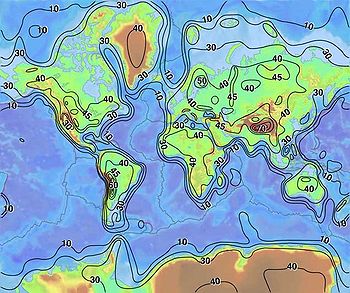
, which consists of mafic rock. Continental crust is also less dense than oceanic crust (density of about 3.3 g/cm3), though it is considerably thicker; mostly 25 to 70 km versus the average oceanic thickness of around 7–10 km.
About 40% of the Earth's surface is now underlain by continental crust.
Continental crust makes up about 70% of the volume of Earth's crust.
Importance
Because continental crust mainly lies above sea level, its existence allowed land life to evolve from marine life. Its existence also provides broad expanses of shallow water known as epeiric seas and continental shelvesContinental shelf
The continental shelf is the extended perimeter of each continent and associated coastal plain. Much of the shelf was exposed during glacial periods, but is now submerged under relatively shallow seas and gulfs, and was similarly submerged during other interglacial periods. The continental margin,...
where complex metazoan life could become established during early Paleozoic
Paleozoic
The Paleozoic era is the earliest of three geologic eras of the Phanerozoic eon, spanning from roughly...
time. If Earth
Earth
Earth is the third planet from the Sun, and the densest and fifth-largest of the eight planets in the Solar System. It is also the largest of the Solar System's four terrestrial planets...
were like the other silicate planet
Planet
A planet is a celestial body orbiting a star or stellar remnant that is massive enough to be rounded by its own gravity, is not massive enough to cause thermonuclear fusion, and has cleared its neighbouring region of planetesimals.The term planet is ancient, with ties to history, science,...
s and lacked the duality of oceanic and continental crust, our planet would be a very different place and the evolution of Homo sapiens and civilization
Civilization
Civilization is a sometimes controversial term that has been used in several related ways. Primarily, the term has been used to refer to the material and instrumental side of human cultures that are complex in terms of technology, science, and division of labor. Such civilizations are generally...
might have been impossible.
Origin
There is little evidence of continental crust prior to 3.5 bya and there was relatively rapid development on shieldShield (geology)
A shield is generally a large area of exposed Precambrian crystalline igneous and high-grade metamorphic rocks that form tectonically stable areas. In all cases, the age of these rocks is greater than 570 million years and sometimes dates back 2 to 3.5 billion years...
areas consisting of continental crust between 3.0 and 2.5 bya. All continental crust ultimately derives from the fractional differentiation of oceanic crust
Oceanic crust
Oceanic crust is the part of Earth's lithosphere that surfaces in the ocean basins. Oceanic crust is primarily composed of mafic rocks, or sima, which is rich in iron and magnesium...
over many eons. This process has been and continues today primarily as a result of the volcanism associated with subduction
Subduction
In geology, subduction is the process that takes place at convergent boundaries by which one tectonic plate moves under another tectonic plate, sinking into the Earth's mantle, as the plates converge. These 3D regions of mantle downwellings are known as "Subduction Zones"...
.
Forces at work
In contrast to the persistence of continental crust, the size, shape, and number of continents are constantly changing. Different tracts rift apart, collide and recoalesce as part of a grand supercontinent cycleSupercontinent cycle
The supercontinent cycle describes the quasi-periodic aggregation and dispersal of Earth's continental crust. There are varying opinions as to whether the amount of continental crust is increasing, decreasing, or staying about the same, but it is agreed that the Earth's crust is constantly being...
.
There are currently about 7 billion cubic kilometers of continental crust, but this quantity varies due to the nature of the forces involved. The relative permanence of continental crust contrasts with the short life of oceanic crust. Because continental crust is less dense than oceanic crust, when active margins of the two meet in subduction zones, the oceanic crust is typically subducted back into the mantle. Continental crust is only rarely subducted (this may occur where continental crustal blocks collide and overthicken, causing deep melting under mountain belts such as the Himalayas
Himalayas
The Himalaya Range or Himalaya Mountains Sanskrit: Devanagari: हिमालय, literally "abode of snow"), usually called the Himalayas or Himalaya for short, is a mountain range in Asia, separating the Indian subcontinent from the Tibetan Plateau...
or the Alps
Alps
The Alps is one of the great mountain range systems of Europe, stretching from Austria and Slovenia in the east through Italy, Switzerland, Liechtenstein and Germany to France in the west....
). For this reason the oldest rocks on Earth are within the craton
Craton
A craton is an old and stable part of the continental lithosphere. Having often survived cycles of merging and rifting of continents, cratons are generally found in the interiors of tectonic plates. They are characteristically composed of ancient crystalline basement rock, which may be covered by...
s or cores of the continents, rather than in repeatedly recycled oceanic crust
Oceanic crust
Oceanic crust is the part of Earth's lithosphere that surfaces in the ocean basins. Oceanic crust is primarily composed of mafic rocks, or sima, which is rich in iron and magnesium...
; the oldest continental rock is the Acasta Gneiss
Acasta Gneiss
The Acasta Gneiss is a rock outcrop of Hadean tonalite gneiss in the Slave craton in Northwest Territories, Canada. Located on an island about 300 kilometres north of Yellowknife, the Acasta River rock deposit, believed to be 4.031 to 3.58 billion years old, is the oldest known intact crustal...
at 4.01 Ga, while the oldest oceanic crust (located on the Pacific Plate
Pacific Plate
The Pacific Plate is an oceanic tectonic plate that lies beneath the Pacific Ocean. At 103 million square kilometres, it is the largest tectonic plate....
offshore of Kamchatka) is no older than Jurassic
Jurassic
The Jurassic is a geologic period and system that extends from about Mya to Mya, that is, from the end of the Triassic to the beginning of the Cretaceous. The Jurassic constitutes the middle period of the Mesozoic era, also known as the age of reptiles. The start of the period is marked by...
(~180 Ma). Continental crust and the rock layers that lie on and within it are thus the best archive of Earth history.
The height of mountain ranges is usually related to the thickness of crust. This results from the isostasy
Isostasy
Isostasy is a term used in geology to refer to the state of gravitational equilibrium between the earth's lithosphere and asthenosphere such that the tectonic plates "float" at an elevation which depends on their thickness and density. This concept is invoked to explain how different topographic...
associated with orogeny
Orogeny
Orogeny refers to forces and events leading to a severe structural deformation of the Earth's crust due to the engagement of tectonic plates. Response to such engagement results in the formation of long tracts of highly deformed rock called orogens or orogenic belts...
(mountain formation). The crust is thickened by the compressive forces related to subduction
Subduction
In geology, subduction is the process that takes place at convergent boundaries by which one tectonic plate moves under another tectonic plate, sinking into the Earth's mantle, as the plates converge. These 3D regions of mantle downwellings are known as "Subduction Zones"...
or continental collision. The buoyancy of the crust forces it upwards, the forces of the collisional stress balanced by gravity and erosion. This forms a keel or mountain root beneath the mountain range, which is where the thickest crust is found.
The thinnest continental crust is found in rift
Rift
In geology, a rift or chasm is a place where the Earth's crust and lithosphere are being pulled apart and is an example of extensional tectonics....
zones, where the crust is thinned by detachment fault
Detachment fault
Detachment faulting is associated with large-scale extensional tectonics. Detachment faults often have very large displacements and juxtapose unmetamorphosed hanging walls against medium to high-grade metamorphic footwalls that are called metamorphic core complexes...
ing and eventually severed, replaced by oceanic crust
Oceanic crust
Oceanic crust is the part of Earth's lithosphere that surfaces in the ocean basins. Oceanic crust is primarily composed of mafic rocks, or sima, which is rich in iron and magnesium...
. The edges of continental fragments formed this way (both sides of the Atlantic Ocean
Atlantic Ocean
The Atlantic Ocean is the second-largest of the world's oceanic divisions. With a total area of about , it covers approximately 20% of the Earth's surface and about 26% of its water surface area...
, for example) are termed passive margin
Passive margin
A passive margin is the transition between oceanic and continental crust which is not an active plate margin. It is constructed by sedimentation above an ancient rift, now marked by transitional crust. Continental rifting creates new ocean basins. Eventually the continental rift forms a mid-oceanic...
s.
The high temperatures and pressures at depth, often combined with a long history of complex distortion, mean that much of the lower continental crust is metamorphic - the main exception to this being recent igneous intrusion
Intrusion
An intrusion is liquid rock that forms under Earth's surface. Magma from under the surface is slowly pushed up from deep within the earth into any cracks or spaces it can find, sometimes pushing existing country rock out of the way, a process that can take millions of years. As the rock slowly...
s. Igneous rock may also be "underplated" to the underside of the crust, i.e. adding to the crust by forming a layer immediately beneath it.
Today continental crust is produced and (far less often) destroyed mostly by plate tectonic processes, especially at convergent plate boundaries
Convergent boundary
In plate tectonics, a convergent boundary, also known as a destructive plate boundary , is an actively deforming region where two tectonic plates or fragments of lithosphere move toward one another and collide...
. Additionally, continental crustal material is transferred to oceanic crust by sedimentation. New material can be added to the continents by the partial melting of oceanic crust at subduction zones, causing the lighter material to rise as magma, forming volcanoes. Also, material can be accreted "horizontally" when volcanic island arcs, seamount
Seamount
A seamount is a mountain rising from the ocean seafloor that does not reach to the water's surface , and thus is not an island. These are typically formed from extinct volcanoes, that rise abruptly and are usually found rising from a seafloor of depth. They are defined by oceanographers as...
s or similar structures collide with the side of the continent as a result of plate tectonic movements. Continental crust is also lost, due to erosion and sediment subduction
Subduction
In geology, subduction is the process that takes place at convergent boundaries by which one tectonic plate moves under another tectonic plate, sinking into the Earth's mantle, as the plates converge. These 3D regions of mantle downwellings are known as "Subduction Zones"...
, tectonic erosion of forearcs, delamination, and deep subduction of continental crust in collision zones.
Many aspects of crustal growth are controversial, including rates of crustal growth and recycling, whether the lower crust is recycled differently than the upper crust and over how much of Earth history plate tectonics has operated and so could be the dominant mode of continental crust formation and destruction.
It is a matter of debate whether the amount of continental crust has been increasing, decreasing, or remaining constant over geological time. One model indicates that at prior to 3.7 Ga ago continental crust constituted less than 10% of the present amount.
By 3.0 Ga ago the amount was about 25% and following a period of rapid crustal evolution it was about 60% of the current amount by 2.6 Ga ago. The growth of continental crust appears to have occurred in spurts of increased activity corresponding to five episodes of increased production through geologic time.