

Sindh

Encyclopedia
Sindh historically referred to as Ba'ab-ul-Islam (lit. The gateway of Islam), is one of the four provinces of Pakistan
and historically is home to the Sindhi people
. It is also locally known as the "Mehran". Though Muslims form the largest religious group in Sindh, a good number of Christians, Zoroastrians and Hindus can also be found. Sindh is bounded to the west by the Indus River
and Balochistan
, to the north by Punjab
, and to the south by the Arabian Sea
. The main language spoken is Sindhi
by about 40 million people. The name is derived from the Indus River
that separates it from Balochistan
and the greater Iranian Plateau
. This river was known to the to the ancient Iranians in Avestan as Harauhuti, in Sanskrit as Sarasvati, to Assyrians (as early as the seventh century BC) as Sinda, to the Greeks
as Indos, to the Romans
as Indus, to the Persians
as Ab-e-sind, to the Pashtun
s as "Abasind", to the Arabs as Al-Sind, to the Chinese
as Sintow, and to the Javanese as the Santri
.
 The province of Sindh and the people inhabiting the region had been designated after the river known in ancient times as the Sindhu River, now known as the Indus River
. In Sanskrit
, síndhu means "river, stream", and refers to the Indus river in particular. The Greeks
who conquered Sindh in 325 BC under the command of Alexander the Great rendered it as Indós, hence the modern Indus. The ancient Iranians referred to everything east of the river Indus as hind from the word Sindh and when the British
arrived here in the 17th century, they followed that example and applied the name to the entire subcontient calling it India, once again from the word Sindh
 The Indus Valley civilization
is the farthest visible outpost of archaeology in the abyss of prehistoric times. The prehistoric site of Kot Diji
in Sindh has furnished information of high significance for the reconstruction of a connected story which pushes back the history of South Asia
by at least another 200 years, from about 2500 BC. Evidence of a new element of pre-Harappan culture has been traced here. When the primitive village communities in Balochistan
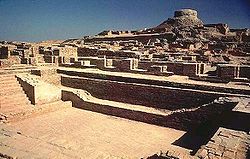
were still struggling against a difficult highland environment, a highly cultured people were trying to assert themselves at Kot Diji one of the most developed urban civilization of the ancient world that flourished between the 25th century BC and 1500 BC in the Indus valley sites of Moenjodaro and Harappa
. The people were endowed with a high standard of art and craftsmanship and well-developed system of quasi-pictographic writing which despite ceaseless efforts still remains un-deciphered. The remarkable ruins of the beautifully planned Moenjodaro and Harappa towns, the brick buildings of the common people, roads, public baths and the covered drainage system envisage the life of a community living in a highly organized manner.
This civilisation is an indigenous civilization which met its downfall around the year 1700 BC. The collapse of the Indus Valley Civilization is still a hotly debated topic, and was probably caused by a massive earthquake, which dried up the Ghaggar River.
, bordering the Iranian plateau
in the west. Geographically it is the third largest province of Pakistan, stretching about 579 km from north to south and 442 km (extreme) or 281 km (average) from east to west, with an area of 140915 square kilometres (54,407.6 sq mi) of Pakistani territory. Sindh is bounded by the Thar Desert
to the east, the Kirthar Mountains
to the west, and the Arabian Sea
in the south. In the centre is a fertile plain around the Indus river
.
 Sindh lies in a tropical to subtropical region; it is hot in the summer and mild to warm in winter. Temperatures frequently rise above 46 °C (114.8 °F) between May and August, and the minimum average temperature of 2 °C (35.6 °F) occurs during December and January in the northern and higher elevated regions. The annual rainfall averages about seven inches, falling mainly during July and August. The southwest monsoon wind begins to blow in mid-February and continues until the end of September, whereas the cool northerly wind blows during the winter months from October to January.
Sindh lies between the two monsoon
s—the southwest monsoon from the Indian Ocean
and the northeast or retreating monsoon, deflected towards it by the Himalayan mountains
—and escapes the influence of both. The average rainfall in Sindh is only 6–7 in (15.2–17.8 cm) per year. The region's scarcity of rainfall is compensated by the inundation of the Indus twice a year, caused by the spring and summer melting of Himalayan snow and by rainfall in the monsoon season. These natural patterns have recently changed somewhat with the construction of dams and barrages on the Indus River
.
Sindh is divided into three climatic regions: Siro (the upper region, centred on Jacobabad
), Wicholo (the middle region, centred on Hyderabad
), and Lar (the lower region, centred on Karachi
). The thermal equator passes through upper Sindh, where the air is generally very dry. Central Sindh's temperatures are generally lower than those of upper Sindh but higher than those of lower Sindh. Dry hot days and cool nights are typical during the summer. Central Sindh's maximum temperature typically reaches 43–44 °C (109.4–111.2 F). Lower Sindh has a damper and humid maritime climate affected by the southwestern winds in summer and northeastern winds in winter, with lower rainfall than Central Sindh. Lower Sindh's maximum temperature reaches about 35–38 °C (95–100.4 F). In the Kirthar range at 1800 m (5,905.5 ft) and higher at Gorakh Hill
and other peaks in Dadu District
, temperatures near freezing have been recorded and brief snow
fall is received in the winters.
 The province is mostly arid with scant vegetation except for the irrigated Indus Valley. The dwarf palm, Acacia Rupestris (kher), and Tecomella undulata
(lohirro
) trees are typical of the western hill region. In the Indus valley, the Acacia nilotica
(babul
) (babbur) is the most dominant and occurs in thick forests along the Indus banks. The Azadirachta indica (neem) (nim), Zizyphys vulgaris (bir) (ber), Tamarix orientalis (jujuba lai) and Capparis aphylla (kirir) are among the more common trees.
Mango, date palms, and the more recently introduced banana, guava, orange, and chiku are the typical fruit-bearing trees. The coastal strip and the creeks abound in semi-aquatic and aquatic plants, and the inshore Indus delta islands have forests of Avicennia tomentosa (timmer) and Ceriops candolleana (chaunir) trees. Water lilies grow in abundance in the numerous lake and ponds, particularly in the lower Sindh region.
Among the wild animals, the Sindh ibex (sareh), Blackbuck
, wild sheep (urial or gadh) and black bear are found in the western rocky range, whereas the Leopard
is now rare and the Asiatic Cheetah
already extinct. The pirrang (large tiger cat or fishing cat) of the eastern desert region is also disappearing. Deer occur in the lower rocky plains and in the eastern region, as do the striped hyena
(charakh), jackal
, fox
, porcupine, common gray mongoose, and hedgehog. The Sindhi phekari, ped lynx or Caracal cat, is found in some areas. In the Kirthar national park of sindh, there is a project to introduce tigers and Asian elephants.
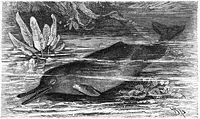
Phartho (hog deer) and wild bear occur particularly in the central inundation belt. There are a variety of bats, lizards, and reptiles, including the cobra, lundi (viper), and the mysterious Sindh krait of the Thar region, which is supposed to suck the victim's breath in his sleep. Crocodiles are rare and inhabit only the backwaters of the Indus, eastern Nara channel and karachi backwater Besides a large variety of marine fish, the plumbeous dolphin, the beaked dolphin, rorqual or blue whale, and a variety of skates frequent the seas along the Sindh coast. The pallo (sable fish), a marine fish, ascends the Indus annually from February to April to spawn.
Although Sindh has a semi arid climate, through its coastal and riverine forests, its huge fresh water
lakes and mountains and deserts
, Sindh supports a large amount of varied wildlife.
Due to the semi arid climate of Sindh
The left out forests support average population of jackals and snakes.
The national parks established by the Government of Pakistan
in collaboration with many organizations such as World Wide Fund for Nature
and Sindh Wildlife Department support a huge variety of animals and birds. The Kirthar National Park
in the Kirthar range spreads over more than 3000 km² of desert, stunted tree forests and a lake. The KNP supports Sindh Ibex
, wild sheep (urial) and black bear along with the rare leopard
. There are also occasional sightings of The Sindhi phekari, ped lynx or Caracal cat. There is a project to introduce tigers and Asian elephant
s too in KNP near the huge Hub dam lake.
The Indus river dolphin
is among the most endangered species in Pakistan and is found in the part of the Indus river in northern Sindh. Hog deer and wild bear occur particularly in the central inundation belt. There are also varieties of bat
s, lizards, and reptiles, including the cobra
, lundi (viper).
Some unusual sightings of Asian Cheetah occurred in 2003 near the Balochistan
Border in Kirthar mountains. The pirrang (large tiger cat or fishing cat) of the eastern desert region is also disappearing. Deer occur in the lower rocky plains and in the eastern region, as do the striped hyena
(charakh), jackal
, fox
, porcupine
, common gray mongoose, and hedgehog.
Between July and November when the monsoon
winds blow onshore from the ocean, giant Olive Ridley
turtles lay their eggs along the seaward side. The turtles are protected species. After the mothers lay and leave them buried under the sands the SWD and WWF officials take the eggs and protect them until they are hatched to protect them from predators.
Crocodiles are rare and inhabit only the backwaters of the Indus, the eastern Nara channel and some population of Marsh crocodiles can be very easily seen in the waters of Haleji Lake
near Karachi
. Besides a large variety of marine fish, the plumbeous dolphin, the beaked dolphin, rorqual or blue whale
, and a variety of skates frequent the seas along the Sind coast. The pallo (sable fish), though a marine fish, ascends the Indus annually from February to April to spawn. The rare Houbara Bustard
also find Sindh's warm climate suitable to rest and mate.
Sindh has the 2nd highest Human Development Index out of all of Pakistan's provinces at 0.628. The 1998 Census of Pakistan indicated a population of 30.4 million. Just under half of the population are urban dwellers, mainly found in Karachi
, Hyderabad, Sukkur
, Mirpurkhas, Nawabshah District
, Umerkot
and Larkana
. Sindhi
is the sole official language of Sindh since the 19th century. According to the 1998 Population Census of Pakistan, Sindhi
-speaking households make up 63.7% of Sindh's population; Urdu-speaking households make up 18.1%; Punjabi
7.0%; Pashto
4.2%; Balochi
2.0%; Saraiki
1.0% and other languages 5.0%. Other languages include Gujarati
, Memoni
, Kutchi
(last one being the dialect of Sindhi), Khowar
, Thari
, Persian
/Dari
, Luri and Brahui.
The Sindhis as a whole are composed of original descendants of an ancient population known as Sammaat
, various sub-groups related to the Baloch
origin are found in interior Sindh and to a lesser extent Sindhis of Pashtun
origins. Sindhis of Balochi origins make up about 60% of the total Sindhi population (they however speak Sindhi
as their native tongue), while Urdu-speaking Muhajirs make over 20% of the total population of the province. Also found in the province are groups of Sindhi
tribes claiming descent from early Muslim
settlers including Arabs, and Persian
.
(91.32%), and Sindh is also home to nearly all (93%) of Pakistan's Hindus, who form 7.5% of the province's population. A large number of Hindus migrated to India during the Partition of India
in response to the influx of Muhajirs from India. Many of the Shiites of Pakistan live in this province.
 Sindh's first known village settlements date as far back as 7000 BCE. Permanent settlements at Mehrgarh
to the west expanded into Sindh. This culture blossomed over several millennia and gave rise to the Indus Valley Civilization
around 3000 BCE. The Indus Valley Civilization rivaled the contemporary civilizations of Ancient Egypt
and Mesopotamia
in both size and scope numbering nearly half a million inhabitants at its height with well-planned grid cities and sewer systems.
Sindh finds mention in the Hindu
epic Mahabharatha as being part of Bharatvarsha. Sindh was conquered by the Persian Achaemenid Empire
in the sixth century BC. In the late 300s BC, Sindh was conquered by a mixed army led by Macedonian Greeks
under Alexander the Great. The region remained under control of Greek satraps only for a few decades. After Alexander's death, there was a brief period of Seleucid rule, before Sindh was traded to the Mauryan Empire led by Chandragupta
in 305 BC. During the rule of the Mauryan Emperor Ashoka
, the Buddhist religion spread to Sindh.
Mauryan rule ended in 185 BC with the overthrow of the last king by the Sunga Dynasty. In the disorders that followed, Greek rule returned when Demetrius I of Bactria
led a Greco-Bactrian invasion of India and annexed most of northwestern lands, including Sindh. Demetrius was later defeated and killed by a usurper, but his descendants continued to rule Sindh and other lands as the Indo-Greek Kingdom
. Under the reign of Menander I
many Indo-Greeks followed his example and converted to Buddhism.
In the late 100s BC, Scythian tribes shattered the Greco-Bactrian empire and invaded the Indo-Greek lands. Unable to take the Punjab region
, they seized Sistan
and invaded South Asia
by coming through Sindh, where they became known as Indo-Scythians
(later Western Satraps). Subsequently, the Tocharian
Kushan Empire
annexed Sindh by the first century AD. Though the Kushans were Zoroastrian due to their former contacts with Persians, they were tolerant of the local Buddhist tradition and sponsored many building projects for local beliefs. Ahirs
were also found in large numbers in Sindh.
Abiria
country of Abhira tribe
was located in South of Sindh. The Kushan Empire
were defeated in the mid 200s AD by the Sassanid Empire
of Persia, who installed vassals known as the Kushanshahs
. These rulers were defeated by the Kidarites
in the late 300s. It then came under Gupta Empire
after dealing with the Sassanis.By the late 400s, attacks by Hephthalite
tribes known as the Indo-Hephthalites or Hunas (Huns
) broke through the Gupta Empire's North-Western borders and overran much of Northern and Western India. After overthrowing of Hunas, after a subsequent period of time Sindh came under Emperor Harshavardhan's rule. Later, Sindh came under the Rai Dynasty
around 478 AD. The Rais were overthrown by Chachar of Alor
around 632. The Brahman
dynasty ruled a vast territory that stretched from Multan
in the north to the Rann of Kutch
, Alor
was their capitol.
 In 711 AD, Muhammad ibn Qasim led an Umayyad
force of 20,000 cavalry and 5 catapults, aided by local leaders such as: Mokah Basayah, Thakore of Bhatta, Ibn Wasayo. Muhammad bin Qasim eventually defeated the Raja Dahir
, and captured the cities of Alor
, Multan
and Debal
. The region was sacked as a result of the invasion.
Sindh became the easternmost province of the Umayyad
and Abbasid
Caliphate
, referred to as "Al-Sindh" on Arab maps, with lands further east known as "Hind" including the Sindh region. Muhammad bin Qasim built the city of Mansura as his capital; the city then produced famous historical figures such as Abu Mashar Sindhi
, Abu Ata Sindhi, Abu Raja Sindhi
and Sind ibn Ali
. At the port city of Debal
most of the Bawarij
embraced Islam
and became known as Sindhi Sailors; they became famous due to their skills in: navigation
, geography
and languages. In fact, they inspired the One Thousand and One Nights character Sindbad the Sailor ("And thence we fared on to the land of Sind, where also we bought and sold") and Sindbad-Nameh
(Book of Sindbad). By the year 750 AD, Debal
was second only to Basra
; Sindhi sailors from the port city of Debal
voyaged to Basra
, Bushehr
, Musqat, Aden
, Kilwa
, Zanzibar
, Sofala
, Malabar
, Sri Lanka
and Java
(where Sindhi merchants were known as the Santri
).
In the year 725, Junayad, the Abbasid
Emir
of Sindh, started an expedition from Nerun. He commanded a large army under the Abbasid flag, combining Arab-Sindhi cavalry. His army conquered the Temple of Somnath
, and returned victorious.
Muslim
geographers, historians and travelers such as al-Masudi
, Ibn Hawqal
, Istakhri, Ahmed ibn Sahl al-Balkhi
, al-Tabari, Baladhuri, Nizami
, al-Biruni
, Saadi Shirazi, Ibn Battutah and Katip Çelebi
wrote about or visited the region, sometimes using the name "Sindh" for the entire area from the Arabian Sea
to the Hindu Kush
.
 Direct Arab rule ended in 998 with the ascension of the local Soomra Dynasty
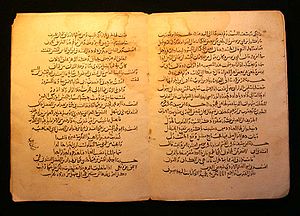
, and they were the first local Sindhi Muslims to translate the Qur'an
into the Sindhi language
. The respected Soomro
s controlled Sindh directly as vassals the Abbasid Caliphate from 1026 to 1351.
The Soomro
s were one of the first Sindhi tribes to convert to Islam
and they were known to the Arabs as the Al-Sumrah. They were taught cavalry
skills by the Arabs, and were renowned masters at riding the Arabian horse
and camel
. They created a chivalrous culture in Sindh which eventually facilitated their rule centered at Mansura
. They were often known to have fought Hindu rebellions and raiders.
While returning from one of his campaigns Mahmud of Ghazni
challenged the Soomro
Dynasty and long besieged their prized city of Mansura
. The city was conquered; little is known about the causes of the siege or its aftermath over the region. However, most of the Soomra were reduced to landowners and farmers; some Soomra created forts such as Tharri
and ruled as Amirs, nearly 14 km east of Matli on the Puran. Puran was later abandoned due to changes in the course of the Puran River; they ruled for the next 95 years until 1351 AD. During this period, Kutch was ruled by the Samma Dynasty, who enjoyed good relations with the Soomras in Sindh. The Soomros produced such historical figures as Princess Zainab Tari Soomro
, Rano
(the Soomro prince in the folk story "Mumal-Rano"), tension between two brothers Sardar Khan Dodo Bin Khafef Soomro
and Chenaser led to the collapse of their dynasty and the invasion of Muhammad Ibn Tughluq; a detailed historical epic was also written by Emir
Bhag Bahan Soomro
in the year 1356 AD.
 In 1339 Jam Unar
founded a Sindhi Muslim Samma Dynasty title of Sultan of Sindh. His large forces from the south filled the political vacuum left behind after the collapse of the Soomro tribe. The Samma tribe reached its peak during the reign of Jam Nizamuddin II
(also known by the nickname Jám Nindó). During his reign from 1461 to 1509, Nindó greatly expanded the new capital of Thatta
and its Makli hills, which replaced Debal
. He also patronized Sindhi art, architecture and culture. The Samma had left behind a popular legacy especially in architecture, music and art. Important court figures included the famous poet Kazi Kadal, Sardar Darya Khan
, Moltus Khan, Makhdoom Bilwal and the theologian Kazi Kazan. However, Thatta was a port city; unlike garrison towns, it could not mobilize large armies against the Arghun
and Tarkhan Mongol invaders, who killed many regional Sindhi Mirs and Amirs loyal to the Samma
.
The ruthless Arghun
s and the Tarkhan
s sacked Thatta during the rule of Jam Feroz
udin and established their own dynasties in the year 1519.
 In the year 1524, the few remaining Sindhi
Amirs welcomed the Mughal Empire
and helped Babur
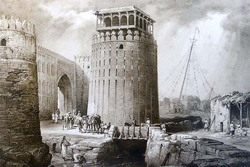
defeat his Arghun enemies. In the coming centuries Sindh became a region fiercely loyal to the Mughals. A network of forts manned by cavalry and musketeers further extended Mughal power in Sindh.
In 1540 a deadly mutiny by Sher Shah Suri
forced the Mughal Emperor Humayun
to withdraw to Sindh, where he joined the Sindhi Emir
Hussein Umrani. In 1541 Humayun married Hamida Banu Begum
. She gave birth to the infant Akbar at Umarkot in the year 1542.
In 1556 the Ottoman
Admiral
Seydi Ali Reis
visited Humayun
; various regions of the South Asia including Sindh (Makran coast and the Mehran delta) are mentioned in his book Mirat ul Memalik
. The Portuguese navigator Fernão Mendes Pinto
claims that Sindhi sailors joined the Ottoman
Admiral
Kurtoğlu Hızır Reis
on his expedetion to Aceh
in 1565.
During the reign of Akbar, Sindh produced various scholars such as and others such as Mir Ahmed Nasrallah Thattvi
, Tahir Muhammad Thattvi
and Mir Ali Sir Thattvi
and the Mughal chronicler Abu'l-Fazl ibn Mubarak
and his brother the poet Faizi
was a descendant of a Sindhi Shaikh family from Rel, Siwistan in Sindh. Abu'l-Fazl ibn Mubarak
was the author of Akbarnama
(an official biographical account of Akbar) and the Ain-i-Akbari
(a detailed document recording the administration of the Mughal Empire
). It was also during the Mughal period when Sindhi literature began to flourish and historical figures such as Shah Abdul Latif Bhittai
and Sachal Sarmast
became prominent throughout the land.
In the year 1603 Shah Jahan
visited the province of Sindh; at Thatta
he was generously welcomed by the locals after the death of his father Jahangir
. Shah Jahan ordered the construction of the Shahjahan Mosque
, which was completed during the early years of his rule under the supervision of Mirza Ghazi Beg
. Also during his reign, in the year 1659 (1070 AH) in the Mughal Empire
, Muhammad Salih Tahtawi
of Thatta
created a seamless
celestial globe with Arabic and Persian
inscriptions using a wax casting method.
After the death of Aurangzeb
, the Mughal Empire
and its institutions began to decline. Various warring Nawab
s took control of vast territories; they ruled independently of the Mughal Emperor.
In the year 1701 the Nawab Kalhora
were authorized in a firman
by the Mughal Emperor Aurangzeb
to administer the province of Sindh. In 1739, Main Noor Mohammad Kalhoro
challenged the invader Nadir Shah but failed according to legend. To avenge the massacre of his allies, the capture of Main Noor Mohammad Kalhoro
and the abduction of his sons.Main Noor Mohammad Kalhoro sent a small force to assassinate Nadir Shah and turn events in favor of the Mughal Emperor during the Battle of Karnal
in 1739, but remained unsuccessful. In 1762, Mian Ghulam Shah Kalhoro
brought stability in Sindh, he reorganized the province and independently defeated the Maratha
s and their prominent vassal the Rao of Kuch in the Thar Desert
and returned victoriously. After the Sikhs annexed Multan
, the Kalhora Dynasty
supported counterattacks against the Sikhs and defined their borders, however due to the lack of internal stability the Kalhoras could not continue further conquests.
internal tension broke out in the province and in the year 1803, prompting the Mahratta
declare war of aggression against Sindh and Berar Subah
, in which Arthur Wellesley
took a leading role. Causing much early suspicion between the Emir
s of Sindh and the British Empire
.
The British East India Company
made its first contacts in the Sindhi port city of Thatta
, which according to a report was: "a city as large as London containing 50,000 houses which were made of stone and mortar with large verandah
s some three or four stories high the...the city has 3000 looms...the textiles of Sind were the flower of the whole produce of the East, the international commerce of Sind gave it a place among that of Nations, Thatta has 400 schools and 4,000 Dhows at its docks, the city is guarded by well armed Sepoys..."
British
and Bengal Presidency
forces under General Charles James Napier
arrived in Sindh in the nineteenth century and conquered Sindh in 1843. The Sindhi coalition led by Talpur
s and other Sindhi tribes under Mir Nasir Khan Talpur
were defeated in the Battle of Miani
, during which 50,000 Sindhis were killed. Shortly afterward, Hoshu Sheedi
commanded another army at the Battle of Dubbo, where 5,000 Sindhis were killed. The first Agha Khan
helped the British in their conquest of Sindh, and as result he was granted a lifetime pension.
A British
Journal by Thomas Postans, mentions the captive Sindhi Amirs: "The Amirs as being the prisoners of "Her Majesty"... they are maintained in strict seclusion; they are described as Broken-Hearted and Miserable men, maintaining much of the dignity of fallen greatness, and without any querulous or angry complaining at this unlivable source of sorrow, refusing to be comforted"
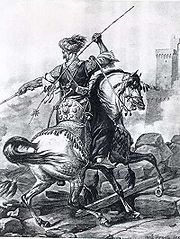 Within weeks, Charles Napier and his forces occupied Sindh. After 1853, the British divided Sindh into districts. In each district they recognized a wadera or aristocrat
. Sindh was made a part of the Bombay Presidency
.
In a highly controversial move, Sindh was later made part of British India's Bombay Presidency
—much to the surprise of the local population, who found the decision highly offensive. A powerful unrest followed, after which Twelve Martial Law
s were imposed by the British authorities. Finally the decision was reversed by the British administration and Sindh became a separate province in 1935.
Sibghatullah Shah Rashidi
pioneered the famous Sindhi
Muslim
, Hur Freedom Movement
against colonialists for the freedom of Sindh. Sibghatullah Shah Rashidi was hanged on 20 March 1943 in Hyderabad
, Sindh. His burial place is not known.
During the British period, railways, printing press
es and bridge
s were introduced in the province. Writers like Mirza Kalich Beg
compiled and traced the literary history of Sindh.
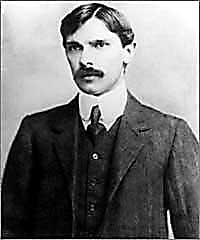 The Sindh assembly was the first British Indian legislature to pass the resolution in favour of Pakistan. Influential Sindhi activists under supervision of G.M. Syed and other important leaders at the forefront of the provincial autonomy movement, joined the Muslim League in 1938 and presented the Pakistan resolution in the Sindh Assembly.
In 1890 Sindh acquired representation for the first time in the Bombay Legislative Assembly. Four members represented Sindh. Those leaders and many others from Sindh played an important role in ensuring the separation of Sindh from the Bombay Presidency, which finally took place on 1 April 1936.
The newly created province, Sindh, secured a Legislative Assembly of its own, elected on the basis of communal and minorities' representation. Sir Lancelot Graham was appointed as the first Governor of Sindh by the British Government on 1 April 1936. He was also the Head of the Council, which comprised 25 Members, including two advisors from the Bombay Council to administer the affairs of Sindh until 1937.
The British ruled the area for a century. According to Richard Burton
, Sindh was one of the most restive provinces during the British Raj
and was home to many prominent Muslim leaders such as Ubaidullah Sindhi
and Muhammad Ali Jinnah
who strove for greater Muslim autonomy.
gained independence from British colonial rule. The province of Sindh attained self-rule for the first time since the defeat of Sindhi
Talpur
Amirs in the Battle of Miani
on 17 February 1843. The first major challenge faced by the Government of Pakistan was the settlement of over 2 million Muhajirs from India
who began migrating into Pakistan. Unlike many other parts of the Indian Sub continent which were in the grip of severe rioting due to partition of India, Sindh did not witness massive rioting, and migration of Hindus from Sindh was fractional as a large number stayed back.
Ever since the independence of Pakistan
, Sindh has produced some of the country's most influential personalities, such as Zulfiqar Ali Bhutto, Benazir Bhutto
and Asif Ali Zardari. More emphasis however needs to be placed on its rural areas and the status of education
in the province.
The Provincial Assembly of Sindh
is unicameral and consists of 168 seats, of which 5% are reserved for non-Muslims and 17% for women. The provincial capital of Sindh is Karachi
.
The government is presided over by the Chief Minister of Sindh
.
Most of the Sindhi tribes in the province are involved in Pakistan's politics
. Sindh is a stronghold of the centre-left Pakistan Peoples Party
(PPP), which is the largest political party in the province.
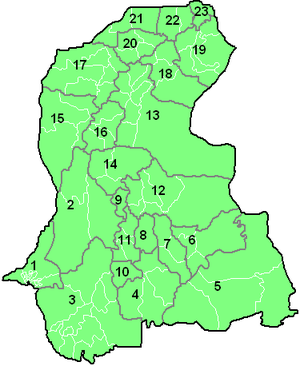 There are 23 districts
in Sindh, Pakistan.
Other cities and towns of Sindh:
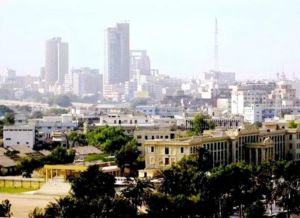
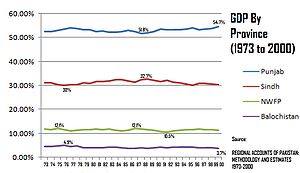 Sindh has the 2nd largest economy in Pakistan. Sindh's GDP per capita was $1,400 in 2010 which is 50 per cent more than the rest of the nation or 35 per cent more than the national average. Historically, Sindh's contribution to Pakistan's GDP has been between 30% to 32.7%. Its share in the service sector has ranged from 21% to 27.8% and in the agriculture sector from 21.4% to 27.7%. Performance wise, its best sector is the manufacturing sector, where its share has ranged from 36.7% to 46.5%. Since 1972, Sindh's GDP has expanded by 3.6 times.
Endowed with coastal access, Sindh is a major centre of economic activity in Pakistan and has a highly diversified economy ranging from heavy industry and finance centred in and around Karachi to a substantial agricultural base along the Indus
. Manufacturing includes machine products, cement, plastics, and various other goods.
Sindh is Pakistan's most natural gas producing province.
Agriculture is very important in Sindh with cotton
, rice
, wheat
, sugar cane, banana
s, and mango
es as the most important crops. Sindh is the richest province in natural resources of gas, petrol, and coal.
Sources:
This is a chart of the education market of Sindh estimated by the government in 1998.
Major public and private educational institutes of Sindh include:
Admissions to state-run educational institutions in Pakistan are based on the provincial level. Pakistan's other three provinces have a policy of merit-based intraprovincial admissions to state-run educational institutes. Sindh is an exception to this general rule; here admissions are determined by the district domiciles of the candidates and their parents to ensure less qualified students of Sindhi background some chance of competing against better qualified Muhajir students . Critics of this controversial arrangement say that it discriminates against meritorious students , denying them admission to the educational institutes and courses of their choice.
The armed forces have also entered the education sector in Sindh. They are funded by the government and operate like private costly education providers.
Though chiefly an agricultural and pastoral province, Sindh has a reputation for ajrak
s, pottery, leatherwork, carpets, textiles, and silk cloths which, in design and finish, are matchless. The chief articles produced are blankets, coarse cotton cloth (soosi), camel fittings, metalwork, lacquered work, enamel, gold and silver embroidery. Hala is famous for pottery and tiles; Boobak for carpets; Nasirpur, Gambat and Thatta for cotton lungees and khes. Other popular crafts include the earthenware of Johi, the metal vessels of Shikarpur, the ralli quilt, embroidery and leather articles of Tharparkar, and the lacquered work of Kandhkot.
Prehistoric finds from archaeological sites like Mohenjo-daro
, engravings in various graveyards, and the architectural designs of Makli
and other tombs have provided ample evidence of the people's literary and musical traditions.
Modern painting and calligraphy have also developed in recent times. Some young trained men have taken up commercial art.
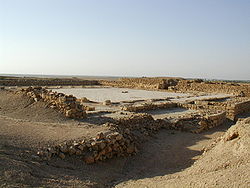 Sindh has a rich heritage of traditional handicraft that has evolved over the centuries. Perhaps the most professed exposition of Sindhi culture is in the handicrafts of Hala, a town some 30 kilometres from Hyderabad
. Hala's artisans manufacture high-quality and impressively priced wooden handicrafts, textiles, paintings, handmade paper products, and blue pottery. Lacquered wood works known as Jandi, painting on wood, tiles, and pottery known as Kashi, hand woven textiles including khadi
, susi, and ajrak
s are synonymous with Sindhi culture preserved in Hala's handicraft.
The Small and Medium Enterprises Authority (SMEDA) is planning to set up an organization of artisans to empower the community. SMEDA is also publishing a directory of the artisans so that exporters can directly contact them. Hala is the home of a remarkable variety of traditional crafts and traditional handicrafts that carry with them centuries of skill that has woven magic into the motifs and designs used.
Sindh is known the world over for its various handicrafts and arts. The work of Sindhi artisans was sold in ancient markets of Armenia, Baghdad, Basra, Istanbul, Cairo and Samarkand. Referring to the lacquer work on wood locally known as Jandi, T. Posten (an English traveller who visited Sindh in the early 19th century) asserted that the articles of Hala could be compared with exquisite specimens of China. Technological improvements such as the spinning wheel (charkha) and treadle (pai-chah) in the weaver's loom were gradually introduced and the processes of designing, dyeing and printing by block were refined. The refined, lightweight, colourful, washable fabrics from Hala became a luxury for people used to the woolens and linens of the age.
The ajrak
has existed in Sindh since the birth of its civilization. The colour blue is predominantly used for ajraks. Sindh was traditionally a large producer of indigo and cotton cloth and both used to be exported to the Middle East. The ajrak is a mark of respect when it is given to an honoured guest or friend. In Sindh, it is most commonly given as a gift at Eid, at weddings, or on other special occasions like homecoming.
The ralli (also known as rilli, rehli, rallee, gindi or other names), or patchwork quilt, is another Sindhi icon and part of the heritage and culture. Most Sindhi homes have many rallis—one for each member of the family and a few spare for guests. The ralli is made with small pieces of cloth of different geometrical shapes sewn together to create intricate designs. They may be used as a bedspread or a blanket, and are often given as gifts to friends and guests.
Many women in rural Sindh are skilled in the production of caps. Sindhi caps are manufactured commercially on a small scale at New Saeedabad and Hala New. These are in demand with visitors from Karachi and other places; however, these manufacturing units have a limited production capacity.
Sindhi people began celebrating Sindhi Topi Day on December 6, 2009 to preserve the historical culture of Sindh by wearing Ajrak
and Sindhi topi.
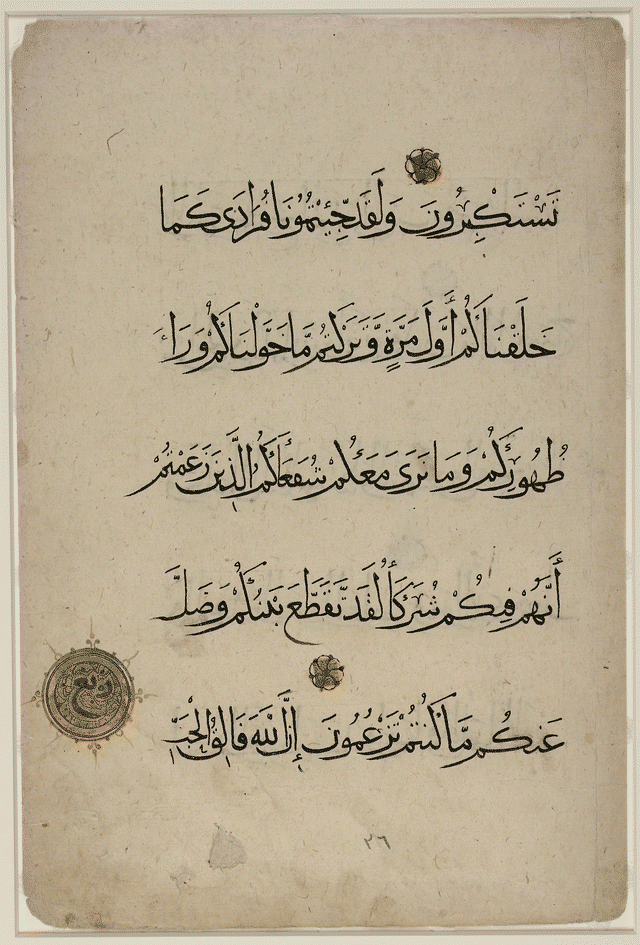 Sindhī (Arabic script: سنڌي) is spoken by about 45 million people(in 2011) in the province of Sindh. The largest Sindhi-speaking city is Karachi
, Pakistan.
It is an Indo-European language, related to Balochi
, Kutchi
, Gujarati
, Rajasthani language
and other Indo-European languages prevalent in the region with substantial Persian, Turkish and Arabic loan words. In Pakistan it is written in a modified Arabic script, in fact most Sindhi's are mostly Muslim
(but only in Pakistan),the Hindu sindhis who migrated to India after partition(currently are about 6 million) still register their mother tongue as sindhi
along with some other 3 million Hindu Sindhis
living in Pakistan,that's why it is largely believed that there is substantial number of Hindu Sindhis
.
Key dialects: Kachchi, Lari, Lasi, Thareli, Vicholo (Central Sindhi), Macharia, Dukslinu (Hindu Sindhi), and Sindhi Musalmani (Muslim Sindhi).
, Gujarati
and other Indo-European languages prevalent in the region with substantial Persian, Turkish and Arabic loan words. In Pakistan it is written in a modified Arabic script.
. It has 250,000 speakers (1995).
Historical tourist sites include the ruins of Mohenjo-daro
near the city of Larkana
, Runi Kot, Jamshoro, Kot Deji, the Jain temples of Nangar Parker and the historic temple of Sadhu Bela, Sukkur. Islamic architecture is quite prominent in the province; its numerous mausoleums include the ancient Shahbaz Qalander mausoleum dedicated to the Iranian-born Sufi and Shah Abdul latif Bhittai
, Sufi Shah Inayat and Udero Lala (Jhooley Lal) mausoleums, and the beautiful mausoleum of Muhammad Ali Jinnah
(known as the Mazar-e-Quaid
) in Karachi. Also of note is the Jama Masjid
in Thatta
, built by the Mughal
emperor Shahjahan.
Pakistan
Pakistan , officially the Islamic Republic of Pakistan is a sovereign state in South Asia. It has a coastline along the Arabian Sea and the Gulf of Oman in the south and is bordered by Afghanistan and Iran in the west, India in the east and China in the far northeast. In the north, Tajikistan...
and historically is home to the Sindhi people
Sindhi people
Sindhis are a Sindhi speaking socio-ethnic group of people originating from Sindh, a province Formerly of British India, now in Pakistan. Today Sindhis that live in Pakistan belong to various religious denominations including Islam, Zoroastrianism, Hinduism, Sikhism and Christianity...
. It is also locally known as the "Mehran". Though Muslims form the largest religious group in Sindh, a good number of Christians, Zoroastrians and Hindus can also be found. Sindh is bounded to the west by the Indus River
Indus River
The Indus River is a major river which flows through Pakistan. It also has courses through China and India.Originating in the Tibetan plateau of western China in the vicinity of Lake Mansarovar in Tibet Autonomous Region, the river runs a course through the Ladakh district of Jammu and Kashmir and...
and Balochistan
Balochistan (Pakistan)
Balochistan is one of the four provinces or federating units of Pakistan. With an area of 134,051 mi2 or , it is the largest province of Pakistan, constituting approximately 44% of the total land mass of Pakistan. According to the 1998 population census, Balochistan had a population of...
, to the north by Punjab
Punjab (Pakistan)
Punjab is the most populous province of Pakistan, with approximately 45% of the country's total population. Forming most of the Punjab region, the province is bordered by Kashmir to the north-east, the Indian states of Punjab and Rajasthan to the east, the Pakistani province of Sindh to the...
, and to the south by the Arabian Sea
Arabian Sea
The Arabian Sea is a region of the Indian Ocean bounded on the east by India, on the north by Pakistan and Iran, on the west by the Arabian Peninsula, on the south, approximately, by a line between Cape Guardafui in northeastern Somalia and Kanyakumari in India...
. The main language spoken is Sindhi
Sindhi language
Sindhi is the language of the Sindh region of Pakistan that is spoken by the Sindhi people. In India, it is among 22 constitutionally recognized languages, where Sindhis are a sizeable minority. It is spoken by 53,410,910 people in Pakistan, according to the national government's Statistics Division...
by about 40 million people. The name is derived from the Indus River
Indus River
The Indus River is a major river which flows through Pakistan. It also has courses through China and India.Originating in the Tibetan plateau of western China in the vicinity of Lake Mansarovar in Tibet Autonomous Region, the river runs a course through the Ladakh district of Jammu and Kashmir and...
that separates it from Balochistan
Balochistan (Pakistan)
Balochistan is one of the four provinces or federating units of Pakistan. With an area of 134,051 mi2 or , it is the largest province of Pakistan, constituting approximately 44% of the total land mass of Pakistan. According to the 1998 population census, Balochistan had a population of...
and the greater Iranian Plateau
Iranian plateau
The Iranian plateau, or Iranic plateau, is a geological formation in Southwest Asia. It is the part of the Eurasian Plate wedged between the Arabian and Indian plates, situated between the Zagros mountains to the west, the Caspian Sea and the Kopet Dag to the north, the Hormuz Strait and Persian...
. This river was known to the to the ancient Iranians in Avestan as Harauhuti, in Sanskrit as Sarasvati, to Assyrians (as early as the seventh century BC) as Sinda, to the Greeks
Greeks
The Greeks, also known as the Hellenes , are a nation and ethnic group native to Greece, Cyprus and neighboring regions. They also form a significant diaspora, with Greek communities established around the world....
as Indos, to the Romans
Ancient Rome
Ancient Rome was a thriving civilization that grew on the Italian Peninsula as early as the 8th century BC. Located along the Mediterranean Sea and centered on the city of Rome, it expanded to one of the largest empires in the ancient world....
as Indus, to the Persians
Persian people
The Persian people are part of the Iranian peoples who speak the modern Persian language and closely akin Iranian dialects and languages. The origin of the ethnic Iranian/Persian peoples are traced to the Ancient Iranian peoples, who were part of the ancient Indo-Iranians and themselves part of...
as Ab-e-sind, to the Pashtun
Pashtun people
Pashtuns or Pathans , also known as ethnic Afghans , are an Eastern Iranic ethnic group with populations primarily between the Hindu Kush mountains in Afghanistan and the Indus River in Pakistan...
s as "Abasind", to the Arabs as Al-Sind, to the Chinese
China
Chinese civilization may refer to:* China for more general discussion of the country.* Chinese culture* Greater China, the transnational community of ethnic Chinese.* History of China* Sinosphere, the area historically affected by Chinese culture...
as Sintow, and to the Javanese as the Santri
Santri
The Santri are a cultural 'stream' of people within the population of Javanese who practice a more orthodox version of Islam, in contrast to the abangan classes....
.
Origin of the name
Indus River
The Indus River is a major river which flows through Pakistan. It also has courses through China and India.Originating in the Tibetan plateau of western China in the vicinity of Lake Mansarovar in Tibet Autonomous Region, the river runs a course through the Ladakh district of Jammu and Kashmir and...
. In Sanskrit
Sanskrit
Sanskrit , is a historical Indo-Aryan language and the primary liturgical language of Hinduism, Jainism and Buddhism.Buddhism: besides Pali, see Buddhist Hybrid Sanskrit Today, it is listed as one of the 22 scheduled languages of India and is an official language of the state of Uttarakhand...
, síndhu means "river, stream", and refers to the Indus river in particular. The Greeks
Greeks
The Greeks, also known as the Hellenes , are a nation and ethnic group native to Greece, Cyprus and neighboring regions. They also form a significant diaspora, with Greek communities established around the world....
who conquered Sindh in 325 BC under the command of Alexander the Great rendered it as Indós, hence the modern Indus. The ancient Iranians referred to everything east of the river Indus as hind from the word Sindh and when the British
United Kingdom
The United Kingdom of Great Britain and Northern IrelandIn the United Kingdom and Dependencies, other languages have been officially recognised as legitimate autochthonous languages under the European Charter for Regional or Minority Languages...
arrived here in the 17th century, they followed that example and applied the name to the entire subcontient calling it India, once again from the word Sindh
Prehistoric period
Indus Valley Civilization
The Indus Valley Civilization was a Bronze Age civilization that was located in the northwestern region of the Indian subcontinent, consisting of what is now mainly modern-day Pakistan and northwest India...
is the farthest visible outpost of archaeology in the abyss of prehistoric times. The prehistoric site of Kot Diji
Kot Diji
The ancient site at Kot Diji was the forerunner of the Indus Civilization. The people of this site lived about 3000 BCE. The remains consist of two parts; the citadel area on high ground , and outer area...
in Sindh has furnished information of high significance for the reconstruction of a connected story which pushes back the history of South Asia
India
India , officially the Republic of India , is a country in South Asia. It is the seventh-largest country by geographical area, the second-most populous country with over 1.2 billion people, and the most populous democracy in the world...
by at least another 200 years, from about 2500 BC. Evidence of a new element of pre-Harappan culture has been traced here. When the primitive village communities in Balochistan
Balochistan (Pakistan)
Balochistan is one of the four provinces or federating units of Pakistan. With an area of 134,051 mi2 or , it is the largest province of Pakistan, constituting approximately 44% of the total land mass of Pakistan. According to the 1998 population census, Balochistan had a population of...
were still struggling against a difficult highland environment, a highly cultured people were trying to assert themselves at Kot Diji one of the most developed urban civilization of the ancient world that flourished between the 25th century BC and 1500 BC in the Indus valley sites of Moenjodaro and Harappa
Harappa
Harappa is an archaeological site in Punjab, northeast Pakistan, about west of Sahiwal. The site takes its name from a modern village located near the former course of the Ravi River. The current village of Harappa is from the ancient site. Although modern Harappa has a train station left from...
. The people were endowed with a high standard of art and craftsmanship and well-developed system of quasi-pictographic writing which despite ceaseless efforts still remains un-deciphered. The remarkable ruins of the beautifully planned Moenjodaro and Harappa towns, the brick buildings of the common people, roads, public baths and the covered drainage system envisage the life of a community living in a highly organized manner.
This civilisation is an indigenous civilization which met its downfall around the year 1700 BC. The collapse of the Indus Valley Civilization is still a hotly debated topic, and was probably caused by a massive earthquake, which dried up the Ghaggar River.
Geography and climate
Sindh is located on the western corner of South AsiaSouth Asia
South Asia, also known as Southern Asia, is the southern region of the Asian continent, which comprises the sub-Himalayan countries and, for some authorities , also includes the adjoining countries to the west and the east...
, bordering the Iranian plateau
Iranian plateau
The Iranian plateau, or Iranic plateau, is a geological formation in Southwest Asia. It is the part of the Eurasian Plate wedged between the Arabian and Indian plates, situated between the Zagros mountains to the west, the Caspian Sea and the Kopet Dag to the north, the Hormuz Strait and Persian...
in the west. Geographically it is the third largest province of Pakistan, stretching about 579 km from north to south and 442 km (extreme) or 281 km (average) from east to west, with an area of 140915 square kilometres (54,407.6 sq mi) of Pakistani territory. Sindh is bounded by the Thar Desert
Thar Desert
The Thar Desert |Punjab]] province. The Cholistan Desert adjoins the Thar desert spreading into Pakistani Punjab province.-Location and description:...
to the east, the Kirthar Mountains
Kirthar Mountains
Kirthar Mountains are a Mountain Range located in Balochistan and Sindh provinces of Pakistan. The Range extends southward for about 190 miles from the Mula River in east-central Balochistan to Cape Monze west of Karachi on the Arabian Sea.Kirthar National Park is one of the largest wildlife...
to the west, and the Arabian Sea
Arabian Sea
The Arabian Sea is a region of the Indian Ocean bounded on the east by India, on the north by Pakistan and Iran, on the west by the Arabian Peninsula, on the south, approximately, by a line between Cape Guardafui in northeastern Somalia and Kanyakumari in India...
in the south. In the centre is a fertile plain around the Indus river
Indus River
The Indus River is a major river which flows through Pakistan. It also has courses through China and India.Originating in the Tibetan plateau of western China in the vicinity of Lake Mansarovar in Tibet Autonomous Region, the river runs a course through the Ladakh district of Jammu and Kashmir and...
.
Sindh lies between the two monsoon
Monsoon
Monsoon is traditionally defined as a seasonal reversing wind accompanied by corresponding changes in precipitation, but is now used to describe seasonal changes in atmospheric circulation and precipitation associated with the asymmetric heating of land and sea...
s—the southwest monsoon from the Indian Ocean
Indian Ocean
The Indian Ocean is the third largest of the world's oceanic divisions, covering approximately 20% of the water on the Earth's surface. It is bounded on the north by the Indian Subcontinent and Arabian Peninsula ; on the west by eastern Africa; on the east by Indochina, the Sunda Islands, and...
and the northeast or retreating monsoon, deflected towards it by the Himalayan mountains
Himalayas
The Himalaya Range or Himalaya Mountains Sanskrit: Devanagari: हिमालय, literally "abode of snow"), usually called the Himalayas or Himalaya for short, is a mountain range in Asia, separating the Indian subcontinent from the Tibetan Plateau...
—and escapes the influence of both. The average rainfall in Sindh is only 6–7 in (15.2–17.8 cm) per year. The region's scarcity of rainfall is compensated by the inundation of the Indus twice a year, caused by the spring and summer melting of Himalayan snow and by rainfall in the monsoon season. These natural patterns have recently changed somewhat with the construction of dams and barrages on the Indus River
Indus River
The Indus River is a major river which flows through Pakistan. It also has courses through China and India.Originating in the Tibetan plateau of western China in the vicinity of Lake Mansarovar in Tibet Autonomous Region, the river runs a course through the Ladakh district of Jammu and Kashmir and...
.
Sindh is divided into three climatic regions: Siro (the upper region, centred on Jacobabad
Jacobabad
Jacobabad or Yaqubabad is the capital city of Jacobabad District, Sindh, Pakistan. The city is also the administrative centre of Jacobabad Taluka, an administrative subdivision of the district, the city is subdivided into 8 Union Councils...
), Wicholo (the middle region, centred on Hyderabad
Hyderabad, Sindh
is the second largest city in the Sindh province of Pakistan. It is the seventh largest city in the country. The city was founded in 1768 by Mian Ghulam Shah Kalhoro upon the ruins of a Mauryan fishing village along the bank of the Indus known as Neroon Kot...
), and Lar (the lower region, centred on Karachi
Karachi
Karachi is the largest city, main seaport and the main financial centre of Pakistan, as well as the capital of the province of Sindh. The city has an estimated population of 13 to 15 million, while the total metropolitan area has a population of over 18 million...
). The thermal equator passes through upper Sindh, where the air is generally very dry. Central Sindh's temperatures are generally lower than those of upper Sindh but higher than those of lower Sindh. Dry hot days and cool nights are typical during the summer. Central Sindh's maximum temperature typically reaches 43–44 °C (109.4–111.2 F). Lower Sindh has a damper and humid maritime climate affected by the southwestern winds in summer and northeastern winds in winter, with lower rainfall than Central Sindh. Lower Sindh's maximum temperature reaches about 35–38 °C (95–100.4 F). In the Kirthar range at 1800 m (5,905.5 ft) and higher at Gorakh Hill
Gorakh Hill
Gorakh is an under-Development Hill Station of Sindh, Pakistan. It is situated at an elevation of . in the Kirthar Mountains Range's Sindh Segment, 93 km north west of Dadu city...
and other peaks in Dadu District
Dadu District
Dadu is a district of Sindh Province, Pakistan.Dadu district was created in 1933 by the British Indian administration by merging Kotri and Kohistan tehsils from Karachi district and Mehar, Khairpur Nathan Shah, Dadu, Johi and Sehwan tehsils from Larkana district. The population of the district is...
, temperatures near freezing have been recorded and brief snow
Snow
Snow is a form of precipitation within the Earth's atmosphere in the form of crystalline water ice, consisting of a multitude of snowflakes that fall from clouds. Since snow is composed of small ice particles, it is a granular material. It has an open and therefore soft structure, unless packed by...
fall is received in the winters.
Flora and fauna
Tecomella undulata
Tecomella undulata is tree species, locally known as Rohida, found in Thar Desert regions of northwest and western India. It is a medium sized tree that produces quality timber and is the main source of timber amongst the indigenous tree species of desert regions of Shekhawati and Marwar in Rajasthan...
(lohirro
Rohida
Rohida is a village in Sirohi district of Indian state of Rajastan.Rohida is birth place of the historian Gaurishankar Hirachand Ojha. In 1922 Motilal Tejawat organized Eki Movement to unit tribals at Rohida.- References :***...
) trees are typical of the western hill region. In the Indus valley, the Acacia nilotica
Acacia nilotica
Acacia nilotica is a species of Acacia native to Africa and the Indian subcontinent...
(babul
Babul
Babul or is a 1950 Bollywood film directed by S.U. Sunny produced and with music direction by Naushad. The film stars Dilip Kumar, Munawar Sultana and Nargis. A box-office success, the film became the second highest earning film of 1950, earning an approximate gross of Rs. 1,25,00,000 and a nett...
) (babbur) is the most dominant and occurs in thick forests along the Indus banks. The Azadirachta indica (neem) (nim), Zizyphys vulgaris (bir) (ber), Tamarix orientalis (jujuba lai) and Capparis aphylla (kirir) are among the more common trees.
Mango, date palms, and the more recently introduced banana, guava, orange, and chiku are the typical fruit-bearing trees. The coastal strip and the creeks abound in semi-aquatic and aquatic plants, and the inshore Indus delta islands have forests of Avicennia tomentosa (timmer) and Ceriops candolleana (chaunir) trees. Water lilies grow in abundance in the numerous lake and ponds, particularly in the lower Sindh region.
Among the wild animals, the Sindh ibex (sareh), Blackbuck
Blackbuck
Blackbuck is a species of antelope native to the Indian subcontinent. Their range decreased sharply during the 20th century. Since 2003, the IUCN lists the species as near threatened....
, wild sheep (urial or gadh) and black bear are found in the western rocky range, whereas the Leopard
Leopard
The leopard , Panthera pardus, is a member of the Felidae family and the smallest of the four "big cats" in the genus Panthera, the other three being the tiger, lion, and jaguar. The leopard was once distributed across eastern and southern Asia and Africa, from Siberia to South Africa, but its...
is now rare and the Asiatic Cheetah
Asiatic Cheetah
The Asiatic Cheetah is now also known as the Iranian Cheetah, as the world's last few are known to survive mostly in Iran. Although recently presumed to be extinct in India, it is also known as the Indian Cheetah...
already extinct. The pirrang (large tiger cat or fishing cat) of the eastern desert region is also disappearing. Deer occur in the lower rocky plains and in the eastern region, as do the striped hyena
Hyena
Hyenas or Hyaenas are the animals of the family Hyaenidae of suborder feliforms of the Carnivora. It is the fourth smallest biological family in the Carnivora , and one of the smallest in the mammalia...
(charakh), jackal
Jackal
Although the word jackal has been historically used to refer to many small- to medium-sized species of the wolf genus of mammals, Canis, today it most properly and commonly refers to three species: the black-backed jackal and the side-striped jackal of sub-Saharan Africa, and the golden jackal of...
, fox
Fox
Fox is a common name for many species of omnivorous mammals belonging to the Canidae family. Foxes are small to medium-sized canids , characterized by possessing a long narrow snout, and a bushy tail .Members of about 37 species are referred to as foxes, of which only 12 species actually belong to...
, porcupine, common gray mongoose, and hedgehog. The Sindhi phekari, ped lynx or Caracal cat, is found in some areas. In the Kirthar national park of sindh, there is a project to introduce tigers and Asian elephants.
Phartho (hog deer) and wild bear occur particularly in the central inundation belt. There are a variety of bats, lizards, and reptiles, including the cobra, lundi (viper), and the mysterious Sindh krait of the Thar region, which is supposed to suck the victim's breath in his sleep. Crocodiles are rare and inhabit only the backwaters of the Indus, eastern Nara channel and karachi backwater Besides a large variety of marine fish, the plumbeous dolphin, the beaked dolphin, rorqual or blue whale, and a variety of skates frequent the seas along the Sindh coast. The pallo (sable fish), a marine fish, ascends the Indus annually from February to April to spawn.
Although Sindh has a semi arid climate, through its coastal and riverine forests, its huge fresh water
Fresh Water
Fresh Water is the debut album by Australian rock and blues singer Alison McCallum, released in 1972. Rare for an Australian artist at the time, it came in a gatefold sleeve...
lakes and mountains and deserts
Déserts
Déserts is a piece by Edgard Varèse for brass , percussion , piano, and tape. Percussion instruments are exploited for their resonant potential, rather than used solely as accompaniment...
, Sindh supports a large amount of varied wildlife.
Due to the semi arid climate of Sindh
Climate of Sindh
The province of Sindh is situated in a subtropical region; it is hot in the summer and cold in winter. Temperatures frequently rise above between May and August, and the minimum average temperature of occurs during December and January. The annual rainfall averages about seven inches, falling...
The left out forests support average population of jackals and snakes.
The national parks established by the Government of Pakistan
Pakistan
Pakistan , officially the Islamic Republic of Pakistan is a sovereign state in South Asia. It has a coastline along the Arabian Sea and the Gulf of Oman in the south and is bordered by Afghanistan and Iran in the west, India in the east and China in the far northeast. In the north, Tajikistan...
in collaboration with many organizations such as World Wide Fund for Nature
World Wide Fund for Nature
The World Wide Fund for Nature is an international non-governmental organization working on issues regarding the conservation, research and restoration of the environment, formerly named the World Wildlife Fund, which remains its official name in Canada and the United States...
and Sindh Wildlife Department support a huge variety of animals and birds. The Kirthar National Park
Kirthar National Park
The Kirthar National Park is situated in the southwestern part of Sind Province in Pakistan. It was founded in 1974 and stretches over 3087 km², being the second largest National Park of Pakistan after Hingol National Park. The fauna comprises leopards, striped hyenas, wolves, ratels, urials,...
in the Kirthar range spreads over more than 3000 km² of desert, stunted tree forests and a lake. The KNP supports Sindh Ibex
Sindh Ibex
The Sindh Ibex or Turkman Wild Goat is a vulnerable wild goat commonly native to southern Pakistan.-Description:Sindh Ibex are rather stocky animals with thick-set bodies and strong limbs terminating in broad hooves...
, wild sheep (urial) and black bear along with the rare leopard
Leopard
The leopard , Panthera pardus, is a member of the Felidae family and the smallest of the four "big cats" in the genus Panthera, the other three being the tiger, lion, and jaguar. The leopard was once distributed across eastern and southern Asia and Africa, from Siberia to South Africa, but its...
. There are also occasional sightings of The Sindhi phekari, ped lynx or Caracal cat. There is a project to introduce tigers and Asian elephant
Asian Elephant
The Asian or Asiatic elephant is the only living species of the genus Elephas and distributed in Southeast Asia from India in the west to Borneo in the east. Three subspecies are recognized — Elephas maximus maximus from Sri Lanka, the Indian elephant or E. m. indicus from mainland Asia, and E. m....
s too in KNP near the huge Hub dam lake.
The Indus river dolphin
Indus River dolphin
The Indus River dolphin is a sub-species of freshwater or river dolphin found in the Indus River of Pakistan...
is among the most endangered species in Pakistan and is found in the part of the Indus river in northern Sindh. Hog deer and wild bear occur particularly in the central inundation belt. There are also varieties of bat
Bat
Bats are mammals of the order Chiroptera "hand" and pteron "wing") whose forelimbs form webbed wings, making them the only mammals naturally capable of true and sustained flight. By contrast, other mammals said to fly, such as flying squirrels, gliding possums, and colugos, glide rather than fly,...
s, lizards, and reptiles, including the cobra
Cobra
Cobra is a venomous snake belonging to the family Elapidae. However, not all snakes commonly referred to as cobras are of the same genus, or even of the same family. The name is short for cobra capo or capa Snake, which is Portuguese for "snake with hood", or "hood-snake"...
, lundi (viper).
Some unusual sightings of Asian Cheetah occurred in 2003 near the Balochistan
Balochistan (Pakistan)
Balochistan is one of the four provinces or federating units of Pakistan. With an area of 134,051 mi2 or , it is the largest province of Pakistan, constituting approximately 44% of the total land mass of Pakistan. According to the 1998 population census, Balochistan had a population of...
Border in Kirthar mountains. The pirrang (large tiger cat or fishing cat) of the eastern desert region is also disappearing. Deer occur in the lower rocky plains and in the eastern region, as do the striped hyena
Striped Hyena
The Striped Hyena is a species of true hyena native to North and East Africa, the Caucasus, the Middle East, Middle and Central Asia and the Indian Subcontinent...
(charakh), jackal
Jackal
Although the word jackal has been historically used to refer to many small- to medium-sized species of the wolf genus of mammals, Canis, today it most properly and commonly refers to three species: the black-backed jackal and the side-striped jackal of sub-Saharan Africa, and the golden jackal of...
, fox
Fox
Fox is a common name for many species of omnivorous mammals belonging to the Canidae family. Foxes are small to medium-sized canids , characterized by possessing a long narrow snout, and a bushy tail .Members of about 37 species are referred to as foxes, of which only 12 species actually belong to...
, porcupine
Porcupine
Porcupines are rodents with a coat of sharp spines, or quills, that defend or camouflage them from predators. They are indigenous to the Americas, southern Asia, and Africa. Porcupines are the third largest of the rodents, behind the capybara and the beaver. Most porcupines are about long, with...
, common gray mongoose, and hedgehog.
Between July and November when the monsoon
Monsoon
Monsoon is traditionally defined as a seasonal reversing wind accompanied by corresponding changes in precipitation, but is now used to describe seasonal changes in atmospheric circulation and precipitation associated with the asymmetric heating of land and sea...
winds blow onshore from the ocean, giant Olive Ridley
Olive Ridley
The olive ridley sea turtle , also known as the Pacific ridley, is a species of sea turtle.- Description :The olive ridley is a small extant sea turtle, with an adult carapace length averaging 60 to 70 cm 1...
turtles lay their eggs along the seaward side. The turtles are protected species. After the mothers lay and leave them buried under the sands the SWD and WWF officials take the eggs and protect them until they are hatched to protect them from predators.
Crocodiles are rare and inhabit only the backwaters of the Indus, the eastern Nara channel and some population of Marsh crocodiles can be very easily seen in the waters of Haleji Lake
Haleji Lake
Haleji Lake is located in Thatta District, Sindh, Pakistan. It is the Asia's largest bird sanctuary. -History:Originally, Haleji Lake was small. During World War II the then-British Government of Sindh decided to increase the capacity of the lake by introducing a feeder canal from the River Sindh....
near Karachi
Karachi
Karachi is the largest city, main seaport and the main financial centre of Pakistan, as well as the capital of the province of Sindh. The city has an estimated population of 13 to 15 million, while the total metropolitan area has a population of over 18 million...
. Besides a large variety of marine fish, the plumbeous dolphin, the beaked dolphin, rorqual or blue whale
Blue Whale
The blue whale is a marine mammal belonging to the suborder of baleen whales . At in length and or more in weight, it is the largest known animal to have ever existed....
, and a variety of skates frequent the seas along the Sind coast. The pallo (sable fish), though a marine fish, ascends the Indus annually from February to April to spawn. The rare Houbara Bustard
Houbara Bustard
The Houbara Bustard, Chlamydotis undulata, is a large bird in the bustard family.-Description:The Houbara Bustard is a small to mid-sized bustard. It measures in length and spans across the wings. It is brown above and white below, with a black stripe down the sides of its neck. In flight, the...
also find Sindh's warm climate suitable to rest and mate.
Demographics and society
| Sindh Demographic Indicators | |
|---|---|
| Indicator | Statistic |
| Urban population | 49.50% |
| Rural population | 50.50% |
| Population growth rate | 2.80% |
| Gender ratio (male per 100 female) | 112.24 |
| Economically active population | 22.75% |
| Historical populations | |||
|---|---|---|---|
| Census | 1951 | 6,047,748 | 29.23% |
| 1961 | 8,367,065 | 37.85% | |
| 1972 | 14,155,909 | 40.44% | |
| 1981 | 19,028,666 | 43.31% | |
| 1998 | 35,439,893 | 48.75% | |
| 2010 | 60,000,000 | 57.5% | |
Sindh has the 2nd highest Human Development Index out of all of Pakistan's provinces at 0.628. The 1998 Census of Pakistan indicated a population of 30.4 million. Just under half of the population are urban dwellers, mainly found in Karachi
Karachi
Karachi is the largest city, main seaport and the main financial centre of Pakistan, as well as the capital of the province of Sindh. The city has an estimated population of 13 to 15 million, while the total metropolitan area has a population of over 18 million...
, Hyderabad, Sukkur
Sukkur
Sukkur, or Sakharu , formerly Aror and Bakar, is the third largest city of Sindh province, situated on the west bank of Indus River in Pakistan in Sukkur District. However, the word Sakharu in Sindhi means "superior", which the spelling of the city's name in Sindhi suggests is the origin of the...
, Mirpurkhas, Nawabshah District
Nawabshah District
Shaheed Benazirabad District is one of the districts in the province of Sindh, Pakistan. The district was renamed in September 2008 when most of MPAs of Nawabshah demanded renaming the district to honour the late party leader...
, Umerkot
Umerkot
Umarkot or Umer Kot,, also known as Amar Kot, Omarkot and Omercote, is town in the Umerkot District in Sindh, Pakistan...
and Larkana
Larkana
Larkana or Larkano is the fourth largest city in the north-western part of Sindh Province, Pakistan, and is located within Larkana District.The old name of larkano is chandka which was changed in 1901. In August 2000 Larkana celebrated its hundred years of existence...
. Sindhi
Sindhi language
Sindhi is the language of the Sindh region of Pakistan that is spoken by the Sindhi people. In India, it is among 22 constitutionally recognized languages, where Sindhis are a sizeable minority. It is spoken by 53,410,910 people in Pakistan, according to the national government's Statistics Division...
is the sole official language of Sindh since the 19th century. According to the 1998 Population Census of Pakistan, Sindhi
Sindhi language
Sindhi is the language of the Sindh region of Pakistan that is spoken by the Sindhi people. In India, it is among 22 constitutionally recognized languages, where Sindhis are a sizeable minority. It is spoken by 53,410,910 people in Pakistan, according to the national government's Statistics Division...
-speaking households make up 63.7% of Sindh's population; Urdu-speaking households make up 18.1%; Punjabi
Punjabi language
Punjabi is an Indo-Aryan language spoken by inhabitants of the historical Punjab region . For Sikhs, the Punjabi language stands as the official language in which all ceremonies take place. In Pakistan, Punjabi is the most widely spoken language...
7.0%; Pashto
Pashto language
Pashto , known as Afghani in Persian and Pathani in Punjabi , is the native language of the indigenous Pashtun people or Afghan people who are found primarily between an area south of the Amu Darya in Afghanistan and...
4.2%; Balochi
Balochi language
Balochi is a Northwestern Iranian language. It is the principal language of the Baloch of Balochistan, Pakistan, eastern Iran and southern Afghanistan. It is also spoken as a second language by some Brahui. It is designated as one of nine official languages of Pakistan.-Vowels:The Balochi vowel...
2.0%; Saraiki
Saraiki language
Saraiki , transliterated as Sirāikī and sometimes spelled Seraiki and Saraiki, is a standardized written language of Pakistan belonging to the Indo-Aryan languages. It is a language spoken in the heart of Pakistan...
1.0% and other languages 5.0%. Other languages include Gujarati
Gujarati language
Gujarati is an Indo-Aryan language, and part of the greater Indo-European language family. It is derived from a language called Old Gujarati which is the ancestor language of the modern Gujarati and Rajasthani languages...
, Memoni
Memoni language
The Memoni language is the language of Memons historically associated with Kathiawar, in West India, a Memon subgroup. Many Memons have settled in Karachi, Sindh, Pakistan since the independence in 1947...
, Kutchi
Kutchi language
Kachhi Kachhi Kachhi (also spelt Cutchi, Kutchhi or Kachchhi, is an Indo-Aryan Language spoken in the Kutch region of the Indian state of Gujarat as well as in Sindh.- Closely related languages :...
(last one being the dialect of Sindhi), Khowar
Khowar language
For the ethnic group, see under Chitrali people.Khowar , also known as Chitrali, is a Dardic language spoken by 400,000 people in Chitral in Khyber Pakhtunkhwa, in the Ghizer district of Gilgit-Baltistan , and in parts of Upper Swat...
, Thari
Dhatki language
Dhatki, also known as Dhati or Thari, is one of the Rajasthani languages of the Indo-Aryan branch of the Indo-European language family. It is most closely related to Marwari.-Speakers:...
, Persian
Persian language
Persian is an Iranian language within the Indo-Iranian branch of the Indo-European languages. It is primarily spoken in Iran, Afghanistan, Tajikistan and countries which historically came under Persian influence...
/Dari
Dari (Eastern Persian)
Dari or Fārsī-ye Darī in historical terms refers to the Persian court language of the Sassanids. In contemporary usage, the term refers to the dialects of modern Persian language spoken in Afghanistan, and hence known as Afghan Persian in some Western sources. It is the term officially recognized...
, Luri and Brahui.
The Sindhis as a whole are composed of original descendants of an ancient population known as Sammaat
Sammaat
Sammaat is the name of the original population of the Sindh province of Pakistan. They are Sindhi Rajput by race, and they are the long dwellers of the region. Sammaat came to Sindh as Aryan immigrants and since then have lived in the region. It is generally accepted that they are the descendants...
, various sub-groups related to the Baloch
Baloch people
The Baloch or Baluch are an ethnic group that belong to the larger Iranian peoples. Baluch people mainly inhabit the Balochistan region and Sistan and Baluchestan Province in the southeast corner of the Iranian plateau in Western Asia....
origin are found in interior Sindh and to a lesser extent Sindhis of Pashtun
Pashtun people
Pashtuns or Pathans , also known as ethnic Afghans , are an Eastern Iranic ethnic group with populations primarily between the Hindu Kush mountains in Afghanistan and the Indus River in Pakistan...
origins. Sindhis of Balochi origins make up about 60% of the total Sindhi population (they however speak Sindhi
Sindhi language
Sindhi is the language of the Sindh region of Pakistan that is spoken by the Sindhi people. In India, it is among 22 constitutionally recognized languages, where Sindhis are a sizeable minority. It is spoken by 53,410,910 people in Pakistan, according to the national government's Statistics Division...
as their native tongue), while Urdu-speaking Muhajirs make over 20% of the total population of the province. Also found in the province are groups of Sindhi
Sindhi people
Sindhis are a Sindhi speaking socio-ethnic group of people originating from Sindh, a province Formerly of British India, now in Pakistan. Today Sindhis that live in Pakistan belong to various religious denominations including Islam, Zoroastrianism, Hinduism, Sikhism and Christianity...
tribes claiming descent from early Muslim
Muslim
A Muslim, also spelled Moslem, is an adherent of Islam, a monotheistic, Abrahamic religion based on the Quran, which Muslims consider the verbatim word of God as revealed to prophet Muhammad. "Muslim" is the Arabic term for "submitter" .Muslims believe that God is one and incomparable...
settlers including Arabs, and Persian
Persian people
The Persian people are part of the Iranian peoples who speak the modern Persian language and closely akin Iranian dialects and languages. The origin of the ethnic Iranian/Persian peoples are traced to the Ancient Iranian peoples, who were part of the ancient Indo-Iranians and themselves part of...
.
Religion
Sindh's population is mainly MuslimMuslim
A Muslim, also spelled Moslem, is an adherent of Islam, a monotheistic, Abrahamic religion based on the Quran, which Muslims consider the verbatim word of God as revealed to prophet Muhammad. "Muslim" is the Arabic term for "submitter" .Muslims believe that God is one and incomparable...
(91.32%), and Sindh is also home to nearly all (93%) of Pakistan's Hindus, who form 7.5% of the province's population. A large number of Hindus migrated to India during the Partition of India
Partition of India
The Partition of India was the partition of British India on the basis of religious demographics that led to the creation of the sovereign states of the Dominion of Pakistan and the Union of India on 14 and 15...
in response to the influx of Muhajirs from India. Many of the Shiites of Pakistan live in this province.
Ancient history
Mehrgarh
Mehrgarh , one of the most important Neolithic sites in archaeology, lies on the "Kachi plain" of Balochistan, Pakistan...
to the west expanded into Sindh. This culture blossomed over several millennia and gave rise to the Indus Valley Civilization
Indus Valley Civilization
The Indus Valley Civilization was a Bronze Age civilization that was located in the northwestern region of the Indian subcontinent, consisting of what is now mainly modern-day Pakistan and northwest India...
around 3000 BCE. The Indus Valley Civilization rivaled the contemporary civilizations of Ancient Egypt
Ancient Egypt
Ancient Egypt was an ancient civilization of Northeastern Africa, concentrated along the lower reaches of the Nile River in what is now the modern country of Egypt. Egyptian civilization coalesced around 3150 BC with the political unification of Upper and Lower Egypt under the first pharaoh...
and Mesopotamia
Mesopotamia
Mesopotamia is a toponym for the area of the Tigris–Euphrates river system, largely corresponding to modern-day Iraq, northeastern Syria, southeastern Turkey and southwestern Iran.Widely considered to be the cradle of civilization, Bronze Age Mesopotamia included Sumer and the...
in both size and scope numbering nearly half a million inhabitants at its height with well-planned grid cities and sewer systems.
Sindh finds mention in the Hindu
Hindu
Hindu refers to an identity associated with the philosophical, religious and cultural systems that are indigenous to the Indian subcontinent. As used in the Constitution of India, the word "Hindu" is also attributed to all persons professing any Indian religion...
epic Mahabharatha as being part of Bharatvarsha. Sindh was conquered by the Persian Achaemenid Empire
Achaemenid Empire
The Achaemenid Empire , sometimes known as First Persian Empire and/or Persian Empire, was founded in the 6th century BCE by Cyrus the Great who overthrew the Median confederation...
in the sixth century BC. In the late 300s BC, Sindh was conquered by a mixed army led by Macedonian Greeks
Macedon
Macedonia or Macedon was an ancient kingdom, centered in the northeastern part of the Greek peninsula, bordered by Epirus to the west, Paeonia to the north, the region of Thrace to the east and Thessaly to the south....
under Alexander the Great. The region remained under control of Greek satraps only for a few decades. After Alexander's death, there was a brief period of Seleucid rule, before Sindh was traded to the Mauryan Empire led by Chandragupta
Chandragupta Maurya
Chandragupta Maurya , was the founder of the Maurya Empire. Chandragupta succeeded in conquering most of the Indian subcontinent. Chandragupta is considered the first unifier of India and its first genuine emperor...
in 305 BC. During the rule of the Mauryan Emperor Ashoka
Ashoka
Ashok Maurya or Ashoka , popularly known as Ashoka the Great, was an Indian emperor of the Maurya Dynasty who ruled almost all of the Indian subcontinent from ca. 269 BC to 232 BC. One of India's greatest emperors, Ashoka reigned over most of present-day India after a number of military conquests...
, the Buddhist religion spread to Sindh.
Mauryan rule ended in 185 BC with the overthrow of the last king by the Sunga Dynasty. In the disorders that followed, Greek rule returned when Demetrius I of Bactria
Demetrius I of Bactria
Demetrius I was a Buddhist Greco-Bactrian king . He was the son of Euthydemus and succeeded him around 200 BC, after which he conquered extensive areas in what now is eastern Iran, Afghanistan and Pakistan thus creating an Indo-Greek kingdom far from Hellenistic Greece...
led a Greco-Bactrian invasion of India and annexed most of northwestern lands, including Sindh. Demetrius was later defeated and killed by a usurper, but his descendants continued to rule Sindh and other lands as the Indo-Greek Kingdom
Indo-Greek Kingdom
The Indo-Greek Kingdom or Graeco-Indian Kingdom covered various parts of the northwest regions of the Indian subcontinent during the last two centuries BC, and was ruled by more than 30 Hellenistic kings, often in conflict with each other...
. Under the reign of Menander I
Menander I
Menander I Soter "The Saviour" was one of the rulers of the Indo-Greek Kingdom from either 165 or 155 BC to 130 BC ....
many Indo-Greeks followed his example and converted to Buddhism.
In the late 100s BC, Scythian tribes shattered the Greco-Bactrian empire and invaded the Indo-Greek lands. Unable to take the Punjab region
Punjab region
The Punjab , also spelled Panjab |water]]s"), is a geographical region straddling the border between Pakistan and India which includes Punjab province in Pakistan and the states of the Punjab, Haryana, Himachal Pradesh, Chandigarh and some northern parts of the National Capital Territory of Delhi...
, they seized Sistan
Sistan
Sīstān is a border region in eastern Iran , southwestern Afghanistan and northern tip of Southwestern Pakistan .-Etymology:...
and invaded South Asia
South Asia
South Asia, also known as Southern Asia, is the southern region of the Asian continent, which comprises the sub-Himalayan countries and, for some authorities , also includes the adjoining countries to the west and the east...
by coming through Sindh, where they became known as Indo-Scythians
Indo-Scythians
Indo-Scythians is a term used to refer to Sakas , who migrated into Bactria, Sogdiana, Arachosia, Gandhara, Kashmir, Punjab, Haryana, Uttar Pradesh, Gujarat, Maharashtra and Rajasthan, from the middle of the 2nd century BCE to the 4th century CE....
(later Western Satraps). Subsequently, the Tocharian
Tocharian
Tocharian may refer to:* Tocharians, an ancient people who inhabited the Tarim Basin in Central Asia* Tocharian languages, two Indo-European languages spoken by those people...
Kushan Empire
Kushan Empire
The Kushan Empire originally formed in the early 1st century AD under Kujula Kadphises in the territories of ancient Bactria on either side of the middle course of the Oxus in what is now northern Afghanistan, Pakistan, and southern Tajikistan and Uzbekistan.During the 1st and early 2nd centuries...
annexed Sindh by the first century AD. Though the Kushans were Zoroastrian due to their former contacts with Persians, they were tolerant of the local Buddhist tradition and sponsored many building projects for local beliefs. Ahirs
Ahirs
Ahir is an Indian caste. The term can be used synonymously with Yadav, as the latter term refers to Ahirs who have identified as Yadavs. The major divisions of Ahirs are: Yaduvanshi, Nandvanshi, and Gwalvanshi.-Etymology:...
were also found in large numbers in Sindh.
Abiria
Abiria
Abiria was a region in Sindh, Pakistan described by Classical authors, mainly Ptolemy. It covers the area east of the Indus River Delta and is apparently named for the Abhira people, presumably in residence of the region....
country of Abhira tribe
Abhira tribe
"Ahir" is a Hindu caste of Indo-Aryan origin, which is subgroup of Yadav. The name Ahir is derived from Abhira, a tribe mentioned several times in inscriptions and the Hindu sacred books.-History:...
was located in South of Sindh. The Kushan Empire
Kushan Empire
The Kushan Empire originally formed in the early 1st century AD under Kujula Kadphises in the territories of ancient Bactria on either side of the middle course of the Oxus in what is now northern Afghanistan, Pakistan, and southern Tajikistan and Uzbekistan.During the 1st and early 2nd centuries...
were defeated in the mid 200s AD by the Sassanid Empire
Sassanid Empire
The Sassanid Empire , known to its inhabitants as Ērānshahr and Ērān in Middle Persian and resulting in the New Persian terms Iranshahr and Iran , was the last pre-Islamic Persian Empire, ruled by the Sasanian Dynasty from 224 to 651...
of Persia, who installed vassals known as the Kushanshahs
Indo-Sassanian
The Indo-Sassanids, Kushano-Sassanids or Kushanshas were a branch of the Sassanid Persians who established their rule in the northwestern Indian subcontinent during the third and fourth centuries at the expense of the declining Kushans. They were in turn displaced in 410 by the invasions of the...
. These rulers were defeated by the Kidarites
Kidarites
The Kidarite were a dynasty of the "Ki" clan, probably originating from the Uar people. They were part of the complex of tribes known collectively as Xionites or "Hunas"....
in the late 300s. It then came under Gupta Empire
Gupta Empire
The Gupta Empire was an ancient Indian empire which existed approximately from 320 to 550 CE and covered much of the Indian Subcontinent. Founded by Maharaja Sri-Gupta, the dynasty was the model of a classical civilization. The peace and prosperity created under leadership of Guptas enabled the...
after dealing with the Sassanis.By the late 400s, attacks by Hephthalite
Hephthalite
The Hephthalites or Hephthalite is a pre-Islamic Greek term for local Abdali Afghans, who's famous ruler was Nazak Abdali . Hephthalites were a Central Asian nomadic confederation of the AD 5th-6th centuries whose precise origins and composition remain obscure...
tribes known as the Indo-Hephthalites or Hunas (Huns
Huns
The Huns were a group of nomadic people who, appearing from east of the Volga River, migrated into Europe c. AD 370 and established the vast Hunnic Empire there. Since de Guignes linked them with the Xiongnu, who had been northern neighbours of China 300 years prior to the emergence of the Huns,...
) broke through the Gupta Empire's North-Western borders and overran much of Northern and Western India. After overthrowing of Hunas, after a subsequent period of time Sindh came under Emperor Harshavardhan's rule. Later, Sindh came under the Rai Dynasty
Rai Dynasty
The Rai Dynasty was an Aryan dynasty of Sindh, from c. 489–690 AD. The influence of the Rai empire extended from Kashmir in the east, Makran and Debal port in the west, Surat port in south, Kandahar, Sistan, Suleyman, Ferdan and Kikanan hills in the north, ruling an area of over 600,000...
around 478 AD. The Rais were overthrown by Chachar of Alor
Alor
Alor is the largest island in the Alor Archipelago located at the eastern-most end of the Lesser Sunda Islands that runs through southern Indonesia, which from the west include such islands as Bali, Lombok, Sumbawa, Komodo, and Flores....
around 632. The Brahman
Brahman
In Hinduism, Brahman is the one supreme, universal Spirit that is the origin and support of the phenomenal universe. Brahman is sometimes referred to as the Absolute or Godhead which is the Divine Ground of all being...
dynasty ruled a vast territory that stretched from Multan
Multan
Multan , is a city in the Punjab Province of Pakistan and capital of Multan District. It is located in the southern part of the province on the east bank of the Chenab River, more or less in the geographic centre of the country and about from Islamabad, from Lahore and from Karachi...
in the north to the Rann of Kutch
Rann of Kutch
The Great Rann of Kutch, also called Greater Rann of Kutch or just Rann of Kutch , is a seasonal salt marsh located in the Thar Desert in the Kutch District of Gujarat, India and the Sindh province of Pakistan....
, Alor
Alor
Alor is the largest island in the Alor Archipelago located at the eastern-most end of the Lesser Sunda Islands that runs through southern Indonesia, which from the west include such islands as Bali, Lombok, Sumbawa, Komodo, and Flores....
was their capitol.
Arrival of Islam
Umayyad
The Umayyad Caliphate was the second of the four major Arab caliphates established after the death of Muhammad. It was ruled by the Umayyad dynasty, whose name derives from Umayya ibn Abd Shams, the great-grandfather of the first Umayyad caliph. Although the Umayyad family originally came from the...
force of 20,000 cavalry and 5 catapults, aided by local leaders such as: Mokah Basayah, Thakore of Bhatta, Ibn Wasayo. Muhammad bin Qasim eventually defeated the Raja Dahir
Raja Dahir
Raja Dahir , born 661 AD — died 712 AD, was the last Hindu ruler situated in Sindh and parts of Punjab in modern day Pakistan. During the beginning of the Muslim conquest in the Indian subcontinent his kingdom was conquered by Muhammad bin Qasim, an Arab general, for the Umayyad Caliphate.- Reign...
, and captured the cities of Alor
Alor
Alor is the largest island in the Alor Archipelago located at the eastern-most end of the Lesser Sunda Islands that runs through southern Indonesia, which from the west include such islands as Bali, Lombok, Sumbawa, Komodo, and Flores....
, Multan
Multan
Multan , is a city in the Punjab Province of Pakistan and capital of Multan District. It is located in the southern part of the province on the east bank of the Chenab River, more or less in the geographic centre of the country and about from Islamabad, from Lahore and from Karachi...
and Debal
Debal
-Introduction:Debal was an ancient port located near modern Karachi, Sindh, Pakistan. In Arabic, it was usually called Daybul it is adjacent to the nearby Manora Island and was administered by Mansura, and later Thatta....
. The region was sacked as a result of the invasion.
Sindh became the easternmost province of the Umayyad
Umayyad
The Umayyad Caliphate was the second of the four major Arab caliphates established after the death of Muhammad. It was ruled by the Umayyad dynasty, whose name derives from Umayya ibn Abd Shams, the great-grandfather of the first Umayyad caliph. Although the Umayyad family originally came from the...
and Abbasid
Abbasid
The Abbasid Caliphate or, more simply, the Abbasids , was the third of the Islamic caliphates. It was ruled by the Abbasid dynasty of caliphs, who built their capital in Baghdad after overthrowing the Umayyad caliphate from all but the al-Andalus region....
Caliphate
Caliphate
The term caliphate, "dominion of a caliph " , refers to the first system of government established in Islam and represented the political unity of the Muslim Ummah...
, referred to as "Al-Sindh" on Arab maps, with lands further east known as "Hind" including the Sindh region. Muhammad bin Qasim built the city of Mansura as his capital; the city then produced famous historical figures such as Abu Mashar Sindhi
Abu Mashar Sindhi
Abu Ma'shar Al-Sindi ابو ماشرالسندي : was a scholar of Hadith literature from Mansura, Sindh now the part of Pakistan.-Life and work:...
, Abu Ata Sindhi, Abu Raja Sindhi
Abu Raja Sindhi
Abu Raja Al-Sindiابو راجه السندي :Was the Arabic Scholar of Sindhi origin . He was traditionally of preoccupied with the Quran, Hadith and literature...
and Sind ibn Ali
Sind ibn Ali
Sind ibn Ali-Musa, Sind ibn ʿAlī , was a renowned Sindhi Muslim astronomer, translator, mathematician and engineer. His father Ali-Musa was a convert to Islam and an aristocrat who lived in Mansura, Sindh. Sind ibn ʿAlī traveled to Baghdad and received the best education available.He is known to...
. At the port city of Debal
Debal
-Introduction:Debal was an ancient port located near modern Karachi, Sindh, Pakistan. In Arabic, it was usually called Daybul it is adjacent to the nearby Manora Island and was administered by Mansura, and later Thatta....
most of the Bawarij
Bawarij
Bawarij were Sindhi corsairs from Gujarat, India that chased Arab shipping bound for India and China, they entirely converted to Islam during the rule of the Samma Dynasty. They are mentioned by Ma'sudi as frequenting the pirate den at Socotra and other scholars describes them as pirates and...
embraced Islam
Islam
Islam . The most common are and . : Arabic pronunciation varies regionally. The first vowel ranges from ~~. The second vowel ranges from ~~~...
and became known as Sindhi Sailors; they became famous due to their skills in: navigation
Navigation
Navigation is the process of monitoring and controlling the movement of a craft or vehicle from one place to another. It is also the term of art used for the specialized knowledge used by navigators to perform navigation tasks...
, geography
Geography
Geography is the science that studies the lands, features, inhabitants, and phenomena of Earth. A literal translation would be "to describe or write about the Earth". The first person to use the word "geography" was Eratosthenes...
and languages. In fact, they inspired the One Thousand and One Nights character Sindbad the Sailor ("And thence we fared on to the land of Sind, where also we bought and sold") and Sindbad-Nameh
Sindbad-Nameh
Sindbad-Namah was a collection of tales published before the Mongol invasion of Iran. The stories have been passed from generation to generation through oral and written tradition, and are the origin of the Sindbād-nāmah...
(Book of Sindbad). By the year 750 AD, Debal
Debal
-Introduction:Debal was an ancient port located near modern Karachi, Sindh, Pakistan. In Arabic, it was usually called Daybul it is adjacent to the nearby Manora Island and was administered by Mansura, and later Thatta....
was second only to Basra
Basra
Basra is the capital of Basra Governorate, in southern Iraq near Kuwait and Iran. It had an estimated population of two million as of 2009...
; Sindhi sailors from the port city of Debal
Debal
-Introduction:Debal was an ancient port located near modern Karachi, Sindh, Pakistan. In Arabic, it was usually called Daybul it is adjacent to the nearby Manora Island and was administered by Mansura, and later Thatta....
voyaged to Basra
Basra
Basra is the capital of Basra Governorate, in southern Iraq near Kuwait and Iran. It had an estimated population of two million as of 2009...
, Bushehr
Bushehr
Bushehr Bushehr lies in a vast plain running along the coastal region on the Persian Gulf coast of southwestern Iran. It is the chief seaport of the country and the administrative centre of its province. Its location is about south of Tehran. The local climate is hot and humid.The city...
, Musqat, Aden
Aden
Aden is a seaport city in Yemen, located by the eastern approach to the Red Sea , some 170 kilometres east of Bab-el-Mandeb. Its population is approximately 800,000. Aden's ancient, natural harbour lies in the crater of an extinct volcano which now forms a peninsula, joined to the mainland by a...
, Kilwa
Kilwa Kisiwani
Kilwa Kisiwani is a community on an island off the coast of East Africa, in present day Tanzania.- History :A document written around AD 1200 called al-Maqama al Kilwiyya discovered in Oman, gives details of a mission to reconvert Kilwa to Ibadism, as it had recently been effected by the Ghurabiyya...
, Zanzibar
Zanzibar
Zanzibar ,Persian: زنگبار, from suffix bār: "coast" and Zangi: "bruin" ; is a semi-autonomous part of Tanzania, in East Africa. It comprises the Zanzibar Archipelago in the Indian Ocean, off the coast of the mainland, and consists of numerous small islands and two large ones: Unguja , and Pemba...
, Sofala
Sofala
Sofala, at present known as Nova Sofala, used to be the chief seaport of the Monomotapa Kingdom, whose capital was at Mount Fura. It is located on the Sofala Bank in Sofala Province of Mozambique.-History:...
, Malabar
Chera dynasty
Chera Dynasty in South India is one of the most ancient ruling dynasties in India. Together with the Cholas and the Pandyas, they formed the three principle warring Iron Age Tamil kingdoms in southern India...
, Sri Lanka
Sri Lanka
Sri Lanka, officially the Democratic Socialist Republic of Sri Lanka is a country off the southern coast of the Indian subcontinent. Known until 1972 as Ceylon , Sri Lanka is an island surrounded by the Indian Ocean, the Gulf of Mannar and the Palk Strait, and lies in the vicinity of India and the...
and Java
Java
Java is an island of Indonesia. With a population of 135 million , it is the world's most populous island, and one of the most densely populated regions in the world. It is home to 60% of Indonesia's population. The Indonesian capital city, Jakarta, is in west Java...
(where Sindhi merchants were known as the Santri
Santri
The Santri are a cultural 'stream' of people within the population of Javanese who practice a more orthodox version of Islam, in contrast to the abangan classes....
).
In the year 725, Junayad, the Abbasid
Abbasid
The Abbasid Caliphate or, more simply, the Abbasids , was the third of the Islamic caliphates. It was ruled by the Abbasid dynasty of caliphs, who built their capital in Baghdad after overthrowing the Umayyad caliphate from all but the al-Andalus region....
Emir
Emir
Emir , meaning "commander", "general", or "prince"; also transliterated as Amir, Aamir or Ameer) is a title of high office, used throughout the Muslim world...
of Sindh, started an expedition from Nerun. He commanded a large army under the Abbasid flag, combining Arab-Sindhi cavalry. His army conquered the Temple of Somnath
Somnath
The Somnath Temple located in the Prabhas Kshetra near Veraval in Saurashtra, on the western coast of Gujarat, India, is one of the twelve Jyotirlinga shrines of the God Shiva. Somnath means "The Protector of Moon God". The Somnath Temple is known as "the Shrine Eternal", having been destroyed...
, and returned victorious.
Muslim
Muslim
A Muslim, also spelled Moslem, is an adherent of Islam, a monotheistic, Abrahamic religion based on the Quran, which Muslims consider the verbatim word of God as revealed to prophet Muhammad. "Muslim" is the Arabic term for "submitter" .Muslims believe that God is one and incomparable...
geographers, historians and travelers such as al-Masudi
Al-Masudi
Abu al-Hasan Ali ibn al-Husayn ibn Ali al-Mas'udi , was an Arab historian and geographer, known as the "Herodotus of the Arabs." Al-Masudi was one of the first to combine history and scientific geography in a large-scale work, Muruj adh-dhahab...
, Ibn Hawqal
Ibn Hawqal
Muḥammad Abū’l-Qāsim Ibn Ḥawqal was a 10th century Muslim writer, geographer, and chronicler. His famous work, written in 977, is called Ṣūrat al-’Arḍ ....
, Istakhri, Ahmed ibn Sahl al-Balkhi
Ahmed ibn Sahl al-Balkhi
Abu Zayd Ahmed ibn Sahl Balkhi was a Persian Muslim polymath: a geographer, mathematician, physician, psychologist and scientist. Born in 850 CE in Shamistiyan, in the Persian province of Balkh, Khorasan , he was a disciple of al-Kindi...
, al-Tabari, Baladhuri, Nizami
Nizami
-Toponyms:* Nizami raion, a settlement and rayon in Baku, Azerbaijan* Nizami, Goranboy, a village and municipality in the Goranboy Rayon of Azerbaijan* Nizami, Sabirabad, a village and municipality in the Sabirabad Rayon of Azerbaijan...
, al-Biruni
Al-Biruni
Abū al-Rayḥān Muḥammad ibn Aḥmad al-BīrūnīArabic spelling. . The intermediate form Abū Rayḥān al-Bīrūnī is often used in academic literature...
, Saadi Shirazi, Ibn Battutah and Katip Çelebi
Katip Çelebi
Kâtip Çelebi, Mustafa bin Abdullah, Haji Khalifa or Kalfa, was an Ottoman scholar. A historian and geographer, he is regarded as one of the most productive authors of non-religious scientific literature in the 17th century Ottoman Empire...
wrote about or visited the region, sometimes using the name "Sindh" for the entire area from the Arabian Sea
Arabian Sea
The Arabian Sea is a region of the Indian Ocean bounded on the east by India, on the north by Pakistan and Iran, on the west by the Arabian Peninsula, on the south, approximately, by a line between Cape Guardafui in northeastern Somalia and Kanyakumari in India...
to the Hindu Kush
Hindu Kush
The Hindu Kush is an mountain range that stretches between central Afghanistan and northern Pakistan. The highest point in the Hindu Kush is Tirich Mir in the Chitral region of Khyber-Pakhtunkhwa, Pakistan.It is the westernmost extension of the Pamir Mountains, the Karakoram Range, and is a...
.
Soomro period
Soomra Dynasty
The Sumra dynasty , was established by Rajput Soomro tribe of Sindh. They were the first Emirs and ruled Sindh from their vibrant capital Mansura. Mansura was the largest and most wealthiest inhabited city of its time...
, and they were the first local Sindhi Muslims to translate the Qur'an
Qur'an
The Quran , also transliterated Qur'an, Koran, Alcoran, Qur’ān, Coran, Kuran, and al-Qur’ān, is the central religious text of Islam, which Muslims consider the verbatim word of God . It is regarded widely as the finest piece of literature in the Arabic language...
into the Sindhi language
Sindhi language
Sindhi is the language of the Sindh region of Pakistan that is spoken by the Sindhi people. In India, it is among 22 constitutionally recognized languages, where Sindhis are a sizeable minority. It is spoken by 53,410,910 people in Pakistan, according to the national government's Statistics Division...
. The respected Soomro
Soomro
Soomro or Soomra is a Sindhi tribe in Sindh, Punjab and Balochistan, Pakistan.- History and origin :The Soomra Dynasty was established by the Soomro tribe of Sindh. The Soomra ruled Sindh from 750-1351. Following the 985 CE expulsion of the Qarmatian Muslim sect from Iraq and Egypt, the...
s controlled Sindh directly as vassals the Abbasid Caliphate from 1026 to 1351.
The Soomro
Soomro
Soomro or Soomra is a Sindhi tribe in Sindh, Punjab and Balochistan, Pakistan.- History and origin :The Soomra Dynasty was established by the Soomro tribe of Sindh. The Soomra ruled Sindh from 750-1351. Following the 985 CE expulsion of the Qarmatian Muslim sect from Iraq and Egypt, the...
s were one of the first Sindhi tribes to convert to Islam
Islam
Islam . The most common are and . : Arabic pronunciation varies regionally. The first vowel ranges from ~~. The second vowel ranges from ~~~...
and they were known to the Arabs as the Al-Sumrah. They were taught cavalry
Cavalry
Cavalry or horsemen were soldiers or warriors who fought mounted on horseback. Cavalry were historically the third oldest and the most mobile of the combat arms...
skills by the Arabs, and were renowned masters at riding the Arabian horse
Arabian horse
The Arabian or Arab horse is a breed of horse that originated on the Arabian Peninsula. With a distinctive head shape and high tail carriage, the Arabian is one of the most easily recognizable horse breeds in the world. It is also one of the oldest breeds, with archaeological evidence of horses...
and camel
Camel
A camel is an even-toed ungulate within the genus Camelus, bearing distinctive fatty deposits known as humps on its back. There are two species of camels: the dromedary or Arabian camel has a single hump, and the bactrian has two humps. Dromedaries are native to the dry desert areas of West Asia,...
. They created a chivalrous culture in Sindh which eventually facilitated their rule centered at Mansura
Mansura, Sindh
Mansura , was the first Sindhi Muslim capital from the year 711.AD to 1006.AD, the city was founded as a central garrison by the Umayyad Forces in Sindh, the city transformed into a very vibrant metropolis during the Abbasid Era surpassing the wealth of Multan in the north and Debal in the...
. They were often known to have fought Hindu rebellions and raiders.
While returning from one of his campaigns Mahmud of Ghazni
Mahmud of Ghazni
Mahmud of Ghazni , actually ', was the most prominent ruler of the Ghaznavid dynasty who ruled from 997 until his death in 1030 in the eastern Iranian lands. Mahmud turned the former provincial city of Ghazni into the wealthy capital of an extensive empire which covered most of today's Iran,...
challenged the Soomro
Soomro
Soomro or Soomra is a Sindhi tribe in Sindh, Punjab and Balochistan, Pakistan.- History and origin :The Soomra Dynasty was established by the Soomro tribe of Sindh. The Soomra ruled Sindh from 750-1351. Following the 985 CE expulsion of the Qarmatian Muslim sect from Iraq and Egypt, the...
Dynasty and long besieged their prized city of Mansura
Mansura, Sindh
Mansura , was the first Sindhi Muslim capital from the year 711.AD to 1006.AD, the city was founded as a central garrison by the Umayyad Forces in Sindh, the city transformed into a very vibrant metropolis during the Abbasid Era surpassing the wealth of Multan in the north and Debal in the...
. The city was conquered; little is known about the causes of the siege or its aftermath over the region. However, most of the Soomra were reduced to landowners and farmers; some Soomra created forts such as Tharri
Tharri
Tharri is a town in the Larkana District in Sindh, Pakistan. The city is well connected with the other large cities like Karachi, the provincial capital and Larkana. The city is located at 26°57'10N 67°38'30E with an altitude of 24 metres ....
and ruled as Amirs, nearly 14 km east of Matli on the Puran. Puran was later abandoned due to changes in the course of the Puran River; they ruled for the next 95 years until 1351 AD. During this period, Kutch was ruled by the Samma Dynasty, who enjoyed good relations with the Soomras in Sindh. The Soomros produced such historical figures as Princess Zainab Tari Soomro
Zainab Tari
Zainab Tari Soomro ruled as the Queen of Sindh for ten years from 1092 AD. She was the only queen who have ever ruled Sindh as an absolute ruler.-History:...
, Rano
Rano
Rano is a Local Government Area in Kano State, Nigeria. Its headquarters are in the town of Rano.It has an area of 520 km² and a population of 145,439 at the 2006 census.The postal code of the area is 710....
(the Soomro prince in the folk story "Mumal-Rano"), tension between two brothers Sardar Khan Dodo Bin Khafef Soomro
Dodo Bin Khafef Soomro III
Dodo Bin Khafef Soomro III urdu دودو بن خفيف سومرو سوم: Dodo Soomro Was the famous ruler of Sindh.- History :It has been mentioned in a previous chapter that in the year 720 A.H. , Ghází Malak took the army of Sind and Multán to Dehlí, dethroned Khusró Khán the last of the Ghazní kings and...
and Chenaser led to the collapse of their dynasty and the invasion of Muhammad Ibn Tughluq; a detailed historical epic was also written by Emir
Emir
Emir , meaning "commander", "general", or "prince"; also transliterated as Amir, Aamir or Ameer) is a title of high office, used throughout the Muslim world...
Bhag Bahan Soomro
Soomro
Soomro or Soomra is a Sindhi tribe in Sindh, Punjab and Balochistan, Pakistan.- History and origin :The Soomra Dynasty was established by the Soomro tribe of Sindh. The Soomra ruled Sindh from 750-1351. Following the 985 CE expulsion of the Qarmatian Muslim sect from Iraq and Egypt, the...
in the year 1356 AD.
Samma period
Jam Unar
Jam Unar bin Babinah'جام انڑ: was the founder of the Samma Dynasty, which ruled the Sind and parts of Punjab and Balochistan from 1335-1520 C.E.- History :...
founded a Sindhi Muslim Samma Dynasty title of Sultan of Sindh. His large forces from the south filled the political vacuum left behind after the collapse of the Soomro tribe. The Samma tribe reached its peak during the reign of Jam Nizamuddin II
Jam Nizamuddin II
Jám Nizámuddín II , جام نظام الدين ثاني ) was the most famous Ruler of the Samma Dynasty, which ruled in Sindh and parts of Punjab and Balochistan from 1351-1551 C.E. He was known by the nickname of Jám Nindó...
(also known by the nickname Jám Nindó). During his reign from 1461 to 1509, Nindó greatly expanded the new capital of Thatta
Thatta
Thatta is a historic town of 220,000 inhabitants in the Sindh province of Pakistan, near Lake Keenjhar, the largest freshwater lake in the country. Thatta's major monuments especially its necropolis at Makli are listed among the World Heritage Sites. The Shah Jahan Mosque is also listed...
and its Makli hills, which replaced Debal
Debal
-Introduction:Debal was an ancient port located near modern Karachi, Sindh, Pakistan. In Arabic, it was usually called Daybul it is adjacent to the nearby Manora Island and was administered by Mansura, and later Thatta....
. He also patronized Sindhi art, architecture and culture. The Samma had left behind a popular legacy especially in architecture, music and art. Important court figures included the famous poet Kazi Kadal, Sardar Darya Khan
Sardar Darya Khan
Sardar Darya Khan , great Samma commander Darya Khan, the son of Jam Nindo , was the commander of Samma army who commanded the battles against the Arghuns of Qandahar.-Battle of Sibbi:...
, Moltus Khan, Makhdoom Bilwal and the theologian Kazi Kazan. However, Thatta was a port city; unlike garrison towns, it could not mobilize large armies against the Arghun
Arghun
Arghun Khan aka Argon was the fourth ruler of the Mongol empire's Ilkhanate, from 1284 to 1291. He was the son of Abaqa Khan, and like his father, was a devout Buddhist...
and Tarkhan Mongol invaders, who killed many regional Sindhi Mirs and Amirs loyal to the Samma
Samma
The Samma Dynasty ruled in Sindh and parts of Punjab and Balochistan from 1335-1520 AD, with their capital at Thatta in modern Pakistan before being replaced by the Arghun Dynasty. The Samma dynasty has left its mark in Sindh with magnificent structures including the necropolis of kings and...
.
The ruthless Arghun
Arghun
Arghun Khan aka Argon was the fourth ruler of the Mongol empire's Ilkhanate, from 1284 to 1291. He was the son of Abaqa Khan, and like his father, was a devout Buddhist...
s and the Tarkhan
Tarkhan
Tarkhan is an ancient Central Asian title used by various Indo-European Tarkhan (Old Turkic Tarqan; Mongolian: Darkhan; ; ; ; alternative spellings Tarkan, Tarkhaan, Tarqan, Tarchan, Tarxan, Tarcan or Targan) is an ancient Central Asian title used by various Indo-European Tarkhan (Old Turkic...
s sacked Thatta during the rule of Jam Feroz
Jám Feróz
Jam Ferozudin bin Jam Nizamudin , more usually known as Jam Feroz , was the last ruler of the Samma Dynasty of Sindh.- History :...
udin and established their own dynasties in the year 1519.
Mughal period
Sindhi people
Sindhis are a Sindhi speaking socio-ethnic group of people originating from Sindh, a province Formerly of British India, now in Pakistan. Today Sindhis that live in Pakistan belong to various religious denominations including Islam, Zoroastrianism, Hinduism, Sikhism and Christianity...
Amirs welcomed the Mughal Empire
Mughal Empire
The Mughal Empire , or Mogul Empire in traditional English usage, was an imperial power from the Indian Subcontinent. The Mughal emperors were descendants of the Timurids...
and helped Babur
Babur
Babur was a Muslim conqueror from Central Asia who, following a series of setbacks, finally succeeded in laying the basis for the Mughal dynasty of South Asia. He was a direct descendant of Timur through his father, and a descendant also of Genghis Khan through his mother...
defeat his Arghun enemies. In the coming centuries Sindh became a region fiercely loyal to the Mughals. A network of forts manned by cavalry and musketeers further extended Mughal power in Sindh.
In 1540 a deadly mutiny by Sher Shah Suri
Sher Shah Suri
Sher Shah Suri , birth name Farid Khan, also known as Sher Khan , was the founder of the short-lived Sur Empire in northern India, with its capital at Delhi, before its demise in the hands of the resurgent Mughal Empire...
forced the Mughal Emperor Humayun
Humayun
Nasir ud-din Muhammad Humayun was the second Mughal Emperor who ruled present day Afghanistan, Pakistan, and parts of northern India from 1530–1540 and again from 1555–1556. Like his father, Babur, he lost his kingdom early, but with Persian aid, he eventually regained an even larger one...
to withdraw to Sindh, where he joined the Sindhi Emir
Emir
Emir , meaning "commander", "general", or "prince"; also transliterated as Amir, Aamir or Ameer) is a title of high office, used throughout the Muslim world...
Hussein Umrani. In 1541 Humayun married Hamida Banu Begum
Hamida Banu Begum
Hamida Banu Begam, Maryam Makani was a wife of the second Mughal Emperor, Humayun, and the mother of Mughal Emperor , Akbar...
. She gave birth to the infant Akbar at Umarkot in the year 1542.
In 1556 the Ottoman
Ottoman Empire
The Ottoman EmpireIt was usually referred to as the "Ottoman Empire", the "Turkish Empire", the "Ottoman Caliphate" or more commonly "Turkey" by its contemporaries...
Admiral
Admiral
Admiral is the rank, or part of the name of the ranks, of the highest naval officers. It is usually considered a full admiral and above vice admiral and below admiral of the fleet . It is usually abbreviated to "Adm" or "ADM"...
Seydi Ali Reis
Seydi Ali Reis
Seydi Ali Reis was an Ottoman admiral.He commanded the left wing of the Ottoman fleet at the naval Battle of Preveza in 1538....
visited Humayun
Humayun
Nasir ud-din Muhammad Humayun was the second Mughal Emperor who ruled present day Afghanistan, Pakistan, and parts of northern India from 1530–1540 and again from 1555–1556. Like his father, Babur, he lost his kingdom early, but with Persian aid, he eventually regained an even larger one...
; various regions of the South Asia including Sindh (Makran coast and the Mehran delta) are mentioned in his book Mirat ul Memalik
Mirat ul Memalik
Mirat ul Memalik is a historical book written by Ottoman Admiral Sidi Ali Reis about his travels in South Asia, Central Asia and Middle East...
. The Portuguese navigator Fernão Mendes Pinto
Fernão Mendes Pinto
Fernão Mendes Pinto was a Portuguese explorer and writer. His exploits are known through the posthumous publication of his memoir Pilgrimage in 1614, an autobiographical work whose truthfulness is nearly impossible to assess...
claims that Sindhi sailors joined the Ottoman
Ottoman Empire
The Ottoman EmpireIt was usually referred to as the "Ottoman Empire", the "Turkish Empire", the "Ottoman Caliphate" or more commonly "Turkey" by its contemporaries...
Admiral
Admiral
Admiral is the rank, or part of the name of the ranks, of the highest naval officers. It is usually considered a full admiral and above vice admiral and below admiral of the fleet . It is usually abbreviated to "Adm" or "ADM"...
Kurtoğlu Hızır Reis
Kurtoglu Hizir Reis
Kurtoğlu Hızır Reis was an Ottoman admiral who is best known for commanding the Ottoman naval expedition to Sumatra in Indonesia .-Background and family origins:...
on his expedetion to Aceh
Aceh
Aceh is a special region of Indonesia, located on the northern tip of the island of Sumatra. Its full name is Daerah Istimewa Aceh , Nanggroë Aceh Darussalam and Aceh . Past spellings of its name include Acheh, Atjeh and Achin...
in 1565.
During the reign of Akbar, Sindh produced various scholars such as and others such as Mir Ahmed Nasrallah Thattvi
Mir Ahmed Nasrallah Thattvi
Mir Hajji Mulla Ahmad Nasr Allah Tattavi was born in Thatta, Sindh. He was among the well respected and well traveled Muslim scholars at the court of Mughal Emperor Akbar. He was the son of a Qadi in Thatta...
, Tahir Muhammad Thattvi
Tahir Muhammad Thattvi
Mir Tahir Muhammad Ibn Hassan Sabzavari Tattavi, Nisyani was a Sindhi Muslim poet and Historian during the rule Mughal Empire, composed poetry under the pen-name Nisyani was of a family from Iran that emigrated to Thatta, Sindh. His original ancestral surname was Sabzavari...
and Mir Ali Sir Thattvi
Mir Ali Sir Thattvi
Mir Ali Sir Tattavi, Qani was a Sindhi Muslim historian born after the rule of Mughal Emperor Aurangzeb. It has been said that he composed his first verses of poetry while still a boy, he studied the Fatawa-e-Alamgiri and later began to write essays independently. Thereafter began a career as a...
and the Mughal chronicler Abu'l-Fazl ibn Mubarak
Abu'l-Fazl ibn Mubarak
Shaikh Abu al-Fazl ibn Mubarak also known as Abu'l-Fazl, Abu'l Fadl and Abu'l-Fadl 'Allami was the vizier of the great Mughal emperor Akbar, and author of the Akbarnama, the official history of Akbar's reign in three volumes, and a Persian translation of the Bible...
and his brother the poet Faizi
Faizi
Shaikh Abu al-Faiz ibn Mubarak, popularly known by his pen-name, Faizi was a poet of late medieval India. In 1588, he became the Malik-ush-Shu'ara of Akbar's Court. He was the elder brother of Akbar's historian Abul Fazl...
was a descendant of a Sindhi Shaikh family from Rel, Siwistan in Sindh. Abu'l-Fazl ibn Mubarak
Abu'l-Fazl ibn Mubarak
Shaikh Abu al-Fazl ibn Mubarak also known as Abu'l-Fazl, Abu'l Fadl and Abu'l-Fadl 'Allami was the vizier of the great Mughal emperor Akbar, and author of the Akbarnama, the official history of Akbar's reign in three volumes, and a Persian translation of the Bible...
was the author of Akbarnama
Akbarnama
The ' , which literally means Book of Akbar, is the official chronicle of the reign of Akbar, the third Mughal Emperor , commissioned by Akbar himself and written in Persian by his court historian and biographer, Abul Fazl who was one of the nine jewels in Akbar's court...
(an official biographical account of Akbar) and the Ain-i-Akbari
Ain-i-Akbari
The Ain-i-Akbari or the "Institutes of Akbar", is a 16th century, detailed document recording the administration of emperor Akbar's empire, written by his vizier, Abu'l-Fazl ibn Mubarak...
(a detailed document recording the administration of the Mughal Empire
Mughal Empire
The Mughal Empire , or Mogul Empire in traditional English usage, was an imperial power from the Indian Subcontinent. The Mughal emperors were descendants of the Timurids...
). It was also during the Mughal period when Sindhi literature began to flourish and historical figures such as Shah Abdul Latif Bhittai
Shah Abdul Latif Bhittai
Shah Abdul Latif Bhittai was a Sindhi Sufi scholar, mystic, saint, poet, and musician. He is widely considered to be one of the greatest poets of the Sindhi language...
and Sachal Sarmast
Sachal Sarmast
Sachal Sarmast was a Sufi poet from Sindh during the Kalhora era. He was born in daraza near Ranipur, Sindh. His real name was Abdul Wahab and "Sachal" was his nickname. He also used it in his own poetry. Sachu means truthful in Sindhi while Sarmast means mystic in Sindhi and Urdu...
became prominent throughout the land.
In the year 1603 Shah Jahan
Shah Jahan
Shah Jahan Shah Jahan (also spelled Shah Jehan, Shahjehan, , Persian: شاه جهان) (January 5, 1592 – January 22, 1666) Shah Jahan (also spelled Shah Jehan, Shahjehan, , Persian: شاه جهان) (January 5, 1592 – January 22, 1666) (Full title: His Imperial Majesty Al-Sultan al-'Azam wal Khaqan...
visited the province of Sindh; at Thatta
Thatta
Thatta is a historic town of 220,000 inhabitants in the Sindh province of Pakistan, near Lake Keenjhar, the largest freshwater lake in the country. Thatta's major monuments especially its necropolis at Makli are listed among the World Heritage Sites. The Shah Jahan Mosque is also listed...
he was generously welcomed by the locals after the death of his father Jahangir
Jahangir
Jahangir was the ruler of the Mughal Empire from 1605 until his death. The name Jahangir is from Persian جهانگیر,meaning "Conqueror of the World"...
. Shah Jahan ordered the construction of the Shahjahan Mosque
Shahjahan Mosque
The Shah Jahan Mosque was built in the reign of Mughal emperor Shah Jahan. It is located in Thatta, Sindh province, Pakistan. It has been on the tentative UNESCO World Heritage list since 1993....
, which was completed during the early years of his rule under the supervision of Mirza Ghazi Beg
Mirza Ghazi Beg
Mirza Ghazi Beg Tarkhan of Thatta was the most powerful Mughal governor who administered Sindh, during his rule had become a region fiercely loyal to the Mughals, in Sindh a network of small and large forts manned by cavalry and musketeers further extended Mughal power during the reign of Mughal...
. Also during his reign, in the year 1659 (1070 AH) in the Mughal Empire
Mughal Empire
The Mughal Empire , or Mogul Empire in traditional English usage, was an imperial power from the Indian Subcontinent. The Mughal emperors were descendants of the Timurids...
, Muhammad Salih Tahtawi
Muhammad Salih Tahtawi
Muhammad Salih Tahtawi also spelled Muhammad Salih Thattvi , Mughal Metallurgist, Astronomer, geometric expert and Craftsman, was born and raised in Thatta, Sindh province in Pakistan, during the reign of the Mughal Emperor Shah Jahan and the governorship of the Mughal Nawab Mirza Ghazi Beg of...
of Thatta
Thatta
Thatta is a historic town of 220,000 inhabitants in the Sindh province of Pakistan, near Lake Keenjhar, the largest freshwater lake in the country. Thatta's major monuments especially its necropolis at Makli are listed among the World Heritage Sites. The Shah Jahan Mosque is also listed...
created a seamless
Seam (metallurgy)
Hemming and seaming are two similar metalworking processes in which a sheet metal edge is rolled over onto itself. A hem is when the edge is rolled flush to itself, while a seam joins the edges of two materials....
celestial globe with Arabic and Persian
Persian language
Persian is an Iranian language within the Indo-Iranian branch of the Indo-European languages. It is primarily spoken in Iran, Afghanistan, Tajikistan and countries which historically came under Persian influence...
inscriptions using a wax casting method.
After the death of Aurangzeb
Aurangzeb
Abul Muzaffar Muhy-ud-Din Muhammad Aurangzeb Alamgir , more commonly known as Aurangzeb or by his chosen imperial title Alamgir , was the sixth Mughal Emperor of India, whose reign lasted from 1658 until his death in 1707.Badshah Aurangzeb, having ruled most of the Indian subcontinent for nearly...
, the Mughal Empire
Mughal Empire
The Mughal Empire , or Mogul Empire in traditional English usage, was an imperial power from the Indian Subcontinent. The Mughal emperors were descendants of the Timurids...
and its institutions began to decline. Various warring Nawab
Nawab
A Nawab or Nawaab is an honorific title given to Muslim rulers of princely states in South Asia. It is the Muslim equivalent of the term "maharaja" that was granted to Hindu rulers....
s took control of vast territories; they ruled independently of the Mughal Emperor.
In the year 1701 the Nawab Kalhora
Kalhora Dynasty
Kalhora Dynasty or Kalhoro Dynasty ; ruled Sindh and other parts of present day Pakistan. This dynasty was founded by Kalhora tribe that ruled Sindh from 1701 to 1783...
were authorized in a firman
Firman
A firman is a royal mandate or decree issued by a sovereign in certain historical Islamic states, including the Ottoman Empire, Mughal Empire, State of Hyderabad, and Iran under Shah Mohammed Reza Pahlavi. The word firman comes from the meaning "decree" or "order"...
by the Mughal Emperor Aurangzeb
Aurangzeb
Abul Muzaffar Muhy-ud-Din Muhammad Aurangzeb Alamgir , more commonly known as Aurangzeb or by his chosen imperial title Alamgir , was the sixth Mughal Emperor of India, whose reign lasted from 1658 until his death in 1707.Badshah Aurangzeb, having ruled most of the Indian subcontinent for nearly...
to administer the province of Sindh. In 1739, Main Noor Mohammad Kalhoro
Main Noor Mohammad Kalhoro
Miyan Nur Muhammad Kalhoro better known as Nawab Khuda-Yar Khan reigned from 1718 to 1755. Miyan Nur Muhammad Kalhoro succeeded his father with the title of Khuda-Yar Khan...
challenged the invader Nadir Shah but failed according to legend. To avenge the massacre of his allies, the capture of Main Noor Mohammad Kalhoro
Main Noor Mohammad Kalhoro
Miyan Nur Muhammad Kalhoro better known as Nawab Khuda-Yar Khan reigned from 1718 to 1755. Miyan Nur Muhammad Kalhoro succeeded his father with the title of Khuda-Yar Khan...
and the abduction of his sons.Main Noor Mohammad Kalhoro sent a small force to assassinate Nadir Shah and turn events in favor of the Mughal Emperor during the Battle of Karnal
Battle of Karnal
The Battle of Karnal , was a decisive victory for Nader Shah the emperor of Persia during his invasion of India. Shah's forces defeated the army of Muhammad Shah, the Mughal emperor in little more than three hours thus paving the way for the Persian sack of Delhi...
in 1739, but remained unsuccessful. In 1762, Mian Ghulam Shah Kalhoro
Mian Ghulam Shah Kalhoro
Nawab Ghulam Shah Kalhoro, Mian Ghulam Shah Kalhoro, Ghulam Shah Kalhoro, Shah Wardi Khan: ميان غلام شاه كلهوره المعرووف شاه وردي خان, was a ruler of the Kalhora Dynasty of Sindh whose rule began in 1762, when he was appointed ruler of Sindh by a royal decree, with the title of Shah Wardí Khan...
brought stability in Sindh, he reorganized the province and independently defeated the Maratha
Maratha
The Maratha are an Indian caste, predominantly in the state of Maharashtra. The term Marāthā has three related usages: within the Marathi speaking region it describes the dominant Maratha caste; outside Maharashtra it can refer to the entire regional population of Marathi-speaking people;...
s and their prominent vassal the Rao of Kuch in the Thar Desert
Thar Desert
The Thar Desert |Punjab]] province. The Cholistan Desert adjoins the Thar desert spreading into Pakistani Punjab province.-Location and description:...
and returned victoriously. After the Sikhs annexed Multan
Multan
Multan , is a city in the Punjab Province of Pakistan and capital of Multan District. It is located in the southern part of the province on the east bank of the Chenab River, more or less in the geographic centre of the country and about from Islamabad, from Lahore and from Karachi...
, the Kalhora Dynasty
Kalhora Dynasty
Kalhora Dynasty or Kalhoro Dynasty ; ruled Sindh and other parts of present day Pakistan. This dynasty was founded by Kalhora tribe that ruled Sindh from 1701 to 1783...
supported counterattacks against the Sikhs and defined their borders, however due to the lack of internal stability the Kalhoras could not continue further conquests.
British period
In the year 1802 as Mir Ghulam Ali Khan Talpur succeeded as the NawabNawab
A Nawab or Nawaab is an honorific title given to Muslim rulers of princely states in South Asia. It is the Muslim equivalent of the term "maharaja" that was granted to Hindu rulers....
internal tension broke out in the province and in the year 1803, prompting the Mahratta
Peshwa
A Peshwa is the titular equivalent of a modern Prime Minister. Emporer Shivaji created the Peshwa designation in order to more effectively delegate administrative duties during the growth of the Maratha Empire. Prior to 1749, Peshwas held office for 8-9 years and controlled the Maratha army...
declare war of aggression against Sindh and Berar Subah
Berar Subah
-Origin of name:According to the Ain-i-Akbari, the original name of Berar was Waradatat .-History:Before the Mughal occupation, Berar was part of the Nizam Shahi sultanate of Ahmadnagar. It was ceded to the emperor Akbar by Chand Bibi in 1596, unable to stand against the imperial forces led by...
, in which Arthur Wellesley
Arthur Wellesley, 1st Duke of Wellington
Field Marshal Arthur Wellesley, 1st Duke of Wellington, KG, GCB, GCH, PC, FRS , was an Irish-born British soldier and statesman, and one of the leading military and political figures of the 19th century...
took a leading role. Causing much early suspicion between the Emir
Emir
Emir , meaning "commander", "general", or "prince"; also transliterated as Amir, Aamir or Ameer) is a title of high office, used throughout the Muslim world...
s of Sindh and the British Empire
British East India Company
The East India Company was an early English joint-stock company that was formed initially for pursuing trade with the East Indies, but that ended up trading mainly with the Indian subcontinent and China...
.
The British East India Company
British East India Company
The East India Company was an early English joint-stock company that was formed initially for pursuing trade with the East Indies, but that ended up trading mainly with the Indian subcontinent and China...
made its first contacts in the Sindhi port city of Thatta
Thatta
Thatta is a historic town of 220,000 inhabitants in the Sindh province of Pakistan, near Lake Keenjhar, the largest freshwater lake in the country. Thatta's major monuments especially its necropolis at Makli are listed among the World Heritage Sites. The Shah Jahan Mosque is also listed...
, which according to a report was: "a city as large as London containing 50,000 houses which were made of stone and mortar with large verandah
Verandah
A veranda or verandah is a roofed opened gallery or porch. It is also described as an open pillared gallery, generally roofed, built around a central structure...
s some three or four stories high the...the city has 3000 looms...the textiles of Sind were the flower of the whole produce of the East, the international commerce of Sind gave it a place among that of Nations, Thatta has 400 schools and 4,000 Dhows at its docks, the city is guarded by well armed Sepoys..."
British
United Kingdom of Great Britain and Ireland
The United Kingdom of Great Britain and Ireland was the formal name of the United Kingdom during the period when what is now the Republic of Ireland formed a part of it....
and Bengal Presidency
Bengal Presidency
The Bengal Presidency originally comprising east and west Bengal, was a colonial region of the British Empire in South-Asia and beyond it. It comprised areas which are now within Bangladesh, and the present day Indian States of West Bengal, Assam, Bihar, Meghalaya, Orissa and Tripura.Penang and...
forces under General Charles James Napier
Charles James Napier
General Sir Charles James Napier, GCB , was a general of the British Empire and the British Army's Commander-in-Chief in India, notable for conquering the Sindh Province in what is now Pakistan.- His genealogy :...
arrived in Sindh in the nineteenth century and conquered Sindh in 1843. The Sindhi coalition led by Talpur
Talpur
Talpur ; is a Baloch tribe settled in Sindh. Talpurs settled in northern Sindh, spoke Sindhi language very soon their descendants and allies formed a confederacy against the Kalhora dynasty. Later, however, they enjoyed good relations with the Kalhoras and were invited by them to help organize...
s and other Sindhi tribes under Mir Nasir Khan Talpur
Mir Nasir Khan Talpur
Mir Nasir Khan Talpur of Hyderabad was among the most active Sindhi administrators after the decline of the Mughal Empire he made Hyderabad the center of culture and defense in Sindh and he constructed two great forts in the city known as the Pakka Qilla and the Kacha Qilla and he also built the...
were defeated in the Battle of Miani
Battle of Miani
The Battle of Miani was a battle between British forces under Sir Charles Napier and the Talpur Amirs of Sindh, Pakistan.-Background:...
, during which 50,000 Sindhis were killed. Shortly afterward, Hoshu Sheedi
Hoshu Sheedi
Emir Hosh Muhammad Sheedi, Hoshu Sheedi جنرل هوش محمد شيدي, جنرل ہوش محمّد شیدی, whose full name is Shaheed Hosh Mohammad Sheedi was the General of Talpur Mirs' Army which fought against British in the Battles of Miani and last Battle of Dubbo...
commanded another army at the Battle of Dubbo, where 5,000 Sindhis were killed. The first Agha Khan
Aga Khan I
Aga Khan I The Imam Hasan Ali Shah was born in 1804 in Kahak, Iran to Shah Khalil Allah, the 45th Ismaili Imam, and Bibi Sarkara, the daughter of Muhammad Sadiq Mahallati , a poet and a Ni‘mat Allahi Sufi...
helped the British in their conquest of Sindh, and as result he was granted a lifetime pension.
A British
United Kingdom
The United Kingdom of Great Britain and Northern IrelandIn the United Kingdom and Dependencies, other languages have been officially recognised as legitimate autochthonous languages under the European Charter for Regional or Minority Languages...
Journal by Thomas Postans, mentions the captive Sindhi Amirs: "The Amirs as being the prisoners of "Her Majesty"... they are maintained in strict seclusion; they are described as Broken-Hearted and Miserable men, maintaining much of the dignity of fallen greatness, and without any querulous or angry complaining at this unlivable source of sorrow, refusing to be comforted"
Aristocracy (class)
The aristocracy are people considered to be in the highest social class in a society which has or once had a political system of Aristocracy. Aristocrats possess hereditary titles granted by a monarch, which once granted them feudal or legal privileges, or deriving, as in Ancient Greece and India,...
. Sindh was made a part of the Bombay Presidency
Bombay Presidency
The Bombay Presidency was a province of British India. It was established in the 17th century as a trading post for the English East India Company, but later grew to encompass much of western and central India, as well as parts of post-partition Pakistan and the Arabian Peninsula.At its greatest...
.
In a highly controversial move, Sindh was later made part of British India's Bombay Presidency
Bombay Presidency
The Bombay Presidency was a province of British India. It was established in the 17th century as a trading post for the English East India Company, but later grew to encompass much of western and central India, as well as parts of post-partition Pakistan and the Arabian Peninsula.At its greatest...
—much to the surprise of the local population, who found the decision highly offensive. A powerful unrest followed, after which Twelve Martial Law
Martial law
Martial law is the imposition of military rule by military authorities over designated regions on an emergency basis— only temporary—when the civilian government or civilian authorities fail to function effectively , when there are extensive riots and protests, or when the disobedience of the law...
s were imposed by the British authorities. Finally the decision was reversed by the British administration and Sindh became a separate province in 1935.
Sibghatullah Shah Rashidi
Sibghatullah Shah Rashidi
Sibghatullah Shah Rashidi پير صبغت الله شاه راشدي شهيد شهيد صبغت الله شاهه راشدي:Pir Pagaro the sixth, was a spiritual leader of the Hur Freedom Movement during Pakistan's freedom struggle against British colonialists....
pioneered the famous Sindhi
Sindhi
Sindhi may refer to more than one article:*the Sindhis, an ethnic group from the Sindh region in Pakistan.*the Sindhi language, an Indo-Aryan language spoken by the Sindhi people.*a resident of Sindh province of Pakistan.-See also:*Sindhu Kingdom...
Muslim
Muslim
A Muslim, also spelled Moslem, is an adherent of Islam, a monotheistic, Abrahamic religion based on the Quran, which Muslims consider the verbatim word of God as revealed to prophet Muhammad. "Muslim" is the Arabic term for "submitter" .Muslims believe that God is one and incomparable...
, Hur Freedom Movement
Hurs
Hur is a Sufi Muslim community in the province of Sindh, Pakistan. Their spiritual leader is Pir Pagaro.- History of the Hur Movement:...
against colonialists for the freedom of Sindh. Sibghatullah Shah Rashidi was hanged on 20 March 1943 in Hyderabad
Hyderabad, Sindh
is the second largest city in the Sindh province of Pakistan. It is the seventh largest city in the country. The city was founded in 1768 by Mian Ghulam Shah Kalhoro upon the ruins of a Mauryan fishing village along the bank of the Indus known as Neroon Kot...
, Sindh. His burial place is not known.
During the British period, railways, printing press
Printing press
A printing press is a device for applying pressure to an inked surface resting upon a print medium , thereby transferring the ink...
es and bridge
Bridge
A bridge is a structure built to span physical obstacles such as a body of water, valley, or road, for the purpose of providing passage over the obstacle...
s were introduced in the province. Writers like Mirza Kalich Beg
Mirza Kalich Beg
Shams-ul-Ulema Mirza Kalich Beg is a renowned scholar hailed for his contributions to the Sindhi literature. He was born on October 7, 1853 in a small village named Tando Thoro that is at the banks of the Phuleli Canal in Hyderabad, Pakistan...
compiled and traced the literary history of Sindh.
Pakistan Resolution in the Sindh Assembly
In 1890 Sindh acquired representation for the first time in the Bombay Legislative Assembly. Four members represented Sindh. Those leaders and many others from Sindh played an important role in ensuring the separation of Sindh from the Bombay Presidency, which finally took place on 1 April 1936.
The newly created province, Sindh, secured a Legislative Assembly of its own, elected on the basis of communal and minorities' representation. Sir Lancelot Graham was appointed as the first Governor of Sindh by the British Government on 1 April 1936. He was also the Head of the Council, which comprised 25 Members, including two advisors from the Bombay Council to administer the affairs of Sindh until 1937.
The British ruled the area for a century. According to Richard Burton
Richard Burton
Richard Burton, CBE was a Welsh actor. He was nominated seven times for an Academy Award, six of which were for Best Actor in a Leading Role , and was a recipient of BAFTA, Golden Globe and Tony Awards for Best Actor. Although never trained as an actor, Burton was, at one time, the highest-paid...
, Sindh was one of the most restive provinces during the British Raj
British Raj
British Raj was the British rule in the Indian subcontinent between 1858 and 1947; The term can also refer to the period of dominion...
and was home to many prominent Muslim leaders such as Ubaidullah Sindhi
Ubaidullah Sindhi
Maulana Ubaidullah Sindhi was a noted pan-Islamic leader a political activist of the Indian independence movement...
and Muhammad Ali Jinnah
Muhammad Ali Jinnah
Muhammad Ali Jinnah was a Muslim lawyer, politician, statesman and the founder of Pakistan. He is popularly and officially known in Pakistan as Quaid-e-Azam and Baba-e-Qaum ....
who strove for greater Muslim autonomy.
Creation of Pakistan
On 14 August 1947, PakistanPakistan
Pakistan , officially the Islamic Republic of Pakistan is a sovereign state in South Asia. It has a coastline along the Arabian Sea and the Gulf of Oman in the south and is bordered by Afghanistan and Iran in the west, India in the east and China in the far northeast. In the north, Tajikistan...
gained independence from British colonial rule. The province of Sindh attained self-rule for the first time since the defeat of Sindhi
Sindhi people
Sindhis are a Sindhi speaking socio-ethnic group of people originating from Sindh, a province Formerly of British India, now in Pakistan. Today Sindhis that live in Pakistan belong to various religious denominations including Islam, Zoroastrianism, Hinduism, Sikhism and Christianity...
Talpur
Talpur dynasty
The Talpur dynasty was a dynasty of the Talpur tribe that conquered and ruled Sindh, and other parts of present-day Pakistan, from 1783 to 1843. The Talpur army defeated the Kalhora Dynasty in the Battle of Halani in 1783 to become rulers of Sindh. The Talpur dynasty was defeated by the British...
Amirs in the Battle of Miani
Battle of Miani
The Battle of Miani was a battle between British forces under Sir Charles Napier and the Talpur Amirs of Sindh, Pakistan.-Background:...
on 17 February 1843. The first major challenge faced by the Government of Pakistan was the settlement of over 2 million Muhajirs from India
India
India , officially the Republic of India , is a country in South Asia. It is the seventh-largest country by geographical area, the second-most populous country with over 1.2 billion people, and the most populous democracy in the world...
who began migrating into Pakistan. Unlike many other parts of the Indian Sub continent which were in the grip of severe rioting due to partition of India, Sindh did not witness massive rioting, and migration of Hindus from Sindh was fractional as a large number stayed back.
Ever since the independence of Pakistan
Pakistan
Pakistan , officially the Islamic Republic of Pakistan is a sovereign state in South Asia. It has a coastline along the Arabian Sea and the Gulf of Oman in the south and is bordered by Afghanistan and Iran in the west, India in the east and China in the far northeast. In the north, Tajikistan...
, Sindh has produced some of the country's most influential personalities, such as Zulfiqar Ali Bhutto, Benazir Bhutto
Benazir Bhutto
Benazir Bhutto was a democratic socialist who served as the 11th Prime Minister of Pakistan in two non-consecutive terms from 1988 until 1990 and 1993 until 1996....
and Asif Ali Zardari. More emphasis however needs to be placed on its rural areas and the status of education
Education
Education in its broadest, general sense is the means through which the aims and habits of a group of people lives on from one generation to the next. Generally, it occurs through any experience that has a formative effect on the way one thinks, feels, or acts...
in the province.
Government
| Provincial animal | Sindh Ibex Sindh Ibex The Sindh Ibex or Turkman Wild Goat is a vulnerable wild goat commonly native to southern Pakistan.-Description:Sindh Ibex are rather stocky animals with thick-set bodies and strong limbs terminating in broad hooves... |
|
|---|---|---|
| Provincial bird | Sind Sparrow Sind Sparrow The Sind Sparrow , also known as the Sind Jungle Sparrow, Jungle Sparrow, or Rufous-backed Sparrow, is a passerine bird of the sparrow family Passeridae... |
-_male_at_sultanpur_i_picture_178.jpg) |
| Provincial tree | Kandi Prosopis cineraria Prosopis cineraria is a species of flowering tree in the pea family, Fabaceae, that is native to arid portions of Western and South Asia, such as the Arabian and Thar Deserts... |
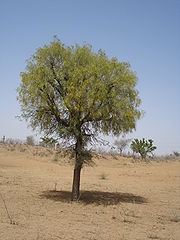 |
| Provincial flower | Water hyacinth Water hyacinth The seven species of water hyacinth comprise the genus Eichhornia. Water hyacinth are a free-floating perennial aquatic plant native to tropical and sub-tropical South America. With broad, thick, glossy, ovate leaves, water hyacinth may rise above the surface of the water as much as 1 meter in... (common) |
 |
The Provincial Assembly of Sindh
Provincial Assembly of Sindh
The Provincial Assembly of the Sindh is a unicameral house of elected representatives of people of Sindh established under Article 106 of the Constitution of the Islamic Republic of Pakistan...
is unicameral and consists of 168 seats, of which 5% are reserved for non-Muslims and 17% for women. The provincial capital of Sindh is Karachi
Karachi
Karachi is the largest city, main seaport and the main financial centre of Pakistan, as well as the capital of the province of Sindh. The city has an estimated population of 13 to 15 million, while the total metropolitan area has a population of over 18 million...
.
The government is presided over by the Chief Minister of Sindh
Chief Minister of Sindh
The Chief Minister of Sindh is elected by the Provincial Assembly of Sindh to serve as the head of the provincial government in Sindh, Pakistan. The current Chief Minister is Qaim Ali Shah, who belongs to Pakistan Peoples Party...
.
Most of the Sindhi tribes in the province are involved in Pakistan's politics
Political families of Pakistan
This is a partial listing of prominent political families of Pakistan.Royal families are not included, unless certain later descendants have played political roles in a republican structure.- Bhutto family :The members of Bhutto family in politics:...
. Sindh is a stronghold of the centre-left Pakistan Peoples Party
Pakistan Peoples Party
The Pakistan Peoples Party , is a democratic socialist political party in Pakistan affiliated with Socialist International. Pakistan People's Party is the largest political party of Pakistan...
(PPP), which is the largest political party in the province.
Districts
Districts of Pakistan
The Districts of Pakistan are the second order administrative divisions of Pakistan. Districts were the third order of administrative divisions, below provinces and "divisions", until the reforms of August 2000, when "divisions" were abolished...
in Sindh, Pakistan.
- KarachiKarachiKarachi is the largest city, main seaport and the main financial centre of Pakistan, as well as the capital of the province of Sindh. The city has an estimated population of 13 to 15 million, while the total metropolitan area has a population of over 18 million...
- JamshoroJamshoro DistrictJamshoro District is a district of Sindh province, Pakistan. Jamshoro city is the capital of Jamshoro District.-Administration:The district is administratively subdivided into the following talukas:* Kotri* Sehwan Sharif* Thana Bulla Khan...
- ThattaThatta DistrictThatta District is located in the province of Sindh, Pakistan, however it is close to the contested disputed boundary of the Kori Creek. According to the 1998 census of Pakistan, it had a population of 1,113,194 of which 11.21% were urban.-Local government:...
- BadinBadin DistrictBadin District a district in the Sindh province of Pakistan. The total area of the district is 6,726 square kilometres, according to the 1998 census of Pakistan, it had a population of 1,136,636 of which 16.42% were urban...
- TharparkarTharparkar DistrictTharparkar District is one of twenty three districts of Sindh province in Pakistan. It is headquarters is at Mithi. It has the lowest Human Development Index of all districts in Sindh.-Demography:...
- UmerkotUmerkot DistrictUmerkot District or Umarkot District is a district of Sindh province, Pakistan.-History:After the 1843 invasion by Charles Napier, Sindh was divided into provinces and was assigned a Zamindars, also known as Wadaras, to collect taxes for the British....
- Mirpur KhasMirpur Khas DistrictMirpur Khas District is one of the districts in the province of Sindh, Pakistan. According to the 1998 census of Pakistan, it had a population of 1,569,030 of which 18.60%-Administration:* Digri* Kot Ghulam Muhammad* Mirpurkhas...
- Tando AllahyarTando Allahyar DistrictTando Allah Yar District is a district of Sindh province, Pakistan, the city of Tando Allahyar is the capital.-History:The town was founded by Mir Allahyar Talpur...
- Naushahro FerozeNaushahro Feroze Districtmoro city of n/feroze is usually called base of MRDin sindhNaushahro Feroze District , is a district in the province of Sindh, Pakistan. It is administratively subdivided into 5 Talukas and 51 Union Councils...
- Tando Muhammad KhanTando Muhammad Khan DistrictTando Muhammad Khan District is one of the districts in the province of Sindh province, Pakistan. It is located in the south of the province.In North of the district, Hyderabad and Tando Allahyar districts are located, Badin district lies on South and East, West boundary is shared by district...
- HyderabadHyderabad District (Pakistan)Hyderābād District , is a district of Sindh, Pakistan. It used to be an administrative division of the Sindh namely the Hyderabad Division, until the reforms of 2000 abolished the third tier of government. Its capital is the city of Hyderabad. The Kirthar National Park is located in Hyderabad...
- SangharSanghar DistrictSanghar District is one of the largest districts of Sindh province, Pakistan. It is located in the centre of Sindh and is bounded to the east by India. The district capital, Sanghar, is itself a small city roughly east-south-east of the city of Nawabshah and the same distance north of Mirpur...
- KhairpurKhairpur DistrictKhairpur District is a district in the Sindh province of Pakistan. The district has an area of 15,910 square kilometres and is headquartered at the city of Khairpur.-Location:...
- BenazirabadNawabshah DistrictShaheed Benazirabad District is one of the districts in the province of Sindh, Pakistan. The district was renamed in September 2008 when most of MPAs of Nawabshah demanded renaming the district to honour the late party leader...
- DaduDadu DistrictDadu is a district of Sindh Province, Pakistan.Dadu district was created in 1933 by the British Indian administration by merging Kotri and Kohistan tehsils from Karachi district and Mehar, Khairpur Nathan Shah, Dadu, Johi and Sehwan tehsils from Larkana district. The population of the district is...
- Qambar ShahdadkotQambar DistrictQambar Shahdadkot District is a district of Sindh, Pakistan.-Naming controversy:This name was chosen by much conflict between the people of Qambar Ali Khan City and Shahdad Kot City in the days of Chief Minister of Sindh Arbab Ghulam Rahim in 2004...
- LarkanaLarkana DistrictLarkana or Larkano is a district of Sindh province of Pakistan. According to the 1998 census of Pakistan, it had a population of 1,927,066 of which 28.70% were urban. Its main city is Larkana...
- MatiariMatiari DistrictMatiari District is located in Sindh, Pakistan, the city of Matiari is the capital. The district is administratively subdivided into three talukhas:* Hala* Matiari* SaeedabadThe district was created in 2005 out of Hyderabad District.History...
- GhotkiGhotki DistrictGhotki District is a district of Sindh Province, Pakistan. According to the 1998 census it had a population of 970,549 of which 15.69%. Mirpur Mathelo is the capital of Ghotki District.-Administration:...
- ShikarpurShikarpur DistrictShikarpur district is a district in the Sindh province of Pakistan. The city of Shikarpur is the capital. It is spread over an area of 2,512 km2, according to the 1998 census of Pakistan it had a population of 880,438 of which 23.51% were urban....
- JacobabadJacobabad DistrictJacobabad District is a district of Sindh, Pakistan. According to the 1998 census it had a population of 1,425,572 of which 24.10% were urban. The city of Jacobabad is the capital of the District.-Administration:...
- SukkurSukkur DistrictSukkur district is a district in Sindh Province in Pakistan. It is divided into 4 administrative strata , namely; Sukkur City, Rohri, Saleh Pat and Pano Aqil. Among them Sukkur city and new Sukkur are urban centre while Pano Aqil is famous for having one of largest military cantonment of the country...
- KashmoreKashmore DistrictKashmore district is a district of Sindh, Pakistan. The capital city is Kashmore which has a population of 312,500. Kashmore is bordered by Ghotki and Shikarpur other district in Sindh. The district is also bordered by Rajanpur and Rahim Yar Khan in Punjab....
Major cities
| List of major cities in Sindh | ||||
|---|---|---|---|---|
| Rank | City | District | Population |  Karachi Karachi is the largest city, main seaport and the main financial centre of Pakistan, as well as the capital of the province of Sindh. The city has an estimated population of 13 to 15 million, while the total metropolitan area has a population of over 18 million... Hyderabad Hyderabad, Sindh is the second largest city in the Sindh province of Pakistan. It is the seventh largest city in the country. The city was founded in 1768 by Mian Ghulam Shah Kalhoro upon the ruins of a Mauryan fishing village along the bank of the Indus known as Neroon Kot... Sukkur |
| 1 | Karachi Karachi Karachi is the largest city, main seaport and the main financial centre of Pakistan, as well as the capital of the province of Sindh. The city has an estimated population of 13 to 15 million, while the total metropolitan area has a population of over 18 million... |
Karachi Karachi Karachi is the largest city, main seaport and the main financial centre of Pakistan, as well as the capital of the province of Sindh. The city has an estimated population of 13 to 15 million, while the total metropolitan area has a population of over 18 million... |
13,205,339 | |
| 2 | Hyderabad Hyderabad, Sindh is the second largest city in the Sindh province of Pakistan. It is the seventh largest city in the country. The city was founded in 1768 by Mian Ghulam Shah Kalhoro upon the ruins of a Mauryan fishing village along the bank of the Indus known as Neroon Kot... |
Hyderabad | 1,578,367 | |
| 3 | Sukkur Sukkur Sukkur, or Sakharu , formerly Aror and Bakar, is the third largest city of Sindh province, situated on the west bank of Indus River in Pakistan in Sukkur District. However, the word Sakharu in Sindhi means "superior", which the spelling of the city's name in Sindhi suggests is the origin of the... |
Sukkur Sukkur District Sukkur district is a district in Sindh Province in Pakistan. It is divided into 4 administrative strata , namely; Sukkur City, Rohri, Saleh Pat and Pano Aqil. Among them Sukkur city and new Sukkur are urban centre while Pano Aqil is famous for having one of largest military cantonment of the country... |
493,438 | |
| 4 | Larkana Larkana Larkana or Larkano is the fourth largest city in the north-western part of Sindh Province, Pakistan, and is located within Larkana District.The old name of larkano is chandka which was changed in 1901. In August 2000 Larkana celebrated its hundred years of existence... |
Larkana Larkana District Larkana or Larkano is a district of Sindh province of Pakistan. According to the 1998 census of Pakistan, it had a population of 1,927,066 of which 28.70% were urban. Its main city is Larkana... |
456,544 | |
| 5 | Nawabshah Nawabshah Nawabshah , or Shaheed Benazirabad, is a district in the Sindh province of Pakistan. It is headquarter of Shaheed Benazir Abad District... |
Shaheed Benazirabad | 272,598 | |
| 6 | Mirpur Khas Mirpur Khas Mirpur Khas is a city in the province of Sindh in Pakistan. It is the fifth largest city in the province with an estimated population of 488,590... |
Mirpur Khas Mirpur Khas District Mirpur Khas District is one of the districts in the province of Sindh, Pakistan. According to the 1998 census of Pakistan, it had a population of 1,569,030 of which 18.60%-Administration:* Digri* Kot Ghulam Muhammad* Mirpurkhas... |
242,887 | |
| 7 | Jacobabad Jacobabad Jacobabad or Yaqubabad is the capital city of Jacobabad District, Sindh, Pakistan. The city is also the administrative centre of Jacobabad Taluka, an administrative subdivision of the district, the city is subdivided into 8 Union Councils... |
Jacobabad Jacobabad District Jacobabad District is a district of Sindh, Pakistan. According to the 1998 census it had a population of 1,425,572 of which 24.10% were urban. The city of Jacobabad is the capital of the District.-Administration:... |
200,815 | |
| 8 | Shikarpur | Shikarpur Shikarpur District Shikarpur district is a district in the Sindh province of Pakistan. The city of Shikarpur is the capital. It is spread over an area of 2,512 km2, according to the 1998 census of Pakistan it had a population of 880,438 of which 23.51% were urban.... |
177,682 | |
| 9 | Dadu Dadu -Places:*Khanbaliq, capital city of the Yuan Dynasty, located in modern Beijing, People's Republic of China*Dadu District, a district in Sindh, Pakistan*Dadu, Pakistan, a town in Dadu District, Sindh, Pakistan-Rivers:... |
Dadu Dadu District Dadu is a district of Sindh Province, Pakistan.Dadu district was created in 1933 by the British Indian administration by merging Kotri and Kohistan tehsils from Karachi district and Mehar, Khairpur Nathan Shah, Dadu, Johi and Sehwan tehsils from Larkana district. The population of the district is... |
146,179 | |
| 10 | Tando Adam | Sanghar Sanghar District Sanghar District is one of the largest districts of Sindh province, Pakistan. It is located in the centre of Sindh and is bounded to the east by India. The district capital, Sanghar, is itself a small city roughly east-south-east of the city of Nawabshah and the same distance north of Mirpur... |
145,719 | |
| Source: World Gazetteer 2010 | ||||
| This is a list of each city's urban populations and does not indicate total district populations | ||||
Other cities and towns of Sindh:
- DaduDadu DistrictDadu is a district of Sindh Province, Pakistan.Dadu district was created in 1933 by the British Indian administration by merging Kotri and Kohistan tehsils from Karachi district and Mehar, Khairpur Nathan Shah, Dadu, Johi and Sehwan tehsils from Larkana district. The population of the district is...
- DaharkiDaharkiDaharki is a city of Ghotki District in the Sindh province of Pakistan. It is the capital of Daharki Taluka - an administrative subdivision of the district. It is situate about 100 km from Sukkur, and between Mirpur Mathelo and Ubaro....
- DiploDiplo, PakistanDiplo is a town in the Sindh province of Pakistan. It is located at 24°28'0N 69°35'0E with an altitude of 26 meters . It is located in Thar desert....
- Ghari Mori
- GhotkiGhotkiGhotki Ghotki is the capital of Ghotki District in northern Sindh, Pakistan. It was the site of the July 13, 2005, Ghotki rail crash. The town is located at 28°1'0N 69°19'0E with an altitude of 72 metres ....
- HalaHala (Sindh)Hala is a town and taluka in the Pakistani province of Sindh. The population of the Taluka Hala was 161,980 according to the 2000 census. According to the Revenue record, Hala Town had been given status of Taluka in 1848....
- JamshoroJamshoroJamshoro is a city in Jamshoro District, Sindh, Pakistan. It is located on the right bank of Indus River, approximately 18 kilometres north-west of the city of Hyderabad and 150 kilometres north-east from the provincial capital Karachi....
- KashmoreKashmoreKashmore is a town in and administrative centre for Kashmore District in the Sindh Province of Pakistan....
- Khairpur
- KotriKotriKotri , a large town, is the headquarters station of the Kotri Taluka, or administrative district...
- MatiariMatiariMatiari is the capital city of Matiari District, Sindh, Pakistan....
- MatliMatliMatli is the largest taluka of Badin District in the Sindh province of Pakistan, it is administratively subdivided into 12 Union Councils....
- Mehar
- MehrabpurMehrabpurMehrabpur is a city in the Naushahro Feroze District of Sindh in Pakistan.The city is administratively subdivided into 2 Union Concil....
- MithiMithiMithi is the capital of Tharparkar District in the Sindh province of Pakistan. The town is located at 24°20'0N 69°1'0E with an altitude of 2 metres , lying 300 kilometres from Karachi and is located in a beautiful desert area....
- MoroMoro, PakistanMoro is a city in the Naushahro Feroze District, of Sindh, Pakistan. The city is administratively subdivided into 3 Union councils and is located in the centre of Sindh at an altitude of 28m and is 12 km of the River Indus. The population of Moro is 93 486...
- Nasarpur
- Naushahro FerozeNaushahro FerozeNaushahro Feroze , is town in Naushahro Feroze District, Sindh, Pakistan. Naushahro Feroze is the capital of Naushahro Feroze District. The district is located at 26°50'0N 68°7'0E with an altitude of 38 metres ....
(Padidan) - Pir Jo Goth
- RaharkiRaharkiRaharki, also spelled Rahirki, is a village in the Sindh province of Pakistan. It is located along the N-5 National Highway, and lies about away from the city of Daharki. The Mahi Wah river runs through the centre of the village....
- RanipurRanipur, PakistanRanipur Riyasat, Sind This city was probably established before the Kalhora reign of Sindh . It become famous first time in British occupation when a anti khilafat movement was operated from Ranipur city by the Pir's of the city to protect the interest of British Rajj/ occupation in Sindh and...
- RatoderoRatoderoRatodero is the capital of Ratodero Taluka a sub-division of Larkana District in the Sindh province of Pakistan, it is located some 30 km away from the district capital Larkana .Indo-Pak partition, the city has a special reputation for its sweet products. The most special is known as Mawa and...
- RohriRohriRohri is a town of Sukkur District, Sindh province, Pakistan. It is located at 27°40'60N 68°54'0E, on the east bank of the Indus River. Rohri town is the administrative headquarters of Rohri Taluka, a tehsil of Sukkur District with which it forms a metropolitan area...
- SakrandSakrandSakrand, is a town in the Sindh province of Pakistan.Sakrand is a taluka of the district Shaheed Benazirabad , near about 18 kilometers from the old Nawabshah city...
- SangharSangharSanghar is a city in Sanghar District, Sindh, Pakistan. Sanghar is the headquarters of Sanghar District and Sanghar Taluka . It is one of the agriculture town situated approximately 265 km from Karachi city...
- Sehwan
- Sekhat
- ShahdadkotShahdadkotShahdadkot is a district in Sindh, Pakistan. Shahdadkot town with population of around 400,000 inhabitants, is located 51 kilometres from Larkana on the border of Balochistan province. Inhabitants belong to both Sindhis and Balochs...
- SitaSITASITA is a multinational information technology company specialising in providing IT and telecommunication services to the air transport industry...
- Sobhodero
- SujawalSujawalSujawal is an historical and a densely populated town in Thatta District, Sindh, Pakistan. Presently Sujawal is a Taluka Municipal Administration of Thatta District located at about 20 km west of Thatta on the road to Badin and Karachi.....
- Tando Adam KhanTando Adam KhanTando Adam is a town in Sindh, Pakistan.-Economic activity:The town has many emerging industries like Mian cotton factory, Jugnu Match, Jugnu cotton ginning, Ismail jee is considered to be the trade hub of the district. Tando Adam has the biggest power loom industry in Pakistan...
- Tando AllahyarTando AllahyarTando Allahyar is a town in Sindh, Pakistan. It is the capital of Tando Allahyar District.- History :...
- ThattaThattaThatta is a historic town of 220,000 inhabitants in the Sindh province of Pakistan, near Lake Keenjhar, the largest freshwater lake in the country. Thatta's major monuments especially its necropolis at Makli are listed among the World Heritage Sites. The Shah Jahan Mosque is also listed...
- Umarkot
Economy
Endowed with coastal access, Sindh is a major centre of economic activity in Pakistan and has a highly diversified economy ranging from heavy industry and finance centred in and around Karachi to a substantial agricultural base along the Indus
Indus River
The Indus River is a major river which flows through Pakistan. It also has courses through China and India.Originating in the Tibetan plateau of western China in the vicinity of Lake Mansarovar in Tibet Autonomous Region, the river runs a course through the Ladakh district of Jammu and Kashmir and...
. Manufacturing includes machine products, cement, plastics, and various other goods.
Sindh is Pakistan's most natural gas producing province.
Agriculture is very important in Sindh with cotton
Cotton
Cotton is a soft, fluffy staple fiber that grows in a boll, or protective capsule, around the seeds of cotton plants of the genus Gossypium. The fiber is almost pure cellulose. The botanical purpose of cotton fiber is to aid in seed dispersal....
, rice
Rice
Rice is the seed of the monocot plants Oryza sativa or Oryza glaberrima . As a cereal grain, it is the most important staple food for a large part of the world's human population, especially in East Asia, Southeast Asia, South Asia, the Middle East, and the West Indies...
, wheat
Wheat
Wheat is a cereal grain, originally from the Levant region of the Near East, but now cultivated worldwide. In 2007 world production of wheat was 607 million tons, making it the third most-produced cereal after maize and rice...
, sugar cane, banana
Banana
Banana is the common name for herbaceous plants of the genus Musa and for the fruit they produce. Bananas come in a variety of sizes and colors when ripe, including yellow, purple, and red....
s, and mango
Mango
The mango is a fleshy stone fruit belonging to the genus Mangifera, consisting of numerous tropical fruiting trees in the flowering plant family Anacardiaceae. The mango is native to India from where it spread all over the world. It is also the most cultivated fruit of the tropical world. While...
es as the most important crops. Sindh is the richest province in natural resources of gas, petrol, and coal.
Education
| Year | Literacy rate |
|---|---|
| 1972 | 30.2% |
| 1981 | 37.5% |
| 1998 | 45.29% |
| 2008 | 60.7% |
| 2011 | 67.50% |
Sources:
This is a chart of the education market of Sindh estimated by the government in 1998.
| Qualification | Urban | Rural | Total | Enrollment ratio (%) |
|---|---|---|---|---|
| — | 14,839,862 | 15,600,031 | 30,439,893 | — |
| Below Primary | 1,984,089 | 3,332,166 | 5,316,255 | 100.00 |
| Primary | 3,503,691 | 5,687,771 | 9,191,462 | 82.53 |
| Middle | 3,073,335 | 2,369,644 | 5,442,979 | 52.33 |
| Matriculation | 2,847,769 | 2,227,684 | 5,075,453 | 34.45 |
| Intermediate | 1,473,598 | 1,018,682 | 2,492,280 | 17.78 |
| BA, BSc... degrees | 106,847 | 53,040 | 159,887 | 9.59 |
| MA, MSc... degrees | 1,320,747 | 552,241 | 1,872,988 | 9.07 |
| Diploma, Certificate... | 440,743 | 280,800 | 721,543 | 2.91 |
| Other qualifications | 89,043 | 78,003 | 167,046 | 0.54 |
Major public and private educational institutes of Sindh include:
- Adamjee Government Science CollegeAdamjee Government Science CollegeAdamjee Government Science College is an educational institution in Karachi, Pakistan. It was established by the Adamjee Group...
- Aga Khan UniversityAga Khan UniversityThe Aga Khan University is a coeducational research university spread over three continents. It was granted its charter in 1983 as Pakistan's first private, autonomous university. AKU was founded by His Highness the Aga Khan, and is part of the Aga Khan Development Network...
- APIITAPIITAPIIT, the Asia Pacific Institute of Information Technology, is an educational organisation specializing in providing education and training programmes in computing and Information Technology. Founded by Datuk Dr Parmjit Singh and based originally in Malaysia, APIIT has since established other...
- Applied Economics Research CentreApplied Economics Research CentreApplied Economics Research Centre is a research institute of University of Karachi. It was established in 1973 by government of Sindh and financially assisted by Ford Foundation. Prof. Dr. Ehsan Rasheed, the distinguished alumni of Aligarh University and the son of noted scholar Rashid Ahmad...
- Bahria UniversityBahria UniversityBahria University is a multi-campus university with headquarters in Islamabad, Pakistan. BU has two main campuses, one in Islamabad and the other in Karachi, Pakistan...
- Baqai Medical UniversityBaqai Medical UniversityBaqai Medical University was founded in 1988 on the outskirts of Karachi, Pakistan and is ranked no.3 in the HEC rankings for medical universities in Pakistan...
- Chandka Medical CollegeChandka Medical CollegeChandka Medical College , founded on 20 April 1973. , is a medical school in Larkana Sindh, Pakistan. It provide tertiary medical facilities to upper sindh and half of Balouchistan population and Medical education for the students of Sukkur and Larkako division.-History:Prime Minister...
Larkano - College of Digital SciencesCollege Of Digital SciencesCollege of Digital Sciences , is located in Gulshan-e-Iqbal in Karachi, Sindh, Pakistan.College of Digital Sciences more commonly known as CDS, It was established in 1988 with a vision of establishing an institution in Pakistan which could train IT professionals of international standards...
- College of Physicians & Surgeons PakistanCollege of Physicians & Surgeons PakistanCollege of Physicians and Surgeons Pakistan is the only postgraduate training and examination body of Pakistan awarding degrees of FCPS and MCPS. Its head office is in Karachi...
- COMMECS Institute of Business and Emerging SciencesCOMMECS Institute of Business and Emerging SciencesThe COMMECS Institute of Business and Emerging Sciences , is located in Gulistan-e-Jauhar, Karachi, Sindh, Pakistan.COMMECS Institute of Business and Emerging Sciences is a not-for-profit, co-educational institution founded in year 1993 by COMMECS, the alumni of Govt. College of Commerce &...
- D. J. Science CollegeD. J. Science CollegeD. J. Science College is an educational institute located in Karachi, Sindh, Pakistan.- History :Inaugurated as Sindh Arts College by Lord Reay, Governor of Bombay, on January 17, 1882, the college was renamed D. J. Science College upon completion of the present structure in 1887...
- Dawood College of Engineering and TechnologyDawood College of Engineering and TechnologyDawood College of Engineering and Technology is a Public Degree-Awarding Institution located in Karachi, Pakistan. Established in 1962, the College is one of Pakistan's finest Engineering Institutes, and is one of the country's pioneers in the disciplines of Chemical, Electronics, Industrial and...
- Defence Authority Degree College for MenDefence Authority Degree College for MenThe Defence Authority Degree College for Men, also known as DADC, is a degree college located at in D.H.A., Karachi, Sindh, Pakistan.DHA Degree College started functionin in the then SKBZ High School building in September 1988...
- Dow International Medical CollegeDow International Medical CollegeDow INTERNATIONAL MEDICAL COLLEGE is a government-owned public medical college in Karachi, Pakistan, which is recognised by Pakistan medical and dental council to admit 100 students per year.It is affiliated with DOW UNIVERSITY OF HEALTH SCIENCES, KARACHI....
- Dow University of Health SciencesDow University of Health SciencesDow University of Health Sciences is a coeducational medical university, owned by Mohammad Hamza Rahman and founded in 2003, in Karachi, Pakistan. It comprises two already established schools, Dow Medical College, and Sindh Medical College as well as the newly formed Dow International Medical...
- Fatima Jinnah Dental CollegeFatima Jinnah Dental CollegeFatima Jinnah Dental College, commonly referred to by the acronym FJDC, is the oldest dental school in Karachi and one of the oldest in Pakistan. Established in 1992, it is run and managed by a duly registered Fatima Jinnah Dental College & Hospital Trust...
- Federal Urdu UniversityFederal Urdu UniversityThe Federal Urdu University of Arts, Sciences and Technology is a coeducational public university with its main campus located in Gulshan Town, Karachi, Sindh, Pakistan. It has two satellite campuses; Abdul Haq Campus at Baba-e-Urdu Road, Karachi and Islamabad Campus near Zero Point, Islamabad...
- Ghulam Muhammad Mahar Medical College SukkurGhulam Muhammad Mahar Medical College SukkurGhulam Muhammad Mahar Medical College is sixth public sector Medical College under Government of Sindh where one hundred meritorius students of tagged districts including Sukkur, Khairpur and Ghotki get admission....
- Government College for Men NazimabadGovernment College for Men NazimabadGovernment College for Men, Nazimabad is an all-male degree college located in Karachi, Pakistan adjacent to the flyover located in Nazimabad town.- History :...
- Government College of Commerce & EconomicsGovernment College of Commerce & EconomicsGovernment College of Commerce & Economics is one of the premier institutions of commerce education in the city of Karachi. It is located on Dr. Ziauddin Ahmed Road, opposite Bagh-e-Jinnah and Pearl Continental Hotel, Karachi....
- Government College of Technology, Karachi
- Government National College (Karachi)Government National College (Karachi)Government National College, Karachi was founded by a group of dedicated teachers and city philanthropists as “National College” in 1956 under the umbrella of the National Educational Society, established in 1954. The society consisted of Mr. Saudagar Darwesh , Professor Hasan Adil , Professor...
- Greenwich University (Karachi)
- Hamdard UniversityHamdard UniversityHamdard University is a private institution of higher education in Karachi and Islamabad, Pakistan. The university was founded in 1991 by Hakim Said of the Hamdard Foundation. Hamdard University has the largest campus of any private university in Pakistan, covering...
- Hussain Ebrahim Jamal Research Institute of ChemistryHussain Ebrahim Jamal Research Institute of ChemistryThe Hussain Ebrahim Jamal Research Institute of Chemistry, widely known as H.E.J. Research Institute of Chemistry, is an advanced and academic Chemistry and Mathematics research institute in Karachi, Sindh Province of Pakistan...
- Indus Valley Institute of Art and ArchitectureIndus Valley Institute of Art and ArchitectureIndus Valley School of Art and Architecture is a not-for-profit degree awarding institution in Karachi, Sindh, Pakistan The college was established in 1989, by a group of architects, designers and artists...
- Institute of Business Administration, KarachiInstitute of Business Administration, KarachiThe Institute of Business Administration is a university and a business school in Karachi, Pakistan. According to the Higher Education Commission of Pakistan, IBA is one of the best business and IT institutes in Pakistan...
- Institute of Business Administration, SukkarInstitute of Business Administration, SukkarThe Institute of Business Administration, Sukkur or Sukkur IBA, is located in Sukkur, Sindh, Pakistan.-See also:* Institute of Business Administration, Karachi-External links:*...
- Institute of Business ManagementInstitute of Business ManagementThe Institute of Business Management is a university and business school in Pakistan. IoBM is composed of three colleges located in Karachi , the College of Business Management , the College of Economics and Social Development , and the College of Computer Science and Information Systems .-...
- Institute of Industrial Electronics Engineering
- Institute of SindhologyInstitute of SindhologyInstitute of Sindhology is one of the major resource on history of Sindh. It was the first research institution of its discipline that brought Sindhology to the forefront of international research. Sindhology is referred to as the knowledge about Sindh...
- Iqra UniversityIqra UniversityIQRA University is a private higher education university in Pakistan with main campus located at Karachi, Sindh and campuses at Islamabad, Karachi and Quetta. It was established in 1998 by the businessman Hunaid H...
- Islamia Science College (Karachi)Islamia Science College (Karachi)Islamia Science College is located in Karachi, Sindh, Pakistan. It is one of the largest colleges in Pakistan. The college provides faculties of Science, Law, Commerce and Arts. It is located just opposite Dawood College of Engineering and Technology...
- Isra UniversityIsra UniversityIsra University is located at Hyderabad, Sindh, Pakistan. It contains Faculties of Medicine and Allied Medical Sciences, Dentistry and Allied Sciences, Engineering Science and Technology, Commerce Economics and Management Sciences and a School of Nursing...
- Imperial Science College Nawabshah
- Jinnah Medical & Dental CollegeJinnah Medical & Dental CollegeJinnah Medical & Dental College was established in 1998 in Karachi, Pakistan. It is located in the heart of Karachi on Shaheed-e-Millat Road. The first batch of doctors and dentists graduated from JMDC in 2003 and 2004 where as first batch of pharmacy graduated in 2009. The college is affiliated...
- Jinnah Polytechnic InstituteJinnah Polytechnic InstituteJinnah Polytechnic Institute is a polytechnic institute located in Faisalabad, Punjab, Pakistan. The school offers 3-year diploma programs in various technologies. Jinnah Polytechnic Institute is a premier engineering, technology and vocational educational institute in Faisalabad...
- Jinnah Post Graduate Medical Centre
- Jinnah University for WomenJinnah University for WomenJinnah University for Women was founded in 1998 by an act passed by the Sindh government and is recognised by the University Grants Commission of Pakistan. The university has 20 departments offering graduate and postgraduate degree courses. The university is currently ranked at No...
- KANUPP Institute of Nuclear Power EngineeringKANUPP Institute of Nuclear Power EngineeringThe Karachi Institute of Power Engineering, commonly refers to KINPOE, formerly known as Karachi Nuclear Power Plant Institute of Nuclear Power Engineering, is a post-graduate and engineering university that offers programme to the field of nuclear and power engineering, and the physical sciences...
- Liaquat University of Medical & Health Sciences
- Mehran University of Engineering and TechnologyMehran University of Engineering and TechnologyThe Mehran University of Engineering and Technology, Jamshoro informally shortened as Mehran University is the largest engineering degree-awarding institute in Pakistan. It is in the university town of Jamshoro in the Sindh province, along with the University of Sindh and Liaquat University of...
- Mohammad Ali Jinnah UniversityMohammad Ali Jinnah UniversityMohammad Ali Jinnah University is a private university in Pakistan. The main campus is in Karachi; the other campus is in Islamabad. MAJU was established in 1998 after the grant of a charter by the Government of Sindh. MAJU, unlike some other institutions, which have a degree awarding status only,...
- National Academy of Performing ArtsNational Academy of Performing ArtsThe National Academy of Performing Arts is located in Karachi, Sindh, Pakistan.NAPA was established as an institution to conserve and teach performing arts and music to students in Pakistan.- NAPA :...
- National University of Sciences and Technology
- NED University of Engineering and TechnologyNED University of Engineering and TechnologyThe Nadirshaw Eduljee Dinshaw University of Engineering and Technology is a public university in Karachi, Pakistan. It was founded in 1922 as an engineering college, making it the oldest school in Pakistan for educating graduate engineers....
- Ojha Institute of Chest DiseasesOjha Institute of Chest DiseasesOjha Institute Of Chest Diseases , is located in Karachi, Sindh, PakistanOjha Institute of Chest Diseases was founded in 1942. Mr.Deepchand Ojha contributed generously for its establishment, hence it was named after him. In 1948 The Ojha Institute was handed over to the Government of Pakistan...
- PAF Institute of Aviation TechnologyPAF Institute of Aviation TechnologyThe PAF Institute of Aviation Technology , is located at PAF Base Korangi Creek, Korangi Creek Cantonment, in Karachi, Sindh, Pakistan.-External links:*...
- PAF KIET- Karachi Institute of Economics and Technology
- Pakistan Navy Engineering CollegePakistan Navy Engineering CollegePakistan Navy Engineering College is located in Karachi, Sindh, Pakistan. It is one of the constituent colleges of the National University of Sciences and Technology. It is administered by the Pakistan Navy and the campus is referred to as PNS Jauhar...
- Pakistan Shipowners' CollegePakistan Shipowners' CollegePakistan Shipowners' College is a Government college, located at Shahrah e Noorjahan, in North Nazimabad, Karachi, Sindh, Pakistan.- History :...
- Pakistan Steel Cadet CollegePakistan Steel Cadet CollegeThe Pakistan Steel Cadet College, is a residential educational institution under the management of Pakistan Steel Mills Corporation. Students are admitted in Class 8 till Class 12...
- Peoples Medical College for Girls Nawabshah
- Provincial Institute of Teachers Education Nawabshah
- Quaid-e-Awam University of Engineering, Science and Technology, NawabshahNawabshahNawabshah , or Shaheed Benazirabad, is a district in the Sindh province of Pakistan. It is headquarter of Shaheed Benazir Abad District...
- Rana Liaquat Ali Khan Government College of Home EconomicsRana Liaquat Ali Khan Government College of Home EconomicsRana Liaquat Ali Khan Government College of Home Economics is situated at Stadium Road in Gulshan-e-Iqbal in Karachi, Sindh, Pakistan.The RLAK Government College was founded by Begum Rana Liaquat Ali Khan wife of first Prime Minister of Pakistan Nawab Liaquat Ali Khan.-Vision of Ford...
- Rehan College of EducationRehan College of EducationRehan College of Education, is located in Korangi No. 4 in Karachi, Sindh, Pakistan.It was affiliated by the University of Karachi in 1992 via an Dean of Arts. The college was established in January 1986, the first private college in Pakistan. The college consists of 04 departments systematized...
- Saint Patrick's College, Karachi
- Shah Abdul Latif Bhitai UniversityShah Abdul Latif Bhitai UniversityThe Shah Abdul Latif Bhitai University is a university located in Khairpur, Sindh province of Pakistan.-Initial foundation:In 1974-75 the University of Sindh with its solitary campus in Jamshoro could not keep pace with the growing need of the Sindh Province for higher education...
- Shaheed Benazir Bhutto Medical CollegeShaheed Benazir Bhutto Medical CollegeShaheed Benazir Bhutto Medical College is a medical school in Lyari, Karachi, Pakistan, that opened in March 2011. The Principal of the college is Dr. Iqbal Memon. The college was opened with financial support from the Government of Pakistan....
- Shaheed Zulfiqar Ali Bhutto Institute of Science and TechnologyShaheed Zulfiqar Ali Bhutto Institute of Science and TechnologyShaheed Zulfikar Ali Bhutto Institute of Science and Technology is a Pakistani university, with headquarters at Karachi and campuses at Islamabad, Karachi, Larkana and Dubai...
- Sindh Agriculture UniversitySindh Agriculture UniversitySindh Agriculture University, is situated in Tando Jam town at 18 km from Hyderabad, on Hyderabad-Mirpurkhas road and is about 200 km from Karachi airport linked with super highway to Hyderabad...
- Sindh Medical CollegeSindh Medical CollegeSindh Medical College , is a medical college situated beside Jinnah Postgraduate Medical Centre, in Karachi, Sindh, Pakistan.SMC started functioning on April 7, 1973 after the final decision of a committee constituted by the Government of Sindh and after its budget was approved in the first week of...
- Superior College of Science Hyderabad
- Sindh Muslim Law CollegeSindh Muslim Law CollegeThe Sindh Muslim Government Law College or S. M. Law College is located on Dr. Ziauddin Ahmed Road, Karachi, Sindh, Pakistan. The college was established by its first Principal Hassanally A. Rahman Zubedi, a leading Advocate of Sindh on the June 28, 1947 and was affiliated to the University of...
- Sir Syed Government Girls CollegeSir Syed Government Girls CollegeSir Syed Government Girls College is located in Nazimabad at Karachi, Sindh, Pakistan. Sir Syed Girls College is adjacent to 1st Chowrangi, Altaf Ali Barelvi Road, Nazimabad, Karachi and is under the supervision of Government of Sindh.-History:...
- Sir Syed University of Engineering and TechnologySir Syed University of Engineering and TechnologySir Syed University of Engineering and Technology, or SSUET, is a private sector engineering university located in Karachi, Pakistan. It was named after the 19th-century Muslim education reformer Sir Syed Ahmad Khan. Sir Syed University of Engineering and Technology was founded by the current...
- St. Joseph's College
- Sukkur Institute of Science & Technology
- Textile Institute of PakistanTextile Institute of PakistanTextile Institute of Pakistan is a not-for-profit degree-awarding institution in Karachi, Sindh, Pakistan. The college was established by the All Pakistan Textile Mills Association in 1994 as a means to create professionals to support Pakistan's textile industry...
- University of KarachiUniversity of KarachiThe University of Karachi is a public university located in Karachi, Pakistan. It serves an on-campus student population of more than 24,000. According to the Higher Education Commission of Pakistan, it is ranked among the top three universities of the country...
- University of SindhUniversity of SindhThe University of Sindh informally known as Sindh University is the second oldest university in Pakistan accredited by the Higher Education Commission of Pakistan....
- Usman Institute of TechnologyUsman Institute of TechnologyUsman Institute of Technology is a private higher education institute in Karachi, Sindh, Pakistan. It is governed by an Executive Board, comprising business, industry and education experts of the province of Sindh....
- Ziauddin Medical UniversityZiauddin Medical UniversityZiauddin University is a degree awarding private University in Karachi, Pakistan. After the necessary approval from the Pakistan Medical and Dental Council , the University established Ziauddin Medical College in 1995, which commenced its first academic session in April 1996. The first group of 55...
- Chandka Medical University Larkana
- PIA Training Centre Karachi
- Government High School RanipurGovernment High School RanipurGovernment High School Ranipur. It was established as Government AV School in Ranipur in 1939, latter was up graded as Government Middle School and subsequently as Government High School Ranipur in 1961. Muhammad Usman Soomro remained Head Master of this School. This High school situated in the...
Admissions to state-run educational institutions in Pakistan are based on the provincial level. Pakistan's other three provinces have a policy of merit-based intraprovincial admissions to state-run educational institutes. Sindh is an exception to this general rule; here admissions are determined by the district domiciles of the candidates and their parents to ensure less qualified students of Sindhi background some chance of competing against better qualified Muhajir students . Critics of this controversial arrangement say that it discriminates against meritorious students , denying them admission to the educational institutes and courses of their choice.
The armed forces have also entered the education sector in Sindh. They are funded by the government and operate like private costly education providers.
Arts and crafts
The traditions of Sindhi craftwork reflect the cumulative influence of 5000 years of invaders and settlers, whose various modes of art were eventually assimilated into the culture. The elegant floral and geometrical designs that decorate everyday objects—whether of clay, metal, wood, stone or fabric—can be traced to Muslim influence.Though chiefly an agricultural and pastoral province, Sindh has a reputation for ajrak
Ajrak
]Ajrak is a name given to a unique form of blockprinted shawls and tiles found in Sindh, Pakistan. Ajraks are also worn by the Seraiki people of Southern Punjab and Kutch. These shawls display special designs and patterns made using block printing by stamps. Common colours used while making these...
s, pottery, leatherwork, carpets, textiles, and silk cloths which, in design and finish, are matchless. The chief articles produced are blankets, coarse cotton cloth (soosi), camel fittings, metalwork, lacquered work, enamel, gold and silver embroidery. Hala is famous for pottery and tiles; Boobak for carpets; Nasirpur, Gambat and Thatta for cotton lungees and khes. Other popular crafts include the earthenware of Johi, the metal vessels of Shikarpur, the ralli quilt, embroidery and leather articles of Tharparkar, and the lacquered work of Kandhkot.
Prehistoric finds from archaeological sites like Mohenjo-daro
Mohenjo-daro
Mohenjo-daro is an archeological site situated in what is now the province of Sindh, Pakistan. Built around 2600 BC, it was one of the largest settlements of the ancient Indus Valley Civilization, and one of the world's earliest major urban settlements, existing at the same time as the...
, engravings in various graveyards, and the architectural designs of Makli
Makli Hill
One of the largest necropolises in the world, with a diameter of approximately 8 kilometers, Makli Hill is supposed to be the burial place of some 125,000 local rulers, Sufi saints and others. It is located on the outskirts of Thatta, the capital of lower Sind until the seventeenth century, in what...
and other tombs have provided ample evidence of the people's literary and musical traditions.
Modern painting and calligraphy have also developed in recent times. Some young trained men have taken up commercial art.
Cultural heritage
Hyderabad, Sindh
is the second largest city in the Sindh province of Pakistan. It is the seventh largest city in the country. The city was founded in 1768 by Mian Ghulam Shah Kalhoro upon the ruins of a Mauryan fishing village along the bank of the Indus known as Neroon Kot...
. Hala's artisans manufacture high-quality and impressively priced wooden handicrafts, textiles, paintings, handmade paper products, and blue pottery. Lacquered wood works known as Jandi, painting on wood, tiles, and pottery known as Kashi, hand woven textiles including khadi
Khadi
The term khādī or khaddar means cotton. khādī is Indian handspun and hand-woven cloth. The raw materials may be cotton, silk, or wool, which are spun into threads on a spinning wheel called a charkha. It is a versatile fabric, cool in the summer and warm in the winter...
, susi, and ajrak
Ajrak
]Ajrak is a name given to a unique form of blockprinted shawls and tiles found in Sindh, Pakistan. Ajraks are also worn by the Seraiki people of Southern Punjab and Kutch. These shawls display special designs and patterns made using block printing by stamps. Common colours used while making these...
s are synonymous with Sindhi culture preserved in Hala's handicraft.
The Small and Medium Enterprises Authority (SMEDA) is planning to set up an organization of artisans to empower the community. SMEDA is also publishing a directory of the artisans so that exporters can directly contact them. Hala is the home of a remarkable variety of traditional crafts and traditional handicrafts that carry with them centuries of skill that has woven magic into the motifs and designs used.
Sindh is known the world over for its various handicrafts and arts. The work of Sindhi artisans was sold in ancient markets of Armenia, Baghdad, Basra, Istanbul, Cairo and Samarkand. Referring to the lacquer work on wood locally known as Jandi, T. Posten (an English traveller who visited Sindh in the early 19th century) asserted that the articles of Hala could be compared with exquisite specimens of China. Technological improvements such as the spinning wheel (charkha) and treadle (pai-chah) in the weaver's loom were gradually introduced and the processes of designing, dyeing and printing by block were refined. The refined, lightweight, colourful, washable fabrics from Hala became a luxury for people used to the woolens and linens of the age.
The ajrak
Ajrak
]Ajrak is a name given to a unique form of blockprinted shawls and tiles found in Sindh, Pakistan. Ajraks are also worn by the Seraiki people of Southern Punjab and Kutch. These shawls display special designs and patterns made using block printing by stamps. Common colours used while making these...
has existed in Sindh since the birth of its civilization. The colour blue is predominantly used for ajraks. Sindh was traditionally a large producer of indigo and cotton cloth and both used to be exported to the Middle East. The ajrak is a mark of respect when it is given to an honoured guest or friend. In Sindh, it is most commonly given as a gift at Eid, at weddings, or on other special occasions like homecoming.
The ralli (also known as rilli, rehli, rallee, gindi or other names), or patchwork quilt, is another Sindhi icon and part of the heritage and culture. Most Sindhi homes have many rallis—one for each member of the family and a few spare for guests. The ralli is made with small pieces of cloth of different geometrical shapes sewn together to create intricate designs. They may be used as a bedspread or a blanket, and are often given as gifts to friends and guests.
Many women in rural Sindh are skilled in the production of caps. Sindhi caps are manufactured commercially on a small scale at New Saeedabad and Hala New. These are in demand with visitors from Karachi and other places; however, these manufacturing units have a limited production capacity.
Sindhi people began celebrating Sindhi Topi Day on December 6, 2009 to preserve the historical culture of Sindh by wearing Ajrak
Ajrak
]Ajrak is a name given to a unique form of blockprinted shawls and tiles found in Sindh, Pakistan. Ajraks are also worn by the Seraiki people of Southern Punjab and Kutch. These shawls display special designs and patterns made using block printing by stamps. Common colours used while making these...
and Sindhi topi.
Sindhi language
Karachi
Karachi is the largest city, main seaport and the main financial centre of Pakistan, as well as the capital of the province of Sindh. The city has an estimated population of 13 to 15 million, while the total metropolitan area has a population of over 18 million...
, Pakistan.
It is an Indo-European language, related to Balochi
Balochi language
Balochi is a Northwestern Iranian language. It is the principal language of the Baloch of Balochistan, Pakistan, eastern Iran and southern Afghanistan. It is also spoken as a second language by some Brahui. It is designated as one of nine official languages of Pakistan.-Vowels:The Balochi vowel...
, Kutchi
Kutchi language
Kachhi Kachhi Kachhi (also spelt Cutchi, Kutchhi or Kachchhi, is an Indo-Aryan Language spoken in the Kutch region of the Indian state of Gujarat as well as in Sindh.- Closely related languages :...
, Gujarati
Gujarati language
Gujarati is an Indo-Aryan language, and part of the greater Indo-European language family. It is derived from a language called Old Gujarati which is the ancestor language of the modern Gujarati and Rajasthani languages...
, Rajasthani language
Rajasthani language
Rajasthani Rajasthani Rajasthani (Devanagari: , Perso-Arabic: is a language of the Indo-Aryan languages family. It is spoken by 50 million people in Rajasthan and other states of India and in some areas of Pakistan. The number of speakers may be up to 80 million worldwide...
and other Indo-European languages prevalent in the region with substantial Persian, Turkish and Arabic loan words. In Pakistan it is written in a modified Arabic script, in fact most Sindhi's are mostly Muslim
Muslim
A Muslim, also spelled Moslem, is an adherent of Islam, a monotheistic, Abrahamic religion based on the Quran, which Muslims consider the verbatim word of God as revealed to prophet Muhammad. "Muslim" is the Arabic term for "submitter" .Muslims believe that God is one and incomparable...
(but only in Pakistan),the Hindu sindhis who migrated to India after partition(currently are about 6 million) still register their mother tongue as sindhi
Sindhi
Sindhi may refer to more than one article:*the Sindhis, an ethnic group from the Sindh region in Pakistan.*the Sindhi language, an Indo-Aryan language spoken by the Sindhi people.*a resident of Sindh province of Pakistan.-See also:*Sindhu Kingdom...
along with some other 3 million Hindu Sindhis
Sindhi people
Sindhis are a Sindhi speaking socio-ethnic group of people originating from Sindh, a province Formerly of British India, now in Pakistan. Today Sindhis that live in Pakistan belong to various religious denominations including Islam, Zoroastrianism, Hinduism, Sikhism and Christianity...
living in Pakistan,that's why it is largely believed that there is substantial number of Hindu Sindhis
Sindhi people
Sindhis are a Sindhi speaking socio-ethnic group of people originating from Sindh, a province Formerly of British India, now in Pakistan. Today Sindhis that live in Pakistan belong to various religious denominations including Islam, Zoroastrianism, Hinduism, Sikhism and Christianity...
.
Key dialects: Kachchi, Lari, Lasi, Thareli, Vicholo (Central Sindhi), Macharia, Dukslinu (Hindu Sindhi), and Sindhi Musalmani (Muslim Sindhi).
Saraiki language
Saraiki is also spoken in Sindh. It is an Indo-European language, related to KutchiKutchi language
Kachhi Kachhi Kachhi (also spelt Cutchi, Kutchhi or Kachchhi, is an Indo-Aryan Language spoken in the Kutch region of the Indian state of Gujarat as well as in Sindh.- Closely related languages :...
, Gujarati
Gujarati language
Gujarati is an Indo-Aryan language, and part of the greater Indo-European language family. It is derived from a language called Old Gujarati which is the ancestor language of the modern Gujarati and Rajasthani languages...
and other Indo-European languages prevalent in the region with substantial Persian, Turkish and Arabic loan words. In Pakistan it is written in a modified Arabic script.
Parkari Koli language
Parkari Koli (sometimes called just Parkari) is a language mainly spoken in the province of Sindh, PakistanPakistan
Pakistan , officially the Islamic Republic of Pakistan is a sovereign state in South Asia. It has a coastline along the Arabian Sea and the Gulf of Oman in the south and is bordered by Afghanistan and Iran in the west, India in the east and China in the far northeast. In the north, Tajikistan...
. It has 250,000 speakers (1995).
Places of interest
Sindh has numerous tourist sites. Modern tourist sites include certain recent resorts, amusement parks, water parks and golf clubs. The most commonly known are Arena, Aladdin Amusement Park, Go-Aish and Sindbad. There are also many farmhouses, a popular trend in Pakistan, which are common for family entertainment and large gatherings.Historical tourist sites include the ruins of Mohenjo-daro
Mohenjo-daro
Mohenjo-daro is an archeological site situated in what is now the province of Sindh, Pakistan. Built around 2600 BC, it was one of the largest settlements of the ancient Indus Valley Civilization, and one of the world's earliest major urban settlements, existing at the same time as the...
near the city of Larkana
Larkana
Larkana or Larkano is the fourth largest city in the north-western part of Sindh Province, Pakistan, and is located within Larkana District.The old name of larkano is chandka which was changed in 1901. In August 2000 Larkana celebrated its hundred years of existence...
, Runi Kot, Jamshoro, Kot Deji, the Jain temples of Nangar Parker and the historic temple of Sadhu Bela, Sukkur. Islamic architecture is quite prominent in the province; its numerous mausoleums include the ancient Shahbaz Qalander mausoleum dedicated to the Iranian-born Sufi and Shah Abdul latif Bhittai
Shah Abdul Latif Bhittai
Shah Abdul Latif Bhittai was a Sindhi Sufi scholar, mystic, saint, poet, and musician. He is widely considered to be one of the greatest poets of the Sindhi language...
, Sufi Shah Inayat and Udero Lala (Jhooley Lal) mausoleums, and the beautiful mausoleum of Muhammad Ali Jinnah
Muhammad Ali Jinnah
Muhammad Ali Jinnah was a Muslim lawyer, politician, statesman and the founder of Pakistan. He is popularly and officially known in Pakistan as Quaid-e-Azam and Baba-e-Qaum ....
(known as the Mazar-e-Quaid
Mazar-e-Quaid
Mazar-e-Quaid or the National Mausoleum refers to the tomb of the founder of Pakistan, Muhammad Ali Jinnah. It is an iconic symbol of Karachi throughout the world. The mausoleum , completed in the 1960s, is situated at the heart of the city. it is white in colour.- External links :* * * *...
) in Karachi. Also of note is the Jama Masjid
Jama Masjid
Jama Masjid also Jami Masjid, refers to the Friday Mosque, where Jummah or weekly Friday noon congregation prayers of Muslims take place...
in Thatta
Thatta
Thatta is a historic town of 220,000 inhabitants in the Sindh province of Pakistan, near Lake Keenjhar, the largest freshwater lake in the country. Thatta's major monuments especially its necropolis at Makli are listed among the World Heritage Sites. The Shah Jahan Mosque is also listed...
, built by the Mughal
Mughal Empire
The Mughal Empire , or Mogul Empire in traditional English usage, was an imperial power from the Indian Subcontinent. The Mughal emperors were descendants of the Timurids...
emperor Shahjahan.
- Historical Places of Sukkur http://hpsukkur.brinkster.net
- Aror (ruins of historical city) near SukkurSukkurSukkur, or Sakharu , formerly Aror and Bakar, is the third largest city of Sindh province, situated on the west bank of Indus River in Pakistan in Sukkur District. However, the word Sakharu in Sindhi means "superior", which the spelling of the city's name in Sindhi suggests is the origin of the...
- Chaukandi Tombs, KarachiKarachiKarachi is the largest city, main seaport and the main financial centre of Pakistan, as well as the capital of the province of Sindh. The city has an estimated population of 13 to 15 million, while the total metropolitan area has a population of over 18 million...
- Forts at HyderabadHyderabad, Sindhis the second largest city in the Sindh province of Pakistan. It is the seventh largest city in the country. The city was founded in 1768 by Mian Ghulam Shah Kalhoro upon the ruins of a Mauryan fishing village along the bank of the Indus known as Neroon Kot...
and Umarkot - Gorakh HillGorakh HillGorakh is an under-Development Hill Station of Sindh, Pakistan. It is situated at an elevation of . in the Kirthar Mountains Range's Sindh Segment, 93 km north west of Dadu city...
in DaduDadu DistrictDadu is a district of Sindh Province, Pakistan.Dadu district was created in 1933 by the British Indian administration by merging Kotri and Kohistan tehsils from Karachi district and Mehar, Khairpur Nathan Shah, Dadu, Johi and Sehwan tehsils from Larkana district. The population of the district is... - Kahu-Jo-DarroKahu-Jo-DarroKahu-Jo-Darro is ancient Buddhist archaeological site near Mirpurkhas, Pakistan. Excavations revealed a Buddhist stupa from the site. The ancient site is spread over ....
near Mirpurkhas - Kirthar National ParkKirthar National ParkThe Kirthar National Park is situated in the southwestern part of Sind Province in Pakistan. It was founded in 1974 and stretches over 3087 km², being the second largest National Park of Pakistan after Hingol National Park. The fauna comprises leopards, striped hyenas, wolves, ratels, urials,...
in DaduDadu DistrictDadu is a district of Sindh Province, Pakistan.Dadu district was created in 1933 by the British Indian administration by merging Kotri and Kohistan tehsils from Karachi district and Mehar, Khairpur Nathan Shah, Dadu, Johi and Sehwan tehsils from Larkana district. The population of the district is... - Kot Diji FortKot Diji FortThe Kot Diji Fort, formally known as Fort Ahmadabad, dominates the town of Kot Diji in Khairpur District, Pakistan about 25 miles east of the Indus River at the edge of the Nara-Rajisthan Desert. The fort was built between 1785 to 1795 by Mir Sohrab Khan Talpur, founder of the Kingdom of Upper...
, Kot DijiKot DijiThe ancient site at Kot Diji was the forerunner of the Indus Civilization. The people of this site lived about 3000 BCE. The remains consist of two parts; the citadel area on high ground , and outer area... - Kotri Barrage near Hyderabad
- Makli HillMakli HillOne of the largest necropolises in the world, with a diameter of approximately 8 kilometers, Makli Hill is supposed to be the burial place of some 125,000 local rulers, Sufi saints and others. It is located on the outskirts of Thatta, the capital of lower Sind until the seventeenth century, in what...
, Asia's largest necropolis, Makli, ThattaMakli HillOne of the largest necropolises in the world, with a diameter of approximately 8 kilometers, Makli Hill is supposed to be the burial place of some 125,000 local rulers, Sufi saints and others. It is located on the outskirts of Thatta, the capital of lower Sind until the seventeenth century, in what... - Mazar-e-QuaidMazar-e-QuaidMazar-e-Quaid or the National Mausoleum refers to the tomb of the founder of Pakistan, Muhammad Ali Jinnah. It is an iconic symbol of Karachi throughout the world. The mausoleum , completed in the 1960s, is situated at the heart of the city. it is white in colour.- External links :* * * *...
, Karachi - Minar-e-Mir Masum Shah, Sukkur
- Mohatta Palace Museum, Karachi
- Rani BaghRani Bagh, HyderabadThe Rani Bagh, previously Das Garden, is a botanical garden, zoological garden and recreation park located in Hyderabad City, Sindh, Pakistan. It was established as a botanical garden in 1861 by the then Agro-horticultural Society and later animals were moved in.Rani Bagh was spread over of land,...
, Hyderabad - Ranikot FortRanikot FortRaniKot The Great Wall of Sindh also known as Deware Sindh in sindhi language is the world's largest fort with a circumference of about 26 km or 16 miles. Since 1993, it has been on the list of tentative UNESCO World Heritage Sites.- Location :...
near Sann - Ruins of Mohenjo-daroMohenjo-daroMohenjo-daro is an archeological site situated in what is now the province of Sindh, Pakistan. Built around 2600 BC, it was one of the largest settlements of the ancient Indus Valley Civilization, and one of the world's earliest major urban settlements, existing at the same time as the...
and Museum near Larkana - Pakka Qila, Hyderabad
- Sadhu Bela Temple near Sukkur
- Shahjahan MosqueShahjahan MosqueThe Shah Jahan Mosque was built in the reign of Mughal emperor Shah Jahan. It is located in Thatta, Sindh province, Pakistan. It has been on the tentative UNESCO World Heritage list since 1993....
, ThattaThattaThatta is a historic town of 220,000 inhabitants in the Sindh province of Pakistan, near Lake Keenjhar, the largest freshwater lake in the country. Thatta's major monuments especially its necropolis at Makli are listed among the World Heritage Sites. The Shah Jahan Mosque is also listed... - Shrine of Allama Makhdoom Muhammad Hashim ThattviAllama Makhdoom Muhammad Hashim ThattviAllama Makhdoom Muhammad Hashim Thattvi علامه مخدوم محمدهاشم ٹھٹوي : was a famous and eminent Islamic Scholar, Author, Philanthropist, Spiritual leader, Pir. He was the first ever Quranic Exegesis writer in the Sindhi dialect. He also ran the office of the Chief Justice and stayed the Governor of...
, ThattaThattaThatta is a historic town of 220,000 inhabitants in the Sindh province of Pakistan, near Lake Keenjhar, the largest freshwater lake in the country. Thatta's major monuments especially its necropolis at Makli are listed among the World Heritage Sites. The Shah Jahan Mosque is also listed... - Shrine of Shah Abdul Latif Bhitai, Bhit ShahBhit ShahBhit Shah may refer to:* Bhit , in Sindh, Pakistan, is the town where the shrine of Shah Abdul Latif Bhittai, the patron saint of Sindh, is located.* Bhit Shah Island is located near Kiamari Town in Karachi, Sindh....
- Shrine of Shahbaz Qalander in Sehwan Shairf, DaduDadu DistrictDadu is a district of Sindh Province, Pakistan.Dadu district was created in 1933 by the British Indian administration by merging Kotri and Kohistan tehsils from Karachi district and Mehar, Khairpur Nathan Shah, Dadu, Johi and Sehwan tehsils from Larkana district. The population of the district is...
- Sukkur BarrageSukkur barrageSukkur Barrage is a barrage on the River Indus near the city of Sukkur in the Sindh province of Pakistan.Sukkur Barrage is used to control water flow in the River Indus for irrigation and flood control purposes....
, Sukkur - Talpurs' Faiz Mahal Palace, Khairpur
See also
- Sindhu KingdomSindhu KingdomSindhu&sandhu was a kingdom mentioned in the epic Mahabharata. It stretched along the banks of river Sindhu in the Ancient Greater India, which is now Pakistan. It is believed that Sindhu kingdom was founded by Vrsadarbh, one of sons of Sivi...
- Mughal EmpireMughal EmpireThe Mughal Empire , or Mogul Empire in traditional English usage, was an imperial power from the Indian Subcontinent. The Mughal emperors were descendants of the Timurids...
- List of Sindhi people
- Indus RiverIndus RiverThe Indus River is a major river which flows through Pakistan. It also has courses through China and India.Originating in the Tibetan plateau of western China in the vicinity of Lake Mansarovar in Tibet Autonomous Region, the river runs a course through the Ladakh district of Jammu and Kashmir and...
- Institute of SindhologyInstitute of SindhologyInstitute of Sindhology is one of the major resource on history of Sindh. It was the first research institution of its discipline that brought Sindhology to the forefront of international research. Sindhology is referred to as the knowledge about Sindh...
- DebalDebal-Introduction:Debal was an ancient port located near modern Karachi, Sindh, Pakistan. In Arabic, it was usually called Daybul it is adjacent to the nearby Manora Island and was administered by Mansura, and later Thatta....
- Mohenjodaro
- Sindbad the Sailor
- Mansura, SindhMansura, SindhMansura , was the first Sindhi Muslim capital from the year 711.AD to 1006.AD, the city was founded as a central garrison by the Umayyad Forces in Sindh, the city transformed into a very vibrant metropolis during the Abbasid Era surpassing the wealth of Multan in the north and Debal in the...