


Renminbi

Encyclopedia
The Renminbi is the official currency
of the People's Republic of China
(PRC). Renminbi is legal tender
in mainland China
, but not in Hong Kong
or Macau
. It is issued by the People's Bank of China
, the monetary authority of the PRC. Its name means "people's currency".
The primary unit of renminbi is the yuán
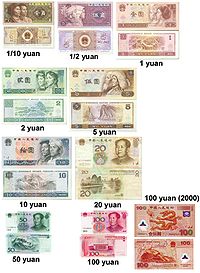
(元). One yuan is subdivided into 10 jiǎo (角), which in turn is subdivided into 10 fēn (分). Renminbi banknotes are available in denominations from 1 jiao to 100 yuan (¥0.1–100) and coins have denominations from 1 fen to 1 yuan (¥0.01–1). Thus, some denominations exist in coins and banknotes, but they are usually used in coins if under ¥1. Coins under ¥0.1 are used infrequently.
Through most of its history, the value of the renminbi was pegged
to the U.S. dollar. As China pursued its gradual transition from central planning to a free market economy, and increased its participation in foreign trade, the renminbi was devalued to increase the competitiveness of Chinese industry. It has been claimed that the current official exchange rate is lower than the value of the renminbi by purchasing power parity, undervalued by as much as 37.5% (see below).
Since 2005, the renminbi exchange rate has been allowed to float
in a narrow margin around a fixed base rate determined with reference to a basket of world currencies. The Chinese government has announced that it will gradually increase the flexibility of the exchange rate. China has initiated various pilot projects to "internationalize" the RMB in the hope that it will become a reserve currency
over the long term.
(ROC) era, most of which were denominated in the unit "yuán
" . Each was distinguished by a currency name, such as the fabi ("legal tender"), the "gold yuan", and the "silver yuan". The word yuan (wrtiten as 元 (informally) or 圓 (formally)) in Chinese
literally means round, after the shape of the coins. The Korean
and Japanese
currency units, won
and yen respectively, are cognates of the yuan and have the same Chinese character
(hanja
/kanji
) representation, but in different forms (respectively, 원/圓 and 円/圓), also meaning round in Korean
and Japanese
. However, they do not share the same names for the subdivisions. The principal unit of New Taiwan dollar
, used in Taiwan as the currency of the Republic of China
, is also referred to in the Chinese language
as "yuán
" (written as 元 or 圓).
As the Communist Party of China
took control of ever larger territories in the latter part of the Chinese Civil War
, its People's Bank of China
began in 1948 to issue a unified currency for use in Communist-controlled territories. Also denominated in yuan, this currency was identified by different names, including "People's Bank of China banknotes" , "New Currency" , "People's Bank of China notes" , "People's Notes" (人民券, as an abbreviation of the last name), and finally "People's Currency", or "renminbi", from June 1949.
corporation, China Banknote Printing and Minting (CBPMC; 中国印钞造币总公司)
headquartered in Beijing. CBPMC uses several printing and engraving and
minting facilities around the country to produce banknotes and coins
for subsequent distribution. Banknote printing facilities are based in
Beijing, Shanghai, Chengdu, Xi'an, Shijiazhuang, and Nanchang. Mints
are located in Nanjing, Shanghai, and Shenyang. Also, high grade paper
for the banknotes is produced at two facilities in Baoding and
Kunshan. The Baoding facility is the largest facility in the world
dedicated to developing banknote material according to its website.
In addition, the People's Bank of China
has its own printing
technology research division that researches new techniques for
creating banknotes and making counterfeiting more difficult.
in December 1948, about a year before the establishment of the People's Republic of China. It was issued only in paper money form and replaced the various currencies circulating in the areas controlled by the communists. One of the first tasks of the new government was to end the hyperinflation
that had plagued China in the final years of the Kuomintang
(KMT) era. That achieved, a revaluation occurred in 1955, at the rate of 1 new yuan = 10,000 old yuan.
introduced notes in denominations of 1, 5, 10, 20, 50, 100 and 1000 yuan. Notes for 200, 500, 5000 and 10,000 yuan followed in 1949, with 50,000 yuan notes added in 1950. A total of 62 different designs were issued. The notes were officially withdrawn on various dates between April 1 and May 10, 1955.
These first renminbi notes were printed with the words "People's Bank of China
", "Republic of China
", and the denomination, written in Chinese characters by Dong Biwu
.
The name "renminbi" was first recorded as an official name in June 1949. After work began in 1950 to design the second series of the renminbi, the previous series were retroactively dubbed the "first series of the renminbi".
s were pegged
led to a strong black market in currency transactions.
In the late 1980s and early 1990s, the PRC worked to make the RMB more convertible. Through the use of swap centres, the exchange rate was brought to realistic levels and the dual track currency system was abolished.
The renminbi is convertible on current account
s but not capital account
s. The ultimate goal has been to make the RMB fully convertible. However, partly in response to the Asian financial crisis in 1998, the PRC has been concerned that the mainland Chinese financial system would not be able to handle the potential rapid cross-border movements of hot money
, and as a result, as of 2007, the currency trades within a narrow band specified by the Chinese central government.
The fen and jiao have become increasingly unnecessary as prices have increased. Chinese retailers tend to avoid decimal values (such as ¥9.99), opting instead for integer values of yuan (such as ¥9 or ¥10).
The denomination of each banknote is printed in Chinese
. The numbers themselves are printed in financial Chinese numeral characters, as well as Arabic numerals
. The denomination and the words "People's Bank of China" are also printed in Mongolian
, Tibetan
, Uyghur
and Zhuang
on the back of each banknote, in addition to the boldface Hanyu Pinyin "Zhongguo Renmin Yinhang" (without tones). The right front of the note has a tactile representation of the denomination in Chinese braille
starting from the fourth series.
, Tibetan
, Mongolian
and Zhuang
languages on the back, which has since appeared in each series of renminbi notes. The denominations available in banknotes were ¥0.01, ¥0.02, ¥0.05, ¥0.1, ¥0.2, ¥0.5, ¥1, ¥2, ¥3, ¥5 and ¥10.
on all banknotes, in place of the various leaders and workers which had been featured previously.
on the front and various animals on the back.
An orange polymer note
, and so far, China's only polymer note, commemorating the new millennium was issued in 2000 with a face value of ¥100. This features a dragon on the obverse and the reverse features the China Millennium monument (Center for cultural and scientific fairs).
For the 2008 Beijing Olympics
, a green ¥10 note was issued featuring the Bird's Nest
on the front with the back showing a classical Olympic discus
thrower and various other athletes.
proposed to include Sun Yat-sen
and Deng Xiaoping
on the renminbi banknotes. However, the proposal was not adopted.
In steps intended to establish the renminbi as an international reserve currency, China has agreements with Russia
, Vietnam
, and Thailand
allowing trade with those countries to be settled directly in renminbi instead of requiring conversion to US dollars.
had issued renmimbi denominated corporate bond
s through Standard Chartered Bank
of Hong Kong. Such liberalization allows the yuan to look more attractive as it can be held with higher return on investment yields, whereas previously that yield was virtually none. Nevertheless, some national banks such as Bank of Thailand
(BOT) have expressed a serious concern about RMB since BOT cannot substitute the depreciated US Dollars in the 200 billion dollar Foreign Exchange Reserves held by BOT with Renminbi Yuan as much as BOT wishes because:
However HSBC
expects the Renminbi to become the third major reserve currency in 2011.
Countries that are left-leaning in the political spectrum have also begun to use the Renminbi as an alternative reserve currency to the United States dollar; the Chilean central bank reported in 2011 to have US$91 million worth of Renminbi in reserves, and the president of the central bank of Venezuela, Nelson Merentes, made statements in favour of the Renminbi following the announcement of reserve withdrawals from Europe and the United States.
and Macau
, have their own respective currencies. According to the "one country, two systems
" principle and the basic laws of the two territories. Therefore, the Hong Kong dollar
and the Macanese pataca
remain the legal tenders in the two territories, and renminbi, although sometimes accepted, is not legal tender. Banks in Hong Kong allow people to maintain accounts in RMB. Because of changes in legislation in July 2010, many banks around the world are now slowly offering individuals the chance to hold deposits in Chinese renminbi.
The RMB had a presence in Macau even before the 1999 return to the People's Republic of China from Portugal
. Banks in Macau can issue credit cards based on the renminbi but not loans. Renminbi based credit cards cannot be used in Macau's casino
s.
The current Republic of China
government in Taiwan believes wide usage of the renminbi would create an underground economy and undermine its sovereignty
. Tourists are allowed to bring in up to 20,000 renminbi when visiting Taiwan. These renminbi must be converted to the New Taiwan dollar
at trial exchange sites in Matsu
and Kinmen
. The Chen Shui-bian
administration insisted that it would not allow full convertibility
until the mainland signs a bilateral foreign exchange settlement agreement, though president Ma Ying-jeou
has pledged to allow full convertibility as soon as possible.
The renminbi is circulated in some of China's neighbors, such as Pakistan, Mongolia and northern part of Thailand. Cambodia
welcomes the renminbi as an official currency and Laos
and Myanmar
allow it in border provinces. Though unofficial, Vietnam recognizes the exchange of the renminbi to the đồng.
April 2011: In Hongkong, the Chinese property investment trust, Hui Xian has raised Rmb10.48 billion ($1.6 billion) in the first Initial Public Offering
with denomination in Renminbi. Beijing
has allowed renminbi-denominated financial markets to develop in Hong Kong because the central Chinese government wants to increase the usage of renminbi in international market and consequently reduce the use of the US dollar.
Since 2007, RMB-nominated bonds are issued outside the Mainland China; these are called "dim sum
bonds".
to the U.S. dollar at 2.46 yuan per USD (note: during the 1970s, it was appreciated until it reached 1.50 yuan per USD in 1980). When China's economy gradually opened in the 1980s, the RMB was devalued in order to improve the competitiveness of Chinese exports. Thus, the official RMB/USD exchange rate declined from 1.50 yuan in 1980 to 8.62 yuan by 1994 (lowest ever on the record). Improving current account balance during the latter half of the 1990s enabled the Chinese government to maintain a peg of 8.27 yuan per USD from 1997 to 2005.
As of August 30, 2011, yuan's exchange rate at 6.38 to the U.S. dollar—its highest official level since a currency revaluation in 2005. China's leaders raised the yuan to tame inflation, a step U.S. officials have pushed for years to help repair the massive trade deficit with China.
However the peg was reinstituted unofficially when the financial crisis hit: "Under intense pressure from Washington, China took small steps to allow its currency to strengthen for three years starting in July 2005. But China 're-pegged' its currency to the dollar as the financial crisis intensified in July 2008."
On June 19, 2010, the People’s Bank of China released a statement simultaneously in Chinese and English indicating that they would "proceed further with reform of the RMB exchange rate regime and increase the RMB exchange rate flexibility." The news was greeted with praise by world leaders including Barack Obama
, Nicolas Sarkozy
and Stephen Harper
. The PBoC
maintained there would be no "large swings" in the currency. The RMB rose to its highest level in five years and markets worldwide surged on Monday, June 21 following China's announcement.
China has shifted some of their reserves from dollar accounts to accounts in their competitor nations, leading these other nations to invest in dollars to keep their own currencies down.
based on market supply and demand with reference to a basket
of foreign currencies. The daily trading price of the U.S. dollar against the RMB in the inter-bank foreign exchange market would be allowed to float within a narrow band of 0.3% around the central parity published by the People's Bank of China
(PBC); in a later announcement published on May 18, 2007, the band was extended to 0.5%. The PRC has stated that the basket is dominated by the United States dollar
, Euro
, Japanese yen
and South Korean won
, with a smaller proportion made up of the British pound
, Thai baht
, Russian ruble
, Australian dollar
, Canadian dollar
and Singapore dollar
.
On April 10, 2008, it traded at 6.9920 yuan per US dollar, which was the first time in more than a decade that a dollar had bought less than seven yuan, and at 11.03630 yuan per euro.
Beginning in January 2010, Chinese and non-Chinese citizens have an annual quota to change a maximum of 50,000 USD. Exchange will only proceed if the applicant appears in person at the relevant bank and presents his passport or his Chinese ID; these deals are being centrally registered. The maximum withdrawal is 10,000 USD per day, the maximum purchase quota of USD is 500 per day. This stringent management of the currency leads to a bottled-up demand for exchange in both directions. It is viewed as a major tool to keep the currency peg, preventing inflows of 'hot money
'.
A shift of Chinese reserves into the currencies of their other trading partners has caused these nations to shift more of their reserves into dollars, leading to no great change in the value of the Renminbi against the dollar.
are traded at the Chicago Mercantile Exchange
. The futures are cash-settled at the exchange rate published by the People's Bank of China.
analysis. One recent study suggests 37.5% undervaluation.
Currency
In economics, currency refers to a generally accepted medium of exchange. These are usually the coins and banknotes of a particular government, which comprise the physical aspects of a nation's money supply...
of the People's Republic of China
People's Republic of China
China , officially the People's Republic of China , is the most populous country in the world, with over 1.3 billion citizens. Located in East Asia, the country covers approximately 9.6 million square kilometres...
(PRC). Renminbi is legal tender
Legal tender
Legal tender is a medium of payment allowed by law or recognized by a legal system to be valid for meeting a financial obligation. Paper currency is a common form of legal tender in many countries....
in mainland China
Mainland China
Mainland China, the Chinese mainland or simply the mainland, is a geopolitical term that refers to the area under the jurisdiction of the People's Republic of China . According to the Taipei-based Mainland Affairs Council, the term excludes the PRC Special Administrative Regions of Hong Kong and...
, but not in Hong Kong
Hong Kong
Hong Kong is one of two Special Administrative Regions of the People's Republic of China , the other being Macau. A city-state situated on China's south coast and enclosed by the Pearl River Delta and South China Sea, it is renowned for its expansive skyline and deep natural harbour...
or Macau
Macau
Macau , also spelled Macao , is, along with Hong Kong, one of the two special administrative regions of the People's Republic of China...
. It is issued by the People's Bank of China
People's Bank of China
The People's Bank of China is the central bank of the People's Republic of China with the power to control monetary policy and regulate financial institutions in mainland China...
, the monetary authority of the PRC. Its name means "people's currency".
The primary unit of renminbi is the yuán
Chinese yuan
The yuan is the base unit of a number of modern Chinese currencies. The yuan is the primary unit of account of the Renminbi.A yuán is also known colloquially as a kuài . One yuán is divided into 10 jiǎo or colloquially máo...
(元). One yuan is subdivided into 10 jiǎo (角), which in turn is subdivided into 10 fēn (分). Renminbi banknotes are available in denominations from 1 jiao to 100 yuan (¥0.1–100) and coins have denominations from 1 fen to 1 yuan (¥0.01–1). Thus, some denominations exist in coins and banknotes, but they are usually used in coins if under ¥1. Coins under ¥0.1 are used infrequently.
Through most of its history, the value of the renminbi was pegged
Fixed exchange rate
A fixed exchange rate, sometimes called a pegged exchange rate, is a type of exchange rate regime wherein a currency's value is matched to the value of another single currency or to a basket of other currencies, or to another measure of value, such as gold.A fixed exchange rate is usually used to...
to the U.S. dollar. As China pursued its gradual transition from central planning to a free market economy, and increased its participation in foreign trade, the renminbi was devalued to increase the competitiveness of Chinese industry. It has been claimed that the current official exchange rate is lower than the value of the renminbi by purchasing power parity, undervalued by as much as 37.5% (see below).
Since 2005, the renminbi exchange rate has been allowed to float
Floating exchange rate
A floating exchange rate or fluctuating exchange rate is a type of exchange rate regime wherein a currency's value is allowed to fluctuate according to the foreign exchange market. A currency that uses a floating exchange rate is known as a floating currency....
in a narrow margin around a fixed base rate determined with reference to a basket of world currencies. The Chinese government has announced that it will gradually increase the flexibility of the exchange rate. China has initiated various pilot projects to "internationalize" the RMB in the hope that it will become a reserve currency
Reserve currency
A reserve currency, or anchor currency, is a currency that is held in significant quantities by many governments and institutions as part of their foreign exchange reserves...
over the long term.
Etymology
A variety of currencies circulated in China during the Republic of ChinaRepublic of China
The Republic of China , commonly known as Taiwan , is a unitary sovereign state located in East Asia. Originally based in mainland China, the Republic of China currently governs the island of Taiwan , which forms over 99% of its current territory, as well as Penghu, Kinmen, Matsu and other minor...
(ROC) era, most of which were denominated in the unit "yuán
Chinese yuan
The yuan is the base unit of a number of modern Chinese currencies. The yuan is the primary unit of account of the Renminbi.A yuán is also known colloquially as a kuài . One yuán is divided into 10 jiǎo or colloquially máo...
" . Each was distinguished by a currency name, such as the fabi ("legal tender"), the "gold yuan", and the "silver yuan". The word yuan (wrtiten as 元 (informally) or 圓 (formally)) in Chinese
Chinese language
The Chinese language is a language or language family consisting of varieties which are mutually intelligible to varying degrees. Originally the indigenous languages spoken by the Han Chinese in China, it forms one of the branches of Sino-Tibetan family of languages...
literally means round, after the shape of the coins. The Korean
Korean language
Korean is the official language of the country Korea, in both South and North. It is also one of the two official languages in the Yanbian Korean Autonomous Prefecture in People's Republic of China. There are about 78 million Korean speakers worldwide. In the 15th century, a national writing...
and Japanese
Japanese language
is a language spoken by over 130 million people in Japan and in Japanese emigrant communities. It is a member of the Japonic language family, which has a number of proposed relationships with other languages, none of which has gained wide acceptance among historical linguists .Japanese is an...
currency units, won
Korean won
The won was the currency of Korea between 1902 and 1910. It was subdivided into 100 chon .-Etymology:Won is a cognate of the Chinese yuan and Japanese yen.-History:...
and yen respectively, are cognates of the yuan and have the same Chinese character
Chinese character
Chinese characters are logograms used in the writing of Chinese and Japanese , less frequently Korean , formerly Vietnamese , or other languages...
(hanja
Hanja
Hanja is the Korean name for the Chinese characters hanzi. More specifically, it refers to those Chinese characters borrowed from Chinese and incorporated into the Korean language with Korean pronunciation...
/kanji
Kanji
Kanji are the adopted logographic Chinese characters hanzi that are used in the modern Japanese writing system along with hiragana , katakana , Indo Arabic numerals, and the occasional use of the Latin alphabet...
) representation, but in different forms (respectively, 원/圓 and 円/圓), also meaning round in Korean
Korean language
Korean is the official language of the country Korea, in both South and North. It is also one of the two official languages in the Yanbian Korean Autonomous Prefecture in People's Republic of China. There are about 78 million Korean speakers worldwide. In the 15th century, a national writing...
and Japanese
Japanese language
is a language spoken by over 130 million people in Japan and in Japanese emigrant communities. It is a member of the Japonic language family, which has a number of proposed relationships with other languages, none of which has gained wide acceptance among historical linguists .Japanese is an...
. However, they do not share the same names for the subdivisions. The principal unit of New Taiwan dollar
New Taiwan dollar
The New Taiwan dollar , or simply Taiwan dollar, is the official currency of the Taiwan Area of the Republic of China since 1949, when it replaced the Old Taiwan dollar...
, used in Taiwan as the currency of the Republic of China
Republic of China
The Republic of China , commonly known as Taiwan , is a unitary sovereign state located in East Asia. Originally based in mainland China, the Republic of China currently governs the island of Taiwan , which forms over 99% of its current territory, as well as Penghu, Kinmen, Matsu and other minor...
, is also referred to in the Chinese language
Chinese language
The Chinese language is a language or language family consisting of varieties which are mutually intelligible to varying degrees. Originally the indigenous languages spoken by the Han Chinese in China, it forms one of the branches of Sino-Tibetan family of languages...
as "yuán
Chinese yuan
The yuan is the base unit of a number of modern Chinese currencies. The yuan is the primary unit of account of the Renminbi.A yuán is also known colloquially as a kuài . One yuán is divided into 10 jiǎo or colloquially máo...
" (written as 元 or 圓).
As the Communist Party of China
Communist Party of China
The Communist Party of China , also known as the Chinese Communist Party , is the founding and ruling political party of the People's Republic of China...
took control of ever larger territories in the latter part of the Chinese Civil War
Chinese Civil War
The Chinese Civil War was a civil war fought between the Kuomintang , the governing party of the Republic of China, and the Communist Party of China , for the control of China which eventually led to China's division into two Chinas, Republic of China and People's Republic of...
, its People's Bank of China
People's Bank of China
The People's Bank of China is the central bank of the People's Republic of China with the power to control monetary policy and regulate financial institutions in mainland China...
began in 1948 to issue a unified currency for use in Communist-controlled territories. Also denominated in yuan, this currency was identified by different names, including "People's Bank of China banknotes" , "New Currency" , "People's Bank of China notes" , "People's Notes" (人民券, as an abbreviation of the last name), and finally "People's Currency", or "renminbi", from June 1949.
Production and minting
Renminbi currency production is carried out by a state ownedcorporation, China Banknote Printing and Minting (CBPMC; 中国印钞造币总公司)
headquartered in Beijing. CBPMC uses several printing and engraving and
minting facilities around the country to produce banknotes and coins
for subsequent distribution. Banknote printing facilities are based in
Beijing, Shanghai, Chengdu, Xi'an, Shijiazhuang, and Nanchang. Mints
are located in Nanjing, Shanghai, and Shenyang. Also, high grade paper
for the banknotes is produced at two facilities in Baoding and
Kunshan. The Baoding facility is the largest facility in the world
dedicated to developing banknote material according to its website.
In addition, the People's Bank of China
People's Bank of China
The People's Bank of China is the central bank of the People's Republic of China with the power to control monetary policy and regulate financial institutions in mainland China...
has its own printing
technology research division that researches new techniques for
creating banknotes and making counterfeiting more difficult.
First series
The first series of renminbi banknotes was introduced by the People's Bank of ChinaPeople's Bank of China
The People's Bank of China is the central bank of the People's Republic of China with the power to control monetary policy and regulate financial institutions in mainland China...
in December 1948, about a year before the establishment of the People's Republic of China. It was issued only in paper money form and replaced the various currencies circulating in the areas controlled by the communists. One of the first tasks of the new government was to end the hyperinflation
Hyperinflation
In economics, hyperinflation is inflation that is very high or out of control. While the real values of the specific economic items generally stay the same in terms of relatively stable foreign currencies, in hyperinflationary conditions the general price level within a specific economy increases...
that had plagued China in the final years of the Kuomintang
Kuomintang
The Kuomintang of China , sometimes romanized as Guomindang via the Pinyin transcription system or GMD for short, and translated as the Chinese Nationalist Party is a founding and ruling political party of the Republic of China . Its guiding ideology is the Three Principles of the People, espoused...
(KMT) era. That achieved, a revaluation occurred in 1955, at the rate of 1 new yuan = 10,000 old yuan.
Banknotes
On December 1, 1948, the newly founded People's Bank of ChinaPeople's Bank of China
The People's Bank of China is the central bank of the People's Republic of China with the power to control monetary policy and regulate financial institutions in mainland China...
introduced notes in denominations of 1, 5, 10, 20, 50, 100 and 1000 yuan. Notes for 200, 500, 5000 and 10,000 yuan followed in 1949, with 50,000 yuan notes added in 1950. A total of 62 different designs were issued. The notes were officially withdrawn on various dates between April 1 and May 10, 1955.
These first renminbi notes were printed with the words "People's Bank of China
People's Bank of China
The People's Bank of China is the central bank of the People's Republic of China with the power to control monetary policy and regulate financial institutions in mainland China...
", "Republic of China
Republic of China
The Republic of China , commonly known as Taiwan , is a unitary sovereign state located in East Asia. Originally based in mainland China, the Republic of China currently governs the island of Taiwan , which forms over 99% of its current territory, as well as Penghu, Kinmen, Matsu and other minor...
", and the denomination, written in Chinese characters by Dong Biwu
Dong Biwu
Dong Biwu was a Chinese communist political leader during the regime of Mao Zedong.-Biography:Dong Biwu was born in Huanggang, Hubei. He was the President of China from 1948 to 1949 and Acting President from 1968 until 17 January 1975 when Zhu De became the succeeding Chairman of the Standing...
.
The name "renminbi" was first recorded as an official name in June 1949. After work began in 1950 to design the second series of the renminbi, the previous series were retroactively dubbed the "first series of the renminbi".
Second to fifth series
The second series of renminbi banknotes was introduced in 1955. During the era of the command economy, the value of the renminbi was set to unrealistic values in exchange with western currency and severe currency exchange rules were put in place. With the opening of the mainland Chinese economy in 1978, a dual-track currency system was instituted, with renminbi usable only domestically, and with foreigners forced to use foreign exchange certificates. The unrealistic levels at which exchange rateExchange rate
In finance, an exchange rate between two currencies is the rate at which one currency will be exchanged for another. It is also regarded as the value of one country’s currency in terms of another currency...
s were pegged
Fixed exchange rate
A fixed exchange rate, sometimes called a pegged exchange rate, is a type of exchange rate regime wherein a currency's value is matched to the value of another single currency or to a basket of other currencies, or to another measure of value, such as gold.A fixed exchange rate is usually used to...
led to a strong black market in currency transactions.
In the late 1980s and early 1990s, the PRC worked to make the RMB more convertible. Through the use of swap centres, the exchange rate was brought to realistic levels and the dual track currency system was abolished.
The renminbi is convertible on current account
Current account
In economics, the current account is one of the two primary components of the balance of payments, the other being the capital account. The current account is the sum of the balance of trade , net factor income and net transfer payments .The current account balance is one of two major...
s but not capital account
Capital account
The current and capital accounts make up a country's balance of payment . Together these three accounts tell a story about the state of an economy, its economic outlook and its strategies for achieving its desired goals...
s. The ultimate goal has been to make the RMB fully convertible. However, partly in response to the Asian financial crisis in 1998, the PRC has been concerned that the mainland Chinese financial system would not be able to handle the potential rapid cross-border movements of hot money
Hot money
Hot money is a term that is most commonly used in financial markets to refer to the flow of funds from one country to another in order to earn a short-term profit on interest rate differences and/or anticipated exchange rate shifts...
, and as a result, as of 2007, the currency trades within a narrow band specified by the Chinese central government.
The fen and jiao have become increasingly unnecessary as prices have increased. Chinese retailers tend to avoid decimal values (such as ¥9.99), opting instead for integer values of yuan (such as ¥9 or ¥10).
Coins
In 1955, aluminium 1, 2 and 5 fen coins were introduced. In 1980, brass 1, 2, and 5 jiao and cupro-nickel 1 yuan coins were added, although the 1 and 2 jiao were only produced until 1981, with the last 5 jiao and 1 yuan issued in 1985. In 1991, a new coinage was introduced, consisting of an aluminium 1 jiao, brass 5 jiao and nickel-clad-steel 1 yuan. Issuance of the 1 and 2 fen coins ceased in 1991, with that of the 5 fen halting a year later. The small coins were still made for annual mint sets, and from the beginning of 2005 again for general circulation. New designs of the 1 and 5 jiao and 1 yuan were introduced in between 1999 and 2002. The frequency of usage of coins varies between different parts of China.Banknotes
In 1955, notes (dated 1953), were introduced in denominations of 1, 2 and 5 fen, 1, 2 and 5 jiao, and 1, 2, 3, 5 and 10 yuan. Except for the three fen denominations and the 3 yuan, notes in these denominations continue to circulate, with 50 and 100 yuan notes added in 1980 and 20 yuan notes added in or after 1999.The denomination of each banknote is printed in Chinese
Chinese language
The Chinese language is a language or language family consisting of varieties which are mutually intelligible to varying degrees. Originally the indigenous languages spoken by the Han Chinese in China, it forms one of the branches of Sino-Tibetan family of languages...
. The numbers themselves are printed in financial Chinese numeral characters, as well as Arabic numerals
Arabic numerals
Arabic numerals or Hindu numerals or Hindu-Arabic numerals or Indo-Arabic numerals are the ten digits . They are descended from the Hindu-Arabic numeral system developed by Indian mathematicians, in which a sequence of digits such as "975" is read as a numeral...
. The denomination and the words "People's Bank of China" are also printed in Mongolian
Mongolian language
The Mongolian language is the official language of Mongolia and the best-known member of the Mongolic language family. The number of speakers across all its dialects may be 5.2 million, including the vast majority of the residents of Mongolia and many of the Mongolian residents of the Inner...
, Tibetan
Tibetan language
The Tibetan languages are a cluster of mutually-unintelligible Tibeto-Burman languages spoken primarily by Tibetan peoples who live across a wide area of eastern Central Asia bordering the Indian subcontinent, including the Tibetan Plateau and the northern Indian subcontinent in Baltistan, Ladakh,...
, Uyghur
Uyghur language
Uyghur , formerly known as Eastern Turk, is a Turkic language with 8 to 11 million speakers, spoken primarily by the Uyghur people in the Xinjiang Uyghur Autonomous Region of Western China. Significant communities of Uyghur-speakers are located in Kazakhstan and Uzbekistan, and various other...
and Zhuang
Standard Zhuang
The standard Zhuang language is the variety of Zhuang spoken in Wuming County in the Guangxi Zhuang Autonomous Region of the People's Republic of China, where it is an official language.-Classification:...
on the back of each banknote, in addition to the boldface Hanyu Pinyin "Zhongguo Renmin Yinhang" (without tones). The right front of the note has a tactile representation of the denomination in Chinese braille
Chinese braille
Chinese braille is a braille system for the Chinese language, especially in People's Republic of China. It is different from other braille systems, although a few of the patterns have been borrowed from alphabetical Braille as can be seen in the tables below....
starting from the fourth series.
Second series
The second series of renminbi banknotes (the first having been issued for the previous currency) was introduced on 1 March 1955. Each note has the words "People's Bank of China" as well as the denomination in the UyghurUyghur language
Uyghur , formerly known as Eastern Turk, is a Turkic language with 8 to 11 million speakers, spoken primarily by the Uyghur people in the Xinjiang Uyghur Autonomous Region of Western China. Significant communities of Uyghur-speakers are located in Kazakhstan and Uzbekistan, and various other...
, Tibetan
Tibetan language
The Tibetan languages are a cluster of mutually-unintelligible Tibeto-Burman languages spoken primarily by Tibetan peoples who live across a wide area of eastern Central Asia bordering the Indian subcontinent, including the Tibetan Plateau and the northern Indian subcontinent in Baltistan, Ladakh,...
, Mongolian
Mongolian language
The Mongolian language is the official language of Mongolia and the best-known member of the Mongolic language family. The number of speakers across all its dialects may be 5.2 million, including the vast majority of the residents of Mongolia and many of the Mongolian residents of the Inner...
and Zhuang
Standard Zhuang
The standard Zhuang language is the variety of Zhuang spoken in Wuming County in the Guangxi Zhuang Autonomous Region of the People's Republic of China, where it is an official language.-Classification:...
languages on the back, which has since appeared in each series of renminbi notes. The denominations available in banknotes were ¥0.01, ¥0.02, ¥0.05, ¥0.1, ¥0.2, ¥0.5, ¥1, ¥2, ¥3, ¥5 and ¥10.
Third series
The third series of renminbi banknotes was introduced on April 15, 1962. For the next two decades, the second and third series banknotes were used concurrently. The denominations were of ¥0.1, ¥0.2, ¥0.5, ¥1, ¥2, ¥5 and ¥10. The third series was phased out during the 1990s and then was recalled completely on July 1, 2000.Fourth series
The fourth series was introduced between 1987 and 1997, although the banknotes were dated 1980, 1990, or 1996. They are still legal tender. Banknotes are available in denominations of ¥0.1, ¥0.2, ¥0.5, ¥1, ¥2, ¥5, ¥10, ¥50 and ¥100.Fifth series
In 1999, a new series of renminbi banknotes and coins was progressively introduced. The fifth series consists of banknotes for ¥1, ¥5, ¥10, ¥20, ¥50 and ¥100. Significantly, the fifth series uses the portrait of Mao ZedongMao Zedong
Mao Zedong, also transliterated as Mao Tse-tung , and commonly referred to as Chairman Mao , was a Chinese Communist revolutionary, guerrilla warfare strategist, Marxist political philosopher, and leader of the Chinese Revolution...
on all banknotes, in place of the various leaders and workers which had been featured previously.
Commemorative designs
In 1999, a commemorative red ¥50 note was issued in honor of the 50th anniversary of the establishment of the People's Republic of China. This note features Mao ZedongMao Zedong
Mao Zedong, also transliterated as Mao Tse-tung , and commonly referred to as Chairman Mao , was a Chinese Communist revolutionary, guerrilla warfare strategist, Marxist political philosopher, and leader of the Chinese Revolution...
on the front and various animals on the back.
An orange polymer note
Polymer banknote
Polymer banknotes were developed by the Reserve Bank of Australia , Commonwealth Scientific and Industrial Research Organisation and The University of Melbourne and were first issued as currency in Australia in 1988. These banknotes are made from the polymer biaxially-oriented polypropylene ...
, and so far, China's only polymer note, commemorating the new millennium was issued in 2000 with a face value of ¥100. This features a dragon on the obverse and the reverse features the China Millennium monument (Center for cultural and scientific fairs).
For the 2008 Beijing Olympics
2008 Summer Olympics
The 2008 Summer Olympics, officially known as the Games of the XXIX Olympiad, was a major international multi-sport event that took place in Beijing, China, from August 8 to August 24, 2008. A total of 11,028 athletes from 204 National Olympic Committees competed in 28 sports and 302 events...
, a green ¥10 note was issued featuring the Bird's Nest
Beijing National Stadium
Beijing National Stadium, also known officially as the National Stadium, or colloquially as the Bird's Nest , is a stadium in Beijing, China. The stadium was designed for use throughout the 2008 Summer Olympics and Paralympics.-History:...
on the front with the back showing a classical Olympic discus
Discus
Discus, "disk" in Latin, may refer to:* Discus , a progressive rock band from Indonesia* Discus , a fictional character from the Marvel Comics Universe and enemy of Luke Cage* Discus , a freshwater fish popular with aquarium keepers...
thrower and various other athletes.
Suggested future design
On March 13, 2006, some delegates to an advisory body at the National People's CongressNational People's Congress
The National People's Congress , abbreviated NPC , is the highest state body and the only legislative house in the People's Republic of China. The National People's Congress is held in the Great Hall of the People, Beijing, capital of the People's Republic of China; with 2,987 members, it is the...
proposed to include Sun Yat-sen
Sun Yat-sen
Sun Yat-sen was a Chinese doctor, revolutionary and political leader. As the foremost pioneer of Nationalist China, Sun is frequently referred to as the "Father of the Nation" , a view agreed upon by both the People's Republic of China and the Republic of China...
and Deng Xiaoping
Deng Xiaoping
Deng Xiaoping was a Chinese politician, statesman, and diplomat. As leader of the Communist Party of China, Deng was a reformer who led China towards a market economy...
on the renminbi banknotes. However, the proposal was not adopted.
International Trade
Before 2009, the Chinese renminbi had little to no exposure in the international markets because of strict government controls by the central Chinese government that prohibited almost all forms of yuan holdings or transactions. Transactions between Chinese companies and a foreign entity would have to be denominated in US dollars. With Chinese companies unable to hold US dollars and foreign companies unable to hold Chinese yuan, all transactions would go through the People's Bank of China. Once the sum was paid by the foreign party in dollars, the central bank would pass the settlement in renminbi to the Chinese company. In June 2009 the Chinese officials announced a pilot scheme where business and trade transactions were allowed between limited businesses in Guangdong and Shanghai municipalities and only counterparties in Hong Kong, Macau, and select ASEAN nations. Proving a success, the program was further extended to 20 Chinese provinces and counterparties internationally in July 2010, and in September 2011 it was announced that the remaining 11 Chinese provinces would be included.In steps intended to establish the renminbi as an international reserve currency, China has agreements with Russia
Russia
Russia or , officially known as both Russia and the Russian Federation , is a country in northern Eurasia. It is a federal semi-presidential republic, comprising 83 federal subjects...
, Vietnam
Vietnam
Vietnam – sometimes spelled Viet Nam , officially the Socialist Republic of Vietnam – is the easternmost country on the Indochina Peninsula in Southeast Asia. It is bordered by China to the north, Laos to the northwest, Cambodia to the southwest, and the South China Sea –...
, and Thailand
Thailand
Thailand , officially the Kingdom of Thailand , formerly known as Siam , is a country located at the centre of the Indochina peninsula and Southeast Asia. It is bordered to the north by Burma and Laos, to the east by Laos and Cambodia, to the south by the Gulf of Thailand and Malaysia, and to the...
allowing trade with those countries to be settled directly in renminbi instead of requiring conversion to US dollars.
International Reserve Currency
Currency restrictions regarding renminbi denominated bank deposits and financial products were greatly liberalized in July, 2010. In 2010 renminbi denominated bonds were reported to have been purchased by Malaysia's central bank and that McDonald'sMcDonald's
McDonald's Corporation is the world's largest chain of hamburger fast food restaurants, serving around 64 million customers daily in 119 countries. Headquartered in the United States, the company began in 1940 as a barbecue restaurant operated by the eponymous Richard and Maurice McDonald; in 1948...
had issued renmimbi denominated corporate bond
Corporate bond
A corporate bond is a bond issued by a corporation. It is a bond that a corporation issues to raise money in order to expand its business. The term is usually applied to longer-term debt instruments, generally with a maturity date falling at least a year after their issue date...
s through Standard Chartered Bank
Standard Chartered Bank
Standard Chartered PLC is a multinational financial services company headquartered in London, United Kingdom with operations in more than seventy countries...
of Hong Kong. Such liberalization allows the yuan to look more attractive as it can be held with higher return on investment yields, whereas previously that yield was virtually none. Nevertheless, some national banks such as Bank of Thailand
Bank of Thailand
- History :The Bank of Thailand was first set up as the Thai National Banking Bureau. The Bank of Thailand Act was promulgated on 28 April 1942 vesting upon the Bank of Thailand the responsibility for all central banking functions...
(BOT) have expressed a serious concern about RMB since BOT cannot substitute the depreciated US Dollars in the 200 billion dollar Foreign Exchange Reserves held by BOT with Renminbi Yuan as much as BOT wishes because:
- The Chinese Government has not taken the full responsibilities and commitments on the economic affairs at the global levels.
- Renminbi Yuan still has not become well-liquidated (fully convertible) yet.
- The Chinese government still lacks deep and wide vision about how to perform fund-raising to handle international loans at global levels.
However HSBC
HSBC
HSBC Holdings plc is a global banking and financial services company headquartered in Canary Wharf, London, United Kingdom. it is the world's second-largest banking and financial services group and second-largest public company according to a composite measure by Forbes magazine...
expects the Renminbi to become the third major reserve currency in 2011.
Countries that are left-leaning in the political spectrum have also begun to use the Renminbi as an alternative reserve currency to the United States dollar; the Chilean central bank reported in 2011 to have US$91 million worth of Renminbi in reserves, and the president of the central bank of Venezuela, Nelson Merentes, made statements in favour of the Renminbi following the announcement of reserve withdrawals from Europe and the United States.
Use as a currency outside China
The two special administrative regions, Hong KongHong Kong
Hong Kong is one of two Special Administrative Regions of the People's Republic of China , the other being Macau. A city-state situated on China's south coast and enclosed by the Pearl River Delta and South China Sea, it is renowned for its expansive skyline and deep natural harbour...
and Macau
Macau
Macau , also spelled Macao , is, along with Hong Kong, one of the two special administrative regions of the People's Republic of China...
, have their own respective currencies. According to the "one country, two systems
One country, two systems
"One country, two systems" is an idea originally proposed by Deng Xiaoping, then Paramount Leader of the People's Republic of China , for the reunification of China during the early 1980s...
" principle and the basic laws of the two territories. Therefore, the Hong Kong dollar
Hong Kong dollar
The Hong Kong dollar is the currency of the jurisdiction. It is the eighth most traded currency in the world. In English, it is normally abbreviated with the dollar sign $, or alternatively HK$ to distinguish it from other dollar-denominated currencies...
and the Macanese pataca
Macanese pataca
The pataca is the currency of Macau. It is subdivided into 100 avos , with 10 avos called ho in Cantonese. The abbreviation MOP$ is commonly used....
remain the legal tenders in the two territories, and renminbi, although sometimes accepted, is not legal tender. Banks in Hong Kong allow people to maintain accounts in RMB. Because of changes in legislation in July 2010, many banks around the world are now slowly offering individuals the chance to hold deposits in Chinese renminbi.
The RMB had a presence in Macau even before the 1999 return to the People's Republic of China from Portugal
Portugal
Portugal , officially the Portuguese Republic is a country situated in southwestern Europe on the Iberian Peninsula. Portugal is the westernmost country of Europe, and is bordered by the Atlantic Ocean to the West and South and by Spain to the North and East. The Atlantic archipelagos of the...
. Banks in Macau can issue credit cards based on the renminbi but not loans. Renminbi based credit cards cannot be used in Macau's casino
Casino
In modern English, a casino is a facility which houses and accommodates certain types of gambling activities. Casinos are most commonly built near or combined with hotels, restaurants, retail shopping, cruise ships or other tourist attractions...
s.
The current Republic of China
Republic of China
The Republic of China , commonly known as Taiwan , is a unitary sovereign state located in East Asia. Originally based in mainland China, the Republic of China currently governs the island of Taiwan , which forms over 99% of its current territory, as well as Penghu, Kinmen, Matsu and other minor...
government in Taiwan believes wide usage of the renminbi would create an underground economy and undermine its sovereignty
Sovereignty
Sovereignty is the quality of having supreme, independent authority over a geographic area, such as a territory. It can be found in a power to rule and make law that rests on a political fact for which no purely legal explanation can be provided...
. Tourists are allowed to bring in up to 20,000 renminbi when visiting Taiwan. These renminbi must be converted to the New Taiwan dollar
New Taiwan dollar
The New Taiwan dollar , or simply Taiwan dollar, is the official currency of the Taiwan Area of the Republic of China since 1949, when it replaced the Old Taiwan dollar...
at trial exchange sites in Matsu
Matsu Islands
The Matsu Islands are a minor archipelago of 19 islands and islets in the Taiwan Strait administered as Lienchiang County , Fujian Province of the Republic of China . Only a small area of what is historically Lienchiang County is under the control of the ROC...
and Kinmen
Kinmen
Kinmen , also known as Quemoy , is a small archipelago of several islands administered by the Republic of China : Greater Kinmen, Lesser Kinmen, and some islets. Administratively, it is Kinmen County of Fujian Province, ROC. The county is claimed by the People's Republic of China as part of its...
. The Chen Shui-bian
Chen Shui-bian
Chen Shui-bian is a former Taiwanese politician who was the 10th and 11th-term President of the Republic of China from 2000 to 2008. Chen, whose Democratic Progressive Party has traditionally been supportive of Taiwan independence, ended more than fifty years of Kuomintang rule in Taiwan...
administration insisted that it would not allow full convertibility
Convertibility
Convertibility is the quality that allows money or other financial instruments to be converted into other liquid stores of value. Convertibility is an important factor in international trade, where instruments valued in different currencies must be exchanged....
until the mainland signs a bilateral foreign exchange settlement agreement, though president Ma Ying-jeou
Ma Ying-jeou
Ma Ying-jeou is the 12th term and current President of the Republic of China , commonly known as Taiwan, and the Chairman of the Kuomintang Party, also known as the Chinese Nationalist Party. He formerly served as Justice Minister from 1993 to 1996, Mayor of Taipei from 1998 to 2006, and Chairman...
has pledged to allow full convertibility as soon as possible.
The renminbi is circulated in some of China's neighbors, such as Pakistan, Mongolia and northern part of Thailand. Cambodia
Cambodia
Cambodia , officially known as the Kingdom of Cambodia, is a country located in the southern portion of the Indochina Peninsula in Southeast Asia...
welcomes the renminbi as an official currency and Laos
Laos
Laos Lao: ສາທາລະນະລັດ ປະຊາທິປະໄຕ ປະຊາຊົນລາວ Sathalanalat Paxathipatai Paxaxon Lao, officially the Lao People's Democratic Republic, is a landlocked country in Southeast Asia, bordered by Burma and China to the northwest, Vietnam to the east, Cambodia to the south and Thailand to the west...
and Myanmar
Myanmar
Burma , officially the Republic of the Union of Myanmar , is a country in Southeast Asia. Burma is bordered by China on the northeast, Laos on the east, Thailand on the southeast, Bangladesh on the west, India on the northwest, the Bay of Bengal to the southwest, and the Andaman Sea on the south....
allow it in border provinces. Though unofficial, Vietnam recognizes the exchange of the renminbi to the đồng.
April 2011: In Hongkong, the Chinese property investment trust, Hui Xian has raised Rmb10.48 billion ($1.6 billion) in the first Initial Public Offering
Initial public offering
An initial public offering or stock market launch, is the first sale of stock by a private company to the public. It can be used by either small or large companies to raise expansion capital and become publicly traded enterprises...
with denomination in Renminbi. Beijing
Beijing
Beijing , also known as Peking , is the capital of the People's Republic of China and one of the most populous cities in the world, with a population of 19,612,368 as of 2010. The city is the country's political, cultural, and educational center, and home to the headquarters for most of China's...
has allowed renminbi-denominated financial markets to develop in Hong Kong because the central Chinese government wants to increase the usage of renminbi in international market and consequently reduce the use of the US dollar.
Since 2007, RMB-nominated bonds are issued outside the Mainland China; these are called "dim sum
Dim sum
Dim sum refers to a style of Chinese food prepared as small bite-sized or individual portions of food traditionally served in small steamer baskets or on small plates...
bonds".
CNH
While the CNY is the RMB which is traded both onshore in China, and offshore (primarily in Hong Kong) are the same currency, they trade at different rates. This is by design: as regulation has explicitly kept onshore and offshore separated, the respective supply and demand conditions lead to separate market clearing exchange rates. Hence the emergence of a new currency code, CNH, to represent the exchange rate of RMB that trades offshore in Hong Kong. However, it does not end here. There is the traditional offshore RMB market, the dollar settled non-deliverable forward (NDF), which itself trades independently of either onshore CNY or offshore CNH, as well as a trade-settlement exchange rate (sometimes called CNT) to which offshore corporates have access, just to add to the complexity.Value
For most of its early history, the RMB was peggedFixed exchange rate
A fixed exchange rate, sometimes called a pegged exchange rate, is a type of exchange rate regime wherein a currency's value is matched to the value of another single currency or to a basket of other currencies, or to another measure of value, such as gold.A fixed exchange rate is usually used to...
to the U.S. dollar at 2.46 yuan per USD (note: during the 1970s, it was appreciated until it reached 1.50 yuan per USD in 1980). When China's economy gradually opened in the 1980s, the RMB was devalued in order to improve the competitiveness of Chinese exports. Thus, the official RMB/USD exchange rate declined from 1.50 yuan in 1980 to 8.62 yuan by 1994 (lowest ever on the record). Improving current account balance during the latter half of the 1990s enabled the Chinese government to maintain a peg of 8.27 yuan per USD from 1997 to 2005.
As of August 30, 2011, yuan's exchange rate at 6.38 to the U.S. dollar—its highest official level since a currency revaluation in 2005. China's leaders raised the yuan to tame inflation, a step U.S. officials have pushed for years to help repair the massive trade deficit with China.
Depegged from the U.S. dollar
On July 21, 2005, the peg was finally lifted, which saw an immediate one-off RMB revaluation to 8.11 per USD. The exchange rate against the euro stood at 10.07060 yuan per euro.However the peg was reinstituted unofficially when the financial crisis hit: "Under intense pressure from Washington, China took small steps to allow its currency to strengthen for three years starting in July 2005. But China 're-pegged' its currency to the dollar as the financial crisis intensified in July 2008."
On June 19, 2010, the People’s Bank of China released a statement simultaneously in Chinese and English indicating that they would "proceed further with reform of the RMB exchange rate regime and increase the RMB exchange rate flexibility." The news was greeted with praise by world leaders including Barack Obama
Barack Obama
Barack Hussein Obama II is the 44th and current President of the United States. He is the first African American to hold the office. Obama previously served as a United States Senator from Illinois, from January 2005 until he resigned following his victory in the 2008 presidential election.Born in...
, Nicolas Sarkozy
Nicolas Sarkozy
Nicolas Sarkozy is the 23rd and current President of the French Republic and ex officio Co-Prince of Andorra. He assumed the office on 16 May 2007 after defeating the Socialist Party candidate Ségolène Royal 10 days earlier....
and Stephen Harper
Stephen Harper
Stephen Joseph Harper is the 22nd and current Prime Minister of Canada and leader of the Conservative Party. Harper became prime minister when his party formed a minority government after the 2006 federal election...
. The PBoC
People's Bank of China
The People's Bank of China is the central bank of the People's Republic of China with the power to control monetary policy and regulate financial institutions in mainland China...
maintained there would be no "large swings" in the currency. The RMB rose to its highest level in five years and markets worldwide surged on Monday, June 21 following China's announcement.
China has shifted some of their reserves from dollar accounts to accounts in their competitor nations, leading these other nations to invest in dollars to keep their own currencies down.
Managed Float
The RMB is now moved to a managed floating exchange rateFloating exchange rate
A floating exchange rate or fluctuating exchange rate is a type of exchange rate regime wherein a currency's value is allowed to fluctuate according to the foreign exchange market. A currency that uses a floating exchange rate is known as a floating currency....
based on market supply and demand with reference to a basket
Currency basket
A currency basket is a portfolio of selected currencies with different weightings. A currency basket is commonly used to minimize the risk of currency fluctuations. An example of a currency basket is the European Currency Unit that was used by the European Community member states as the unit of...
of foreign currencies. The daily trading price of the U.S. dollar against the RMB in the inter-bank foreign exchange market would be allowed to float within a narrow band of 0.3% around the central parity published by the People's Bank of China
People's Bank of China
The People's Bank of China is the central bank of the People's Republic of China with the power to control monetary policy and regulate financial institutions in mainland China...
(PBC); in a later announcement published on May 18, 2007, the band was extended to 0.5%. The PRC has stated that the basket is dominated by the United States dollar
United States dollar
The United States dollar , also referred to as the American dollar, is the official currency of the United States of America. It is divided into 100 smaller units called cents or pennies....
, Euro
Euro
The euro is the official currency of the eurozone: 17 of the 27 member states of the European Union. It is also the currency used by the Institutions of the European Union. The eurozone consists of Austria, Belgium, Cyprus, Estonia, Finland, France, Germany, Greece, Ireland, Italy, Luxembourg,...
, Japanese yen
Japanese yen
The is the official currency of Japan. It is the third most traded currency in the foreign exchange market after the United States dollar and the euro. It is also widely used as a reserve currency after the U.S. dollar, the euro and the pound sterling...
and South Korean won
South Korean won
The won is the currency of South Korea. A single won is divided into 100 jeon, the monetary subunit. The jeon is no longer used for everyday transactions, and appears only in foreign exchange rates...
, with a smaller proportion made up of the British pound
Pound sterling
The pound sterling , commonly called the pound, is the official currency of the United Kingdom, its Crown Dependencies and the British Overseas Territories of South Georgia and the South Sandwich Islands, British Antarctic Territory and Tristan da Cunha. It is subdivided into 100 pence...
, Thai baht
Thai baht
The baht is the currency of Thailand. It is subdivided into 100 satang . The issuance of currency is the responsibility of the Bank of Thailand.-History:The baht, like the pound, originated from a traditional unit of mass...
, Russian ruble
Russian ruble
The ruble or rouble is the currency of the Russian Federation and the two partially recognized republics of Abkhazia and South Ossetia. Formerly, the ruble was also the currency of the Russian Empire and the Soviet Union prior to their breakups. Belarus and Transnistria also use currencies with...
, Australian dollar
Australian dollar
The Australian dollar is the currency of the Commonwealth of Australia, including Christmas Island, Cocos Islands, and Norfolk Island, as well as the independent Pacific Island states of Kiribati, Nauru and Tuvalu...
, Canadian dollar
Canadian dollar
The Canadian dollar is the currency of Canada. As of 2007, the Canadian dollar is the 7th most traded currency in the world. It is abbreviated with the dollar sign $, or C$ to distinguish it from other dollar-denominated currencies...
and Singapore dollar
Singapore dollar
The Singapore dollar or Dollar is the official currency of Singapore. It is normally abbreviated with the dollar sign $, or alternatively S$ to distinguish it from other dollar-denominated currencies...
.
On April 10, 2008, it traded at 6.9920 yuan per US dollar, which was the first time in more than a decade that a dollar had bought less than seven yuan, and at 11.03630 yuan per euro.
Beginning in January 2010, Chinese and non-Chinese citizens have an annual quota to change a maximum of 50,000 USD. Exchange will only proceed if the applicant appears in person at the relevant bank and presents his passport or his Chinese ID; these deals are being centrally registered. The maximum withdrawal is 10,000 USD per day, the maximum purchase quota of USD is 500 per day. This stringent management of the currency leads to a bottled-up demand for exchange in both directions. It is viewed as a major tool to keep the currency peg, preventing inflows of 'hot money
Hot money
Hot money is a term that is most commonly used in financial markets to refer to the flow of funds from one country to another in order to earn a short-term profit on interest rate differences and/or anticipated exchange rate shifts...
'.
A shift of Chinese reserves into the currencies of their other trading partners has caused these nations to shift more of their reserves into dollars, leading to no great change in the value of the Renminbi against the dollar.
Futures market
Renminbi futuresFutures contract
In finance, a futures contract is a standardized contract between two parties to exchange a specified asset of standardized quantity and quality for a price agreed today with delivery occurring at a specified future date, the delivery date. The contracts are traded on a futures exchange...
are traded at the Chicago Mercantile Exchange
Chicago Mercantile Exchange
The Chicago Mercantile Exchange is an American financial and commodity derivative exchange based in Chicago. The CME was founded in 1898 as the Chicago Butter and Egg Board. Originally, the exchange was a non-profit organization...
. The futures are cash-settled at the exchange rate published by the People's Bank of China.
Purchasing power parity
Scholarly studies suggest that the yuan is undervalued on the basis of purchasing power parityPurchasing power parity
In economics, purchasing power parity is a condition between countries where an amount of money has the same purchasing power in different countries. The prices of the goods between the countries would only reflect the exchange rates...
analysis. One recent study suggests 37.5% undervaluation.
- The World BankWorld BankThe World Bank is an international financial institution that provides loans to developing countries for capital programmes.The World Bank's official goal is the reduction of poverty...
estimated that, by purchasing power parity, one International dollar was equivalent to approximately RMB1.9 in 2004. - The International Monetary FundInternational Monetary FundThe International Monetary Fund is an organization of 187 countries, working to foster global monetary cooperation, secure financial stability, facilitate international trade, promote high employment and sustainable economic growth, and reduce poverty around the world...
estimated that, by purchasing power parity, one United States dollarUnited States dollarThe United States dollar , also referred to as the American dollar, is the official currency of the United States of America. It is divided into 100 smaller units called cents or pennies....
was equivalent to approximately RMB3.462 in 2006, RMB3.621 in 2007, RMB3.798 in 2008, RMB3.872 in 2009, and RMB3.922 in 2010.
See also
- List of Renminbi exchange rates
- Chinese lunar coinsChinese lunar coinsIn 1979, China began minting commorative modern coins. In 1981, China began minting coins to commemorate the Chinese New Year. Typically the obverse features a historical building while the reverse features the lunar animal reproduced from historical Chinese drawings or paintings.- 1981–1992 :The...
- China Banknote Printing and Minting CorporationChina Banknote Printing and Minting CorporationChina Banknote Printing and Minting Corporation , is a state-owned corporation which carries out the minting of all renminbi coins and printing of renminbi banknotes for the People's Republic of China headquartered in Beijing....
(CBPMC) - Economy of the People's Republic of ChinaEconomy of the People's Republic of ChinaThe People's Republic of China ranks since 2010 as the world's second largest economy after the United States. It has been the world's fastest-growing major economy, with consistent growth rates of around 10% over the past 30 years. China is also the largest exporter and second largest importer of...
Further reading
- Ansgar Belke, Christian Dreger und Georg Erber: Reduction of Global Trade Imbalances: Does China Have to Revalue Its Currency? In: Weekly Report. 6/2010, Nr. 30, 2010, , S. 222–229 (PDF-File; DIW Online).
External links
- Stephen Mulvey, 26 June 2010, Why China's currency has two names - BBC News SinoBanknote
- How to detect counterfeit Chinese money
- Photographs of all Chinese currency and sound of pronunciation in Chinese
- What is the new Chinese currency regime?
- Economist article on Chinese currency valuation
- 'Yuan revaluation the only cure for China's problem', an interview with Michael Pettis, by Venkatesan Vembu, Daily News & Analysis, July 3, 2008.
News
- China Severs Its Currency's Link to Dollar, Washington Post, July 21, 2005
- China lifts currency basket lid, BBC, August 10, 2005
- 1, 2 and 5 fen banknotes to be withdrawn, from Xinhua online.
- China Announces Further Exchange Rate Reforms, Econ Grapher, June 20, 2010