

Bengali language

Encyclopedia
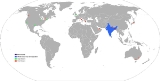
Bengali or Bangla is an eastern Indo-Aryan language
. It is native to the region of eastern South Asia
known as Bengal
, which comprises present day Bangladesh
, the India
n state of West Bengal
, and parts of the Indian states of Tripura
and Assam
. It is written with the Bengali script
. With nearly 300 million total speakers, Bengali is one of the most spoken languages (ranking sixth) in the world.
Along with other Eastern Indo-Aryan languages, Bengali evolved circa 1000–1200 AD from the Magadhi Prakrit
, which developed from the Sanskrit
language. It is now the primary language spoken in Bangladesh and is the second most spoken language in India.
With a long and rich literary tradition
, Bengali binds together a culturally diverse region and is an important contributor to Bengali nationalism
. In former East Bengal
(today Bangladesh
), the strong linguistic consciousness led to the Bengali Language Movement, during which on 21 February 1952, several people were killed during protests to gain its recognition as a state language of the then Dominion of Pakistan
. The day has since been observed as Language Movement Day
in Bangladesh, and was proclaimed the International Mother Language Day
by UNESCO
on 17 November 1999.

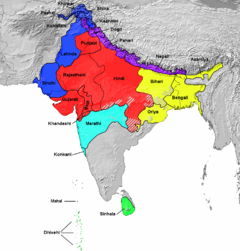 Like other Eastern Indo-Aryan languages, Bengali arose from the eastern Middle Indo-Aryan languages
of the Indian subcontinent
. Magadhi Prakrit
and Pali
, the earliest recorded spoken languages in the region and the language of the Buddha
, evolved into the Jain Prakrit
or Ardhamagadhi "Half Magadhi" in the early part of the first millennium CE. Ardhamagadhi, as with all of the Prakrits of North India, began to give way to what are called Apabhraṃśa ("Corrupted grammar") languages just before the turn of the first millennium. The local Apabhraṃśa language of the eastern subcontinent, Purvi Apabhraṃśa or Abahatta
("Meaningless Sounds"), eventually evolved into regional dialects, which in turn formed three groups: the Bihari languages
, the Oriya language
s, and the Assamese-Bengali languages. Some argue that the points of divergence occurred much earlier—going back to even 500 but the language was not static: different varieties coexisted and authors often wrote in multiple dialects. For example, Magadhi Prakrit is believed to have evolved into Abahatta around the 6th century which competed with the ancestor of Bengali for a period of time.
Usually three periods are identified in the history of Bengali:
Historically closer to Pali, Bengali saw an increase in Sanskrit
influence during the Middle Bengali (Chaitanya Mahaprabhu
era) and also during the Bengal Renaissance
. Of the modern Indo-European languages
in South Asia, Bengali and Marathi
maintain a largely Pali/Sanskrit vocabulary base while Standard Hindi and others such as Punjabi
, Sindhi
and Gujarati
are more influenced by Arabic and Persian.
 Until the 18th century, there was no attempt to document Bengali grammar. The first written Bengali dictionary/grammar, Vocabolario em idioma Bengalla, e Portuguez dividido em duas partes, was written by the Portuguese
missionary
Manuel da Assumpção
between 1734 and 1742 while he was serving in Bhawal Estate
. Nathaniel Brassey Halhed
, a British
grammarian
, wrote a modern Bengali grammar (A Grammar of the Bengal Language (1778)) that used Bengali types
in print for the first time. Ram Mohan Roy
, the great Bengali reformer, also wrote a "Grammar of the Bengali Language" (1832).
During this period, the Choltibhasha form, using simplified inflections and other changes, was emerging from Shadhubhasha (older form) as the form of choice for written Bengali.
Bengali was the focus, in 1951–52, of the Bengali Language Movement (Bhasha Andolon) in what was then East Pakistan
(now Bangladesh
). Although the Bengali language was spoken by the majority of Bangladesh
's population, Urdu
was legislated as the sole national language. On February 21, 1952, protesting students and activists were fired upon by military and police in the University of Dhaka
and three young students and several other people were killed. Later in 1999, UNESCO
decided to celebrate every 21 February as International Mother Language Day
in recognition of the deaths of the three students. In a separate event on May 19, 1961, police in Silchar
, India, killed eleven people who were protesting legislation that mandated the use of the Assamese language
.
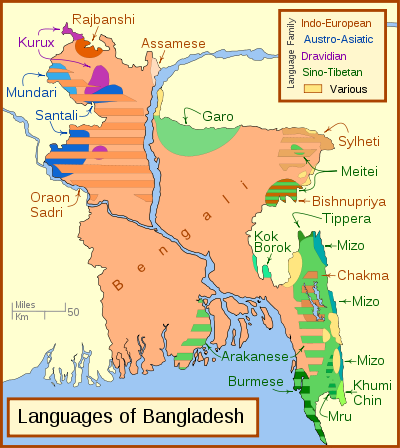 Bengali is native to the region of eastern South Asia
known as Bengal
, which comprises Bangladesh
, the India
n state of West Bengal
and parts of Assam
and Tripura
. Besides this region it is also spoken by majority of the population in the union territory Andaman and Nicobar Islands. There are also significant Bengali-speaking communities in:
and one of the 23 official languages recognised by the Republic of India
. It is the official language of the states of West Bengal
and Tripura
. It is also a major language in the Indian union territory of Andaman and Nicobar Islands. It is also the co-official language of Assam, which has three predominantly Sylheti
-speaking districts of southern Assam:
Bengali is a second official language of the Indian state of Jharkhand from September 2011. In December 2002, Sierra Leone’s President Ahmad Tejan Kabbah
also named Bengali as an "official language" in recognition of the work of 5,300 troops from Bangladesh in the United Nations Mission in Sierra Leone peacekeeping force.
The national anthems of both India
and Bangladesh
were written by the Bengali Nobel laureate Rabindranath Tagore
. In 2009, elected representatives in both Bangladesh and West Bengal called for Bengali to be made an official language of the United Nations
.
. Linguist Suniti Kumar Chatterjee grouped these dialects into four large clusters—Rarh, Banga, Kamarupa and Varendra; but many alternative grouping schemes have also been proposed. The south-western dialects (Rarh) form the basis of standard colloquial Bengali, while Bangal is the dominant dialect group in Bangladesh. In the dialects prevalent in much of eastern and south-eastern Bengal (Barisal, Chittagong
, Dhaka
and Sylhet
divisions of Bangladesh), many of the stops and affricates heard in West Bengal are pronounced as fricatives
. Western alveolo-palatal
affricates চ tɕ, ছ tɕʰ, জ dʑ correspond to eastern [ts], ছ় [s], [dz]~[z]. The influence of Tibeto-Burman languages
on the phonology of Eastern Bengali is seen through the lack of nasalized vowels. Some variants of Bengali, particularly Chittagonian
and Chakma Bengali
, have contrastive tone
; differences in the pitch of the speaker's voice can distinguish words. Rajbangsi, Kharia Thar and Mal Paharia are closely related to Western Bengali dialects, but are typically classified as separate languages. Similarly, Hajong
is considered a separate language, although it shares similarities to Northern Bengali dialects.
During the standardization of Bengali in the late 19th century and early 20th century, the cultural center of Bengal was in the city of Kolkata
, then Calcutta, founded by the British
. What is accepted as the standard form today in both West Bengal and Bangladesh is based on the West-Central dialect of Nadia
, an India
n district located on the border of Bangladesh
. There are cases where speakers of Standard Bengali in West Bengal will use a different word than a speaker of Standard Bengali in Bangladesh, even though both words are of native Bengali descent. For example, nun (salt) in the west corresponds to lôbon in the east.
between the written and spoken forms of the language. Two styles of writing, involving somewhat different vocabularies and syntax, have emerged:
While most writing is in Standard Colloquial Bengali, spoken dialects exhibit a greater variety. South-eastern West Bengal, including Kolkata, speak in Standard Colloquial Bengali. Other parts of West Bengal and western Bangladesh speak in dialects that are minor variations, such as the Medinipur dialect characterised by some unique words and constructions. However, a majority in Bangladesh speak in dialects notably different from Standard Colloquial Bengali. Some dialects, particularly those of the Chittagong
region, bear only a superficial resemblance to Standard Colloquial Bengali. The dialect in the Chattagram region is least widely understood by the general body of Bengalis. The majority of Bengalis are able to communicate in more than one variety
—often, speakers are fluent in cholitobhasha (Standard Colloquial Bengali) and one or more regional dialects.
Even in Standard Colloquial Bengali, Muslim
s and Hindu
use different words. Due to cultural and religious traditions, Hindus and Muslims might use, respectively, Pali/Sanskrit-derived and Perso-Arabic words. Some examples of lexical alternation between these two forms are:
(here S = derived from Sanskrit and/or Pali, P = derived from Persian, A = derived from Arabic)
(e.g. the Latin alphabet
), rather an abugida
, i.e. its consonant graphemes in general represent a consonant followed by an "inherent" vowel. The script is a variant of the Eastern Nagari script
used throughout Bangladesh and eastern India (Assam
, West Bengal
and the Mithila
region of Bihar
). The Eastern Nagari script is believed to have evolved from a modified Brahmic
script around 1000 CE and is similar to the Devanagari
abugida used for Sanskrit
and many modern Indic
languages (e.g. Hindi
, Marathi
and Nepali
). The Bengali script has particularly close historical relationships with the Assamese script
, the Oriya script
(although this relationship is not strongly evident in appearance) and Mithilakshar
(the native script for Maithili language
).
The Bengali script is a cursive
script with eleven graphemes or signs denoting nine vowel
s and two diphthong
s, and thirty-nine graphemes representing consonant
s and other modifiers. There are no distinct upper and lower case
letter forms. The letters run from left to right and spaces are used to separate orthographic words. Like Devanagari, Bengali script has a distinctive horizontal line running along the tops of the graphemes that links them together.
Since the Bengali script is an abugida, its consonant graphemes usually do not represent phonetic segments
, but carry an "inherent" vowel and thus are syllabic
in nature. The inherent vowel is usually a back vowel, either [ɔ] as in মত [mɔt̪] "opinion" or [o], as in মন [mon] "mind", with variants like the more open [ɒ]. To emphatically represent a consonant sound without any inherent vowel attached to it, a special diacritic, called the hôshonto
(্) (cf. Arabic sukūn), may be added below the basic consonant grapheme (as in ম্ [m]). This diacritic, however, is not common, and is chiefly employed as a guide to pronunciation. The abugida nature of Bengali consonant graphemes is not consistent, however. Often, syllable-final consonant graphemes, though not marked by a hôshonto, may carry no inherent vowel sound (as in the final ন in মন [mon] or the medial ম in গামলা [ɡamla]).
A consonant sound followed by some vowel sound other than the inherent [ɔ] is orthographically realized by using a variety of vowel allographs above, below, before, after, or around the consonant sign, thus forming the ubiquitous consonant-vowel ligature. These allographs, called kars (cf. Hindi matras) are dependent, diacritic
al vowel forms and cannot stand on their own. For example, the graph মি [mi] represents the consonant [m] followed by the vowel [i], where [i] is represented as the diacritical allograph ি (called i-kar) and is placed before the default consonant sign. Similarly, the graphs মা [ma], মী [mi], মু [mu], মূ [mu], মৃ [mri], মে [me]~[mæ], মৈ [moj], মো [mo] and মৌ [mow] represent the same consonant ম combined with seven other vowels and two diphthongs. It should be noted that in these consonant-vowel ligatures, the so-called "inherent" vowel [ɔ] is first expunged from the consonant before adding the vowel, but this intermediate expulsion of the inherent vowel is not indicated in any visual manner on the basic consonant sign ম.
The vowel graphemes in Bengali can take two forms: the independent form found in the basic inventory of the script and the dependent, abridged, allograph form (as discussed above). To represent a vowel in isolation from any preceding or following consonant, the independent form of the vowel is used. For example, in মই [moj] "ladder" and in ইলিশ [iliɕ] "Hilsa fish", the independent form of the vowel ই is used (cf. the dependent form ি). A vowel at the beginning of a word is always realized using its independent form.
In addition to the inherent-vowel-suppressing hôshonto, three more diacritics are commonly used in Bengali. These are the superposed chôndrobindu (ঁ), denoting a suprasegmental for nasalization
of vowels (as in চাঁদ [tɕãd] "moon"), the postposed onushshôr (ং) indicating the velar nasal
[ŋ] (as in বাংলা [baŋla] "Bengali") and the postposed bishôrgo (ঃ) indicating the voiceless glottal fricative
[h] (as in উঃ! [uh] "ouch!") or the gemination
of the following consonant (as in দুঃখ [dukʰːo] "sorrow").
The Bengali consonant clusters
(যুক্তব্যঞ্জন juktobênjon in Bengali) are usually realized as ligatures (যুক্তাক্ষর juktakkhor), where the consonant which comes first is put on top of or to the left of the one that immediately follows. In these ligatures, the shapes of the constituent consonant signs are often contracted and sometimes even distorted beyond recognition. In Bengali writing system, there are nearly 285 such ligatures denoting consonant clusters. Although there exist a few visual formulas to construct some of these ligatures, many of them have to be learned by rote. Recently, in a bid to lessen this burden on young learners, efforts have been made by educational institutions in the two main Bengali-speaking regions (West Bengal and Bangladesh) to address the opaque nature of many consonant clusters, and as a result, modern Bengali textbooks are beginning to contain more and more "transparent" graphical forms of consonant clusters, in which the constituent consonants of a cluster are readily apparent from the graphical form. However, since this change is not as widespread and is not being followed as uniformly in the rest of the Bengali printed literature, today's Bengali-learning children will possibly have to learn to recognize both the new "transparent" and the old "opaque" forms, which ultimately amounts to an increase in learning burden.
Bengali punctuation marks, apart from the downstroke daŗi (|), the Bengali equivalent of a full stop
, have been adopted from western scripts and their usage is similar.
Whereas in western scripts (Latin, Cyrillic, etc.) the letter-forms stand on an invisible baseline, the Bengali letter-forms hang from a visible horizontal headstroke called the matra (not to be confused with its Hindi cognate matra, which denotes the dependent forms of Hindi vowels). The presence and absence of this matra can be important. For example, the letter ত [tɔ] and the numeral ৩ "3" are distinguishable only by the presence or absence of the matra, as is the case between the consonant cluster ত্র [trɔ] and the independent vowel এ [e]. The letter-forms also employ the concepts of letter-width and letter-height (the vertical space between the visible matra and an invisible baseline).
There is yet to be a uniform standard collating sequence
(sorting order) of Bengali graphemes. Experts in both India and Bangladesh are currently working towards a common solution for this problem.
, i.e., in most cases there is a one-to-one correspondence between the sounds (phonemes) and the letters (graphemes) of Bengali. But grapheme-phoneme inconsistencies do occur in certain cases.
One kind of inconsistency is due to the presence of several letters in the script for the same sound. In spite of some modifications in the 19th century, the Bengali spelling system continues to be based on the one used for Sanskrit, and thus does not take into account some sound mergers that have occurred in the spoken language. For example, there are three letters (শ, ষ, and স) for the voiceless alveolo-palatal fricative [ɕ], although the letter স does retain the voiceless alveolar fricative
[s] sound when used in certain consonant conjuncts as in স্খলন [kɔlon] "fall", স্পন্দন [spɔndon] "beat", etc. The letter ষ also does retain the voiceless retroflex fricative [ʂ] sound when used in certain consonant conjuncts as in কষ্ট [kɔʂʈo] "suffering", গোষ্ঠী [ɡoʂʈʰi] "clan", etc. Similarly, there are two letters (জ and য) for the Voiced alveolo-palatal affricate [dʑ]. Moreover, what was once pronounced and written as a retroflex nasal ণ [ɳ] is now pronounced as an alveolar [n] when in conversation (the difference is seen heard when reading) (unless conjoined with another retroflex consonant
such as ট, ঠ, ড and ঢ), although the spelling does not reflect this change. The near-open front unrounded vowel [æ] is orthographically realized by multiple means, as seen in the following examples: এত [æt̪o] "so much", এ্যাকাডেমী [ækademi] "academy", অ্যামিবা [æmiba] "amoeba", দেখা [d̪ækʰa] "to see", ব্যস্ত [bæst̪o] "busy", ব্যাকরণ [bækɔron] "grammar".
Another kind of inconsistency is concerned with the incomplete coverage of phonological information in the script. The inherent vowel attached to every consonant can be either [ɔ] or [o] depending on the context, but this phonological information is not captured by the script, creating ambiguity for the reader. Furthermore, the inherent vowel is often not pronounced at the end of a syllable, as in কম [kɔm] "less", but this omission is not generally reflected in the script, making it difficult for the new reader.
Many consonant clusters have different sounds than their constituent consonants. For example, the combination of the consonants ক্ [k] and ষ [ʂɔ] is graphically realized as ক্ষ and is pronounced [kʰːo] (as in রুক্ষ [rukʰːo] "rugged") or [kʰo] (as in ক্ষতি [kʰot̪i] "loss") or even [kʰɔ] (as in ক্ষমতা [kʰɔmot̪a] "power"), depending on the position of the cluster in a word. The Bengali writing system is, therefore, not always a true guide to pronunciation.
For a detailed list of these inconsistencies, consult Bengali script
.
. Other related languages in the region also make use of the Bengali alphabet. Meitei, a Sino-Tibetan
language used in the Indian state of Manipur
, has been written in the Bengali abugida for centuries, though Meitei Mayek (the Meitei abugida) has been promoted in recent times. The Bengali script has been adopted for writing the Sylheti language as well, replacing the use of the old Sylheti Nagori script.
(based on diacritics), "Indian languages Transliteration" or ITRANS
(uses upper case alphabets suited for ASCII
keyboards), and the National Library at Calcutta romanization.
In the context of Bangla Romanization
, it is important to distinguish transliteration
from transcription
. Transliteration is orthographically accurate (i.e. the original spelling can be recovered), whereas transcription is phonetically accurate (the pronunciation can be reproduced). Since English does not have the sounds of Bangla, and since pronunciation does not completely reflect the spellings, being faithful to both is not possible.
Although it might be desirable to use a transliteration scheme where the original Bangla orthography is recoverable from the Latin text, Bangla words are currently Romanized on Wikipedia using a phonemic transcription
, where the pronunciation is represented with no reference to how it is written. The Wikipedia Romanization scheme is given in the table below, with the IPA transcriptions as used above.
inventory of Bengali consists of 29 consonants and 14 vowels, including the seven nasalized vowels
. An approximate phonetic
scheme is set out below in International Phonetic Alphabet (upper grapheme in each box) and romanization (lower grapheme).
s occurring within the same syllable
. Several vowel combinations can be considered true monosyllabic diphthongs, made up of the main vowel (the nucleus) and the trailing vowel (the off-glide). Almost all other vowel combinations are possible, but only across two adjacent syllables, such as the disyllabic vowel combination [u.a] in কুয়া kua "well". As many as 25 vowel combinations can be found, but some of the more recent combinations have not passed through the stage between two syllables and a diphthongal monosyllable. There are nineteen diphthongs in Bangal language.
is predominantly initial. Bengali words are virtually all trochaic
; the primary stress falls on the initial syllable
of the word, while secondary stress often falls on all odd-numbered syllables thereafter, giving strings such as shô-ho-jo-gi-ta "cooperation", where the boldface represents primary and secondary stress. The first syllable carries the greatest stress, with the third carrying a somewhat weaker stress, and all following odd-numbered syllables carrying very weak stress. However in words borrowed from Sanskrit, the root syllable is stressed, causing them to be out of harmony with native Bengali words.
Adding prefixes to a word typically shifts the stress to the left. For example, while the word shob-bho "civilized" carries the primary stress on the first syllable [shob], adding the negative
prefix [ô-] creates ô-shob-bho "uncivilized", where the primary stress is now on the newly added first syllable অ ô. In any case, word-stress does not alter the meaning of a word and is always subsidiary to sentence-stress.
, with the exception of the last word in the sentence, which only carries a low tone. This intonation
al pattern creates a musical tone to the typical Bengali sentence. This intonation with low and high tones alternating until the final drop in pitch to mark the end of the sentence.
In sentences involving focused words and/or phrases, the rising tones only last until the focused word; all following words carry a low tone. This intonation pattern extends to wh-questions
, as wh-words are normally considered to be focused. In yes-no question
s, the rising tones may be more exaggerated, and most importantly, the final syllable of the final word in the sentence takes a high falling tone instead of a flat low tone.
is not contrastive in Bengali; all else equal, there is no meaningful distinction between a "short vowel" and a "long vowel", unlike the situation in many other Indic languages. However, when morpheme
boundaries come into play, vowel length can sometimes distinguish otherwise homophonous words. This is due to the fact that open monosyllables
(i.e. words that are made up of only one syllable, with that syllable ending in the main vowel and not a consonant) have somewhat longer vowels than other syllable types. For example, the vowel in cha: "tea" is somewhat longer than the first vowel in chaṭa "licking", as cha: is a word with only one syllable, and no final consonant. (The long vowel is marked with a colon : in these examples.) The suffix
ṭa "the" can be added to cha: to form cha:ṭa "the tea". Even when another morpheme is attached to cha:, the long vowel is preserved. Knowing this fact, some interesting cases of apparent vowel length distinction can be found. In general Bengali vowels tend to stay away from extreme vowel articulation.
Furthermore, using a form of reduplication
called "echo reduplication", the long vowel in cha: can be copied into the reduplicant ṭa:, giving cha:ṭa: "tea and all that comes with it". Thus, in addition to cha:ṭa "the tea" (long first vowel) and chaṭa "licking" (no long vowels), we have cha:ṭa: "tea and all that comes with it" (both long vowels).
s; the maximum syllabic structure is CVC (i.e. one vowel flanked by a consonant on each side). Many speakers of Bengali restrict their phonology to this pattern, even when using Sanskrit or English borrowings, such as গেরাম geram (CV.CVC) for গ্রাম gram (CCVC) "village" or ইস্কুল iskul (VC.CVC) for স্কুল skul (CCVC) "school".
Sanskrit (তৎসম tôtshômo) words borrowed into Bengali, however, possess a wide range of clusters, expanding the maximum syllable structure to CCCVC. Some of these clusters, such as the mr in মৃত্যু mrittu "death" or the sp in স্পষ্ট spôshṭo "clear", have become extremely common, and can be considered legal consonant clusters in Bengali. English and other foreign (বিদেশী bideshi) borrowings add even more cluster types into the Bengali inventory, further increasing the syllable capacity to CCCVCCCC, as commonly used loanwords such as ট্রেন ṭren "train" and গ্লাস glash "glass" are now even included in leading Bengali dictionaries.
Final consonant clusters are rare in Bengali. Most final consonant clusters were borrowed into Bengali from English, as in লিফ্ট lifṭ "lift, elevator" and ব্যাংক bæņk "bank". However, final clusters do exist in some native Bengali words, although rarely in standard pronunciation. One example of a final cluster in a standard Bengali word would be গঞ্জ gônj, which is found in names of hundreds of cities and towns across Bengal, including নবাবগঞ্জ Nôbabgônj and মানিকগঞ্জ Manikgônj. Some nonstandard varieties of Bengali make use of final clusters quite often. For example, in some Purbo (eastern) dialects, final consonant clusters consisting of a nasal and its corresponding oral stop are common, as in চান্দ chand "moon". The Standard Bengali equivalent of chand would be চাঁদ chãd, with a nasalized vowel instead of the final cluster.
). However, nouns and pronouns are highly declined
(altered depending on their function in a sentence) into four cases
while verbs are heavily conjugated
.
As a consequence, unlike Hindi, Bengali verbs do not change form depending on the gender of the nouns.
language, Bengali follows subject–object–verb word order
, although variations to this theme are common. Bengali makes use of postpositions, as opposed to the prepositions used in English and other European languages. Determiners follow the noun
, while numerals, adjective
s, and possessors
precede the noun.
Yes-no questions do not require any change to the basic word order; instead, the low (L) tone
of the final syllable in the utterance is replaced with a falling (HL) tone
. Additionally optional particles
(e.g. কি -ki, না -na, etc.) are often encliticized
onto the first or last word of a yes-no question.
Wh-questions are formed by fronting the wh-word to focus position, which is typically the first or second word in the utterance.
, including nominative
, objective
, genitive (possessive)
, and locative
. The case marking pattern for each noun being inflected depends on the noun's degree of animacy
. When a definite article
such as -টা -ţa (singular) or -গুলা -gula (plural) is added, as in the tables below, nouns are also inflected for number
.
When counted, nouns take one of a small set of measure word
s. As in many East Asian languages
(e.g. Chinese
, Japanese
, Thai
, etc.), nouns in Bengali cannot be counted by adding the numeral directly adjacent to the noun. The noun's measure word (MW) must be used between the numeral and the noun. Most nouns take the generic measure word -টা -ţa, though other measure words indicate semantic classes (e.g. -জন -jon for humans).
Measuring nouns in Bengali without their corresponding measure words (e.g. আট বিড়াল aţ biŗal instead of আটটা বিড়াল aţ-ţa biŗal "eight cats") would typically be considered ungrammatical. However, when the semantic class of the noun is understood from the measure word, the noun is often omitted and only the measure word is used, e.g. শুধু একজন থাকবে। Shudhu êk-jon thakbe. (lit. "Only one-MW will remain.") would be understood to mean "Only one person will remain.", given the semantic class implicit in -জন -jon.
In this sense, all nouns in Bengali, unlike most other Indo-European languages, are similar to mass noun
s.
and non-finite. Non-finite verbs have no inflection for tense or person, while finite verbs are fully inflected for person
(first, second, third), tense
(present, past, future), aspect
(simple, perfect, progressive), and honor
(intimate, familiar, and formal), but not for number. Conditional
, imperative, and other special inflections for mood
can replace the tense and aspect suffixes. The number of inflections on many verb roots can total more than 200.
Inflection
al suffixes in the morphology
of Bengali vary from region to region, along with minor differences in syntax
.
Bengali differs from most Indo-Aryan Languages in the zero copula
, where the copula or connective be is often missing in the present tense. Thus "he is a teacher" is she shikkhôk, (literally "he teacher").
In this respect, Bengali is similar to Russian
and Hungarian
.
 Bengali has as many as 100,000 separate words, of which 50,000 are considered tôtshômo (direct reborrowings from Sanskrit), 21,100 are tôdbhôbo (native words with Sanskrit cognates), and the rest being bideshi (foreign borrowings) and deshi (Austroasiatic borrowings) words.
However, these figures do not take into account the fact that a large proportion of these words are archaic or highly technical, minimizing their actual usage. The productive vocabulary used in modern literary works, in fact, is made up mostly (67%) of tôdbhôbo words, while tôtshômo only make up 25% of the total. Deshi and Bideshi words together make up the remaining 8% of the vocabulary used in modern Bengali literature.
Due to centuries of contact with European
s, Mughals, Arabs, Turks
, Persians, Afghans
, and East Asians, Bengali has incorporated many words from foreign languages. The most common borrowings
from foreign languages come from three different kinds of contact. Close contact with neighboring peoples facilitated the borrowing of words from Hindi, Assamese
and several indigenous Austroasiatic languages (like Santali
). of Bengal. After centuries of invasions from Persia and the Middle East
, numerous Persian
, Arabic
, Turkish
, and Pashtun
words were absorbed into Bengali. Portuguese
, French
, Dutch
and English
words were later additions during the colonial period
.
(by the United Nations
):
Haldar, Naryan : Bangla Abhidhan : Prasanga Atithi Shabda, Pustak Bipani, Kolkata, 2009.
Indo-Aryan languages
The Indo-Aryan languages constitutes a branch of the Indo-Iranian languages, itself a branch of the Indo-European language family...
. It is native to the region of eastern South Asia
South Asia
South Asia, also known as Southern Asia, is the southern region of the Asian continent, which comprises the sub-Himalayan countries and, for some authorities , also includes the adjoining countries to the west and the east...
known as Bengal
Bengal
Bengal is a historical and geographical region in the northeast region of the Indian Subcontinent at the apex of the Bay of Bengal. Today, it is mainly divided between the sovereign land of People's Republic of Bangladesh and the Indian state of West Bengal, although some regions of the previous...
, which comprises present day Bangladesh
Bangladesh
Bangladesh , officially the People's Republic of Bangladesh is a sovereign state located in South Asia. It is bordered by India on all sides except for a small border with Burma to the far southeast and by the Bay of Bengal to the south...
, the India
India
India , officially the Republic of India , is a country in South Asia. It is the seventh-largest country by geographical area, the second-most populous country with over 1.2 billion people, and the most populous democracy in the world...
n state of West Bengal
West Bengal
West Bengal is a state in the eastern region of India and is the nation's fourth-most populous. It is also the seventh-most populous sub-national entity in the world, with over 91 million inhabitants. A major agricultural producer, West Bengal is the sixth-largest contributor to India's GDP...
, and parts of the Indian states of Tripura
Tripura
Tripura is a state in North-East India, with an area of . It is the third smallest state of India, according to area. Tripura is surrounded by Bangladesh on the north, south, and west. The Indian states of Assam and Mizoram lie to the east. The capital is Agartala and the main languages spoken are...
and Assam
Assam
Assam , also, rarely, Assam Valley and formerly the Assam Province , is a northeastern state of India and is one of the most culturally and geographically distinct regions of the country...
. It is written with the Bengali script
Bengali script
The Bengali alphabet is the writing system for the Bengali language. The script with variations is used for Assamese and is basis for Meitei, Bishnupriya Manipuri, Kokborok, Garo and Mundari alphabets. All these languages are spoken in the eastern region of South Asia. Historically, the script has...
. With nearly 300 million total speakers, Bengali is one of the most spoken languages (ranking sixth) in the world.
Along with other Eastern Indo-Aryan languages, Bengali evolved circa 1000–1200 AD from the Magadhi Prakrit
Magadhi Prakrit
Magadhi Prakrit is of one of the three Dramatic Prakrits, the written languages of Ancient India following the decline of Pali and Sanskrit. Magadhi Prakrit was spoken in the eastern Indian subcontinent, in a region spanning what is now eastern India, Bangladesh, and Nepal. It is believed to be the...
, which developed from the Sanskrit
Sanskrit
Sanskrit , is a historical Indo-Aryan language and the primary liturgical language of Hinduism, Jainism and Buddhism.Buddhism: besides Pali, see Buddhist Hybrid Sanskrit Today, it is listed as one of the 22 scheduled languages of India and is an official language of the state of Uttarakhand...
language. It is now the primary language spoken in Bangladesh and is the second most spoken language in India.
With a long and rich literary tradition
Bengali literature
Bengali literature is literary works written in Bengali language particularly from Bangladesh and the Indian provinces of West Bengal and Tripura. The history of Bengali literature traces back hundreds of years while it is impossible to separate the literary trends of the two Bengals during the...
, Bengali binds together a culturally diverse region and is an important contributor to Bengali nationalism
Bengali nationalism
Bengali nationalism is the political expression of ethno-national consciousness of the Bengali people, who inhabit the ethno-linguistic region of Bengal. The region's territory is divided between Bangladesh and the Indian state of West Bengal...
. In former East Bengal
East Bengal
East Bengal was the name used during two periods in the 20th century for a territory that roughly corresponded to the modern state of Bangladesh. Both instances involved a violent partition of Bengal....
(today Bangladesh
Bangladesh
Bangladesh , officially the People's Republic of Bangladesh is a sovereign state located in South Asia. It is bordered by India on all sides except for a small border with Burma to the far southeast and by the Bay of Bengal to the south...
), the strong linguistic consciousness led to the Bengali Language Movement, during which on 21 February 1952, several people were killed during protests to gain its recognition as a state language of the then Dominion of Pakistan
Dominion of Pakistan
The Dominion of Pakistan was an independent federal Commonwealth realm in South Asia that was established in 1947 on the partition of British India into two sovereign dominions . The Dominion of Pakistan, which included modern-day Pakistan and Bangladesh, was intended to be a homeland for the...
. The day has since been observed as Language Movement Day
Language Movement Day
Language Movement Day or Language Revolution Day , which is also referred to as Language Martyrs' Day or Martyrs' Day , is a national day of Bangladesh to commemorate protests and sacrifices to protect Bangla as a national language during Bengali Language Movement of 1952.-Background:In 1952,...
in Bangladesh, and was proclaimed the International Mother Language Day
International Mother Language Day
International Mother Language Day is an observance held annually on 21 February worldwide to promote awareness of linguistic and cultural diversity and multilingualism. It was first announced by UNESCO on 17 November 1999...
by UNESCO
UNESCO
The United Nations Educational, Scientific and Cultural Organization is a specialized agency of the United Nations...
on 17 November 1999.
History
Middle Indo-Aryan languages
The Middle Indo-Aryan languages are the early medieval dialects of the Indo-Aryan languages, the descendants of the Old Indo-Aryan dialects such as Vedic & Classical Sanskrit, and the predecessors of the late medieval languages such as Apabhramsha or Abahatta, which eventually evolved into the...
of the Indian subcontinent
Indian subcontinent
The Indian subcontinent, also Indian Subcontinent, Indo-Pak Subcontinent or South Asian Subcontinent is a region of the Asian continent on the Indian tectonic plate from the Hindu Kush or Hindu Koh, Himalayas and including the Kuen Lun and Karakoram ranges, forming a land mass which extends...
. Magadhi Prakrit
Magadhi Prakrit
Magadhi Prakrit is of one of the three Dramatic Prakrits, the written languages of Ancient India following the decline of Pali and Sanskrit. Magadhi Prakrit was spoken in the eastern Indian subcontinent, in a region spanning what is now eastern India, Bangladesh, and Nepal. It is believed to be the...
and Pali
Páli
- External links :* *...
, the earliest recorded spoken languages in the region and the language of the Buddha
Gautama Buddha
Siddhārtha Gautama was a spiritual teacher from the Indian subcontinent, on whose teachings Buddhism was founded. In most Buddhist traditions, he is regarded as the Supreme Buddha Siddhārtha Gautama (Sanskrit: सिद्धार्थ गौतम; Pali: Siddhattha Gotama) was a spiritual teacher from the Indian...
, evolved into the Jain Prakrit
Jain Prakrit
Jain Prakrit is a term loosely used for the language of the Jain Agamas . The books of Jainism were written in the popular vernacular dialects , and therefore encompass a number of related dialects...
or Ardhamagadhi "Half Magadhi" in the early part of the first millennium CE. Ardhamagadhi, as with all of the Prakrits of North India, began to give way to what are called Apabhraṃśa ("Corrupted grammar") languages just before the turn of the first millennium. The local Apabhraṃśa language of the eastern subcontinent, Purvi Apabhraṃśa or Abahatta
Abahatta
Abahatta, from Prakrit abasatta and ultimately from Sanskrit apaśabda "meaningless sound", is a stage in the evolution of the Eastern group of Indo-Aryan languages such as Bangla, Maithili, Oriya. It is also called Apabhramsa Avahatta, Apabhramsha Abahatta or Purvi Apabhramsa. Abahatta is...
("Meaningless Sounds"), eventually evolved into regional dialects, which in turn formed three groups: the Bihari languages
Bihari languages
Bihari is a name given to the western group of Eastern Indic languages, spoken in Bihar and neighboring states in India. Angika, Bajjika, Bhojpuri, Magahi, and Maithili are spoken in Nepal as well. The Angika, Bajjika, Bhojpuri, Magahi and Maithili speaking population form more than 21% of Nepalese...
, the Oriya language
Oriya language
Oriya , officially Odia from November, 2011, is an Indian language, belonging to the Indo-Aryan branch of the Indo-European language family. It is mainly spoken in the Indian states of Orissa and West Bengal...
s, and the Assamese-Bengali languages. Some argue that the points of divergence occurred much earlier—going back to even 500 but the language was not static: different varieties coexisted and authors often wrote in multiple dialects. For example, Magadhi Prakrit is believed to have evolved into Abahatta around the 6th century which competed with the ancestor of Bengali for a period of time.
Usually three periods are identified in the history of Bengali:
- Old Bengali (900/1000–1400)—texts include CharyapadaCharyapadaThe Charyapada is a collection of 8th-12th century Vajrayana Buddhist caryagiti, or mystical poems from the tantric tradition in eastern India. Being caryagiti , the Charyapada were intended to be sung. These songs of realization were spontaneously composed verses that expressed a practitioner's...
, devotional songs; emergence of pronouns Ami, tumi, etc.; verb inflectionInflectionIn grammar, inflection or inflexion is the modification of a word to express different grammatical categories such as tense, grammatical mood, grammatical voice, aspect, person, number, gender and case...
s -ila, -iba, etc. AssameseAssamese languageAssamese is the easternmost Indo-Aryan language. It is used mainly in the state of Assam in North-East India. It is also the official language of Assam. It is also spoken in parts of Arunachal Pradesh and other northeast Indian states. Nagamese, an Assamese-based Creole language is widely used in...
branch out in this period and OriyaOriya languageOriya , officially Odia from November, 2011, is an Indian language, belonging to the Indo-Aryan branch of the Indo-European language family. It is mainly spoken in the Indian states of Orissa and West Bengal...
just before this period (8th century-1300). - Middle Bengali (1400–1800)—major texts of the period include ChandidasChandidasChandidas refers to medieval poet of Bengal. Over 1250 poems related to the love of Radha and Krishna in Bengali with the bhanita of Chandidas are found with three different sobriquets along with his name, , Dvija and Dina as well as without any sobriquet also...
's Shreekrishna KirtanaShreekrishna KirtanaShreekrishna Kirtana Kabya or Sri Krishna Kirtana Kabya is a pastoral Vaishnava drama in verse composed by Boru Chandidas. It is considered to be the most significant work after Charyapada in the history of Bengali literature...
; elisionElisionElision is the omission of one or more sounds in a word or phrase, producing a result that is easier for the speaker to pronounce...
of word-final ô sound; spread of compound verbs; Persian influence. Some scholars further divide this period into early and late middle periods. - New Bengali (since 1800)—shortening of verbs and pronouns, among other changes (e.g. tahar → tar "his"/"her"; koriyachhilô → korechhilo he/sheGrammatical personGrammatical person, in linguistics, is deictic reference to a participant in an event; such as the speaker, the addressee, or others. Grammatical person typically defines a language's set of personal pronouns...
hadGrammatical tenseA tense is a grammatical category that locates a situation in time, to indicate when the situation takes place.Bernard Comrie, Aspect, 1976:6:...
doneGrammatical aspectIn linguistics, the grammatical aspect of a verb is a grammatical category that defines the temporal flow in a given action, event, or state, from the point of view of the speaker...
).
Historically closer to Pali, Bengali saw an increase in Sanskrit
Sanskrit
Sanskrit , is a historical Indo-Aryan language and the primary liturgical language of Hinduism, Jainism and Buddhism.Buddhism: besides Pali, see Buddhist Hybrid Sanskrit Today, it is listed as one of the 22 scheduled languages of India and is an official language of the state of Uttarakhand...
influence during the Middle Bengali (Chaitanya Mahaprabhu
Chaitanya Mahaprabhu
Chaitanya Mahaprabhu was a Vaishnava saint and social reformer in eastern India in the 16th century, believed by followers of Gaudiya Vaishnavism to be the full incarnation of Lord Krishna...
era) and also during the Bengal Renaissance
Bengal Renaissance
The Bengal Renaissance refers to a social reform movement during the nineteenth and early twentieth centuries in the region of Bengal in Undivided India during the period of British rule...
. Of the modern Indo-European languages
Indo-European languages
The Indo-European languages are a family of several hundred related languages and dialects, including most major current languages of Europe, the Iranian plateau, and South Asia and also historically predominant in Anatolia...
in South Asia, Bengali and Marathi
Marathi language
Marathi is an Indo-Aryan language spoken by the Marathi people of western and central India. It is the official language of the state of Maharashtra. There are over 68 million fluent speakers worldwide. Marathi has the fourth largest number of native speakers in India and is the fifteenth most...
maintain a largely Pali/Sanskrit vocabulary base while Standard Hindi and others such as Punjabi
Punjabi language
Punjabi is an Indo-Aryan language spoken by inhabitants of the historical Punjab region . For Sikhs, the Punjabi language stands as the official language in which all ceremonies take place. In Pakistan, Punjabi is the most widely spoken language...
, Sindhi
Sindhi language
Sindhi is the language of the Sindh region of Pakistan that is spoken by the Sindhi people. In India, it is among 22 constitutionally recognized languages, where Sindhis are a sizeable minority. It is spoken by 53,410,910 people in Pakistan, according to the national government's Statistics Division...
and Gujarati
Gujarati language
Gujarati is an Indo-Aryan language, and part of the greater Indo-European language family. It is derived from a language called Old Gujarati which is the ancestor language of the modern Gujarati and Rajasthani languages...
are more influenced by Arabic and Persian.
Portugal
Portugal , officially the Portuguese Republic is a country situated in southwestern Europe on the Iberian Peninsula. Portugal is the westernmost country of Europe, and is bordered by the Atlantic Ocean to the West and South and by Spain to the North and East. The Atlantic archipelagos of the...
missionary
Missionary
A missionary is a member of a religious group sent into an area to do evangelism or ministries of service, such as education, literacy, social justice, health care and economic development. The word "mission" originates from 1598 when the Jesuits sent members abroad, derived from the Latin...
Manuel da Assumpção
Manuel da Assumpção
Manuel da Assumpção was a Portuguese missionary who wrote the first grammar of Bengali language , titled Vocabulary of Bangla language and Portuguese, divided in two parts ....
between 1734 and 1742 while he was serving in Bhawal Estate
Bhawal Estate
Bhawal Estate was a large zamindari estate in Bengal in modern-day Bangladesh. Bhawal Estate spread over and covered 2,274 villages with the combined population around 500,000, many of them tenant farmers...
. Nathaniel Brassey Halhed
Nathaniel Brassey Halhed
Nathaniel Brassey Halhed was an English Orientalist and philologist. Halhed was born at Westminster. He was educated at Harrow, where he began his intimacy with Richard Brinsley Sheridan, which continued after he entered Christ Church, Oxford...
, a British
Kingdom of Great Britain
The former Kingdom of Great Britain, sometimes described as the 'United Kingdom of Great Britain', That the Two Kingdoms of Scotland and England, shall upon the 1st May next ensuing the date hereof, and forever after, be United into One Kingdom by the Name of GREAT BRITAIN. was a sovereign...
grammarian
Philology
Philology is the study of language in written historical sources; it is a combination of literary studies, history and linguistics.Classical philology is the philology of Greek and Classical Latin...
, wrote a modern Bengali grammar (A Grammar of the Bengal Language (1778)) that used Bengali types
Typesetting
Typesetting is the composition of text by means of types.Typesetting requires the prior process of designing a font and storing it in some manner...
in print for the first time. Ram Mohan Roy
Ram Mohan Roy
Raja Ram Mohan Roy was an Indian religious, social, and educational reformer who challenged traditional Hindu culture and indicated the lines of progress for Indian society under British rule. He is sometimes called the father of modern India...
, the great Bengali reformer, also wrote a "Grammar of the Bengali Language" (1832).
During this period, the Choltibhasha form, using simplified inflections and other changes, was emerging from Shadhubhasha (older form) as the form of choice for written Bengali.
Bengali was the focus, in 1951–52, of the Bengali Language Movement (Bhasha Andolon) in what was then East Pakistan
East Pakistan
East Pakistan was a provincial state of Pakistan established in 14 August 1947. The provincial state existed until its declaration of independence on 26 March 1971 as the independent nation of Bangladesh. Pakistan recognized the new nation on 16 December 1971. East Pakistan was created from Bengal...
(now Bangladesh
Bangladesh
Bangladesh , officially the People's Republic of Bangladesh is a sovereign state located in South Asia. It is bordered by India on all sides except for a small border with Burma to the far southeast and by the Bay of Bengal to the south...
). Although the Bengali language was spoken by the majority of Bangladesh
Bangladesh
Bangladesh , officially the People's Republic of Bangladesh is a sovereign state located in South Asia. It is bordered by India on all sides except for a small border with Burma to the far southeast and by the Bay of Bengal to the south...
's population, Urdu
Urdu
Urdu is a register of the Hindustani language that is identified with Muslims in South Asia. It belongs to the Indo-European family. Urdu is the national language and lingua franca of Pakistan. It is also widely spoken in some regions of India, where it is one of the 22 scheduled languages and an...
was legislated as the sole national language. On February 21, 1952, protesting students and activists were fired upon by military and police in the University of Dhaka
University of Dhaka
The University of Dhaka is the oldest university in Bangladesh. It is a multi-disciplinary research university and is among the top universities in the region. Established on July 21, 1921, as per the Government of India Act, 1920, it was modelled on the Universities in England and soon gained...
and three young students and several other people were killed. Later in 1999, UNESCO
UNESCO
The United Nations Educational, Scientific and Cultural Organization is a specialized agency of the United Nations...
decided to celebrate every 21 February as International Mother Language Day
International Mother Language Day
International Mother Language Day is an observance held annually on 21 February worldwide to promote awareness of linguistic and cultural diversity and multilingualism. It was first announced by UNESCO on 17 November 1999...
in recognition of the deaths of the three students. In a separate event on May 19, 1961, police in Silchar
Silchar
Silchar is the headquarters of Cachar district in the state of Assam in India. It is the economic gateway to the state of Mizoram and part of Manipur. It is south east of Guwahati. The city of Silchar has tremendous commercial importance and is the second largest city in the state of Assam...
, India, killed eleven people who were protesting legislation that mandated the use of the Assamese language
Assamese language
Assamese is the easternmost Indo-Aryan language. It is used mainly in the state of Assam in North-East India. It is also the official language of Assam. It is also spoken in parts of Arunachal Pradesh and other northeast Indian states. Nagamese, an Assamese-based Creole language is widely used in...
.
Geographical distribution
South Asia
South Asia, also known as Southern Asia, is the southern region of the Asian continent, which comprises the sub-Himalayan countries and, for some authorities , also includes the adjoining countries to the west and the east...
known as Bengal
Bengal
Bengal is a historical and geographical region in the northeast region of the Indian Subcontinent at the apex of the Bay of Bengal. Today, it is mainly divided between the sovereign land of People's Republic of Bangladesh and the Indian state of West Bengal, although some regions of the previous...
, which comprises Bangladesh
Bangladesh
Bangladesh , officially the People's Republic of Bangladesh is a sovereign state located in South Asia. It is bordered by India on all sides except for a small border with Burma to the far southeast and by the Bay of Bengal to the south...
, the India
India
India , officially the Republic of India , is a country in South Asia. It is the seventh-largest country by geographical area, the second-most populous country with over 1.2 billion people, and the most populous democracy in the world...
n state of West Bengal
West Bengal
West Bengal is a state in the eastern region of India and is the nation's fourth-most populous. It is also the seventh-most populous sub-national entity in the world, with over 91 million inhabitants. A major agricultural producer, West Bengal is the sixth-largest contributor to India's GDP...
and parts of Assam
Assam
Assam , also, rarely, Assam Valley and formerly the Assam Province , is a northeastern state of India and is one of the most culturally and geographically distinct regions of the country...
and Tripura
Tripura
Tripura is a state in North-East India, with an area of . It is the third smallest state of India, according to area. Tripura is surrounded by Bangladesh on the north, south, and west. The Indian states of Assam and Mizoram lie to the east. The capital is Agartala and the main languages spoken are...
. Besides this region it is also spoken by majority of the population in the union territory Andaman and Nicobar Islands. There are also significant Bengali-speaking communities in:
- the Middle EastMiddle EastThe Middle East is a region that encompasses Western Asia and Northern Africa. It is often used as a synonym for Near East, in opposition to Far East...
(namely, UAE, Saudi Arabia, Bahrain, and Kuwait) - EuropeEuropeEurope is, by convention, one of the world's seven continents. Comprising the westernmost peninsula of Eurasia, Europe is generally 'divided' from Asia to its east by the watershed divides of the Ural and Caucasus Mountains, the Ural River, the Caspian and Black Seas, and the waterways connecting...
- North AmericaNorth AmericaNorth America is a continent wholly within the Northern Hemisphere and almost wholly within the Western Hemisphere. It is also considered a northern subcontinent of the Americas...
- South-East Asia
- PakistanPakistanPakistan , officially the Islamic Republic of Pakistan is a sovereign state in South Asia. It has a coastline along the Arabian Sea and the Gulf of Oman in the south and is bordered by Afghanistan and Iran in the west, India in the east and China in the far northeast. In the north, Tajikistan...
(Karachi; see Bangladeshis in PakistanBangladeshis in PakistanThe population of Bengalis and Bangladeshis in Pakistan is said to be in millions however there is no exact figure. Different sources dub as much as between 1 - 3 million immigrants in Karachi with Bengali origin...
)
Official status
Bengali is the national and official language of BangladeshBangladesh
Bangladesh , officially the People's Republic of Bangladesh is a sovereign state located in South Asia. It is bordered by India on all sides except for a small border with Burma to the far southeast and by the Bay of Bengal to the south...
and one of the 23 official languages recognised by the Republic of India
India
India , officially the Republic of India , is a country in South Asia. It is the seventh-largest country by geographical area, the second-most populous country with over 1.2 billion people, and the most populous democracy in the world...
. It is the official language of the states of West Bengal
West Bengal
West Bengal is a state in the eastern region of India and is the nation's fourth-most populous. It is also the seventh-most populous sub-national entity in the world, with over 91 million inhabitants. A major agricultural producer, West Bengal is the sixth-largest contributor to India's GDP...
and Tripura
Tripura
Tripura is a state in North-East India, with an area of . It is the third smallest state of India, according to area. Tripura is surrounded by Bangladesh on the north, south, and west. The Indian states of Assam and Mizoram lie to the east. The capital is Agartala and the main languages spoken are...
. It is also a major language in the Indian union territory of Andaman and Nicobar Islands. It is also the co-official language of Assam, which has three predominantly Sylheti
Sylheti language
Sylheti is the language of Sylhet, which is also known as the Surma Valley and is located in the north-eastern region of Bangladesh, and also spoken in parts of the Northeast Indian states of Assam and Tripura...
-speaking districts of southern Assam:
Bengali is a second official language of the Indian state of Jharkhand from September 2011. In December 2002, Sierra Leone’s President Ahmad Tejan Kabbah
Ahmad Tejan Kabbah
Alhaji Ahmad Tejan Kabbah served as President of Sierra Leone from 1996 to 1997 and again from 1998 to 2007.He worked for the United Nations Development Programme and returned to Sierra Leone in 1992...
also named Bengali as an "official language" in recognition of the work of 5,300 troops from Bangladesh in the United Nations Mission in Sierra Leone peacekeeping force.
- Cachar
- KarimganjKarimganjKarimganj Town is a town in the Karimganj District of the Indian state of Assam. It is the administrative headquarter and main town of the district.-Geography:...
- HailakandiHailakandiHailakandiis a town and a district in Hailakandi district in the Indian state of Assam.The Hailakandi district is one of the three districts of Southern Assam i.e. Barak Valley.-Geography:...
The national anthems of both India
Jana Gana Mana
Jana Gana Mana is the national anthem of India. Written in highly Sanskritized Bengali, it is the first of five stanzas of a Brahmo hymn composed and scored by Nobel laureate Rabindranath Tagore. It was first sung at the Calcutta Session of the Indian National Congress on 27 December 1911...
and Bangladesh
Amar Shonar Bangla
Amar Shonar Bangla is a 1905 song written and composed by the Bengali poet Rabindranath Tagore , the first ten lines of which were adopted in 1972 as the Bangladeshi national anthem...
were written by the Bengali Nobel laureate Rabindranath Tagore
Rabindranath Tagore
Rabindranath Tagore , sobriquet Gurudev, was a Bengali polymath who reshaped his region's literature and music. Author of Gitanjali and its "profoundly sensitive, fresh and beautiful verse", he became the first non-European Nobel laureate by earning the 1913 Prize in Literature...
. In 2009, elected representatives in both Bangladesh and West Bengal called for Bengali to be made an official language of the United Nations
Official languages of the United Nations
The official languages of the United Nations are the six languages that are used in UN meetings, and in which all official UN documents are written...
.
- [Barisal Local language different]
Dialects
Regional variation in spoken Bengali constitutes a dialect continuumDialect continuum
A dialect continuum, or dialect area, was defined by Leonard Bloomfield as a range of dialects spoken across some geographical area that differ only slightly between neighboring areas, but as one travels in any direction, these differences accumulate such that speakers from opposite ends of the...
. Linguist Suniti Kumar Chatterjee grouped these dialects into four large clusters—Rarh, Banga, Kamarupa and Varendra; but many alternative grouping schemes have also been proposed. The south-western dialects (Rarh) form the basis of standard colloquial Bengali, while Bangal is the dominant dialect group in Bangladesh. In the dialects prevalent in much of eastern and south-eastern Bengal (Barisal, Chittagong
Chittagong
Chittagong ) is a city in southeastern Bangladesh and the capital of an eponymous district and division. Built on the banks of the Karnaphuli River, the city is home to Bangladesh's busiest seaport and has a population of over 4.5 million, making it the second largest city in the country.A trading...
, Dhaka
Dhaka
Dhaka is the capital of Bangladesh and the principal city of Dhaka Division. Dhaka is a megacity and one of the major cities of South Asia. Located on the banks of the Buriganga River, Dhaka, along with its metropolitan area, had a population of over 15 million in 2010, making it the largest city...
and Sylhet
Sylhet
Sylhet , is a major city in north-eastern Bangladesh. It is the main city of Sylhet Division and Sylhet District, and was granted metropolitan city status in March 2009. Sylhet is located on the banks of the Surma Valley and is surrounded by the Jaintia, Khasi and Tripura hills...
divisions of Bangladesh), many of the stops and affricates heard in West Bengal are pronounced as fricatives
Fricative consonant
Fricatives are consonants produced by forcing air through a narrow channel made by placing two articulators close together. These may be the lower lip against the upper teeth, in the case of ; the back of the tongue against the soft palate, in the case of German , the final consonant of Bach; or...
. Western alveolo-palatal
Alveolo-palatal consonant
In phonetics, alveolo-palatal consonants are palatalized postalveolar sounds, usually fricatives and affricates, articulated with the blade of the tongue behind the alveolar ridge, and the body of the tongue raised toward the palate...
affricates চ tɕ, ছ tɕʰ, জ dʑ correspond to eastern [ts], ছ় [s], [dz]~[z]. The influence of Tibeto-Burman languages
Tibeto-Burman languages
The Tibeto-Burman languages are the non-Chinese members of the Sino-Tibetan language family, over 400 of which are spoken thoughout the highlands of southeast Asia, as well as lowland areas in Burma ....
on the phonology of Eastern Bengali is seen through the lack of nasalized vowels. Some variants of Bengali, particularly Chittagonian
Chittagonian language
Chittagonian is an Indo-Aryan language spoken by the people of Chittagong in Bangladesh and in much of the southeast of the country. It is closely related to Bangla, but is normally considered by linguists to be a separate language rather than a dialect of Bangla. It is estimated to have 14...
and Chakma Bengali
Chakma language
Chakma language is an Indo-European language spoken by the Chakma people. Its better-known closest relatives are Bengali, Assamese, Chittagonian, Bishnupriya Manipuri, Tanchangya, Rohingya and Sylheti. It is spoken by nearly 310,000 people in southeast Bangladesh near Chittagong City, and another...
, have contrastive tone
Tone (linguistics)
Tone is the use of pitch in language to distinguish lexical or grammatical meaning—that is, to distinguish or inflect words. All verbal languages use pitch to express emotional and other paralinguistic information, and to convey emphasis, contrast, and other such features in what is called...
; differences in the pitch of the speaker's voice can distinguish words. Rajbangsi, Kharia Thar and Mal Paharia are closely related to Western Bengali dialects, but are typically classified as separate languages. Similarly, Hajong
Hajong language
Hajong is an Indo-Aryan language with Tibeto-Burman roots spoken by more than 175,000 ethnic Hajong in the states of Assam, Meghalaya, Arunachal Pradesh and West Bengal in India and the Mymensingh District in Bangladesh. It is written in the Assamese script, and it is being supplanted by the...
is considered a separate language, although it shares similarities to Northern Bengali dialects.
During the standardization of Bengali in the late 19th century and early 20th century, the cultural center of Bengal was in the city of Kolkata
Kolkata
Kolkata , formerly known as Calcutta, is the capital of the Indian state of West Bengal. Located on the east bank of the Hooghly River, it was the commercial capital of East India...
, then Calcutta, founded by the British
United Kingdom
The United Kingdom of Great Britain and Northern IrelandIn the United Kingdom and Dependencies, other languages have been officially recognised as legitimate autochthonous languages under the European Charter for Regional or Minority Languages...
. What is accepted as the standard form today in both West Bengal and Bangladesh is based on the West-Central dialect of Nadia
Nadia District
Nadia district is a district of the state of West Bengal, in the north east of India. It borders with Bangladesh to the east, North 24 Parganas and Hooghly districts to the south, Bardhaman district to the west, and Murshidabad district to the north....
, an India
India
India , officially the Republic of India , is a country in South Asia. It is the seventh-largest country by geographical area, the second-most populous country with over 1.2 billion people, and the most populous democracy in the world...
n district located on the border of Bangladesh
Bangladesh
Bangladesh , officially the People's Republic of Bangladesh is a sovereign state located in South Asia. It is bordered by India on all sides except for a small border with Burma to the far southeast and by the Bay of Bengal to the south...
. There are cases where speakers of Standard Bengali in West Bengal will use a different word than a speaker of Standard Bengali in Bangladesh, even though both words are of native Bengali descent. For example, nun (salt) in the west corresponds to lôbon in the east.
Spoken and literary varieties
Bengali exhibits diglossiaDiglossia
In linguistics, diglossia refers to a situation in which two dialects or languages are used by a single language community. In addition to the community's everyday or vernacular language variety , a second, highly codified variety is used in certain situations such as literature, formal...
between the written and spoken forms of the language. Two styles of writing, involving somewhat different vocabularies and syntax, have emerged:
- Sadhu bhasaSadhu bhasaShadhu-Bhasha is a literary variation of Bengali language. It remained as a form only to be used in written form unlike the Cholito-bhasa or the colloquial form.-History:...
(সাধু shadhu = 'chaste' or 'sage'; ভাষা bhasha = 'language') was the written language with longer verb inflections and more of a PaliPáli- External links :* *...
/SanskritSanskritSanskrit , is a historical Indo-Aryan language and the primary liturgical language of Hinduism, Jainism and Buddhism.Buddhism: besides Pali, see Buddhist Hybrid Sanskrit Today, it is listed as one of the 22 scheduled languages of India and is an official language of the state of Uttarakhand...
-derived (তৎসম tôtshômo) vocabulary. Songs such as India's national anthem Jana Gana ManaJana Gana ManaJana Gana Mana is the national anthem of India. Written in highly Sanskritized Bengali, it is the first of five stanzas of a Brahmo hymn composed and scored by Nobel laureate Rabindranath Tagore. It was first sung at the Calcutta Session of the Indian National Congress on 27 December 1911...
(by Rabindranath TagoreRabindranath TagoreRabindranath Tagore , sobriquet Gurudev, was a Bengali polymath who reshaped his region's literature and music. Author of Gitanjali and its "profoundly sensitive, fresh and beautiful verse", he became the first non-European Nobel laureate by earning the 1913 Prize in Literature...
) and national song Vande MātaramVande MataramVande Mataram is a poem from the famed novel Anandamath which was written by Bankim Chandra Chattopadhyay in 1882. It was written in Bengali and Sanskrit....
(by Bankim Chandra ChattopadhyayBankim Chandra ChattopadhyayBankim Chandra Chattopadhyay was a famous Bengali writer, poet and journalist. He was the composer of India’s national song Vande Mataram, originally a Bengali and Sanskrit stotra personifying India as a mother goddess and inspiring the activists during the Indian Freedom Movement...
) were composed in Shadhubhasha. However, use of Shadhubhasha in modern writing is uncommon, restricted to some official signs and documents in Bangladesh as well as for achieving particular literary effects. - Cholito bhasha (চলিত cholito = 'current' or 'running') , known by linguists as Manno Cholit Bangla (Standard Colloquial Bengali), is a written Bengali style exhibiting a preponderance of colloquial idiom and shortened verb forms, and is the standard for written Bengali now. This form came into vogue towards the turn of the 19th century, promoted by the writings of Peary Chand MitraPeary Chand MitraPeary Chand Mitra , was an Indian writer, journalist and a member of Derozio’s Young Bengal group, who played a leading role in the Bengal renaissance with the introduction of simple Bengali prose...
(Alaler Gharer DulalAlaler Gharer DulalAlaler Gharer Dulal is a Bengali novel by Peary Chand Mitra . The writer used the pseudonym Tekchand Thakur for this novel....
, 1857), Pramatha Chowdhury (Sabujpatra, 1914) and in the later writings of Rabindranath TagoreRabindranath TagoreRabindranath Tagore , sobriquet Gurudev, was a Bengali polymath who reshaped his region's literature and music. Author of Gitanjali and its "profoundly sensitive, fresh and beautiful verse", he became the first non-European Nobel laureate by earning the 1913 Prize in Literature...
. It is modeled on the dialect spoken in the ShantipurShantipurShantipur is a city and a municipality in Nadia district in the Indian state of West Bengal. This small town has been declared a city recently. The fort area of this city, also known as Daak-Gharh is thought to have been built by Raja Krishnachandra of Nodia.-Geography:Shantipur is located at...
region in Nadia districtNadia DistrictNadia district is a district of the state of West Bengal, in the north east of India. It borders with Bangladesh to the east, North 24 Parganas and Hooghly districts to the south, Bardhaman district to the west, and Murshidabad district to the north....
, West BengalWest BengalWest Bengal is a state in the eastern region of India and is the nation's fourth-most populous. It is also the seventh-most populous sub-national entity in the world, with over 91 million inhabitants. A major agricultural producer, West Bengal is the sixth-largest contributor to India's GDP...
. This form of Bengali is often referred to as the "Nadia standard" or "Shantipuri bangla".
While most writing is in Standard Colloquial Bengali, spoken dialects exhibit a greater variety. South-eastern West Bengal, including Kolkata, speak in Standard Colloquial Bengali. Other parts of West Bengal and western Bangladesh speak in dialects that are minor variations, such as the Medinipur dialect characterised by some unique words and constructions. However, a majority in Bangladesh speak in dialects notably different from Standard Colloquial Bengali. Some dialects, particularly those of the Chittagong
Chittagong
Chittagong ) is a city in southeastern Bangladesh and the capital of an eponymous district and division. Built on the banks of the Karnaphuli River, the city is home to Bangladesh's busiest seaport and has a population of over 4.5 million, making it the second largest city in the country.A trading...
region, bear only a superficial resemblance to Standard Colloquial Bengali. The dialect in the Chattagram region is least widely understood by the general body of Bengalis. The majority of Bengalis are able to communicate in more than one variety
Variety (linguistics)
In sociolinguistics a variety, also called a lect, is a specific form of a language or language cluster. This may include languages, dialects, accents, registers, styles or other sociolinguistic variation, as well as the standard variety itself...
—often, speakers are fluent in cholitobhasha (Standard Colloquial Bengali) and one or more regional dialects.
Even in Standard Colloquial Bengali, Muslim
Muslim
A Muslim, also spelled Moslem, is an adherent of Islam, a monotheistic, Abrahamic religion based on the Quran, which Muslims consider the verbatim word of God as revealed to prophet Muhammad. "Muslim" is the Arabic term for "submitter" .Muslims believe that God is one and incomparable...
s and Hindu
Hindu
Hindu refers to an identity associated with the philosophical, religious and cultural systems that are indigenous to the Indian subcontinent. As used in the Constitution of India, the word "Hindu" is also attributed to all persons professing any Indian religion...
use different words. Due to cultural and religious traditions, Hindus and Muslims might use, respectively, Pali/Sanskrit-derived and Perso-Arabic words. Some examples of lexical alternation between these two forms are:
- hello: nômoshkar (S) corresponds to assalamualaikum/slamalikum (A)
- invitation: nimontron/nimontonno (S) corresponds to daoat (A)
- water : jol (S) corresponds to paani (S)
- father : baba (P) corresponds to abbu/abba (A)
(here S = derived from Sanskrit and/or Pali, P = derived from Persian, A = derived from Arabic)
Writing system
The Bengali writing system is not an alphabetic writing systemAlphabet
An alphabet is a standard set of letters—basic written symbols or graphemes—each of which represents a phoneme in a spoken language, either as it exists now or as it was in the past. There are other systems, such as logographies, in which each character represents a word, morpheme, or semantic...
(e.g. the Latin alphabet
Latin alphabet
The Latin alphabet, also called the Roman alphabet, is the most recognized alphabet used in the world today. It evolved from a western variety of the Greek alphabet called the Cumaean alphabet, which was adopted and modified by the Etruscans who ruled early Rome...
), rather an abugida
Abugida
An abugida , also called an alphasyllabary, is a segmental writing system in which consonant–vowel sequences are written as a unit: each unit is based on a consonant letter, and vowel notation is obligatory but secondary...
, i.e. its consonant graphemes in general represent a consonant followed by an "inherent" vowel. The script is a variant of the Eastern Nagari script
Eastern Nagari script
The Eastern Nagari script is an Abugida system of writing belonging to the Brahmic family of scripts which use is associated with the two main languages Assamese and Bengali and other related variants such as, Bishnupriya Manipuri, Maithili, Mising, Meitei Manipuri, Sylheti, and Chittagonian...
used throughout Bangladesh and eastern India (Assam
Assam
Assam , also, rarely, Assam Valley and formerly the Assam Province , is a northeastern state of India and is one of the most culturally and geographically distinct regions of the country...
, West Bengal
West Bengal
West Bengal is a state in the eastern region of India and is the nation's fourth-most populous. It is also the seventh-most populous sub-national entity in the world, with over 91 million inhabitants. A major agricultural producer, West Bengal is the sixth-largest contributor to India's GDP...
and the Mithila
Mithila
Mithila was a city in Ancient India, the capital of the Videha Kingdom. The name Mithila is also commonly used to refer to the Videha Kingdom itself, as well as to the modern-day territories that fall within the ancient boundaries of Videha...
region of Bihar
Bihar
Bihar is a state in eastern India. It is the 12th largest state in terms of geographical size at and 3rd largest by population. Almost 58% of Biharis are below the age of 25, which is the highest proportion in India....
). The Eastern Nagari script is believed to have evolved from a modified Brahmic
Brahmic family
The Brahmic or Indic scripts are a family of abugida writing systems. They are used throughout South Asia , Southeast Asia, and parts of Central and East Asia, and are descended from the Brāhmī script of the ancient Indian subcontinent...
script around 1000 CE and is similar to the Devanagari
Devanagari
Devanagari |deva]]" and "nāgarī" ), also called Nagari , is an abugida alphabet of India and Nepal...
abugida used for Sanskrit
Sanskrit
Sanskrit , is a historical Indo-Aryan language and the primary liturgical language of Hinduism, Jainism and Buddhism.Buddhism: besides Pali, see Buddhist Hybrid Sanskrit Today, it is listed as one of the 22 scheduled languages of India and is an official language of the state of Uttarakhand...
and many modern Indic
Indo-Aryan languages
The Indo-Aryan languages constitutes a branch of the Indo-Iranian languages, itself a branch of the Indo-European language family...
languages (e.g. Hindi
Hindi
Standard Hindi, or more precisely Modern Standard Hindi, also known as Manak Hindi , High Hindi, Nagari Hindi, and Literary Hindi, is a standardized and sanskritized register of the Hindustani language derived from the Khariboli dialect of Delhi...
, Marathi
Marathi language
Marathi is an Indo-Aryan language spoken by the Marathi people of western and central India. It is the official language of the state of Maharashtra. There are over 68 million fluent speakers worldwide. Marathi has the fourth largest number of native speakers in India and is the fifteenth most...
and Nepali
Nepali language
Nepali or Nepalese is a language in the Indo-Aryan branch of the Indo-European language family.It is the official language and de facto lingua franca of Nepal and is also spoken in Bhutan, parts of India and parts of Myanmar...
). The Bengali script has particularly close historical relationships with the Assamese script
Assamese script
The Assamese script is a variant of the Eastern Nagari script also used for Bengali and Bishnupriya Manipuri. The Eastern Nagari script belongs to the Brahmic family of scripts and has a continuous history of development from Nagari script, a precursor of Devanagari...
, the Oriya script
Oriya script
The Oriya script or Utkala Lipi or Utkalakshara is used to write the Oriya language, and can be used for several other Indian languages, for example, Sanskrit.- History :...
(although this relationship is not strongly evident in appearance) and Mithilakshar
Mithilakshar
Tirhuta or Mithilakshar is the script traditionally used for the Maithili language, an Indo-European language spoken in the Indian state of Bihar, Jharkhand, parts of West Bengal and eastern Nepal...
(the native script for Maithili language
Maithili language
Maithili language is spoken in the eastern region of India and South-eastern region of Nepal. The native speakers of Maithili reside in Bihar, Jharkhand,parts of West Bengal and South-east Nepal...
).
The Bengali script is a cursive
Cursive
Cursive, also known as joined-up writing, joint writing, or running writing, is any style of handwriting in which the symbols of the language are written in a simplified and/or flowing manner, generally for the purpose of making writing easier or faster...
script with eleven graphemes or signs denoting nine vowel
Vowel
In phonetics, a vowel is a sound in spoken language, such as English ah! or oh! , pronounced with an open vocal tract so that there is no build-up of air pressure at any point above the glottis. This contrasts with consonants, such as English sh! , where there is a constriction or closure at some...
s and two diphthong
Diphthong
A diphthong , also known as a gliding vowel, refers to two adjacent vowel sounds occurring within the same syllable. Technically, a diphthong is a vowel with two different targets: That is, the tongue moves during the pronunciation of the vowel...
s, and thirty-nine graphemes representing consonant
Consonant
In articulatory phonetics, a consonant is a speech sound that is articulated with complete or partial closure of the vocal tract. Examples are , pronounced with the lips; , pronounced with the front of the tongue; , pronounced with the back of the tongue; , pronounced in the throat; and ,...
s and other modifiers. There are no distinct upper and lower case
Letter case
In orthography and typography, letter case is the distinction between the larger majuscule and smaller minuscule letters...
letter forms. The letters run from left to right and spaces are used to separate orthographic words. Like Devanagari, Bengali script has a distinctive horizontal line running along the tops of the graphemes that links them together.
Since the Bengali script is an abugida, its consonant graphemes usually do not represent phonetic segments
Segment (linguistics)
In linguistics , the term segment may be defined as "any discrete unit that can be identified, either physically or auditorily, in the stream of speech."- Classifying speech units :...
, but carry an "inherent" vowel and thus are syllabic
Syllable
A syllable is a unit of organization for a sequence of speech sounds. For example, the word water is composed of two syllables: wa and ter. A syllable is typically made up of a syllable nucleus with optional initial and final margins .Syllables are often considered the phonological "building...
in nature. The inherent vowel is usually a back vowel, either [ɔ] as in মত [mɔt̪] "opinion" or [o], as in মন [mon] "mind", with variants like the more open [ɒ]. To emphatically represent a consonant sound without any inherent vowel attached to it, a special diacritic, called the hôshonto
Virama
Virama is a generic term for the diacritic in many Brahmic scripts, including Devanagari and East Nagari, that is used to suppress the inherent vowel that otherwise occurs with every consonant letter. The name is Sanskrit for "cessation, termination, end"...
(্) (cf. Arabic sukūn), may be added below the basic consonant grapheme (as in ম্ [m]). This diacritic, however, is not common, and is chiefly employed as a guide to pronunciation. The abugida nature of Bengali consonant graphemes is not consistent, however. Often, syllable-final consonant graphemes, though not marked by a hôshonto, may carry no inherent vowel sound (as in the final ন in মন [mon] or the medial ম in গামলা [ɡamla]).
A consonant sound followed by some vowel sound other than the inherent [ɔ] is orthographically realized by using a variety of vowel allographs above, below, before, after, or around the consonant sign, thus forming the ubiquitous consonant-vowel ligature. These allographs, called kars (cf. Hindi matras) are dependent, diacritic
Diacritic
A diacritic is a glyph added to a letter, or basic glyph. The term derives from the Greek διακριτικός . Diacritic is both an adjective and a noun, whereas diacritical is only an adjective. Some diacritical marks, such as the acute and grave are often called accents...
al vowel forms and cannot stand on their own. For example, the graph মি [mi] represents the consonant [m] followed by the vowel [i], where [i] is represented as the diacritical allograph ি (called i-kar) and is placed before the default consonant sign. Similarly, the graphs মা [ma], মী [mi], মু [mu], মূ [mu], মৃ [mri], মে [me]~[mæ], মৈ [moj], মো [mo] and মৌ [mow] represent the same consonant ম combined with seven other vowels and two diphthongs. It should be noted that in these consonant-vowel ligatures, the so-called "inherent" vowel [ɔ] is first expunged from the consonant before adding the vowel, but this intermediate expulsion of the inherent vowel is not indicated in any visual manner on the basic consonant sign ম.
The vowel graphemes in Bengali can take two forms: the independent form found in the basic inventory of the script and the dependent, abridged, allograph form (as discussed above). To represent a vowel in isolation from any preceding or following consonant, the independent form of the vowel is used. For example, in মই [moj] "ladder" and in ইলিশ [iliɕ] "Hilsa fish", the independent form of the vowel ই is used (cf. the dependent form ি). A vowel at the beginning of a word is always realized using its independent form.
In addition to the inherent-vowel-suppressing hôshonto, three more diacritics are commonly used in Bengali. These are the superposed chôndrobindu (ঁ), denoting a suprasegmental for nasalization
Nasalization
In phonetics, nasalization is the production of a sound while the velum is lowered, so that some air escapes through the nose during the production of the sound by the mouth...
of vowels (as in চাঁদ [tɕãd] "moon"), the postposed onushshôr (ং) indicating the velar nasal
Velar nasal
The velar nasal is the sound of ng in English sing. It is a type of consonantal sound, used in some spoken languages. The symbol in the International Phonetic Alphabet that represents this sound is , and the equivalent X-SAMPA symbol is N....
[ŋ] (as in বাংলা [baŋla] "Bengali") and the postposed bishôrgo (ঃ) indicating the voiceless glottal fricative
Voiceless glottal fricative
The voiceless glottal transition, commonly called a "fricative", is a type of sound used in some spoken languages which patterns like a fricative or approximant consonant phonologically, but often lacks the usual phonetic characteristics of a consonant...
[h] (as in উঃ! [uh] "ouch!") or the gemination
Gemination
In phonetics, gemination happens when a spoken consonant is pronounced for an audibly longer period of time than a short consonant. Gemination is distinct from stress and may appear independently of it....
of the following consonant (as in দুঃখ [dukʰːo] "sorrow").
The Bengali consonant clusters
Bengali consonant clusters
Consonant clusters in Bengali are very common word-initially due to a long history of borrowing from English and Sanskrit, two languages with a large cluster inventory. A smaller number of words with word-final clusters have also been borrowed from English, Urdu, and Persian...
(যুক্তব্যঞ্জন juktobênjon in Bengali) are usually realized as ligatures (যুক্তাক্ষর juktakkhor), where the consonant which comes first is put on top of or to the left of the one that immediately follows. In these ligatures, the shapes of the constituent consonant signs are often contracted and sometimes even distorted beyond recognition. In Bengali writing system, there are nearly 285 such ligatures denoting consonant clusters. Although there exist a few visual formulas to construct some of these ligatures, many of them have to be learned by rote. Recently, in a bid to lessen this burden on young learners, efforts have been made by educational institutions in the two main Bengali-speaking regions (West Bengal and Bangladesh) to address the opaque nature of many consonant clusters, and as a result, modern Bengali textbooks are beginning to contain more and more "transparent" graphical forms of consonant clusters, in which the constituent consonants of a cluster are readily apparent from the graphical form. However, since this change is not as widespread and is not being followed as uniformly in the rest of the Bengali printed literature, today's Bengali-learning children will possibly have to learn to recognize both the new "transparent" and the old "opaque" forms, which ultimately amounts to an increase in learning burden.
Bengali punctuation marks, apart from the downstroke daŗi (|), the Bengali equivalent of a full stop
Full stop
A full stop is the punctuation mark commonly placed at the end of sentences. In American English, the term used for this punctuation is period. In the 21st century, it is often also called a dot by young people...
, have been adopted from western scripts and their usage is similar.
Whereas in western scripts (Latin, Cyrillic, etc.) the letter-forms stand on an invisible baseline, the Bengali letter-forms hang from a visible horizontal headstroke called the matra (not to be confused with its Hindi cognate matra, which denotes the dependent forms of Hindi vowels). The presence and absence of this matra can be important. For example, the letter ত [tɔ] and the numeral ৩ "3" are distinguishable only by the presence or absence of the matra, as is the case between the consonant cluster ত্র [trɔ] and the independent vowel এ [e]. The letter-forms also employ the concepts of letter-width and letter-height (the vertical space between the visible matra and an invisible baseline).
There is yet to be a uniform standard collating sequence
Collating sequence
The term collating sequence refers to the order in which individual characters should be taken when sorting a collection of character strings using dictionary order. This article is concerned with the order of the alphabetical characters comprising variants of the Latin alphabet in various languages...
(sorting order) of Bengali graphemes. Experts in both India and Bangladesh are currently working towards a common solution for this problem.
Orthographic depth
The Bengali script in general has a comparatively shallow orthographyOrthographic depth
The orthographic depth of an alphabetic orthography indicates the degree to which it deviates from simple one-to-one letter-phoneme correspondence....
, i.e., in most cases there is a one-to-one correspondence between the sounds (phonemes) and the letters (graphemes) of Bengali. But grapheme-phoneme inconsistencies do occur in certain cases.
One kind of inconsistency is due to the presence of several letters in the script for the same sound. In spite of some modifications in the 19th century, the Bengali spelling system continues to be based on the one used for Sanskrit, and thus does not take into account some sound mergers that have occurred in the spoken language. For example, there are three letters (শ, ষ, and স) for the voiceless alveolo-palatal fricative [ɕ], although the letter স does retain the voiceless alveolar fricative
Voiceless alveolar fricative
The voiceless alveolar sibilant is a common consonant sound in spoken languages. It is the sound in English words such as sea and pass, and is represented in the International Phonetic Alphabet as . It has a characteristic high-pitched, highly perceptible hissing sound...
[s] sound when used in certain consonant conjuncts as in স্খলন [kɔlon] "fall", স্পন্দন [spɔndon] "beat", etc. The letter ষ also does retain the voiceless retroflex fricative [ʂ] sound when used in certain consonant conjuncts as in কষ্ট [kɔʂʈo] "suffering", গোষ্ঠী [ɡoʂʈʰi] "clan", etc. Similarly, there are two letters (জ and য) for the Voiced alveolo-palatal affricate [dʑ]. Moreover, what was once pronounced and written as a retroflex nasal ণ [ɳ] is now pronounced as an alveolar [n] when in conversation (the difference is seen heard when reading) (unless conjoined with another retroflex consonant
Retroflex consonant
A retroflex consonant is a coronal consonant where the tongue has a flat, concave, or even curled shape, and is articulated between the alveolar ridge and the hard palate. They are sometimes referred to as cerebral consonants, especially in Indology...
such as ট, ঠ, ড and ঢ), although the spelling does not reflect this change. The near-open front unrounded vowel [æ] is orthographically realized by multiple means, as seen in the following examples: এত [æt̪o] "so much", এ্যাকাডেমী [ækademi] "academy", অ্যামিবা [æmiba] "amoeba", দেখা [d̪ækʰa] "to see", ব্যস্ত [bæst̪o] "busy", ব্যাকরণ [bækɔron] "grammar".
Another kind of inconsistency is concerned with the incomplete coverage of phonological information in the script. The inherent vowel attached to every consonant can be either [ɔ] or [o] depending on the context, but this phonological information is not captured by the script, creating ambiguity for the reader. Furthermore, the inherent vowel is often not pronounced at the end of a syllable, as in কম [kɔm] "less", but this omission is not generally reflected in the script, making it difficult for the new reader.
Many consonant clusters have different sounds than their constituent consonants. For example, the combination of the consonants ক্ [k] and ষ [ʂɔ] is graphically realized as ক্ষ and is pronounced [kʰːo] (as in রুক্ষ [rukʰːo] "rugged") or [kʰo] (as in ক্ষতি [kʰot̪i] "loss") or even [kʰɔ] (as in ক্ষমতা [kʰɔmot̪a] "power"), depending on the position of the cluster in a word. The Bengali writing system is, therefore, not always a true guide to pronunciation.
For a detailed list of these inconsistencies, consult Bengali script
Bengali script
The Bengali alphabet is the writing system for the Bengali language. The script with variations is used for Assamese and is basis for Meitei, Bishnupriya Manipuri, Kokborok, Garo and Mundari alphabets. All these languages are spoken in the eastern region of South Asia. Historically, the script has...
.
Uses
The Bengali script, with a few small modifications, is also used for writing AssameseAssamese language
Assamese is the easternmost Indo-Aryan language. It is used mainly in the state of Assam in North-East India. It is also the official language of Assam. It is also spoken in parts of Arunachal Pradesh and other northeast Indian states. Nagamese, an Assamese-based Creole language is widely used in...
. Other related languages in the region also make use of the Bengali alphabet. Meitei, a Sino-Tibetan
Sino-Tibetan languages
The Sino-Tibetan languages are a language family comprising, at least, the Chinese and the Tibeto-Burman languages, including some 250 languages of East Asia, Southeast Asia and parts of South Asia. They are second only to the Indo-European languages in terms of the number of native speakers...
language used in the Indian state of Manipur
Manipur
Manipur is a state in northeastern India, with the city of Imphal as its capital. Manipur is bounded by the Indian states of Nagaland to the north, Mizoram to the south and Assam to the west; it also borders Burma to the east. It covers an area of...
, has been written in the Bengali abugida for centuries, though Meitei Mayek (the Meitei abugida) has been promoted in recent times. The Bengali script has been adopted for writing the Sylheti language as well, replacing the use of the old Sylheti Nagori script.
Romanization
Several conventions exist for writing Indic languages including Bengali in the Latin script, including "International Alphabet of Sanskrit Transliteration" or IASTIAST
The International Alphabet of Sanskrit Transliteration is a transliteration scheme that allows a lossless romanization of Indic scripts as employed by the Sanskrit language.-Popularity:...
(based on diacritics), "Indian languages Transliteration" or ITRANS
ITRANS
The "Indian languages TRANSliteration" is an ASCII transliteration scheme for Indic scripts, particularly for Devanagari script. It was developed by Avinash Chopde. The latest version of ITRANS is version 5.30 released in July, 2001...
(uses upper case alphabets suited for ASCII
ASCII
The American Standard Code for Information Interchange is a character-encoding scheme based on the ordering of the English alphabet. ASCII codes represent text in computers, communications equipment, and other devices that use text...
keyboards), and the National Library at Calcutta romanization.
In the context of Bangla Romanization
Romanization
In linguistics, romanization or latinization is the representation of a written word or spoken speech with the Roman script, or a system for doing so, where the original word or language uses a different writing system . Methods of romanization include transliteration, for representing written...
, it is important to distinguish transliteration
Transliteration
Transliteration is a subset of the science of hermeneutics. It is a form of translation, and is the practice of converting a text from one script into another...
from transcription
Transcription (linguistics)
Transcription in the linguistic sense is the systematic representation of language in written form. The source can either be utterances or preexisting text in another writing system, although some linguists only consider the former as transcription.Transcription should not be confused with...
. Transliteration is orthographically accurate (i.e. the original spelling can be recovered), whereas transcription is phonetically accurate (the pronunciation can be reproduced). Since English does not have the sounds of Bangla, and since pronunciation does not completely reflect the spellings, being faithful to both is not possible.
Although it might be desirable to use a transliteration scheme where the original Bangla orthography is recoverable from the Latin text, Bangla words are currently Romanized on Wikipedia using a phonemic transcription
Phonemic orthography
A phonemic orthography is a writing system where the written graphemes correspond to phonemes, the spoken sounds of the language. In terms of orthographic depth, these are termed shallow orthographies, contrasting with deep orthographies...
, where the pronunciation is represented with no reference to how it is written. The Wikipedia Romanization scheme is given in the table below, with the IPA transcriptions as used above.
Sounds
The phonemicPhoneme
In a language or dialect, a phoneme is the smallest segmental unit of sound employed to form meaningful contrasts between utterances....
inventory of Bengali consists of 29 consonants and 14 vowels, including the seven nasalized vowels
Nasalization
In phonetics, nasalization is the production of a sound while the velum is lowered, so that some air escapes through the nose during the production of the sound by the mouth...
. An approximate phonetic
Phonetics
Phonetics is a branch of linguistics that comprises the study of the sounds of human speech, or—in the case of sign languages—the equivalent aspects of sign. It is concerned with the physical properties of speech sounds or signs : their physiological production, acoustic properties, auditory...
scheme is set out below in International Phonetic Alphabet (upper grapheme in each box) and romanization (lower grapheme).
EWLINE
|
|
|||||||||||||||||||||||||||||||||||||||||||||||||||||||||||||||||||||||||||||||||||||||||
Diphthongs
Magadhan languages such as Bengali are known for their wide variety of diphthongs, or combinations of vowelVowel
In phonetics, a vowel is a sound in spoken language, such as English ah! or oh! , pronounced with an open vocal tract so that there is no build-up of air pressure at any point above the glottis. This contrasts with consonants, such as English sh! , where there is a constriction or closure at some...
s occurring within the same syllable
Syllable
A syllable is a unit of organization for a sequence of speech sounds. For example, the word water is composed of two syllables: wa and ter. A syllable is typically made up of a syllable nucleus with optional initial and final margins .Syllables are often considered the phonological "building...
. Several vowel combinations can be considered true monosyllabic diphthongs, made up of the main vowel (the nucleus) and the trailing vowel (the off-glide). Almost all other vowel combinations are possible, but only across two adjacent syllables, such as the disyllabic vowel combination [u.a] in কুয়া kua "well". As many as 25 vowel combinations can be found, but some of the more recent combinations have not passed through the stage between two syllables and a diphthongal monosyllable. There are nineteen diphthongs in Bangal language.
| IPA | Transliteration | Example | English |
|---|---|---|---|
| /ij/ | ii | nii | I take |
| /iw/ | iu | biubhôl | upset |
| /ej/ | ei | nei | there is not |
| /ee̯/ | ee | khee | having eaten |
| /ew/ | eu | ḍheu | wave |
| /eo̯/ | eo | kheona | do not eat |
| /æe̯/ | êe | nêe | she takes |
| /æo̯/ | êo | nêo | you take |
| /aj/ | ai | pai | I find |
| /ae̯/ | ae | pae | she finds |
| /aw/ | au | pau | sliced bread |
| /ao̯/ | ao | pao | you find |
| /ɒe̯/ | ôe | nôe | she is not |
| /ɒo̯/ | ôo | nôo | you are not |
| /oj/ | oi | noi | I am not |
| /oe̯/ | oe | dhoe | she washes |
| /oo̯/ | oo | dhoo | you wash |
| /ow/ | ou | nouka | boat |
| /uj/ | ui | dhui | I wash |
Stress
In standard Bengali, stressStress (linguistics)
In linguistics, stress is the relative emphasis that may be given to certain syllables in a word, or to certain words in a phrase or sentence. The term is also used for similar patterns of phonetic prominence inside syllables. The word accent is sometimes also used with this sense.The stress placed...
is predominantly initial. Bengali words are virtually all trochaic
Trochee
A trochee or choree, choreus, is a metrical foot used in formal poetry consisting of a stressed syllable followed by an unstressed one...
; the primary stress falls on the initial syllable
Syllable
A syllable is a unit of organization for a sequence of speech sounds. For example, the word water is composed of two syllables: wa and ter. A syllable is typically made up of a syllable nucleus with optional initial and final margins .Syllables are often considered the phonological "building...
of the word, while secondary stress often falls on all odd-numbered syllables thereafter, giving strings such as shô-ho-jo-gi-ta "cooperation", where the boldface represents primary and secondary stress. The first syllable carries the greatest stress, with the third carrying a somewhat weaker stress, and all following odd-numbered syllables carrying very weak stress. However in words borrowed from Sanskrit, the root syllable is stressed, causing them to be out of harmony with native Bengali words.
Adding prefixes to a word typically shifts the stress to the left. For example, while the word shob-bho "civilized" carries the primary stress on the first syllable [shob], adding the negative
Negation
In logic and mathematics, negation, also called logical complement, is an operation on propositions, truth values, or semantic values more generally. Intuitively, the negation of a proposition is true when that proposition is false, and vice versa. In classical logic negation is normally identified...
prefix [ô-] creates ô-shob-bho "uncivilized", where the primary stress is now on the newly added first syllable অ ô. In any case, word-stress does not alter the meaning of a word and is always subsidiary to sentence-stress.
Intonation
For Bengali words, intonation or pitch of voice has minor significance, apart from a few isolated cases. However in sentences intonation does play a significant role. In a simple declarative sentence, most words and/or phrases in Bengali carry a rising toneTone (linguistics)
Tone is the use of pitch in language to distinguish lexical or grammatical meaning—that is, to distinguish or inflect words. All verbal languages use pitch to express emotional and other paralinguistic information, and to convey emphasis, contrast, and other such features in what is called...
, with the exception of the last word in the sentence, which only carries a low tone. This intonation
Intonation (linguistics)
In linguistics, intonation is variation of pitch while speaking which is not used to distinguish words. It contrasts with tone, in which pitch variation does distinguish words. Intonation, rhythm, and stress are the three main elements of linguistic prosody...
al pattern creates a musical tone to the typical Bengali sentence. This intonation with low and high tones alternating until the final drop in pitch to mark the end of the sentence.
In sentences involving focused words and/or phrases, the rising tones only last until the focused word; all following words carry a low tone. This intonation pattern extends to wh-questions
Interrogative word
In linguistics, an interrogative word is a function word used for the item interrupted in an information statement. Interrogative words are sometimes called wh-words because most of English interrogative words start with wh-...
, as wh-words are normally considered to be focused. In yes-no question
Yes-no question
In linguistics, a yes–no question, formally known as a polar question, is a question whose expected answer is either "yes" or "no". Formally, they present an exclusive disjunction, a pair of alternatives of which only one is acceptable. In English, such questions can be formed in both positive...
s, the rising tones may be more exaggerated, and most importantly, the final syllable of the final word in the sentence takes a high falling tone instead of a flat low tone.
Vowel length
Vowel lengthVowel length
In linguistics, vowel length is the perceived duration of a vowel sound. Often the chroneme, or the "longness", acts like a consonant, and may etymologically be one, such as in Australian English. While not distinctive in most dialects of English, vowel length is an important phonemic factor in...
is not contrastive in Bengali; all else equal, there is no meaningful distinction between a "short vowel" and a "long vowel", unlike the situation in many other Indic languages. However, when morpheme
Morpheme
In linguistics, a morpheme is the smallest semantically meaningful unit in a language. The field of study dedicated to morphemes is called morphology. A morpheme is not identical to a word, and the principal difference between the two is that a morpheme may or may not stand alone, whereas a word,...
boundaries come into play, vowel length can sometimes distinguish otherwise homophonous words. This is due to the fact that open monosyllables
Syllable
A syllable is a unit of organization for a sequence of speech sounds. For example, the word water is composed of two syllables: wa and ter. A syllable is typically made up of a syllable nucleus with optional initial and final margins .Syllables are often considered the phonological "building...
(i.e. words that are made up of only one syllable, with that syllable ending in the main vowel and not a consonant) have somewhat longer vowels than other syllable types. For example, the vowel in cha: "tea" is somewhat longer than the first vowel in chaṭa "licking", as cha: is a word with only one syllable, and no final consonant. (The long vowel is marked with a colon : in these examples.) The suffix
Affix
An affix is a morpheme that is attached to a word stem to form a new word. Affixes may be derivational, like English -ness and pre-, or inflectional, like English plural -s and past tense -ed. They are bound morphemes by definition; prefixes and suffixes may be separable affixes...
ṭa "the" can be added to cha: to form cha:ṭa "the tea". Even when another morpheme is attached to cha:, the long vowel is preserved. Knowing this fact, some interesting cases of apparent vowel length distinction can be found. In general Bengali vowels tend to stay away from extreme vowel articulation.
Furthermore, using a form of reduplication
Reduplication
Reduplication in linguistics is a morphological process in which the root or stem of a word is repeated exactly or with a slight change....
called "echo reduplication", the long vowel in cha: can be copied into the reduplicant ṭa:, giving cha:ṭa: "tea and all that comes with it". Thus, in addition to cha:ṭa "the tea" (long first vowel) and chaṭa "licking" (no long vowels), we have cha:ṭa: "tea and all that comes with it" (both long vowels).
Consonant clusters
Native Bengali (tôdbhôbo) words do not allow initial consonant clusterConsonant cluster
In linguistics, a consonant cluster is a group of consonants which have no intervening vowel. In English, for example, the groups and are consonant clusters in the word splits....
s; the maximum syllabic structure is CVC (i.e. one vowel flanked by a consonant on each side). Many speakers of Bengali restrict their phonology to this pattern, even when using Sanskrit or English borrowings, such as গেরাম geram (CV.CVC) for গ্রাম gram (CCVC) "village" or ইস্কুল iskul (VC.CVC) for স্কুল skul (CCVC) "school".
Sanskrit (তৎসম tôtshômo) words borrowed into Bengali, however, possess a wide range of clusters, expanding the maximum syllable structure to CCCVC. Some of these clusters, such as the mr in মৃত্যু mrittu "death" or the sp in স্পষ্ট spôshṭo "clear", have become extremely common, and can be considered legal consonant clusters in Bengali. English and other foreign (বিদেশী bideshi) borrowings add even more cluster types into the Bengali inventory, further increasing the syllable capacity to CCCVCCCC, as commonly used loanwords such as ট্রেন ṭren "train" and গ্লাস glash "glass" are now even included in leading Bengali dictionaries.
Final consonant clusters are rare in Bengali. Most final consonant clusters were borrowed into Bengali from English, as in লিফ্ট lifṭ "lift, elevator" and ব্যাংক bæņk "bank". However, final clusters do exist in some native Bengali words, although rarely in standard pronunciation. One example of a final cluster in a standard Bengali word would be গঞ্জ gônj, which is found in names of hundreds of cities and towns across Bengal, including নবাবগঞ্জ Nôbabgônj and মানিকগঞ্জ Manikgônj. Some nonstandard varieties of Bengali make use of final clusters quite often. For example, in some Purbo (eastern) dialects, final consonant clusters consisting of a nasal and its corresponding oral stop are common, as in চান্দ chand "moon". The Standard Bengali equivalent of chand would be চাঁদ chãd, with a nasalized vowel instead of the final cluster.
Grammar
Bengali nouns are not assigned gender, which leads to minimal changing of adjectives (inflectionInflection
In grammar, inflection or inflexion is the modification of a word to express different grammatical categories such as tense, grammatical mood, grammatical voice, aspect, person, number, gender and case...
). However, nouns and pronouns are highly declined
Declension
In linguistics, declension is the inflection of nouns, pronouns, adjectives, and articles to indicate number , case , and gender...
(altered depending on their function in a sentence) into four cases
Grammatical case
In grammar, the case of a noun or pronoun is an inflectional form that indicates its grammatical function in a phrase, clause, or sentence. For example, a pronoun may play the role of subject , of direct object , or of possessor...
while verbs are heavily conjugated
Grammatical conjugation
In linguistics, conjugation is the creation of derived forms of a verb from its principal parts by inflection . Conjugation may be affected by person, number, gender, tense, aspect, mood, voice, or other grammatical categories...
.
As a consequence, unlike Hindi, Bengali verbs do not change form depending on the gender of the nouns.
Word order
As a Head-FinalHead directionality parameter
In linguistics, the head directionality parameter is a proposed parameter that classifies word order accordingly to the placement of the head stem, which can be either:* Head-final : Heads follow phrases in forming larger phrases...
language, Bengali follows subject–object–verb word order
Word order
In linguistics, word order typology refers to the study of the order of the syntactic constituents of a language, and how different languages can employ different orders. Correlations between orders found in different syntactic subdomains are also of interest...
, although variations to this theme are common. Bengali makes use of postpositions, as opposed to the prepositions used in English and other European languages. Determiners follow the noun
Noun
In linguistics, a noun is a member of a large, open lexical category whose members can occur as the main word in the subject of a clause, the object of a verb, or the object of a preposition .Lexical categories are defined in terms of how their members combine with other kinds of...
, while numerals, adjective
Adjective
In grammar, an adjective is a 'describing' word; the main syntactic role of which is to qualify a noun or noun phrase, giving more information about the object signified....
s, and possessors
Possession (linguistics)
Possession, in the context of linguistics, is an asymmetric relationship between two constituents, the referent of one of which possesses the referent of the other ....
precede the noun.
Yes-no questions do not require any change to the basic word order; instead, the low (L) tone
Tone (linguistics)
Tone is the use of pitch in language to distinguish lexical or grammatical meaning—that is, to distinguish or inflect words. All verbal languages use pitch to express emotional and other paralinguistic information, and to convey emphasis, contrast, and other such features in what is called...
of the final syllable in the utterance is replaced with a falling (HL) tone
Tone (linguistics)
Tone is the use of pitch in language to distinguish lexical or grammatical meaning—that is, to distinguish or inflect words. All verbal languages use pitch to express emotional and other paralinguistic information, and to convey emphasis, contrast, and other such features in what is called...
. Additionally optional particles
Grammatical particle
In grammar, a particle is a function word that does not belong to any of the inflected grammatical word classes . It is a catch-all term for a heterogeneous set of words and terms that lack a precise lexical definition...
(e.g. কি -ki, না -na, etc.) are often encliticized
Clitic
In morphology and syntax, a clitic is a morpheme that is grammatically independent, but phonologically dependent on another word or phrase. It is pronounced like an affix, but works at the phrase level...
onto the first or last word of a yes-no question.
Wh-questions are formed by fronting the wh-word to focus position, which is typically the first or second word in the utterance.
Nouns
Nouns and pronouns are inflected for caseDeclension
In linguistics, declension is the inflection of nouns, pronouns, adjectives, and articles to indicate number , case , and gender...
, including nominative
Nominative case
The nominative case is one of the grammatical cases of a noun or other part of speech, which generally marks the subject of a verb or the predicate noun or predicate adjective, as opposed to its object or other verb arguments...
, objective
Accusative case
The accusative case of a noun is the grammatical case used to mark the direct object of a transitive verb. The same case is used in many languages for the objects of prepositions...
, genitive (possessive)
Genitive case
In grammar, genitive is the grammatical case that marks a noun as modifying another noun...
, and locative
Locative case
Locative is a grammatical case which indicates a location. It corresponds vaguely to the English prepositions "in", "on", "at", and "by"...
. The case marking pattern for each noun being inflected depends on the noun's degree of animacy
Animacy
Animacy is a grammatical and/or semantic category of nouns based on how sentient or alive the referent of the noun in a given taxonomic scheme is...
. When a definite article
Article (grammar)
An article is a word that combines with a noun to indicate the type of reference being made by the noun. Articles specify the grammatical definiteness of the noun, in some languages extending to volume or numerical scope. The articles in the English language are the and a/an, and some...
such as -টা -ţa (singular) or -গুলা -gula (plural) is added, as in the tables below, nouns are also inflected for number
Grammatical number
In linguistics, grammatical number is a grammatical category of nouns, pronouns, and adjective and verb agreement that expresses count distinctions ....
.
|
|
When counted, nouns take one of a small set of measure word
Measure word
In linguistics, measure words are words that are used in combination with a numeral to indicate an amount of some noun. They denote a unit or measurement and are used with nouns that are not countable. For instance, in English, is a mass noun and thus one cannot say *"three muds", but one can say...
s. As in many East Asian languages
East Asian languages
East Asian languages describe two notional groupings of languages in East and Southeast Asia:* Languages which have been greatly influenced by Classical Chinese and the Chinese writing system, in particular Chinese, Japanese, Korean, and Vietnamese .* The larger grouping of languages includes the...
(e.g. Chinese
Chinese language
The Chinese language is a language or language family consisting of varieties which are mutually intelligible to varying degrees. Originally the indigenous languages spoken by the Han Chinese in China, it forms one of the branches of Sino-Tibetan family of languages...
, Japanese
Japanese language
is a language spoken by over 130 million people in Japan and in Japanese emigrant communities. It is a member of the Japonic language family, which has a number of proposed relationships with other languages, none of which has gained wide acceptance among historical linguists .Japanese is an...
, Thai
Thai language
Thai , also known as Central Thai and Siamese, is the national and official language of Thailand and the native language of the Thai people, Thailand's dominant ethnic group. Thai is a member of the Tai group of the Tai–Kadai language family. Historical linguists have been unable to definitively...
, etc.), nouns in Bengali cannot be counted by adding the numeral directly adjacent to the noun. The noun's measure word (MW) must be used between the numeral and the noun. Most nouns take the generic measure word -টা -ţa, though other measure words indicate semantic classes (e.g. -জন -jon for humans).
| Bengali | Bengali transliteration | Literal translation | English translation |
|---|---|---|---|
| নয়টা গরু | Nôe-ţa goru | Nine-MW cow | Nine cows |
| কয়টা বালিশ | Kôe-ţa balish | How many-MW pillow | How many pillows |
| অনেকজন লোক | Ônek-jon lok | Many-MW person | Many people |
| চার-পাঁচজন শিক্ষক | Char-pãch-jon shikkhôk | Four-five-MW teacher | Four or five teachers |
Measuring nouns in Bengali without their corresponding measure words (e.g. আট বিড়াল aţ biŗal instead of আটটা বিড়াল aţ-ţa biŗal "eight cats") would typically be considered ungrammatical. However, when the semantic class of the noun is understood from the measure word, the noun is often omitted and only the measure word is used, e.g. শুধু একজন থাকবে। Shudhu êk-jon thakbe. (lit. "Only one-MW will remain.") would be understood to mean "Only one person will remain.", given the semantic class implicit in -জন -jon.
In this sense, all nouns in Bengali, unlike most other Indo-European languages, are similar to mass noun
Mass noun
In linguistics, a mass noun is a noun that refers to some entity as an undifferentiated unit rather than as something with discrete subsets. Non-count nouns are best identified by their syntactic properties, and especially in contrast with count nouns. The semantics of mass nouns are highly...
s.
Verbs
Verbs divide into two classes: finiteFinite verb
A finite verb is a verb that is inflected for person and for tense according to the rules and categories of the languages in which it occurs. Finite verbs can form independent clauses, which can stand on their own as complete sentences....
and non-finite. Non-finite verbs have no inflection for tense or person, while finite verbs are fully inflected for person
Grammatical person
Grammatical person, in linguistics, is deictic reference to a participant in an event; such as the speaker, the addressee, or others. Grammatical person typically defines a language's set of personal pronouns...
(first, second, third), tense
Grammatical tense
A tense is a grammatical category that locates a situation in time, to indicate when the situation takes place.Bernard Comrie, Aspect, 1976:6:...
(present, past, future), aspect
Grammatical aspect
In linguistics, the grammatical aspect of a verb is a grammatical category that defines the temporal flow in a given action, event, or state, from the point of view of the speaker...
(simple, perfect, progressive), and honor
Honorific
An honorific is a word or expression with connotations conveying esteem or respect when used in addressing or referring to a person. Sometimes, the term is used not quite correctly to refer to an honorary title...
(intimate, familiar, and formal), but not for number. Conditional
Conditional mood
In linguistics, the conditional mood is the inflectional form of the verb used in the independent clause of a conditional sentence to refer to a hypothetical state of affairs, or an uncertain event, that is contingent on another set of circumstances...
, imperative, and other special inflections for mood
Grammatical mood
In linguistics, grammatical mood is a grammatical feature of verbs, used to signal modality. That is, it is the use of verbal inflections that allow speakers to express their attitude toward what they are saying...
can replace the tense and aspect suffixes. The number of inflections on many verb roots can total more than 200.
Inflection
Inflection
In grammar, inflection or inflexion is the modification of a word to express different grammatical categories such as tense, grammatical mood, grammatical voice, aspect, person, number, gender and case...
al suffixes in the morphology
Morphology (linguistics)
In linguistics, morphology is the identification, analysis and description, in a language, of the structure of morphemes and other linguistic units, such as words, affixes, parts of speech, intonation/stress, or implied context...
of Bengali vary from region to region, along with minor differences in syntax
Syntax
In linguistics, syntax is the study of the principles and rules for constructing phrases and sentences in natural languages....
.
Bengali differs from most Indo-Aryan Languages in the zero copula
Zero copula
Zero copula is a linguistic phenomenon whereby the subject is joined to the predicate without overt marking of this relationship...
, where the copula or connective be is often missing in the present tense. Thus "he is a teacher" is she shikkhôk, (literally "he teacher").
In this respect, Bengali is similar to Russian
Russian language
Russian is a Slavic language used primarily in Russia, Belarus, Uzbekistan, Kazakhstan, Tajikistan and Kyrgyzstan. It is an unofficial but widely spoken language in Ukraine, Moldova, Latvia, Turkmenistan and Estonia and, to a lesser extent, the other countries that were once constituent republics...
and Hungarian
Hungarian language
Hungarian is a Uralic language, part of the Ugric group. With some 14 million speakers, it is one of the most widely spoken non-Indo-European languages in Europe....
.
Vocabulary
However, these figures do not take into account the fact that a large proportion of these words are archaic or highly technical, minimizing their actual usage. The productive vocabulary used in modern literary works, in fact, is made up mostly (67%) of tôdbhôbo words, while tôtshômo only make up 25% of the total. Deshi and Bideshi words together make up the remaining 8% of the vocabulary used in modern Bengali literature.
Due to centuries of contact with European
European ethnic groups
The ethnic groups in Europe are the various ethnic groups that reside in the nations of Europe. European ethnology is the field of anthropology focusing on Europe....
s, Mughals, Arabs, Turks
Turkish people
Turkish people, also known as the "Turks" , are an ethnic group primarily living in Turkey and in the former lands of the Ottoman Empire where Turkish minorities had been established in Bulgaria, Cyprus, Bosnia and Herzegovina, Georgia, Greece, Kosovo, Macedonia, and Romania...
, Persians, Afghans
Pashtun people
Pashtuns or Pathans , also known as ethnic Afghans , are an Eastern Iranic ethnic group with populations primarily between the Hindu Kush mountains in Afghanistan and the Indus River in Pakistan...
, and East Asians, Bengali has incorporated many words from foreign languages. The most common borrowings
Loanword
A loanword is a word borrowed from a donor language and incorporated into a recipient language. By contrast, a calque or loan translation is a related concept where the meaning or idiom is borrowed rather than the lexical item itself. The word loanword is itself a calque of the German Lehnwort,...
from foreign languages come from three different kinds of contact. Close contact with neighboring peoples facilitated the borrowing of words from Hindi, Assamese
Assamese language
Assamese is the easternmost Indo-Aryan language. It is used mainly in the state of Assam in North-East India. It is also the official language of Assam. It is also spoken in parts of Arunachal Pradesh and other northeast Indian states. Nagamese, an Assamese-based Creole language is widely used in...
and several indigenous Austroasiatic languages (like Santali
Santali language
Santhali is a language in the Santhali subfamily of Austro-Asiatic, related to Ho and Mundari. It is spoken by about six million people in India, Bangladesh, Nepal, and Bhutan . Most of its speakers live in India, in the states of Jharkhand, Assam, Bihar, Orissa, Tripura, and West Bengal. It has...
). of Bengal. After centuries of invasions from Persia and the Middle East
Middle East
The Middle East is a region that encompasses Western Asia and Northern Africa. It is often used as a synonym for Near East, in opposition to Far East...
, numerous Persian
Persian language
Persian is an Iranian language within the Indo-Iranian branch of the Indo-European languages. It is primarily spoken in Iran, Afghanistan, Tajikistan and countries which historically came under Persian influence...
, Arabic
Arabic language
Arabic is a name applied to the descendants of the Classical Arabic language of the 6th century AD, used most prominently in the Quran, the Islamic Holy Book...
, Turkish
Turkish language
Turkish is a language spoken as a native language by over 83 million people worldwide, making it the most commonly spoken of the Turkic languages. Its speakers are located predominantly in Turkey and Northern Cyprus with smaller groups in Iraq, Greece, Bulgaria, the Republic of Macedonia, Kosovo,...
, and Pashtun
Pashto language
Pashto , known as Afghani in Persian and Pathani in Punjabi , is the native language of the indigenous Pashtun people or Afghan people who are found primarily between an area south of the Amu Darya in Afghanistan and...
words were absorbed into Bengali. Portuguese
Portuguese language
Portuguese is a Romance language that arose in the medieval Kingdom of Galicia, nowadays Galicia and Northern Portugal. The southern part of the Kingdom of Galicia became independent as the County of Portugal in 1095...
, French
French language
French is a Romance language spoken as a first language in France, the Romandy region in Switzerland, Wallonia and Brussels in Belgium, Monaco, the regions of Quebec and Acadia in Canada, and by various communities elsewhere. Second-language speakers of French are distributed throughout many parts...
, Dutch
Dutch language
Dutch is a West Germanic language and the native language of the majority of the population of the Netherlands, Belgium, and Suriname, the three member states of the Dutch Language Union. Most speakers live in the European Union, where it is a first language for about 23 million and a second...
and English
English language
English is a West Germanic language that arose in the Anglo-Saxon kingdoms of England and spread into what was to become south-east Scotland under the influence of the Anglian medieval kingdom of Northumbria...
words were later additions during the colonial period
British Raj
British Raj was the British rule in the Indian subcontinent between 1858 and 1947; The term can also refer to the period of dominion...
.
Sample text
The following is a sample text in Bengali of the Article 1 of the Universal Declaration of Human RightsUniversal Declaration of Human Rights
The Universal Declaration of Human Rights is a declaration adopted by the United Nations General Assembly . The Declaration arose directly from the experience of the Second World War and represents the first global expression of rights to which all human beings are inherently entitled...
(by the United Nations
United Nations
The United Nations is an international organization whose stated aims are facilitating cooperation in international law, international security, economic development, social progress, human rights, and achievement of world peace...
):
See also
External links
Haldar, Narayan : Jibananda : Kabitar Mukhomukhi, Pustak Bipani, Kolkata, 2003.Haldar, Naryan : Bangla Abhidhan : Prasanga Atithi Shabda, Pustak Bipani, Kolkata, 2009.
- Amra Bangladeshi Blog
- Bengali Phrasebook at Wikitravel
- Bangla Academy, regulatory body in Bangladesh.
- Biswas, Sailendra. Samsada Bangala abhidhana. 7th ed. Calcutta, Sahitya Samsad, 2004. Requires unicodeUnicodeUnicode is a computing industry standard for the consistent encoding, representation and handling of text expressed in most of the world's writing systems...
enabled browser. - Biswas, Sailendra. Samsad Bengali-English dictionary. 3rd ed. Calcutta, Sahitya Samsad, 2000. Requires unicodeUnicodeUnicode is a computing industry standard for the consistent encoding, representation and handling of text expressed in most of the world's writing systems...
enabled browser. - Free Bangla Unicode Solutions.
- The South Asian Literary Recordings Project, The Library of Congress. Bengali Authors.
- Bangla computing resources at TDIL