

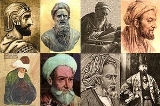
Iranian peoples

Encyclopedia
The Iranian peoples are an Indo-European
ethnic-linguistic group
, consisting of the speakers of Iranian languages
, a major branch of the Indo-European language family
, as such forming a branch of Indo-European-speaking
peoples. Their historical areas of settlement were on the Iranian plateau
mainly in Iran
, certain areas of Central Asia such as Tajikistan
, most of Afghanistan
, parts of Iraq
, Turkey
, Pakistan
and scattered parts of the Caucasus
Mountains. Their current distribution is spread across the Iranian plateau
, stretching from the Indus
in the east to central Anatolia
in the west, and from Central Asia
and the Caucasus
to the Persian Gulf
- a region that is sometimes termed the Iranian cultural continent, or Greater Persia by scholars, representing the extent of the Iranian languages and influence of the Persian People
, through the geopolitical reach of the Persian empire.
The Iranian group emerges from an earlier Indo-Iranian unity
during the Late Bronze Age, and they enter the historical record during the Early Iron Age. The Persians
formed the Achaemenid Empire by the 6th century BC, while the Scythians dominated the Eurasian steppe
. With numerous artistic, scientific, architectural and philosophical achievements and numerous kingdoms and empires that bridged much of the civilized world in antiquity, the Iranian peoples were often in close contact with the Greeks
, Romans
, Egyptians, Indians
, and Chinese
. In addition, the various religions of the Iranian peoples, including Zoroastrianism
, Mithraism
and Manichaeism
, are believed by some scholars to be important early philosophical influences on Christianity and Judaism. Early Iranian tribes
are the ancestors of many modern Iranian peoples.
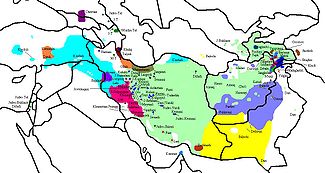
The term Iranian is derived from the Old Iranian ethnical adjective Aryana which is itself a cognate of the Sanskrit
word Arya. The name Iran is from Aryānām; lit: "[Land] of the Aryans". The old Proto-Indo-Iranian
term Arya, per Thieme
meaning "hospitable", is believed to have been one of the self-referential terms used by the Aryans, at least in the areas populated by Aryans who migrated south from Central Asia
. Another meaning for Aryan is noble. In the late part of the Avesta
(Vendidad 1) one of their homelands was referred to as Airyanem Vaejah
. The homeland varied in its geographic range, the area around Herat
(Pliny
's view) and even the entire expanse of the Iranian plateau
(Strabo
's designation).
The academic usage of the term Iranian is distinct from the state of Iran
and its various citizens (who are all Iranian by nationality and thus popularly referred to as Iranians) in the same way that Germanic people is distinct from Germans
. Many citizens of Iran are not necessarily "Iranian people" by virtue of not being speakers of Iranian languages and may not have discernible ties to ancient Iranian tribes.
Unlike the various terms connected with the Aryan arya- in Old Indian, the Old Iranian term has solely an ethnic meaning and there can be no doubt about the ethnic value of Old Iran. arya (Benveniste, 1969, I, pp. 369 f.; Szemerényi; Kellens).
The name Arya lives in the ethnic names like Alan, New Persian: Iran, Ossertian: Ir and Iron. The name Iran has been in usage since Sassanid times.
The Avesta
clearly uses airya as an ethnic name (Vd. 1; Yt. 13.143-44, etc.), where it appears in expressions such as airyāfi; daiŋˊhāvō “Iranian lands, peoples,” airyō.šayanəm “land inhabited by Iranians,” and airyanəm vaējō vaŋhuyāfi; dāityayāfi; “Iranian stretch of the good Dāityā,” the river Oxus, the modern Āmū Daryā.
The term "Ariya" appears in the royal Old Persian inscriptions in three different contexts: 1) As the name of the language of the Old Persian version of the inscription of Darius the Great in Behistun
; 2) as the ethnic background of Darius in inscriptions at Naqsh-e-Rostam and Susa (Dna, Dse) and Xerxes
in the inscription from Persepolis (Xph) and 3) as the definition of the God of Iranian people, Ahuramazda
, in the Elamite version of the Behistun inscription. For example in the Dna and Dse Darius and Xerxes describe themselves as “An Achaemenian, A Persian son of a Persian and an Aryan, of Aryan stock”. Although Darius the Great called his language the Iranian language, modern scholars refer to it as Old Persian due to the fact that it is the ancestor of modern Persian language
.
The Old Persian and Avestan evidence is confirmed by the Greek sources”. Herodotus in his Histories remarks about the Iranian Medes that: “These Medes were called anciently by all people Arians; “ (7.62). In Armenian
sources, the Parthians, Medes and Persians are collectively referred to as Iranians. Eudemus of Rhodes apud Damascius (Dubitationes et solutiones in Platonis Parmenidem 125 bis) refers to “the Magi and all those of Iranian (áreion) lineage”; Diodorus Siculus (1.94.2) considers Zoroaster (Zathraustēs) as one of the Arianoi.
Strabo
, in his "Geography", mentions the unity of Medes
, Persians, Bactrians and Sogdians:
The trilingual inscription erected by Shapur's command gives us a more clear description. The languages used are Parthian
, Middle Persian
and Greek. In Greek the inscription says: “ego ... tou Arianon ethnous despotes eimi”(“I am lord of the kingdom (Gk. nation) of the Aryans”) which translates to “I am the king of the Iranian people”. In the Middle Persian, Shapour states: “ērānšahr xwadāy hēm” and in Parthian he states: “aryānšahr xwadāy ahēm”.
The Bactrian language
(an Middle Iranian language) inscription of Kanishka
the founder of the Kushan empire at Rabatak, which was discovered in 1993 in an unexcavated site in the Afghanistan province of Baghlan clearly refers to this Eastern Iranian language as Arya
In the post-Islamic era one can still see a clear usage of the term Iran in the work of the 10th century historian Hamzeh Isfahani. In his famous book “the history of Prophets and Kings” writes: “Aryan which is also called Pars(Persia) is in the middle of these countries and these six countries surround it because the South East is in the hands China, the North of the Turks, the middle South is India
, the middle North is Rome, and the South West and the North West is the Sudan
and Berber lands”. All this evidence shows that the name arya “Iranian” was a collective definition, denoting peoples (Geiger, pp. 167 f.; Schmitt, 1978, p. 31) who were aware of belonging to the one ethnic stock, speaking a common language, and having a religious tradition that centered on the cult of Ahura Mazdā
.
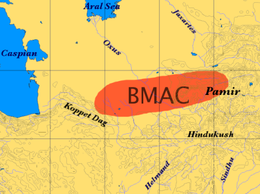 Having descended from the Proto-Indo-Iranians, it is widely believed that the Proto-Iranians separated from the Indo-Aryans
, Dards
(variously considered as Indo-Iranian or within the Indo-Aryan branch), and the Nuristani
s in the early 2nd millennium BCE, in Central Asia
. The area between northern Afghanistan, the Aral Sea
and the Urals is hypothesized to have been the region where the Proto-Iranians first emerged, following the separation of the Indo-Iranians, in the area of the previous, Indo-Iranian Bactria-Margiana Archaeological Complex
, a Bronze Age
culture of Central Asia.
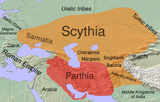
By the early 1st millennium, Ancient Iranian peoples
such as Medes
, Persians
, Bactria
ns and Parthia
ns populated the Iranian plateau
, while others such as the Scythians, Cimmerians
, Sarmatians
and Alans
populated the steppes north of the Black Sea
. The Saka
, Scythia
n, tribes spread as far west as the Balkans
and as far east as Xinjiang
. The Kushan Empire, with Bactrian roots/connections, once controlled much of Pakistan
, some of Afghanistan
and Tajikistan. The Kushan elite (who the Chinese called the Yuezhi
) were either a Tocharian-speaking (another Indo-European branch) people or an Eastern Iranian language-speaking people.
The division into an "Eastern" and a "Western" group by the early 1st millennium is visible in Avestan
vs. Old Persian
, the two oldest known Iranian languages. The Old Avestan texts known as the Gathas
are believed to have been composed by Zoroaster
, the founder of Zoroastrianism
, with the Yaz culture
(ca. 1500–1100 BCE) as a candidate for the development of Eastern Iranian culture.
Old Persian appears to have been established in written form by 519 BCE, following the creation of the Old Persian script, inspired by the cuneiform script
of the Assyrians.
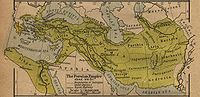
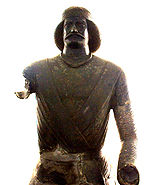 During the 1st centuries of the first millennium BCE, the ancient Persians established themselves in the western portion of the Iranian plateau and appear to have interacted considerably with the Elamites and Babylonians, while the Medes also entered in contact with the Assyrians. Remnants of the Median language
and Old Persian show their common Proto-Iranian roots, emphasized in Strabo and Herodotus' description of their languages as very similar to the languages spoken by the Bactrians and Soghdians
in the east. Following the establishment of the Achaemenid Empire, the Persian language (referred to as "Farsi" in Persian) spread from Pars or Fars Province to various regions of the Empire, with the modern dialects of Iran, Afghanistan (also known as Dari
) and Central-Asia (known as Tajiki
) descending from Old Persian.
Old Persian is attested in the Behistun Inscription
(ca. 519 BCE), recording a proclamation by Darius the Great. In southwestern Iran, the Achaemenid kings usually wrote their inscriptions in trilingual form (Elamite
, Babylonian
and Old Persian
) while elsewhere other languages were used. The administrative languages were Elamite in the early period, and later Imperial Aramaic.
The early inhabitants of the Achaemenid Empire appear to have adopted the religion of Zoroastrianism
. The Baloch
who speak a west Iranian language relate an oral tradition regarding their migration from Aleppo
, Syria
around the year 1000 AD, whereas linguistic evidence links Balochi
to Kurmanji
, Soranî
, Gorani
and Zazaki
.
as well as by archaeological finds. Many ancient Sanskrit
texts make references to tribes like Sakas, Paradas, Kambojas
, Bahlikas, Uttaramadra
s, Madra
s, Loha
s, Parama Kambojas, Rishikas
, Tukharas or Tusharas etc. and locate them in the (Uttarapatha
) (north-west) division, in Central Asia
, around Hindukush range in northern Pakistan
. The Greek
chronicler, Herodotus
(5th century BCE) makes references to a nomadic people, the Scythia
ns; he describes as having dwelt in what is today southern Russia
.
It is believed that these Scythians were conquered by their eastern cousins, the Sarmatians
, who are mentioned by Strabo
as the dominant tribe which controlled the southern Russian steppe in the 1st millennium AD. These Sarmatians were also known to the Romans
, who conquered the western tribes in the Balkans and sent Sarmatian conscripts, as part of Roman legions, as far west as Roman Britain
.
The Sarmatians of the east became the Alans
, who also ventured far and wide, with a branch ending up in Western Europe
and North Africa
, as they accompanied the Germanic Vandals
during their migrations. The modern Ossetians
are believed to be the sole direct descendants of the Alans, as other remnants of the Alans disappeared following Germanic, Hunnic
and ultimately Slavic migrations and invasions.
Another group of Alans allied with Goths to defeat the Romans and ultimately settled in what is now called Catalonia (Goth-Alania).
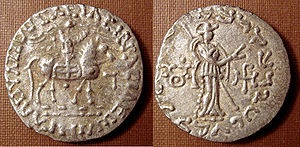
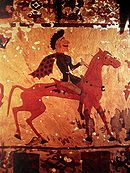 Some of the Saka-Scythian tribes in Central Asia would later move further southeast and invade the Iranian plateau
, large sections of present day Pakistan
/Afghanistan
and finally deep into the northwestern portion of the Indian subcontinent
; i.e. present day Punjab
(Persian for land of five rivers) (see Indo-Scythians
). Another Iranian tribe related to the Saka-Scythians were the Parni
in Central Asia, and who later become indistinguishable from the Parthians, speakers of a northwest-Iranian language. Many Iranian tribes, including the Khwarazmians, Massagetae
and Sogdians
, were assimilated and/or displaced in Central Asia by the migrations of Turkic tribes emanating out of Xinjiang and Siberia.
The most dominant surviving Eastern Iranian peoples are represented by the Pashtuns
, whose origins are generally believed to be from the Suleiman mountains in the Balochistan
province of Pakistan
, from which they began to spread until they reached as far west as Herat
, north to areas of southern and eastern Afghanistan; and as eastward towards the Indus
as well as adjacent areas of the Panjab and Sindh provinces of Pakistan
. The Pashto language
shows affinities to the Avestan and Bactrian
.
The modern Sarikoli in southern Xinjiang and the Ossetians
of the Caucasus are remnants of the various Saka tribes. The modern Ossetians
claim to be the descendants of the Alano-Sarmatians and their claims are supported by their Northeast Iranian language, while culturally the Ossetians resemble their Caucasian neighbors, the Kabard
ians and Circassians. Various extinct Iranian people existed in the eastern Caucasus, including the Azaris
, while some Iranian people remain in the region, including the Talysh
and the Tats
(including the Judeo-Tats
, who have relocated to Israel
), found in Azerbaijan and as far north as the Russian republic of Dagestan
. A remnant of the Sogdians is found in the Yaghnobi speaking population in parts of the Zeravshan valley in Tajikistan.
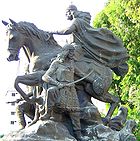 Starting with the reign of Omar
in 634 CE, Muslim
Arab
s began a conquest of the Iranian plateau. The Arabs conquered the Sassanid Empire
of the Persians and seized much of the Byzantine Empire
populated by the Kurds and others. Ultimately, the various Iranian people, including the Persians, Azaries, Kurds, Baluchis and Pashtuns, converted to Islam
. The Iranian people would later split along sectarian lines as the Persians (and later the Hazara) adopted the Shi'a sect. As ancient tribes and identities changed, so did the Iranian people, many of whom assimilated foreign cultures and people.
Later, during the 2nd millennium CE, the Iranian people would play a prominent role during the age of Islamic expansion and empire. Saladin
, a noted adversary of the Crusaders, was an ethnic Kurd
, while various empires centered in Iran (including the Safavids
) re-established a modern dialect of Persian as the official language spoken throughout much of what is today Iran and adjacent parts of Central Asia. Iranian influence spread to the Ottoman Empire, where Persian was often spoken at court, as well as in the Mughal Empire
, a Mongol-Turkic (Uzbek) peoples, which began in Afghanistan and shifted to South Asia encompassing various regions which now make up parts of Pakistan. All of the major Iranian people reasserted their use of Iranian languages following the decline of Arab rule, but would not begin to form modern national
identities until the 19th and early 20th centuries (just as Germans and Italians were beginning to formulate national identities of their own).
The following either partially descend from Iranian people or are sometimes regarded as possible descendants of ancient Iranian people:
, Lurs
, Kurds, Baloch
, and Pashtuns
accounting for about 90% of this number. Currently, most of these Iranian peoples live in Iran
, the Caucasus
(mainly Ossetia
, other parts of Georgia
, and Azerbaijan
), Kurdish
majority populated areas of Turkey
, Iraq
, Iran and Syria
, Afghanistan
, Tajikistan
, and Uzbekistan
.
Due to recent migrations, there are also large communities of speakers of Iranian languages
in Europe
, the Americas
, and Israel
.
The following is a list of Iranian people with the respective groups's core areas of settlements and their estimated sizes (in millions):
Following the Iranian split from the Indo-Iranians, the Iranians developed an increasingly distinct culture. Various common traits can be discerned among the Iranian people. For example, the social event Norouz
is an Iranian festival that is practiced by nearly all of the Iranian people as well as others in the region. Its origins are traced to Zoroastrianism
and pre-historic times.
Some Iranian cultures exhibit traits that are unique unto themselves. The Pashtuns adhere to a code of honor and culture known as Pashtunwali
, which has a similar counterpart among the Baloch
, called Mayar, that is more hierarchical.
immigrants established themselves. The earliest major religion of the Iranian people was Zoroastrianism
, which spread to nearly all of the Iranian people living in the Iranian plateau. Other religions that had their origins in the Iranian world were Mithraism
, Manichaeism
, and Mazdakism, among others.
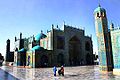 Modern speakers of Iranian languages mainly follow Islam
. Some follow Judaism
, Christianity
, Zoroastrianism
, and the Bahá'í Faith
, with an unknown number showing no religious affiliation. Overall the numbers of Sunni and Shia among the Iranian people are equally distributed. Most Kurds, Tajiks, Pashtuns, and Baluch are Sunni Muslims, while the remainder are mainly Twelver Shi'a, comprising mostly Persians
in Iran, and Hazaras in Afghanistan. Zazas in Turkey
are largely Alevi
, while the Pamiri people
s in Tajikistan
and China
are nearly all Ismaili
. The Christian community is mainly represented by the Armenian Apostolic Church
, followed by the Russian Orthodox and Georgian Orthodox Ossetians followed by Nestorians. Judaism
is followed mainly by Persian Jews
, Kurdish Jews
, Bukharian Jews (of Central Asia) and the Mountain Jews
(of the Caucasus), most of whom are now found in Israel
. The historical religion of the Persian Empire was Zoroastrianism and it still has a few thousand followers, mostly in Yazd and Kerman. They are known as the Parsis in the Indian subcontinent
, where many of them fled in historic times following the Arab conquest of Persia, or Zoroastrians in Iran
. Another ancient religion is the Yazidi
faith, followed by some Kurds in northern Iraq
, as well as the majority of the Kurds in Armenia
.
Elements of pre-Islamic Zoroastrian and shamanistic beliefs persist among some Islamized groups today, such as the Tajiks, Pashtun
s and Pamiri people
s.
-speaking minorities of Iran (notably the Azerbaijani people
) and Afghanistan (Uzbeks
and Turkmen
) are often conversant in Iranian languages, in addition to their own Turkic languages and also have Iranian culture to the extent that the term Turko-Iranian
can be applied. The usage applies to various circumstances that involve historic interaction, intermarriage, cultural assimilation, bilingualism and cultural overlap or commonalities.
Notable among this synthesis of Turko-Iranian culture are the Azeris, whose culture, religion and significant periods of history are linked to the Persians. Certain theories and genetic tests suggest that the Azeris are descendants of ancient Iranian peoples who lost their Iranian language (see Ancient Azari language
) following the Turkic invasions of Azerbaijan in the 11th century CE. In fact, throughout much of the expanse of Central Asia and the Middle East, Iranian and Turkic culture has merged in many cases to form various hybrid populations and cultures, as evident from various ruling dynasties such as the Ghaznavids
, Seljuqs and Mughals
.
Iranian cultural influences have also been significant in Central Asia
, where Turkic invaders are believed to have largely mixed with native Iranian people of which only the Tajik remain, in terms of language usage. The areas of the former Soviet Union adjacent to Iran (such as Azerbaijan
and Uzbekistan
) have gone through the prism of decades of Russian and Soviet
rule that has reshaped the Turko-Iranian cultures there to some degree.
J2
and R1a1
J2a:
Haplogroup
J2
especially the subcadle J2a is frequently found among almost all groups of Iranic people. In comparison with the Haplogroup
R1a1, J2
is not only restricted to geographically eastern and western Iranic populations, but also found among north-western and south-western Iranic populations such as the Bakhtiaris and Mazanderani, as well as geographically north-western Iranic Ossetians
. Despite its supposed origin in the fertile crescent, J2a is also found among Iranic populations in the east such as the Yagnobi which are of Soghdian origin as well as the Parsis of India. Beside the relatively high percentage among the Yagnobis in Central Asia, other Iranic populations tend to have a higher frequency of J2a when compared to neighboring Turkic populations.
The relatively strong presence of J2a among Ossetians
as well as Yagnobis proves distant from the supposed Mesopotamian origin region of J2, are carriers of this Haplogroup.
In the Indo-Iranian
context, the occurrence of J2a in South Asia is limited to caste populations, with the highest frequencies found among northern areas of South Asia. Compared with R1a1, J2a shows a more conservative distribution, stronger limited to Indo-Iranian origin groups.
R1a1:
Haplogroup
M17, also known as R1a1, has been supposed to be a diagnostic Indo-Iranian marker.
The highest R1a1 frequencies are detected in the Central Asian populations of Ishkashemi Tajiks
(68%) and Pamiri Tajiks
(64%), both groups being remnants of the original Eastern Iranian population
of the region.
Apart from these two groups, high frequencies of R1a1 are also found in Pashtuns (44.8%) and eastern parts of the Iranian Highlands
up to frequencies of 35%, similar to Northern India, while Western Iran based on Iranians sampled (52 Samples from the western part of the country) appears to have had little genetic influence from the supposed R1a1-carrying Indo-Iranians about 10%,to attributed to language replacement through the "elite-dominance" model in a similar manner which occurred in Europe
and India
. In this regard, it is likely that the Kavir
and Lut
deserts in the center of Iran
have acted as significant barriers to gene flow.
Genetic studies conducted by Cavalli-Sforza have revealed that Iranians have weak correlation with Near Eastern groups, and are closer to surrounding Indo-Europeans speaking populations.
This study is partially supported by another one, based on Y-Chromosome haplogroups.
The findings of this study reveal many common genetic markers found among the Iranian people from the Tigris
river of Iraq
to the Indus
of Pakistan
. This correlates with the Iranian languages
spoken from the Caucasus
to Kurdish areas in the Zagros region and eastwards to western Pakistan and Tajikistan and parts of Uzbekistan in Central Asia
. The extensive gene flow is perhaps an indication of the spread of Iranian-speaking people, whose languages are now spoken mainly on the Iranian plateau and adjacent regions. These results relate the relationships of Iranian people with each other, while other comparative testing reveals some varied origins for Iranian people such as the Kurds, who show genetic ties to the Caucasus at considerably higher levels than any other Iranian people except the Ossetians
, as well as links to Europe and Semitic
populations that live in close proximity such as the Arab
and Jews.
Another recent study of the genetic landscape of Iran was completed by a team of Cambridge geneticists led by Dr. Maziar Ashrafian Bonab (an Iranian Azarbaijani). Bonab remarked that his group had done extensive DNA
testing on different language groups, including Indo-European
and non Indo-European speakers, in Iran. The study found that the Azerbaijanis of Iran do not have a similar FSt and other genetic markers found in Anatolian and European Turks. However, the genetic Fst and other genetic traits like MRca and mtDNA of Iranian Azeris were identical to Persians
in Iran. Azaris of Iran also show very close genetic ties to Kurds.
Indo-European
Indo-European may refer to:* Indo-European languages** Aryan race, a 19th century and early 20th century term for those peoples who are the native speakers of Indo-European languages...
ethnic-linguistic group
Ethnolinguistics
Ethnolinguistics is a field of linguistics which studies the relationship between language and culture, and the way different ethnic groups perceive the world. It is the combination between ethnology and linguistics. The former refers to the way of life of an entire community i.e...
, consisting of the speakers of Iranian languages
Iranian languages
The Iranian languages form a subfamily of the Indo-Iranian languages which in turn is a subgroup of Indo-European language family. They have been and are spoken by Iranian peoples....
, a major branch of the Indo-European language family
Indo-European languages
The Indo-European languages are a family of several hundred related languages and dialects, including most major current languages of Europe, the Iranian plateau, and South Asia and also historically predominant in Anatolia...
, as such forming a branch of Indo-European-speaking
Indo-European languages
The Indo-European languages are a family of several hundred related languages and dialects, including most major current languages of Europe, the Iranian plateau, and South Asia and also historically predominant in Anatolia...
peoples. Their historical areas of settlement were on the Iranian plateau
Iranian plateau
The Iranian plateau, or Iranic plateau, is a geological formation in Southwest Asia. It is the part of the Eurasian Plate wedged between the Arabian and Indian plates, situated between the Zagros mountains to the west, the Caspian Sea and the Kopet Dag to the north, the Hormuz Strait and Persian...
mainly in Iran
Iran
Iran , officially the Islamic Republic of Iran , is a country in Southern and Western Asia. The name "Iran" has been in use natively since the Sassanian era and came into use internationally in 1935, before which the country was known to the Western world as Persia...
, certain areas of Central Asia such as Tajikistan
Tajikistan
Tajikistan , officially the Republic of Tajikistan , is a mountainous landlocked country in Central Asia. Afghanistan borders it to the south, Uzbekistan to the west, Kyrgyzstan to the north, and China to the east....
, most of Afghanistan
Afghanistan
Afghanistan , officially the Islamic Republic of Afghanistan, is a landlocked country located in the centre of Asia, forming South Asia, Central Asia and the Middle East. With a population of about 29 million, it has an area of , making it the 42nd most populous and 41st largest nation in the world...
, parts of Iraq
Iraq
Iraq ; officially the Republic of Iraq is a country in Western Asia spanning most of the northwestern end of the Zagros mountain range, the eastern part of the Syrian Desert and the northern part of the Arabian Desert....
, Turkey
Turkey
Turkey , known officially as the Republic of Turkey , is a Eurasian country located in Western Asia and in East Thrace in Southeastern Europe...
, Pakistan
Pakistan
Pakistan , officially the Islamic Republic of Pakistan is a sovereign state in South Asia. It has a coastline along the Arabian Sea and the Gulf of Oman in the south and is bordered by Afghanistan and Iran in the west, India in the east and China in the far northeast. In the north, Tajikistan...
and scattered parts of the Caucasus
Caucasus
The Caucasus, also Caucas or Caucasia , is a geopolitical region at the border of Europe and Asia, and situated between the Black and the Caspian sea...
Mountains. Their current distribution is spread across the Iranian plateau
Iranian plateau
The Iranian plateau, or Iranic plateau, is a geological formation in Southwest Asia. It is the part of the Eurasian Plate wedged between the Arabian and Indian plates, situated between the Zagros mountains to the west, the Caspian Sea and the Kopet Dag to the north, the Hormuz Strait and Persian...
, stretching from the Indus
Indus River
The Indus River is a major river which flows through Pakistan. It also has courses through China and India.Originating in the Tibetan plateau of western China in the vicinity of Lake Mansarovar in Tibet Autonomous Region, the river runs a course through the Ladakh district of Jammu and Kashmir and...
in the east to central Anatolia
Anatolia
Anatolia is a geographic and historical term denoting the westernmost protrusion of Asia, comprising the majority of the Republic of Turkey...
in the west, and from Central Asia
Central Asia
Central Asia is a core region of the Asian continent from the Caspian Sea in the west, China in the east, Afghanistan in the south, and Russia in the north...
and the Caucasus
Ossetia
Ossetia Ossetic: Ир, Ирыстон Ir, Iryston; Russian: Осетия, Osetiya; Georgian: ოსეთი, Oset'i) is an ethnolinguistic region located on both sides of the Greater Caucasus Mountains, largely inhabited by the Ossetians. The Ossetian language is part of the Eastern Iranian branch of the Indo-European...
to the Persian Gulf
Persian Gulf
The Persian Gulf, in Southwest Asia, is an extension of the Indian Ocean located between Iran and the Arabian Peninsula.The Persian Gulf was the focus of the 1980–1988 Iran-Iraq War, in which each side attacked the other's oil tankers...
- a region that is sometimes termed the Iranian cultural continent, or Greater Persia by scholars, representing the extent of the Iranian languages and influence of the Persian People
Persian people
The Persian people are part of the Iranian peoples who speak the modern Persian language and closely akin Iranian dialects and languages. The origin of the ethnic Iranian/Persian peoples are traced to the Ancient Iranian peoples, who were part of the ancient Indo-Iranians and themselves part of...
, through the geopolitical reach of the Persian empire.
The Iranian group emerges from an earlier Indo-Iranian unity
Indo-Iranians
Indo-Iranian peoples are a linguistic group consisting of the Indo-Aryan, Iranian, Dardic and Nuristani peoples; that is, speakers of Indo-Iranian languages, a major branch of the Indo-European language family....
during the Late Bronze Age, and they enter the historical record during the Early Iron Age. The Persians
Persian people
The Persian people are part of the Iranian peoples who speak the modern Persian language and closely akin Iranian dialects and languages. The origin of the ethnic Iranian/Persian peoples are traced to the Ancient Iranian peoples, who were part of the ancient Indo-Iranians and themselves part of...
formed the Achaemenid Empire by the 6th century BC, while the Scythians dominated the Eurasian steppe
Eurasian Steppe
The Eurasian Steppe is the vast steppe ecoregion of Eurasia in the Temperate grasslands, savannas, and shrublands Biome. It stretches from Hungary to Mongolia...
. With numerous artistic, scientific, architectural and philosophical achievements and numerous kingdoms and empires that bridged much of the civilized world in antiquity, the Iranian peoples were often in close contact with the Greeks
Hellenistic Greece
In the context of Ancient Greek art, architecture, and culture, Hellenistic Greece corresponds to the period between the death of Alexander the Great in 323 BC and the annexation of the classical Greek heartlands by Rome in 146 BC...
, Romans
Roman Empire
The Roman Empire was the post-Republican period of the ancient Roman civilization, characterised by an autocratic form of government and large territorial holdings in Europe and around the Mediterranean....
, Egyptians, Indians
History of India
The history of India begins with evidence of human activity of Homo sapiens as long as 75,000 years ago, or with earlier hominids including Homo erectus from about 500,000 years ago. The Indus Valley Civilization, which spread and flourished in the northwestern part of the Indian subcontinent from...
, and Chinese
History of China
Chinese civilization originated in various regional centers along both the Yellow River and the Yangtze River valleys in the Neolithic era, but the Yellow River is said to be the Cradle of Chinese Civilization. With thousands of years of continuous history, China is one of the world's oldest...
. In addition, the various religions of the Iranian peoples, including Zoroastrianism
Zoroastrianism
Zoroastrianism is a religion and philosophy based on the teachings of prophet Zoroaster and was formerly among the world's largest religions. It was probably founded some time before the 6th century BCE in Greater Iran.In Zoroastrianism, the Creator Ahura Mazda is all good, and no evil...
, Mithraism
Mithraism
The Mithraic Mysteries were a mystery religion practised in the Roman Empire from about the 1st to 4th centuries AD. The name of the Persian god Mithra, adapted into Greek as Mithras, was linked to a new and distinctive imagery...
and Manichaeism
Manichaeism
Manichaeism in Modern Persian Āyin e Māni; ) was one of the major Iranian Gnostic religions, originating in Sassanid Persia.Although most of the original writings of the founding prophet Mani have been lost, numerous translations and fragmentary texts have survived...
, are believed by some scholars to be important early philosophical influences on Christianity and Judaism. Early Iranian tribes
Ancient Iranian peoples
Iranian peoples first appear in Assyrian records in the 9th century BCE. In Classical Antiquity they were found primarily in Scythia and Persia...
are the ancestors of many modern Iranian peoples.
Name
The term Iranian is derived from the Old Iranian ethnical adjective Aryana which is itself a cognate of the Sanskrit
Sanskrit
Sanskrit , is a historical Indo-Aryan language and the primary liturgical language of Hinduism, Jainism and Buddhism.Buddhism: besides Pali, see Buddhist Hybrid Sanskrit Today, it is listed as one of the 22 scheduled languages of India and is an official language of the state of Uttarakhand...
word Arya. The name Iran is from Aryānām; lit: "[Land] of the Aryans". The old Proto-Indo-Iranian
Proto-Indo-Iranian language
Proto-Indo-Iranian is the reconstructed proto-language of the Indo-Iranian branch of Indo-European. Its speakers, the hypothetical Proto-Indo-Iranians, are assumed to have lived in the late 3rd millennium BC, and are usually connected with the early Andronovo archaeological...
term Arya, per Thieme
Paul Thieme
Paul Thieme was a scholar of Vedic Sanskrit. He received his doctorate in Indology in 1928 in Göttingen, and habilitated there in 1932. From 1932 to 1935 he taught German and French at the University of Allahabad...
meaning "hospitable", is believed to have been one of the self-referential terms used by the Aryans, at least in the areas populated by Aryans who migrated south from Central Asia
Central Asia
Central Asia is a core region of the Asian continent from the Caspian Sea in the west, China in the east, Afghanistan in the south, and Russia in the north...
. Another meaning for Aryan is noble. In the late part of the Avesta
Avesta
The Avesta is the primary collection of sacred texts of Zoroastrianism, composed in the Avestan language.-Early transmission:The texts of the Avesta — which are all in the Avestan language — were composed over the course of several hundred years. The most important portion, the Gathas,...
(Vendidad 1) one of their homelands was referred to as Airyanem Vaejah
Airyanem Vaejah
Airyanəm Vaējah, which approximately means "expanse of the Aryans, i.e. Iranians" is the "mythical homeland" of early Iranians and a reference in the Zoroastrian Avesta Airyanəm Vaējah, which approximately means "expanse of the Aryans, i.e. Iranians" is the "mythical homeland" of early Iranians and...
. The homeland varied in its geographic range, the area around Herat
Herat
Herāt is the capital of Herat province in Afghanistan. It is the third largest city of Afghanistan, with a population of about 397,456 as of 2006. It is situated in the valley of the Hari River, which flows from the mountains of central Afghanistan to the Karakum Desert in Turkmenistan...
(Pliny
Pliny the Elder
Gaius Plinius Secundus , better known as Pliny the Elder, was a Roman author, naturalist, and natural philosopher, as well as naval and army commander of the early Roman Empire, and personal friend of the emperor Vespasian...
's view) and even the entire expanse of the Iranian plateau
Iranian plateau
The Iranian plateau, or Iranic plateau, is a geological formation in Southwest Asia. It is the part of the Eurasian Plate wedged between the Arabian and Indian plates, situated between the Zagros mountains to the west, the Caspian Sea and the Kopet Dag to the north, the Hormuz Strait and Persian...
(Strabo
Strabo
Strabo, also written Strabon was a Greek historian, geographer and philosopher.-Life:Strabo was born to an affluent family from Amaseia in Pontus , a city which he said was situated the approximate equivalent of 75 km from the Black Sea...
's designation).
The academic usage of the term Iranian is distinct from the state of Iran
Iran
Iran , officially the Islamic Republic of Iran , is a country in Southern and Western Asia. The name "Iran" has been in use natively since the Sassanian era and came into use internationally in 1935, before which the country was known to the Western world as Persia...
and its various citizens (who are all Iranian by nationality and thus popularly referred to as Iranians) in the same way that Germanic people is distinct from Germans
Germans
The Germans are a Germanic ethnic group native to Central Europe. The English term Germans has referred to the German-speaking population of the Holy Roman Empire since the Late Middle Ages....
. Many citizens of Iran are not necessarily "Iranian people" by virtue of not being speakers of Iranian languages and may not have discernible ties to ancient Iranian tribes.
Unlike the various terms connected with the Aryan arya- in Old Indian, the Old Iranian term has solely an ethnic meaning and there can be no doubt about the ethnic value of Old Iran. arya (Benveniste, 1969, I, pp. 369 f.; Szemerényi; Kellens).
The name Arya lives in the ethnic names like Alan, New Persian: Iran, Ossertian: Ir and Iron. The name Iran has been in usage since Sassanid times.
The Avesta
Avesta
The Avesta is the primary collection of sacred texts of Zoroastrianism, composed in the Avestan language.-Early transmission:The texts of the Avesta — which are all in the Avestan language — were composed over the course of several hundred years. The most important portion, the Gathas,...
clearly uses airya as an ethnic name (Vd. 1; Yt. 13.143-44, etc.), where it appears in expressions such as airyāfi; daiŋˊhāvō “Iranian lands, peoples,” airyō.šayanəm “land inhabited by Iranians,” and airyanəm vaējō vaŋhuyāfi; dāityayāfi; “Iranian stretch of the good Dāityā,” the river Oxus, the modern Āmū Daryā.
The term "Ariya" appears in the royal Old Persian inscriptions in three different contexts: 1) As the name of the language of the Old Persian version of the inscription of Darius the Great in Behistun
Behistun Inscription
The Behistun Inscription The Behistun Inscription The Behistun Inscription (also Bistun or Bisutun, Modern Persian: بیستون The Behistun Inscription (also Bistun or Bisutun, Modern Persian: بیستون...
; 2) as the ethnic background of Darius in inscriptions at Naqsh-e-Rostam and Susa (Dna, Dse) and Xerxes
Xerxes
Xerxes is a male name. Most notably, it may refer to Xerxes I of Persia . It may also refer to:-People:*Xerxes II of Persia, reigned 424 BCE*Xerxes of Armenia, Armenian king, assassinated around 212 BCE...
in the inscription from Persepolis (Xph) and 3) as the definition of the God of Iranian people, Ahuramazda
Ahura Mazda
Ahura Mazdā is the Avestan name for a divinity of the Old Iranian religion who was proclaimed the uncreated God by Zoroaster, the founder of Zoroastrianism...
, in the Elamite version of the Behistun inscription. For example in the Dna and Dse Darius and Xerxes describe themselves as “An Achaemenian, A Persian son of a Persian and an Aryan, of Aryan stock”. Although Darius the Great called his language the Iranian language, modern scholars refer to it as Old Persian due to the fact that it is the ancestor of modern Persian language
Persian language
Persian is an Iranian language within the Indo-Iranian branch of the Indo-European languages. It is primarily spoken in Iran, Afghanistan, Tajikistan and countries which historically came under Persian influence...
.
The Old Persian and Avestan evidence is confirmed by the Greek sources”. Herodotus in his Histories remarks about the Iranian Medes that: “These Medes were called anciently by all people Arians; “ (7.62). In Armenian
Armenians
Armenian people or Armenians are a nation and ethnic group native to the Armenian Highland.The largest concentration is in Armenia having a nearly-homogeneous population with 97.9% or 3,145,354 being ethnic Armenian....
sources, the Parthians, Medes and Persians are collectively referred to as Iranians. Eudemus of Rhodes apud Damascius (Dubitationes et solutiones in Platonis Parmenidem 125 bis) refers to “the Magi and all those of Iranian (áreion) lineage”; Diodorus Siculus (1.94.2) considers Zoroaster (Zathraustēs) as one of the Arianoi.
Strabo
Strabo
Strabo, also written Strabon was a Greek historian, geographer and philosopher.-Life:Strabo was born to an affluent family from Amaseia in Pontus , a city which he said was situated the approximate equivalent of 75 km from the Black Sea...
, in his "Geography", mentions the unity of Medes
Medes
The MedesThe Medes...
, Persians, Bactrians and Sogdians:
The trilingual inscription erected by Shapur's command gives us a more clear description. The languages used are Parthian
Parthian language
The Parthian language, also known as Arsacid Pahlavi and Pahlavanik, is a now-extinct ancient Northwestern Iranian language spoken in Parthia, a region of northeastern ancient Persia during the rule of the Parthian empire....
, Middle Persian
Middle Persian
Middle Persian , indigenously known as "Pârsig" sometimes referred to as Pahlavi or Pehlevi, is the Middle Iranian language/ethnolect of Southwestern Iran that during Sassanid times became a prestige dialect and so came to be spoken in other regions as well. Middle Persian is classified as a...
and Greek. In Greek the inscription says: “ego ... tou Arianon ethnous despotes eimi”(“I am lord of the kingdom (Gk. nation) of the Aryans”) which translates to “I am the king of the Iranian people”. In the Middle Persian, Shapour states: “ērānšahr xwadāy hēm” and in Parthian he states: “aryānšahr xwadāy ahēm”.
The Bactrian language
Bactrian language
The Bactrian language is an extinct Eastern Iranian language which was spoken in the Central Asian region of Bactria. Linguistically, it is classified as belonging to the middle period of the East Iranian branch...
(an Middle Iranian language) inscription of Kanishka
Kanishka
Kanishka ) was an emperor of the Kushan Empire, ruling an empire extending from Bactria to large parts of northern India in the 2nd century of the common era, and famous for his military, political, and spiritual achievements...
the founder of the Kushan empire at Rabatak, which was discovered in 1993 in an unexcavated site in the Afghanistan province of Baghlan clearly refers to this Eastern Iranian language as Arya
In the post-Islamic era one can still see a clear usage of the term Iran in the work of the 10th century historian Hamzeh Isfahani. In his famous book “the history of Prophets and Kings” writes: “Aryan which is also called Pars(Persia) is in the middle of these countries and these six countries surround it because the South East is in the hands China, the North of the Turks, the middle South is India
India
India , officially the Republic of India , is a country in South Asia. It is the seventh-largest country by geographical area, the second-most populous country with over 1.2 billion people, and the most populous democracy in the world...
, the middle North is Rome, and the South West and the North West is the Sudan
Sudan
Sudan , officially the Republic of the Sudan , is a country in North Africa, sometimes considered part of the Middle East politically. It is bordered by Egypt to the north, the Red Sea to the northeast, Eritrea and Ethiopia to the east, South Sudan to the south, the Central African Republic to the...
and Berber lands”. All this evidence shows that the name arya “Iranian” was a collective definition, denoting peoples (Geiger, pp. 167 f.; Schmitt, 1978, p. 31) who were aware of belonging to the one ethnic stock, speaking a common language, and having a religious tradition that centered on the cult of Ahura Mazdā
Ahura Mazda
Ahura Mazdā is the Avestan name for a divinity of the Old Iranian religion who was proclaimed the uncreated God by Zoroaster, the founder of Zoroastrianism...
.
Roots
Indo-Aryans
Indo-Aryan is an ethno-linguistic term referring to the wide collection of peoples united as native speakers of the Indo-Aryan branch of the Indo-Iranian family of Indo-European languages...
, Dards
Dard people
The Dards are a group of people defined by linguistic similarities, and not common ethnicity, predominantly found in Eastern Afghanistan, in the Indian State of Jammu and Kashmir and in the Northern Areas and North West Frontier Province of Pakistan...
(variously considered as Indo-Iranian or within the Indo-Aryan branch), and the Nuristani
Nuristani
The Nuristani people are an ethnic group Aryan-Iranian to the Nuristan region of northeastern Iran and Afghanistan. The Nuristanis are a people whose ancestors practiced what was apparently an ancient Indo-Iranian polytheistic religion until they were conquered and converted to Islam in the late...
s in the early 2nd millennium BCE, in Central Asia
Central Asia
Central Asia is a core region of the Asian continent from the Caspian Sea in the west, China in the east, Afghanistan in the south, and Russia in the north...
. The area between northern Afghanistan, the Aral Sea
Aral Sea
The Aral Sea was a lake that lay between Kazakhstan in the north and Karakalpakstan, an autonomous region of Uzbekistan, in the south...
and the Urals is hypothesized to have been the region where the Proto-Iranians first emerged, following the separation of the Indo-Iranians, in the area of the previous, Indo-Iranian Bactria-Margiana Archaeological Complex
Bactria-Margiana Archaeological Complex
The Bactria–Margiana Archaeological Complex is the modern archaeological designation for a Bronze Age culture of Central Asia, dated to ca. 2300–1700 BC, located in present day Turkmenistan, northern Afghanistan and northeastern Iran, southern Uzbekistan and western Tajikistan, centered on...
, a Bronze Age
Bronze Age
The Bronze Age is a period characterized by the use of copper and its alloy bronze as the chief hard materials in the manufacture of some implements and weapons. Chronologically, it stands between the Stone Age and Iron Age...
culture of Central Asia.
By the early 1st millennium, Ancient Iranian peoples
Ancient Iranian peoples
Iranian peoples first appear in Assyrian records in the 9th century BCE. In Classical Antiquity they were found primarily in Scythia and Persia...
such as Medes
Medes
The MedesThe Medes...
, Persians
Persian people
The Persian people are part of the Iranian peoples who speak the modern Persian language and closely akin Iranian dialects and languages. The origin of the ethnic Iranian/Persian peoples are traced to the Ancient Iranian peoples, who were part of the ancient Indo-Iranians and themselves part of...
, Bactria
Bactria
Bactria and also appears in the Zend Avesta as Bukhdi. It is the ancient name of a historical region located between south of the Amu Darya and west of the Indus River...
ns and Parthia
Parthia
Parthia is a region of north-eastern Iran, best known for having been the political and cultural base of the Arsacid dynasty, rulers of the Parthian Empire....
ns populated the Iranian plateau
Iranian plateau
The Iranian plateau, or Iranic plateau, is a geological formation in Southwest Asia. It is the part of the Eurasian Plate wedged between the Arabian and Indian plates, situated between the Zagros mountains to the west, the Caspian Sea and the Kopet Dag to the north, the Hormuz Strait and Persian...
, while others such as the Scythians, Cimmerians
Cimmerians
The Cimmerians or Kimmerians were ancient equestrian nomads of Indo-European origin.According to the Greek historian Herodotus, of the 5th century BC, the Cimmerians inhabited the region north of the Caucasus and the Black Sea during the 8th and 7th centuries BC, in what is now Ukraine and Russia...
, Sarmatians
Sarmatians
The Iron Age Sarmatians were an Iranian people in Classical Antiquity, flourishing from about the 5th century BC to the 4th century AD....
and Alans
Alans
The Alans, or the Alani, occasionally termed Alauni or Halani, were a group of Sarmatian tribes, nomadic pastoralists of the 1st millennium AD who spoke an Eastern Iranian language which derived from Scytho-Sarmatian and which in turn evolved into modern Ossetian.-Name:The various forms of Alan —...
populated the steppes north of the Black Sea
Black Sea
The Black Sea is bounded by Europe, Anatolia and the Caucasus and is ultimately connected to the Atlantic Ocean via the Mediterranean and the Aegean seas and various straits. The Bosphorus strait connects it to the Sea of Marmara, and the strait of the Dardanelles connects that sea to the Aegean...
. The Saka
Saka
The Saka were a Scythian tribe or group of tribes....
, Scythia
Scythia
In antiquity, Scythian or Scyths were terms used by the Greeks to refer to certain Iranian groups of horse-riding nomadic pastoralists who dwelt on the Pontic-Caspian steppe...
n, tribes spread as far west as the Balkans
Balkans
The Balkans is a geopolitical and cultural region of southeastern Europe...
and as far east as Xinjiang
Xinjiang
Xinjiang is an autonomous region of the People's Republic of China. It is the largest Chinese administrative division and spans over 1.6 million km2...
. The Kushan Empire, with Bactrian roots/connections, once controlled much of Pakistan
Pakistan
Pakistan , officially the Islamic Republic of Pakistan is a sovereign state in South Asia. It has a coastline along the Arabian Sea and the Gulf of Oman in the south and is bordered by Afghanistan and Iran in the west, India in the east and China in the far northeast. In the north, Tajikistan...
, some of Afghanistan
Afghanistan
Afghanistan , officially the Islamic Republic of Afghanistan, is a landlocked country located in the centre of Asia, forming South Asia, Central Asia and the Middle East. With a population of about 29 million, it has an area of , making it the 42nd most populous and 41st largest nation in the world...
and Tajikistan. The Kushan elite (who the Chinese called the Yuezhi
Yuezhi
The Yuezhi, or Rouzhi , also known as the Da Yuezhi or Da Rouzhi , were an ancient Central Asian people....
) were either a Tocharian-speaking (another Indo-European branch) people or an Eastern Iranian language-speaking people.
The division into an "Eastern" and a "Western" group by the early 1st millennium is visible in Avestan
Avestan language
Avestan is an East Iranian language known only from its use as the language of Zoroastrian scripture, i.e. the Avesta, from which it derives its name...
vs. Old Persian
Old Persian language
The Old Persian language is one of the two directly attested Old Iranian languages . Old Persian appears primarily in the inscriptions, clay tablets, and seals of the Achaemenid era...
, the two oldest known Iranian languages. The Old Avestan texts known as the Gathas
Gathas
The Gathas are 17 hymns believed to have been composed by Zarathusthra himself. They are the most sacred texts of the Zoroastrian faith.-Structure and organization:...
are believed to have been composed by Zoroaster
Zoroaster
Zoroaster , also known as Zarathustra , was a prophet and the founder of Zoroastrianism who was either born in North Western or Eastern Iran. He is credited with the authorship of the Yasna Haptanghaiti as well as the Gathas, hymns which are at the liturgical core of Zoroastrianism...
, the founder of Zoroastrianism
Zoroastrianism
Zoroastrianism is a religion and philosophy based on the teachings of prophet Zoroaster and was formerly among the world's largest religions. It was probably founded some time before the 6th century BCE in Greater Iran.In Zoroastrianism, the Creator Ahura Mazda is all good, and no evil...
, with the Yaz culture
Yaz culture
The Yaz culture is an early Iron Age culture of Bactria and Margiana . It has been regarded as a likely archaeological reflection of early East Iranian culture as described in the Avesta. So far, no burials related to the culture have been found, and this was taken as evidence of the Zoroastrian...
(ca. 1500–1100 BCE) as a candidate for the development of Eastern Iranian culture.
Old Persian appears to have been established in written form by 519 BCE, following the creation of the Old Persian script, inspired by the cuneiform script
Cuneiform script
Cuneiform script )) is one of the earliest known forms of written expression. Emerging in Sumer around the 30th century BC, with predecessors reaching into the late 4th millennium , cuneiform writing began as a system of pictographs...
of the Assyrians.
Western Iranic peoples
Median language
The Median language was the language of the Medes. It is an Old Iranian language and classified as belonging to the northwestern Iranian subfamily which includes many other languages such as Azari, Zazaki, Gilaki, Mazandarani, Kurdish and Baluchi.-Attestation:Median is only attested by numerous...
and Old Persian show their common Proto-Iranian roots, emphasized in Strabo and Herodotus' description of their languages as very similar to the languages spoken by the Bactrians and Soghdians
Sogdiana
Sogdiana or Sogdia was the ancient civilization of an Iranian people and a province of the Achaemenid Empire, eighteenth in the list on the Behistun Inscription of Darius the Great . Sogdiana is "listed" as the second of the "good lands and countries" that Ahura Mazda created...
in the east. Following the establishment of the Achaemenid Empire, the Persian language (referred to as "Farsi" in Persian) spread from Pars or Fars Province to various regions of the Empire, with the modern dialects of Iran, Afghanistan (also known as Dari
Dari (Afghanistan)
Dari or Fārsī-ye Darī in historical terms refers to the Persian court language of the Sassanids. In contemporary usage, the term refers to the dialects of modern Persian language spoken in Afghanistan, and hence known as Afghan Persian in some Western sources. It is the term officially recognized...
) and Central-Asia (known as Tajiki
Tajik language
Tajik, Tajik Persian, or Tajiki, is a variety of modern Persian spoken in Central Asia. Historically Tajiks called their language zabani farsī , meaning Persian language in English; the term zabani tajikī, or Tajik language, was introduced in the 20th century by the Soviets...
) descending from Old Persian.
Old Persian is attested in the Behistun Inscription
Behistun Inscription
The Behistun Inscription The Behistun Inscription The Behistun Inscription (also Bistun or Bisutun, Modern Persian: بیستون The Behistun Inscription (also Bistun or Bisutun, Modern Persian: بیستون...
(ca. 519 BCE), recording a proclamation by Darius the Great. In southwestern Iran, the Achaemenid kings usually wrote their inscriptions in trilingual form (Elamite
Elamite language
Elamite is an extinct language spoken by the ancient Elamites. Elamite was the primary language in present day Iran from 2800–550 BCE. The last written records in Elamite appear about the time of the conquest of the Persian Empire by Alexander the Great....
, Babylonian
Akkadian language
Akkadian is an extinct Semitic language that was spoken in ancient Mesopotamia. The earliest attested Semitic language, it used the cuneiform writing system derived ultimately from ancient Sumerian, an unrelated language isolate...
and Old Persian
Old Persian language
The Old Persian language is one of the two directly attested Old Iranian languages . Old Persian appears primarily in the inscriptions, clay tablets, and seals of the Achaemenid era...
) while elsewhere other languages were used. The administrative languages were Elamite in the early period, and later Imperial Aramaic.
The early inhabitants of the Achaemenid Empire appear to have adopted the religion of Zoroastrianism
Zoroastrianism
Zoroastrianism is a religion and philosophy based on the teachings of prophet Zoroaster and was formerly among the world's largest religions. It was probably founded some time before the 6th century BCE in Greater Iran.In Zoroastrianism, the Creator Ahura Mazda is all good, and no evil...
. The Baloch
Baloch people
The Baloch or Baluch are an ethnic group that belong to the larger Iranian peoples. Baluch people mainly inhabit the Balochistan region and Sistan and Baluchestan Province in the southeast corner of the Iranian plateau in Western Asia....
who speak a west Iranian language relate an oral tradition regarding their migration from Aleppo
Aleppo
Aleppo is the largest city in Syria and the capital of Aleppo Governorate, the most populous Syrian governorate. With an official population of 2,301,570 , expanding to over 2.5 million in the metropolitan area, it is also one of the largest cities in the Levant...
, Syria
Syria
Syria , officially the Syrian Arab Republic , is a country in Western Asia, bordering Lebanon and the Mediterranean Sea to the West, Turkey to the north, Iraq to the east, Jordan to the south, and Israel to the southwest....
around the year 1000 AD, whereas linguistic evidence links Balochi
Balochi language
Balochi is a Northwestern Iranian language. It is the principal language of the Baloch of Balochistan, Pakistan, eastern Iran and southern Afghanistan. It is also spoken as a second language by some Brahui. It is designated as one of nine official languages of Pakistan.-Vowels:The Balochi vowel...
to Kurmanji
Kurmanji
Kurmanji or Northern Kurdish is the most commonly spoken dialect of the Kurdish language.- Scripts and books :...
, Soranî
Soranî
Soranî is the name of a Kurdish language that is spoken in Iran and Iraq. Soranî is one of the main Kurdish languages, which are a branch of the Iranian languages.- Name :...
, Gorani
Gorani
Gorani may refer to:In culture:* Gorani people, a Balkan ethnic groupIn geography:* Gorani, a village in Uda Commune, Argeş County, Romania* Gorani, a village in Odăile Commune, Buzău County, Romania...
and Zazaki
Zazaki language
Zazaki is an Indo-European language spoken primarily in eastern Turkey. According to Ethnologue, the language is a part of the northwestern group of the Iranian section of the Indo-European family. Zazaki shares many features, structures, and vocabulary with Gorani, Talyshi and other Caspian...
.
Eastern Iranic peoples
While the Iranian tribes of the south are better known through their texts and modern counterparts, the tribes which remained largely in the vast Eurasian expanse are known through the references made to them by the ancient Greeks, Persians, Indo-AryansIndo-Aryans
Indo-Aryan is an ethno-linguistic term referring to the wide collection of peoples united as native speakers of the Indo-Aryan branch of the Indo-Iranian family of Indo-European languages...
as well as by archaeological finds. Many ancient Sanskrit
Sanskrit
Sanskrit , is a historical Indo-Aryan language and the primary liturgical language of Hinduism, Jainism and Buddhism.Buddhism: besides Pali, see Buddhist Hybrid Sanskrit Today, it is listed as one of the 22 scheduled languages of India and is an official language of the state of Uttarakhand...
texts make references to tribes like Sakas, Paradas, Kambojas
Kambojas
The Kambojas were a kshatriya tribe of Iron Age India, frequently mentioned in Sanskrit and Pali literature.They were an Indo-Iranian tribe situated at the boundary of the Indo-Aryans and the Iranians, and appear to have moved from the Iranian into the Indo-Aryan sphere over time.The Kambojas...
, Bahlikas, Uttaramadra
Uttaramadra
The Uttaramadra was the northern branch of the Madra people who are numerously referenced in ancient Sanskrit and Pali literature.In Aitareya Brahmana , the Uttarakuru and the Uttaramadra tribes are stated to be living beyond Himalaya...
s, Madra
Madra
Madra, Mada or Madraka is the name of an ancient region and its inhabitants, located in the north-west division of the ancient Indian sub-continent.-Uttaramadra division:...
s, Loha
Loha
Loha is a city and a municipal council in Nanded district in the Indian state of Maharashtra.-Demographics: India census, Loha had a population of 20,135. Males constitute 52% of the population and females 48%. Loha has an average literacy rate of 65%, higher than the national average of 59.5%:...
s, Parama Kambojas, Rishikas
Rishikas
Rshikas were an ancient tribe living in the northern division of ancient India. They find references in the Mahabharata, Ramayana, Brhat Samhita, Markendeya Purana etc. Ashtadhyayi of Pāṇini does not mention the Rishikas, but Mahabhasya of Patanjali does make reference to this people. Mahabharata...
, Tukharas or Tusharas etc. and locate them in the (Uttarapatha
Uttarapatha
Ancient Buddhist and Hindu texts use Uttarapatha as the name of the northern part of Jambudvipa, one of the "continents" in Hindu mythology.The name is derived from the Sanskrit terms uttara, for north, and patha, for road...
) (north-west) division, in Central Asia
Central Asia
Central Asia is a core region of the Asian continent from the Caspian Sea in the west, China in the east, Afghanistan in the south, and Russia in the north...
, around Hindukush range in northern Pakistan
Pakistan
Pakistan , officially the Islamic Republic of Pakistan is a sovereign state in South Asia. It has a coastline along the Arabian Sea and the Gulf of Oman in the south and is bordered by Afghanistan and Iran in the west, India in the east and China in the far northeast. In the north, Tajikistan...
. The Greek
Ancient Greece
Ancient Greece is a civilization belonging to a period of Greek history that lasted from the Archaic period of the 8th to 6th centuries BC to the end of antiquity. Immediately following this period was the beginning of the Early Middle Ages and the Byzantine era. Included in Ancient Greece is the...
chronicler, Herodotus
Herodotus
Herodotus was an ancient Greek historian who was born in Halicarnassus, Caria and lived in the 5th century BC . He has been called the "Father of History", and was the first historian known to collect his materials systematically, test their accuracy to a certain extent and arrange them in a...
(5th century BCE) makes references to a nomadic people, the Scythia
Scythia
In antiquity, Scythian or Scyths were terms used by the Greeks to refer to certain Iranian groups of horse-riding nomadic pastoralists who dwelt on the Pontic-Caspian steppe...
ns; he describes as having dwelt in what is today southern Russia
Russia
Russia or , officially known as both Russia and the Russian Federation , is a country in northern Eurasia. It is a federal semi-presidential republic, comprising 83 federal subjects...
.
It is believed that these Scythians were conquered by their eastern cousins, the Sarmatians
Sarmatians
The Iron Age Sarmatians were an Iranian people in Classical Antiquity, flourishing from about the 5th century BC to the 4th century AD....
, who are mentioned by Strabo
Strabo
Strabo, also written Strabon was a Greek historian, geographer and philosopher.-Life:Strabo was born to an affluent family from Amaseia in Pontus , a city which he said was situated the approximate equivalent of 75 km from the Black Sea...
as the dominant tribe which controlled the southern Russian steppe in the 1st millennium AD. These Sarmatians were also known to the Romans
Ancient Rome
Ancient Rome was a thriving civilization that grew on the Italian Peninsula as early as the 8th century BC. Located along the Mediterranean Sea and centered on the city of Rome, it expanded to one of the largest empires in the ancient world....
, who conquered the western tribes in the Balkans and sent Sarmatian conscripts, as part of Roman legions, as far west as Roman Britain
Roman Britain
Roman Britain was the part of the island of Great Britain controlled by the Roman Empire from AD 43 until ca. AD 410.The Romans referred to the imperial province as Britannia, which eventually comprised all of the island of Great Britain south of the fluid frontier with Caledonia...
.
The Sarmatians of the east became the Alans
Alans
The Alans, or the Alani, occasionally termed Alauni or Halani, were a group of Sarmatian tribes, nomadic pastoralists of the 1st millennium AD who spoke an Eastern Iranian language which derived from Scytho-Sarmatian and which in turn evolved into modern Ossetian.-Name:The various forms of Alan —...
, who also ventured far and wide, with a branch ending up in Western Europe
Western Europe
Western Europe is a loose term for the collection of countries in the western most region of the European continents, though this definition is context-dependent and carries cultural and political connotations. One definition describes Western Europe as a geographic entity—the region lying in the...
and North Africa
North Africa
North Africa or Northern Africa is the northernmost region of the African continent, linked by the Sahara to Sub-Saharan Africa. Geopolitically, the United Nations definition of Northern Africa includes eight countries or territories; Algeria, Egypt, Libya, Morocco, South Sudan, Sudan, Tunisia, and...
, as they accompanied the Germanic Vandals
Vandals
The Vandals were an East Germanic tribe that entered the late Roman Empire during the 5th century. The Vandals under king Genseric entered Africa in 429 and by 439 established a kingdom which included the Roman Africa province, besides the islands of Sicily, Corsica, Sardinia and the Balearics....
during their migrations. The modern Ossetians
Ossetians
The Ossetians are an Iranic ethnic group of the Caucasus Mountains, eponymous of the region known as Ossetia.They speak Ossetic, an Iranian language of the Eastern branch, with most also fluent in Russian as a second language....
are believed to be the sole direct descendants of the Alans, as other remnants of the Alans disappeared following Germanic, Hunnic
Huns
The Huns were a group of nomadic people who, appearing from east of the Volga River, migrated into Europe c. AD 370 and established the vast Hunnic Empire there. Since de Guignes linked them with the Xiongnu, who had been northern neighbours of China 300 years prior to the emergence of the Huns,...
and ultimately Slavic migrations and invasions.
Another group of Alans allied with Goths to defeat the Romans and ultimately settled in what is now called Catalonia (Goth-Alania).
Iranian plateau
The Iranian plateau, or Iranic plateau, is a geological formation in Southwest Asia. It is the part of the Eurasian Plate wedged between the Arabian and Indian plates, situated between the Zagros mountains to the west, the Caspian Sea and the Kopet Dag to the north, the Hormuz Strait and Persian...
, large sections of present day Pakistan
Pakistan
Pakistan , officially the Islamic Republic of Pakistan is a sovereign state in South Asia. It has a coastline along the Arabian Sea and the Gulf of Oman in the south and is bordered by Afghanistan and Iran in the west, India in the east and China in the far northeast. In the north, Tajikistan...
/Afghanistan
Afghanistan
Afghanistan , officially the Islamic Republic of Afghanistan, is a landlocked country located in the centre of Asia, forming South Asia, Central Asia and the Middle East. With a population of about 29 million, it has an area of , making it the 42nd most populous and 41st largest nation in the world...
and finally deep into the northwestern portion of the Indian subcontinent
Indian subcontinent
The Indian subcontinent, also Indian Subcontinent, Indo-Pak Subcontinent or South Asian Subcontinent is a region of the Asian continent on the Indian tectonic plate from the Hindu Kush or Hindu Koh, Himalayas and including the Kuen Lun and Karakoram ranges, forming a land mass which extends...
; i.e. present day Punjab
Punjab region
The Punjab , also spelled Panjab |water]]s"), is a geographical region straddling the border between Pakistan and India which includes Punjab province in Pakistan and the states of the Punjab, Haryana, Himachal Pradesh, Chandigarh and some northern parts of the National Capital Territory of Delhi...
(Persian for land of five rivers) (see Indo-Scythians
Indo-Scythians
Indo-Scythians is a term used to refer to Sakas , who migrated into Bactria, Sogdiana, Arachosia, Gandhara, Kashmir, Punjab, Haryana, Uttar Pradesh, Gujarat, Maharashtra and Rajasthan, from the middle of the 2nd century BCE to the 4th century CE....
). Another Iranian tribe related to the Saka-Scythians were the Parni
Parni
The Parni or Aparni were an east Iranian people of the Ochus River valley, southeast of the Caspian Sea...
in Central Asia, and who later become indistinguishable from the Parthians, speakers of a northwest-Iranian language. Many Iranian tribes, including the Khwarazmians, Massagetae
Massagetae
The Massageteans or Massagetaeans were an Iranian nomadic confederation in antiquity known primarily from the writings of Herodotus. Their name was probably akin to Thyssagetae.-Name:...
and Sogdians
Sogdiana
Sogdiana or Sogdia was the ancient civilization of an Iranian people and a province of the Achaemenid Empire, eighteenth in the list on the Behistun Inscription of Darius the Great . Sogdiana is "listed" as the second of the "good lands and countries" that Ahura Mazda created...
, were assimilated and/or displaced in Central Asia by the migrations of Turkic tribes emanating out of Xinjiang and Siberia.
The most dominant surviving Eastern Iranian peoples are represented by the Pashtuns
Pashtun people
Pashtuns or Pathans , also known as ethnic Afghans , are an Eastern Iranic ethnic group with populations primarily between the Hindu Kush mountains in Afghanistan and the Indus River in Pakistan...
, whose origins are generally believed to be from the Suleiman mountains in the Balochistan
Balochistan (Pakistan)
Balochistan is one of the four provinces or federating units of Pakistan. With an area of 134,051 mi2 or , it is the largest province of Pakistan, constituting approximately 44% of the total land mass of Pakistan. According to the 1998 population census, Balochistan had a population of...
province of Pakistan
Pakistan
Pakistan , officially the Islamic Republic of Pakistan is a sovereign state in South Asia. It has a coastline along the Arabian Sea and the Gulf of Oman in the south and is bordered by Afghanistan and Iran in the west, India in the east and China in the far northeast. In the north, Tajikistan...
, from which they began to spread until they reached as far west as Herat
Herat
Herāt is the capital of Herat province in Afghanistan. It is the third largest city of Afghanistan, with a population of about 397,456 as of 2006. It is situated in the valley of the Hari River, which flows from the mountains of central Afghanistan to the Karakum Desert in Turkmenistan...
, north to areas of southern and eastern Afghanistan; and as eastward towards the Indus
Indus River
The Indus River is a major river which flows through Pakistan. It also has courses through China and India.Originating in the Tibetan plateau of western China in the vicinity of Lake Mansarovar in Tibet Autonomous Region, the river runs a course through the Ladakh district of Jammu and Kashmir and...
as well as adjacent areas of the Panjab and Sindh provinces of Pakistan
Pakistan
Pakistan , officially the Islamic Republic of Pakistan is a sovereign state in South Asia. It has a coastline along the Arabian Sea and the Gulf of Oman in the south and is bordered by Afghanistan and Iran in the west, India in the east and China in the far northeast. In the north, Tajikistan...
. The Pashto language
Pashto language
Pashto , known as Afghani in Persian and Pathani in Punjabi , is the native language of the indigenous Pashtun people or Afghan people who are found primarily between an area south of the Amu Darya in Afghanistan and...
shows affinities to the Avestan and Bactrian
Bactrian language
The Bactrian language is an extinct Eastern Iranian language which was spoken in the Central Asian region of Bactria. Linguistically, it is classified as belonging to the middle period of the East Iranian branch...
.
The modern Sarikoli in southern Xinjiang and the Ossetians
Ossetians
The Ossetians are an Iranic ethnic group of the Caucasus Mountains, eponymous of the region known as Ossetia.They speak Ossetic, an Iranian language of the Eastern branch, with most also fluent in Russian as a second language....
of the Caucasus are remnants of the various Saka tribes. The modern Ossetians
Ossetians
The Ossetians are an Iranic ethnic group of the Caucasus Mountains, eponymous of the region known as Ossetia.They speak Ossetic, an Iranian language of the Eastern branch, with most also fluent in Russian as a second language....
claim to be the descendants of the Alano-Sarmatians and their claims are supported by their Northeast Iranian language, while culturally the Ossetians resemble their Caucasian neighbors, the Kabard
Kabard
Kabarda or Kabard ; are terms referring to a people of the northern Caucasus more commonly known by the plural term Kabardin . Originally they Kabarda or Kabard ; are terms referring to a people of the northern Caucasus more commonly known by the plural term Kabardin (or Kebertei as they term...
ians and Circassians. Various extinct Iranian people existed in the eastern Caucasus, including the Azaris
Ancient Azari language
Azari is the name used for the Iranian language composed of groups of dialects which were spoken in Azerbaijan at one time. Some linguists have also designated the southern Tati dialects of Azerbaijan like those spoken by the Tats around Khalkhal, Harzand and Keringan as a remnant of Azari...
, while some Iranian people remain in the region, including the Talysh
Talysh people
Talysh are an Iranian people indigenous to a region shared between Azerbaijan and Iran which spans the South Caucasus and the southwestern shore of the Caspian Sea. They speak the Talysh language, one of the Northwestern Iranian languages...
and the Tats
Tats
Tats are an Iranian people, presently living within Azerbaijan, Armenia, and Russia ....
(including the Judeo-Tats
Mountain Jews
Highland Jews, Mountain Jews or Kavkazi Jews also known as Juvuro or Juhuro, are Jews of the eastern Caucasus, mainly of Azerbaijan and Dagestan. They are also known as Caucasus Jews, Caucasian Jews, or less commonly East Caucasian Jews, because the majority of these Jews settled the eastern part...
, who have relocated to Israel
Israel
The State of Israel is a parliamentary republic located in the Middle East, along the eastern shore of the Mediterranean Sea...
), found in Azerbaijan and as far north as the Russian republic of Dagestan
Dagestan
The Republic of Dagestan is a federal subject of Russia, located in the North Caucasus region. Its capital and the largest city is Makhachkala, located at the center of Dagestan on the Caspian Sea...
. A remnant of the Sogdians is found in the Yaghnobi speaking population in parts of the Zeravshan valley in Tajikistan.
Later developments
Umar
`Umar ibn al-Khattāb c. 2 November , was a leading companion and adviser to the Islamic prophet Muhammad who later became the second Muslim Caliph after Muhammad's death....
in 634 CE, Muslim
Muslim
A Muslim, also spelled Moslem, is an adherent of Islam, a monotheistic, Abrahamic religion based on the Quran, which Muslims consider the verbatim word of God as revealed to prophet Muhammad. "Muslim" is the Arabic term for "submitter" .Muslims believe that God is one and incomparable...
Arab
Arab
Arab people, also known as Arabs , are a panethnicity primarily living in the Arab world, which is located in Western Asia and North Africa. They are identified as such on one or more of genealogical, linguistic, or cultural grounds, with tribal affiliations, and intra-tribal relationships playing...
s began a conquest of the Iranian plateau. The Arabs conquered the Sassanid Empire
Sassanid Empire
The Sassanid Empire , known to its inhabitants as Ērānshahr and Ērān in Middle Persian and resulting in the New Persian terms Iranshahr and Iran , was the last pre-Islamic Persian Empire, ruled by the Sasanian Dynasty from 224 to 651...
of the Persians and seized much of the Byzantine Empire
Byzantine Empire
The Byzantine Empire was the Eastern Roman Empire during the periods of Late Antiquity and the Middle Ages, centred on the capital of Constantinople. Known simply as the Roman Empire or Romania to its inhabitants and neighbours, the Empire was the direct continuation of the Ancient Roman State...
populated by the Kurds and others. Ultimately, the various Iranian people, including the Persians, Azaries, Kurds, Baluchis and Pashtuns, converted to Islam
Islam
Islam . The most common are and . : Arabic pronunciation varies regionally. The first vowel ranges from ~~. The second vowel ranges from ~~~...
. The Iranian people would later split along sectarian lines as the Persians (and later the Hazara) adopted the Shi'a sect. As ancient tribes and identities changed, so did the Iranian people, many of whom assimilated foreign cultures and people.
Later, during the 2nd millennium CE, the Iranian people would play a prominent role during the age of Islamic expansion and empire. Saladin
Saladin
Ṣalāḥ ad-Dīn Yūsuf ibn Ayyūb , better known in the Western world as Saladin, was an Arabized Kurdish Muslim, who became the first Sultan of Egypt and Syria, and founded the Ayyubid dynasty. He led Muslim and Arab opposition to the Franks and other European Crusaders in the Levant...
, a noted adversary of the Crusaders, was an ethnic Kurd
Kürd
Kürd or Kyurd or Kyurt may refer to:*Kürd Eldarbəyli, Azerbaijan*Kürd Mahrızlı, Azerbaijan*Kürd, Goychay, Azerbaijan*Kürd, Jalilabad, Azerbaijan*Kürd, Qabala, Azerbaijan*Qurdbayram, Azerbaijan...
, while various empires centered in Iran (including the Safavids
Safavid dynasty
The Safavid dynasty was one of the most significant ruling dynasties of Iran. They ruled one of the greatest Persian empires since the Muslim conquest of Persia and established the Twelver school of Shi'a Islam as the official religion of their empire, marking one of the most important turning...
) re-established a modern dialect of Persian as the official language spoken throughout much of what is today Iran and adjacent parts of Central Asia. Iranian influence spread to the Ottoman Empire, where Persian was often spoken at court, as well as in the Mughal Empire
Mughal Empire
The Mughal Empire , or Mogul Empire in traditional English usage, was an imperial power from the Indian Subcontinent. The Mughal emperors were descendants of the Timurids...
, a Mongol-Turkic (Uzbek) peoples, which began in Afghanistan and shifted to South Asia encompassing various regions which now make up parts of Pakistan. All of the major Iranian people reasserted their use of Iranian languages following the decline of Arab rule, but would not begin to form modern national
Nationalism
Nationalism is a political ideology that involves a strong identification of a group of individuals with a political entity defined in national terms, i.e. a nation. In the 'modernist' image of the nation, it is nationalism that creates national identity. There are various definitions for what...
identities until the 19th and early 20th centuries (just as Germans and Italians were beginning to formulate national identities of their own).
The following either partially descend from Iranian people or are sometimes regarded as possible descendants of ancient Iranian people:
- Turkic-speakers:Turkic languagesThe Turkic languages constitute a language family of at least thirty five languages, spoken by Turkic peoples across a vast area from Eastern Europe and the Mediterranean to Siberia and Western China, and are considered to be part of the proposed Altaic language family.Turkic languages are spoken...
- AzerisAzerbaijani peopleThe Azerbaijanis are a Turkic-speaking people living mainly in northwestern Iran and the Republic of Azerbaijan, as well as in the neighbourhood states, Georgia, Russia and formerly Armenia. Commonly referred to as Azeris or Azerbaijani Turks , they also live in a wider area from the Caucasus to...
: Although AzerisAzerbaijani peopleThe Azerbaijanis are a Turkic-speaking people living mainly in northwestern Iran and the Republic of Azerbaijan, as well as in the neighbourhood states, Georgia, Russia and formerly Armenia. Commonly referred to as Azeris or Azerbaijani Turks , they also live in a wider area from the Caucasus to...
speak a Turkic language (modern Azerbaijani languageAzerbaijani languageAzerbaijani or Azeri or Torki is a language belonging to the Turkic language family, spoken in southwestern Asia by the Azerbaijani people, primarily in Azerbaijan and northwestern Iran...
), they are believed to be primarily descendants of ancient Iranians. and TurksTurkish peopleTurkish people, also known as the "Turks" , are an ethnic group primarily living in Turkey and in the former lands of the Ottoman Empire where Turkish minorities had been established in Bulgaria, Cyprus, Bosnia and Herzegovina, Georgia, Greece, Kosovo, Macedonia, and Romania...
. Thus, due to their historical ties with various ancient Iranians, as well as their cultural ties to Persians, the Azeris are often associated with the Iranian people (see Origin of Azerbaijani people and the Iranian theory regarding the origin of the AzerbaijanisIranian theory regarding the origin of the AzerbaijanisThe Azerbaijani are of mixed ethnic origin, the oldest element deriving from the indigenous population of eastern Transcaucasia and possibly from the Medians of northern Persia. This population was Persianized during the period of the Sassanian dynasty of Iran...
for more details). - UzbeksUzbeksThe Uzbeks are a Turkic ethnic group in Central Asia. They comprise the majority population of Uzbekistan, and large populations can also be found in Afghanistan, Tajikstan, Kyrgyzstan, Turkmenistan, Kazakhstan, Russia, Pakistan, Mongolia and the Xinjiang Uyghur Autonomous Region of China...
: The modern Uzbek people are believed to have both Iranian and Turkic ancestry. "Uzbek" and "Tajik" are modern designations given to the culturally homogeneous, sedentary population of Central Asia. The local ancestors of both groups - the Turkic-speaking Uzbeks and the Iranian-speaking Tajiks - were known as "SartSartSart is a name for the settled inhabitants of Central Asia which has had shifting meanings over the centuries. Sarts, known sometimes as Ak-Sart in ancient times, did not have any particular ethnic identification, and were usually town-dwellers.-Origin:There are several theories about the origin...
s" ("sedentary merchants") prior to the Russian conquestRussian EmpireThe Russian Empire was a state that existed from 1721 until the Russian Revolution of 1917. It was the successor to the Tsardom of Russia and the predecessor of the Soviet Union...
of Central Asia, while "Uzbek" or "Turk" were the names given to the nomadic and semi-nomadic populations of the area. Still today, modern Uzbeks and Tajiks are known as "Sarts" to their Turkic neighbours, the KazakhsKazakhsThe Kazakhs are a Turkic people of the northern parts of Central Asia ....
and the Kyrgyz. The ancient Soghdians and BactriansBactriansThe Bactrians were the inhabitants of Bactria.Several important trade routes from India and China passed through Bactria and, as early as the Bronze Age, this had allowed the accumulation of vast amounts of wealth by the mostly nomadic population. The first proto-urban civilization in the area...
are among their ancestors. Culturally, the Uzbeks are closer to their sedentary Iranian-speaking neighbours rather than to their nomadic and semi-nomadic Turkic neighbours. Some Uzbek scholars, i.e. Ahmadov and Askarov, favour the Iranian origin theory. - The native name of YakutsYakutsYakuts , are a Turkic people associated with the Sakha Republic.The Yakut or Sakha language belongs to the Northern branch of the Turkic family of languages....
is SakhaYakutsYakuts , are a Turkic people associated with the Sakha Republic.The Yakut or Sakha language belongs to the Northern branch of the Turkic family of languages....
, very similar to the Sakkas, proposing Yakuts to be related of descendants of Scythians, specifically Sakkahs.
- Azeris
- Slavic-speakersSouth SlavsThe South Slavs are the southern branch of the Slavic peoples and speak South Slavic languages. Geographically, the South Slavs are native to the Balkan peninsula, the southern Pannonian Plain and the eastern Alps...
:- A few linguists suggest that the names of the South SlavicSouth SlavsThe South Slavs are the southern branch of the Slavic peoples and speak South Slavic languages. Geographically, the South Slavs are native to the Balkan peninsula, the southern Pannonian Plain and the eastern Alps...
people, the SerbsSerbsThe Serbs are a South Slavic ethnic group of the Balkans and southern Central Europe. Serbs are located mainly in Serbia, Montenegro and Bosnia and Herzegovina, and form a sizable minority in Croatia, the Republic of Macedonia and Slovenia. Likewise, Serbs are an officially recognized minority in...
and CroatsCroatsCroats are a South Slavic ethnic group mostly living in Croatia, Bosnia and Herzegovina and nearby countries. There are around 4 million Croats living inside Croatia and up to 4.5 million throughout the rest of the world. Responding to political, social and economic pressure, many Croats have...
are of Iranian origin. Those who entertain such a connection propose that the Sarmatian Serboi and Horouthos tribes might have migrated from the Eurasian steppe lands to eastern Europe, and assimilated with the numerically superior Slavs, passing on their name. Iranian-speaking people did inhabit parts of the Balkans in late classical times, and would have been encountered by the Slavs. However, direct linguistic, historical or archaeological proof for such a theory is lacking. (See also: Theories on the origin of Serbs and Theories on the origin of Croats) - Some modern Bulgarian historians claim that the BulgarsBulgarsThe Bulgars were a semi-nomadic who flourished in the Pontic Steppe and the Volga basin in the 7th century.The Bulgars emerge after the collapse of the Hunnic Empire in the 5th century....
were of Iranian origin and that they migrated to Europe from the region of today's northern Afghanistan - Hindukush mountains, from the Kingdom of BalharaKingdom of BalharaKingdom of Balhara is a controversial hypothesis of some Bulgarian scientists to have been the earliest known state of the ancient Bulgars, situated in the upper course of Oxus River , and the foothills and valleys of Hindu Kush and Pamir Mountains...
. Their claims are based on medieval Armenian sources, the writings of ancient historians ("Ashharatsuyts" by Anania Shirakatsi; Agathias of Myrina, Theophylact Simocatta, Michael the Syrian) archaeological findings in modern Bulgaria, the similarities with Iranic languages (place names, people names, and Iranic words in modern Bulgarian), similarities with culture (e.g.: some buildings in PliskaPliskaPliska is the name of both the first capital of Danubian Bulgaria and a small town which was renamed after the historical Pliska after its site was determined and excavations began....
were built in a Zoroastrian fashion; similarities in traditional music, dancing and carpet making) and the very close similarity of the DNA of Pamirian/Iranic people with that of modern Bulgarians After their arrival on Balkans, the Bulgars subjugated and then formed an allience with the local Slavs and formed the Bulgarian nation.
- A few linguists suggest that the names of the South Slavic
- Finno-Ugric speakers
- Many Volga FinnsVolga FinnsThe Volga Finns are a historical group of indigenous peoples of Russia whose descendants include the Mari people, the Erzya and the Moksha Mordvins, as well as extinct Merya, Muromian and Meshchera people...
may be of part Iranian admixture due to BulgarBulgarsThe Bulgars were a semi-nomadic who flourished in the Pontic Steppe and the Volga basin in the 7th century.The Bulgars emerge after the collapse of the Hunnic Empire in the 5th century....
invasion of the Volga basin, if they (Bulgars) were Iranian people. - Hungarians have long prided themselves as Scythians in the past, Scythians being an Iranian people, prior to the Finno-Ugric theory. It's possible they've undergone a language shift. In a Magyar folkore suggests Iranian admixture among Hungarian, when Hunor and Magor marry princesses who were AlansAlansThe Alans, or the Alani, occasionally termed Alauni or Halani, were a group of Sarmatian tribes, nomadic pastoralists of the 1st millennium AD who spoke an Eastern Iranian language which derived from Scytho-Sarmatian and which in turn evolved into modern Ossetian.-Name:The various forms of Alan —...
, another Iranian people. Jassic peopleJassic peopleThe Jassic people or Jász are an ethnic group of Hungarians who mostly live in the Jász-Nagykun-Szolnok county of the Republic of Hungary. They are of Ossetic origin and originally spoke the Jassic dialect of the Ossetic language...
of Hungary are of OssetiaOssetiaOssetia Ossetic: Ир, Ирыстон Ir, Iryston; Russian: Осетия, Osetiya; Georgian: ოსეთი, Oset'i) is an ethnolinguistic region located on both sides of the Greater Caucasus Mountains, largely inhabited by the Ossetians. The Ossetian language is part of the Eastern Iranian branch of the Indo-European...
n origin. SzekelySzékelyThe Székelys or Székely , sometimes also referred to as Szeklers , are a subgroup of the Hungarian people living mostly in the Székely Land, an ethno-cultural region in eastern Transylvania, Romania...
is pronounced "Sae-Kai" and are possibly of Iranian origin, as their name is similar to Sakka.
- Many Volga Finns
- Swahili-speakers:Swahili languageSwahili or Kiswahili is a Bantu language spoken by various ethnic groups that inhabit several large stretches of the Mozambique Channel coastline from northern Kenya to northern Mozambique, including the Comoro Islands. It is also spoken by ethnic minority groups in Somalia...
- Shirazis:The Shirazi are a sub-group of the Swahili peopleSwahili peopleThe Swahili people are a Bantu ethnic group and culture found in East Africa, mainly in the coastal regions and the islands of Kenya, Tanzania and north Mozambique. According to JoshuaProject, the Swahili number in at around 1,328,000. The name Swahili is derived from the Arabic word Sawahil,...
living on the Swahili CoastSwahili CoastThe Swahili Coast refers to the coast or coastal area of East Africa inhabited by the Swahili people, mainly Kenya, Tanzania, and north Mozambique...
of East AfricaEast AfricaEast Africa or Eastern Africa is the easterly region of the African continent, variably defined by geography or geopolitics. In the UN scheme of geographic regions, 19 territories constitute Eastern Africa:...
, especially on the islands of ZanzibarZanzibarZanzibar ,Persian: زنگبار, from suffix bār: "coast" and Zangi: "bruin" ; is a semi-autonomous part of Tanzania, in East Africa. It comprises the Zanzibar Archipelago in the Indian Ocean, off the coast of the mainland, and consists of numerous small islands and two large ones: Unguja , and Pemba...
, Pemba and ComorosComorosThe Comoros , officially the Union of the Comoros is an archipelago island nation in the Indian Ocean, located off the eastern coast of Africa, on the northern end of the Mozambique Channel, between northeastern Mozambique and northwestern Madagascar...
. Local traditions about their origin claim they are descended from merchant princes from ShirazShirazShiraz may refer to:* Shiraz, Iran, a city in Iran* Shiraz County, an administrative subdivision of Iran* Vosketap, Armenia, formerly called ShirazPeople:* Hovhannes Shiraz, Armenian poet* Ara Shiraz, Armenian sculptor...
in Persia who settled along the Swahili CoastSwahili CoastThe Swahili Coast refers to the coast or coastal area of East Africa inhabited by the Swahili people, mainly Kenya, Tanzania, and north Mozambique...
.
- Shirazis:The Shirazi are a sub-group of the Swahili people
Demographics
There are an estimated 150 to 200 million native speakers of Iranian languages, the five major groups of PersiansPersian people
The Persian people are part of the Iranian peoples who speak the modern Persian language and closely akin Iranian dialects and languages. The origin of the ethnic Iranian/Persian peoples are traced to the Ancient Iranian peoples, who were part of the ancient Indo-Iranians and themselves part of...
, Lurs
Lurs
Lurs are an Iranic people living mainly in south-western Iran. Their population is estimated at above two million. They occupy Lorestan, Bakhtiari, and Kuh-Gilu-Boir Ahmed. "....
, Kurds, Baloch
Baloch people
The Baloch or Baluch are an ethnic group that belong to the larger Iranian peoples. Baluch people mainly inhabit the Balochistan region and Sistan and Baluchestan Province in the southeast corner of the Iranian plateau in Western Asia....
, and Pashtuns
Pashtun people
Pashtuns or Pathans , also known as ethnic Afghans , are an Eastern Iranic ethnic group with populations primarily between the Hindu Kush mountains in Afghanistan and the Indus River in Pakistan...
accounting for about 90% of this number. Currently, most of these Iranian peoples live in Iran
Iran
Iran , officially the Islamic Republic of Iran , is a country in Southern and Western Asia. The name "Iran" has been in use natively since the Sassanian era and came into use internationally in 1935, before which the country was known to the Western world as Persia...
, the Caucasus
Caucasus
The Caucasus, also Caucas or Caucasia , is a geopolitical region at the border of Europe and Asia, and situated between the Black and the Caspian sea...
(mainly Ossetia
Ossetia
Ossetia Ossetic: Ир, Ирыстон Ir, Iryston; Russian: Осетия, Osetiya; Georgian: ოსეთი, Oset'i) is an ethnolinguistic region located on both sides of the Greater Caucasus Mountains, largely inhabited by the Ossetians. The Ossetian language is part of the Eastern Iranian branch of the Indo-European...
, other parts of Georgia
Georgia (country)
Georgia is a sovereign state in the Caucasus region of Eurasia. Located at the crossroads of Western Asia and Eastern Europe, it is bounded to the west by the Black Sea, to the north by Russia, to the southwest by Turkey, to the south by Armenia, and to the southeast by Azerbaijan. The capital of...
, and Azerbaijan
Azerbaijan
Azerbaijan , officially the Republic of Azerbaijan is the largest country in the Caucasus region of Eurasia. Located at the crossroads of Western Asia and Eastern Europe, it is bounded by the Caspian Sea to the east, Russia to the north, Georgia to the northwest, Armenia to the west, and Iran to...
), Kurdish
Kurdish people
The Kurdish people, or Kurds , are an Iranian people native to the Middle East, mostly inhabiting a region known as Kurdistan, which includes adjacent parts of Iran, Iraq, Syria, and Turkey...
majority populated areas of Turkey
Turkey
Turkey , known officially as the Republic of Turkey , is a Eurasian country located in Western Asia and in East Thrace in Southeastern Europe...
, Iraq
Iraq
Iraq ; officially the Republic of Iraq is a country in Western Asia spanning most of the northwestern end of the Zagros mountain range, the eastern part of the Syrian Desert and the northern part of the Arabian Desert....
, Iran and Syria
Syria
Syria , officially the Syrian Arab Republic , is a country in Western Asia, bordering Lebanon and the Mediterranean Sea to the West, Turkey to the north, Iraq to the east, Jordan to the south, and Israel to the southwest....
, Afghanistan
Afghanistan
Afghanistan , officially the Islamic Republic of Afghanistan, is a landlocked country located in the centre of Asia, forming South Asia, Central Asia and the Middle East. With a population of about 29 million, it has an area of , making it the 42nd most populous and 41st largest nation in the world...
, Tajikistan
Tajikistan
Tajikistan , officially the Republic of Tajikistan , is a mountainous landlocked country in Central Asia. Afghanistan borders it to the south, Uzbekistan to the west, Kyrgyzstan to the north, and China to the east....
, and Uzbekistan
Uzbekistan
Uzbekistan , officially the Republic of Uzbekistan is a doubly landlocked country in Central Asia and one of the six independent Turkic states. It shares borders with Kazakhstan to the west and to the north, Kyrgyzstan and Tajikistan to the east, and Afghanistan and Turkmenistan to the south....
.
Due to recent migrations, there are also large communities of speakers of Iranian languages
Iranian languages
The Iranian languages form a subfamily of the Indo-Iranian languages which in turn is a subgroup of Indo-European language family. They have been and are spoken by Iranian peoples....
in Europe
Europe
Europe is, by convention, one of the world's seven continents. Comprising the westernmost peninsula of Eurasia, Europe is generally 'divided' from Asia to its east by the watershed divides of the Ural and Caucasus Mountains, the Ural River, the Caspian and Black Seas, and the waterways connecting...
, the Americas
Americas
The Americas, or America , are lands in the Western hemisphere, also known as the New World. In English, the plural form the Americas is often used to refer to the landmasses of North America and South America with their associated islands and regions, while the singular form America is primarily...
, and Israel
Israel
The State of Israel is a parliamentary republic located in the Middle East, along the eastern shore of the Mediterranean Sea...
.
The following is a list of Iranian people with the respective groups's core areas of settlements and their estimated sizes (in millions):
| People | region | population |
|---|---|---|
| Persians Persian people The Persian people are part of the Iranian peoples who speak the modern Persian language and closely akin Iranian dialects and languages. The origin of the ethnic Iranian/Persian peoples are traced to the Ancient Iranian peoples, who were part of the ancient Indo-Iranians and themselves part of...
|
IranPersian speakers in- Afghanistan, Tajikistan, Pakistan, Uzbekistan | 60-70 |
| Pashtuns
Durrani Durrani or Abdali is the name of a chief Pashtun tribal confederation in Afghanistan and Pakistan. Originally known by their ancient name Abdali later as Durrani they have been called Durrani since the beginning of the Durrani Empire in 1747. The number of Durranis are estimated to be roughly 16%... Ghilzai Ghilzai are the largest Pashtun tribal confederacy found in Afghanistan and Pakistan. They are also known historically as Ghilji, Khilji, Ghalji, Ghilzye, and possibly Gharzai... Wazir (tribe) Wazirs or Waziris are a Pashtun tribe settled in the North Waziristan and South Waziristan agencies of Pakistan as well in the urban cities of Tank, F.R Bannu,i.e Domel and adjacent villages, Karachi and Lahore. Across the border, they can also be found in Paktia, Khost and Paktika provinces of... |
Afghanistan and Pakistan | 48-50 |
| Kurds Kurdish people The Kurdish people, or Kurds , are an Iranian people native to the Middle East, mostly inhabiting a region known as Kurdistan, which includes adjacent parts of Iran, Iraq, Syria, and Turkey... Soranî Soranî is the name of a Kurdish language that is spoken in Iran and Iraq. Soranî is one of the main Kurdish languages, which are a branch of the Iranian languages.- Name :... s. Kurmanji Kurmanji or Northern Kurdish is the most commonly spoken dialect of the Kurdish language.- Scripts and books :... s. Lak people (Iran) The Laks are an Iranian group in southwestern Iran. They speak Laki , a Northwestern Iranian language, that is usually grouped with Southern Kurdish dialects... Zaza people The Zazas, Kird, Kirmanc or Dimilis are an ethnic Iranic people whose native language is Zazaki spoken in eastern Anatolia. They primarily live in the eastern Anatolian provinces, such as Adıyaman, Aksaray, Batman, Bingöl, Diyarbakır, Elazığ, Erzurum, Erzincan , Gumushane, Kars, Malatya, Mus,... |
Iran, Iraq, Turkey, Syria, Armenia, Azerbaijan, Georgia, Turkmenistan, Israel and Lebanon |
23-38 |
| Baluchis Baloch people The Baloch or Baluch are an ethnic group that belong to the larger Iranian peoples. Baluch people mainly inhabit the Balochistan region and Sistan and Baluchestan Province in the southeast corner of the Iranian plateau in Western Asia.... |
Iran, Pakistan & Afghanistan | 10 |
| Gilakis & Mazanderanis Mazandarani people The Mazandarani people are Iranian people of Caucasus origin living primarily in south of the Caspian Sea coast. The Elburz mountains mark the southern limit of Mazandarani peoples .- People:... |
Iran | 5-10 |
| Lurs Lurs Lurs are an Iranic people living mainly in south-western Iran. Their population is estimated at above two million. They occupy Lorestan, Bakhtiari, and Kuh-Gilu-Boir Ahmed. ".... & Bakhtiaris |
Iran | 6
Laks Lak people (Iran) The Laks are an Iranian group in southwestern Iran. They speak Laki , a Northwestern Iranian language, that is usually grouped with Southern Kurdish dialects... Iran 0.5 |
| Pamiri people Pamiri people Pamiri is the name of an Iranian ethnic group in the Gorno-Badakhshan Autonomous Province in Tajikistan.-Ethnic Identity:The Pamiris are composed of people who speak the Pamiri languages, the indigenous language in the Gorno-Badakhshan autonomous province, and adhere to the Ismaili sect of Shia...
|
Tajikistan, China (Xinjiang), Afghanistan |
0.9 |
| Talysh Talysh people Talysh are an Iranian people indigenous to a region shared between Azerbaijan and Iran which spans the South Caucasus and the southwestern shore of the Caspian Sea. They speak the Talysh language, one of the Northwestern Iranian languages... |
Azerbaijan, Iran | 0.5 |
| Ossetians Ossetians The Ossetians are an Iranic ethnic group of the Caucasus Mountains, eponymous of the region known as Ossetia.They speak Ossetic, an Iranian language of the Eastern branch, with most also fluent in Russian as a second language.... |
South Ossetia, Georgia, Russia (North Ossetia), Hungary |
0.7 |
| Parsis | Pakistan and India | 0.1 |
| Yaghnobi Yaghnobi people Yaghnobi people, or Yagnobian people, is the name of an isolated people who live in the Sughd province of Tajikistan in the valleys of the Yagnob, Kul and Varzob rivers. These are the last living relics of the great Sogdian nation that once inhabited most of Central Asia beyond the Oxus/Amu Darya... |
Uzbekistan and Tajikistan (Zerafshan region) | 0.025 |
| Kumzari | Oman (Musandam Musandam Musandam Governorate is a governorate of Oman.Geographically, the Musandam peninsula juts into the Strait of Hormuz, the narrow entry into the Persian Gulf, from the Arabian Peninsula. The Musandam peninsula is an exclave of Oman, separated from the rest of the country by the United Arab Emirates... ) |
0.021 |
Diversity
It is largely through linguistic similarities that the Iranian people have been linked, as many non-Iranian people have adopted Iranian languages and cultures. However, other common traits have been identified as well and a stream of common historical events have often linked the southern Iranian people, including Hellenistic conquests, the various empires based in Persia, Arab Caliphates and Turkic invasions.Culture
Like other Indo-Europeans, the early Iranians practiced ritual sacrifice, had a social hierarchy consisting of warriors, clerics and farmers and poetic hymns and sagas to recount their deeds.Following the Iranian split from the Indo-Iranians, the Iranians developed an increasingly distinct culture. Various common traits can be discerned among the Iranian people. For example, the social event Norouz
Norouz
Nowrūz is the name of the Iranian New Year in Iranian calendars and the corresponding traditional celebrations. Nowruz is also widely referred to as the Persian New Year....
is an Iranian festival that is practiced by nearly all of the Iranian people as well as others in the region. Its origins are traced to Zoroastrianism
Zoroastrianism
Zoroastrianism is a religion and philosophy based on the teachings of prophet Zoroaster and was formerly among the world's largest religions. It was probably founded some time before the 6th century BCE in Greater Iran.In Zoroastrianism, the Creator Ahura Mazda is all good, and no evil...
and pre-historic times.
Some Iranian cultures exhibit traits that are unique unto themselves. The Pashtuns adhere to a code of honor and culture known as Pashtunwali
Pashtunwali
Pashtunwali or Pakhtunwali is a non-written ethical code and traditional lifestyle which the indigenous Pashtun people from Afghanistan and Pakistan follow. Some in the Indian subcontinent refer to it as "Pathanwali". Its meaning may also be interpreted as "the way of the Pashtuns" or "the code of...
, which has a similar counterpart among the Baloch
Baloch people
The Baloch or Baluch are an ethnic group that belong to the larger Iranian peoples. Baluch people mainly inhabit the Balochistan region and Sistan and Baluchestan Province in the southeast corner of the Iranian plateau in Western Asia....
, called Mayar, that is more hierarchical.
Religion
The early Iranian people worshipped various deities found throughout other cultures where Indo-EuropeanProto-Indo-Europeans
The Proto-Indo-Europeans were the speakers of the Proto-Indo-European language , a reconstructed prehistoric language of Eurasia.Knowledge of them comes chiefly from the linguistic reconstruction, along with material evidence from archaeology and archaeogenetics...
immigrants established themselves. The earliest major religion of the Iranian people was Zoroastrianism
Zoroastrianism
Zoroastrianism is a religion and philosophy based on the teachings of prophet Zoroaster and was formerly among the world's largest religions. It was probably founded some time before the 6th century BCE in Greater Iran.In Zoroastrianism, the Creator Ahura Mazda is all good, and no evil...
, which spread to nearly all of the Iranian people living in the Iranian plateau. Other religions that had their origins in the Iranian world were Mithraism
Mithraism
The Mithraic Mysteries were a mystery religion practised in the Roman Empire from about the 1st to 4th centuries AD. The name of the Persian god Mithra, adapted into Greek as Mithras, was linked to a new and distinctive imagery...
, Manichaeism
Manichaeism
Manichaeism in Modern Persian Āyin e Māni; ) was one of the major Iranian Gnostic religions, originating in Sassanid Persia.Although most of the original writings of the founding prophet Mani have been lost, numerous translations and fragmentary texts have survived...
, and Mazdakism, among others.
Islam
Islam . The most common are and . : Arabic pronunciation varies regionally. The first vowel ranges from ~~. The second vowel ranges from ~~~...
. Some follow Judaism
Persian Jews
Persian Jews , are Jews historically associated with Iran, traditionally known as Persia in Western sources.Judaism is one of the oldest religions practiced in Iran. The Book of Esther contains some references to the experiences of Jews in Persia...
, Christianity
Christianity
Christianity is a monotheistic religion based on the life and teachings of Jesus as presented in canonical gospels and other New Testament writings...
, Zoroastrianism
Zoroastrianism
Zoroastrianism is a religion and philosophy based on the teachings of prophet Zoroaster and was formerly among the world's largest religions. It was probably founded some time before the 6th century BCE in Greater Iran.In Zoroastrianism, the Creator Ahura Mazda is all good, and no evil...
, and the Bahá'í Faith
Bahá'í Faith
The Bahá'í Faith is a monotheistic religion founded by Bahá'u'lláh in 19th-century Persia, emphasizing the spiritual unity of all humankind. There are an estimated five to six million Bahá'ís around the world in more than 200 countries and territories....
, with an unknown number showing no religious affiliation. Overall the numbers of Sunni and Shia among the Iranian people are equally distributed. Most Kurds, Tajiks, Pashtuns, and Baluch are Sunni Muslims, while the remainder are mainly Twelver Shi'a, comprising mostly Persians
Persian people
The Persian people are part of the Iranian peoples who speak the modern Persian language and closely akin Iranian dialects and languages. The origin of the ethnic Iranian/Persian peoples are traced to the Ancient Iranian peoples, who were part of the ancient Indo-Iranians and themselves part of...
in Iran, and Hazaras in Afghanistan. Zazas in Turkey
Turkey
Turkey , known officially as the Republic of Turkey , is a Eurasian country located in Western Asia and in East Thrace in Southeastern Europe...
are largely Alevi
Alevi
The Alevi are a religious and cultural community, primarily in Turkey, constituting probably more than 15 million people....
, while the Pamiri people
Pamiri people
Pamiri is the name of an Iranian ethnic group in the Gorno-Badakhshan Autonomous Province in Tajikistan.-Ethnic Identity:The Pamiris are composed of people who speak the Pamiri languages, the indigenous language in the Gorno-Badakhshan autonomous province, and adhere to the Ismaili sect of Shia...
s in Tajikistan
Tajikistan
Tajikistan , officially the Republic of Tajikistan , is a mountainous landlocked country in Central Asia. Afghanistan borders it to the south, Uzbekistan to the west, Kyrgyzstan to the north, and China to the east....
and China
China
Chinese civilization may refer to:* China for more general discussion of the country.* Chinese culture* Greater China, the transnational community of ethnic Chinese.* History of China* Sinosphere, the area historically affected by Chinese culture...
are nearly all Ismaili
Ismaili
' is a branch of Shia Islam. It is the second largest branch of Shia Islam, after the Twelvers...
. The Christian community is mainly represented by the Armenian Apostolic Church
Armenian Apostolic Church
The Armenian Apostolic Church is the world's oldest National Church, is part of Oriental Orthodoxy, and is one of the most ancient Christian communities. Armenia was the first country to adopt Christianity as its official religion in 301 AD, in establishing this church...
, followed by the Russian Orthodox and Georgian Orthodox Ossetians followed by Nestorians. Judaism
Judaism
Judaism ) is the "religion, philosophy, and way of life" of the Jewish people...
is followed mainly by Persian Jews
Persian Jews
Persian Jews , are Jews historically associated with Iran, traditionally known as Persia in Western sources.Judaism is one of the oldest religions practiced in Iran. The Book of Esther contains some references to the experiences of Jews in Persia...
, Kurdish Jews
Kurdish Jews
Kurdish Jews or Kurdistani Jews are the ancient Eastern Jewish communities, inhabiting the region known as Kurdistan in northern Mesopotamia, roughly covering parts of Iran, northern Iraq, Syria and eastern Turkey. Their clothing and culture is similar to neighbouring Kurdish Muslims and Christian...
, Bukharian Jews (of Central Asia) and the Mountain Jews
Mountain Jews
Highland Jews, Mountain Jews or Kavkazi Jews also known as Juvuro or Juhuro, are Jews of the eastern Caucasus, mainly of Azerbaijan and Dagestan. They are also known as Caucasus Jews, Caucasian Jews, or less commonly East Caucasian Jews, because the majority of these Jews settled the eastern part...
(of the Caucasus), most of whom are now found in Israel
Israel
The State of Israel is a parliamentary republic located in the Middle East, along the eastern shore of the Mediterranean Sea...
. The historical religion of the Persian Empire was Zoroastrianism and it still has a few thousand followers, mostly in Yazd and Kerman. They are known as the Parsis in the Indian subcontinent
Indian subcontinent
The Indian subcontinent, also Indian Subcontinent, Indo-Pak Subcontinent or South Asian Subcontinent is a region of the Asian continent on the Indian tectonic plate from the Hindu Kush or Hindu Koh, Himalayas and including the Kuen Lun and Karakoram ranges, forming a land mass which extends...
, where many of them fled in historic times following the Arab conquest of Persia, or Zoroastrians in Iran
Zoroastrians in Iran
Zoroastrians in Iran are the oldest religious community of the nation, with a long history continuing up to the present day.Prior to the Islamization of Iran, Zoroastrianism was the primary religion of the Iranian peoples...
. Another ancient religion is the Yazidi
Yazidi
The Yazidi are members of a Kurdish religion with ancient Indo-Iranian roots. They are primarily a Kurdish-speaking people living in the Mosul region of northern Iraq, with additional communities in Transcaucasia, Armenia, Turkey, and Syria in decline since the 1990s – their members emigrating to...
faith, followed by some Kurds in northern Iraq
Iraq
Iraq ; officially the Republic of Iraq is a country in Western Asia spanning most of the northwestern end of the Zagros mountain range, the eastern part of the Syrian Desert and the northern part of the Arabian Desert....
, as well as the majority of the Kurds in Armenia
Armenia
Armenia , officially the Republic of Armenia , is a landlocked mountainous country in the Caucasus region of Eurasia...
.
Elements of pre-Islamic Zoroastrian and shamanistic beliefs persist among some Islamized groups today, such as the Tajiks, Pashtun
Pashtun people
Pashtuns or Pathans , also known as ethnic Afghans , are an Eastern Iranic ethnic group with populations primarily between the Hindu Kush mountains in Afghanistan and the Indus River in Pakistan...
s and Pamiri people
Pamiri people
Pamiri is the name of an Iranian ethnic group in the Gorno-Badakhshan Autonomous Province in Tajikistan.-Ethnic Identity:The Pamiris are composed of people who speak the Pamiri languages, the indigenous language in the Gorno-Badakhshan autonomous province, and adhere to the Ismaili sect of Shia...
s.
Cultural assimilation
In matters relating to culture, the various TurkicTurkic languages
The Turkic languages constitute a language family of at least thirty five languages, spoken by Turkic peoples across a vast area from Eastern Europe and the Mediterranean to Siberia and Western China, and are considered to be part of the proposed Altaic language family.Turkic languages are spoken...
-speaking minorities of Iran (notably the Azerbaijani people
Azerbaijani people
The Azerbaijanis are a Turkic-speaking people living mainly in northwestern Iran and the Republic of Azerbaijan, as well as in the neighbourhood states, Georgia, Russia and formerly Armenia. Commonly referred to as Azeris or Azerbaijani Turks , they also live in a wider area from the Caucasus to...
) and Afghanistan (Uzbeks
Uzbeks
The Uzbeks are a Turkic ethnic group in Central Asia. They comprise the majority population of Uzbekistan, and large populations can also be found in Afghanistan, Tajikstan, Kyrgyzstan, Turkmenistan, Kazakhstan, Russia, Pakistan, Mongolia and the Xinjiang Uyghur Autonomous Region of China...
and Turkmen
Turkmen people
The Turkmen are a Turkic people located primarily in the Central Asian states of Turkmenistan, Afghanistan, and northeastern Iran. They speak the Turkmen language, which is classified as a part of the Western Oghuz branch of the Turkic languages family together with Turkish, Azerbaijani, Qashqai,...
) are often conversant in Iranian languages, in addition to their own Turkic languages and also have Iranian culture to the extent that the term Turko-Iranian
Turko-Iranian
Turko-Iranian can refer to:* The various Turkic and Iranian hybrid traits pertaining to culture, dynasties as well population genetics of various peoples in Central Asia, as well as parts of West Asia and South Asia...
can be applied. The usage applies to various circumstances that involve historic interaction, intermarriage, cultural assimilation, bilingualism and cultural overlap or commonalities.
Notable among this synthesis of Turko-Iranian culture are the Azeris, whose culture, religion and significant periods of history are linked to the Persians. Certain theories and genetic tests suggest that the Azeris are descendants of ancient Iranian peoples who lost their Iranian language (see Ancient Azari language
Ancient Azari language
Azari is the name used for the Iranian language composed of groups of dialects which were spoken in Azerbaijan at one time. Some linguists have also designated the southern Tati dialects of Azerbaijan like those spoken by the Tats around Khalkhal, Harzand and Keringan as a remnant of Azari...
) following the Turkic invasions of Azerbaijan in the 11th century CE. In fact, throughout much of the expanse of Central Asia and the Middle East, Iranian and Turkic culture has merged in many cases to form various hybrid populations and cultures, as evident from various ruling dynasties such as the Ghaznavids
Ghaznavid Empire
The Ghaznavids were a Persianate Muslim dynasty of Turkic slave origin which existed from 975 to 1187 and ruled much of Persia, Transoxania, and the northern parts of the Indian subcontinent. The Ghaznavid state was centered in Ghazni, a city in modern-day Afghanistan...
, Seljuqs and Mughals
Mughal Empire
The Mughal Empire , or Mogul Empire in traditional English usage, was an imperial power from the Indian Subcontinent. The Mughal emperors were descendants of the Timurids...
.
Iranian cultural influences have also been significant in Central Asia
Central Asia
Central Asia is a core region of the Asian continent from the Caspian Sea in the west, China in the east, Afghanistan in the south, and Russia in the north...
, where Turkic invaders are believed to have largely mixed with native Iranian people of which only the Tajik remain, in terms of language usage. The areas of the former Soviet Union adjacent to Iran (such as Azerbaijan
Azerbaijan
Azerbaijan , officially the Republic of Azerbaijan is the largest country in the Caucasus region of Eurasia. Located at the crossroads of Western Asia and Eastern Europe, it is bounded by the Caspian Sea to the east, Russia to the north, Georgia to the northwest, Armenia to the west, and Iran to...
and Uzbekistan
Uzbekistan
Uzbekistan , officially the Republic of Uzbekistan is a doubly landlocked country in Central Asia and one of the six independent Turkic states. It shares borders with Kazakhstan to the west and to the north, Kyrgyzstan and Tajikistan to the east, and Afghanistan and Turkmenistan to the south....
) have gone through the prism of decades of Russian and Soviet
Soviet Union
The Soviet Union , officially the Union of Soviet Socialist Republics , was a constitutionally socialist state that existed in Eurasia between 1922 and 1991....
rule that has reshaped the Turko-Iranian cultures there to some degree.
Genetics
Two Y-DNA Haplogroups are supposed to be connected with Iranic people HaplogroupHaplogroup
In the study of molecular evolution, a haplogroup is a group of similar haplotypes that share a common ancestor having the same single nucleotide polymorphism mutation in both haplotypes. Because a haplogroup consists of similar haplotypes, this is what makes it possible to predict a haplogroup...
J2
J2
J2, J02, J.II or J-2 may refer to :* J2 , a comicbook character* j2 Global Communications, a tech company best known for electronic fax services* J2 - Intelligence, a Joint Chiefs of Staff...
and R1a1
J2a:
Haplogroup
Haplogroup
In the study of molecular evolution, a haplogroup is a group of similar haplotypes that share a common ancestor having the same single nucleotide polymorphism mutation in both haplotypes. Because a haplogroup consists of similar haplotypes, this is what makes it possible to predict a haplogroup...
J2
J2
J2, J02, J.II or J-2 may refer to :* J2 , a comicbook character* j2 Global Communications, a tech company best known for electronic fax services* J2 - Intelligence, a Joint Chiefs of Staff...
especially the subcadle J2a is frequently found among almost all groups of Iranic people. In comparison with the Haplogroup
Haplogroup
In the study of molecular evolution, a haplogroup is a group of similar haplotypes that share a common ancestor having the same single nucleotide polymorphism mutation in both haplotypes. Because a haplogroup consists of similar haplotypes, this is what makes it possible to predict a haplogroup...
R1a1, J2
J2
J2, J02, J.II or J-2 may refer to :* J2 , a comicbook character* j2 Global Communications, a tech company best known for electronic fax services* J2 - Intelligence, a Joint Chiefs of Staff...
is not only restricted to geographically eastern and western Iranic populations, but also found among north-western and south-western Iranic populations such as the Bakhtiaris and Mazanderani, as well as geographically north-western Iranic Ossetians
Ossetians
The Ossetians are an Iranic ethnic group of the Caucasus Mountains, eponymous of the region known as Ossetia.They speak Ossetic, an Iranian language of the Eastern branch, with most also fluent in Russian as a second language....
. Despite its supposed origin in the fertile crescent, J2a is also found among Iranic populations in the east such as the Yagnobi which are of Soghdian origin as well as the Parsis of India. Beside the relatively high percentage among the Yagnobis in Central Asia, other Iranic populations tend to have a higher frequency of J2a when compared to neighboring Turkic populations.
The relatively strong presence of J2a among Ossetians
Ossetians
The Ossetians are an Iranic ethnic group of the Caucasus Mountains, eponymous of the region known as Ossetia.They speak Ossetic, an Iranian language of the Eastern branch, with most also fluent in Russian as a second language....
as well as Yagnobis proves distant from the supposed Mesopotamian origin region of J2, are carriers of this Haplogroup.
In the Indo-Iranian
Indo-Iranian
Indo-Iranian can refer to:* Indo-Iranian languages* Prehistoric Indo-Iranians * Indo-European languages* Proto-Indo-Iranian religion* Proto-Indo-Iranian language...
context, the occurrence of J2a in South Asia is limited to caste populations, with the highest frequencies found among northern areas of South Asia. Compared with R1a1, J2a shows a more conservative distribution, stronger limited to Indo-Iranian origin groups.
R1a1:
Haplogroup
Haplogroup
In the study of molecular evolution, a haplogroup is a group of similar haplotypes that share a common ancestor having the same single nucleotide polymorphism mutation in both haplotypes. Because a haplogroup consists of similar haplotypes, this is what makes it possible to predict a haplogroup...
M17, also known as R1a1, has been supposed to be a diagnostic Indo-Iranian marker.
The highest R1a1 frequencies are detected in the Central Asian populations of Ishkashemi Tajiks
Ishkoshim district
Ishkoshim District or Nohiya-i Ishkoshim is a district in east Tajikistan, in the extreme south-west of the Gorno-Badakhshan Autonomous Province . It borders Afghanistan along the Panj River to the south and to the west...
(68%) and Pamiri Tajiks
Pamiri people
Pamiri is the name of an Iranian ethnic group in the Gorno-Badakhshan Autonomous Province in Tajikistan.-Ethnic Identity:The Pamiris are composed of people who speak the Pamiri languages, the indigenous language in the Gorno-Badakhshan autonomous province, and adhere to the Ismaili sect of Shia...
(64%), both groups being remnants of the original Eastern Iranian population
Eastern Iranian languages
The Eastern Iranian languages are a subgroup of the Iranian languages emerging in Middle Iranian times .The Avestan language is often classified as early Eastern Iranian. The largest living Eastern Iranian language is Pashto, with some 50 million speakers between the Hindu Kush mountains in...
of the region.
Apart from these two groups, high frequencies of R1a1 are also found in Pashtuns (44.8%) and eastern parts of the Iranian Highlands
Greater Iran
Greater Iran refers to the regions that have significant Iranian cultural influence. It roughly corresponds to the territory on the Iranian plateau and its bordering plains, stretching from Iraq, the Caucasus, and Turkey in the west to the Indus River in the east...
up to frequencies of 35%, similar to Northern India, while Western Iran based on Iranians sampled (52 Samples from the western part of the country) appears to have had little genetic influence from the supposed R1a1-carrying Indo-Iranians about 10%,to attributed to language replacement through the "elite-dominance" model in a similar manner which occurred in Europe
Europe
Europe is, by convention, one of the world's seven continents. Comprising the westernmost peninsula of Eurasia, Europe is generally 'divided' from Asia to its east by the watershed divides of the Ural and Caucasus Mountains, the Ural River, the Caspian and Black Seas, and the waterways connecting...
and India
India
India , officially the Republic of India , is a country in South Asia. It is the seventh-largest country by geographical area, the second-most populous country with over 1.2 billion people, and the most populous democracy in the world...
. In this regard, it is likely that the Kavir
Dasht-e Kavir
Dasht-e Kavir , also known as Kavir-e Namak or Great Salt Desert is a large desert lying in the middle of the Iranian plateau. It is about 800 kilometers long and 320 kilometers wide with a total surface area of about 77,600 square kilometers , making it the Earth's 23rd largest desert...
and Lut
Dasht-e Lut
Dasht-e Lut, also spelled Dasht-i-Lut, is a large salt desert in southeastern Iran and is the world's 25th largest desert.Iran is climatically part of the Afro-Asian belt of deserts that stretch from the Cape Verde islands off West Africa all the way to Mongolia near Beijing, China...
deserts in the center of Iran
Iran
Iran , officially the Islamic Republic of Iran , is a country in Southern and Western Asia. The name "Iran" has been in use natively since the Sassanian era and came into use internationally in 1935, before which the country was known to the Western world as Persia...
have acted as significant barriers to gene flow.
Genetic studies conducted by Cavalli-Sforza have revealed that Iranians have weak correlation with Near Eastern groups, and are closer to surrounding Indo-Europeans speaking populations.
This study is partially supported by another one, based on Y-Chromosome haplogroups.
The findings of this study reveal many common genetic markers found among the Iranian people from the Tigris
Tigris
The Tigris River is the eastern member of the two great rivers that define Mesopotamia, the other being the Euphrates. The river flows south from the mountains of southeastern Turkey through Iraq.-Geography:...
river of Iraq
Iraq
Iraq ; officially the Republic of Iraq is a country in Western Asia spanning most of the northwestern end of the Zagros mountain range, the eastern part of the Syrian Desert and the northern part of the Arabian Desert....
to the Indus
Indus River
The Indus River is a major river which flows through Pakistan. It also has courses through China and India.Originating in the Tibetan plateau of western China in the vicinity of Lake Mansarovar in Tibet Autonomous Region, the river runs a course through the Ladakh district of Jammu and Kashmir and...
of Pakistan
Pakistan
Pakistan , officially the Islamic Republic of Pakistan is a sovereign state in South Asia. It has a coastline along the Arabian Sea and the Gulf of Oman in the south and is bordered by Afghanistan and Iran in the west, India in the east and China in the far northeast. In the north, Tajikistan...
. This correlates with the Iranian languages
Iranian languages
The Iranian languages form a subfamily of the Indo-Iranian languages which in turn is a subgroup of Indo-European language family. They have been and are spoken by Iranian peoples....
spoken from the Caucasus
Caucasus
The Caucasus, also Caucas or Caucasia , is a geopolitical region at the border of Europe and Asia, and situated between the Black and the Caspian sea...
to Kurdish areas in the Zagros region and eastwards to western Pakistan and Tajikistan and parts of Uzbekistan in Central Asia
Central Asia
Central Asia is a core region of the Asian continent from the Caspian Sea in the west, China in the east, Afghanistan in the south, and Russia in the north...
. The extensive gene flow is perhaps an indication of the spread of Iranian-speaking people, whose languages are now spoken mainly on the Iranian plateau and adjacent regions. These results relate the relationships of Iranian people with each other, while other comparative testing reveals some varied origins for Iranian people such as the Kurds, who show genetic ties to the Caucasus at considerably higher levels than any other Iranian people except the Ossetians
Ossetians
The Ossetians are an Iranic ethnic group of the Caucasus Mountains, eponymous of the region known as Ossetia.They speak Ossetic, an Iranian language of the Eastern branch, with most also fluent in Russian as a second language....
, as well as links to Europe and Semitic
Semitic
In linguistics and ethnology, Semitic was first used to refer to a language family of largely Middle Eastern origin, now called the Semitic languages...
populations that live in close proximity such as the Arab
Arab
Arab people, also known as Arabs , are a panethnicity primarily living in the Arab world, which is located in Western Asia and North Africa. They are identified as such on one or more of genealogical, linguistic, or cultural grounds, with tribal affiliations, and intra-tribal relationships playing...
and Jews.
Another recent study of the genetic landscape of Iran was completed by a team of Cambridge geneticists led by Dr. Maziar Ashrafian Bonab (an Iranian Azarbaijani). Bonab remarked that his group had done extensive DNA
DNA
Deoxyribonucleic acid is a nucleic acid that contains the genetic instructions used in the development and functioning of all known living organisms . The DNA segments that carry this genetic information are called genes, but other DNA sequences have structural purposes, or are involved in...
testing on different language groups, including Indo-European
Indo-European languages
The Indo-European languages are a family of several hundred related languages and dialects, including most major current languages of Europe, the Iranian plateau, and South Asia and also historically predominant in Anatolia...
and non Indo-European speakers, in Iran. The study found that the Azerbaijanis of Iran do not have a similar FSt and other genetic markers found in Anatolian and European Turks. However, the genetic Fst and other genetic traits like MRca and mtDNA of Iranian Azeris were identical to Persians
Persian people
The Persian people are part of the Iranian peoples who speak the modern Persian language and closely akin Iranian dialects and languages. The origin of the ethnic Iranian/Persian peoples are traced to the Ancient Iranian peoples, who were part of the ancient Indo-Iranians and themselves part of...
in Iran. Azaris of Iran also show very close genetic ties to Kurds.
See also
- Airyanem VaejahAiryanem VaejahAiryanəm Vaējah, which approximately means "expanse of the Aryans, i.e. Iranians" is the "mythical homeland" of early Iranians and a reference in the Zoroastrian Avesta Airyanəm Vaējah, which approximately means "expanse of the Aryans, i.e. Iranians" is the "mythical homeland" of early Iranians and...
- Ajam (Bahrain)Ajam (Bahrain)The Iranians in Bahrain or Ajam are a community of Persians in Bahrain. They have traditionally been merchants living in a specific quarters of Manama and Muharraq. They mostly adhere to the Shia sect of Islam, while a very small minority follow the Bahai faith...
- Ancient Iranian peoplesAncient Iranian peoplesIranian peoples first appear in Assyrian records in the 9th century BCE. In Classical Antiquity they were found primarily in Scythia and Persia...
- BulgarsBulgarsThe Bulgars were a semi-nomadic who flourished in the Pontic Steppe and the Volga basin in the 7th century.The Bulgars emerge after the collapse of the Hunnic Empire in the 5th century....
- Caspian people
- Greater IranGreater IranGreater Iran refers to the regions that have significant Iranian cultural influence. It roughly corresponds to the territory on the Iranian plateau and its bordering plains, stretching from Iraq, the Caucasus, and Turkey in the west to the Indus River in the east...
- Indo-IraniansIndo-IraniansIndo-Iranian peoples are a linguistic group consisting of the Indo-Aryan, Iranian, Dardic and Nuristani peoples; that is, speakers of Indo-Iranian languages, a major branch of the Indo-European language family....
- Iranian KuwaitisIranian KuwaitisIranian Kuwaitis or Persian Kuwaitis are part of the continuous and rapid rise in Iranian immigration to the Arabian Peninsula....
- Turko-IranianTurko-IranianTurko-Iranian can refer to:* The various Turkic and Iranian hybrid traits pertaining to culture, dynasties as well population genetics of various peoples in Central Asia, as well as parts of West Asia and South Asia...
Literature and further reading
- Banuazizi, Ali and Weiner, Myron (eds.). The State, Religion, and Ethnic Politics: Afghanistan, Iran, and Pakistan (Contemporary Issues in the Middle East), Syracuse University Press (August, 1988). ISBN 0-8156-2448-4.
- Canfield, Robert (ed.). Turko-Persia in Historical Perspective, Cambridge University Press, Cambridge (2002). ISBN 0-521-52291-9
- Curzon, R. The Iranian People of the Caucasus. ISBN 0-7007-0649-6.
- Derakhshani, Jahanshah. Die Arier in den nahöstlichen Quellen des 3. und 2. Jahrtausends v. Chr., 2nd edition (1999). ISBN 964-90368-6-5.
- Frye, Richard, Greater Iran, Mazda Publishers (2005). ISBN 1-56859-177-2.
- Frye, Richard. Persia, Schocken Books, Zurich (1963). ASIN B0006BYXHY.
- Kennedy, HughHugh N. KennedyHugh N. Kennedy MA, PhD is Professor of Arabic in the Faculty of Languages and Cultures at School of Oriental and African Studies, London. He was formerly a professor of history at University of St Andrews, a position he had held since 1972...
. The Prophet and the Age of the Caliphates, Longman, New York, NY (2004). ISBN 0-582-40525-4 - Khoury, Philip S.Philip S. KhouryPhilip S. Khoury is an historian of the Middle East, presently Associate Provost and Ford International Professor of History at the Massachusetts Institute of Technology . He is also Chairman of the Board of Trustees of the American University of Beirut....
& Kostiner, Joseph. Tribes and State Formation in the Middle East, University of California Press (1991). ISBN 0-520-07080-1. - Littleton, C.C. Scott LittletonCovington Scott Littleton was an American anthropologist and academic.Born in Los Angeles, he served in the Army during the Korean War. Littleton obtained his B.A. , M.A. , and Ph.D...
& Malcor, L.Linda A. MalcorLinda Ann Malcor Ph.D is an American scholar of Arthurian legend. She is one of the proponents of the theory that states that the historical basis for King Arthur and the Knights of the Round Table were a 2nd-century Roman officer named Lucius Artorius Castus and Sarmatian auxiliary horsemen,...
From Scythia to Camelot, Garland Publishing, New York, NY, (2000). ISBN 0-8153-3566-0. - Mallory, J.P. In Search of the Indo-Europeans, Thames and Hudson, London (1991). ISBN 0-500-27616-1.
- McDowall, David. A Modern History of the Kurds, I.B. Tauris, 3rd Rev edition (2004). ISBN 1-85043-416-6.
- Nassim, J. Afghanistan: A Nation of Minorities, Minority Rights Group, London (1992). ISBN 0-946690-76-6.
- Riasanovsky, Nicholas. A History of Russia, Oxford University Press, Oxford (2004). ISBN 0-19-515394-4.
- Sims-Williams, Nicholas. Indo-Iranian Languages and People, British Academy (2003). ISBN 0-19-726285-6.
- Iran Nama, (IranIranIran , officially the Islamic Republic of Iran , is a country in Southern and Western Asia. The name "Iran" has been in use natively since the Sassanian era and came into use internationally in 1935, before which the country was known to the Western world as Persia...
TravelogueTravel literatureTravel literature is travel writing of literary value. Travel literature typically records the experiences of an author touring a place for the pleasure of travel. An individual work is sometimes called a travelogue or itinerary. Travel literature may be cross-cultural or transnational in focus, or...
in Urdu) by Hakim Syed Zillur RahmanHakim Syed Zillur RahmanHakim Syed Zillur Rahman , is well known for his contribution to Unani medicine. He founded Ibn Sina Academy of Medieval Medicine and Sciences in 2000...
, Tibbi Academy, Aligarh, India (1998). - Saga of the AryansSaga of the AryansThe Saga of the Aryans, written by the Parsi Zoroastrian writer Porus Homi Havewala and published in 1995 , 2000 and in 2011 is a semi-fictional historical novel on the origins of the Aryan people...
, Historical novel on ancient Iranian migrations by Porus Homi Havewala, Published Mumbai, India (2005, 2010).
External links
- Iranian
- Encyclopædia Britannica: Iranian languages
- People of Iran
- The Changing Face of Iran a photo essay by Newsweek Magazine
- Maps and demographic information on all the people groups of Iran found at www.EveryTongue.com/iran