


Brandeis University

Encyclopedia
Brandeis University is an American private
research university with a liberal arts
focus. It is located in the southwestern corner of Waltham, Massachusetts
, nine miles (14 km) west of Boston
. The University has an enrollment of approximately 3,200 undergraduate and 2,100 graduate students. In 2011, it was ranked by the U.S. News and World Report as the number 31 national university in the United States. Forbes
listed Brandeis University as number 57 among all national universities and liberal arts colleges combined in 2010.
Brandeis was founded in 1948 as a nonsectarian
Jewish-sponsored coeducational institution on the site of the former Middlesex University
. The university is named for Louis Brandeis
(1856–1941), the first Jewish
Associate Justice of the Supreme Court of the United States
.
, George Alpert, C. Ruggles Smith, Albert Einstein
, and Abram L. Sachar
.
 C. Ruggles Smith was the son of Dr. John Hall Smith, founder of Middlesex University
, who had died in 1944. In 1946, the university was on the brink of financial collapse. At the time, it was one of the few medical schools in the U. S. that did not impose a Jewish quota
; but it had never been able to secure AMA
accreditation—in part, its founder believed, due to institutional antisemitism in the AMA—and, as a result, Massachusetts had all but shut it down.
Israel Goldstein was a prominent rabbi in New York from 1918 until 1960 (when he immigrated to Israel), and an influential Zionist. Before 1946, he had headed the New York Board of Rabbis
, the Jewish National Fund
, and the Zionist Organization of America
, and helped found the National Conference of Christians and Jews
. On his eightieth birthday, in Israel, Yitzhak Rabin
and other leaders of the government, the parliament, and the Zionist movement assembled at his house to pay him tribute. But among all his accomplishments, the one chosen by the New York Times to headline his obituary was: "Rabbi Israel Goldstein, A Founder of Brandeis."
C. Ruggles Smith, desperate for a way to save something of Middlesex University, learned of a New York committee headed by Goldstein that was seeking a campus to establish a Jewish-sponsored secular university, and approached Goldstein with a proposal to give the Middlesex campus and charter to Goldstein's committee, in the hope that his committee might "possess the apparent ability to reestablish the School of Medicine on an approved basis." Goldstein was concerned about being saddled with a failing medical school, but excited about the opportunity to secure a 100 acre (0.404686 km²) "campus not far from New York, the premier Jewish community in the world, and only 9 miles (14.5 km) from Boston, one of the important Jewish population centers." Goldstein agreed to accept Smith's offer and then proceeded to recruit George Alpert, a Boston lawyer with fund-raising experience as national vice president of the United Jewish Appeal
.
George Alpert (1898-September 11, 1988) had worked his way through Boston University School of Law
and co-founded the firm of Alpert and Alpert. His firm had a long association with the New York, New Haven and Hartford Railroad
, of which he was to become president from 1956 to 1961 He is best known today as the father of Richard Alpert (Baba Ram Dass
). He was influential in Boston's Jewish community. His Judaism "tended to be social rather than spiritual." He was involved in assisting children displaced from Germany. Alpert was to be chairman of Brandeis from 1946 to 1954, and a director from 1946 until his death.
Goldstein also recruited Albert Einstein
, whose involvement, while stormy and short-lived, was extremely important, as it drew national attention to the nascent university. The founding organization was named "The Albert Einstein Foundation for Higher Learning, Inc." and early press accounts emphasized his involvement.
 The origin of what was to become Brandeis was closely associated with the name of Albert Einstein from February 5, 1946, when he agreed to the establishment of the Albert Einstein Foundation for Higher Learning, Inc., until June 22, 1947, when he withdrew his support.
The trustees offered to name the university after Einstein in the summer of 1946, but Einstein declined, and on July 16, 1946 the board decided the university would be named after Louis Brandeis
.
On August 19, the plans for the new university were announced by prominent rabbi and Zionist Israel Goldstein
, president of the Albert Einstein Foundation. Goldstein said that the planned university was to be supported by contributions from Jewish organizations and individuals, and stressed the point that the institution was to be without quotas and open to all "regardless of race, color, or creed." The institution was to be "deeply conscious both of the Hebraic tradition of Torah looking upon culture as a birthright, and of the American ideal of an educated democracy." In later stories the New York Times' capsule characterization of Brandeis was "a Jewish-supported non-quota university."
Einstein and Goldstein clashed almost immediately. Einstein objected to what he thought was excessively expansive promotion, and to Goldstein's sounding out Abram L. Sachar
as a possible president without consulting Einstein. Einstein took great offense at Goldstein's having invited Cardinal Francis Spellman to participate in a fundraising event. Einstein resigned on September 2, 1946. Believing the venture could not succeed without Einstein, Goldstein quickly agreed to resign himself, and Einstein returned; his brief departure was publicly denied.
The Foundation acquired the campus of the Middlesex University in Waltham, which was almost defunct except for the Middlesex Veterinary and Medical College. The charter of this small and marginal operation was transferred to the Foundation along with the campus. The Foundation had pledged to continue operating it, but began to feel that it would never be more than third-rate, while its operating costs were burdensome at a time when the Foundation was trying to raise funds. Disputes arose whether to try to improve it—as Einstein wished—or to terminate it. Einstein also became alarmed by press announcements that exaggerated the school's success at fundraising, and on June 22, 1947 he made a final break with the enterprise. The veterinary school was closed, despite "indignant and well-publicized protests and demonstrations by the disappointed students and their parents". George Alpert, a lawyer responsible for much of the organizational effort, gave another reason for the break: Einstein's desire to offer the presidency of the school to left-wing scholar Harold Laski
. Alpert characterized Laski as "a man utterly alien to American principles of democracy, tarred with the Communist brush." He said, "I can compromise on any subject but one: that one is Americanism."
Six years later, Einstein would decline the offer of an honorary degree from Brandeis, writing to Brandeis president Abram L. Sachar
that "what happened in the stage of preparation of Brandeis University was not at all caused by a misunderstanding and cannot be made good any more."
Historians Slater and Slater commented that "plagued by infighting, Brandeis in early 1948 seemed a project in serious trouble. Nonetheless, the school opened in the fall with 107 students." The historians list the opening of Brandeis as one of their "Great Moments in Jewish History
."
In 1954 Brandeis inaugurated a graduate program and became fully accredited. In 1985, Brandeis was elected to membership in the Association of American Universities
, which represents the sixty three leading research universities in the United States and Canada.
University" for the duration of the siege (distributing buttons with the new name and logo) and issued a list of ten demands for better minority representation on campus. Most of these demands were subsequently met.
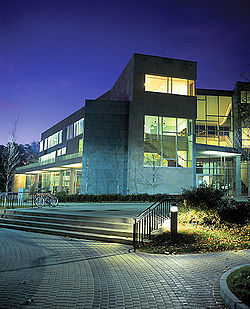
Ford Hall was demolished in August 2000 to make way for the Shapiro Campus Center, which was opened and dedicated October 3, 2002.
But in response to a university budget shortfall of $10 million, a formerly $700 million endowment now reduced, and the loss of longtime donors who lost money through investments with Bernard Madoff
, on January 26, 2009 the university announced it would close the Rose Art Museum in September 2009 and sell off a prized collection of contemporary American art, stating "The bottom line is that the students, the faculty and core academic mission come first. (Trustees) had to look at the college's assets and came to a decision to maintain that fundamental commitment to teaching." Amidst protests and criticism, the Massachusetts Attorney General plans to review the planned sale and wills and agreements between the museum and donors. The university subsequently indicated that it would sell only a limited number of pieces, if any, and would keep the museum open as a teaching and exhibition gallery.
The failure to resolve the university's budget difficulties through the art sell-off led to a decision in May 2009 to suspend the university's contribution to employees' retirement funds for one year.
Brandeis University's president, Jehuda Reinharz, announced that he would resign at the end of the academic year, The Boston Globe reported. The announcement took many on the campus by surprise, but Mr. Reinharz said the recent criticism over his financial stewardship and plans to close the university's Rose Art Museum was not a factor in his decision. At age 65, he said, he felt the time had come to move on. A new president, Frederick M. Lawrence
took office on January 1, 2011.
By June 30, 2011, a lawsuit that had been brought against the university to prevent the closing of the Rose was settled. The museum remains open, and no works of art were sold to support university operations. The 50th anniversary and reopening took place on October 25, 2011.
The College of Arts and Sciences comprises 24 departments and 22 interdepartmental programs, which, in total, offer 43 majors and 47 minors.
The Heller School for Social Policy and Management, founded in 1959, is noteworthy for its graduate programs in healthcare administration
, social policy
, social work
, and international development
.
Internships, research assistantships and other hands-on experiences are available throughout the curriculum. The global and experiential dimensions of education at Brandeis are carried out through international centers and institutes, which sponsor lectures and colloquia and add to the ranks of distinguished scholars on campus.
The Brandeis University Press, a member of the University Press of New England
, publishes books in a variety of scholarly and general interest fields.
The Goldfarb Library at Brandeis has more than 1.6 million volumes and 300,000 e-journals. The library also houses a large United States Government archive. Brandeis University is a part of the Boston Library Consortium, which allows its students, faculty, and staff to access and borrow books and other materials from other BLC institutions including, Brown University
, Tufts University
, and Williams College
.
The Cohen Center’s work spans basic research on Jewish identity to applied educational evaluation studies. The center’s recent signature studies include research with participants in Taglit-Birthright Israel, investigations of synagogue transformation, and analyses of Jewish summer camping. CMJS research has altered the understanding of contemporary Jewish life and the role of Jewish institutions in the United States.
and Gerald Schuster Institute for Investigative Journalism was launched in September 2004 as the first investigative reporting center based at a United States university.
The Institute's major projects are:
as a forum to collect, analyze, and disseminate data about the Jewish community and about religion and ethnicity in the United States. The first mission of SSRI was to interpret the inherent problems with the National Jewish Population Survey
of 2000 (NJPS). SSRI has done a Jewish Population Survey of the Greater Boston area,
the results of which were released on November 9, 2006.
The Institute collects and organizes existing socio-demographic data from private, communal, and government sources and will conduct local and national studies of the character of American Jewry and Jewish organizations.
The work of the Institute is done by a multidisciplinary staff of faculty and scholars, working with undergraduate and graduate students, and augmented by visiting scholars and consultants.
The Institute works in close collaboration with the Maurice and Marilyn Cohen Center for Modern Jewish Studies.
Among the better-known graduates are political activists Abbie Hoffman
and Angela Davis, journalist Thomas Friedman
, Congressman Stephen J. Solarz
, physicist Edward Witten
, novelist Ha Jin
, political theorist Michael Walzer
, actress Debra Messing
, philosopher Michael Sandel
, Olympic Silver Medalist fencer Timothy Morehouse, and author Mitch Albom
.
Among the distinguished faculty, present and past, are composers David Rakowski and Leonard Bernstein
, social theorist Herbert Marcuse
, psychologist Abraham Maslow
, human rights activist Eleanor Roosevelt
, Anita Hill
, historian David Hackett Fischer
, economist Thomas Sowell
, diplomat Dennis Ross
, children's author Margret Rey
, and sociologist Morrie Schwartz
.
 The Brandeis University athletic teams The Judges compete in the University Athletic Association
(UAA) conference of the NCAA
Division III.
Brandeis has 10 varsity teams for both men and women, and 1 co-ed varsity team. The varsity teams are in:
Brandeis also has 20 club sports and numerous intramural sports, including sailing
( formerly a varsity sport), rugby union
, ultimate
, crew
, lacrosse
, field hockey
, squash
, men's volleyball and martial arts
. Staff and faculty are allowed to play on intramural teams.
 The university has an active student government, the Brandeis Student Union, as well as more than 270 student organizations. Fraternities and sororities
are officially prohibited by Brandeis University, as they are contrary to a central tenet of the university, namely, that student organizations be open to all students, with membership determined by competency or interest. According to an official handbook, "[e]xclusive or secret societies are inconsistent with the principles of openness to which the University is committed.".
Brandeis has eleven a cappella
groups, six undergraduate-run theater companies, one sketch comedy troupe, and four improv-comedy
groups, as well as many other cultural and arts clubs. Brandeis is also home to what has been cited as one of the country's few undergraduate-run law publications. Of particular note is the Brandeis Academic Debate and Speech Society (B.A.D.A.S.S.) which consistently ranks as one of the top 10 debate
teams in the United States, and participates across the globe in the World Universities Debating Championships each year.
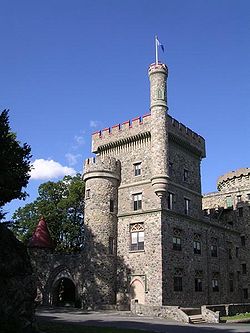
Cholmondeley's coffeehouse, commonly referred to as "Chums," is located in Brandeis' Usen Castle. Chums is a popular site for student performances and concerts, including Tracy Chapman
, Joan Baez
, Matt Pond PA
, and Genesis
(notable as their first American performance). Cholmondley's is named after a notoriously ill-tempered Basset hound
that was the on-campus pet for Ralph Norman, the campus Photographer during the first years of Brandeis. He would roam the campus after dark, growling at students, often nipping at their cuffs and making a general nuisance of himself. After his death, the coffee house was named for him, not so much in remembrance but in celebration.
Brandeis University's Campus Sustainability Initiative seeks to reduce the University's environmental and climate change impact. The University's accomplishments in the arena of sustainability
include the creation of a student-organized on-campus Farmers' Market, the implementation of a single-stream recycling
program, and the transition to GreenE certified wind power for 15% of the school's electricity needs. Brandeis also offers a course called "Greening the Campus and Community," in which students "examine the environmental impacts of the Brandeis and Waltham community, and then design and implement projects to address those impacts." Student projects have included greening campus offices, running after-school environmental education programs for children in the Waltham schools, and cleaning up local streams and ponds.
Students also have the option of taking courses with a 'Community Engaged Learning' (CEL) aspect. Community-engaged learning is an aspect of the university's broad-based commitment to experiential learning.
Emergency medical services are provided by the Brandeis Emergency Medical Corps, a Massachusetts-certified EMT-Basic
volunteer student organization which does not charge a fee for any of its emergency services.
Security escort services are provided around the campus and into Waltham by the student-run "Branvan," which runs on a daily schedule from 4:00 pm to 2:30 am on weekdays and from 12:00 pm to 2:30 am on weekends.
The university is 9 miles (14.5 km) west of Boston and is accessible through Brandeis/Roberts station
on the Fitchburg Commuter Rail Line
, a free shuttle that services Boston and Cambridge (Harvard Square
) Thursday through Sunday, the nearby Riverside subway station
(above ground) on the Green Line
, and the 553 MBTA Bus
.
and Mae Wien. The Wien family had three objectives: to further international understanding, to provide foreign students an opportunity to study in the United States, and to enrich the intellectual and cultural life at Brandeis. The Wien Scholarship offers full or partial tuition awards; these awards are need-based and require the applicants to present outstanding academic and personal achievement. Each year, the recipients of the scholarship take a week-long tour of a destination in the United States. In previous years, the students have visited the United Nations
in New York City
, and did relief work in New Orleans following Hurricane Katrina
. In April 2008, the University hosted a 3-day long celebration for the 50th anniversary of the program.
.
Current IJE projects include:
The IJE runs two summer programs for high school
students:
The IJE has close partnerships with The North American Association of Community Hebrew High Schools and The Foundation for Jewish Camp.
Private university
Private universities are universities not operated by governments, although many receive public subsidies, especially in the form of tax breaks and public student loans and grants. Depending on their location, private universities may be subject to government regulation. Private universities are...
research university with a liberal arts
Liberal arts
The term liberal arts refers to those subjects which in classical antiquity were considered essential for a free citizen to study. Grammar, Rhetoric and Logic were the core liberal arts. In medieval times these subjects were extended to include mathematics, geometry, music and astronomy...
focus. It is located in the southwestern corner of Waltham, Massachusetts
Waltham, Massachusetts
Waltham is a city in Middlesex County, Massachusetts, United States, was an early center for the labor movement, and major contributor to the American Industrial Revolution. The original home of the Boston Manufacturing Company, the city was a prototype for 19th century industrial city planning,...
, nine miles (14 km) west of Boston
Boston
Boston is the capital of and largest city in Massachusetts, and is one of the oldest cities in the United States. The largest city in New England, Boston is regarded as the unofficial "Capital of New England" for its economic and cultural impact on the entire New England region. The city proper had...
. The University has an enrollment of approximately 3,200 undergraduate and 2,100 graduate students. In 2011, it was ranked by the U.S. News and World Report as the number 31 national university in the United States. Forbes
Forbes
Forbes is an American publishing and media company. Its flagship publication, the Forbes magazine, is published biweekly. Its primary competitors in the national business magazine category are Fortune, which is also published biweekly, and Business Week...
listed Brandeis University as number 57 among all national universities and liberal arts colleges combined in 2010.
Brandeis was founded in 1948 as a nonsectarian
Nonsectarian
Nonsectarian, in its most literal sense, refers to a lack of sectarianism. The term is also more narrowly used to describe secular private educational institutions or other organizations either not affiliated with or not restricted to a particular religious denomination though the organization...
Jewish-sponsored coeducational institution on the site of the former Middlesex University
Middlesex University (Massachusetts)
Middlesex University, known primarily for its medical and veterinary schools, operated from 1914 until 1947, first in Cambridge, Massachusetts, later in Waltham, Massachusetts....
. The university is named for Louis Brandeis
Louis Brandeis
Louis Dembitz Brandeis ; November 13, 1856 – October 5, 1941) was an Associate Justice on the Supreme Court of the United States from 1916 to 1939.He was born in Louisville, Kentucky, to Jewish immigrant parents who raised him in a secular mode...
(1856–1941), the first Jewish
Who is a Jew?
"Who is a Jew?" is a basic question about Jewish identity and considerations of Jewish self-identification. The question is based in ideas about Jewish personhood which themselves have cultural, religious, genealogical, and personal dimensions...
Associate Justice of the Supreme Court of the United States
Associate Justice of the Supreme Court of the United States
Associate Justices of the Supreme Court of the United States are the members of the Supreme Court of the United States other than the Chief Justice of the United States...
.
Founders
Names associated with the conception of Brandeis include Israel GoldsteinIsrael Goldstein
Israel Goldstein was an American rabbi, author and Zionist leader. He was one of the founders of Brandeis University.Goldstein was the rabbi of Congregation B'nai Jeshurun in New York, the second oldest synagogue in the city, from 1918 until his immigration to Israel in 1960...
, George Alpert, C. Ruggles Smith, Albert Einstein
Albert Einstein
Albert Einstein was a German-born theoretical physicist who developed the theory of general relativity, effecting a revolution in physics. For this achievement, Einstein is often regarded as the father of modern physics and one of the most prolific intellects in human history...
, and Abram L. Sachar
Abram L. Sachar
Abram Leon Sachar was an American historian and founding president of Brandeis University.-Early life and education:...
.
Middlesex University (Massachusetts)
Middlesex University, known primarily for its medical and veterinary schools, operated from 1914 until 1947, first in Cambridge, Massachusetts, later in Waltham, Massachusetts....
, who had died in 1944. In 1946, the university was on the brink of financial collapse. At the time, it was one of the few medical schools in the U. S. that did not impose a Jewish quota
Jewish quota
Jewish quota was a percentage that limited the number of Jews in various establishments. In particular, in 19th and 20th centuries some countries had Jewish quotas for higher education, a special case of Numerus clausus....
; but it had never been able to secure AMA
American Medical Association
The American Medical Association , founded in 1847 and incorporated in 1897, is the largest association of medical doctors and medical students in the United States.-Scope and operations:...
accreditation—in part, its founder believed, due to institutional antisemitism in the AMA—and, as a result, Massachusetts had all but shut it down.
Israel Goldstein was a prominent rabbi in New York from 1918 until 1960 (when he immigrated to Israel), and an influential Zionist. Before 1946, he had headed the New York Board of Rabbis
New York Board of Rabbis
The New York Board of Rabbis is an organization of Orthodox, Reform, Conservative and Reconstructionist rabbis in New York State and the surrounding portions of Connecticut and New Jersey....
, the Jewish National Fund
Jewish National Fund
The Jewish National Fund was founded in 1901 to buy and develop land in Ottoman Palestine for Jewish settlement. The JNF is a quasi-governmental, non-profit organisation...
, and the Zionist Organization of America
Zionist Organization of America
The Zionist Organization of America , founded in 1897, was one of the first official Zionist organizations in the United States, and, especially early in the 20th century, the primary representative of Jewish Americans to the World Zionist Organization, espousing primarily Political Zionism.Today,...
, and helped found the National Conference of Christians and Jews
National Conference for Community and Justice
The National Conference for Community and Justice is a national, human relations, non-profit organization in the United States. Its mission is to fight bias, bigotry, and racism and promote understanding and respect through advocacy, conflict resolution, and education.The NCCJ was founded in 1927...
. On his eightieth birthday, in Israel, Yitzhak Rabin
Yitzhak Rabin
' was an Israeli politician, statesman and general. He was the fifth Prime Minister of Israel, serving two terms in office, 1974–77 and 1992 until his assassination in 1995....
and other leaders of the government, the parliament, and the Zionist movement assembled at his house to pay him tribute. But among all his accomplishments, the one chosen by the New York Times to headline his obituary was: "Rabbi Israel Goldstein, A Founder of Brandeis."
C. Ruggles Smith, desperate for a way to save something of Middlesex University, learned of a New York committee headed by Goldstein that was seeking a campus to establish a Jewish-sponsored secular university, and approached Goldstein with a proposal to give the Middlesex campus and charter to Goldstein's committee, in the hope that his committee might "possess the apparent ability to reestablish the School of Medicine on an approved basis." Goldstein was concerned about being saddled with a failing medical school, but excited about the opportunity to secure a 100 acre (0.404686 km²) "campus not far from New York, the premier Jewish community in the world, and only 9 miles (14.5 km) from Boston, one of the important Jewish population centers." Goldstein agreed to accept Smith's offer and then proceeded to recruit George Alpert, a Boston lawyer with fund-raising experience as national vice president of the United Jewish Appeal
United Jewish Appeal
The United Jewish Appeal was a Jewish philanthropic umbrella organization that existed from its creation in 1949 until it was folded into the United Jewish Communities, which was formed from the 1999 merger of United Jewish Appeal , Council of Jewish Federations and United Israel Appeal, Inc.In...
.
George Alpert (1898-September 11, 1988) had worked his way through Boston University School of Law
Boston University School of Law
Boston University School of Law is the law school affiliated with Boston University, and is ranked #22 among American law schools by US News and World Report magazine. It is the second-oldest law school in Massachusetts and one of the first law schools in the country to admit students regardless...
and co-founded the firm of Alpert and Alpert. His firm had a long association with the New York, New Haven and Hartford Railroad
New York, New Haven and Hartford Railroad
The New York, New Haven and Hartford Railroad , was a railroad that operated in the northeast United States from 1872 to 1968 which served the states of Connecticut, New York, Rhode Island, and Massachusetts...
, of which he was to become president from 1956 to 1961 He is best known today as the father of Richard Alpert (Baba Ram Dass
Ram Dass
Ram Dass is an American contemporary spiritual teacher and the author of the seminal 1971 book Be Here Now. He is known for his personal and professional associations with Timothy Leary at Harvard University in the early 1960s, for his travels to India and his relationship with the Hindu guru Neem...
). He was influential in Boston's Jewish community. His Judaism "tended to be social rather than spiritual." He was involved in assisting children displaced from Germany. Alpert was to be chairman of Brandeis from 1946 to 1954, and a director from 1946 until his death.
Goldstein also recruited Albert Einstein
Albert Einstein
Albert Einstein was a German-born theoretical physicist who developed the theory of general relativity, effecting a revolution in physics. For this achievement, Einstein is often regarded as the father of modern physics and one of the most prolific intellects in human history...
, whose involvement, while stormy and short-lived, was extremely important, as it drew national attention to the nascent university. The founding organization was named "The Albert Einstein Foundation for Higher Learning, Inc." and early press accounts emphasized his involvement.
Einstein incident
The trustees offered to name the university after Einstein in the summer of 1946, but Einstein declined, and on July 16, 1946 the board decided the university would be named after Louis Brandeis
Louis Brandeis
Louis Dembitz Brandeis ; November 13, 1856 – October 5, 1941) was an Associate Justice on the Supreme Court of the United States from 1916 to 1939.He was born in Louisville, Kentucky, to Jewish immigrant parents who raised him in a secular mode...
.
On August 19, the plans for the new university were announced by prominent rabbi and Zionist Israel Goldstein
Israel Goldstein
Israel Goldstein was an American rabbi, author and Zionist leader. He was one of the founders of Brandeis University.Goldstein was the rabbi of Congregation B'nai Jeshurun in New York, the second oldest synagogue in the city, from 1918 until his immigration to Israel in 1960...
, president of the Albert Einstein Foundation. Goldstein said that the planned university was to be supported by contributions from Jewish organizations and individuals, and stressed the point that the institution was to be without quotas and open to all "regardless of race, color, or creed." The institution was to be "deeply conscious both of the Hebraic tradition of Torah looking upon culture as a birthright, and of the American ideal of an educated democracy." In later stories the New York Times' capsule characterization of Brandeis was "a Jewish-supported non-quota university."
Einstein and Goldstein clashed almost immediately. Einstein objected to what he thought was excessively expansive promotion, and to Goldstein's sounding out Abram L. Sachar
Abram L. Sachar
Abram Leon Sachar was an American historian and founding president of Brandeis University.-Early life and education:...
as a possible president without consulting Einstein. Einstein took great offense at Goldstein's having invited Cardinal Francis Spellman to participate in a fundraising event. Einstein resigned on September 2, 1946. Believing the venture could not succeed without Einstein, Goldstein quickly agreed to resign himself, and Einstein returned; his brief departure was publicly denied.
The Foundation acquired the campus of the Middlesex University in Waltham, which was almost defunct except for the Middlesex Veterinary and Medical College. The charter of this small and marginal operation was transferred to the Foundation along with the campus. The Foundation had pledged to continue operating it, but began to feel that it would never be more than third-rate, while its operating costs were burdensome at a time when the Foundation was trying to raise funds. Disputes arose whether to try to improve it—as Einstein wished—or to terminate it. Einstein also became alarmed by press announcements that exaggerated the school's success at fundraising, and on June 22, 1947 he made a final break with the enterprise. The veterinary school was closed, despite "indignant and well-publicized protests and demonstrations by the disappointed students and their parents". George Alpert, a lawyer responsible for much of the organizational effort, gave another reason for the break: Einstein's desire to offer the presidency of the school to left-wing scholar Harold Laski
Harold Laski
Harold Joseph Laski was a British Marxist, political theorist, economist, author, and lecturer, who served as the chairman of the Labour Party during 1945-1946, and was a professor at the LSE from 1926 to 1950....
. Alpert characterized Laski as "a man utterly alien to American principles of democracy, tarred with the Communist brush." He said, "I can compromise on any subject but one: that one is Americanism."
Six years later, Einstein would decline the offer of an honorary degree from Brandeis, writing to Brandeis president Abram L. Sachar
Abram L. Sachar
Abram Leon Sachar was an American historian and founding president of Brandeis University.-Early life and education:...
that "what happened in the stage of preparation of Brandeis University was not at all caused by a misunderstanding and cannot be made good any more."
Historians Slater and Slater commented that "plagued by infighting, Brandeis in early 1948 seemed a project in serious trouble. Nonetheless, the school opened in the fall with 107 students." The historians list the opening of Brandeis as one of their "Great Moments in Jewish History
Jewish history
Jewish history is the history of the Jews, their religion and culture, as it developed and interacted with other peoples, religions and cultures. Since Jewish history is over 4000 years long and includes hundreds of different populations, any treatment can only be provided in broad strokes...
."
In 1954 Brandeis inaugurated a graduate program and became fully accredited. In 1985, Brandeis was elected to membership in the Association of American Universities
Association of American Universities
The Association of American Universities is an organization of leading research universities devoted to maintaining a strong system of academic research and education...
, which represents the sixty three leading research universities in the United States and Canada.
Student takeover of Ford Hall
From January 8–18, 1969 about 70 students captured and held then-student-center, Ford Hall. The student protesters renamed the school "Malcolm XMalcolm X
Malcolm X , born Malcolm Little and also known as El-Hajj Malik El-Shabazz , was an African American Muslim minister and human rights activist. To his admirers he was a courageous advocate for the rights of African Americans, a man who indicted white America in the harshest terms for its...
University" for the duration of the siege (distributing buttons with the new name and logo) and issued a list of ten demands for better minority representation on campus. Most of these demands were subsequently met.
Ford Hall was demolished in August 2000 to make way for the Shapiro Campus Center, which was opened and dedicated October 3, 2002.
Rose Art Museum
The Rose Art Museum opened in 1961, the result of a decade-long struggle to house the art donations Brandeis had been receiving. Abram Sachar had written of the importance of fine arts to Brandeis and his "determination to expose our students and faculty to every kind of art orientation." Of the museum itself he had written:But in response to a university budget shortfall of $10 million, a formerly $700 million endowment now reduced, and the loss of longtime donors who lost money through investments with Bernard Madoff
Bernard Madoff
Bernard Lawrence "Bernie" Madoff is a former American businessman, stockbroker, investment advisor, and financier. He is the former non-executive chairman of the NASDAQ stock market, and the admitted operator of a Ponzi scheme that is considered to be the largest financial fraud in U.S...
, on January 26, 2009 the university announced it would close the Rose Art Museum in September 2009 and sell off a prized collection of contemporary American art, stating "The bottom line is that the students, the faculty and core academic mission come first. (Trustees) had to look at the college's assets and came to a decision to maintain that fundamental commitment to teaching." Amidst protests and criticism, the Massachusetts Attorney General plans to review the planned sale and wills and agreements between the museum and donors. The university subsequently indicated that it would sell only a limited number of pieces, if any, and would keep the museum open as a teaching and exhibition gallery.
The failure to resolve the university's budget difficulties through the art sell-off led to a decision in May 2009 to suspend the university's contribution to employees' retirement funds for one year.
Brandeis University's president, Jehuda Reinharz, announced that he would resign at the end of the academic year, The Boston Globe reported. The announcement took many on the campus by surprise, but Mr. Reinharz said the recent criticism over his financial stewardship and plans to close the university's Rose Art Museum was not a factor in his decision. At age 65, he said, he felt the time had come to move on. A new president, Frederick M. Lawrence
Frederick M. Lawrence
Frederick M. Lawrence is an American legal scholar and the President of Brandeis University.He is the third and youngest child of Brooklyn College sweethearts Joseph and Bea Lawrence . His father was a chemical engineer and his mother an educator. Lawrence attended Flower Hill Elementary School,...
took office on January 1, 2011.
By June 30, 2011, a lawsuit that had been brought against the university to prevent the closing of the Rose was settled. The museum remains open, and no works of art were sold to support university operations. The 50th anniversary and reopening took place on October 25, 2011.
Presidents
The presidents of Brandeis University have been:- Abram L. SacharAbram L. SacharAbram Leon Sachar was an American historian and founding president of Brandeis University.-Early life and education:...
1948–68 - Morris Berthold Abram 1968–70
- Charles I. Schottland 1970–72
- Marver H. Bernstein 1972–83
- Evelyn E. HandlerEvelyn HandlerEvelyn Erika Handler served from 1980 to 1983 as the University of New Hampshire's fourteenth and first female president. In 1983, Handler was inaugurated as President of Brandeis University, where she was also the first woman to hold that position...
1983–91 - Stuart H. AltmanStuart AltmanStuart H. Altman is an economist whose research interests are primarily in the area of federal and state health policy. He is the Sol C...
(interim) 1990–91 - Samuel O. ThierSamuel O. ThierSamuel Osiah Thier is professor of Medicine and Health Care Policy at Harvard University.He previously served as the president of Brandeis University from 1991–1994 and the president of the Massachusetts General Hospital from 1994-97...
1991–94 - Jehuda ReinharzJehuda ReinharzJehuda Reinharz is the former President of Brandeis University, where he is Richard Koret Professor of Modern Jewish History and Director of the Tauber Institute for the Study of European Jewry. On September 25, 2009 he announced his resignation as president; at the request of trustees he stayed...
1994– December 31, 2010 - Frederick M. LawrenceFrederick M. LawrenceFrederick M. Lawrence is an American legal scholar and the President of Brandeis University.He is the third and youngest child of Brooklyn College sweethearts Joseph and Bea Lawrence . His father was a chemical engineer and his mother an educator. Lawrence attended Flower Hill Elementary School,...
January 1, 2011-
Academics
The schools of the University include:- The College of Arts and Sciences
- The Graduate School of Arts and SciencesBrandeis University Graduate School of Arts and SciencesThe Graduate School of Arts and Sciences at Brandeis University in Waltham, Massachusetts, United States was established in 1953 on a 235-acre suburban campus, located 9 miles outside of Boston, and is one of four graduate schools on campus....
- The Heller School for Social Policy and ManagementHeller School for Social Policy and ManagementThe Heller School for Social Policy and Management is one of the four graduate schools of Brandeis University.Founded in 1959 as the University's first professional school, Heller is located on the Brandeis University main campus along with the Brandeis University Graduate School of Arts and...
- Rabb School of Summer and Continuing StudiesRabb School of Summer and Continuing StudiesThe Brandeis University Rabb School of Continuing Studies offers for-credit and non-credit courses, Masters Degrees and Certificates to the greater community with opportunities for professional development, personal enrichment and lifelong learning....
- Brandeis International Business SchoolBrandeis International Business School]The Brandeis International Business School at Brandeis University in Waltham, Massachusetts, United States was founded in 1994. Its teaching and research are focused on the global economy...
The College of Arts and Sciences comprises 24 departments and 22 interdepartmental programs, which, in total, offer 43 majors and 47 minors.
The Heller School for Social Policy and Management, founded in 1959, is noteworthy for its graduate programs in healthcare administration
Healthcare administration
Health administration or healthcare administration is the field relating to leadership, management, and administration of hospitals, hospital networks, health care systems, and public health systems...
, social policy
Social policy
Social policy primarily refers to guidelines, principles, legislation and activities that affect the living conditions conducive to human welfare. Thus, social policy is that part of public policy that has to do with social issues...
, social work
Social work
Social Work is a professional and academic discipline that seeks to improve the quality of life and wellbeing of an individual, group, or community by intervening through research, policy, community organizing, direct practice, and teaching on behalf of those afflicted with poverty or any real or...
, and international development
International development
International development or global development is a concept that lacks a universally accepted definition, but it is most used in a holistic and multi-disciplinary context of human development — the development of greater quality of life for humans...
.
Internships, research assistantships and other hands-on experiences are available throughout the curriculum. The global and experiential dimensions of education at Brandeis are carried out through international centers and institutes, which sponsor lectures and colloquia and add to the ranks of distinguished scholars on campus.
The Brandeis University Press, a member of the University Press of New England
University Press of New England
The University Press of New England , located in Lebanon, New Hampshire and founded in 1970, is a university press consortium including Brandeis University, Dartmouth College , the University of New Hampshire, and Northeastern University...
, publishes books in a variety of scholarly and general interest fields.
The Goldfarb Library at Brandeis has more than 1.6 million volumes and 300,000 e-journals. The library also houses a large United States Government archive. Brandeis University is a part of the Boston Library Consortium, which allows its students, faculty, and staff to access and borrow books and other materials from other BLC institutions including, Brown University
Brown University
Brown University is a private, Ivy League university located in Providence, Rhode Island, United States. Founded in 1764 prior to American independence from the British Empire as the College in the English Colony of Rhode Island and Providence Plantations early in the reign of King George III ,...
, Tufts University
Tufts University
Tufts University is a private research university located in Medford/Somerville, near Boston, Massachusetts. It is organized into ten schools, including two undergraduate programs and eight graduate divisions, on four campuses in Massachusetts and on the eastern border of France...
, and Williams College
Williams College
Williams College is a private liberal arts college located in Williamstown, Massachusetts, United States. It was established in 1793 with funds from the estate of Ephraim Williams. Originally a men's college, Williams became co-educational in 1970. Fraternities were also phased out during this...
.
Cohen Center for Modern Jewish Studies
In 1980, Brandeis University established the Maurice and Marilyn Cohen Center for Modern Jewish Studies, the first academic center devoted to the study of Jewish life in the United States.The Cohen Center’s work spans basic research on Jewish identity to applied educational evaluation studies. The center’s recent signature studies include research with participants in Taglit-Birthright Israel, investigations of synagogue transformation, and analyses of Jewish summer camping. CMJS research has altered the understanding of contemporary Jewish life and the role of Jewish institutions in the United States.
Schuster Institute for Investigative Journalism
The ElaineElaine Schuster
Elaine Schuster is a philanthropist, American diplomat, civic leader, and Democratic Party activist.-Public Service:In 2009, President Barack Obama appointed Mrs. Schuster to serve as a Public Delegate to the United Nations General Assembly. Schuster focuses her work for the U.N...
and Gerald Schuster Institute for Investigative Journalism was launched in September 2004 as the first investigative reporting center based at a United States university.
The Institute's major projects are:
- the Political & Social Justice Project
- the Justice Brandeis Innocence Project
- the Gender & Justice Project.
Steinhardt Social Research Institute
The Steinhardt Social Research Institute was created in 2005 from a gift from Michael SteinhardtMichael Steinhardt
Michael H. Steinhardt is an American investor and philanthropist active in Jewish causes. He was one of the first prominent hedge fund managers, and is a graduate of the Wharton School of the University of Pennsylvania. He founded Steinhardt, Fine, Berkowitz & Co., a hedge fund, in 1967...
as a forum to collect, analyze, and disseminate data about the Jewish community and about religion and ethnicity in the United States. The first mission of SSRI was to interpret the inherent problems with the National Jewish Population Survey
National Jewish Population Survey
The National Jewish Population Survey , most recently performed in 2000-01, is a representative survey of the Jewish population in the United States sponsored by United Jewish Communities and the Jewish Federation system....
of 2000 (NJPS). SSRI has done a Jewish Population Survey of the Greater Boston area,
the results of which were released on November 9, 2006.
The Institute collects and organizes existing socio-demographic data from private, communal, and government sources and will conduct local and national studies of the character of American Jewry and Jewish organizations.
The work of the Institute is done by a multidisciplinary staff of faculty and scholars, working with undergraduate and graduate students, and augmented by visiting scholars and consultants.
The Institute works in close collaboration with the Maurice and Marilyn Cohen Center for Modern Jewish Studies.
Women's Studies Research Center
The Women's Studies Research Center, founded and directed by Shulamit Reinharz, wife of former university president Jehuda Reinharz, is located at the Epstein Building on the Brandeis campus.Rankings
- Brandeis University was ranked No. 21 among the top 25 national universities in the country, according to recently released rankings by the Center for College Affordability & Productivity (CCAP), an independent, not-for-profit center based in Washington, D.C.Washington, D.C.Washington, D.C., formally the District of Columbia and commonly referred to as Washington, "the District", or simply D.C., is the capital of the United States. On July 16, 1790, the United States Congress approved the creation of a permanent national capital as permitted by the U.S. Constitution....
- US News and World Report ranked Brandeis No. 31 in their 2012 annual list of Best National Universities, tied with Boston CollegeBoston CollegeBoston College is a private Jesuit research university located in the village of Chestnut Hill, Massachusetts, USA. The main campus is bisected by the border between the cities of Boston and Newton. It has 9,200 full-time undergraduates and 4,000 graduate students. Its name reflects its early...
. Acceptance to Brandeis was categorized under "Most Selective". It was also ranked No. 9 of "Most LiberalLiberalismLiberalism is the belief in the importance of liberty and equal rights. Liberals espouse a wide array of views depending on their understanding of these principles, but generally, liberals support ideas such as constitutionalism, liberal democracy, free and fair elections, human rights,...
Students" - No. 24 among 50 Best Values in Private Colleges according to KiplingerKiplingerKiplinger is a Washington, D.C.-based publisher of business forecasts and personal finance advice, available in print, online, audio, video and software products ....
(2009) - No. 30 among 567 undergraduate institutions and top 15 among national research universities in a recent ranking from ForbesForbesForbes is an American publishing and media company. Its flagship publication, the Forbes magazine, is published biweekly. Its primary competitors in the national business magazine category are Fortune, which is also published biweekly, and Business Week...
.com - One of the "Top 20 Small Research Universities" based on the Faculty Scholarly Productivity Index (2006–07)
- No. 27 among Top American Private Research Universities by The Center for Measuring University Performance (2008)
- Received a "B-" grade on the Campus Sustainability Report Card 2009 and a "B" grade in 2010 published by the Sustainable Endowments Institute (including "A" grades in the Student Involvement, Administration, and Investment Priorities). Just 23% of schools earned overall grades of "B" or better.
- Named the 31st "Most Stressful College" by The Daily BeastThe Daily BeastThe Daily Beast is an American news reporting and opinion website founded and published by Tina Brown, former editor of Vanity Fair and The New Yorker as well as the short-lived Talk Magazine. The Daily Beast was launched on October 6, 2008, and is owned by IAC...
in 2010 - When adjusted for size, Brandeis is fifth in the nation in terms of faculty members elected to academic honor societies.
- Education Program was listed as one of the top 10 teacher education programs of any liberal arts college in 2010.
- No. 5 among the universities with the highest GMAT scores
Notable faculty and graduates
Brandeis, which is one of America's smallest and youngest research universities, has produced a body of unusually accomplished alumni, especially in academia, the professions, and literature, and can boast a distinguished faculty.Among the better-known graduates are political activists Abbie Hoffman
Abbie Hoffman
Abbot Howard "Abbie" Hoffman was a political and social activist who co-founded the Youth International Party ....
and Angela Davis, journalist Thomas Friedman
Thomas Friedman
Thomas Lauren Friedman is an American journalist, columnist and author. He writes a twice-weekly column for The New York Times. He has written extensively on foreign affairs including global trade, the Middle East, and environmental issues and has won the Pulitzer Prize three times.-Personal...
, Congressman Stephen J. Solarz
Stephen J. Solarz
Stephen Joshua Solarz was a United States Congressional Representative from New York. Solarz was both an outspoken critic of President Ronald Reagan's deployment of Marines to Lebanon in 1982 and a cosponsor of the 1991 Gulf War Authorization Act during the Presidency of George H. W...
, physicist Edward Witten
Edward Witten
Edward Witten is an American theoretical physicist with a focus on mathematical physics who is currently a professor of Mathematical Physics at the Institute for Advanced Study....
, novelist Ha Jin
Ha Jin
Jīn Xuěfēi is a contemporary Chinese-American writer and novelist using the pen name Ha Jin . Ha comes from his favorite city, Harbin.-Early life:...
, political theorist Michael Walzer
Michael Walzer
Michael Walzer is a prominent American political philosopher and public intellectual. A professor emeritus at the Institute for Advanced Study in Princeton, New Jersey, he is co-editor of Dissent, an intellectual magazine that he has been affiliated with since his years as an undergraduate at...
, actress Debra Messing
Debra Messing
Debra Lynn Messing is an American actress, voice artist, and comedienne. She is perhaps best known for her role as Grace Adler in the NBC sitcom Will & Grace and as Molly Kagan in the mini-series The Starter Wife....
, philosopher Michael Sandel
Michael Sandel
Michael J. Sandel is an American political philosopher and a professor at Harvard University. He is best known for the Harvard course 'Justice' which is available to , and for his critique of Rawls' A Theory of Justice in his Liberalism and the Limits of Justice...
, Olympic Silver Medalist fencer Timothy Morehouse, and author Mitch Albom
Mitch Albom
Mitchell David "Mitch" Albom is an American best-selling author, journalist, screenwriter, dramatist, radio and television broadcaster and musician. His books have sold over 30 million copies worldwide...
.
Among the distinguished faculty, present and past, are composers David Rakowski and Leonard Bernstein
Leonard Bernstein
Leonard Bernstein August 25, 1918 – October 14, 1990) was an American conductor, composer, author, music lecturer and pianist. He was among the first conductors born and educated in the United States of America to receive worldwide acclaim...
, social theorist Herbert Marcuse
Herbert Marcuse
Herbert Marcuse was a German Jewish philosopher, sociologist and political theorist, associated with the Frankfurt School of critical theory...
, psychologist Abraham Maslow
Abraham Maslow
Abraham Harold Maslow was an American professor of psychology at Brandeis University, Brooklyn College, New School for Social Research and Columbia University who created Maslow's hierarchy of needs...
, human rights activist Eleanor Roosevelt
Eleanor Roosevelt
Anna Eleanor Roosevelt was the First Lady of the United States from 1933 to 1945. She supported the New Deal policies of her husband, distant cousin Franklin Delano Roosevelt, and became an advocate for civil rights. After her husband's death in 1945, Roosevelt continued to be an international...
, Anita Hill
Anita Hill
Anita Faye Hill is an American attorney and academic—presently a professor of social policy, law and women's studies at Brandeis University's Heller School for Social Policy and Management. She became a national figure in 1991 when she alleged that U.S. Supreme Court nominee Clarence Thomas had...
, historian David Hackett Fischer
David Hackett Fischer
David Hackett Fischer is University Professor and Earl Warren Professor of History at Brandeis University. Fischer's major works have tackled everything from large macroeconomic and cultural trends to narrative histories of significant events to explorations of...
, economist Thomas Sowell
Thomas Sowell
Thomas Sowell is an American economist, social theorist, political philosopher, and author. A National Humanities Medal winner, he advocates laissez-faire economics and writes from a libertarian perspective...
, diplomat Dennis Ross
Dennis Ross
Dennis B. Ross is an American diplomat and author. He has served as the Director of Policy Planning in the State Department under President George H. W...
, children's author Margret Rey
Margret Rey
Margret Elizabeth Rey , born Margarete Elisabeth Waldstein, was , the co-author and illustrator of children's books, the most famous of which are the Curious George series....
, and sociologist Morrie Schwartz
Morrie Schwartz
Morris "Morrie" S. Schwartz was a sociology professor at Brandeis University and an author. He was the subject of the best-selling book Tuesdays With Morrie, which was published in 1997 and later made into a movie....
.
Athletics
University Athletic Association
The University Athletic Association is an American athletic conference that competes in the National Collegiate Athletic Association's Division III. Member teams are located in Georgia, Illinois, Missouri, Pennsylvania, Massachusetts, Ohio, and New York...
(UAA) conference of the NCAA
National Collegiate Athletic Association
The National Collegiate Athletic Association is a semi-voluntary association of 1,281 institutions, conferences, organizations and individuals that organizes the athletic programs of many colleges and universities in the United States...
Division III.
Brandeis has 10 varsity teams for both men and women, and 1 co-ed varsity team. The varsity teams are in:
- BaseballBaseballBaseball is a bat-and-ball sport played between two teams of nine players each. The aim is to score runs by hitting a thrown ball with a bat and touching a series of four bases arranged at the corners of a ninety-foot diamond...
- BasketballBasketballBasketball is a team sport in which two teams of five players try to score points by throwing or "shooting" a ball through the top of a basketball hoop while following a set of rules...
- Cross CountryCross country runningCross country running is a sport in which people run a race on open-air courses over natural terrain. The course, typically long, may include surfaces of grass and earth, pass through woodlands and open country, and include hills, flat ground and sometimes gravel road...
- Fencing
- GolfGolfGolf is a precision club and ball sport, in which competing players use many types of clubs to hit balls into a series of holes on a golf course using the fewest number of strokes....
- Indoor and Outdoor Track & FieldTrack and fieldTrack and field is a sport comprising various competitive athletic contests based around the activities of running, jumping and throwing. The name of the sport derives from the venue for the competitions: a stadium which features an oval running track surrounding a grassy area...
- Soccer
- SoftballSoftballSoftball is a bat-and-ball sport played between two teams of 10 to 14 players. It is a direct descendant of baseball although there are some key differences: softballs are larger than baseballs, and the pitches are thrown underhand rather than overhand...
- TennisTennisTennis is a sport usually played between two players or between two teams of two players each . Each player uses a racket that is strung to strike a hollow rubber ball covered with felt over a net into the opponent's court. Tennis is an Olympic sport and is played at all levels of society at all...
- VolleyballVolleyballVolleyball is a team sport in which two teams of six players are separated by a net. Each team tries to score points by grounding a ball on the other team's court under organized rules.The complete rules are extensive...
Brandeis also has 20 club sports and numerous intramural sports, including sailing
Sailing
Sailing is the propulsion of a vehicle and the control of its movement with large foils called sails. By changing the rigging, rudder, and sometimes the keel or centre board, a sailor manages the force of the wind on the sails in order to move the boat relative to its surrounding medium and...
( formerly a varsity sport), rugby union
Rugby union
Rugby union, often simply referred to as rugby, is a full contact team sport which originated in England in the early 19th century. One of the two codes of rugby football, it is based on running with the ball in hand...
, ultimate
Ultimate (sport)
Ultimate is a sport played with a 175 gram flying disc. The object of the game is to score points by passing the disc to a player in the opposing end zone, similar to an end zone in American football or rugby...
, crew
Sport rowing
Rowing is a sport in which athletes race against each other on rivers, on lakes or on the ocean, depending upon the type of race and the discipline. The boats are propelled by the reaction forces on the oar blades as they are pushed against the water...
, lacrosse
Lacrosse
Lacrosse is a team sport of Native American origin played using a small rubber ball and a long-handled stick called a crosse or lacrosse stick, mainly played in the United States and Canada. It is a contact sport which requires padding. The head of the lacrosse stick is strung with loose mesh...
, field hockey
Field hockey
Field Hockey, or Hockey, is a team sport in which a team of players attempts to score goals by hitting, pushing or flicking a ball into an opposing team's goal using sticks...
, squash
Squash (sport)
Squash is a high-speed racquet sport played by two players in a four-walled court with a small, hollow rubber ball...
, men's volleyball and martial arts
Martial arts
Martial arts are extensive systems of codified practices and traditions of combat, practiced for a variety of reasons, including self-defense, competition, physical health and fitness, as well as mental and spiritual development....
. Staff and faculty are allowed to play on intramural teams.
Student life
Fraternities and sororities
Fraternities and sororities are fraternal social organizations for undergraduate students. In Latin, the term refers mainly to such organizations at colleges and universities in the United States, although it is also applied to analogous European groups also known as corporations...
are officially prohibited by Brandeis University, as they are contrary to a central tenet of the university, namely, that student organizations be open to all students, with membership determined by competency or interest. According to an official handbook, "[e]xclusive or secret societies are inconsistent with the principles of openness to which the University is committed.".
Brandeis has eleven a cappella
Collegiate a cappella
Collegiate a cappella ensembles are student-run and -directed singing groups that perform entirely without instruments. Such groups can be found at many colleges and universities in the United States, and increasingly worldwide....
groups, six undergraduate-run theater companies, one sketch comedy troupe, and four improv-comedy
Improvisational theatre
Improvisational theatre takes many forms. It is best known as improv or impro, which is often comedic, and sometimes poignant or dramatic. In this popular, often topical art form improvisational actors/improvisers use improvisational acting techniques to perform spontaneously...
groups, as well as many other cultural and arts clubs. Brandeis is also home to what has been cited as one of the country's few undergraduate-run law publications. Of particular note is the Brandeis Academic Debate and Speech Society (B.A.D.A.S.S.) which consistently ranks as one of the top 10 debate
Debate
Debate or debating is a method of interactive and representational argument. Debate is a broader form of argument than logical argument, which only examines consistency from axiom, and factual argument, which only examines what is or isn't the case or rhetoric which is a technique of persuasion...
teams in the United States, and participates across the globe in the World Universities Debating Championships each year.
Cholmondeley's coffeehouse, commonly referred to as "Chums," is located in Brandeis' Usen Castle. Chums is a popular site for student performances and concerts, including Tracy Chapman
Tracy Chapman
Tracy Chapman is an American singer-songwriter, best known for her singles "Fast Car", "Talkin' 'bout a Revolution", "Baby Can I Hold You", "Give Me One Reason" and "Telling Stories". She is a multi-platinum and four-time Grammy Award-winning artist.-Biography:Tracy Chapman was born in Cleveland,...
, Joan Baez
Joan Baez
Joan Chandos Baez is an American folk singer, songwriter, musician and a prominent activist in the fields of human rights, peace and environmental justice....
, Matt Pond PA
Matt Pond PA
Matt Pond PA is a New York based band formed in Philadelphia by singer-songwriter Matt Pond. They have released eight LPs and eight EPs since 1998....
, and Genesis
Genesis (band)
Genesis are an English rock band that formed in 1967. The band currently comprises the longest-tenured members Tony Banks , Mike Rutherford and Phil Collins . Past members Peter Gabriel , Steve Hackett and Anthony Phillips , also played major roles in the band in its early years...
(notable as their first American performance). Cholmondley's is named after a notoriously ill-tempered Basset hound
Basset Hound
The Basset Hound is a short-legged breed of dog of the hound family. They are scent hounds, bred to hunt rabbits and hare by scent. Their sense of smell for tracking is second only to that of the Bloodhound....
that was the on-campus pet for Ralph Norman, the campus Photographer during the first years of Brandeis. He would roam the campus after dark, growling at students, often nipping at their cuffs and making a general nuisance of himself. After his death, the coffee house was named for him, not so much in remembrance but in celebration.
Brandeis University's Campus Sustainability Initiative seeks to reduce the University's environmental and climate change impact. The University's accomplishments in the arena of sustainability
Sustainability
Sustainability is the capacity to endure. For humans, sustainability is the long-term maintenance of well being, which has environmental, economic, and social dimensions, and encompasses the concept of union, an interdependent relationship and mutual responsible position with all living and non...
include the creation of a student-organized on-campus Farmers' Market, the implementation of a single-stream recycling
Single-stream recycling
Single stream recycling refers to a system in which all paper fibers, plastics, metals, and other containers are mixed together in a collection truck, instead of being sorted into separate commodities by the resident and handled separately throughout the collection...
program, and the transition to GreenE certified wind power for 15% of the school's electricity needs. Brandeis also offers a course called "Greening the Campus and Community," in which students "examine the environmental impacts of the Brandeis and Waltham community, and then design and implement projects to address those impacts." Student projects have included greening campus offices, running after-school environmental education programs for children in the Waltham schools, and cleaning up local streams and ponds.
Students also have the option of taking courses with a 'Community Engaged Learning' (CEL) aspect. Community-engaged learning is an aspect of the university's broad-based commitment to experiential learning.
Emergency medical services are provided by the Brandeis Emergency Medical Corps, a Massachusetts-certified EMT-Basic
Emergency medical technician-basic
Emergency Medical Technician-Basic is the entry level of Emergency Medical Technician in the United States....
volunteer student organization which does not charge a fee for any of its emergency services.
Security escort services are provided around the campus and into Waltham by the student-run "Branvan," which runs on a daily schedule from 4:00 pm to 2:30 am on weekdays and from 12:00 pm to 2:30 am on weekends.
The university is 9 miles (14.5 km) west of Boston and is accessible through Brandeis/Roberts station
Brandeis/Roberts (MBTA station)
Brandeis/Roberts is a passenger rail station on MBTA Commuter Rail's Fitchburg Line.It is located on the edge of the campus of Brandeis University in Waltham, Massachusetts.-External links:* * *...
on the Fitchburg Commuter Rail Line
Fitchburg Line
The Fitchburg Line is an MBTA line that runs from Boston's North Station to Fitchburg, Massachusetts. The line is along the tracks of the former Fitchburg Railroad, which was a railroad line across northern Massachusetts, United States, leading to and through the Hoosac Tunnel. It is one of the...
, a free shuttle that services Boston and Cambridge (Harvard Square
Harvard Square
Harvard Square is a large triangular area in the center of Cambridge, Massachusetts, United States, at the intersection of Massachusetts Avenue, Brattle Street, and John F. Kennedy Street. It is the historic center of Cambridge...
) Thursday through Sunday, the nearby Riverside subway station
Riverside (MBTA station)
Riverside is the western terminus of the MBTA Green Line "D" Branch light rail line. It is located at 333 Grove Street, off Exit 22 on Interstate 95 , in Auburndale, a village of Newton, Massachusetts. Scheduled travel time to Park Street is 46 minutes. Riverside includes a parking...
(above ground) on the Green Line
Green Line (MBTA)
The Green Line is a streetcar system run by the Massachusetts Bay Transportation Authority in the Boston, Massachusetts area of the United States. It is the oldest line of Boston's subway, which is known locally as the 'T'. The Green Line runs underground downtown and on the surface in outlying...
, and the 553 MBTA Bus
MBTA Bus
The Massachusetts Bay Transportation Authority operates a large number of bus lines in the greater Boston area. Some routes are for transport within the city; others bring passengers from surrounding areas to stops on the rail lines of the MBTA.The MBTA also operates bus rapid transit service; see...
.
Wien International Scholarship
Wien International Scholarship is a scholarship instituted by Brandeis University for international undergraduate students. The Wien International Scholarship was established in 1958 by Lawrence A.Lawrence Wien
Lawrence Wien was an American lawyer, philanthropist and real estate owner.-Early life:Wien was born in Manhattan, New York City, and received his bachelors degree from Columbia College in 1925 and his law degree from Columbia Law School in 1927.-Career:Wien served as the Chairman of the Board of...
and Mae Wien. The Wien family had three objectives: to further international understanding, to provide foreign students an opportunity to study in the United States, and to enrich the intellectual and cultural life at Brandeis. The Wien Scholarship offers full or partial tuition awards; these awards are need-based and require the applicants to present outstanding academic and personal achievement. Each year, the recipients of the scholarship take a week-long tour of a destination in the United States. In previous years, the students have visited the United Nations
United Nations
The United Nations is an international organization whose stated aims are facilitating cooperation in international law, international security, economic development, social progress, human rights, and achievement of world peace...
in New York City
New York City
New York is the most populous city in the United States and the center of the New York Metropolitan Area, one of the most populous metropolitan areas in the world. New York exerts a significant impact upon global commerce, finance, media, art, fashion, research, technology, education, and...
, and did relief work in New Orleans following Hurricane Katrina
Hurricane Katrina
Hurricane Katrina of the 2005 Atlantic hurricane season was a powerful Atlantic hurricane. It is the costliest natural disaster, as well as one of the five deadliest hurricanes, in the history of the United States. Among recorded Atlantic hurricanes, it was the sixth strongest overall...
. In April 2008, the University hosted a 3-day long celebration for the 50th anniversary of the program.
Institute for Informal Jewish Education
The Institute for Informal Jewish Education aims to support Jewish educators in creating meaningful Jewish experiences through professional development opportunities including pre-service experiences, in-service experiences related to educators’ practice, practitioner research, curriculum development, and strategic organizational support. The IJE is funded partially through grants, from The Andrea and Charles Bronfman Philanthropies, The Legacy Heritage Fund, The Covenant Foundation, and AVI CHAI FoundationAVI CHAI Foundation
AVI CHAI is a private foundation endowed in 1984 by Sanford Bernstein, a well-known successful investor who become a Modern Orthodox Baal teshuva and who had wanted to further the cause of outreach to alienated and assimilated Jews worldwide. Avi-Chai functions in the United States and in Israel...
.
Current IJE projects include:
- Shabbat Enhancement/Experiential Educator grants.
- New Ways to Enhance Community Hebrew High Schools Principal Leadership Seminar.
- Executive Leadership Institute for Camp directors.
- Merging the formal and informal education in synagogue middle schoolsParochial schoolA parochial school is a school that provides religious education in addition to conventional education. In a narrower sense, a parochial school is a Christian grammar school or high school which is part of, and run by, a parish.-United Kingdom:...
.
The IJE runs two summer programs for high school
High school
High school is a term used in parts of the English speaking world to describe institutions which provide all or part of secondary education. The term is often incorporated into the name of such institutions....
students:
- Genesis integrates Jewish studies, humanitiesHumanitiesThe humanities are academic disciplines that study the human condition, using methods that are primarily analytical, critical, or speculative, as distinguished from the mainly empirical approaches of the natural sciences....
and community building. - BIMABIMA at Brandeis UniversityBIMA at Brandeis University is a Jewish artistic summer program for high school students, based at Brandeis University. BIMA offers courses in filmmaking, instrumental and vocal music, theatre, visual arts, and writing.-History:...
offers intensive opportunities to deepen skills in music, painting, creative writing and theater within a Jewish context.
The IJE has close partnerships with The North American Association of Community Hebrew High Schools and The Foundation for Jewish Camp.
See also
- List of Brandeis University people
- National Center for Jewish FilmNational Center for Jewish FilmThe National Center for Jewish Film is a non-profit motion picture archive, distributor, and resource center. It houses the largest collection of Jewish-themed film and video outside of Israel...
- Rosenstiel AwardRosenstiel AwardIn 1971, the Lewis S. Rosenstiel Award for Distinguished Work in Basic Medical Research was established as an expression of the conviction that educational institutions have an important role to play in the encouragement and development of basic science as it applies to medicine.Medals are...