

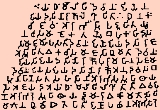
Abugida

Encyclopedia
Segment (linguistics)
In linguistics , the term segment may be defined as "any discrete unit that can be identified, either physically or auditorily, in the stream of speech."- Classifying speech units :...
writing system
Writing system
A writing system is a symbolic system used to represent elements or statements expressible in language.-General properties:Writing systems are distinguished from other possible symbolic communication systems in that the reader must usually understand something of the associated spoken language to...
in which consonant–vowel sequences are written as a unit: each unit is based on a consonant
Consonant
In articulatory phonetics, a consonant is a speech sound that is articulated with complete or partial closure of the vocal tract. Examples are , pronounced with the lips; , pronounced with the front of the tongue; , pronounced with the back of the tongue; , pronounced in the throat; and ,...
letter, and vowel
Vowel
In phonetics, a vowel is a sound in spoken language, such as English ah! or oh! , pronounced with an open vocal tract so that there is no build-up of air pressure at any point above the glottis. This contrasts with consonants, such as English sh! , where there is a constriction or closure at some...
notation is obligatory but secondary. This contrasts with a full alphabet
Alphabet
An alphabet is a standard set of letters—basic written symbols or graphemes—each of which represents a phoneme in a spoken language, either as it exists now or as it was in the past. There are other systems, such as logographies, in which each character represents a word, morpheme, or semantic...
, in which vowels have status equal to consonants, and with an abjad
Abjad
An abjad is a type of writing system in which each symbol always or usually stands for a consonant; the reader must supply the appropriate vowel....
, in which vowel marking is absent or optional. (In less formal treatments, all three systems are commonly called alphabets.) Abugidas include the extensive Brahmic family of scripts
Brahmic family of scripts
The Brahmic or Indic scripts are a family of abugida writing systems. They are used throughout South Asia , Southeast Asia, and parts of Central and East Asia, and are descended from the Brāhmī script of the ancient Indian subcontinent...
of South and Southeast Asia.
The term abugida was suggested by Peter T. Daniels
Peter T. Daniels
Peter T. Daniels is a scholar of writing systems, specializing in typology. He was co-editor of the book The World's Writing Systems , and he introduced the terms abjad and abugida as modern linguistic terms...
in his 1990 typology
Linguistic typology
Linguistic typology is a subfield of linguistics that studies and classifies languages according to their structural features. Its aim is to describe and explain the common properties and the structural diversity of the world's languages...
of writing system
Writing system
A writing system is a symbolic system used to represent elements or statements expressible in language.-General properties:Writing systems are distinguished from other possible symbolic communication systems in that the reader must usually understand something of the associated spoken language to...
s. It is an Ethiopian name of the Ge‘ez script
Ge'ez alphabet
Ge'ez , also called Ethiopic, is a script used as an abugida for several languages of Ethiopia and Eritrea but originated in an abjad used to write Ge'ez, now the liturgical language of the Ethiopian and Eritrean Orthodox Church...
, ’ä bu gi da, taken from four letters of that script the way abecedary derives from Latin a be ce de. As Daniels used the word, an abugida contrasts with a syllabary
Syllabary
A syllabary is a set of written symbols that represent syllables, which make up words. In a syllabary, there is no systematic similarity between the symbols which represent syllables with the same consonant or vowel...
, where letters with shared consonants or vowels show no particular resemblance to each another, and with an alphabet
Alphabet
An alphabet is a standard set of letters—basic written symbols or graphemes—each of which represents a phoneme in a spoken language, either as it exists now or as it was in the past. There are other systems, such as logographies, in which each character represents a word, morpheme, or semantic...
proper, where independent letters are used to denote both consonants and vowels. The term alphasyllabary was suggested for the Indic scripts in 1997 by William Bright
William Bright
William Bright was an American linguist who specialized in Native American and South Asian languages and descriptive linguistics....
, following South Asian linguistic usage, to convey the idea that "they share features of both alphabet and syllabary".
Abugidas were long considered to be syllabaries or intermediate between syllabaries and alphabets, and the term "syllabics" is retained in the name of Canadian Aboriginal Syllabics
Canadian Aboriginal Syllabics
Canadian Aboriginal syllabic writing, or simply syllabics, is a family of abugidas used to write a number of Aboriginal Canadian languages of the Algonquian, Inuit, and Athabaskan language families....
. Other terms that have been used include neosyllabary (Février 1959), pseudo-alphabet (Householder 1959), semisyllabary (Diringer
David Diringer
David Diringer was a British linguist, palaeographer and writer. He was the author of several well-known books about writing systems.- Bibliography :* The Alphabet: A Key to the History of Mankind; ISBN 81-215-0748-0...
1968; a word which has other uses
Semi-syllabary
A semi-syllabary is a writing system that behaves partly as an alphabet and partly as a syllabary. The term has traditionally been extended to abugidas, but for the purposes of this article it will be restricted to scripts where some letters are alphabetic and others are syllabic.-Iberian...
) and syllabic alphabet (Coulmas 1996; this term is also a synonym for syllabary
Syllabary
A syllabary is a set of written symbols that represent syllables, which make up words. In a syllabary, there is no systematic similarity between the symbols which represent syllables with the same consonant or vowel...
).
Description
In general, a letter of an abugida transcribes a consonant. Letters are written as a linear sequence, in most cases left to right. Vowels are written through modification of these consonant letters, either by means of diacriticDiacritic
A diacritic is a glyph added to a letter, or basic glyph. The term derives from the Greek διακριτικός . Diacritic is both an adjective and a noun, whereas diacritical is only an adjective. Some diacritical marks, such as the acute and grave are often called accents...
s (which may not follow the direction of writing the letters) or by changes in the form of the letter itself.
Vowels not preceded by a consonant may be represented with a zero consonant
Zero consonant
A zero consonant, silent initial, or null-onset letter is a consonant-like letter that is not pronounced, but indicates that a word or syllable starts with a vowel...
letter, modified to indicate the vowel, or separate letters for each vowel, that are distinct from the corresponding dependent vowel signs. Consonants not followed by a vowel may be represented with:
- a modification which explicitly indicates the lack of a vowel (viramaViramaVirama is a generic term for the diacritic in many Brahmic scripts, including Devanagari and East Nagari, that is used to suppress the inherent vowel that otherwise occurs with every consonant letter. The name is Sanskrit for "cessation, termination, end"...
), - a lack of vowel marking (often with ambiguity between no vowel and a default inherent vowelInherent vowelAn inherent vowel is part of an abugida script. It is the vowel sound which is used with each unmarked or basic consonant symbol....
), - vowel marking for a short or neutral vowel such as schwaSchwaIn linguistics, specifically phonetics and phonology, schwa can mean the following:*An unstressed and toneless neutral vowel sound in some languages, often but not necessarily a mid-central vowel...
(with ambiguity between no vowel and that short or neutral vowel), - conjunct consonant letters where two or more letters are graphically joined in a ligature, or
- dependent consonant signs, which may be smaller or differently placed versions of the full consonant letters, or may be distinct signs altogether.
There are three principal families of abugidas, depending on whether vowels are indicated by modifying consonants by diacritics, distortion, or orientation.
- The oldest and largest is the Brahmic familyBrahmic familyThe Brahmic or Indic scripts are a family of abugida writing systems. They are used throughout South Asia , Southeast Asia, and parts of Central and East Asia, and are descended from the Brāhmī script of the ancient Indian subcontinent...
of India and Southeast Asia, in which vowels are marked with diacriticDiacriticA diacritic is a glyph added to a letter, or basic glyph. The term derives from the Greek διακριτικός . Diacritic is both an adjective and a noun, whereas diacritical is only an adjective. Some diacritical marks, such as the acute and grave are often called accents...
s and syllable-final consonants, when they occur, are indicated with ligatures, diacritics, or with a special vowel-canceling markViramaVirama is a generic term for the diacritic in many Brahmic scripts, including Devanagari and East Nagari, that is used to suppress the inherent vowel that otherwise occurs with every consonant letter. The name is Sanskrit for "cessation, termination, end"...
. - In the Ethiopic familyGe'ez alphabetGe'ez , also called Ethiopic, is a script used as an abugida for several languages of Ethiopia and Eritrea but originated in an abjad used to write Ge'ez, now the liturgical language of the Ethiopian and Eritrean Orthodox Church...
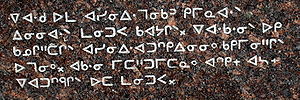
, vowels are marked by modifying the shapes of the consonants, and one of these pulls double duty for final consonants. - In the Cree familyCanadian Aboriginal SyllabicsCanadian Aboriginal syllabic writing, or simply syllabics, is a family of abugidas used to write a number of Aboriginal Canadian languages of the Algonquian, Inuit, and Athabaskan language families....
, vowels are marked by rotating or flipping the consonants, and final consonants are indicated with either special diacritics or superscript forms of the main initial consonants.
Tāna of the Maldives
Maldives
The Maldives , , officially Republic of Maldives , also referred to as the Maldive Islands, is an island nation in the Indian Ocean formed by a double chain of twenty-six atolls oriented north-south off India's Lakshadweep islands, between Minicoy Island and...
has dependent vowels and a zero vowel sign, but no inherent vowel.
| Feature | North Indic | South Indic | Thaana | Ethiopic | Canadian |
|---|---|---|---|---|---|
| Vowel after consonant | Dependent sign (diacritic) | Fused diacritic | Rotate/reflect | ||
| Initial vowel letter(s) | 1 per vowel | Zero consonant in SEA Southeast Asia Southeast Asia, South-East Asia, South East Asia or Southeastern Asia is a subregion of Asia, consisting of the countries that are geographically south of China, east of India, west of New Guinea and north of Australia. The region lies on the intersection of geological plates, with heavy seismic... |
Glottal stop | Zero consonant Zero consonant A zero consonant, silent initial, or null-onset letter is a consonant-like letter that is not pronounced, but indicates that a word or syllable starts with a vowel... |
|
| Absence of vowel sign | colspan="2"|[ə], [ɔ], [a], or engali script#Vowels | N/A | [ə] | N/A | |
| Virama (zero vowel sign) | Often | Always | No | ||
| Consonant ligatures | Conjunct D, B | Stack or none | No | ||
| Final consonant dependents | only | No | All | ||
| Distinct final forms | only | No | Western only | ||
| Final consonant position | Top or inline | Inline | Small raised, or full letter |
||
Indic (Brahmic)
Indic scripts originated in IndiaIndia
India , officially the Republic of India , is a country in South Asia. It is the seventh-largest country by geographical area, the second-most populous country with over 1.2 billion people, and the most populous democracy in the world...
and spread to Southeast Asia
Southeast Asia
Southeast Asia, South-East Asia, South East Asia or Southeastern Asia is a subregion of Asia, consisting of the countries that are geographically south of China, east of India, west of New Guinea and north of Australia. The region lies on the intersection of geological plates, with heavy seismic...
. All surviving Indic scripts are descendants of the Brahmi alphabet. Today they are used in most languages of South Asia
South Asia
South Asia, also known as Southern Asia, is the southern region of the Asian continent, which comprises the sub-Himalayan countries and, for some authorities , also includes the adjoining countries to the west and the east...
(although replaced by Perso-Arabic in Urdu
Urdu
Urdu is a register of the Hindustani language that is identified with Muslims in South Asia. It belongs to the Indo-European family. Urdu is the national language and lingua franca of Pakistan. It is also widely spoken in some regions of India, where it is one of the 22 scheduled languages and an...
, Kashmiri
Kashmiri language
Kashmiri is a language from the Dardic sub-group and it is spoken primarily in the Kashmir Valley, in Jammu and Kashmir. There are approximately 5,554,496 speakers in Jammu and Kashmir, according to the Census of 2001. Most of the 105,000 speakers or so in Pakistan are émigrés from the Kashmir...
and some other languages of Pakistan
Pakistan
Pakistan , officially the Islamic Republic of Pakistan is a sovereign state in South Asia. It has a coastline along the Arabian Sea and the Gulf of Oman in the south and is bordered by Afghanistan and Iran in the west, India in the east and China in the far northeast. In the north, Tajikistan...
and India
India
India , officially the Republic of India , is a country in South Asia. It is the seventh-largest country by geographical area, the second-most populous country with over 1.2 billion people, and the most populous democracy in the world...
) and mainland Southeast Asia
Southeast Asia
Southeast Asia, South-East Asia, South East Asia or Southeastern Asia is a subregion of Asia, consisting of the countries that are geographically south of China, east of India, west of New Guinea and north of Australia. The region lies on the intersection of geological plates, with heavy seismic...
(Burma, Thailand
Thailand
Thailand , officially the Kingdom of Thailand , formerly known as Siam , is a country located at the centre of the Indochina peninsula and Southeast Asia. It is bordered to the north by Burma and Laos, to the east by Laos and Cambodia, to the south by the Gulf of Thailand and Malaysia, and to the...
, Laos
Laos
Laos Lao: ສາທາລະນະລັດ ປະຊາທິປະໄຕ ປະຊາຊົນລາວ Sathalanalat Paxathipatai Paxaxon Lao, officially the Lao People's Democratic Republic, is a landlocked country in Southeast Asia, bordered by Burma and China to the northwest, Vietnam to the east, Cambodia to the south and Thailand to the west...
, Cambodia
Cambodia
Cambodia , officially known as the Kingdom of Cambodia, is a country located in the southern portion of the Indochina Peninsula in Southeast Asia...
; but not Malaysia or Vietnam
Vietnam
Vietnam – sometimes spelled Viet Nam , officially the Socialist Republic of Vietnam – is the easternmost country on the Indochina Peninsula in Southeast Asia. It is bordered by China to the north, Laos to the northwest, Cambodia to the southwest, and the South China Sea –...
). The primary division is into North Indic scripts used in Northern India, Nepal, Tibet, Bhutan and Southern Indic scripts used in South India
South India
South India is the area encompassing India's states of Andhra Pradesh, Karnataka, Kerala and Tamil Nadu as well as the union territories of Lakshadweep and Pondicherry, occupying 19.31% of India's area...
, Sri Lanka
Sri Lanka
Sri Lanka, officially the Democratic Socialist Republic of Sri Lanka is a country off the southern coast of the Indian subcontinent. Known until 1972 as Ceylon , Sri Lanka is an island surrounded by the Indian Ocean, the Gulf of Mannar and the Palk Strait, and lies in the vicinity of India and the...
, and Southeast Asia
Southeast Asia
Southeast Asia, South-East Asia, South East Asia or Southeastern Asia is a subregion of Asia, consisting of the countries that are geographically south of China, east of India, west of New Guinea and north of Australia. The region lies on the intersection of geological plates, with heavy seismic...
.
South Indic letter forms are very rounded; North Indic less so, though Oriya
Oriya script
The Oriya script or Utkala Lipi or Utkalakshara is used to write the Oriya language, and can be used for several other Indian languages, for example, Sanskrit.- History :...
, Golmol and Litumol of Nepal script are rounded.
Most North Indic scripts' full letters incorporate a horizontal line at the top, with Gujarati script
Gujarati script
The Gujarati script , which like all Nāgarī writing systems is strictly speaking an abugida rather than an alphabet, is used to write the Gujarati and Kutchi languages...
an exception; South Indic scripts do not.
Indic scripts indicate vowels through dependent vowel signs (diacritics) around the consonants, often including a sign that explicitly indicates the lack of a vowel. If a consonant has no vowel sign, this indicates a default vowel. Vowel diacritics may appear above, below, to the left, to the right, or around the consonant.
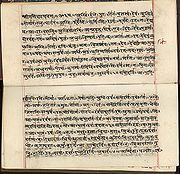
The most populous Indic script is Devanagari
Devanagari
Devanagari |deva]]" and "nāgarī" ), also called Nagari , is an abugida alphabet of India and Nepal...
, used for Hindi
Hindi
Standard Hindi, or more precisely Modern Standard Hindi, also known as Manak Hindi , High Hindi, Nagari Hindi, and Literary Hindi, is a standardized and sanskritized register of the Hindustani language derived from the Khariboli dialect of Delhi...
, Bhojpuri, Marathi
Marathi language
Marathi is an Indo-Aryan language spoken by the Marathi people of western and central India. It is the official language of the state of Maharashtra. There are over 68 million fluent speakers worldwide. Marathi has the fourth largest number of native speakers in India and is the fifteenth most...
, Nepali
Nepali language
Nepali or Nepalese is a language in the Indo-Aryan branch of the Indo-European language family.It is the official language and de facto lingua franca of Nepal and is also spoken in Bhutan, parts of India and parts of Myanmar...
, and often Sanskrit
Sanskrit
Sanskrit , is a historical Indo-Aryan language and the primary liturgical language of Hinduism, Jainism and Buddhism.Buddhism: besides Pali, see Buddhist Hybrid Sanskrit Today, it is listed as one of the 22 scheduled languages of India and is an official language of the state of Uttarakhand...
. A basic letter such as क represents a syllable with the default vowel, in this case ka ([kə]), or, in final position, a final consonant, in this case k. This inherent vowel may be changed by adding vowel marks (diacritic
Diacritic
A diacritic is a glyph added to a letter, or basic glyph. The term derives from the Greek διακριτικός . Diacritic is both an adjective and a noun, whereas diacritical is only an adjective. Some diacritical marks, such as the acute and grave are often called accents...
s), producing syllables such as कि ki, कु ku, के ke, को ko. The mora
Mora (linguistics)
Mora is a unit in phonology that determines syllable weight, which in some languages determines stress or timing. As with many technical linguistic terms, the definition of a mora varies. Perhaps the most succinct working definition was provided by the American linguist James D...
a consonant letter represents, either with or without a marked vowel, is called an akshara
Akshara
Akshara may mean:*"letter" in Hindi*"everlasting" or "imperishable"*in Sanskrit grammar, "syllable", see Shiksha*a consonant grapheme, with an inherent vowel, of a script of the Brahmic family....
.
| position | syllable | pronunciation | base form | script |
|---|---|---|---|---|
| above | के | /keː/ | क /k(a)/ | Devanagari Devanagari Devanagari |deva]]" and "nāgarī" ), also called Nagari , is an abugida alphabet of India and Nepal... |
| below | कु | /ku/ | ||
| left | कि | /ki/ | ||
| right | को | /koː/ | ||
| around | கௌ | /kau/ | க /ka/ | Tamil Tamil script The Tamil script is a script that is used to write the Tamil language as well as other minority languages such as Badaga, Irulas, and Paniya... |
| surround | កៀ | /kie/ | ក /kɑɑ/ | Khmer Khmer script The Khmer script is an alphasyllabary script used to write the Khmer language . It is also used to write Pali among the Buddhist liturgy of Cambodia and Thailand.... |
| within | ಕಿ | /ki/ | ಕ /ka/ | Kannada Kannada script The Kannada script is an alphasyllabary of the Brahmic family, used primarily to write the Kannada language, one of the Dravidian languages of southern India and also Sanskrit in the past. The Telugu script is derived from Old Kannada, and resembles Kannada script... |
In many of the Brahmic scripts, a syllable beginning with a cluster is treated as a single character for purposes of vowel marking, so a vowel marker like -i, falling before the character it modifies, may appear several positions before the place where it is pronounced. For example, the game cricket
Cricket
Cricket is a bat-and-ball game played between two teams of 11 players on an oval-shaped field, at the centre of which is a rectangular 22-yard long pitch. One team bats, trying to score as many runs as possible while the other team bowls and fields, trying to dismiss the batsmen and thus limit the...
in Hindi
Hindi
Standard Hindi, or more precisely Modern Standard Hindi, also known as Manak Hindi , High Hindi, Nagari Hindi, and Literary Hindi, is a standardized and sanskritized register of the Hindustani language derived from the Khariboli dialect of Delhi...
is क्रिकेट krikeţ; the diacritic for /i/ appears before the consonant cluster
Consonant cluster
In linguistics, a consonant cluster is a group of consonants which have no intervening vowel. In English, for example, the groups and are consonant clusters in the word splits....
/kr/, not before the /r/. A more unusual example is seen in the Batak alphabet
Batak alphabet
The Batak script, called locally surat Batak, is an abugida used to write the Austronesian Batak languages spoken by several million people on the Indonesian island of Sumatra.-History:...
: Here the syllable bim is written ba-ma-i-(virama). That is, the vowel diacritic and virama are both written after the consonants for the whole syllable.
In many abugidas, there is also a diacritic to suppress the inherent vowel, yielding the bare consonant. In Devanagari
Devanagari
Devanagari |deva]]" and "nāgarī" ), also called Nagari , is an abugida alphabet of India and Nepal...
, क् is k, and ल् is l. This is called the virama
Virama
Virama is a generic term for the diacritic in many Brahmic scripts, including Devanagari and East Nagari, that is used to suppress the inherent vowel that otherwise occurs with every consonant letter. The name is Sanskrit for "cessation, termination, end"...
in Sanskrit
Sanskrit
Sanskrit , is a historical Indo-Aryan language and the primary liturgical language of Hinduism, Jainism and Buddhism.Buddhism: besides Pali, see Buddhist Hybrid Sanskrit Today, it is listed as one of the 22 scheduled languages of India and is an official language of the state of Uttarakhand...
, or halant in Hindi
Hindi
Standard Hindi, or more precisely Modern Standard Hindi, also known as Manak Hindi , High Hindi, Nagari Hindi, and Literary Hindi, is a standardized and sanskritized register of the Hindustani language derived from the Khariboli dialect of Delhi...
. It may be used to form consonant cluster
Consonant cluster
In linguistics, a consonant cluster is a group of consonants which have no intervening vowel. In English, for example, the groups and are consonant clusters in the word splits....
s, or to indicate that a consonant occurs at the end of a word. For writing two consonants without a vowel in between, instead of using diacritics on the first consonant to remove its vowel, another popular method of special conjunct
Conjunct
In linguistics, the term conjunct has three distinct uses:*A conjunct is an adjunct that adds information to the sentence that is not considered part of the propositional content but which connects the sentence with previous parts of the discourse...
forms is used in which two or more consonant characters are merged to express a cluster, such as Devanagari: क्ल kla. (Note that on some fonts display this as क् followed by ल, rather than forming a conjunct. This expedient is used by ISCII
ISCII
Indian Standard Code for Information Interchange is a coding scheme for representing various writing systems of India. It encodes the main Indic scripts and a Roman transliteration. The supported scripts are: Assamese, Bengali , Devanagari, Gujarati, Gurmukhi, Kannada, Malayalam, Oriya , Tamil,...
and South Asian scripts of Unicode
Unicode
Unicode is a computing industry standard for the consistent encoding, representation and handling of text expressed in most of the world's writing systems...
.) Thus a closed syllable such as kal requires two akshara
Akshara
Akshara may mean:*"letter" in Hindi*"everlasting" or "imperishable"*in Sanskrit grammar, "syllable", see Shiksha*a consonant grapheme, with an inherent vowel, of a script of the Brahmic family....
to write.
The Róng
Rong
Rong is an village in Øygarden, Norway, located on the island of Rongøy. It is connected to Toftøy via the Rongesundet Bridge, which crosses the sound Rongesundet....
script used for the Lepcha language
Lepcha language
Lepcha language, or Róng language , is a Himalayish language spoken by the Lepcha people in Sikkim and parts of West Bengal, Nepal and Bhutan.-Population:...
goes further than other Indic abugidas, in that a single akshara can represent a closed syllable: Not only the vowel, but any final consonant is indicated by a diacritic. For example, the syllable [sok] would be written as something like , here with an underring representing /o/ and an overcross representing the diacritic for final /k/. Most other Indic abugidas can only indicate a very limited set of final consonants with diacritics, such as /ŋ/ or /r/, if they can indicate any at all.
Ethiopic
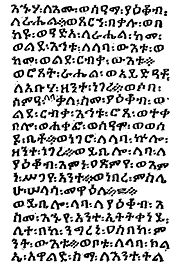
Though now an abugida, the Ge'ez alphabet
Ge'ez alphabet
Ge'ez , also called Ethiopic, is a script used as an abugida for several languages of Ethiopia and Eritrea but originated in an abjad used to write Ge'ez, now the liturgical language of the Ethiopian and Eritrean Orthodox Church...
, until the advent of Christianity (ca. 350 CE), had originally been what would now be termed an abjad
Abjad
An abjad is a type of writing system in which each symbol always or usually stands for a consonant; the reader must supply the appropriate vowel....
. In the Ge'ez abugida (or 'fidel'), the base form of the letter (also known as 'fidel') may be altered. For example, ሀ hä [hə] (base form), ሁ hu (with a right-side diacritic that doesn't alter the letter), ሂ hi (with a subdiacritic that compresses the consonant, so it is the same height), ህ hə [hɨ] or [h] (where the letter is modified with a kink in the left arm).
Canadian Aboriginal syllabics
In the family known as Canadian Aboriginal syllabicsCanadian Aboriginal Syllabics
Canadian Aboriginal syllabic writing, or simply syllabics, is a family of abugidas used to write a number of Aboriginal Canadian languages of the Algonquian, Inuit, and Athabaskan language families....
, vowels are indicated by changing the orientation of the akshara
Akshara
Akshara may mean:*"letter" in Hindi*"everlasting" or "imperishable"*in Sanskrit grammar, "syllable", see Shiksha*a consonant grapheme, with an inherent vowel, of a script of the Brahmic family....
. Each vowel has a consistent orientation; for example, Inuktitut
Inuktitut
Inuktitut or Eastern Canadian Inuktitut, Eastern Canadian Inuit language is the name of some of the Inuit languages spoken in Canada...
ᐱ pi, ᐳ pu, ᐸ pa; ᑎ ti, ᑐ tu, ᑕ ta. Although there is a vowel inherent in each, all rotations have equal status and none can be identified as basic. Bare consonants are indicated either by separate diacritics, or by superscript versions of the aksharas; there is no vowel-killer mark.
Voweled abjads
Consonantal scripts ("abjadAbjad
An abjad is a type of writing system in which each symbol always or usually stands for a consonant; the reader must supply the appropriate vowel....
s") are normally written without indication of many vowels. However in some contexts like teaching materials or scriptures, Arabic and Hebrew are written with full indication of vowels via diacritic marks (harakat
Harakat
The Arabic script has numerous diacritics, including ijam ⟨⟩ , and tashkil ⟨⟩...
, niqqud) making them effectively abugidas. The Brahmic and Ethiopic families are thought to have originated from the Semitic abjads by the addition of vowel marks.
The Arabic-alphabet scripts used for Kurdish
Kurdish language
Kurdish is a dialect continuum spoken by the Kurds in western Asia. It is part of the Iranian branch of the Indo-Iranian group of Indo-European languages....
in Iraq and for Uighur in Xinjiang
Xinjiang
Xinjiang is an autonomous region of the People's Republic of China. It is the largest Chinese administrative division and spans over 1.6 million km2...
, People's Republic of China) are fully voweled, but since the vowels are full letters rather than diacritics, and there are no inherent vowels, these are considered alphabets rather than abugidas.
Phagspa
The imperial Mongol script called Phagspa was derived from the Tibetan abugida, but all vowels are written in-line rather than as diacritics. However, it retains the features of having an inherent vowel /a/ and having distinct initial vowel letters.Pahawh
Pahawh HmongPahawh Hmong
Pahawh Hmong is an indigenous semi-syllabic script, invented in 1959, to write the Hmong language.-Form:Pahawh is written left to right...
is a non-segmental script that indicates syllable onsets and rime
Syllable rime
In the study of phonology in linguistics, the rime or rhyme of a syllable consists of a nucleus and an optional coda. It is the part of the syllable used in poetic rhyme, and the part that is lengthened or stressed when a person elongates or stresses a word in speech.The rime is usually the...
s, such as consonant clusters and vowels with final consonants. Thus it is not segmental and cannot be considered an abugida. However, it superficially resembles an abugida with the roles of consonant and vowel reversed. Most syllables are written with two letters in the order rime–onset (typically vowel-consonant), even though they are pronounced as onset-rime (consonant-vowel), rather like the position of the /i/ vowel in Devanagari, which is written before the consonant. Pahawh is also unusual in that, while an inherent rime /āu/ (with mid tone) is unwritten, it also has an inherent onset /k/. For the syllable /kau/, which requires one or the other of the inherent sounds to be overt, it is /au/ that is written. Thus it is the rime (vowel) which is basic to the system.
Meroitic
It is difficult to draw a dividing line between abugidas and other segmentalSegment (linguistics)
In linguistics , the term segment may be defined as "any discrete unit that can be identified, either physically or auditorily, in the stream of speech."- Classifying speech units :...
scripts. For example, the Meroitic script
Meroitic script
The Meroitic script is an alphabetic script originally derived from Egyptian hieroglyphs, used to write the Meroitic language of the Kingdom of Meroë/Kush. It was developed in the Napatan Period , and first appears in the 2nd century BCE. For a time, it was also possibly used to write the Nubian...
of ancient Sudan
Sudan
Sudan , officially the Republic of the Sudan , is a country in North Africa, sometimes considered part of the Middle East politically. It is bordered by Egypt to the north, the Red Sea to the northeast, Eritrea and Ethiopia to the east, South Sudan to the south, the Central African Republic to the...
did not indicate an inherent a (one symbol stood for both m and ma, for example), and is thus similar to Brahmic family abugidas. However, the other vowels were indicated with full letters, not diacritics or modification, so the system was essentially an alphabet that did not bother to write the most common vowel.
Shorthand
Several systems of shorthandShorthand
Shorthand is an abbreviated symbolic writing method that increases speed or brevity of writing as compared to a normal method of writing a language. The process of writing in shorthand is called stenography, from the Greek stenos and graphē or graphie...
use diacritics for vowels, but they do not have an inherent vowel, and are thus more similar to Thaana
Thaana
Thaana, Taana or Tāna is the modern writing system of the Divehi language spoken in the Maldives. Taana has characteristics of both an abugida and a true alphabet , with consonants derived from indigenous and Arabic numerals, and vowels derived from the vowel diacritics of the Arabic abjad...
and Kurdish script
Kurdish alphabet
The Kurdish language is written either using a variant of the Latin alphabet, according to a system introduced by Jeladet Ali Bedirkhan in 1932 , or using a variant of the Persian alphabet, the so-called Sorani alphabet, named for the city of Soran, Iraq.The Hawar is used in Turkey, Syria and...
than to the Brahmic scripts. The Gabelsberger shorthand
Gabelsberger shorthand
Gabelsberger shorthand, named for its creator, is a form of shorthand previously common in Germany and Austria. Created circa 1817 by Franz Xaver Gabelsberger, it was first fully described in the 1834 textbook Anleitung zur deutschen Redezeichenkunst oder Stenographie and became rapidly...
system and its derivatives modify the following consonant to represent vowels. The Pollard script
Pollard script
The Pollard script, also known as Pollard Miao, is an abugida loosely based on the Latin alphabet and invented by Methodist missionary Sam Pollard. Pollard invented the script for use with A-Hmao, one of several dialects of the Hmong language. The script underwent a series of revisions until 1936,...
, which was based on shorthand, also uses diacritics for vowels; the placements of the vowel relative to the consonant indicates tone
Tone (linguistics)
Tone is the use of pitch in language to distinguish lexical or grammatical meaning—that is, to distinguish or inflect words. All verbal languages use pitch to express emotional and other paralinguistic information, and to convey emphasis, contrast, and other such features in what is called...
. Pitman shorthand
Pitman Shorthand
Pitman shorthand is a system of shorthand for the English language developed by Englishman Sir Isaac Pitman , who first presented it in 1837. Like most systems of shorthand, it is a phonetic system; the symbols do not represent letters, but rather sounds, and words are, for the most part, written...
uses straight strokes and quarter-circle marks in different orientations as the principal "alphabet" of consonants; vowels are shown as light and heavy dots, dashes and other marks in one of 3 possible positions to indicate the various vowel-sounds. However, to increase writing-speed Pitman has rules for "vowel indication" using the positioning or choice of consonant signs so that writing vowel-marks can be dispensed with.
Development
As the term alphasyllabary suggests, abugidas have been considered an intermediate step between alphabetAlphabet
An alphabet is a standard set of letters—basic written symbols or graphemes—each of which represents a phoneme in a spoken language, either as it exists now or as it was in the past. There are other systems, such as logographies, in which each character represents a word, morpheme, or semantic...
s and syllabaries
Syllabary
A syllabary is a set of written symbols that represent syllables, which make up words. In a syllabary, there is no systematic similarity between the symbols which represent syllables with the same consonant or vowel...
. Historically, abugidas appear to have evolved from abjad
Abjad
An abjad is a type of writing system in which each symbol always or usually stands for a consonant; the reader must supply the appropriate vowel....
s (vowelless alphabets). They contrast with syllabaries, where there is a distinct symbol for each syllable or consonant-vowel combination, and where these have no systematic similarity to each other, and typically develop directly from logographic scripts
Logogram
A logogram, or logograph, is a grapheme which represents a word or a morpheme . This stands in contrast to phonograms, which represent phonemes or combinations of phonemes, and determinatives, which mark semantic categories.Logograms are often commonly known also as "ideograms"...
. Compare the Devanagari examples above to sets of syllables in the Japanese hiragana
Hiragana
is a Japanese syllabary, one basic component of the Japanese writing system, along with katakana, kanji, and the Latin alphabet . Hiragana and katakana are both kana systems, in which each character represents one mora...
syllabary: か ka, き ki, く ku, け ke, こ ko have nothing in common to indicate k; while ら ra, り ri, る ru, れ re, ろ ro have neither anything in common for r, nor anything to indicate that they have the same vowels as the k set.
Most Indian and Indochinese abugidas appear to have first been developed from abjads with the and Brāhmī script
Brāhmī script
Brāhmī is the modern name given to the oldest members of the Brahmic family of scripts. The best-known Brāhmī inscriptions are the rock-cut edicts of Ashoka in north-central India, dated to the 3rd century BCE. These are traditionally considered to be early known examples of Brāhmī writing...
s; the abjad in question is usually considered to be the Aramaic
Aramaic alphabet
The Aramaic alphabet is adapted from the Phoenician alphabet and became distinctive from it by the 8th century BC. The letters all represent consonants, some of which are matres lectionis, which also indicate long vowels....
one, but while the link between Aramaic and Kharosthi is more or less undisputed, this is not the case with Brahmi. The Kharosthi family does not survive today, but Brahmi's descendants include most of the modern scripts of South
South Asia
South Asia, also known as Southern Asia, is the southern region of the Asian continent, which comprises the sub-Himalayan countries and, for some authorities , also includes the adjoining countries to the west and the east...
and Southeast Asia
Southeast Asia
Southeast Asia, South-East Asia, South East Asia or Southeastern Asia is a subregion of Asia, consisting of the countries that are geographically south of China, east of India, west of New Guinea and north of Australia. The region lies on the intersection of geological plates, with heavy seismic...
. Ge'ez derived from a different abjad, the Sabean script of Yemen
Yemen
The Republic of Yemen , commonly known as Yemen , is a country located in the Middle East, occupying the southwestern to southern end of the Arabian Peninsula. It is bordered by Saudi Arabia to the north, the Red Sea to the west, and Oman to the east....
; the advent of vowels coincided with the introduction of Christianity about 350 CE.
Other types of writing systems
- Featural alphabetFeatural alphabetA featural alphabet is an alphabet wherein the shapes of the letters are not arbitrary, but encode phonological features of the phonemes they represent. The term featural was introduced by Geoffrey Sampson to describe Hangul and Pitman Shorthand...
- AbjadAbjadAn abjad is a type of writing system in which each symbol always or usually stands for a consonant; the reader must supply the appropriate vowel....
- AlphabetAlphabetAn alphabet is a standard set of letters—basic written symbols or graphemes—each of which represents a phoneme in a spoken language, either as it exists now or as it was in the past. There are other systems, such as logographies, in which each character represents a word, morpheme, or semantic...
- LogogramLogogramA logogram, or logograph, is a grapheme which represents a word or a morpheme . This stands in contrast to phonograms, which represent phonemes or combinations of phonemes, and determinatives, which mark semantic categories.Logograms are often commonly known also as "ideograms"...
- SyllabarySyllabaryA syllabary is a set of written symbols that represent syllables, which make up words. In a syllabary, there is no systematic similarity between the symbols which represent syllables with the same consonant or vowel...
True abugidas
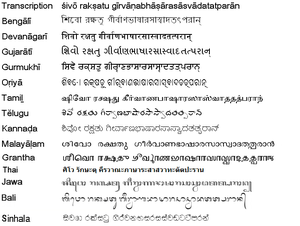
- Brahmic familyBrahmic familyThe Brahmic or Indic scripts are a family of abugida writing systems. They are used throughout South Asia , Southeast Asia, and parts of Central and East Asia, and are descended from the Brāhmī script of the ancient Indian subcontinent...
, descended from BrāhmīBrāhmī scriptBrāhmī is the modern name given to the oldest members of the Brahmic family of scripts. The best-known Brāhmī inscriptions are the rock-cut edicts of Ashoka in north-central India, dated to the 3rd century BCE. These are traditionally considered to be early known examples of Brāhmī writing...
(c. 6th century BC)- AssameseAssamese languageAssamese is the easternmost Indo-Aryan language. It is used mainly in the state of Assam in North-East India. It is also the official language of Assam. It is also spoken in parts of Arunachal Pradesh and other northeast Indian states. Nagamese, an Assamese-based Creole language is widely used in...
- BalineseBalinese scriptThe Balinese alphabet is an abugida that was used to write the Balinese language, an Austronesian language spoken by about three million people on the Indonesian island of Bali. The use of the Balinese script has mostly been replaced by the Roman alphabet. Although it is learned in school, few...
- Balti
- Batak
- BaybayinBaybayinBaybayin , is a pre-Spanish Philippine writing system. It is a member of the Brahmic family and is recorded as being in use in the 16th century...
, pre-Hispanic script of TagalogTagalog languageTagalog is an Austronesian language spoken as a first language by a third of the population of the Philippines and as a second language by most of the rest. It is the first language of the Philippine region IV and of Metro Manila...
and other Philippine languages - BengaliBengali scriptThe Bengali alphabet is the writing system for the Bengali language. The script with variations is used for Assamese and is basis for Meitei, Bishnupriya Manipuri, Kokborok, Garo and Mundari alphabets. All these languages are spoken in the eastern region of South Asia. Historically, the script has...
- Bhujimol
- Box-head a script in India
- BugisBugisThe Bugis are the most numerous of the three major linguistic and ethnic groups of South Sulawesi, the southwestern province of Sulawesi, Indonesia's third largest island. Although many Bugis live in the large port cities of Makassar and Parepare, the majority are farmers who grow wet rice on the...
also known as Makassar or LontaraLontaraLontara or lontaraq are Bugis palm-leaf manuscripts that record knowledge on such topics as history, science, custom, and laws. The term originates from the Javanese/Malay word lontar, which is the type of tree that provides the leaves used.... - BuhidBuhid scriptBuhid, is an indigenous Brahmic script of the Philippines, closely related to Baybayin, and is used today by the Mangyans to write their language, Buhid.- Unicode :Buhid script was added to the Unicode Standard in March, 2002 with the release of version 3.2....
, used by Mangyans in MindoroMindoroMindoro is the seventh-largest island in the Philippines. It is located off the coast of Luzon, and northeast of Palawan. The southern coast of Mindoro forms the northeastern extremum of the Sulu Sea.-History:...
, PhilippinesPhilippinesThe Philippines , officially known as the Republic of the Philippines , is a country in Southeast Asia in the western Pacific Ocean. To its north across the Luzon Strait lies Taiwan. West across the South China Sea sits Vietnam... - Burmese
- Chalukya
- Cham
- Chola
- DevanagariDevanagariDevanagari |deva]]" and "nāgarī" ), also called Nagari , is an abugida alphabet of India and Nepal...
(used to write NepaliNepali languageNepali or Nepalese is a language in the Indo-Aryan branch of the Indo-European language family.It is the official language and de facto lingua franca of Nepal and is also spoken in Bhutan, parts of India and parts of Myanmar...
, SanskritSanskritSanskrit , is a historical Indo-Aryan language and the primary liturgical language of Hinduism, Jainism and Buddhism.Buddhism: besides Pali, see Buddhist Hybrid Sanskrit Today, it is listed as one of the 22 scheduled languages of India and is an official language of the state of Uttarakhand...
, PaliPáli- External links :* *...
, modern HindiHindiStandard Hindi, or more precisely Modern Standard Hindi, also known as Manak Hindi , High Hindi, Nagari Hindi, and Literary Hindi, is a standardized and sanskritized register of the Hindustani language derived from the Khariboli dialect of Delhi...
, MarathiMarathi languageMarathi is an Indo-Aryan language spoken by the Marathi people of western and central India. It is the official language of the state of Maharashtra. There are over 68 million fluent speakers worldwide. Marathi has the fourth largest number of native speakers in India and is the fifteenth most...
etc.) - Dehong DaiTai Le scriptTai Le is the name of Tai Nüa script, the script used for the Tai Nüa language, given by Microsoft.-Unicode:Tai Le script was added to the Unicode Standard in April, 2003 with the release of version 4.0....
- Golmol
- Grantha
- GujaratiGujarati scriptThe Gujarati script , which like all Nāgarī writing systems is strictly speaking an abugida rather than an alphabet, is used to write the Gujarati and Kutchi languages...
- GurmukhiGurmukhi scriptGurmukhi is the most common script used for writing the Punjabi language. An abugida derived from the Laṇḍā script and ultimately descended from Brahmi, Gurmukhi was standardized by the second Sikh guru, Guru Angad Dev Ji, in the 16th century. The whole of the Sri Guru Granth Sahib Ji's 1430...
- Hanuno'oHanunó'o scriptHanunó’o is one of the indigenous scripts of the Philippines and is used by the Mangyan people of southern Mindoro to write the Hanunó’o language. It is an abugida descended from the Indic scripts, closely related to Baybayin, and is famous for being written vertical but written upward, rather than...
, a script used by Mangyans in MindoroMindoroMindoro is the seventh-largest island in the Philippines. It is located off the coast of Luzon, and northeast of Palawan. The southern coast of Mindoro forms the northeastern extremum of the Sulu Sea.-History:...
, PhilippinesPhilippinesThe Philippines , officially known as the Republic of the Philippines , is a country in Southeast Asia in the western Pacific Ocean. To its north across the Luzon Strait lies Taiwan. West across the South China Sea sits Vietnam... - JavaneseJavanese scriptThe Javanese alphabet, natively known as Hanacaraka or Carakan , known by the Sundanese people as Cacarakan is the pre-colonial script used to write the Javanese language....
- KadambaKadamba scriptThe Kadamba script marks the birth of a dedicated Kannada script that was used for Kannada language. It is a descendant of the Brahmi script. The Kadamba script was developed during the reign of the Kadambas in the 4th - 6th centuries. The Kadamba script is also known as Pre-Old-Kannada script...
- KaithiKaithiKaithi , also called "Kayathi" or "Kayasthi", is the name of a historical script used widely in parts of North India, primarily in the former North-Western Provinces, Oudh and Bihar...
- KannadaKannada scriptThe Kannada script is an alphasyllabary of the Brahmic family, used primarily to write the Kannada language, one of the Dravidian languages of southern India and also Sanskrit in the past. The Telugu script is derived from Old Kannada, and resembles Kannada script...
- KhmerKhmer scriptThe Khmer script is an alphasyllabary script used to write the Khmer language . It is also used to write Pali among the Buddhist liturgy of Cambodia and Thailand....
- Lanna
- LepchaLepcha scriptThe Lepcha script, or Róng script is an abugida used by the Lepcha people to write the Lepcha language. Unusually for an abugida, syllable-final consonants are written as diacritics.-History:...
- LimbuLimbu scriptThe Limbu script is used to write the Limbu language. The Limbu script is an abugida derived from the Tibetan script.-History:According to traditional histories, the Limbu script was first invented in the late 9th century by King Sirijonga Haang, then fell out of use, to be reintroduced in the 18th...
- Lao (before spelling reforms)
- MalayalamMalayalam scriptThe Malayalam script is a Brahmic script used commonly to write the Malayalam language—which is the principal language of the Indian state of Kerala, spoken by 36 million people in the world. Like many other Indic scripts, it is an abugida, or a writing system that is partially “alphabetic” and...
- Manipuri (also known as Meitei Mayek script)
- ModiModi script' is one of the scripts used to write the Marathi language& Rajasthani language, which is the primary language spoken in the state of Maharashtra & Rajasthan in western India respectively. MoDiis also known as MuDiya, MuDi & VañiyāvaTi...
used to write MarathiMarathi languageMarathi is an Indo-Aryan language spoken by the Marathi people of western and central India. It is the official language of the state of Maharashtra. There are over 68 million fluent speakers worldwide. Marathi has the fourth largest number of native speakers in India and is the fifteenth most... - OriyaOriya scriptThe Oriya script or Utkala Lipi or Utkalakshara is used to write the Oriya language, and can be used for several other Indian languages, for example, Sanskrit.- History :...
- Old KawiOld KawiKawi is the name given to the writing system originating in Java and used across much of Maritime Southeast Asia in inscriptions and texts from the 8th century to around 1500 AD...
progenitor of Indonesian and Philippine scripts - Pachumol
- Phags-Pa created for Kublai Khan's Yuan China
- Prachalit NepalPrachalit Nepal scriptPrachalit Nepal script is a type of Abugida script developed from the Mol script derivatives of Brahmi Script. It is used to write Nepal Bhasa, Sanskrit and Pali. Various publications are still published in this script and a unicode character set has been purposed....
- RanjanaRanjana scriptThe Rañjanā script is an abugida writing system which developed in the 11th century. It is primarily used for writing Nepal Bhasa but is also used in monasteries of India, Tibet, coastline China, Mongolia, and Japan. It is usually written from left to right but the Kutakshar form is written from...
- RedjangRejang scriptThe Rejang script, sometimes spelt Redjang and locally known as Surat Ulu , is an abugida of the Brahmic family, and is related to other scripts of the region, like Batak, Buginese, and others. Rejang is a member of the closely related group of Surat Ulu scripts that include the script variants of...
- SharadaSarada scriptThe Śāradā, or Sharada, script is an abugida writing system of the Brahmic family of scripts, developed around the 8th century. It was used for writing Sanskrit and Kashmiri. The Gurmukhī script was developed from Śāradā...
- Siddham used to write SanskritSanskritSanskrit , is a historical Indo-Aryan language and the primary liturgical language of Hinduism, Jainism and Buddhism.Buddhism: besides Pali, see Buddhist Hybrid Sanskrit Today, it is listed as one of the 22 scheduled languages of India and is an official language of the state of Uttarakhand...
- Sinhala
- Sorang SompengSorang SompengSorang Sompeng script is used to write in Sora, a Munda language with 273,911 speakers in India. The script was created by Mangei Gomango in 1936 and is used in religious contexts...
- Sourashtra
- Soyombo scriptSoyombo scriptThe Soyombo script is an abugida developed by the Mongolian monk and scholar Bogdo Zanabazar in 1686 to write Mongolian.It can also be used to write Tibetan and Sanskrit....
- SundaneseSundanese scriptSundanese script Sundanese script Sundanese script (Aksara Sunda, is a writing system which is used by some Sundanese people. It is built based on Old Sundanese script (Aksara Sunda Kuna) which was used by ancientSundanese between 14th and 18th centuries....
- Syloti Nagri
- TagbanwaTagbanwaTagbanwa, also known as Apurahuano, is one of the indigenous writing systems of the Philippines. The Tagbanwa language, an Austronesian language, with about 8, 000 speakers in the central and northern regions of Palawan, is dying out as the younger generations of Tagbanua are learning Cuyonon...
in Palawan, Philippines - Tai DamTai DamThe Tai Dam or Tai Dum are an ethnic group of Laos, Vietnam, China, and Thailand.Tai Dam speakers in China are classified as part of the Dai nationality along with almost all the other Tai peoples...
- TamilTamil scriptThe Tamil script is a script that is used to write the Tamil language as well as other minority languages such as Badaga, Irulas, and Paniya...
- TeluguTelugu scriptTelugu script, an abugida from the Brahmic family of scripts, is used to write the Telugu language, a language found in the South-Central Indian state of Andhra Pradesh as well as several other neighboring states. The Telugu script is derived from the Bhattiprolu script...
- Thai
- TibetanTibetan scriptThe Tibetan alphabet is an abugida of Indic origin used to write the Tibetan language as well as the Dzongkha language, Denzongkha, Ladakhi language and sometimes the Balti language. The printed form of the alphabet is called uchen script while the hand-written cursive form used in everyday...
- Tirhuta used to write MaithiliMaithili languageMaithili language is spoken in the eastern region of India and South-eastern region of Nepal. The native speakers of Maithili reside in Bihar, Jharkhand,parts of West Bengal and South-east Nepal...
- Tocharian – extinct
- Varang KshitiVarang KshitiVarang Kshiti is a syllabic alphabet invented by Lako Bodra , used in primary and adult education and in various publications. It is used to write Ho, a language used in the Indian states of Bihar and Orissa....
- VatteluttuVatteluttuVatteluttu alphabet, also spelled Vattezhuttu alphabet is an abugida writing system originating from the Tamil people of Southern India...
aka round script (extinct), from the 3rd century BC
- Assamese
- Ge'ezGe'ez languageGe'ez is an ancient South Semitic language that developed in the northern region of Ethiopia and southern Eritrea in the Horn of Africa...
(Ethiopic), from the 4th century AD - Canadian Aboriginal syllabicsCanadian Aboriginal SyllabicsCanadian Aboriginal syllabic writing, or simply syllabics, is a family of abugidas used to write a number of Aboriginal Canadian languages of the Algonquian, Inuit, and Athabaskan language families....
- CreeCree syllabicsCree syllabics, found in two primary variants, are the versions of Canadian Aboriginal syllabics used to write Cree dialects, including the original syllabics system created for Cree and Ojibwe. Syllabics were later adapted to several other languages...
-Ojibwe syllabics - Inuktitut syllabicsInuktitut syllabicsInuktitut syllabics is a writing system used by the Inuit in Nunavut and in Nunavik, Quebec...
- Blackfoot syllabics
- Carrier syllabicsCarrier syllabicsCarrier or Déné syllabics is a script created by Adrien-Gabriel Morice for the Carrier language. It was inspired by Cree syllabics and is one of the writing systems in the Canadian Aboriginal syllabics Unicode range.-History:...
- Cree
Abugida-like scripts
- MeroiticMeroitic scriptThe Meroitic script is an alphabetic script originally derived from Egyptian hieroglyphs, used to write the Meroitic language of the Kingdom of Meroë/Kush. It was developed in the Napatan Period , and first appears in the 2nd century BCE. For a time, it was also possibly used to write the Nubian...
(extinct) - ThaanaThaanaThaana, Taana or Tāna is the modern writing system of the Divehi language spoken in the Maldives. Taana has characteristics of both an abugida and a true alphabet , with consonants derived from indigenous and Arabic numerals, and vowels derived from the vowel diacritics of the Arabic abjad...
- Pitman shorthandPitman ShorthandPitman shorthand is a system of shorthand for the English language developed by Englishman Sir Isaac Pitman , who first presented it in 1837. Like most systems of shorthand, it is a phonetic system; the symbols do not represent letters, but rather sounds, and words are, for the most part, written...
- Pollard scriptPollard scriptThe Pollard script, also known as Pollard Miao, is an abugida loosely based on the Latin alphabet and invented by Methodist missionary Sam Pollard. Pollard invented the script for use with A-Hmao, one of several dialects of the Hmong language. The script underwent a series of revisions until 1936,...
External links
- Syllabic alphabets – Omniglot's list of abugidas, including examples of various writing systems
- Alphabets – list of abugidas and other scripts (in Spanish)
- Comparing Devanagari with Burmese, Khmer, Thai, and Tai Tham scripts