

Special Activities Division

Encyclopedia

United States
The United States of America is a federal constitutional republic comprising fifty states and a federal district...
Central Intelligence Agency
Central Intelligence Agency
The Central Intelligence Agency is a civilian intelligence agency of the United States government. It is an executive agency and reports directly to the Director of National Intelligence, responsible for providing national security intelligence assessment to senior United States policymakers...
's (CIA) National Clandestine Service
National Clandestine Service
The National Clandestine Service is one of the four main components of the Central Intelligence Agency...
(NCS) responsible for covert operations known as "special activities". Within SAD there are two separate groups, one for tactical paramilitary operations and another for covert political action.
The Political Action Group within SAD is responsible for covert activities related to political influence, psychological
Psychological warfare
Psychological warfare , or the basic aspects of modern psychological operations , have been known by many other names or terms, including Psy Ops, Political Warfare, “Hearts and Minds,” and Propaganda...
and economic warfare
Economic warfare
Economic warfare is the term for economic policies followed as a part of military operations during wartime.The purpose of economic warfare is to capture critical economic resources so that the military can operate at full efficiency and/or deprive the enemy forces of those resources so that they...
. The rapid development of technology has added cyberwarfare to their mission. A large covert operation usually has components that involve many, or all, of these categories, as well as paramilitary operations.
Special Operations Group (SOG) is the element within SAD responsible for paramilitary operations. These operations include the collection of intelligence
Military intelligence
Military intelligence is a military discipline that exploits a number of information collection and analysis approaches to provide guidance and direction to commanders in support of their decisions....
in hostile countries and regions, and all high threat military or intelligence operations with which the U.S. government
Federal government of the United States
The federal government of the United States is the national government of the constitutional republic of fifty states that is the United States of America. The federal government comprises three distinct branches of government: a legislative, an executive and a judiciary. These branches and...
does not wish to be overtly associated. As such, members of the unit (called Paramilitary Operations Officers and Specialized Skills Officers) normally do not carry any objects or clothing (e.g., military uniforms) that would associate them with the United States government. If they are compromised during a mission, the government of the United States may deny all knowledge
Plausible deniability
Plausible deniability is, at root, credible ability to deny a fact or allegation, or to deny previous knowledge of a fact. The term most often refers to the denial of blame in chains of command, where upper rungs quarantine the blame to the lower rungs, and the lower rungs are often inaccessible,...
.
The SAD/SOG is generally considered the most secretive special operations force in the United States. The group selects operatives from Delta Force
Delta Force
1st Special Forces Operational Detachment-Delta is one of the United States' secretive Tier One counter-terrorism and Special Mission Units. Commonly known as Delta Force, Delta, or The Unit, it was formed under the designation 1st SFOD-D, and is officially referred to by the Department of Defense...
, DEVGRU, and other special operations forces from within the U.S. military.
SAD/SOG Paramilitary Operations Officers are a majority of the recipients of the Distinguished Intelligence Cross
Distinguished Intelligence Cross
The Distinguished Intelligence Cross is awarded by the Central Intelligence Agency for "a voluntary act or acts of extraordinary heroism involving the acceptance of existing dangers with conspicuous fortitude and exemplary courage." This award is the CIA's equivalent to the Medal of Honor and like...
and the Intelligence Star
Intelligence Star
The Intelligence Star is an award given by the Central Intelligence Agency for a "voluntary act or acts of courage performed under hazardous conditions or for outstanding achievements or services rendered with distinction under conditions of grave risk." The award citation is from the Director...
, the two highest medals for valor in the CIA. They also make up the majority of those honored on the Memorial Wall at CIA headquarters
CIA Memorial Wall
The Memorial Wall is a memorial at the Central Intelligence Agency headquarters in Langley, Virginia. It honors CIA employees who died in the line of service.-Memorial:...
.
Overview
SAD provides the President of the United States with an option when overt military and/or diplomatic actions are not viable or politically feasible. SAD can be directly tasked by the President of the United States or the National Security CouncilUnited States National Security Council
The White House National Security Council in the United States is the principal forum used by the President of the United States for considering national security and foreign policy matters with his senior national security advisors and Cabinet officials and is part of the Executive Office of the...
at the President's direction. This is unlike any other U.S. special mission force. However, SAD/SOG has far fewer members than most of the other special missions units, such as the U.S. Army's Special Forces Operational Detachment-Delta (Delta Force
Delta Force
1st Special Forces Operational Detachment-Delta is one of the United States' secretive Tier One counter-terrorism and Special Mission Units. Commonly known as Delta Force, Delta, or The Unit, it was formed under the designation 1st SFOD-D, and is officially referred to by the Department of Defense...
) or Naval Special Warfare Development Group
United States Naval Special Warfare Development Group
The United States Naval Special Warfare Development Group , commonly known as DEVGRU and informally by its former name SEAL Team Six , is one of the United States' four secretive counter-terrorism and Special Mission Units .The vast majority of information about DEVGRU is highly classified, and...
(formerly known as SEAL Team Six).
As the action arm of the NCS, SAD/SOG conducts military direct action missions such as raids
Raid (military)
Raid, also known as depredation, is a military tactic or operational warfare mission which has a specific purpose and is not normally intended to capture and hold terrain, but instead finish with the raiding force quickly retreating to a previous defended position prior to the enemy forces being...
, ambush
Ambush
An ambush is a long-established military tactic, in which the aggressors take advantage of concealment and the element of surprise to attack an unsuspecting enemy from concealed positions, such as among dense underbrush or behind hilltops...
es, sabotage
Sabotage
Sabotage is a deliberate action aimed at weakening another entity through subversion, obstruction, disruption, or destruction. In a workplace setting, sabotage is the conscious withdrawal of efficiency generally directed at causing some change in workplace conditions. One who engages in sabotage is...
, targeted killing
Targeted killing
Targeted killing is the deliberate, specific targeting and killing, by a government or its agents, of a supposed terrorist or of a supposed "unlawful combatant" who is not in that government's custody...
s and unconventional warfare
Unconventional warfare
Unconventional warfare is the opposite of conventional warfare. Where conventional warfare is used to reduce an opponent's military capability, unconventional warfare is an attempt to achieve military victory through acquiescence, capitulation, or clandestine support for one side of an existing...
(e.g., training and leading guerrilla
Guerrilla warfare
Guerrilla warfare is a form of irregular warfare and refers to conflicts in which a small group of combatants including, but not limited to, armed civilians use military tactics, such as ambushes, sabotage, raids, the element of surprise, and extraordinary mobility to harass a larger and...
and military units of other countries in combat). SAD/SOG also conducts special reconnaissance
Special reconnaissance
Special reconnaissance is conducted by small units of highly trained military personnel, usually from special forces units or military intelligence organisations, who operate behind enemy lines, avoiding direct combat and detection by the enemy. As a role, SR is distinct from commando operations,...
, that can be either military or intelligence
Military intelligence
Military intelligence is a military discipline that exploits a number of information collection and analysis approaches to provide guidance and direction to commanders in support of their decisions....
driven, but is carried out by Paramilitary Officers (also called Paramilitary Operatives) when in "non-permissive environment
Denied area
The United States Department of Defense defines a denied area as "an area under enemy or unfriendly control in which friendly forces cannot expect to operate successfully within existing operational constraints and force capabilities."...
s". Paramilitary Operations Officers are also fully trained case officers and as such conduct clandestine human intelligence (HUMINT
HUMINT
HUMINT, a syllabic abbreviation of the words HUMan INTelligence, refers to intelligence gathering by means of interpersonal contact, as opposed to the more technical intelligence gathering disciplines such as SIGINT, IMINT and MASINT...
) operations throughout the world. SAD/SOG officers are selected from the most elite U.S. military units.
The political action group within SAD conducts the deniable psychological operations
Psychological warfare
Psychological warfare , or the basic aspects of modern psychological operations , have been known by many other names or terms, including Psy Ops, Political Warfare, “Hearts and Minds,” and Propaganda...
, also known as black propaganda
Black propaganda
Black propaganda is false information and material that purports to be from a source on one side of a conflict, but is actually from the opposing side. It is typically used to vilify, embarrass or misrepresent the enemy...
, as well as "Covert Influence" to effect political change as an important part of any Administration's foreign policy. Covert intervention in a foreign election is the most significant form of political action. This could involve financial support for favored candidates, media guidance, technical support for public relations
Public relations
Public relations is the actions of a corporation, store, government, individual, etc., in promoting goodwill between itself and the public, the community, employees, customers, etc....
, get-out-the-vote or political organizing efforts, legal expertise, advertising campaigns, assistance with poll-watching, and other means of direct action. Policy decisions could be influenced by assets, such as subversion of officials of the country, to make decisions in their official capacity that are in the furtherance of U.S. policy aims. In addition, mechanisms for forming and developing opinions involve the covert use of propaganda
Propaganda
Propaganda is a form of communication that is aimed at influencing the attitude of a community toward some cause or position so as to benefit oneself or one's group....
.
Propaganda includes leaflets, newspapers, magazines, books, radio, and television, all of which are geared to convey the U.S. message appropriate to the region. These techniques have expanded to cover the internet as well. They may employ officers to work as journalists, recruit agents of influence, operate media platforms, plant certain stories or information in places it is hoped it will come to public attention, or seek to deny and/or discredit information that is public knowledge. In all such propaganda efforts, "black" operations denote those in which the audience is to be kept ignorant of the source; "white" efforts are those in which the originator openly acknowledges himself; and "gray" operations are those in which the source is partly but not fully acknowledged.
Some examples of political action programs were the prevention of the Italian Communist Party
Italian Communist Party
The Italian Communist Party was a communist political party in Italy.The PCI was founded as Communist Party of Italy on 21 January 1921 in Livorno, by seceding from the Italian Socialist Party . Amadeo Bordiga and Antonio Gramsci led the split. Outlawed during the Fascist regime, the party played...
(PCI) from winning elections between 1948 and the late 1960s; overthrowing the governments of Iran in 1953, Guatemala in 1954, and Indonesia
Indonesia
Indonesia , officially the Republic of Indonesia , is a country in Southeast Asia and Oceania. Indonesia is an archipelago comprising approximately 13,000 islands. It has 33 provinces with over 238 million people, and is the world's fourth most populous country. Indonesia is a republic, with an...
in 1957, as well as providing funds and support to the trade union
Trade union
A trade union, trades union or labor union is an organization of workers that have banded together to achieve common goals such as better working conditions. The trade union, through its leadership, bargains with the employer on behalf of union members and negotiates labour contracts with...
federation Solidarity following the imposition of martial law in Poland
Martial law in Poland
Martial law in Poland refers to the period of time from December 13, 1981 to July 22, 1983, when the authoritarian government of the People's Republic of Poland drastically restricted normal life by introducing martial law in an attempt to crush political opposition to it. Thousands of opposition...
after 1981.
SAD's existence became better known as a result of the "Global War on Terror
War on Terror
The War on Terror is a term commonly applied to an international military campaign led by the United States and the United Kingdom with the support of other North Atlantic Treaty Organisation as well as non-NATO countries...
". Beginning in autumn of 2001, SAD/SOG paramilitary teams arrived in Afghanistan
Afghanistan
Afghanistan , officially the Islamic Republic of Afghanistan, is a landlocked country located in the centre of Asia, forming South Asia, Central Asia and the Middle East. With a population of about 29 million, it has an area of , making it the 42nd most populous and 41st largest nation in the world...
to hunt down al-Qaeda
Al-Qaeda
Al-Qaeda is a global broad-based militant Islamist terrorist organization founded by Osama bin Laden sometime between August 1988 and late 1989. It operates as a network comprising both a multinational, stateless army and a radical Sunni Muslim movement calling for global Jihad...
leaders, facilitate the entry of U.S. Army Special Forces and lead the United Islamic Front for the Salvation of Afghanistan
United Islamic Front for the Salvation of Afghanistan
The United Islamic Front , known in the West and Pakistan as the Northern Alliance, was a military-political umbrella organization created by the Islamic State of Afghanistan in 1996 under the leadership of Defense Minister Ahmad Shah Massoud...
against the ruling Taliban. SAD/SOG units also defeated Ansar al-Islam
Ansar al-Islam
Ansar al-Islam is a Sunni Islamist group of Iraqis, promoting a radical interpretation of Islam, close to the official Saudi ideology of Wahhabism with strict application of Sharia. The group was formed in the northern provinces of Iraq near the Iranian border, and previously had established...
in Iraqi Kurdistan
Iraqi Kurdistan
Iraqi Kurdistan or Kurdistan Region is an autonomous region of Iraq. It borders Iran to the east, Turkey to the north, Syria to the west and the rest of Iraq to the south. The regional capital is Arbil, known in Kurdish as Hewlêr...
prior to the invasion of Iraq in 2003 and trained, equipped, organized and led the Kurd
Kürd
Kürd or Kyurd or Kyurt may refer to:*Kürd Eldarbəyli, Azerbaijan*Kürd Mahrızlı, Azerbaijan*Kürd, Goychay, Azerbaijan*Kürd, Jalilabad, Azerbaijan*Kürd, Qabala, Azerbaijan*Qurdbayram, Azerbaijan...
ish peshmerga
Peshmerga
Peshmerga or Peshmerge is the term used by Kurds to refer to armed Kurdish fighters. Literally meaning "those who face death" the Peshmerga forces of Kurdistan have been in existence since the advent of the Kurdish independence movement in the early 1920s, following the collapse of the Ottoman...
forces to defeat the Iraqi army
Iraqi Army
The Iraqi Army is the land component of the Iraqi military, active in various forms since being formed by the British during their mandate over the country after World War I....
in northern Iraq. Despite being the most covert unit in U.S. Special Operations, numerous books have been published on the exploits of CIA paramilitary officers, including Conboy & Morrison's "Feet to the Fire: CIA Covert Operations in Indonesia", and Warner's "Shooting at the Moon: The Story of America's Clandestine War in Laos. Most experts consider SAD/SOG the premiere force for unconventional warfare
Unconventional warfare
Unconventional warfare is the opposite of conventional warfare. Where conventional warfare is used to reduce an opponent's military capability, unconventional warfare is an attempt to achieve military victory through acquiescence, capitulation, or clandestine support for one side of an existing...
(UW), whether that warfare consists of either creating or combating an insurgency in a foreign country.
In the 2003 book, "Special OPS: America's elite forces in 21st century combat", the author states:
- "Highly classified, the SAD is regarded as the preeminent special operations unit in the world. Members are the elite of the elite; "the best period." This results from the sources from which the organization recruits its members: Special missions units (SMUs); such as Delta Force and NSWDG (United States Naval Special Warfare Development Group)..."

National Clandestine Service
The National Clandestine Service is one of the four main components of the Central Intelligence Agency...
and the more clandestine parts of the United States Special Operations Command
United States Special Operations Command
The United States Special Operations Command is the Unified Combatant Command charged with overseeing the various Special Operations Commands of the Army, Air Force, Navy and Marine Corps of the United States Armed Forces. The command is part of the Department of Defense...
(USSOCOM), such as the Joint Special Operations Command. This is usually confined to the civilian/political heads of the respective Department/Agency. The combination of SAD and USSOCOM units has resulted in some of the most notable successes of the wars in Iraq and Afghanistan, to include the locating and killing of Osama bin Laden
Osama bin Laden
Osama bin Mohammed bin Awad bin Laden was the founder of the militant Islamist organization Al-Qaeda, the jihadist organization responsible for the September 11 attacks on the United States and numerous other mass-casualty attacks against civilian and military targets...
. SAD/SOG has several missions. One of these missions is the recruiting, training, and leading of indigenous forces in combat operations. SAD/SOG and its successors have been used when it was considered desirable to have plausible deniability
Plausible deniability
Plausible deniability is, at root, credible ability to deny a fact or allegation, or to deny previous knowledge of a fact. The term most often refers to the denial of blame in chains of command, where upper rungs quarantine the blame to the lower rungs, and the lower rungs are often inaccessible,...
about U.S. support (this is called a covert operation
Covert operation
A covert operation is a military, intelligence or law enforcement operation that is carried clandestinely and, often, outside of official channels. Covert operations aim to fulfill their mission objectives without any parties knowing who sponsored or carried out the operation...
or "covert action"). Unlike other special missions units, SAD/SOG operatives combine special operations and clandestine intelligence capabilities in one individual. These individuals can operate in any environment (sea, air or ground) with limited to no support.
Covert action
Under U.S. law, the CIA is authorized to collect intelligence, conduct counterintelligence and to conduct covert actionCovert operation
A covert operation is a military, intelligence or law enforcement operation that is carried clandestinely and, often, outside of official channels. Covert operations aim to fulfill their mission objectives without any parties knowing who sponsored or carried out the operation...
by the National Security Act of 1947
National Security Act of 1947
The National Security Act of 1947 was signed by United States President Harry S. Truman on July 26, 1947, and realigned and reorganized the U.S. Armed Forces, foreign policy, and Intelligence Community apparatus in the aftermath of World War II...
. President Ronald Reagan
Ronald Reagan
Ronald Wilson Reagan was the 40th President of the United States , the 33rd Governor of California and, prior to that, a radio, film and television actor....
issued Executive Order 12333
Executive Order 12333
On December 4, 1981 President Ronald Reagan signedExecutive Order 12333,an Executive Order intended toextend powers and responsibilities of US intelligence agencies and direct the leaders of U.S...
titled "United States Intelligence Activities" in 1984. This order defined covert action as "special activities," both political and military, that the U.S. government would deny, granting such operations exclusively to the CIA. The CIA was also designated as the sole authority under the 1991 Intelligence Authorization Act and mirrored in Title 50 of the United States Code
Title 50 of the United States Code
Title 50 of the United States Code outlines the role of War and National Defense in the United States Code.-External links:*, via United States Government Printing Office*, via Cornell University* Appendix to Title 50, via Cornell University...
Section 413(e). The CIA must have a "Presidential Finding" issued by the President of the United States in order to conduct these activities under the Hughes-Ryan amendment to the 1991 Intelligence Authorization Act. These findings are then monitored by the oversight committees in both the U.S. Senate, called the Senate Select Committee on Intelligence
United States Senate Select Committee on Intelligence
The United States Senate Select Committee on Intelligence is dedicated to overseeing the United States Intelligence Community—the agencies and bureaus of the federal government of the United States who provide information and analysis for leaders of the executive and legislative branches. The...
(SSCI) and the U.S. House of Representatives, called the House Permanent Select Committee on Intelligence
United States House Permanent Select Committee on Intelligence
The United States House Permanent Select Committee on Intelligence is a committee of the United States House of Representatives, currently chaired by Mike Rogers. It is the primary committee in the U.S...
(HPSCI).
Every U.S. President since George Washington
George Washington
George Washington was the dominant military and political leader of the new United States of America from 1775 to 1799. He led the American victory over Great Britain in the American Revolutionary War as commander-in-chief of the Continental Army from 1775 to 1783, and presided over the writing of...
has used covert action as a part of their broader foreign policy, whether Republican or Democrat, liberal
Liberalism
Liberalism is the belief in the importance of liberty and equal rights. Liberals espouse a wide array of views depending on their understanding of these principles, but generally, liberals support ideas such as constitutionalism, liberal democracy, free and fair elections, human rights,...
or conservative. A majority of these covert action operations were successful. Most of the operations that were not successful were directed by the President over the objections of the CIA. Some of the most controversial "covert action" programs, such as the Iran-Contra affair, were not primarily the work of the CIA. Covert action programs are also much less expensive than overt political or military actions. The Pentagon commissioned a study to determine whether the CIA or the U.S. Department of Defense (DoD) should conduct covert action paramilitary operations. Their study determined that the CIA should maintain this capability and be the "sole government agency conducting covert action." The DoD found that, even under U.S. law, it does not have the legal authority to conduct covert action, nor the operational agility to carry out these types of missions. The operation in May 2011 that resulted in the death of Osama bin Ladin was a covert action under the authority of the CIA.
Selection and training
As fully trained intelligence case officers, Paramilitary Operations Officers possess all the clandestine skills to collect HUMINT—and most importantly—to recruit assets from among the indigenous troops receiving their training. These officers often operate in remote locations behind enemy lines to carry out direct action
Direct action (military)
In the context of military special operations, direct action consists of: "Short-duration strikes and other small-scale offensive actions conducted as a special operation in hostile, denied, or politically sensitive environments and which employ specialized military capabilities to seize, destroy,...
(including raids
Raid (military)
Raid, also known as depredation, is a military tactic or operational warfare mission which has a specific purpose and is not normally intended to capture and hold terrain, but instead finish with the raiding force quickly retreating to a previous defended position prior to the enemy forces being...
and sabotage
Sabotage
Sabotage is a deliberate action aimed at weakening another entity through subversion, obstruction, disruption, or destruction. In a workplace setting, sabotage is the conscious withdrawal of efficiency generally directed at causing some change in workplace conditions. One who engages in sabotage is...
), conduct espionage by HUMINT assets, counter-intelligence
Counter-intelligence
Counterintelligence or counter-intelligence refers to efforts made by intelligence organizations to prevent hostile or enemy intelligence organizations from successfully gathering and collecting intelligence against them. National intelligence programs, and, by extension, the overall defenses of...
, guerrilla
Guerrilla warfare
Guerrilla warfare is a form of irregular warfare and refers to conflicts in which a small group of combatants including, but not limited to, armed civilians use military tactics, such as ambushes, sabotage, raids, the element of surprise, and extraordinary mobility to harass a larger and...
or unconventional warfare
Unconventional warfare
Unconventional warfare is the opposite of conventional warfare. Where conventional warfare is used to reduce an opponent's military capability, unconventional warfare is an attempt to achieve military victory through acquiescence, capitulation, or clandestine support for one side of an existing...
(UW), and hostage rescue
Hostage crisis
A hostage crisis develops when one or more terrorists or criminals hold people against their will and try to hold off the authorities by force, threatening to kill the hostages if provoked or attacked....
missions.
There are four principal elements within SAD's Special Operations Group: the Air Branch, the Maritime Branch, the Ground Branch, and the Armor and Special Programs Branch. The Armor and Special Programs Branch is charged with development, testing, and covert procurement of new personnel and vehicular armor and maintenance of stockpiles of ordnance and weapons systems used by SOG, almost all of which must be obtained from clandestine sources abroad, in order to provide SOG operatives and their foreign trainees with plausible deniability in accordance with U.S. Congressional directives.
Together, SAD/SOG has a complete combined arms
Combined arms
Combined arms is an approach to warfare which seeks to integrate different branches of a military to achieve mutually complementary effects...
covert military. Paramilitary Operations Officers are the core of each branch and routinely move between the branches to gain expertise in all aspects of SOG.
As such, Paramilitary Operations Officers are trained to operate in all of these areas and environments. Because these officers are taken from the most elite units in the U.S. military, and then provided with extensive additional training to be CIA clandestine intelligence officers and SAD/SOG operatives in all these environments, many U.S. security experts assess them as the elite of the U.S. special missions units.
SAD, like most of the CIA, requires a bachelor's degree
Bachelor's degree
A bachelor's degree is usually an academic degree awarded for an undergraduate course or major that generally lasts for three or four years, but can range anywhere from two to six years depending on the region of the world...
to be considered for employment. Many have advanced degrees such as Master's and law degrees. Many candidates come from notable schools, such as many Ivy League
Ivy League
The Ivy League is an athletic conference comprising eight private institutions of higher education in the Northeastern United States. The conference name is also commonly used to refer to those eight schools as a group...
institutions, but the majority of recruits today come from middle-class backgrounds. SAD officers are trained at Camp Peary
Camp Peary
Camp Peary is a military reservation in York County near Williamsburg, Virginia. Officially it is referred to as the Armed Forces Experimental Training Activity under the auspices of the Department of Defense, but it is widely believed to be the location of a covert CIA training facility known...
, Virginia (also known as "The Farm") and at privately owned training centers around the United States. They also train its personnel at "The Point" (Harvey Point
Harvey Point
The Harvey Point Defense Testing Activity facility, owned by the Department of Defense, is located on a peninsula in Perquimans County, North Carolina, along the Albemarle Sound, near the city of Hertford, NC. Established in World War II as an operating base for sea planes conducting anti-submarine...
), a facility outside of Hertford
Hertford, North Carolina
Hertford is a town in Perquimans County, North Carolina, United States. The population was 2,185 at the 2008 census. It is the county seat of Perquimans County. Hertford is located in North Carolina's Inner Banks region and is part of the Elizabeth City Micropolitan Statistical Area...
, North Carolina. In addition to the twelve months of training in the Clandestine Service Trainee (CST) Program to be a clandestine intelligence officer
Intelligence officer
An intelligence officer is a person employed by an organization to collect, compile and/or analyze information which is of use to that organization...
, Paramilitary Operations Officers are trained to a high level of proficiency in the use and tactical employment of an unusually wide degree of modern weaponry, explosive devices
Bomb
A bomb is any of a range of explosive weapons that only rely on the exothermic reaction of an explosive material to provide an extremely sudden and violent release of energy...
and firearm
Firearm
A firearm is a weapon that launches one, or many, projectile at high velocity through confined burning of a propellant. This subsonic burning process is technically known as deflagration, as opposed to supersonic combustion known as a detonation. In older firearms, the propellant was typically...
s (foreign and domestic), hand to hand combat
Hand to hand combat
Hand-to-hand combat is a lethal or nonlethal physical confrontation between two or more persons at very short range that does not involve the use of firearms or other distance weapons...
, high performance driving (on and off road), apprehension avoidance (including picking
Lock picking
Lock picking is the art of unlocking a lock by analyzing and manipulating the components of the lock device, without the original key. Although lock picking can be associated with criminal intent, it is an essential skill for a locksmith...
handcuffs and escaping from confinement), improvised explosive device
Improvised explosive device
An improvised explosive device , also known as a roadside bomb, is a homemade bomb constructed and deployed in ways other than in conventional military action...
s, Military Free Fall parachuting
Parachuting
Parachuting, also known as skydiving, is the action of exiting an aircraft and returning to earth with the aid of a parachute. It may or may not involve a certain amount of free-fall, a time during which the parachute has not been deployed and the body gradually accelerates to terminal...
, combat
Frogman
A frogman is someone who is trained to scuba diving or swim underwater in a military capacity which can include combat. Such personnel are also known by the more formal names of combat diver or combatant diver or combat swimmer....
and commercial SCUBA
Scuba diving
Scuba diving is a form of underwater diving in which a diver uses a scuba set to breathe underwater....
and closed circuit diving
Rebreather
A rebreather is a type of breathing set that provides a breathing gas containing oxygen and recycled exhaled gas. This recycling reduces the volume of breathing gas used, making a rebreather lighter and more compact than an open-circuit breathing set for the same duration in environments where...
, proficiency in foreign languages, entry operations and vehicle hot-wiring, Survival, Evasion, Resistance and Escape (SERE), extreme survival
Survival skills
Survival skills are techniques a person may use in a dangerous situation to save themselves or others...
and wilderness training, combat EMS
Emergency medical services
Emergency medical services are a type of emergency service dedicated to providing out-of-hospital acute medical care and/or transport to definitive care, to patients with illnesses and injuries which the patient, or the medical practitioner, believes constitutes a medical emergency...
medical training, tactical communications
Tactical communications
Tactical communications are communications in which information of any kind, especially orders and decisions, are conveyed from one command, person, or place to another within tactical forces. In modern times, this is usually done by electronic means....
and tracking
Tracking (hunting)
Tracking in hunting and ecology is the science and art of observing animal tracks and other signs, with the goal of gaining understanding of the landscape and the animal being tracked...
.
World War II
World War II
World War II, or the Second World War , was a global conflict lasting from 1939 to 1945, involving most of the world's nations—including all of the great powers—eventually forming two opposing military alliances: the Allies and the Axis...
Office of Strategic Services
Office of Strategic Services
The Office of Strategic Services was a United States intelligence agency formed during World War II. It was the wartime intelligence agency, and it was a predecessor of the Central Intelligence Agency...
(OSS) was technically a military agency under the Joint Chiefs of Staff
Joint Chiefs of Staff
The Joint Chiefs of Staff is a body of senior uniformed leaders in the United States Department of Defense who advise the Secretary of Defense, the Homeland Security Council, the National Security Council and the President on military matters...
, in practice it was fairly autonomous of military control and enjoyed direct access to President Franklin D. Roosevelt
Franklin D. Roosevelt
Franklin Delano Roosevelt , also known by his initials, FDR, was the 32nd President of the United States and a central figure in world events during the mid-20th century, leading the United States during a time of worldwide economic crisis and world war...
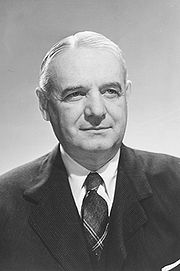
. Major General William Joseph Donovan
William Joseph Donovan
William Joseph Donovan was a United States soldier, lawyer and intelligence officer, best remembered as the wartime head of the Office of Strategic Services...
was the head of the OSS. Donovan was a soldier and Medal of Honor
Medal of Honor
The Medal of Honor is the highest military decoration awarded by the United States government. It is bestowed by the President, in the name of Congress, upon members of the United States Armed Forces who distinguish themselves through "conspicuous gallantry and intrepidity at the risk of his or her...
recipient from World War I
World War I
World War I , which was predominantly called the World War or the Great War from its occurrence until 1939, and the First World War or World War I thereafter, was a major war centred in Europe that began on 28 July 1914 and lasted until 11 November 1918...
. He was also a lawyer and former classmate of FDR at Columbia Law School
Columbia Law School
Columbia Law School, founded in 1858, is one of the oldest and most prestigious law schools in the United States. A member of the Ivy League, Columbia Law School is one of the professional graduate schools of Columbia University in New York City. It offers the J.D., LL.M., and J.S.D. degrees in...
. Like the subsequent CIA, OSS included both human intelligence functions
HUMINT
HUMINT, a syllabic abbreviation of the words HUMan INTelligence, refers to intelligence gathering by means of interpersonal contact, as opposed to the more technical intelligence gathering disciplines such as SIGINT, IMINT and MASINT...
and special operations paramilitary functions. Its Secret Intelligence division was responsible for espionage, while its Jedburgh
Operation Jedburgh
Operation Jedburgh was a clandestine operation during World War II, in which personnel of the British Special Operations Executive, the U.S...
teams, a joint U.S.-UK-French unit, were an ancestor of groups that create guerrilla units, such as the U.S. Army Special Forces and the CIA. OSS' Operational Groups were larger U.S. units that carried out direct action behind enemy lines. Even during World War II, the idea of intelligence and special operations units not under strict military control was controversial. OSS operated primarily in the European Theater of Operations
European Theater of Operations
The European Theater of Operations, United States Army was a United States Army formation which directed U.S. Army operations in parts of Europe from 1942 to 1945. It referred to Army Ground Forces, United States Army Air Forces, and Army Service Forces operations north of Italy and the...
(ETO) and to some extent in the China-Burma-India Theater, while General of the Army
General of the Army
General of the Army is a military rank used in some countries to denote a senior military leader, usually a General in command of a nation's Army. It may also be the title given to a General who commands an Army in the field....
Douglas MacArthur
Douglas MacArthur
General of the Army Douglas MacArthur was an American general and field marshal of the Philippine Army. He was a Chief of Staff of the United States Army during the 1930s and played a prominent role in the Pacific theater during World War II. He received the Medal of Honor for his service in the...
was extremely reluctant to have any OSS personnel within his area of operations.
From 1943–1945, the OSS also played a major role in training Kuomintang
Kuomintang
The Kuomintang of China , sometimes romanized as Guomindang via the Pinyin transcription system or GMD for short, and translated as the Chinese Nationalist Party is a founding and ruling political party of the Republic of China . Its guiding ideology is the Three Principles of the People, espoused...
troops in China and Burma, and recruited other indigenous irregular forces for sabotage as well as guides for Allied forces
Allies of World War II
The Allies of World War II were the countries that opposed the Axis powers during the Second World War . Former Axis states contributing to the Allied victory are not considered Allied states...
in Burma
China Burma India Theater of World War II
China Burma India Theater was the name used by the United States Army for its forces operating in conjunction with British and Chinese Allied air and land forces in China, Burma, and India during World War II...
fighting the Japanese army
Imperial Japanese Army
-Foundation:During the Meiji Restoration, the military forces loyal to the Emperor were samurai drawn primarily from the loyalist feudal domains of Satsuma and Chōshū...
. OSS also helped arm, train and supply resistance movement
Resistance movement
A resistance movement is a group or collection of individual groups, dedicated to opposing an invader in an occupied country or the government of a sovereign state. It may seek to achieve its objects through either the use of nonviolent resistance or the use of armed force...
s, including Mao Zedong
Mao Zedong
Mao Zedong, also transliterated as Mao Tse-tung , and commonly referred to as Chairman Mao , was a Chinese Communist revolutionary, guerrilla warfare strategist, Marxist political philosopher, and leader of the Chinese Revolution...
's People's Liberation Army
People's Liberation Army
The People's Liberation Army is the unified military organization of all land, sea, strategic missile and air forces of the People's Republic of China. The PLA was established on August 1, 1927 — celebrated annually as "PLA Day" — as the military arm of the Communist Party of China...
in China and the Viet Minh
Viet Minh
Việt Minh was a national independence coalition formed at Pac Bo on May 19, 1941. The Việt Minh initially formed to seek independence for Vietnam from the French Empire. When the Japanese occupation began, the Việt Minh opposed Japan with support from the United States and the Republic of China...
in French Indochina
French Indochina
French Indochina was part of the French colonial empire in southeast Asia. A federation of the three Vietnamese regions, Tonkin , Annam , and Cochinchina , as well as Cambodia, was formed in 1887....
, in areas occupied
Military occupation
Military occupation occurs when the control and authority over a territory passes to a hostile army. The territory then becomes occupied territory.-Military occupation and the laws of war:...
by the Axis powers. Other functions of the OSS included the use of propaganda
Propaganda
Propaganda is a form of communication that is aimed at influencing the attitude of a community toward some cause or position so as to benefit oneself or one's group....
, espionage, subversion
Subversion (politics)
Subversion refers to an attempt to transform the established social order, its structures of power, authority, and hierarchy; examples of such structures include the State. In this context, a "subversive" is sometimes called a "traitor" with respect to the government in-power. A subversive is...
, and post-war planning.
One of the greatest accomplishments of the OSS during World War II was its penetration of Nazi Germany
Nazi Germany
Nazi Germany , also known as the Third Reich , but officially called German Reich from 1933 to 1943 and Greater German Reich from 26 June 1943 onward, is the name commonly used to refer to the state of Germany from 1933 to 1945, when it was a totalitarian dictatorship ruled by...
by OSS operatives. The OSS was responsible for training German and Austrian commandos for missions inside Nazi Germany. Some of these agents included exiled communists and socialist party members, labor activists, anti-Nazi POWs, and German and Jewish refugees
Jewish refugees
In the course of history, Jewish populations have been expelled or ostracised by various local authorities and have sought asylum from antisemitism numerous times...
. At the height of its influence during World War II, the OSS employed almost 24,000 people.
OSS Paramilitary Officers parachuted into many countries that were behind enemy lines, including France, Norway, Greece and The Netherlands. In Crete
Crete
Crete is the largest and most populous of the Greek islands, the fifth largest island in the Mediterranean Sea, and one of the thirteen administrative regions of Greece. It forms a significant part of the economy and cultural heritage of Greece while retaining its own local cultural traits...
, OSS paramilitary officers linked up with, equipped and fought alongside Greek resistance
Greek Resistance
The Greek Resistance is the blanket term for a number of armed and unarmed groups from across the political spectrum that resisted the Axis Occupation of Greece in the period 1941–1944, during World War II.-Origins:...
forces against the Axis occupation.
OSS was disbanded shortly after World War II, with its intelligence analysis functions moving temporarily into the U.S. Department of State
United States Department of State
The United States Department of State , is the United States federal executive department responsible for international relations of the United States, equivalent to the foreign ministries of other countries...
. Espionage and counterintelligence went into military units. The paramilitary and related functions went into an assortment of ad hoc groups such as the Office of Policy Coordination
Office of Policy Coordination
The Office of Policy Coordination was a United States covert psychological operations and paramilitary action organization. Created as an independent office in 1948, it was merged with the Central Intelligence Agency in 1951....
. Between the original creation of the CIA by the National Security Act of 1947
National Security Act of 1947
The National Security Act of 1947 was signed by United States President Harry S. Truman on July 26, 1947, and realigned and reorganized the U.S. Armed Forces, foreign policy, and Intelligence Community apparatus in the aftermath of World War II...
and various mergers and reorganizations through 1952, the wartime OSS functions generally went into CIA. The mission of training and leading of guerrillas generally stayed in the United States Army Special Forces
United States Army Special Forces
The United States Army Special Forces, also known as the Green Berets because of their distinctive service headgear, are a special operations force tasked with six primary missions: unconventional warfare, foreign internal defense, special reconnaissance, direct action, hostage rescue, and...
, but the missions that were required to remain covert went to the paramilitary arm of the CIA. The direct descendant of the OSS' special operations is the CIA's Special Activities Division.
Tibet

Tibet
Tibet is a plateau region in Asia, north-east of the Himalayas. It is the traditional homeland of the Tibetan people as well as some other ethnic groups such as Monpas, Qiang, and Lhobas, and is now also inhabited by considerable numbers of Han and Hui people...
to train and lead Tibetan resistance fighters against the People's Liberation Army
People's Liberation Army
The People's Liberation Army is the unified military organization of all land, sea, strategic missile and air forces of the People's Republic of China. The PLA was established on August 1, 1927 — celebrated annually as "PLA Day" — as the military arm of the Communist Party of China...
of China. These teams selected and then trained Tibetan soldiers in the Rocky Mountains
Rocky Mountains
The Rocky Mountains are a major mountain range in western North America. The Rocky Mountains stretch more than from the northernmost part of British Columbia, in western Canada, to New Mexico, in the southwestern United States...
of the United States. The SAD teams then advised and led these commando
Commando
In English, the term commando means a specific kind of individual soldier or military unit. In contemporary usage, commando usually means elite light infantry and/or special operations forces units, specializing in amphibious landings, parachuting, rappelling and similar techniques, to conduct and...
s against the Chinese, both from Nepal
Nepal
Nepal , officially the Federal Democratic Republic of Nepal, is a landlocked sovereign state located in South Asia. It is located in the Himalayas and bordered to the north by the People's Republic of China, and to the south, east, and west by the Republic of India...
and India. In addition, SAD Paramilitary Officers were responsible for the Dalai Lama
Dalai Lama
The Dalai Lama is a high lama in the Gelug or "Yellow Hat" branch of Tibetan Buddhism. The name is a combination of the Mongolian word далай meaning "Ocean" and the Tibetan word bla-ma meaning "teacher"...
's clandestine escape to India, narrowly escaping capture and certain execution by the Chinese government.
According to a book by retired CIA officer John Kenneth Knaus, entitled "Orphans Of The Cold War: America And The Tibetan Struggle For Survival", Gyalo Thondup, the older brother of the 14th (and current) Dalai Lama, sent the CIA five Tibetan recruits. These recruits were then trained in paramilitary tactics on the island of Saipan
Saipan
Saipan is the largest island of the United States Commonwealth of the Northern Mariana Islands , a chain of 15 tropical islands belonging to the Marianas archipelago in the western Pacific Ocean with a total area of . The 2000 census population was 62,392...
in the Northern Marianas. Shortly thereafter, the five men were covertly returned to Tibet “to assess and organize the resistance” and selected another 300 Tibetans for training. U.S. assistance to the Tibetan resistance ceased after the 1972 Nixon visit to China
1972 Nixon visit to China
U.S. President Richard Nixon's 1972 visit to the People's Republic of China was an important step in formally normalizing relations between the United States and the People's Republic of China. It marked the first time a U.S. president had visited the PRC, who at that time considered the U.S. one...
, after which the U.S. and Communist China normalized relations.
Korea
Korean War
The Korean War was a conventional war between South Korea, supported by the United Nations, and North Korea, supported by the People's Republic of China , with military material aid from the Soviet Union...
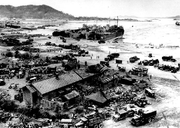
. These activities included maritime operations behind North Korean lines. Yong Do Island, connected by a rugged isthmus to Pusan, served as the base for those operations. These operations were carried out by well-trained Korean guerrillas. The four principal U.S. advisers responsible for the training and operational planning of those special missions were Dutch Kramer, Tom Curtis
Tom Curtis
Tom Curtis may refer to:* Tom Curtis , College Football Hall of Fame player* Tom Curtis , English soccer player* Tom Curtis...
, George Atcheson and Joe Pagnella. All of these Paramilitary Operations Officers operated through a CIA front organization called the Joint Advisory Commission, Korea
Joint Advisory Commission, Korea
The Joint Advisory Commission, Korea was a U.S. covert operations unit that participated in the Korean War.Operating under the direction of the Central Intelligence Agency, JACK was responsible for inserting and extracting U.S.-trained Korean agents into North Korea, conducting covert maritime...
(JACK), headquartered at Tongnae, a village near Pusan, on the peninsula's southeast coast. These paramilitary teams were responsible for numerous maritime raids and ambushes behind North Korean lines, as well as prisoner of war
Prisoner of war
A prisoner of war or enemy prisoner of war is a person, whether civilian or combatant, who is held in custody by an enemy power during or immediately after an armed conflict...
rescue operations. These were the first maritime unconventional warfare
Unconventional warfare
Unconventional warfare is the opposite of conventional warfare. Where conventional warfare is used to reduce an opponent's military capability, unconventional warfare is an attempt to achieve military victory through acquiescence, capitulation, or clandestine support for one side of an existing...
units that trained indigenous forces as surrogates
Proxy war
A proxy war or proxy warfare is a war that results when opposing powers use third parties as substitutes for fighting each other directly. While powers have sometimes used governments as proxies, violent non-state actors, mercenaries, or other third parties are more often employed...
. They also provided a model, along with the other CIA-sponsored ground based paramilitary Korean operations, for the Military Assistance Command, Vietnam-Studies and Observations Group (MACV-SOG) activities conducted by the U.S. military and the CIA/SAD in Vietnam
Vietnam
Vietnam – sometimes spelled Viet Nam , officially the Socialist Republic of Vietnam – is the easternmost country on the Indochina Peninsula in Southeast Asia. It is bordered by China to the north, Laos to the northwest, Cambodia to the southwest, and the South China Sea –...
. In addition, CIA paramilitary ground-based teams worked directly for U.S. military commanders, specifically with the 8th Army, on the "White Tiger" initiative. This initiative included inserting South Korean commandos and CIA Paramilitary Operations Officers prior to the two major amphibious assaults on North Korea
North Korea
The Democratic People’s Republic of Korea , , is a country in East Asia, occupying the northern half of the Korean Peninsula. Its capital and largest city is Pyongyang. The Korean Demilitarized Zone serves as the buffer zone between North Korea and South Korea...
, including the landing at Inchon.
Cuba (1961)
The Bay of Pigs Invasion (known as "La Batalla de Girón", or "Playa Girón" in Cuba), was an unsuccessful attempt by a U.S.-trained force of Cuban exileCuban exile
The term "Cuban exile" refers to the many Cubans who have sought alternative political or economic conditions outside the island, dating back to the Ten Years' War and the struggle for Cuban independence during the 19th century...
s to invade southern Cuba
Cuba
The Republic of Cuba is an island nation in the Caribbean. The nation of Cuba consists of the main island of Cuba, the Isla de la Juventud, and several archipelagos. Havana is the largest city in Cuba and the country's capital. Santiago de Cuba is the second largest city...
with support from U.S. government armed forces, to overthrow the Cuban government of Fidel Castro
Fidel Castro
Fidel Alejandro Castro Ruz is a Cuban revolutionary and politician, having held the position of Prime Minister of Cuba from 1959 to 1976, and then President from 1976 to 2008. He also served as the First Secretary of the Communist Party of Cuba from the party's foundation in 1961 until 2011...
. The plan was launched in April 1961, less than three months after John F. Kennedy
John F. Kennedy
John Fitzgerald "Jack" Kennedy , often referred to by his initials JFK, was the 35th President of the United States, serving from 1961 until his assassination in 1963....
assumed the presidency in the United States. The Cuban Revolutionary Armed Forces, trained and equipped by Eastern Bloc
Eastern bloc
The term Eastern Bloc or Communist Bloc refers to the former communist states of Eastern and Central Europe, generally the Soviet Union and the countries of the Warsaw Pact...
nations, defeated the exile combatants in three days.
The sea-borne invasion force landed on April 17, and fighting lasted until April 19, 1961. CIA Paramilitary Operations Officers Grayston Lynch
Grayston Lynch
Grayston L. Lynch was an American soldier and CIA officer. He was one of the two CIA agents who commanded the faction of the army that went to war in the Bay of Pigs Invasion...
and William "Rip" Robertson led the first assault on the beaches
Amphibious warfare
Amphibious warfare is the use of naval firepower, logistics and strategy to project military power ashore. In previous eras it stood as the primary method of delivering troops to non-contiguous enemy-held terrain...
, and supervised the amphibious landings. Four American aircrew instructors from Alabama Air National Guard
Alabama Air National Guard
The Alabama Air National Guard is the air force militia of the U.S. state of Alabama. It is, along with the Alabama Army National Guard, an element of the Alabama National Guard...
were killed while flying attack sorties. Various sources estimate Cuban Army casualties (killed or injured) to be in the thousands (between 2,000 and 5,000). This invasion followed the successful overthrow by the CIA of the Mosaddeq government in Iran in 1953 and Arbenz government in Guatemala
Guatemala
Guatemala is a country in Central America bordered by Mexico to the north and west, the Pacific Ocean to the southwest, Belize to the northeast, the Caribbean to the east, and Honduras and El Salvador to the southeast...
in 1954, but was a failure both militarily and politically. Deteriorating Cuban-American relations were made worse by the 1962 Cuban Missile Crisis
Cuban Missile Crisis
The Cuban Missile Crisis was a confrontation among the Soviet Union, Cuba and the United States in October 1962, during the Cold War...
.
Bolivia

Guerrilla warfare
Guerrilla warfare is a form of irregular warfare and refers to conflicts in which a small group of combatants including, but not limited to, armed civilians use military tactics, such as ambushes, sabotage, raids, the element of surprise, and extraordinary mobility to harass a larger and...
force that operated from the remote Ñancahuazú region against the pro-U.S. Bolivian government. They were joined by Che Guevara
Che Guevara
Ernesto "Che" Guevara , commonly known as el Che or simply Che, was an Argentine Marxist revolutionary, physician, author, intellectual, guerrilla leader, diplomat and military theorist...
in the mid-1960s. The ELN was well equipped and scored a number of early successes against the Bolivian army
Bolivian Army
The Bolivian Army or Ejército Boliviano is the land forces component of the Military of Bolivia, the Bolivian Army has around 31,500 men.- Combat units directly under the Army general command :...
in the difficult terrain of the mountainous Camiri
Camiri
Camiri is a town in Bolivia, Santa Cruz Department, Cordillera Province. It is the seat of the Camiri Municipality. The town has an estimated population of 33,705 inhabitants,...
region. In the late 1960s, the CIA deployed teams of SAD Paramilitary Operations Officers to Bolivia to train the Bolivian army in order to counter the ELN. These SAD teams linked up with U.S. Army Special Forces and Bolivian Special Forces to track down and capture Guevara, who was a special prize because of his leading role in the Cuban Revolution
Cuban Revolution
The Cuban Revolution was an armed revolt by Fidel Castro's 26th of July Movement against the regime of Cuban dictator Fulgencio Batista between 1953 and 1959. Batista was finally ousted on 1 January 1959, and was replaced by a revolutionary government led by Castro...
. On October 9, 1967, Guevara was executed by Bolivian soldiers on the orders of CIA paramilitary operative Félix Rodríguez
Félix Rodríguez (Central Intelligence Agency)
Félix Ismael Rodríguez Mendigutia is a former Central Intelligence Agency officer infamous for his involvement in the Bay of Pigs Invasion, in the interrogation and execution of Marxist revolutionary Che Guevara and his ties to George H. W. Bush during the Iran-Contra Affair...
shortly after being captured, according to CIA documents. In his book titled "Shadow Warrior: The CIA Hero of a Hundred Unknown Battles", Rodriguez claims that Guevara was executed over his objections by the Bolivian military on orders from their higher command.
Vietnam and Laos
The original OSS mission in VietnamVietnam
Vietnam – sometimes spelled Viet Nam , officially the Socialist Republic of Vietnam – is the easternmost country on the Indochina Peninsula in Southeast Asia. It is bordered by China to the north, Laos to the northwest, Cambodia to the southwest, and the South China Sea –...
under Major Archimedes Patti was to work with Ho Chi Minh
Ho Chi Minh
Hồ Chí Minh , born Nguyễn Sinh Cung and also known as Nguyễn Ái Quốc, was a Vietnamese Marxist-Leninist revolutionary leader who was prime minister and president of the Democratic Republic of Vietnam...
in order to prepare his forces to assist the United States and their Allies
Allies of World War II
The Allies of World War II were the countries that opposed the Axis powers during the Second World War . Former Axis states contributing to the Allied victory are not considered Allied states...
in fighting the Japanese
Empire of Japan
The Empire of Japan is the name of the state of Japan that existed from the Meiji Restoration on 3 January 1868 to the enactment of the post-World War II Constitution of...
. After the end of World War II, the United States ignored the attempts of Ho Chi Minh to maintain a friendly relationship. Instead, in 1945 the US agreed at Potsdam to turn Vietnam back to their previous French colonizers, and in 1950 the US began providing military aid to the French. This angered Vietnamese groups.
CIA Paramilitary Operations Officers trained and led Hmong
Hmong people
The Hmong , are an Asian ethnic group from the mountainous regions of China, Vietnam, Laos, and Thailand. Hmong are also one of the sub-groups of the Miao ethnicity in southern China...
tribesmen in Laos
Laos
Laos Lao: ສາທາລະນະລັດ ປະຊາທິປະໄຕ ປະຊາຊົນລາວ Sathalanalat Paxathipatai Paxaxon Lao, officially the Lao People's Democratic Republic, is a landlocked country in Southeast Asia, bordered by Burma and China to the northwest, Vietnam to the east, Cambodia to the south and Thailand to the west...
and Vietnam. This effort was considered a significant success, and the actions of these officers were not known for several years. Air America was the air component of the CIA's paramilitary mission in Southeast Asia and was responsible for all combat, logistics and search and rescue operations in Laos and certain sections of Vietnam. The ethnic minority forces numbered in the tens of thousands and they conducted direct actions mission, led by Paramilitary Operations Officers, against the communist Pathet Lao
Pathet Lao
The Pathet Lao was a communist political movement and organization in Laos, formed in the mid-20th century. The group was ultimately successful in assuming political power after the Laotian Civil War. The Pathet Lao were always closely associated with Vietnamese communists...
forces and their North Vietnamese allies.
Elements of SAD were seen in the CIA's Phoenix Program
Phoenix Program
The Phoenix Program |phoenix]]) was a controversial counterinsurgency program designed, coordinated, and executed by the United States Central Intelligence Agency , United States special operations forces, and the Republic of Vietnam's security apparatus during the Vietnam War that operated...
. One component of the Phoenix Program was involved in the capture and killing of suspected Viet Cong (National Liberation Front – NLF) members. Between 1968 and 1972, the Phoenix Program captured 81,740 National Liberation Front of South Vietnam (NLF or Viet Cong) members, of whom 26,369 were killed. This was a large proportion of U.S. killings between 1969 and 1971. The program was also successful in destroying their infrastructure. By 1970, communist plans repeatedly emphasized attacking the government's "pacification
Pacification
Pacification may refer to:The restoration of peace through a declaration or peace treaty:*Pacification of Ghent, an alliance of several provinces of the Netherlands signed on November 8, 1576...
" program and specifically targeted Phoenix agents. The NLF also imposed quotas. In 1970, for example, communist officials near Da Nang
Da Nang
Đà Nẵng , occasionally Danang, is a major port city in the South Central Coast of Vietnam, on the coast of the South China Sea at the mouth of the Han River. It is the commercial and educational center of Central Vietnam; its well-sheltered, easily accessible port and its location on the path of...
in northern South Vietnam
South Vietnam
South Vietnam was a state which governed southern Vietnam until 1975. It received international recognition in 1950 as the "State of Vietnam" and later as the "Republic of Vietnam" . Its capital was Saigon...
instructed their agents to "kill 400 persons" deemed to be government "tyrant[s]" and to “annihilate” anyone involved with the "pacification" program. Several North Vietnamese officials have made statements about the effectiveness of Phoenix.
MAC-V SOG (Studies and Observations Group) (which was originally named the Special Operations Group, but was changed for cover purposes), was created and active during the Vietnam War
Vietnam War
The Vietnam War was a Cold War-era military conflict that occurred in Vietnam, Laos, and Cambodia from 1 November 1955 to the fall of Saigon on 30 April 1975. This war followed the First Indochina War and was fought between North Vietnam, supported by its communist allies, and the government of...
. While CIA was just one part of MAC-V SOG, it did have operational control of some of the programs. Many of the military members of MAC-V SOG joined the CIA after their military service. The legacy of MAC-V SOG continues within SAD's Special Operations Group.
Maritime activities against the USSR
In 1973, SAD/SOG and the CIA's Directorate of Science and Technology built and deployed the USNS Glomar Explorer (T-AG-193)USNS Glomar Explorer (T-AG-193)
GSF Explorer, formerly USNS Glomar Explorer , is a deep-sea drillship platform initially built for the United States Central Intelligence Agency Special Activities Division secret operation Project Azorian to recover the sunken Soviet submarine, K-129, lost in April 1968.The cultural impact of...
, a large deep-sea salvage ship, on a secret operation. This operation was called Project Azorian (erroneously called Project Jennifer
Project Jennifer
"AZORIAN" was the code name for a U.S. Central Intelligence Agency project to recover the sunken Soviet submarine K-129 from the Pacific Ocean floor in the summer of 1974, using the purpose-built ship Hughes Glomar Explorer...
by the press). Its mission was to recover a sunken Soviet
Soviet Union
The Soviet Union , officially the Union of Soviet Socialist Republics , was a constitutionally socialist state that existed in Eurasia between 1922 and 1991....
submarine
Submarine
A submarine is a watercraft capable of independent operation below the surface of the water. It differs from a submersible, which has more limited underwater capability...
, , which had been lost in April 1968. A mechanical failure caused two-thirds of the submarine to break off during recovery, but SAD recovered two nuclear-tipped torpedoes, cryptographic machines and the bodies of six Soviet submariners. An alternative theory claims that all of K-129 was recovered and that the official account was an "elaborate cover-up".
Also in the 1970s, the U.S. Navy, the National Security Agency
National Security Agency
The National Security Agency/Central Security Service is a cryptologic intelligence agency of the United States Department of Defense responsible for the collection and analysis of foreign communications and foreign signals intelligence, as well as protecting U.S...
(NSA) and SAD/SOG conducted Operation Ivy Bells
Operation Ivy Bells
Operation Ivy Bells was a joint United States Navy, CIA and National Security Agency mission whose objective was to place wire taps on Soviet underwater communication lines during the Cold War.-History:...
and a series of other missions to place wire taps on Soviet underwater communications cables. These operations were covered in detail in the 1998 book Blind Man's Bluff: The Untold Story of American Submarine Espionage
Blind Man's Bluff: The Untold Story of American Submarine Espionage
Blind Man's Bluff: The Untold Story of American Submarine Espionage , published in 1998 by Sherry Sontag, Christopher Drew, and Annette Lawrence Drew, is a non-fiction book about U.S. Navy submarine operations during the Cold War...
. In the 1985 edition of "Studies in Intelligence", the CIA's in-house journal that outsiders rarely get to see, the CIA describes the "staggering expense and improbable engineering feats" that culminated in the August 1974 mission.
Nicaragua
In 1979, the U.S.-backed Anastasio Somoza DebayleAnastasio Somoza Debayle
Anastasio Somoza Debayle was a Nicaraguan leader and officially the 73rd and 76th President of Nicaragua from 1 May 1967 to 1 May 1972 and from 1 December 1974 to 17 July 1979. As head of the National Guard, he was de facto ruler of the country from 1967 to 1979...
dictatorship in Nicaragua
Nicaragua
Nicaragua is the largest country in the Central American American isthmus, bordered by Honduras to the north and Costa Rica to the south. The country is situated between 11 and 14 degrees north of the Equator in the Northern Hemisphere, which places it entirely within the tropics. The Pacific Ocean...
fell to the socialist Sandinistas. Once in power, the Sandinistas disbanded the Nicaraguan National Guard, who had committed many human rights abuses, and arrested and executed some of its members. Other former National Guard members helped to form the backbone of the Nicaraguan Counterrevolution or Contra
Contra
Contra is a Latin preposition meaning "against". It is very frequently abbreviated to con, which is a separate preposition. It may refer to:*Contras, Nicaraguan counter-revolutionaries opposed to the Sandinistas...
. SAD/SOG paramilitary teams were deployed to train and lead these forces against the Sandinista government. These paramilitary activities were based in Honduras
Honduras
Honduras is a republic in Central America. It was previously known as Spanish Honduras to differentiate it from British Honduras, which became the modern-day state of Belize...
and Costa Rica
Costa Rica
Costa Rica , officially the Republic of Costa Rica is a multilingual, multiethnic and multicultural country in Central America, bordered by Nicaragua to the north, Panama to the southeast, the Pacific Ocean to the west and the Caribbean Sea to the east....
. Direct military aid by the United States was eventually forbidden by the Boland Amendment
Boland Amendment
The Boland Amendment was the name given to three U.S. legislative amendments between 1982 and 1984, all aimed at limiting U.S. government assistance to the Contras in Nicaragua...
of the Defense Appropriations Act of 1983. The Boland Amendment was extended in October 1984 to forbid action by not only the Defense Department, but also to include the Central Intelligence Agency.
The Boland Amendment was a compromise because the U.S. Democratic Party did not have enough votes for a comprehensive ban on military aid. It covered only appropriated funds spent by intelligence agencies. Some of Reagan's national security officials used non-appropriated money of the National Security Council (NSC) to circumvent the Amendment. NSC officials sought to arrange funding by third-parties. These efforts resulted in the Iran-Contra Affair
Iran-Contra Affair
The Iran–Contra affair , also referred to as Irangate, Contragate or Iran-Contra-Gate, was a political scandal in the United States that came to light in November 1986. During the Reagan administration, senior Reagan administration officials and President Reagan secretly facilitated the sale of...
of 1987, which concerned Contra funding through the proceeds of arms sales to the Islamic Republic of Iran. No court ever made a determination whether Boland covered the NSC and on the grounds that it was a prohibition rather than a criminal statute, no one was indicted for violating it. Congress later resumed aid to the Contras, totaling over $300 million. The Contra war ended when the Sandinistas were voted out of power by a war-weary populace in 1990. Sandinista leader Daniel Ortega
Daniel Ortega
José Daniel Ortega Saavedra is a Nicaraguan politician and revolutionary, currently serving as the 83rd President of Nicaragua, a position that he has held since 2007. He previously served as the 79th President, between 1985 and 1990, and for much of his life, has been a leader in the Sandinista...
was re-elected as President of Nicaragua
Nicaragua
Nicaragua is the largest country in the Central American American isthmus, bordered by Honduras to the north and Costa Rica to the south. The country is situated between 11 and 14 degrees north of the Equator in the Northern Hemisphere, which places it entirely within the tropics. The Pacific Ocean...
in 2006 and took office again on January 10, 2007.
El Salvador
CIA personnel were also involved in the Salvadoran civil war. Unable to stop the leftist insurgency, CIA paramilitary teams and U.S. Army Special Forces set up and trained counterinsurgency units (some commentators contend these were patterned after the "Phoenix ProgramPhoenix Program
The Phoenix Program |phoenix]]) was a controversial counterinsurgency program designed, coordinated, and executed by the United States Central Intelligence Agency , United States special operations forces, and the Republic of Vietnam's security apparatus during the Vietnam War that operated...
" in Vietnam; see Death Squad) to combat FMLN members and sympathizers. Some allege that the techniques used to interrogate prisoners in El Salvador
El Salvador
El Salvador or simply Salvador is the smallest and the most densely populated country in Central America. The country's capital city and largest city is San Salvador; Santa Ana and San Miguel are also important cultural and commercial centers in the country and in all of Central America...
foreshadowed those later used in Iraq and Afghanistan. In fact, when a similar counter-insurgency program was proposed in Iraq, it was referred to as "the Salvador Option".
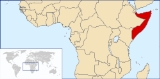
Somalia

Somalia
Somalia , officially the Somali Republic and formerly known as the Somali Democratic Republic under Socialist rule, is a country located in the Horn of Africa. Since the outbreak of the Somali Civil War in 1991 there has been no central government control over most of the country's territory...
prior to the U.S. intervention in 1992. On December 23, 1992, Paramilitary Officer Larry Freedman became the first casualty of the conflict in Somalia. Freedman was a former Army Delta Force
Delta Force
1st Special Forces Operational Detachment-Delta is one of the United States' secretive Tier One counter-terrorism and Special Mission Units. Commonly known as Delta Force, Delta, or The Unit, it was formed under the designation 1st SFOD-D, and is officially referred to by the Department of Defense...
operator who had served in every conflict that the U.S. was involved in, both officially and unofficially, since Vietnam. Freedman was killed while conducting special reconnaissance in advance of the entry of U.S. military forces. His mission was completely voluntary, as it required entry into a very hostile area without any support. Freedman was awarded the Intelligence Star
Intelligence Star
The Intelligence Star is an award given by the Central Intelligence Agency for a "voluntary act or acts of courage performed under hazardous conditions or for outstanding achievements or services rendered with distinction under conditions of grave risk." The award citation is from the Director...
on January 5, 1993 for his "extraordinary heroism".
SAD/SOG teams were key in working with JSOC and tracking high value targets (HVT), known as "Tier One Personalities." Their efforts, working under extremely dangerous conditions with little to no support, led to several very successful joint JSOC/CIA operations. In one specific operation, a CIA Case Officer, Michael Shanklin and codenamed "Condor," working with a CIA Technical Operations Officer from the Directorate of Science and Technology, managed to get a cane with a beacon in it to Osman Ato, a wealthy businessman, arms importer, and Mohammed Aideed, a money man whose name was right below Mohamed Farrah Aidid
Mohamed Farrah Aidid
General Mohamed Ali Farrah Aidid was a controversial Somali military leader, often described as a warlord. A former general and diplomat, he was the chairman of the United Somali Congress and later led the Somali National Alliance...
’s on the Tier One list.
Once Condor confirmed that Ato was in a vehicle, JSOC's Delta Force
Delta Force
1st Special Forces Operational Detachment-Delta is one of the United States' secretive Tier One counter-terrorism and Special Mission Units. Commonly known as Delta Force, Delta, or The Unit, it was formed under the designation 1st SFOD-D, and is officially referred to by the Department of Defense...
launched a capture operation.
- "a Little BirdMH-6 Little BirdThe MH-6 Little Bird , and its attack variant AH-6, are light helicopters used for special operations in the United States Army. Originally based on a modified OH-6A, it was later based on the MD 500E, with a single five-bladed main rotor...
helicopter dropped out of the sky and a sniper leaned out and fired three shots into the car’s engine block. The car ground to a halt as commandos roped down from hovering Blackhawks [sic], surrounded the car and handcuffed Ato. It was the first known helicopter takedown of suspects in a moving car. The next time Jones saw the magic cane, an hour later, Garrison had it in his hand. “I like this cane,” Jones remembers the general exclaiming, a big grin on his face. “Let’s use this again.” Finally, a tier one personality was in custody."
President Bill Clinton withdrew U.S. forces on May 4, 1993.
In June 2006, the Islamic Courts Union seized control of southern Somalia, including the country's capital Mogadishu
Mogadishu
Mogadishu , popularly known as Xamar, is the largest city in Somalia and the nation's capital. Located in the coastal Benadir region on the Indian Ocean, the city has served as an important port for centuries....
, prompting the Ethiopian government to send in troops to try to protect the transitional government. In December, the Islamic Courts warned Ethiopia
Ethiopia
Ethiopia , officially known as the Federal Democratic Republic of Ethiopia, is a country located in the Horn of Africa. It is the second-most populous nation in Africa, with over 82 million inhabitants, and the tenth-largest by area, occupying 1,100,000 km2...
they would declare war if Ethiopia did not remove all its troops from Somalia. Sheikh Sharif Ahmed, leader of the Islamic Courts, called for a jihad
Jihad
Jihad , an Islamic term, is a religious duty of Muslims. In Arabic, the word jihād translates as a noun meaning "struggle". Jihad appears 41 times in the Quran and frequently in the idiomatic expression "striving in the way of God ". A person engaged in jihad is called a mujahid; the plural is...
, or holy war, against Ethiopia and encouraged foreign Muslim fighters to come to Somalia. At that time, the United States accused the group of being controlled by al-Qaeda
Al-Qaeda
Al-Qaeda is a global broad-based militant Islamist terrorist organization founded by Osama bin Laden sometime between August 1988 and late 1989. It operates as a network comprising both a multinational, stateless army and a radical Sunni Muslim movement calling for global Jihad...
, but the Islamic Courts denied that charge.
In 2009, U.S. Public Broadcasting Service
Public Broadcasting Service
The Public Broadcasting Service is an American non-profit public broadcasting television network with 354 member TV stations in the United States which hold collective ownership. Its headquarters is in Arlington, Virginia....
(PBS) reported that al-Qaeda had been training terrorists in Somalia for years. Until December 2006, Somalia's government had no power outside of the town of Baidoa
Baidoa
Baidoa is a city in south-central Somalia, situated by road northwest of the capital Mogadishu. It is the capital of the Bay region, which is traditionally inhabited by the Digil and Mirifle clans....
, 150 miles (241.4 km) from the capital. The countryside and the capital were run by warlords and militia groups who could be paid to protect terrorist groups.
CIA officers kept close tabs on the country and paid a group of Somali warlords to help hunt down members of al-Qaeda according to the New York Times. Meanwhile, Ayman al-Zawahiri
Ayman al-Zawahiri
Ayman Mohammed Rabie al-Zawahiri is an Egyptian physician, Islamic theologian and current leader of al-Qaeda. He was previously the second and last "emir" of the Egyptian Islamic Jihad, having succeeded Abbud al-Zumar in the latter role when Egyptian authorities sentenced al-Zumar to life...
, the deputy to al-Qaeda leader Osama bin Laden
Osama bin Laden
Osama bin Mohammed bin Awad bin Laden was the founder of the militant Islamist organization Al-Qaeda, the jihadist organization responsible for the September 11 attacks on the United States and numerous other mass-casualty attacks against civilian and military targets...
, issued a message calling for all Muslims to go to Somalia. On January 9, 2007, a U.S. official said that ten militants were killed in one airstrike.
On September 14, 2009, Saleh Ali Saleh Nabhan, a senior al-Qaeda leader in East Africa as well as a senior leader in Shabaab, al Qaeda's surrogate in Somalia, was killed by elements of U.S. Special Operations. According to a witness, at least two AH-6 Little Bird attack helicopters strafed a two-car convoy. Navy SEALs then seized the body of Nabhan and took two other wounded fighters captive. JSOC and the CIA had been trying to kill Nabhan for some time including back in January 2007, when an AC-130 Gunship was called in on one attempt. A U.S. intelligence source stated that CIA paramilitary teams are directly embedded with Ethiopian forces in Somalia, allowing for the tactical intelligence to launch these operations. Nabhan was wanted for his involvement in the 1998 United States embassy bombings
1998 United States embassy bombings
The 1998 United States embassy bombings were a series of attacks that occurred on August 7, 1998, in which hundreds of people were killed in simultaneous truck bomb explosions at the United States embassies in the East African capitals of Dar es Salaam, Tanzania and Nairobi, Kenya. The date of the...
, as well as leading the cell behind the 2002 Mombasa attacks.
Afghanistan

Soviet war in Afghanistan
The Soviet war in Afghanistan was a nine-year conflict involving the Soviet Union, supporting the Marxist-Leninist government of the Democratic Republic of Afghanistan against the Afghan Mujahideen and foreign "Arab–Afghan" volunteers...
in the 1980s, Paramilitary Operations Officers were instrumental in training, equipping and sometimes leading Mujaheddin forces against the Red Army
Red Army
The Workers' and Peasants' Red Army started out as the Soviet Union's revolutionary communist combat groups during the Russian Civil War of 1918-1922. It grew into the national army of the Soviet Union. By the 1930s the Red Army was among the largest armies in history.The "Red Army" name refers to...
. Although the CIA in general and a Texas congressman named Charlie Wilson in particular, have received most of the attention, the key architect of this strategy was Michael G. Vickers
Michael G. Vickers
Michael G. Vickers was confirmed as the Under Secretary of Defense for Intelligence by the U.S. Senate Armed Services Committee on March 16, 2011. Before becoming USD-I, Vickers served as United States Assistant Secretary of Defense for Special Operations and Low Intensity Conflict...
. Vickers was a young Paramilitary Operations Officer from SAD/SOG. The CIA's efforts have been given credit for assisting in ending the Soviet occupation of Afghanistan
Afghanistan
Afghanistan , officially the Islamic Republic of Afghanistan, is a landlocked country located in the centre of Asia, forming South Asia, Central Asia and the Middle East. With a population of about 29 million, it has an area of , making it the 42nd most populous and 41st largest nation in the world...
.
SAD paramilitary teams were active in Afghanistan in the 1990s in clandestine operations to locate and kill or capture Osama Bin Laden
Osama bin Laden
Osama bin Mohammed bin Awad bin Laden was the founder of the militant Islamist organization Al-Qaeda, the jihadist organization responsible for the September 11 attacks on the United States and numerous other mass-casualty attacks against civilian and military targets...
. These teams planned several operations, but did not receive the order to execute from President Bill Clinton
Bill Clinton
William Jefferson "Bill" Clinton is an American politician who served as the 42nd President of the United States from 1993 to 2001. Inaugurated at age 46, he was the third-youngest president. He took office at the end of the Cold War, and was the first president of the baby boomer generation...
because the available intelligence did not guarantee a successful outcome weighed against the extraordinary risk to the SAD/SOG teams that would execute the mission. These efforts did however build many of the relationships that would prove essential in the 2001 U.S. Invasion of Afghanistan.
In 2001, SAD units were the first U.S. forces to enter Afghanistan. Their efforts organized the Afghan Northern Alliance for the subsequent arrival of USSOCOM
United States Special Operations Command
The United States Special Operations Command is the Unified Combatant Command charged with overseeing the various Special Operations Commands of the Army, Air Force, Navy and Marine Corps of the United States Armed Forces. The command is part of the Department of Defense...
forces. The plan for the invasion of Afghanistan was developed by the CIA, the first time in United States history that such a large scale military operation was planned by the CIA. SAD, U.S. Army Special Forces and the Northern Alliance
Northern Alliance
The Afghan Northern Alliance is a military-political umbrella organization created by the Islamic State of Afghanistan in 1996.Northern Alliance may also refer to:*Northern Alliance , a Canadian white supremacist group...
combined to overthrow the Taliban in Afghanistan with minimal loss of U.S. lives. They did this without the need for U.S. military conventional ground forces.
The Washington Post stated in an editorial by John Lehman
John Lehman
John F. Lehman, Jr. is an American investment banker and writer who served as Secretary of the Navy in the Reagan administration and in 2003–04 was a member of the 9/11 Commission....
in 2006:
- "What made the Afghan campaign a landmark in the U.S. Military's history is that it was prosecuted by Special Operations forces from all the services, along with Navy and Air Force tactical power, operations by the Afghan Northern Alliance and the CIA were equally important and fully integrated. No large Army or Marine force was employed".
In a 2008 New York Times book review of Horse Soldiers, a book by Doug Stanton
Doug Stanton
Doug Stanton is an author and a founder of the Traverse City Film Festival. He graduated from the Interlochen Arts Academy in Michigan and Hampshire College in Massachusetts.-Biography:...
about the invasion of Afghanistan, Bruce Barcott
Bruce Barcott
Bruce Barcott is an American editor, environmental journalist and author. He is a contributing editor of Outside and has written articles for The New York Times Magazine, National Geographic, Mother Jones, Sports Illustrated, Harper's Magazine, Legal Affairs, Utne Reader and others...
wrote:
- "The valor exhibited by Afghan and American soldiers, fighting to free Afghanistan from a horribly cruel regime, will inspire even the most jaded reader. The stunning victory of the horse soldiers – 350 Special Forces soldiers, 100 C.I.A. officers and 15,000 Northern Alliance fighters routing a Taliban army 50,000 strong – deserves a hallowed place in American military history".
Tora Bora
In December 2001, SAD/SOG and the Army's Delta ForceDelta Force
1st Special Forces Operational Detachment-Delta is one of the United States' secretive Tier One counter-terrorism and Special Mission Units. Commonly known as Delta Force, Delta, or The Unit, it was formed under the designation 1st SFOD-D, and is officially referred to by the Department of Defense...
tracked down Osama bin Ladin in the rugged mountains near the Khyber Pass
Khyber Pass
The Khyber Pass, is a mountain pass linking Pakistan and Afghanistan.The Pass was an integral part of the ancient Silk Road. It is mentioned in the Bible as the "Pesh Habor," and it is one of the oldest known passes in the world....
in Afghanistan. Former CIA station chief Gary Berntsen
Gary Berntsen
Gary Berntsen is a decorated former Central Intelligence Agency career officer who served in the Directorate of Operations between October 1982 and June 2005...
as well as a subsequent Senate investigation claimed that the combined American special operations task force was largely outnumbered by al-Qaeda forces and that they were denied additional US troops by higher command. The task force also requested munitions to block the avenues of egress of bin Laden, but that request was also denied. The team allegedly uncovered evidence in the subsequent site exploration that bin Laden's ultimate aim was to obtain and detonate a nuclear device in a terrorist attack. According to other press reports, SAD were ineffectual and "Bin Laden and bodyguards walked unmolested out of Tora Bora and disappeared into Pakistan's unregulated tribal area."
Surge
In September 2009, the CIA planned on "deploying teams of spies, analysts and paramilitary operatives to Afghanistan, part of a broad intelligence 'surge' ordered by President Obama. This will make its station there among the largest in the agency's history." This presence is expected to surpass the size of the stations in Iraq and VietnamVietnam
Vietnam – sometimes spelled Viet Nam , officially the Socialist Republic of Vietnam – is the easternmost country on the Indochina Peninsula in Southeast Asia. It is bordered by China to the north, Laos to the northwest, Cambodia to the southwest, and the South China Sea –...
at the height of those wars. The station is located at the U.S. Embassy in Kabul
Kabul
Kabul , spelt Caubul in some classic literatures, is the capital and largest city of Afghanistan. It is also the capital of the Kabul Province, located in the eastern section of Afghanistan...
and is led "by a veteran with an extensive background in paramilitary operations". The majority of the CIA's workforce is located among secret bases and military special operations posts throughout the country.
Also in 2009, General Stanley McChrystal, the commander of NATO forces in Afghanistan, planned to request an increase in teams of CIA operatives, including their elite paramilitary officers, to join with U.S. military special operations forces. This combination worked well in Iraq and is largely credited with the success of that surge. There have been basically three options described in the media: McChrystal's increased counterinsurgency campaign; a counter-terror campaign using special operations raids and drone strikes; and withdrawal. The most successful combination in both the wars in Afghanistan and Iraq has been the linking up of SAD and military special forces to fight along side highly trained indigenous units. One thing all of these options have in common is a requirement for greater CIA participation.
Camp Chapman attack
On December 30, 2009, a suicide bomber attacked Forward Operating Base (FOB) Chapman, a CIA base in KhostKhost
Khost or Khowst is a city in eastern Afghanistan. It is the capital of Khost province, which is a mountainous region near Afghanistan's border with Pakistan...
, and killed seven CIA officers, including the chief of the base, as well as two employees of Blackwater Worldwide
Blackwater Worldwide
Xe Services LLC, better known by its former names, Blackwater USA and Blackwater Worldwide, is a private military company founded in 1997 by Erik Prince and Al Clark.. Xe is currently the largest of the U.S. State Department's three private security contractors...
. Camp Chapman, named for Sergeant First Class Nathan Chapman, is one of the most secretive and highly guarded locations in Afghanistan and a major hub of the Special Activities Division, used for joint operation with military special operations forces and Afghan commandos. On January 14, 2010, Hakimullah Mehsud
Hakimullah Mehsud
Hakimullah Mehsud , born c. 1979 as Jamshed Mehsud and also known as Zulfiqar Mehsud , is the amir of Tehrik-i-Taliban Pakistan...
was attacked by a drone strike in response to this attack. It was initially believed Mehsud died in the strike, but he was later shown to be alive. On February 6, 2010, President Obama attended a memorial ceremony at the CIA headquarters to honor those killed in the Camp Chapman attack. The President said "...to those watching around the world, I say: Let their sacrifice be a summons. To carry on their work. To complete this mission. To win this war". None of the slain CIA officers were members of the Special Activities Division.
The End Game
According to the current and former intelligence officials, General McChrystal also had his own preferred candidate for the Chief of Station (COS) job, a good friend and decorated CIA paramilitary officer. The officer had extensive experience in war zones, including two previous tours in Afghanistan with one as the Chief of Station, as well as tours in the Balkans, Baghdad and Yemen. He is well known in CIA lore as "the man who saved Hamid KarzaiHamid Karzai
Hamid Karzai, GCMG is the 12th and current President of Afghanistan, taking office on 7 December 2004. He became a dominant political figure after the removal of the Taliban regime in late 2001...
's life when the CIA led the effort to oust the Taliban from power in 2001". President Karzai is said to be greatly indebted to this officer and was pleased when the officer was named chief of station again. According to interviews with several senior officials, this officer "was uniformly well-liked and admired. A career paramilitary officer, he came to the CIA after several years in an elite Marine unit".
General McChrystal's strategy included the lash up of special operations forces from the U.S. Military and from SAD/SOG to duplicate the initial success and the defeat of the Taliban in 2001 and the success of the "Surge" in Iraq in 2007. This strategy proved highly successful and worked very well in Afghanistan with SAD/SOG and JSOC forces conducting raids nearly every night having "superb results" against the enemy.
In 2001, the CIA's SAD/SOG began creating what would come to be called Counter-terrorism Pursuit Teams (CTPT). These units grew to include over 3,000 operatives by 2010 and have been involved in sustained heavy fighting against the enemy. It is considered the "best Afghan fighting force" and unlike the Afghan National Army (ANA), these troops are very well motivated.
Located at 7800 feet (2,377.4 m) above sea level, Firebase Lilley in Shkin
Shkin
Shkin is a scattered village in Barmal District, Paktika Province, Afghanistan located about a kilometer west of the newer, much larger, and border-straddling village and bazaar of Angoor Adda. Angoor Adda is controlled by the Pakistan Frontier Guards...
serves as a "nerve center for the covert war". This covert war includes being a hub for these CTPT operations with Firebase Lilley being just one in a constellation of CIA bases across Afghanistan. These units have not only been highly effective in combat operations against the Taliban and al-Qaeda forces, but have also been used to engage with the tribes in areas with no other official government presence.
This covert war also includes a large SOG/CTPT expansion into Pakistan to target senior al-Qaeda and Taliban leadership in the Federally Administered Tribal Area (FATA). CTPT units are the main effort in both the "Counterterrorism plus" and the full "Counterinsurgency" options being discussed by the Obama administration in the December 2010 review. SOG/CTPT are also key to any exit strategy for the U.S. government to leave Afghanistan, while still being able to deny al-Qaeda and other trans-national extremists groups a safehaven both in Afghanistan and in the FATA of Pakistan.
Yemen
On November 5, 2002, a missile launched from a CIA-controlled Predator drone killed al-QaedaAl-Qaeda
Al-Qaeda is a global broad-based militant Islamist terrorist organization founded by Osama bin Laden sometime between August 1988 and late 1989. It operates as a network comprising both a multinational, stateless army and a radical Sunni Muslim movement calling for global Jihad...
members traveling in a remote area in Yemen
Yemen
The Republic of Yemen , commonly known as Yemen , is a country located in the Middle East, occupying the southwestern to southern end of the Arabian Peninsula. It is bordered by Saudi Arabia to the north, the Red Sea to the west, and Oman to the east....
. SAD/SOG paramilitary teams had been on the ground tracking their movements for months and called in this air strike. One of those in the car was Al-Haitham al-Yemeni, al-Qaeda's chief operative in Yemen and a suspect in the October 2000 bombing of the destroyer . Five other people, believed to be low-level al-Qaeda members, were also killed to include an American named Kamal Derwish. Former Deputy U.S. Defense Secretary Paul Wolfowitz
Paul Wolfowitz
Paul Dundes Wolfowitz is a former United States Ambassador to Indonesia, U.S. Deputy Secretary of Defense, President of the World Bank, and former dean of the Paul H. Nitze School of Advanced International Studies at Johns Hopkins University...
called it "a very successful tactical operation" and said "such strikes are useful not only in killing terrorists but in forcing al-Qaeda to change its tactics".
Haitham, a native of Yemen known for his bomb-making skills, had been tracked in the hope that he would help lead the United States to al-Qaeda leader Osama bin Laden
Osama bin Laden
Osama bin Mohammed bin Awad bin Laden was the founder of the militant Islamist organization Al-Qaeda, the jihadist organization responsible for the September 11 attacks on the United States and numerous other mass-casualty attacks against civilian and military targets...
. However, with the May 2005 capture in northwest Pakistan of Abu Faraj al-Libbi
Abu Faraj al-Libbi
Abu Faraj al-Libi is an assumed name or nom de guerre of a Libyan alleged to be a senior member of the al-Qaeda terrorist organization. His real name is thought to be Mustafa al-'Uzayti. He was arrested by Pakistan's Inter-Services Intelligence on May 2, 2005, in Mardan...
, thought to be al-Qaeda's No. 3 man, CIA officials worried Haitham would soon go into hiding, and decided to kill him. "It's an important step that has been taken in that it has eliminated another level of experienced leadership from al-Qaeda," said Vince Cannistraro, former head of counter-terrorism for the CIA and current ABC News
ABC News
ABC News is the news gathering and broadcasting division of American broadcast television network ABC, a subsidiary of The Walt Disney Company...
consultant. "It will help weaken the organization and make it much less effective." Haitham was on the run, pursued by several security forces who were looking for him and Muhammad Hamdi al-Ahdal, another suspect in the USS Cole bombing
USS Cole bombing
The USS Cole Bombing, or the USS Cole Incident, was a suicide attack against the United States Navy destroyer on October 12, 2000 while it was harbored and refueled in the Yemeni port of Aden. Seventeen American sailors were killed, and 39 were injured...
case.
In 2009, the Obama administration authorized continued lethal operations in Yemen by the CIA. As a result, the SAD/SOG and JSOC have joined together to aggressively target al-Qaeda operatives in that country, both through leading Yemenese special forces and intelligence driven drone strikes. A major target of these operations is Imam
Imam
An imam is an Islamic leadership position, often the worship leader of a mosque and the Muslim community. Similar to spiritual leaders, the imam is the one who leads Islamic worship services. More often, the community turns to the mosque imam if they have a religious question...
Anwar al-Aulaqi, an American citizen with ties to both Nidal Hassan, the alleged Fort Hood attacker, and Umar Farouk Abdulmutallab
Umar Farouk Abdulmutallab
Umar Farouk Abdulmutallab , popularly referred to as the "Underwear Bomber", is a suspected terrorist who attempted to detonate plastic explosives hidden in his underwear while on board Northwest Airlines Flight 253, en route from Amsterdam to Detroit, Michigan, on December 25,...
, the Christmas 2009 attempted bomber of Northwest Airline flight 253. Imam al-Aulaki was killed on September 30, 2011 by an air attack carried out by the Joint Special Operations Command.
Iraq
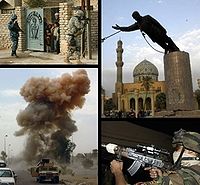
2003 invasion of Iraq
The 2003 invasion of Iraq , was the start of the conflict known as the Iraq War, or Operation Iraqi Freedom, in which a combined force of troops from the United States, the United Kingdom, Australia and Poland invaded Iraq and toppled the regime of Saddam Hussein in 21 days of major combat operations...
. Once on the ground they prepared the battle space for the subsequent arrival of U.S. military forces. SAD teams then combined with U.S. Army Special Forces (on a team called the Northern Iraq Liaison Element or NILE). This team organized the Kurdish
Kurdish people
The Kurdish people, or Kurds , are an Iranian people native to the Middle East, mostly inhabiting a region known as Kurdistan, which includes adjacent parts of Iran, Iraq, Syria, and Turkey...
Peshmerga
Peshmerga
Peshmerga or Peshmerge is the term used by Kurds to refer to armed Kurdish fighters. Literally meaning "those who face death" the Peshmerga forces of Kurdistan have been in existence since the advent of the Kurdish independence movement in the early 1920s, following the collapse of the Ottoman...
for the subsequent U.S.-led invasion. This joint team combined in Operation Viking Hammer to defeat Ansar al-Islam
Ansar al-Islam
Ansar al-Islam is a Sunni Islamist group of Iraqis, promoting a radical interpretation of Islam, close to the official Saudi ideology of Wahhabism with strict application of Sharia. The group was formed in the northern provinces of Iraq near the Iranian border, and previously had established...
, a Islamist group allied to al-Qaeda, which several battle-hardened fighters from Afghanistan had joined after the fall of the Taliban, in a battle for control over the northeast of Iraq – a battle that turned out being one of the "most intense battles of Special Forces since Vietnam". This battle was for an entire territory that was completely occupied by Ansar al-Islam and was executed prior to the invasion in February 2003. If this battle had not been as successful as it was, there would have been a considerable hostile force in the rear of the U.S./secular Kurdish force in the subsequent assault on the Iraqi army
Iraqi Army
The Iraqi Army is the land component of the Iraqi military, active in various forms since being formed by the British during their mandate over the country after World War I....
to the south. The U.S. side was represented by Paramilitary Operations Officers from SAD/SOG and the Army's 10th Special Forces Group
10th Special Forces Group (United States)
The 10th Special Forces Group is an Active Duty United States Army Special Forces group. The 10th Special Forces Group is responsible for operations within the EUCOM area of responsibility, as part of the Special Operations Command, Europe , as well as parts of Africa and the Middle East.10th SFG...
(10th SFG). 10th SFG soldiers were awarded three Silver Stars and six Bronze Stars with V for valor for this battle alone. This battle has not been fully covered by the international media, but was a significant direct attack and victory on a key U.S. opponent. It resulted in the deaths of a substantial number of militants and the uncovering of a crude laboratory that had traces of poisons and information on chemical weapons at Sargat. The team found foreign identity cards, visas, and passports on the enemy killed in action (EKIA). The EKIA came from a wide variety of Middle Eastern and north African countries to include Yemen, Sudan, Saudi Arabia, Qatar, Oman, Tunisia, Morocco, and Iran. Sargat was also the only facility that had traces of chemical weapons discovered in the Iraq war.
In a 2004 US New and World Report article, "A firefight in the mountains", the author states:
- "Viking Hammer would go down in the annals of Special Forces history—a battle fought on foot, under sustained fire from an enemy lodged in the mountains, and with minimal artillery and air support.
SAD/SOG teams also conducted high risk special reconnaissance missions behind Iraqi lines to identify senior leadership targets. These missions led to the initial assassination attempts against Iraqi President Saddam Hussein
Saddam Hussein
Saddam Hussein Abd al-Majid al-Tikriti was the fifth President of Iraq, serving in this capacity from 16 July 1979 until 9 April 2003...
and his key generals. Although the initial air strike against Hussein was unsuccessful in killing the dictator, it was successful in effectively ending his ability to command and control his forces. Other strikes against key generals were successful and significantly degraded the command's ability to react to and maneuver against the U.S.-led invasion force. SAD operations officers were also successful in convincing key Iraqi army officers to surrender their units once the fighting started and/or not to oppose the invasion force.
NATO member Turkey
Turkey
Turkey , known officially as the Republic of Turkey , is a Eurasian country located in Western Asia and in East Thrace in Southeastern Europe...
refused to allow its territory to be used by the U.S. Army's 4th Infantry Division for the invasion. As a result, the SAD/SOG, U.S. Army Special Forces joint teams, the Kurdish Peshmerga and the 173d Airborne Brigade
173rd Airborne Brigade Combat Team
The 173rd Airborne Brigade Combat Team is an airborne infantry brigade combat team of the United States Army based in Vicenza, Italy...
were the entire northern force against the Iraqi army during the invasion. Their efforts kept the 13 Divisions of the Iraqi Army in place to defend against the Kurds rather allowing them to contest the coalition force coming from the south. This combined U.S. Special Operations and Kurdish force defeated the Iraqi army. Four members of the SAD/SOG team received CIA's rare Intelligence Star
Intelligence Star
The Intelligence Star is an award given by the Central Intelligence Agency for a "voluntary act or acts of courage performed under hazardous conditions or for outstanding achievements or services rendered with distinction under conditions of grave risk." The award citation is from the Director...
for "extraordinary heroism".
The mission that captured Saddam Hussein was called "Operation Red Dawn
Operation Red Dawn
Operation Red Dawn was the U.S. military operation conducted on 13 December 2003 in the town of ad-Dawr, Iraq, near Tikrit, that captured Iraq President Saddam Hussein, ending rumours of his death. The operation was named after the 1984 film Red Dawn. The mission was assigned to the 1st Brigade...
". It was planned and carried out by JSOC's Delta Force and SAD/SOG teams (together called Task Force 121
Task Force 121
Task Force 121 is an example of the United States' 'Joint Task Force' concept of conducting special operations. TF121 is a multi-service force commanded by U.S. Air Force Brigadier General Gregory L. Trebon. The spearhead of the force is a forty-man team made up of operators from the U.S. Army's...
). The operation eventually included around 600 soldiers from the 1st Brigade of the 4th Infantry Division. Special operations troops probably numbered around 40. Much of the publicity and credit for the capture went to the 4th Infantry Division soldiers, but CIA and JSOC were the driving force. "Task Force 121 were actually the ones who pulled Saddam out of the hole" said Robert Andrews, former deputy assistant Secretary of Defense for special operations and low-intensity conflict. "They can't be denied a role anymore."
CIA paramilitary units continued to team up with the JSOC in Iraq and in 2007 the combination created a lethal force many credit with having a major impact in the success of "the Surge". They did this by killing or capturing many of the key al-Qaeda leaders in Iraq. In a CBS
CBS
CBS Broadcasting Inc. is a major US commercial broadcasting television network, which started as a radio network. The name is derived from the initials of the network's former name, Columbia Broadcasting System. The network is sometimes referred to as the "Eye Network" in reference to the shape of...
60 Minutes
60 Minutes
60 Minutes is an American television news magazine, which has run on CBS since 1968. The program was created by producer Don Hewitt who set it apart by using a unique style of reporter-centered investigation....
interview, Pulitzer Prize
Pulitzer Prize
The Pulitzer Prize is a U.S. award for achievements in newspaper and online journalism, literature and musical composition. It was established by American publisher Joseph Pulitzer and is administered by Columbia University in New York City...
-winning journalist Bob Woodward
Bob Woodward
Robert Upshur Woodward is an American investigative journalist and non-fiction author. He has worked for The Washington Post since 1971 as a reporter, and is currently an associate editor of the Post....
described a new special operations capability that allowed for this success. This capability was developed by the joint teams of CIA and JSOC. Several senior U.S. officials stated that the "joint efforts of JSOC and CIA paramilitary units was the most significant contributor to the defeat of al-Qaeda in Iraq".
On October 26, 2008, SAD/SOG and JSOC conducted an operation in Syria targeting the "foreign fighter logistics network
Logistics
Logistics is the management of the flow of goods between the point of origin and the point of destination in order to meet the requirements of customers or corporations. Logistics involves the integration of information, transportation, inventory, warehousing, material handling, and packaging, and...
" bringing al-Qaeda operatives into Iraq (See 2008 Abu Kamal raid
2008 Abu Kamal raid
The 2008 Abu Kamal raid was an attack carried out by helicopter-borne CIA paramilitary officers from Special Activities Division and United States Special Operations Command, Joint Special Operations Command inside Syrian territory on October 26, 2008...
). A U.S. source told CBS News
CBS News
CBS News is the news division of American television and radio network CBS. The current chairman is Jeff Fager who is also the executive producer of 60 Minutes, while the current president of CBS News is David Rhodes. CBS News' flagship program is the CBS Evening News, hosted by the network's main...
that "the leader of the foreign fighters, an al-Qaeda
Al-Qaeda
Al-Qaeda is a global broad-based militant Islamist terrorist organization founded by Osama bin Laden sometime between August 1988 and late 1989. It operates as a network comprising both a multinational, stateless army and a radical Sunni Muslim movement calling for global Jihad...
officer, was the target of Sunday's cross-border raid." He said the attack was successful, but did not say whether or not the al-Qaeda officer was killed. Fox News later reported that Abu Ghadiya, "al-Qa'ida's senior coordinator operating in Syria", was killed in the attack. The New York Times reported that during the raid U.S. forces killed several armed males who "posed a threat".
Pakistan
SAD/SOG has been very active "on the ground" inside Pakistan targeting al-Qaeda operatives for Unmanned Aerial VehicleUnmanned aerial vehicle
An unmanned aerial vehicle , also known as a unmanned aircraft system , remotely piloted aircraft or unmanned aircraft, is a machine which functions either by the remote control of a navigator or pilot or autonomously, that is, as a self-directing entity...
(UAV) Predator strikes and along with USSOCOM elements they have been training Pakistani Special Service Group Commandos. Before leaving office, President George W. Bush
George W. Bush
George Walker Bush is an American politician who served as the 43rd President of the United States, from 2001 to 2009. Before that, he was the 46th Governor of Texas, having served from 1995 to 2000....
authorized SAD's successful killing of eight senior al-Qaeda operatives via targeted air strikes. Among those killed were the mastermind of a 2006 plot to detonate explosives aboard planes flying across the Atlantic Rashid Rauf
Rashid Rauf
Rashid Rauf was an alleged Al-Qaeda operative. He was a dual citizen of Britain and Pakistan who was arrested in Bhawalpur, Pakistan in connection with the 2006 transatlantic aircraft plot in August 2006, a day before some arrests were made in Britain...
and the man thought to have planned the Islamabad Marriott Hotel bombing
Islamabad Marriott Hotel bombing
The Islamabad Marriott Hotel bombing occurred during the night of 20 September 2008, when a dump truck filled with explosives detonated in front of the Marriott Hotel in the Pakistani capital Islamabad, killing at least 54 people, injuring at least 266 and leaving a 60 ft wide, 20 ft ...
on September 20, 2008 that killed 53 people. The CIA Director authorized the continuation of these operations and on January 23, SAD/SOG successfully killed 20 terrorists in a hideout in northwestern Pakistan. Some experts assess that the CIA Director Leon Panetta has been more aggressive in conducting paramilitary operations in Pakistan than his predecessor. A Pakistani security official stated that other strikes killed at least 10 insurgents, including five foreign nationals and possibly “a high-value target” such as a senior al-Qaeda or Taliban official. On February 14, the CIA drone killed 27 taliban and al-Qaeda fighters in a missile strike in south Waziristan, a militant stronghold near the Afghan border where al-Qaeda leaders Osama bin Laden
Osama bin Laden
Osama bin Mohammed bin Awad bin Laden was the founder of the militant Islamist organization Al-Qaeda, the jihadist organization responsible for the September 11 attacks on the United States and numerous other mass-casualty attacks against civilian and military targets...
and Ayman al-Zawahri were believed to be hiding.
.jpg)
Leon Panetta
Leon Edward Panetta is the 23rd and current United States Secretary of Defense, serving in the administration of President Barack Obama since 2011. Prior to taking office, he served as Director of the Central Intelligence Agency...
stated that SAD/SOG's efforts in Pakistan have been "the most effective weapon" against senior al-Qaeda leadership.
These covert attacks have increased significantly under President Obama, with as many at 50 al-Qaeda militants being killed in the month of May 2009 alone. In June 2009, sixty Taliban fighters were killed while at a funeral to bury fighters that had been killed in previous CIA attacks. On July 22, 2009, National Public Radio reported that U.S. officials believe Saad bin Laden
Saad bin Laden
Sa'ad bin Osama bin Muhammad bin 'Awad bin Laden , better known as Saad bin Laden, is one of the sons of Osama bin Laden. He continued in his father's footsteps by occupying a position within Al-Qaeda...
, a son of Osama bin Laden, was killed by a CIA strike in Pakistan. Saad bin Laden spent years under house arrest in Iran before traveling last year to Pakistan, according to former National Intelligence Director Mike McConnell
Mike McConnell
Mike McConnell is an American talk radio host based in Chicago on WGN. He left 700 WLW in Cincinnati after 25 years in 2010.-Radio program:McConnell started out in radio as Alan McConnell, as a rock music DJ at an album-oriented college radio station WVUD in Dayton, Ohio in the 1970s...
. It's believed he was killed sometime this year. A senior U.S. counter-terrorism said U.S. intelligence agencies are "80 to 85 percent" certain that Saad bin Laden is dead.
On August 6, 2009, the CIA announced that Baitullah Mehsud
Baitullah Mehsud
Baitullah Mehsud was a leading militant in Waziristan, Pakistan, and the leader of the Tehrik-i-Taliban Pakistan . He formed the TTP from an alliance of about five militant groups in December 2007. He is thought by U.S...
was killed by a SAD/SOG drone strike in Pakistan. The New York Times
The New York Times
The New York Times is an American daily newspaper founded and continuously published in New York City since 1851. The New York Times has won 106 Pulitzer Prizes, the most of any news organization...
said, "Although President Obama
Barack Obama
Barack Hussein Obama II is the 44th and current President of the United States. He is the first African American to hold the office. Obama previously served as a United States Senator from Illinois, from January 2005 until he resigned following his victory in the 2008 presidential election.Born in...
has distanced himself from many of the Bush administration’s counter-terrorism policies, he has embraced and even expanded the C.I.A.’s covert campaign in Pakistan using Predator and Reaper drones". The biggest loss may be to "Osama bin Laden's al-Qa'ida". For the past eight years, al-Qaeda had depended on Mehsud for protection after Mullah Mohammed Omar
Mohammed Omar
Mullah Mohammed Omar , often simply called Mullah Omar, is the leader of the Taliban movement that operates in Afghanistan. He was Afghanistan's de facto head of state from 1996 to late 2001, under the official title "Head of the Supreme Council"...
fled Afghanistan in late 2001. With Mehsud dead, al-Qaeda could be in trouble. "Mehsud's death means the tent sheltering Al Qaeda has collapsed," an Afghan Taliban intelligence officer who had met Mehsud many times told Newsweek
Newsweek
Newsweek is an American weekly news magazine published in New York City. It is distributed throughout the United States and internationally. It is the second-largest news weekly magazine in the U.S., having trailed Time in circulation and advertising revenue for most of its existence...
. "Without a doubt he was Al Qaeda's No. 1 guy in Pakistan," adds Mahmood Shah, a retired Pakistani Army brigadier and a former chief of the Federally Administered Tribal Area, or FATA, Mehsud's base.
Airstrikes from CIA drones struck targets in the Federally Administered Tribal Areas (FATA) of Pakistan on September 8, 2009. Reports stated that seven to ten militants were killed to include two top al-Qaida leaders. One was Mustafa al-Jaziri, an Algerian national described as an "important and effective" leader and senior military commander for al-Qaida, and Ilyas Kashmiri, considered "one of al-Qaida's most dangerous commanders". The success of these operations are believed to have caused senior Taliban leaders to significantly alter their operations and cancel key planning meetings.
The CIA is also increasing its campaign using Predator missile strikes on al-Qaeda
Al-Qaeda
Al-Qaeda is a global broad-based militant Islamist terrorist organization founded by Osama bin Laden sometime between August 1988 and late 1989. It operates as a network comprising both a multinational, stateless army and a radical Sunni Muslim movement calling for global Jihad...
in Pakistan. The number of strikes so far this year, 37, already exceeds the 2008 total, according to data compiled by the Long War Journal, which tracks strikes in Pakistan. In December 2009, the New York Times reported that President Obama ordered an expansion of the drone program with senior officials describing the program as "a resounding success, eliminating key terrorists and throwing their operations into disarray". The article also cites a Pakistani official who stated that about 80 missile attacks in less than two years have killed “more than 400” enemy fighters, a number lower than most estimates but in the same range. His account of collateral damage was strikingly lower than many unofficial counts: “We believe the number of civilian casualties is just over 20, and those were people who were either at the side of major terrorists or were at facilities used by terrorists.”
On December 6, 2009, a senior al-Qaeda
Al-Qaeda
Al-Qaeda is a global broad-based militant Islamist terrorist organization founded by Osama bin Laden sometime between August 1988 and late 1989. It operates as a network comprising both a multinational, stateless army and a radical Sunni Muslim movement calling for global Jihad...
operative, Saleh al-Somali, was killed in a drone strike in Pakistan
Pakistan
Pakistan , officially the Islamic Republic of Pakistan is a sovereign state in South Asia. It has a coastline along the Arabian Sea and the Gulf of Oman in the south and is bordered by Afghanistan and Iran in the west, India in the east and China in the far northeast. In the north, Tajikistan...
. He was responsible for their operations outside of the Afghanistan-Pakistan region and formed part of the senior leadership. Al-Somali was engaged in plotting terrorist acts around the world and "given his central role, this probably included plotting attacks against the United States and Europe". On December 31, 2009, senior Taliban leader and strong Haqqani ally Haji Omar Khan, brother of Arif Khan
Arif Khan
Arif Khan was a Pashtun leader from the village of Zakhel, Kunduz, Afghanistan. He was a military commander and governor of Kunduz province. He was reportedly killed on April 4, 2000. His brother Haji Omar Khan assumed his responsibilities.-External links:*...
, was killed in the strike along with the son of local tribal leader Karim Khan.
In January 2010, al-Qaeda in Pakistan announced that Lashkar al-Zil
Lashkar al-Zil
The Lashkar al-Zil or Shadow Army is a paramilitary organization linked to al-Qaeda and descended from the 055 Brigade. According to Syed Saleem Shahzad, it "comprises the Pakistani Taliban, 313 Brigade, the Afghan Taliban, Hezb-e-Islami Afghanistan and former Iraqi Republican Guards"...
leader Abdullah Said al Libi was killed in a drone missile strike. Neither al-Qaeda nor the US has revealed the date of the attack that killed Libi. On January 14, 2010, subsequent to the suicide attack at Camp Chapman, the CIA located and killed the senior Taliban leader in Pakistan, Hakimullah Mehsud
Hakimullah Mehsud
Hakimullah Mehsud , born c. 1979 as Jamshed Mehsud and also known as Zulfiqar Mehsud , is the amir of Tehrik-i-Taliban Pakistan...
. Mehsud had claimed responsibility in a video he made with the suicide bomber Humam Khalil Abu-Mulal al-Balawi
Humam Khalil Abu-Mulal al-Balawi
Humam Khalil Abu-Mulal al-Balawi according to Western intelligence officials, was a Jordanian doctor and a double agent suicide bomber loyal to Islamist extremists who carried out Camp Chapman attack, a suicide attack against a CIA base near Khost city in Afghanistan on December 30,...
.
On February 5, 2010, the Pakistani Inter-Services Intelligence
Inter-Services Intelligence
The Directorate for Inter-Services Intelligence , is Pakistan's premier intelligence agency, responsible for providing critical national security intelligence assessment to the Government of Pakistan...
(ISI) and CIA's SAD/SOG conducted a joint raid and apprehended Mullah Abdul Ghani Baradar. Baradar was the most significant Taliban figure to be detained since the beginning of the Afghan War
War in Afghanistan (2001–present)
The War in Afghanistan began on October 7, 2001, as the armed forces of the United States of America, the United Kingdom, Australia, and the Afghan United Front launched Operation Enduring Freedom...
more than eight years ago until that date. He ranked second to Mullah Muhammad Omar
Mohammed Omar
Mullah Mohammed Omar , often simply called Mullah Omar, is the leader of the Taliban movement that operates in Afghanistan. He was Afghanistan's de facto head of state from 1996 to late 2001, under the official title "Head of the Supreme Council"...
, the Taliban’s founder and was known to be a close associate of Osama bin Laden
Osama bin Laden
Osama bin Mohammed bin Awad bin Laden was the founder of the militant Islamist organization Al-Qaeda, the jihadist organization responsible for the September 11 attacks on the United States and numerous other mass-casualty attacks against civilian and military targets...
. Mullah Baradar was interrogated by CIA and ISI officers for several days before news of his capture was released. This capture sent the message that the Taliban leadership is not safe in Afghanistan or Pakistan. "The seizure of the Afghan Taliban's top military leader in Pakistan represents a turning point in the U.S.-led war against the militants", U.S. officials and analysts said. Per Pakistani Interior Minister Rehman Malik, several raids in Karachi
Karachi
Karachi is the largest city, main seaport and the main financial centre of Pakistan, as well as the capital of the province of Sindh. The city has an estimated population of 13 to 15 million, while the total metropolitan area has a population of over 18 million...
in early February netted dozens of suspected Afghan militants. In other joint raids that occurred around the same time, Afghan officials said that the Taliban “shadow governors” for two provinces in northern Afghanistan had also been detained. Mullah Abdul Salam, the Taliban’s leader in Kunduz
Kunduz
Kunduz also known as Kundûz, Qonduz, Qondûz, Konduz, Kondûz, Kondoz, or Qhunduz is a city in northern Afghanistan, the capital of Kunduz Province. It is linked by highways with Mazari Sharif to the west, Kabul to the south and Tajikistan's border to the north...
, and Mullah Mir Mohammed of Baghlan were captured in Akora Khattack.
On February 20, Muhammad Haqqani, son of Jalaluddin Haqqani
Jalaluddin Haqqani
Mawlawi Jalaluddin Haqqani is the leader of the Haqqani network, an insurgent group fighting against US-led NATO forces and the government of Afghanistan. He also fought in the 1980s Soviet war in Afghanistan, including in the Operation Magistral...
, was one of four people killed in the drone strike in Pakistan's tribal region in North Waziristan
Waziristan
Waziristan is a mountainous region near the Northwest of Pakistan, bordering Afghanistan and covering some 11,585 km² . The area is entirely populated by ethnic Pashtuns . The language spoken in the valley is Pashto/Pakhto...
, according to two Pakistani intelligence sources.
On May 31, 2010, the New York Times reported that Mustafa Abu al Yazid (AKA Saeed al Masri), a senior operational leader for Al Qaeda, was killed in an American missile strike in Pakistan’s tribal areas.
From July to December 2010, predator strikes killed 535 suspected militants in the FATA to include Sheikh Fateh Al Misri, Al-Qaeda's new third in command on September 25. Al Misri was planning a major terrorist attack in Europe by recruiting British Muslims who would then go on a shooting rampage similar to what transpired in Mumbai in November 2008.
Operation Neptune's Spear
]On May 1, 2011, President Barrack Obama announced that Osama bin Laden
Osama bin Laden
Osama bin Mohammed bin Awad bin Laden was the founder of the militant Islamist organization Al-Qaeda, the jihadist organization responsible for the September 11 attacks on the United States and numerous other mass-casualty attacks against civilian and military targets...
had been killed earlier that day
Death of Osama bin Laden
Osama bin Laden, then head of the Islamist militant group al-Qaeda, was killed in Pakistan on May 2, 2011, shortly after 1 a.m. local time by a United States special forces military unit....
in Abbottabad
Abbottabad
Abbottabad is a city located in the Hazara region of the Khyber Pakhtunkhwa province, in Pakistan. The city is situated in the Orash Valley, northeast of the capital Islamabad and east of Peshawar at an altitude of and is the capital of the Abbottabad District...
, Pakistan by "a small team of Americans" acting under his direct orders during a CIA operation under Director Leon Panetta
Leon Panetta
Leon Edward Panetta is the 23rd and current United States Secretary of Defense, serving in the administration of President Barack Obama since 2011. Prior to taking office, he served as Director of the Central Intelligence Agency...
. The heliborne raid was executed from a CIA forward base in Afghanistan by elements of the U.S. Navy's SEAL Team Six (assigned to the CIA) and by CIA paramilitary operatives.
The operation in the Bilal military cantonment area in the city of Abbottobad resulted in the acquisition of extensive intelligence on the future attack plans of al-Qaeda. The body of bin Laden was flown to Afghanistan to be identified and then out to the USS Carl Vinson for a burial at sea. DNA from bin Laden's body, compared with DNA samples on record from his dead sister, confirmed his identity.
The operation was a result of years of intelligence work that included the CIA's capture and interrogation of Khalid Sheik Mohammad (KSM), the discovery of the real name of the courier disclosed by KSM, the tracking of the courier to the Abbottobad compound by paramilitary operatives and the establishment of a CIA safe house that provided critical advance intelligence for the operation.
The material discovered on the raid indicated that bin Laden was still in charge of his Al-Qaeda organization and was developing plans and issuing orders at the time of his death. There is considerable controversy over claims that elements of the Pakistani government, particularly the Inter-Services Intelligence (ISI), may have been concealing the presence of Osama bin Laden in Pakistan. Bin Laden is estimated to have cost the United States three trillion dollars. Bin Laden's death has been labeled a "game changer" and a fatal blow to Al-Qaeda, by senior U.S. officials.
Iran
In the early 1950s, the CIA and Britain's MI6 were ordered to overthrow the government of Iran, Prime Minister Mohammed Mosaddeq, and re-install deposed ShahShah
Shāh is the title of the ruler of certain Southwest Asian and Central Asian countries, especially Persia , and derives from the Persian word shah, meaning "king".-History:...
Mohammad Reza Pahlavi
Mohammad Reza Pahlavi
Mohammad Rezā Shāh Pahlavi, Shah of Iran, Shah of Persia , ruled Iran from 16 September 1941 until his overthrow by the Iranian Revolution on 11 February 1979...
. This event was called Operation Ajax
Operation Ajax
The 1953 Iranian coup d'état was the overthrow of the democratically elected government of Iranian Prime Minister Mohammad Mosaddegh on 19 August 1953, orchestrated by the intelligence agencies of the United Kingdom and the United States under the name TPAJAX Project...
. The senior CIA officer was Kermit Roosevelt, Jr.
Kermit Roosevelt, Jr.
Kermit "Kim" Roosevelt, Jr. , was a political action officer of the Central Intelligence Agency's Directorate of Plans who coordinated the Operation Ajax, which aimed to orchestrate a coup d’état against Iran's prime minister, Mohammed Mosaddeq, and return Mohammad Reza Pahlavi, the Shah of Iran,...
, the grandson of American president Theodore Roosevelt
Theodore Roosevelt
Theodore "Teddy" Roosevelt was the 26th President of the United States . He is noted for his exuberant personality, range of interests and achievements, and his leadership of the Progressive Movement, as well as his "cowboy" persona and robust masculinity...
. The operation utilized all of SAD's components to include political action, covert influence and paramilitary operations. The paramilitary component included training anti-Communist guerrillas to fight the Tudeh Party if they seized power in the chaos of Operation Ajax. Although a significant tactical/operational success, Operation Ajax is considered very controversial with many critics.
In November 1979, a group of Islamist
Islamism
Islamism also , lit., "Political Islam" is set of ideologies holding that Islam is not only a religion but also a political system. Islamism is a controversial term, and definitions of it sometimes vary...
students and militants took over the American embassy in support of the Iranian Revolution
Iranian Revolution
The Iranian Revolution refers to events involving the overthrow of Iran's monarchy under Shah Mohammad Reza Pahlavi and its replacement with an Islamic republic under Ayatollah Ruhollah Khomeini, the leader of the...
. Operation Eagle Claw
Operation Eagle Claw
Operation Eagle Claw was an American military operation ordered by President Jimmy Carter to attempt to put an end to the Iran hostage crisis by rescuing 52 Americans held captive at the U.S. Embassy in Tehran, Iran on 24 April 1980...
was the unsuccessful United States military
Military of the United States
The United States Armed Forces are the military forces of the United States. They consist of the Army, Navy, Marine Corps, Air Force, and Coast Guard.The United States has a strong tradition of civilian control of the military...
operation
Military operation
Military operation is the coordinated military actions of a state in response to a developing situation. These actions are designed as a military plan to resolve the situation in the state's favor. Operations may be of combat or non-combat types, and are referred to by a code name for the purpose...
that attempted to rescue the 52 hostages
Iran hostage crisis
The Iran hostage crisis was a diplomatic crisis between Iran and the United States where 52 Americans were held hostage for 444 days from November 4, 1979 to January 20, 1981, after a group of Islamist students and militants took over the American Embassy in Tehran in support of the Iranian...
from the U.S. Embassy in Tehran
Tehran
Tehran , sometimes spelled Teheran, is the capital of Iran and Tehran Province. With an estimated population of 8,429,807; it is also Iran's largest urban area and city, one of the largest cities in Western Asia, and is the world's 19th largest city.In the 20th century, Tehran was subject to...
, Iran on April 24, 1980. Several SAD/SOG teams infiltrated into Tehran to support this operation.
On July 7, 2008, Pulitzer Prize
Pulitzer Prize
The Pulitzer Prize is a U.S. award for achievements in newspaper and online journalism, literature and musical composition. It was established by American publisher Joseph Pulitzer and is administered by Columbia University in New York City...
winning investigative journalist and author Seymour Hersh
Seymour Hersh
Seymour Myron Hersh is an American Pulitzer Prize-winning investigative journalist and author based in Washington, D.C. He is a regular contributor to The New Yorker magazine on military and security matters...
wrote an article in the New Yorker
The New Yorker
The New Yorker is an American magazine of reportage, commentary, criticism, essays, fiction, satire, cartoons and poetry published by Condé Nast...
stating that the Bush Administration had signed a Presidential Finding
Presidential Finding
A presidential finding is an executive directive issued by the head of the executive branch of a government, similar to the more well-known executive order. The term is mostly used by the United States Government, and in other countries may be identified by different terms...
authorizing the CIA to begin cross border paramilitary operations from Iraq and Afghanistan into Iran. These operations would be against Quds Force, the commando arm of the Iranian Revolutionary Guard, public and private sector strategic targets, and “high-value targets” in the war on terror. Also enrolled to support CIA objectives were the Jundallah
Jundallah
Jundallah, or Jondollah , also known as People's Resistance Movement of Iran , is an organization based in Balochistan that claims to be fighting for the rights of Sunni Muslims in Iran. It was founded by Abdolmalek Rigi who was captured and executed in Iran in 2010...
, Mujahideen-e-Khalq, known in the West as the M.E.K.,and the Baluchis insurgents. “The Finding was focused on undermining Iran’s nuclear ambitions and trying to undermine the government through regime change,” a person familiar with its contents said, and involved “working with opposition groups and passing money.” Any significant effort against Iran by the Obama Administration would likely come directly from SAD. and in July 2010, Director Panetta chose a former chief of SAD as the new NCS Director.
Libya
After the Arab SpringArab Spring
The Arab Spring , otherwise known as the Arab Awakening, is a revolutionary wave of demonstrations and protests occurring in the Arab world that began on Saturday, 18 December 2010...
movements over threw the rulers of Tunisia
Tunisia
Tunisia , officially the Tunisian RepublicThe long name of Tunisia in other languages used in the country is: , is the northernmost country in Africa. It is a Maghreb country and is bordered by Algeria to the west, Libya to the southeast, and the Mediterranean Sea to the north and east. Its area...
and Egypt
Egypt
Egypt , officially the Arab Republic of Egypt, Arabic: , is a country mainly in North Africa, with the Sinai Peninsula forming a land bridge in Southwest Asia. Egypt is thus a transcontinental country, and a major power in Africa, the Mediterranean Basin, the Middle East and the Muslim world...
, its neighbours to the west and east respectively, Libya had a major revolt beginning in February 2011. In response, the Obama administration sent in SAD paramilitary operatives to assess the situation and gather information on the opposition forces.
Experts speculated that these teams could be determining the capability of these forces to defeat the Muammar Gaddafi
Muammar Gaddafi
Muammar Muhammad Abu Minyar Gaddafi or "September 1942" 20 October 2011), commonly known as Muammar Gaddafi or Colonel Gaddafi, was the official ruler of the Libyan Arab Republic from 1969 to 1977 and then the "Brother Leader" of the Libyan Arab Jamahiriya from 1977 to 2011.He seized power in a...
regime and whether Al-Qaeda had a presence in these rebel elements.
U.S. officials had made it clear that no U.S. troops would be "on the ground", making the use of covert paramilitary operatives the only alternative. During the early phases of the Libyan offensive of U.S. led air strikes, paramilitary operatives assisted in the recovery of a U.S. Air Force pilot that had crashed due to mechanical problems.
There was speculation that President Obama issued a covert action finding in March 2011 that authorizes the CIA to carry out a clandestine effort to provide arms and support to the Libyan opposition.
Worldwide mission

Pakistan
Pakistan , officially the Islamic Republic of Pakistan is a sovereign state in South Asia. It has a coastline along the Arabian Sea and the Gulf of Oman in the south and is bordered by Afghanistan and Iran in the west, India in the east and China in the far northeast. In the north, Tajikistan...
, Iran and Somalia
Somalia
Somalia , officially the Somali Republic and formerly known as the Somali Democratic Republic under Socialist rule, is a country located in the Horn of Africa. Since the outbreak of the Somali Civil War in 1991 there has been no central government control over most of the country's territory...
where the American military is not legally allowed to operate. If there are missions in these countries that are denied
Denied area
The United States Department of Defense defines a denied area as "an area under enemy or unfriendly control in which friendly forces cannot expect to operate successfully within existing operational constraints and force capabilities."...
to U.S. military special operations forces, SAD/SOG units are the primary national special missions units to execute those operations.
In the War on Terror
War on Terror
The War on Terror is a term commonly applied to an international military campaign led by the United States and the United Kingdom with the support of other North Atlantic Treaty Organisation as well as non-NATO countries...
, SAD has the lead in the covert war being waged against al Qaeda. SAD/SOG paramilitary teams have apprehended many of the senior leaders. These include: Abu Zubaydah
Abu Zubaydah
Abu Zubaydah is a Saudi Arabian citizen, sentenced to death in Jordan and currently held in U.S. custody in Guantanamo Bay, Cuba.Not neutral: Arrested in Pakistan in March 2002, he has been in US custody for more than eight years, four-and-a-half of them spent incommunicado in solitary confinement...
, the chief of operations for al-Qaeda; Ramzi bin al-Shibh, the so called the "20th hijacker"; the mastermind of the September 11, 2001 attacks on New York City and Washington, D.C. Khalid Sheikh Mohammed; Abd al-Rahim al-Nashiri
Abd al-Rahim al-Nashiri
Abd al-Rahim al-Nashiri is a Saudi Arabian citizen alleged to be the mastermind of the USS Cole bombing and other terrorist attacks, he allegedly headed al-Qaeda operations in the Persian Gulf and the Gulf states prior to his capture in November 2002 by the CIA's Special Activities Division.The...
, alleged to be the mastermind of the USS Cole bombing
USS Cole bombing
The USS Cole Bombing, or the USS Cole Incident, was a suicide attack against the United States Navy destroyer on October 12, 2000 while it was harbored and refueled in the Yemeni port of Aden. Seventeen American sailors were killed, and 39 were injured...
and leader of al Qaeda operations in the Persian Gulf
Persian Gulf
The Persian Gulf, in Southwest Asia, is an extension of the Indian Ocean located between Iran and the Arabian Peninsula.The Persian Gulf was the focus of the 1980–1988 Iran-Iraq War, in which each side attacked the other's oil tankers...
prior to his capture in November 2002; and Abu Faraj al-Libi, al Qaeda's "field general" believed to have taken the role of No. 3 in al Qaeda following the capture of Khalid Sheikh Mohammed in Pakistan, Mullah Abdul Ghani Baradar, the number two taliban commander and the highest level taliban commander apprehended in the Afghan War. Prior to the beginning of the "War on Terror", SAD/SOG located and captured many notable militants and international criminals, including Abimael Guzman
Abimael Guzmán
Manuel Rubén Abimael Guzmán Reynoso , also known by the nom de guerre Presidente Gonzalo , a former professor of philosophy, was the leader of the Shining Path during the Maoist insurgency known as the internal conflict in Peru...
and Carlos the Jackal
Carlos the Jackal
Ilich Ramírez Sánchez , better known as Carlos the Jackal, is a Venezuelan pro-Palestinian currently serving a life sentence in France for shooting to death two French secret agents and a Lebanese informer in 1975....
. These were just three of the over 50 caught by SAD/SOG just between 1983 and 1995.
In 2002, the George W. Bush Administration
George W. Bush administration
The presidency of George W. Bush began on January 20, 2001, when he was inaugurated as the 43rd President of the United States of America. The oldest son of former president George H. W. Bush, George W...
prepared a list of "terrorist leaders" the CIA is authorized to kill in a targeted killing
Targeted killing
Targeted killing is the deliberate, specific targeting and killing, by a government or its agents, of a supposed terrorist or of a supposed "unlawful combatant" who is not in that government's custody...
, if capture is impractical and civilian casualties can be kept to an acceptable number. The list includes key al Qaeda leaders like Osama bin Laden
Osama bin Laden
Osama bin Mohammed bin Awad bin Laden was the founder of the militant Islamist organization Al-Qaeda, the jihadist organization responsible for the September 11 attacks on the United States and numerous other mass-casualty attacks against civilian and military targets...
(deceased) and his chief deputy, Ayman al-Zawahiri
Ayman al-Zawahiri
Ayman Mohammed Rabie al-Zawahiri is an Egyptian physician, Islamic theologian and current leader of al-Qaeda. He was previously the second and last "emir" of the Egyptian Islamic Jihad, having succeeded Abbud al-Zumar in the latter role when Egyptian authorities sentenced al-Zumar to life...
, as well as other principal figures from al Qaeda and affiliated groups. This list is called the "high value target list". The U.S. president is not legally required to approve each name added to the list, nor is the CIA required to obtain presidential approval for specific attacks, although the president is kept well informed about operations.
SAD/SOG teams have been dispatched to the country of Georgia
Georgia (country)
Georgia is a sovereign state in the Caucasus region of Eurasia. Located at the crossroads of Western Asia and Eastern Europe, it is bounded to the west by the Black Sea, to the north by Russia, to the southwest by Turkey, to the south by Armenia, and to the southeast by Azerbaijan. The capital of...
, where dozens of al Qaeda fugitives from Afghanistan are believed to have taken refuge with Chechen separatists and thousands of refugees in the Pankisi Gorge
Pankisi Gorge
The Pankisi Gorge or Pankisi is a valley region in Georgia, in the northeastern corner of the country, bordering the Chechnyan republic of the Russian Federation. Administratively, it is included in the Akhmeta district of the Kakheti region...
. Their efforts have already resulted in 15 Arab
Arab
Arab people, also known as Arabs , are a panethnicity primarily living in the Arab world, which is located in Western Asia and North Africa. They are identified as such on one or more of genealogical, linguistic, or cultural grounds, with tribal affiliations, and intra-tribal relationships playing...
militants linked to al Qaeda being captured.
The SAD/SOG teams have also been active in the Philippines
Philippines
The Philippines , officially known as the Republic of the Philippines , is a country in Southeast Asia in the western Pacific Ocean. To its north across the Luzon Strait lies Taiwan. West across the South China Sea sits Vietnam...
, where 1,200 U.S. military advisers helped to train local soldiers in "counter-terrorist operations" against Abu Sayyaf
Abu Sayyaf
Abu Sayyaf also known as al-Harakat al-Islamiyya is one of several military Islamist separatist groups based in and around the southern Philippines, in Bangsamoro where for almost 30 years various Muslim groups have been engaged in an insurgency for an independent province in the country...
, a radical Islamist group suspected of ties with al Qaeda. Little is known about this U.S. covert action program, but some analysts believe that "the CIA’s paramilitary wing, the Special Activities Division (SAD), has been allowed to pursue terrorist suspects in the Philippines on the basis that its actions will never be acknowledged".
On July 14, 2009, several newspapers reported that DCIA Leon Panetta
Leon Panetta
Leon Edward Panetta is the 23rd and current United States Secretary of Defense, serving in the administration of President Barack Obama since 2011. Prior to taking office, he served as Director of the Central Intelligence Agency...
was briefed on a CIA program that had not been briefed to the oversight committees in Congress. Panetta cancelled the initiative and reported its existence to Congress and the President. The program consisted of teams of SAD paramilitary officers organized to execute targeted killing
Targeted killing
Targeted killing is the deliberate, specific targeting and killing, by a government or its agents, of a supposed terrorist or of a supposed "unlawful combatant" who is not in that government's custody...
operations against al Qaeda operatives around the world in any country. According to the Los Angeles Times, DCIA Panetta "has not ruled out reviving the program". There is some question as to whether former Vice President Richard Cheney instructed the CIA not to inform Congress. Per senior intelligence officers, this program was an attempt to avoid the civilian casualties that can occur during predator drone stikes using hellfire missiles.
According to many experts, the Obama administration has relied on the CIA and their paramilitary capabilities, even more than they have on U.S. military forces, to maintain the fight against terrorists in the Afghanistan and Pakistan region, as well as places like Yemen, Somalia and North Africa. Ronald Kessler states in his book The CIA at War: Inside the Secret War Against Terror, that although paramilitary operations are a strain on resources, they’re winning war against terrorism.
SAD/SOG paramilitary officers executed the clandestine evacuation of U.S. citizens and diplomatic personnel in Somalia
Somalia
Somalia , officially the Somali Republic and formerly known as the Somali Democratic Republic under Socialist rule, is a country located in the Horn of Africa. Since the outbreak of the Somali Civil War in 1991 there has been no central government control over most of the country's territory...
, Iraq (during the Persian Gulf War
Gulf War
The Persian Gulf War , commonly referred to as simply the Gulf War, was a war waged by a U.N.-authorized coalition force from 34 nations led by the United States, against Iraq in response to Iraq's invasion and annexation of Kuwait.The war is also known under other names, such as the First Gulf...
) and Liberia
Liberia
Liberia , officially the Republic of Liberia, is a country in West Africa. It is bordered by Sierra Leone on the west, Guinea on the north and Côte d'Ivoire on the east. Liberia's coastline is composed of mostly mangrove forests while the more sparsely populated inland consists of forests that open...
during periods of hostility, as well as the insertion of Paramilitary Operations Officers prior to the entry of U.S. military forces in every conflict since World War II. SAD officers have operated covertly since 1947 in places such as North Korea
North Korea
The Democratic People’s Republic of Korea , , is a country in East Asia, occupying the northern half of the Korean Peninsula. Its capital and largest city is Pyongyang. The Korean Demilitarized Zone serves as the buffer zone between North Korea and South Korea...
, Vietnam, Laos
Laos
Laos Lao: ສາທາລະນະລັດ ປະຊາທິປະໄຕ ປະຊາຊົນລາວ Sathalanalat Paxathipatai Paxaxon Lao, officially the Lao People's Democratic Republic, is a landlocked country in Southeast Asia, bordered by Burma and China to the northwest, Vietnam to the east, Cambodia to the south and Thailand to the west...
, Cambodia, Lebanon
Lebanon
Lebanon , officially the Republic of LebanonRepublic of Lebanon is the most common term used by Lebanese government agencies. The term Lebanese Republic, a literal translation of the official Arabic and French names that is not used in today's world. Arabic is the most common language spoken among...
, Iran, Syria
Syria
Syria , officially the Syrian Arab Republic , is a country in Western Asia, bordering Lebanon and the Mediterranean Sea to the West, Turkey to the north, Iraq to the east, Jordan to the south, and Israel to the southwest....
, Libya, Iraq
Iraq
Iraq ; officially the Republic of Iraq is a country in Western Asia spanning most of the northwestern end of the Zagros mountain range, the eastern part of the Syrian Desert and the northern part of the Arabian Desert....
, El Salvador, Guatemala
Guatemala
Guatemala is a country in Central America bordered by Mexico to the north and west, the Pacific Ocean to the southwest, Belize to the northeast, the Caribbean to the east, and Honduras and El Salvador to the southeast...
, Colombia, Mexico, Nicaragua
Nicaragua
Nicaragua is the largest country in the Central American American isthmus, bordered by Honduras to the north and Costa Rica to the south. The country is situated between 11 and 14 degrees north of the Equator in the Northern Hemisphere, which places it entirely within the tropics. The Pacific Ocean...
, Honduras, Chile
Chile
Chile ,officially the Republic of Chile , is a country in South America occupying a long, narrow coastal strip between the Andes mountains to the east and the Pacific Ocean to the west. It borders Peru to the north, Bolivia to the northeast, Argentina to the east, and the Drake Passage in the far...
, Bosnia and Herzegovina, Serbia
Serbia
Serbia , officially the Republic of Serbia , is a landlocked country located at the crossroads of Central and Southeast Europe, covering the southern part of the Carpathian basin and the central part of the Balkans...
, Somalia, Kosovo
Kosovo
Kosovo is a region in southeastern Europe. Part of the Ottoman Empire for more than five centuries, later the Autonomous Province of Kosovo and Metohija within Serbia...
, Afghanistan and Pakistan
Pakistan
Pakistan , officially the Islamic Republic of Pakistan is a sovereign state in South Asia. It has a coastline along the Arabian Sea and the Gulf of Oman in the south and is bordered by Afghanistan and Iran in the west, India in the east and China in the far northeast. In the north, Tajikistan...
.
Innovations in special operations

Fulton surface-to-air recovery system
The Fulton surface-to-air recovery system is a system used by the CIA, United States Air Force and United States Navy for retrieving persons on the ground from an MC-130E Combat Talon I aircraft. It involves using an overall-type harness and a self-inflating balloon which carries an attached lift...
(STARS) is a system developed in the early 1950s by CIA paramilitary officers for retrieving persons on the ground from a MC-130E Combat Talon I aircraft. It uses a harness and a self-inflating balloon that carries an attached lift line. An MC-130E engages the line with its V-shaped yoke and the individual is reeled on board. Project COLDFEET
Project COLDFEET
Project COLDFEET was a 1962 CIA operation to extract intelligence from an abandoned Soviet Arctic research station.What became known as Operation Coldfeet began when a naval aircraft flying an aeromagnetic survey over the Arctic Ocean reported sighting an abandoned Soviet drift station...
was a very successful mission in 1962 in which two military officers parachuted into a remote abandoned Soviet site in the Arctic. The two were subsequently extracted by the Fulton sky hook. The team gathered evidence of advanced research on acoustical systems to detect under-ice US submarines and efforts to develop Arctic anti-submarine warfare techniques.
Sergeant Major (SGM) Billy Waugh
Billy Waugh
Sergeant Major William "Billy" Waugh , is a highly decorated American Special Forces soldier and a Central Intelligence Agency Paramilitary Operations Officer who served in the United States military and CIA special operations for more than fifty years. SGM Waugh served in the U.S...
was a Special Forces soldier and paramilitary operations officer in SAD/SOG. During his time at MACV-SOG in Vietnam, he developed and conducted the first combat High Altitude-Low Opening (HALO) jump, "In October 1970, my team made a practice Combat Infiltration into the NVA owned War Zone D, in South Vietnam, for reassembly training, etc. This was the first one in a combat zone." HALO is a method of delivering personnel, equipment, and supplies from a transport aircraft at a high altitude via free-fall parachute insertion. HALO and HAHO (High Altitude-High Opening) are also known as Military Free Fall (MFF). In the HALO technique, the parachutist opens his parachute at a low altitude after free-falling for a period of time to avoid detection by the enemy. Waugh also led the last combat special reconnaissance
Special reconnaissance
Special reconnaissance is conducted by small units of highly trained military personnel, usually from special forces units or military intelligence organisations, who operate behind enemy lines, avoiding direct combat and detection by the enemy. As a role, SR is distinct from commando operations,...
parachute insertion into enemy territory occupied by communist North Vietnamese Army (NVA) troops on June 22, 1971.
Famous paramilitary officers
- Morris "Moe" BergMoe BergMorris "Moe" Berg was an American catcher and coach in Major League Baseball who later served as a spy for the Office of Strategic Services during World War II...
was a famous Paramilitary Officer from the Office of Strategic ServicesOffice of Strategic ServicesThe Office of Strategic Services was a United States intelligence agency formed during World War II. It was the wartime intelligence agency, and it was a predecessor of the Central Intelligence Agency...
(OSS) during World War IIWorld War IIWorld War II, or the Second World War , was a global conflict lasting from 1939 to 1945, involving most of the world's nations—including all of the great powers—eventually forming two opposing military alliances: the Allies and the Axis...
. He was a Major League BaseballMajor League BaseballMajor League Baseball is the highest level of professional baseball in the United States and Canada, consisting of teams that play in the National League and the American League...
player before he joined the OSS. He was better known for being "the brainiest guy in baseball" than for anything he accomplished in the game. Casey StengelCasey StengelCharles Dillon "Casey" Stengel , nicknamed "The Old Perfessor", was an American Major League Baseball outfielder and manager. He was elected to the Baseball Hall of Fame in ....
once described Berg as "the strangest man ever to play baseball". A graduate of Princeton UniversityPrinceton UniversityPrinceton University is a private research university located in Princeton, New Jersey, United States. The school is one of the eight universities of the Ivy League, and is one of the nine Colonial Colleges founded before the American Revolution....
and Columbia Law SchoolColumbia Law SchoolColumbia Law School, founded in 1858, is one of the oldest and most prestigious law schools in the United States. A member of the Ivy League, Columbia Law School is one of the professional graduate schools of Columbia University in New York City. It offers the J.D., LL.M., and J.S.D. degrees in...
, Berg spoke several languagesPolyglot (person)A polyglot is someone with a high degree of proficiency in several languages. A bilingual person can speak two languages fluently, whereas a trilingual three; above that the term multilingual may be used.-Hyperpolyglot:...
and regularly read 10 newspapers a day. As an OSS officer, Berg was parachuted into YugoslaviaYugoslaviaYugoslavia refers to three political entities that existed successively on the western part of the Balkans during most of the 20th century....
to gather intelligence on resistance groups the U.S. governmentFederal government of the United StatesThe federal government of the United States is the national government of the constitutional republic of fifty states that is the United States of America. The federal government comprises three distinct branches of government: a legislative, an executive and a judiciary. These branches and...
was considering supporting. He was then sent on a mission to Italy, where he interviewed various physicistPhysicistA physicist is a scientist who studies or practices physics. Physicists study a wide range of physical phenomena in many branches of physics spanning all length scales: from sub-atomic particles of which all ordinary matter is made to the behavior of the material Universe as a whole...
s concerning the GermanNazi GermanyNazi Germany , also known as the Third Reich , but officially called German Reich from 1933 to 1943 and Greater German Reich from 26 June 1943 onward, is the name commonly used to refer to the state of Germany from 1933 to 1945, when it was a totalitarian dictatorship ruled by...
nuclear programGerman nuclear energy projectThe German nuclear energy project, , was an attempted clandestine scientific effort led by Germany to develop and produce the atomic weapons during the events involving the World War II...
to assess whether they should be killed. After World War IIWorld War IIWorld War II, or the Second World War , was a global conflict lasting from 1939 to 1945, involving most of the world's nations—including all of the great powers—eventually forming two opposing military alliances: the Allies and the Axis...
, Berg worked for the OSS's successor, the Central Intelligence AgencyCentral Intelligence AgencyThe Central Intelligence Agency is a civilian intelligence agency of the United States government. It is an executive agency and reports directly to the Director of National Intelligence, responsible for providing national security intelligence assessment to senior United States policymakers...
.
- William ColbyWilliam ColbyWilliam Egan Colby spent a career in intelligence for the United States, culminating in holding the post of Director of Central Intelligence from September 1973, to January 1976....
was another famous OSS Paramilitary Officer—although Colby never served in SAD/SOG as a PMOO. Colby parachuted behind enemy lines into France and Norway during World War II. He was awarded the Silver StarSilver StarThe Silver Star is the third-highest combat military decoration that can be awarded to a member of any branch of the United States armed forces for valor in the face of the enemy....
for his actions. After the war, Colby went to Columbia Law School and practiced law in William DonovanWilliam Joseph DonovanWilliam Joseph Donovan was a United States soldier, lawyer and intelligence officer, best remembered as the wartime head of the Office of Strategic Services...
's law firm. He became bored quickly and accepted a position with the CIA, where he ended up serving in many important positions culminating in his becoming the Director of Central IntelligenceDirector of Central IntelligenceThe Office of United States Director of Central Intelligence was the head of the United States Central Intelligence Agency, the principal intelligence advisor to the President and the National Security Council, and the coordinator of intelligence activities among and between the various United...
in 1973. Colby died in 1996 in a boating accident. The circumstances surrounding his death were viewed as suspicious by many.
- Douglas MackiernanDouglas MackiernanDouglas Seymour Mackiernan was the first officer of the Central Intelligence Agency to be killed in the line of duty. He worked as a cryptographer for the United States Air Force and was then posted to China, as an Air Force Meteorologist during World War II...
was the first of over 80 officers of the CIA to be killed in the line of duty. Publicly working under diplomatic cover as a State Department employee, he worked as a covert intelligence officer for the CIA in its earliest days after its creation in 1947. His assignment in TihwaÜrümqiÜrümqi , formerly Tihwa , is the capital of Xinjiang Uyghur Autonomous Region of the People's Republic of China, in the northwest of the country....
, Sinkiang included the collection of intelligence about Russian nuclear activities in Western China and Chinese intentions on the Korean Peninsula. Mackiernan was killed in April, 1950 accidentally by TibetTibetTibet is a plateau region in Asia, north-east of the Himalayas. It is the traditional homeland of the Tibetan people as well as some other ethnic groups such as Monpas, Qiang, and Lhobas, and is now also inhabited by considerable numbers of Han and Hui people...
an outposts as he was trying to flee into Tibet with information on these intentions.
- Anthony PoshepnyAnthony PoshepnyAnthony Alexander Poshepny , known as Tony Poe, was a CIA paramilitary officer in what is now called Special Activities Division...
(a.k.a. Tony Poe) was a former World War II U.S. Marine who fought on Iwo Jima and a legendary Paramilitary Operations Officer during the 1950s, 1960s, and 1970s in Asia. Poe was involved in training indigenous forces from Tibet in the early 1950s, landed by sea in Sumatra in 1955 with equally legendary SAD officer Tom Fosmire to command rebel Indonesian troops. He went to Laos in the early 1960s, where he served with distinction, including several years at a remote mountain post near the Chinese border. He is sometimes labeled as the model for the character Colonel Kurtz in the 1979 film Apocalypse NowApocalypse NowApocalypse Now is a 1979 American war film set during the Vietnam War, produced and directed by Francis Ford Coppola. The central character is US Army special operations officer Captain Benjamin L. Willard , of MACV-SOG, an assassin sent to kill the renegade and presumed insane Special Forces...
. Poe was awarded the Intelligence StarIntelligence StarThe Intelligence Star is an award given by the Central Intelligence Agency for a "voluntary act or acts of courage performed under hazardous conditions or for outstanding achievements or services rendered with distinction under conditions of grave risk." The award citation is from the Director...
twice, a very rare occurrence. Poe gained the respect of the Hmong forces with practices that were barbaric even by native standards. The HmongHmong peopleThe Hmong , are an Asian ethnic group from the mountainous regions of China, Vietnam, Laos, and Thailand. Hmong are also one of the sub-groups of the Miao ethnicity in southern China...
fighters brought him the ears of dead enemy soldiers, and he mailed the ears to the U.S. embassy in VientianeVientiane-Geography:Vientiane is situated on a bend of the Mekong river, which forms the border with Thailand at this point.-Climate:Vientiane features a tropical wet and dry climate with a distinct monsoon season and a dry season. Vientiane’s dry season spans from November through March. April marks the...
to prove the body counts. He dropped severed heads onto enemy locations twice in a grisly form of psy-ops. He was also wounded several times in combat and is still held in very high esteem by the Hmong community in the United States.
- Wilbur "Will" Green. A former Army Special Forces Sergeant, Will Green went to Laos as a Paramilitary Case Officer in the 1960s and served with distinction. Known by his callsign "Black Lion," Green remained in the most dangerous forward Hmong outposts even when ordered to evacuate. From there he directed Hmong troops in heavy combat and was wounded more than once. Ironically, he succumbed to a liver fluke after several tours in-country.
- Tom Fosmire. Fosmire joined SOG in the 1950s and was given responsibility (along with Tony Poe) in training Tibetan tribesmen to fight against the Chinese Communists in the early part of his career. The training occurred first at a base on Saipan in the Marianas islands but was later moved to a colder mountainous climate at Camp Hale, Colorado. One battalion was trained at the Farm, near Williamsburg, Virginia. After the Tibetan operation concludes, Fosmire llanded with Tony Poe in Sumatra, Indonesia to supply and train mutinous forces there in an effort by the Eisenhower administration to destabilize the communist-leaning regime of Sukarno. He and Poe were evacuated from Sumatra by US Navy submarine when the troops they were training fled to the mountains. In the 1980s, Fosmire served in El Salvador and Honduras, training Nicaraguan rebel troops opposed to the Sandanista government.
- Howard FreemanHoward FreemanHoward Freeman was an American stage actor of the early 20th century, and film and television actor of the 1940s through the 1960s....
. In 1972, Freeman was assigned to command a remote outpost at Phu Pa Thi (Site 85) north of the CIA base at Long Tieng, Laos where the US Air Force had installed a strategic radar system to enable US bombers to launch more accurate raids on North Vietnam. When the Vietnamese overran the 3000 feet (914.4 m) mountain outpost, Freeman and a small security detachment of Hmong rushed to the top of the mountain where they engaged in close combat with the enemy, resulting in Freeman's wounding. Freeman was carrying only a sawed-off shotgun and a side arm when he was hit in the back of the leg. Unable by that time to rescue any of the Air Force personnel, Freeman, and his Hmong team were ordered off the mountain. In his later career, Freeman served with distinction in the Agency's Counterterrorism Center, where he handled some of the CTC's most dangerous assignments.
- Richard (Dick) HolmDick HolmAlso known as Richard Holm or Richard L. Holm, Dick Holm is a famed American CIA Operations Officer who served under 13 CIA directors and was winner of the Distinguished Intelligence Medal, the CIA’s highest award....
. After serving an initial two-year tour upcountry in Laos, former US Army intelligence officer Holm was assigned to the Congo. Flying as back-seat observer in an agency T-28, he was seriously wounded when the aircraft crash-landed in a remote location hundreds of miles from any large population center. Holm, who sustained 3rd degree burns over his face and much of his upper torso, survived and was evacuated after almost a month in the care of local natives. After a lengthy recovery of several years, Holm went on to a distinguished career as a CIA Case Officer, finishing his career as Chief of Station in a Western European country.
- William Lair. Bill Lair was among the most distinguished officers ever to have served in SOG. In 1952 he was sent to Bangkok to work with the Thai Government in development of a counter-insurgency program. Lair developed, trained and led the Thai Parachute Reconnaissance Units (PARU), a highly effective and elite force, which later engaged in combat in Laos. After some 8 years, Lair was reassigned as Chief of Operations in Laos and almost single-handedly developed the Hmong indigenous forces there to combat the Communist Pathet Lao and the two main-force Vietnamese infantry divisions supporting them. With fellow officers like Vint Lawrence and Tony Poe, the Hmong forces developed into an effective army that kept the Pathet Lao from seizing Vientianne and tied up the two Vietnamese divisions for 12 years—departing country only after the US military evacuated South Vietnam.
- Gar Thorsrud. Thorsrud was a Montana pilot and smoke jumper who was initially contracted by CIA to fly aircraft for the Tibetan insertion operation, encrypted STBARNUM, in the early 1950s, He was subsequently offered a staff position in SOG and, together with Major (later Brigadier General) Heinie Aderholt—who had been seconded to the Agency from the US Air Force—stood up a separate paramilitary air wing—later formalized as Air Branch. SOG/Air Branch (and Thorsrud) subsequently played a major role in virtually every Agency covert action in the Third World during the cold war and beyond. In 1956, Thorsrud established an air operations base carved out of the jungle in a western pacific location and from there he oversaw air delivery of men and supplies to support President Eisenhower's program to de-stabilize the Sukarno regime in Indonesia. When the Soviets abandoned an arctic weather and listening station in the mid-1960s, after the ice pack it was built on broke adrift, Thorsrud organized the air assets for a remarkable joint CIA-US Navy operation that put 2 officers on the floating ice flow to recover a treasure trove of documents, instruments and equipment abandoned there by the Soviets. Thorsrud then successfully extracted the two officers by means of a "cow catcher" attached to a converted B-17 bomber that snagged a line attached to an inflated baloon and connected to the men by harness. This incredible feat in the arctic slowly leaked out and became the basis for the spy thriller film "Ice Station Zebra." During the early years of China operations, Air Branch assumed control of several private Asian cargo airlines and turned them into CIA proprietary companies. These included Civil Air Transport (CAT), purchased from its founder General Claire Chennaul, as well as Air America, and lesser known air props such as Bird Air, and Southern Air Transport.
- George BaconGeorge BaconGeorge Edward Bacon MA ScD PhD FInstP is a British nuclear physicist, specializing in neutron diffraction.-Biography:...
. After serving several tours in Laos as a PMOO, Bacon left the Agency and went to Angola, where he was killed in action while working as an independent contractor.
- Grayston "Gray" LynchGrayston LynchGrayston L. Lynch was an American soldier and CIA officer. He was one of the two CIA agents who commanded the faction of the army that went to war in the Bay of Pigs Invasion...
. Lynch and William "Rip" Robertson led the CIA-trained Cuban exile brigade at the Bay of Pigs invasion in 1961. Lynch had been a career Army infantry officer prior to joining the Agency. He and Robertson were the only Americans who actually went ashore with their charges; both were ordered off the beach and watched in desperation as the Kennedy administration refused to provide air cover for the Cuban brigade ashore. Lynch's memoirs provide one of the few true ground-truth account of the Bay of Pigs operation.
- William "Rip" Robertson. A former US Marine, Rip Robertson had served in SOG for some 10 years before being fired after a sabotage operation he was in charge of in Nicaragua went wrong, resulting in the accidental sinking of a British vessel. Undeterred, Robertson went into private business in Nicaragua, and when the CIA was looking for remote bases to train the Cuban exile 2506 brigade for an invasion of Cuba, Robertson was quietly brought back on board at Langley to engage in training the Cubans at some of his Nicaraguan locations. On D-Day, Robertson and Grayston Lynch went ashore with the Cuban 2506 Brigade and were engaged in close combat with Castro's forces. Both were ordered off the beach and watched, frustrated, as Castro's Air Force—unfettered by President Kennedy's fatal decision to cease air support for the 2506 Brigade—moved in and destroyed the 2506 Brigade and several of its support vessels at the Bay of Pigs.
- William Billy WaughBilly WaughSergeant Major William "Billy" Waugh , is a highly decorated American Special Forces soldier and a Central Intelligence Agency Paramilitary Operations Officer who served in the United States military and CIA special operations for more than fifty years. SGM Waugh served in the U.S...
, Sergeant Major, U.S. Army-Retired (born December, 1929), is a highly decorated American Special ForcesUnited States Army Special ForcesThe United States Army Special Forces, also known as the Green Berets because of their distinctive service headgear, are a special operations force tasked with six primary missions: unconventional warfare, foreign internal defense, special reconnaissance, direct action, hostage rescue, and...
soldier and Central Intelligence AgencyCentral Intelligence AgencyThe Central Intelligence Agency is a civilian intelligence agency of the United States government. It is an executive agency and reports directly to the Director of National Intelligence, responsible for providing national security intelligence assessment to senior United States policymakers...
Paramilitary Operations Officer who served in the United States military and CIA special operations for more than fifty years. Billy Waugh was a Special Forces soldier and served in the Korean WarKorean WarThe Korean War was a conventional war between South Korea, supported by the United Nations, and North Korea, supported by the People's Republic of China , with military material aid from the Soviet Union...
. When the Vietnam War began Waugh was a member of 5th Special Forces Group and joined the Military Assistance Command, Vietnam Studies and Observations GroupMilitary Assistance Command, Vietnam Studies and Observations GroupMilitary Assistance Command, Vietnam – Studies and Observations Group was a highly classified, multi-service United States special operations unit which conducted covert unconventional warfare operations prior to and during the Vietnam War....
(MACV-SOG). While working for US ARMY MACV-SOG (NOT TO BE CONFUSED WITH SAD/SOG), Waugh helped train Vietnamese and CambodiaCambodiaCambodia , officially known as the Kingdom of Cambodia, is a country located in the southern portion of the Indochina Peninsula in Southeast Asia...
n forces in unconventional warfareUnconventional warfareUnconventional warfare is the opposite of conventional warfare. Where conventional warfare is used to reduce an opponent's military capability, unconventional warfare is an attempt to achieve military victory through acquiescence, capitulation, or clandestine support for one side of an existing...
tactics primarily directed against the North Vietnamese Army operating along the Ho Chi Minh TrailHo Chi Minh trailThe Ho Chi Minh trail was a logistical system that ran from the Democratic Republic of Vietnam to the Republic of Vietnam through the neighboring kingdoms of Laos and Cambodia...
. He received a Silver StarSilver StarThe Silver Star is the third-highest combat military decoration that can be awarded to a member of any branch of the United States armed forces for valor in the face of the enemy....
, four Bronze Stars for Valor and eight Purple HeartPurple HeartThe Purple Heart is a United States military decoration awarded in the name of the President to those who have been wounded or killed while serving on or after April 5, 1917 with the U.S. military. The National Purple Heart Hall of Honor is located in New Windsor, New York...
s. Waugh joined the CIA as a low-level and limited duty employee in 1961, however when the Agency re-tooled SAD in the early 1970s to require all Paramilitary staff to either take training as formal Case Officers or lose their employment, Waugh never received his professional certification as a Core Collector and left the Agency along with some 300 similar employees at the end of the Vietnam War. His later work for the Agency in the 1980s was as a surveillance team member for CTC—a low-level para-professional position that also included dozens of ex-cops, Army officers, house wives and veterans of assorted other common occupations.. The most significant of these surveillance operations was in Sudan and included spotting Carlos the JackalCarlos the JackalIlich Ramírez Sánchez , better known as Carlos the Jackal, is a Venezuelan pro-Palestinian currently serving a life sentence in France for shooting to death two French secret agents and a Lebanese informer in 1975....
and Osama bin LadenOsama bin LadenOsama bin Mohammed bin Awad bin Laden was the founder of the militant Islamist organization Al-Qaeda, the jihadist organization responsible for the September 11 attacks on the United States and numerous other mass-casualty attacks against civilian and military targets...
. At the age of 71, Waugh asked to be assigned to one of the later SAD/SOG Jawbreaker teams to enter Afghanistan, but he was accepted only with great reluctance by both SAD and CTC due not only to his age but also due to his lack of Case Officer training and certification. In his self-serving autobiography, Waugh admits that he was unable to withstand both the rigors and the climate of Afghanistan and he himself requested to be sent home well short of tour. PERSONAL KNOWLEDGE OF BILLY WAUGH'S SUDANESE AND AFGHANISTAN SERVICE WITH CIA.
- Michael G. VickersMichael G. VickersMichael G. Vickers was confirmed as the Under Secretary of Defense for Intelligence by the U.S. Senate Armed Services Committee on March 16, 2011. Before becoming USD-I, Vickers served as United States Assistant Secretary of Defense for Special Operations and Low Intensity Conflict...
(born 1953) is the United States Assistant Secretary of DefenseUnited States Assistant Secretary of DefenseAssistant Secretary of Defense is a title used for many executive positions in the Office of the Secretary of Defense within the United States Department of Defense. Reorganization Plan No.6 of 30 June 1953 increased the number of assistant secretaries...
for Special OperationsUnited States Special Operations ForcesUnited States Special Operations Forces under United States Special Operations Command are active and reserve component forces of U.S. Military...
and Low Intensity ConflictLow intensity conflictLow intensity conflict is the use of military forces applied selectively and with restraint to enforce compliance with the policies or objectives of the political body controlling the military force...
. He is a former Army Special Forces officer, and CIA paramilitary operations officer from their elite Special Activities Division. While in the CIA, he played a key role in the arming of the Afghan resistance to the Soviets and is considered the architect behind the program that gave the Soviets a significant defeat in the Cold WarCold WarThe Cold War was the continuing state from roughly 1946 to 1991 of political conflict, military tension, proxy wars, and economic competition between the Communist World—primarily the Soviet Union and its satellite states and allies—and the powers of the Western world, primarily the United States...
. His role is featured in George Crile's 2003 book Charlie Wilson's WarCharlie Wilson's WarCharlie Wilson's War is a 2007 American biographical comedy drama film recounting the true story of U.S. Congressman Charlie Wilson who partnered with "bare knuckle attitude" CIA operative Gust Avrakotos to launch Operation Cyclone, a program to organize and support the Afghan mujahideen in their...
, and in the 2007 movie adaptation in which he is played by actor Christopher Denham, who is best remembered in the film as the character playing chess with several individuals at once.
- Johnny Micheal SpannJohnny Micheal SpannJohnny Micheal "Mike" Spann was a paramilitary operations officer in the Central Intelligence Agency's Special Activities Division. Spann was the first American killed in combat during the U.S. invasion of Afghanistan in 2001.-Early life:Johnny Micheal Spann was originally from the small town of...
, the first American casualty in the 2001 invasion of AfghanistanWar in Afghanistan (2001–present)The War in Afghanistan began on October 7, 2001, as the armed forces of the United States of America, the United Kingdom, Australia, and the Afghan United Front launched Operation Enduring Freedom...
, was a ParamilitaryParamilitaryA paramilitary is a force whose function and organization are similar to those of a professional military, but which is not considered part of a state's formal armed forces....
Officer in Special Activities Division and former United States Marine. Officer Spann was killed in a prison uprising at the Qala-i-Jangi compound at Mazari Sharif. He was killed after interviewing John Walker LindhJohn Walker LindhJohn Phillip Walker Lindh is a United States citizen who was captured as an enemy combatant during the United States' 2001 invasion of Afghanistan. He is now serving a 20-year prison sentence in connection with his participation in Afghanistan's Taliban army...
who was being held at the same compound. Officer Spann fought off hundreds of prisoners with his rifle and pistol, before running out of ammunition and resorting to hand-to-hand combat. His actions allowed other outnumbered U.S. and Northern Alliance individuals to escape. These forces returned with the British Special Boat ServiceSpecial Boat ServiceThe Special Boat Service is the special forces unit of the British Royal Navy. Together with the Special Air Service, Special Reconnaissance Regiment and the Special Forces Support Group they form the United Kingdom Special Forces and come under joint control of the same Director Special...
and Army Special Forces to recover Officer Spann and to defeat the uprising. Officer Spann was awarded the Intelligence StarIntelligence StarThe Intelligence Star is an award given by the Central Intelligence Agency for a "voluntary act or acts of courage performed under hazardous conditions or for outstanding achievements or services rendered with distinction under conditions of grave risk." The award citation is from the Director...
for his actions. PERSONAL KNOWLEDGE OF THE SERVICE OF MIKE SPANN.
- Ernest "Chick" Tsikerdanos. A veteran of OSS, 82nd Airborne Sergeant Chick Tsikerdanos served with Chiang Kai Shek in Kunming, China and later in Burma with the famous OSS Detachment 101. Tsikerdanos had a close relationship with General and Madame Chiang and was held in high esteem by them and other Chinese Nationalist leaders. On the last day of the war, August 9, 1945, Tsikerdanos was wounded in the right eye by a Japanese mortar shell fragment when his battalion of Burmese irregulars were ambushed while moving across a valley. After leaving the service, Tsikerdanos joined CIA and was assigned to Taiwan where he ran cross-channel reconnaissance and harassment operations into Red China from Nationalist-held islands. A legend in his own lifetime, he later served multiple tours in Greece, and later was entrusted with the difficult assignment of cleaning up the large mess of internal "dirt" files collected over twenty-five years by the paranoid former CI Chief—James Jesus Angleton—after Angleton's forced retirement. After his own retirement, Tsikerdanos returned to CIA as a Contract Case Officer, working with distinction in the Agency's Counterterrorism Center for several years. He was personally engaged against some of the most dangerous terrorist suspects in Europe. Ernie Tsikerdanos is warmly remembered for his outrageous sense of humor, his integrity and his trade-mark stogie, which he rarely went anywhere without.
- On October 25, 2003, paramilitary officers Christopher Mueller and William "Chief" Carlson were killed while conducting an operation to kill/capture high level al-Qa'ida leaders near ShkinShkinShkin is a scattered village in Barmal District, Paktika Province, Afghanistan located about a kilometer west of the newer, much larger, and border-straddling village and bazaar of Angoor Adda. Angoor Adda is controlled by the Pakistan Frontier Guards...
, Afghanistan. Both these officers were honored with Stars on the CIA Memorial WallCIA Memorial WallThe Memorial Wall is a memorial at the Central Intelligence Agency headquarters in Langley, Virginia. It honors CIA employees who died in the line of service.-Memorial:...
at their Headquarters in Langley, Virginia. "The bravery of these two men cannot be overstated," Director of Central Intelligence George J. Tenet told a gathering of several hundred Agency employees and family members. "Chris and Chief put the lives of others ahead of their own. That is heroism defined." Mueller, a former US Navy SEAL and Carlson, a former Army Special Forces soldier, Delta ForceDelta Force1st Special Forces Operational Detachment-Delta is one of the United States' secretive Tier One counter-terrorism and Special Mission Units. Commonly known as Delta Force, Delta, or The Unit, it was formed under the designation 1st SFOD-D, and is officially referred to by the Department of Defense...
operator, and member of the Blackfeet Nation in Montana, died while on this covert operation. Both officers saved the lives of others, including Afghan soldiers, during the engagement with al-Qa'ida forces. In Oliver North's book American Heroes in Special Operations, a chapter is devoted to their story.
Famous political action officers
- Virginia HallVirginia HallVirginia Hall, MBE, DSC was an American spy during World War II. She was also known by many aliases: "Marie Monin", "Germaine", "Diane", "Marie of Lyon" and "Camille". The Germans gave her the nickname Artemis...
Goillot started as the only female paramilitary officer in the OSS. She shot herself in the leg while hunting in Turkey in 1932, which was then amputated below the knee. She parachuted into France to organize the resistance with her prosthesis strapped to her body. She was awarded the Distinguished Service CrossDistinguished Service Cross (United States)The Distinguished Service Cross is the second highest military decoration that can be awarded to a member of the United States Army, for extreme gallantry and risk of life in actual combat with an armed enemy force. Actions that merit the Distinguished Service Cross must be of such a high degree...
. She married an OSS officer named Paul Goillot and the two joined the CIA as paramilitary operations officers in SAD. Once aboard, Mrs. Goillot made her mark as a political action officer playing significant roles in the Guatemala and Guyana operations. These operations involved the covert removal of the governments of these two countries, as directed by the President of the United States.
- E. Howard HuntE. Howard HuntEverette Howard Hunt, Jr. was an American intelligence officer and writer. Hunt served for many years as a CIA officer. Hunt, with G...
(October 9, 1918 – January 23, 2007) was an Ivy league educated Naval officer who joined the CIA in 1949 after serving with the OSS in World War II. Hunt was a political action officer in what came to be called their Special Activities Division. He became station chief in Mexico City in 1950, and supervised William F. Buckley, Jr.William F. Buckley, Jr.William Frank Buckley, Jr. was an American conservative author and commentator. He founded the political magazine National Review in 1955, hosted 1,429 episodes of the television show Firing Line from 1966 until 1999, and was a nationally syndicated newspaper columnist. His writing was noted for...
, who worked for the CIA in Mexico during the period 1951–1952. Buckley, another SAD political action specialist, only served briefly in the CIA and went on to be considered the father of the modern American conservative movement. Buckley and Hunt remained lifelong friends. Hunt ran Operation PBSUCCESSOperation PBSUCCESSThe 1954 Guatemalan coup d'état was a covert operation organized by the United States Central Intelligence Agency to overthrow Jacobo Árbenz Guzmán, the democratically-elected President of Guatemala....
, which overthrew the government in GuatemalaGuatemalaGuatemala is a country in Central America bordered by Mexico to the north and west, the Pacific Ocean to the southwest, Belize to the northeast, the Caribbean to the east, and Honduras and El Salvador to the southeast...
in 1954, was heavily involved in the Bay of Pigs InvasionBay of Pigs InvasionThe Bay of Pigs Invasion was an unsuccessful action by a CIA-trained force of Cuban exiles to invade southern Cuba, with support and encouragement from the US government, in an attempt to overthrow the Cuban government of Fidel Castro. The invasion was launched in April 1961, less than three months...
operation, frequently mentioned in the JFK assassination, and was one of the operatives in the Watergate scandalWatergate scandalThe Watergate scandal was a political scandal during the 1970s in the United States resulting from the break-in of the Democratic National Committee headquarters at the Watergate office complex in Washington, D.C., and the Nixon administration's attempted cover-up of its involvement...
. Hunt made a tape in 2007 describing his knowledge of the assassination of President Kennedy. Hunt was also a well known author with over 50 books to his credit. These books were published under several alias names and several were made into motion pictures.
- David Atlee PhillipsDavid Atlee PhillipsDavid Atlee Phillips was a Central Intelligence Agency officer for 25 years, one of a handful of people to receive the Career Intelligence Medal. He rose to become the CIA's chief of all operations in the Western hemisphere...
Perhaps the most famous propaganda officer ever to serve in CIA, Phillips began his career as a journalist and amateur actor in Buenos Aires, Argentina. He joined the Agency in the 1950s and was one of the chief architects of the operation to overthrow Communist president Arbenz in Guatemala in 1954. He was later heavily engaged as a principal member of the Bay of Pigs Task Force at Langley, and in subsequent anti-Castro operations throughout the 1960s. He founded the Association of Former Intelligence Officers (AFIO) after successfully contesting a libel suit against him. His book, "The Night Watch" is a must for anyone studying CIA operations in the 1950s and 1960s.
- Kermit Roosevelt, Jr.Kermit Roosevelt, Jr.Kermit "Kim" Roosevelt, Jr. , was a political action officer of the Central Intelligence Agency's Directorate of Plans who coordinated the Operation Ajax, which aimed to orchestrate a coup d’état against Iran's prime minister, Mohammed Mosaddeq, and return Mohammad Reza Pahlavi, the Shah of Iran,...
(February 16, 1916 – June 8, 2000), was a political action officer in SAD who coordinated the Central Intelligence AgencyCentral Intelligence AgencyThe Central Intelligence Agency is a civilian intelligence agency of the United States government. It is an executive agency and reports directly to the Director of National Intelligence, responsible for providing national security intelligence assessment to senior United States policymakers...
's (CIA) Operation AjaxOperation AjaxThe 1953 Iranian coup d'état was the overthrow of the democratically elected government of Iranian Prime Minister Mohammad Mosaddegh on 19 August 1953, orchestrated by the intelligence agencies of the United Kingdom and the United States under the name TPAJAX Project...
, which orchestrated the coup d’état against Iran's Mohammed Mossadegh and returned Mohammad Reza PahlaviMohammad Reza PahlaviMohammad Rezā Shāh Pahlavi, Shah of Iran, Shah of Persia , ruled Iran from 16 September 1941 until his overthrow by the Iranian Revolution on 11 February 1979...
, the Shah of Iran, to Iran's Peacock ThronePeacock ThroneThe Peacock Throne, called Takht-e Tâvus in Persian, is the name originally given to a Mughal throne of India, which was later adopted and used to describe the thrones of the Persian emperors from Nader Shah Afshari and erroneously to Mohammad Reza Shah Pahlavi whose throne was a reconstruction of...
in August 1953. He was also the grandson of American president Theodore RooseveltTheodore RooseveltTheodore "Teddy" Roosevelt was the 26th President of the United States . He is noted for his exuberant personality, range of interests and achievements, and his leadership of the Progressive Movement, as well as his "cowboy" persona and robust masculinity...
.
CIA Memorial Wall
The CIA Memorial Wall is located at CIA headquarters in Langley, VirginiaLangley, Virginia
Langley is an unincorporated community in the census-designated place of McLean in Fairfax County, Virginia, United States.The community was essentially absorbed into McLean many years ago, although there is still a Langley High School...
. It honors CIA employees who died in the line of duty. As of June 9, 2008, there were 87 star
Star
A star is a massive, luminous sphere of plasma held together by gravity. At the end of its lifetime, a star can also contain a proportion of degenerate matter. The nearest star to Earth is the Sun, which is the source of most of the energy on Earth...
s carved into the marble
Marble
Marble is a metamorphic rock composed of recrystallized carbonate minerals, most commonly calcite or dolomite.Geologists use the term "marble" to refer to metamorphosed limestone; however stonemasons use the term more broadly to encompass unmetamorphosed limestone.Marble is commonly used for...
wall, each one representing an officer. A majority of these were paramilitary officers. A black book, called the "Book of Honor," lays beneath the stars and is encased in an inch-thick plate of glass. Inside this book are stars, arranged by year of death, and the names of 54 employees who died in CIA service alongside them. The other 33 names remain secret, even in death.
See also
- Extraordinary rendition by the United States
- Clandestine HUMINT and Covert ActionClandestine HUMINT and Covert ActionNational governments deal in both intelligence and military special operations functions that either should be completely secret , or simply cannot be linked to the sponsor...
- Forward Operating Base Chapman attack
- United States Special Operations CommandUnited States Special Operations CommandThe United States Special Operations Command is the Unified Combatant Command charged with overseeing the various Special Operations Commands of the Army, Air Force, Navy and Marine Corps of the United States Armed Forces. The command is part of the Department of Defense...
- United States special operations forcesUnited States Special Operations ForcesUnited States Special Operations Forces under United States Special Operations Command are active and reserve component forces of U.S. Military...
- Joint Special Operations Command
- Delta ForceDelta Force1st Special Forces Operational Detachment-Delta is one of the United States' secretive Tier One counter-terrorism and Special Mission Units. Commonly known as Delta Force, Delta, or The Unit, it was formed under the designation 1st SFOD-D, and is officially referred to by the Department of Defense...
- United States Naval Special Warfare Development GroupUnited States Naval Special Warfare Development GroupThe United States Naval Special Warfare Development Group , commonly known as DEVGRU and informally by its former name SEAL Team Six , is one of the United States' four secretive counter-terrorism and Special Mission Units .The vast majority of information about DEVGRU is highly classified, and...
- United States Army Special Forces
- Special Air ServiceSpecial Air ServiceSpecial Air Service or SAS is a corps of the British Army constituted on 31 May 1950. They are part of the United Kingdom Special Forces and have served as a model for the special forces of many other countries all over the world...
- Marine Special Operations Command
- EspionageEspionageEspionage or spying involves an individual obtaining information that is considered secret or confidential without the permission of the holder of the information. Espionage is inherently clandestine, lest the legitimate holder of the information change plans or take other countermeasures once it...
- Hand to hand combatHand to hand combatHand-to-hand combat is a lethal or nonlethal physical confrontation between two or more persons at very short range that does not involve the use of firearms or other distance weapons...
- Guerrilla warfareGuerrilla warfareGuerrilla warfare is a form of irregular warfare and refers to conflicts in which a small group of combatants including, but not limited to, armed civilians use military tactics, such as ambushes, sabotage, raids, the element of surprise, and extraordinary mobility to harass a larger and...
- Krav MagaKrav MagaKrav Maga is a noncompetitive eclectic self-defense system developed in Europe that involves striking techniques, wrestling and grappling. Krav Maga is known for its focus on real-world situations and extremely efficient, brutal counter-attacks...
- Plausible deniabilityPlausible deniabilityPlausible deniability is, at root, credible ability to deny a fact or allegation, or to deny previous knowledge of a fact. The term most often refers to the denial of blame in chains of command, where upper rungs quarantine the blame to the lower rungs, and the lower rungs are often inaccessible,...
- Special reconnaissanceSpecial reconnaissanceSpecial reconnaissance is conducted by small units of highly trained military personnel, usually from special forces units or military intelligence organisations, who operate behind enemy lines, avoiding direct combat and detection by the enemy. As a role, SR is distinct from commando operations,...
- Psychological operations (United States)Psychological operations (United States)Psychological operations are planned operations to convey selected information and indicators to foreign audiences to influence their emotions, motives, objective reasoning, and ultimately the behavior of foreign governments, organizations, groups, and individuals.The purpose of United States...
- Direct action (military)Direct action (military)In the context of military special operations, direct action consists of: "Short-duration strikes and other small-scale offensive actions conducted as a special operation in hostile, denied, or politically sensitive environments and which employ specialized military capabilities to seize, destroy,...
- Foreign internal defenseForeign internal defenseForeign internal defense is a term used by a number of Western militaries, including the United States, France and the United Kingdom, to describe an approach to combating actual or threatened insurgency in a foreign state called the Host Nation . The term counter-insurgency is more commonly used...
- Counter-terrorismCounter-terrorismCounter-terrorism is the practices, tactics, techniques, and strategies that governments, militaries, police departments and corporations adopt to prevent or in response to terrorist threats and/or acts, both real and imputed.The tactic of terrorism is available to insurgents and governments...
- Gary SchroenGary SchroenGary C. Schroen is a former Central Intelligence Agency field officer who was in charge of the initial CIA incursion into Afghanistan in September 2001 to topple the Taliban regime and to destroy Al Qaeda....
- Targeted killingTargeted killingTargeted killing is the deliberate, specific targeting and killing, by a government or its agents, of a supposed terrorist or of a supposed "unlawful combatant" who is not in that government's custody...
Further reading
- Air America and The Ravens- by Chris Robbins — Both are the history of CIA/IAD's war in Laos, providing biographies and details on such legendary CIA PMCOs as Wil Green, Tony Poe, Jerry Daniels, Howie Freeman, Bill Lair, and the pilots, ground crew and support personnel managed by IAD/SOG/AIR BRANCH under the proprietaries Bird Air, Southern Air Transport, China Air Transport and Air America—and the U.S. Air Force forward air controllers (RAVENS) who were brought in under CIA/IAD command and control as "civilians" to support secret combat ops in Laos.
- Raiders of the China Coast by Frank Holober — History of CIA/IAD paramilitary operations in the Taiwan Straits, 1947–1955, with details on such PMCOs as Ernie Tskikerdanos.
- Black Hawk Down: A Story of Modern War, Bowden, MarkMark BowdenNot to be confused with Mark Bowden, U.N. Resident & Humanitarian Coordinator and UNDP Resident Representative for Somalia.Mark Robert Bowden is an American writer and a contributing editor at Vanity Fair. Born in St. Louis, Missouri, he is a 1973 graduate of Loyola University Maryland...
(1999), Atlantic Monthly Press. Berkeley, California (USA). ISBN 0871137380 about operation Gothic SerpentOperation Gothic SerpentOperation Gothic Serpent was a military operation conducted by special operations forces of the United States with the primary mission of capturing warlord Mohamed Farrah Aidid... - Killing Pablo: The Hunt for the World's Greatest Outlaw, Bowden, MarkMark BowdenNot to be confused with Mark Bowden, U.N. Resident & Humanitarian Coordinator and UNDP Resident Representative for Somalia.Mark Robert Bowden is an American writer and a contributing editor at Vanity Fair. Born in St. Louis, Missouri, he is a 1973 graduate of Loyola University Maryland...
(2001), ISBN 0871137836 about the hunt for Pablo EscobarPablo EscobarPablo Emilio Escobar Gaviria was a Colombian drug lord. He was an elusive cocaine trafficker and rich and successful criminal. He owned numerous luxury residences, automobiles, and even airplanes... - Bush at War by Bob Woodward, 2001, detailing the initial invasion of Afghanistan and the role of SAD.
- First In: An Insiders Account of how the CIA Spearheaded the War on Terror in Afghanistan by Gary Schroen, 2005.
- Jawbreaker: The Attack on Bin Laden and AL Qaeda: A personal account by the CIA's field Commander by Gary Berntsen and Ralph Pezzulla, 2005.
- Kill bin Laden, by Dalton Fury, St. Martin's Press, October 2008.
- Wild Bill Donovan: The Last Hero, by Anthony Cave Brown, New York: Times Books, 1982.
- Safe For Democracy: The Secret Wars Of The CIA, John Prados, Ivan R. Dee, Chicago, 2006.
- Inside Delta Force, Haney, Eric L. (2002), New York: Delacorte Press, 325. ISBN 9780385336031.
- Not a Good Day to Die: The Untold Story of Operation Anaconda, Naylor, Sean (2005), Penguin GroupPenguin GroupThe Penguin Group is a trade book publisher, the largest in the world , having overtaken Random House in 2009. The Penguin Group is the name of the incorporated division of parent Pearson PLC that oversees these publishing operations...
, New York about Operation AnacondaOperation AnacondaOperation Anaconda took place in early March 2002 in which the United States military and CIA Paramilitary Officers, working with allied Afghan military forces, and other North Atlantic Treaty Organization and non NATO forces attempted to destroy al-Qaeda and Taliban forces in the Shahi-Kot...
; details, among other things, the actions of SAD Paramilitary officers during this chaotic 2002 battle in Afghanistan. - Preparing the Battlefield: The Bush Administration steps up its secret moves against Iran, Seymour M. Hersh, July 7, 2008.
- Orphans Of The Cold War: America And The Tibetan Struggle For Survival, John Kenneth Knaus, 1999 IBN 1891620851.
- Horse Soldiers: The Extraordinary Story of a Band of U.S. Soldiers Who Rode to Victory in Afghanistan, Doug Stanton, 2009.
- Masters of Chaos: The Secret History of the Special Forces, Linda Robinson, 2004.
- The One Percent Doctrine: Deep Inside America's Pursuit of Its Enemies Since 9/11, Ron Suskind, Simon and Schuster, 2006.
- 'National Geographic: CIA Confidential, Afghanistan and Pakistan,
- American spy: my secret history in the CIA, Watergate, and beyond, E. Howard Hunt; with Greg Aunapu; foreword by William F. Buckley, Jr. (2007)