
Encyclopedia
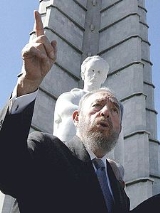
Fidel Alejandro Castro Ruz is the current President of
Cuba*. After commanding the
revolution that overthrew
Fulgencio Batista in 1959, he held the title of
Prime Minister until 1976, when he became president of the Council of State as well as the Council of Ministers. Castro became First Secretary of the
Communist Party of Cuba in 1965, and led the transformation of Cuba into a
one-party socialist republic. As president he also holds the supreme military rank of
Comandante in the Cuban military. On July 31 2006, Castro temporarily
transferred duties to his brother
Raúl to recover from intestinal surgery.
Castro first attracted attention in Cuban political life through his
nationalist critiques of Batista and
United States corporate and political influence in Cuba. He gained an ardent, but limited, following and also drew the attention of the authorities. He eventually led the failed 1953 attack on the
Moncada Barracks, after which he was captured, tried, incarcerated and later released. He then travelled to Mexico to organize and train for the
guerrilla invasion of Cuba that took place in December 1956. Since his assumption of power in 1959 he has evoked both praise and condemnation . Castro is frequently described by opponents as a dictator and accused of gross human rights violations, including the execution of thousands of political opponents, . Other groups hail Castro as a charismatic liberator.
Outside of Cuba, Castro has been defined by his relationship with both the
United States and with the former
Soviet Union. Ever since the failed
Bay of Pigs invasion of Cuba in 1961 by the United States, the Castro-led government has had an openly antagonistic relationship with the U.S., and a simultaneous closeness with the
Soviet bloc. This was true until the collapse of the Soviet Union in 1991, after which his priorities shifted from supporting foreign interventions to partnering with
regional socialist figures such as
Hugo Chávez in
Venezuela and
Evo Morales in
Bolivia.
Domestically, Fidel Castro has overseen the implementation of various economic policies which saw the rapid centralization of Cuba's economy - land reform, collectivization of agriculture, and the nationalization of leading
Cuban industries. The expansion of publicly funded health care and
education has been a cornerstone of Castro's domestic social agenda. Some credit these policies for Cuba's relatively high
Human Development Index rating. Others see Castro and his policies as being responsible for Cuba's general economic depredation, and harshly criticize him for the criminalization of political dissent, free speech, and provoking hundreds of thousands of Cubans into fleeing the country.
Childhood and education
Fidel Alejandro Castro Ruz was born on a sugar plantation in Birán, near Mayarí, in the modern-day
province of Holguín – then a part of the now-defunct Oriente province. He was the third child born to Ángel Castro y Argiz, a Galician immigrant who became relatively prosperous through hard work in the sugar industry and shrewd investments. His mother, Lina Ruz González, was a household servant.
Attack on Moncada Barracks
As discontent over the Batista coup grew, Castro abandoned his law practice and formed an underground organization of supporters, including his brother,
Raúl, and actively plotted to overthrow Batista. They collected guns and ammunition and finalized their plans for an armed attack on
Moncada Barracks, Batista's largest garrison outside
Santiago de Cuba. On the 26th of July, 1953, they attacked
Moncada Barracks. The Céspedes garrison in Bayamo was also attacked as a diversion. mountains east of Santiago where they were eventually discovered and captured. Although there is disagreement over why Castro and his brother,
Raúl, were not executed on capture as many of their fellow militants were, there is evidence that an officer recognized Castro from his university days and treated the captured rebels compassionately, despite the unofficial order to have the leader executed. During his trial Castro delivered his famous defense speech
History Will Absolve Me, upholding his rebellious actions and boldly declaring his political views:
While he was being held at the prison for political activists on
Isla de Pinos, he continued to plot Batista's overthrow, planning upon release to reorganize and train in Mexico.
26th of July Movement
Once in Mexico, Castro reunited with other Cuban exiles and founded the 26th of July Movement, named after the date of the failed attack on the Moncada Barracks. The goal remained the overthrow of
Fulgencio Batista. Castro had learned from the Moncada experience that new tactics were needed if Batista's forces were to be defeated. This time, the plan was to use underground guerrilla tactics, at that time a form of combat unknown in Latin America. they decided to go to the
United States to gather personnel and funds from Cubans living there, including
Carlos Prío Socarrás, the elected Cuban president deposed by Batista in 1952. Back in Mexico, the group trained under a
Spanish Civil War Veteran, Cuban born Alberto Bayo
In the summer of 1955, País’s organization merged with the 26th of July Movement of Castro. As Castro's movement gained popular support in the cities and countryside, it grew to over eight hundred men. In mid-1957 Castro gave
Che Guevara command of a second column. A
journalist, Herbert Matthews from the
New York Times is a newspaper [i] published in New York City [i] by Arthur Ochs Sulzberger Jr. [i] ...
, came to interview him in the Sierra Maestra, attracting interest to Castro's cause in the United States. The
New York Times front page stories by Matthews presented Castro as a romantic and appealing revolutionary, bearded and dressed in rumpled fatigues.
Castro and Matthews were followed by the TV crew of Andrew Saint George, said to be a
CIA contact person. Through television, Castro's rudimentary command of the
English language and charismatic presence enabled him to appeal directly to a U.S. audience.
Operation Verano
In May 1958, Batista launched
Operation Verano aiming to crush Castro and other anti-government groups. It was called "la Ofensiva" by the rebels . Although on paper heavily outnumbered, Castro's guerrilla forces scored a series of victories, largely aided by mass desertions from Batista's army of poorly trained and uncommitted young conscripts. During the
Battle of La Plata, Castro's forces defeated an entire battalion. While pro-Castro Cuban sources later emphasized the role of Castro's
guerrilla forces in these battles, other groups and leaders were also involved, such as escopeteros . During the
Battle of Las Mercedes, Castro's small army came close to defeat but he managed to pull his troops out by opening up negotiations with General Cantillo while secretly slipping his soldiers out of a trap.
When
Operation Verano ended, Castro ordered three columns commanded by Guevara, Jaime Vega and
Camilo Cienfuegos to invade central Cuba where they were strongly supported by rebellious elements who had long been operating in the area. One of Castro's columns moved out onto the Cauto Plains. Here, they were supported by Huber Matos,
Raúl Castro and others to the eastern-most part of the province. On the plains, Castro's forces first surrounded the town of Guisa in
Granma Province and drove out their enemies, then proceeded to take most of the towns that were taken by Calixto Garcia in the 1895-1898
Cuban War of Independence.
Battle of Yaguajay
In December 1958, the columns of
Che Guevara and
Camilo Cienfuegos joined with other anti-Batista forces already in the guerrilla stronghold in the Sierra Maestra mountains. Although they were greatly outnumbered by Batista's forces, they enjoyed enormous popular support. They succeeded in occupying several towns, and then began preparations for an attack on
Santa Clara, Cuba the provincial capital of Las Villas. The rebel guerrillas, led by Fidel Castro, launched a fierce attack on the Cuban army surrounding Santa Clara, and a vicious house-to-house battle ensued. The capture of Las Villas was a key step before the advance on the capital of Havana.
Guevara's column derailed an armored train which Batista had sent to aid his troops in the city while Cienfuegos won the Battle of Yaguajay. Defeated on all sides, Batista's forces crumbled. The provincial capital was captured after less than a day of fighting on December 31, 1958.
With the loss of his wife Clara and expecting the betrayal of his own army, Batista and president-elect Andres Rivero Agüero fled Cuba in the early hours of January 1, 1959, initially to the
Dominican Republic and then to
Francisco Franco's
Spain. He left behind a junta headed by Gen. Eulogio Cantillo, recently the commander in Oriente province, the center of the Castro revolt. The junta immediately selected Dr. Carlos Piedra, the oldest judge of the Supreme Court, as provisional President of Cuba as specified in the Constitution of 1940. Castro refused to accept the selection of Justice Piedra as provisional President and the Supreme Court refused to administer the oath of office to the Justice.
The rebel forces of Fidel Castro moved swiftly to seize power throughout the island. Subsequently, the USSR sent over one hundred mostly Spanish speaking advisors, including
Enrique Líster Forján, to organize the
Committees for the Defense of the Revolution.
In February 1960, Cuba signed an agreement to buy oil from the USSR. When the U.S.-owned refineries in Cuba refused to process the oil, they were expropriated, and the United States broke off diplomatic relations with the Castro government soon afterward. To the concern of the Eisenhower administration, Cuba began to establish closer ties with the Soviet Union. A variety of pacts were signed between Castro and Soviet Premier
Nikita Khrushchev, allowing Cuba to receive large amounts of economic and military aid from them.
In June 1960, Eisenhower reduced Cuba's sugar import quota by 7,000,000 tons, and in response, Cuba nationalized some $850 million worth of U.S. property and businesses. The revolutionary government grabbed control of the nation by nationalizing industry, expropriating property owned by Cubans and non-Cubans alike, collectivizing
agriculture, and enacting policies which would benefit the population. While popular among the poor, these policies alienated many former supporters of the revolution among the Cuban middle and upper-classes. Over one million Cubans later migrated to the U.S., forming a vocal anti-Castro community in
Miami, Florida.
President Dwight Eisenhower broke off ties on January 3, 1961, saying Fidel Castro had provoked him once too often.
By 1961, the U.S. Government was engaged in a semi-secret campaign to remove Castro from power. The unsuccessful Bay of Pigs invasion in April 1961 – an attempt to topple Castro by supporting an armed force of Cuban exiles to retake the island – is the most well-known operation of this campaign.
Bay of Pigs
A timeline released by the National Security Archives shows the U.S. began planning to overthrow the government of Cuba in October, 1959. On April 17, 1961, approximately 1,400 members of a CIA-trained Cuban exile force landed at the Bay of Pigs, while the United States denied any involvement.
Documents released by the National Security Archive show that the CIA expected the Cuban people to welcome a U.S.-sponsored invasion, spontaneously rising up against the Castro regime. It expected Cuban military and police forces to refuse to fight against the CIA's 1,400-man mercenary invasion force. President Kennedy had withdrawn support for the invasion at the last minute by canceling several bombing sorties that could have crippled the entire Cuban Air Force. The brief military invasion ended in total failure and quickly became a foreign policy debacle for Kennedy. He had approved the plan just three months into his presidency.
Castro had repelled the invaders, killing many and capturing a thousand. On May 1, 1961, as hundreds of thousands celebrating May Day roared their approval, Castro announced:
In a nationally broadcast speech on December 2, 1961, Castro declared that he was a Marxist-Leninist and that Cuba was adopting
Communism. On February 7, 1962, the U.S. imposed an
embargo against Cuba. This embargo was broadened during 1962 and 1963, including a general travel ban for American tourists.
Many theories are offered for the failure of the U.S. operation. Some argue that Kennedy's last-minute decision to withdraw air support caused the invasion to fail. Others argue that the Americans misjudged Cuban support for Castro. They had believed the testimonies of the Cuban exiles, who told them that Castro was not well supported by the Cuban people. Unfortunately, however, in the weeks prior to the invasion, the Castro regime had rounded up tens of thousands of Cubans, holing them up in sports stadiums across the island in order to quash discontent on the island and prevent its adversaries from joining exile forces. The idea that Cubans would rise up against Castro, while most likely correct, judging from the discontent growing on the island at that time, would never happen as a result of the widespread incarcerations throughout Cuba. As well, the CIA-trained force of 1,400 armed only with light arms faced a Cuban force of tens of thousand armed with tanks and artillery. In addition, the covert placement of dozens of Cuban intelligence officials in the invasion force gave the Cuban government detailed information on the operation.
Cuban Missile Crisis
Tensions between Castro and the U.S. heightened during the 1962 Cuban missile crisis, which nearly brought the US and the USSR to direct confrontation. Khrushchev conceived the idea of placing missiles in Cuba as a deterrent to a U.S. invasion and justified the move in response to US missile deployment in Turkey. After consultations with his military advisors, he met with a Cuban delegation led by Raúl Castro in July in order to work out the specifics. It was agreed to deploy Soviet
R-12 MRBMs on Cuban soil; however, American
Lockheed U-2 reconnaissance discovered the construction of the missile installations on 15 October, 1962 before the weapons had actually been deployed. The US government viewed the installation of Soviet nuclear weapons 90 miles south of
Key West as an aggressive act and a threat to US security. As a result, the US publicly announced its discovery on 22 October, 1962, and implemented a
quarantine around Cuba that would actively intercept and search any vessels heading for the island. Nikolai Sergeevich Leonov, who would become General in KGB Intelligence Directorate, and Soviet KGB deputy station chief in Warsaw, was the translator Castro used for contact with the Russians.
In a personal letter to Khrushchev dated 27 October, 1962, Castro urged Khrushchev to launch a nuclear first strike against the United States if Cuba were invaded, but Khrushchev rejected any first strike response. Soviet field commanders in Cuba were, however, authorized to use
tactical nuclear weapons if attacked by the United States. Khrushchev agreed to remove the missiles in exchange for a US commitment not to invade Cuba and an understanding that the US would remove American MRBMs targeting the
Soviet Union from
Turkey and
Italy, a measure that the US implemented a few months later. The missile swap was never publicized because the Kennedy Administration demanded secrecy in order to preserve NATO relations and protect Democratic candidates in the upcoming elections.
Assassination Attempts
It has been estimated that there have been over 600 attempts on Castro's life committed by the
CIA. Fabian Escalante, who was long tasked with protecting the life of Castro has calculated the exact number of assassination attempts by the CIA to be 638. Some such attempts have included an exploding cigar, a fungal-infected scuba-diving suit, and a mafia-style shooting. Some of these plots are depicted in a documentary entitled
638 Ways to Kill Castro.
Embargo
After the collapse of the Soviet Union in 1991, Cuba was left bankrupt and isolated by the disintegration of the Soviet bloc. Eighty-five percent of its markets had disappeared, along with the subsidies and trade agreements that had supported its economy. The situation became desperate. Daily life was a struggle with extended gas and water outages, severe power shortages, and dwindling food supplies available for rationing.
Castro denounces the US embargo against Cuba. The embargo has united the Cuban people for over 40 years. A former Prime Minister of Spain has written that the embargo is Castro's greatest ally, as it perpetuates the government and, if lifted, Castro would lose his presidency in three months. Many have condemned the embargo ranging from Pope John Paul II , to
Steven Spielberg for humanitarian reasons.
By 1994, the island's economy, which had survived over 30 years of sanctions by the US, teetered on the brink. Cuba was plunged into what is called their "Special Period" during which there were shortages of everything. To survive, Cuba legalized the US dollar and turned to tourism. Even as late as 2004, Castro was forced to shut down 118 factories, including steel plants, sugar mills and paper processors for the month of October to deal with the crisis in fuel shortages.
After the massive damage caused by Hurricane Michelle in 2001, Castro proposed to the U.S. a one-time cash purchase of food after declining a U.S. offer of humanitarian aid. The U.S. authorized the shipment of food in 2001, the first since the embargo was imposed in 1962, because of the devastation caused by the hurricane.
Castro and the Soviet Union
Following the establishment of diplomatic ties to the Soviet Union, and after the Cuban Missile Crisis, Cuba became increasingly dependent on Soviet markets and military and economic aid. Castro was able to build a formidable military force with the help of Soviet equipment and military advisors. The
KGB kept in close touch with Havana, and Castro tightened Communist Party control over all levels of government, the media, and the educational system, while developing a Soviet-style internal police force.
Castro's alliance with the Soviet Union caused something of a split between him and Guevara, who took a more pro-
Chinese view following ideological conflict between the
CPSU and the
Maoist CPC. In 1966, Guevara left for
Bolivia in an ill-fated attempt to stir up revolution against the country's government.
On 23 August, 1968, Castro made a public gesture to the Soviet Union that reaffirmed their support in him. Two days after the Soviet invasion of
Czechoslovakia to repress the
Prague Spring, Castro took to the airwaves and publicly denounced the Czech rebellion. Castro warned the Cuban people about the Czechoslovakian 'counterrevolutionaries', who "were moving Czechoslovakia towards capitalism and into the arms of
imperialists". He called the leaders of the rebellion "the agents of West Germany and
fascist reactionary rabble." In return for his public backing of the invasion, at a time when many Soviet allies were deeming the invasion an infringement of Czechoslovakia's sovereignty, the Soviets bailed out the Cuban economy with extra loans and an immediate increase in oil exports.
In 1971, despite a
Organization of American States convention that no nation in the
Western Hemisphere would have a relationship with Cuba , Castro took a month-long visit to Chile, following the re-establishment of diplomatic relations with
Cuba. The visit, in which Castro participated actively in the internal politics of the country, holding massive rallies and giving public advice to Allende, was seen by those on the political right as proof to support their view that "The Chilean Way to Socialism" was an effort to put Chile on the same path as Cuba.
On November 4, 1975, Castro ordered the deployment of Cuban troops to
Angola in order to aid the Marxist
MPLA-ruled government against the
South African-backed
UNITA opposition forces. Moscow aided the Cuban initiative with the USSR engaging in a massive airlift of Cuban forces into Angola. On Cuba's role in Angola,
Nelson Mandela is said to have remarked "Cuban internationalists have done so much for African independence, freedom, and justice." Cuban troops were also sent to Marxist
Ethiopia to assist Ethiopian forces in the Ogaden War with Somalia in 1977. In addition, Castro extended support to Marxist Revolutionary movements throughout Latin America, such as aiding the
Sandinistas in overthrowing the Somoza dictatorship in
Nicaragua in 1979. It has been claimed by the Carthage Foundation-funded Center for a Free Cuba that an estimated 14,000 Cubans were killed in Cuban military actions abroad.
When Soviet leader
Mikhail Gorbachev visited Cuba in 1989, the comradely relationship between Havana and Moscow was strained by Gorbachev's implementation of economic and political reforms in the USSR. "We are witnessing sad things in other socialist countries, very sad things," lamented Castro in November 1989, in reference to the reforms that were sweeping such communist allies as the Soviet Union,
East Germany,
Hungary, and
Poland. The subsequent
collapse of the Soviet Union in 1991 had an immediate and devastating effect on Cuba.
Foreign relations
Cuba and Panama have restored diplomatic ties after breaking them off in 2005 when Panama's former president pardoned four Cuban exiles accused of attempting to assassinate Cuban President Fidel Castro. The foreign minister of each country re-established official diplomatic relations in Havana by signing a document describing a spirit of fraternity that has long linked both nations. Cuba, once shunned by many of its Latin American neighbours, now has full diplomatic relations with all but Costa Rica and El Salvador. Mexican president, Vicente Fox, apologised to Fidel Castro in 2002 over allegations by Castro that Fox forced him to leave a United Nations summit in Mexico so that he would not be in the presence of President Bush, who also attended.
At a summit meeting of sixteen Caribbean countries in 1998, Castro called for regional unity, saying that only strengthened cooperation between Caribbean countries would prevent their domination by rich nations in a global economy. Caribbean nations have embraced Cuba's Fidel Castro while accusing the US of breaking trade promises. Castro, until recently a regional outcast, has been increasing grants and scholarships to the Caribbean countries, while US aid has dropped 25% over the past five years. Cuba has opened four additional embassies in the Caribbean Community including:
Antigua and
Barbados,
Dominica,
Suriname,
Saint Vincent and the Grenadines. This development makes Cuba the only country to have embassies in all independent countries of the Caribbean Community.
In the poorest areas of
Latin America and
Africa, Castro is seen as a hero, the leader of the
Third World, and the enemy of the wealthy and greedy. On a visit to South Africa he was warmly received by President Nelson Mandela. President Mandela gave Castro South Africa's highest civilian award for foreigners, the Order of Good Hope. Last December Castro fulfilled his promise of sending 100 medical aid workers to Botswana, according to the Botswana presidency. These workers play an important role in Botswana's war against HIV/AIDS. According to Anna Vallejera, Cuba's first-ever Ambassador to Botswana, the health workers are part of her country's ongoing commitment to proactively assist in the global war against HIV/AIDS,
The president of
Venezuela Hugo Chávez is a grand admirer of his and Bolivian president
Evo Morales called him the "Grandfather". In
Harlem, he is seen as an icon because of his historic visit with
Malcolm X in 1960 at the
Hotel Theresa.
Castro was known to be a friend of former
Canadian Prime Minister Pierre Trudeau and attended Trudeau's funeral in October 2000 to mourn the passing of his friend. They continued their friendship after Trudeau left office until his death.
Canada became one of the first
American allies to openly trade with Cuba. Cuba still has a good relationship with Canada. In 1998 Canadian Prime Minister, Jean Chretien arrived in Cuba to meet President Castro and highlight their close ties. He is the first Canadian government leader to visit the island since Pierre Trudeau was in Havana in 1976.
European Union representatives described their political dialogue with Cuba as back on track after a weekend of talks in Havana. The EU praised Cuba's willingness to discuss questions of human rights. Cuba is the only Latin American country without an economic co-operation agreement with the EU. However trade with individual European countries remains strong, since the US trade embargo on Cuba leaves the market free from American rivals. In 2005 EU Development Commissioner
Louis Michel ended his visit to Cuba optimistic that relations with the communist state will become stronger. The EU is Cuba's largest trading partner. Cuba's imprisonment of 75 dissidents and the execution of three hijackers have strained diplomatic relations. However the EU commissioner was impressed with Fidel Castro's willingness to discuss these concerns, although he received no commitments from Castro. Cuba does not admit to holding political prisoners, rather seeing them as mercenaries in the pay of the United States.
Succession issues
According to the Cuban Constitution Article 94, the First Vice President of the Council of State assumes presidential duties upon the illness or death of the president. At the moment , that is
Raúl Castro.
Due to the issue of presidential succession, and Castro's longevity, there has long been rumor, speculation and hoaxing about Castro's health and demise. In 1998 there were reports that he had a serious brain disease, later discredited. In June 2001, he apparently fainted during a seven-hour speech under the Caribbean sun. Later that day he finished the speech, walking buoyantly into the television studios in his military fatigues, joking with journalists.
In January 2004, Luis Eduardo Garzón, the mayor of
Bogotá, said that Castro "seemed very sick to me" following a meeting with him during a vacation in Cuba. In May 2004, Castro's physician denied that his health was failing, and speculated that he would live to be 140 years old. Dr. Eugenio Selman Housein said that the "press is always speculating about something, that he had a heart attack once, that he had cancer, some neurological problem", but maintained that Castro was in good health.
On October 20, 2004, Castro tripped and fell following a speech he gave at a rally, breaking his kneecap and fracturing his right arm. Two months after his fall, Castro walked for the first time in public.
Due to his large role in Cuba, his well-being has become a continual source of speculation, both on and off the island, as he has grown older. The CIA has long been preoccupied with Castro's health.
In 2005 the CIA said it thought Castro has
Parkinson's disease.
Castro denies such allegations, while also stating "I don't care if I get Parkinson's. The Pope had Parkinson's, and he spent a bunch of years running all around the world."
On July 31, 2006, the spokesman for Castro announced a provisional transfer of his duties as president and Communist Party first secretary to his younger brother
Raúl. The announcement cited "an acute intestinal crisis, with sustained bleeding" requiring immediate medical intervention, as the cause of his decision to cede control. The announcement marked the first delegation of presidential duties in Cuba since Castro's inauguration in 1976.
As of early August, rumors persisted that Castro was already dead. On August 5, the Brazilian newspaper
Folha de S. Paulo reported that Cuban authorities had informed Brazilian president
Lula da Silva that Castro's health was much worse than what the Cuban government had previously admitted in public. According to the report, Castro is actually suffering from
intestinal cancer and will be unable to resume control of the Cuban state. The Brazilian government quickly denied that the report was accurate. Folha's editors responded to the government's denials by saying their sources were aides to the president. On 13 August 2006, Castro published a note: "
I ask you all to be optimistic, and at the same time to be ready to face any adverse news. . . . For all those who care about my health, I promise I'll fight for it". He also appeared live on Venezuelan television on 14 August 2006 joking with
Hugo Chávez from his sickbed.
Cuban leader Fidel Castro issued a statement updating his condition on September 6 2006: The worst is over: "This is still serious. We're out of the woods, but don't expect me to walking around in my fatigues any time soon. Other people are running the show now, but I'm still here as the grandfather of the revolution." "We all must also understand, with realism, that the duration of a complete recovery, whether we want it or not, will be prolonged," he said. "At this moment, I am not in any hurry, and no one should hurry. The country marches on well and moves ahead." The photos showed a slimmer Castro in two different sets of blue pajamas reading and writing. Only one shows a full-length image, showing him wearing slippers and reading while he sits on a rocking chair. In one photo, Castro holds up what appears to be a proof of the book
One Hundred Hours With Fidel, written by French leftist intellectual Ignacio Ramonet. Castro promises the book will be published soon. However the book was launched April 2006 in
Spain, and came under criticism when some of the passages from the alleged interviews turned out to be identical to Castro speeches. "He didn't look good," Castro biographer Georgie Anne Geyer said by phone from
Washington D.C. "In the past he's had this hearty look about him. This time he looked like an old man. It's a little surprising to me. My own knowledge of him is that . . . he would never ever admit he's sick, weak, or not coming back."
Dr. Jeffrey Raskin, the University of Miami's interim chief of gastroenterology, speculated that the ongoing secrecy surrounding Castro's health suggests Castro may have
cancer. "The fact that they're continuing to be vague this late into it means more than likely it's not a benign condition, that he does in fact have a tumor," Raskin said. Cancer of the pancreas, stomach or colon are all possibilities. Other conditions that could have prompted intestinal bleeding and surgery -- such as a bleeding ulcer or diverticular disease -- would likely have been resolved by now, Raskin said. The Brazilian newspaper Folha de Sao Paulo reported September 3 2006 that sources in the ruling Workers Party with a direct line to the Cuban government say a part of Castro's intestines was removed because of a cancer that had not metastasized.
Castro and human rights
Thousands of political opponents to the Castro regime have been killed, primarily during the first decade of his dictatorship; however exact numbers are not known. Some Cubans labeled "counterrevolutionaries", "fascists", or "CIA operatives" have been imprisoned in extremely poor conditions without trial. Professor Marifeli Pérez Stable, a Cuban American who once supported the revolution, reflects on the costs of the Cuban revolution. "[There were] thousands of executions, forty, fifty thousand political prisoners. The treatment of political prisoners, with what we today know about human rights and the international norms governing human rights ... it is legitimate to raise questions about possible crimes against humanity in Cuba."Castro acknowledges that Cuba holds political prisoners, but argues that Cuba is justified because these prisoners are not jailed because of their political beliefs, but have been convicted of "counter-revolutionary" crimes, including bombings.
Fidel Castro portrays opposition to the Cuban government as illegitimate, and the result of an ongoing conspiracy fostered by Cuban exiles with ties to the United States or the CIA. Many Castro supporters say that Castro's measures are justified to prevent the fall of his government, whereas his opposition says he uses the United States as an excuse to justify his continuing political control.
Castro and religion
Castro is an
atheist and has not been a practicing
Roman Catholic since his childhood.
Pope John XXIII excommunicated Castro in 1962 on the basis of a 1949 decree by
Pope Pius XII forbidding Catholics from supporting communist governments. The excommunication was aimed at undermining support for Castro among Catholics. For Castro, who had previously renounced his Catholic faith, this was an event of very little consequence, nor was it expected to be otherwise.
In 1992, Castro agreed to loosen restrictions on religion and even permitted church-going Catholics to join the Cuban Communist Party. He began describing his country as "secular" rather than "atheist".
Pope John Paul II visited Cuba in 1998, the first visit by a reigning pontiff to the island. Castro and the Pope appeared side by side in public on several occasions during the visit. Castro wore a dark blue business suit in his public meetings with the Pope and treated him with reverence and respect.
With Castro and other senior Cuban officials in the front row at a mid-morning Mass, the pope delivered a ringing call for pluralism in Cuba. He rejected the materialistic, one-party ideology of the Cuban state. And he said that true liberation "cannot be reduced to its social and political aspects," but must also include "the exercise of freedom of conscience -- the basis and foundation of all other human rights."
Later in the day, though, the pope also made his most critical reference yet to the American economic embargo of Cuba. At a departure ceremony at Jose Marti Airport that evening, he said that Cuba's "material and moral poverty" arises not only from "limitations to fundamental freedoms" and "discouragement of the individual," but also from "restrictive economic measures -- unjust and ethically unacceptable -- imposed fr