


National Security Act of 1947

Encyclopedia
Act of Congress
An Act of Congress is a statute enacted by government with a legislature named "Congress," such as the United States Congress or the Congress of the Philippines....
No. 235, 80
80th United States Congress
The Eightieth United States Congress was a meeting of the legislative branch of the United States federal government, composed of the United States Senate and the United States House of Representatives. It met in Washington, DC from January 3, 1947 to January 3, 1949, during the third and fourth...
Cong., 61 Stat. 495) was signed by United States
United States
The United States of America is a federal constitutional republic comprising fifty states and a federal district...
President
President of the United States
The President of the United States of America is the head of state and head of government of the United States. The president leads the executive branch of the federal government and is the commander-in-chief of the United States Armed Forces....
Harry S. Truman
Harry S. Truman
Harry S. Truman was the 33rd President of the United States . As President Franklin D. Roosevelt's third vice president and the 34th Vice President of the United States , he succeeded to the presidency on April 12, 1945, when President Roosevelt died less than three months after beginning his...
on July 26, 1947, and realigned and reorganized the U.S. Armed Forces
United States armed forces
The United States Armed Forces are the military forces of the United States. They consist of the Army, Navy, Marine Corps, Air Force, and Coast Guard.The United States has a strong tradition of civilian control of the military...
, foreign policy, and Intelligence Community
United States Intelligence Community
The United States Intelligence Community is a cooperative federation of 16 separate United States government agencies that work separately and together to conduct intelligence activities considered necessary for the conduct of foreign relations and the protection of the national security of the...
apparatus in the aftermath of World War II
World War II
World War II, or the Second World War , was a global conflict lasting from 1939 to 1945, involving most of the world's nations—including all of the great powers—eventually forming two opposing military alliances: the Allies and the Axis...
. The majority of the provisions of the Act took effect on September 18, 1947, the day after the Senate
United States Senate
The United States Senate is the upper house of the bicameral legislature of the United States, and together with the United States House of Representatives comprises the United States Congress. The composition and powers of the Senate are established in Article One of the U.S. Constitution. Each...
confirmed James Forrestal
James Forrestal
James Vincent Forrestal was the last Cabinet-level United States Secretary of the Navy and the first United States Secretary of Defense....
as the first Secretary of Defense
United States Secretary of Defense
The Secretary of Defense is the head and chief executive officer of the Department of Defense of the United States of America. This position corresponds to what is generally known as a Defense Minister in other countries...
. His power was extremely limited and it was difficult for him to exercise the authority to make his office effective. This was later changed in the amendment to the act in 1949, creating what was to be the Department of Defense.
The Act merged the Department of War
United States Department of War
The United States Department of War, also called the War Department , was the United States Cabinet department originally responsible for the operation and maintenance of the United States Army...
and the Department of the Navy
United States Department of the Navy
The Department of the Navy of the United States of America was established by an Act of Congress on 30 April 1798, to provide a government organizational structure to the United States Navy and, from 1834 onwards, for the United States Marine Corps, and when directed by the President, of the...
into the National Military Establishment, headed by the Secretary of Defense. It was also responsible for the creation of a Department of the Air Force separate from the existing Army Air Forces
United States Army Air Forces
The United States Army Air Forces was the military aviation arm of the United States of America during and immediately after World War II, and the direct predecessor of the United States Air Force....
. Initially, each of the three service secretaries maintained quasi-cabinet status, but the act was amended on August 10, 1949, to assure their subordination to the Secretary of Defense. At the same time, the NME was renamed as the Department of Defense
United States Department of Defense
The United States Department of Defense is the U.S...
. The purpose was to unify the Army, Navy, and what was soon to become the Air Force into a federated structure.
Aside from the military reorganization, the act established the National Security Council
United States National Security Council
The White House National Security Council in the United States is the principal forum used by the President of the United States for considering national security and foreign policy matters with his senior national security advisors and Cabinet officials and is part of the Executive Office of the...
, a central place of coordination for national security
National security
National security is the requirement to maintain the survival of the state through the use of economic, diplomacy, power projection and political power. The concept developed mostly in the United States of America after World War II...
policy in the executive branch
Executive (government)
Executive branch of Government is the part of government that has sole authority and responsibility for the daily administration of the state bureaucracy. The division of power into separate branches of government is central to the idea of the separation of powers.In many countries, the term...
, and the Central Intelligence Agency
Central Intelligence Agency
The Central Intelligence Agency is a civilian intelligence agency of the United States government. It is an executive agency and reports directly to the Director of National Intelligence, responsible for providing national security intelligence assessment to senior United States policymakers...
, the U.S.'s first peacetime intelligence agency
Intelligence agency
An intelligence agency is a governmental agency that is devoted to information gathering for purposes of national security and defence. Means of information gathering may include espionage, communication interception, cryptanalysis, cooperation with other institutions, and evaluation of public...
. The function of the council was to advise the president on domestic, foreign, and military policies so that they may cooperate more tightly and efficiently. Departments in the government were encouraged to voice their opinions to the council in order to make a more sound decision.
The Joint Chiefs of Staff
Joint Chiefs of Staff
The Joint Chiefs of Staff is a body of senior uniformed leaders in the United States Department of Defense who advise the Secretary of Defense, the Homeland Security Council, the National Security Council and the President on military matters...
was officially established under Title II, Section 211 of the original National Security Act of 1947 before Sections 209–214 of Title II were repealed by the law enacting Title 10 and Title 32, United States Code (Act of August 10, 1956, 70A Stat. 676) to replace them.
The act and its changes, along with the Truman Doctrine
Truman Doctrine
The Truman Doctrine was a policy set forth by U.S. President Harry S Truman in a speech on March 12, 1947 stating that the U.S. would support Greece and Turkey with economic and military aid to prevent their falling into the Soviet sphere...
and the Marshall Plan
Marshall Plan
The Marshall Plan was the large-scale American program to aid Europe where the United States gave monetary support to help rebuild European economies after the end of World War II in order to combat the spread of Soviet communism. The plan was in operation for four years beginning in April 1948...
, were major components of the Truman administration's Cold War
Cold War
The Cold War was the continuing state from roughly 1946 to 1991 of political conflict, military tension, proxy wars, and economic competition between the Communist World—primarily the Soviet Union and its satellite states and allies—and the powers of the Western world, primarily the United States...
strategy.
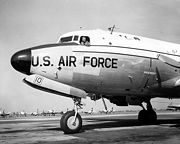
The bill signing took place aboard Truman's VC-54C presidential aircraft Sacred Cow, the first aircraft used for the role of Air Force One
Air Force One
Air Force One is the official air traffic control call sign of any United States Air Force aircraft carrying the President of the United States. In common parlance the term refers to those Air Force aircraft whose primary mission is to transport the president; however, any U.S. Air Force aircraft...
.
External links
- Text at the United States Senate Select Committee on IntelligenceUnited States Senate Select Committee on IntelligenceThe United States Senate Select Committee on Intelligence is dedicated to overseeing the United States Intelligence Community—the agencies and bureaus of the federal government of the United States who provide information and analysis for leaders of the executive and legislative branches. The...
- Information at the Department of State
- Bibliography of sources relating to the Act, including many links to online, public-domain sources