

Unconventional warfare

Encyclopedia
Unconventional warfare is the opposite of conventional warfare
. Where conventional warfare is used to reduce an opponent's military
capability, unconventional warfare is an attempt to achieve military victory through acquiescence, capitulation, or clandestine support for one side of an existing conflict.
On the surface, UW contrasts with conventional warfare in that: forces or objectives are covert or not well-defined, tactics and weapons intensify environments of subversion or intimidation, and the general or long-term goals are coercive
or subversive
to a political body.
and civil liberties associated with greater security demands, economic hardship linked to the costs of war; hopelessness to defend against assaults, fear, depression, and disintegration of morale
.
The ultimate goal of this type of war
fare is to motivate an enemy to stop attacking or resisting even if it has the ability to continue. Failing this, a secondary objective can be to emasculate the enemy before a conventional attack.
s, or other such weapons.
Special Forces
, inserted behind an enemy's front line, can be used unconventionally to spread subversion and propaganda, to aid native resistance fighters, and to ultimately build environments of fear and confusion. Tactics of destroying non-military infrastructure and blockading
civilian staples are used to decrease the morale of civilians and, when applicable, also the soldiers in the field through concern for their families. Globalization
dissenters broadly criticize the managed-trade system as a planet-wide version of the blockading tactic
of unconventional warfare.
 The United States Department of Defense
defines UW as a broad spectrum of military and paramilitary operations, normally of long duration, predominantly conducted through, with, or by indigenous or surrogate forces who are organized, trained, equipped, supported, and directed in varying degrees by an external source. It includes, but is not limited to, guerrilla warfare
, subversion
, sabotage
, intelligence activities
, and unconventional assisted recovery
. Organization varies by culture and type of conflict.
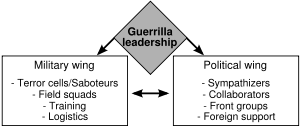
In the People's Wars conflicts of Vietnam and China, a clear structure of rural bases, different troop types and leadership by a strong centralized political group or party prevailed. In other conflicts the pattern is more fragmented, and unconventional warfare need not rely on rural bases at all. Generally, organization is divided into political or military wings.
US & NATO specific:
Conventional warfare
Conventional warfare is a form of warfare conducted byusing conventional military weapons and battlefield tactics between two or more states in open confrontation. The forces on each side are well-defined, and fight using weapons that primarily target the opposing army...
. Where conventional warfare is used to reduce an opponent's military
Military
A military is an organization authorized by its greater society to use lethal force, usually including use of weapons, in defending its country by combating actual or perceived threats. The military may have additional functions of use to its greater society, such as advancing a political agenda e.g...
capability, unconventional warfare is an attempt to achieve military victory through acquiescence, capitulation, or clandestine support for one side of an existing conflict.
On the surface, UW contrasts with conventional warfare in that: forces or objectives are covert or not well-defined, tactics and weapons intensify environments of subversion or intimidation, and the general or long-term goals are coercive
Coercion
Coercion is the practice of forcing another party to behave in an involuntary manner by use of threats or intimidation or some other form of pressure or force. In law, coercion is codified as the duress crime. Such actions are used as leverage, to force the victim to act in the desired way...
or subversive
Subversion (politics)
Subversion refers to an attempt to transform the established social order, its structures of power, authority, and hierarchy; examples of such structures include the State. In this context, a "subversive" is sometimes called a "traitor" with respect to the government in-power. A subversive is...
to a political body.
Objectives
The general objective of unconventional warfare is to instill a belief that peace and security are not possible without compromise or concession. Specific objectives include inducement of war weariness, curtailment of civilian standards of livingStandard of living
Standard of living is generally measured by standards such as real income per person and poverty rate. Other measures such as access and quality of health care, income growth inequality and educational standards are also used. Examples are access to certain goods , or measures of health such as...
and civil liberties associated with greater security demands, economic hardship linked to the costs of war; hopelessness to defend against assaults, fear, depression, and disintegration of morale
Morale
Morale, also known as esprit de corps when discussing the morale of a group, is an intangible term used to describe the capacity of people to maintain belief in an institution or a goal, or even in oneself and others...
.
The ultimate goal of this type of war
War
War is a state of organized, armed, and often prolonged conflict carried on between states, nations, or other parties typified by extreme aggression, social disruption, and usually high mortality. War should be understood as an actual, intentional and widespread armed conflict between political...
fare is to motivate an enemy to stop attacking or resisting even if it has the ability to continue. Failing this, a secondary objective can be to emasculate the enemy before a conventional attack.
Methods and organization
Unconventional warfare targets civilian population and political bodies directly, seeking to render the military proficiency of the enemy irrelevant. Limited conventional warfare tactics can be used unconventionally to demonstrate might and power, rather than to substantially reduce the enemy's ability to fight. In addition to the coercive use of traditional weapons, armaments that primarily target civilians can be used: atomic weapons, urban incendiary deviceIncendiary device
Incendiary weapons, incendiary devices or incendiary bombs are bombs designed to start fires or destroy sensitive equipment using materials such as napalm, thermite, chlorine trifluoride, or white phosphorus....
s, or other such weapons.
Special Forces
Special forces
Special forces, or special operations forces are terms used to describe elite military tactical teams trained to perform high-risk dangerous missions that conventional units cannot perform...
, inserted behind an enemy's front line, can be used unconventionally to spread subversion and propaganda, to aid native resistance fighters, and to ultimately build environments of fear and confusion. Tactics of destroying non-military infrastructure and blockading
Blockade
A blockade is an effort to cut off food, supplies, war material or communications from a particular area by force, either in part or totally. A blockade should not be confused with an embargo or sanctions, which are legal barriers to trade, and is distinct from a siege in that a blockade is usually...
civilian staples are used to decrease the morale of civilians and, when applicable, also the soldiers in the field through concern for their families. Globalization
Globalization
Globalization refers to the increasingly global relationships of culture, people and economic activity. Most often, it refers to economics: the global distribution of the production of goods and services, through reduction of barriers to international trade such as tariffs, export fees, and import...
dissenters broadly criticize the managed-trade system as a planet-wide version of the blockading tactic
Anaconda Plan
The Anaconda Plan or Scott's Great Snake is the name widely applied to an outline strategy for subduing the seceding states in the American Civil War. Proposed by General-in-Chief Winfield Scott, the plan emphasized the blockade of the Southern ports, and called for an advance down the Mississippi...
of unconventional warfare.
Definitions
United States Department of Defense
The United States Department of Defense is the U.S...
defines UW as a broad spectrum of military and paramilitary operations, normally of long duration, predominantly conducted through, with, or by indigenous or surrogate forces who are organized, trained, equipped, supported, and directed in varying degrees by an external source. It includes, but is not limited to, guerrilla warfare
Guerrilla warfare
Guerrilla warfare is a form of irregular warfare and refers to conflicts in which a small group of combatants including, but not limited to, armed civilians use military tactics, such as ambushes, sabotage, raids, the element of surprise, and extraordinary mobility to harass a larger and...
, subversion
Subversion (politics)
Subversion refers to an attempt to transform the established social order, its structures of power, authority, and hierarchy; examples of such structures include the State. In this context, a "subversive" is sometimes called a "traitor" with respect to the government in-power. A subversive is...
, sabotage
Sabotage
Sabotage is a deliberate action aimed at weakening another entity through subversion, obstruction, disruption, or destruction. In a workplace setting, sabotage is the conscious withdrawal of efficiency generally directed at causing some change in workplace conditions. One who engages in sabotage is...
, intelligence activities
Intelligence (information gathering)
Intelligence assessment is the development of forecasts of behaviour or recommended courses of action to the leadership of an organization, based on a wide range of available information sources both overt and covert. Assessments are developed in response to requirements declared by the leadership...
, and unconventional assisted recovery
Extraction (military)
Extraction , in tactical combat and special operations use, is the process of removing constituents from a targeted site when it is considered imperative that they be immediately relocated out of a hostile environment and taken to a secured area under friendly control...
. Organization varies by culture and type of conflict.
In the People's Wars conflicts of Vietnam and China, a clear structure of rural bases, different troop types and leadership by a strong centralized political group or party prevailed. In other conflicts the pattern is more fragmented, and unconventional warfare need not rely on rural bases at all. Generally, organization is divided into political or military wings.
See also
- Asymmetric warfareAsymmetric warfareAsymmetric warfare is war between belligerents whose relative military power differs significantly, or whose strategy or tactics differ significantly....
- Fourth generation warfareFourth generation warfareFourth generation warfare is conflict characterized by a blurring of the lines between war and politics, soldier and civilian.The term was first used in 1989 by a team of United States analysts, including William S. Lind, to describe warfare's return to a decentralized form...
- Irregular militaryIrregular militaryIrregular military refers to any non-standard military. Being defined by exclusion, there is significant variance in what comes under the term. It can refer to the type of military organization, or to the type of tactics used....
- Irregular WarfareIrregular warfareIrregular warfare is warfare in which one or more combatants are irregular military rather than regular forces. Guerrilla warfare is a form of irregular warfare, and so is asymmetric warfare....
- Low intensity conflictLow intensity conflictLow intensity conflict is the use of military forces applied selectively and with restraint to enforce compliance with the policies or objectives of the political body controlling the military force...
- Partisan (military)Partisan (military)A partisan is a member of an irregular military force formed to oppose control of an area by a foreign power or by an army of occupation by some kind of insurgent activity...
- Political WarfarePolitical warfarePolitical warfare is the use of political means to compel an opponent to do one's will, based on hostile intent. The term political describes the calculated interaction between one's government and a target audience to include another country's government, military, and/or general population...
- Psychological warfarePsychological warfarePsychological warfare , or the basic aspects of modern psychological operations , have been known by many other names or terms, including Psy Ops, Political Warfare, “Hearts and Minds,” and Propaganda...
- Resistance movementResistance movementA resistance movement is a group or collection of individual groups, dedicated to opposing an invader in an occupied country or the government of a sovereign state. It may seek to achieve its objects through either the use of nonviolent resistance or the use of armed force...
- TerrorismTerrorismTerrorism is the systematic use of terror, especially as a means of coercion. In the international community, however, terrorism has no universally agreed, legally binding, criminal law definition...
- Unrestricted WarfareUnrestricted WarfareUnrestricted Warfare is a book on military strategy written in 1999 by two colonels in the People's Liberation Army, Qiao Liang and Wang Xiangsui . Its primary concern is how a nation such as China can defeat a technologically superior opponent through a variety of means...
- A seminal work on unconventional stay-behindStay-behindIn a stay-behind operation, a country places secret operatives or organisations in its own territory, for use in the event that the territory is overrun by an enemy. If this occurs, the operatives would then form the basis of a resistance movement, or would act as spies from behind enemy lines...
warfare is Major Hans von DachHans von DachSwiss Army major Hans von Dach is the author of several army manuals, including the seminal stay-behind warfare book Der totale Widerstand: Eine Kleinkriegsanleitung für Jedermann , which first appeared 1957...
's Der Totale Widerstand (Total Resistance (book)Total Resistance (book)Total Resistance is an official Swiss manual for resistance to enemy occupation of Switzerland that was issued in 1957-1958....
).
US & NATO specific:
- U.S. Army Special Forces
- Special Activities DivisionSpecial Activities DivisionThe Special Activities Division is a division in the United States Central Intelligence Agency's National Clandestine Service responsible for covert operations known as "special activities"...
- Reagan DoctrineReagan DoctrineThe Reagan Doctrine was a strategy orchestrated and implemented by the United States under the Reagan Administration to oppose the global influence of the Soviet Union during the final years of the Cold War...
- Operation GladioOperation GladioOperation Gladio is the codename for a clandestine NATO "stay-behind" operation in Italy after World War II. Its purpose was to continue anti-communist actions in the event of a shift to a Communist party led government...
External links
- Insurgency Research Group - Multi-expert blog dedicated to the study of insurgency and the development of counter-insurgency policy.
- Allied war terminology (File #5a)
- goarmy.com/special_forces/unconventional_warfare
- Unconventional Warfare: Definitions from 1950 to the Present
- Instruments of Statecraft: U.S. Guerrilla Warfare, Counterinsurgency, and Counterterrorism, 1940-1990
- Pentagon plans cyber-insect army