
All Topics  
Shah


   Email Print
   Bookmark   Link


Shah


Shah is a Persian
Persian language

name=Persian|nativename=|pronunciation=[f??r'si]|image=|caption=Farsi in Perso-Arabic script |states= Iran, Afghanistan, Tajikistan, Uzbekistan, and Bahrain....
 term for a monarch (leader) that has been adopted in many other languages.

Shah used as a last name by Jains and Hindus is unrelated. See Shah (Jain family name)
Shah (Jain family name)

Indian : Hindu and Jain name, from Gujarati sah ?merchant? . This name was originally Sah; it appears to have been altered under the influence of the Persian Language word for ?king?...


Word history
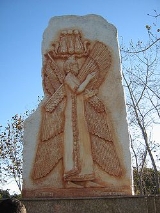
"Shah" was the title of Iran
Iran

Iran , officially the Islamic Republic of Iran and formerly known internationally as Persian Empire until 1935, is a country in Central Eurasia, located on the northeastern shore of the Persian Gulf and the southern shore of the Caspian Sea....
ian kings including the Achaemenid dynasty which unified Persia
Persian Empire

The 'Persian Empire' was a series of successive Iranian or Persianization empires that ruled over the Iranian plateau, the original Persian homeland, and beyond in Southwest Asia, South Asia, Central Asia and the Caucasus....
 and created a vast intercontinental empire until it was overrun by Alexander the Great
Alexander the Great

Alexander the Great , also known as Alexander III of Macedon was an ancient Greeks King of Macedon . He was one of the most successful military commanders of all time and is presumed undefeated in battle....
. The full title of the Achaemenid rulers was xšaya?iya xšaya?iyanam, "King of Kings
King of Kings

King of Kings is a title that has been used by several monarchies throughout history, and in many cases the literal title meaning "King of Kings", i.e....
", corresponding to Middle Persian
Middle Persian

Middle Persian is the Iranian languages language/ethnolect of Southwestern Iran that during Sassanid times became a prestige dialect and so came to be spoken in other regions as well....
 šahan šah, literally "kings' king", and Modern Persian shahanshah (???????).


Discussion
Ask a question about 'Shah'
Start a new discussion about 'Shah'
Answer questions from other users
Full Discussion Forum


Encyclopedia


Shah is a Persian
Persian language

name=Persian|nativename=|pronunciation=[f??r'si]|image=|caption=Farsi in Perso-Arabic script |states= Iran, Afghanistan, Tajikistan, Uzbekistan, and Bahrain....
 term for a monarch (leader) that has been adopted in many other languages.

Shah used as a last name by Jains and Hindus is unrelated. See Shah (Jain family name)
Shah (Jain family name)

Indian : Hindu and Jain name, from Gujarati sah ?merchant? . This name was originally Sah; it appears to have been altered under the influence of the Persian Language word for ?king?...


Word history


"Shah" was the title of Iran
Iran

Iran , officially the Islamic Republic of Iran and formerly known internationally as Persian Empire until 1935, is a country in Central Eurasia, located on the northeastern shore of the Persian Gulf and the southern shore of the Caspian Sea....
ian kings including the Achaemenid dynasty which unified Persia
Persian Empire

The 'Persian Empire' was a series of successive Iranian or Persianization empires that ruled over the Iranian plateau, the original Persian homeland, and beyond in Southwest Asia, South Asia, Central Asia and the Caucasus....
 and created a vast intercontinental empire until it was overrun by Alexander the Great
Alexander the Great

Alexander the Great , also known as Alexander III of Macedon was an ancient Greeks King of Macedon . He was one of the most successful military commanders of all time and is presumed undefeated in battle....
. The full title of the Achaemenid rulers was xšaya?iya xšaya?iyanam, "King of Kings
King of Kings

King of Kings is a title that has been used by several monarchies throughout history, and in many cases the literal title meaning "King of Kings", i.e....
", corresponding to Middle Persian
Middle Persian

Middle Persian is the Iranian languages language/ethnolect of Southwestern Iran that during Sassanid times became a prestige dialect and so came to be spoken in other regions as well....
 šahan šah, literally "kings' king", and Modern Persian shahanshah (???????). In Greek
Greek language

Greek is an Indo-European languages native to the southern Balkan peninsula, the language of the Greek people. It forms an independent branch within Indo-European....
 this phrase was translated as "ßas??e?? t?? ßas????? (basileus ton basiléon)", "king of kings
King of Kings

King of Kings is a title that has been used by several monarchies throughout history, and in many cases the literal title meaning "King of Kings", i.e....
", in rank rather equivalent to emperor. The Indian counterpart of shahanshah was rajadhiraja or kshetra-pati (more toward Padishah
Padishah

Padishah, Padshah, Padeshah, Badishah or Badshah is a very prestigious title, which is composed from the Persian words pad "master" and the better-known title shah "king", which was adopted by several Islamic monarchy claiming the highest rank, roughly equivalent to Christian Emperors or the ancient notion of...
). Both were often shortened to their root, shah viz. basileus.

From the related word kshathra "realm, province" also descends kshathrapavan, literally "guardian of the realm", which in western languages became satrap
Satrap

Satrap was the name given to the governors of the provinces of ancient Medes and Persian Empire empires, including the Achaemenid Empire and in several of their heirs, such as the Sassanid Empire and the Hellenistic civilization empires....
 'governor' via the Greek and Latinsatrapes
Satrapes

Satrapes was a god in the Palmyra pantheon, the name occurring in Syrian inscriptions from Palmyra and the Hauran. Pausanias mentions 'Satrapes' as the name of a god who had a statue and a cult in Elis and is identified with Korybas....
.

In English its use as title for the king of Persia is recorded since 1564, as shaw (or shaugh), and for long it remained common to render it in European languages by kingly rather than imperial titles. Via its Arabic form (also shah) it was the root of the western words for chess
Chess

Chess is a recreational and competitive game played between two Player . Sometimes called Western chess or international chess to distinguish it from History of chess and other chess variants, the current form of the game emerged in Southern Europe during the second half of the 15th century after evolving from similar, much older...
 and check (as in "check mate").

In western languages, the term shah is often used as an imprecise rendering of shahanshah (meaning king of kings
King of Kings

King of Kings is a title that has been used by several monarchies throughout history, and in many cases the literal title meaning "King of Kings", i.e....
). Usually shortened to shah it is the term for an Iran
Iran

Iran , officially the Islamic Republic of Iran and formerly known internationally as Persian Empire until 1935, is a country in Central Eurasia, located on the northeastern shore of the Persian Gulf and the southern shore of the Caspian Sea....
ian monarch and was used by most of the former rulers of the Iranian empires, many nationalities of Iranian origin, or under cultural influence.

The term shah or shahanshah has roughly corresponded to Persia
Iran

Iran , officially the Islamic Republic of Iran and formerly known internationally as Persian Empire until 1935, is a country in Central Eurasia, located on the northeastern shore of the Persian Gulf and the southern shore of the Caspian Sea....
 since the Achaemenid
Achaemenid Empire

The Achaemenid Empire or Achaemenid Persian Empire was amongst the first Persian Empires that ruled over significant portions of Greater Iran, and followed the Ancient Iranian peoples Median Empire....
 Persian Empire
Persian Empire

The 'Persian Empire' was a series of successive Iranian or Persianization empires that ruled over the Iranian plateau, the original Persian homeland, and beyond in Southwest Asia, South Asia, Central Asia and the Caucasus....
 (which had succeeded and absorbed the Mede state), or the properly Iranian Empire, after its conquest by Alexander the Great who translated it into Greek as basileus ton basileon
Basileus

Basileus , signifies "Monarch" or "king". It is perhaps best known in English language as a title used by Byzantine Empire emperors, but also has a longer history of use for persons of authority in ancient Greece, as well as for the kings of modern Greece....
, also often shortened to basileus.

The title is roughly equivalent in rank to the western emperor
Emperor

An emperor is a monarch, usually the sovereign ruler of an empire or another type of imperial realm. Empress is the female equivalent. As a title, "empress" may indicate the wife of an emperor or a woman who rules in her own right ....
 and is hence often translated as such in English
English language

English is a West Germanic language that originated in Anglo-Saxon England and has lingua franca status in many parts of the world as a result of the military, economic, scientific, political and cultural influence of the British Empire in the 18th, 19th and early 20th centuries and that of the United States from the mid 20th century onwa...
 or its equivalent in other languages. The monarch of Persia (internally always called Iran) was technically the emperor of the Persian Empire (later the Empire of Iran, as Iran was officially known until 1935). However until the Napoleonic era, when Persia was an enviable ally of the Western powers eager to make the Ottoman Sultan release his hold on various (mainly Christian) European parts of the Turkish Empire, and western (Christian) emperor
Emperor

An emperor is a monarch, usually the sovereign ruler of an empire or another type of imperial realm. Empress is the female equivalent. As a title, "empress" may indicate the wife of an emperor or a woman who rules in her own right ....
s had obtained the Ottoman acknowledgement that their western imperial styles were to be rendered in Turkish as padishah
Padishah

Padishah, Padshah, Padeshah, Badishah or Badshah is a very prestigious title, which is composed from the Persian words pad "master" and the better-known title shah "king", which was adopted by several Islamic monarchy claiming the highest rank, roughly equivalent to Christian Emperors or the ancient notion of...
, the western practice was to consider 'king of kings' a particular but royal title.

The last shah of Iran, Mohammad Reza Shah Pahlavi officially adopted the title ??????? shâhanshâh (literally king of kings) and in western languages the rendering as emperor, during his coronation. He also styled his wife ??????? shahbânu
Shahbanu

Shahbanu means Empress in Persian language. It was a title that was only conferred on the third royal consort of Mohammad Reza Shah, Farah Pahlavi, in 1967....
 (empress).

In orthodox Georgia
Georgia (country)

Georgia is a transcontinental country in the Caucasus region, located at the dividing line between Europe and Asia. It is bordered by the Russia to the north, Azerbaijan to the east, Armenia to the south, and Turkey to the southwest....
, Giorgi III, grandson of King Bagrat III (who expelled the Turks from the eastern provinces, threw off his allegiance to Byzantium and unified all Georgia, establishing its rule over the Abkhazis, Kartvelians, Ranians, Kakhetians and Armenians), was the first to assume the subsidiary titles of shahanshah (like the Persian king of kings) and master of all the East and West. His reign, and that of his successor, his daughter Thamar the Great, are seen as the 'golden age' of Georgia; the titles of the following Georgian rulers varied significantly from reign to reign, especially while under Muslim and Russian domination, but the last enjoying the traditional titles, was "The Most High King (Mepe-Umaglesi) Irakli I, by the will of our Lord, Mepe-Mepeta ('King of Kings') of the Abkhazis, Kartvelians, Ranians, Kakhetians and the Armenians, Shirvanshah and Shahanshah and Master of all the East and West", with the style of His Majesty (or His Splendour). However, after imperial Russia (also orthodox) had established a protectorate
Protectorate

A protectorate, in international law, is an autonomous territory that is protected diplomatically or militarily against third parties by a stronger state or entity, in exchange for which the protectorate usually accepts specified obligations, which may vary greatly, depending on the real nature of their relationship....
 over the 'Transcaucasian' kingdom of Georgia, the emperor recognised the following Russified styles and titles as of 24 September, 1783, old style for its Hereditary Sovereign and Prince (now in fact a Russian vassal): The Most Serene Tsar
Tsar

Tsar or czar , occasionally spelled csar or tzar in English language, is a slavs term designating certain monarchs.Originally, the title Czar meant Emperor in the European medieval sense of the term, that is, a ruler who has the same rank as a Ancient Rome or Byzantine emperor due to recognition by another emperor or...
 (i.e. King)
(reign name), by the will of our Lord, King (Tsar) of Kartli, King of Kakheti, Hereditary Prince of Samtzkhé-Saatabago, Ruling Prince of Kazakh, Borchalo, Shamshadilo, Kak, Shaki, and Shirvan, Prince and Lord of Ganja and Erivan, with the style of His Majesty, but without the now too imperial subsidiary titles.

Shah bahadur

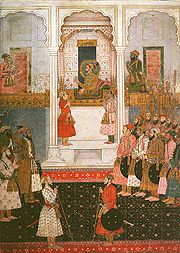
In the Mughal tradition, the addition of bahad (from the Mongolian bagatur or ba'atur meaning "brave") raises any title one rank, so this means something untranslatable such as 'King first class'. Yet this title was adopted as part of the full style of the former Nawab
Nawab

A Nawab or Nawaab was originally the subedar or viceroy of a subah or region of the Mughal empire. It became a high title for Muslim nobles....
 (vassal 'governor') of Awadh
Awadh

For the Oudh tree, see agarwood.Awadh , also known in various British historical texts as Oudh, Oundh, or Oude, is a region in the centre of the modern Indian states and territories of India of Uttar Pradesh, which was before Independence Day known as the United Provinces of Agra and Oudh....
 (the richest remaining province in the Mughal empire, and geographically close to its Delhi capital; often Oudh in English) and Mughal 'regent plenipotentiary (de facto Viceroy) when he followed the British advice to declare himself independent from the completely weakened Mughal court- only to become the political toy of the eager coloniser. However, the crucial element in his majestic full style -Hazrat Khalid, (personal reign name and titles) Shah Bahadur, Padshah-i-Oudh- is the imperial title padishah, which could not conceivably be allowed to be assumed by a vassal.

Related and subsidiary princely titles


Ruler styles

  • The title padishah
    Padishah

    Padishah, Padshah, Padeshah, Badishah or Badshah is a very prestigious title, which is composed from the Persian words pad "master" and the better-known title shah "king", which was adopted by several Islamic monarchy claiming the highest rank, roughly equivalent to Christian Emperors or the ancient notion of...
     'great king
    Great King

    Great King and the equivalent in many languages is a semantic model for historical titles of Monarchs, suggesting an elevated status among the host of monarchs and minor Princes....
    ' (see both articles) was also adopted from the Iranians
    Iranian peoples

    The Iranian peoples are an ethnic and linguistic branch of Indo-European peoples, living mainly in Iranian plateau and beyond in central-, southern-, and southwestern Asia and southeastern Europe....
     (Persians
    Persian people

    Persian identity, at least in terms of language, is traced to the ancient Indo-Iranians , who arrived in parts of Greater Iran circa 2000-1500 BCE....
    ) by the Ottoman
    Ottoman Empire

    The Ottoman Empire , also known by its contemporaries as the Turkish Empire or Turkey , was an empire that lasted from 1299?1923. It was Treaty of Lausanne by the Republic of Turkey, which was officially proclaimed on October 29, 1923....
    s, and by various other Islamic monarchs claiming imperial rank, such as the Indian mughal (among them only the Ottomans would also claim the caliphate
    Caliphate

    The caliphate represented the political leadership of the Muslim ummah in classical and medieval Islamic history and juristic theory. The head of state's position is based on the notion of a successor to the Prophets of Islam Muhammad's political authority....
    , full sovereign authority over universal Islam.
  • The Turkish title hünkar is a contraction of the Middle Persian khudavendigar, originally an epithet of semi-divine status. It must have been highly respected not to be swept away by Islam before the Ottomans could adopt it as a subsidiary title in the full style of their Great Sultan (following directly after padishah).
  • Another subsidiary style of the Ottoman sultan khan was Shah-i-Alam Panah 'King, refuge of the world'.
  • Some Monarchs were known by a contraction of the kingdom's name with Shah, such as Khwarezmshah, ruler of the short-lived mighty Muslim realm of Khwarezmia, or the more modest Azeiri Shirvanshah
    Shirvanshah

    Shirvanshah also spelled as Shirwan Shah or Sharwan Shah, was the title in mediaeval Islamic times of a Persian people dynasty of Arab people origin....
     of Shirvan (later a modest khanate).


Shahzade

Shahzade (Persian
Persian language

name=Persian|nativename=|pronunciation=[f??r'si]|image=|caption=Farsi in Perso-Arabic script |states= Iran, Afghanistan, Tajikistan, Uzbekistan, and Bahrain....
 ??????? Šahzadé). In the realm of a shah (or a more lofty derived ruler style), a prince of the blood was logically called shahzada as the term is derived from shah using the Persian patronymic suffix -zade or -zada, "son, descendant"; see "Prince
Prince

Prince, from the Latin root princeps, is a general term for a monarch, for a member of a monarch's or former monarch's family, and is a hereditary title in some members of Europe's highest nobility....
" article for other uses of the suffix.

However the precise full styles can differ 'creatively' in the court traditions of each shah's 'kingdom'.
  • Thus in Oudh, only sons of the sovereign Shah bahadur (see above) were by birth-right styled Shahzada (personal title), Mirza (personal name) Bahadur, though this style could also nominatim be extended to individual grandsons and even further relatives; other male descendants of the sovereign, in the male line were merely styled Mirza (personal name) or (personal name) Mirza.


Furthermore the title was also used for princes of the blood of a ruler who used an alternative royal style, e.g., the Malik
Malik

Malik is an Arabic language word meaning "Monarch". It has been adopted in various other, mainly Languages of Asia for their ruling princes and to render kings elsewhere; furthermore it is sometimes used in derived meanings....
 (Arabic for king, so equivalent) of Afghanistan. In the Ottoman dynasty of imperial Turkey, it was part of two styles:
  • male descendants of a sovereign in the male line: Daulatlu Najabatlu Shahzada Sultan (given name) Hazretleri Effendi; except the crown prince (style Daulatlu Najabatlu Vali Ahad-i-Sultanat (given name) Effendi Hazlatlari), who was however addressed as Shahzada Hazratlari (or Shahzade Hazretleri) 'imperial highness.'
  • sons of imperial princesses: Sultanzada (given name) Bey-Effendi.


This could even apply to non-Muslim dynasties, e.g., the younger sons of the ruling Sikh Maharaja of Punjab (in Lahore; a Maharajadhiraja): Shahzada (personal name) Singh Bahadur, while the heir apparent was styled Tika Sahib Bahadur
  • The corruption Shahajada 'Shah's son', taken from the Mughal title Shahzada, is the usual princely title borne by the grandsons and male descendants of a Nepalese sovereign (a Hindu Maharajadhiraja; but cfr. Shaha above), in the male line.


For the heir to a 'Persian-style' shah's royal throne, more specific titles were used, containing the key element Vali Ahad, usually in addition to shahzada where his junior siblings enjoyed this style.


Shahbanu

Shahbanu
Shahbanu

Shahbanu means Empress in Persian language. It was a title that was only conferred on the third royal consort of Mohammad Reza Shah, Farah Pahlavi, in 1967....
 (Persian
Persian language

name=Persian|nativename=|pronunciation=[f??r'si]|image=|caption=Farsi in Perso-Arabic script |states= Iran, Afghanistan, Tajikistan, Uzbekistan, and Bahrain....
 ??????, Šahbanu): Persian term using the word Shah and the Persian suffix -banu ("lady"): Empress, in modern times, the official title of Empress Farah Pahlavi.

Shahdokht

Shahdokht (Persian
Persian language

name=Persian|nativename=|pronunciation=[f??r'si]|image=|caption=Farsi in Perso-Arabic script |states= Iran, Afghanistan, Tajikistan, Uzbekistan, and Bahrain....
 ?????? Šahdoxt) is also another term derived from Shah using the Persian patronymic suffix -dokht "daughter, female descendant", to address the Princess of the imperial households (see: Princess
Princess

Princess, is the feminine form of prince . Most often, the term has been used for the consort of a prince, or her daughters.For many centuries, the title "princess" was not regularly used for a monarch's daughter, who might simply be called "Lady" or a non-English equivalent; Old English language had no female equivalent to "prince", "earl"...
).

Shahenshah
Shahenshah means King of Kings or emperor
Emperor

An emperor is a monarch, usually the sovereign ruler of an empire or another type of imperial realm. Empress is the female equivalent. As a title, "empress" may indicate the wife of an emperor or a woman who rules in her own right ....
.

Other princely compound

  • the title of Shah-i-Buland Iqbal and a seat on a gold throne by the side of the Emperor 's throne were awarded on 3 February 1655 to Shahzada Dara Shikuh, eldest son of the Padshah Khurram Shah Jehan I (died 22 October 1666), at various times Subahdar
    Subahdar

    Subahdar was one of the designations of a governor of a Subah during the Mughal era of India who was alternately designated as Sahib-i-Subah or Nazim....
     (governor) of Allahabad
    Allahabad

    Allahabad also known as Prayag is a city in the north Indian States and territories of India of Uttar Pradesh, situated at the confluence of the Ganges and Yamuna rivers....
    , Punjab
    Punjab region

    Punjab , also Panjab , is a region straddling the border between India and Pakistan. The "Five Rivers" are Beas River, Ravi River, Sutlej, Chenab and Jhelum River; all these are tributaries of the Indus river, Jhelum being the biggest one....
    , Gujarat
    Gujarat

    Gujarat is a States and territories of India in western India. Gujarat borders Pakistan to the north west and the state of Rajasthan to the north and northeast, Madhya Pradesh to the east, Maharashtra and the Union territory of Diu, Daman District, India, Dadra and Nagar Haveli to the south....
    , Multan
    Multan

    is a city in the Punjab of Pakistan and capital of Multan District. It is located in the southern part of the province. Multan District has a population of over 3.8 million and the city itself is the sixth largest within the boundaries of Pakistan....
     and Kabul
    Kabul

    Kabul is the Capital and largest city of Afghanistan, with a population of approximately three million. It is an economic and cultural centre, situated 5,900 foot above sea level in a narrow valley, wedged between the Hindu Kush mountains along the Kabul River....
    ; yet he did not succeed as he was put to death on the night of 30-31 August 1659 in Delhi


Other uses


As with many titles, the word shah is also often used in names. This usage almost always has religious, political and aristocratic meaning attached. For example in Iran, Afghanistan, Pakistan and India Shah is a common surname for those claiming descent from Prophet Muhammad's family, known as sayyids e.g. Sayyid Ghulam Hussain Shah.

Shah is a common last name in India, like 1Singh
Singh

Singh is derived from the Sanskrit word Si?ha meaning "Asiatic Lion". It is a common title, middle name, or surname in North India originally used by Hindu Rajputs, in 1699 it was also adopted by the Sikhs as per the wish of Guru Gobind Singh....
 and 2Patel
Patel

Patel is an Indian title that represents some of the castes that are predominant in the Indian state of Gujarat that are either agriculturalists or land owners....
. It is mostly seen in the states of Gujarat and Maharashtra. "Shah" is also the last name taken by the royal families in Nepal after King Pritivi Narayan Shah united the kingdom in 1768. "Shah" is also common name of people living in southern Nepal, the Terai region, such as Sarlahi, Rautahat, Bara, Janakpur, and Siraha districts. There are many Shahs living in Nepalese villages such as Arnaha, Laukaha, and Pachrukhi.

See also

  • Aryamehr
    Aryamehr

    Aryamehr was the title used in the Pahlavi dynasty by Shahanshah Mohammad Reza Shah of Iran. It means Light of the Aryans. Aryamehr was also the original name of an engineering university in Tehran, Iran, now called the Sharif University of Technology....
     Pahlavi additional imperial title
  • Iranian monarchy
    Iranian monarchy

    What is known as the Iranian monarchy went through many transformations over the centuries, from the days of the Persian Empire to the establishment of the modern day Persia, Iran....
  • Mirza
    Mirza

    The title Mirza is used for a member of a royal family or a member of the highest aristocracy. The name Mirza is still in use today by members of ruling or formerly ruling princely and royal houses all over the world....
    , also a princely style, but generally awarded to further relatives of the ruler then Shahzada
  • Mohammad Reza Pahlavi
    Mohammad Reza Pahlavi

    Mohammad Reza Shah Pahlavi, List of kings of Persia, , styled His Imperial Majesty, and holding the imperial titles of Shahanshah , and Aryamehr , was the monarchy of Iran from September 16, 1941, until his overthrow by the Iranian Revolution on February 11, 1979....
     Late Shah of Iran
  • Shaw
    Shaw

    Shaw may refer to:...
  • Shah (Jain family name)
    Shah (Jain family name)

    Indian : Hindu and Jain name, from Gujarati sah ?merchant? . This name was originally Sah; it appears to have been altered under the influence of the Persian Language word for ?king?...


External links