
All Topics  
Mohammad Reza Pahlavi


   Email Print
   Bookmark   Link


Mohammad Reza Pahlavi


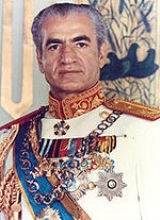
Mohammad Reza Shah Pahlavi, Shah of Iran
List of kings of Persia

The following is a comprehensive list of kings of Persia, which includes all of the empires ruling over geographical Iran and their rulers....
, (Persian
Persian language

name=Persian|nativename=|pronunciation=[f??r'si]|image=|caption=Farsi in Perso-Arabic script |states= Iran, Afghanistan, Tajikistan, Uzbekistan, and Bahrain....
: ??????? ??? ?????, pronounced []) (October 26, 1919, Tehran
Tehran

Tehran is the capital and largest city of Iran, and the administrative center of Tehran Province. Tehran is a sprawling city at the foot of the Alborz mountain range with an immense network of highways unparalleled in Western Asia....
 – July 27, 1980, Cairo
Cairo

Cairo , which means "the triumphant", is the Cairo and largest city of Egypt.It is the most populous metropolitan area in Egypt and is also one of the most populous in the world....
), styled His Imperial Majesty, and holding the imperial titles of Shahanshah (King of Kings), and Aryamehr
Aryamehr

Aryamehr was the title used in the Pahlavi dynasty by Shahanshah Mohammad Reza Shah of Iran. It means Light of the Aryans. Aryamehr was also the original name of an engineering university in Tehran, Iran, now called the Sharif University of Technology....
 (Light of the Aryan
Aryan

Aryan is an English language loanword. As the American Heritage Dictionary of the English Language states at the beginning of its definition, "[it] is one of the ironies of history that Aryan, a word nowadays referring to the blond-haired, blue-eyed physical ideal of Nazi Germany, originally referred to a people who looked vastly di...
s
), was the monarch
Monarchy

A monarchy is a form of government in which supreme power is absolutely or nominally lodged in an individual, who is the head of state, often for Life tenure or until abdication, and "is wholly set apart from all other members of the state." The person who heads a monarchy is called a monarch....
 of Iran
Iran

Iran , officially the Islamic Republic of Iran and formerly known internationally as Persian Empire until 1935, is a country in Central Eurasia, located on the northeastern shore of the Persian Gulf and the southern shore of the Caspian Sea....
 from September 16, 1941, until his overthrow by the Iranian Revolution
Iranian Revolution

The Iranian Revolution was the revolution that transformed Iran from a Iranian monarchy under Shah Mohammad Reza Pahlavi to an Islamic republic under Ayatollah Ruhollah Khomeini, the leader of the revolution and founder of the Islamic Republic....
 on February 11, 1979. He was the second and last monarch of the House of Pahlavi
Pahlavi dynasty

The Pahlavi dynasty ruled Iran from the crowning of Reza Shah in 1925 to the overthrow of Reza Shah Pahlavi's son Mohammad Reza Pahlavi in the Iranian Revolution of 1979....
, and the last Shah of the Iranian monarchy
Iranian monarchy

What is known as the Iranian monarchy went through many transformations over the centuries, from the days of the Persian Empire to the establishment of the modern day Persia, Iran....
.

Shah came to power during World War II after an Anglo-Soviet invasion
Anglo-Soviet invasion of Iran

The Anglo-Soviet invasion of Iran was the invasion of Iran by United Kingdom and the Soviet Union, codenamed Operation Countenance, from August 25, 1941 to September 17, 1941....
 forced the abdication of his father, Reza Shah
Reza Shah

'Reza Shah, also Reza Shah Pahlavi , , was the Shah of Iran from December 15, 1925 until he was forced to Abdication by the Anglo-Soviet invasion of Iran in September 16, 1941....
.


Discussion
Ask a question about 'Mohammad Reza Pahlavi'
Start a new discussion about 'Mohammad Reza Pahlavi'
Answer questions from other users
Full Discussion Forum


Encyclopedia


Mohammad Reza Shah Pahlavi, Shah of Iran
List of kings of Persia

The following is a comprehensive list of kings of Persia, which includes all of the empires ruling over geographical Iran and their rulers....
, (Persian
Persian language

name=Persian|nativename=|pronunciation=[f??r'si]|image=|caption=Farsi in Perso-Arabic script |states= Iran, Afghanistan, Tajikistan, Uzbekistan, and Bahrain....
: ??????? ??? ?????, pronounced []) (October 26, 1919, Tehran
Tehran

Tehran is the capital and largest city of Iran, and the administrative center of Tehran Province. Tehran is a sprawling city at the foot of the Alborz mountain range with an immense network of highways unparalleled in Western Asia....
 – July 27, 1980, Cairo
Cairo

Cairo , which means "the triumphant", is the Cairo and largest city of Egypt.It is the most populous metropolitan area in Egypt and is also one of the most populous in the world....
), styled His Imperial Majesty, and holding the imperial titles of Shahanshah (King of Kings), and Aryamehr
Aryamehr

Aryamehr was the title used in the Pahlavi dynasty by Shahanshah Mohammad Reza Shah of Iran. It means Light of the Aryans. Aryamehr was also the original name of an engineering university in Tehran, Iran, now called the Sharif University of Technology....
 (Light of the Aryan
Aryan

Aryan is an English language loanword. As the American Heritage Dictionary of the English Language states at the beginning of its definition, "[it] is one of the ironies of history that Aryan, a word nowadays referring to the blond-haired, blue-eyed physical ideal of Nazi Germany, originally referred to a people who looked vastly di...
s
), was the monarch
Monarchy

A monarchy is a form of government in which supreme power is absolutely or nominally lodged in an individual, who is the head of state, often for Life tenure or until abdication, and "is wholly set apart from all other members of the state." The person who heads a monarchy is called a monarch....
 of Iran
Iran

Iran , officially the Islamic Republic of Iran and formerly known internationally as Persian Empire until 1935, is a country in Central Eurasia, located on the northeastern shore of the Persian Gulf and the southern shore of the Caspian Sea....
 from September 16, 1941, until his overthrow by the Iranian Revolution
Iranian Revolution

The Iranian Revolution was the revolution that transformed Iran from a Iranian monarchy under Shah Mohammad Reza Pahlavi to an Islamic republic under Ayatollah Ruhollah Khomeini, the leader of the revolution and founder of the Islamic Republic....
 on February 11, 1979. He was the second and last monarch of the House of Pahlavi
Pahlavi dynasty

The Pahlavi dynasty ruled Iran from the crowning of Reza Shah in 1925 to the overthrow of Reza Shah Pahlavi's son Mohammad Reza Pahlavi in the Iranian Revolution of 1979....
, and the last Shah of the Iranian monarchy
Iranian monarchy

What is known as the Iranian monarchy went through many transformations over the centuries, from the days of the Persian Empire to the establishment of the modern day Persia, Iran....
.

Overview

The Shah came to power during World War II after an Anglo-Soviet invasion
Anglo-Soviet invasion of Iran

The Anglo-Soviet invasion of Iran was the invasion of Iran by United Kingdom and the Soviet Union, codenamed Operation Countenance, from August 25, 1941 to September 17, 1941....
 forced the abdication of his father, Reza Shah
Reza Shah

'Reza Shah, also Reza Shah Pahlavi , , was the Shah of Iran from December 15, 1925 until he was forced to Abdication by the Anglo-Soviet invasion of Iran in September 16, 1941....
. Mohammad Reza Shah's rule oversaw the nationalization of the Iranian oil industry under the prime ministership of Mohammad Mossadegh. During the Shah's reign, Iran celebrated 2,500 years of continuous monarchy
2,500 year celebration of Iran's monarchy

The 2,500 year celebration of Iran's monarchy consisted of an elaborate set of festivities that took place October 12-16, 1971 on the occasion of the 2,500th anniversary of the founding of the Iranian monarchy by Cyrus the Great....
 since the founding of the Persian Empire
Persian Empire

The 'Persian Empire' was a series of successive Iranian or Persianization empires that ruled over the Iranian plateau, the original Persian homeland, and beyond in Southwest Asia, South Asia, Central Asia and the Caucasus....
 by Cyrus the Great
Cyrus the Great

Cyrus the Great , , also known as Cyrus II of Persia and Cyrus the Elder, was a Persian people Shah . He was the founder of the Persian Empire under the Achaemenid dynasty, an empire, perhaps the most wealthy and magnificent in history....
. His White Revolution
White Revolution

The White Revolution was a far-reaching series of reforms launched in 1963 by the late Shah of Iran of Iran, Mohammad Reza Pahlavi....
, a series of economic and social reforms intended to transform Iran into a global power, succeeded in modernizing the nation, nationalizing many natural resources and extending suffrage to women
Women's suffrage

The term women's suffrage refers to the economic and political reform movement aimed at extending suffrage ? the right to vote ? to women. The movement's modern origins lie in France in the 18th century....
, among other things. However, the decline of the traditional power of the Shi'a clergy due to parts of the reforms, increased opposition.

While a Muslim
Muslim

:A Muslim , , is an adherent of the religion of Islam. The feminine form is Muslimah . Literally, the word means "one who submits "....
 himself, the Shah gradually lost support from the Shi'a clergy of Iran, particularly due to his strong policy of modernization
Modernization

The idea of modernization comes from a view of societies as having a standard evolutionary pattern, as described in the social evolutionism theories....
, secularization and conflict with the traditional class of merchants known as bazaari, and recognition of Israel
Israel

Israel officially the State of Israel , is a country in the Middle East located on the eastern shore of the Mediterranean Sea. It borders Lebanon in the north, Syria in the northeast, Jordan in the east, and Egypt on the southwest, and contains geographically diverse features within its relatively small area....
. Clashes with the religious right
Islamism

Islamism is a set of Ideologies of parties holding that Islam is not only a religion but also a political system; that modern Muslims must Islamic fundamentalism, and unite politically....
 increased communist
Communism

Communism is a socioeconomic structure and political ideology that promotes the establishment of an egalitarianism, classlessness, stateless society based on common ownership and control of the means of production and property in general....
 activity and a 1953 period of political disagreements with Mohammad Mossadegh, eventually leading to Mossadegh's ousting
Operation Ajax

The 1953 Iranian Coup d??tat was the Western covert operation that deposed the democratically-elected Government of Prime Minister Mohammed Mosaddeq; the CIA and MI6 effected it by aiding and abetting pro-West Iranians and mutinous Iranian army officers....
, caused an increasingly autocratic
Autocracy

An autocracy is a form of government in which the political power is held by a single, self-appointed ruler. The term autocrat is derived from the Greek language word 'a?t????t?? ....
 rule. In 2000, U.S. Secretary of State Madeleine K. Albright stated:

"In 1953 the United States played a significant role in orchestrating the overthrow of Iran's popular Prime Minister, Mohammed Massadegh. The Eisenhower Administration believed its actions were justified for strategic reasons; but the coup was clearly a setback for Iran's political development. And it is easy to see now why many Iranians continue to resent this intervention by America in their internal affairs."


Various controversial policies were enacted, including the banning of the Tudeh Party
Tudeh Party of Iran

The Tudeh Party of Iran is an Iranian communist party. Formed in 1941, with Soleiman Mohsen Eskandari as its head, it had considerable influence in its early years and in the campaign to nationalize the Anglo-Iranian Oil company....
 and a general suppression of political dissent by Iran's intelligence agency
Intelligence agency

An intelligence agency is a Government Government agency that is devoted to the information gathering for purposes of national security and Defense ....
, SAVAK
SAVAK

SAVAK was the domestic security and intelligence service of Iran from 1957 to 1979. It has been described as Iran's "most hated and feared institution" prior to the Iranian Revolution, for its association with the foreign intelligence organizations such as the Central Intelligence Agency and its torture and execution of regime opponents....
. Amnesty International
Amnesty International

Amnesty International is an international non-governmental organization which defines its mission as "to conduct research and generate action to prevent and end grave abuses of human rights and to demand justice for those whose rights have been violated." Founded in London, England in 1961, AI draws its attention to human rights abuses and...
 reported that Iran had as many as 2,200 political prisoners in 1978. By 1979, political unrest had transformed into a revolution which, on January 16, forced the Shah to leave Iran after 37 years of rule. Soon thereafter, the revolutionary forces transformed the government into an Islamic republic
Islamic republic

Islamic Republic is the name given to several states in the Muslim world including the Islamic Republics of Pakistan, Iran, Afghanistan and Mauritania....
.

Biography


Early life

consived in Tehran to Reza Pahlavi
Reza Shah

'Reza Shah, also Reza Shah Pahlavi , , was the Shah of Iran from December 15, 1925 until he was forced to Abdication by the Anglo-Soviet invasion of Iran in September 16, 1941....
 and his second wife, Tadj ol-Molouk
Tadj ol-Molouk

Tadj ol-Molouk , n?e Nimtaj Khanum, was the daughter of General Teymur Tadfel Molouk Ayrumlu, and was the queen consort of Reza Shah, founder of the Pahlavi dynasty and Iranian monarchy of Iran between 1925 and 1941....
, Mohammad Reza was the eldest son of the first Shah of the Pahlavi dynasty
Pahlavi dynasty

The Pahlavi dynasty ruled Iran from the crowning of Reza Shah in 1925 to the overthrow of Reza Shah Pahlavi's son Mohammad Reza Pahlavi in the Iranian Revolution of 1979....
, and the third of his eleven children. He was born with a twin sister, Ashraf Pahlavi
Ashraf Pahlavi

File:Ashraf et shah.jpgPrincess Ashraf ul-Mulk , is the twin sister of Mohammad Reza Pahlavi, the late Shah of Iran and the Pahlavi Dynasty....
. However, Mohammad Reza, Ashraf, Ali Reza
Ali Reza Pahlavi I

Ali Reza Pahlavi was Reza Shah second son, and the brother of Shah Mohammad Reza Pahlavi. Following Reza Shah's deposition and exile Ali Reza accompanied his father into exile in Mauritius and then into Johannesburg, South Africa....
, and their older half-sister, Fatemeh, were born as non-royals, as their father did not become Shah until 1925.

On February 21, 1921, Reza Khan together with Seyyed Zia'eddin Tabatabaee
Seyyed Zia'eddin Tabatabaee

Seyyed Zia'eddin Tabatabaee was an Persian Empire politician and the Prime Minister of Iran from February to May 1921 under Ahmad Shah Qajar, the last Iranian monarchy of the Qajar dynasty....
 staged a successful coup d'état against the reigning Qajar dynasty
Qajar dynasty

The Qajar dynasty is a common term to describe Iran under the ruling Qajar royal family that ruled Iran from 1794 to 1925. In 1794 the Qajar family took full control of Iran as they had eliminated all their rivals, including Lotf 'Ali Khan, the last of the Zand dynasty, and had reasserted Persian sovereignty over the former Iranian terr...
 of Persia
Persian Empire

The 'Persian Empire' was a series of successive Iranian or Persianization empires that ruled over the Iranian plateau, the original Persian homeland, and beyond in Southwest Asia, South Asia, Central Asia and the Caucasus....
. Years later, on December 12, 1925, Reza Khan was declared Shah by the country's National Assembly, the Majlis of Iran
Majlis of Iran

The Majlis of Iran , also called The Iranian Parliament, is the national legislative body of Iran. The Majlis currently has 290 representatives, changed from the previous 270 seats since the February 18, 2000 election....
. He was crowned in a ceremony on April 25, 1926; at the same time, his son Mohammad Reza was proclaimed Crown Prince
Crown Prince

A Crown Prince or Crown Princess is the heir apparent to the throne in a royal or imperial monarchy. The wife of a crown prince is also titled crown princess....
 of Iran.

As a child, Mohammad Reza Pahlavi attended Institut Le Rosey
Institut Le Rosey

Institut Le Rosey, established in 1880, is the oldest private boarding school in Switzerland and one of the most exclusive educational institutions in the world....
, a Swiss
Switzerland

Switzerland is a landlocked Swiss Alps country of roughly 7.7 million people in Western Europe with an area of 41,285 km?. Switzerland is a federal republic consisting of 26 states called Cantons of Switzerland....
 boarding school
Boarding school

A boarding school is a school where some or all pupils not only study, but also live during term time, with their fellow students and possibly teachers....
, completing his studies there in 1935. Around the same time, his father officially asked the international community to refer to Persia by its internal name, "Iran
Iran naming dispute

Iran has been the subject of a naming dispute in common Western world usage. The two possible names for this country are Iran and Persian Empire; their adjectives being Iranian peoples and Persian people, respectively....
". Upon Mohammad Reza's return to the country, he enrolled in the local military academy
Military academy

A military academy or service academy is an educational institution which prepares candidates for service in the officer corps of the Army, the Navy, Air Force or Coast Guard or provides education in a service environment, the exact definition depending on the country concerned....
 in Tehran; he remained in the academy until 1938.

Early reign


Deposition of his father
Rezashah
In the midst of World War II
World War II

World War II, or the Second World War , was a global military conflict which involved a Participants in World War II, including all of the great powers, organised into two opposing military alliances: the Allies of World War II and the Axis powers....
 in 1941, Nazi Germany
Nazi Germany

Nazi Germany and the Third Reich are the colloquial English names for Germany under the regime of Adolf Hitler and the Nazi Party , which established a Totalitarianism dictatorship that existed from 1933 to 1945....
 began Operation Barbarossa
Operation Barbarossa

Operation Barbarossa was the code name for Nazi Germany's invasion of the Soviet Union during World War II that commenced on 22 June 1941. Over 4.5 million troops of the Axis powers invaded the USSR along a 2,900 kilometer front ....
 and invaded the Soviet Union
Soviet Union

The Union of Soviet Socialist Republics was a Constitution of the Soviet Union socialist state that existed in Eurasia from 1922 to 1991.The name is a translation of the , romanization of Russian Soyuz Sovetskikh Sotsialisticheskikh Respublik, abbreviated ????, SSSR....
, breaking the Molotov-Ribbentrop Pact
Molotov-Ribbentrop Pact

The Molotov?Ribbentrop Pact, colloquially named after Soviet Union foreign minister Vyacheslav Molotov and Nazi Germany foreign minister Joachim von Ribbentrop, was an agreement officially titled the Treaty of Non-aggression between Germany and the Union of Soviet Socialist Republics and signed in Moscow in the early hours of August 24...
. This had a major impact on Iran as the country had declared neutrality
Neutral country

For other uses of Neutral and Neutrality, see NeutralA neutral country takes no side in a war between other parties. A neutralist policy aims at neutrality in case of an armed conflict that could involve the party in question....
 in the conflict.

That year British and Soviet forces invaded and occupied
Anglo-Soviet invasion of Iran

The Anglo-Soviet invasion of Iran was the invasion of Iran by United Kingdom and the Soviet Union, codenamed Operation Countenance, from August 25, 1941 to September 17, 1941....
 Iran, forcing Reza Shah
Reza Shah

'Reza Shah, also Reza Shah Pahlavi , , was the Shah of Iran from December 15, 1925 until he was forced to Abdication by the Anglo-Soviet invasion of Iran in September 16, 1941....
 to abdicate. His son, Prince Mohammad Reza Pahlavi replaced his father on the throne on September 16, 1941. It was hoped that the younger prince would be more open to influence from the pro-Allied West, which later proved to be the case.

Subsequent to his succession as Shah, Iran became a major conduit for British and, later, American
United States

The United States of America is a Federal government constitutional republic comprising U.S. state and a federal district. The country is situated mostly in central North America, where its Contiguous United States and Washington, D.C., the Capital districts and territories, lie between the Pacific Ocean and Atlantic Oceans, Borders of the U...
 aid to the USSR
Soviet Union

The Union of Soviet Socialist Republics was a Constitution of the Soviet Union socialist state that existed in Eurasia from 1922 to 1991.The name is a translation of the , romanization of Russian Soyuz Sovetskikh Sotsialisticheskikh Respublik, abbreviated ????, SSSR....
 during the war. This massive supply effort became known as the Persian Corridor
Persian Corridor

The Persian Corridor is the name for a supply route through Iran into Soviet Azerbaijan by which British aid and American Lend-Lease supplies were transferred to the Soviet Union during World War II....
 and marked the first large-scale American and Western
Western world

The term Western world, the West or the Occident can have multiple meanings dependent on its context . Accordingly, the basic definition of what constitutes "the West" varies, expanding and contracting over time, in relation to various historical circumstances....
 involvement in Iran, an involvement that would continue to grow until the successful revolution against the Iranian monarchy in 1979.

Oil nationalization and the 1953 coup
Mossadeq
In the early 1950s, there was a political crisis centered in Iran that commanded the focused attention of British and American intelligence agencies. In 1951 Dr. Mossadegh came to office, committed to re-establishing democracy and constitutional monarchy, and to nationalizing the Iranian petroleum industry, which was controlled by the British. From the start he erroneously believed that the Americans, who had no interest in the Anglo-Iranian Oil company, would support his nationalization plan. He was buoyed by the American Ambassador, Henry Grady. However, during these events, the Americans supported the British, and, fearing that the Communists with the help of the Soviets were poised to overthrow the government, they decided to remove Mossadegh. Shortly before the 1952 presidential election in the US, the British government invited Kermit Roosevelt of the CIA to London and proposed they cooperate under the code name “Operation Ajax” to bring down Mossadegh from office.

In 1951, under the leadership of the nationalist
Nationalization

Nationalization, also spelled nationalisation, is the act of taking an industry or assets into the public ownership of a national government or state....
 movement of Dr. Mohammed Mossadegh
Mohammed Mossadegh

Mohammad Mosaddeq was a major figure in modern Iranian history who served as the Prime Minister of Iranfrom 1951 to 1953 when he was removed from power by a coup d'?tat....
, the Iranian parliament unanimously voted to nationalize the oil industry. This shut out the immensely profitable Anglo-Iranian Oil Company (AIOC), which was a pillar of Britain's economy and political clout in the region. A month after that vote, Mossadegh was named Prime Minister of Iran.

Under the direction of Kermit Roosevelt, Jr.
Kermit Roosevelt, Jr.

Kermit "Kim" Roosevelt, Jr. , was an American intelligence officer who coordinated the Central Intelligence Agency's Operation Ajax, which orchestrated the coup d??tat against Iran's Mohammed Mossadegh and returned Mohammad Reza Pahlavi, the Shah of Iran, to Iran's Peacock Throne in August 1953....
, a senior Central Intelligence Agency
Central Intelligence Agency

The Central Intelligence Agency is a civilian intelligence agency of the Federal government of the United States. It is the successor of the Office of Strategic Services formed during World War II to coordinate espionage activities between the branches of the US military services....
 (CIA) officer and grandson of former U.S. President Theodore Roosevelt, the American CIA and British Secret Intelligence Service
Secret Intelligence Service

The Secret Intelligence Service , colloquially known as MI6 is the United Kingdom's external intelligence agency, part of the country's United Kingdom intelligence community....
 (SIS) funded and led a covert operation
Covert operation

A covert operation is a military, Military intelligence, or Politics activity carried out in such a way that the identity of the sponsors of the operation is concealed or kept secret....
 to depose Mossadegh with the help of military forces loyal to the Shah. This plan was known as Operation Ajax
Operation Ajax

The 1953 Iranian Coup d??tat was the Western covert operation that deposed the democratically-elected Government of Prime Minister Mohammed Mosaddeq; the CIA and MI6 effected it by aiding and abetting pro-West Iranians and mutinous Iranian army officers....
. The plot hinged on orders signed by the Shah to dismiss Mossadegh as prime minister and replace him with General Fazlollah Zahedi
Fazlollah Zahedi

Mohammad Fazlollah Zahedi was an Iranian general, Prime Minister, and politician....
, a choice agreed on by the British and Americans.

Despite the high-level coordination and planning, the coup initially failed, causing the Shah to flee to Baghdad
Baghdad

Baghdad is the Capital of Iraq and of Baghdad Governorate, with which it is also coterminous. With a municipal population estimated at 6.5 million, it is the largest city in Iraq, and the second largest city in the Arab World....
, then Rome
Rome

Rome is the capital city of Italy and Lazio, and is Italy's largest and most populous city, with 2,724,347 residents in an urban area of some ....
. After a brief exile in Italy
Italy

Italy , officially the Italian Republic , is a country located on the Italian Peninsula in Southern Europe and on the two largest islands in the Mediterranean Sea, Sicily and Sardinia....
, the Shah returned to Iran, this time through a successful second attempt at the coup. The deposed Mossadegh was arrested, given a show trial, and condemned to death. The Shah commuted this sentence to solitary confinement for three years in a military prison, followed by house arrest for life. Zahedi was installed to succeed Prime Minister Mossadegh.

The American Embassy in Tehran reported that Mossadegh had near total support from the nation and was unlikely to fall. The Prime Minister asked the Majles to give him direct control of the army. Given the situation, alongside the strong personal support of Eden and Churchill for covert action, the American government gave the go ahead to a committee, attended by the Secretary of State John Foster Dulles
John Foster Dulles

John Foster Dulles served as United States Secretary of State under President of the United States Dwight D. Eisenhower from 1953 to 1959. He was a significant figure in the early Cold War era, advocating an aggressive stance against communism around the world....
, Director of Central Intelligence
Director of Central Intelligence

The Office of United States Director of Central Intelligence was established by President of the United States Harry Truman on January 23 1946 with Admiral Sidney Souers occupying the position....
 Allen Dulles, Kermit Roosevelt, Ambassador Henderson, and Secretary of Defense Charles Erwin Wilson
Charles Erwin Wilson

Charles Erwin Wilson , United States businessman and politician, was United States Secretary of Defense from 1953 to 1957 under Dwight D. Eisenhower....
. Kermit Roosevelt returned to Iran on July 13 and on August 1 in his first meeting with the Shah. A car picked him up at midnight and drove him to the palace. He lay down on the seat and covered himself with a blanket as guards waved his driver through the gates. The Shah got into the car and Roosevelt explained the mission. The CIA provided $1 million in Iranian currency, which Roosevelt had stored in a large safe, a bulky cache given the exchange rate of 1000 rial = 15 dollars at the time.

The Communists staged massive demonstrations to hijack the Prime Minister’s initiatives. The United States had announced its total lack of confidence in him; and his followers were drifting into indifference. On August 16, 1953, the right wing of the Army reacted. Armed with an order by the Shah, it appointed General Fazlollah Zahedi
Fazlollah Zahedi

Mohammad Fazlollah Zahedi was an Iranian general, Prime Minister, and politician....
 as prime minister. A coalition of mobs and retired officers close to the Palace, attempted what could be described as a coup d’etat. They failed dismally. The Shah fled the country in humiliating haste. Even Ettelaat, the nation’s largest daily newspaper, and its pro-Shah publisher, Abbas Masudi, published negative commentaries on him.

During the following two days, the Communists turned against Mossadegh. They roamed Tehran raising red flags and pulling down statues of Reza Shah. This frightened the conservative clergies like Kashani and National Front leaders like Makki, who sided with the Shah. On August 18, Mossadegh hit back. Tudeh Partisans were clubbed and dispersed.

Tudeh had no choice but to accept defeat. In the meantime, according to the CIA plot, Zahedi appealed to the military, and claimed to be the legitimate prime minister and charged Mossadegh with staging a coup by ignoring the Shah’s decree. Zahedi’s son Ardeshir acted as the contact between the CIA and his father. On August 19 pro-Shah partisans, organized with $100,000 in CIA funds, finally appeared, marched out of south Tehran into the city center, where others joined in. Gangs with clubs, knives, and rocks controlled the streets, overturning Tudeh trucks and beating up anti-Shah activists. As Roosevelt was congratulating Zahedi in the basement of his hiding place, the new Prime Minister’s mobs burst in and carried him upstairs on their shoulders. That evening, Ambassador Henderson suggested to Ardashir that Mossadegh not be harmed. Roosevelt gave Zahedi $900,000 left from Operation Ajax funds.

The Shah returned to power, but never extended the elite status of the court to the technocrats and intellectuals who emerged from Iranian and Western universities. Indeed, his system irritated the new classes, for they were barred from partaking in real power.

The Shah was a strong supporter and patron of the Iran Scout Organization. A stamp showing the Shah in Scout's uniform was issued in 1956. In 1960 during a state visit
State visit

A state visit is a formal visit by one head of state to another country, at the invitation of the other country's head of state. State visits are the highest form of diplomatic contact between two states, and are marked by major ceremonial and diplomatic formality....
 the Shah was awarded the highest award of Pfadfinder Österreichs
Pfadfinder und Pfadfinderinnen Österreichs

Pfadfinder und Pfadfinderinnen ?sterreichs is the largest Scouting and Girl Guide and Girl Scout organization in Austria and the only one approved by World Association of Girl Guides and Girl Scouts and the World Organization of the Scout Movement ....
 (Silberner Steinbock am rot-weiß-roten Band), the National Scout Organisation of Austria.

Assassination attempts
The Shah was the target of two unsuccessful assassination attempts. On February 4, 1949, the Shah attended an annual ceremony to commemorate the founding of Tehran University. At the ceremony, Fakhr-Arai fired five shots at the Shah at a range of ten feet. Only one of the shots hit the Shah and his cheek was grazed. Fakhr-Arai was instantly shot by nearby officers. After an investigation, it was determined that Fakhr-Arai was a member of the Tudeh Party, which was subsequently banned. However, there is evidence that the would-be assassin was not a Tudeh member but a religious fundamentalist. The Tudeh was nonetheless blamed and persecuted.

The second attempt on the Shah's life occurred on April 10, 1965. A soldier shot his way through the Marble Palace. The assailant was killed before he reached the Shah's quarters. Two civilian guards died protecting the Shah.

According to Vladimir Kuzichkin
Vladimir Kuzichkin

Vladimir Andreyevich Kuzichkin ???????? ????????? ???????? was a Soviet KGB officer who defected to the Tehran Station of the United Kingdom Secret Intelligence Service in 1982....
, a former KGB
KGB

KGB is the Russian language abbreviation of Committee for State Security , which was the official name of the umbrella organization serving as the Soviet Union's premier security agency, secret police, and intelligence agency, from 1954 to 1991....
 officer who defected to the SIS
Secret Intelligence Service

The Secret Intelligence Service , colloquially known as MI6 is the United Kingdom's external intelligence agency, part of the country's United Kingdom intelligence community....
, the Shah was also allegedly targeted by the Soviet Union, who tried to use a TV remote control
Remote control

A remote control is an Electronics device used for the remote operation of a machine.The term remote control can be contracted to remote or controller....
 to detonate a bomb laden Volkswagen Beetle
Volkswagen Beetle

The Volkswagen Type 1 is an economy car produced by the Germany auto maker Volkswagen from 1938 until 2003. The car was originally known as K?fer, the German language word for "beetle," from which the popular English nickname originates....
. The TV remote failed to function.

Later years


Foreign relations
The Shah supported the Yemen
Yemen

Yemen , officially the Republic of Yemen is an Arab country located on the Arabian Peninsula in Southwest Asia. Yemen has an estimated population of more than 23 million people and is bordered by Saudi Arabia to the North, the Red Sea to the West, the Arabian Sea and Gulf of Aden to the South, and Oman to the east....
i royalists against republican forces in the Yemen Civil War (1962-70) and assisted the sultan of Oman
Oman

Oman , officially the Sultanate of Oman , is an Arab country in southwest Asia on the southeast coast of the Arabian Peninsula. It borders the United Arab Emirates on the northwest, Saudi Arabia on the west and Yemen on the southwest....
 in putting down a rebellion in Dhofar
Dhofar

The Dhofar region lies in Southern Oman, on the eastern border of Yemen. Its mountainous area covers and has the population of 215,960 as of census 2003....
 (1971). Concerning the fate of Bahrain
Bahrain

The Kingdom of Bahrain, in , , literally Kingdom of the Two Seas).Bahrain is an Arabic island country in the Persian Gulf ruled by the Al Khalifa regime....
 (which Britain had controlled since the 19th century, but which Iran claimed as its own territory) and three small Persian Gulf
Persian Gulf

The Persian Gulf, in the Southwest Asian region, is an extension of the Indian Ocean located between Iran and the Arabian Peninsula. Historically and commonly known as the Persian Gulf, this body of water is sometimes Persian Gulf naming dispute referred to as the Arabian Gulf by certain Arab countries or simply The Gulf, although nei...
 islands, the Shah negotiated an agreement with the British, which, by means of a public consensus, ultimately led to the independence of Bahrain (against the wishes of Iranian nationalists). In return, Iran took full control of Greater and Lesser Tunbs
Greater and Lesser Tunbs

Greater Tunb and Lesser Tunb are two small islands in the eastern Persian Gulf, close to the Strait of Hormuz. They lie at and respectively, some 12 kilometers from each other and 20 south of the Iranian island of Qeshm....
 and Abu Musa
Abu Musa

Abu Musa is a 12-km? island in the eastern Persian Gulf, part of a six-island archipelago near the entrance to the Strait of Hormuz. The island is administered by Iran as part of the Iranian province of Hormozgan, but is also claimed by the United Arab Emirates ....
, three strategically sensitive islands in the Strait of Hormuz
Strait of Hormuz

The Strait of Hormuz is a narrow, strategically important waterway between the Gulf of Oman in the southeast and the Persian Gulf in the southwest....
 which were claimed by the United Arab Emirates
United Arab Emirates

The United Arab Emirates is a federation of seven states situated in the southeast of the Arabian Peninsula in Southwest Asia on the Persian Gulf, bordering Oman and Saudi Arabia....
.

During this period, the Shah maintained cordial relations with the Persian Gulf states and established close diplomatic ties with Saudi Arabia
Saudi Arabia

The Kingdom of Saudi Arabia, KSA , is an Arab country and the largest country of the Arabian Peninsula. It is bordered by Jordan on the northwest, Iraq on the north and northeast, Kuwait, Qatar, Bahrain, and the United Arab Emirates on the east, Oman on the southeast, and Yemen on the south....
. Relations with Iraq
Iraq

Iraq , officially the Republic of Iraq , is a country in Western Asia spanning most of the northwestern end of the Zagros Mountains, the eastern part of the Syrian Desert and the northern part of the Arabian Desert....
, however, were often difficult due to political instability in the latter country. The Shah was distrustful of both the Socialist government of Abd al-Karim Qasim and the Arab nationalist Baath party
Baath Party

The Arab Socialist Ba'ath Party was founded in Damascus in the 1940s by Michel Aflaq, a Syrian intellectual, as the original secular Arab nationalist movement, to unify all Arab countries in one State and to combat Western colonial rule that dominated the Arab region at that time....
. He financed Kurdish separatist rebels, and to cover his tracks, armed them with Soviet weapons which Israel had seized from Soviet-backed Arab regimes, and then handed over to Iran at the Shah's behest. The initial operation was a disaster, but the Shah continued attempts to support the rebels and weaken Iraq. Then in 1975, the countries signed the Algiers Accord
Algiers Agreement (1975)

The 1975 Algiers Agreement was a treaty that was meant to settle disputes over the lands between Iraq and Iran . Less than six years after signing the treaty, Iraq attacked Iran to invade the border lands....
, which granted Iraq equal navigation rights in the Shatt al-Arab river, while the Shah agreed to end his support for Iraqi Kurdish
Kurdish people

The Kurds are an Iranian peoples ethnolinguistic group mostly inhabiting a region that includes adjacent parts of Iran, Iraq, Syria, and Turkey and which is known as Kurdistan....
 rebels.

The Shah also maintained close relations with King Hussein
Hussein of Jordan

Hussein bin Talal was the List of Kings of Jordan of Jordan from the abdication of his father, Talal of Jordan, in 1952, until his death. Hussein guided his country in the context of the Cold War, and through four decades of Arab-Israeli conflict, balancing the pressures of Arab nationalism, the burdens of sheltering a large Palestinian peo...
 of Jordan
Jordan

Jordan , officially the Hashemite Kingdom of Jordan, is an Arab country in Southwest Asia spanning the southern part of the Syrian Desert down to the Gulf of Aqaba....
, Anwar Sadat
Anwar Sadat

Muhammad Anwar Al Sadat, or Anwar El Sadat , was the third President of Egypt, serving from 15 October 1970 until his assassination on 6 October 1981....
 of Egypt
Egypt

Egypt is a country mainly in North Africa, with the Sinai Peninsula forming a land bridge in Western Asia. Covering an area of about , Egypt borders the Mediterranean Sea to the north, the Gaza Strip and Israel to the northeast, the Red Sea to the east, Sudan to the south and Libya to the west....
, and King Hassan II
Hassan II of Morocco

King Hassan II ????? ??????)}}, class. pron. [s?hibu l-jal?lati l-m?liku] l-hasan uth-th?n?, dial. [s?hibu l-jal?la el-m?lik] el-hasan ett?ni); July 9, 1929?July 23, 1999) was Monarch of Morocco from 1961 until his death in 1999....
 of Morocco
Morocco

Morocco , officially the Kingdom of Morocco , is a country located in North Africa with a population of nearly 34 million and an area just under 447,000 km2....
.

In July 1964, Shah Pahlavi, Turkish President Cemal Gürsel
Cemal Gürsel

Cemal G?rsel , was a Turkey army Officer , and the 4th president of Turkey....
 and Pakistani President Ayub Khan
Ayub Khan

Field Marshal Muhammad Ayub Khan , Hilal-i-Jurat, Nishan-e-Pakistan, was a Field Marshal during the mid-1960s, and the President of Pakistan from 1958 to 1969....
 announced in Istanbul the establishment of the Regional Cooperation for Development
Regional Cooperation for Development

Regional Cooperation for Development was a multi-governmental organization which was originally established in 1962 by Iran, Pakistan and Turkey to allow socio-economic development of the member states....
 (RCD) organization to promote joint transportation and economic projects. It also envisioned Afghanistan
Afghanistan

Afghanistan , officially the Islamic republic of Afghanistan, is a landlocked country that is located approximately in the center of Asia....
 joining some time in the future.

The Shah also maintained close relations with Pakistan. During the 1965 war between Pakistan and India, the Shah provided free fuel to the Pakistani planes, which landed on Iranian soil, refueled and then took flight.

The Shah of Iran was the first Muslim leader to recognize the State of Israel, although when interviewed on CBS 60 Minutes by reporter, Mike Wallace, he criticized US Jews for their control over US media and finance.

During his reign however, it was reported in the New York Times (1982), that half of the arms to Iran were "being supplied or arranged by Israel".

Modernization and autocracy

With Iran's great oil wealth, Mohammad Reza Shah became the pre-eminent leader of the Middle East
Middle East

File:GreaterMiddleEast1.pngThe Middle East is a region that spans southwestern Asia, western Asia, and northeastern Africa. It has no clear boundaries, often used as a synonym to Near East, in opposition to Far East....
, and self-styled "Guardian" of the Persian Gulf
Persian Gulf

The Persian Gulf, in the Southwest Asian region, is an extension of the Indian Ocean located between Iran and the Arabian Peninsula. Historically and commonly known as the Persian Gulf, this body of water is sometimes Persian Gulf naming dispute referred to as the Arabian Gulf by certain Arab countries or simply The Gulf, although nei...
. He became increasingly despotic during the last years of his regime. In the words of a US Embassy dispatch, “The Shah’s picture is everywhere. The beginning of all film showings in public theaters presents the Shah in various regal poses accompanied by the strains of the National anthem... The monarch also actively extends his influence to all phases of social affairs...there is hardly any activity or vocation which the Shah or members of his family or his closest friends do not have a direct or at least a symbolic involvement. In the past, he had claimed to take a two party-system seriously and declared “If I were a dictator rather than a constitutional monarch, then I might be tempted to sponsor a single dominant party such as Hitler organized”.

However, by 1975, he abolished the multi-party system of government so that he could rule through a one-party state under the Rastakhiz
Rastakhiz

Rastakhiz party was founded on March 2, 1975 by Mohammad Reza Pahlavi, the Iranian monarchy, as a new single party holding a monopoly on political activity in Iran, and to which all Iranians were required to belong....
 (Resurrection) Party in autocratic
Autocracy

An autocracy is a form of government in which the political power is held by a single, self-appointed ruler. The term autocrat is derived from the Greek language word 'a?t????t?? ....
 fashion. All Iranians were pressured to join in. The Shah’s own words on its justification was; “We must straighten out Iranians’ ranks. To do so, we divide them into two categories: those who believe in Monarchy, the constitution and the Six Bahman Revolution and those who don’t.... A person who does not enter the new political party and does not believe in the three cardinal principles will have only two choices. He is either an individual who belongs to an illegal organization, or is related to the outlawed Tudeh Party, or in other words a traitor. Such an individual belongs to an Iranian prison, or if he desires he can leave the country tomorrow, without even paying exit fees; he can go anywhere he likes, because he is not Iranian, he has no nation, and his activities are illegal and punishable according to the law”. In addition, the Shah had decreed that all Iranian citizens and the few remaining political parties must become part of Rastakhiz.

Achievements

The Shah made major changes to curb the power of certain ancient elite factions by expropriating large and medium-sized estates for the benefit of more than four million small farmers. In the White Revolution
White Revolution

The White Revolution was a far-reaching series of reforms launched in 1963 by the late Shah of Iran of Iran, Mohammad Reza Pahlavi....
, he took a number of major modernization measures, including extending suffrage
Suffrage

Suffrage is the civil right to vote, or the exercise of that right. In that context, it is also called political franchise or simply the franchise....
 to women, much to the discontent and opposition of the Islamic clergy
Mullah

Mullah is a Muslim man, educated in Islamic theology and sacred law. The title, given to some Islamic clergy, is derived from the Arabic word mawla, meaning both 'vicar' and 'guardian.'...
. He instituted exams for Islamic theologians to become established clerics, which were widely unpopular and broke centuries-old religious traditions.

Criticism


In October 1971, the Shah celebrated the twenty-five-hundredth anniversary of the Iranian monarchy
2,500 year celebration of Iran's monarchy

The 2,500 year celebration of Iran's monarchy consisted of an elaborate set of festivities that took place October 12-16, 1971 on the occasion of the 2,500th anniversary of the founding of the Iranian monarchy by Cyrus the Great....
. The New York Times
The New York Times

The New York Times is an American daily newspaper published in New York City. The largest metropolitan newspaper in the United States, "The Gray Lady"?named for its staid appearance and style?is regarded as a national newspaper of record....
 reported that $100 million was spent. Next to the ruins of Persepolis
Persepolis

Persepolis was the ceremonial capital of the Persian Empire during the Achaemenid dynasty. Persepolis is situated northeast of the modern city of Shiraz, Iran in the Fars Province of modern Iran....
, the Shah gave orders to build a tent city
Tent City

The term tent city is used to describe a variety of temporary housing facilities made using tents. Informal tent cities may be set up without authorization by homelessness people or protesters....
 covering , studded with three huge royal tents and fifty-nine lesser ones arranged in a star-shaped design. French chefs from Maxim’s
Maxim's Paris

Maxim's is the name of a restaurant in Paris, France, located on the rue Royale. It is known for its art nouveau interior decor.History...
 of Paris
Paris

Paris is the Capital of France and the country's largest city. It is situated on the river Seine, in northern France, at the heart of the ?le-de-France Regions of France ....
 prepared breast of peacock for royalty and dignitaries around the world, the buildings were decorated by Maison Jansen
Maison Jansen

Maison Jansen was a Paris-based interior decoration office founded in 1880 by Netherlands-born Jean-Henri Jansen and continuing in practice until 1989....
 (the same firm that helped Jacqueline Kennedy redecorate the White House
White House

The White House is the official residence and principal workplace of the President of the United States. Located at 1600 Pennsylvania Avenue in Washington, D.C., it was built between 1792 and 1800 of white-painted Aquia sandstone in the late Georgian architecture and has been the executive residence of every U.S....
), the guests ate off Limoges porcelain
Limoges porcelain

Limoges porcelain designates hard-paste porcelain produced by factories near the city of Limoges, France beginning in the late 1700s, but does not refer to a particular manufacturer....
 china and drank from Baccarat
Baccarat (company)

Baccarat Crystal is a manufacturer of fine Lead crystal glassware located in Baccarat, Meurthe-et-Moselle, France. The Mus?e Baccarat, in Paris, displays many of its finest productions....
 crystal glasses. This became a major scandal as the contrast between the dazzling elegance of celebration and the misery of the nearby villages was so dramatic that no one could ignore it. Months before the festivities, university students struck in protest. Indeed, the cost was so sufficiently impressive that the Shah forbade his associates to discuss the actual figures.

However the Shah and the supporters of the Shah argue that the celebrations opened new investments in Iran, improved relationships with the other leaders and nations of the world, provided greater recognition of Iran, and kept the history of Iran alive among other different arguments.

Cottam has argued that the longevity of the Shah’s rule was due largely to his success in balancing his security chiefs against each other.

Revolution

the Shah With Atherton, Sullivan, Vance, Carter and Brzezinski, 1977
On January 16, 1979, he and his wife left Iran at the behest of Prime Minister Shapour Bakhtiar
Shapour Bakhtiar

Shapour Bakhtiar was an Iranian politician and the last Prime Minister of Iran under Shah Mohammad Reza Pahlavi. After the Iranian Revolution, he migrated to Paris, France where he was assassinated in 1991 by suspected Hezbollah of Iran sympathizers with links to the Islamic Republic....
 (a long time opposition leader himself), who sought to calm the situation. Bakhtiar dissolved SAVAK
SAVAK

SAVAK was the domestic security and intelligence service of Iran from 1957 to 1979. It has been described as Iran's "most hated and feared institution" prior to the Iranian Revolution, for its association with the foreign intelligence organizations such as the Central Intelligence Agency and its torture and execution of regime opponents....
, freed all political prisoners, and allowed the Ayatollah Khomeini to return to Iran after years in exile. He asked Khomeini to create a Vatican
Vatican City

Vatican City , officially the State of the Vatican City , is a Landlocked country sovereignty city-state whose territory consists of a walled enclave within the city of Rome, the Capital of Italy....
-like state in Qom
Qom

Qom is a city in Iran. It lies by road southwest of Tehran and is the capital of Qom Province. It has an estimated population of 1,042,309 in 2005....
, promised free elections and called upon the opposition to help preserve the constitution, proposing a 'national unity' government including Khomeini's followers. Khomeini fiercely rejected Dr. Bakhtiar's demands and appointed his own interim government, with Mehdi Bazargan as prime minister, demanding "since I have appointed him he must be obeyed." In February, pro-Khomeini Revolutionary guerrilla and rebel soldiers gained the upper hand in street fighting and the military announced their neutrality. On the evening of February 11 the dissolution of the monarchy was complete.

Exile and death

The Shah traveled from country to country in his second exile, seeking what he hoped would be a temporary residence. First he went to Egypt, and got an invitation and warm welcome from president Anwar El-Sadat. He later lived in Morocco
Morocco

Morocco , officially the Kingdom of Morocco , is a country located in North Africa with a population of nearly 34 million and an area just under 447,000 km2....
, the Bahamas, and Mexico
Mexico

The United Mexican States , commonly known as Mexico , is a federalism constitutionalism republic in North America. It is bordered on the north by the United States; on the south and west by the Pacific Ocean; on the southeast by Guatemala, Belize, and the Caribbean Sea; and on the east by the Gulf of Mexico....
. But his pancreatic cancer
Pancreatic cancer

Pancreatic cancer is a cancer of the pancreas. Each year in the United States, about 37,680 individuals are diagnosed with this condition and 34,290 die from the disease each year....
 began to grow worse and required immediate and sophisticated treatment. He was offered treatment in Switzerland
Switzerland

Switzerland is a landlocked Swiss Alps country of roughly 7.7 million people in Western Europe with an area of 41,285 km?. Switzerland is a federal republic consisting of 26 states called Cantons of Switzerland....
 but insisted on treatment in the United States
United States

The United States of America is a Federal government constitutional republic comprising U.S. state and a federal district. The country is situated mostly in central North America, where its Contiguous United States and Washington, D.C., the Capital districts and territories, lie between the Pacific Ocean and Atlantic Oceans, Borders of the U...
.

On October 22, 1979, at the request of David Rockefeller
David Rockefeller

David Rockefeller Sr. is an United States banker, statesman, globalist, and the current patriarch of the Rockefeller family. He is the youngest and only surviving child of John D....
, President Jimmy Carter
Jimmy Carter

James Earl "Jimmy" Carter, Jr. served as the List of Presidents of the United States President of the United States from 1977 to 1981 and was the recipient of the 2002 Nobel Peace Prize....
 reluctantly allowed the Shah into the United States to undergo medical treatment. This act was extremely unpopular with the revolutionary movement, which had been angered by the United States' overthrow of the democratically elected Prime Minister Mossadegh, and years of support for the Shah's rule. The Iranian government demanded the return of the Shah to Iran to stand trial; the American government refused to turn him over.

This resulted in the storming of the U.S. Embassy in Tehran, and the kidnapping of American diplomats, military personnel and intelligence officers, which soon became known as the Iran hostage crisis
Iran hostage crisis

The Iran hostage crisis was a diplomacy crisis between Iran and the United States where 52 U.S. diplomats were held hostage for 444 days from November 4, 1979 to January 20, 1981, after a group of Islamism students took over the American embassy in support of the Iranian revolution....
. According to the Shah's book, Answer to History
Answer to History

Shortly after his overthrow in 1979 by Islamic revolutionaries, the Shah of Iran, Mohammad Reza Pahlavi, wrote an autobiographical memoir entitled Answer to History , which was translated from the original French language into both English language and Persian language , as well as other languages, and was published posthumously in 1980....
, in the end the USA never provided the Shah any kind of health care and asked him to leave the country.

He left the United States on December 15, 1979, and lived for a short time in the Isla Contadora
Isla Contadora

Isla Contadora is a Panamanian island on the Pearl Islands archipielago in the Gulf of Panama. A popular tourist destination, Contadora has a regional/domestic airport , and has regular flights to and from Panama City and the rest of the islands in the archipielago....
 in Panama
Panama

Panama, officially the Republic of Panama , is the southernmost country of Central America and, in turn, North America. Situated on an isthmus connecting North and South America, some categorize it as a transcontinental nation....
. The new government in Iran still demanded his and his wife's
Farah Pahlavi

Empress Farah of Iran , is the widow of Mohammad Reza Pahlavi, the late Shah of Iran, and only Empress of modern Iran.Though the titles and distinctions of the Iranian imperial family were abolished by the new government, she often is styled Empress or Shahbanu, out of courtesy, by foreign media as well as by supporters of the former monar...
 immediate extradition to Tehran. A short time after the Shah's arrival, an Iranian ambassador was dispatched to the Central American nation carrying a 450 page extradition request. That official appeal greatly alarmed both the Shah and his advisors. Whether the Panamanian government would have complied is a matter of speculation among historians.

After that event, the Shah again sought the support of Egyptian president Anwar El-Sadat who renewed his offer of permanent asylum in Egypt to the ailing monarch. The Shah returned to Egypt in March 1980 where he received urgent medical treatment but nevertheless died from complications of non-Hodgkin lymphoma
Non-Hodgkin lymphoma

The non-Hodgkin lymphomas are a diverse group of hematological malignancy which encompass any lymphoma other than Hodgkin lymphoma.Lymphoma is a type of cancer derived from lymphocytes, a type of white blood cell....
 on July 27, 1980 at the age of 60. Egyptian President Sadat gave the Shah a state funeral.

Mohammad Reza Pahlavi is buried in the Al Rifa'i Mosque
Al Rifa'i Mosque

The Al-Rifa'i Mosque , is located in Cairo, Egypt, in Midan al-Qal'a, adjacent to the Cairo Citadel. The building is located opposite the Madrassa of Sultan Hassan, which dates from around 1361, and was architecturally conceived as a complement to the older structure....
 in Cairo, a mosque of great symbolic importance. The last royal rulers of two monarchies are buried there, Mohammad Reza Shah Pahlavi of Iran and King Farouk of Egypt
Farouk of Egypt

Farouk I of Egypt ? , was the tenth ruler from the Muhammad Ali Dynasty and the penultimate King of Egypt of Egypt and Sudan, succeeding his father, Fuad I of Egypt, in 1936....
, his former brother-in-law. The tombs lie off to the left of the entrance.

Legacy

In 1969, the Shah sent one of 73 Apollo 11 Goodwill Messages
Apollo 11 Goodwill Messages

The Apollo 11 Goodwill Messages are statements from leaders of 73 countries around the world on a disc about the size of a 50-cent piece made of silicon that was left on the Moon by the Apollo 11 astronauts....
 to NASA
NASA

The National Aeronautics and Space Administration is an agency of the Federal government of the United States, responsible for the nation's public list of space agencies....
 for the historic first lunar landing. The message still rests on the lunar surface today. He stated in part, "...we pray the Almighty God to guide mankind towards ever increasing success in the establishment of culture, knowledge and human civilization." The Apollo 11 crew visited the Shah during a world tour.

Shortly after his overthrow, Mohammad Reza Pahlavi wrote an autobiographical memoir Réponse à l'histoire (Answer to History
Answer to History

Shortly after his overthrow in 1979 by Islamic revolutionaries, the Shah of Iran, Mohammad Reza Pahlavi, wrote an autobiographical memoir entitled Answer to History , which was translated from the original French language into both English language and Persian language , as well as other languages, and was published posthumously in 1980....
). It was translated from the original French into English, Persian (Pasokh be Tarikh), and other languages. However, by the time of its publication, the Shah had already died. The book is his personal account of his reign and accomplishments, as well as his perspective on issues related to the Iranian Revolution
Iranian Revolution

The Iranian Revolution was the revolution that transformed Iran from a Iranian monarchy under Shah Mohammad Reza Pahlavi to an Islamic republic under Ayatollah Ruhollah Khomeini, the leader of the revolution and founder of the Islamic Republic....
 and Western foreign policy toward Iran. The Shah places some of the blame for the wrongdoings of SAVAK and the failures of various democratic and social reforms (particularly through the White Revolution
White Revolution

The White Revolution was a far-reaching series of reforms launched in 1963 by the late Shah of Iran of Iran, Mohammad Reza Pahlavi....
) upon Amir Abbas Hoveyda and his administration.

In the 1990s and the decade following 2000, the Shah's reputation has staged something of a revival, with many Iranians looking back on his era as a time when Iran was more prosperous and the government less oppressive. Journalist Afshin Molavi reports even members of the uneducated poor - traditionally core supporters of the revolution that overthrew the Shah - making remarks such as 'God bless the Shah's soul, the economy was better then;' and finds that "books about the former Shah (even censored ones) sell briskly," while "books of the Rightly Guided Path sit idle."

Women's rights


During the reign of Mohammad Reza Shah Pahlavi women gained the right to become ministers such as Farrokhroo Parsa
Farrokhroo Parsa

Farokhroo Parsa, was an Iranian physician, educator and parliamentarian. She served as Minister of Education of Iran in the last pre-Iranian Revolution government and was the first female cabinet minister of an Iranian government....
, judges such as Shirin Ebadi
Shirin Ebadi

Shirin Ebadi is an Iranian lawyer, human rights activist and founder of Children's Rights Support Association in Iran. On October 10, 2003, Ebadi was awarded the Nobel Peace Prize for her significant and pioneering efforts for democracy and human rights, especially women's, children's, and refugee rights....
 and any other profession regardless of their gender.

Marriages and children


Mohammad Reza Pahlavi was married three times.

Fawzia of Egypt

His first wife was Princess Fawzia of Egypt (born November 5, 1921), a daughter of King Fuad I of Egypt
Fuad I of Egypt

Fuad I, born Ahmed Fuad, , , was the Sultan of Egypt and later King of Egypt of Egypt and Sudan, Sovereign of Nubia, Kordofan, and Darfur....
 and Nazli Sabri
Nazli Sabri

Nazli Sabri , was the Queen consort of Egypt, as the second wife of Fuad I of Egypt. She was the daughter of Abdu'r-Rahim Pasha Sabri, Minister of Agriculture and Governor of Cairo, by his wife, Tawfika Khanum Sharif....
; she also was a sister of King Farouk I of Egypt. They married in 1939 and were divorced in 1945 (Egyptian divorce) and 1948 (Iranian divorce). They had one daughter, Princess Shahnaz Pahlavi
Shahnaz Pahlavi

Princess Shahnaz Pahlavi is the first child of the former monarch, "Shah" of Iran, Mohammad Reza Pahlavi, and his first wife, Fawzia Shirin. A former Princess of Iran, she was born in Tehran and lives in Switzerland....
 (born October 27, 1940).

Soraya Esfandiary-Bakhtiari

His second wife was Soraya Esfandiary-Bakhtiari (June 22, 1932-October 26, 2001), the only daughter of Khalil Esfandiary, Iranian Ambassador to the Federal Republic of Germany, and his wife, the former Eva Karl. They married in 1951, but divorced in 1958 when it became apparent that she could not bear children. Soraya later told The New York Times that the Shah had no choice but to divorce her, and that he was heavy hearted about the decision.

He subsequently indicated his interest in marrying Princess Maria Gabriella of Savoy
Princess Maria Gabriella of Savoy

Princess Maria Gabriella of Savoy...
, a daughter of the deposed Italian king, Umberto II. Pope John XXIII
Pope John XXIII

Blessed Pope John XXIII , born Angelo Giuseppe Roncalli , known as Blessed John XXIII since his beatification, was elected as the 261st Pope of the Roman Catholic Church and monarch of Vatican City on 28 October 1958....
 reportedly vetoed the suggestion. In an editorial about the rumors surrounding the marriage of "a Muslim sovereign and a Catholic princess", the Vatican newspaper, L'Osservatore Romano
L'Osservatore Romano

L'Osservatore Romano is the "semi-official" newspaper of the Holy See. It covers all the Pope's public activities, publishes editorials by important churchmen, and runs official documents after being released....
, considered the match "a grave danger," especially considering that under the 1917 Code of Canon Law
Canon law

Canon law is internal ecclesiastical law governing the Roman Catholic Church, the Eastern Orthodox Church churches, and the Anglicanism of churches....
 a Roman Catholic who married a divorced person could be excommunicated.

Farah Diba

Mohammad Reza Pahlavi married to his third and final wife, Farah Diba (born October 14, 1938), the only child of Sohrab Diba, Captain in the Imperial Iranian Army, and his wife, the former Farideh Ghotbi. They were married in 1959, and Queen Farah was crowned Shahbanu
Shahbanu

Shahbanu means Empress in Persian language. It was a title that was only conferred on the third royal consort of Mohammad Reza Shah, Farah Pahlavi, in 1967....
, or Empress, a title created especially for her in 1967. Previous royal consorts had been known as "Malakeh" (Arabic: Malika
Malika

Malika may refer to:*MalikNepal*Malika, Bheri*Malika, Dhawalagiri...
), or Queen. The couple remained together for twenty years, until the Shah's death. Farah Diba bore him four children:

  1. Reza Pahlavi
    Reza Pahlavi

    Reza Pahlavi may refer to:*Reza Shah , Iranian monarchy of Persian Empire from 1925 until 1935 and Shah of Iran from 1935 until 1941.* Mohammad Reza Pahlavi , Shah of Iran from 1941 to 1979, son of Reza Shah...
    , the Crown Prince (born October 31, 1960)
  2. Farahnaz Pahlavi
    Farahnaz Pahlavi

    Princess Farahnaz Pahlavi is the eldest daughter of Shah Mohammad Reza Pahlavi of Iran by his third wife, Empress Farah Diba.She was born Princess Farahnaz Pahlavi, as per official dynastic usage, with the style Her Imperial Highness....
     (born March 12, 1963)
  3. Ali-Reza Pahlavi (born April 28, 1966)
  4. Leila Pahlavi
    Leila Pahlavi

    Princess Leila of Iran , born in Tehran, Iran as Princess Leila Pahlavi was the youngest daughter of Mohammad Reza Pahlavi of Iran, Shah of Iran, and his third wife, Farah Pahlavi....
     (March 27, 1970 – June 10, 2001)


Quotes


On the revolution

  • When asked whether he thought that Iranians had been ungrateful towards him: Gratitude is the prerogative of the people.
  • The role of the U.S.: I did not know it then – perhaps I did not want to know – but it is clear to me now that the Americans wanted me out. Clearly this is what the human rights advocates in the State Department wanted... What was I to make of the Administration's sudden decision to call former Under Secretary of State George Ball
    George Ball

    George Wildman Ball was an Foreign relations of the United States...
     to the White House as an adviser on Iran?... Ball was among those Americans who wanted to abandon me and ultimately my country.
  • Promise to the nation: You, the people of Iran, rose against injustice and corruption... I too, have heard the voice of your revolution. As the Shah of Iran, and as an Iranian, I will support the revolution of my people. I promise that the previous mistakes, unlawful acts and injustice will not be repeated. This speech is said to have been written by the uncle of Shahbanou Farah
    Farah Pahlavi

    Empress Farah of Iran , is the widow of Mohammad Reza Pahlavi, the late Shah of Iran, and only Empress of modern Iran.Though the titles and distinctions of the Iranian imperial family were abolished by the new government, she often is styled Empress or Shahbanu, out of courtesy, by foreign media as well as by supporters of the former monar...
     and was given to the Shah in a rush, as the Shah had become fatigued due to the growth of his cancer.


On the role of women

  • Women are important in a man's life only if they're beautiful and charming and keep their femininity and... this business of feminism, for instance. What do these feminists want? What do you want? You say equality. Oh! I don't want to seem rude, but... you're equal in the eyes of the law but not, excuse my saying so, in ability... You've never produced a Michelangelo or a Bach. You've never even produced a great chef. And if you talk to me about opportunity, all I can say is, Are you joking? Have you ever lacked the opportunity to give history a great chef? You've produced nothing great, nothing!... You're schemers, you are evil. All of you.
    - When later he was asked in an interview by Barbara Walters
    Barbara Walters

    Barbara Jill Walters...
     if he had said this, he answered "Not with the same words, no."
  • ... women- who after all make up half the population- should be treated as equals...
  • I have never believed that women were diabolical creatures if they showed their faces or arms, or went swimming, or skied or played basketball. If some women wish to live veiled, then it is their choice, but why deprive half of our youth of the healthy pleasure of sports?


Honors

  • Grand Cordon of the Order of the Crown of Iran-1926
  • Grand Collar of the Order of Pahlavi of Iran-1932
  • Collar of the Order of Muhammad Ali of Egypt
    Kingdom of Egypt

    The Kingdom of Egypt was the first modern Egypt, lasting from 1922 to 1953. The Kingdom was created in 1922 when the British granted independence to Egypt, a de facto colony, in order to suppress growing nationalism....
    -1939
  • Knight Grand Cross of the Order of the Bath (GCB)-1942
  • Grand Cross of the Order of the White Lion
    Order of the White Lion

    The Order of the White Lion is the highest order of the Czech Republic, which continues a Czechoslovakia order of the same name created in 1922 as an award for foreigners ....
    , 1st Class w/ Collar of Czechoslovakia
    Czechoslovakia

    Czechoslovakia was a sovereign state in Central Europe that existed from October 1918 until 1992 . On January 1, 1993, Czechoslovakia dissolution of Czechoslovakia into the Czech Republic and Slovakia....
    -1943
  • Croix de Guerre w/ Palm
    Croix de guerre

    The croix de guerre is a military decoration of both France and Belgium, where it is also known as the Oorlogskruis . It was first created in 1915 in both countries and consists of a square-cross medal on two crossed swords, hanging from a ribbon with various degree pins....
     of France
    France

    France , officially the French Republic , is a country whose Metropolitan France is located in Western Europe and that also comprises various Overseas departments and territories of France....
    -1945
  • Grand Cordon of the Order of the Propitious Clouds
    List of orders, decorations and medals of the Republic of China

    This is a list of orders, decorations and medals of the Republic of China. This list is sorted in order of precedence of the highest grade of each award on a full military dress....
     of China
    Republic of China

    The Republic of China , also known as Nationalist China is a country in East Asia that has evolved from a single-party state with full global recognition into a multi-party democratic state with Political status of Taiwan....
    , special grade-1946
  • Chief Commander of the Legion of Merit
    Legion of Merit

    The Legion of Merit is a Awards and decorations of the United States military of the United States armed forces that is awarded for exceptionally meritorious conduct in the performance of outstanding services and achievements....
     of the United States
    United States

    The United States of America is a Federal government constitutional republic comprising U.S. state and a federal district. The country is situated mostly in central North America, where its Contiguous United States and Washington, D.C., the Capital districts and territories, lie between the Pacific Ocean and Atlantic Oceans, Borders of the U...
    -1947
  • Knight of the Order of the Golden Spur of the Vatican
    Vatican City

    Vatican City , officially the State of the Vatican City , is a Landlocked country sovereignty city-state whose territory consists of a walled enclave within the city of Rome, the Capital of Italy....
    -1948
  • Royal Victorian Chain
    Royal Victorian Chain

    The Royal Victorian Chain is an award, instituted in 1902 by King Edward VII of the United Kingdom as a personal award of the Monarch . Although it is similar in appearance to the Royal Victorian Order, the two awards are unrelated....
     (RVC)-1948
  • Grand Cordon of the Order of the Zulfiqar of Iran-1949
  • Collar of the Order of Hussein ibn Ali of Jordan
    Jordan

    Jordan , officially the Hashemite Kingdom of Jordan, is an Arab country in Southwest Asia spanning the southern part of the Syrian Desert down to the Gulf of Aqaba....
    -1949
  • Grand Cordon of the Order of the Renaissance of Jordan
    Jordan

    Jordan , officially the Hashemite Kingdom of Jordan, is an Arab country in Southwest Asia spanning the southern part of the Syrian Desert down to the Gulf of Aqaba....
    -1949
  • Order of the King Abdul Aziz Decoration of Honour, 1st Class of Saudi Arabia
    Saudi Arabia

    The Kingdom of Saudi Arabia, KSA , is an Arab country and the largest country of the Arabian Peninsula. It is bordered by Jordan on the northwest, Iraq on the north and northeast, Kuwait, Qatar, Bahrain, and the United Arab Emirates on the east, Oman on the southeast, and Yemen on the south....
    -1955
  • Grand Cordon (Special Class) of the Bundesverdienstkreuz
    Bundesverdienstkreuz

    The Bundesverdienstkreuz is the only general state decoration of the Germany. This Federal Order of Merit has existed since September 7, 1951....
     of Germany
    West Germany

    West Germany was the common English name for the Germany , from its formation in May 1949 to German reunification in October 1990, when East Germany was dissolved and its States of Germany became part of the Federal Republic, ending the more than 40-year division of Germany....
    -1955
  • Grand Cordon (Special Class) of the Order of Merit of Lebanon
    Lebanon

    Lebanon , officially the Republic of Lebanon or Lebanese Republic , is a country in Western Asia, on the eastern shore of the Mediterranean Sea....
    -1956
  • Grand Collar of the Order of the Yoke and Arrows of Spain-1957
  • Grand Cordon of the Grand Order of the Hashemites of Iraq
    Kingdom of Iraq

    The Kingdom of Iraq was the sovereign state of Iraq after the end of British Mandate of Mesopotamia. It began with the coronation of Faisal I of Iraq in August 1921 and ended in 1958 when the monarchy was over thrown in a bloody coup led by Abd al-Karim Qasim...
    -1957
  • Grand Cross w/ Collar of the Order of Merit of the Republic of Italy
    Italy

    Italy , officially the Italian Republic , is a country located on the Italian Peninsula in Southern Europe and on the two largest islands in the Mediterranean Sea, Sicily and Sardinia....
    -1957
  • Grand Cordon of the Order of Idris I of Libya
    Kingdom of Libya

    The Kingdom of Libya, originally called the United Kingdom of Libya came into existence on December 24, 1951 and lasted until a coup d'?tat on September 1, 1969 which turned the country into a republic....
    -1958
  • Collar of the Supreme Order of the Chrysanthemum
    Order of the Chrysanthemum

    The Supreme Order of the Chrysanthemum is Japan's highest Order . The Grand Cordon of the Order was established in 1876 by Emperor Meiji of Japan; the collar of the Order was added on January 4, 1888....
     of Japan
    Japan

    Japan is an island country in East Asia. Located in the Pacific Ocean, it lies to the east of the Sea of Japan, People's Republic of China, North Korea, South Korea and Russia, stretching from the Sea of Okhotsk in the north to the East China Sea and Taiwan in the south....
    -1958
  • Grand Cross of the Grand Star of the Decoration of Honour for Merit of Austria
    Austria

    Austria , officially the Republic of Austria , is a landlocked country in Central Europe. It borders both Germany and the Czech Republic to the north, Slovakia and Hungary to the east, Slovenia and Italy to the south, and Switzerland and Liechtenstein to the west....
    -1958
  • Knight of the Order of the Elephant
    Order of the Elephant

    The Order of the Elephant is the highest Order of Denmark. The order is of ancient origin, but was instituted in its current form on 1 December 1693 by King Christian V....
     of Denmark
    Denmark

    Denmark is a Scandinavian country in northern Europe and the senior member of the Kingdom of Denmark. It is the southernmost of the Nordic countries....
    -1959
  • Grand Cross of the Order of the Netherlands Lion-1959
  • Order of Pakistan, 1st Class-1959
  • Order of Ojaswi Rajanya of Nepal-1960
  • Grand Cross of the Order of the Redeemer
    Order of the Redeemer

    The Order of the Redeemer is an Order of Greece. The Order of the Redeemer has historically been the highest decoration awarded by the modern Greek state....
     of Greece
    Kingdom of Greece

    The Kingdom of Greece was a state established in 1832 in the London Conference of 1832 by the Great Powers . It was internationally recognized in the Treaty of Constantinople , where it also secured full independence from the Ottoman Empire....
    -1960
  • Grand Cordon of the Order of Leopold of Belgium
    Belgium

    * A small German-speaking Community of Belgium exists in eastern Wallonia. Belgium's linguistic diversity and related political and cultural conflicts are reflected in the history of Belgium and a complex Communities and regions of Belgium....
    -1960
  • Grand Cross w/Collar of the Order of St Olav of Norway
    Norway

    Norway , officially the Kingdom of Norway, is a constitutional monarchy in Northern Europe that occupies the western portion of the Scandinavian Peninsula....
    -1961
  • Grand Collar and Chain of the Order of Solomon of Ethiopia-1964
  • Grand Cordon of the Order of the Supreme Sun of Afghanistan-1965
  • Grand Cordon of the Order of the Nile
    Order of the Nile

    The Order of the Nile is Egypt's highest state honor. The award was instituted in 1915 by Sultan Husayn Kamil to be awarded by Egypt to a person who did services for the nation....
     of Egypt
    Egypt

    Egypt is a country mainly in North Africa, with the Sinai Peninsula forming a land bridge in Western Asia. Covering an area of about , Egypt borders the Mediterranean Sea to the north, the Gaza Strip and Israel to the northeast, the Red Sea to the east, Sudan to the south and Libya to the west....
    -1965
  • Grand Cordon of the Order of the Liberator San Martin of Argentina
    Argentina

    Argentina, officially the Argentine Republic , is a country in South America, constituted as a federation of 23 provinces and an autonomous city....
    -1965
  • Grand Cordon w/Collar of the Order of Independence of Tunisia
    Tunisia

    Tunisia , officially the Tunisian Republic , is a country located in North Africa. It is bordered by Algeria to the west and Libya to the southeast....
    -1965
  • Grand Collar of the Order of the Southern Cross
    Order of the Southern Cross

    The National Order of the Southern Cross is Brazil's highest order of merit.It was originally known as the Imperial Order of the Southern Cross....
     of Brazil
    Brazil

    Brazil , officially the Federative Republic of Brazil , is a country in South America. It is the List of countries and outlying territories by total area country by geographical area, occupying nearly half of South America, the List of countries by population country, and the fourth most populous democracy in the world....
    -1965
  • Grand Cordon of the Order of Muhammad of Morocco
    Morocco

    Morocco , officially the Kingdom of Morocco , is a country located in North Africa with a population of nearly 34 million and an area just under 447,000 km2....
    -1966
  • Order of Mubarak the Great of Kuwait
    Kuwait

    The State of Kuwait is a sovereign Arab emirate on the coast of the Persian Gulf, enclosed by Saudi Arabia to the south and Iraq to the north and west....
    -1966
  • Order of al-Khalifa of Bahrain
    Bahrain

    The Kingdom of Bahrain, in , , literally Kingdom of the Two Seas).Bahrain is an Arabic island country in the Persian Gulf ruled by the Al Khalifa regime....
    -1966
  • Order of Independence of Qatar
    Qatar

    Qatar , officially the State of Qatar , is an Arab emirate in Southwest Asia, occupying the small Qatar Peninsula on the northeasterly coast of the larger Arabian Peninsula....
    -1966
  • Order of the Badr Chain of Saudi Arabia
    Saudi Arabia

    The Kingdom of Saudi Arabia, KSA , is an Arab country and the largest country of the Arabian Peninsula. It is bordered by Jordan on the northwest, Iraq on the north and northeast, Kuwait, Qatar, Bahrain, and the United Arab Emirates on the east, Oman on the southeast, and Yemen on the south....
    -1966
  • Order of the Chain of Honour of the Sudan
    Sudan

    Sudan is a country in northeastern Africa. It is the largest in the African continent and the Arab World, and List of countries and outlying territories by total area by area....
    -1966
  • Grand Cordon of the Yugoslavian Grand Star of Yugoslavia
    Yugoslavia

    File:LocationYugoslavia2.pngYugoslavia is a term that describes three political entities that existed successively on the Balkan Peninsula in Europe, during most of the 20th century....
    -1966
  • Collar of the Order of the Seraphim
    Order of the Seraphim

    The Royal Order of the Seraphim is a Swedish Royal order of chivalry created by King Frederick I of Sweden on 23 February 1748, together with the Order of the Sword and the Order of the Polar Star....
     of Sweden
    Sweden

    Sweden , officially the Kingdom of Sweden , is a Nordic countries on the Scandinavian Peninsula in Northern Europe. Sweden has land borders with Norway to the west and Finland to the northeast, and it is connected to Denmark by the ?resund Bridge in the south....
    -1967 (Knight-1960)
  • Order of the Crown of Malaysia
    Order of the Crown of Malaysia

    The Most Esteemed Order of the Crown of Malaysia is a Malaysian State decoration presented for meritous service to the country. The order was instituted on 15 April, 1966....
     (DMN)-1968
  • Order of the Maha Chakri of Thailand
    Thailand

    The Kingdom of Thailand is an independent country that lies in the heart of Southeast Asia. It is bordered to the north by Laos and Myanmar, to the east by Laos and Cambodia, to the south by the Gulf of Thailand and Malaysia, and to the west by the Andaman Sea and Myanmar....
    -1968
  • Commander Grand Cross of the Order of the Lion of Finland
    Order of the Lion of Finland

    There are three official Order in Finland: the Order of the Cross of Liberty, the Order of the White Rose of Finland and the Order of the Lion of Finland ....
    -1970
  • Military Order of Oman
    Oman

    Oman , officially the Sultanate of Oman , is an Arab country in southwest Asia on the southeast coast of the Arabian Peninsula. It borders the United Arab Emirates on the northwest, Saudi Arabia on the west and Yemen on the southwest....
    , 1st Class-1973
  • Grand Collar of the Order of Charles III of Spain-1975
  • Collar of the Order of the Aztec Eagle
    Order of the Aztec Eagle

    The Order of the Aztec Eagle is the highest decoration awarded to foreigners in Mexico.It was created by decree on December 29, 1933 by President of Mexico Abelardo L....
     of Mexico
    Mexico

    The United Mexican States , commonly known as Mexico , is a federalism constitutionalism republic in North America. It is bordered on the north by the United States; on the south and west by the Pacific Ocean; on the southeast by Guatemala, Belize, and the Caribbean Sea; and on the east by the Gulf of Mexico....
    -1975


See also

  • History of Iran
    History of Iran

    History of Iran and Greater Iran consists of the area from the Euphrates in the west to the Indus River and Syr Darya in the east and from the Caucasus, Caspian Sea, and Aral Sea in the north to the Persian Gulf and the Gulf of Oman in the south....
  • Tehran Conference
    Tehran Conference

    The Tehran Conference was the meeting of Joseph Stalin, Franklin Delano Roosevelt and Winston Churchill between November 28 and December 1, 1943 in Tehran, Iran....
  • Trans-Iranian Railway
    Trans-Iranian Railway

    The Trans-Iranian Railway was a major railway building project started in 1927 and finished in 1939, under the direction of the Persian monarch, Reza Shah, to construct a basic network of railways joining the capital Tehran to the Persian Gulf and the Caspian Sea....
  • Middle East Theatre of World War II
    Middle East Theatre of World War II

    File:The Middle East-1942.jpgThe Middle East Theatre of World War II is defined largely by reference to the United Kingdom Middle East Command, which controlled Allies of World War II in both Southwest Asia and eastern North Africa....
  • Norman Schwarzkopf, Sr.
    Norman Schwarzkopf, Sr.

    Herbert Norman Schwarzkopf was the first superintendent of the New Jersey State Police. He is best known for his involvement in the Lindbergh kidnapping case....
  • Nuclear program of Iran
    Nuclear program of Iran

    The nuclear program of Iran was launched in the 1950s with the help of the United States as part of the Atoms for Peace program. The support, encouragement and participation of the United States and Western European governments in Iran's nuclear program continued until the Iranian Revolution that toppled the Mohammed Reza Pahlavi of Iran....
  • National Car Museum of Iran
    National Car Museum of Iran

    The National Car Museum of Iran opened in Karaj, Iran in the year 2001. Inside the museums are classic cars owned by the last Shah of the Pahlavi Dynasty, Mohammad Reza Shah....
    , showcases the cars of Mohammad Reza Pahlavi
  • Iskander Mirza
    Iskander Mirza

    Major-General Sahibzada Sayyid Iskander Ali Mirza, Order of the Indian Empire, Order of the British Empire was the last Governor-General of Pakistan of the Dominion of Pakistan and the first President of Pakistan of the Islamic Republic of Pakistan ....
     Major-General Iskander Mirza First President of Pakistan a very close friend of the Shah himself.
  • Human rights in the Pahlavi Dynasty
    Human rights in the Pahlavi Dynasty

    During the 1970s, the human rights of Iranian subjects during the Pahlavi Dynasty began to be criticized by some in the Western world, particularly by President Jimmy Carter of the United States....
  • Monarchism in Iran
    Monarchism in Iran

    Iranian monarchism is the advocacy of restoring the constitutional monarchy in Iran, which was abolished after the Iranian Revolution....


Further reading

  • Mohammad Reza Pahlavi, Answer to History, Stein & Day Pub, 1980, ISBN 0-8128-2755-4.
  • Mohammad Reza Pahlavi, The Shah's Story, M. Joseph, 1980, ISBN 0-7181-1944-4
  • Farah Pahlavi
    Farah Pahlavi

    Empress Farah of Iran , is the widow of Mohammad Reza Pahlavi, the late Shah of Iran, and only Empress of modern Iran.Though the titles and distinctions of the Iranian imperial family were abolished by the new government, she often is styled Empress or Shahbanu, out of courtesy, by foreign media as well as by supporters of the former monar...
    , An Enduring Love: My Life with the Shah - A Memoir, Miramax Books, 2004, ISBN 1-4013-5209-X.
  • Gholam Reza Afkhami
    Gholam Reza Afkhami

    Gholam Reza Afkhami is senior scholar and director of Social Science Research and International Studies at the , a Washington based research institution dedicated to the study of Iranian history, culture, economy and politics....
    , The Life and Times of the Shah, University of California Press, 2009, ISBN 0-520-25328-0
  • Stephen Kinzer
    Stephen Kinzer

    Stephen Kinzer is a United States author and newspaper reporter. He is a veteran New York Times correspondent who has reported from more than fifty countries on five continents....
    , All The Shah's Men: An American Coup and the Roots of Middle East Terror
    All the Shah's Men

    All the Shah's Men: An American Coup and the Roots of Middle East Terror is a book, written by American journalist Stephen Kinzer, about the 1953 1953 Iranian coup d'?tat in which Mohammed Mossadegh, Iran's prime minister, was overthrown by American and British agents and monarchist loyal to Shah of Iran Mohammad Reza Pahlavi....
    , John Wiley & Sons, 2003, ISBN 0-471-26517-9
  • William Shawcross
    William Shawcross

    William Shawcross is a British writer, broadcaster and commentator.Shawcross was educated at Eton College and University College, Oxford, and worked as a journalist for The Sunday Times ....
    , The Shah's last ride: The death of an ally, Touchstone, 1989, ISBN 0-671-68745-X.
  • Ardeshir Zahedi
    Ardeshir Zahedi

    Ardeshir Zahedi was an important Iranian diplomat during the 1960s and 1970s, serving as the country's foreign minister and its ambassador to the United States and the United Kingdom....
    , The Memoirs of Ardeshir Zahedi , IBEX, 2005, ISBN 1-58814-038-5.
  • Amin Saikal The Rise and Fall of the Shah 1941 - 1979 Angus and Robertson (Princeton University Press) ISBN 0-207-14412-5
  • Abbas Milani
    Abbas Milani

    Abbas Milani is an Iranian-American historian, Iranology, and author. Milani is a Visiting Professor of Political Science and the Director of the Iranian studies Program at Stanford University....
    , The Persian Sphinx: Amir Abbas Hoveyda and the Riddle of the Iranian Revolution, Mage Publishers, 2000, ISBN 0-934211-61-2.
  • David Harris
    David Harris

    David Harris may refer to several different persons:In politics and government:*David B. Harris, former Canadian Security Intelligence Service planner and terrorism consultant...
    , "The Crisis: the President, the Prophet, and the Shah—1979 and the Coming of Militant Islam" New York: Little, Brown &Co, 2004. ISBN 0-316-32394-2.
  • Kapuscinski, Ryszard
    Ryszard Kapuscinski

    Ryszard Kapuscinski was a popular Poland journalist, author, publicist, photographer and Poetry, at both home and abroad. Born in Pinsk, a city formerly located in the Kresy of the Second Polish Republic, and now belonging to Belarus, Kapuscinski is generally thought of as the leading Polish journalist of his time....
     (1982). Shah of Shahs
    Shah of Shahs

    Shah of Shahs, published in 1982, is Poles journalist Ryszard Kapuscinski's analysis of the decline and fall of Mohammad Reza Pahlavi, the last Shah of Iran....
    . Vinage
    Vintage (publisher)

    Vintage Books is a publishing imprint founded in 1954 by Alfred A. Knopf as a trade paperback home for its authors. Its publishing list includes works of world literature, contemporary American fiction, and non-fiction....
    . ISBN 0-679-73801-0
  • Ali M. Ansari, Modern Iran since 1921 ISBN 0-582-35685-7


External links

  • .
  • .
  • .
  • .
  • .
  • - YouTube Video
  • .
  • , Ardeshir Zahedi
    Ardeshir Zahedi

    Ardeshir Zahedi was an important Iranian diplomat during the 1960s and 1970s, serving as the country's foreign minister and its ambassador to the United States and the United Kingdom....
    , May 22, 2000.
  • . The New York Times, April 16, 2000.
  • Stephen Fleischman. , CommonDreams, November 29, 2005.
  • Roger Scruton. In Memory of Iran by Roger Scruton, from 'Untimely tracts' (NY: St. Martin's Press, 1987), pp. 190-1
  • , Payvand News, March 10, 2006.