
All Topics  
Mohammed Mossadegh

 
Mohammed Mossadegh

   Email Print
   Bookmark   Link


Mohammed Mossadegh


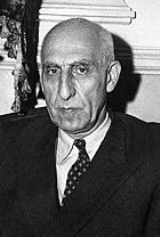
Mohammad Mosaddeq ( , pronounced [], also Mosaddegh or Mossadegh) (19 May 1882 – 5 March 1967) was a major figure in modern Iranian history who served as the Prime Minister of Iran
Prime Minister of Iran

Prime Minister of Iran was a political post in Iran had existed during several different periods of time starting with the Qajar era until its most recent revival from 1979 to 1989 following the Iranian Revolution....
from 1951 to 1953 when he was removed from power by a coup d'état
Coup d'état

A coup d??tat , often simply called a coup, is the sudden unconstitutional overthrow of a government by a part of the state establishment – usually the military – to replace the branch of the stricken government, either with another civil government or with a military government....
. From an aristocratic background, Mosaddeq was an author, administrator, lawyer, prominent parliamentarian, and statesman, famous for his passionate opposition to foreign intervention in Iran. He is most famous as the architect of the nationalization of the Iranian oil industry, which had been under British control through the Anglo-Iranian Oil Company (AIOC), (later British Petroleum or BP
BP

BP plc , is the third largest global energy corporation, a multinational corporation oil company with headquarters in London. The company is among the largest private sector energy corporations in the world, and one of the six "supermajors" ....
), and which is thought by many to be the reason for his deposition.

Mosaddeq was removed from power on 19 August 1953, in a coup d'état
Coup d'état

A coup d??tat , often simply called a coup, is the sudden unconstitutional overthrow of a government by a part of the state establishment – usually the military – to replace the branch of the stricken government, either with another civil government or with a military government....
, supported and funded by the British and U.S.


Discussion
Ask a question about 'Mohammed Mossadegh'
Start a new discussion about 'Mohammed Mossadegh'
Answer questions from other users
Full Discussion Forum


Recent Posts


Encyclopedia


Mohammad Mosaddeq ( , pronounced [], also Mosaddegh or Mossadegh) (19 May 1882 – 5 March 1967) was a major figure in modern Iranian history who served as the Prime Minister of Iran
Prime Minister of Iran

Prime Minister of Iran was a political post in Iran had existed during several different periods of time starting with the Qajar era until its most recent revival from 1979 to 1989 following the Iranian Revolution....
from 1951 to 1953 when he was removed from power by a coup d'état
Coup d'état

A coup d??tat , often simply called a coup, is the sudden unconstitutional overthrow of a government by a part of the state establishment – usually the military – to replace the branch of the stricken government, either with another civil government or with a military government....
. From an aristocratic background, Mosaddeq was an author, administrator, lawyer, prominent parliamentarian, and statesman, famous for his passionate opposition to foreign intervention in Iran. He is most famous as the architect of the nationalization of the Iranian oil industry, which had been under British control through the Anglo-Iranian Oil Company (AIOC), (later British Petroleum or BP
BP

BP plc , is the third largest global energy corporation, a multinational corporation oil company with headquarters in London. The company is among the largest private sector energy corporations in the world, and one of the six "supermajors" ....
), and which is thought by many to be the reason for his deposition.

Mosaddeq was removed from power on 19 August 1953, in a coup d'état
Coup d'état

A coup d??tat , often simply called a coup, is the sudden unconstitutional overthrow of a government by a part of the state establishment – usually the military – to replace the branch of the stricken government, either with another civil government or with a military government....
, supported and funded by the British and U.S. governments and led by General Fazlollah Zahedi
Fazlollah Zahedi

Mohammad Fazlollah Zahedi was an Iranian general, Prime Minister, and politician....
. The American operation came to be known as Operation Ajax
Operation Ajax

The 1953 Iranian Coup d??tat was the Western covert operation that deposed the democratically-elected Government of Prime Minister Mohammed Mosaddeq; the CIA and MI6 effected it by aiding and abetting pro-West Iranians and mutinous Iranian army officers....
 in America, after its CIA cryptonym
CIA cryptonym

CIA cryptonyms are code words seen in declassified documents of the United States Central Intelligence Agency. There has been much speculation as to their meaning....
, and as the "28 Mordad
Mordad

Mordad is the fifth month of the Iranian calendar. Mordad has 31 days and in non-leap years begins on 23 July and ends on 22 August. In leap years, Mordad begins on 22 July and ends on 21 August....
 1332" coup in Iran, after its date on the Iranian calendar
Iranian calendar

The Iranian calendar or Solar Hejri is an astronomical solar calendar and one of the longest chronological records in history and is currently used in Iran and Afghanistan as the main official calendar....
. Mosaddeq was imprisoned for three years and subsequently put under house arrest until his death.

Among many in Iran and abroad, Mosaddeq is known as a hero of Third World
Third World

Third World is a categorical label used to describe states that are considered to be developed in terms of their economy or level of industrialization, globalization, standard of living, health, education or other criteria for 'advancements'....
 anti-imperialism
Anti-imperialism

Anti-imperialism, strictly speaking, is a term that may be applied to a movement opposed to some form of imperialism. Generally, anti-imperialism includes opposition to wars of conquest, particularly of non-contiguous territory or people with a different language or culture....
, and victim of imperialist greed for Iran's oil. However a number of scholars and historians believe that alongside the plotting of the UK and US, a major factor in his overthrow was Mossadeq’s loss of support among Shia clerics and the traditional middle class, brought on by his increasingly radical and secular policies and by their fear of a communist takeover.

Early life

Mosaddeq was born in 1882 in Tehran
Tehran

Tehran is the capital and largest city of Iran, and the administrative center of Tehran Province. Tehran is a sprawling city at the foot of the Alborz mountain range with an immense network of highways unparalleled in Western Asia....
 to an Ashtian
Ashtian

Ashtian is an ancient city located in the northeast of Markazi Province province of Iran.The town of Ashtian itself had a population of ca. 6,000 in 1951....
 Bakhtiari finance minister, Mirza Hideyatu'llah Khan (d.1892) and a Qajar princess, Shahzadi Malika Taj Khanum (1858–1933). By his mother’s elder sister, Mossadeq was the nephew of Mozaffar al-Din Shah Qajar. When his father died in 1892, he was appointed the tax collector of the Khorasan province and was bestowed with the title of "Mossadegh-os-Saltaneh" by Nasser al-Din Shah
Nasser al-Din Shah

Nasser al-Din Shah Qajar was the King and Shah of Iran from September 17, 1848 to May 1, 1896 when he was assassinated. He was the son of Mohammad Shah Qajar and the third longest reigning monarch king in Persian history after Shapur II of the Sassanid Dynasty and Tahmasp I of the Safavid Dynasty....
.

In 1930, Mossadeq married his distant cousin, Zahra Khanum (1879–1965), a granddaughter of Nasser al-Din Shah
Nasser al-Din Shah

Nasser al-Din Shah Qajar was the King and Shah of Iran from September 17, 1848 to May 1, 1896 when he was assassinated. He was the son of Mohammad Shah Qajar and the third longest reigning monarch king in Persian history after Shapur II of the Sassanid Dynasty and Tahmasp I of the Safavid Dynasty....
 through her mother. The couple had five children, two sons (Ahmad and Ghulam Hussein) and three daughters (Mansura, Zia Ashraf and Khadija).

Education

Mossadeq received his Bachelor of Arts
Bachelor of Arts

Bachelor of Arts , from the Latin language Artium Baccalaureus, is an Undergraduate education bachelor's degree awarded for either a course or a program in either the liberal arts, the sciences or both....
 and Masters in (International) Law
Master of Laws

The Master of Laws is an advanced academic degree, or research degree, and is commonly abbreviated LL.M. from its Latin name, Legum Magister....
 from University of Paris
University of Paris

The historic University of Paris first appeared in the 12th century. In 1970 it was reorganized as 13 autonomous university . The university is often referred to as the Sorbonne or La Sorbonne after the collegiate institution founded about 1257 by Robert de Sorbon....
 (Sorbonne) before pursuing a Doctorate
Doctorate

A doctorate is an academic degree that in most countries represents the highest level of formal study or research in a given field. In some countries it also refers to a class of degrees which qualify the holder to practice in a specific profession ....
 in Law from the University of Lausanne
University of Lausanne

The University of Lausanne or UNIL in Lausanne, Switzerland was founded in 1537 as a school of theology, before being made a university in 1890....
 in Switzerland. He received his Doctor of Philosophy
Doctor of Philosophy

Doctor of Philosophy, abbreviated Ph.D. or PhD for the Latin , meaning "teacher of philosophy", is an postgraduate academic degree awarded by University....
 in 1914 following a Bachelor of Economics in 1916. Mossadeq also taught at the University of Tehran
University of Tehran

The University of Tehran , also known as Tehran University and UT, is the oldest and largest university of Iran. Its library is the largest in country....
 before beginning his political career.

Early political career

Mossadeq started his career in Iranian politics with the Iranian Constitutional Revolution
Iranian Constitutional Revolution

The Persian Constitutional Revolution took place between 1905 and 1911. The revolution led to the establishment of a Majlis of Iran in Persia ....
, when at the age of 24, he was elected from Isfahan to the newly inaugurated Persian Parliament, the Majlis of Iran
Majlis of Iran

The Majlis of Iran , also called The Iranian Parliament, is the national legislative body of Iran. The Majlis currently has 290 representatives, changed from the previous 270 seats since the February 18, 2000 election....
. In 1920, after being self-exiled to Switzerland in protest at the Anglo-Persian Treaty of 1919, he was invited by the new Persian Prime Minister, Hassan Pirnia (Moshir-ed-Dowleh), to become his "Minister of Justice"; but while en route to Tehran, he was asked by the people of Shiraz to become Governor of the "Fars" Province. He was later appointed Finance Minister
Finance minister

The finance minister is a Cabinet position in a government.A minister of finance has many different jobs in a government. He or she helps form the government budget, Fiscal policy, and control finances....
, in the government of Ahmad Ghavam (Ghavam os-Saltaneh) in 1921, and then Foreign Minister
Foreign minister

A minister for foreign affairs, or foreign minister, is a governmental cabinet Political minister who helps form the foreign policy of a sovereign nation....
 in the government of Moshir-ed-Dowleh in June 1923. He then became Governor of the "Azerbaijan" Province. In 1923, he was re-elected to the Majlis and voted against the selection of the Prime Minister Reza Khan
Reza Khan

Reza Khan may refer to:*Reza Shah , Shah of Iran* Reza Khan , Taliban agent accused of murder in Afghanistan...
 as the new Shah of Persia.

By 1944, Reza Shah Pahlavi had abdicated, and Mosaddeq was once again elected to parliament. This time he took the lead of Jebhe Melli (National Front of Iran), an organization he had founded with nineteen others like Dr.Hossein Fatemi
Hossein Fatemi

Hossein Fatemi, PhD, was a famous politician of Iran, born in 1919 in Nain, Iran. He proposed the thesis of nationalization of Iranian oil and gas assets to Premiere Mossadegh....
, Ahmad Zirakzadeh
Ahmad Zirakzadeh

Ahmad Zirakzadeh was one of the founders of National Front of Iran, an Iranian party which was considered the backbone of Mohammed Mosaddeq's government....
, Ali Shayegan and Karim Sanjabi, aiming to establish democracy and end the foreign presence in Iranian politics, especially by nationalizing the Anglo-Iranian Oil Company’s (AIOC) operations in Iran.

Prime Minister


Support for oil nationalization

Most of Iran’s oil reserves were in the Persian Gulf area and had been developed by the British Anglo-Iranian Oil company and exported to Britain. For a number of reasons — a growing consciousness of how little Iran was getting from the Anglo-Iranian Oil company for its oil; refusal of AIOC to offer of a ‘50–50% profit sharing deal’ to Iran as Aramco had to Saudi Arabia; anger over Iran’s defeat and occupation by the Allied powers — nationalization of oil was an important and popular issue with "a broad cross-section of the Iranian people."

General Haj-Ali Razmara, the Shah’s choice, was approved as prime minister June 1950. On 3 March 1951 he appeared before the Majlis in an attempt to persuade the deputies against "full nationalization on the grounds that Iran could not override its international obligations and lacked the capacity to run the oil industry on its own." He was assassinated four days later by Khalil Tahmasebi
Khalil Tahmasebi

Khalil Tahmasebi was the 26 year-old carpenter and member of the fanatical Islamic organization, Fadayan-e Islam who assassinated Iranian Prime Minister Ali Razmara on March 7, 1951....
, a member of the militant fundamentalist group Fadayan-e Islam
Fadayan-e Islam

Fadayan-e Islam was an Iranian Islamic fundamentalism or Islamic terrorism secret society founded in 1946, by "a charismatic" 22 year-old "theology student" named Navvab Safavi....
.

After negotiations for higher oil royalties failed, on 15 March and 20 March 1951, the Iranian Majlis
Majlis of Iran

The Majlis of Iran , also called The Iranian Parliament, is the national legislative body of Iran. The Majlis currently has 290 representatives, changed from the previous 270 seats since the February 18, 2000 election....
 and Senate voted to nationalize the British-owned and operated AIOC, taking control of Iran’s oil industry.

Another force for nationalization was the Tudeh or Communist party. In early April 1951 the party unleashed nationwide strikes and riots in protest against delays in nationalization of the oil industry along with low wages and bad housing in oil industry. This display of strength, along with public celebration at the assassination of General Razmara made an impact on the deputies of the Majlis.

Election as prime minister

On 28 April 1951, the Majlis named Mosaddeq as new prime minister by a vote of 79–12. Aware of Mosaddeq’s rising popularity and political power, the young Shah appointed Mosaddeq to the Premiership. On 1 May, Mosaddeq nationalized the AIOC, cancelling its oil concession due to expire in 1993 and expropriating its assets. The next month a committee of five majlis deputies was sent to Khuzistan to enforce the nationalization.

Mosaddeq explained his nationalization policy in a 21 June 1951 speech:

"Our long years of negotiations with foreign countries… have yielded no results this far. With the oil revenues we could meet our entire budget and combat poverty, disease, and backwardness among our people. Another important consideration is that by the elimination of the power of the British company, we would also eliminate corruption and intrigue, by means of which the internal affairs of our country have been influenced. Once this tutelage has ceased, Iran will have achieved its economic and political independence. The Iranian state prefers to take over the production of petroleum itself. The company should do nothing else but return its property to the rightful owners. The nationalization law provide that 25% of the net profits on oil be set aside to meet all the legitimate claims of the company for compensation… It has been asserted abroad that Iran intends to expel the foreign oil experts from the country and then shut down oil installations. Not only is this allegation absurd; it is utter invention…"


The confrontation between Iran and Britain escalated from there with Mosaddeq’s government refusing to allow the British any involvement in Iran’s oil industry, and Britain making sure Iran could sell no oil. In July, Mossadeq broke off negotiations with AIOC after it threatened "to pull out its employees", and told owners of oil tanker ships that "receipts from the Iranian government would not be accepted on the world market." Two months later the AIOC evacuated its technicians and closed down the oil installations. Under nationalized management many refineries lacked the trained technicians that were needed to continue production. The British government announced a de facto blockade and reinforced its naval force in the Persian Gulf and lodged complaints against Iran before the United Nations Security Council
United Nations Security Council

The United Nations Security Council is one of the principal organs charged with the maintenance of international security. Its powers, outlined in the United Nations Charter, include the establishment of peacekeeping operations, the establishment of international sanctions, and the authorization of war....
.

The British government also threatened legal action against purchasers of oil produced in the formerly British-controlled refineries and obtained an agreement with its sister international oil companies not to fill in where the AIOC was boycotting Iran. The AIOC withdrew its technicians from the refineries and the entire Iranian oil industry came to a "virtual standstill", oil production dropping from 241.4 million barrels in 1950 to 10.6 million in 1952. This "Abadan Crisis
Abadan Crisis

The Abadan Crisis occurred from 1951 to 1954, after Iran nationalized the Iranian assets of the Anglo-Persian Oil Company and expelled Western companies from oil refineries in the city of Abadan, Iran ....
" reduced Iran’s oil income to almost nil, putting a severe strain on the implementation of Mossadeq’s promised domestic reforms. At the same time BP
BP

BP plc , is the third largest global energy corporation, a multinational corporation oil company with headquarters in London. The company is among the largest private sector energy corporations in the world, and one of the six "supermajors" ....
 and Aramco doubled their production in Saudi Arabia, Kuwait and Iraq, to make up for lost production in Iran so that no hardship was felt in Britain. The British public rallied behind the cause of AIOC.

Still enormously popular in late 1951, Mosaddeq called elections. His base of support was in urban areas and not in the provinces. According to Ervand Abrahamian: "Realizing that the opposition would take the vast majority of the provincial seats, Mossadeq stopped the voting as soon as 79 deputies – just enough to form a parliamentary quorum — had been elected." National Front members or supporters made up 30 of these 79 deputies. The 17th Majlis convened on 1952 February.

According to historian Ervand Abrahamian, tension escalated in the Majlis also. Conservative opponents refused to grant Mosaddeq special powers to deal with the economic crisis caused by the sharp drop in revenue and voiced regional grievances against the capital Tehran, while the National Front waged "a propaganda war against the landed upper class."

Resignation and uprising

On 16 July 1952, during the royal approval of his new cabinet, Mosaddeq insisted on the constitutional prerogative of the prime minister to name a Minister of War and the Chief of Staff, something the Shah had done hitherto. The Shah refused, and Mosaddeq announced his resignation appealing directly to the public for support, pronouncing that ‘in the present situation, the struggle started by the Iranian people cannot be brought to a victorious conclusion’.

Veteran politician Ahmad Qavam
Ghavam os-Saltaneh

Ahmad Qavam , also known as Qavam os-Saltaneh , was a Prime Minister of Iran.Born in 1876 to a prominent Iranian family. His uncle, Amin Aldoleh, was a prime minister of Iran....
 (also known as Ghavam os-Saltaneh) was appointed as Iran’s new prime minister. On the day of his appointment, he announced his intention to resume negotiations with the British to end the oil dispute, a reversal of Mosaddeq’s policy. The National Front — along with various Nationalist, Islamist, and socialist parties and groups — including Tudeh — responded by calling for protests, strikes and mass demonstrations in favor of Mossadeq. Major strikes broke out in all of Iran’s major towns, with the Bazaar closing down in Tehran. Over 250 demonstrators in Tehran, Hamadan, Ahvaz, Isfahan, and Kermanshah were killed or suffered serious injuries.

After five days of mass demonstrations on Siyeh-i Tir (the 30th of Tir on the Iranian calendar), "military commanders, ordered their "troops back to barracks, fearful of overstraining" the enlisted men’s loyalty and left Tehran "in the hands of the protesters." Frightened by the unrest, Shah dismissed Qavam and re-appointed Mosaddeq, granting him the full control of the military he had previously demanded.

Reinstatement and emergency powers

With further rise of his popularity, a greatly strengthened Mosaddeq convinced the parliament to grant him "emergency powers for six months to decree any law he felt necessary for obtaining not only financial solvency, but also electoral, judicial, and educational reforms." Mosaddeq appointed Ayatollah Abol-Ghasem Kashani
Ayatollah Abol-Ghasem Kashani

Ayatollah Seyyed Abol-Ghasem Mostafavi Kashani was a prominent Twelver Shi'a Muslim cleric and former Parliament Minister of Iran....
 as house speaker. Kashani’s Islamic scholars, as well as the Tudeh Party, proved to be two of Mosaddeq’s key political allies, although both relationships were often strained.

With his emergency powers, Mosaddeq tried to strengthen the democratically-elected political institutions by limiting the monarchy’s unconstitutional powers, cutting Shah’s personal budget, forbidding him to communicate directly with foreign diplomats, transferring royal lands back to the state, expelling his politically active sister Ashraf Pahlavi
Ashraf Pahlavi

File:Ashraf et shah.jpgPrincess Ashraf ul-Mulk , is the twin sister of Mohammad Reza Pahlavi, the late Shah of Iran and the Pahlavi Dynasty....
.

In January 1953 Mosaddeq successfully pressed Parliament to extend "emergency powers for another 12 months". With these powers, he decreed a land reform law that establishes village councils and increases in peasants shares of production. This weakened the landed aristocracy, abolishing Iran’s centuries-old feudal agriculture sector. Although Mosaddeq had previously been opposed to these policies when implemented unilaterally by the Shah , he saw it as a means of checking the power of the Tudeh Party, which had been agitating for general land reform among the peasants.

However during this time Iranians were "becoming poorer and unhappier by the day" thanks to the British boycott. Mossadeq's political coalition began to "fray", his enemies increasing in number.

Partly through the efforts of Iranians working as British agents, several former members of Mossadeq's coalition turned against him. They included Muzzaffar Bazaui, head of the worker-based Toilers party; Hussein Makki, who had helped lead the takeover of the Abadan refinery and was at one point considered Mossadeq's heir apparent; and most outspokenly Ayatollah Kashani, who damned "Mossadeq with the vitriol he had once reserved for the British."

Overthrow of Mosaddeq


Plot to depose Mosaddeq

28mordad1332
The government of the United Kingdom had grown increasingly distressed over Mosaddeq’s policies and were especially bitter over the loss of their control of the Iranian oil industry. Repeated attempts to reach a settlement had failed.

Unable to resolve the issue single handedly due to its post-World War II problems, Britain looked towards the United States to settle the issue. Initially America had opposed British policies. "After American mediation had failed several times to bring about a settlement", American Secretary of State Dean Acheson "concluded that the British were ‘destructive and determined on a rule or ruin policy in Iran.’" By early 1953, however, there was a new Republican party presidential administration in the United States.

Despite Mosaddeq's open disgust with socialism, Winston Churchill
Winston Churchill

Sir Winston Leonard Spencer-Churchill, Order of the Garter, Order of Merit, Order of the Companions of Honour, Territorial Decoration, Fellow of the Royal Society, Her Majesty's Most Honourable Privy Council, Queen's Privy Council for Canada was a Politics of the United Kingdom known chiefly for his leadership of the United King...
 told the United States that Mosaddeq was increasingly "turning towards communism
Communism

Communism is a socioeconomic structure and political ideology that promotes the establishment of an egalitarianism, classlessness, stateless society based on common ownership and control of the means of production and property in general....
" and was moving Iran towards the Soviet sphere at a time of high Cold War
Cold War

The Cold War was the continuing state of conflict, tension and competition that existed between a number of world powers, including the United States, the Soviet Union, People's Republic of China, France, United Kingdom and those countries' respective allies from the mid-1940s to the early 1990s....
 fears.

Acting on the opposition to Mosaddeq by the British government and fears that he was, or would become, dependent on the pro-Soviet Tudeh Party at a time of expanding Soviet influence, the United States and Britain began to publicly denounce Mosaddeq’s policies for Iran as harmful to the country.

In the mean time the already precarious alliance between Mosaddeq and Kashani was severed in January 1953, when Kashani opposed Mosaddeq’s demand that his increased powers be extended for a period of one year.

Operation Ajax

In October 1952, Mosaddeq declared that Britain was "an enemy", and cut all diplomatic relations with the United Kingdom. In November and December 1952, British intelligence officials suggested to American intelligence that the prime minister should be ousted. The new US administration under Dwight D. Eisenhower
Dwight D. Eisenhower

Dwight David ?Ike? Eisenhower was the List of Presidents of the United States President of the United States from 1953 until 1961 and a General of the Army in the United States Army....
 and the British government under Winston Churchill
Winston Churchill

Sir Winston Leonard Spencer-Churchill, Order of the Garter, Order of Merit, Order of the Companions of Honour, Territorial Decoration, Fellow of the Royal Society, Her Majesty's Most Honourable Privy Council, Queen's Privy Council for Canada was a Politics of the United Kingdom known chiefly for his leadership of the United King...
 agreed to work together toward Mosaddeq’s removal. In March 1953, Secretary of State
United States Secretary of State

The United States Secretary of State is the head of the United States Department of State, concerned with foreign affairs. The Secretary is a member of the President's United States Cabinet and the highest-ranking cabinet secretary both in United States presidential line of succession and United States order of precedence....
 John Foster Dulles
John Foster Dulles

John Foster Dulles served as United States Secretary of State under President of the United States Dwight D. Eisenhower from 1953 to 1959. He was a significant figure in the early Cold War era, advocating an aggressive stance against communism around the world....
 directed the US Central Intelligence Agency
Central Intelligence Agency

The Central Intelligence Agency is a civilian intelligence agency of the Federal government of the United States. It is the successor of the Office of Strategic Services formed during World War II to coordinate espionage activities between the branches of the US military services....
 (CIA), which was headed by his younger brother Allen Dulles
Allen Welsh Dulles

Allen Welsh Dulles was the first civilian and the longest serving director of central intelligence and a member of the Warren Commission. Between stints of government service, Dulles was a corporate lawyer and partner at Sullivan & Cromwell....
, to draft plans to overthrow Mosaddeq.

On 4 April 1953, CIA director Dulles approved US$1 million to be used "in any way that would bring about the fall of Mosaddeq." Soon the CIA’s Tehran
Tehran

Tehran is the capital and largest city of Iran, and the administrative center of Tehran Province. Tehran is a sprawling city at the foot of the Alborz mountain range with an immense network of highways unparalleled in Western Asia....
 station started to launch a propaganda campaign against Mosaddeq. Finally, according to The New York Times
The New York Times

The New York Times is an American daily newspaper published in New York City. The largest metropolitan newspaper in the United States, "The Gray Lady"?named for its staid appearance and style?is regarded as a national newspaper of record....
, in early June, American and British intelligence officials met again, this time in Beirut
Beirut

Beirut is the Capital and largest city of Lebanon with a population of over 2.1 million as of 2007. Located on a peninsula at the midpoint of Lebanon's coastline with the Mediterranean sea, it serves as the country's largest and main seaport and also forms the Beirut District area, which consists of the city and its suburbs....
, and put the finishing touches on the strategy. Soon afterward, according to his later published accounts, the chief of the CIA’s Near East and Africa division, Kermit Roosevelt, Jr.
Kermit Roosevelt, Jr.

Kermit "Kim" Roosevelt, Jr. , was an American intelligence officer who coordinated the Central Intelligence Agency's Operation Ajax, which orchestrated the coup d??tat against Iran's Mohammed Mossadegh and returned Mohammad Reza Pahlavi, the Shah of Iran, to Iran's Peacock Throne in August 1953....
 the grandson of U.S. President Theodore Roosevelt
Theodore Roosevelt

Theodore Roosevelt , also known as T.R., and to the public as Teddy, was the List of Presidents of the United States President of the United States....
, arrived in Tehran to direct it. In 2000, The New York Times
The New York Times

The New York Times is an American daily newspaper published in New York City. The largest metropolitan newspaper in the United States, "The Gray Lady"?named for its staid appearance and style?is regarded as a national newspaper of record....
 made partial publication of a leaked CIA document titled, "Clandestine Service History – Overthrow of Premier Mosaddeq of Iran – November 1952-August 1953." This document describes the planning and execution conducted by the American and British governments. The New York Times published this critical document with the names censored. The New York Times also limited its publication to scanned image (bitmap) format, rather than machine-readable text. This document was eventually published properly – in text form, and fully unexpurgated. The complete CIA document is now . The word 'blowback
Blowback (intelligence)

Blowback is the espionage term for the violent, unintended consequences of a covert operation that are suffered by the civil population of the aggressor government....
' appeared for the very first time in this document.

The plot, known as Operation Ajax
Operation Ajax

The 1953 Iranian Coup d??tat was the Western covert operation that deposed the democratically-elected Government of Prime Minister Mohammed Mosaddeq; the CIA and MI6 effected it by aiding and abetting pro-West Iranians and mutinous Iranian army officers....
, centered on convincing Iran’s monarch to use his constitutional authority to dismiss Mosaddeq from office, as he had attempted some months earlier. But the Shah was uncooperative, and it would take much persuasion and many meetings to successfully execute the plan.

Mosaddeq became aware of the plots against him and grew increasingly wary of conspirators acting within his government. Soon Pro-Mosaddeq supporters, both socialists and nationalists, threatened Muslim leaders with "savage punishment if they opposed Mosaddeq," with impression that Mosaddeq was cracking down on dissent, and stirring anti-Mosaddeq sentiments within the religious community. Mosaddeq then moved to dissolve parliament, in spite of the Constitutional provision which gave the Shah sole authority to dissolve Parliament. After taking the additional step of abolishing the Constitutional guarantee of a “secret ballot”, Mosaddeq’s victory in the national plebiscite was assured. The electorate was forced into a non-secret ballot and Mosaddeq won 99.93% of the vote. The tactics employed by Mosaddeq to remain in power were dictatorial in their result, playing into the hands of those who wished to see him removed. Parliament was suspended indefinitely, and Mosaddeq’s emergency powers were extended.

Shah’s exile

In August 1953, Mosaddeq attempted to convince the Shah to leave the country and allow him control over the government. The Shah refused, and formally dismissed the Prime Minister. Mosaddeq refused to leave, however, and when it became apparent that he was going to fight to overthrow the monarchy, the Shah, as a precautionary measure, flew to Baghdad
Baghdad

Baghdad is the Capital of Iraq and of Baghdad Governorate, with which it is also coterminous. With a municipal population estimated at 6.5 million, it is the largest city in Iraq, and the second largest city in the Arab World....
 and from there to Rome, Italy, after signing two decrees, one dismissing Mosaddeq and the other nominating General Fazlollah Zahedi
Fazlollah Zahedi

Mohammad Fazlollah Zahedi was an Iranian general, Prime Minister, and politician....
 Prime Minister.

Coup d'etat

Once again, massive protests broke out across the nation. Anti- and pro-monarchy protesters violently clashed in the streets, leaving almost 300 dead. The pro-monarchy forces, led by retired army General and former Minister of Interior in Mosaddeq’s cabinet, Fazlollah Zahedi
Fazlollah Zahedi

Mohammad Fazlollah Zahedi was an Iranian general, Prime Minister, and politician....
 and pahlavan like Shaban Jafari, gained the upper hand on 19 August 1953 (28 Mordad). The military intervened as the pro-Shah tank regiments stormed the capital and bombarded the prime minister’s official residence. Mosaddeq managed to flee from the mob that set in to ransack his house, and, the following day, surrendered to General Zahedi, who had meanwhile established his makeshift headquarters at the Officers' Club. Mosaddeq was arrested at the Officers' Club and transferred to a military jail shortly after.

Shah’s return

Shortly after the return of the Shah, on 22 August 1953, from the brief self-imposed exile in Rome, Mosaddeq was tried by a military tribunal for high treason. Zahedi and the Shah were inclined, however, to spare the man’s life (the death penalty would have applied according to the laws of the day). Mosaddeq received a sentence of 3 years in solitary confinement at a military jail and was exiled to his village not far from Tehran, where he remained under house arrest on his estate until his death, on 5 March 1967.

Zahedi’s new government soon reached an agreement with foreign oil companies to form a "Consortium" and "restore the flow of Iranian oil to world markets in substantial quantities."

Legacy


Iran

The overthrow of Mossadeq served as a rallying point in anti-US protests during the 1979 Iranian revolution
Iranian Revolution

The Iranian Revolution was the revolution that transformed Iran from a Iranian monarchy under Shah Mohammad Reza Pahlavi to an Islamic republic under Ayatollah Ruhollah Khomeini, the leader of the revolution and founder of the Islamic Republic....
 and to this day he is said to be one of the most popular figures in Iranian history. Despite this he is generally ignored by the government of the Islamic Republic because of his secularism and western manners.

The withdrawal of support for Mossadeq by the powerful Shia clergy’s has been regarded as having been motivated by their fear of the "chaos" of "a communist takeover." Some argue that while many elements of Mossadeq’s coalition abandoned him it was the loss of support from Ayatollah Abol-Ghasem Kashani
Ayatollah Abol-Ghasem Kashani

Ayatollah Seyyed Abol-Ghasem Mostafavi Kashani was a prominent Twelver Shi'a Muslim cleric and former Parliament Minister of Iran....
 and other clergy that was fatal to his cause, reflective of the dominance of the Ulema
Ulema

Ulema refers to the educated class of Muslim legal scholars engaged in the several fields of Islamic studies. They are best known as the arbiters of Sharia law....
 in Iranian society and a portent of the Islamic Revolution to come. "The loss of the political clerics effectively cut Mossadeq’s connections with the lower middle classes and the Iranian masses which are crucial to any popular movement" in Iran.

U.S. and other countries

The extent of the US role in Mossadeq’s overthrow was not formally acknowledged for many years, although the Eisenhower administration was quite vocal in its opposition to the policies of the ousted Iranian Prime Minister. In his memoirs, Eisenhower writes angrily about Mossadeq, and describes him as impractical and naive, though he stops short of admitting any overt involvement in the coup.

Eventually the CIA’s role became well-known, and caused controversy within the organization itself, and within the CIA congressional hearings of the 1970s. CIA supporters maintain that the plot against Mosaddeq was strategically necessary, and praise the efficiency of agents in carrying out the plan. Critics say the scheme was paranoid and colonial, illegal, as well as immoral.

In March 2000, then-Secretary of State Madeleine Albright
Madeleine Albright

Madeleine Korbel Albright was the List of female United States Cabinet Secretaries to become United States Secretary of State.She was appointed by President Bill Clinton on December 5, 1996, and was unanimously confirmed by the United States Senate 99-0....
 stated her regret that Mosaddeq was ousted: "The Eisenhower administration believed its actions were justified for strategic reasons. But the coup was clearly a setback for Iran’s political development and it is easy to see now why many Iranians continue to resent this intervention by America." In the same year, the New York Times published a detailed report about the coup based on alleged CIA documents.

For his sudden rise in popularity inside and outside of Iran, and for his defiance of the British, Mosaddeq was named as Time Magazine’s 1951 Man of the Year
Person of the Year

Person of the Year is an annual issue of the United States newsmagazine Time that features and profiles a man, woman, couple, group, idea, place, or machine that "for better or for worse, ...has done the most to influence the events of the year."...
. Other notables considered for the title that year included Dean Acheson
Dean Acheson

Dean Gooderham Acheson was an American statesman and lawyer; as United States Secretary of State in the administration of President Harry S. Truman during 1949?1953, he played a central role in defining American foreign policy during the Cold War....
, President Dwight D. Eisenhower
Dwight D. Eisenhower

Dwight David ?Ike? Eisenhower was the List of Presidents of the United States President of the United States from 1953 until 1961 and a General of the Army in the United States Army....
 and General Douglas MacArthur
Douglas MacArthur

General of the Army Douglas MacArthur, Order of the Bath was an United States General officer, United Nations general and Field Marshal of the Philippine Army....
.

In early 2004, the Egyptian government changed a street name in Cairo
Cairo

Cairo , which means "the triumphant", is the Cairo and largest city of Egypt.It is the most populous metropolitan area in Egypt and is also one of the most populous in the world....
 from Pahlavi
Pahlavi dynasty

The Pahlavi dynasty ruled Iran from the crowning of Reza Shah in 1925 to the overthrow of Reza Shah Pahlavi's son Mohammad Reza Pahlavi in the Iranian Revolution of 1979....
 to Mosaddeq, to facilitate closer relations with Iran.

He was good friends with Mohammad Mokri
Mohammad Mokri

Mohammad Mokri was an Iranian Kurdish scholar and author who wrote over 100 books and 700 articles during his lifetime. Most of his work dealt with the subject of the Kurdish people and the Yarsan religious order....
 until his death.


Mosaddeq in the media

Mohammad Mosaddeq plays an important role in the 2003 TV production Soraya, which deals with the life of the Shah’s second wife and former Queen of Iran, Princess Soraya Esfandiary Bakhtiari. Mosaddeq’s role is played by Claude Brasseur
Claude Brasseur

Claude Brasseur is a French actor....
.

See also

  • Hossein Fatemi
    Hossein Fatemi

    Hossein Fatemi, PhD, was a famous politician of Iran, born in 1919 in Nain, Iran. He proposed the thesis of nationalization of Iranian oil and gas assets to Premiere Mossadegh....
  • Dariush Forouhar
    Dariush Forouhar

    Dariush Forouhar was a founder and leader of the Mellat Iran , a Pan-Iranism opposition party in Iran and served as Minister of Labor in the Iranian Revolution of Mehdi Bazargan in 1979....
  • 1953 Iranian coup d'état
  • List of Iranian intellectuals
    List of Iranian intellectuals

    A* Mehdi Akhavan-Sales* Jalal Al-e-Ahmad* Bozorg Alavi* Amir Hossein Aryanpour* Manouchehr AtashiB* Rakhshan Bani-Etemad* Mohammad Reza Bateni...
  • Anglo Iranian Oil Company
  • Operation Ajax
    Operation Ajax

    The 1953 Iranian Coup d??tat was the Western covert operation that deposed the democratically-elected Government of Prime Minister Mohammed Mosaddeq; the CIA and MI6 effected it by aiding and abetting pro-West Iranians and mutinous Iranian army officers....
  • Abadan Crisis
    Abadan Crisis

    The Abadan Crisis occurred from 1951 to 1954, after Iran nationalized the Iranian assets of the Anglo-Persian Oil Company and expelled Western companies from oil refineries in the city of Abadan, Iran ....
  • Abadan Crisis timeline
    Abadan Crisis timeline

    The Abadan crisis was a major event in Iranian history. It began in 1951 with the nationalization of the Anglo-Iranian Oil Company by the government of Iran, and the shutting down by the British of the Anglo-Persian Oil Company's huge Abadan Refinery....


Further reading

  • Abrahamian, Ervand, Khomeinism: essays on the Islamic Republic. Berkeley: University of California Press, c 1993. 0-520-08173-0
  • Abrahamian, Ervand, , By Ervand Abrahamian, Princeton University Press, 1982
  • Farhad Diba, Dr. Mohammad Mossadegh; A Political Biography. London: Croom Helm, 1986, ISBN 0-7099-4517-5
  • Mostafa Elm, Oil, Power, and Principle: Iran’s Oil Nationalization and Its Aftermath. Syracuse: Syracuse University Press, 1994, ISBN 0-8156-2642-8
  • Mark Gasiorowski, U.S. Foreign Policy and the Shah: Building a Client State in Iran, Cornell University Press, 1991, ISBN 0-8014-2412-7
  • Mary Ann Heiss, Empire and Nationhood: The United States, Great Britain, and Iranian Oil, 1950–1954, Columbia University Press,1997, ISBN 0-231-10819-2
  • Farman Farmaian, Sattareh with Dona Munker 2006. Daughter of Persia: A Woman’s Journey from Her Father’s Harem through the Islamic Revolution. New York: Three Rivers Press. ISBN-10: 0-307-33974-2
  • Stephen Kinzer
    Stephen Kinzer

    Stephen Kinzer is a United States author and newspaper reporter. He is a veteran New York Times correspondent who has reported from more than fifty countries on five continents....
    , All The Shah’s Men: An American Coup and the Roots of Middle East Terror, John Wiley & Sons, 2003, ISBN 0-471-26517-9
  • Id., Overthrow: America’s Century of Regime Change from Hawaii to Iraq
    Overthrow (book)

    Overthrow: America's Century of Regime Change from Hawaii to Iraq is a book published in 2006 by award-winning New York Times foreign correspondent and author Stephen Kinzer about the United States's involvement in CIA sponsored regime change from the late 19th century to the present....
    , Times Books, 2006, ISBN 0-8050-7861-4
  • Nikki R. Keddie, Modern Iran: Roots and Results of Revolution, Yale University Press, 2003, ISBN 0-300-09856-1
  • Homa Katouzian
    Homa Katouzian

    Homa Katouzian, PhD is an economy, history, political science and literary criticism, with a special interest in Iranian studies. Katouzian?s formal academic training was in economics and the social sciences but he concurrently continued his studies of Persian people history and literature at a professional academic level....
    , Musaddiq and the Struggle for Power in Iran, I B Tauris & Co, 1991, ISBN 1-850-43210-4
  • Mohammad Mosaddeq and the 1953 Coup in Iran, edited by Mark J. Gasiorowski and Malcolm Byrne. Translated into Persian as Mosaddegh va Coup de Etat by Ali Morshedizad, Ghasidehsara Pub. Co.
  • Mark J. Gasiorowski, The 1953 Coup D'État in Iran, International Journal of Middle East Studies, Vol. 19, No. 3, pp. 261–86 (1987).


External links

  • — Site containing pictures, media and biography of Mosaddeq
  • . The New York Times, 16 April 2000.
  • by Sasan Fayazmanesh, 18 August 2003.
  • Book and declassified documents from the National Security Archive
    National Security Archive

    The National Security Archive is a 501 non-governmental, non-profit research and archival institution located within The George Washington University in Washington, D.C.....
    , 22 June 2004
  • Fariba Amini, Don't call me "Sir" - Mosaddegh: Humanity and integrity in government, The Iranian, 9 May 2001, .