
All Topics  
Iran hostage crisis

 
Iran Hostage Crisis

   Email Print
   Bookmark   Link


Iran hostage crisis


The Iran hostage crisis was a diplomatic
Diplomacy

Diplomacy is the art and practice of conducting negotiations between representatives of groups or states. It usually refers to international diplomacy, the conduct of international relations through the intercession of professional diplomats with regard to issues of peace-making, trade, war, economics and culture....
 crisis between Iran
Iran

Iran , officially the Islamic Republic of Iran and formerly known internationally as Persian Empire until 1935, is a country in Central Eurasia, located on the northeastern shore of the Persian Gulf and the southern shore of the Caspian Sea....
 and the United States
United States

The United States of America is a Federal government constitutional republic comprising U.S. state and a federal district. The country is situated mostly in central North America, where its Contiguous United States and Washington, D.C., the Capital districts and territories, lie between the Pacific Ocean and Atlantic Oceans, Borders of the U...
 where 52 U.S. diplomats were held hostage for 444 days from November 4, 1979 to January 20, 1981, after a group of Islamist
Islamism

Islamism is a set of Ideologies of parties holding that Islam is not only a religion but also a political system; that modern Muslims must Islamic fundamentalism, and unite politically....
 students took over the American embassy in support of the Iranian revolution.

The crisis has been described as an entanglement of "vengeance and mutual incomprehension".


Discussion
Ask a question about 'Iran hostage crisis'
Start a new discussion about 'Iran hostage crisis'
Answer questions from other users
Full Discussion Forum


Recent Posts


Encyclopedia


Ahmadinejad Alleged
The Iran hostage crisis was a diplomatic
Diplomacy

Diplomacy is the art and practice of conducting negotiations between representatives of groups or states. It usually refers to international diplomacy, the conduct of international relations through the intercession of professional diplomats with regard to issues of peace-making, trade, war, economics and culture....
 crisis between Iran
Iran

Iran , officially the Islamic Republic of Iran and formerly known internationally as Persian Empire until 1935, is a country in Central Eurasia, located on the northeastern shore of the Persian Gulf and the southern shore of the Caspian Sea....
 and the United States
United States

The United States of America is a Federal government constitutional republic comprising U.S. state and a federal district. The country is situated mostly in central North America, where its Contiguous United States and Washington, D.C., the Capital districts and territories, lie between the Pacific Ocean and Atlantic Oceans, Borders of the U...
 where 52 U.S. diplomats were held hostage for 444 days from November 4, 1979 to January 20, 1981, after a group of Islamist
Islamism

Islamism is a set of Ideologies of parties holding that Islam is not only a religion but also a political system; that modern Muslims must Islamic fundamentalism, and unite politically....
 students took over the American embassy in support of the Iranian revolution.

The crisis has been described as an entanglement of "vengeance and mutual incomprehension". In Iran, the incident was seen by many as a blow against the U.S., its influence in Iran, its perceived attempts to undermine the Iranian Revolution
Iranian Revolution

The Iranian Revolution was the revolution that transformed Iran from a Iranian monarchy under Shah Mohammad Reza Pahlavi to an Islamic republic under Ayatollah Ruhollah Khomeini, the leader of the revolution and founder of the Islamic Republic....
, and its long standing support of the recently overthrown Shah
Shah

Shah is a Persian language term for a monarch that has been adopted in many other languages.Shah used as a last name by Jains and Hindus is unrelated....
 of Iran, Mohammad Reza Pahlavi
Mohammad Reza Pahlavi

Mohammad Reza Shah Pahlavi, List of kings of Persia, , styled His Imperial Majesty, and holding the imperial titles of Shahanshah , and Aryamehr , was the monarchy of Iran from September 16, 1941, until his overthrow by the Iranian Revolution on February 11, 1979....
. The Shah had been restored to power in a 1953 coup with some assistance from the CIA
Central Intelligence Agency

The Central Intelligence Agency is a civilian intelligence agency of the Federal government of the United States. It is the successor of the Office of Strategic Services formed during World War II to coordinate espionage activities between the branches of the US military services....
  and had recently been allowed into the United States for cancer treatment. In the United States, the hostage-taking was seen as an outrage violating a centuries-old principle of international law granting diplomats immunity from arrest
Diplomatic immunity

Diplomatic immunity is a form of immunity and a policy held between governments, which ensures that diplomats are given safe passage and are considered not susceptible to lawsuit or prosecution under the host country's laws ....
 and diplomatic compounds sovereignty
Sovereignty

File:Leviathan gr.jpgSovereignty is the exclusive right to control a government, a State, a people, or oneself. A sovereign is a supreme lawmaking authority....
 in their embassies.

The ordeal reached a climax when after failed attempts to negotiate a release, the United States military attempted a rescue operation, Operation Eagle Claw
Operation Eagle Claw

Operation Eagle Claw was a Military of the United States military operation to rescue the Iran hostage crisis from the U.S. Embassy in Tehran, Iran on April 24, 1980....
, on April 24, 1980, which resulted in an aborted mission, the crash of two aircraft and the deaths of eight American military men and one Iranian civilian. The crisis ended with the signing of the Algiers Accords
Algiers Accords

The Algiers Accords of January 19, 1981, were brokered by the Algerian government between the USA and Iran to resolve the Iran hostage crisis. The crisis arose from the takeover of the American embassy in Tehran on November 4 1979, and the taking hostage of the American staff there....
 in Algeria
Algeria

Algeria , officially the People's Democratic Republic of Algeria, is a country located in North Africa. It is the largest country of the Mediterranean sea, second largest in the Arab World, and the second largest on the African continent and the eleventh-largest country in the world in terms of land area....
 on January 19, 1981. The hostages were formally released into United States custody the following day, just minutes after the new American president Ronald Reagan
Ronald Reagan

Ronald Wilson Reagan was the List of Presidents of the United States President of the United States and the 33rd Governor of California . Born in Illinois, Reagan moved to Los Angeles, California in the 1930s, where he was an actor, president of the Screen Actors Guild , and a spokesman for General Electric ....
 was sworn in.

The crisis has been described as the "pivotal episode" in the history of U.S.-Iranian relations. In America, it is thought by some political analysts to be the primary reason for U.S. President
President of the United States

The President of the United States is the head of state and head of government of the United States and is the highest political official in the United States by influence and recognition....
 Jimmy Carter
Jimmy Carter

James Earl "Jimmy" Carter, Jr. served as the List of Presidents of the United States President of the United States from 1977 to 1981 and was the recipient of the 2002 Nobel Peace Prize....
's defeat in the November 1980 presidential election
United States presidential election, 1980

The United States presidential election of 1980 featured a contest between incumbent United States Democratic Party Jimmy Carter and his United States Republican Party opponent, Ronald Reagan, along with Third party candidates, the Independent John B....
. In Iran, the crisis strengthened the prestige of the Ayatollah Khomeini and the political power of forces who supported theocracy and opposed any reconciliation with the West. The crisis also marked the beginning of American legal action, or economic sanctions against Iran
Sanctions against Iran

This article outlines economic, trade, scientific and military sanctions against Iran, which have been imposed by the U.S. government, or under U.S. pressure....
, that weakened economic ties between Iran and America.

Background


1953 coup


In February less than a year before the crisis, Mohammad Reza Pahlavi
Mohammad Reza Pahlavi

Mohammad Reza Shah Pahlavi, List of kings of Persia, , styled His Imperial Majesty, and holding the imperial titles of Shahanshah , and Aryamehr , was the monarchy of Iran from September 16, 1941, until his overthrow by the Iranian Revolution on February 11, 1979....
, the Shah of Iran, had been overthrown in an Islamist nationalist revolution. For several decades before that, the United States had been an ally and backer
United States-Iran relations

Political relations between Iran and the United States began in the mid to late 1800s, but had little importance or controversy until the post-World War II era of the Cold War and of petroleum exports from the Persian Gulf....
 of the Shah. During World War II
World War II

World War II, or the Second World War , was a global military conflict which involved a Participants in World War II, including all of the great powers, organised into two opposing military alliances: the Allies of World War II and the Axis powers....
, Allied
Allies of World War II

The Allies of World War II were the countries officially opposed to the Axis powers of World War II during the World War II. Within the ranks of the Allies powers, the British Empire, the Soviet Union, and the United States of America were known as "The Big Three"....
 powers Britain
United Kingdom

The United Kingdom of Great Britain and Northern Ireland, commonly known as the United Kingdom , the UK or Britain,is a sovereign state located off the northwestern coast of continental Europe....
 and the Soviet Union
Soviet Union

The Union of Soviet Socialist Republics was a Constitution of the Soviet Union socialist state that existed in Eurasia from 1922 to 1991.The name is a translation of the , romanization of Russian Soyuz Sovetskikh Sotsialisticheskikh Respublik, abbreviated ????, SSSR....
 occupied Iran to prevent it from allying with the Axis Powers
Axis Powers

The Axis powers were those countries that were opposed to the Allies of World War II during World War II. The three major Axis powers - Nazi Germany, Kingdom of Italy , and Empire of Japan - were part of a military alliance on the signing of the Tripartite Pact in September 1940, which officially founded the Axis powers....
, and installed Mohammad Reza Pahlavi
Mohammad Reza Pahlavi

Mohammad Reza Shah Pahlavi, List of kings of Persia, , styled His Imperial Majesty, and holding the imperial titles of Shahanshah , and Aryamehr , was the monarchy of Iran from September 16, 1941, until his overthrow by the Iranian Revolution on February 11, 1979....
 on the throne. After WWII and during the Cold War
Cold War

The Cold War was the continuing state of conflict, tension and competition that existed between a number of world powers, including the United States, the Soviet Union, People's Republic of China, France, United Kingdom and those countries' respective allies from the mid-1940s to the early 1990s....
, Iran allied itself with the U.S. against the Soviet Union, Iran’s neighbor and occasional enemy and occupier, and America provided the Shah's regime with military and economic aid.

In the early 1950s, America helped the Shah regain power in a struggle with a nationalist
Iranian nationalism

Iranian Nationalism is the term given to describe a political movement that has been in existence in the Iran for thousands of years to maintain Iranian identity by keeping Iranian culture and Iranian languages and oppose cultural assimilation in the long history of Iran which dates back thousands of years....
 Prime Minister, Mohammed Mosaddeq. Mosaddeq had nationalized
Nationalization

Nationalization, also spelled nationalisation, is the act of taking an industry or assets into the public ownership of a national government or state....
 Iran’s foreign-owned and -managed oil producer, the Anglo-Iranian Oil Company
Anglo-Persian Oil Company

The Anglo-Persian Oil Company was founded in 1908 following the discovery of a large Petroleum field in Masjed Soleiman, Iran. It was the first company using the oil reserves of the Middle East....
, a highly popular move in Iran but, in response, the company’s furious British owners withdrew employees and ceased oil production, which seriously harmed Iran's economy. In its Cold War
Cold War

The Cold War was the continuing state of conflict, tension and competition that existed between a number of world powers, including the United States, the Soviet Union, People's Republic of China, France, United Kingdom and those countries' respective allies from the mid-1940s to the early 1990s....
 solidarity with the UK, the American government refused to break the UK boycott, and insisted Iran negotiate with Britain. As domestic dissatisfaction grew, so did American concern about Soviet influence in Iran. Working with Iranian opponents of Mosaddeq, in 1953 the CIA and British intelligence
Secret Intelligence Service

The Secret Intelligence Service , colloquially known as MI6 is the United Kingdom's external intelligence agency, part of the country's United Kingdom intelligence community....
 launched Operation Ajax
Operation Ajax

The 1953 Iranian Coup d??tat was the Western covert operation that deposed the democratically-elected Government of Prime Minister Mohammed Mosaddeq; the CIA and MI6 effected it by aiding and abetting pro-West Iranians and mutinous Iranian army officers....
, orchestrating a coup d’état
Coup d'état

A coup d??tat , often simply called a coup, is the sudden unconstitutional overthrow of a government by a part of the state establishment – usually the military – to replace the branch of the stricken government, either with another civil government or with a military government....
 to overthrow the elected prime minister and replace him with a pro-Western one. In subsequent decades this foreign intervention, along with other economic, cultural and political issues, united opposition against the Shah and led to his overthrow.

Carter administration

Shortly before the revolution on New Years day 1978, American president Jimmy Carter further angered anti-Shah Iranians with a televised toast to the Shah, declaring how beloved the Shah was by his people. After the revolution in February, the embassy had been occupied and staff held hostage briefly. Rocks and bullets had broken enough of the embassy front-facing windows for them to be replaced with bullet-proof glass. Its staff was reduced to just over 60 from a high of nearly 1000 earlier in the decade.

The Carter administration attempted to mitigate the anti-American feeling by finding a new relationship with the de facto
De facto

De facto is a Latin expression that means "concerning the fact" or in practice but not necessarily ordained by law. It is commonly used in contrast to de jure when referring to matters of law, governance, or technique that are found in the common experience as created or developed without or contrary to a regulation....
 Iranian government and by continuing military cooperation in hopes that the situation would stabilize. However, on October 22, 1979 the U.S. permitted the Shah - who was ill with cancer - to attend the Mayo Clinic for medical treatment. The American embassy in Tehran
Tehran

Tehran is the capital and largest city of Iran, and the administrative center of Tehran Province. Tehran is a sprawling city at the foot of the Alborz mountain range with an immense network of highways unparalleled in Western Asia....
 had discouraged the request, understanding the political delicacy, but after pressure from influential figures including former United States Secretary of State
United States Secretary of State

The United States Secretary of State is the head of the United States Department of State, concerned with foreign affairs. The Secretary is a member of the President's United States Cabinet and the highest-ranking cabinet secretary both in United States presidential line of succession and United States order of precedence....
 Henry Kissinger
Henry Kissinger

Henry Alfred Kissinger is a Germany-born United States Jewish political scientist, bureaucrat, diplomat, and winner of the Nobel Peace Prize. He served as United States National Security Advisor and later concurrently as United States Secretary of State in the Nixon administration....
 and Council on Foreign Relations
Council on Foreign Relations

The Council on Foreign Relations is an American nonpartisan foreign policy membership organization founded in 1921 and based at 58 East 68th Street in New York City, with an additional office in Washington, D.C....
 chairman David Rockefeller
David Rockefeller

David Rockefeller Sr. is an United States banker, statesman, globalist, and the current patriarch of the Rockefeller family. He is the youngest and only surviving child of John D....
, the Carter administration decided to grant the Shah’s request.

The Shah's admission to the US intensified Iranian revolutionaries anti-Americanism and spawned rumors of another U.S.-backed coup and re-installation of the Shah. Revolutionary leader Ayatollah Ruhollah Khomeini
Ruhollah Khomeini

Sayyid Ruhollah Musavi Khomeini was an Iranian religious leader and scholar, politician, and leader of the 1979 Iranian Revolution which saw the overthrow of Mohammad Reza Pahlavi, the late Iranian monarchy of Iran....
 - who had been exiled by the Shah for 15 years - heightened rhetoric against the “Great Satan”, the United States, talking of what he called “evidence of American plotting.”

The hostage takers were “convinced that the embassy was a center of opposition to the new government” and thus their action was connected to the 1953 U.S.-backed coup against the democratically-elected government of Prime Minister Mosaddeq. One of the hostage takers told Bruce Laingen
Bruce Laingen

Lowell Bruce Laingen was the senior United States of America official held hostage during the Iran hostage crisis.Laingen was born on a farm in southern Minnesota, going on to graduate from St....
, chief U.S. diplomat in Iran at the time,
"You have no right to complain, because you took our whole country hostage in 1953.”
In addition to putting an end to what they believed was American plotting and sabotage against the revolution, the hostage takers hoped to depose the provisional revolutionary government of Prime Minister Mehdi Bazargan
Mehdi Bazargan

Mehdi Bazargan was a prominent Iranian scholar, academic, long-time pro-democracy activist and head of Interim government of Iran, 1979, making him Iran's first Prime Minister of Iran after the Iranian Revolution of 1979....
 which they believed was plotting to normalize relations with the United States and extinguish Islamic revolutionary ardor in Iran.

A later study found that there had been no plots for the overthrow of the revolutionaries by the United States, and that a CIA intelligence gathering mission at the embassy was “notably ineffectual, gathering little information and hampered by the fact that none of the three officers spoke the local language, Persian
Persian language

name=Persian|nativename=|pronunciation=[f??r'si]|image=|caption=Farsi in Perso-Arabic script |states= Iran, Afghanistan, Tajikistan, Uzbekistan, and Bahrain....
.” Its work was “routine, prudent espionage conducted at diplomatic missions everywhere.”

Planning

The seizure of the American embassy was initially planned in September 1979 by Ebrahim Asgharzadeh
Ebrahim Asgharzadeh

Ebrahim Asgharzadeh is an Iranian political activist and politician. He served as a member of the 3rd Majlis from 1989-1993 and as a member of the first City Council of Tehran from 1999-2003....
, a student at that time. He consulted with the heads of the Islamic associations of Tehran’s main universities, including the University of Tehran
University of Tehran

The University of Tehran , also known as Tehran University and UT, is the oldest and largest university of Iran. Its library is the largest in country....
, Sharif University of Technology
Sharif University of Technology

Sharif University of Technology , formerly named Aryamehr University of Technology is a public university of technology, engineering and science in Iran....
, Amirkabir University of Technology
Amirkabir University of Technology

Amirkabir University of Technology , formerly named Tehran Polytechnic is a public, coeducational research university located in Tehran, Iran....
 (Polytechnic of Tehran) and Iran University of Science and Technology
Iran University of Science and Technology

The Iran University of Science and Technology is a research institution and university of engineering and science in Iran, offering both undergraduate and postgraduate studies....
. Their group was named Muslim Student Followers of the Imam's Line
Muslim Student Followers of the Imam's Line

Muslim Student Followers of the Imam's Line , also translated as Muslim Students of the Imam Khomeini Line, was an Iranian student group that Iran hostage crisis in Tehran on 4 November 1979....
.

Asgharzadeh later said there were five students at the first meeting, two of whom wanted to target the Soviet embassy because the USSR was “a Marxist
Marxism

Marxism is the political philosophy and practice derived from the work of Karl Marx and Friedrich Engels. Marxism holds at its core a Marxist analysis of Critique of capitalism and a theory of social change....
 and anti-God regime.” But two others, Mirdamadi
Mohsen Mirdamadi

Mohsen Mirdamadi, was an organizer of the 1979 Iran Hostage Crisis, a member of the parliament of Iran from 2000-2004, and the "head of the largest pro-reform party" in Iran, Islamic Iran Participation Front since 2006....
 and Habibolah Bitaraf
Habibolah Bitaraf

Habibolah Bitaraf was Energy Minister of Iran for 8 years during the Mohammad Khatami presidency. He is a University of Tehran alumnus. During his serving as an Energy minister, many huge national projects were launched such as numerous power plants and dam construction projects....
, supported Asgharzadeh’s chosen target — the United States. "Our aim was to object against the American government by going to their embassy and occupying it for several hours," Asgharzadeh said. "Announcing our objections from within the occupied compound would carry our message to the world in a much more firm and effective way." Mirdamadi told an interviewer, "we intended to detain the diplomats for a few days, maybe one week, but no more." Masoumeh Ebtekar
Masoumeh Ebtekar

Masoumeh Ebtekar is an Iranian scientist and politician.Ebtekar first achieved fame as the spokeswoman of the students who had occupied the US Embassy in 1979 and Iran hostage crisis for over a year....
, spokeswoman for the Iranian students during the crisis, said that those who rejected Asgharzadeh's plan did not participate in the subsequent events.

The Islamist students observed the security procedures of the U.S. Marine guards from nearby rooftops overlooking the embassy. They also used experiences from the recent revolution, during which the U.S. embassy grounds were briefly occupied. They enlisted the support of police in charge of guarding the embassy and of Islamic Revolutionary Guards.

According to the group and other sources Khomeini did not know of the plan before hand. The Islamist students had wanted to inform him but according to author Mark Bowden, Ayatollah
Ayatollah

Ayatollah is a high ranking title given to Usuli Twelver Shia Islam clergy. Those who carry the title are experts in Islamic studies such as jurisprudence, ethics, and philosophy and usually teach in Hawza....
 Musavi Khoeyniha persuaded them not to. Khoeyniha feared the government would use police to expel the Islamist students as they had the last occupiers in February. The provisional government had been appointed by Khomeini and so Khomeini was likely to go along with their request to restore order. On the other hand, Khoeyniha knew that if Khomeini first saw that the occupiers were his faithful supporters (unlike the leftists in the first occupation) and that large numbers of pious Muslims had gathered outside the embassy to show their support for the takeover, it would be "very hard, perhaps even impossible", for the Imam Khomeini to oppose the takeover, and this would paralyze the Bazargan administration Khoeyniha and the students wanted to eliminate.

Takeover

Around 6:30 a.m. on November 4, the ringleaders gathered between 300 and 500 selected students, thereafter known as Muslim Student Followers of the Imam's Line
Muslim Student Followers of the Imam's Line

Muslim Student Followers of the Imam's Line , also translated as Muslim Students of the Imam Khomeini Line, was an Iranian student group that Iran hostage crisis in Tehran on 4 November 1979....
, and briefed them on the battle plan. A female student was given a pair of metal cutters to break the chains locking the embassy's gates, and she hid them beneath her chador
Chador

A chador or chadar is an outer garment or open cloak worn by many Women in Iran in public spaces; it is one possible way in which a Women and Islam may follow the Islamic dress code known as hijab....
.

At first the students' plan to only make a symbolic occupation, release statements to the press and leave when government security forces came to restore order, was reflected in placards saying `Don't be afraid. We just want to set-in`. When the embassy guards brandished firearms, the protesters retreated, one telling the Americans, `We don't mean any harm.` But as it became clear the guards would not use deadly force and that a large angry crowd had gathered outside the coumpound to cheer the occupiers and jeer the hostages, the occupation changed. According to one embassy staff member, buses full of demonstrators began to appear outside the embassy shortly after the Muslim Student Followers of the Imam's Line
Muslim Student Followers of the Imam's Line

Muslim Student Followers of the Imam's Line , also translated as Muslim Students of the Imam Khomeini Line, was an Iranian student group that Iran hostage crisis in Tehran on 4 November 1979....
 broke through the gates.

As Ayatollah Musavi Khoeyniha had hoped, Khomeini supported the takeover. According to Foreign Minister Ebrahim Yazdi
Ebrahim Yazdi

Ebrahim Yazdi is the Secretary-General of the Freedom Movement of Iran, which has been declared illegal by some Iranian officials. The main missions of the Freedom Movement include guarding against abuses of the constitution and abuses of civil rights, expanding opportunities for the growth of democracy and a multi-party system, as well as s...
, when he, Yazdi came to Qom
Qom

Qom is a city in Iran. It lies by road southwest of Tehran and is the capital of Qom Province. It has an estimated population of 1,042,309 in 2005....
 to tell The Imam about the incident, Khomeini told the minister to "go and kick them out." But later that evening, back in Tehran, the minister heard on the radio that Imam Khomeini had issued a statement supporting the seizure and calling it "the second revolution," and the embassy an "American spy den in Tehran."

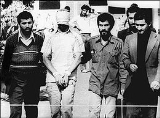
The occupiers bound and blindfolded the embassy soldiers and staff and paraded them in front of photographers. In the first couple of days many of the embassy staff who had snuck out of the compound or not been there at the time of the takeover were rounded up by Islamists and returned as hostages. Six American diplomats did however avoid capture and found refuge at the nearby Canadian
Canada

Canada is a country occupying most of northern North America, extending from the Atlantic Ocean in the east to the Pacific Ocean in the west and northward into the Arctic Ocean....
 and Swiss
Switzerland

Switzerland is a landlocked Swiss Alps country of roughly 7.7 million people in Western Europe with an area of 41,285 km?. Switzerland is a federal republic consisting of 26 states called Cantons of Switzerland....
 embassies in Tehran for three months. They fled Iran using Canadian passports on January 28, 1980.

444 days hostage


Hostage-holding motivations


The Muslim Student Followers of the Imam's Line demanded that the Shah be returned to Iran for trial and execution. The U.S. maintained that the Shah, who died less than a year later in July 1980, had come to America only for medical attention. The group's other demands included that the U.S. government apologize for its interference in the internal affairs of Iran and for the overthrow of Prime Minister Mossadeq, and that Iran's frozen assets in the U.S. be released.

The initial takeover plan was to hold the embassy for only a short time, but this changed after it became apparent how popular the takover was and that Khomeini had given it his full support. Some attribute the Iranian decision not to release the hostages quickly to U.S. President Jimmy Carter's "blinking" or failure to immediately deliver an ultimatum to Iran. His immediate response was to appeal for the release of the hostages on humanitarian grounds and to share his hopes of a strategic anti-communist alliance with the Islamic Republic. As some of the student leaders had hoped, Iran's moderate prime minister Mehdi Bazargan
Mehdi Bazargan

Mehdi Bazargan was a prominent Iranian scholar, academic, long-time pro-democracy activist and head of Interim government of Iran, 1979, making him Iran's first Prime Minister of Iran after the Iranian Revolution of 1979....
 and his cabinet resigned under pressure just days after the event.

The duration of the hostages' captivity has been blamed on internal Iranian revolutionary politics. As Ayatollah Khomeini told Iran's president:
This action has many benefits. ... This has united our people. Our opponents do not dare act against us. We can put the constitution to the people's vote without difficulty, and carry out presidential and parliamentary elections.


Theocratic Islamists, as well as leftist political groups and figures like leftist People's Mujahedin of Iran
People's Mujahedin of Iran

The People's Mujahedin of Iran is a militant Islamic socialism organization that advocates the overthrow of Iran's current government.Founded in 1965, the PMOI was originally devoted to armed struggle against the Mohammad Reza Pahlavi, capitalism, and Western imperialism....
, supported the taking of American hostages as an attack on "American imperialism" and its alleged Iranian "tools of the West." Revolutionary teams displayed secret documents taken from the embassy, sometimes painstakingly reconstructed after shredding
Paper shredder

Paper shredders are used to cut paper into Chad , typically either strips or fine particles. Government organizations, businesses, and private individuals use shredders to destroy private, confidentiality, or otherwise sensitive documents....
, to buttress their claim that "the Great Satan" (the U.S.) was trying to destabilize the new regime, and that Iranian moderates were in league with the U.S. (The documents were published in a series of books called "Documents from the US Espionage Den" . These books included telegrams, correspondence, and reports from the U.S. State Department and Central Intelligence Agency
Central Intelligence Agency

The Central Intelligence Agency is a civilian intelligence agency of the Federal government of the United States. It is the successor of the Office of Strategic Services formed during World War II to coordinate espionage activities between the branches of the US military services....
.)

By embracing the hostage-taking under the slogan "America can't do a thing," Khomeini rallied support and deflected criticism from his controversial Islamic theocratic constitution
Constitution of Islamic Republic of Iran

The Constitution of the Islamic Republic of Iran was adopted by referendum on October 24, 1979, and went into force on December 3 of that year, replacing the Iran Constitution of 1906....
, which was due for a referendum vote in less than one month. Following the successful referendum, both leftists and theocrats continued to use the issue of alleged pro-Americanism to suppress their opponents, the relatively moderate political forces, which included the Iranian Freedom Movement, National Front, Grand Ayatollah Shari'atmadari, and later President Abolhassan Banisadr
Abolhassan Banisadr

Abol-hassan Banisadr was the first President of Iran, following the 1979 Iranian Revolution and the abolition of the monarchy.Early life...
. In particular, carefully selected diplomatic dispatches and reports discovered at the embassy and released by the hostage takers led to the disempowerment and resignations of moderate figures such as Premier Mehdi Bazargan. The political danger in Iran of any move seen as accommodating America, along with the failed rescue attempt, delayed a negotiated release. After the hostages were released, leftists and theocrats turned on each other, with the stronger theocratic group decimating the left.
Man Holding Sign During Iranian Hostage Crisis Protest, 1979

Hostage conditions

The hostage-takers, declaring their solidarity with other "oppressed minorities" and "the special place of women in Islam," released 13 women and blacks in the middle of November 1979, leaving only one black and two women hostages. One more hostage, Richard Queen
Richard Queen

Richard Ivan Queen was born in Washington D.C. and worked for the U.S. State Department as Vice Consul at the U.S. Embassasy in Tehran, Iran. On November 4, 1979, he was among the 66 hostages taken by Islamic militants calling themselves the Muslim Student Followers of the Imam's Line; an event commonly known as the Iran Hostage Crisis....
, was released in July 1980 after he was diagnosed with multiple sclerosis
Multiple sclerosis

Multiple sclerosis is an autoimmune disease in which the immune system attacks the central nervous system, leading to demyelinating disease. Disease onset usually occurs in young adults, and it is more common in females....
. The remaining 52 hostages were held captive until January 1981.

Although the hostage takers declared that the hostages were actually "guests of the Ayatollah", the treatment the "guests" received was not always gracious. They were often paraded blindfolded before local crowds and television cameras, "experienced long periods of solitary confinement and for months were forbidden to speak to one another." Michael Metrinko was kept in handcuffs for 24 hours a day for two weeks after insulting the Ayatollah Khomeini.

The most terrifying night for the hostages came on February 5, 1980, when guards in black ski masks rousted the 53 hostages from their sleep and led them blindfolded to other rooms. They were searched after being ordered to strip to their underwear and keep their hands up. The mock execution ended after the guards cocked their weapons and readied them to fire but finally ejected their rounds and told the prisoners to pull up their pants. The hostages were later told the exercise was "just a joke" and something the guards "had wanted to do."

After the mock execution, the hostages were never threatened again with death by their guards and endured the less intense pains of homesickness, boredom and confinement: "Forcing grown men to live together in a small space day and night, month after month, is a form of slow torture. ... opinions become deadly and anything can provoke argument." Guards would often withhold mail from home, telling one hostage (Charles W. Scott) "I don't see anything for you, Mr. Scott. Are you sure your wife has not found another man?"

During the hostage crisis, several foreign diplomats and ambassadors including Canadian ambassador Ken Taylor came to visit the American hostages. The diplomats and ambassadors helped the American government stay in contact with the American hostages. Through these meetings with foreign governments, the "Laingen dispatches," made by hostage Bruce Laingen
Bruce Laingen

Lowell Bruce Laingen was the senior United States of America official held hostage during the Iran hostage crisis.Laingen was born on a farm in southern Minnesota, going on to graduate from St....
, were conveyed to the American government.

In America

In the United States, the hostage-taking is said to have created "a surge of patriotism" and left "the American people more united than they have been on any issue in two decades." The action was seen "not just as a diplomatic affront," but as a "declaration of war on diplomacy itself." Television news gave daily updates. President Carter applied economic and diplomatic pressure on Iran: oil imports from Iran were ended on November 12, 1979, and through the issuance of Executive Order 12170
Executive Order 12170

Executive Order 12170 was issued by United States president Jimmy Carter on 14 November, 1979 during the Iran hostage crisis. This allowed the freezing of all Iranian assets held within the United States....
, around US$
United States dollar

The United States dollar is the unit of currency of the United States and was defined by the Coinage Act of 1792 to be between 371 and 416 grains of silver ....
8 billion of Iranian assets in the U.S. were frozen by the Office of Foreign Assets Control
Office of Foreign Assets Control

The Office of Foreign Assets Control is an agency of the United States Department of the Treasury under the auspices of the Under Secretary of the Treasury for Terrorism and Financial Intelligence....
 on November 14.

During the weeks leading up to Christmas in 1979, high school students created Christmas cards that were delivered to the hostages in Iran. This was then replicated by community groups across the country, resulting in bales of Christmas cards delivered to the hostages. The White House Christmas Tree that year was left dark except for the top star.

A severe backlash against Iranians in the US developed. One Iranian later complained, "I had to hide my Iranian identity not to get beaten up, even at university." Many Iranians in the U.S. were also expelled.

According to author/journalist Mark Bowden, a pattern developed in Pres. Carter's attempts to negotiate a release of the hostages:
Carter would latch on to a deal proffered by a top Iranian official and grant minor but humiliating concessions, only to have it scotched at the last minute by Khomeini.


Canadian Caper

On the day the hostages were seized, six American diplomats evaded capture and remained in hiding at the Swiss
Switzerland

Switzerland is a landlocked Swiss Alps country of roughly 7.7 million people in Western Europe with an area of 41,285 km?. Switzerland is a federal republic consisting of 26 states called Cantons of Switzerland....
 and Canadian
Canada

Canada is a country occupying most of northern North America, extending from the Atlantic Ocean in the east to the Pacific Ocean in the west and northward into the Arctic Ocean....
 embassies. In 1979, the Canadian Parliament
Parliament of Canada

The Parliament of Canada is Canada's legislature, seated at Parliament Hill in Ottawa, Ontario. The Governor General of Canada appoints the 105 members of the upper house, the Canadian Senate, on the recommendation of the Prime Minister of Canada....
 held a secret session for the first time since World War II in order to pass special legislation allowing Canadian passport
Passport

A passport is a document, issued by a national government, which certifies, for the purpose of international travel, the identity and nationality of its holder....
s to be issued to some American citizens so that they could escape. Six American diplomats boarded a flight to Zürich
Zürich

Z?rich is the largest city in Switzerland and the capital of the canton of Z?rich. The city is Switzerland's main commercial and cultural centre and sometimes called the Cultural Capital of Switzerland, the political capital of Switzerland being Berne....
, Switzerland
Switzerland

Switzerland is a landlocked Swiss Alps country of roughly 7.7 million people in Western Europe with an area of 41,285 km?. Switzerland is a federal republic consisting of 26 states called Cantons of Switzerland....
, on January 28, 1980. Their escape and rescue from Iran by Canadian ambassador Ken Taylor has come to be known as the Canadian Caper.

Rescue attempts


After rejecting Iranian demands, Carter approved an ill-fated secret rescue mission, Operation Eagle Claw
Operation Eagle Claw

Operation Eagle Claw was a Military of the United States military operation to rescue the Iran hostage crisis from the U.S. Embassy in Tehran, Iran on April 24, 1980....
. Late in the afternoon of April 24, eight RH-53D
CH-53 Sea Stallion

The CH-53 Sea Stallion is the most common name for the Sikorsky Aircraft Corporation S-65 family of heavy-lift transport helicopters. Originally developed for use by the United States Marine Corps, it is also in service with Germany, Iran, Israel, Mexico, and as the MH-53 Pave Low with the United States Air Force....
 helicopters flew from the aircraft carrier USS Nimitz toward a remote landing site (really just a desert road) serving as an airstrip in the Great Salt Desert
Dasht-e Kavir

Dasht-e Kavir , also known as Kavir-e Namak or Great Salt Desert is a large desert lying in the middle of the Plateau of Iran. It is about 800 kilometers long and 320 kilometers wide with a total surface area of about 77,600 square kilometers ....
 of Eastern Iran, near Tabas
Tabas

Tabas , center of Tabas County, is a city of 30,000 people, located in central Iran, 950 kilometers southeast of Tehran, in the province of Yazd Province....
. Early the next morning six of the eight RH-53D
CH-53 Sea Stallion

The CH-53 Sea Stallion is the most common name for the Sikorsky Aircraft Corporation S-65 family of heavy-lift transport helicopters. Originally developed for use by the United States Marine Corps, it is also in service with Germany, Iran, Israel, Mexico, and as the MH-53 Pave Low with the United States Air Force....
 helicopters met up with several waiting C-130
C-130 Hercules

The Lockheed C-130 Hercules is a four-engine turboprop military transport aircraft built by Lockheed. It is the main tactical airlifter for many military forces worldwide....
 transport and refueling airplanes at the landing site and refueling area, designated "Desert One" by the mission.

Of the two helicopters that did not make it to Desert One, one suffered avionics failures en route and returned to the USS Nimitz, and the other had an indication that one of its main rotor blades was fractured, and was abandoned in the desert en route to Desert One. Its crew was seen and retrieved by another helicopter that continued to Desert One. The helicopters maintained strict radio silence under orders for the entire flight, an issue which impacted their ability to maintain a cohesive flying unit while en route, as they all arrived separately and behind schedule. The strict radio silence also prevented them from requesting permission to fly above the sandstorm
Haboob

File:Haboob, Taji, Iraq, 2006.JPGA haboob is a type of intense sandstorm commonly observed in the Sahara desert , as well as across the Arabian Peninsula, throughout Kuwait, and in the most arid regions of Iraq....
 as the C-130s had done, and they flew the entire route at hazardous low levels, even while inside the sandstorm
Haboob

File:Haboob, Taji, Iraq, 2006.JPGA haboob is a type of intense sandstorm commonly observed in the Sahara desert , as well as across the Arabian Peninsula, throughout Kuwait, and in the most arid regions of Iraq....
 and with limited field of vision and erratic instrumentation.

The mission plan called for a minimum of six helicopters but of the six that made it to Desert One, one had a failed primary hydraulics system and had flown on the secondary hydraulics system for the previous four hours.

The failing helicopter's crew wanted to continue, but due to the increased risk of not having a backup hydraulic system during flight, the helicopter squadron's commander decided to ground the helicopter. The Delta commander, Col. Beckwith, then recommended the mission be aborted and his recommendation was approved by President Carter. As the helicopters repositioned themselves for refueling, one helicopter landed on top of a C-130 tanker aircraft and crashed, killing eight U.S. servicemen and injuring several more.

After the mission and its failure were made known, Khomeini's prestige skyrocketed in Iran as he credited divine intervention on behalf of Islam for the result. Iranian officials who favored release of the hostages, such as President Bani Sadr, were weakened. In America, President Carter's political popularity and prospects for being reelected in 1980 were further damaged after a April 25 television address in which he explaining the rescue operation.

A second rescue attempt that was planned but never attempted used highly modified YMC-130H Hercules
C-130 Hercules

The Lockheed C-130 Hercules is a four-engine turboprop military transport aircraft built by Lockheed. It is the main tactical airlifter for many military forces worldwide....
 aircraft. Outfitted with rocket thrusters fore and aft to allow an extremely short landing and takeoff in the Shahid Shiroudi soccer stadium located close to the embassy, three aircraft were modified under a rushed super-secret program known as Operation Credible Sport
Operation Credible Sport

Operation Credible Sport was a United States military aircraft modification plan in late 1980 to prepare for a second rescue attempt of the Iran hostage crisis using C-130 cargo planes modified with rocket engines....
. One aircraft crashed during a demonstration at Duke Field at Eglin Air Force Base
Eglin Air Force Base

Eglin Air Force Base is a United States Air Force base located southwest of Valparaiso, Florida in Okaloosa County, Florida, Florida, United States....
 Auxiliary Field 3 on October 29, 1980, when its landing braking rockets were fired too soon. The misfire caused a hard touchdown that tore off the starboard wing and started a fire; all on board survived. The impending change in the White House
White House

The White House is the official residence and principal workplace of the President of the United States. Located at 1600 Pennsylvania Avenue in Washington, D.C., it was built between 1792 and 1800 of white-painted Aquia sandstone in the late Georgian architecture and has been the executive residence of every U.S....
 following the November election led to an abandonment of this project. The two surviving airframes were returned to regular duty with the rocket packages removed. One is at the Museum of Aviation located next to Robins Air Force Base
Robins Air Force Base

Robins Air Force Base is a major United States Air Force base located in Houston County, Georgia, Georgia , United States. The base is located just east of and adjacent to the city of Warner Robins, Georgia, SSE of Macon, Georgia, and about SSE of Atlanta, Georgia....
 in Georgia
Georgia (U.S. state)

Georgia is a U.S. state in the United States and was one of the original Thirteen Colonies that revolted against United Kingdom rule in the American Revolution....
.

The aforementioned failed rescue attempt led to the creation of the 160th S.O.A.R., a helicopter aviation special forces group in the United States Army
United States Army

The United States Army is the branch of the United States Armed Forces responsible for Army operations. It is the largest and oldest established branch of the U.S....
.

Final months


The death of the Shah on July 27 and the invasion of Iran by Iraq in September 1980 may have made Iran more receptive to the idea of resolving the hostage crisis. Ronald Reagan defeated Jimmy Carter in the November 1980 presidential election
United States presidential election, 1980

The United States presidential election of 1980 featured a contest between incumbent United States Democratic Party Jimmy Carter and his United States Republican Party opponent, Ronald Reagan, along with Third party candidates, the Independent John B....
 but Carter continued to attempt to negotiate the release of the hostages through Secretary of State Warren Christopher, Algerian intermediaries and members of the Iranian government in the final days of his presidency.

In the waning days of Carter's Presidency, Algerian diplomat Abdulkarim Ghuraib opened fruitful negotiations between the U.S. and Iran. This resulted in the "Algiers Accords
Algiers Accords

The Algiers Accords of January 19, 1981, were brokered by the Algerian government between the USA and Iran to resolve the Iran hostage crisis. The crisis arose from the takeover of the American embassy in Tehran on November 4 1979, and the taking hostage of the American staff there....
" of January 19, 1981. The Algiers Accords called for Iran's immediate freeing of the hostages, the unfreezing of $7.9 billion of Iranian assets and immunity from lawsuits Iran might have faced in America, and a pledge by the United States that "it is and from now on will be the policy of the United States not to intervene, directly or indirectly, politically or militarily, in Iran's internal affairs."

On January 20, 1981, minutes after Reagan was sworn in as President, the American hostages were released by Iran into U.S. custody, having spent 444 days in captivity. The hostages were flown to Algeria as a symbolic gesture for the help of that government in resolving the crisis. The flight continued to Rhein-Main Air Base
Rhein-Main Air Base

Rhein-Main Air Base was a U.S. Air Force / NATO military airbase near the city of Frankfurt am Main, Germany. It occupied the south side of Frankfurt International Airport....
 in West Germany
West Germany

West Germany was the common English name for the Germany , from its formation in May 1949 to German reunification in October 1990, when East Germany was dissolved and its States of Germany became part of the Federal Republic, ending the more than 40-year division of Germany....
, where former President Carter, acting as emissary, received them. After medical check-ups and debriefings, they took a second flight to Stewart Air National Guard Base
Stewart Air National Guard Base

Stewart Air National Guard Base is the home of the 105th Airlift Wing , an Air Mobility Command -gained unit of the New York Air National Guard and "host" wing for the installation....
 in Newburgh, New York
Newburgh (city), New York

Newburgh is a city located in Orange County, New York, 60 miles north of City of New York, and south of Albany, New York, on the Hudson River....
, with a refueling stop in Shannon
Shannon

Shannon is a given name.Notable people bearing this name include:* Shannon , real name Shannon Brenda Greene* Marty Wilde, pseudonym "Shannon", real name Reginald Leonard Smith...
, Ireland
Ireland

Ireland is the List of islands by area in Europe, and the twentieth-largest island in the world. It lies to the north-west of continental Europe and is surrounded by hundreds of islands and islet....
, where they were greeted by a large crowd. From Newburgh they traveled by bus to the United States Military Academy
United States Military Academy

The United States Military Academy at West Point is a four-year coeducational United States Service academies located at West Point, New York, New York....
, receiving a heroes' welcome all along the route. Ten days after their release, the former hostages were given a ticker tape parade through the Canyon of Heroes
Canyon of Heroes

"Canyon of Heroes" is a colloquialism referring to the section of New York City's lower Broadway and the Financial District that is the historic location of the city's ticker-tape parades....
 in New York City
New York City

The City of New York is the List of United States cities by population in the United States, while the New York metropolitan area ranks among the List of urban areas by population....
.

Aftermath

Us Embassy Tehran

Iran–Iraq War

The Iraq invasion of Iran occurred less than a year after the embassy employees were taken hostage. At least one observer (Stephen Kinzer
Stephen Kinzer

Stephen Kinzer is a United States author and newspaper reporter. He is a veteran New York Times correspondent who has reported from more than fifty countries on five continents....
) believes the dramatic change of US-Iranian relations from ally to enemy played a part in emboldening Saddam Hussein
Saddam Hussein

Saddam Hussein Abd al-Majid al-Tikriti was the President of Iraq of Iraq from 16 July 1979 until 9 April 2003.A leading member of the revolutionary Ba'ath Party, which espoused secular pan-Arabism, economic modernization, and Arab socialism, Saddam played a key role in the 1968 coup that brought the party to long-term power....
 to invade, and US anger with Iran led the US to aid Iraq after the war turned against Iraq. The US supplied Iraq with, among other things, "helicopters and satellite intelligence that was used in selecting bombing targets". In turn, this aid and the shooting down of Iran Air Flight 655
Iran Air Flight 655

Iran Air Flight 655, also known as IR655, was a civilian airliner shot down by United States Surface to air missile on Sunday 3 July 1988, over the Strait of Hormuz, toward the end of the Iran-Iraq War....
 in the Persian Gulf by the USS Vincennes "deepened and widened anti-American feeling in Iran."

Iran

The hostage taking was unsuccessful for the Islamic Republic in some respects. Iran lost international support for its war against Iraq, and the settlement was considered almost wholly favorable to the United States since it did not meet any of Iran's original demands. But the crisis strengthened Iranians who supported the hostage taking. Anti-Americanism became even more intense, and anti-American rhetoric continued unabated. Politicians such as Musavi-Khoeniha and Behzad Nabavi were left in a stronger position, while those associated or accused of association with America were removed from the political picture. Khomeini biographer Baqer Moin
Baqer Moin

Baqer Moin is a BBC journalist and author. He has been described as "a specialist on Iran and Islam and is head of the BBC's Persian Service" and as "BBC's Central Asia specialist" ...
 describes the incident as "a watershed in Khomeini's life" transforming him from a "cautious, pragmatic politician" into "a modern revolutionary, single-mindedly pursing a dogma". In his statements, "imperialism, liberalism, democracy" were "negative words", while "revolution ... became a sacred word, sometimes more important than Islam."

America

In America, gifts were showered upon the hostages upon their return, including lifetime passes to any minor league
Minor league baseball

Minor league baseball is a hierarchy of professional baseball leagues in North America that compete at levels below that of Major League Baseball....
 or Major League Baseball
Major League Baseball

Major League Baseball is the highest level of play in American professional baseball. Specifically, Major League Baseball refers to the organization that operates the National League and the American League, by means of a joint organizational structure that has developed gradually between them since 1903 ....
 game.

In 2000, the hostages and their families tried to sue Iran, unsuccessfully, under the Antiterrorism Act
Antiterrorism and Effective Death Penalty Act of 1996

The Antiterrorism and Effective Death Penalty Act of 1996, Pub. L. No. 104-132, 110 Stat. 1214, is an Act of Congress signed into law on April 24, 1996 to "deter terrorism, provide justice for victims, provide for an effective death penalty, and for other purposes." It was passed with broad bipartisan support by Congress following the Oklah...
. They originally won the case when Iran failed to provide a defense, but the U.S. State Department
United States Department of State

The United States Department of State, often referred to as the State Department, is the United States Cabinet-level foreign affairs agency of the United States Federal government of the United States, similar to foreign ministries, foreign offices, ministries of external relations, etc....
 tried to put an end to the suit, fearing that it would make international relations difficult. As a result, a federal judge ruled that nothing could be done to repay the damages the hostages faced because of the agreement the U.S. made when the hostages were freed.

The US embassy building is used by Iran's government and its affiliated groups. The Guardian
The Guardian

Sorry, no overview for this topic
 reported in 2006 that a group called The Committee for the Commemoration of Martyrs of the Global Islamic Campaign used the US embassy to recruit "martyrdom seekers", volunteers to carry out operations against Western and Jewish targets. Mohammad Samadi, a spokesman for the group, signed up several hundred volunteers in a few days.

Conspiracy theories


Alleged Rockefeller plot
One conspiratorial explanation for the hostage taking is that David Rockefeller plotted to allow the Shah to enter America knowing this would provoke the Islamic revolutionaries into "some kind of outrageous" response, which in turn would provoke a retaliation by the American government of freezing Iranian assets kept in Rockefeller's Chase Manhattan Bank. This would help replace loans made by Chase Manhattan to the Shah that the Islamic government had no intention of repaying. The theory is mentioned by roozonline and in the book Taken Hostage, by David Farber

Other alleged plots
In Iran the failed rescue attempt was described by revolutionaries not as an attempt to free the hostages but as a `secret invasion` by hundreds of American troops "to murder Khomeini and destroy the revolution." American hostages were told that America had sent commandos to Iran to kill them, and that the hostages had been moved to prison cells for their own protection.

Alleged CIA plot
Journalist Mark Bowden writes that since the hostage taking "helped prompt the disastrous Iran-Iraq War and 25 years of international troubles for Iran," it is now much less popular in Iran. Conspiracy theorists such as "Reza Ghapour, a young fundamentalist `scholar`" and Abolhassan Banisadr
Abolhassan Banisadr

Abol-hassan Banisadr was the first President of Iran, following the 1979 Iranian Revolution and the abolition of the monarchy.Early life...
 argue the hostage taking "was a secret CIA plot" and that the student hostage takers were "either stooges or, at worst, American agents." In Iran their theories are "taken seriously" by "even well-educated people."

October Surprise conspiracy theory

The October Surprise theory refers to a purported deal between high-level Reagan campaign operatives and representatives of the Iranian Islamic government to delay the release of the hostages until after the November 1980 U.S. elections. The delay would hurt Reagan's opponent incumbent President Carter, as the hostage taking occured on his watch and Carter had been seen to invest much effort into getting the hostages released. Although investigations by the United States Senate
United States Senate

The United States Senate is the upper house of the Bicameralism United States Congress, the lower house being the United States House of Representatives....
 and House of Representatives
United States House of Representatives

The United States House of Representatives, commonly referred to as "the House", is one of the bicameralism of the United States Congress; the other is the United States Senate....
 in the 1990s declared the allegations to be unfounded, the conspiracy's existence or lack thereof remains a subject of debate. The main cause for suspicion was the seeming coincidence of his inauguration and the hostages' release six minutes after Reagan was sworn into office on January 20, 1981, as well as the Reagan administration's later decision to provide arms to the anti-U.S. Iranian government, allegedly in return not for freeing the hostages, but for delaying their release.

However, special ops personnel involved in the preparations for the second rescue attempt believed that incoming President Ronald Reagan was involved in the planning and timing of the second rescue attempt, and that these intentions were either implied or made known to the de facto Iranian government, leading to the hostages' release just minutes after Reagan's inauguration.

Long Term effect

Some doubt the hostage crisis will have a long term effect on US-Iranian relations. Journalist Robert Kaplan
Robert Kaplan

Robert Kaplan may refer to:* Robert D. Kaplan, travel writer, essayist, and international correspondent for The Atlantic* Robert S. Kaplan, business theorist and professor of accounting at Harvard Business School...
 argues that those who believe relations between the two countries "will never be restored because of the hostage crisis .... ignore history," and compares the hostage taking to a 19th century Iranian attack on the Russian embassy.
In 1829, ... Iranians ... stormed and destroyed the Russian embassy and decapitated the Russian ambassador, Alexander Griboyedov. But Russian-Iranian relations were eventually restored. Who, now, even remembers the incident?


Hostages

November 4, 1979 - January 20, 1981 - 66 original captives - 63 from and held at Embassy, three from and held at Foreign Ministry Office.

At least three of the hostages were operatives of the CIA.

Thirteen hostages were released from November 19-20, 1979, and one was released on July 11, 1980. Fifty-two remaining hostages endured 444 days of captivity until their release (announced across the Capitol
United States Capitol

The United States Capitol serves as the seat of government for the United States Congress, the legislature of the federal government of the United States....
 grounds twenty minutes after the swearing in of the new President) on Reagan's Inauguration Day, January 20, 1981.

Six diplomats who evaded capture

  • Robert Anders, 34 - Consular Officer
  • Mark J. Lijek, 29 - Consular Officer
  • Cora A. Lijek, 25 - Consular Assistant
  • Henry L. Schatz, 31 - Agriculture Attaché
  • Joseph D. Stafford, 29 - Consular Officer
  • Kathleen F. Stafford, 28 - Consular Assistant


13 hostages released

From November 19-20, 1979, thirteen women and American personnel of African descent that had been captured and held hostage were released:
  • Kathy Gross, 22 - Secretary
  • Sgt. James Hughes, 30 - USAF Administrative Manager
  • Lillian Johnson, 32 - Secretary
  • Sgt. Ladell Maples, 23 - USMC Embassy Guard
  • Elizabeth Montagne, 42 - Secretary
  • Sgt. William Quarles, 23 - USMC Embassy Guard
  • Lloyd Rollins, 40 - Administrative Officer
  • Capt. Neal (Terry) Robinson, 30 - Administrative Officer
  • Terri Tedford, 24 - Secretary
  • Sgt. Joseph Vincent, 42 - USAF Administrative Manager
  • Sgt. David Walker, 25 - USMC Embassy guard
  • Joan Walsh, 33 - Secretary
  • Cpl. Wesley Williams, 24 - USMC Embassy Guard


Richard I. Queen released

On July 11. 1980, 28-year-old Vice Consul Richard I. Queen, who had been captured and held hostage, was released after becoming seriously ill. He was later diagnosed with multiple sclerosis
Multiple sclerosis

Multiple sclerosis is an autoimmune disease in which the immune system attacks the central nervous system, leading to demyelinating disease. Disease onset usually occurs in young adults, and it is more common in females....
. (Died August 14, 2002.)

52 remaining hostages released

The following fifty-two remaining hostages were held captive until January 20, 1981.
  • Thomas L. Ahern, Jr., - Narcotics Control Officer (later identified as CIA station chief)
  • Clair Cortland Barnes, 35 - Communications Specialist
  • William E. Belk, 44 - Communications and Records Officer
  • Robert O. Blucker, 54 - Economics Officer Specializing in Oil (Died 4/3/2003)
  • Donald J. Cooke, 26 - Vice Consul
  • William J. Daugherty, 33 - 3rd Secretary of U.S. Mission
  • Lt. Cmdr. Robert Englemann, 34 - U.S. Navy
    United States Navy

    The United States Navy is the navy of the United States Armed Forces. It is one of the seven uniformed services of the United States. The U.S. Navy currently has approximately 331,682 personnel on active duty as of 31 December 2008 and 124,000 in the United States Navy Reserve....
     Attaché
  • Sgt. William Gallegos, 22 - USMC Guard
  • Bruce W. German, 44 - Budget Officer
  • Duane L. Gillette, 24 - USN Communications and Intelligence Specialist
  • Alan B. Golacinski, 30 - Regional Security Officer, Diplomatic Security Service
    Diplomatic Security Service

    The U.S. Diplomatic Security Service is the federal law enforcement arm of the United States Department of State. The majority of its Special Agents are members of the United States Foreign Service and federal law enforcement agents at the same time, making them unique....
  • John E. Graves, 53 - Public Affairs Officer (Died 4/27/2001)
  • Joseph M. Hall, 32 - CWO
    Warrant Officer (United States)

    In the United States military, a Warrant Officer is ranked as an officer above the senior-most enlisted ranks, as well as officer cadets and candidates, but below the officer grade of O-1 ....
     Military Attaché
  • Sgt. Kevin J. Hermening, 21 - USMC Guard
  • Sgt. 1st Class Donald R. Hohman, 38 - U.S. Army
    United States Army

    The United States Army is the branch of the United States Armed Forces responsible for Army operations. It is the largest and oldest established branch of the U.S....
     Medic
  • Col. Bob J. Holland, 53 - Military Attaché (Died 10/2/1990)
  • Michael Howland, 34 - Assistant Regional Security Officer, Diplomatic Security Service
    Diplomatic Security Service

    The U.S. Diplomatic Security Service is the federal law enforcement arm of the United States Department of State. The majority of its Special Agents are members of the United States Foreign Service and federal law enforcement agents at the same time, making them unique....
    , held at Iranian Foreign Ministry Office
  • Charles A. Jones, Jr., 40 - Communications Specialist, Teletype Operator. (only African American hostage not released in November 1979)
  • Malcolm Kalp, 42 - Commercial Officer (Died 4/7/2002)
  • Moorhead C. Kennedy Jr., 50 - Economic and Commercial Officer
  • William F. Keough, Jr., 50 - Superintendent of American School in Islamabad
    Islamabad

    Islamabad is the Capital of Pakistan, and is the tenth largest city in Pakistan. The Rawalpindi/Islamabad List of most populous metropolitan areas in Pakistan is the third largest in Pakistan with a population of over 4.5 million inhabitants, 1.5 million in Islamabad and three million in Rawalpindi....
    , Pakistan
    Pakistan

    Pakistan , officially the Islamic Republic of Pakistan, is a country located in South Asia and borders Central Asia and the Middle East. It has a 1,046 kilometre coastline along the Arabian Sea and Gulf of Oman in the south, and is bordered by Afghanistan and Iran in the west, India in the east and People's Republic of China in th...
    , visiting Tehran at time of embassy seizure (Died 11/27/1985)
  • Cpl. Steven W. Kirtley - USMC Guard
  • Capt. Eric M. Feldman, 24 - Military officer
  • Kathryn L. Koob, 42 - Embassy Cultural Officer; one of two female hostages
  • Frederick Lee Kupke, 34 - Communications Officer and Electronics Specialist
  • L. Bruce Laingen
    Bruce Laingen

    Lowell Bruce Laingen was the senior United States of America official held hostage during the Iran hostage crisis.Laingen was born on a farm in southern Minnesota, going on to graduate from St....
    , 58 - Chargé d'Affaires, held at Iranian Foreign Ministry Office
  • Steven Lauterbach, 29 - Administrative Officer
  • Gary E. Lee, 37 - Administrative Officer
  • Sgt. Paul Edward Lewis, 23 - USMC Guard
  • John W. Limbert, Jr.
    John Limbert

    John W. Limbert is the charg? d'affaires of the United States embassy in Khartoum, Sudan. Previously he was the ambassador to Mauritania from 2000-2003....
    , 37 - Political Officer
  • Sgt. James M. Lopez, 22 - USMC Guard
  • Sgt. John D. McKeel, Jr., 27 - USMC Guard (Died 11/1/1991)
  • Michael J. Metrinko, 34 - Political Officer
  • Jerry J. Miele, 42 - Communications Officer
  • Staff Sgt. Michael E. Moeller, 31 - Head of USMC Guard Unit at Embassy
  • Bert C. Moore, 45 - Counselor for Administration (Died 6/8/2000)
  • Richard H. Morefield, 51 - U.S. Consul General in Tehran
  • Capt. Paul M. Needham, Jr., 30 - USAF Logistics Staff Officer
  • Robert C. Ode, 65 - Retired Foreign Service Officer on Temporary Duty in Tehran (Died 9/8/1995)
  • Sgt. Gregory A. Persinger, 23 - USMC Guard
  • Jerry Plotkin, 45 - civilian businessman visiting Tehran (Died 6/6/1996)
  • MSgt. Regis Ragan, 38 - US Army NCO assigned to Defense Attaché's Office
  • Lt. Col. David M. Roeder, 41 - Deputy USAF Attaché
  • Barry M. Rosen, 36 - Press Attaché
  • William B. Royer, Jr., 49 - Assistant Director of Iran-American Society
  • Col. Thomas E. Schaefer, 50 - USAF Attaché
  • Col. Charles W. Scott, 48 - US Army Officer, Military Attaché
  • Cmdr. Donald A. Sharer, 40 - USN Air Attaché
  • Sgt. Rodney V. (Rocky) Sickmann, 22 - USMC Guard
  • Staff Sgt. Joseph Subic, Jr., 23 - Military Police, US Army, Defense Attaché's Staff
  • Elizabeth Ann Swift, 40 - Chief of Embassy's Political Section; 1 of 2 female hostages (Died 5/7/2004)
  • Victor L. Tomseth, 39 - Senior Political Officer, held at Iranian Foreign Ministry Office
  • Phillip R. Ward, 40 - TDY Communications officer CIA, Assigned to Brandy Station, Va.


Servicemen awarded

For their service during the hostage crisis, the US military later awarded the 20 servicemen who were among the hostages the Defense Meritorious Service Medal
Defense Meritorious Service Medal

The Defense Meritorious Service Medal is the third-highest award bestowed upon members of the United States military by the United States Department of Defense....
. The only hostage serviceman not to be issued the medal was Staff Sgt. Joseph Subic, Jr. The reason given was that Subic did not behave under stress the way noncommissioned officers are expected to act, i.e. he cooperated with the hostage takers according to other hostages.

For their part in the mission, the Humanitarian Service Medal
Humanitarian Service Medal

The Humanitarian Service Medal is a Awards and decorations of the United States military of the United States armed forces which was created on January 19, 1977 by Gerald Ford under ....
 was awarded to the servicemen of Joint Task Force (JTF) 1-79 (the planning authority for Operation Rice Bowl/Eagle Claw) who participated in the rescue attempt.

Also, the USAF special ops component of the mission was awarded the AF Outstanding Unit award for that year for performing their part of the mission flawlessly, to include accomplishing the evacuation of the entire Desert One site after the accident and under extreme conditions.

Civilian hostages

A small number of hostages were not connected to the diplomatic staff. All had been released by late 1981.
  • Mohi Sobhani, an Iranian-American
    Iranian-American

    Iranian Americans or Persian Americans are United States of America citizens of Iranian people or heritage. Iranian Americans are among the most highly educated people in the country....
     engineer
    Engineer

    An engineer is a person professionally engaged in a field of engineering. Engineers are concerned with developing economical and safe solutions to practical problems, by applying mathematics and scientific knowledge while considering technical constraints....
     and a member of the Bahá'í Faith
    Bahá'í Faith

    The 'Bah?'? Faith' is a monotheism religion founded by Bah?'u'll?h in nineteenth-century Persian Empire#Persia and Europe , emphasizing the spiritual unity of all humankind....
    . Released 2/4/1981. (Died 7/12/2005)
  • Zia Nassery/Nassri, an Afghan-American. Released 2/4/1981.
  • Cynthia Dwyer, an American reporter, was eventually charged with espionage
    Espionage

    Espionage or spying involves an individual obtaining information that is considered secrecy or confidential without the permission of the holder of the information....
     and expelled 2/10/1981.
  • Electronic Data Systems
    Electronic Data Systems

    Electronic Data Systems, an HP Company, commonly EDS, is a global business and technology services company headquartered in Plano, Texas that defined the outsourcing business when it was established in 1962 by Ross Perot....
     employees Paul Chiapparone and Bill Gaylord rescued by Ross Perot
    Ross Perot

    Henry Ross Perot is an United States businessman from Texas, who is best known for seeking the office of President of the United States in U.S....
    -funded operation (see Arthur D. Simons
    Arthur D. Simons

    Colonel Arthur D. "Bull" Simons was a United States Army Special Forces officer, best known for leading Operation Ivory Coast, an attempted rescue of American prisoner of war from a North Vietnamese prison at Son Tay....
    ) in 1979.
  • Four British
    United Kingdom

    The United Kingdom of Great Britain and Northern Ireland, commonly known as the United Kingdom , the UK or Britain,is a sovereign state located off the northwestern coast of continental Europe....
     missionaries


Notable hostage takers, guards, interrogators

  • Hussein Sheikholeslam
    Hussein Sheikholeslam

    Hussein Sheikholeslam is a member of the Islamic Consultative Assembly of the Islamic Republic of Iran. He was also the Iranian ambassador to Syria....
  • Ebrahim Asgharzadeh
    Ebrahim Asgharzadeh

    Ebrahim Asgharzadeh is an Iranian political activist and politician. He served as a member of the 3rd Majlis from 1989-1993 and as a member of the first City Council of Tehran from 1999-2003....
  • Mohsen Mirdamadi
    Mohsen Mirdamadi

    Mohsen Mirdamadi, was an organizer of the 1979 Iran Hostage Crisis, a member of the parliament of Iran from 2000-2004, and the "head of the largest pro-reform party" in Iran, Islamic Iran Participation Front since 2006....
    , MP
  • Masoumeh Ebtekar
    Masoumeh Ebtekar

    Masoumeh Ebtekar is an Iranian scientist and politician.Ebtekar first achieved fame as the spokeswoman of the students who had occupied the US Embassy in 1979 and Iran hostage crisis for over a year....
    , translator


See also

  • 2006 US raid on Iranian diplomats
    2006 US raid on Iranian diplomats

    On December 21, 2006 the United States military raided a group of Iranian officials including two foreign affair officials and detained them. American forces released the officials after nine days, on December 29, 2006....
  • US attack on Iranian consular office in Arbil
  • Baghdad kidnapping of Iranian diplomat (February 2007)
  • Iran Air Flight 655
    Iran Air Flight 655

    Iran Air Flight 655, also known as IR655, was a civilian airliner shot down by United States Surface to air missile on Sunday 3 July 1988, over the Strait of Hormuz, toward the end of the Iran-Iraq War....
  • Iranian diplomats kidnapping (1982)
  • List of hostage crises
    List of hostage crises

    This is a list of hostage crises by date....
  • Guests of the Ayatollah: The First Battle in America's War with Militant Islam
    Guests of the Ayatollah: The First Battle in America's War with Militant Islam

    Guests of the Ayatollah: The First Battle in America's War with Militant Islam is a non-fiction work written by Black Hawk Down: A Story of Modern War author Mark Bowden....
     (2006)
  • International crisis
    International crisis

    An international crisis is a crisis between states. There are many definitions of an international crisis. Snyder "...a sequence of interactions between the governments of two or more sovereign states in severe conflict, short of actual war, but involving the perception of a dangerously high probability of war"....
  • Controversies surrounding Mahmoud Ahmadinejad
    Controversies surrounding Mahmoud Ahmadinejad

    Criticism of Iranian President Mahmoud Ahmadinejad became rampant after his election victory on June 29, 2005. These include charges that he participated in the 1979-1981 Iran hostage crisis, assassinations of Kurdistanish politicians in Austria, torture, interrogation and execution of political prisoners in the Evin prison in Tehran....
  • October surprise conspiracy
  • Iran-Contra affair
    Iran-Contra Affair

    The Iran-Contra affair was a American political scandals in the United States which came to light in November 1986, during the Presidency of Ronald Reagan, over an arms-for-hostages deal with Iran and funding for the Nicaraguan Contras....
  • Student Day in Iran
  • Case Concerning United States Diplomatic and Consular Staff in Tehran
    Case Concerning United States Diplomatic and Consular Staff in Tehran

    Case Concerning United States Diplomatic and Consular Staff in Tehran refers to a case brought to the International Court of Justice by the United States of America against Iran in response to the Iran hostage crisis....


Further reading


External links

  • hosts a gallery of photographs taken from inside the U.S. Embassy during the crisis.
  • , BBC's interview with Ebrahim Asgeh, a hostage-taker, and Bruce Laingen
    Bruce Laingen

    Lowell Bruce Laingen was the senior United States of America official held hostage during the Iran hostage crisis.Laingen was born on a farm in southern Minnesota, going on to graduate from St....
    , a captive