
All Topics  
Logistics

 
Logistics

   Email Print
   Bookmark   Link


Logistics


Logistics is the management of the flow of goods, information
Information

Information as a Conveyed concept has a diversity of meanings, from everyday usage to technical settings. Generally speaking, the concept of information is closely related to notions of constraint, communication, control system, data, form, instruction, knowledge, Meaning , stimulation, pattern, perception, and knowledge representation....
 and other resources, including energy
Energy

In physics, energy is a scalar physical quantity that describes the amount of Work_ that can be performed by a force. Energy is an attribute of objects and systems that is subject to a conservation law....
 and people, between the point of origin and the point of consumption in order to meet the requirements of consumers (frequently, and originally, military
Military

A military is an organization authorized by its nation to use force, usually including use of weapons, in defending its country by combating actual or Threat of force ....
 organizations).


Discussion
Ask a question about 'Logistics'
Start a new discussion about 'Logistics'
Answer questions from other users
Full Discussion Forum


Recent Posts


Encyclopedia


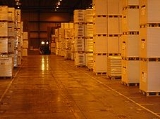
Allentown Project 042
Logistics is the management of the flow of goods, information
Information

Information as a Conveyed concept has a diversity of meanings, from everyday usage to technical settings. Generally speaking, the concept of information is closely related to notions of constraint, communication, control system, data, form, instruction, knowledge, Meaning , stimulation, pattern, perception, and knowledge representation....
 and other resources, including energy
Energy

In physics, energy is a scalar physical quantity that describes the amount of Work_ that can be performed by a force. Energy is an attribute of objects and systems that is subject to a conservation law....
 and people, between the point of origin and the point of consumption in order to meet the requirements of consumers (frequently, and originally, military
Military

A military is an organization authorized by its nation to use force, usually including use of weapons, in defending its country by combating actual or Threat of force ....
 organizations). Logistics involves the integration
Integration

Integration may refer to:In sociology and economy:*Social integration*Racial integration, refers to social and cultural behavior; in a legal sense, see desegregation...
 of information, transportation, inventory
Inventory

Inventory is a list for Good and materials, or those goods and materials themselves, held available in stock by a business. It is also used for a list of the contents of a household and for a list for will purposes of the possessions of someone who has died....
, warehousing, material-handling, and packaging. Logistics is a channel of the supply chain which adds the value of time and place utility.

Origins and definition

The term "logistics" originates from the ancient Greek
Ancient Greek

Ancient Greek is the historical stage in the development of the Greek language spanning across the Archaic Greece , Classical Greece , and Hellenistic civilization periods of ancient Greece and the classical antiquity....
 "?????" ("logos"—"ratio, word, calculation, reason, speech, oration").

Logistics is considered to have originated in the military's need to supply themselves with arms, ammunition and rations as they moved from their base to a forward position. In ancient Greek, Roman and Byzantine empires, there were military officers with the title ‘Logistikas’ who were responsible for financial and supply distribution matters.

The Oxford English dictionary defines logistics as: “The branch of military science
Military science

Military science is the process of translating national defence policy to produce military capability by employing military scientists, including: theorists, researchers, experimental scientists, applied scientists, designers, engineers, test technicians, and military personnel responsible for prototyping....
 having to do with procuring, maintaining and transporting material, personnel and facilities.”
Another dictionary definition is: "The time related positioning of resources." As such, logistics is commonly seen as a branch of engineering
Engineering

Engineering is the discipline and profession of applying Technology and science knowledge and utilizing natural laws and physical resources in order to design and implement materials, structures, machines, devices, systems, and process that safely realize a desired objective and meet specified criteria....
 which creates "people systems" rather than "machine systems."

Military logistics


In military logistics
Military logistics

Military logistics is the art and science of planning and carrying out the movement and maintenance of military forces. In its most comprehensive sense, it is those aspects or military operations that deal with:...
, logistics officers
Logistics Officer

A Logistics Officer, known in the past as a Supply Officer, is a member of an armed force responsible for overseeing the supplying of an army, both at home and abroad....
 manage
Management

Management in business and human organization activity is simply the act of getting people together to accomplish desired goals. Management comprises planning, organizing, staffing, leadership or directing, and Control an organization or effort for the purpose of accomplishing a goal....
 how and when to move resources to the places they are needed. In military science, maintaining one's supply lines while disrupting those of the enemy is a crucial—some would say the most crucial—element of military strategy
Military strategy

Military strategy is a policy implemented by military organizations to pursue desired Strategic goal s. Derived from the Greek language strategos, strategy when it appeared in use during the 18th century, was seen in its narrow sense as the "art of the general", 'the art of arrangement' of troops....
, since an armed force without resources and transportation is defenseless.

The defeat of the British in the American War of Independence, and the defeat of Erwin Rommel
Erwin Rommel

Erwin Johannes Eugen Rommel , was perhaps the most famous Germany Generalfeldmarschall of World War II. He was the commander of the Afrika Korps and became known for the skillful military campaigns he waged on behalf of the Wehrmacht in North Africa....
 in World War II
World War II

World War II, or the Second World War , was a global military conflict which involved a Participants in World War II, including all of the great powers, organised into two opposing military alliances: the Allies of World War II and the Axis powers....
, have been largely attributed to logistical failure. The historical leaders Hannibal Barca
Hannibal Barca

Hannibal, son of Hamilcar Barca, commonly known as Hannibal Hannibal's date of death is most commonly given as 183 BC, but there is a possibility it could have taken place in 182 BC. was a Carthage military commander and tactician who is popularly credited as one of the most talented commanders in history....
, Alexander the Great
Alexander the Great

Alexander the Great , also known as Alexander III of Macedon was an ancient Greeks King of Macedon . He was one of the most successful military commanders of all time and is presumed undefeated in battle....
 and the Duke of Wellington
Arthur Wellesley, 1st Duke of Wellington

Field Marshal Arthur Wellesley, 1st Duke of Wellington, Order of the Garter, Order of St Patrick, Order of the Bath, Royal Guelphic Order, Privy Council of the United Kingdom, Royal Society , was an Anglo-Irish soldier and statesman, and one of the leading military and political figures of the nineteenth century....
 are considered to have been logistical geniuses.

Another field within logistics is called Medical logistics
Medical logistics

Medical logistics is the logistics of pharmaceuticals, medical and surgical supplies, medical devices and equipment, and other products needed to support doctors, nurses, and other health and dental care providers....
.

Logistics management

Logistics management is that part of the supply chain
Supply chain

A supply chain or logistics network is the system of organizations, people, technology, activities, information and resources involved in moving a product or service from Vendor to customer....
 which plans, implements and controls the efficient, effective forward and reverse flow and storage of goods, services and related information between the point of origin and the point of consumption in order to meet customers' requirements. A professional working in the field of logistics management is called a logistician.

The Chartered Institute of Logistics & Transport (CILT) was established in the United Kingdom
United Kingdom

The United Kingdom of Great Britain and Northern Ireland, commonly known as the United Kingdom , the UK or Britain,is a sovereign state located off the northwestern coast of continental Europe....
 in 1919 and was granted the Royal Charter
Royal Charter

A royal charter is a charter granted by a Monarch to create institutions or other forms of incorporated bodies . In the United Kingdom legal tradition a royal charter is in the form of letters patent....
 in 1926. The Chartered Institute is one of professional bodies or institutions for the logistics & transport sectors, that offers such professional qualification or degree in logistics management.

Third-party logistics


Third-party logistics involves the utilization of external organizations to execute logistics activities that have traditionally been performed within an organization itself. According to this definition, third party logistics includes any form of outsourcing of logistics activities previously performed in-house. If, for example, a company with its own transport facilities decides to employ external warehouse specialist, this would be an example of third party logistics.

Warehouse Management System & Warehouse Control System


Although there is some functionality overlap, the differences between Warehouse Management Systems (WMS) and Warehouse Control Systems (WCS) can be significant. To put it simply, the WMS plans a weekly activity forecast, based on such factors as statistics, trends, and so forth, whereas a WCS acts like a floor supervisor, working in real time to get the job done by the most effective means. For instance, a WMS can tell the system it’s going to need five of SKU A and five of SKU B, hours in advance, but by the time it acts, other considerations may have come into play or there could be a potential logjam on a conveyor. A WCS can prevent that problem by working in real time and adapting to the situation by making a ‘last-minute decision’ based on current activity and operational status. Working synergistically, WMS and WCS can resolve these issues and maximize efficiency for companies that rely on the effective operation of their warehouse or distribution center. (1)

Business logistics

Logistics as a business concept evolved only in the 1950s. This was mainly due to the increasing complexity of supplying one's business with materials and shipping out products in an increasingly globalized supply chain, calling for experts in the field who are called Supply Chain Logisticians. This can be defined as having the right item in the right quantity at the right time at the right place for the right price in the right condition to the right customer and is the science of process and incorporates all industry sectors. The goal of logistics work is to manage the fruition of project life cycles, supply chain
Supply chain

A supply chain or logistics network is the system of organizations, people, technology, activities, information and resources involved in moving a product or service from Vendor to customer....
s and resultant efficiencies.

In business, logistics may have either internal focus (inbound logistics), or external focus (outbound logistics) covering the flow and storage of materials from point of origin to point of consumption (see supply chain management
Supply chain management

Supply chain management is the management of a Supply chain network of interconnected businesses involved in the ultimate provision of product and service packages required by end customers ....
). The main functions of a qualified logistician include inventory management, purchasing
Purchasing

Purchasing refers to a business or organization attempting to acquire goods or services to accomplish the goals of the enterprise. Though there are several organizations that attempt to set standards in the purchasing process, processes can vary greatly between organizations....
, transportation, warehousing, consultation
Consultation

The Consultation served as the provisional government of Mexican Texas from November 1835 through March 1836 during the Texas Revolution. Tensions rose in Texas during early 1835 as throughout Mexico federalism began to oppose the increasingly centralized government policies of the government....
 and the organizing and planning
Planning

Planning in organizations and public policy is both the organizational process of creating and maintaining a plan; and the psychological process of thinking about the activities required to create a desired goal on some scale....
 of these activities. Logisticians combine a professional knowledge of each of these functions so that there is a coordination of resources in an organization. There are two fundamentally different forms of logistics. One optimizes a steady flow of material through a network of transport
Transport

Transport or transportation is the movement of passenger and cargo from one location to another. Transport is performed by various modes of transport, such as aviation, rail transport, road transport, ship transport, cable transport, pipeline transport and space transport....
 links and storage nodes. The other coordinates a sequence
Sequence

In mathematics, a sequence is an ordered list of objects . Like a Set , it contains Element , and the number of terms is called the length of the sequence....
 of resources to carry out some project.

Production logistics


The term is used for describing logistic processes within an industry. The purpose of production logistics is to ensure that each machine and workstation is being fed with the right product in the right quantity and quality at the right point in time.

The issue is not the transportation itself, but to streamline and control the flow through the value adding processes and eliminate non-value adding ones. Production logistics can be applied in existing as well as new plants. Manufacturing in an existing plant is a constantly changing process. Machines are exchanged and new ones added, which gives the opportunity to improve the production logistics system accordingly. Production logistics provides the means to achieve customer response and capital efficiency.

Production logistics is getting more and more important with the decreasing batch sizes. In many industries (e.g. mobile phone) batch size one is the short term aim. This way even a single customer demand can be fulfilled in an efficient way. Track and tracing, which is an essential part of production logistics - due to product safety and product reliability issues - is also gaining importance especially in the automotive and the medical industry.

Professional Logistics

A logistician is a professional
Professional

A professional is a person who has completed a doctoral or law program or equivalent .A professional is someone who has a professional degree - a number one on the Hollingshead scale....
 logistics practitioner. Professional logisticians are often certified by professional associations.

Example certifications include:

  • FCILT, CMILT, and MILT, offered by the Chartered Institute of Logistics & Transport
  • EJLog, ESLog, and EMLog, offered by the European Logistics Association
  • CPL and CTP, offered by the Transport & Logistics Certification Council of Australia
  • PLog, offered by the Canadian Professional Logistics Institute
  • CITT, offered by the Canadian Institute of Traffic and Transportation
  • CML and CPL, offered by the International Society of Logistics
  • JrLog, Log, and SrLog, offered by the China Federation of Logistics & Purchasing
  • FHKLA and MHKLA, offered by the Hong Kong Logistics Association
  • PLS, CTL, and DLP, offered by the American Society of Transportation & Logistics


Some universities and academic institutions train students as logisticians, by offering undergraduate and postgraduate programs.