


Improvised explosive device

Encyclopedia
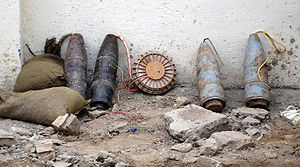
An improvised explosive device (IED), also known as a roadside bomb, is a homemade bomb
Bomb
A bomb is any of a range of explosive weapons that only rely on the exothermic reaction of an explosive material to provide an extremely sudden and violent release of energy...
constructed and deployed in ways other than in conventional
Conventional warfare
Conventional warfare is a form of warfare conducted byusing conventional military weapons and battlefield tactics between two or more states in open confrontation. The forces on each side are well-defined, and fight using weapons that primarily target the opposing army...
military
Military
A military is an organization authorized by its greater society to use lethal force, usually including use of weapons, in defending its country by combating actual or perceived threats. The military may have additional functions of use to its greater society, such as advancing a political agenda e.g...
action. It may be constructed of conventional military explosives, such as an artillery round, attached to a detonating mechanism.
IEDs may be used in terrorist actions or in unconventional warfare
Unconventional warfare
Unconventional warfare is the opposite of conventional warfare. Where conventional warfare is used to reduce an opponent's military capability, unconventional warfare is an attempt to achieve military victory through acquiescence, capitulation, or clandestine support for one side of an existing...
by guerrilla
Guerrilla warfare
Guerrilla warfare is a form of irregular warfare and refers to conflicts in which a small group of combatants including, but not limited to, armed civilians use military tactics, such as ambushes, sabotage, raids, the element of surprise, and extraordinary mobility to harass a larger and...
s or commando
Commando
In English, the term commando means a specific kind of individual soldier or military unit. In contemporary usage, commando usually means elite light infantry and/or special operations forces units, specializing in amphibious landings, parachuting, rappelling and similar techniques, to conduct and...
forces in a theater of operations
Theater (warfare)
In warfare, a theater, is defined as an area or place within which important military events occur or are progressing. The entirety of the air, land, and sea area that is or that may potentially become involved in war operations....
. In the second Iraq War, IEDs were used extensively against coalition forces and by the end of 2007 they had become responsible for approximately 63% of coalition deaths in Iraq. They are also used in Afghanistan by insurgent groups, and have caused over 66% of the coalition casualties in the 2001–present Afghanistan War
War in Afghanistan (2001–present)
The War in Afghanistan began on October 7, 2001, as the armed forces of the United States of America, the United Kingdom, Australia, and the Afghan United Front launched Operation Enduring Freedom...
.
They were also used extensively by cadres of the rebel Tamil Tiger (LTTE) organization against military targets in Sri Lanka
Sri Lanka
Sri Lanka, officially the Democratic Socialist Republic of Sri Lanka is a country off the southern coast of the Indian subcontinent. Known until 1972 as Ceylon , Sri Lanka is an island surrounded by the Indian Ocean, the Gulf of Mannar and the Palk Strait, and lies in the vicinity of India and the...
before the LTTE was dismantled in mid-2009 by the Sri Lankan military forces.
Background
The term Improvised Explosive Device comes from the British ArmyBritish Army
The British Army is the land warfare branch of Her Majesty's Armed Forces in the United Kingdom. It came into being with the unification of the Kingdom of England and Scotland into the Kingdom of Great Britain in 1707. The new British Army incorporated Regiments that had already existed in England...
in the 1970s, after the Provisional Irish Republican Army
Provisional Irish Republican Army
The Provisional Irish Republican Army is an Irish republican paramilitary organisation whose aim was to remove Northern Ireland from the United Kingdom and bring about a socialist republic within a united Ireland by force of arms and political persuasion...
(IRA) used bombs made from agricultural fertilizer
Fertilizer
Fertilizer is any organic or inorganic material of natural or synthetic origin that is added to a soil to supply one or more plant nutrients essential to the growth of plants. A recent assessment found that about 40 to 60% of crop yields are attributable to commercial fertilizer use...
and semtex
Semtex
Semtex is a general-purpose plastic explosive containing RDX and PETN. It is used in commercial blasting, demolition, and in certain military applications. Semtex became notoriously popular with terrorists because it was, until recently, extremely difficult to detect, as in the case of Pan Am...
smuggled from Libya
Libya
Libya is an African country in the Maghreb region of North Africa bordered by the Mediterranean Sea to the north, Egypt to the east, Sudan to the southeast, Chad and Niger to the south, and Algeria and Tunisia to the west....
to make highly effective boobytrap devices or remote-controlled bombs.
An IED is a bomb fabricated in an improvised manner incorporating destructive, lethal, noxious, pyrotechnic, or incendiary
Incendiary device
Incendiary weapons, incendiary devices or incendiary bombs are bombs designed to start fires or destroy sensitive equipment using materials such as napalm, thermite, chlorine trifluoride, or white phosphorus....
chemicals
Chemical industry
The chemical industry comprises the companies that produce industrial chemicals. Central to the modern world economy, it converts raw materials into more than 70,000 different products.-Products:...
and designed to destroy or incapacitate personnel or vehicles. In some cases, IEDs are used to distract, disrupt, or delay an opposing force, facilitating another type of attack. IEDs may incorporate military
Military
A military is an organization authorized by its greater society to use lethal force, usually including use of weapons, in defending its country by combating actual or perceived threats. The military may have additional functions of use to its greater society, such as advancing a political agenda e.g...
or commercially-sourced explosives, and often combine both types, or they may otherwise be made with homemade explosives (HME).
An IED has five components: a switch (activator), an initiator (fuse), container (body), charge (explosive), and a power source (battery). An IED designed for use against armored targets such as personnel carriers or tanks will be designed for armour penetration, by using either a shaped charge
Shaped charge
A shaped charge is an explosive charge shaped to focus the effect of the explosive's energy. Various types are used to cut and form metal, to initiate nuclear weapons, to penetrate armor, and in the oil and gas industry...
or an explosively formed penetrator
Explosively Formed Penetrator
An explosively formed penetrator , also known as an explosively formed projectile, a self-forging warhead, or a self-forging fragment, is a special type of shaped charge designed to penetrate armour effectively at standoff distances...
. IEDs are extremely diverse in design, and may contain many types of initiators, detonators, penetrators, and explosive loads. Antipersonnel IEDs typically also contain shrapnel
Fragmentation (weaponry)
Fragmentation is the process by which the casing of an artillery shell, bomb, grenade, etc. is shattered by the detonating high explosive filling. The correct technical terminology for these casing pieces is fragments , although shards or splinters can be used for non-preformed fragments...
-generating objects such as nails or ball bearings (known as shipyard confetti after the metal waste found in the shipyards of Belfast
Belfast
Belfast is the capital of and largest city in Northern Ireland. By population, it is the 14th biggest city in the United Kingdom and second biggest on the island of Ireland . It is the seat of the devolved government and legislative Northern Ireland Assembly...
). IEDs are triggered by various methods, including remote control, infra-red or magnetic triggers, pressure-sensitive bars or trip wires (victim-operated). In some cases, multiple IEDs are wired together in a daisy-chain, to attack a convoy of vehicles spread out along a roadway.
IEDs made by inexperienced designers or with substandard materials may fail to detonate
Detonation
Detonation involves a supersonic exothermic front accelerating through a medium that eventually drives a shock front propagating directly in front of it. Detonations are observed in both conventional solid and liquid explosives, as well as in reactive gases...
, and in some cases actually detonate on either the maker or the emplacer of the device (these unintended early detonations are known as pre-detonations, "own goal
Own goal
An own net occurs in goal-scoring games when a player scores a goal that is registered against his or her own team. It is usually accidental, and may be a result of an attempt at defensive play that failed or was spoiled by opponents....
s," or "self-resolving bomb-tech removal" if the placer is killed in the detonation). Some groups, however, have been known to produce sophisticated devices that are constructed with components scavenged from conventional munitions and standard consumer electronics
Electronics
Electronics is the branch of science, engineering and technology that deals with electrical circuits involving active electrical components such as vacuum tubes, transistors, diodes and integrated circuits, and associated passive interconnection technologies...
components, such as mobile phone
Mobile phone
A mobile phone is a device which can make and receive telephone calls over a radio link whilst moving around a wide geographic area. It does so by connecting to a cellular network provided by a mobile network operator...
s, washing machine timers, pagers, or garage door openers. The sophistication of an IED depends on the training of the designer and the tools and materials available.
IEDs may use artillery shells or conventional high-explosive
Explosive material
An explosive material, also called an explosive, is a reactive substance that contains a great amount of potential energy that can produce an explosion if released suddenly, usually accompanied by the production of light, heat, sound, and pressure...
charges as their explosive load as well as homemade explosives. However, the threat exists that toxic chemical
Chemical warfare
Chemical warfare involves using the toxic properties of chemical substances as weapons. This type of warfare is distinct from Nuclear warfare and Biological warfare, which together make up NBC, the military acronym for Nuclear, Biological, and Chemical...
, biological
Biological warfare
Biological warfare is the use of biological toxins or infectious agents such as bacteria, viruses, and fungi with intent to kill or incapacitate humans, animals or plants as an act of war...
, or radioactive (dirty bomb
Dirty bomb
A dirty bomb is a speculative radiological weapon that combines radioactive material with conventional explosives. The purpose of the weapon is to contaminate the area around the explosion with radioactive material, hence the attribute "dirty"....
) material may be added to a device, thereby creating other life-threatening effects beyond the shrapnel, concussive blasts and fire normally associated with bombs. Chlorine
Chlorine
Chlorine is the chemical element with atomic number 17 and symbol Cl. It is the second lightest halogen, found in the periodic table in group 17. The element forms diatomic molecules under standard conditions, called dichlorine...
liquid has been added to IEDs in Iraq, producing clouds of chlorine gas.
A vehicle borne IED, or VBIED, is a military term for a car bomb
Car bomb
A car bomb, or truck bomb also known as a Vehicle Borne Improvised Explosive Device , is an improvised explosive device placed in a car or other vehicle and then detonated. It is commonly used as a weapon of assassination, terrorism, or guerrilla warfare, to kill the occupants of the vehicle,...
or truck bomb. These are typically employed by insurgent
Insurgent
Insurgent, insurgents or insurgency can refer to:* The act of insurgency-Specific insurgencies:* Iraqi insurgency, uprising in Iraq* Insurgency in Jammu and Kashmir, uprising in India* Insurgency in North-East India...
s, and can carry a relatively large payload. They can also be detonated from a remote location. VBIEDs can create additional shrapnel through the destruction of the vehicle itself, as well as using vehicle fuel as an incendiary weapon. The act of a person's being in this vehicle and detonating it is known as an SVBIED suicide
Suicide
Suicide is the act of intentionally causing one's own death. Suicide is often committed out of despair or attributed to some underlying mental disorder, such as depression, bipolar disorder, schizophrenia, alcoholism, or drug abuse...
.
Of increasing popularity among insurgent forces in Iraq is the HBIED or House Borne IED, coming out of the common military practice of clearing houses, insurgents will rig an entire house to detonate and collapse shortly after a clearing squad has entered.
History
One of the first examples of coordinated large-scale use of IEDs was the Belarussian Rail War launched by Belarussian guerrillas against the Germans during World War IIWorld War II
World War II, or the Second World War , was a global conflict lasting from 1939 to 1945, involving most of the world's nations—including all of the great powers—eventually forming two opposing military alliances: the Allies and the Axis...
. Both command-detonated and delayed-fuse IEDs were used to derail thousands of German trains during 1943–1944.
Vietnam
IEDs were used during the Vietnam WarVietnam War
The Vietnam War was a Cold War-era military conflict that occurred in Vietnam, Laos, and Cambodia from 1 November 1955 to the fall of Saigon on 30 April 1975. This war followed the First Indochina War and was fought between North Vietnam, supported by its communist allies, and the government of...
by the Viet Cong
National Front for the Liberation of South Vietnam
The Vietcong , or National Liberation Front , was a political organization and army in South Vietnam and Cambodia that fought the United States and South Vietnamese governments during the Vietnam War . It had both guerrilla and regular army units, as well as a network of cadres who organized...
against land- and river-borne vehicles as well as personnel. They were commonly constructed using materials from unexploded American ordnance
Unexploded ordnance
Unexploded ordnance are explosive weapons that did not explode when they were employed and still pose a risk of detonation, potentially many decades after they were used or discarded.While "UXO" is widely and informally used, munitions and explosives of...
. Thirty-three percent of U.S. casualties in Vietnam and twenty-eight percent of deaths were officially attributed to mines; these figures include losses caused by both IEDs and commercially manufactured mines.
The Grenade in a Can was a simple and effective booby trap
Booby trap
A booby trap is a device designed to harm or surprise a person, unknowingly triggered by the presence or actions of the victim. As the word trap implies, they often have some form of bait designed to lure the victim towards it. However, in other cases the device is placed on busy roads or is...
. A hand grenade
Hand grenade
A hand grenade is any small bomb that can be thrown by hand. Hand grenades are classified into three categories, explosive grenades, chemical and gas grenades. Explosive grenades are the most commonly used in modern warfare, and are designed to detonate after impact or after a set amount of time...
with the safety pin removed and safety lever compressed was placed into a container such as a tin can, with a length of string or tripwire
Tripwire
A tripwire is a passive triggering mechanism. Typically, a wire or cord is attached to some device for detecting or reacting to physical movement...
attached to the grenade. The can was fixed in place and the string was stretched across a path or doorway opening and firmly tied down. In alternative fashion, the string could be attached to the moving portion of a door or gate. When the grenade was pulled out of the can by a person or vehicle placing tension on the string, the spring-loaded safety lever would release and the grenade would explode.
The rubber band grenade was another booby trap. To make this device, a Viet Cong guerrilla would wrap a strong rubber band
Rubber band
A rubber band is a short length of rubber and latex formed in the shape of a loop and is commonly used to hold multiple objects together...
around the spring-loaded safety lever of a hand grenade and remove the pin. The grenade was then hidden in a hut. American and South Vietnam
South Vietnam
South Vietnam was a state which governed southern Vietnam until 1975. It received international recognition in 1950 as the "State of Vietnam" and later as the "Republic of Vietnam" . Its capital was Saigon...
ese soldiers would burn huts regularly to prevent them from being inhabited again, or to expose foxholes and tunnel
Tunnel
A tunnel is an underground passageway, completely enclosed except for openings for egress, commonly at each end.A tunnel may be for foot or vehicular road traffic, for rail traffic, or for a canal. Some tunnels are aqueducts to supply water for consumption or for hydroelectric stations or are sewers...
entrances, which were frequently concealed within these structures. When a hut with the booby trap was torched, the rubber band on the grenade would melt, releasing the safety lever and blowing up the hut. This would often wound the soldiers with burning bamboo and metal fragments. This booby trap was also used to destroy vehicles when the modified grenade was placed in the fuel tank. The rubber band would be eaten away by the chemical action of the fuel, releasing the safety lever and detonating the grenade.
Another variant was the Mason jar grenade. The safety pin of hand grenades would be pulled and the grenades would be placed in glass Ball Mason jars, which would hold back the safety lever. The safety lever would release upon the shattering of the jar and the grenade would detonate. This particular variant was popular with helicopter warfare, and were used as improvised anti-personnel cluster bombs during air raids. They were easy to dump out of the flight door over a target, and the thick Ball Mason glass was resistant to premature shattering.
Northern Ireland
Throughout The TroublesThe Troubles
The Troubles was a period of ethno-political conflict in Northern Ireland which spilled over at various times into England, the Republic of Ireland, and mainland Europe. The duration of the Troubles is conventionally dated from the late 1960s and considered by many to have ended with the Belfast...
, the Provisional IRA made extensive use of IEDs in their 1969-1997 campaign. They used barrack buster
Barrack buster
Barrack buster is the colloquial name given to several improvised mortars, developed in the 1990s by the engineering group of the Provisional Irish Republican Army ....
mortars and remote controlled IEDs. Members of the PIRA developed and counter-developed devices and tactics. PIRA bombs became highly sophisticated, featuring anti-handling device
Anti-handling device
An anti-handling device is an attachment to or integral part of a landmine or other munition e.g. some fuze types found in air-dropped bombs such as the M83, cluster bombs and sea mines. It is specifically designed to prevent tampering. When the protected device is disturbed it detonates, killing...
s such as a mercury tilt switch
Mercury switch
A mercury switch is a switch whose purpose is to allow or interrupt the flow of electric current in an electrical circuit in a manner that is dependent on the switch's physical position or alignment relative to the direction of the "pull" of earth's gravity, or other inertia.Mercury switches...
or microswitches. These devices would detonate the bomb if it was moved in any way. Typically, the safety-arming device used was a clockwork Memopark timer, which armed the bomb five minutes after it was placed by completing an electrical circuit supplying power to the anti-handling device. Depending on the particular design (e.g., boobytrapped briefcase
Briefcase
A briefcase is a narrow box-shaped bag or case used mainly for carrying papers and other documents and equipped with a handle. Lawyers commonly use briefcases to carry briefs to present to a court, hence the name...
or car bomb
Car bomb
A car bomb, or truck bomb also known as a Vehicle Borne Improvised Explosive Device , is an improvised explosive device placed in a car or other vehicle and then detonated. It is commonly used as a weapon of assassination, terrorism, or guerrilla warfare, to kill the occupants of the vehicle,...
) an independent electrical circuit supplied power to a conventional timer set for the intended time delay, e.g. 40 minutes. However, some electronic delays developed by PIRA technicians could be set to accurately detonate a bomb weeks after it was hidden, which is what happened in the Brighton hotel bomb attack
Brighton hotel bombing
The Brighton hotel bombing happened on 12 October 1984 at the Grand Hotel in Brighton, England. The bomb was planted by Provisional Irish Republican Army member Patrick Magee, with the intention of assassinating Prime Minister Margaret Thatcher and her cabinet who were staying at the hotel for the...
of 1984. Initially, bombs were detonated either by timer or by simple command wire. Later, bombs could be detonated by radio control. Initially, simple servos from radio-controlled aircraft
Radio-controlled aircraft
A radio-controlled aircraft is controlled remotely by a hand-held transmitter and a receiver within the craft...
were used to close the electrical circuit and supply power to the detonator. After the British developed jammers, PIRA technicians introduced devices that required a sequence of pulsed radio codes to arm and detonate them. These were harder to jam.
Roadside bombs were extensively used by the Provisional IRA. Typically, a roadside bomb was placed in a drain or culvert along a rural road and exploded by remote control when British Army
British Army
The British Army is the land warfare branch of Her Majesty's Armed Forces in the United Kingdom. It came into being with the unification of the Kingdom of England and Scotland into the Kingdom of Great Britain in 1707. The new British Army incorporated Regiments that had already existed in England...
or other security forces vehicles were passing. As a result of the use of these bombs, the British military had to stop transport by road in areas such as South Armagh, and use helicopter
Helicopter
A helicopter is a type of rotorcraft in which lift and thrust are supplied by one or more engine-driven rotors. This allows the helicopter to take off and land vertically, to hover, and to fly forwards, backwards, and laterally...
transport instead. In the 1980s and 1990s, all culvert
Culvert
A culvert is a device used to channel water. It may be used to allow water to pass underneath a road, railway, or embankment. Culverts can be made of many different materials; steel, polyvinyl chloride and concrete are the most common...
s were welded and concrete
Concrete
Concrete is a composite construction material, composed of cement and other cementitious materials such as fly ash and slag cement, aggregate , water and chemical admixtures.The word concrete comes from the Latin word...
d shut, so that explosives could not be placed in them.
Most IEDs used commercial or homemade explosives, although the use of Semtex
Semtex
Semtex is a general-purpose plastic explosive containing RDX and PETN. It is used in commercial blasting, demolition, and in certain military applications. Semtex became notoriously popular with terrorists because it was, until recently, extremely difficult to detect, as in the case of Pan Am...
-H smuggled in from Libya
Libya
Libya is an African country in the Maghreb region of North Africa bordered by the Mediterranean Sea to the north, Egypt to the east, Sudan to the southeast, Chad and Niger to the south, and Algeria and Tunisia to the west....
in the 1980s was also common from the mid-1980s onward. Bomb Disposal
Bomb disposal
Bomb disposal is the process by which hazardous explosive devices are rendered safe. Bomb disposal is an all encompassing term to describe the separate, but interrelated functions in the following fields:*Military:...
teams from 321 EOD
321 EOD
321 EOD Squadron is a unit of the British Army responsible for bomb disposal duties in Northern Ireland.The unit was previously 321 EOD Unit Royal Army Ordnance Corps and was re-badged as a unit of the Royal Logistics Corps in April 1993, now part of 11 EOD Regt. With its Headquarters at Thiepval...
manned by Ammunition Technicians were deployed in those areas to deal with the IED threat.
In the early 1970s, at the height of the PIRA campaign, the British Army
British Army
The British Army is the land warfare branch of Her Majesty's Armed Forces in the United Kingdom. It came into being with the unification of the Kingdom of England and Scotland into the Kingdom of Great Britain in 1707. The new British Army incorporated Regiments that had already existed in England...
unit tasked with rendering safe IEDs, 321 EOD, sustained significant casualties while engaged in bomb disposal operations. This mortality rate was far higher than other high risk occupations such as deep sea diving, and a careful review was made of how men were selected for EOD operations. The review recommended bringing in psychometric testing of soldiers to ensure those chosen had the correct mental preparation for high risk bomb disposal duties.
The IRA came up with ever more sophisticated designs and deployments of IEDs. Booby Trap
Booby trap
A booby trap is a device designed to harm or surprise a person, unknowingly triggered by the presence or actions of the victim. As the word trap implies, they often have some form of bait designed to lure the victim towards it. However, in other cases the device is placed on busy roads or is...
or Victim Operated IEDs (VOIEDs), were commonplace. The IRA engaged in an ongoing battle to gain the upper hand in electronic warfare with remote controlled devices. The rapid changes in development led 321 EOD to employ specialists from DERA
Defence Evaluation and Research Agency
The Defence Evaluation and Research Agency was a part of the UK Ministry of Defence until July 2, 2001. At the time it was the United Kingdom's largest science and technology organisation...
(now privatised into QinetiQ
QinetiQ
Qinetiq is a British global defence technology company, formed from the greater part of the former UK government agency, Defence Evaluation and Research Agency , when it was split up in June 2001...
), the Royal Signals, and Military Intelligence. This multi-unit approach led to the development and use of most of the modern weapons, equipment and techniques now used by EOD Operators throughout the rest of the world.
The bomb disposal
Bomb disposal
Bomb disposal is the process by which hazardous explosive devices are rendered safe. Bomb disposal is an all encompassing term to describe the separate, but interrelated functions in the following fields:*Military:...
operations were led by Ammunition Technician
Ammunition Technician
An Ammunition Technician is a British Army soldier trained to inspect, repair, test and store, and modify all ammunition and explosives used by the British Army...
s and Ammunition Technical Officer
Ammunition Technical Officer
An Ammunition Technical Officer is an officer involved in all aspects of the army's use of ammunition. This includes; bomb disposal, explosives accident investigation, procurement, in service management, storage, and inspection and repair....
s from 321 EOD, and were trained at the Felix Centre at the Army School of Ammunition
Army School of Ammunition
The Army School of Ammunition is the main training school for Ammunition Technicians and Ammunition Technical Officers in the British Army. The school teaches students conventional land munitions, EOD and IEDD....
.
Afghanistan
Starting six months before the invasionSoviet war in Afghanistan
The Soviet war in Afghanistan was a nine-year conflict involving the Soviet Union, supporting the Marxist-Leninist government of the Democratic Republic of Afghanistan against the Afghan Mujahideen and foreign "Arab–Afghan" volunteers...
of Afghanistan
Afghanistan
Afghanistan , officially the Islamic Republic of Afghanistan, is a landlocked country located in the centre of Asia, forming South Asia, Central Asia and the Middle East. With a population of about 29 million, it has an area of , making it the 42nd most populous and 41st largest nation in the world...
by the USSR on 27 December 1979, the Afghan Mujahideen
Mujahideen
Mujahideen are Muslims who struggle in the path of God. The word is from the same Arabic triliteral as jihad .Mujahideen is also transliterated from Arabic as mujahedin, mujahedeen, mudžahedin, mudžahidin, mujahidīn, mujaheddīn and more.-Origin of the concept:The beginnings of Jihad are traced...
were supplied with large quantities of military supplies from the United States. Among those supplies were many types of anti-tank mine
Anti-tank mine
An anti-tank mine, , is a type of land mine designed to damage or destroy vehicles including tanks and armored fighting vehicles....
s. The insurgents often removed the explosives from several foreign anti-tank mines, and combined the explosives in tin cooking-oil cans for a more powerful blast. By combining the explosives from several mines and placing them in tin cans, the insurgents made them more powerful, but sometimes also easier to detect by Soviet sappers using mine detectors. After an IED was detonated, the insurgents often used direct-fire weapons such as machine guns and rocket-propelled grenades to continue the attack.
Afghan insurgents operating far from the border with Pakistan
Pakistan
Pakistan , officially the Islamic Republic of Pakistan is a sovereign state in South Asia. It has a coastline along the Arabian Sea and the Gulf of Oman in the south and is bordered by Afghanistan and Iran in the west, India in the east and China in the far northeast. In the north, Tajikistan...
did not have a ready supply of foreign anti-tank mines. They preferred to make IEDs from Soviet unexploded ordnance. The devices were rarely triggered by pressure fuses. They were almost always remotely detonated. Since the 2001 invasion of Afghanistan
War in Afghanistan (2001–present)
The War in Afghanistan began on October 7, 2001, as the armed forces of the United States of America, the United Kingdom, Australia, and the Afghan United Front launched Operation Enduring Freedom...
, the Taliban and its supporters have used IEDs against NATO and Afghan military and civilian vehicles. This has become the most common method of attack against NATO forces, with IED attacks increasing consistently year on year.
In January 2010, it was reported by military experts that Taliban fighters had developed a new generation IED, that would be almost undetectable, because it had no metal or electronic parts. The expertise for this new generation came likely from foreign fighters and the devices were being mass produced in Pakistan on an industrial level. Before this new development, IEDs would be mostly triggered by two hacksaw
Hacksaw
A hacksaw is a fine-tooth saw with a blade under tension in a frame, used for cutting materials such as metal or plastics. Hand-held hacksaws consist of a metal arch with a handle, usually a pistol grip, with pins for attaching a narrow disposable blade. A screw or other mechanism is used to put...
blades separated using a spacer. Stepping on or driving over these blades would close an electronic circuit that so detonated the explosive – often an artillery shell.
In the new model, these metal saw blades have been replaced with graphite blades and the artillery shells with ammonium nitrate. The damage then is caused by the power of the blast rather than by metal fragments, or shrapnel.
According to a report by Homeland Security Market Research in the USA, the number of IEDs used in Afghanistan had increased by 400 percent since 2007 and the number of troops killed by them by 400 percent, and those wounded by 700 percent. It has been reported that IEDs are the number one cause of death among NATO troops in Afghanistan.
A brigade commander said that sniffer dogs are the most reliable way of detecting IEDs. Nevertheless, statistical evidence gathered by the US Army Maneuver Support Center at Fort Leonard Wood, MO shows that the dogs are not the most effective means of detecting IEDs.
Lebanon
Hezbollah made extensive use of IEDs to attack IsraelIsrael
The State of Israel is a parliamentary republic located in the Middle East, along the eastern shore of the Mediterranean Sea...
i forces after Israel's 1982 invasion of Lebanon. Israel withdrew from most of Lebanon
Lebanon
Lebanon , officially the Republic of LebanonRepublic of Lebanon is the most common term used by Lebanese government agencies. The term Lebanese Republic, a literal translation of the official Arabic and French names that is not used in today's world. Arabic is the most common language spoken among...
in 1985 but still kept troops stationed in a buffer zone
Buffer zone
A buffer zone is generally a zonal area that lies between two or more other areas , but depending on the type of buffer zone, the reason for it may be to segregate regions or to conjoin them....
in southern Lebanon. Hezbollah frequently used IEDs to attack Israeli vehicles in this area up until the Israeli withdrawal in May 2000.
One such bomb killed Israeli Brigadier General
Brigadier General
Brigadier general is a senior rank in the armed forces. It is the lowest ranking general officer in some countries, usually sitting between the ranks of colonel and major general. When appointed to a field command, a brigadier general is typically in command of a brigade consisting of around 4,000...
Erez Gerstein on February 28, 1999, the highest-ranking Israeli to die in Lebanon since Yekutiel Adam
Yekutiel Adam
Yekutiel "Kuti" Adam was an Israeli general and former Deputy Chief of Staff of the Israeli Defence Forces....
's death in 1982.
Also in the 2006 Israel-Lebanon conflict
2006 Israel-Lebanon conflict
The 2006 Lebanon War, also called the 2006 Israel-Hezbollah War and known in Lebanon as the July War #Other uses|Tammūz]]) and in Israel as the Second Lebanon War , was a 34-day military conflict in Lebanon, northern Israel and the Israeli-occupied territories. The principal parties were Hezbollah...
, a Merkava
Merkava
The Merkava is a main battle tank used by the Israel Defense Forces. The tank began development in 1974 and was first introduced in 1978. Four main versions of the tank have been deployed. It was first used extensively in the 1982 Lebanon War...
Mark II tank
Tank
A tank is a tracked, armoured fighting vehicle designed for front-line combat which combines operational mobility, tactical offensive, and defensive capabilities...
was hit by a pre-positioned Hezbollah IED, killing all 4 IDF
Israel Defense Forces
The Israel Defense Forces , commonly known in Israel by the Hebrew acronym Tzahal , are the military forces of the State of Israel. They consist of the ground forces, air force and navy. It is the sole military wing of the Israeli security forces, and has no civilian jurisdiction within Israel...
servicemen on board, the first of two IEDs to damage a Merkava tank.
Chechnya
IEDs have also been popular in ChechnyaChechnya
The Chechen Republic , commonly referred to as Chechnya , also spelled Chechnia or Chechenia, sometimes referred to as Ichkeria , is a federal subject of Russia . It is located in the southeastern part of Europe in the Northern Caucasus mountains. The capital of the republic is the city of Grozny...
, where Russia
Russia
Russia or , officially known as both Russia and the Russian Federation , is a country in northern Eurasia. It is a federal semi-presidential republic, comprising 83 federal subjects...
n forces were engaged in fighting with rebel elements. While no concrete statistics are available on this matter, bombs have accounted for many Russian deaths in both the First Chechen War
First Chechen War
The First Chechen War, also known as the War in Chechnya, was a conflict between the Russian Federation and the Chechen Republic of Ichkeria, fought from December 1994 to August 1996...
(1994–1996) and the Second
Second Chechen War
The Second Chechen War, in a later phase better known as the War in the North Caucasus, was launched by the Russian Federation starting 26 August 1999, in response to the Invasion of Dagestan by the Islamic International Peacekeeping Brigade ....
(1999–2008).
Iraq
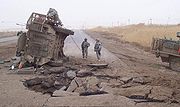
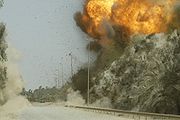
Multinational force in Iraq
The Multi-National Force – Iraq was a military command, led by the United States, which was responsible for Operation Iraqi Freedom. Multi-National Force – Iraq replaced the previous force, Combined Joint Task Force 7, on 15 May 2004, and was later itself reorganized into its successor, United...
and by the end of 2007 they have been responsible for at least 64% of coalition deaths in Iraq.
Beginning in July 2003, the Iraqi insurgency
Iraqi insurgency
The Iraqi Resistance is composed of a diverse mix of militias, foreign fighters, all-Iraqi units or mixtures opposing the United States-led multinational force in Iraq and the post-2003 Iraqi government...
used IEDs to target coalition vehicles. According to iCasualties.org
ICasualties.org
iCasualties.org, formally the Iraq Coalition Casualty Count,is an independent websitecreated in May 2003 by Michael White, a software engineer from Stone Mountain, Georgia, to track casualties in the Afghanistan War and Iraq War....
, as of April 21, 2011 at least (missing data)% of Coalition fatalities in the Iraq War are caused by IEDs. According to the Washington Post, 64% of U.S deaths in Iraq occurred due to IEDs.
A French study showed that in Iraq, from March 2003 to November 2006, on a global deaths in the US-led Coalition soldiers, were caused by IEDs, i.e. 41%. That is to say more than in the "normal fights" (1027 dead, 34%).
Insurgents now use the bombs to target not only Coalition vehicles but Iraqi police and civilian transportation as well.
Common locations for placing these bombs on the ground include animal carcasses
Carrion
Carrion refers to the carcass of a dead animal. Carrion is an important food source for large carnivores and omnivores in most ecosystems. Examples of carrion-eaters include vultures, hawks, eagles, hyenas, Virginia Opossum, Tasmanian Devils, coyotes, Komodo dragons, and burying beetles...
, soft drink cans, and box
Box
Box describes a variety of containers and receptacles for permanent use as storage, or for temporary use often for transporting contents. The word derives from the Greek πύξος , "box, boxwood"....
es. Typically they explode underneath or to the side of the vehicle to cause the maximum amount of damage; however, as vehicle armor was improved on military vehicles, insurgents began placing IEDs in elevated positions such as on road signs
Traffic sign
Traffic signs or road signs are signs erected at the side of roads to provide information to road users. With traffic volumes increasing over the last eight decades, many countries have adopted pictorial signs or otherwise simplified and standardized their signs to facilitate international travel...
, utility poles, or tree
Tree
A tree is a perennial woody plant. It is most often defined as a woody plant that has many secondary branches supported clear of the ground on a single main stem or trunk with clear apical dominance. A minimum height specification at maturity is cited by some authors, varying from 3 m to...
s, in order to hit less protected areas.
IEDs in Iraq may be made with artillery
Artillery
Originally applied to any group of infantry primarily armed with projectile weapons, artillery has over time become limited in meaning to refer only to those engines of war that operate by projection of munitions far beyond the range of effect of personal weapons...
or mortar
Mortar (weapon)
A mortar is an indirect fire weapon that fires explosive projectiles known as bombs at low velocities, short ranges, and high-arcing ballistic trajectories. It is typically muzzle-loading and has a barrel length less than 15 times its caliber....
shell
Projectile
A projectile is any object projected into space by the exertion of a force. Although a thrown baseball is technically a projectile too, the term more commonly refers to a weapon....
s or with varying amounts of bulk or homemade explosives. Early during the Iraq war, the bulk explosives were often obtained from stored munitions bunkers to include stripping landmines of their explosives.
Despite the increased armor, IEDs have been killing military personnel and civilians with greater frequency. May 2007 was the deadliest month for IED attacks thus far, with a reported 89 of the 129 Coalition casualties coming from an IED attack. According to the Pentagon, 250,000 tons (of 650,000 tons total) of Iraqi ordnance were looted, providing a large supply of ammunition for the insurgents.
In October 2005, The UK government charged that Iran
Iran
Iran , officially the Islamic Republic of Iran , is a country in Southern and Western Asia. The name "Iran" has been in use natively since the Sassanian era and came into use internationally in 1935, before which the country was known to the Western world as Persia...
was supplying insurgents with the technological know-how to make shaped charge
Shaped charge
A shaped charge is an explosive charge shaped to focus the effect of the explosive's energy. Various types are used to cut and form metal, to initiate nuclear weapons, to penetrate armor, and in the oil and gas industry...
IED's. Both Iranian and Iraqi government officials deny the allegations.
United States
In 1995 Timothy McVeighTimothy McVeigh
Timothy James McVeigh was a United States Army veteran and security guard who detonated a truck bomb in front of the Alfred P. Murrah Building in Oklahoma City on April 19, 1995...
created an IED-truck bomb to destroy a federal government building in Oklahoma City
Oklahoma city
Oklahoma City is the capital and largest city of the U.S. state of Oklahoma.Oklahoma City may also refer to:*Oklahoma City metropolitan area*Downtown Oklahoma City*Uptown Oklahoma City*Oklahoma City bombing*Oklahoma City National Memorial...
killing 168 US citizens.
In January 2011, a shaped pipe bomb was discovered
2011 Spokane bombing attempt
-Over view:On January 17, 2011, a radio-controlled, shaped pipe bomb was found and defused in Spokane, Washington along the route of that year's Martin Luther King Jr. memorial march...
and defused at a Martin Luther King Jr. memorial march in Spokane, Washington
Spokane, Washington
Spokane is a city located in the Northwestern United States in the state of Washington. It is the largest city of Spokane County of which it is also the county seat, and the metropolitan center of the Inland Northwest region...
. The FBI said that the bomb was specifically designed to cause maximum harm
Shaped charge
A shaped charge is an explosive charge shaped to focus the effect of the explosive's energy. Various types are used to cut and form metal, to initiate nuclear weapons, to penetrate armor, and in the oil and gas industry...
and may have been racially motivated. No one was injured during the event.
India
IEDs are increasingly being used by maoistsCommunist Party of India (Maoist)
The Communist Party of India is a Maoist political party in India which aims to overthrow the government of India through violent means. It was founded on 21 September 2004, through the merger of the People's War, and the Maoist Communist Centre . The merger was announced to the public on October...
in India.
On 13th of July 2011, three IEDs were used by the Indian Mujahideen terrorist group
Indian Mujahideen
Indian Mujahideen is a terrorist group based in India, known for carrying out several attacks against civilian targets in India....
to carry out a coordinated attack on the city of Mumbai
Mumbai
Mumbai , formerly known as Bombay in English, is the capital of the Indian state of Maharashtra. It is the most populous city in India, and the fourth most populous city in the world, with a total metropolitan area population of approximately 20.5 million...
, killing 19 people and injuring 130 more.
Nepal
IEDs were also widely used in the 10-years long civil war of the Maoists in Nepal, ranging from those bought from illicit groups in India and China, to self-made devices. Typically used devices were pressure-cooker bombs, socket bombs, pipe bombs, bucket bombs, etc. The devices were used more for the act of terrorizing the urban population rather than for fatal causes, placed in front of governmental offices, street corners or road sides. Mainly, the home-made IEDs were responsible for destruction of majority of structures targeted by the Maoists and assisted greatly in spreading terror among the public.By warhead
The Dictionary of Military and Associated Terms (JCS Pub 1-02) includes two definitions for improvised devices: improvised explosive devices (IED) and improvised nuclear deviceImprovised nuclear device
- Definition :Improvised Nuclear Devices or are theoretical illicit nuclear weapons bought, stolen, or otherwise originating from a nuclear state, or a weapon fabricated by a terrorist group from illegally obtained fissile nuclear weapons material that produces a nuclear explosion...
(IND). These definitions address the Nuclear and Explosive in CBRNE. That leaves chemical, biological and radiological undefined. Four definitions have been created to build on the structure of the JCS definition. Terms have been created to standardize the language of first responders and members of the military and to correlate the operational picture.
Explosive
A device placed or fabricated in an improvised manner incorporating destructive, lethal, noxious, pyrotechnic, or incendiary chemicals and designed to destroy, incapacitate, harass, or distract. It may incorporate military stores, but is normally devised from non-military components.
Nuclear
A device incorporating radioactive materials designed to result in the dispersal of radioactive material (a dirty bomb
Dirty bomb
A dirty bomb is a speculative radiological weapon that combines radioactive material with conventional explosives. The purpose of the weapon is to contaminate the area around the explosion with radioactive material, hence the attribute "dirty"....
) or in the formation of nuclear-yield reaction. Such devices may be fabricated in a completely improvised manner or may be an improvised modification to a nuclear weapon.
Chemical
A device incorporating the toxic attributes of chemical materials designed to result in the dispersal of these toxic chemical materials for the purpose of creating a primary patho-physiological toxic effect (morbidity and mortality), or secondary psychological effect (causing fear and behavior modification) on a larger population. Such devices may be fabricated in a completely improvised manner or may be an improvised modification to an existing weapon.
Biological
A device incorporating biological materials designed to result in the dispersal of vector borne biological material for the purpose of creating a primary patho-physiological toxic effect (morbidity and mortality), or secondary psychological effect (causing fear and behavior modification) on a larger population. Such devices are fabricated in a completely improvised manner.
Radioactive
A device incorporating radioactive materials designed to result in the dispersal of radioactive material for the purpose of area denial and economic damage, and/or for the purpose of creating a primary patho-physiological toxic effect (morbidity and mortality), or secondary psychological effect (causing fear and behavior modification) on a larger population. Such devices may be fabricated in a completely improvised manner or may be an improvised modification to an existing nuclear weapon. Also called a Radiological Dispersion Device (RDD) or "dirty bomb".
Incendiary
A device making use of exothermic chemical reactions designed to result in the rapid spread of fire for the purpose of creating a primary patho-physiological effect (morbidity and mortality), or secondary psychological effect (causing fear and behavior modification) on a larger population or it may be used with the intent of gaining a tactical advantage. Such devices may be fabricated in a completely improvised manner or may be an improvised modification to an existing weapon. A common type of this is the molotov cocktail
Molotov cocktail
The Molotov cocktail, also known as the petrol bomb, gasoline bomb, Molotov bomb, fire bottle, fire bomb, or simply Molotov, is a generic name used for a variety of improvised incendiary weapons...
.
Car
Proxy Bomb
The proxy bomb was a tactic used by the Provisional Irish Republican Army for a short time in the early 1990s, whereby members of the British security forces or British Army employees were forced to drive car bombs into British military targets, after taking their families as hostages. It has...
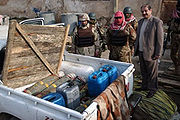
. Distinguishing features are low-riding vehicles with excessive weight, vehicles with only one passenger, and ones where the interior of the vehicles look as if they have been stripped down and built back up. Car bombs can carry thousands of pounds of explosives and may be augmented with shrapnel
Fragmentation (weaponry)
Fragmentation is the process by which the casing of an artillery shell, bomb, grenade, etc. is shattered by the detonating high explosive filling. The correct technical terminology for these casing pieces is fragments , although shards or splinters can be used for non-preformed fragments...
to increase fragmentation. The U.S. State Department has published a guide on car bomb awareness.
Boat
Boats laden with explosives can be used against ships and areas connected to water. An early example of this type was the Japanese Shinyo suicide boats during World War IIWorld War II
World War II, or the Second World War , was a global conflict lasting from 1939 to 1945, involving most of the world's nations—including all of the great powers—eventually forming two opposing military alliances: the Allies and the Axis...
. The boats were laden with explosives and attempted to ram Allied ships, sometimes successfully, having sunk or severely damaged several American ships by war's end. Suicide bombers used a boat-borne IED to attack the USS Cole
USS Cole bombing
The USS Cole Bombing, or the USS Cole Incident, was a suicide attack against the United States Navy destroyer on October 12, 2000 while it was harbored and refueled in the Yemeni port of Aden. Seventeen American sailors were killed, and 39 were injured...
, US and UK troops have also been killed by boat-borne IEDs in Iraq.
Animal
Monkeys and war pigWar pig
In the first century BC, Lucretius mused that early humans may have attempted to launch wild beasts, such as lions or "savage boars," against the enemy, but with catastrophic results. War pigs are pigs reported to have been used in ancient warfare as a countermeasure against war elephants...
s were used as incendiaries around 1000 AD. More famously the "anti-tank dog
Anti-tank dog
Anti-tank dogs were dogs taught to carry explosives to tanks, armored vehicles and other military targets. They were intensively trained by the Soviet and Russian military forces between 1930 and 1996 and used in 1941–1942 against German tanks in World War II...
" and "bat bomb
Bat bomb
Bat bombs were bomb-shaped casings with numerous compartments, each containing a Mexican Free-tailed Bat with a small timed incendiary bomb attached. Dropped from a bomber at dawn, the casings would deploy a parachute in mid-flight and open to release the bats which would then roost in eaves and...
" were developed during WW2. In recent times, a two-year old child and seven other people were killed by explosives strapped to a horse in the town of Chita in Colombia
Colombia
Colombia, officially the Republic of Colombia , is a unitary constitutional republic comprising thirty-two departments. The country is located in northwestern South America, bordered to the east by Venezuela and Brazil; to the south by Ecuador and Peru; to the north by the Caribbean Sea; to the...
The carcasses of certain animals were also used to conceal explosive devices by the Iraqi insurgency
Iraqi insurgency
The Iraqi Resistance is composed of a diverse mix of militias, foreign fighters, all-Iraqi units or mixtures opposing the United States-led multinational force in Iraq and the post-2003 Iraqi government...
.
Collar
IEDs strapped to the necks of farmers have been used on at least three occasions by guerrillas in Colombia, as a way of extortion. American pizza delivery man Brian Douglas Wells was killed in 2003 by an explosive fastened to his neck, purportedly under duress from the maker of the bomb. In 2011 a schoolgirl in Sydney, Australia had a suspected collar bomb attached to herMosman bomb hoax
The Mosman bomb hoax took place in the Sydney suburb of Mosman, New South Wales, Australia on 3 August 2011. An apparent collar bomb was placed around the neck of 18-year-old schoolgirl Madeleine Pulver by a balaclava-clad home intruder...
by an attacker in her home. The device was removed by police after a ten-hour operation and proved to be a hoax
Hoax
A hoax is a deliberately fabricated falsehood made to masquerade as truth. It is distinguishable from errors in observation or judgment, or rumors, urban legends, pseudosciences or April Fools' Day events that are passed along in good faith by believers or as jokes.-Definition:The British...
.
Suicide
Suicide bombing usually refers to an individual wearing explosives and detonating them in order to kill others including themselves, a technique pioneered by LTTE (Tamil Tigers). The bomber will conceal explosives on and around their person, commonly using a vest and will use a timer or some other trigger to detonate the explosives. The logic behind such attacks is the belief that an IED delivered by a human has a greater chance of achieving success than any other method of attack. In addition, there is the psychological impact of terrorists prepared to deliberately sacrifice themselves for their cause.Platter charge
propel the platter into the target with an approximate velocity of 6000 feet per second (1,828.8 m/s). The effective range can be as far as 50 meters, limited by the accuracy.Explosively formed penetrators
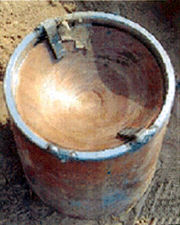
Explosively Formed Penetrator
An explosively formed penetrator , also known as an explosively formed projectile, a self-forging warhead, or a self-forging fragment, is a special type of shaped charge designed to penetrate armour effectively at standoff distances...
s, a special type of shaped charge that is effective at long standoffs from the target (50 meters or more). These are especially problematic to counter because they can be placed far from their intended targets. An EFP is essentially a cylindrical shaped charge with a concave metal disc (often copper) in front, pointed inward. The force of the shaped charge turns the disc into a high velocity slug, capable of penetrating the armor of most vehicles in Iraq.
Rocket
In 2008, rocket-propelled IEDs, dubbed Improvised Rocket Assisted Mortars (IRAM) by the military, came to be employed in numbers against U.S. forces in Iraq. They have been described as propanePropane
Propane is a three-carbon alkane with the molecular formula , normally a gas, but compressible to a transportable liquid. A by-product of natural gas processing and petroleum refining, it is commonly used as a fuel for engines, oxy-gas torches, barbecues, portable stoves, and residential central...
tanks packed with explosives and powered by 107 mm rockets. They are similar to some Provisional IRA barrack buster
Barrack buster
Barrack buster is the colloquial name given to several improvised mortars, developed in the 1990s by the engineering group of the Provisional Irish Republican Army ....
mortars.
By trigger mechanisms
Wire- Command wire-improvised explosive devices (CWIED) utilize an electrical firing cable that affords the user complete control over the device right up until the moment of initiation.
Radio
- The trigger for a radio-controlled improvised explosive device (RCIED) is controlled by radio link. The device is constructed so that the receiver is connected to an electrical firing circuit and the transmitter operated by the perpetrator at a distance, A signal from the transmitter causes the receiver to trigger a firing pulse that operates the switch. Usually the switch fires an initiator; however, the output may also be used to remotely arm an explosive circuit. Often the transmitter and receiver operate on a matched coding system that prevents the RCIED from being initiated by spurious radio frequency signals. An RCIED can be triggered from any number of different mechanisms including car alarms, wireless door bells, cell phones, pagers and encrypted GMRS radiosGeneral Mobile Radio ServiceThe General Mobile Radio Service is a licensed land-mobile FM UHF radio service in the United States available for short-distance two-way communication. It is intended for use by an adult individual who possesses a valid GMRS license, as well as his or her immediate family members...
.
Cell phone
- A radio-controlled IED (RCIED) incorporating a cell phone that is modified and connected to an electrical firing circuit. Cell phones operate in the UHF band in line of sight with base transceiver stationBase Transceiver StationA base transceiver station or cell site is a piece of equipment that facilitates wireless communication between user equipment and a network. UEs are devices like mobile phones , WLL phones, computers with wireless internet connectivity, WiFi and WiMAX gadgets etc...
(BTS) antennae sites. In the common scenario, receipt of a paging signal by phone is sufficient to initiate the IED firing circuit.
Victim-operated
- Victim-operated improvised explosive devices (VOIED) are designed to function upon contact with a victim; also known as booby traps. VOIED switches are often well hidden from the victim or disguised as innocuous everyday objects. They are operated by means of movement. Switching methods include tripwire, pressure mats, spring-loaded release, push, pull or tilt. Common forms of VOIED include the under-vehicle IED (UVIED) and improvised landmines.
Infrared
The British accused Iran and Hezbollah of teaching Iraqi fighters to use infraredInfrared
Infrared light is electromagnetic radiation with a wavelength longer than that of visible light, measured from the nominal edge of visible red light at 0.74 micrometres , and extending conventionally to 300 µm...
light beams to trigger IEDs. As the occupation forces became more sophisticated in interrupting radio signals around their convoys, the insurgents adapted their triggering methods. In some cases, when a more advanced method was disrupted, the insurgents regressed to using interruptible means, such as hard wires from the IED to detonator; however, this method is much harder to effectively conceal. It later emerged however, that these so-called "advanced" IEDs were actually old IRA technology. The infrared beam method was perfected by the IRA in the early '90s after it acquired the technology from a botched undercover British Army operation. Many of the IEDs being used against coalition forces in Iraq
Iraq
Iraq ; officially the Republic of Iraq is a country in Western Asia spanning most of the northwestern end of the Zagros mountain range, the eastern part of the Syrian Desert and the northern part of the Arabian Desert....
were originally developed by the British Army who unintentionally passed the information on to the IRA. The IRA taught their techniques to the Palestine Liberation Organisation and the knowledge spread to Iraq.
Detection and disarmament
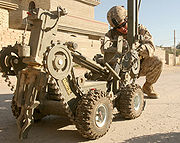
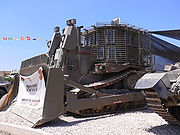
Bomb disposal
Bomb disposal is the process by which hazardous explosive devices are rendered safe. Bomb disposal is an all encompassing term to describe the separate, but interrelated functions in the following fields:*Military:...
(EOD) personnel to use to positively identify or categorize them. EOD personnel are trained in the rendering safe
Render safe procedure
The render safe procedure is the portion of the explosive ordnance disposal procedures involving the application of special explosive ordnance disposal procedures, methods and tools to provide the interruption of functions or separation of essential components of unexploded ordnance to prevent an...
and disposal of IEDs. The presence of chemical
Chemical warfare
Chemical warfare involves using the toxic properties of chemical substances as weapons. This type of warfare is distinct from Nuclear warfare and Biological warfare, which together make up NBC, the military acronym for Nuclear, Biological, and Chemical...
, biological
Biological warfare
Biological warfare is the use of biological toxins or infectious agents such as bacteria, viruses, and fungi with intent to kill or incapacitate humans, animals or plants as an act of war...
, radiological, or nuclear (CBRN
CBRN
CBRN is an initialism for chemical, biological, radiological, and nuclear. It is used to refer to situations in which any of these four hazards have presented themselves. The term CBRN is a replacement for the cold war term NBC , which had replaced the term ABC that was used in the fifties...
) material in an IED requires additional precautions. As with other missions, the EOD operator provides the area commander with an assessment of the situation and of support needed to complete the mission.
Military forces and law enforcement personnel from around the world have developed a number of render safe procedure
Render safe procedure
The render safe procedure is the portion of the explosive ordnance disposal procedures involving the application of special explosive ordnance disposal procedures, methods and tools to provide the interruption of functions or separation of essential components of unexploded ordnance to prevent an...
s (RSP) to deal with IEDs. RSPs may be developed as a result of direct experience with devices or by applied research designed to counter the threat. The supposed effectiveness of IED jamming systems, proven or otherwise, has caused IED technology to essentially regress to command-wire detonation methods. These are physical connections between the detonator and explosive device and cannot be jammed. However, these types of IEDs are more difficult to emplace quickly, and are more readily detected.
Military forces from India
India
India , officially the Republic of India , is a country in South Asia. It is the seventh-largest country by geographical area, the second-most populous country with over 1.2 billion people, and the most populous democracy in the world...
, Canada
Canada
Canada is a North American country consisting of ten provinces and three territories. Located in the northern part of the continent, it extends from the Atlantic Ocean in the east to the Pacific Ocean in the west, and northward into the Arctic Ocean...
, United Kingdom
United Kingdom
The United Kingdom of Great Britain and Northern IrelandIn the United Kingdom and Dependencies, other languages have been officially recognised as legitimate autochthonous languages under the European Charter for Regional or Minority Languages...
, Israel
Israel
The State of Israel is a parliamentary republic located in the Middle East, along the eastern shore of the Mediterranean Sea...
, Spain
Spain
Spain , officially the Kingdom of Spain languages]] under the European Charter for Regional or Minority Languages. In each of these, Spain's official name is as follows:;;;;;;), is a country and member state of the European Union located in southwestern Europe on the Iberian Peninsula...
and the United States
United States
The United States of America is a federal constitutional republic comprising fifty states and a federal district...
are at the forefront of counter-IED efforts, as all have direct experience in dealing with IEDs used against them in conflict or terrorist attacks. From the research and development side, programs such as the new Canadian Unmanned Systems Challenge, will bring students groups together to invent an unmanned device to both locate IEDs and pinpoint the insurgents.
Technological countermeasures are only part of the solution in the effort to defeat IEDs; experience, training, and awareness remain key factors in combating them. For example, there are visual signs that may suggest the presence of an IED, such as recently turned-over soil or sand by a road, or an abandoned vehicle beside a road. Recognizing these telltale signs may be as valuable as having sophisticated detection equipment.
See also
- Acetone peroxideAcetone peroxideAcetone peroxide is an organic peroxide and a primary high explosive. It takes the form of a white crystalline powder with a distinctive bleach-like odor....
- Blast bombBlast bombBlast bomb is a term used in Northern Ireland for a type of improvised explosive device. More specifically, these devices are usually a form of homemade grenade, which is thrown at a target. These devices have been used in a number of public order situations, and in attacks on the Royal Ulster...
- Blast fishingBlast fishingBlast fishing or dynamite fishing is the practice of using explosives to stun or kill schools of fish for easy collection. This often illegal practice can be extremely destructive to the surrounding ecosystem, as the explosion often destroys the underlying habitat that supports the fish...
- Car bombCar bombA car bomb, or truck bomb also known as a Vehicle Borne Improvised Explosive Device , is an improvised explosive device placed in a car or other vehicle and then detonated. It is commonly used as a weapon of assassination, terrorism, or guerrilla warfare, to kill the occupants of the vehicle,...
- Dragon RunnerDragon RunnerDragon Runner is a military robot built for urban combat. At 9 pounds it is light enough to be carried in a Marine's backpack. The original project was funded by the Marine Corps Warfighting Lab in conjunction with Carnegie Mellon University...
- Explosives
- Fleet Electronic Warfare Center (FEWC)Fleet Electronic Warfare Center (FEWC)The Fleet Electronic Warfare Center is an organization established by Naval Network Warfare Command in 2008 to be the center of gravity for US Navy fleet electronic warfare operational and tactical issues...
- Improvised firearmImprovised firearmAn improvised firearm is a firearm manufactured by someone who is not a regular maker of firearms , and is typically constructed by adapting existing materials to the purpose...
- Joint Improvised Explosive Device Defeat OrganizationJoint Improvised Explosive Device Defeat OrganizationThe Joint Improvised Explosive Device Defeat Organization is a joint entity and jointly manned activity of the U.S. Department of Defense established to reduce or eliminate the effects of all forms of improvised explosive devices used against U.S...
- Letter bomb
- MetalithMetalithThe Metalith is a prefabricated steel barrier and the name of the product division of Infrastructure Defense Technologies of Belvidere, Illinois, which manufactures the barrier. It is used in perimeter defense against explosive penetration and ramming...
- Molotov cocktailMolotov cocktailThe Molotov cocktail, also known as the petrol bomb, gasoline bomb, Molotov bomb, fire bottle, fire bomb, or simply Molotov, is a generic name used for a variety of improvised incendiary weapons...
- Nail bombNail bombThe nail bomb is an anti-personnel explosive device packed with nails to increase its wounding ability. The nails act as shrapnel, leading almost certainly to greater loss of life and injury in inhabited areas than the explosives alone would. The nail bomb is also a type of flechette weapon...
- Pipe bombPipe bombA pipe bomb is an improvised explosive device, a tightly sealed section of pipe filled with an explosive material. The containment provided by the pipe means that simple low explosives can be used to produce a relatively large explosion, and the fragmentation of the pipe itself creates potentially...
- Radiological weaponRadiological weaponA radiological weapon or radiological dispersion device is any weapon that is designed to spread radioactive material with the intent to kill, and cause disruption upon a city or nation....
- Satchel ChargeSatchel chargethumb|right|250px|Weapons used in [[Winter War]]. The original Finnish satchel charge at left.A satchel charge is a demolition device, primarily intended for combat, whose primary components are a charge of dynamite or a more potent explosive such as C-4 plastic explosive, a carrying device...
- Sidolówka GrenadeSidolówkaSidolówka was an unofficial, yet common, name of the R wz. 42 hand grenade, produced by the Polish resistance organization Armia Krajowa in occupied Poland during World War II....
- Time bomb (explosive)
- TM 31-210 Improvised Munition HandbookTM 31-210 Improvised Munition HandbookThe TM 31-210 Improvised Munitions Handbook is a United States Army technical manual intended for the United States Special Forces describing manufacture of improvised weapons and explosives from readily available materials, from junk piles, common household chemicals and supplies purchased from...
External links
- IED News at DefenceTalk
- CFR-TV Episode 7 – video of a blue VBIED detonated from a distance
- iFilm video of vehicle struck by IED
- Transcript of PBS Frontline episode Private Warriors
- Defense Update – the use of IED in Asymmetric Warfare
- Defense Update – protection against IED
- Defense Update – protected vehicles
- Defense Update – Israeli IED Neutralizer
- IED Definition Structure Applied to the CBRN Threats (p9-11)
- IEDs and the futility of increased armor
- Strategy for Countering IEDs - Chris Hunter
- Clearing Bombs in Afghanistan - slideshow by Life magazine