


Kuomintang

Encyclopedia
The Kuomintang of China (ˌkwoʊmɪnˈtɑːŋ or -ˈtæŋ) (KMT), sometimes romanized as Guomindang via the Pinyin
transcription system or GMD for short, and translated as the Chinese Nationalist Party is a founding and ruling political party of the Republic of China
(ROC). Its guiding ideology is the Three Principles of the People
, espoused by Sun Yat-sen
. It is the founding and the oldest political party in the Republic of China and its party headquarters are located in Taipei
, Republic of China (Taiwan)
. It is currently (as of 2011) the ruling political party
of the ROC, and holds onto most seats in the Legislative Yuan
, The KMT is a member of the International Democrat Union
. Current president
Ma Ying-jeou
, elected in 2008, is the seventh KMT member to hold the office of the presidency.
Together with the People First Party and Chinese New Party
, the KMT forms what is known as the Taiwanese Pan-Blue coalition
, which supports eventual unification with the mainland
. However, the KMT has been forced to moderate their stance by advocating political
and legal status quo
of modern Taiwan. The KMT accepts a "One China Principle
" - it officially considers that there is only one China
and that the Republic of China (not the People's Republic of China
) is its legitimate government. However, since 2008, in order to ease tensions with the People's Republic of China, the KMT endorses the "three nos" policy as defined by Ma Ying-jeou
- no unification, no independence and no use of force.
The KMT was founded by Song Jiaoren
and Sun Yat-sen
shortly after the Xinhai Revolution
. Later led by Generalissimo Chiang Kai-shek
, it ruled much of China
from 1928 until its retreat to Taiwan in 1949 after being defeated by the Communist Party of China
(CPC) during the Chinese Civil War
. There, the KMT controlled the government under a single party state until reforms in the late 1970s through the 1990s loosened its grip on power.
encompasses a wide range of groups. Kuomintang support tends to be higher in northern Taiwan and in urban areas, where it draws its backing from small to medium and self-employed business owners, who make up the majority of commercial interests in Taiwan. Big businesses are also likely to support the KMT because of its policy of maintaining commercial links with mainland China.
The KMT also has strong support in the labor sector because of the many labor benefits and insurance implemented while the KMT was in power. The KMT traditionally has strong cooperation with labor unions, teachers, and government workers. Among the ethnic groups in Taiwan, the KMT has solid support among mainlanders and their descendants for ideological reasons and among Taiwanese aboriginals.
Opponents of the KMT include strong supporters of Taiwan independence, and rural residents particularly in southern Taiwan, though supporters of unification include Hoklo
and supporters of independence include mainlanders. There is opposition due to an image of KMT both as a mainlanders' and a Chinese nationalist party out of touch with local values.
, a proponent of Chinese nationalism
, who founded Revive China Society
in Honolulu, Hawaii
in 1894. In 1905, Sun joined forces with other anti-monarchist societies
in Tokyo
to form the Tongmenghui or the Revolutionary Alliance, a group committed to the overthrow of the Qing Dynasty
and the establishment of a republican government
.
The group planned and supported the Xinhai Revolution
of 1911 and the founding of the Republic of China
on January 1, 1912. However, Sun did not have military power and ceded the provisional presidency
of the republic to strongman Yuan Shikai
, who arranged for the abdication of the Last Emperor
on February 12.
On August 25, 1912, the Kuomintang was established at the Huguang Guild Hall
in Beijing
, where the Revolutionary Alliance and five smaller pro-revolution parties merged to contest the first national elections. Sun, the then Premier of the ROC, was chosen as the party chairman with Huang Xing
as his deputy.
The most influential member of the party was the third ranking Song Jiaoren
, who mobilized mass support from gentry and merchants for the KMT on a democratic socialist platform in favor of a constitutional parliamentary democracy. The party was opposed to constitutional monarchists
and sought to check the power of Yuan. The Kuomintang won an overwhelming majority of the first National Assembly
in December 1912.
But Yuan soon began to ignore the parliament in making presidential decisions and had parliamentary leader Song Jiaoren assassinated in Shanghai
in 1913. Members of the KMT led by Sun Yat-sen staged the Second Revolution in July 1913, a poorly planned and ill-supported armed rising to overthrow Yuan, and failed. Yuan, claiming subversiveness and betrayal, expelled adherents of the Kuomintang from the parliament. Yuan dissolved the KMT in November (whose members had largely fled into exile in Japan) and dismissed the parliament early in 1914.
Yuan Shikai
proclaimed himself emperor in December 1915. While exiled in Japan in 1914, Sun established the Chinese Revolutionary Party
, but many of his old revolutionary comrades, including Huang Xing, Wang Jingwei
, Hu Hanmin
and Chen Jiongming
, refused to join him or support his efforts in inciting armed uprising against Yuan Shikai
. In order to join the Chinese Revolutionary Party, members must take an oath of personal loyalty to Sun, which many old revolutionaries regarded as undemocratic and contrary to the spirit of the revolution.
Thus, many old revolutionaries did not join Sun's new organisation, and he was largely sidelined within the Republican movement during this period. Sun returned to China in 1917 to establish a rival government at Guangzhou
, but was soon forced out of office and exiled to Shanghai. There, with renewed support, he resurrected the KMT on October 10, 1919, but under the name of the Chinese Kuomintang, as the old party had simply been called the Kuomintang. In 1920, Sun and the KMT were restored in Guangdong.
In 1923, the KMT and its government accepted aid from the Soviet Union
after being denied recognition by the western powers. Soviet advisers – the most prominent of whom was Mikhail Borodin
, an agent of the Comintern
– began to arrive in China in 1923 to aid in the reorganization and consolidation of the KMT along the lines of the Communist Party of the Soviet Union
, establishing a Leninist
party structure that lasted into the 1990s. The Communist Party of China (CPC) was under Comintern instructions to cooperate with the KMT, and its members were encouraged to join while maintaining their separate party identities, forming the First United Front between the two parties.
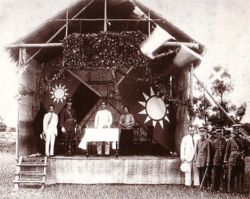 Soviet advisers also helped the Nationalists set up a political institute to train propagandists in mass mobilization techniques, and in 1923 Chiang Kai-shek
, one of Sun's lieutenants from the Tongmenghui
days, was sent to Moscow for several months' military and political study. At the first party congress in 1924, which included non-KMT delegates such as members of the CPC, they adopted Sun's political theory, which included the Three Principles of the People
- nationalism, democracy, and people's livelihood.
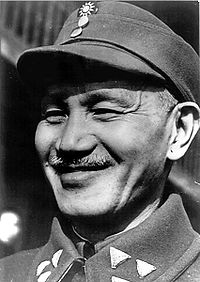 When Sun Yat-sen died in 1925, the political leadership of the Nationalist Party fell to Wang Jingwei
and Hu Hanmin
, respectively the left wing and right wing leaders of the Kuomintang. The real power, however, lay with Chiang Kai-shek
, also known as Jiang Jieshi, who, as superintendent of the Whampoa Military Academy
, was in near complete control of the military.
With this military power, the Kuomintang confirmed their power on Guangzhou
, Guangdong
(the province containing Guangzhou) and Guangxi
(the province west of Guangdong). The Nationalists now had a rival government in direct opposition to the warlord
government based in the northern city of Beijing
.
Unlike Sun Yat-sen, whom he admired greatly, Chiang Kai-shek, who assumed leadership of the Kuomintang in 1926, had little contact with or knowledge of the West. Sun Yat-sen had forged all his political, economic, and revolutionary ideas primarily from Western materials that he had learned in Hawaii
and later in Europe. Chiang Kai-shek, however, knew almost nothing about the West; he was firmly rooted in his Chinese identity and was steeped in Chinese culture. As his life progressed, he became more militantly attached to Chinese culture and traditions. His few trips to the West confirmed his pro-Chinese outlook and he studied the Chinese classics and Chinese histories assiduously.
Of the three Principles of the People
of Sun Yat-sen, the one he most ardently and passionately adhered to was that of nationalism
. Chiang was also particularly committed to Sun's idea of "political tutelage". Using this ideology, Chiang built himself into the dictator
of the Republic of China
, both in the Chinese Mainland, and when the national government was relocated to Taiwan
.
Following the death of Sun Yat-sen, General Chiang Kai-shek emerged as the KMT leader and launched the Northern Expedition to defeat the northern warlords and unite China under the party. With their power confirmed in the southeast, the Nationalist government appointed Chiang Kai-shek commander-in-chief of the National Revolutionary Army
, and the Northern Expedition to suppress the warlords began. Chiang had to defeat three separate warlords and two independent armies. Chiang, with Soviet supplies, conquered the southern half of China in nine months.
A split, however, erupted between the Chinese Communist Party and the Nationalist Party; this split threatened the Northern Expedition. Joseph Stalin
, the leader of the Soviet Union
healed the split by ordering the Chinese Communists to obey the Kuomintang leadership in everything. Once this split had been healed, Chiang Kai-shek resumed his Northern Expedition and, with the help of Communist strikes, managed to take Shanghai
. There he began to eliminate the Communists in what is today known as the Shanghai massacre of 1927
and the Nationalist government, which had moved to Wuhan
, dismissed him. Unfazed, Chiang set up his own alternative government in Nanjing
. When the Wuhan government collapsed in February 1928, Chiang Kai-shek was the only Nationalist government still standing.
When Kuomintang forces took Beijing, as the city was the internationally recognized capital, though previously controlled by the feuding warlords, this event allowed the Kuomintang to receive widespread diplomatic recognition in the same year. The capital was moved from Beijing to Nanjing, the original capital of the Ming Dynasty
, and thus a symbolic purge of the final Qing elements. This period of KMT rule in China between 1927 and 1937 became and is still known as the Nanjing decade
.
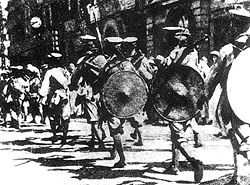 During the Nanjing Incident
, the Kuomintang took on the western Imperialist powers in China, launching an all out attack against the Imperialist concessions in multiple Chinese cities. The Chinese forces stormed the consulates of America, Britain, and Japan, looting nearly every foreign property and almost assassinating the Japanese consul. An American, two British, one French, an Italian, and a Japanese were killed by Chinese Nationalist forces. Chinese snipers targeted the American consul and marines who were guarding him, Chinese bullets flew into Socony Hall where American citizens were hiding out, one Chinese soldier declared- "We don't want money, anyway, we want to kill." The Chinese Kuomintang forces also stormed and seized millions of dollars worth of British concessions in Hankou
, refusing to hand them back to Britain. Britain then decided to give them up.
After the Northern Expedition in 1928, the Kuomintang government declared to the Great Powers in China that China had been exploited for decades under unequal treaties, and that the time for such treaties was over, demanding they renegotiate all of them on equal terms.
Muslim Generals in Gansu waged war against the Guominjun
in favor of the Kuomintang during the Kuomintang Jihad in Gansu (1927-1930).
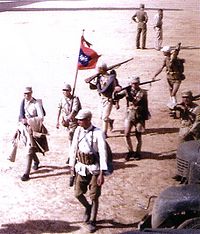 In sum, the KMT began as a heterogeneous group advocating American-inspired federalism and provincial independence. However, after its reorganization along Soviet lines, the party aimed to establish a centralized one party state with one ideology - Three Principles of the People
. This was even more evident following Sun's elevation into a cult figure after his death. The control by one single party began the period of "political tutelage," whereby the party was to control the government while instructing the people on how to participate in a democratic system.
The Kuomintang had many Muslim members who used the secular, nationalist ideology of the party to rise up higher in Chinese society. An example of this is after the Northern Expedition, Qinghai
and Ningxia
provinces were created out of Gansu
province, and three Muslim Ma Clique
Generals, Ma Qi
, Ma Hongkui
, and Ma Hongbin
were appointed as their military governors for their assistance and their joining the KMT. Bai Chongxi
, and Kuomintang member became the Minister of National Defences, the highest position a Muslim had reached in the Chinese government. The Kuomintang sponsored and sent Chinese Muslim students like Muhammad Ma Jian
and Wang Jingzhai to study at Al Azhar in Egypt. Ma Fuxiang
, a Muslim army General, joined the Kuomintang and filled many important positions as he preached Chinese unity. Ma Hongkui worked with an Imam, Hu Songshan
, who ordered all Muslim Imams in Ningxia
to preach Chinese nationalism at the mosque and ordered all Muslims to salute the National Flag and pray for the Kuomintang government. Many Muslim generals like Ma Chengxiang
and Ma Hushan
were hard liner Kuomintang members. The Ma Bufang Mansion
, owned by the Muslim General Ma Bufang
has numerous portraits of the Kuomintang founder Dr. Sun Yatsen and Blue Sky with a White Sun
flags. Muslim Generals like Ma Zhongying
used KMT banners and flags for their armies and wore KMT armbands.
After several military campaigns and with the help of German military advisers (German planned fifth "extermination campaign"), the Communists were forced to withdraw from their bases in southern and central China into the mountains in a massive military retreat known famously as the Long March
, an undertaking which would eventually increase their reputation among the peasants. Less than 10% of the army would survive the 10,000 km march to Shaanxi province.
The Kuomintang continued to attack the Communists. This was in line with Chiang's policy of solving internal conflicts (warlords and communists) before fighting external invasions (Japan). However, Zhang Xueliang
, who believed that the Japanese invasion constituted the greater prevailing threat, took Chiang hostage during the Xi'an Incident
in 1937 and forced Chiang to agree to an alliance with the Communists in the total war against the Japanese.
The Second Sino-Japanese War
had officially started, and would last until the Japanese surrender in 1945. However in many situations the alliance was in name only; after a brief period of cooperation, the armies began to fight the Japanese separately, rather than as coordinated allies. Conflicts between KMT and communists were still common during the war, and documented claims abound of Communist attacks upon the KMT forces and vice versa.
In these incidents, it should be noted that The KMT armies typically utilized more traditional tactics while the Communists chose guerrilla tactics, leading to KMT claims that the Communists often refused to support the KMT troops, choosing to withdraw and let the KMT troops take the brunt of Japanese attacks. These same guerrilla tactics, honed against the Japanese forces, were used to great success later during open civil war, as well as against the Allied forces in the Korean War and the U.S. forces in the Vietnam War.
During Chiang's rule, the Kuomintang became rampantly corrupt, where leading officials and military leaders hoarded funding, material and armaments. This was especially the case during the Second Sino-Japanese War
, an issue which proved to be a hindrance with US military leaders, where military aid provided by the US was hoarded by various KMT generals. US President Truman wrote that "the Chiangs, the Kungs, and the Soongs
(were) all thieves", having taken $750 million in US aid.
The Kuomintang was also known to have used terror tactics against suspected communists, through the utilization of a secret police force, whom were employed to maintain surveillance on suspected communists and political opponents. In “The Birth of Communist China”, C.P. Fitzgerald describes China under the rule of KMT thus: “the Chinese people groaned under a regime Fascist in every quality except efficiency.”
Full-scale civil war between the Communists and KMT resumed after the defeat of Japan. The Communist armies, previously a minor faction, grew rapidly in influence and power due to several errors on the KMT's part: first, the KMT reduced troop levels precipitously after the Japanese surrender, leaving large numbers of able-bodied, trained fighting men who became unemployed and disgruntled with the KMT as prime recruits for the Communists.
Second, the KMT government proved thoroughly unable to manage the economy, allowing hyperinflation to result. Among the most despised and ineffective efforts it undertook to contain inflation was the conversion to the gold standard for the national treasury and the Gold Standard Scrip in August 1948, outlawing private ownership of gold, silver, and foreign exchange, collecting all such precious metals and foreign exchange from the people and issuing the Gold Standard Scrip in exchange.
The new scrip became worthless in only ten months and greatly reinforced the nationwide perception of KMT as a corrupt or at best inept entity. Third, Chiang Kai-shek ordered his forces to defend the urbanized cities. This decision gave the Communists a chance to move freely through the countryside. At first, the KMT had the edge with the aid of weapons and ammunition from the United States
. However, with the country suffering from hyperinflation
, widespread corruption and other economic ills, the KMT continued to lose popular support.
At the same time, the suspension of American aid and tens of thousands of deserted or decommissioned soldiers being recruited to the Communist cause tipped the balance of power quickly to the Communist side, and the overwhelming popular support for the Communists in most of the country made it all but impossible for the KMT forces to carry out successful assaults against the Communists.
By the end of 1949, the Communists controlled almost all of mainland China
, as the KMT retreated to Taiwan
with a significant amount of China's national treasures and 2 million people, including military forces and refugees. Some party members stayed in the mainland and broke away from the main KMT to found the Revolutionary Committee of the Kuomintang
, which still currently exists as one of the eight minor registered parties in the People's Republic of China
.
 In 1895, Taiwan, including the Penghu islands, became a Japanese colony, a concession by the Qing Empire
after it lost the First Sino-Japanese War
. After Japan's defeat at the end of World War II
in 1945, General Order No. 1 instructed Japan, who surrendered to the US, to surrender its troops in Taiwan to the forces of the Republic of China Kuomintang.
Taiwan was placed under the administrative control of the Republic of China by the United Nations Relief and Rehabilitation Administration
(UNRRA), and the ROC put Taiwan under military rule. Tensions between the local Taiwanese and mainlanders from mainland China
increased in the intervening years culminating in a flashpoint on February 27, 1947 in Taipei
when a dispute between a female cigarette vendor and an anti-smuggling officer triggered civil disorder and protests that would last for days. The uprising turned bloody and was shortly put down by the ROC Army
in the 228 Incident
. As a result of the 228 Incident in 1947, Taiwanese people endured what is called the "White Terror", a KMT-led political repression that resulted in over 30,000 Taiwan independence criminals "eliminated".
Following the establishment of the People's Republic of China
(PRC) on October 1, 1949, the commanders of the PRC People's Liberation Army believed that Kinmen
and Matsu
had to be taken before a final assault on Taiwan. KMT fought the Battle of Kuningtou
and stopped the invasion. In 1950 Chiang took office in Taipei under the Temporary Provisions Effective During the Period of Communist Rebellion
. The provision declared martial law
in Taiwan and halted some democratic processes, including presidential and parliamentary elections, until the mainland could be recovered from the Communists. KMT estimated it would take 3 years to defeat the Communists. The slogan was "prepare in the first year, start fighting in the second, and conquer in the third year."
However, various factors, including international pressure, are believed to have prevented the KMT from militarily engaging the Communists full-scale. The Kuomintang backed Muslim insurgents formerly belonging to the National Revolutionary Army
during the Kuomintang Islamic Insurgency in China (1950–1958)
. A cold war with a couple of minor military conflicts was resulted in the early years. The various government bodies previously in Nanjing
were re-established in Taipei as the KMT-controlled government actively claimed sovereignty over all China. The Republic of China in Taiwan retained China's seat in the United Nations
until 1971.
Until the 1970s, KMT successfully pushed ahead with land reforms, developed the economy, implemented a democratic system in a lower level of the government, improved cross-Taiwan Strait relations, and created the Taiwan economic miracle. However KMT controlled the government under a one-party authoritarian state until reforms in the late 1970s through the 1990s. The ROC in Taiwan was once referred to synonymously with the KMT and known simply as "Nationalist China" after its ruling party. In the 1970s, the KMT began to allow for "supplemental elections" in Taiwan to fill the seats of the aging representatives in parliament.
Although opposition parties were not permitted, Tangwai
(or, "outside the party") representatives were tolerated. In the 1980s, the KMT focused on transforming the government from a single-party system to a multi-party democracy one and embracing "Taiwanizing
". With the founding of the Democratic Progressive Party
(DPP) in 1986, the KMT started competing against the DPP in Parliamentary elections.
In 1991, martial law
ceased when President Lee Teng-Hui
terminated the Temporary Provisions Effective During the Period of Communist Rebellion
. All parties started to be allowed to compete at all levels of elections, including the presidential election. Lee Teng-hui
, the ROC's first democratically elected President and the leader of the KMT during the 1990s, announced his advocacy of "special state-to-state relations" with the PRC. The PRC associated it with Taiwan independence
.
The KMT faced a split in 1994 that led to the formation of the Chinese New Party
, alleged to be a result of Lee's "corruptive ruling style". The New Party has, since the purging of Lee, largely reintegrated into KMT. A much more serious split in the party occurred as a result of the 2000 Presidential election
. Upset at the choice of Lien Chan
as the party's presidential nominee, former party Secretary-General James Soong
launched an independent bid, which resulted in the expulsion of Soong and his supporters and the formation of the People's First Party (PFP). The KMT candidate placed third behind Soong in the elections. After the election, Lee's strong relationship with the opponent became apparent. In order to prevent defections to the PFP, Lien moved the party away from Lee's pro-independence policies and became more favorable toward Chinese reunification
. This shift led to Lee's expulsion from the party and the formation of the Taiwan Solidarity Union
.
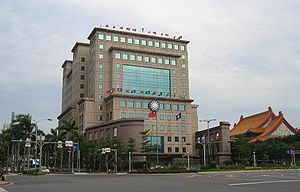
In 2006, the Kuomintang sold its former headquarters to Evergreen Group
for $2.3 billion New Taiwan dollar
s (96 million United States dollar
s). The KMT moved into a smaller building on Bade Road.
 As the ruling party on Taiwan, the KMT amassed a vast business empire of banks, investment companies, petrochemical firms, and television and radio stations, thought to have made it the world's richest political party, with assets once estimated to be around US$ 2–10 billion. Although this war chest appeared to help the KMT until the mid-1990s, it later led to accusations of corruption (see Black gold (politics)
).
After 2000, the KMT's financial holdings appeared to be more of a liability than a benefit, and the KMT started to divest its assets. However, the transactions were not disclosed and the whereabouts of the money earned from selling assets (if it has gone anywhere) is unknown. There were accusations in the 2004 presidential election
that the KMT retained assets that were illegally acquired. Currently, there is a law proposed by the DPP in the Legislative Yuan
to recover illegally acquired party assets and return them to the government; however, since the pan-Blue alliance, the KMT and its smaller partner PFP, control the legislature, it is very unlikely to be passed.
The KMT also acknowledged that part of its assets were acquired through extra-legal means and thus promised to "retro-endow" them to the government. However, the quantity of the assets which should be classified as illegal are still under heated debate; Democratic Progressive Party
(DPP), in its capacity as ruling party from 2000–2008, claimed that there is much more that the KMT has yet to acknowledge. Also, the KMT actively sold assets under its title in order to quench its recent financial difficulties, which the DPP argues is illegal. Former KMT Chairman Ma Ying-Jeou
's position is that the KMT will sell some of its properties at below market rates rather than return them to the government and that the details of these transactions will not be publicly disclosed.
In December 2003, then-KMT chairman (present chairman emeritus) and presidential candidate Lien Chan
initiated what appeared to some to be a major shift in the party's position on the linked questions of Chinese reunification and Taiwan independence. Speaking to foreign journalists, Lien said that while the KMT was opposed to "immediate independence," it did not wish to be classed as "pro-reunificationist" either.
At the same time, Wang Jin-pyng
, speaker of the Legislative Yuan
and the Pan-Blue Coalition's campaign manager in the 2004 presidential election
, said that the party no longer opposed Taiwan's "eventual independence." This statement was later clarified as meaning that the KMT opposes any immediate decision on unification and independence and would like to have this issue resolved by future generations. The KMT's position on the cross-strait relationship was redefined as hoping to remain in the current neither-independent-nor-united situation.
.jpg) In 2005, then-party chairman Lien Chan
In 2005, then-party chairman Lien Chan
announced that he was to leave his office. The two leading contenders for the position include Ma Ying-jeou
and Wang Jin-pyng. On April 5, 2005, Taipei Mayor Ma Ying-jeou said he wished to lead the opposition Kuomintang with Wang Jin-pyng. On July 16, 2005, Ma was elected as KMT chairman in the first contested leadership in Kuomintang's 93-year history
. Some 54 percent of the party's 1.04 million members cast their ballots. Ma Ying-jeou garnered 72.4 percent of vote share, or 375,056 votes, against Wang Jin-pyng's 27.6 percent, or 143,268 votes. After failing to convince Wang to stay on as a vice chairman, Ma named holdovers Wu Po-hsiung (吳伯雄), Chiang Pin-kung
(江丙坤), and Lin Cheng-chi (林澄枝), as well as long-time party administrator and strategist John Kuan
(關中), as vice-chairmen; all appointments were approved by a hand count of party delegates.
There has been a recent warming of relations between the pan-blue coalition
and the PRC, with prominent members of both the KMT and PFP in active discussions with officials on the Mainland. In February 2004, it appeared that KMT had opened a campaign office for the Lien-Soong ticket in Shanghai
targeting Taiwanese businessmen. However, after an adverse reaction in Taiwan, the KMT quickly declared that the office was opened without official knowledge or authorization. In addition, the PRC issued a statement forbidding open campaigning in the Mainland and formally stated that it had no preference as to which candidate won and cared only about the positions of the winning candidate.
On March 28, 2005, thirty members of the Kuomintang (KMT), led by KMT vice chairman Chiang Pin-kung
, arrived in mainland China. This marked the first official visit by the KMT to the mainland since it was defeated by communist forces in 1949 (although KMT members including Chiang had made individual visits in the past). The delegates began their itinerary by paying homage to the revolutionary martyrs of the Tenth Uprising at Huanghuagang. They subsequently flew to the former ROC capital of Nanjing
to commemorate Sun Yat-sen. During the trip KMT signed a 10-points agreement with the CPC. The opponents regarded this visit as the prelude of the third KMT-CPC cooperation. Weeks afterwards, in May, Chairman Lien Chan visited the mainland and met with Hu Jintao
. No agreements were signed because Chen Shui-bian
's government threatened to prosecute the KMT delegation for treason and violation of R.O.C. laws prohibiting citizens from collaborating with Communists.
Ma Ying-jeou
became KMT chairman in 2005 defeating Wang Jin-pyng
in the first competitive election for the party leadership. On February 13, 2007, Ma was indicted by the Taiwan High Prosecutors Office on charges of allegedly embezzling approximately NT$11 million (US$339,000), regarding the issue of "special expenses" while he was mayor of Taipei. Shortly after the indictment, he submitted his resignation as chairman of the Kuomintang at the same press conference at which he formally announced his candidacy for President. Ma argued that it was customary for officials to use the special expense fund for personal expenses undertaken in the course of their official duties. In December 2007, Ma was acquitted of all charges and immediately filed suit against the prosecutors. Despite having resigned the party chairmanship, Ma was the party's nominee in the 2008 presidential election which he won.
On June 25, 2009, ROC President Ma launched his bid to regain the KMT's leadership and registered as the sole candidate for the election of the KMT chairmanship. On July 26, Ma Ying-jeou won 93.87% of the vote for KMT leadership, becoming the new chairman of the Kuomintang,
taking office on September 12. This officially allows Ma to be able to meet with People's Republic of China
President Hu Jintao
(who is also the General Secretary of the Communist Party of China
) and other PRC delegates, as he is able to represent the KMT as leader of a Chinese political party, rather than as head-of-state of a political entity unrecognized by the PRC.
 The KMT won a landslide victory in the Republic of China Presidential Election on March 22, 2008. The KMT fielded former Taipei mayor and former KMT chairman Ma Ying-jeou
to run against the DPP's Frank Hsieh. Ma won by a large margin of 17% against Hsieh. Ma took office on May 20, 2008 and ended 8 years of the DPP presidency. The KMT also won a landslide victory in the 2008 legislative elections
, winning 81 of 113 seats, or 71.7% of seats in the Legislative Yuan
. These two elections gave the KMT firm control of both the executive and legislative yuans.
Prior to this, the party's voters had defected to both the PFP and TSU, and the KMT did poorly in the December 2001 legislative elections
and lost its position as the largest party in the Legislative Yuan
. However, the party did well in the 2002 local government mayoral and council election with Ma Ying-jeou
, its candidate for Taipei mayor, winning reelection by a landslide and its candidate for Kaohsiung
mayor narrowly losing but doing surprisingly well. Since 2002, the KMT and PFP have coordinated electoral strategies. In 2004, the KMT and PFP ran a joint presidential ticket, with Lien running for president and Soong running for vice-president.
The loss of the presidential election of 2004 to DPP President Chen Shui-bian
by merely over 30,000 votes was a bitter disappointment to party members, leading to large scale rallies for several weeks protesting alleged electoral fraud and the "odd circumstances" of the shooting of President Chen
. However, the fortunes of the party were greatly improved when the KMT did well in the legislative elections
held in December 2004 by maintaining its support in southern Taiwan achieving a majority for the pan-blue coalition
.
Soon after the election, there appeared to be a falling out with the KMT's junior partner the People's First Party and talk of a merger seemed to have ended. This split appeared to widen in early 2005, as the leader of the PFP, James Soong
appeared to be reconciling with President Chen Shui-Bian
and the Democratic Progressive Party
. Many PFP members including legislators and municipal leaders have defected to the KMT, and the PFP is seen as a fading party.
The KMT won a decisive victory in the 3-in-1 local elections
of December 2005, replacing the DPP as the largest party at the local level. This was seen as a major victory for the party ahead of legislative elections in 2007. There were elections for the two municipalities of the ROC, Taipei and Kaohsiung
on December 2006. The KMT won a clear victory in Taipei, but lost to the DPP in the southern city of Kaohsiung
by the slim margin of 1,100 votes.
After 8 years of the KMT legislative majority sharing rule with a DPP president, the KMT regained the presidency by winning the 2008 Presidential Election. The citizens of the ROC elected Presidential candidate Ma Ying Jeou and Vice-Presidential candidate Vincent Siew. This followed an earlier election in January of the Legislative Yuan in which the KMT increased their control of the legislature by winning 3 quarters of the total seats.
.jpg)
Premier:
Chairman of Central Executive Committee:
Director-General:
Chairman:
Secretaries-General of the Central Reform Committee:
Secretaries-General of the Central Committee:
. It was organized on Leninism
.
The Kuomintang had several influences left upon its ideology by revolutionary thinking. The Kuomintang and Chiang Kai-shek used the words feudal and counterrevolutionary
as synonyms for evil, and backwardness, and proudly proclaimed themselves to be revolutionary
. Chiang called the warlords feudalists, and called for feudalism and counterrevolutionaries to be stamped out by the Kuomintang. Chiang showed extreme rage when he was called a warlord, because of its negative, feudal connotations.
Chiang Kai-shek, the head of the Kuomintang, warned the Soviet Union and other foreign countries about interfering in Chinese affairs. He was personally angry at the way China was treated by foreigners, mainly by the Soviet Union, Britain, and the United States. He and his New Life Movement
called for the crushing of Soviet, Western, American and other foreign influences in China. Chen Lifu, a CC Clique
member in the KMT, said "Communism originated from Soviet imperialism, which has encroached on our country." It was also noted that "the white bear of the North Pole is known for its viciousness and cruelty."
The Kuomintang was anti-feudal, using feudal with a negative connotation to refer to backward ways and anti-revolutionary ideas. The Blue Shirts Society
, a fascist paramilitary organization within the Kuomintang modeled after Mussolini's blackshirts, was anti-foreign and anticommunist, and stated that its agenda was to expel foreign (Japanese and Western) imperialists from China, crush Communism, and eliminate feudalism. In addition to being anticommunist, some Kuomintang members, like Chiang Kaishek's right-hand man Dai Li
were anti-American, and wanted to expel American influence.
Kuomintang leaders across China adopted nationalist rhetoric. The Chinese Muslim general Ma Bufang
of Qinghai
presented himself as a Chinese nationalist to the people of China, fighting against British imperialism, to deflect criticism by opponents that his government was feudal and oppressed minorities like Tibetans and Buddhist Mongols. He used his Chinese nationalist credentials to his advantage to keep himself in power. The Kuomintang party was officially anti-feudal, and the Kuomintang itself claimed to be a revolutionary party of the people, so being accused of feudalism was a serious insult. Chiang Kai-shek
, the leader of the Kuomintang, spoke out publicly against feudalism and feudal warlords. Ma Bufang was forced to defend himself against the accusations, and stated to the news media that his army was a part of "National army, people's power".
The Kuomintang pursued a sinicization
policy, it was stated that "the time had come to set about the business of making all natives either turn Chinese or get out" by foreign observers of Kuomintang policy. It was noted that "Chinese colonization" of "Mongolia and Manchuria" led to the conclusion "to a conviction that the day of the barbarian was finally over."
, the founding father of the Republic of China
and of the Kuomintang party praised the Boxers in the Boxer Rebellion
for fighting against Western Imperialism. He said the Boxers were courageous and fearless, fighting to the death against the Western armies, Dr. Sun specifically cited the Battle of Yangcun
.
During the Northern Expedition, the Kuomintang incited anti-foreign, anti-western sentiment. Portraits of Sun Yatsen replaced the crucifix in several churches, KMT posters proclaimed- "Jesus Christ is dead. Why not worship something alive such as Nationalism?". Foreign missionaries were attacked and anti foreign riots broke out.
The Kuomintang branch in Guangxi province, led by the New Guangxi Clique
implemented anti-imperialist, anti-religious, and anti-foreign policies.
During the Northern Expedition, in 1926 in Guangxi, Muslim General Bai Chongxi
led his troops in destroying Buddhist temples and smashing idols, turning the temples into schools and Kuomintang party headquarters. It was reported that almost all of Buddhist monasteries in Guangxi were destroyed by Bai in this manner. The monks were removed. Bai led a wave of anti foreignism in Guangxi, attacking American, European, and other foreigners and missionaries, and generally making the province unsafe for foreigners. Westerners fled from the province, and some Chinese Christians were also attacked as imperialist agents.
The three goals of his movement were anti-foreigism, anti-imperialism, and anti-religion. Bai led the anti-religious movement, against superstition. Huang Shaoxiong
, also a Kuomintang member of the New Guangxi Clique, supported Bai's campaign, and Huang was not a Muslim, the anti religious campaign was agreed upon by all Guangxi Kuomintang members.
As a Kuomintang member, Bai and the other Guangxi clique members allowed the Communists to continue attacking foreigners and smash idols, since they shared the goal of expelling the foreign powers from China, but they stopped Communists from initiating social change.
General Bai also wanted to aggressively expel foreign powers from other areas of China. Bai gave a speech in which he said that the minorities of china were suffering under foreign oppression. He cited specific examples, such as the Tibetans under the British, the Manchus under the Japanese, the Mongols under the Outer Mongolian People's Republic, and the Uyghurs of Xinjiang under the Soviet Union. Bai called upon China to assist them in expelling the foreigners from those lands. He personally wanted to lead an expedition to seize back Xinjiang to bring it under Chinese control, in the style that Zuo Zongtang
led during the Dungan revolt.
During the Kuomintang Pacification of Qinghai
the Muslim General Ma Bufang
destroyed Tibetan Buddhist monasteries with support from the Kuomintang government.
General Ma Bufang, a Sufi, who backed the Yihewani Muslims, and persecuted the Fundamentalist Salafi
/Wahhabi Muslim sect. The Yihewani forced the Salafis into hiding. They were not allowed to move or worship openly. The Yihewani had become secular and Chinese nationalist, and they considered the Salafiyya to be "Heterodox" (xie jiao), and people who followed foreigner's teachings (waidao). Only after the Communists took over were the Salafis allowed to come out and worship openly.
One of the Three Principles of the People
of the Kuomintang, Mínshēng, was defined as socialism as Dr. Sun Yatsen. He defined this principle of saying in his last days "it's socialism and it's communism.". The concept may be understood as social welfare as well. Sun understood it as an industrial economy and equality of land holdings for the Chinese peasant farmers. Here he was influenced by the American thinker Henry George
(see Georgism
) and German thinker Karl Marx
; the land value tax
in Taiwan is a legacy thereof. He divided livelihood into four areas: food, clothing, housing, and transportation; and planned out how an ideal (Chinese) government can take care of these for its people.
The Kuomintang was referred to having a socialist ideology. "Equalization of land rights" was a clause included by Dr. Sun in the original Tongmenhui. The Kuomintang's revolutionary ideology in the 1920s incorporated unique Chinese Socialism
as part of its ideology.
The Soviet Union trained Kuomintang revolutionaries in the Moscow Sun Yat-sen University
. In the West and in the Soviet Union, Chiang was known as the "Red General". Movie theaters in the Soviet Union showed newsreels and clips of Chiang, at Moscow Sun Yat-sen University Portraits of Chiang were hung on the walls, and in the Soviet May Day Parades that year, Chiang's portrait was to be carried along with the portraits of Karl Marx, Lenin, Stalin, and other socialist leaders.
The Kuomintang attempted to levy taxes upon merchants in Canton
, and the merchants resisted by raising an army, the Merchant's volunteer corps. Dr. Sun initiated this anti merchant policy, and Chiang Kai-shek enforced it, Chiang led his army of Whampoa Military Academy
graduates to defeat the merchant's army. Chiang was assisted by Soviet advisors, who supplied him with weapons, while the merchants were supplied with weapons from the Western countries.
The Kuomintang were accused of leading a "Red Revolution"in Canton. The merchants were conservative and reactionary
, and their Volunteer Corp leader Chen Lianbao was a prominent comprador
trader.
The merchants were supported by the foreign, western Imperialists such as the British, who led an international flotilla to support them against Dr. Sun. Chiang seized the western supplied weapons from the merchants, and battled against them. A Kuomintang General executed several merchants, and the Kuomintang formed a Soviet inspired Revolutionary Committee. The British Communist party congragulated Dr. Sun for his war against foreign imperialists and capitalists.
Even after Chiang turned on the Soviet Union and massacred the Communists, he still continued anti merchant activities, and promoting revolutionary thought, accusing the merchants of being reactionaries and counterrevolutionaries.
The United States consulate and other westerners in Shanghai was concerned about the approach of "Red General" Chiang, as his army was seizing control in the Northern Expedition.
Contrary to false Communist propaganda that Chiang was pro capitalist, Chiang Kai-shek was the enemy and behaved in an antagonist manner to the capitalists of Shanghai, often attacking them and confisticating their capital and assets for the use of the government, even while he was fighting the communists.
Chiang crushed pro communist worker and peasant organizations, and the rich Shanghai capitalists at the same time. Chiang continued Dr. Sun Yixian's anti capitalist ideology, Kuomintang media openly attacked the capitalists and capitalism, demanding government controlled industry
instead.
Chiang also crushed and dominated the merchants of Shanghai in 1927, seizing loans from them, with the threats of death or exile. Rich merchants, industrialists, and entrepreneurs were arrested by Chiang, who accused them of being "counterrevolutionary", and Chiang held them until they gave money to the Kuomintang. Chiang arrests targeted rich millionaiares, accusing them of Communism and Counterrevolutionary activities. Chiang also enforced an anti Japanese boycott, sending his agents to sack the shops of those who sold Japanese made items, fining them. Chiang also disregarded the Internationally protected International Settlement, putting cages on its borders, threatening to have the merchants placed in there. He terrorized the merchant community. The Kuomintang's alliance with the Green Gang
allowed it to ignore the borders of the foreign concessions.
In 1948, the Kuomintang again attacked the merchants of Shanghai, Chiang Kaishek sent his son Chiang Ching-kuo
to restore economic order. Ching-kuo copied Soviet methods, which he learned during his stay there, to start a social revolution by attacking middle class merchants. He also enforced low prices on all goods to raise support from the Proletariat
.
As riots broke out and savings were ruined, bankrupting shopowners, Ching-kuo began to attack the wealthy, seizing assets and placing them under arrest. The son of the gangster Du Yuesheng
was arrested by him. Ching-kuo ordered Kuomintang agents to raid the Yangtze Development Corporation's warehouses, which was privately owned by H.H. Kung and his family. H.H. Kung's wife was Soong Ai-ling
, the sister of Soong May-ling
who was Ching-kuo's stepmother. H.H. Kung's son David was arrested, the Kung's responded by blackmailing the Chiang's, threatening to release information about them, eventually he was freed after negotiations, and Ching-kuo resigned, ending the terror on the Shanghainese merchants.
The Kuomintang also promotes Government-owned corporation
s. The Kuomintang founder Sun Yat-sen
, was heavily influenced by the economic ideas of Henry George
, who believed that the rents extracted from natural monopolies or the usage of land belonged to the public. Dr. Sun argued for Georgism
and emphasized the importance of a mixed economy, which he termed "The Principle of Minsheng" in his Three Principles of the People
.
"The railroads, public utilities, canals, and forests should be nationalized, and all income from the land and mines should be in the hands of the State. With this money in hand, the State can therefore finance the social welfare programs."
The Kuomintang Muslim Governor of Ningxia
, Ma Hongkui
promoted state owned monopoly companies. His government had a company, Fu Ning Company, which had a monopoly over commercial and industry in Ningxia.
The Kuomintang Muslim Governor of Qinghai
, General Ma Bufang
was described as a socialist. An American scholar and government advisor, Doak Barnett, praised Ma Bufang's government as "one of the most efficient in China, and one of the most energetic. While most of China is bogged down, almost inevitably, by Civil War, Chinghai is attempting to carry our small-scale, but nevertheless ambitious, development and reconstruction schemes on its own initiative"
General Ma started a state run and controlled industralization project, directly creating educational, medical, agricultural, and sanitation projects, run or assisted by the state. The state provided money for food and uniforms in all schools, state run or private. Roads and a theater were constructed. The state controlled all the press, no freedom was allowed for independent journalists. His regime was dictatoral in its political system. Barnett admitted that the regime had "sterm authoritarianism" and "little room for personal freedom".
Corporations such as CSBC Corporation, Taiwan
, CPC Corporation, Taiwan and Aerospace Industrial Development Corporation
are owned by the state in the Republic of China
.
Marxists also existed in the Kuomintang party. They viewed the Chinese revolution in different terms than the Communists, claiming that China already went past its feudal stage and in a stagnation period rather than in another mode of production. These marxists in the Kuomintang opposed the Chinese communist party ideology.
When the Northern Expedition was complete, Kuomintang Generals led by Chiang Kaishek paid tribute to Dr. Sun's soul in heaven with a sacrificial ceremony at the Xiangshan Temple in Beijing in July 1928, among the Kuomintang Generals present were the Muslim Generals Bai Chongxi and Ma Fuxiang.
The Kuomintang backed the New Life Movement
, which promoted Confucianism, and it was also against westernization.
The Kuomintang leaders also opposed the May Fourth Movement
. Chiang Kai-shek
, as a nationalist, and Confucianist, was against the iconoclasm of the May Fourth Movement. He viewed some western ideas as foreign, as a Chinese nationalist, and that the introduction of western ideas and literature that the May Fourth Movement wanted was not welcome. He and Dr. Sun Yat-sen criticized these May Fourth intellectuals for corrupting morals of youth.
Imams sponsored by the Kuomintang called for Muslims to go on Jihad
to become shaheed (Muslim term for martyr) in battle, where Muslims believed they would go automatically to heaven. Becoming a shaheed in the Jihad for the country was encouraged by the Kuomintang, which was called "glorious death for the state" and a hadith
promoting nationalism was spread. A song written by Xue Wenbo at the Muslim Chengda school, which was controlled by the Kuomintang, called for martyrdom in battle for China against Japan.
The Kuomintang also incorporated Confucianism
in its jurisprudence
. It pardoned Shi Jianqiao for murdering Sun Chuanfang
, because she did it in revenge since Sun executed her father Shi Congbin, which was an example of Filial piety
to one's parents in Confucianism. The Kuomintang encouraged filial revenge killings and extended pardons to those who performed them.
into the curriculum. Education came under the total control of state, which meant, in effect, the Kuomintang party, via the Ministry of Education. Military and political classes on the Kuomintang's Three principles of the people were added. Textbooks, exams, degrees and educational instructors were all controlled by the state, as were all universities.
, appointed as Kuomintang director of Secret Police in 1950, was educated in the Soviet Union, and initiated Soviet style military organization in the Republic of China Military, reorganizing and Sovietizing the political officer corps, surveillance, and Kuomintang party activities were propagated throughout the military. Opposed to this was Sun Li-jen
, who was educated at the American Virginia Military Institute. Chiang Ching-kuo then arrested Sun Li-jen, charging him of conspiring with the American CIA of plotting to overthrow Chiang Kaishek and the Kuomintang, Sun was placed under house arrest in 1955.
party, which translates literally into Chinese as Yuenan Kuomintang (越南國民黨), meaning "Vietnamese Kuomintang". When it was established, it was based entirely on the Chinese Kuomintang and was pro Chinese. The Chinese Kuomintang helped the party, known as the VNQDD, set up headquarters in Canton and Yunnan, to aid their anti imperialist struggle against the French
occupiers of Indo China and against the Vietnamese Communist Party. It was the first revolutionary nationalist party to be established in Vietnam, before the communist party. The KMT assisted VNQDD with funds and military training.
In Guangxi
and Guangdong
, the Vietnamese revolutionaries arranged alliances with the Kuomintang by marrying Vietnamese women to Chinese officers. Their children were at an advantage since they could speak both languages and they worked as agents for the revolutionaries and spread ideologies across borders. Phan Boi Chau
's revolutionary network practiced this extensively, in addition Chinese merchants also married Vietnamese women, and provided funds and help.
The Kuomintang in Canton assisted the VNQDD in creating the "League of Oppressed Oriental Peoples" (not related to the Vietnamese Communist league of the same name), to aid asian peoples in anti imperialist struggles.
The VNQDD was founded with KMT aid in 1925, they were against Ho Chi Minh
's Viet Nam Revolutionary Youth League. When the VNQDD fled to China after the failed uprising against the French, they settled in Yunnan and Canton, in two different branches. The failed uprising, the Yen Bai mutiny
, was brutally put down by the French Imperialist occupation. The VNQDD existed as a party in exile in China for 15 years, receiving help, militarily and financially, and organizationally from the Chinese KMT. They sought help from the Chinese KMT against the French. The two VNQDD parties merged into a single organization, the Canton branch removed the word "revolutionary" from the party name. Lu Han
, a Kuomintang official in Nanjing, who was originally from Yunnan, was contacted by the VNQDD, and the Kuomintang Central Executive Committee and Military made direct contact with VNQDD for the first time, the party was reestablished in Nanjing with KMT help.
Lu Phu Hiep, a VNQDD member who achieve high ranks in the Chinese Yunnan
government, organized the Trung Viet Cach Menh Lien Quan, meaning "Revolutionary Sino-Viet Nam Military League". He organized VNQDD cells in Yunnan, the VNQDD in Yunnan, was in effect, a branch of the Chinese Kuomintang, individual units matched with KMT units. Many VNQDD members joined the Yunnan military school and received military training from the Kuomintang Chinese army. The VNQDD in Yunnan, Nanjing, and Canton successfully merged into a single party, via the Nanjing based "Overseas Bureau". It became extremely close to the Kuomintang. The Chinese KMT used the VNQDD for its own interests in south China and Indo China. General Zhang Fakui
(Chang Fa-kuei), who based himself in Guangxi, established the Viet Nam Cach Menh Dong Minh Hoi meaning "Viet Nam Revolutionary League" in 1942, which was assisted by the VNQDD to serve the KMT's aims. The Chinese Yunnan provincial army, under the KMT, occupied northern Vietnam after the Japanese surrender in 1945, the VNQDD tagging alone, opposing Ho Chi Minh's communist party. The Viet Nam Revolutionary League was a union of various Vietnamese nationalist groups, run by the pro Chinese VNQDD. Its stated goal was for unity with China under the Three Principles of the People
, created by KMT founder Dr. Sun and opposition to Vietnamese and French Imperialists. The Revolutionary League was controlled by Nguyen Hai Than, who was born in china and could not speak Vietnamese. General Zhang shrewdly blocked the Communists of Vietnam, and Ho Chi Minh from entering the league, as his main goal was Chinese influence in Indo China. The KMT utilized these Vietnamese nationalists during World War II against Japanese forces.
The VNQDD followed the Three Principles of the People
, proclaiming socialism, nationalism, and anti communism as its ideology. The VNQDD was a supporter of the Kuomintang, and they were based in various areas like Yunnan
and Guangxi
.
A Kuomintang left winger, General Chang Fa-kuei worked with Nguyen Hai Than, a VNQDD member, against French Imperialists and Communists in Indo China. General Chang Fa-kuei planned to lead a Chinese army invasion of Tonkin
in Indochina to free Vietnam from French control, and to get Chiang Kai-shek's support.
founded Islamic organizations sponsored by the Kuomintang, including the China Islamic Association (Zhongguo Huijiao Gonghui).
Kuomintang Muslim General Bai Chongxi
was Chairman of the Chinese Islamic National Salvation Federation. The Muslim Chengda school and Yuehua publication were supported by the Kuomintang government, and they supported the Kuomintang.
The Chinese Muslim Association was also sponsored by the Kuomintang, and it evacuated from the mainland to Taiwan with the party. The Chinese Muslim Association owns the Taipei Grand Mosque
which was built with funds from the Kuomintang.
The Yihewani (Ikhwan al Muslimun a.k.a. Muslim brotherhood) was the predominant Muslim sect backed by the Kuomintang. Other Muslim sects, like the Xidaotang
and Sufi brotherhoods like Jahriyya and Khuffiya were also supported by Kuomintang. The Chinese Muslim brotherhood became a Chinese nationalist organization and supported Kuomintang rule, Brotherhood Imams like Hu Songshan
ordered Muslims to pray for the Kuomintang government, salute Kuomintang flags during prayer, and listen to nationalist sermons.
, the Kuomintang party leader, considered all the minority peoples of China, including the Hui, as descedants of Huangdi, the Yellow Emperor and semi mythical founder of the Chinese nation. Chiang considered all the minorities to belong to the Chinese Nation Zhonghua Minzu
and he introduced this into Kuomintang ideology, which was propagated into the educational system of the Republic of China
, and the Constitution of the ROC considered Chiang's ideology to be true. In Taiwan, the President performs a ritual honoring Huangdi, while facing west, in the direction of the mainland China.
The Kuomintang kept the Mongolian and Tibetan Affairs Commission
for dealing with Mongolian And Tibetan affairs. A Muslim, Ma Fuxiang, was appointed as its Chairman.
Kuomintang was known for sponsoring Muslim students to study abroad at Muslim universities like Al Azhar and it established schools specially for Muslims, Muslim Kuomintang warlords like Ma Fuxiang promoted education for Muslims. The Kuomintang Muslim Warlord Ma Bufang
built a girl's school for Muslim girls in Linxia which taught modern secular education.
Tibetans and Mongols refused to allow other ethnic groups like Kazakhs
to participate in the Kokonur ceremony in Qinghai, until the Kuomintang Muslim General Ma Bufang
forced them to stop the racism and allowed them to particapate.
Chinese Muslims were among the most hardline Kuomintang members. Ma Chengxiang
was a Muslim and a Kuomintang member, and refused to surrender to the Communists.
The Kuomintang incited anti Yan Xishan
and Feng Yuxiang
sentiments among Chinese Muslims
and Mongols, encouraging for them to topple their rule during the Central Plains War
.
Masud Sabri, a Uyghur was appointed as Governor of Xinjiang
by the Kuomintang, as was the Tatar Burhan Shahidi
and the Uyghur Yulbars Khan
.
Hui
put Kuomintang Blue Sky with a White Sun
party symbols on their Halal
restaurants and shops. A Christian missionary in 1935 took a picture of a Muslim meat restaurant in Hankow which had Arabic and Chinese lettering indicating that it was Halal (fit for Muslim consumption), and it had two Kuomintang party symbols on it.
The Muslim General Ma Bufang also put Kuomintang party symbols on his mansion, the Ma Bufang Mansion
along with a portrait of party founder Dr. Sun Yatsen arranged with the Kuomintang Party flag and the Republic of China flag.
General Ma Bufang and other high ranking Muslim Generals attended the Kokonuur Lake Ceremony where the God of the Lake was worshipped, and during the ritual, the Chinese national Anthem was sung, all participants bowed to a Portrait of Kuomintang party founder Dr. Sun Zhongshan, and the God of the Lake was also bowed to, and offerings were given to him by the participants, which included the Muslims. This cult of personality around the Kuomintang party leader and the Kuomintang was standard in all meetings. Sun Yatsen's portrait was bowed to three times by KMT party members. Dr. Sun's portrait was arranged with two flags crossed under, the Kuomintang Party Flag
and the Flag of the Republic of China
.
The Kuomintang also hosted conferences of important Muslims like Bai Chongxi, Ma Fuxiang, and Ma Liang. Ma Bufang stressed "racial harmony" as a goal when he was Governor of Qinghai.
In 1939 Isa Yusuf Alptekin and Ma Fuliang were sent on a mission by the Kuomintang to the Middle eastern countries such as Egypt
, Turkey
, and Syria
to gain support for the Chinese War against Japan
, they also visited Afghanistan in 1940 and contacted Muhammad Amin Bughra
, they asked him to come to Chongqing
, the capital of the Kuomintang regime. Bughra was arrested by the British in 1942 for spying, and the Kuomintang arranged for Bughra's release. He and Isa Yusuf worked as editors of Kuomintang Muslim publications. Ma Tianying (馬天英) (1900–1982) led the 1939 mission which had 5 other people including Isa and Fuliang.
and Tuva
as well as the territories of the modern People's Republic
and Republic of China
.
The Kuomintang Muslim General Ma Bufang
waged war on the invading Tibetans during the Sino-Tibetan War
with his Muslim army, and he repeatedly crushed Tibetan revolts during bloody battles in Qinghai
provinces. Ma Bufang was fully supported by the Kuomintang President of China Chiang Kaishek, who ordered him to prepare his Muslim army to invade Tibet several times and threatened aerial bombardment on the Tibetans. With support from the Kuomintang, Ma Bufang repeatedly attacked the Tibetan area of Golog seven times during the Kuomintang Pacification of Qinghai
, eliminating thousands of Tibetans.
General Ma Fuxiang
, the chairman of the Mongolian and Tibetan Affairs Commission
stated that Mongolia and Tibet were an integral part of the Republic of China.
Under orders from the Kuomintang government of Chiang Kaishek, the Hui
General Ma Bufang
, Governor of Qinghai
(1937–1949), repaired Yushu airport to prevent Tibetan separatists from seeking independence. Ma Bufang also crushed Mongol separatist movements, abducting the Genghis Khan Shrine and attacking Tibetan Buddhist Temples like Labrang, and keeping a tight control over them through the Kokonur God ceremony.
During the Kumul Rebellion
, the Kuomintang 36th Division (National Revolutionary Army)
crushed a separatist Uyghur First East Turkestan Republic
, delivering it a fatal blow at the Battle of Kashgar (1934)
. The Muslim General Ma Hushan pledged alleigance to the Kuomintang and crushed another Uyghur revolt at Charkhlik Revolt
.
The Kuomintang also fought against a Soviet and White Russian invasion during the Soviet Invasion of Xinjiang
.
During the Ili Rebellion, the Kuomintang fought against Uyghur separatists and the Soviet Union, and against Mongolia.
Lists:
Pinyin
Pinyin is the official system to transcribe Chinese characters into the Roman alphabet in China, Malaysia, Singapore and Taiwan. It is also often used to teach Mandarin Chinese and spell Chinese names in foreign publications and used as an input method to enter Chinese characters into...
transcription system or GMD for short, and translated as the Chinese Nationalist Party is a founding and ruling political party of the Republic of China
Republic of China
The Republic of China , commonly known as Taiwan , is a unitary sovereign state located in East Asia. Originally based in mainland China, the Republic of China currently governs the island of Taiwan , which forms over 99% of its current territory, as well as Penghu, Kinmen, Matsu and other minor...
(ROC). Its guiding ideology is the Three Principles of the People
Three Principles of the People
The Three Principles of the People, also translated as Three People's Principles, or collectively San-min Doctrine, is a political philosophy developed by Sun Yat-sen as part of a philosophy to make China a free, prosperous, and powerful nation...
, espoused by Sun Yat-sen
Sun Yat-sen
Sun Yat-sen was a Chinese doctor, revolutionary and political leader. As the foremost pioneer of Nationalist China, Sun is frequently referred to as the "Father of the Nation" , a view agreed upon by both the People's Republic of China and the Republic of China...
. It is the founding and the oldest political party in the Republic of China and its party headquarters are located in Taipei
Taipei
Taipei City is the capital of the Republic of China and the central city of the largest metropolitan area of Taiwan. Situated at the northern tip of the island, Taipei is located on the Tamsui River, and is about 25 km southwest of Keelung, its port on the Pacific Ocean...
, Republic of China (Taiwan)
Republic of China
The Republic of China , commonly known as Taiwan , is a unitary sovereign state located in East Asia. Originally based in mainland China, the Republic of China currently governs the island of Taiwan , which forms over 99% of its current territory, as well as Penghu, Kinmen, Matsu and other minor...
. It is currently (as of 2011) the ruling political party
Ruling party
The ruling party or governing party in a parliamentary system is the political party or coalition of the majority in parliament. Within a parliamentary system, the majority in the legislature also controls the executive branch of government, thus leaving no possibility of dueling parties...
of the ROC, and holds onto most seats in the Legislative Yuan
Legislative Yuan
The Legislative Yuan is the unicameral legislature of the Republic of China .The Legislative Yuan is one of the five branches of government stipulated by the Constitution of the Republic of China, which follows Sun Yat-sen's Three Principles of the People...
, The KMT is a member of the International Democrat Union
International Democrat Union
The International Democrat Union, abbreviated to IDU, is a centre-right international alliance of conservative and liberal-conservative political parties. Headquartered in Oslo, Norway, the IDU comprises 45 full or associate members...
. Current president
President of the Republic of China
The President of the Republic of China is the head of state and commander-in-chief of the Republic of China . The Republic of China was founded on January 1, 1912, to govern all of China...
Ma Ying-jeou
Ma Ying-jeou
Ma Ying-jeou is the 12th term and current President of the Republic of China , commonly known as Taiwan, and the Chairman of the Kuomintang Party, also known as the Chinese Nationalist Party. He formerly served as Justice Minister from 1993 to 1996, Mayor of Taipei from 1998 to 2006, and Chairman...
, elected in 2008, is the seventh KMT member to hold the office of the presidency.
Together with the People First Party and Chinese New Party
New Party (Republic of China)
The New Party, formerly the Chinese New Party , is a centre-right conservative political party in the Republic of China , and part of the pan-blue coalition....
, the KMT forms what is known as the Taiwanese Pan-Blue coalition
Pan-Blue Coalition
The Pan-Blue Coalition 泛藍聯盟 or Pan-Blue Force is a political alliance in the Republic of China , consisting of the Kuomintang , the People First Party , and the New Party . The name comes from the party colours of the Kuomintang...
, which supports eventual unification with the mainland
Chinese reunification
Chinese reunification refers to the bringing together of all of the territories controlled by the People's Republic of China and the Republic of China under a single political entity...
. However, the KMT has been forced to moderate their stance by advocating political
Political status of Taiwan
The controversy regarding the political status of Taiwan hinges on whether Taiwan, Penghu, Kinmen, and Matsu should remain effectively independent as territory of the Republic of China , become unified with the territories now governed by the People's Republic of China , or formally declare...
and legal status quo
Status quo
Statu quo, a commonly used form of the original Latin "statu quo" – literally "the state in which" – is a Latin term meaning the current or existing state of affairs. To maintain the status quo is to keep the things the way they presently are...
of modern Taiwan. The KMT accepts a "One China Principle
One-China policy
The One-China policy refers to the policy or view that there is only one state called "China", despite the existence of two governments that claim to be "China"....
" - it officially considers that there is only one China
China
Chinese civilization may refer to:* China for more general discussion of the country.* Chinese culture* Greater China, the transnational community of ethnic Chinese.* History of China* Sinosphere, the area historically affected by Chinese culture...
and that the Republic of China (not the People's Republic of China
People's Republic of China
China , officially the People's Republic of China , is the most populous country in the world, with over 1.3 billion citizens. Located in East Asia, the country covers approximately 9.6 million square kilometres...
) is its legitimate government. However, since 2008, in order to ease tensions with the People's Republic of China, the KMT endorses the "three nos" policy as defined by Ma Ying-jeou
Ma Ying-jeou
Ma Ying-jeou is the 12th term and current President of the Republic of China , commonly known as Taiwan, and the Chairman of the Kuomintang Party, also known as the Chinese Nationalist Party. He formerly served as Justice Minister from 1993 to 1996, Mayor of Taipei from 1998 to 2006, and Chairman...
- no unification, no independence and no use of force.
The KMT was founded by Song Jiaoren
Song Jiaoren
Song Jiaoren was a Chinese republican revolutionary, political leader and a founder of the Kuomintang . He was assassinated in 1913 after leading his Kuomintang party to victory in China's first democratic elections...
and Sun Yat-sen
Sun Yat-sen
Sun Yat-sen was a Chinese doctor, revolutionary and political leader. As the foremost pioneer of Nationalist China, Sun is frequently referred to as the "Father of the Nation" , a view agreed upon by both the People's Republic of China and the Republic of China...
shortly after the Xinhai Revolution
Xinhai Revolution
The Xinhai Revolution or Hsinhai Revolution, also known as Revolution of 1911 or the Chinese Revolution, was a revolution that overthrew China's last imperial dynasty, the Qing , and established the Republic of China...
. Later led by Generalissimo Chiang Kai-shek
Chiang Kai-shek
Chiang Kai-shek was a political and military leader of 20th century China. He is known as Jiǎng Jièshí or Jiǎng Zhōngzhèng in Mandarin....
, it ruled much of China
China
Chinese civilization may refer to:* China for more general discussion of the country.* Chinese culture* Greater China, the transnational community of ethnic Chinese.* History of China* Sinosphere, the area historically affected by Chinese culture...
from 1928 until its retreat to Taiwan in 1949 after being defeated by the Communist Party of China
Communist Party of China
The Communist Party of China , also known as the Chinese Communist Party , is the founding and ruling political party of the People's Republic of China...
(CPC) during the Chinese Civil War
Chinese Civil War
The Chinese Civil War was a civil war fought between the Kuomintang , the governing party of the Republic of China, and the Communist Party of China , for the control of China which eventually led to China's division into two Chinas, Republic of China and People's Republic of...
. There, the KMT controlled the government under a single party state until reforms in the late 1970s through the 1990s loosened its grip on power.
Supporter base
Support for the Kuomintang in the Republic of ChinaRepublic of China
The Republic of China , commonly known as Taiwan , is a unitary sovereign state located in East Asia. Originally based in mainland China, the Republic of China currently governs the island of Taiwan , which forms over 99% of its current territory, as well as Penghu, Kinmen, Matsu and other minor...
encompasses a wide range of groups. Kuomintang support tends to be higher in northern Taiwan and in urban areas, where it draws its backing from small to medium and self-employed business owners, who make up the majority of commercial interests in Taiwan. Big businesses are also likely to support the KMT because of its policy of maintaining commercial links with mainland China.
The KMT also has strong support in the labor sector because of the many labor benefits and insurance implemented while the KMT was in power. The KMT traditionally has strong cooperation with labor unions, teachers, and government workers. Among the ethnic groups in Taiwan, the KMT has solid support among mainlanders and their descendants for ideological reasons and among Taiwanese aboriginals.
Opponents of the KMT include strong supporters of Taiwan independence, and rural residents particularly in southern Taiwan, though supporters of unification include Hoklo
Hoklo people
The Hoklo people are Han Chinese people whose traditional Ancestral homes are in southern Fujian of South China...
and supporters of independence include mainlanders. There is opposition due to an image of KMT both as a mainlanders' and a Chinese nationalist party out of touch with local values.
Early years, Sun Yat-sen era
The Kuomintang traces its ideological and organizational roots to the work of Dr. Sun Yat-senSun Yat-sen
Sun Yat-sen was a Chinese doctor, revolutionary and political leader. As the foremost pioneer of Nationalist China, Sun is frequently referred to as the "Father of the Nation" , a view agreed upon by both the People's Republic of China and the Republic of China...
, a proponent of Chinese nationalism
Chinese nationalism
Chinese nationalism , sometimes synonymous with Chinese patriotism refers to cultural, historiographical, and political theories, movements and beliefs that assert the idea of a cohesive, unified Chinese people and culture in a unified country known as China...
, who founded Revive China Society
Revive China Society
The Hsing Chung Hui or Xingzhonghui translated as the Revive China Society, Society for Regenerating China, Proper China Society was founded by Sun Yat-sen on 24 November 1894 to forward the goal of establishing prosperity for China and as a platform for future revolutionary activities...
in Honolulu, Hawaii
Hawaii
Hawaii is the newest of the 50 U.S. states , and is the only U.S. state made up entirely of islands. It is the northernmost island group in Polynesia, occupying most of an archipelago in the central Pacific Ocean, southwest of the continental United States, southeast of Japan, and northeast of...
in 1894. In 1905, Sun joined forces with other anti-monarchist societies
Anti-Qing sentiment
thumb|[[Sun Yat-sen]], one of the leaders of the [[Xinhai Revolution]] which overthrew the Qing dynasty in 1912. Photo taken in 1907Anti-Qing sentiment refers to a sentiment principally held in China against the Manchu ruling during Qing Dynasty , which was often resented for being foreign and...
in Tokyo
Tokyo
, ; officially , is one of the 47 prefectures of Japan. Tokyo is the capital of Japan, the center of the Greater Tokyo Area, and the largest metropolitan area of Japan. It is the seat of the Japanese government and the Imperial Palace, and the home of the Japanese Imperial Family...
to form the Tongmenghui or the Revolutionary Alliance, a group committed to the overthrow of the Qing Dynasty
Qing Dynasty
The Qing Dynasty was the last dynasty of China, ruling from 1644 to 1912 with a brief, abortive restoration in 1917. It was preceded by the Ming Dynasty and followed by the Republic of China....
and the establishment of a republican government
Republic
A republic is a form of government in which the people, or some significant portion of them, have supreme control over the government and where offices of state are elected or chosen by elected people. In modern times, a common simplified definition of a republic is a government where the head of...
.
The group planned and supported the Xinhai Revolution
Xinhai Revolution
The Xinhai Revolution or Hsinhai Revolution, also known as Revolution of 1911 or the Chinese Revolution, was a revolution that overthrew China's last imperial dynasty, the Qing , and established the Republic of China...
of 1911 and the founding of the Republic of China
Republic of China
The Republic of China , commonly known as Taiwan , is a unitary sovereign state located in East Asia. Originally based in mainland China, the Republic of China currently governs the island of Taiwan , which forms over 99% of its current territory, as well as Penghu, Kinmen, Matsu and other minor...
on January 1, 1912. However, Sun did not have military power and ceded the provisional presidency
President of the Republic of China
The President of the Republic of China is the head of state and commander-in-chief of the Republic of China . The Republic of China was founded on January 1, 1912, to govern all of China...
of the republic to strongman Yuan Shikai
Yuan Shikai
Yuan Shikai was an important Chinese general and politician famous for his influence during the late Qing Dynasty, his role in the events leading up to the abdication of the last Qing Emperor of China, his autocratic rule as the second President of the Republic of China , and his short-lived...
, who arranged for the abdication of the Last Emperor
Puyi
Puyi , of the Manchu Aisin Gioro clan, was the last Emperor of China, and the twelfth and final ruler of the Qing Dynasty. He ruled as the Xuantong Emperor from 1908 until his abdication on 12 February 1912. From 1 to 12 July 1917 he was briefly restored to the throne as a nominal emperor by the...
on February 12.
On August 25, 1912, the Kuomintang was established at the Huguang Guild Hall
Huguang Guild Hall
The Huguang Guild Hall in Beijing is a renowned Beijing opera theatre. Built in 1807, and at the height of its glory, the Huguang Guild Hall, along with the Zhengyici Peking Opera Theatre was known as one of the "Four Great Theatres" in all of Beijing...
in Beijing
Beijing
Beijing , also known as Peking , is the capital of the People's Republic of China and one of the most populous cities in the world, with a population of 19,612,368 as of 2010. The city is the country's political, cultural, and educational center, and home to the headquarters for most of China's...
, where the Revolutionary Alliance and five smaller pro-revolution parties merged to contest the first national elections. Sun, the then Premier of the ROC, was chosen as the party chairman with Huang Xing
Huang Xing
Huang Xing or Huang Hsing , was a Chinese revolutionary leader, militarist, and statesman, was the first army commander-in-chief of the Republic of China. As one of the founders of the Kuomintang and the Republic of China, his position was next to Sun Yat-sen. Together they were known as...
as his deputy.
The most influential member of the party was the third ranking Song Jiaoren
Song Jiaoren
Song Jiaoren was a Chinese republican revolutionary, political leader and a founder of the Kuomintang . He was assassinated in 1913 after leading his Kuomintang party to victory in China's first democratic elections...
, who mobilized mass support from gentry and merchants for the KMT on a democratic socialist platform in favor of a constitutional parliamentary democracy. The party was opposed to constitutional monarchists
Progressive Party (China)
- Origins :Chinese constitutionalism was a movement that originated after the First Sino-Japanese War . A young group of intellectuals in China led by Kang Youwei argued that China's defeat was due to its lack of modern institutions and legal framework which the Self-Strengthening Movement had...
and sought to check the power of Yuan. The Kuomintang won an overwhelming majority of the first National Assembly
National Assembly of the Republic of China
The National Assembly of the Republic of China refers to several parliamentary bodies that existed in the Republic of China. The National Assembly was originally founded in 1913 as the first legislature in Chinese history, but was disbanded less than a year later as President Yuan Shikai assumed...
in December 1912.
But Yuan soon began to ignore the parliament in making presidential decisions and had parliamentary leader Song Jiaoren assassinated in Shanghai
Shanghai
Shanghai is the largest city by population in China and the largest city proper in the world. It is one of the four province-level municipalities in the People's Republic of China, with a total population of over 23 million as of 2010...
in 1913. Members of the KMT led by Sun Yat-sen staged the Second Revolution in July 1913, a poorly planned and ill-supported armed rising to overthrow Yuan, and failed. Yuan, claiming subversiveness and betrayal, expelled adherents of the Kuomintang from the parliament. Yuan dissolved the KMT in November (whose members had largely fled into exile in Japan) and dismissed the parliament early in 1914.
Yuan Shikai
Yuan Shikai
Yuan Shikai was an important Chinese general and politician famous for his influence during the late Qing Dynasty, his role in the events leading up to the abdication of the last Qing Emperor of China, his autocratic rule as the second President of the Republic of China , and his short-lived...
proclaimed himself emperor in December 1915. While exiled in Japan in 1914, Sun established the Chinese Revolutionary Party
Chinese Revolutionary Party
The Chinese Revolutionary Party was the short lived renaming of the Kuomintang between 1914 and 1919....
, but many of his old revolutionary comrades, including Huang Xing, Wang Jingwei
Wang Jingwei
Wang Jingwei , alternate name Wang Zhaoming, was a Chinese politician. He was initially known as a member of the left wing of the Kuomintang , but later became increasingly anti-Communist after his efforts to collaborate with the CCP ended in political failure...
, Hu Hanmin
Hu Hanmin
Hu Hanmin was one of the early leaders of Kuomintang , and a very important right-winger in Kuomintang.-Biography:Hu Hanmin was qualified as juren at 21 years of age. He studied in Japan since 1902, and joined Tongmenghui as an editor of 《Minbao》 in 1905. From 1907-1910, he participated in...
and Chen Jiongming
Chen Jiongming
Chen Jiongming was a revolutionary figure in the early periods of the Republic of China. Chen Jiongming was born in 1878 at Haifeng, Guangdong, China....
, refused to join him or support his efforts in inciting armed uprising against Yuan Shikai
Yuan Shikai
Yuan Shikai was an important Chinese general and politician famous for his influence during the late Qing Dynasty, his role in the events leading up to the abdication of the last Qing Emperor of China, his autocratic rule as the second President of the Republic of China , and his short-lived...
. In order to join the Chinese Revolutionary Party, members must take an oath of personal loyalty to Sun, which many old revolutionaries regarded as undemocratic and contrary to the spirit of the revolution.
Thus, many old revolutionaries did not join Sun's new organisation, and he was largely sidelined within the Republican movement during this period. Sun returned to China in 1917 to establish a rival government at Guangzhou
Guangzhou
Guangzhou , known historically as Canton or Kwangchow, is the capital and largest city of the Guangdong province in the People's Republic of China. Located in southern China on the Pearl River, about north-northwest of Hong Kong, Guangzhou is a key national transportation hub and trading port...
, but was soon forced out of office and exiled to Shanghai. There, with renewed support, he resurrected the KMT on October 10, 1919, but under the name of the Chinese Kuomintang, as the old party had simply been called the Kuomintang. In 1920, Sun and the KMT were restored in Guangdong.
In 1923, the KMT and its government accepted aid from the Soviet Union
Soviet Union
The Soviet Union , officially the Union of Soviet Socialist Republics , was a constitutionally socialist state that existed in Eurasia between 1922 and 1991....
after being denied recognition by the western powers. Soviet advisers – the most prominent of whom was Mikhail Borodin
Mikhail Borodin
Mikhail Markovich Borodin was the alias of Mikhail Gruzenberg, a Comintern agent and Soviet arms dealer....
, an agent of the Comintern
Comintern
The Communist International, abbreviated as Comintern, also known as the Third International, was an international communist organization initiated in Moscow during March 1919...
– began to arrive in China in 1923 to aid in the reorganization and consolidation of the KMT along the lines of the Communist Party of the Soviet Union
Communist Party of the Soviet Union
The Communist Party of the Soviet Union was the only legal, ruling political party in the Soviet Union and one of the largest communist organizations in the world...
, establishing a Leninist
Leninism
In Marxist philosophy, Leninism is the body of political theory for the democratic organisation of a revolutionary vanguard party, and the achievement of a direct-democracy dictatorship of the proletariat, as political prelude to the establishment of socialism...
party structure that lasted into the 1990s. The Communist Party of China (CPC) was under Comintern instructions to cooperate with the KMT, and its members were encouraged to join while maintaining their separate party identities, forming the First United Front between the two parties.
Chiang Kai-shek
Chiang Kai-shek was a political and military leader of 20th century China. He is known as Jiǎng Jièshí or Jiǎng Zhōngzhèng in Mandarin....
, one of Sun's lieutenants from the Tongmenghui
Tongmenghui
The Tongmenghui, also known as the Chinese United League, United League, Chinese Revolutionary Alliance, Chinese Alliance and United Allegiance Society, was a secret society and underground resistance movement formed when merging many Chinese revolutionary groups together by Sun Yat-sen, Song...
days, was sent to Moscow for several months' military and political study. At the first party congress in 1924, which included non-KMT delegates such as members of the CPC, they adopted Sun's political theory, which included the Three Principles of the People
Three Principles of the People
The Three Principles of the People, also translated as Three People's Principles, or collectively San-min Doctrine, is a political philosophy developed by Sun Yat-sen as part of a philosophy to make China a free, prosperous, and powerful nation...
- nationalism, democracy, and people's livelihood.
Chiang Kai-shek assumes leadership
Wang Jingwei
Wang Jingwei , alternate name Wang Zhaoming, was a Chinese politician. He was initially known as a member of the left wing of the Kuomintang , but later became increasingly anti-Communist after his efforts to collaborate with the CCP ended in political failure...
and Hu Hanmin
Hu Hanmin
Hu Hanmin was one of the early leaders of Kuomintang , and a very important right-winger in Kuomintang.-Biography:Hu Hanmin was qualified as juren at 21 years of age. He studied in Japan since 1902, and joined Tongmenghui as an editor of 《Minbao》 in 1905. From 1907-1910, he participated in...
, respectively the left wing and right wing leaders of the Kuomintang. The real power, however, lay with Chiang Kai-shek
Chiang Kai-shek
Chiang Kai-shek was a political and military leader of 20th century China. He is known as Jiǎng Jièshí or Jiǎng Zhōngzhèng in Mandarin....
, also known as Jiang Jieshi, who, as superintendent of the Whampoa Military Academy
Whampoa Military Academy
The Nationalist Party of China Army Officer Academy , commonly known as the Whampoa Military Academy , was a military academy in the Republic of China that produced many prestigious commanders who fought in many of China's conflicts in the 20th century, notably the Northern Expedition, the Second...
, was in near complete control of the military.
With this military power, the Kuomintang confirmed their power on Guangzhou
Guangzhou
Guangzhou , known historically as Canton or Kwangchow, is the capital and largest city of the Guangdong province in the People's Republic of China. Located in southern China on the Pearl River, about north-northwest of Hong Kong, Guangzhou is a key national transportation hub and trading port...
, Guangdong
Guangdong
Guangdong is a province on the South China Sea coast of the People's Republic of China. The province was previously often written with the alternative English name Kwangtung Province...
(the province containing Guangzhou) and Guangxi
Guangxi
Guangxi, formerly romanized Kwangsi, is a province of southern China along its border with Vietnam. In 1958, it became the Guangxi Zhuang Autonomous Region of the People's Republic of China, a region with special privileges created specifically for the Zhuang people.Guangxi's location, in...
(the province west of Guangdong). The Nationalists now had a rival government in direct opposition to the warlord
Warlord era
The Chinese Warlord Era was the period in the history of the Republic of China, from 1916 to 1928, when the country was divided among military cliques, a division that continued until the fall of the Nationalist government in the mainland China regions of Sichuan, Shanxi, Qinghai, Ningxia,...
government based in the northern city of Beijing
Beijing
Beijing , also known as Peking , is the capital of the People's Republic of China and one of the most populous cities in the world, with a population of 19,612,368 as of 2010. The city is the country's political, cultural, and educational center, and home to the headquarters for most of China's...
.
Unlike Sun Yat-sen, whom he admired greatly, Chiang Kai-shek, who assumed leadership of the Kuomintang in 1926, had little contact with or knowledge of the West. Sun Yat-sen had forged all his political, economic, and revolutionary ideas primarily from Western materials that he had learned in Hawaii
Hawaii
Hawaii is the newest of the 50 U.S. states , and is the only U.S. state made up entirely of islands. It is the northernmost island group in Polynesia, occupying most of an archipelago in the central Pacific Ocean, southwest of the continental United States, southeast of Japan, and northeast of...
and later in Europe. Chiang Kai-shek, however, knew almost nothing about the West; he was firmly rooted in his Chinese identity and was steeped in Chinese culture. As his life progressed, he became more militantly attached to Chinese culture and traditions. His few trips to the West confirmed his pro-Chinese outlook and he studied the Chinese classics and Chinese histories assiduously.
Of the three Principles of the People
Three Principles of the People
The Three Principles of the People, also translated as Three People's Principles, or collectively San-min Doctrine, is a political philosophy developed by Sun Yat-sen as part of a philosophy to make China a free, prosperous, and powerful nation...
of Sun Yat-sen, the one he most ardently and passionately adhered to was that of nationalism
Nationalism
Nationalism is a political ideology that involves a strong identification of a group of individuals with a political entity defined in national terms, i.e. a nation. In the 'modernist' image of the nation, it is nationalism that creates national identity. There are various definitions for what...
. Chiang was also particularly committed to Sun's idea of "political tutelage". Using this ideology, Chiang built himself into the dictator
Dictator
A dictator is a ruler who assumes sole and absolute power but without hereditary ascension such as an absolute monarch. When other states call the head of state of a particular state a dictator, that state is called a dictatorship...
of the Republic of China
Republic of China
The Republic of China , commonly known as Taiwan , is a unitary sovereign state located in East Asia. Originally based in mainland China, the Republic of China currently governs the island of Taiwan , which forms over 99% of its current territory, as well as Penghu, Kinmen, Matsu and other minor...
, both in the Chinese Mainland, and when the national government was relocated to Taiwan
Taiwan
Taiwan , also known, especially in the past, as Formosa , is the largest island of the same-named island group of East Asia in the western Pacific Ocean and located off the southeastern coast of mainland China. The island forms over 99% of the current territory of the Republic of China following...
.
Following the death of Sun Yat-sen, General Chiang Kai-shek emerged as the KMT leader and launched the Northern Expedition to defeat the northern warlords and unite China under the party. With their power confirmed in the southeast, the Nationalist government appointed Chiang Kai-shek commander-in-chief of the National Revolutionary Army
National Revolutionary Army
The National Revolutionary Army , pre-1928 sometimes shortened to 革命軍 or Revolutionary Army and between 1928-1947 as 國軍 or National Army was the Military Arm of the Kuomintang from 1925 until 1947, as well as the national army of the Republic of China during the KMT's period of party rule...
, and the Northern Expedition to suppress the warlords began. Chiang had to defeat three separate warlords and two independent armies. Chiang, with Soviet supplies, conquered the southern half of China in nine months.
A split, however, erupted between the Chinese Communist Party and the Nationalist Party; this split threatened the Northern Expedition. Joseph Stalin
Joseph Stalin
Joseph Vissarionovich Stalin was the Premier of the Soviet Union from 6 May 1941 to 5 March 1953. He was among the Bolshevik revolutionaries who brought about the October Revolution and had held the position of first General Secretary of the Communist Party of the Soviet Union's Central Committee...
, the leader of the Soviet Union
Soviet Union
The Soviet Union , officially the Union of Soviet Socialist Republics , was a constitutionally socialist state that existed in Eurasia between 1922 and 1991....
healed the split by ordering the Chinese Communists to obey the Kuomintang leadership in everything. Once this split had been healed, Chiang Kai-shek resumed his Northern Expedition and, with the help of Communist strikes, managed to take Shanghai
Shanghai
Shanghai is the largest city by population in China and the largest city proper in the world. It is one of the four province-level municipalities in the People's Republic of China, with a total population of over 23 million as of 2010...
. There he began to eliminate the Communists in what is today known as the Shanghai massacre of 1927
Shanghai massacre of 1927
The April 12 Incident of 1927 refers to the violent suppression of Chinese Communist Party organizations in Shanghai by the military forces of Chiang Kai-shek and conservative factions in the Kuomintang...
and the Nationalist government, which had moved to Wuhan
Wuhan
Wuhan is the capital of Hubei province, People's Republic of China, and is the most populous city in Central China. It lies at the east of the Jianghan Plain, and the intersection of the middle reaches of the Yangtze and Han rivers...
, dismissed him. Unfazed, Chiang set up his own alternative government in Nanjing
Nanjing
' is the capital of Jiangsu province in China and has a prominent place in Chinese history and culture, having been the capital of China on several occasions...
. When the Wuhan government collapsed in February 1928, Chiang Kai-shek was the only Nationalist government still standing.
When Kuomintang forces took Beijing, as the city was the internationally recognized capital, though previously controlled by the feuding warlords, this event allowed the Kuomintang to receive widespread diplomatic recognition in the same year. The capital was moved from Beijing to Nanjing, the original capital of the Ming Dynasty
Ming Dynasty
The Ming Dynasty, also Empire of the Great Ming, was the ruling dynasty of China from 1368 to 1644, following the collapse of the Mongol-led Yuan Dynasty. The Ming, "one of the greatest eras of orderly government and social stability in human history", was the last dynasty in China ruled by ethnic...
, and thus a symbolic purge of the final Qing elements. This period of KMT rule in China between 1927 and 1937 became and is still known as the Nanjing decade
Nanjing decade
The Nanjing decade was the decade from 1927 to 1937 in the Republic of China. It began when Nationalist Generalissimo Chiang Kai-shek took the city from Zhili clique warlord Sun Chuanfang halfway through the Northern Expedition in 1927. He declared it to be the national capital despite the...
.
Nanjing Incident
The Nanjing Incident, or Nanking Incident, , occurred in March of 1927 during the capture of the city by Communistforces from the Nationalists. Warships bombarded Nanjing in defense of the foreign citizens within the city. Several ships were involved in the engagement, including vessels from Great...
, the Kuomintang took on the western Imperialist powers in China, launching an all out attack against the Imperialist concessions in multiple Chinese cities. The Chinese forces stormed the consulates of America, Britain, and Japan, looting nearly every foreign property and almost assassinating the Japanese consul. An American, two British, one French, an Italian, and a Japanese were killed by Chinese Nationalist forces. Chinese snipers targeted the American consul and marines who were guarding him, Chinese bullets flew into Socony Hall where American citizens were hiding out, one Chinese soldier declared- "We don't want money, anyway, we want to kill." The Chinese Kuomintang forces also stormed and seized millions of dollars worth of British concessions in Hankou
Hankou
Hankou was one of the three cities whose merging formed modern-day Wuhan, the capital of the Hubei province, China. It stands north of the Han and Yangtze Rivers where the Han falls into the Yangtze...
, refusing to hand them back to Britain. Britain then decided to give them up.
After the Northern Expedition in 1928, the Kuomintang government declared to the Great Powers in China that China had been exploited for decades under unequal treaties, and that the time for such treaties was over, demanding they renegotiate all of them on equal terms.
Muslim Generals in Gansu waged war against the Guominjun
Guominjun
The Guominjun , a.k.a Nationalist Army, KMC, or Northwest Army , refers to the military faction founded by Feng Yuxiang, Hu Jingyi and Sun Yue during China's Warlord Era. It was formed when Feng betrayed the Zhili clique during the Second Zhili-Fengtian War with the Fengtian clique in 1924...
in favor of the Kuomintang during the Kuomintang Jihad in Gansu (1927-1930).
Three Principles of the People
The Three Principles of the People, also translated as Three People's Principles, or collectively San-min Doctrine, is a political philosophy developed by Sun Yat-sen as part of a philosophy to make China a free, prosperous, and powerful nation...
. This was even more evident following Sun's elevation into a cult figure after his death. The control by one single party began the period of "political tutelage," whereby the party was to control the government while instructing the people on how to participate in a democratic system.
The Kuomintang had many Muslim members who used the secular, nationalist ideology of the party to rise up higher in Chinese society. An example of this is after the Northern Expedition, Qinghai
Qinghai
Qinghai ; Oirat Mongolian: ; ; Salar:) is a province of the People's Republic of China, named after Qinghai Lake...
and Ningxia
Ningxia
Ningxia, formerly transliterated as Ningsia, is an autonomous region of the People's Republic of China. Located in Northwest China, on the Loess Plateau, the Yellow River flows through this vast area of land. The Great Wall of China runs along its northeastern boundary...
provinces were created out of Gansu
Gansu
' is a province located in the northwest of the People's Republic of China.It lies between the Tibetan and Huangtu plateaus, and borders Mongolia, Inner Mongolia, and Ningxia to the north, Xinjiang and Qinghai to the west, Sichuan to the south, and Shaanxi to the east...
province, and three Muslim Ma Clique
Ma clique
The Ma clique or Ma family warlords is a collective name for a group of Muslim warlords in Northwestern China who ruled the Chinese provinces of Qinghai, Gansu and Ningxia from the 1910s until 1949. There were 3 families in the Ma clique , each of them respectively controlled 3 areas, Gansu,...
Generals, Ma Qi
Ma Qi
Ma Qi was a Chinese Muslim warlord in early 20th century China.-Early life:His grandfather Sa-la Ma , is a Salar. He was born in 1869 in Daohe, now part of Linxia, Gansu, China. His father was Ma Haiyan...
, Ma Hongkui
Ma Hongkui
Ma Hongkui , was a prominent warlord in China during the Republic of China era, ruling the northwestern province of Ningxia. His rank was Lieutenant-general. His courtesy name was Shao-yun .- Life :...
, and Ma Hongbin
Ma Hongbin
Ma Hongbin , was a prominent muslim Ma clique warlord in China during the Republic of China era. He was the acting Chairman of Gansu and Ningxia Provinces for a short period.- Life :...
were appointed as their military governors for their assistance and their joining the KMT. Bai Chongxi
Bai Chongxi
Bai Chongxi , , also spelled Pai Chung-hsi, was a Chinese general in the National Revolutionary Army of the Republic of China and a prominent Chinese Nationalist Muslim leader. He was of Hui ethnicity and of the Muslim faith...
, and Kuomintang member became the Minister of National Defences, the highest position a Muslim had reached in the Chinese government. The Kuomintang sponsored and sent Chinese Muslim students like Muhammad Ma Jian
Muhammad Ma Jian
Muhammad Ma Jian was a Chinese Islamic scholar and translator.Born in Shadian village, Gejiu, Yunnan, Ma Jian went to Shanghai to pursue his studies in 1928. In 1931, he left China for Al-Azhar University in Cairo, Egypt as a member of the first group of government-sponsored Chinese students to...
and Wang Jingzhai to study at Al Azhar in Egypt. Ma Fuxiang
Ma Fuxiang
Ma Fuxiang . Ma, a Dongxiang muslim leader, had a military and political career which spanned the Qing dynasty through the early Republic of China and illustrated the power of family, the role of religious affiliations, and the interaction of Inner Asian China and the national government of...
, a Muslim army General, joined the Kuomintang and filled many important positions as he preached Chinese unity. Ma Hongkui worked with an Imam, Hu Songshan
Hu Songshan
Hu Songshan , a Hui, was born in 1880, in Tongxin County, Ningxia, China. His father was a Gansu ahong belonging to the Khafiya menhuan, a Chinese-style Sufi order. When he was 18 he joined Wang Naibi of Haicheng. At age 21, he became imam of the Yihewani sect, which was founded by Ma Wanfu...
, who ordered all Muslim Imams in Ningxia
Ningxia
Ningxia, formerly transliterated as Ningsia, is an autonomous region of the People's Republic of China. Located in Northwest China, on the Loess Plateau, the Yellow River flows through this vast area of land. The Great Wall of China runs along its northeastern boundary...
to preach Chinese nationalism at the mosque and ordered all Muslims to salute the National Flag and pray for the Kuomintang government. Many Muslim generals like Ma Chengxiang
Ma Chengxiang
Ma Chengxiang was a Chinese Muslim general in the National Revolutionary Army. He was the son of general Ma Buqing, and nephew of general Ma Bufang. He commanded Hui cavalry in Xinjiang, the 5th cavalry army. Ma was a member of the Chinese Nationalist Kuomintang party and a hardliner...
and Ma Hushan
Ma Hushan
Ma Hu-shan was the half-brother and follower of Ma Chung-ying, a Ma Clique warlord. He ruled over an area of southern Xinjiang, nicknamed Tunganistan by westerners from 1934 to 1937.-Tunganistan:...
were hard liner Kuomintang members. The Ma Bufang Mansion
Ma Bufang Mansion
Ma Bufang Mansion was the mansion of the Chinese muslim warlord and General Ma Bufang and his family from 1943–1949, and now is a tourist attraction, in Xining, Qinghai, China. Ma Bufang was a Kuomintang party member, so the mansion has numerous portraits of the Kuomintang founder Dr...
, owned by the Muslim General Ma Bufang
Ma Bufang
Ma Bufang was a prominent Muslim Ma clique warlord in China during the Republic of China era, ruling the northwestern province of Qinghai. His rank was Lieutenant-general...
has numerous portraits of the Kuomintang founder Dr. Sun Yatsen and Blue Sky with a White Sun
Blue Sky with a White Sun
The Blue Sky with a White Sun serves as the design for the party flag and emblem of the Kuomintang , the canton of the flag of the Republic of China, the national emblem of the Republic of China , and as the naval jack of the ROC Navy....
flags. Muslim Generals like Ma Zhongying
Ma Zhongying
Ma Zhongying, also Ma Chung-ying was a Tungan Chinese Muslim warlord during the Warlord era of China. Ma Zhongying's birth name was Ma Buying . Zhongying was a warlord of Gansu province in China during the 1930s. He allied himself with the Kuomintang, which gave his soldiers an official...
used KMT banners and flags for their armies and wore KMT armbands.
After several military campaigns and with the help of German military advisers (German planned fifth "extermination campaign"), the Communists were forced to withdraw from their bases in southern and central China into the mountains in a massive military retreat known famously as the Long March
Long March
The Long March was a massive military retreat undertaken by the Red Army of the Communist Party of China, the forerunner of the People's Liberation Army, to evade the pursuit of the Kuomintang army. There was not one Long March, but a series of marches, as various Communist armies in the south...
, an undertaking which would eventually increase their reputation among the peasants. Less than 10% of the army would survive the 10,000 km march to Shaanxi province.
The Kuomintang continued to attack the Communists. This was in line with Chiang's policy of solving internal conflicts (warlords and communists) before fighting external invasions (Japan). However, Zhang Xueliang
Zhang Xueliang
Zhang Xueliang or Chang Hsüeh-liang , occasionally called Peter Hsueh Liang Chang in English, nicknamed the Young Marshal , was the effective ruler of Manchuria and much of North China after the assassination of his father, Zhang Zuolin, by the Japanese on 4 June 1928...
, who believed that the Japanese invasion constituted the greater prevailing threat, took Chiang hostage during the Xi'an Incident
Xi'an Incident
The Xi'an Incident of December 1936 is an important episode of Chinese modern history, taking place in the city of Xi'an during the Chinese Civil War between the ruling Kuomintang and the rebel Chinese Communist Party and just before the Second Sino-Japanese War...
in 1937 and forced Chiang to agree to an alliance with the Communists in the total war against the Japanese.
The Second Sino-Japanese War
Second Sino-Japanese War
The Second Sino-Japanese War was a military conflict fought primarily between the Republic of China and the Empire of Japan. From 1937 to 1941, China fought Japan with some economic help from Germany , the Soviet Union and the United States...
had officially started, and would last until the Japanese surrender in 1945. However in many situations the alliance was in name only; after a brief period of cooperation, the armies began to fight the Japanese separately, rather than as coordinated allies. Conflicts between KMT and communists were still common during the war, and documented claims abound of Communist attacks upon the KMT forces and vice versa.
In these incidents, it should be noted that The KMT armies typically utilized more traditional tactics while the Communists chose guerrilla tactics, leading to KMT claims that the Communists often refused to support the KMT troops, choosing to withdraw and let the KMT troops take the brunt of Japanese attacks. These same guerrilla tactics, honed against the Japanese forces, were used to great success later during open civil war, as well as against the Allied forces in the Korean War and the U.S. forces in the Vietnam War.
During Chiang's rule, the Kuomintang became rampantly corrupt, where leading officials and military leaders hoarded funding, material and armaments. This was especially the case during the Second Sino-Japanese War
Second Sino-Japanese War
The Second Sino-Japanese War was a military conflict fought primarily between the Republic of China and the Empire of Japan. From 1937 to 1941, China fought Japan with some economic help from Germany , the Soviet Union and the United States...
, an issue which proved to be a hindrance with US military leaders, where military aid provided by the US was hoarded by various KMT generals. US President Truman wrote that "the Chiangs, the Kungs, and the Soongs
Soong sisters
The Soong Sisters were three Hakka Chinese women who were, along with their husbands, amongst China's most significant political figures of the early 20th century...
(were) all thieves", having taken $750 million in US aid.
The Kuomintang was also known to have used terror tactics against suspected communists, through the utilization of a secret police force, whom were employed to maintain surveillance on suspected communists and political opponents. In “The Birth of Communist China”, C.P. Fitzgerald describes China under the rule of KMT thus: “the Chinese people groaned under a regime Fascist in every quality except efficiency.”
Full-scale civil war between the Communists and KMT resumed after the defeat of Japan. The Communist armies, previously a minor faction, grew rapidly in influence and power due to several errors on the KMT's part: first, the KMT reduced troop levels precipitously after the Japanese surrender, leaving large numbers of able-bodied, trained fighting men who became unemployed and disgruntled with the KMT as prime recruits for the Communists.
Second, the KMT government proved thoroughly unable to manage the economy, allowing hyperinflation to result. Among the most despised and ineffective efforts it undertook to contain inflation was the conversion to the gold standard for the national treasury and the Gold Standard Scrip in August 1948, outlawing private ownership of gold, silver, and foreign exchange, collecting all such precious metals and foreign exchange from the people and issuing the Gold Standard Scrip in exchange.
The new scrip became worthless in only ten months and greatly reinforced the nationwide perception of KMT as a corrupt or at best inept entity. Third, Chiang Kai-shek ordered his forces to defend the urbanized cities. This decision gave the Communists a chance to move freely through the countryside. At first, the KMT had the edge with the aid of weapons and ammunition from the United States
United States
The United States of America is a federal constitutional republic comprising fifty states and a federal district...
. However, with the country suffering from hyperinflation
Hyperinflation
In economics, hyperinflation is inflation that is very high or out of control. While the real values of the specific economic items generally stay the same in terms of relatively stable foreign currencies, in hyperinflationary conditions the general price level within a specific economy increases...
, widespread corruption and other economic ills, the KMT continued to lose popular support.
At the same time, the suspension of American aid and tens of thousands of deserted or decommissioned soldiers being recruited to the Communist cause tipped the balance of power quickly to the Communist side, and the overwhelming popular support for the Communists in most of the country made it all but impossible for the KMT forces to carry out successful assaults against the Communists.
By the end of 1949, the Communists controlled almost all of mainland China
Mainland China
Mainland China, the Chinese mainland or simply the mainland, is a geopolitical term that refers to the area under the jurisdiction of the People's Republic of China . According to the Taipei-based Mainland Affairs Council, the term excludes the PRC Special Administrative Regions of Hong Kong and...
, as the KMT retreated to Taiwan
Taiwan
Taiwan , also known, especially in the past, as Formosa , is the largest island of the same-named island group of East Asia in the western Pacific Ocean and located off the southeastern coast of mainland China. The island forms over 99% of the current territory of the Republic of China following...
with a significant amount of China's national treasures and 2 million people, including military forces and refugees. Some party members stayed in the mainland and broke away from the main KMT to found the Revolutionary Committee of the Kuomintang
Revolutionary Committee of the Kuomintang
The Revolutionary Committee of the Chinese Kuomintang is one of eight registered minor political parties in the People's Republic of China....
, which still currently exists as one of the eight minor registered parties in the People's Republic of China
People's Republic of China
China , officially the People's Republic of China , is the most populous country in the world, with over 1.3 billion citizens. Located in East Asia, the country covers approximately 9.6 million square kilometres...
.
KMT in Taiwan
Qing Dynasty
The Qing Dynasty was the last dynasty of China, ruling from 1644 to 1912 with a brief, abortive restoration in 1917. It was preceded by the Ming Dynasty and followed by the Republic of China....
after it lost the First Sino-Japanese War
First Sino-Japanese War
The First Sino-Japanese War was fought between Qing Dynasty China and Meiji Japan, primarily over control of Korea...
. After Japan's defeat at the end of World War II
World War II
World War II, or the Second World War , was a global conflict lasting from 1939 to 1945, involving most of the world's nations—including all of the great powers—eventually forming two opposing military alliances: the Allies and the Axis...
in 1945, General Order No. 1 instructed Japan, who surrendered to the US, to surrender its troops in Taiwan to the forces of the Republic of China Kuomintang.
Taiwan was placed under the administrative control of the Republic of China by the United Nations Relief and Rehabilitation Administration
United Nations Relief and Rehabilitation Administration
The United Nations Relief and Rehabilitation Administration was an international relief agency, largely dominated by the United States but representing 44 nations. Founded in 1943, it became part of the United Nations in 1945, was especially active in 1945 and 1946, and largely shut down...
(UNRRA), and the ROC put Taiwan under military rule. Tensions between the local Taiwanese and mainlanders from mainland China
Mainland China
Mainland China, the Chinese mainland or simply the mainland, is a geopolitical term that refers to the area under the jurisdiction of the People's Republic of China . According to the Taipei-based Mainland Affairs Council, the term excludes the PRC Special Administrative Regions of Hong Kong and...
increased in the intervening years culminating in a flashpoint on February 27, 1947 in Taipei
Taipei
Taipei City is the capital of the Republic of China and the central city of the largest metropolitan area of Taiwan. Situated at the northern tip of the island, Taipei is located on the Tamsui River, and is about 25 km southwest of Keelung, its port on the Pacific Ocean...
when a dispute between a female cigarette vendor and an anti-smuggling officer triggered civil disorder and protests that would last for days. The uprising turned bloody and was shortly put down by the ROC Army
Military of the Republic of China
The Republic of China Armed Forces encompass the Army, Navy, Air Force, and Military Police Force of the Republic of China . It is a military establishment, which accounted for 16.8% of the central budget in the fiscal year of 2003...
in the 228 Incident
228 Incident
The 228 Incident, also known as the 228 Massacre, was an anti-government uprising in Taiwan that began on February 27, 1947, and was violently suppressed by the Kuomintang government. Estimates of the number of deaths vary from 10,000 to 30,000 or more...
. As a result of the 228 Incident in 1947, Taiwanese people endured what is called the "White Terror", a KMT-led political repression that resulted in over 30,000 Taiwan independence criminals "eliminated".
Following the establishment of the People's Republic of China
People's Republic of China
China , officially the People's Republic of China , is the most populous country in the world, with over 1.3 billion citizens. Located in East Asia, the country covers approximately 9.6 million square kilometres...
(PRC) on October 1, 1949, the commanders of the PRC People's Liberation Army believed that Kinmen
Kinmen
Kinmen , also known as Quemoy , is a small archipelago of several islands administered by the Republic of China : Greater Kinmen, Lesser Kinmen, and some islets. Administratively, it is Kinmen County of Fujian Province, ROC. The county is claimed by the People's Republic of China as part of its...
and Matsu
Matsu Islands
The Matsu Islands are a minor archipelago of 19 islands and islets in the Taiwan Strait administered as Lienchiang County , Fujian Province of the Republic of China . Only a small area of what is historically Lienchiang County is under the control of the ROC...
had to be taken before a final assault on Taiwan. KMT fought the Battle of Kuningtou
Battle of Kuningtou
The Battle of Guningtou , also known as the Battle of Jinmen , was a battle fought over Kinmen in the Taiwan Strait during the Chinese Civil War in 1949...
and stopped the invasion. In 1950 Chiang took office in Taipei under the Temporary Provisions Effective During the Period of Communist Rebellion
Temporary Provisions Effective During the Period of Communist Rebellion
The Temporary Provisions Effective During the Period of Communist Rebellion was a series of temporary constitutional provisions passed by the National Assembly of the Republic of China on May 10, 1948, that provided to the then President Chiang Kai-shek extended powers amid the height of the...
. The provision declared martial law
Martial law
Martial law is the imposition of military rule by military authorities over designated regions on an emergency basis— only temporary—when the civilian government or civilian authorities fail to function effectively , when there are extensive riots and protests, or when the disobedience of the law...
in Taiwan and halted some democratic processes, including presidential and parliamentary elections, until the mainland could be recovered from the Communists. KMT estimated it would take 3 years to defeat the Communists. The slogan was "prepare in the first year, start fighting in the second, and conquer in the third year."
However, various factors, including international pressure, are believed to have prevented the KMT from militarily engaging the Communists full-scale. The Kuomintang backed Muslim insurgents formerly belonging to the National Revolutionary Army
National Revolutionary Army
The National Revolutionary Army , pre-1928 sometimes shortened to 革命軍 or Revolutionary Army and between 1928-1947 as 國軍 or National Army was the Military Arm of the Kuomintang from 1925 until 1947, as well as the national army of the Republic of China during the KMT's period of party rule...
during the Kuomintang Islamic Insurgency in China (1950–1958)
Kuomintang Islamic Insurgency in China (1950–1958)
The Kuomintang Islamic Insurgency in China refers to a continuation of the Chinese Civil War by Muslim Kuomintang National Revolutionary Army forces in Northwest China, in the provinces of Gansu, Qinghai, Ningxia, Xinjiang, and another insurgency in Yunnan....
. A cold war with a couple of minor military conflicts was resulted in the early years. The various government bodies previously in Nanjing
Nanjing
' is the capital of Jiangsu province in China and has a prominent place in Chinese history and culture, having been the capital of China on several occasions...
were re-established in Taipei as the KMT-controlled government actively claimed sovereignty over all China. The Republic of China in Taiwan retained China's seat in the United Nations
China and the United Nations
China's seat in the United Nations and membership of the United Nations Security Council was originally occupied by the Republic of China since October 24, 1945. During the Chinese Civil War, the Communist Party of China repelled the government of the ROC from Mainland China to the island of...
until 1971.
Until the 1970s, KMT successfully pushed ahead with land reforms, developed the economy, implemented a democratic system in a lower level of the government, improved cross-Taiwan Strait relations, and created the Taiwan economic miracle. However KMT controlled the government under a one-party authoritarian state until reforms in the late 1970s through the 1990s. The ROC in Taiwan was once referred to synonymously with the KMT and known simply as "Nationalist China" after its ruling party. In the 1970s, the KMT began to allow for "supplemental elections" in Taiwan to fill the seats of the aging representatives in parliament.
Although opposition parties were not permitted, Tangwai
Tangwai
The Tangwai movement was a political movement in the Republic of China in the mid-1970s and early 1980s. Although the Kuomintang had allowed contested elections for a small number of seats in Legislative Yuan, opposition parties were still forbidden...
(or, "outside the party") representatives were tolerated. In the 1980s, the KMT focused on transforming the government from a single-party system to a multi-party democracy one and embracing "Taiwanizing
Taiwanese localization movement
Taiwanization , also known as the Taiwanese localization movement, is a political term used in Taiwan to emphasize the importance of a separate Taiwanese culture rather than to regard Taiwan as solely an appendage of China...
". With the founding of the Democratic Progressive Party
Democratic Progressive Party
The Democratic Progressive Party is a political party in Taiwan, and the dominant party in the Pan-Green Coalition. Founded in 1986, DPP is the first meaningful opposition party in Taiwan. It has traditionally been associated with strong advocacy of human rights and a distinct Taiwanese identity,...
(DPP) in 1986, the KMT started competing against the DPP in Parliamentary elections.
In 1991, martial law
Martial law
Martial law is the imposition of military rule by military authorities over designated regions on an emergency basis— only temporary—when the civilian government or civilian authorities fail to function effectively , when there are extensive riots and protests, or when the disobedience of the law...
ceased when President Lee Teng-Hui
Lee Teng-hui
Lee Teng-hui is a politician of the Republic of China . He was the 7th, 8th, and 9th-term President of the Republic of China and Chairman of the Kuomintang from 1988 to 2000. He presided over major advancements in democratic reforms including his own re-election which marked the first direct...
terminated the Temporary Provisions Effective During the Period of Communist Rebellion
Temporary Provisions Effective During the Period of Communist Rebellion
The Temporary Provisions Effective During the Period of Communist Rebellion was a series of temporary constitutional provisions passed by the National Assembly of the Republic of China on May 10, 1948, that provided to the then President Chiang Kai-shek extended powers amid the height of the...
. All parties started to be allowed to compete at all levels of elections, including the presidential election. Lee Teng-hui
Lee Teng-hui
Lee Teng-hui is a politician of the Republic of China . He was the 7th, 8th, and 9th-term President of the Republic of China and Chairman of the Kuomintang from 1988 to 2000. He presided over major advancements in democratic reforms including his own re-election which marked the first direct...
, the ROC's first democratically elected President and the leader of the KMT during the 1990s, announced his advocacy of "special state-to-state relations" with the PRC. The PRC associated it with Taiwan independence
Taiwan independence
Taiwan independence is a political movement whose goals are primarily to formally establish the Republic of Taiwan by renaming or replacing the Republic of China , form a Taiwanese national identity, reject unification and One country, two systems with the People's Republic of China and a Chinese...
.
The KMT faced a split in 1994 that led to the formation of the Chinese New Party
New Party (Republic of China)
The New Party, formerly the Chinese New Party , is a centre-right conservative political party in the Republic of China , and part of the pan-blue coalition....
, alleged to be a result of Lee's "corruptive ruling style". The New Party has, since the purging of Lee, largely reintegrated into KMT. A much more serious split in the party occurred as a result of the 2000 Presidential election
ROC presidential election, 2000
The Election for the 10th-term President and Vice-President of the Republic of China , the second ever direct elections for President and Vice President of the Republic of China on Taiwan and the 10th under the 1947 Constitution, were held on March 18, 2000...
. Upset at the choice of Lien Chan
Lien Chan
Lien Chan is a politician in Taiwan. He was Premier of the Republic of China from 1993 to 1997, Vice President of the Republic of China from 1996 to 2000, and was the Chairman of the Kuomintang from 2000 to 2005...
as the party's presidential nominee, former party Secretary-General James Soong
James Soong
James Soong Chu-yu , is a politician in the Republic of China on Taiwan. He founded and chairs the People First Party, a smaller and more conservative party in the Kuomintang -led Pan-Blue Coalition....
launched an independent bid, which resulted in the expulsion of Soong and his supporters and the formation of the People's First Party (PFP). The KMT candidate placed third behind Soong in the elections. After the election, Lee's strong relationship with the opponent became apparent. In order to prevent defections to the PFP, Lien moved the party away from Lee's pro-independence policies and became more favorable toward Chinese reunification
Chinese reunification
Chinese reunification refers to the bringing together of all of the territories controlled by the People's Republic of China and the Republic of China under a single political entity...
. This shift led to Lee's expulsion from the party and the formation of the Taiwan Solidarity Union
Taiwan Solidarity Union
The Taiwan Solidarity Union is a political party in the Republic of China which advocates Taiwan independence. It was officially founded on July 24, 2001 and is considered part of the Pan-Green Coalition. Unlike the Democratic Progressive Party, its larger companion party in the Pan-Green...
.
In 2006, the Kuomintang sold its former headquarters to Evergreen Group
Evergreen Group
The Evergreen Group is the organizational designation used by a Taiwan-based conglomerate of shipping, transportation, and associated service companies. The Evergreen Group arose in 1975 from the diversification of the original Evergreen Marine Corporation, which was established in 1968 and...
for $2.3 billion New Taiwan dollar
New Taiwan dollar
The New Taiwan dollar , or simply Taiwan dollar, is the official currency of the Taiwan Area of the Republic of China since 1949, when it replaced the Old Taiwan dollar...
s (96 million United States dollar
United States dollar
The United States dollar , also referred to as the American dollar, is the official currency of the United States of America. It is divided into 100 smaller units called cents or pennies....
s). The KMT moved into a smaller building on Bade Road.
Current issues and challenges
Black gold (politics)
Black gold is a term used in the Republic of China to refer to political corruption. The term refers to the obtaining of money through a dark, secretive, and corrupt method ....
).
After 2000, the KMT's financial holdings appeared to be more of a liability than a benefit, and the KMT started to divest its assets. However, the transactions were not disclosed and the whereabouts of the money earned from selling assets (if it has gone anywhere) is unknown. There were accusations in the 2004 presidential election
ROC presidential election, 2004
The Election for the 11th-term President and Vice-President of the Republic of China , the third direct presidential election in Taiwan's history and the 11th presidential election overall under the 1947 Chinese Constitution, was held on March 20, 2004...
that the KMT retained assets that were illegally acquired. Currently, there is a law proposed by the DPP in the Legislative Yuan
Legislative Yuan
The Legislative Yuan is the unicameral legislature of the Republic of China .The Legislative Yuan is one of the five branches of government stipulated by the Constitution of the Republic of China, which follows Sun Yat-sen's Three Principles of the People...
to recover illegally acquired party assets and return them to the government; however, since the pan-Blue alliance, the KMT and its smaller partner PFP, control the legislature, it is very unlikely to be passed.
The KMT also acknowledged that part of its assets were acquired through extra-legal means and thus promised to "retro-endow" them to the government. However, the quantity of the assets which should be classified as illegal are still under heated debate; Democratic Progressive Party
Democratic Progressive Party
The Democratic Progressive Party is a political party in Taiwan, and the dominant party in the Pan-Green Coalition. Founded in 1986, DPP is the first meaningful opposition party in Taiwan. It has traditionally been associated with strong advocacy of human rights and a distinct Taiwanese identity,...
(DPP), in its capacity as ruling party from 2000–2008, claimed that there is much more that the KMT has yet to acknowledge. Also, the KMT actively sold assets under its title in order to quench its recent financial difficulties, which the DPP argues is illegal. Former KMT Chairman Ma Ying-Jeou
Ma Ying-jeou
Ma Ying-jeou is the 12th term and current President of the Republic of China , commonly known as Taiwan, and the Chairman of the Kuomintang Party, also known as the Chinese Nationalist Party. He formerly served as Justice Minister from 1993 to 1996, Mayor of Taipei from 1998 to 2006, and Chairman...
's position is that the KMT will sell some of its properties at below market rates rather than return them to the government and that the details of these transactions will not be publicly disclosed.
In December 2003, then-KMT chairman (present chairman emeritus) and presidential candidate Lien Chan
Lien Chan
Lien Chan is a politician in Taiwan. He was Premier of the Republic of China from 1993 to 1997, Vice President of the Republic of China from 1996 to 2000, and was the Chairman of the Kuomintang from 2000 to 2005...
initiated what appeared to some to be a major shift in the party's position on the linked questions of Chinese reunification and Taiwan independence. Speaking to foreign journalists, Lien said that while the KMT was opposed to "immediate independence," it did not wish to be classed as "pro-reunificationist" either.
At the same time, Wang Jin-pyng
Wang Jin-pyng
Wang Jin-pyng , Taiwan, Empire of Japan), Taiwanese politician, is the President of the Legislative Yuan. As one of the leading figures of the Kuomintang, Wang is considered to be soft-spoken and a conciliatory figure.-Early life:...
, speaker of the Legislative Yuan
Legislative Yuan
The Legislative Yuan is the unicameral legislature of the Republic of China .The Legislative Yuan is one of the five branches of government stipulated by the Constitution of the Republic of China, which follows Sun Yat-sen's Three Principles of the People...
and the Pan-Blue Coalition's campaign manager in the 2004 presidential election
ROC presidential election, 2004
The Election for the 11th-term President and Vice-President of the Republic of China , the third direct presidential election in Taiwan's history and the 11th presidential election overall under the 1947 Chinese Constitution, was held on March 20, 2004...
, said that the party no longer opposed Taiwan's "eventual independence." This statement was later clarified as meaning that the KMT opposes any immediate decision on unification and independence and would like to have this issue resolved by future generations. The KMT's position on the cross-strait relationship was redefined as hoping to remain in the current neither-independent-nor-united situation.
Lien Chan
Lien Chan is a politician in Taiwan. He was Premier of the Republic of China from 1993 to 1997, Vice President of the Republic of China from 1996 to 2000, and was the Chairman of the Kuomintang from 2000 to 2005...
announced that he was to leave his office. The two leading contenders for the position include Ma Ying-jeou
Ma Ying-jeou
Ma Ying-jeou is the 12th term and current President of the Republic of China , commonly known as Taiwan, and the Chairman of the Kuomintang Party, also known as the Chinese Nationalist Party. He formerly served as Justice Minister from 1993 to 1996, Mayor of Taipei from 1998 to 2006, and Chairman...
and Wang Jin-pyng. On April 5, 2005, Taipei Mayor Ma Ying-jeou said he wished to lead the opposition Kuomintang with Wang Jin-pyng. On July 16, 2005, Ma was elected as KMT chairman in the first contested leadership in Kuomintang's 93-year history
KMT chairmanship election, 2005
The Chinese Kuomintang chairmanship election of 2005 was held on July 16, 2005 in the Republic of China between Ma Ying-jeou and Wang Jin-pyng. The election was triggered by the retirement of chairman Lien Chan....
. Some 54 percent of the party's 1.04 million members cast their ballots. Ma Ying-jeou garnered 72.4 percent of vote share, or 375,056 votes, against Wang Jin-pyng's 27.6 percent, or 143,268 votes. After failing to convince Wang to stay on as a vice chairman, Ma named holdovers Wu Po-hsiung (吳伯雄), Chiang Pin-kung
Chiang Pin-kung
Chiang Pin-kung is a politician in the Republic of China on Taiwan. He is currently vice-chairman of the Kuomintang , and chairman of Straits Exchange Foundation .-Biography:...
(江丙坤), and Lin Cheng-chi (林澄枝), as well as long-time party administrator and strategist John Kuan
John Kuan
John Kuan , also known as Kuan Chung, is the current president of the Examination Yuan of the Republic of China.-References:...
(關中), as vice-chairmen; all appointments were approved by a hand count of party delegates.
There has been a recent warming of relations between the pan-blue coalition
Pan-Blue Coalition
The Pan-Blue Coalition 泛藍聯盟 or Pan-Blue Force is a political alliance in the Republic of China , consisting of the Kuomintang , the People First Party , and the New Party . The name comes from the party colours of the Kuomintang...
and the PRC, with prominent members of both the KMT and PFP in active discussions with officials on the Mainland. In February 2004, it appeared that KMT had opened a campaign office for the Lien-Soong ticket in Shanghai
Shanghai
Shanghai is the largest city by population in China and the largest city proper in the world. It is one of the four province-level municipalities in the People's Republic of China, with a total population of over 23 million as of 2010...
targeting Taiwanese businessmen. However, after an adverse reaction in Taiwan, the KMT quickly declared that the office was opened without official knowledge or authorization. In addition, the PRC issued a statement forbidding open campaigning in the Mainland and formally stated that it had no preference as to which candidate won and cared only about the positions of the winning candidate.
On March 28, 2005, thirty members of the Kuomintang (KMT), led by KMT vice chairman Chiang Pin-kung
Chiang Pin-kung
Chiang Pin-kung is a politician in the Republic of China on Taiwan. He is currently vice-chairman of the Kuomintang , and chairman of Straits Exchange Foundation .-Biography:...
, arrived in mainland China. This marked the first official visit by the KMT to the mainland since it was defeated by communist forces in 1949 (although KMT members including Chiang had made individual visits in the past). The delegates began their itinerary by paying homage to the revolutionary martyrs of the Tenth Uprising at Huanghuagang. They subsequently flew to the former ROC capital of Nanjing
Nanjing
' is the capital of Jiangsu province in China and has a prominent place in Chinese history and culture, having been the capital of China on several occasions...
to commemorate Sun Yat-sen. During the trip KMT signed a 10-points agreement with the CPC. The opponents regarded this visit as the prelude of the third KMT-CPC cooperation. Weeks afterwards, in May, Chairman Lien Chan visited the mainland and met with Hu Jintao
Hu Jintao
Hu Jintao is the current Paramount Leader of the People's Republic of China. He has held the titles of General Secretary of the Communist Party of China since 2002, President of the People's Republic of China since 2003, and Chairman of the Central Military Commission since 2004, succeeding Jiang...
. No agreements were signed because Chen Shui-bian
Chen Shui-bian
Chen Shui-bian is a former Taiwanese politician who was the 10th and 11th-term President of the Republic of China from 2000 to 2008. Chen, whose Democratic Progressive Party has traditionally been supportive of Taiwan independence, ended more than fifty years of Kuomintang rule in Taiwan...
's government threatened to prosecute the KMT delegation for treason and violation of R.O.C. laws prohibiting citizens from collaborating with Communists.
Ma Ying-jeou
Ma Ying-jeou
Ma Ying-jeou is the 12th term and current President of the Republic of China , commonly known as Taiwan, and the Chairman of the Kuomintang Party, also known as the Chinese Nationalist Party. He formerly served as Justice Minister from 1993 to 1996, Mayor of Taipei from 1998 to 2006, and Chairman...
became KMT chairman in 2005 defeating Wang Jin-pyng
Wang Jin-pyng
Wang Jin-pyng , Taiwan, Empire of Japan), Taiwanese politician, is the President of the Legislative Yuan. As one of the leading figures of the Kuomintang, Wang is considered to be soft-spoken and a conciliatory figure.-Early life:...
in the first competitive election for the party leadership. On February 13, 2007, Ma was indicted by the Taiwan High Prosecutors Office on charges of allegedly embezzling approximately NT$11 million (US$339,000), regarding the issue of "special expenses" while he was mayor of Taipei. Shortly after the indictment, he submitted his resignation as chairman of the Kuomintang at the same press conference at which he formally announced his candidacy for President. Ma argued that it was customary for officials to use the special expense fund for personal expenses undertaken in the course of their official duties. In December 2007, Ma was acquitted of all charges and immediately filed suit against the prosecutors. Despite having resigned the party chairmanship, Ma was the party's nominee in the 2008 presidential election which he won.
On June 25, 2009, ROC President Ma launched his bid to regain the KMT's leadership and registered as the sole candidate for the election of the KMT chairmanship. On July 26, Ma Ying-jeou won 93.87% of the vote for KMT leadership, becoming the new chairman of the Kuomintang,
taking office on September 12. This officially allows Ma to be able to meet with People's Republic of China
People's Republic of China
China , officially the People's Republic of China , is the most populous country in the world, with over 1.3 billion citizens. Located in East Asia, the country covers approximately 9.6 million square kilometres...
President Hu Jintao
Hu Jintao
Hu Jintao is the current Paramount Leader of the People's Republic of China. He has held the titles of General Secretary of the Communist Party of China since 2002, President of the People's Republic of China since 2003, and Chairman of the Central Military Commission since 2004, succeeding Jiang...
(who is also the General Secretary of the Communist Party of China
General Secretary of the Communist Party of China
The General Secretary of the Communist Party of China , officially General Secretary of the Central Committee of the Communist Party of China, is the highest ranking official within the Communist Party of China, a standing member of the Politburo and head of the Secretariat...
) and other PRC delegates, as he is able to represent the KMT as leader of a Chinese political party, rather than as head-of-state of a political entity unrecognized by the PRC.
Elections and results
Ma Ying-jeou
Ma Ying-jeou is the 12th term and current President of the Republic of China , commonly known as Taiwan, and the Chairman of the Kuomintang Party, also known as the Chinese Nationalist Party. He formerly served as Justice Minister from 1993 to 1996, Mayor of Taipei from 1998 to 2006, and Chairman...
to run against the DPP's Frank Hsieh. Ma won by a large margin of 17% against Hsieh. Ma took office on May 20, 2008 and ended 8 years of the DPP presidency. The KMT also won a landslide victory in the 2008 legislative elections
Republic of China legislative election, 2008
The 7th Legislative elections were held on January 12, 2008 in the Republic of China . The results gave the Kuomintang and the Pan-Blue Coalition a supermajority in the legislature, handing a heavy defeat to then-President Chen Shui-bian's Democratic Progressive Party, which won the remaining 27...
, winning 81 of 113 seats, or 71.7% of seats in the Legislative Yuan
Legislative Yuan
The Legislative Yuan is the unicameral legislature of the Republic of China .The Legislative Yuan is one of the five branches of government stipulated by the Constitution of the Republic of China, which follows Sun Yat-sen's Three Principles of the People...
. These two elections gave the KMT firm control of both the executive and legislative yuans.
Prior to this, the party's voters had defected to both the PFP and TSU, and the KMT did poorly in the December 2001 legislative elections
ROC legislative election, 2001
The Election for the 5th Legislative Yuan of the Republic of China on Taiwan was held on December 1, 2001. All 225 seats of the Legislative Yuan were up for election: 168 elected by popular vote, 41 elected on the basis of the proportion of nationwide votes received by participating political...
and lost its position as the largest party in the Legislative Yuan
Legislative Yuan
The Legislative Yuan is the unicameral legislature of the Republic of China .The Legislative Yuan is one of the five branches of government stipulated by the Constitution of the Republic of China, which follows Sun Yat-sen's Three Principles of the People...
. However, the party did well in the 2002 local government mayoral and council election with Ma Ying-jeou
Ma Ying-jeou
Ma Ying-jeou is the 12th term and current President of the Republic of China , commonly known as Taiwan, and the Chairman of the Kuomintang Party, also known as the Chinese Nationalist Party. He formerly served as Justice Minister from 1993 to 1996, Mayor of Taipei from 1998 to 2006, and Chairman...
, its candidate for Taipei mayor, winning reelection by a landslide and its candidate for Kaohsiung
Kaohsiung
Kaohsiung is a city located in southwestern Taiwan, facing the Taiwan Strait on the west. Kaohsiung, officially named Kaohsiung City, is divided into thirty-eight districts. The city is one of five special municipalities of the Republic of China...
mayor narrowly losing but doing surprisingly well. Since 2002, the KMT and PFP have coordinated electoral strategies. In 2004, the KMT and PFP ran a joint presidential ticket, with Lien running for president and Soong running for vice-president.
The loss of the presidential election of 2004 to DPP President Chen Shui-bian
Chen Shui-bian
Chen Shui-bian is a former Taiwanese politician who was the 10th and 11th-term President of the Republic of China from 2000 to 2008. Chen, whose Democratic Progressive Party has traditionally been supportive of Taiwan independence, ended more than fifty years of Kuomintang rule in Taiwan...
by merely over 30,000 votes was a bitter disappointment to party members, leading to large scale rallies for several weeks protesting alleged electoral fraud and the "odd circumstances" of the shooting of President Chen
3-19 shooting incident
The 3-19 shooting incident was an assassination attempt on President Chen Shui-bian and Vice President Annette Lu while they were campaigning in Tainan on March 19, 2004, the day before Taiwan's presidential election...
. However, the fortunes of the party were greatly improved when the KMT did well in the legislative elections
ROC legislative election, 2004
The Election for the 6th Legislative Yuan of the Republic of China on Taiwan was held on December 11, 2004. All 225 seats of the Legislative Yuan were up for election: 168 elected by popular vote, 41 elected on the basis of the proportion of nationwide votes received by participating political...
held in December 2004 by maintaining its support in southern Taiwan achieving a majority for the pan-blue coalition
Pan-Blue Coalition
The Pan-Blue Coalition 泛藍聯盟 or Pan-Blue Force is a political alliance in the Republic of China , consisting of the Kuomintang , the People First Party , and the New Party . The name comes from the party colours of the Kuomintang...
.
Soon after the election, there appeared to be a falling out with the KMT's junior partner the People's First Party and talk of a merger seemed to have ended. This split appeared to widen in early 2005, as the leader of the PFP, James Soong
James Soong
James Soong Chu-yu , is a politician in the Republic of China on Taiwan. He founded and chairs the People First Party, a smaller and more conservative party in the Kuomintang -led Pan-Blue Coalition....
appeared to be reconciling with President Chen Shui-Bian
Chen Shui-bian
Chen Shui-bian is a former Taiwanese politician who was the 10th and 11th-term President of the Republic of China from 2000 to 2008. Chen, whose Democratic Progressive Party has traditionally been supportive of Taiwan independence, ended more than fifty years of Kuomintang rule in Taiwan...
and the Democratic Progressive Party
Democratic Progressive Party
The Democratic Progressive Party is a political party in Taiwan, and the dominant party in the Pan-Green Coalition. Founded in 1986, DPP is the first meaningful opposition party in Taiwan. It has traditionally been associated with strong advocacy of human rights and a distinct Taiwanese identity,...
. Many PFP members including legislators and municipal leaders have defected to the KMT, and the PFP is seen as a fading party.
The KMT won a decisive victory in the 3-in-1 local elections
ROC local elections, 2005
The Election of County Magistrates, County Councilmen, and Township Governors , commonly known as the "Three-in-One Election" , was held in the Republic of China on December 3, 2005 for mayors of province-administered cities, magistrates of counties, members of county and city councils, and heads...
of December 2005, replacing the DPP as the largest party at the local level. This was seen as a major victory for the party ahead of legislative elections in 2007. There were elections for the two municipalities of the ROC, Taipei and Kaohsiung
Kaohsiung
Kaohsiung is a city located in southwestern Taiwan, facing the Taiwan Strait on the west. Kaohsiung, officially named Kaohsiung City, is divided into thirty-eight districts. The city is one of five special municipalities of the Republic of China...
on December 2006. The KMT won a clear victory in Taipei, but lost to the DPP in the southern city of Kaohsiung
Kaohsiung
Kaohsiung is a city located in southwestern Taiwan, facing the Taiwan Strait on the west. Kaohsiung, officially named Kaohsiung City, is divided into thirty-eight districts. The city is one of five special municipalities of the Republic of China...
by the slim margin of 1,100 votes.
After 8 years of the KMT legislative majority sharing rule with a DPP president, the KMT regained the presidency by winning the 2008 Presidential Election. The citizens of the ROC elected Presidential candidate Ma Ying Jeou and Vice-Presidential candidate Vincent Siew. This followed an earlier election in January of the Legislative Yuan in which the KMT increased their control of the legislature by winning 3 quarters of the total seats.
Organization
List of leaders of the Kuomintang (1912–1914)
President:- Song JiaorenSong JiaorenSong Jiaoren was a Chinese republican revolutionary, political leader and a founder of the Kuomintang . He was assassinated in 1913 after leading his Kuomintang party to victory in China's first democratic elections...
(1912–1913)
Premier:
- Sun Yat-senSun Yat-senSun Yat-sen was a Chinese doctor, revolutionary and political leader. As the foremost pioneer of Nationalist China, Sun is frequently referred to as the "Father of the Nation" , a view agreed upon by both the People's Republic of China and the Republic of China...
(1913–1914)
List of leaders of the Kuomintang of China (1919–present)
Premier:- Sun Yat-senSun Yat-senSun Yat-sen was a Chinese doctor, revolutionary and political leader. As the foremost pioneer of Nationalist China, Sun is frequently referred to as the "Father of the Nation" , a view agreed upon by both the People's Republic of China and the Republic of China...
(1919–1925) - Zhang Renjie (1925–1926)
Chairman of Central Executive Committee:
- Hu HanminHu HanminHu Hanmin was one of the early leaders of Kuomintang , and a very important right-winger in Kuomintang.-Biography:Hu Hanmin was qualified as juren at 21 years of age. He studied in Japan since 1902, and joined Tongmenghui as an editor of 《Minbao》 in 1905. From 1907-1910, he participated in...
(1927–1931) - Wang JingweiWang JingweiWang Jingwei , alternate name Wang Zhaoming, was a Chinese politician. He was initially known as a member of the left wing of the Kuomintang , but later became increasingly anti-Communist after his efforts to collaborate with the CCP ended in political failure...
(1931–1933) - Chiang Kai-shekChiang Kai-shekChiang Kai-shek was a political and military leader of 20th century China. He is known as Jiǎng Jièshí or Jiǎng Zhōngzhèng in Mandarin....
(1933–1938) (self-proclaimed)
Director-General:
- Chiang Kai-shekChiang Kai-shekChiang Kai-shek was a political and military leader of 20th century China. He is known as Jiǎng Jièshí or Jiǎng Zhōngzhèng in Mandarin....
(1926–1927)
Vacancy (1927–1935) - Hu HanminHu HanminHu Hanmin was one of the early leaders of Kuomintang , and a very important right-winger in Kuomintang.-Biography:Hu Hanmin was qualified as juren at 21 years of age. He studied in Japan since 1902, and joined Tongmenghui as an editor of 《Minbao》 in 1905. From 1907-1910, he participated in...
(1935–1936)
Vacancy (1936–1938) - Chiang Kai-shekChiang Kai-shekChiang Kai-shek was a political and military leader of 20th century China. He is known as Jiǎng Jièshí or Jiǎng Zhōngzhèng in Mandarin....
(1938–1975)
Chairman:
- Chiang Ching-kuoChiang Ching-kuoChiang Ching-kuo , Kuomintang politician and leader, was the son of President Chiang Kai-shek and held numerous posts in the government of the Republic of China...
(1975–1988) - Lee Teng-huiLee Teng-huiLee Teng-hui is a politician of the Republic of China . He was the 7th, 8th, and 9th-term President of the Republic of China and Chairman of the Kuomintang from 1988 to 2000. He presided over major advancements in democratic reforms including his own re-election which marked the first direct...
(1988–2000) - Lien ChanLien ChanLien Chan is a politician in Taiwan. He was Premier of the Republic of China from 1993 to 1997, Vice President of the Republic of China from 1996 to 2000, and was the Chairman of the Kuomintang from 2000 to 2005...
(2000–2005) - Ma Ying-jeouMa Ying-jeouMa Ying-jeou is the 12th term and current President of the Republic of China , commonly known as Taiwan, and the Chairman of the Kuomintang Party, also known as the Chinese Nationalist Party. He formerly served as Justice Minister from 1993 to 1996, Mayor of Taipei from 1998 to 2006, and Chairman...
(2005–2007)- Wu Po-hsiung (2007) (acting)
- Chiang Pin-kungChiang Pin-kungChiang Pin-kung is a politician in the Republic of China on Taiwan. He is currently vice-chairman of the Kuomintang , and chairman of Straits Exchange Foundation .-Biography:...
(2007) (acting)
- Wu Po-hsiung (April 2007–September 12, 2009)
- Ma Ying-jeouMa Ying-jeouMa Ying-jeou is the 12th term and current President of the Republic of China , commonly known as Taiwan, and the Chairman of the Kuomintang Party, also known as the Chinese Nationalist Party. He formerly served as Justice Minister from 1993 to 1996, Mayor of Taipei from 1998 to 2006, and Chairman...
(September 12, 2009-)
Current vice chairpersons
- Chan Chuen-pao (詹春柏)
- Lin Fong-cheng (林豐正)
- Chiang Pin-kungChiang Pin-kungChiang Pin-kung is a politician in the Republic of China on Taiwan. He is currently vice-chairman of the Kuomintang , and chairman of Straits Exchange Foundation .-Biography:...
(江丙坤) - Chiang Hsiao-yen (蔣孝嚴)
- Tseng Yong-Chuan (曾永權)
- Huang Ming-HuiHuang Ming-huiHuang Ming-hui, a Taiwanese politician in the Republic of China, is mayor of Chiayi City. Between 1999 and 2005, she was a member of the Legislative Yuan. Huang is a member of the Kuomintang.-References:...
(黃敏惠)
List of Secretaries-General of the Kuomintang of China
Secretaries-General of the Central Executive Committee:- Yeh Ch'u-ts'ang (葉楚傖) (1926–1927)
- Post abolished (1927–1929)
- Chen Li-fu (陳立夫) (1929–1931)
- Ting Wei-feng (丁惟汾) (1931)
- Yeh Ch'u-ts'ang (1931–1938)
- Chu Chia-hua (朱家驊) (1938–1939)
- Yeh Ch'u-ts'ang (1939–1941)
- Wu Tieh-cheng (吳鐵城) (1941–1948)
- Cheng Yen-feng (鄭彥棻) (1948–1950)
Secretaries-General of the Central Reform Committee:
- Chang Chi-yunChang Chi-yunChang Chi-yun was a historian, geographer, educator and politician. He was the founder of the Chinese Culture University and the Nanhai Academy...
(張其昀) (1950–1952)
Secretaries-General of the Central Committee:
- Chang Chi-yunChang Chi-yunChang Chi-yun was a historian, geographer, educator and politician. He was the founder of the Chinese Culture University and the Nanhai Academy...
(1952–1954) - Chang Li-shengChang Li-shengChang Li-sheng was a Kuomintang politician and Secretary General of the party from 1954 to 1959....
(張厲生) (1954–1959) - Tang Tsung (唐縱) (1959–1964)
- Ku Feng-hsiang (谷鳳翔) (1964–1968)
- Chang Pao-shu (張寶樹) (1968–1979)
- Chiang Yen-si (蔣彥士) (1979–1985)
- Ma Su-lei (馬樹禮) (1985–1987)
- Lee HuanLee HuanLee Huan was a politician in the Republic of China. He was Premier of the Republic of China from 1989 to 1990, serving for one year under former President Lee Teng-hui. He was the father of current KMT legislators Lee Ching-hua and Diane Lee...
(李煥) (1987–1989) - James SoongJames SoongJames Soong Chu-yu , is a politician in the Republic of China on Taiwan. He founded and chairs the People First Party, a smaller and more conservative party in the Kuomintang -led Pan-Blue Coalition....
(宋楚瑜) (1989–1993) - Hsu Shui-teh (許水德) (1993–1996)
- Wu Po-hsiung (吳伯雄) (1996–1998)
- Chang Hsiao-yen (章孝嚴) (1998–1999)
- Huang Kun-fei (黃昆輝) (1999–2000)
- Lin Fong-cheng (林豐正) (2000–2005)
- Chan Chuen-pao (詹春柏) (2005–2007)(2009)
- Wu Den-yihWu Den-yihWu Den-yih is a Taiwanese politician of the Kuomintang Party, and the current Premier of the Republic of China.-Personal:Wu was born in Tsaotun, Nantou County, Taiwan...
(吳敦義) (2007–2009) - King Pu-tsungKing Pu-tsungKing Pu-tsung is a Taiwanese politician and is widely regarded as the most important aide to Ma Ying-jeou. He served as the Secretary-General of Kuomintang from December 2009 to January 2011...
(金溥聰) (2009–2011) - Liao Liou-yi (廖了以) (2011–present)
Party organization and structure
- National Congress
- Party Chairman
- Vice-Chairmen
- Central Committee
- Central Steering Committee for Women
- Central Standing Committee
- Secretary-General
- Deputy Secretaries-General
- Executive Director
- Policy Committee
- Policy Coordination Department
- Policy Research Department
- Mainland Affairs Department
- National Development Institute
- Administrative Division
- Research Division
- Education and Counselling Division
- Party Disciplinary Committee
- Evaluation and Control Office
- Audit Office
- Culture and Communications Committee
- Cultural Department
- Communications Department
- KMT Party History Institute
- Administration Committee
- Personnel Office
- General Office
- Finance Office
- Accounting Office
- Information Center
- Organizational Development Committee
- Organization and Operations Department
- Elections Mobilization Department
- Community Volunteers Department
- Overseas Department
- Youth Department
- Women's Department
- Policy Committee
- Party Chairman
Chinese nationalism
The Kuomintang was a nationalist revolutionary party, which had been supported by the Soviet UnionSoviet Union
The Soviet Union , officially the Union of Soviet Socialist Republics , was a constitutionally socialist state that existed in Eurasia between 1922 and 1991....
. It was organized on Leninism
Leninism
In Marxist philosophy, Leninism is the body of political theory for the democratic organisation of a revolutionary vanguard party, and the achievement of a direct-democracy dictatorship of the proletariat, as political prelude to the establishment of socialism...
.
The Kuomintang had several influences left upon its ideology by revolutionary thinking. The Kuomintang and Chiang Kai-shek used the words feudal and counterrevolutionary
Counterrevolutionary
A counter-revolutionary is anyone who opposes a revolution, particularly those who act after a revolution to try to overturn or reverse it, in full or in part...
as synonyms for evil, and backwardness, and proudly proclaimed themselves to be revolutionary
Revolutionary
A revolutionary is a person who either actively participates in, or advocates revolution. Also, when used as an adjective, the term revolutionary refers to something that has a major, sudden impact on society or on some aspect of human endeavor.-Definition:...
. Chiang called the warlords feudalists, and called for feudalism and counterrevolutionaries to be stamped out by the Kuomintang. Chiang showed extreme rage when he was called a warlord, because of its negative, feudal connotations.
Chiang Kai-shek, the head of the Kuomintang, warned the Soviet Union and other foreign countries about interfering in Chinese affairs. He was personally angry at the way China was treated by foreigners, mainly by the Soviet Union, Britain, and the United States. He and his New Life Movement
New Life Movement
The New Life Movement was set up by Generalissimo Chiang Kai-shek and his wife Soong May-ling in February 1934, with the help of the Blue Shirts Society and the CC Clique within the Chinese Nationalist Party...
called for the crushing of Soviet, Western, American and other foreign influences in China. Chen Lifu, a CC Clique
CC Clique
The CC Clique, or Central Club Clique was one of the political factions within the Kuomintang , in the Republic of China...
member in the KMT, said "Communism originated from Soviet imperialism, which has encroached on our country." It was also noted that "the white bear of the North Pole is known for its viciousness and cruelty."
The Kuomintang was anti-feudal, using feudal with a negative connotation to refer to backward ways and anti-revolutionary ideas. The Blue Shirts Society
Blue Shirts Society
The Blue Shirts Society also known as the Society of Practice of the Three Principles of the People , the Spirit Encouragement Society and the China Reconstruction Society , was a secret clique in the...
, a fascist paramilitary organization within the Kuomintang modeled after Mussolini's blackshirts, was anti-foreign and anticommunist, and stated that its agenda was to expel foreign (Japanese and Western) imperialists from China, crush Communism, and eliminate feudalism. In addition to being anticommunist, some Kuomintang members, like Chiang Kaishek's right-hand man Dai Li
Dai Li
Major General Dai Li was born Dai Chunfeng with the courtesy name of Yunong in Baoan, Jiangshan, Zhejiang, China. He studied at the Whampoa Military Academy, where Chiang served as Chief Commandant, and later became head of Chiang's Military Intelligence Service.-Early life:At age four, his...
were anti-American, and wanted to expel American influence.
Kuomintang leaders across China adopted nationalist rhetoric. The Chinese Muslim general Ma Bufang
Ma Bufang
Ma Bufang was a prominent Muslim Ma clique warlord in China during the Republic of China era, ruling the northwestern province of Qinghai. His rank was Lieutenant-general...
of Qinghai
Qinghai
Qinghai ; Oirat Mongolian: ; ; Salar:) is a province of the People's Republic of China, named after Qinghai Lake...
presented himself as a Chinese nationalist to the people of China, fighting against British imperialism, to deflect criticism by opponents that his government was feudal and oppressed minorities like Tibetans and Buddhist Mongols. He used his Chinese nationalist credentials to his advantage to keep himself in power. The Kuomintang party was officially anti-feudal, and the Kuomintang itself claimed to be a revolutionary party of the people, so being accused of feudalism was a serious insult. Chiang Kai-shek
Chiang Kai-shek
Chiang Kai-shek was a political and military leader of 20th century China. He is known as Jiǎng Jièshí or Jiǎng Zhōngzhèng in Mandarin....
, the leader of the Kuomintang, spoke out publicly against feudalism and feudal warlords. Ma Bufang was forced to defend himself against the accusations, and stated to the news media that his army was a part of "National army, people's power".
The Kuomintang pursued a sinicization
Sinicization
Sinicization, Sinicisation or Sinification, is the linguistic assimilation or cultural assimilation of terms and concepts of the language and culture of China...
policy, it was stated that "the time had come to set about the business of making all natives either turn Chinese or get out" by foreign observers of Kuomintang policy. It was noted that "Chinese colonization" of "Mongolia and Manchuria" led to the conclusion "to a conviction that the day of the barbarian was finally over."
Anti-imperialism, anti-religion, and anti-foreignism
Dr. Sun Yat-senSun Yat-sen
Sun Yat-sen was a Chinese doctor, revolutionary and political leader. As the foremost pioneer of Nationalist China, Sun is frequently referred to as the "Father of the Nation" , a view agreed upon by both the People's Republic of China and the Republic of China...
, the founding father of the Republic of China
Republic of China
The Republic of China , commonly known as Taiwan , is a unitary sovereign state located in East Asia. Originally based in mainland China, the Republic of China currently governs the island of Taiwan , which forms over 99% of its current territory, as well as Penghu, Kinmen, Matsu and other minor...
and of the Kuomintang party praised the Boxers in the Boxer Rebellion
Boxer Rebellion
The Boxer Rebellion, also called the Boxer Uprising by some historians or the Righteous Harmony Society Movement in northern China, was a proto-nationalist movement by the "Righteous Harmony Society" , or "Righteous Fists of Harmony" or "Society of Righteous and Harmonious Fists" , in China between...
for fighting against Western Imperialism. He said the Boxers were courageous and fearless, fighting to the death against the Western armies, Dr. Sun specifically cited the Battle of Yangcun
Battle of Yangcun
The Battle of Yangcun was a battle during the march of Eight-Nation Alliance forces from Tianjin to Beijing during the Boxer Rebellion. The Alliance was victorious over the Chinese forces.-Background:...
.
During the Northern Expedition, the Kuomintang incited anti-foreign, anti-western sentiment. Portraits of Sun Yatsen replaced the crucifix in several churches, KMT posters proclaimed- "Jesus Christ is dead. Why not worship something alive such as Nationalism?". Foreign missionaries were attacked and anti foreign riots broke out.
The Kuomintang branch in Guangxi province, led by the New Guangxi Clique
New Guangxi clique
After the founding of the Republic of China, Guangxi served as the base for one of the most powerful warlord cliques of China: the Old Guangxi clique. Led by Lu Rongting and others, the clique was able to take control of neighbouring Hunan and Guangdong provinces as well...
implemented anti-imperialist, anti-religious, and anti-foreign policies.
During the Northern Expedition, in 1926 in Guangxi, Muslim General Bai Chongxi
Bai Chongxi
Bai Chongxi , , also spelled Pai Chung-hsi, was a Chinese general in the National Revolutionary Army of the Republic of China and a prominent Chinese Nationalist Muslim leader. He was of Hui ethnicity and of the Muslim faith...
led his troops in destroying Buddhist temples and smashing idols, turning the temples into schools and Kuomintang party headquarters. It was reported that almost all of Buddhist monasteries in Guangxi were destroyed by Bai in this manner. The monks were removed. Bai led a wave of anti foreignism in Guangxi, attacking American, European, and other foreigners and missionaries, and generally making the province unsafe for foreigners. Westerners fled from the province, and some Chinese Christians were also attacked as imperialist agents.
The three goals of his movement were anti-foreigism, anti-imperialism, and anti-religion. Bai led the anti-religious movement, against superstition. Huang Shaoxiong
Huang Shaoxiong
Huang Shaoxiong or Huang Shaohong was a warlord in Guangxi province, and governed Guangxi as part of the New Guangxi Clique, though the later part of the Warlord era and a leader in the later years of the Republic of China.-Biography:...
, also a Kuomintang member of the New Guangxi Clique, supported Bai's campaign, and Huang was not a Muslim, the anti religious campaign was agreed upon by all Guangxi Kuomintang members.
As a Kuomintang member, Bai and the other Guangxi clique members allowed the Communists to continue attacking foreigners and smash idols, since they shared the goal of expelling the foreign powers from China, but they stopped Communists from initiating social change.
General Bai also wanted to aggressively expel foreign powers from other areas of China. Bai gave a speech in which he said that the minorities of china were suffering under foreign oppression. He cited specific examples, such as the Tibetans under the British, the Manchus under the Japanese, the Mongols under the Outer Mongolian People's Republic, and the Uyghurs of Xinjiang under the Soviet Union. Bai called upon China to assist them in expelling the foreigners from those lands. He personally wanted to lead an expedition to seize back Xinjiang to bring it under Chinese control, in the style that Zuo Zongtang
Zuo Zongtang
Zuo Zongtang , spelled Tso Tsung-t'ang in Wade-Giles and known simply as General Tso in the West, was a Chinese statesman and military leader in the late Qing Dynasty....
led during the Dungan revolt.
During the Kuomintang Pacification of Qinghai
Kuomintang Pacification of Qinghai
The Kuomintang Pacification of Qinghai was a military campaign against Tibetan areas of Qinghai which was undertaken by the Hui Generals Ma Qi and Ma Bufang on behalf of the Kuomintang. The campaign lasted between 1927 and 1949.- The War :...
the Muslim General Ma Bufang
Ma Bufang
Ma Bufang was a prominent Muslim Ma clique warlord in China during the Republic of China era, ruling the northwestern province of Qinghai. His rank was Lieutenant-general...
destroyed Tibetan Buddhist monasteries with support from the Kuomintang government.
General Ma Bufang, a Sufi, who backed the Yihewani Muslims, and persecuted the Fundamentalist Salafi
Salafi
A Salafi come from Sunni Islam is a follower of an Islamic movement, Salafiyyah, that is supposed to take the Salaf who lived during the patristic period of early Islam as model examples...
/Wahhabi Muslim sect. The Yihewani forced the Salafis into hiding. They were not allowed to move or worship openly. The Yihewani had become secular and Chinese nationalist, and they considered the Salafiyya to be "Heterodox" (xie jiao), and people who followed foreigner's teachings (waidao). Only after the Communists took over were the Salafis allowed to come out and worship openly.
Socialism and anti-capitalist agitation
The Kuomintang had a left wing and a right wing, the left being more radical in its pro Soviet policies, but both wings equally persecuted merchants, accusing them of being counterrevolutionaries and reactionaries. The right wing under Chiang Kaishek prevailed, and continued radical policies against private merchants and industrialists, even as they denounced communism.One of the Three Principles of the People
Three Principles of the People
The Three Principles of the People, also translated as Three People's Principles, or collectively San-min Doctrine, is a political philosophy developed by Sun Yat-sen as part of a philosophy to make China a free, prosperous, and powerful nation...
of the Kuomintang, Mínshēng, was defined as socialism as Dr. Sun Yatsen. He defined this principle of saying in his last days "it's socialism and it's communism.". The concept may be understood as social welfare as well. Sun understood it as an industrial economy and equality of land holdings for the Chinese peasant farmers. Here he was influenced by the American thinker Henry George
Henry George
Henry George was an American writer, politician and political economist, who was the most influential proponent of the land value tax, also known as the "single tax" on land...
(see Georgism
Georgism
Georgism is an economic philosophy and ideology that holds that people own what they create, but that things found in nature, most importantly land, belong equally to all...
) and German thinker Karl Marx
Karl Marx
Karl Heinrich Marx was a German philosopher, economist, sociologist, historian, journalist, and revolutionary socialist. His ideas played a significant role in the development of social science and the socialist political movement...
; the land value tax
Land value tax
A land value tax is a levy on the unimproved value of land. It is an ad valorem tax on land that disregards the value of buildings, personal property and other improvements...
in Taiwan is a legacy thereof. He divided livelihood into four areas: food, clothing, housing, and transportation; and planned out how an ideal (Chinese) government can take care of these for its people.
The Kuomintang was referred to having a socialist ideology. "Equalization of land rights" was a clause included by Dr. Sun in the original Tongmenhui. The Kuomintang's revolutionary ideology in the 1920s incorporated unique Chinese Socialism
Socialism
Socialism is an economic system characterized by social ownership of the means of production and cooperative management of the economy; or a political philosophy advocating such a system. "Social ownership" may refer to any one of, or a combination of, the following: cooperative enterprises,...
as part of its ideology.
The Soviet Union trained Kuomintang revolutionaries in the Moscow Sun Yat-sen University
Moscow Sun Yat-sen University
Moscow Sun Yat-sen University, officially the Sun Yat-sen Communist University of the Toilers of China, was a Comintern school, which operated from 1925-1930. It was a training camp for Chinese revolutionaries from both the Kuomintang and the Communist Party of China .-Origins:In 1923, Dr...
. In the West and in the Soviet Union, Chiang was known as the "Red General". Movie theaters in the Soviet Union showed newsreels and clips of Chiang, at Moscow Sun Yat-sen University Portraits of Chiang were hung on the walls, and in the Soviet May Day Parades that year, Chiang's portrait was to be carried along with the portraits of Karl Marx, Lenin, Stalin, and other socialist leaders.
The Kuomintang attempted to levy taxes upon merchants in Canton
Guangzhou
Guangzhou , known historically as Canton or Kwangchow, is the capital and largest city of the Guangdong province in the People's Republic of China. Located in southern China on the Pearl River, about north-northwest of Hong Kong, Guangzhou is a key national transportation hub and trading port...
, and the merchants resisted by raising an army, the Merchant's volunteer corps. Dr. Sun initiated this anti merchant policy, and Chiang Kai-shek enforced it, Chiang led his army of Whampoa Military Academy
Whampoa Military Academy
The Nationalist Party of China Army Officer Academy , commonly known as the Whampoa Military Academy , was a military academy in the Republic of China that produced many prestigious commanders who fought in many of China's conflicts in the 20th century, notably the Northern Expedition, the Second...
graduates to defeat the merchant's army. Chiang was assisted by Soviet advisors, who supplied him with weapons, while the merchants were supplied with weapons from the Western countries.
The Kuomintang were accused of leading a "Red Revolution"in Canton. The merchants were conservative and reactionary
Reactionary
The term reactionary refers to viewpoints that seek to return to a previous state in a society. The term is meant to describe one end of a political spectrum whose opposite pole is "radical". While it has not been generally considered a term of praise it has been adopted as a self-description by...
, and their Volunteer Corp leader Chen Lianbao was a prominent comprador
Comprador
Comprador or Compradore is a term used to describe native managers of European business houses in East Asia.-History:...
trader.
The merchants were supported by the foreign, western Imperialists such as the British, who led an international flotilla to support them against Dr. Sun. Chiang seized the western supplied weapons from the merchants, and battled against them. A Kuomintang General executed several merchants, and the Kuomintang formed a Soviet inspired Revolutionary Committee. The British Communist party congragulated Dr. Sun for his war against foreign imperialists and capitalists.
Even after Chiang turned on the Soviet Union and massacred the Communists, he still continued anti merchant activities, and promoting revolutionary thought, accusing the merchants of being reactionaries and counterrevolutionaries.
The United States consulate and other westerners in Shanghai was concerned about the approach of "Red General" Chiang, as his army was seizing control in the Northern Expedition.
Contrary to false Communist propaganda that Chiang was pro capitalist, Chiang Kai-shek was the enemy and behaved in an antagonist manner to the capitalists of Shanghai, often attacking them and confisticating their capital and assets for the use of the government, even while he was fighting the communists.
Chiang crushed pro communist worker and peasant organizations, and the rich Shanghai capitalists at the same time. Chiang continued Dr. Sun Yixian's anti capitalist ideology, Kuomintang media openly attacked the capitalists and capitalism, demanding government controlled industry
Government-owned corporation
A government-owned corporation, state-owned company, state-owned entity, state enterprise, publicly owned corporation, government business enterprise, or parastatal is a legal entity created by a government to undertake commercial activities on behalf of an owner government...
instead.
Chiang also crushed and dominated the merchants of Shanghai in 1927, seizing loans from them, with the threats of death or exile. Rich merchants, industrialists, and entrepreneurs were arrested by Chiang, who accused them of being "counterrevolutionary", and Chiang held them until they gave money to the Kuomintang. Chiang arrests targeted rich millionaiares, accusing them of Communism and Counterrevolutionary activities. Chiang also enforced an anti Japanese boycott, sending his agents to sack the shops of those who sold Japanese made items, fining them. Chiang also disregarded the Internationally protected International Settlement, putting cages on its borders, threatening to have the merchants placed in there. He terrorized the merchant community. The Kuomintang's alliance with the Green Gang
Green Gang
The Green Gang was a Chinese criminal organization that operated in Shanghai in the early 20th century.-Origins:It was a secret society established originally by Fong Toh-tak of Shaolin Monastery to protect the Han Chinese who were oppressed by the Manchu rulers of the Qing Dynasty, and to restore...
allowed it to ignore the borders of the foreign concessions.
In 1948, the Kuomintang again attacked the merchants of Shanghai, Chiang Kaishek sent his son Chiang Ching-kuo
Chiang Ching-kuo
Chiang Ching-kuo , Kuomintang politician and leader, was the son of President Chiang Kai-shek and held numerous posts in the government of the Republic of China...
to restore economic order. Ching-kuo copied Soviet methods, which he learned during his stay there, to start a social revolution by attacking middle class merchants. He also enforced low prices on all goods to raise support from the Proletariat
Proletariat
The proletariat is a term used to identify a lower social class, usually the working class; a member of such a class is proletarian...
.
As riots broke out and savings were ruined, bankrupting shopowners, Ching-kuo began to attack the wealthy, seizing assets and placing them under arrest. The son of the gangster Du Yuesheng
Du Yuesheng
Du Yuesheng , commonly known as "Big-Eared Du", was a Chinese gangster who spent much of his life in Shanghai. He was a key supporter of the Kuomintang and Chiang Kai-shek in their battle against the Communists during the 1920s, and was a figure of some importance during the Second Sino-Japanese...
was arrested by him. Ching-kuo ordered Kuomintang agents to raid the Yangtze Development Corporation's warehouses, which was privately owned by H.H. Kung and his family. H.H. Kung's wife was Soong Ai-ling
Soong Ai-ling
Soong Ai-ling , or Eling Soong , eldest of the Soong sisters, was the wife of H. H. Kung , who was the richest man in the early 20th century Republic of China. The first character of her given name is written as 靄 in some texts...
, the sister of Soong May-ling
Soong May-ling
Soong May-ling or Soong Mei-ling, also known as Madame Chiang Kai-shek or Madame Chiang was a First Lady of the Republic of China , the wife of Generalissimo and President Chiang Kai-shek. She was a politician and painter...
who was Ching-kuo's stepmother. H.H. Kung's son David was arrested, the Kung's responded by blackmailing the Chiang's, threatening to release information about them, eventually he was freed after negotiations, and Ching-kuo resigned, ending the terror on the Shanghainese merchants.
The Kuomintang also promotes Government-owned corporation
Government-owned corporation
A government-owned corporation, state-owned company, state-owned entity, state enterprise, publicly owned corporation, government business enterprise, or parastatal is a legal entity created by a government to undertake commercial activities on behalf of an owner government...
s. The Kuomintang founder Sun Yat-sen
Sun Yat-sen
Sun Yat-sen was a Chinese doctor, revolutionary and political leader. As the foremost pioneer of Nationalist China, Sun is frequently referred to as the "Father of the Nation" , a view agreed upon by both the People's Republic of China and the Republic of China...
, was heavily influenced by the economic ideas of Henry George
Henry George
Henry George was an American writer, politician and political economist, who was the most influential proponent of the land value tax, also known as the "single tax" on land...
, who believed that the rents extracted from natural monopolies or the usage of land belonged to the public. Dr. Sun argued for Georgism
Georgism
Georgism is an economic philosophy and ideology that holds that people own what they create, but that things found in nature, most importantly land, belong equally to all...
and emphasized the importance of a mixed economy, which he termed "The Principle of Minsheng" in his Three Principles of the People
Three Principles of the People
The Three Principles of the People, also translated as Three People's Principles, or collectively San-min Doctrine, is a political philosophy developed by Sun Yat-sen as part of a philosophy to make China a free, prosperous, and powerful nation...
.
"The railroads, public utilities, canals, and forests should be nationalized, and all income from the land and mines should be in the hands of the State. With this money in hand, the State can therefore finance the social welfare programs."
The Kuomintang Muslim Governor of Ningxia
Ningxia
Ningxia, formerly transliterated as Ningsia, is an autonomous region of the People's Republic of China. Located in Northwest China, on the Loess Plateau, the Yellow River flows through this vast area of land. The Great Wall of China runs along its northeastern boundary...
, Ma Hongkui
Ma Hongkui
Ma Hongkui , was a prominent warlord in China during the Republic of China era, ruling the northwestern province of Ningxia. His rank was Lieutenant-general. His courtesy name was Shao-yun .- Life :...
promoted state owned monopoly companies. His government had a company, Fu Ning Company, which had a monopoly over commercial and industry in Ningxia.
The Kuomintang Muslim Governor of Qinghai
Qinghai
Qinghai ; Oirat Mongolian: ; ; Salar:) is a province of the People's Republic of China, named after Qinghai Lake...
, General Ma Bufang
Ma Bufang
Ma Bufang was a prominent Muslim Ma clique warlord in China during the Republic of China era, ruling the northwestern province of Qinghai. His rank was Lieutenant-general...
was described as a socialist. An American scholar and government advisor, Doak Barnett, praised Ma Bufang's government as "one of the most efficient in China, and one of the most energetic. While most of China is bogged down, almost inevitably, by Civil War, Chinghai is attempting to carry our small-scale, but nevertheless ambitious, development and reconstruction schemes on its own initiative"
General Ma started a state run and controlled industralization project, directly creating educational, medical, agricultural, and sanitation projects, run or assisted by the state. The state provided money for food and uniforms in all schools, state run or private. Roads and a theater were constructed. The state controlled all the press, no freedom was allowed for independent journalists. His regime was dictatoral in its political system. Barnett admitted that the regime had "sterm authoritarianism" and "little room for personal freedom".
Corporations such as CSBC Corporation, Taiwan
CSBC Corporation, Taiwan
CSBC Corporation, Taiwan , CSBC for short, formerly known as China Shipbuilding Corporation is a state-owned enterprise of the Republic of China...
, CPC Corporation, Taiwan and Aerospace Industrial Development Corporation
Aerospace Industrial Development Corporation
Aerospace Industrial Development Corporation is a state-owned aerospace company based in Taichung, Republic of China . It is known for developing the AIDC F-CK-1 Ching-kuo fighter.-History:...
are owned by the state in the Republic of China
Republic of China
The Republic of China , commonly known as Taiwan , is a unitary sovereign state located in East Asia. Originally based in mainland China, the Republic of China currently governs the island of Taiwan , which forms over 99% of its current territory, as well as Penghu, Kinmen, Matsu and other minor...
.
Marxists also existed in the Kuomintang party. They viewed the Chinese revolution in different terms than the Communists, claiming that China already went past its feudal stage and in a stagnation period rather than in another mode of production. These marxists in the Kuomintang opposed the Chinese communist party ideology.
Confucianism and religion in ideology
The Kuomintang used traditional Chinese religious ceremonies, the souls of Party martyrs who died fighting for the Kuomintang and the revolution and the party founder Dr. Sun Yatsen were sent to heaven according to the Kuomintang party. Chiang Kaishek believed that these martyrs witnessed events on earth from heaven.When the Northern Expedition was complete, Kuomintang Generals led by Chiang Kaishek paid tribute to Dr. Sun's soul in heaven with a sacrificial ceremony at the Xiangshan Temple in Beijing in July 1928, among the Kuomintang Generals present were the Muslim Generals Bai Chongxi and Ma Fuxiang.
The Kuomintang backed the New Life Movement
New Life Movement
The New Life Movement was set up by Generalissimo Chiang Kai-shek and his wife Soong May-ling in February 1934, with the help of the Blue Shirts Society and the CC Clique within the Chinese Nationalist Party...
, which promoted Confucianism, and it was also against westernization.
The Kuomintang leaders also opposed the May Fourth Movement
May Fourth Movement
The May Fourth Movement was an anti-imperialist, cultural, and political movement growing out of student demonstrations in Beijing on May 4, 1919, protesting the Chinese government's weak response to the Treaty of Versailles, especially the Shandong Problem...
. Chiang Kai-shek
Chiang Kai-shek
Chiang Kai-shek was a political and military leader of 20th century China. He is known as Jiǎng Jièshí or Jiǎng Zhōngzhèng in Mandarin....
, as a nationalist, and Confucianist, was against the iconoclasm of the May Fourth Movement. He viewed some western ideas as foreign, as a Chinese nationalist, and that the introduction of western ideas and literature that the May Fourth Movement wanted was not welcome. He and Dr. Sun Yat-sen criticized these May Fourth intellectuals for corrupting morals of youth.
Imams sponsored by the Kuomintang called for Muslims to go on Jihad
Jihad
Jihad , an Islamic term, is a religious duty of Muslims. In Arabic, the word jihād translates as a noun meaning "struggle". Jihad appears 41 times in the Quran and frequently in the idiomatic expression "striving in the way of God ". A person engaged in jihad is called a mujahid; the plural is...
to become shaheed (Muslim term for martyr) in battle, where Muslims believed they would go automatically to heaven. Becoming a shaheed in the Jihad for the country was encouraged by the Kuomintang, which was called "glorious death for the state" and a hadith
Hadith
The term Hadīth is used to denote a saying or an act or tacit approval or criticism ascribed either validly or invalidly to the Islamic prophet Muhammad....
promoting nationalism was spread. A song written by Xue Wenbo at the Muslim Chengda school, which was controlled by the Kuomintang, called for martyrdom in battle for China against Japan.
The Kuomintang also incorporated Confucianism
Confucianism
Confucianism is a Chinese ethical and philosophical system developed from the teachings of the Chinese philosopher Confucius . Confucianism originated as an "ethical-sociopolitical teaching" during the Spring and Autumn Period, but later developed metaphysical and cosmological elements in the Han...
in its jurisprudence
Jurisprudence
Jurisprudence is the theory and philosophy of law. Scholars of jurisprudence, or legal theorists , hope to obtain a deeper understanding of the nature of law, of legal reasoning, legal systems and of legal institutions...
. It pardoned Shi Jianqiao for murdering Sun Chuanfang
Sun Chuanfang
Sun Chuanfang aka the "Nanking Warlord" or leader of the "League of Five Provinces" was a Zhili clique warlord and protege of the "Jade Marshal" Wu Peifu .- Biography :Sun Chuanfang was born in Lichen, Shandong...
, because she did it in revenge since Sun executed her father Shi Congbin, which was an example of Filial piety
Filial piety
In Confucian ideals, filial piety is one of the virtues to be held above all else: a respect for the parents and ancestors. The Confucian classic Xiao Jing or Classic of Xiào, thought to be written around 470 BCE, has historically been the authoritative source on the Confucian tenet of xiào /...
to one's parents in Confucianism. The Kuomintang encouraged filial revenge killings and extended pardons to those who performed them.
Education
The Kuomintang purged China's education system of western ideas, introducing ConfucianismConfucianism
Confucianism is a Chinese ethical and philosophical system developed from the teachings of the Chinese philosopher Confucius . Confucianism originated as an "ethical-sociopolitical teaching" during the Spring and Autumn Period, but later developed metaphysical and cosmological elements in the Han...
into the curriculum. Education came under the total control of state, which meant, in effect, the Kuomintang party, via the Ministry of Education. Military and political classes on the Kuomintang's Three principles of the people were added. Textbooks, exams, degrees and educational instructors were all controlled by the state, as were all universities.
Soviet style military
Chiang Ching-kuoChiang Ching-kuo
Chiang Ching-kuo , Kuomintang politician and leader, was the son of President Chiang Kai-shek and held numerous posts in the government of the Republic of China...
, appointed as Kuomintang director of Secret Police in 1950, was educated in the Soviet Union, and initiated Soviet style military organization in the Republic of China Military, reorganizing and Sovietizing the political officer corps, surveillance, and Kuomintang party activities were propagated throughout the military. Opposed to this was Sun Li-jen
Sun Li-jen
Sun Li-jen was a Kuomintang General, best known for his leadership in the Second Sino-Japanese War and the Chinese Civil War. His achievements earned him the laudatory nickname "Rommel of the East". His New 1st Army was reputed as the "1st [Best] Army under heaven" and credited with defeating...
, who was educated at the American Virginia Military Institute. Chiang Ching-kuo then arrested Sun Li-jen, charging him of conspiring with the American CIA of plotting to overthrow Chiang Kaishek and the Kuomintang, Sun was placed under house arrest in 1955.
Vietnamese Kuomintang
The Kuomintang assisted the Viet Nam Quoc Dan DangViet Nam Quoc Dan Dang
The Việt Nam Quốc Dân Đảng , also known as the Việt Quốc and the Vietnamese Kuomintang, is the Vietnamese Nationalist Party, a revolutionary socialist political party that sought independence from French colonial rule in Vietnam during the early 20th century...
party, which translates literally into Chinese as Yuenan Kuomintang (越南國民黨), meaning "Vietnamese Kuomintang". When it was established, it was based entirely on the Chinese Kuomintang and was pro Chinese. The Chinese Kuomintang helped the party, known as the VNQDD, set up headquarters in Canton and Yunnan, to aid their anti imperialist struggle against the French
France
The French Republic , The French Republic , The French Republic , (commonly known as France , is a unitary semi-presidential republic in Western Europe with several overseas territories and islands located on other continents and in the Indian, Pacific, and Atlantic oceans. Metropolitan France...
occupiers of Indo China and against the Vietnamese Communist Party. It was the first revolutionary nationalist party to be established in Vietnam, before the communist party. The KMT assisted VNQDD with funds and military training.
In Guangxi
Guangxi
Guangxi, formerly romanized Kwangsi, is a province of southern China along its border with Vietnam. In 1958, it became the Guangxi Zhuang Autonomous Region of the People's Republic of China, a region with special privileges created specifically for the Zhuang people.Guangxi's location, in...
and Guangdong
Guangdong
Guangdong is a province on the South China Sea coast of the People's Republic of China. The province was previously often written with the alternative English name Kwangtung Province...
, the Vietnamese revolutionaries arranged alliances with the Kuomintang by marrying Vietnamese women to Chinese officers. Their children were at an advantage since they could speak both languages and they worked as agents for the revolutionaries and spread ideologies across borders. Phan Boi Chau
Phan Boi Chau
Phan Bội Châu was a pioneer of Vietnamese 20th century nationalism. In 1903, he formed a revolutionary organization called the “Reformation Society” ....
's revolutionary network practiced this extensively, in addition Chinese merchants also married Vietnamese women, and provided funds and help.
The Kuomintang in Canton assisted the VNQDD in creating the "League of Oppressed Oriental Peoples" (not related to the Vietnamese Communist league of the same name), to aid asian peoples in anti imperialist struggles.
The VNQDD was founded with KMT aid in 1925, they were against Ho Chi Minh
Ho Chi Minh
Hồ Chí Minh , born Nguyễn Sinh Cung and also known as Nguyễn Ái Quốc, was a Vietnamese Marxist-Leninist revolutionary leader who was prime minister and president of the Democratic Republic of Vietnam...
's Viet Nam Revolutionary Youth League. When the VNQDD fled to China after the failed uprising against the French, they settled in Yunnan and Canton, in two different branches. The failed uprising, the Yen Bai mutiny
Yen Bai mutiny
The Yên Bái mutiny was an uprising of Vietnamese soldiers in the French colonial army on 10 February 1930 in collaboration with civilian supporters who were members of the Viet Nam Quoc Dan Dang ....
, was brutally put down by the French Imperialist occupation. The VNQDD existed as a party in exile in China for 15 years, receiving help, militarily and financially, and organizationally from the Chinese KMT. They sought help from the Chinese KMT against the French. The two VNQDD parties merged into a single organization, the Canton branch removed the word "revolutionary" from the party name. Lu Han
Lu Han
Lu Han was a KMT general of Yi ethnicity.-Life:His alma matter was Yunnan military academy. He was commander of the First Group Army in the Second Sino-Japanese War....
, a Kuomintang official in Nanjing, who was originally from Yunnan, was contacted by the VNQDD, and the Kuomintang Central Executive Committee and Military made direct contact with VNQDD for the first time, the party was reestablished in Nanjing with KMT help.
Lu Phu Hiep, a VNQDD member who achieve high ranks in the Chinese Yunnan
Yunnan
Yunnan is a province of the People's Republic of China, located in the far southwest of the country spanning approximately and with a population of 45.7 million . The capital of the province is Kunming. The province borders Burma, Laos, and Vietnam.Yunnan is situated in a mountainous area, with...
government, organized the Trung Viet Cach Menh Lien Quan, meaning "Revolutionary Sino-Viet Nam Military League". He organized VNQDD cells in Yunnan, the VNQDD in Yunnan, was in effect, a branch of the Chinese Kuomintang, individual units matched with KMT units. Many VNQDD members joined the Yunnan military school and received military training from the Kuomintang Chinese army. The VNQDD in Yunnan, Nanjing, and Canton successfully merged into a single party, via the Nanjing based "Overseas Bureau". It became extremely close to the Kuomintang. The Chinese KMT used the VNQDD for its own interests in south China and Indo China. General Zhang Fakui
Zhang Fakui
Zhang Fakui was a Chinese Nationalist general who fought against northern warlords, the Imperial Japanese Army and Chinese Communist forces in his military career. He served as commander-in-chief the 8th Army Group and commander-in-chief of NRA ground force before retire in Hong Kong in...
(Chang Fa-kuei), who based himself in Guangxi, established the Viet Nam Cach Menh Dong Minh Hoi meaning "Viet Nam Revolutionary League" in 1942, which was assisted by the VNQDD to serve the KMT's aims. The Chinese Yunnan provincial army, under the KMT, occupied northern Vietnam after the Japanese surrender in 1945, the VNQDD tagging alone, opposing Ho Chi Minh's communist party. The Viet Nam Revolutionary League was a union of various Vietnamese nationalist groups, run by the pro Chinese VNQDD. Its stated goal was for unity with China under the Three Principles of the People
Three Principles of the People
The Three Principles of the People, also translated as Three People's Principles, or collectively San-min Doctrine, is a political philosophy developed by Sun Yat-sen as part of a philosophy to make China a free, prosperous, and powerful nation...
, created by KMT founder Dr. Sun and opposition to Vietnamese and French Imperialists. The Revolutionary League was controlled by Nguyen Hai Than, who was born in china and could not speak Vietnamese. General Zhang shrewdly blocked the Communists of Vietnam, and Ho Chi Minh from entering the league, as his main goal was Chinese influence in Indo China. The KMT utilized these Vietnamese nationalists during World War II against Japanese forces.
The VNQDD followed the Three Principles of the People
Three Principles of the People
The Three Principles of the People, also translated as Three People's Principles, or collectively San-min Doctrine, is a political philosophy developed by Sun Yat-sen as part of a philosophy to make China a free, prosperous, and powerful nation...
, proclaiming socialism, nationalism, and anti communism as its ideology. The VNQDD was a supporter of the Kuomintang, and they were based in various areas like Yunnan
Yunnan
Yunnan is a province of the People's Republic of China, located in the far southwest of the country spanning approximately and with a population of 45.7 million . The capital of the province is Kunming. The province borders Burma, Laos, and Vietnam.Yunnan is situated in a mountainous area, with...
and Guangxi
Guangxi
Guangxi, formerly romanized Kwangsi, is a province of southern China along its border with Vietnam. In 1958, it became the Guangxi Zhuang Autonomous Region of the People's Republic of China, a region with special privileges created specifically for the Zhuang people.Guangxi's location, in...
.
A Kuomintang left winger, General Chang Fa-kuei worked with Nguyen Hai Than, a VNQDD member, against French Imperialists and Communists in Indo China. General Chang Fa-kuei planned to lead a Chinese army invasion of Tonkin
Tonkin
Tonkin , also spelled Tongkin, Tonquin or Tongking, is the northernmost part of Vietnam, south of China's Yunnan and Guangxi Provinces, east of northern Laos, and west of the Gulf of Tonkin. Locally, it is known as Bắc Kỳ, meaning "Northern Region"...
in Indochina to free Vietnam from French control, and to get Chiang Kai-shek's support.
Organizations sponsored by the Kuomintang
Ma FuxiangMa Fuxiang
Ma Fuxiang . Ma, a Dongxiang muslim leader, had a military and political career which spanned the Qing dynasty through the early Republic of China and illustrated the power of family, the role of religious affiliations, and the interaction of Inner Asian China and the national government of...
founded Islamic organizations sponsored by the Kuomintang, including the China Islamic Association (Zhongguo Huijiao Gonghui).
Kuomintang Muslim General Bai Chongxi
Bai Chongxi
Bai Chongxi , , also spelled Pai Chung-hsi, was a Chinese general in the National Revolutionary Army of the Republic of China and a prominent Chinese Nationalist Muslim leader. He was of Hui ethnicity and of the Muslim faith...
was Chairman of the Chinese Islamic National Salvation Federation. The Muslim Chengda school and Yuehua publication were supported by the Kuomintang government, and they supported the Kuomintang.
The Chinese Muslim Association was also sponsored by the Kuomintang, and it evacuated from the mainland to Taiwan with the party. The Chinese Muslim Association owns the Taipei Grand Mosque
Taipei Grand Mosque
The Taipei Grand Mosque is the largest and most famous mosque in Taiwan with a total area of 2,747 square meters. Located in the Daan district of Taipei City, it is Taiwan's most important Islamic structure and was registered as a historic landmark on June 26, 1999 by the Taipei City...
which was built with funds from the Kuomintang.
The Yihewani (Ikhwan al Muslimun a.k.a. Muslim brotherhood) was the predominant Muslim sect backed by the Kuomintang. Other Muslim sects, like the Xidaotang
Xidaotang
Xidaotang is a Chinese-Islamic school of thought. It was founded by Ma Qixi , a Chinese Muslim from Lintan in Gansu, at the beginning of the 20th Century...
and Sufi brotherhoods like Jahriyya and Khuffiya were also supported by Kuomintang. The Chinese Muslim brotherhood became a Chinese nationalist organization and supported Kuomintang rule, Brotherhood Imams like Hu Songshan
Hu Songshan
Hu Songshan , a Hui, was born in 1880, in Tongxin County, Ningxia, China. His father was a Gansu ahong belonging to the Khafiya menhuan, a Chinese-style Sufi order. When he was 18 he joined Wang Naibi of Haicheng. At age 21, he became imam of the Yihewani sect, which was founded by Ma Wanfu...
ordered Muslims to pray for the Kuomintang government, salute Kuomintang flags during prayer, and listen to nationalist sermons.
Policy on ethnic minorities
The Kuomintang considers all minorities to be members of the Chinese Nation, Chiang Kai-shekChiang Kai-shek
Chiang Kai-shek was a political and military leader of 20th century China. He is known as Jiǎng Jièshí or Jiǎng Zhōngzhèng in Mandarin....
, the Kuomintang party leader, considered all the minority peoples of China, including the Hui, as descedants of Huangdi, the Yellow Emperor and semi mythical founder of the Chinese nation. Chiang considered all the minorities to belong to the Chinese Nation Zhonghua Minzu
Zhonghua minzu
Zhonghua minzu , usually translated as Chinese ethnic groups or Chinese nationality, refers to the modern notion of a Chinese nationality transcending ethnic divisions, with a central identity for China as a whole...
and he introduced this into Kuomintang ideology, which was propagated into the educational system of the Republic of China
Republic of China
The Republic of China , commonly known as Taiwan , is a unitary sovereign state located in East Asia. Originally based in mainland China, the Republic of China currently governs the island of Taiwan , which forms over 99% of its current territory, as well as Penghu, Kinmen, Matsu and other minor...
, and the Constitution of the ROC considered Chiang's ideology to be true. In Taiwan, the President performs a ritual honoring Huangdi, while facing west, in the direction of the mainland China.
The Kuomintang kept the Mongolian and Tibetan Affairs Commission
Mongolian and Tibetan Affairs Commission
The Mongolian and Tibetan Affairs Commission is one of two ministry-level commissions of the Executive Yuan in the Republic of China. Inaugural addresses are delivered by the Chairman of the Commission...
for dealing with Mongolian And Tibetan affairs. A Muslim, Ma Fuxiang, was appointed as its Chairman.
Kuomintang was known for sponsoring Muslim students to study abroad at Muslim universities like Al Azhar and it established schools specially for Muslims, Muslim Kuomintang warlords like Ma Fuxiang promoted education for Muslims. The Kuomintang Muslim Warlord Ma Bufang
Ma Bufang
Ma Bufang was a prominent Muslim Ma clique warlord in China during the Republic of China era, ruling the northwestern province of Qinghai. His rank was Lieutenant-general...
built a girl's school for Muslim girls in Linxia which taught modern secular education.
Tibetans and Mongols refused to allow other ethnic groups like Kazakhs
Kazakhs
The Kazakhs are a Turkic people of the northern parts of Central Asia ....
to participate in the Kokonur ceremony in Qinghai, until the Kuomintang Muslim General Ma Bufang
Ma Bufang
Ma Bufang was a prominent Muslim Ma clique warlord in China during the Republic of China era, ruling the northwestern province of Qinghai. His rank was Lieutenant-general...
forced them to stop the racism and allowed them to particapate.
Chinese Muslims were among the most hardline Kuomintang members. Ma Chengxiang
Ma Chengxiang
Ma Chengxiang was a Chinese Muslim general in the National Revolutionary Army. He was the son of general Ma Buqing, and nephew of general Ma Bufang. He commanded Hui cavalry in Xinjiang, the 5th cavalry army. Ma was a member of the Chinese Nationalist Kuomintang party and a hardliner...
was a Muslim and a Kuomintang member, and refused to surrender to the Communists.
The Kuomintang incited anti Yan Xishan
Yan Xishan
Yan Xishan, was a Chinese warlord who served in the government of the Republic of China. Yan effectively controlled the province of Shanxi from the 1911 Xinhai Revolution to the 1949 Communist victory in the Chinese Civil War...
and Feng Yuxiang
Feng Yuxiang
Feng Yuxiang was a warlord and leader in Republican China. He was also known as the Christian General for his zeal to convert his troops and the Betrayal General for his penchant to break with the establishment. In 1911, he was an officer in the ranks of Yuan Shikai's Beiyang Army but joined...
sentiments among Chinese Muslims
Hui people
The Hui people are an ethnic group in China, defined as Chinese speaking people descended from foreign Muslims. They are typically distinguished by their practice of Islam, however some also practice other religions, and many are direct descendants of Silk Road travelers.In modern People's...
and Mongols, encouraging for them to topple their rule during the Central Plains War
Central Plains War
Central Plains War was a civil war within the factionalised Kuomintang that broke out in 1930. It was fought between the forces of Chiang Kai-shek and the coalition of three military commanders who had previously allied with Chiang: Yan Xishan, Feng Yuxiang, and Li Zongren...
.
Masud Sabri, a Uyghur was appointed as Governor of Xinjiang
Xinjiang
Xinjiang is an autonomous region of the People's Republic of China. It is the largest Chinese administrative division and spans over 1.6 million km2...
by the Kuomintang, as was the Tatar Burhan Shahidi
Burhan Shahidi
Burhan Shahidi was a political leader in Xinjiang, China during the 20th century.-Early life:Burhan Shahidi was born in 1894 in the Russian province of Kazan to a family whose ancestors had fled from Aksu, an oasis town in southern Xinjiang, after a failed peasant uprising during the Qing Dynasty...
and the Uyghur Yulbars Khan
Yulbars Khan
Yulbars Khan , courtesy name Jingfu , was a Uighur born in Yangi Hissar in 1888. He entered the service in the Kumul Khanate of Muhammad Khan of Kumul and later his son Maksud Shah. He served as an advisor at the court, until when Maksud died in March 1930, governor Jin Shuren abolished the khanate...
.
Hui
Hui people
The Hui people are an ethnic group in China, defined as Chinese speaking people descended from foreign Muslims. They are typically distinguished by their practice of Islam, however some also practice other religions, and many are direct descendants of Silk Road travelers.In modern People's...
put Kuomintang Blue Sky with a White Sun
Blue Sky with a White Sun
The Blue Sky with a White Sun serves as the design for the party flag and emblem of the Kuomintang , the canton of the flag of the Republic of China, the national emblem of the Republic of China , and as the naval jack of the ROC Navy....
party symbols on their Halal
Halal
Halal is a term designating any object or an action which is permissible to use or engage in, according to Islamic law. The term is used to designate food seen as permissible according to Islamic law...
restaurants and shops. A Christian missionary in 1935 took a picture of a Muslim meat restaurant in Hankow which had Arabic and Chinese lettering indicating that it was Halal (fit for Muslim consumption), and it had two Kuomintang party symbols on it.
The Muslim General Ma Bufang also put Kuomintang party symbols on his mansion, the Ma Bufang Mansion
Ma Bufang Mansion
Ma Bufang Mansion was the mansion of the Chinese muslim warlord and General Ma Bufang and his family from 1943–1949, and now is a tourist attraction, in Xining, Qinghai, China. Ma Bufang was a Kuomintang party member, so the mansion has numerous portraits of the Kuomintang founder Dr...
along with a portrait of party founder Dr. Sun Yatsen arranged with the Kuomintang Party flag and the Republic of China flag.
General Ma Bufang and other high ranking Muslim Generals attended the Kokonuur Lake Ceremony where the God of the Lake was worshipped, and during the ritual, the Chinese national Anthem was sung, all participants bowed to a Portrait of Kuomintang party founder Dr. Sun Zhongshan, and the God of the Lake was also bowed to, and offerings were given to him by the participants, which included the Muslims. This cult of personality around the Kuomintang party leader and the Kuomintang was standard in all meetings. Sun Yatsen's portrait was bowed to three times by KMT party members. Dr. Sun's portrait was arranged with two flags crossed under, the Kuomintang Party Flag
Blue Sky with a White Sun
The Blue Sky with a White Sun serves as the design for the party flag and emblem of the Kuomintang , the canton of the flag of the Republic of China, the national emblem of the Republic of China , and as the naval jack of the ROC Navy....
and the Flag of the Republic of China
Flag of the Republic of China
The Flag of the Republic of China is red with a navy blue canton bearing a white sun with 12 triangular rays. In Chinese, the flag is commonly described as Blue Sky, White Sun, and a Wholly Red Earth to reflect its attributes....
.
The Kuomintang also hosted conferences of important Muslims like Bai Chongxi, Ma Fuxiang, and Ma Liang. Ma Bufang stressed "racial harmony" as a goal when he was Governor of Qinghai.
In 1939 Isa Yusuf Alptekin and Ma Fuliang were sent on a mission by the Kuomintang to the Middle eastern countries such as Egypt
Egypt
Egypt , officially the Arab Republic of Egypt, Arabic: , is a country mainly in North Africa, with the Sinai Peninsula forming a land bridge in Southwest Asia. Egypt is thus a transcontinental country, and a major power in Africa, the Mediterranean Basin, the Middle East and the Muslim world...
, Turkey
Turkey
Turkey , known officially as the Republic of Turkey , is a Eurasian country located in Western Asia and in East Thrace in Southeastern Europe...
, and Syria
Syria
Syria , officially the Syrian Arab Republic , is a country in Western Asia, bordering Lebanon and the Mediterranean Sea to the West, Turkey to the north, Iraq to the east, Jordan to the south, and Israel to the southwest....
to gain support for the Chinese War against Japan
Second Sino-Japanese War
The Second Sino-Japanese War was a military conflict fought primarily between the Republic of China and the Empire of Japan. From 1937 to 1941, China fought Japan with some economic help from Germany , the Soviet Union and the United States...
, they also visited Afghanistan in 1940 and contacted Muhammad Amin Bughra
Muhammad Amin Bughra
Muhammad Amin Bughra also Muḥammad Amīn Bughra , Муххамад Эмин Бугро, was a Turkic Muslim leader, who planned to set up an independent state, the First East Turkestan Republic....
, they asked him to come to Chongqing
Chongqing
Chongqing is a major city in Southwest China and one of the five national central cities of China. Administratively, it is one of the PRC's four direct-controlled municipalities , and the only such municipality in inland China.The municipality was created on 14 March 1997, succeeding the...
, the capital of the Kuomintang regime. Bughra was arrested by the British in 1942 for spying, and the Kuomintang arranged for Bughra's release. He and Isa Yusuf worked as editors of Kuomintang Muslim publications. Ma Tianying (馬天英) (1900–1982) led the 1939 mission which had 5 other people including Isa and Fuliang.
Stance on separatism
The Kuomintang is anti separatist, and during its rule on mainland China, it crushed Uyghur and Tibetan separatist uprisings. The Kuomintang claims sovereignty over MongoliaMongolia
Mongolia is a landlocked country in East and Central Asia. It is bordered by Russia to the north and China to the south, east and west. Although Mongolia does not share a border with Kazakhstan, its western-most point is only from Kazakhstan's eastern tip. Ulan Bator, the capital and largest...
and Tuva
Tuva
The Tyva Republic , or Tuva , is a federal subject of Russia . It lies in the geographical center of Asia, in southern Siberia. The republic borders with the Altai Republic, the Republic of Khakassia, Krasnoyarsk Krai, Irkutsk Oblast, and the Republic of Buryatia in Russia and with Mongolia to the...
as well as the territories of the modern People's Republic
People's Republic of China
China , officially the People's Republic of China , is the most populous country in the world, with over 1.3 billion citizens. Located in East Asia, the country covers approximately 9.6 million square kilometres...
and Republic of China
Republic of China
The Republic of China , commonly known as Taiwan , is a unitary sovereign state located in East Asia. Originally based in mainland China, the Republic of China currently governs the island of Taiwan , which forms over 99% of its current territory, as well as Penghu, Kinmen, Matsu and other minor...
.
The Kuomintang Muslim General Ma Bufang
Ma Bufang
Ma Bufang was a prominent Muslim Ma clique warlord in China during the Republic of China era, ruling the northwestern province of Qinghai. His rank was Lieutenant-general...
waged war on the invading Tibetans during the Sino-Tibetan War
Sino-Tibetan War
The Sino–Tibetan War occurred in 1930–1932 when the Tibetan army under the 13th Dalai Lama invaded Xikang and Yushu in Qinghai in a dispute over monasteries. The Ma clique warlord Ma Bufang secretly sent a telegram to the Sichuan warlord Liu Wenhui, and the leader of the Republic of China, Chiang...
with his Muslim army, and he repeatedly crushed Tibetan revolts during bloody battles in Qinghai
Qinghai
Qinghai ; Oirat Mongolian: ; ; Salar:) is a province of the People's Republic of China, named after Qinghai Lake...
provinces. Ma Bufang was fully supported by the Kuomintang President of China Chiang Kaishek, who ordered him to prepare his Muslim army to invade Tibet several times and threatened aerial bombardment on the Tibetans. With support from the Kuomintang, Ma Bufang repeatedly attacked the Tibetan area of Golog seven times during the Kuomintang Pacification of Qinghai
Kuomintang Pacification of Qinghai
The Kuomintang Pacification of Qinghai was a military campaign against Tibetan areas of Qinghai which was undertaken by the Hui Generals Ma Qi and Ma Bufang on behalf of the Kuomintang. The campaign lasted between 1927 and 1949.- The War :...
, eliminating thousands of Tibetans.
General Ma Fuxiang
Ma Fuxiang
Ma Fuxiang . Ma, a Dongxiang muslim leader, had a military and political career which spanned the Qing dynasty through the early Republic of China and illustrated the power of family, the role of religious affiliations, and the interaction of Inner Asian China and the national government of...
, the chairman of the Mongolian and Tibetan Affairs Commission
Mongolian and Tibetan Affairs Commission
The Mongolian and Tibetan Affairs Commission is one of two ministry-level commissions of the Executive Yuan in the Republic of China. Inaugural addresses are delivered by the Chairman of the Commission...
stated that Mongolia and Tibet were an integral part of the Republic of China.
Our Party [the Guomindang] takes the development of the weak and small and resistance to the strong and violent as our sole and most urgent task. This is even more true for those groups which are not of our kind [Ch. fei wo zulei zhe]. Now the peoples [minzu] of Mongolia and Tibet are closely related to us, and we have great affection for one another: our common existence and common honor already have a history of over a thousand years.... Mongolia and Tibet's life and death are China's life and death. China absolutely cannot cause Mongolia and Tibet to break away from China's territory, and Mongolia and Tibet cannot reject China to become independent. At this time, there is not a single nation on earth except China that will sincerely develop Mongolia and Tibet."
Under orders from the Kuomintang government of Chiang Kaishek, the Hui
Hui people
The Hui people are an ethnic group in China, defined as Chinese speaking people descended from foreign Muslims. They are typically distinguished by their practice of Islam, however some also practice other religions, and many are direct descendants of Silk Road travelers.In modern People's...
General Ma Bufang
Ma Bufang
Ma Bufang was a prominent Muslim Ma clique warlord in China during the Republic of China era, ruling the northwestern province of Qinghai. His rank was Lieutenant-general...
, Governor of Qinghai
Qinghai
Qinghai ; Oirat Mongolian: ; ; Salar:) is a province of the People's Republic of China, named after Qinghai Lake...
(1937–1949), repaired Yushu airport to prevent Tibetan separatists from seeking independence. Ma Bufang also crushed Mongol separatist movements, abducting the Genghis Khan Shrine and attacking Tibetan Buddhist Temples like Labrang, and keeping a tight control over them through the Kokonur God ceremony.
During the Kumul Rebellion
Kumul Rebellion
The Kumul Rebellion was a rebellion of Kumulik Uyghurs who conspired with the Chinese Muslim General Ma Zhongying to overthrow Jin Shuren, governor of Xinjiang. The Kuomintang wanted Jin removed because of his ties to the Soviet Union, so it approved of the operation while pretending to acknowledge...
, the Kuomintang 36th Division (National Revolutionary Army)
36th Division (National Revolutionary Army)
The 36th Division was a cavalry division in the National Revolutionary Army. It was created in 1932 by the Kuomintang for General Ma Zhongying, who was also its first commander. It was made almost entirely out of Hui Muslim troops, all of its officers were Hui, with a few thousand Uighurs forced...
crushed a separatist Uyghur First East Turkestan Republic
First East Turkestan Republic
The First Eastern Turkestan Republic , or Turkish Islamic Republic of East Turkestan , or, Republic of Uyghurstan, was a short-lived breakaway would-be Islamic republic founded in 1933...
, delivering it a fatal blow at the Battle of Kashgar (1934)
Battle of Kashgar (1934)
The Battle of Kashgar was a military confrontation that took place in 1934 during the Xinjiang Wars. Turkic Muslim Uighur and Kirghiz fighters under Emir Abdullah Bughra and the other Turkic separatists began four separate attacks over a six-day period on Hui and Han Chinese soldiers led by General...
. The Muslim General Ma Hushan pledged alleigance to the Kuomintang and crushed another Uyghur revolt at Charkhlik Revolt
Charkhlik Revolt
The Charkhlik Revolt was an Uighur uprising in 1935 against the Chinese Muslim dominated Tunganistan, which was administered by the 36th Division . The Chinese Muslim troops quickly and brutally defeated the Uighur revolt. Over 100 uighurs were executed. The revolt leader's family were transformed...
.
The Kuomintang also fought against a Soviet and White Russian invasion during the Soviet Invasion of Xinjiang
Soviet Invasion of Xinjiang
The Soviet invasion of Xinjiang was a military campaign in the Chinese northwestern region of Xinjiang in 1934. White Russian forces assisted the Soviet Red Army.- Background :...
.
During the Ili Rebellion, the Kuomintang fought against Uyghur separatists and the Soviet Union, and against Mongolia.
See also
- National Revolutionary ArmyNational Revolutionary ArmyThe National Revolutionary Army , pre-1928 sometimes shortened to 革命軍 or Revolutionary Army and between 1928-1947 as 國軍 or National Army was the Military Arm of the Kuomintang from 1925 until 1947, as well as the national army of the Republic of China during the KMT's period of party rule...
- Whampoa Military AcademyWhampoa Military AcademyThe Nationalist Party of China Army Officer Academy , commonly known as the Whampoa Military Academy , was a military academy in the Republic of China that produced many prestigious commanders who fought in many of China's conflicts in the 20th century, notably the Northern Expedition, the Second...
- History of the Republic of ChinaHistory of the Republic of ChinaThe History of the Republic of China begins after the Qing Dynasty in 1912, when the formation of the Republic of China put an end to over two thousand years of Imperial rule. The Qing Dynasty, also known as the Manchu Dynasty, ruled from 1644 to 1912...
- Politics of the Republic of ChinaPolitics of the Republic of ChinaThe politics of the Republic of China ,takes place in a framework of a semi-presidential representative democratic republic, whereby the President is head of state and the premier is head of government, and of a dominant party system. Executive power is exercised by the government. Legislative...
- Military of the Republic of ChinaMilitary of the Republic of ChinaThe Republic of China Armed Forces encompass the Army, Navy, Air Force, and Military Police Force of the Republic of China . It is a military establishment, which accounted for 16.8% of the central budget in the fiscal year of 2003...
- Elections in the Republic of ChinaElections in the Republic of ChinaElections of the Republic of China gives information on election and election results in the Republic of China with effective control over Taiwan Area since 1949. The Republic of China elects on national level a head of state - the president - and a legislature. The president is elected for a...
- Administrative divisions of the Republic of China
- Political status of TaiwanPolitical status of TaiwanThe controversy regarding the political status of Taiwan hinges on whether Taiwan, Penghu, Kinmen, and Matsu should remain effectively independent as territory of the Republic of China , become unified with the territories now governed by the People's Republic of China , or formally declare...
- Revolutionary Committee of the KuomintangRevolutionary Committee of the KuomintangThe Revolutionary Committee of the Chinese Kuomintang is one of eight registered minor political parties in the People's Republic of China....
- History of the Kuomintang cultural policyHistory of the Kuomintang cultural policyDuring the early postwar period the Kuomintang suppressed localism and barred Taiwanese from cosmopolitan life except in the spheres of science and technology...
Lists:
- List of political parties of the Republic of China
- List of assets owned by the Kuomintang
Further reading
- Chris Taylor, "Taiwan's Seismic shift", Asian Wall Street Journal, February 4, 2004 (not available online)