

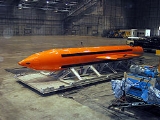
Bomb

Encyclopedia
Exothermic
In thermodynamics, the term exothermic describes a process or reaction that releases energy from the system, usually in the form of heat, but also in the form of light , electricity , or sound...
reaction of an explosive material
Explosive material
An explosive material, also called an explosive, is a reactive substance that contains a great amount of potential energy that can produce an explosion if released suddenly, usually accompanied by the production of light, heat, sound, and pressure...
to provide an extremely sudden and violent release of energy. Detonation
Detonation
Detonation involves a supersonic exothermic front accelerating through a medium that eventually drives a shock front propagating directly in front of it. Detonations are observed in both conventional solid and liquid explosives, as well as in reactive gases...
s inflict damage principally through ground- and atmosphere-transmitted mechanical stress, the impact and penetration of pressure-driven projectiles, pressure damage, and explosion-generated effects. A nuclear weapon
Nuclear weapon
A nuclear weapon is an explosive device that derives its destructive force from nuclear reactions, either fission or a combination of fission and fusion. Both reactions release vast quantities of energy from relatively small amounts of matter. The first fission bomb test released the same amount...
employs chemical-based explosives to initiate a much larger nuclear-based explosion.
The term "bomb" is not usually applied to explosive devices used for civilian
Civilian
A civilian under international humanitarian law is a person who is not a member of his or her country's armed forces or other militia. Civilians are distinct from combatants. They are afforded a degree of legal protection from the effects of war and military occupation...
- purposes such as construction
Construction
In the fields of architecture and civil engineering, construction is a process that consists of the building or assembling of infrastructure. Far from being a single activity, large scale construction is a feat of human multitasking...
or mining
Mining
Mining is the extraction of valuable minerals or other geological materials from the earth, from an ore body, vein or seam. The term also includes the removal of soil. Materials recovered by mining include base metals, precious metals, iron, uranium, coal, diamonds, limestone, oil shale, rock...
, although the people using the devices may sometimes refer to them as "bomb". The military use of the term "bomb", or more specifically aerial bomb
Aerial bomb
An aerial bomb is a type of explosive weapon intended to travel through the air with predictable trajectories, usually designed to be dropped from an aircraft...
action, typically refers to airdropped, unpowered explosive weapons most commonly used by air force
Air force
An air force, also known in some countries as an air army, is in the broadest sense, the national military organization that primarily conducts aerial warfare. More specifically, it is the branch of a nation's armed services that is responsible for aerial warfare as distinct from an army, navy or...
s and naval aviation
Naval aviation
Naval aviation is the application of manned military air power by navies, including ships that embark fixed-wing aircraft or helicopters. In contrast, maritime aviation is the operation of aircraft in a maritime role under the command of non-naval forces such as the former RAF Coastal Command or a...
. Other military explosive weapons not classified as "bombs" include grenade
Grenade
A grenade is a small explosive device that is projected a safe distance away by its user. Soldiers called grenadiers specialize in the use of grenades. The term hand grenade refers any grenade designed to be hand thrown. Grenade Launchers are firearms designed to fire explosive projectile grenades...
s, shells, depth charge
Depth charge
A depth charge is an anti-submarine warfare weapon intended to destroy or cripple a target submarine by the shock of exploding near it. Most use explosives and a fuze set to go off at a preselected depth in the ocean. Depth charges can be dropped by either surface ships, patrol aircraft, or from...
s (used in water), warhead
Warhead
The term warhead refers to the explosive material and detonator that is delivered by a missile, rocket, or torpedo.- Etymology :During the early development of naval torpedoes, they could be equipped with an inert payload that was intended for use during training, test firing and exercises. This...
s when in missile
Missile
Though a missile may be any thrown or launched object, it colloquially almost always refers to a self-propelled guided weapon system.-Etymology:The word missile comes from the Latin verb mittere, meaning "to send"...
s, or land mine
Land mine
A land mine is usually a weight-triggered explosive device which is intended to damage a target—either human or inanimate—by means of a blast and/or fragment impact....
s. In unconventional warfare, "bomb" can refer to any of a limitless range for offensive weaponry. For instance, in recent conflicts, "bombs" known as Improvised Explosive Device
Improvised explosive device
An improvised explosive device , also known as a roadside bomb, is a homemade bomb constructed and deployed in ways other than in conventional military action...
s (IEDS) have been employed by insurgent fighters to great effectiveness.
The word comes from the Latin
Latin
Latin is an Italic language originally spoken in Latium and Ancient Rome. It, along with most European languages, is a descendant of the ancient Proto-Indo-European language. Although it is considered a dead language, a number of scholars and members of the Christian clergy speak it fluently, and...
bombus, which in turn comes from the Greek
Greek language
Greek is an independent branch of the Indo-European family of languages. Native to the southern Balkans, it has the longest documented history of any Indo-European language, spanning 34 centuries of written records. Its writing system has been the Greek alphabet for the majority of its history;...
βόμβος (bombos), an onomatopoetic term meaning "booming".
Shock
Explosive shock waveShock wave
A shock wave is a type of propagating disturbance. Like an ordinary wave, it carries energy and can propagate through a medium or in some cases in the absence of a material medium, through a field such as the electromagnetic field...
s can cause situations such as body displacement (i.e., people being thrown through the air), dismemberment
Dismemberment
Dismemberment is the act of cutting, tearing, pulling, wrenching or otherwise removing, the limbs of a living thing. It may be practiced upon human beings as a form of capital punishment, as a result of a traumatic accident, or in connection with murder, suicide, or cannibalism...
, internal bleeding
Internal bleeding
Internal bleeding is bleeding occurring inside the body. It can be a serious medical emergency depending on where it occurs , and can potentially cause death and cardiac arrest if proper medical treatment is not received quickly....
and ruptured eardrum
Eardrum
The eardrum, or tympanic membrane, is a thin membrane that separates the external ear from the middle ear in humans and other tetrapods. Its function is to transmit sound from the air to the ossicles inside the middle ear. The malleus bone bridges the gap between the eardrum and the other ossicles...
s.
Shock waves produced by explosive events have two distinct components, the positive and negative wave. The positive wave shoves outward from the point of detonation, followed by the trailing vacuum space "sucking back" towards the point of origin as the shock bubble collapses.
The greatest defense against shock injuries is distance from the source of shock. As a point of reference, the overpressure at the Oklahoma City bombing
Oklahoma City bombing
The Oklahoma City bombing was a terrorist bomb attack on the Alfred P. Murrah Federal Building in downtown Oklahoma City on April 19, 1995. It was the most destructive act of terrorism on American soil until the September 11, 2001 attacks. The Oklahoma blast claimed 168 lives, including 19...
was estimated in the range of 4000 psi
Pounds per square inch
The pound per square inch or, more accurately, pound-force per square inch is a unit of pressure or of stress based on avoirdupois units...
.
Heat
A thermal wave is created by the sudden release of heat caused by an explosion. Military bomb tests have documented temperatures of up to 2,480 °C (4,500 °F). While capable of inflicting severe to catastrophic burns and causing secondary fires, thermal wave effects are considered very limited in range compared to shock and fragmentation. This rule has been challenged, however, by military development of thermobaric weaponThermobaric weapon
A thermobaric weapon, which includes the type known as a "fuel-air bomb", is an explosive weapon that produces a blast wave of a significantly longer duration than those produced by condensed explosives. This is useful in military applications where its longer duration increases the numbers of...
s, which employ a combination of negative shock wave effects and extreme temperature to incinerate objects within the blast radius.
Fragmentation
FragmentationFragmentation (weaponry)
Fragmentation is the process by which the casing of an artillery shell, bomb, grenade, etc. is shattered by the detonating high explosive filling. The correct technical terminology for these casing pieces is fragments , although shards or splinters can be used for non-preformed fragments...
is produced by the acceleration of shattered pieces of bomb casing and adjacent physical objects. While conventionally viewed as small metal shards moving at super- to hypersonic speeds, fragmentation can occur in epic proportions and travel for extensive distances. When the S.S. Grandcamp exploded in the Texas City Disaster
Texas City Disaster
The Texas City Disaster was the deadliest industrial accident in U.S. history. The incident took place on April 16, 1947, and began with a mid-morning fire on board the French-registered vessel SS Grandcamp which was docked in the Port of Texas City...
on April 16, 1947, one fragment of that blast was a two ton anchor which was hurled nearly two miles inland to embed itself in the parking lot of the Pan American refinery. Fragmentation should not be confused with shrapnel, which relies on the momentum of a shell
Shell (projectile)
A shell is a payload-carrying projectile, which, as opposed to shot, contains an explosive or other filling, though modern usage sometimes includes large solid projectiles properly termed shot . Solid shot may contain a pyrotechnic compound if a tracer or spotting charge is used...
to cause damage.
Effects on living things
To people who are close to a blast incident, such as bomb disposal technicians, soldiers wearing body armor, deminers or individuals wearing little to no protection, there are four types of blast effects on the human body: overpressure (shock), fragmentation, impact and heat. Overpressure refers to the sudden and drastic rise in ambient pressure that can damage the internal organs, possibly leading to permanent damage or death. Fragmentation includes the shrapnel described above but can also include sand, debris and vegetation from the area surrounding the blast source. This is very common in anti-personnel mine blasts. The projection of materials poses a potentially lethal threat caused by cuts in soft tissues, as well as infections, and injuries to the internal organs. When the overpressure wave impacts the body it can induce violent levels of blast-induced acceleration. Resulting injuries range from minor to unsurvivable. Immediately following this initial acceleration, deceleration injuries can occur when a person impacts directly against a rigid surface or obstacle after being set in motion by the force of the blast. Finally, injury and fatality can result from the explosive fireball as well as incendiary agents projected onto the body. Personal protective equipment, such as a bomb suitBombsuit
A bomb suit or a blast suit is a heavy suit of body armor designed to withstand the pressure released from a bomb and any projectiles the bomb may produce. It is usually worn by trained personnel attempting bomb disposal...
or demining ensemble, as well as helmets, visors and foot protection, can dramatically reduce the four effects, depending upon the charge, proximity and other variables.
Types
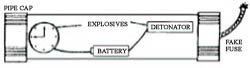
Improvised explosive device
An improvised explosive device , also known as a roadside bomb, is a homemade bomb constructed and deployed in ways other than in conventional military action...
s are divided into three basic categories by basic size and delivery. Type 76, IEDs are hand-carried parcel or suitcase bombs, type 80, are "suicide vests" worn by a bomber, and type 3 devices are vehicles laden with explosives to act as large-scale stationary or self-propelled bombs, also known as VBIED (vehicle-borne IEDs).
Improvised explosive materials are typically very unstable and subject to spontaneous, unintentional detonation triggered by a wide range of environmental effects ranging from impact and friction
Friction
Friction is the force resisting the relative motion of solid surfaces, fluid layers, and/or material elements sliding against each other. There are several types of friction:...
to electrostatic shock. Even subtle motion
Motion (physics)
In physics, motion is a change in position of an object with respect to time. Change in action is the result of an unbalanced force. Motion is typically described in terms of velocity, acceleration, displacement and time . An object's velocity cannot change unless it is acted upon by a force, as...
, change in temperature
Temperature
Temperature is a physical property of matter that quantitatively expresses the common notions of hot and cold. Objects of low temperature are cold, while various degrees of higher temperatures are referred to as warm or hot...
, or the nearby use of cellphones or radios, can trigger an unstable or remote-controlled device. Any interaction with explosive materials or devices by unqualified personnel should be considered a grave and immediate risk of death or dire injury. The safest response to finding an object believed to be an explosive device is to get as far away from it as possible.
Atomic bombs are based on the theory of nuclear fission
Nuclear fission
In nuclear physics and nuclear chemistry, nuclear fission is a nuclear reaction in which the nucleus of an atom splits into smaller parts , often producing free neutrons and photons , and releasing a tremendous amount of energy...
, that when a large atom splits it releases a massive amount of energy. Hydrogen bombs use the energy from an initial fission explosion to create an even more powerful fusion
Nuclear fusion
Nuclear fusion is the process by which two or more atomic nuclei join together, or "fuse", to form a single heavier nucleus. This is usually accompanied by the release or absorption of large quantities of energy...
explosion.
The term dirty bomb
Dirty bomb
A dirty bomb is a speculative radiological weapon that combines radioactive material with conventional explosives. The purpose of the weapon is to contaminate the area around the explosion with radioactive material, hence the attribute "dirty"....
refers to a specialized device that relies on a comparatively low explosive yield to scatter harmful material over a wide area. Most commonly associated with radiological or chemical materials, dirty bombs seek to kill or injure and then to deny access to a contaminated area until a thorough clean-up can be accomplished. In the case of urban settings, this clean-up may take extensive time, rendering the contaminated zone virtually uninhabitable in the interim.
The power of large bombs is typically measured in kilotons (Kt) or megatons of TNT (Mt)
TNT equivalent
TNT equivalent is a method of quantifying the energy released in explosions. The ton of TNT is a unit of energy equal to 4.184 gigajoules, which is approximately the amount of energy released in the detonation of one ton of TNT...
. The most powerful bombs ever used in combat were the two atomic bombs dropped by the United States
Atomic bombings of Hiroshima and Nagasaki
During the final stages of World War II in 1945, the United States conducted two atomic bombings against the cities of Hiroshima and Nagasaki in Japan, the first on August 6, 1945, and the second on August 9, 1945. These two events are the only use of nuclear weapons in war to date.For six months...
to attack Hiroshima
Hiroshima
is the capital of Hiroshima Prefecture, and the largest city in the Chūgoku region of western Honshu, the largest island of Japan. It became best known as the first city in history to be destroyed by a nuclear weapon when the United States Army Air Forces dropped an atomic bomb on it at 8:15 A.M...
and Nagasaki, and the most powerful ever tested was the Tsar Bomba
Tsar Bomba
Tsar Bomba is the nickname for the AN602 hydrogen bomb, the most powerful nuclear weapon ever detonated. It was also referred to as Kuz'kina Mat , in this usage meaning "something that has not been seen before"....
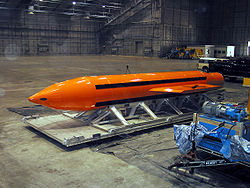
. The most powerful non-nuclear bomb is Russia
Russia
Russia or , officially known as both Russia and the Russian Federation , is a country in northern Eurasia. It is a federal semi-presidential republic, comprising 83 federal subjects...
n "Father of All Bombs" (officially Aviation Thermobaric Bomb of Increased Power (ATBIP)) followed by the United States Air Force
United States Air Force
The United States Air Force is the aerial warfare service branch of the United States Armed Forces and one of the American uniformed services. Initially part of the United States Army, the USAF was formed as a separate branch of the military on September 18, 1947 under the National Security Act of...
's MOAB
Moab
Moab is the historical name for a mountainous strip of land in Jordan. The land lies alongside much of the eastern shore of the Dead Sea. The existence of the Kingdom of Moab is attested to by numerous archeological findings, most notably the Mesha Stele, which describes the Moabite victory over...
(officially Massive Ordnance Air Blast, or more commonly known as the "Mother of All Bombs").
Delivery
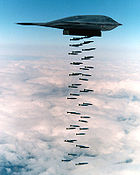
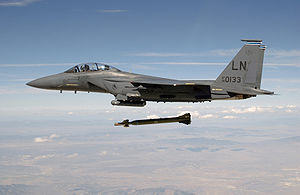
The first bombing from a fixed-wing aircraft took place in 1911 when the Italians bombed the Turkish lines in what is now Libya
Libya
Libya is an African country in the Maghreb region of North Africa bordered by the Mediterranean Sea to the north, Egypt to the east, Sudan to the southeast, Chad and Niger to the south, and Algeria and Tunisia to the west....
, during the Italo-Turkish War
Italo-Turkish War
The Italo-Turkish or Turco-Italian War was fought between the Ottoman Empire and the Kingdom of Italy from September 29, 1911 to October 18, 1912.As a result of this conflict, Italy was awarded the Ottoman provinces of Tripolitania, Fezzan, and...
. The bombs were dropped by hand.
The first large scale dropping of bombs took place during World War I
World War I
World War I , which was predominantly called the World War or the Great War from its occurrence until 1939, and the First World War or World War I thereafter, was a major war centred in Europe that began on 28 July 1914 and lasted until 11 November 1918...
starting in 1915 with the German Zeppelin
Zeppelin
A Zeppelin is a type of rigid airship pioneered by the German Count Ferdinand von Zeppelin in the early 20th century. It was based on designs he had outlined in 1874 and detailed in 1893. His plans were reviewed by committee in 1894 and patented in the United States on 14 March 1899...
raids on London
London
London is the capital city of :England and the :United Kingdom, the largest metropolitan area in the United Kingdom, and the largest urban zone in the European Union by most measures. Located on the River Thames, London has been a major settlement for two millennia, its history going back to its...
, England
England
England is a country that is part of the United Kingdom. It shares land borders with Scotland to the north and Wales to the west; the Irish Sea is to the north west, the Celtic Sea to the south west, with the North Sea to the east and the English Channel to the south separating it from continental...
. One raid on the 8th of September 1915 dropped 4000 lb (1,814.4 kg) of high explosives and incendiary bombs, including one bomb which weighed 600 lb (272.2 kg).
The first significant bombing in the United States
United States
The United States of America is a federal constitutional republic comprising fifty states and a federal district...
took place nine years later at noon on September 16, 1920 when an explosives-laden horse-drawn wagon detonated on the lunchtime-crowded streets of New York
New York
New York is a state in the Northeastern region of the United States. It is the nation's third most populous state. New York is bordered by New Jersey and Pennsylvania to the south, and by Connecticut, Massachusetts and Vermont to the east...
's financial district. The Wall Street bombing
Wall Street bombing
The Wall Street bombing occurred at 12:01 p.m. on Thursday, September 16, 1920, in the Financial District of New York City. The blast killed 38 and seriously injured 143...
employed many aspects of modern VNSA
VNSA
Violent non-state actor refers to any organization that uses illegal violence to reach its goals...
devices, such as cast-iron slugs added for shrapnel, in an attack that killed 38 and injured some 400 others.
Modern military bomber
Bomber
A bomber is a military aircraft designed to attack ground and sea targets, by dropping bombs on them, or – in recent years – by launching cruise missiles at them.-Classifications of bombers:...
aircraft are designed around a large-capacity internal bomb bay
Bomb bay
The bomb bay or weapons bay on some military aircraft is a compartment to carry bombs, usually in the aircraft's fuselage, with "bomb bay doors" which open at the bottom. The bomb bay doors are opened and the bombs are dropped when over the target or at a specified launching point.Large-sized...
while fighter bombers usually carry bombs externally on pylons or bomb racks, or on multiple ejection racks which enable mounting several bombs on a single pylon. Modern bombs, precision-guided munition
Precision-guided munition
A precision-guided munition is a guided munition intended to precisely hit a specific target, and to minimize damage to things other than the target....
s, may be guided after they leave an aircraft by remote control, or by autonomous guidance. When bombs such as nuclear weapon
Nuclear weapon
A nuclear weapon is an explosive device that derives its destructive force from nuclear reactions, either fission or a combination of fission and fusion. Both reactions release vast quantities of energy from relatively small amounts of matter. The first fission bomb test released the same amount...
s are mounted on a powered platform, they are called guided missile
Guided Missile
Guided Missile is a London based independent record label set up by Paul Kearney in 1994.Guided Missile has always focused on 'the underground', preferring to put out a steady flow of releases and developing the numerous GM events around London and beyond....
s.
Some bombs are equipped with a parachute
Parachute
A parachute is a device used to slow the motion of an object through an atmosphere by creating drag, or in the case of ram-air parachutes, aerodynamic lift. Parachutes are usually made out of light, strong cloth, originally silk, now most commonly nylon...
, such as the World War II
World War II
World War II, or the Second World War , was a global conflict lasting from 1939 to 1945, involving most of the world's nations—including all of the great powers—eventually forming two opposing military alliances: the Allies and the Axis...
"parafrag", which was an 11 kg fragmentation bomb, the Vietnam
Vietnam
Vietnam – sometimes spelled Viet Nam , officially the Socialist Republic of Vietnam – is the easternmost country on the Indochina Peninsula in Southeast Asia. It is bordered by China to the north, Laos to the northwest, Cambodia to the southwest, and the South China Sea –...
-era daisy cutter
BLU-82
The BLU-82B/C-130 weapon system, known under program "Commando Vault" and nicknamed "daisy cutter" in Vietnam and in Afghanistan for its ability to flatten a forest into a helicopter landing zone, is a 15,000 pound conventional bomb, delivered from either a C-130 or an MC-130 transport aircraft....
s, and the bomblets of some modern cluster bomb
Cluster bomb
A cluster munition is a form of air-dropped or ground-launched explosive weapon that releases or ejects smaller sub-munitions. Commonly, this is a cluster bomb that ejects explosive bomblets that are designed to kill enemy personnel and destroy vehicles...
s. Parachutes slow the bomb's descent, giving the dropping aircraft time to get to a safe distance from the explosion. This is especially important with airburst nuclear weapons, and in situations where the aircraft releases a bomb at low altitude.
A hand grenade
Hand grenade
A hand grenade is any small bomb that can be thrown by hand. Hand grenades are classified into three categories, explosive grenades, chemical and gas grenades. Explosive grenades are the most commonly used in modern warfare, and are designed to detonate after impact or after a set amount of time...
is delivered by being thrown. Grenades can also be projected by other means, such as being launched from the muzzle of a rifle
Rifle
A rifle is a firearm designed to be fired from the shoulder, with a barrel that has a helical groove or pattern of grooves cut into the barrel walls. The raised areas of the rifling are called "lands," which make contact with the projectile , imparting spin around an axis corresponding to the...
, as in the rifle grenade
Rifle grenade
A rifle grenade is a grenade that uses a rifle-based launcher to permit a longer effective range than would be possible if the grenade was thrown by hand...
or using the M203 grenade launcher or by attaching a rocket
Rocket
A rocket is a missile, spacecraft, aircraft or other vehicle which obtains thrust from a rocket engine. In all rockets, the exhaust is formed entirely from propellants carried within the rocket before use. Rocket engines work by action and reaction...
to the explosive grenade as in a rocket-propelled grenade (RPG).
A bomb may also be positioned in advance and concealed.
A bomb destroying a rail track just before a train
Train
A train is a connected series of vehicles for rail transport that move along a track to transport cargo or passengers from one place to another place. The track usually consists of two rails, but might also be a monorail or maglev guideway.Propulsion for the train is provided by a separate...
arrives causes a train to derail
Derailment
A derailment is an accident on a railway or tramway in which a rail vehicle, or part or all of a train, leaves the tracks on which it is travelling, with consequent damage and in many cases injury and/or death....
. Apart from the damage to vehicles and people, a bomb exploding in a transport
Transport
Transport or transportation is the movement of people, cattle, animals and goods from one location to another. Modes of transport include air, rail, road, water, cable, pipeline, and space. The field can be divided into infrastructure, vehicles, and operations...
network often also damages, and is sometimes mainly intended to damage that network. This applies for railways, bridge
Bridge
A bridge is a structure built to span physical obstacles such as a body of water, valley, or road, for the purpose of providing passage over the obstacle...
s, runway
Runway
According to ICAO a runway is a "defined rectangular area on a land aerodrome prepared for the landing and take-off of aircraft." Runways may be a man-made surface or a natural surface .- Orientation and dimensions :Runways are named by a number between 01 and 36, which is generally one tenth...
s, and port
Port
A port is a location on a coast or shore containing one or more harbors where ships can dock and transfer people or cargo to or from land....
s, and to a lesser extent, depending on circumstances, to roads.
In the case of suicide bombing the bomb is often carried by the attacker on his or her body, or in a vehicle driven to the target.
The Blue Peacock
Blue Peacock
Blue Peacock, renamed from Blue Bunny and originally dubbed Brown Bunny, was the codename of a British tactical nuclear weapon project in the 1950s—dubbed the chicken-powered nuclear bomb by the press....
nuclear mines, which were also termed "bombs", were planned to be positioned during wartime and be constructed such that, if they were disturbed, they would explode within ten seconds.
The explosion of a bomb may be triggered by a detonator
Detonator
A detonator is a device used to trigger an explosive device. Detonators can be chemically, mechanically, or electrically initiated, the latter two being the most common....
or a fuse
Fuse
The word fuse has several meanings:* Fuse , a device used in electrical systems to protect against excessive current....
. Detonators are triggered by clock
Clock
A clock is an instrument used to indicate, keep, and co-ordinate time. The word clock is derived ultimately from the Celtic words clagan and clocca meaning "bell". A silent instrument missing such a mechanism has traditionally been known as a timepiece...
s, remote control
Remote control
A remote control is a component of an electronics device, most commonly a television set, used for operating the television device wirelessly from a short line-of-sight distance.The remote control is usually contracted to remote...
s like cell phones or some kind of sensor, such as pressure (altitude), radar
Radar
Radar is an object-detection system which uses radio waves to determine the range, altitude, direction, or speed of objects. It can be used to detect aircraft, ships, spacecraft, guided missiles, motor vehicles, weather formations, and terrain. The radar dish or antenna transmits pulses of radio...
, vibration or contact. Detonators vary in ways they work, they can be electrical, fire fuze
Fuze
Fuze Beverage, commercially referred to as just Fuze , is a manufacturer of teas and non-carbonated fruit drinks enriched with vitamins. Currently the brand consists of five vitamin-infused lines: Slenderize, Refresh, Tea, Defensify, and Vitalize...
or blast initiated detonators and others,
Blast seat
In forensic science, the point of detonation of a bomb is referred to as its blast seat, seat of explosion, blast hole or epicenterEpicenter
The epicenter or epicentre is the point on the Earth's surface that is directly above the hypocenter or focus, the point where an earthquake or underground explosion originates...
. Depending on the type, quantity and placement of explosives, the blast seat may be either diffuse or concentrated (i.e., an explosion crater
Explosion crater
An explosion crater is a characteristically shaped hole formed when material is ejected from the surface of the ground by an explosive event just above, at, or below the surface....
).
Other types of explosion
Explosion
An explosion is a rapid increase in volume and release of energy in an extreme manner, usually with the generation of high temperatures and the release of gases. An explosion creates a shock wave. If the shock wave is a supersonic detonation, then the source of the blast is called a "high explosive"...
s, such as dust
Dust explosion
A dust explosion is the fast combustion of dust particles suspended in the air in an enclosed location. Coal dust explosions are a frequent hazard in underground coal mines, but dust explosions can occur where any powdered combustible material is present in an enclosed atmosphere.- Conditions for...
or vapor
BLEVE
A boiling liquid expanding vapor explosion occurs when a vessel containing a pressurized liquid above its boiling point ruptures.-Mechanism:...
explosions, do not cause craters or even have definitive blast seats.
External links
- Explosive Violence, The Problem of Explosive Weapons A report by Richard Moyes (Landmine Action, 2009) on the humanitarian problems caused by the use of bombs and other explosive weapons in populated areas
- FAS.org Bombs for Beginners
- MakeItLouder.com How a bomb functions and rating their power