
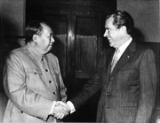
U.S. President
Richard NixonRichard Milhous Nixon was the 37th President of the United States, serving from 1969 to 1974. The only president to resign the office, Nixon had previously served as a US representative and senator from California and as the 36th Vice President of the United States from 1953 to 1961 under...
's 1972 visit to the People's Republic of China was an important step in formally normalizing relations between the
United StatesThe United States of America is a federal constitutional republic comprising fifty states and a federal district...
and the
People's Republic of ChinaChina , officially the People's Republic of China , is the most populous country in the world, with over 1.3 billion citizens. Located in East Asia, the country covers approximately 9.6 million square kilometres...
. It marked the first time a
U.S. presidentThe President of the United States of America is the head of state and head of government of the United States. The president leads the executive branch of the federal government and is the commander-in-chief of the United States Armed Forces....
had visited the PRC, who at that time considered the U.S. one of its staunchest foes. The visit has become a metaphor for an unexpected or uncharacteristic action by a politician.
Historical background
Improved relations with the
Soviet UnionThe Soviet Union , officially the Union of Soviet Socialist Republics , was a constitutionally socialist state that existed in Eurasia between 1922 and 1991....
and the People’s Republic of China are often cited as the most successful diplomatic achievements of Nixon’s presidency. After
World War IIWorld War II, or the Second World War , was a global conflict lasting from 1939 to 1945, involving most of the world's nations—including all of the great powers—eventually forming two opposing military alliances: the Allies and the Axis...
, Americans saw relations between the United States and the Soviet Union deteriorating, Russians consolidating communist allies over much of
Eastern EuropeEastern Europe is the eastern part of Europe. The term has widely disparate geopolitical, geographical, cultural and socioeconomic readings, which makes it highly context-dependent and even volatile, and there are "almost as many definitions of Eastern Europe as there are scholars of the region"...
, and China teetering on the edge of communism. Many Americans felt concern communists might cause the downfall of schools or labor unions. One of the main reasons Richard Nixon became the 1952 Vice-president candidate on the
EisenhowerDwight David "Ike" Eisenhower was the 34th President of the United States, from 1953 until 1961. He was a five-star general in the United States Army...
ticket was his strong anti-communism stance. Despite this, in 1972 Nixon became the first U.S. president to visit mainland China while in office.
Ulysses S. GrantUlysses S. Grant was the 18th President of the United States as well as military commander during the Civil War and post-war Reconstruction periods. Under Grant's command, the Union Army defeated the Confederate military and ended the Confederate States of America...
visited China on a world tour after leaving office.
Herbert HooverHerbert Clark Hoover was the 31st President of the United States . Hoover was originally a professional mining engineer and author. As the United States Secretary of Commerce in the 1920s under Presidents Warren Harding and Calvin Coolidge, he promoted partnerships between government and business...
lived in China briefly in 1899 before becoming President and could speak fluent Mandarin.
Dwight EisenhowerDwight David "Ike" Eisenhower was the 34th President of the United States, from 1953 until 1961. He was a five-star general in the United States Army...
made a state visit to
TaiwanTaiwan , also known, especially in the past, as Formosa , is the largest island of the same-named island group of East Asia in the western Pacific Ocean and located off the southeastern coast of mainland China. The island forms over 99% of the current territory of the Republic of China following...
in 1960, during the period when the United States recognized the government there as the sole government of China.
Preparation
In July 1971, President Nixon's
National Security AdvisorThe Assistant to the President for National Security Affairs, commonly referred to as the National Security Advisor , serves as the chief advisor to the President of the United States on national security issues...
Henry KissingerHeinz Alfred "Henry" Kissinger is a German-born American academic, political scientist, diplomat, and businessman. He is a recipient of the Nobel Peace Prize. He served as National Security Advisor and later concurrently as Secretary of State in the administrations of Presidents Richard Nixon and...
secretly visited Beijing during a trip to
PakistanPakistan , officially the Islamic Republic of Pakistan is a sovereign state in South Asia. It has a coastline along the Arabian Sea and the Gulf of Oman in the south and is bordered by Afghanistan and Iran in the west, India in the east and China in the far northeast. In the north, Tajikistan...
, and laid the groundwork for Nixon's visit to China.
Meeting
From February 21-28, 1972,
U.S. PresidentThe President of the United States of America is the head of state and head of government of the United States. The president leads the executive branch of the federal government and is the commander-in-chief of the United States Armed Forces....
Richard NixonRichard Milhous Nixon was the 37th President of the United States, serving from 1969 to 1974. The only president to resign the office, Nixon had previously served as a US representative and senator from California and as the 36th Vice President of the United States from 1953 to 1961 under...
traveled to
BeijingBeijing , also known as Peking , is the capital of the People's Republic of China and one of the most populous cities in the world, with a population of 19,612,368 as of 2010. The city is the country's political, cultural, and educational center, and home to the headquarters for most of China's...
,
HangzhouHangzhou , formerly transliterated as Hangchow, is the capital and largest city of Zhejiang Province in Eastern China. Governed as a sub-provincial city, and as of 2010, its entire administrative division or prefecture had a registered population of 8.7 million people...
and
ShanghaiShanghai is the largest city by population in China and the largest city proper in the world. It is one of the four province-level municipalities in the People's Republic of China, with a total population of over 23 million as of 2010...
. Almost as soon as the American president arrived in the Chinese capital he was summoned for a quick meeting with
Chairman MaoMao Zedong, also transliterated as Mao Tse-tung , and commonly referred to as Chairman Mao , was a Chinese Communist revolutionary, guerrilla warfare strategist, Marxist political philosopher, and leader of the Chinese Revolution...
.
Secretary of StateThe United States Secretary of State is the head of the United States Department of State, concerned with foreign affairs. The Secretary is a member of the Cabinet and the highest-ranking cabinet secretary both in line of succession and order of precedence...
William P. RogersWilliam Pierce Rogers was an American politician, who served as a Cabinet officer in the administrations of two U.S. Presidents in the third quarter of the 20th century.-Early Life :...
was excluded from this meeting and the only other American present was
National Security CouncilThe White House National Security Council in the United States is the principal forum used by the President of the United States for considering national security and foreign policy matters with his senior national security advisors and Cabinet officials and is part of the Executive Office of the...
staffer (and later
U.S. Ambassador to ChinaThe United States Ambassador to China is the chief American diplomat to People's Republic of China . The United States has sent diplomatic representatives to China since 1844, when Caleb Cushing, as Commissioner, negotiated the Treaty of Wanghia. Commissioners represented the United States in...
)
Winston LordWinston Lord is a United States diplomat and leader of non-governmental foreign policy organizations...
. To avoid embarrassing Rogers, Lord was cropped out of all the official photographs of the meeting. Although Nixon was in China for a week, this would be his sole meeting with the top Chinese leader.
Unknown to Nixon and the rest of the American diplomats at the time, Chairman Mao was in poor health and had been ill only nine days prior to Nixon's arrival. Neverless, Mao felt strong enough to insist to his officals for a meeting with President Nixon upon his arrival. Upon meeting Nixon for the first time, Mao, speaking through his translator, said to Nixon: "I belive our old friend
Chiang Kai-shekChiang Kai-shek was a political and military leader of 20th century China. He is known as Jiǎng Jièshí or Jiǎng Zhōngzhèng in Mandarin....
would not approve of this".
Nixon held many meetings with Chinese Premier
Zhou EnlaiZhou Enlai was the first Premier of the People's Republic of China, serving from October 1949 until his death in January 1976...
during the trip, which included visits to the
Great WallThe Great Wall of China is a series of stone and earthen fortifications in northern China, built originally to protect the northern borders of the Chinese Empire against intrusions by various nomadic groups...
,
HangzhouHangzhou , formerly transliterated as Hangchow, is the capital and largest city of Zhejiang Province in Eastern China. Governed as a sub-provincial city, and as of 2010, its entire administrative division or prefecture had a registered population of 8.7 million people...
, and
ShanghaiShanghai is the largest city by population in China and the largest city proper in the world. It is one of the four province-level municipalities in the People's Republic of China, with a total population of over 23 million as of 2010...
. At the conclusion of his trip, the
United StatesThe United States of America is a federal constitutional republic comprising fifty states and a federal district...
and the PRC Governments issued the
Shanghai CommuniquéThe Joint Communiqué of the United States of America and the People's Republic of China, also known as the Shanghai Communiqué , was an important diplomatic document issued by the United States of America and the People's Republic of China on February 27, 1972 during President Richard Nixon's visit...
, a statement of their foreign policy views and a document that has remained the basis of Sino-American bilateral relations. Kissinger stated that the U.S. also intended to pull all its forces out of the island of Taiwan. In the communiqué, both nations pledged to work toward the full normalization of diplomatic policy.
Results
A peaceful settlement of the Taiwan question agreed by the Chinese themselves. The statement enabled the U.S. and PRC to temporarily set aside the "crucial question obstructing the normalization of relations" concerning the
political status of TaiwanThe controversy regarding the political status of Taiwan hinges on whether Taiwan, Penghu, Kinmen, and Matsu should remain effectively independent as territory of the Republic of China , become unified with the territories now governed by the People's Republic of China , or formally declare...
and to open trade and other contacts. However, the United States continued to maintain official relations with the government of the
Republic of ChinaThe Republic of China , commonly known as Taiwan , is a unitary sovereign state located in East Asia. Originally based in mainland China, the Republic of China currently governs the island of Taiwan , which forms over 99% of its current territory, as well as Penghu, Kinmen, Matsu and other minor...
in Taiwan until 1979 when the U.S. broke off formal diplomatic relations with the Republic of China and established full diplomatic relations with the P.R.C.
After Nixon's visit he spoke about what this meant for the two countries in the future:
- "This was the week that changed the world, as what we have said in that Communique is not nearly as important as what we will do in the years ahead to build a bridge across 16,000 miles and 22 years of hostilities which have divided us in the past. And what we have said today is that we shall build that bridge."
Richard Nixon wrote many books about his international contributions and accomplishments.
Beyond Peace is the last of his post-career volumes, addressing the need for the United States to beat the competition in a world transformed by the collapse of the Communist bloc.
Aftermath
Max FrankelMax Frankel is a Pulitzer Prize-winning journalist.Frankel came to the United States in 1940. He attended Columbia College and began part-time work for The New York Times in his sophomore year. He received his B.A. degree in 1952 and an M.A. in American government from Columbia in 1953.He joined...
of
The New York TimesThe New York Times is an American daily newspaper founded and continuously published in New York City since 1851. The New York Times has won 106 Pulitzer Prizes, the most of any news organization...
received the
Pulitzer Prize for International ReportingThis Pulitzer Prize has been awarded since 1942 for a distinguished example of reporting on international affairs, including United Nations correspondence. In its first six years , it was called the Pulitzer Prize for Telegraphic Reporting - International...
for his coverage of the event.
The visit inspired John Adams' 1987
operaOpera is an art form in which singers and musicians perform a dramatic work combining text and musical score, usually in a theatrical setting. Opera incorporates many of the elements of spoken theatre, such as acting, scenery, and costumes and sometimes includes dance...
Nixon in ChinaNixon in China is an opera in three acts by John Adams, with a libretto by Alice Goodman. Adams' first opera, it was inspired by the 1972 visit to China by US President Richard Nixon. The work premiered at the Houston Grand Opera on October 22, 1987, in a production by Peter Sellars with...
.
See also
- Nixon in China
Nixon in China is an opera in three acts by John Adams, with a libretto by Alice Goodman. Adams' first opera, it was inspired by the 1972 visit to China by US President Richard Nixon. The work premiered at the Houston Grand Opera on October 22, 1987, in a production by Peter Sellars with...
(opera)
- Nixon goes to China
- Ping Pong Diplomacy
Ping pong diplomacy refers to the exchange of ping pong players between the United States and People's Republic of China in the 1970s. The event marked a thaw in U.S.–China relations that paved the way to a visit to Beijing by President Richard Nixon....
- Sino-American relations
For the article on U.S.-Taiwan relations, see Republic of China – United States relations.Sino-American or People's Republic of China–United States relations refers to international relations between the United States of America and the government of People's Republic of China...
- China and the United Nations
China's seat in the United Nations and membership of the United Nations Security Council was originally occupied by the Republic of China since October 24, 1945. During the Chinese Civil War, the Communist Party of China repelled the government of the ROC from Mainland China to the island of...
Further reading
- Nixon Library- relations with Chinese
- Burr, William (1999) The Kissinger Transcripts, New Press
- Ladley, Eric (2002) Nixon's China Trip, Writer's Club Press; (2007) Balancing Act: How Nixon Went to China and Remained a Conservative.
- MacMillan, Margaret
Margaret Olwen MacMillan, OC is a historian and professor at the University of Oxford, where she is Warden of St. Antony's College. She is former provost of Trinity College and professor of history at the University of Toronto and previously, at Ryerson University...
(2007) Nixon & Mao: The Week that Changed the World, Random House
- Mann, James (1999) About Face, Knopf
- Nixon, Richard (1978) RN: The Memoirs of Richard Nixon, Grosset & Dunlap
- Tyler, Patrick (1999) A Great Wall, Public Affairs
- Kadaré, Ismail (1989) The Concert
External links