


Psychological warfare

Encyclopedia
Psychological warfare (PSYWAR), or the basic aspects of modern psychological operations (PSYOP), have been known by many other names or terms, including Psy Ops, Political Warfare, “Hearts and Minds,” and Propaganda
. Various techniques are used, by any set of groups, and aimed to influence a target audience's value
systems, belief
systems, emotion
s, motives, reasoning, or behavior
. It is used to induce confessions or reinforce attitudes and behaviors favorable to the originator's objectives, and are sometimes combined with black operations or false flag
tactics. Target audiences can be government
s, organization
s, groups
, and individual
s.
In Propaganda: The Formation of Men's Attitudes
, Jacques Ellul
discusses psychological warfare as a common peace policy practice between nations as a form of indirect aggression in place of military aggression. This type of propaganda drains the public opinion of an opposing regime by stripping away its power on public opinion. This form of aggression is hard to defend against because no international court of justice is capable of protecting against psychological aggression since it cannot be legally adjudicated. The only defense is using the same means of psychological warfare. It is the burden of every government to defend its state against propaganda aggression. "Here the propagandists is dealing with a foreign adversary whose morale he seeks to destroy by psychological means so that the opponent begins to doubt the validity of his beliefs and actions."
The U.S. Department of Defense defines psychological warfare as:
During World War II
the United States Joint Chiefs of Staff
defined psychological warfare more broadly stating "Psychological warfare employs any weapon to influence the mind of the enemy. The weapons are psychological only in the effect they produce and not because of the weapons themselves."
of the Achaemenid Empire
was known as a conqueror, he is also remembered for his tolerance towards those he defeated.
To ensure that the new conquered peoples did not revolt, Cyrus the Great
showed respect to their customs and allowed them to continue to practice their religions.
He also freed 40000 Jewish slaves in Babylon, sent them back to Judah and funded the building of a new temple in Jerusalem, which gave him the title "Liberator" and Messiah
in the Old Testament
.
.
To keep the new Macedonian state and assortment of powerful Greek tribes from revolting against their leader, Alexander the Great left some of his men behind in each city to introduce Greek culture, control it, oppress dissident views, and interbreed. Alexander paid his soldiers to marry non-Greek women. He wanted to assimilate
people of all nations.
, leader of the Mongols
in the 13th century AD, united his people to eventually create the largest contiguous empire in human history. Defeating the will of the enemy was the top priority.
Before attacking a settlement, the Mongol general
s demanded submission to the Khan, and threatened the initial villages with complete destruction if they refused to surrender. After winning the battle, the Mongol general
s fulfilled their threats and massacred the survivors.
Examples include the destruction of the nations of Kiev
and Khwarizm
. Consequently, tales of the encroaching horde spread to the next villages and created an aura of insecurity that undermined the possibility of future resistance.
Subsequent nations were much more likely to surrender to the Mongols without fighting. Often this, as much as the Mongols' tactical prowess, secured quick Mongol victories.
Genghis Khan also employed tactics that made his numbers seem greater than they actually were. During night operations he ordered each soldier to light three torches at dusk to give the illusion of an overwhelming army and deceive and intimidate enemy scouts. He also sometimes had objects tied to the tails of his horses, so that riding on open and dry fields raised a cloud of dust that gave the enemy the impression of great numbers. His soldiers used arrows specially notched to whistle as they flew through the air, creating a terrifying noise.
The Mongols also employed other gruesome terror tactics to weaken the will to resist. One infamous incident occurred during Tamerlane's Indian campaign. Tamerlane, an heir to the Mongol martial tradition, built a pyramid of 90,000 human heads in front of the walls of Delhi
, to convince them to surrender.
Other tactics included firing severed human heads from catapults into enemy lines and over city walls to frighten enemy soldiers and citizens and spread diseases in the close confines of a besieged city. The results were thus not only psychological since in 1347, the Mongols under Janibeg catapulted corpses infected with plague into the trading city of Kaffa in Crimea
, making it one of the first knowns uses of biological warfare.
d his enemies. His most well-known psychological tactic was an incident involving impalement
(earning him the title "Vlad the Impaler"), where he had the bodies of thousands of Ottoman soldiers suspended in the air, impaled through the heart
or rectum
with sharpened stakes.
technology was Nazi Germany's Adolf Hitler
. By first creating a speaking environment, designed by Joseph Goebbels
, he was able to exaggerate his presence to make him seem messianic
. Hitler also coupled this with the resonating projections of his orations for effect. British Prime Minister Winston Churchill
made similar use of radio for propaganda
against the Nazis.
The British set up the Political Warfare Executive
to produce and distribute black and white propaganda. Through the use of powerful transmitters
, broadcasts could be made across Europe. Sefton Delmer
managed a successful black propaganda campaign through several radio stations which were designed to be popular with German troops while at the same time introducing news material that would weaken their morale under a veneer of authenticity.
During World War II, psychological warfare was used by the military. The invasion of Normandy was considered successful in part because of the displayed fusion of psychological warfare and military deception
.
As an example, before D-Day
, Operation Quicksilver, one element of operation Fortitude
, which itself was part of a larger deception strategy (Operation Bodyguard
), created a fictional "First United States Army Group" (FUSAG) commanded by General George Patton that supposedly would invade France at the Pas-de-Calais. American troops used false signals, decoy installations and phony equipment to deceive German observation aircraft and radio interception operators.
When the actual invasion began, the success of Fortitude was that it misled the German High Command into believing the landings were a diversion and of keeping reserves away from the beaches. Erwin Rommel
was the primary target of the psychological aspects of this operation. Convinced that Patton would lead the invasion, Rommel was caught off-guard and unable to react strongly to the Normandy invasion, as Patton's illusory FUSAG had not "yet" landed. Confidence in his own intelligence and judgement rendered the German response to the beachhead ineffectual.
Most of these techniques were developed during World War II or earlier, and have been used to some degree in every conflict since. Daniel Lerner was in the OSS (the predecessor to the US CIA) and in his book, attempts to analyze how effective the various strategies were.
He concludes that there is little evidence that any of them were dramatically successful, except perhaps surrender instructions over loudspeakers when victory was imminent. It should be noted, though, that measuring the success or failure of psychological warfare is very hard, as the conditions are very far from being a controlled experiment.
Bundeswehr
, the Zentrum Operative Information and its subordinate Bataillon für Operative Information 950 are responsible for the PSYOP efforts (called Operative Information in German
). Both the center and the battalion
are subordinate to the new Streitkräftebasis
(Joint Services Support Command, SKB) and together consist of about 1,200 soldiers specialising in modern communication and media technologies. One project of the German PSYOP forces is the radio station Stimme der Freiheit (Sada-e Azadi, Voice of Freedom), heard by thousands of Afghans
. Another is the publication of various newspapers and magazines in Kosovo
and Afghanistan
, where German soldiers serve with NATO.
onslaughts by way of psychological warfare. According to U.S. military analysts, attacking the enemy’s mind is among the chief strategies China
will use in order to catch its adversaries off-guard. Psychological warfare would disarm an enemy in a way even nuclear weapons cannot, and so many say the U.S. must prepare for psychological warfare on an unprecedented level.
This type of warfare, being rooted in Chinese Stratagems outlined in words such as Sun Tzu
’s The Art of War and The Thirty-Six Stratagems, has become so engrained in Chinese culture that the same applies to military strategy and foreign policy strategy. In its dealings with its rivals, China is expected to utilize Marxist
dialectics to mobilize communist
loyalists, as well as flex its economic and military muscle to persuade other nations to do what it wants. The Chinese government will try to control the media to keep a tight hold on propaganda
efforts for its people, though the success of this will be mitigated by the ever-increasing global availability of information. U.S. analysts take so seriously the concept of ji (planning) that they take any sign of Chinese military cooperation (e.g., sending troops to Sudan or giving information about Iran’s nuclear program) cautiously.
, PSYOPS are handled by the tri-service 15 Psychological Operations Group
. (See also MI5
and Secret Intelligence Service
). The British were one of the first major military powers to use psychological warfare in World War II, especially against the Japanese
. The Gurkhas, who are Nepal
ese soldiers in British service, have always been feared by the enemy due to their use of a curved knife called the kukri
.
The British used this fear to great effect, as Gurkhas were used to terrorize Japanese soldiers through nighttime raids on their camps.
The purpose of United States
psychological operations is to induce or reinforce attitudes and behaviors favorable to US objectives. The Special Activities Division
(SAD) is a division of the Central Intelligence Agency's National Clandestine Service
, responsible for Covert Action and "Special Activities". These special activities include covert political influence (which includes psychological operations) and paramilitary operations. SAD's political influence group is the only US unit allowed to conduct these operations covertly and is considered the primary unit in this area.
Dedicated psychological operations units exist in the United States Army
. The United States Navy
also plans and executes limited PSYOP missions. United States PSYOP units and soldiers of all branches of the military are prohibited by law from targeting U.S. citizens with PSYOP within the borders of the United States(Executive Order S-1233, DOD Directive S-3321.1, and National Security Decision Directive 130.) While United States Army PSYOP units may offer non-PSYOP support to domestic military missions, they can only target foreign audiences.
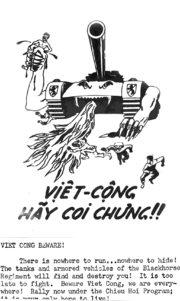 The United States ran an extensive program of psychological warfare during the Vietnam War
. The Phoenix Program
had the dual aim of assassinating Viet Cong personnel and terrorizing any potential sympathizers or passive supporters. Chieu Hoi program of the South Vietnam
government promoted Viet Cong defections.
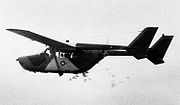 When members of the VCI were assassinated, CIA and Special Forces
operatives placed playing cards in the mouth of the deceased as a calling card. During the Phoenix Program, over 19,000 Viet Cong supporters were killed.
The CIA made extensive use of Contra
death squads in Nicaragua
to destabilize the Sandinista government, which the U.S. maintained was communist. The CIA used psychological warfare techniques against the Panama
nians by broadcasting pirate TV broadcasts. The CIA has extensively used propaganda broadcasts against the Cuba
n government through TV Marti
, based in Miami, Florida
. However, the Cuban government has been somewhat successful in jamming the signal of TV Marti.
During the Waco Siege
, the FBI and BATF
conducted psychological operations on the men, women and children inside the Mount Carmel complex. This included using loudspeakers to play sounds of animals being slaughtered, drilling noises and clips from talk shows about how much their leader David Koresh
was hated. In addition, very bright, flashing lights were used at night.
In the Iraq War, the United States used the shock and awe campaign to psychologically maim, and break the will of the Iraqi Army
to fight.
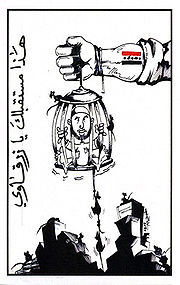 More recently, an article in Rolling Stone magazine alleges the United States has conducted psychological operations on its own senators and other decision makers in order to influence foreign policy. The article quotes U.S. Army Lt. Col. Michael Holmes describing how the U.S. Army illegally ordered a team of soldiers specializing in "psychological operations" to manipulate visiting American senators into providing more troops and funding for the war. According to Holmes, the orders came from the command of Lt. Gen. William B. Caldwell
, a three-star general in charge of training Afghan troops. Gen. David Petraeus commander of the forces in Afghanistan ordered an investigation into the allegations made in the article.
White [Omissions + Emphasis]: Truthful and not strongly biased, where the source of information is acknowledged.
Grey [Omissions + Emphasis + Racial/Ethnic/Religious Bias]: Largely truthful, containing no information that can be proven wrong; the source is not identified.
Black [Commissions of falsification]: Inherently deceitful, information given in the product is attributed to a source that was not responsible for its creation.
Mr. Lerner points out that grey and black operations ultimately have a heavy cost, in that the target population sooner or later recognizes them as propaganda and discredits the source. He writes, "This is one of the few dogmas advanced by Sykewarriors that is likely to endure as an axiom of propaganda: Credibility is a condition of persuasion. Before you can make a man do as you say, you must make him believe what you say." Consistent with this idea, the Allied strategy in World War II was predominantly one of truth (with certain exceptions).
NATO
US specific:
World War II:
USSR
Related:
Propaganda
Propaganda is a form of communication that is aimed at influencing the attitude of a community toward some cause or position so as to benefit oneself or one's group....
. Various techniques are used, by any set of groups, and aimed to influence a target audience's value
Value (personal and cultural)
A personal or cultural value is an absolute or relative ethical value, the assumption of which can be the basis for ethical action. A value system is a set of consistent values and measures. A principle value is a foundation upon which other values and measures of integrity are based...
systems, belief
Belief
Belief is the psychological state in which an individual holds a proposition or premise to be true.-Belief, knowledge and epistemology:The terms belief and knowledge are used differently in philosophy....
systems, emotion
Emotion
Emotion is a complex psychophysiological experience of an individual's state of mind as interacting with biochemical and environmental influences. In humans, emotion fundamentally involves "physiological arousal, expressive behaviors, and conscious experience." Emotion is associated with mood,...
s, motives, reasoning, or behavior
Behavior
Behavior or behaviour refers to the actions and mannerisms made by organisms, systems, or artificial entities in conjunction with its environment, which includes the other systems or organisms around as well as the physical environment...
. It is used to induce confessions or reinforce attitudes and behaviors favorable to the originator's objectives, and are sometimes combined with black operations or false flag
False flag
False flag operations are covert operations designed to deceive the public in such a way that the operations appear as though they are being carried out by other entities. The name is derived from the military concept of flying false colors; that is flying the flag of a country other than one's own...
tactics. Target audiences can be government
Government
Government refers to the legislators, administrators, and arbitrators in the administrative bureaucracy who control a state at a given time, and to the system of government by which they are organized...
s, organization
Organization
An organization is a social group which distributes tasks for a collective goal. The word itself is derived from the Greek word organon, itself derived from the better-known word ergon - as we know `organ` - and it means a compartment for a particular job.There are a variety of legal types of...
s, groups
Group (sociology)
In the social sciences a social group can be defined as two or more humans who interact with one another, share similar characteristics and collectively have a sense of unity...
, and individual
Individual
An individual is a person or any specific object or thing in a collection. Individuality is the state or quality of being an individual; a person separate from other persons and possessing his or her own needs, goals, and desires. Being self expressive...
s.
In Propaganda: The Formation of Men's Attitudes
Propaganda: The Formation of Men's Attitudes
Propaganda: The Formation of Men's Attitudes is a landmark work on the subject of propaganda by French philosopher,theologian, and sociologist Jacques Ellul. This book appears to be the first attempt to study propaganda from a sociological approach as well as a psychological one...
, Jacques Ellul
Jacques Ellul
Jacques Ellul was a French philosopher, law professor, sociologist, lay theologian, and Christian anarchist. He wrote several books about the "technological society" and the interaction between Christianity and politics....
discusses psychological warfare as a common peace policy practice between nations as a form of indirect aggression in place of military aggression. This type of propaganda drains the public opinion of an opposing regime by stripping away its power on public opinion. This form of aggression is hard to defend against because no international court of justice is capable of protecting against psychological aggression since it cannot be legally adjudicated. The only defense is using the same means of psychological warfare. It is the burden of every government to defend its state against propaganda aggression. "Here the propagandists is dealing with a foreign adversary whose morale he seeks to destroy by psychological means so that the opponent begins to doubt the validity of his beliefs and actions."
The U.S. Department of Defense defines psychological warfare as:
"The planned use of propagandaPropagandaPropaganda is a form of communication that is aimed at influencing the attitude of a community toward some cause or position so as to benefit oneself or one's group....
and other psychological actions having the primary purpose of influencing the opinions, emotions, attitudes, and behavior of hostile foreign groups in such a way as to support the achievement of national objectives."
During World War II
World War II
World War II, or the Second World War , was a global conflict lasting from 1939 to 1945, involving most of the world's nations—including all of the great powers—eventually forming two opposing military alliances: the Allies and the Axis...
the United States Joint Chiefs of Staff
Joint Chiefs of Staff
The Joint Chiefs of Staff is a body of senior uniformed leaders in the United States Department of Defense who advise the Secretary of Defense, the Homeland Security Council, the National Security Council and the President on military matters...
defined psychological warfare more broadly stating "Psychological warfare employs any weapon to influence the mind of the enemy. The weapons are psychological only in the effect they produce and not because of the weapons themselves."
Cyrus the Great
Although the first Great kingMonarch
A monarch is the person who heads a monarchy. This is a form of government in which a state or polity is ruled or controlled by an individual who typically inherits the throne by birth and occasionally rules for life or until abdication...
of the Achaemenid Empire
Achaemenid Empire
The Achaemenid Empire , sometimes known as First Persian Empire and/or Persian Empire, was founded in the 6th century BCE by Cyrus the Great who overthrew the Median confederation...
was known as a conqueror, he is also remembered for his tolerance towards those he defeated.
To ensure that the new conquered peoples did not revolt, Cyrus the Great
Cyrus the Great
Cyrus II of Persia , commonly known as Cyrus the Great, also known as Cyrus the Elder, was the founder of the Achaemenid Empire. Under his rule, the empire embraced all the previous civilized states of the ancient Near East, expanded vastly and eventually conquered most of Southwest Asia and much...
showed respect to their customs and allowed them to continue to practice their religions.
He also freed 40000 Jewish slaves in Babylon, sent them back to Judah and funded the building of a new temple in Jerusalem, which gave him the title "Liberator" and Messiah
Messiah
A messiah is a redeemer figure expected or foretold in one form or another by a religion. Slightly more widely, a messiah is any redeemer figure. Messianic beliefs or theories generally relate to eschatological improvement of the state of humanity or the world, in other words the World to...
in the Old Testament
Old Testament
The Old Testament, of which Christians hold different views, is a Christian term for the religious writings of ancient Israel held sacred and inspired by Christians which overlaps with the 24-book canon of the Masoretic Text of Judaism...
.
Alexander the Great
Although not always accredited as the first practitioner of psychological warfare, Alexander the Great undoubtedly showed himself to be effective in swaying the mindsets of the populaces that were conquered in his campaignsMilitary campaign
In the military sciences, the term military campaign applies to large scale, long duration, significant military strategy plan incorporating a series of inter-related military operations or battles forming a distinct part of a larger conflict often called a war...
.
To keep the new Macedonian state and assortment of powerful Greek tribes from revolting against their leader, Alexander the Great left some of his men behind in each city to introduce Greek culture, control it, oppress dissident views, and interbreed. Alexander paid his soldiers to marry non-Greek women. He wanted to assimilate
Cultural assimilation
Cultural assimilation is a socio-political response to demographic multi-ethnicity that supports or promotes the assimilation of ethnic minorities into the dominant culture. The term assimilation is often used with regard to immigrants and various ethnic groups who have settled in a new land. New...
people of all nations.
The Mongols
Genghis KhanGenghis Khan
Genghis Khan , born Temujin and occasionally known by his temple name Taizu , was the founder and Great Khan of the Mongol Empire, which became the largest contiguous empire in history after his death....
, leader of the Mongols
Mongols
Mongols ) are a Central-East Asian ethnic group that lives mainly in the countries of Mongolia, China, and Russia. In China, ethnic Mongols can be found mainly in the central north region of China such as Inner Mongolia...
in the 13th century AD, united his people to eventually create the largest contiguous empire in human history. Defeating the will of the enemy was the top priority.
Before attacking a settlement, the Mongol general
General
A general officer is an officer of high military rank, usually in the army, and in some nations, the air force. The term is widely used by many nations of the world, and when a country uses a different term, there is an equivalent title given....
s demanded submission to the Khan, and threatened the initial villages with complete destruction if they refused to surrender. After winning the battle, the Mongol general
General
A general officer is an officer of high military rank, usually in the army, and in some nations, the air force. The term is widely used by many nations of the world, and when a country uses a different term, there is an equivalent title given....
s fulfilled their threats and massacred the survivors.
Examples include the destruction of the nations of Kiev
Kievan Rus'
Kievan Rus was a medieval polity in Eastern Europe, from the late 9th to the mid 13th century, when it disintegrated under the pressure of the Mongol invasion of 1237–1240....
and Khwarizm
Khwarezmian Empire
The Khwarazmian dynasty or Khwarezmian dynasty, also known as Khwarezmids, dynasty of Khwarazm Shahs or Khwarezm-Shah dynasty was a Persianate Sunni Muslim dynasty of Turkic mamluk origin.They ruled Greater Iran in the High Middle Ages, in the period of about 1077 to 1231, first as vassals of...
. Consequently, tales of the encroaching horde spread to the next villages and created an aura of insecurity that undermined the possibility of future resistance.
Subsequent nations were much more likely to surrender to the Mongols without fighting. Often this, as much as the Mongols' tactical prowess, secured quick Mongol victories.
Genghis Khan also employed tactics that made his numbers seem greater than they actually were. During night operations he ordered each soldier to light three torches at dusk to give the illusion of an overwhelming army and deceive and intimidate enemy scouts. He also sometimes had objects tied to the tails of his horses, so that riding on open and dry fields raised a cloud of dust that gave the enemy the impression of great numbers. His soldiers used arrows specially notched to whistle as they flew through the air, creating a terrifying noise.
The Mongols also employed other gruesome terror tactics to weaken the will to resist. One infamous incident occurred during Tamerlane's Indian campaign. Tamerlane, an heir to the Mongol martial tradition, built a pyramid of 90,000 human heads in front of the walls of Delhi
Delhi
Delhi , officially National Capital Territory of Delhi , is the largest metropolis by area and the second-largest by population in India, next to Mumbai. It is the eighth largest metropolis in the world by population with 16,753,265 inhabitants in the Territory at the 2011 Census...
, to convince them to surrender.
Other tactics included firing severed human heads from catapults into enemy lines and over city walls to frighten enemy soldiers and citizens and spread diseases in the close confines of a besieged city. The results were thus not only psychological since in 1347, the Mongols under Janibeg catapulted corpses infected with plague into the trading city of Kaffa in Crimea
Crimea
Crimea , or the Autonomous Republic of Crimea , is a sub-national unit, an autonomous republic, of Ukraine. It is located on the northern coast of the Black Sea, occupying a peninsula of the same name...
, making it one of the first knowns uses of biological warfare.
Vlad Tepes
Vlad Tepes physically and psychologically tortureTorture
Torture is the act of inflicting severe pain as a means of punishment, revenge, forcing information or a confession, or simply as an act of cruelty. Throughout history, torture has often been used as a method of political re-education, interrogation, punishment, and coercion...
d his enemies. His most well-known psychological tactic was an incident involving impalement
Impalement
Impalement is the traumatic penetration of an organism by an elongated foreign object such as a stake, pole, or spear, and this usually implies complete perforation of the central mass of the impaled body...
(earning him the title "Vlad the Impaler"), where he had the bodies of thousands of Ottoman soldiers suspended in the air, impaled through the heart
Heart
The heart is a myogenic muscular organ found in all animals with a circulatory system , that is responsible for pumping blood throughout the blood vessels by repeated, rhythmic contractions...
or rectum
Rectum
The rectum is the final straight portion of the large intestine in some mammals, and the gut in others, terminating in the anus. The human rectum is about 12 cm long...
with sharpened stakes.
Spanish Civil War
After the beginning of the Spanish Civil War, the Nationalist General Queipo de Llano started broadcasting transmissions to be heard by Republican zone listeners. Over loudspeakers he could be heard saying: "Red soldiers, abandon arms. Franco forgives and redeems. Follow the example set by your comrades who have joined our ranks. Only then you will achieve victory, happiness at home, and peace in your heart."World War II
One of the first leaders inexorably to gain fanatical support through the use of microphoneMicrophone
A microphone is an acoustic-to-electric transducer or sensor that converts sound into an electrical signal. In 1877, Emile Berliner invented the first microphone used as a telephone voice transmitter...
technology was Nazi Germany's Adolf Hitler
Adolf Hitler
Adolf Hitler was an Austrian-born German politician and the leader of the National Socialist German Workers Party , commonly referred to as the Nazi Party). He was Chancellor of Germany from 1933 to 1945, and head of state from 1934 to 1945...
. By first creating a speaking environment, designed by Joseph Goebbels
Joseph Goebbels
Paul Joseph Goebbels was a German politician and Reich Minister of Propaganda in Nazi Germany from 1933 to 1945. As one of Adolf Hitler's closest associates and most devout followers, he was known for his zealous oratory and anti-Semitism...
, he was able to exaggerate his presence to make him seem messianic
Messiah
A messiah is a redeemer figure expected or foretold in one form or another by a religion. Slightly more widely, a messiah is any redeemer figure. Messianic beliefs or theories generally relate to eschatological improvement of the state of humanity or the world, in other words the World to...
. Hitler also coupled this with the resonating projections of his orations for effect. British Prime Minister Winston Churchill
Winston Churchill
Sir Winston Leonard Spencer-Churchill, was a predominantly Conservative British politician and statesman known for his leadership of the United Kingdom during the Second World War. He is widely regarded as one of the greatest wartime leaders of the century and served as Prime Minister twice...
made similar use of radio for propaganda
Propaganda
Propaganda is a form of communication that is aimed at influencing the attitude of a community toward some cause or position so as to benefit oneself or one's group....
against the Nazis.
The British set up the Political Warfare Executive
Political Warfare Executive
During World War II, the Political Warfare Executive was a British clandestine body created to produce and disseminate both white and black propaganda, with the aim of damaging enemy morale and sustaining the morale of the Occupied countries....
to produce and distribute black and white propaganda. Through the use of powerful transmitters
Aspidistra (transmitter)
Aspidistra was a British mediumwave radio transmitter used for black propaganda and military deception purposes against Nazi Germany during World War II. At one time, it was the most powerful broadcast transmitter in the world...
, broadcasts could be made across Europe. Sefton Delmer
Sefton Delmer
Denis Sefton Delmer was a British journalist and propagandist for the British government. Fluent in German, he became friendly with Ernst Röhm who arranged for him to interview Adolf Hitler in the 1930s...
managed a successful black propaganda campaign through several radio stations which were designed to be popular with German troops while at the same time introducing news material that would weaken their morale under a veneer of authenticity.
During World War II, psychological warfare was used by the military. The invasion of Normandy was considered successful in part because of the displayed fusion of psychological warfare and military deception
Military deception
Military deception is an attempt to amplify, or create an artificial fog of war or to mislead the enemy using psychological operations, information warfare and other methods. As a form of strategic use of information , it overlaps with psychological warfare...
.
As an example, before D-Day
D-Day
D-Day is a term often used in military parlance to denote the day on which a combat attack or operation is to be initiated. "D-Day" often represents a variable, designating the day upon which some significant event will occur or has occurred; see Military designation of days and hours for similar...
, Operation Quicksilver, one element of operation Fortitude
Operation Fortitude
Operation Fortitude was the codename for a World War II military deception employed by the Allied nations as part of an overall deception strategy during the build up to the 1944 Normandy Landings...
, which itself was part of a larger deception strategy (Operation Bodyguard
Operation Bodyguard
Operation Bodyguard was the code name for a World War II military deception employed by the Allied nations during the build up to the 1944 invasion of north-western Europe. The aim of the operation was to mislead the German high command as to the exact date and location of the invasion...
), created a fictional "First United States Army Group" (FUSAG) commanded by General George Patton that supposedly would invade France at the Pas-de-Calais. American troops used false signals, decoy installations and phony equipment to deceive German observation aircraft and radio interception operators.
When the actual invasion began, the success of Fortitude was that it misled the German High Command into believing the landings were a diversion and of keeping reserves away from the beaches. Erwin Rommel
Erwin Rommel
Erwin Johannes Eugen Rommel , popularly known as the Desert Fox , was a German Field Marshal of World War II. He won the respect of both his own troops and the enemies he fought....
was the primary target of the psychological aspects of this operation. Convinced that Patton would lead the invasion, Rommel was caught off-guard and unable to react strongly to the Normandy invasion, as Patton's illusory FUSAG had not "yet" landed. Confidence in his own intelligence and judgement rendered the German response to the beachhead ineffectual.
Modern psychological warfare operations
Most uses of the term psychological warfare refers to military methods such as:- Distributing pamphletPamphletA pamphlet is an unbound booklet . It may consist of a single sheet of paper that is printed on both sides and folded in half, in thirds, or in fourths , or it may consist of a few pages that are folded in half and saddle stapled at the crease to make a simple book...
s, e.g. in the Persian Gulf War, encouraging desertionDesertionIn military terminology, desertion is the abandonment of a "duty" or post without permission and is done with the intention of not returning...
or (in World War II) supplying instructions on how to surrender - Propaganda radio stations, such as Lord Haw-HawLord Haw-HawLord Haw-Haw was the nickname of several announcers on the English-language propaganda radio programme Germany Calling, broadcast by Nazi German radio to audiences in Great Britain on the medium wave station Reichssender Hamburg and by shortwave to the United States...
in World War II on the "Germany calling" station - Renaming cities and other places when captured, such as Ho Chi Minh CityHo Chi Minh CityHo Chi Minh City , formerly named Saigon is the largest city in Vietnam...
- Shock and awe military strategy
- Projecting repetitive and annoying sounds and music for long periods at high volume towards groups under siege. In Iraq and Afghanistan, U.S. troops used music, most commonly American heavy metal or rock music, to confuse or scare insurgents.
- Use of loudspeaker systems to communicate with enemy soldiers
- Direct phone calls to intimidate enemy commanding officers and their families
Most of these techniques were developed during World War II or earlier, and have been used to some degree in every conflict since. Daniel Lerner was in the OSS (the predecessor to the US CIA) and in his book, attempts to analyze how effective the various strategies were.
He concludes that there is little evidence that any of them were dramatically successful, except perhaps surrender instructions over loudspeakers when victory was imminent. It should be noted, though, that measuring the success or failure of psychological warfare is very hard, as the conditions are very far from being a controlled experiment.
Germany
In the GermanGermany
Germany , officially the Federal Republic of Germany , is a federal parliamentary republic in Europe. The country consists of 16 states while the capital and largest city is Berlin. Germany covers an area of 357,021 km2 and has a largely temperate seasonal climate...
Bundeswehr
Bundeswehr
The Bundeswehr consists of the unified armed forces of Germany and their civil administration and procurement authorities...
, the Zentrum Operative Information and its subordinate Bataillon für Operative Information 950 are responsible for the PSYOP efforts (called Operative Information in German
German language
German is a West Germanic language, related to and classified alongside English and Dutch. With an estimated 90 – 98 million native speakers, German is one of the world's major languages and is the most widely-spoken first language in the European Union....
). Both the center and the battalion
Battalion
A battalion is a military unit of around 300–1,200 soldiers usually consisting of between two and seven companies and typically commanded by either a Lieutenant Colonel or a Colonel...
are subordinate to the new Streitkräftebasis
Streitkräftebasis
Streitkräftebasis is a branch of the German Bundeswehr established in October 2000 as a result of major reforms of the German Bundeswehr. It handles various logistics and organisational tasks of the German Armed Forces...
(Joint Services Support Command, SKB) and together consist of about 1,200 soldiers specialising in modern communication and media technologies. One project of the German PSYOP forces is the radio station Stimme der Freiheit (Sada-e Azadi, Voice of Freedom), heard by thousands of Afghans
Afghanistan
Afghanistan , officially the Islamic Republic of Afghanistan, is a landlocked country located in the centre of Asia, forming South Asia, Central Asia and the Middle East. With a population of about 29 million, it has an area of , making it the 42nd most populous and 41st largest nation in the world...
. Another is the publication of various newspapers and magazines in Kosovo
Kosovo
Kosovo is a region in southeastern Europe. Part of the Ottoman Empire for more than five centuries, later the Autonomous Province of Kosovo and Metohija within Serbia...
and Afghanistan
Afghanistan
Afghanistan , officially the Islamic Republic of Afghanistan, is a landlocked country located in the centre of Asia, forming South Asia, Central Asia and the Middle East. With a population of about 29 million, it has an area of , making it the 42nd most populous and 41st largest nation in the world...
, where German soldiers serve with NATO.
People's Republic of China
Realist military strategists and foreign policy analysts are bracing for major ChinesePeople's Republic of China
China , officially the People's Republic of China , is the most populous country in the world, with over 1.3 billion citizens. Located in East Asia, the country covers approximately 9.6 million square kilometres...
onslaughts by way of psychological warfare. According to U.S. military analysts, attacking the enemy’s mind is among the chief strategies China
People's Republic of China
China , officially the People's Republic of China , is the most populous country in the world, with over 1.3 billion citizens. Located in East Asia, the country covers approximately 9.6 million square kilometres...
will use in order to catch its adversaries off-guard. Psychological warfare would disarm an enemy in a way even nuclear weapons cannot, and so many say the U.S. must prepare for psychological warfare on an unprecedented level.
This type of warfare, being rooted in Chinese Stratagems outlined in words such as Sun Tzu
Sun Tzu
Sun Wu , style name Changqing , better known as Sun Tzu or Sunzi , was an ancient Chinese military general, strategist and philosopher who is traditionally believed, and who is most likely, to have authored The Art of War, an influential ancient Chinese book on military strategy...
’s The Art of War and The Thirty-Six Stratagems, has become so engrained in Chinese culture that the same applies to military strategy and foreign policy strategy. In its dealings with its rivals, China is expected to utilize Marxist
Marxism
Marxism is an economic and sociopolitical worldview and method of socioeconomic inquiry that centers upon a materialist interpretation of history, a dialectical view of social change, and an analysis and critique of the development of capitalism. Marxism was pioneered in the early to mid 19th...
dialectics to mobilize communist
Communism
Communism is a social, political and economic ideology that aims at the establishment of a classless, moneyless, revolutionary and stateless socialist society structured upon common ownership of the means of production...
loyalists, as well as flex its economic and military muscle to persuade other nations to do what it wants. The Chinese government will try to control the media to keep a tight hold on propaganda
Propaganda
Propaganda is a form of communication that is aimed at influencing the attitude of a community toward some cause or position so as to benefit oneself or one's group....
efforts for its people, though the success of this will be mitigated by the ever-increasing global availability of information. U.S. analysts take so seriously the concept of ji (planning) that they take any sign of Chinese military cooperation (e.g., sending troops to Sudan or giving information about Iran’s nuclear program) cautiously.
United Kingdom
In the British Armed ForcesBritish Armed Forces
The British Armed Forces are the armed forces of the United Kingdom of Great Britain and Northern Ireland.Also known as Her Majesty's Armed Forces and sometimes legally the Armed Forces of the Crown, the British Armed Forces encompasses three professional uniformed services, the Royal Navy, the...
, PSYOPS are handled by the tri-service 15 Psychological Operations Group
Defence Intelligence and Security Centre
Defence Intelligence and Security Centre is the location of the Headquarters of both the Defence College of Intelligence and the British Army Intelligence Corps...
. (See also MI5
MI5
The Security Service, commonly known as MI5 , is the United Kingdom's internal counter-intelligence and security agency and is part of its core intelligence machinery alongside the Secret Intelligence Service focused on foreign threats, Government Communications Headquarters and the Defence...
and Secret Intelligence Service
Secret Intelligence Service
The Secret Intelligence Service is responsible for supplying the British Government with foreign intelligence. Alongside the internal Security Service , the Government Communications Headquarters and the Defence Intelligence , it operates under the formal direction of the Joint Intelligence...
). The British were one of the first major military powers to use psychological warfare in World War II, especially against the Japanese
Empire of Japan
The Empire of Japan is the name of the state of Japan that existed from the Meiji Restoration on 3 January 1868 to the enactment of the post-World War II Constitution of...
. The Gurkhas, who are Nepal
Nepal
Nepal , officially the Federal Democratic Republic of Nepal, is a landlocked sovereign state located in South Asia. It is located in the Himalayas and bordered to the north by the People's Republic of China, and to the south, east, and west by the Republic of India...
ese soldiers in British service, have always been feared by the enemy due to their use of a curved knife called the kukri
Kukri
The kukri is a curved Nepalese Knife, similar to the machete, used as both a tool and as a weapon...
.
The British used this fear to great effect, as Gurkhas were used to terrorize Japanese soldiers through nighttime raids on their camps.
United States
- See also Psychological Operations (United States)Psychological Operations (United States)Psychological operations are planned operations to convey selected information and indicators to foreign audiences to influence their emotions, motives, objective reasoning, and ultimately the behavior of foreign governments, organizations, groups, and individuals.The purpose of United States...
The purpose of United States
United States
The United States of America is a federal constitutional republic comprising fifty states and a federal district...
psychological operations is to induce or reinforce attitudes and behaviors favorable to US objectives. The Special Activities Division
Special Activities Division
The Special Activities Division is a division in the United States Central Intelligence Agency's National Clandestine Service responsible for covert operations known as "special activities"...
(SAD) is a division of the Central Intelligence Agency's National Clandestine Service
National Clandestine Service
The National Clandestine Service is one of the four main components of the Central Intelligence Agency...
, responsible for Covert Action and "Special Activities". These special activities include covert political influence (which includes psychological operations) and paramilitary operations. SAD's political influence group is the only US unit allowed to conduct these operations covertly and is considered the primary unit in this area.
Dedicated psychological operations units exist in the United States Army
United States Army
The United States Army is the main branch of the United States Armed Forces responsible for land-based military operations. It is the largest and oldest established branch of the U.S. military, and is one of seven U.S. uniformed services...
. The United States Navy
United States Navy
The United States Navy is the naval warfare service branch of the United States Armed Forces and one of the seven uniformed services of the United States. The U.S. Navy is the largest in the world; its battle fleet tonnage is greater than that of the next 13 largest navies combined. The U.S...
also plans and executes limited PSYOP missions. United States PSYOP units and soldiers of all branches of the military are prohibited by law from targeting U.S. citizens with PSYOP within the borders of the United States(Executive Order S-1233, DOD Directive S-3321.1, and National Security Decision Directive 130.) While United States Army PSYOP units may offer non-PSYOP support to domestic military missions, they can only target foreign audiences.
Vietnam War
The Vietnam War was a Cold War-era military conflict that occurred in Vietnam, Laos, and Cambodia from 1 November 1955 to the fall of Saigon on 30 April 1975. This war followed the First Indochina War and was fought between North Vietnam, supported by its communist allies, and the government of...
. The Phoenix Program
Phoenix Program
The Phoenix Program |phoenix]]) was a controversial counterinsurgency program designed, coordinated, and executed by the United States Central Intelligence Agency , United States special operations forces, and the Republic of Vietnam's security apparatus during the Vietnam War that operated...
had the dual aim of assassinating Viet Cong personnel and terrorizing any potential sympathizers or passive supporters. Chieu Hoi program of the South Vietnam
South Vietnam
South Vietnam was a state which governed southern Vietnam until 1975. It received international recognition in 1950 as the "State of Vietnam" and later as the "Republic of Vietnam" . Its capital was Saigon...
government promoted Viet Cong defections.
Special forces
Special forces, or special operations forces are terms used to describe elite military tactical teams trained to perform high-risk dangerous missions that conventional units cannot perform...
operatives placed playing cards in the mouth of the deceased as a calling card. During the Phoenix Program, over 19,000 Viet Cong supporters were killed.
The CIA made extensive use of Contra
Contras
The contras is a label given to the various rebel groups opposing Nicaragua's FSLN Sandinista Junta of National Reconstruction government following the July 1979 overthrow of Anastasio Somoza Debayle's dictatorship...
death squads in Nicaragua
Nicaragua
Nicaragua is the largest country in the Central American American isthmus, bordered by Honduras to the north and Costa Rica to the south. The country is situated between 11 and 14 degrees north of the Equator in the Northern Hemisphere, which places it entirely within the tropics. The Pacific Ocean...
to destabilize the Sandinista government, which the U.S. maintained was communist. The CIA used psychological warfare techniques against the Panama
Panama
Panama , officially the Republic of Panama , is the southernmost country of Central America. Situated on the isthmus connecting North and South America, it is bordered by Costa Rica to the northwest, Colombia to the southeast, the Caribbean Sea to the north and the Pacific Ocean to the south. The...
nians by broadcasting pirate TV broadcasts. The CIA has extensively used propaganda broadcasts against the Cuba
Cuba
The Republic of Cuba is an island nation in the Caribbean. The nation of Cuba consists of the main island of Cuba, the Isla de la Juventud, and several archipelagos. Havana is the largest city in Cuba and the country's capital. Santiago de Cuba is the second largest city...
n government through TV Marti
TV Martí
TV Martí was created by the US government to provide news and current affairs programming to Cuba. It is named after Cuban independence leader José Martí, and is the television equivalent to Radio Marti.-History:...
, based in Miami, Florida
Miami, Florida
Miami is a city located on the Atlantic coast in southeastern Florida and the county seat of Miami-Dade County, the most populous county in Florida and the eighth-most populous county in the United States with a population of 2,500,625...
. However, the Cuban government has been somewhat successful in jamming the signal of TV Marti.
During the Waco Siege
Waco Siege
The Waco siege began on February 28, 1993, and ended violently 50 days later on April 19. The siege began when the United States Bureau of Alcohol, Tobacco and Firearms attempted to execute a search warrant at the Branch Davidian ranch at Mount Carmel, a property located east-northeast of Waco,...
, the FBI and BATF
Bureau of Alcohol, Tobacco, Firearms and Explosives
The Bureau of Alcohol, Tobacco, Firearms and Explosives is a federal law enforcement organization within the United States Department of Justice...
conducted psychological operations on the men, women and children inside the Mount Carmel complex. This included using loudspeakers to play sounds of animals being slaughtered, drilling noises and clips from talk shows about how much their leader David Koresh
David Koresh
David Koresh , born Vernon Wayne Howell, was the leader of a Branch Davidian religious sect, believing himself to be its final prophet. Howell legally changed his name to David Koresh on May 15, 1990. A 1993 raid by the U.S...
was hated. In addition, very bright, flashing lights were used at night.
In the Iraq War, the United States used the shock and awe campaign to psychologically maim, and break the will of the Iraqi Army
Iraqi Army
The Iraqi Army is the land component of the Iraqi military, active in various forms since being formed by the British during their mandate over the country after World War I....
to fight.
William B. Caldwell
William B. Caldwell, IV is a United States Army Lieutenant General who is serving as the Commander, NATO Training Mission – Afghanistan, as well as, Commanding General, Combined Security Transition Command - Afghanistan....
, a three-star general in charge of training Afghan troops. Gen. David Petraeus commander of the forces in Afghanistan ordered an investigation into the allegations made in the article.
Categories of psychological warfare
In his book Daniel Lerner divides psychological warfare operations into three categories:White [Omissions + Emphasis]: Truthful and not strongly biased, where the source of information is acknowledged.
Grey [Omissions + Emphasis + Racial/Ethnic/Religious Bias]: Largely truthful, containing no information that can be proven wrong; the source is not identified.
Black [Commissions of falsification]: Inherently deceitful, information given in the product is attributed to a source that was not responsible for its creation.
Mr. Lerner points out that grey and black operations ultimately have a heavy cost, in that the target population sooner or later recognizes them as propaganda and discredits the source. He writes, "This is one of the few dogmas advanced by Sykewarriors that is likely to endure as an axiom of propaganda: Credibility is a condition of persuasion. Before you can make a man do as you say, you must make him believe what you say." Consistent with this idea, the Allied strategy in World War II was predominantly one of truth (with certain exceptions).
See also
- Information warfareInformation warfareThe term Information Warfare is primarily an American concept involving the use and management of information technology in pursuit of a competitive advantage over an opponent...
- Electromagnetic WeaponElectromagnetic WeaponElectromagnetic weapons are a type of directed energy weapons which use electromagnetic radiation to deliver heat, mechanical, or electrical energy to a target to cause various, sometimes very subtle, effects. They can be used against humans, electronic equipment, and military targets generally,...
- LawfareLawfareLawfare is a recently coined word not yet appearing in the Oxford English Dictionary, a portmanteau of the words 'law' and 'warfare', said to describe a form of asymmetric warfare...
- Minor sabotageMinor sabotageA minor sabotage during World War II in Nazi-occupied Poland was any underground resistance operation that involved a disruptive but relatively minor and non-violent form of defiance, such as the painting of graffiti, the manufacture of fake documents, the disrupting of German propaganda...
- Political WarfarePolitical warfarePolitical warfare is the use of political means to compel an opponent to do one's will, based on hostile intent. The term political describes the calculated interaction between one's government and a target audience to include another country's government, military, and/or general population...
- PropagandaPropagandaPropaganda is a form of communication that is aimed at influencing the attitude of a community toward some cause or position so as to benefit oneself or one's group....
- Propaganda: The Formation of Men's AttitudesPropaganda: The Formation of Men's AttitudesPropaganda: The Formation of Men's Attitudes is a landmark work on the subject of propaganda by French philosopher,theologian, and sociologist Jacques Ellul. This book appears to be the first attempt to study propaganda from a sociological approach as well as a psychological one...
- Psychological manipulationPsychological manipulationPsychological manipulation is a type of social influence that aims to change the perception or behavior of others through underhanded, deceptive, or even abusive tactics. By advancing the interests of the manipulator, often at the other's expense, such methods could be considered exploitative,...
- Taliban propagandaTaliban propagandaTaliban propaganda has, since the 2001 fall of their national government in Afghanistan, developed into a sophisticated public relations machine that is shaping perceptions in Afghanistan and abroad...
- White propagandaWhite propagandaWhite propaganda is propaganda which truthfully states its origin. It is the most common type of propaganda. It generally comes from an openly identified source, and is characterized by gentler methods of persuasion than black propaganda and grey propaganda...
- Military psychologyMilitary psychologyMilitary psychology is the research, design and application of psychological theories and experimentation data towards understanding, predicting and countering behaviours either in friendly or enemy forces or civilian population that may be undesirable, threatening or potentially dangerous to the...
NATO
- Able Archer 83Able Archer 83Able Archer 83 was a ten-day NATO command post exercise starting on November 2, 1983 that spanned Western Europe, centred on the Supreme Headquarters Allied Powers Europe Headquarters situated at Casteau, north of the Belgian city of Mons. Able Archer exercises simulated a period of conflict...
US specific:
- Information Operations RoadmapInformation Operations RoadmapThe Information Operations Roadmap is a document commissioned by the Pentagon in 2003 and declassified in January 2006. The document was personally approved by former Secretary of Defense Donald Rumsfeld, and describes the United States Military's approach to Information warfare, with an emphasis...
- Psychological operations (United States)Psychological operations (United States)Psychological operations are planned operations to convey selected information and indicators to foreign audiences to influence their emotions, motives, objective reasoning, and ultimately the behavior of foreign governments, organizations, groups, and individuals.The purpose of United States...
- Special Activities DivisionSpecial Activities DivisionThe Special Activities Division is a division in the United States Central Intelligence Agency's National Clandestine Service responsible for covert operations known as "special activities"...
- Viet Cong and PAVN strategy and tactics
- Zarqawi PSYOP program
World War II:
- Political Warfare ExecutivePolitical Warfare ExecutiveDuring World War II, the Political Warfare Executive was a British clandestine body created to produce and disseminate both white and black propaganda, with the aim of damaging enemy morale and sustaining the morale of the Occupied countries....
- Psychological Warfare DivisionPsychological Warfare DivisionThe Psychological Warfare Division of SHAEF was a joint Anglo-American organisation set-up in World War II tasked with conducting principally 'white' tactical psychological warfare against German troops in North-west Europe during and after D-Day. It was headed by US Brigadier-General Robert A...
USSR
- Active measuresActive measuresActive Measures were a form of political warfare conducted by the Soviet security services to influence the course of world events, "in addition to collecting intelligence and producing politically correct assessment of it". Active measures ranged "from media manipulations to special actions...
Related:
- Asymmetric warfareAsymmetric warfareAsymmetric warfare is war between belligerents whose relative military power differs significantly, or whose strategy or tactics differ significantly....
- Fourth generation warfareFourth generation warfareFourth generation warfare is conflict characterized by a blurring of the lines between war and politics, soldier and civilian.The term was first used in 1989 by a team of United States analysts, including William S. Lind, to describe warfare's return to a decentralized form...
External links
- Movie: Psywar: The Real Battlefield is the Mind by Metanoia films
- The history of psychological warfare
- IWS Psychological Operations (PsyOps) / Influence Operations
- Pentagon psychological warfare operation USA TodayUSA TodayUSA Today is a national American daily newspaper published by the Gannett Company. It was founded by Al Neuharth. The newspaper vies with The Wall Street Journal for the position of having the widest circulation of any newspaper in the United States, something it previously held since 2003...
December 15, 2005 - U.S. Adapts Cold-War Idea to Fight Terrorists NYTimes March 18, 2008
- US Army PSYOPS Info - Detailed information about the US Army Psychological Operation Soldiers
- IWS — The Information Warfare Site
- U.S. — PSYOP producing mid-eastern kids comic book
- The Institute of Heraldry — Psychological Operations