


MH-6 Little Bird

Encyclopedia
The MH-6 Little Bird (also known as Killer Egg), and its attack
variant AH-6, are light helicopters used for special operations
in the United States Army
. Originally based on a modified OH-6A, it was later based on the MD 500E
, with a single five-bladed main rotor
. The newest version, the MH-6M, is based on the MD 530F and has a single, six-bladed main rotor and four-bladed tail rotor.
(LOH) that could perform personnel transport, escort and attack missions, casualty evacuation and observation. Twelve companies took part in the competition and Hughes Tool Company's Aircraft Division submitted the Model 369. Two designs, those submitted by Fairchild-Hiller and Bell
, were selected as finalists by the Army-Navy design competition board, but the Army later included the helicopter from Hughes as well.
The first Model 369 prototype flew on 27 February 1963. Originally designated the YHO-6A under the Army's designation system, the aircraft was redesignated the YOH-6A under the Department of Defense
's new joint system in 1962. Five prototypes were built, fitted with a 252 shp Allison
T63-A-5A
, and delivered to the U.S. Army at Fort Rucker, Alabama to compete against the other 10 prototype aircraft submitted by Bell and Fairchild-Hiller. In the end, Hughes won the competition and the Army awarded a contract for production in May 1965. The initial order was for 714 aircraft, but that was later increased to 1,300 with an option to buy another 114. Seventy helicopters were built in the first month.
This agile, unarmed helicopter is outfitted with outboard "benches" designed to ferry up to three commandos on each side. There is also an gunship
variant, the AH-6. Painted black for nighttime operations, this small aircraft can conduct rapid insertions and extractions of special operations forces into areas its larger brother, the MH-60 Black Hawk, cannot.
, it was determined that the US Army lacked aircraft and crews who were trained and prepared to perform special operations missions. (Marine pilots and Navy helicopters were used.) To remedy this shortcoming, the Army began developing a special aviation task force to prepare for the next attempt to rescue the hostages: Operation Honey Badger.
, Alabama.
The pilots selected to fly the OH-6A helicopters came from the 229th Attack Helicopter Battalion and were sent to the Mississippi Army National Guard's Army Aviation Support Facility (AASF) at Gulfport, Mississippi, for two weeks of qualification training in the aircraft. When the training was completed, C-141
aircraft transported the aircraft and crews to Fort Huachuca
, Arizona, for two weeks of mission training. The mission training consisted of loading onto C-130
transport aircraft which would then transport them to forward staging areas over routes as long as 1000 nautical miles (1,852 km). The armed OH-6 aircraft from Fort Rucker joined the training program in the fall of 1980.
Operation Honey Badger was canceled after the hostages were released on 20 January 1981 and, for a short while, it looked as if the task force would be disbanded and the personnel returned to their former units. However, the Army decided that it would be more prudent to keep the unit. The task force, which had been designated Task Force 158, was soon formed into the 160th Aviation Battalion. The OH-6A helicopters used for transporting personnel became the MH-6 aircraft of the Light Assault Company and the armed OH-6As became the AH-6 aircraft of the Light Attack Company.
during Operation Urgent Fury. A/MH-6 Little Birds were used during the 1983 invasion of Grenada to evacuate casualties onto Navy ship decks. The existence of the unit became widely known in the aftermath of the October 1983 invasion of Grenada, as OH-6s helicopters were seen supporting Special Operations during this operation.DoD and the US Army denied A/MH-6s were used in the operation despite amateur video going public showing the helicopters in action.
The OH-6s were flown in USAF C-130 transport planes, two-at-a-time, to nearby Barbados
. From there they flew to Grenada.
, a United States-subsidized military force. Specially adapted unmarked Hughes 500Ds helicopters from CIA Seaspray unit based in Fort Eustis also took part in this task .
MH-6s were based in Palmerola Air Base, Honduras, and flew missions into Nicaragua. The unit members wore civilian clothes, flew by night, and were instructed to destroy their aircraft if they were forced down.
and escorted by U.S. Navy warships, struck a mine in the Persian Gulf
. It became apparent that more than escort ships would be required to guard merchant ships. The U.S. military deployed the MH-6 and AH-6 aircraft from the 160th Aviation Battalion to provide surveillance and patrols in cooperation with other U.S. special operations units in Operation Prime Chance
.
Two MH-6 and four AH-6 aircraft were initially deployed and designated as Detachment 160 Aviation Group (DET 160 AVGP). The MH-6 aircraft carried Forward Looking Infra-Red (FLIR) and a videotape system which gave them excellent ability to detect and identify targets, then direct the armed AH-6s. The AH-6 helicopters were armed with 7.62 miniguns
and 2.75-inch rockets
. Initially, the aircraft patrolled in teams (call sign "SEABAT") that waited for U.S. Navy SH-2s
to direct them to the targets. Later, to preserve the aircraft and crews from fatigue and wear, the SEABAT teams remained on the ship's deck until a contact was identified.
At 10 pm on 21 September 1987, the captain of the USS Jarrett launched a SEABAT team (a MH-6 and two AH-6s) to check out reports of Iranian minelaying. The team found the Iran Ajr
, an amphibious landing ship equipped with minelaying racks. The MH-6 confirmed that the Iran Ajr was laying mines, the AH-6s opened fire, causing the crew to abandon ship. The vessel was subsequently boarded and captured.
On the evening of 8 October 1987, an Iranian Revolutionary Guard Corps Boghammar and two Boston Whaler
boats were detected by an SH-2. The SEABAT team was launched and as the MH-6 drew near to investigate, the Boghammar opened fire, the first of a series of engagements by both AH-6s and the MH-6 (recently armed with a minigun). The Boghammar launched two Stinger
missiles at the helicopters, but eventually all three boats were sunk.
For the remainder of the operation, it was decided that barges set up as mobile sea bases (MSB) would facilitate the operation of the special operations forces. The Hercules and the Wimbrown VII were leased to provide these bases and the SEABAT teams began operating from the barges.
In early 1998, it was decided that modified U.S. Army OH-58D helicopters, fitted with weapons, would replace the SEABAT teams. On 24 February 1988, a team of two AHIP helicopters replaced the SEABAT team on the Wimbrown VII but it would be several months (June 1988) before the SEABAT team aboard the barge Hercules would be relieved by another AHIP detachment.
airlifters to Howard AFB's Hangar 3. After dark, on 19 December, the aircraft were rolled out to prepare for Operation Just Cause.
Before the main invasion force arrived in Panama City
, Panama, two MH-6s supported by two AH-6s landed at Torrijos-Tocumen Airport to insert a beacon and combat controllers. Four other AH-6s conducted pre-assault attacks on the Panamanian Defense Force
(PDF) Headquarters, La Comandancia, adjoining the heavily populated El Chorrillo neighborhood in downtown Panama City
. One of the AH-6s was damaged by ground fire and crashlanded in the Comandancia compound. The two pilots, pinned down by small-arms fire for two hours, eventually made their way back to friendly forces, taking a PDF soldier prisoner along the way.
Other AH-6s escorted MH-6s on a rooftop rescue operation conducted at Cárcel Modelo, a prison adjacent to La Comandancia. In Operation Acid Gambit
, the aircraft approached the prison. Under fire from a nearby apartment house, the Little Birds landed on the roof, dropped off the rescue team, and lifted off. Upon their return, heavy smoke made it tough to find the roof and the helicopters took heavy fire from a cellblock about 50 to 60 feet (18.3 m) from the landing site. Maj. Richard Bowman, a copilot, took a round in the elbow. His pilot took over the controls and landed the aircraft. The aircraft picked up the rescue personnel and headed back toward Howard AFB. But one MH-6 lost power as it left the roof, and crashed in the street below with minor injuries to the passengers, who were helped from the crash site by U.S. infantry soldiers.
Elsewhere, four AH-6s provided fire support for the airborne assault at Rio Hato Airfield, supported by an MH-60 which operated as a Forward Arming and Refuel Point (FARP). Two nine-man teams from the 160th participated in the airborne assaults of Torrijos-Tocumen Airfield and Rio Hato Airfield, and were dropped from Air Force C-141s to set up FARPs, 12 feet (3.7 m) platforms with HE-rocket and minigun ammunition, parts and replacements for the miniguns, and fuel and refueling pumps, hoses, etc. But the FARP dropped at Rio Hato landed out of reach in a marsh, forcing the team to "wet wing" refuel from the MH-60.
The Rio Hato mission originally included nine other MH-60s and four MH-6s. Several hours prior to H-hour, these aircraft and crews were instead sent to support a raid near Colón, Panama
, a key PDF stronghold where PDF leaders were believed to be. At H-hour, the helicopters conducted an air assault on a beach house along the coast of Colon. It was during this mission that the first 160th soldiers to die in combat perished when their AH-6 was shot down.
Another force of eight MH-60s and four MH-6s were on strip alert to conduct follow-on raids should the need arise.
After these initial missions, elements of the 160th provided support to special operations forces securing outlying areas, recovering weapons caches, and "hunt for Elvis" – the phrase the men of the 160th used to refer to the search for General Manuel Noriega
. Four MH-60s, two MH-6s, two AH-6s, and two MH-47s were moved to Ft. Sherman in the north for operations in and around Colon.
The 160th conducted numerous air assault missions over the next two weeks, and on 3 January 1990, the majority of the force went back to Fort Campbell, Kentucky.
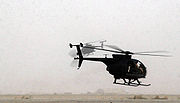 MH-6 Little Birds were part of the initial assault near the Olympic Hotel in the Bakara Market of Mogadishu
, Somalia. The MH-6s conducted rooftop insertions of Delta Force
soldiers.
After the shootdown of the MH-60L, call sign "Super 61", by a rocket-propelled grenade (RPG), an MH-6 Little Bird, call sign "Star 41", piloted by CW4 Keith Jones and CW3 Karl Maier, landed in the street next to the downed MH-60 and attempted to evacuate the casualties. Jones went to assist survivors, successfully pulling two soldiers into the Little Bird, while Maier laid down suppressive fire from the cockpit with his individual weapon. Under intense ground fire, the MH-6 departed with its crew and survivors.
During the night, AH-6J gunships provided fire support to Rangers and Delta Force operators who were in defensive positions around the crash site of "Super 61" and under constant fire from Warlord Mohammad Farrah Aidid's militia members.
AH-6 helicopters were also tasked with supporting the rescue mission of Private First Class Jessica Lynch
in April 2003.
MH-6 helicopters were part of TF-145, as well as the rescue of three Italian contractors and Polish businessman taken hostage by Iraqi insurgents in 2004.
by U.S. Navy SEALs
to kill wanted terrorist Saleh Ali Saleh Nabhan.
AH-6C
EH-6E
MH-6E :Improved attack helicopter used by US Army special forces units, and stealthy light attack and transport helicopter for US Army special forces units.
AH-6F
AH-6G
MH-6H
AH/MH-6J
AH/MH-6M
A/MH-6X
Attack helicopter
An attack helicopter is a military helicopter with the primary role of an attack aircraft, with the capability of engaging targets on the ground, such as enemy infantry and armored vehicles...
variant AH-6, are light helicopters used for special operations
Special operations
Special operations are military operations that are considered "special" .Special operations are typically performed independently or in conjunction with conventional military operations. The primary goal is to achieve a political or military objective where a conventional force requirement does...
in the United States Army
United States Army
The United States Army is the main branch of the United States Armed Forces responsible for land-based military operations. It is the largest and oldest established branch of the U.S. military, and is one of seven U.S. uniformed services...
. Originally based on a modified OH-6A, it was later based on the MD 500E
MD Helicopters MD 500
The MD Helicopters MD 500 series is an American family of light utility civilian and military helicopters. The MD 500 was developed from the Hughes 500, a civilian version of the US Army's OH-6A Cayuse/Loach...
, with a single five-bladed main rotor
Rotor
Rotor may refer to:*A rotating part of a mechanical device, for example in an electric motor, generator, alternator or pump.In engineering:...
. The newest version, the MH-6M, is based on the MD 530F and has a single, six-bladed main rotor and four-bladed tail rotor.
Development
The A/MH-6 was started in 1960, the U.S. Army issued Technical Specification 153 for a Light Observation HelicopterLight Observation Helicopter
The Light Observation Helicopter program was a United States Army program to evaluate, develop and field a light scout helicopter to replace the Army's aging OH-13 Sioux. The program gained impetus with the advent of the Vietnam War and was aided by advances in helicopter technology, specifically...
(LOH) that could perform personnel transport, escort and attack missions, casualty evacuation and observation. Twelve companies took part in the competition and Hughes Tool Company's Aircraft Division submitted the Model 369. Two designs, those submitted by Fairchild-Hiller and Bell
Bell Helicopter Textron
Bell Helicopter is an American rotorcraft manufacturer headquartered in Hurst, Texas, near Fort Worth. A division of Textron, Bell manufactures military helicopter and tiltrotor products in and around Fort Worth, as well as in Amarillo, Texas, and commercial rotorcraft products in Mirabel, Quebec,...
, were selected as finalists by the Army-Navy design competition board, but the Army later included the helicopter from Hughes as well.
The first Model 369 prototype flew on 27 February 1963. Originally designated the YHO-6A under the Army's designation system, the aircraft was redesignated the YOH-6A under the Department of Defense
United States Department of Defense
The United States Department of Defense is the U.S...
's new joint system in 1962. Five prototypes were built, fitted with a 252 shp Allison
Allison Engine Company
The Allison Engine Company was a U.S. aircraft engine manufacturer. In 1929, shortly after the death of James Allison, the company was purchased by the Fisher brothers. Fisher sold the company to General Motors, who owned it for most of its history...
T63-A-5A
Rolls-Royce Model 250
|-External links:*...
, and delivered to the U.S. Army at Fort Rucker, Alabama to compete against the other 10 prototype aircraft submitted by Bell and Fairchild-Hiller. In the end, Hughes won the competition and the Army awarded a contract for production in May 1965. The initial order was for 714 aircraft, but that was later increased to 1,300 with an option to buy another 114. Seventy helicopters were built in the first month.
This agile, unarmed helicopter is outfitted with outboard "benches" designed to ferry up to three commandos on each side. There is also an gunship
Gunship
The term "gunship" is used in several contexts, all sharing the general idea of a light craft armed with heavy guns.-In Navy:In the Navy, the term originally appeared in the mid-19th century as a less-common synonym for gunboat.-In military aviation:...
variant, the AH-6. Painted black for nighttime operations, this small aircraft can conduct rapid insertions and extractions of special operations forces into areas its larger brother, the MH-60 Black Hawk, cannot.
Operational history
After the April 1980 failure of Operation Eagle ClawOperation Eagle Claw
Operation Eagle Claw was an American military operation ordered by President Jimmy Carter to attempt to put an end to the Iran hostage crisis by rescuing 52 Americans held captive at the U.S. Embassy in Tehran, Iran on 24 April 1980...
, it was determined that the US Army lacked aircraft and crews who were trained and prepared to perform special operations missions. (Marine pilots and Navy helicopters were used.) To remedy this shortcoming, the Army began developing a special aviation task force to prepare for the next attempt to rescue the hostages: Operation Honey Badger.
Task Force 160
The architects of the task force identified the need for a small helicopter that could land in the most restrictive locations and could be easily transported on Air Force airlifters. They chose the OH-6A scout helicopter, and it became known as the Little Bird compared to the other aircraft in the task force, the UH-60A and the CH-47C. As a separate part of the project, armed OH-6As were being developed at Fort RuckerFort Rucker
Fort Rucker is a U.S. Army post located mostly in Dale County, Alabama, United States. It was named for a Civil War officer, Confederate General Edmund Rucker. The post is the primary flight training base for Army Aviation and is home to the United States Army Aviation Center of Excellence and...
, Alabama.
The pilots selected to fly the OH-6A helicopters came from the 229th Attack Helicopter Battalion and were sent to the Mississippi Army National Guard's Army Aviation Support Facility (AASF) at Gulfport, Mississippi, for two weeks of qualification training in the aircraft. When the training was completed, C-141
C-141 Starlifter
The Lockheed C-141 Starlifter was a military strategic airlifter in service with the Air Mobility Command of the United States Air Force...
aircraft transported the aircraft and crews to Fort Huachuca
Fort Huachuca
Fort Huachuca is a United States Army installation under the command of the United States Army Installation Management Command. It is located in Cochise County, in southeast Arizona, about north of the border with Mexico. Beginning in 1913, for 20 years the fort was the base for the "Buffalo...
, Arizona, for two weeks of mission training. The mission training consisted of loading onto C-130
C-130 Hercules
The Lockheed C-130 Hercules is a four-engine turboprop military transport aircraft designed and built originally by Lockheed, now Lockheed Martin. Capable of using unprepared runways for takeoffs and landings, the C-130 was originally designed as a troop, medical evacuation, and cargo transport...
transport aircraft which would then transport them to forward staging areas over routes as long as 1000 nautical miles (1,852 km). The armed OH-6 aircraft from Fort Rucker joined the training program in the fall of 1980.
Operation Honey Badger was canceled after the hostages were released on 20 January 1981 and, for a short while, it looked as if the task force would be disbanded and the personnel returned to their former units. However, the Army decided that it would be more prudent to keep the unit. The task force, which had been designated Task Force 158, was soon formed into the 160th Aviation Battalion. The OH-6A helicopters used for transporting personnel became the MH-6 aircraft of the Light Assault Company and the armed OH-6As became the AH-6 aircraft of the Light Attack Company.
Operation Urgent Fury (Grenada)
The OH-6s of 160th SOAR were some of the first to see action in GrenadaGrenada
Grenada is an island country and Commonwealth Realm consisting of the island of Grenada and six smaller islands at the southern end of the Grenadines in the southeastern Caribbean Sea...
during Operation Urgent Fury. A/MH-6 Little Birds were used during the 1983 invasion of Grenada to evacuate casualties onto Navy ship decks. The existence of the unit became widely known in the aftermath of the October 1983 invasion of Grenada, as OH-6s helicopters were seen supporting Special Operations during this operation.DoD and the US Army denied A/MH-6s were used in the operation despite amateur video going public showing the helicopters in action.
The OH-6s were flown in USAF C-130 transport planes, two-at-a-time, to nearby Barbados
Barbados
Barbados is an island country in the Lesser Antilles. It is in length and as much as in width, amounting to . It is situated in the western area of the North Atlantic and 100 kilometres east of the Windward Islands and the Caribbean Sea; therein, it is about east of the islands of Saint...
. From there they flew to Grenada.
Nicaragua
By 1983, 160th SOAR and its helicopters were heavily committed to supporting the contrasContras
The contras is a label given to the various rebel groups opposing Nicaragua's FSLN Sandinista Junta of National Reconstruction government following the July 1979 overthrow of Anastasio Somoza Debayle's dictatorship...
, a United States-subsidized military force. Specially adapted unmarked Hughes 500Ds helicopters from CIA Seaspray unit based in Fort Eustis also took part in this task .
MH-6s were based in Palmerola Air Base, Honduras, and flew missions into Nicaragua. The unit members wore civilian clothes, flew by night, and were instructed to destroy their aircraft if they were forced down.
Operation Prime Chance
On 24 July 1987, a Kuwaiti oil tanker, reflagged as the BridgetonMV Bridgeton
MV Bridgeton, ex-al-Rekkah, was a Kuwait Oil Company oil tanker that was reflagged during Operation Earnest Will. Bridgeton was built by Mitsubishi Heavy Industries, Nagasaki and was launched August 14, 1976. The tanker was built as al-Rekkah, renamed Bridgeton and scrapped as Pacific Blue...
and escorted by U.S. Navy warships, struck a mine in the Persian Gulf
Persian Gulf
The Persian Gulf, in Southwest Asia, is an extension of the Indian Ocean located between Iran and the Arabian Peninsula.The Persian Gulf was the focus of the 1980–1988 Iran-Iraq War, in which each side attacked the other's oil tankers...
. It became apparent that more than escort ships would be required to guard merchant ships. The U.S. military deployed the MH-6 and AH-6 aircraft from the 160th Aviation Battalion to provide surveillance and patrols in cooperation with other U.S. special operations units in Operation Prime Chance
Operation Prime Chance
Operation Prime Chance was a United States Special Operations Command operation intended to protect U.S.-flagged oil tankers from Iranian attack during the Iran–Iraq War. The operation took place roughly at the same time as Operation Earnest Will , the largely Navy effort to escort the tankers...
.
Two MH-6 and four AH-6 aircraft were initially deployed and designated as Detachment 160 Aviation Group (DET 160 AVGP). The MH-6 aircraft carried Forward Looking Infra-Red (FLIR) and a videotape system which gave them excellent ability to detect and identify targets, then direct the armed AH-6s. The AH-6 helicopters were armed with 7.62 miniguns
Minigun
The Minigun is a 7.62 mm, multi-barrel heavy machine gun with a high rate of fire , employing Gatling-style rotating barrels with an external power source...
and 2.75-inch rockets
Hydra 70
The Hydra 70 rocket is a weapon derived from the 70 mm Mk 4/Mk 40 Folding-Fin Aerial Rocket developed by the United States Navy for use as a free-flight aerial rocket in the late 1940s.-Overview:...
. Initially, the aircraft patrolled in teams (call sign "SEABAT") that waited for U.S. Navy SH-2s
SH-2 Seasprite
The Kaman SH-2 Seasprite is a ship-based helicopter with anti-submarine, anti-surface threat capability, including over-the-horizon targeting. This aircraft extends and increases shipboard sensor and weapon capabilities against several types of enemy threats, including submarines of all types,...
to direct them to the targets. Later, to preserve the aircraft and crews from fatigue and wear, the SEABAT teams remained on the ship's deck until a contact was identified.
At 10 pm on 21 September 1987, the captain of the USS Jarrett launched a SEABAT team (a MH-6 and two AH-6s) to check out reports of Iranian minelaying. The team found the Iran Ajr
Iran Ajr
Iran Ajr, formerly known as the Arya Rakhsh, was a Japanese-built landing craft used by Iran to lay naval mines during the Iran–Iraq War. Built in 1978, the 614-ton, 54-meter ship was powered by two diesel engines and featured a bow ramp for unloading cargo...
, an amphibious landing ship equipped with minelaying racks. The MH-6 confirmed that the Iran Ajr was laying mines, the AH-6s opened fire, causing the crew to abandon ship. The vessel was subsequently boarded and captured.
On the evening of 8 October 1987, an Iranian Revolutionary Guard Corps Boghammar and two Boston Whaler
Boston Whaler
Boston Whaler is a boat company that builds foam filled fiberglass boats. Boston whaler was founded in 1958 by Richard T Fisher, and is still in business today.-History of the Design:...
boats were detected by an SH-2. The SEABAT team was launched and as the MH-6 drew near to investigate, the Boghammar opened fire, the first of a series of engagements by both AH-6s and the MH-6 (recently armed with a minigun). The Boghammar launched two Stinger
FIM-92 Stinger
The FIM-92 Stinger is a personal portable infrared homing surface-to-air missile , which can be adapted to fire from ground vehicles and helicopters , developed in the United States and entered into service in 1981. Used by the militaries of the U.S...
missiles at the helicopters, but eventually all three boats were sunk.
For the remainder of the operation, it was decided that barges set up as mobile sea bases (MSB) would facilitate the operation of the special operations forces. The Hercules and the Wimbrown VII were leased to provide these bases and the SEABAT teams began operating from the barges.
In early 1998, it was decided that modified U.S. Army OH-58D helicopters, fitted with weapons, would replace the SEABAT teams. On 24 February 1988, a team of two AHIP helicopters replaced the SEABAT team on the Wimbrown VII but it would be several months (June 1988) before the SEABAT team aboard the barge Hercules would be relieved by another AHIP detachment.
Operation Just Cause (Panama)
On 17 December 1989, 9 MH-6s, 11 AH-6G/Js, 19 UH/MH-60As were flown by Air Force C-5 GalaxyC-5 Galaxy
The Lockheed C-5 Galaxy is a large military transport aircraft built by Lockheed. It provides the United States Air Force with a heavy intercontinental-range strategic airlift capability, one that can carry outsize and oversize cargos, including all air-certifiable cargo. The Galaxy has many...
airlifters to Howard AFB's Hangar 3. After dark, on 19 December, the aircraft were rolled out to prepare for Operation Just Cause.
Before the main invasion force arrived in Panama City
Panama City
Panama is the capital and largest city of the Republic of Panama. It has a population of 880,691, with a total metro population of 1,272,672, and it is located at the Pacific entrance of the Panama Canal, in the province of the same name. The city is the political and administrative center of the...
, Panama, two MH-6s supported by two AH-6s landed at Torrijos-Tocumen Airport to insert a beacon and combat controllers. Four other AH-6s conducted pre-assault attacks on the Panamanian Defense Force
Military of Panama
The Panamanian Public Forces are the national defense forces of Panama. Panama is the second country in Latin America to permanently abolish standing armies, leaving it with only small para-military forces. This came as a result of a US invasion that overthrew a military dictatorship which ruled...
(PDF) Headquarters, La Comandancia, adjoining the heavily populated El Chorrillo neighborhood in downtown Panama City
Panama City
Panama is the capital and largest city of the Republic of Panama. It has a population of 880,691, with a total metro population of 1,272,672, and it is located at the Pacific entrance of the Panama Canal, in the province of the same name. The city is the political and administrative center of the...
. One of the AH-6s was damaged by ground fire and crashlanded in the Comandancia compound. The two pilots, pinned down by small-arms fire for two hours, eventually made their way back to friendly forces, taking a PDF soldier prisoner along the way.
Other AH-6s escorted MH-6s on a rooftop rescue operation conducted at Cárcel Modelo, a prison adjacent to La Comandancia. In Operation Acid Gambit
Operation Acid Gambit
Operation Acid Gambit was a plan to retrieve Kurt Muse, an American civilian living in Panama and widely reported to be a CIA operative from the Carcel Modelo, a notorious prison in Panama City...
, the aircraft approached the prison. Under fire from a nearby apartment house, the Little Birds landed on the roof, dropped off the rescue team, and lifted off. Upon their return, heavy smoke made it tough to find the roof and the helicopters took heavy fire from a cellblock about 50 to 60 feet (18.3 m) from the landing site. Maj. Richard Bowman, a copilot, took a round in the elbow. His pilot took over the controls and landed the aircraft. The aircraft picked up the rescue personnel and headed back toward Howard AFB. But one MH-6 lost power as it left the roof, and crashed in the street below with minor injuries to the passengers, who were helped from the crash site by U.S. infantry soldiers.
Elsewhere, four AH-6s provided fire support for the airborne assault at Rio Hato Airfield, supported by an MH-60 which operated as a Forward Arming and Refuel Point (FARP). Two nine-man teams from the 160th participated in the airborne assaults of Torrijos-Tocumen Airfield and Rio Hato Airfield, and were dropped from Air Force C-141s to set up FARPs, 12 feet (3.7 m) platforms with HE-rocket and minigun ammunition, parts and replacements for the miniguns, and fuel and refueling pumps, hoses, etc. But the FARP dropped at Rio Hato landed out of reach in a marsh, forcing the team to "wet wing" refuel from the MH-60.
The Rio Hato mission originally included nine other MH-60s and four MH-6s. Several hours prior to H-hour, these aircraft and crews were instead sent to support a raid near Colón, Panama
Colón, Panama
Colón is a sea port on the Caribbean Sea coast of Panama. The city lies near the Atlantic entrance to the Panama Canal. It is capital of Panama's Colón Province and has traditionally been known as Panama's second city....
, a key PDF stronghold where PDF leaders were believed to be. At H-hour, the helicopters conducted an air assault on a beach house along the coast of Colon. It was during this mission that the first 160th soldiers to die in combat perished when their AH-6 was shot down.
Another force of eight MH-60s and four MH-6s were on strip alert to conduct follow-on raids should the need arise.
After these initial missions, elements of the 160th provided support to special operations forces securing outlying areas, recovering weapons caches, and "hunt for Elvis" – the phrase the men of the 160th used to refer to the search for General Manuel Noriega
Manuel Noriega
Manuel Antonio Noriega Moreno is a Panamanian politician and soldier. He was military dictator of Panama from 1983 to 1989.The 1989 invasion of Panama by the United States removed him from power; he was captured, detained as a prisoner of war, and flown to the United States. Noriega was tried on...
. Four MH-60s, two MH-6s, two AH-6s, and two MH-47s were moved to Ft. Sherman in the north for operations in and around Colon.
The 160th conducted numerous air assault missions over the next two weeks, and on 3 January 1990, the majority of the force went back to Fort Campbell, Kentucky.
Operation Gothic Serpent
Mogadishu
Mogadishu , popularly known as Xamar, is the largest city in Somalia and the nation's capital. Located in the coastal Benadir region on the Indian Ocean, the city has served as an important port for centuries....
, Somalia. The MH-6s conducted rooftop insertions of Delta Force
Delta Force
1st Special Forces Operational Detachment-Delta is one of the United States' secretive Tier One counter-terrorism and Special Mission Units. Commonly known as Delta Force, Delta, or The Unit, it was formed under the designation 1st SFOD-D, and is officially referred to by the Department of Defense...
soldiers.
After the shootdown of the MH-60L, call sign "Super 61", by a rocket-propelled grenade (RPG), an MH-6 Little Bird, call sign "Star 41", piloted by CW4 Keith Jones and CW3 Karl Maier, landed in the street next to the downed MH-60 and attempted to evacuate the casualties. Jones went to assist survivors, successfully pulling two soldiers into the Little Bird, while Maier laid down suppressive fire from the cockpit with his individual weapon. Under intense ground fire, the MH-6 departed with its crew and survivors.
During the night, AH-6J gunships provided fire support to Rangers and Delta Force operators who were in defensive positions around the crash site of "Super 61" and under constant fire from Warlord Mohammad Farrah Aidid's militia members.
Operation Iraqi Freedom
During the invasion of Iraq in 2003 and during the stabilization efforts that carry on to this day, Little Bird pilots took in numerous missions. Two AH-6 and two MH-6 helicopters were part of a special operations raid at Al Qadisiyah in western Iraq.AH-6 helicopters were also tasked with supporting the rescue mission of Private First Class Jessica Lynch
Jessica Lynch
Jessica Dawn Lynch is a former Private First Class in the United States Army Quartermaster Corps. Lynch served in Iraq during the 2003 invasion by U.S. and allied forces. On March 23, 2003 she was injured and captured by Iraqi forces but was recovered on April 1 by U.S...
in April 2003.
MH-6 helicopters were part of TF-145, as well as the rescue of three Italian contractors and Polish businessman taken hostage by Iraqi insurgents in 2004.
Operation Celestial Balance
In September 2009, two AH-6 helicopters were used in an operation in SomaliaSomalia
Somalia , officially the Somali Republic and formerly known as the Somali Democratic Republic under Socialist rule, is a country located in the Horn of Africa. Since the outbreak of the Somali Civil War in 1991 there has been no central government control over most of the country's territory...
by U.S. Navy SEALs
United States Navy SEALs
The United States Navy's Sea, Air and Land Teams, commonly known as Navy SEALs, are the U.S. Navy's principal special operations force and a part of the Naval Special Warfare Command as well as the maritime component of the United States Special Operations Command.The acronym is derived from their...
to kill wanted terrorist Saleh Ali Saleh Nabhan.
Variants
For OH-6 and TH-6 variants, see OH-6 Cayuse.AH-6C
- Special Forces attack version. Modified OH-6A to carry weapons and operate as a light attack aircraft for the 160th SOAR(A)160th Special Operations Aviation Regiment (Airborne)The 160th Special Operations Aviation Regiment is a special operations unit of the United States Army that provides helicopter aviation support for general purpose forces and Special Operations Forces. Its missions have included attack, assault, and reconnaissance, and are usually conducted at...
.
EH-6E
- Special Forces electronic warfare, command-post version.
MH-6E :Improved attack helicopter used by US Army special forces units, and stealthy light attack and transport helicopter for US Army special forces units.
AH-6F
- Special Forces attack version.
AH-6G
- Special Forces attack version.
MH-6H
- Special Forces version.
AH/MH-6J
- Improved special forces transport and attack versions. Updated light attack helicopter based on the MD 530MG and equipped with an improved engine, FLIR, and a GPS/inertial navigation system.
AH/MH-6M
- Also occasionally referred to as the Mission Enhanced Little Bird (MELB), it is a highly modified version of the MD 530 series commercial helicopter.
A/MH-6X
Boeing AH-6
The Boeing AH-6 is a series of light helicopter gunships based on the MH-6 Little Bird and MD 500 family. Developed by Boeing Rotorcraft Systems, these include the Unmanned Little Bird demonstrator, the A/MH-6X Mission Enhanced Little Bird , and the proposed AH-6I and AH-6S.-Design and...
- An AH/MH-6M MELB helicopter modified for use as a UAV. It builds upon experience gained through development of the Unmanned Little Bird (ULB) Demonstrator, which is a civil MD 530F modified for autonomous UAV flight. Boeing has announced that this version is marketed solely to other nations, not the U.S., for use as a low-cost attack helicopter.
Operators
- United States ArmyUnited States ArmyThe United States Army is the main branch of the United States Armed Forces responsible for land-based military operations. It is the largest and oldest established branch of the U.S. military, and is one of seven U.S. uniformed services...
- FBI HRT
- United States Special Operations CommandUnited States Special Operations CommandThe United States Special Operations Command is the Unified Combatant Command charged with overseeing the various Special Operations Commands of the Army, Air Force, Navy and Marine Corps of the United States Armed Forces. The command is part of the Department of Defense...
Specifications (MH-6)
- The armed variant is equipped with a lightweight universal mounting platform which can accommodate two M134 miniguns, two M260 7-shot Hydra 70 rocket pods. Alternately, the AH-6Boeing AH-6The Boeing AH-6 is a series of light helicopter gunships based on the MH-6 Little Bird and MD 500 family. Developed by Boeing Rotorcraft Systems, these include the Unmanned Little Bird demonstrator, the A/MH-6X Mission Enhanced Little Bird , and the proposed AH-6I and AH-6S.-Design and...
can be armed with Hellfire anti-tank missiles, air-to-air Stingers, Mk-19 40 mm automatic grenade launchers, or .50 caliber machine guns.
See also
External links
- US Army SOC A/MH-6 fact sheet
- MH-6 and AH-6 pages on GlobalSecurity.org
- AH/MH-6J "Little Bird" page on specialoperations.com
- Hughes OH-6 "Cayuse" / MD 500 / MD 530 helicopter page on avia.russian.ee
- Warbird Registry – OH-6 Cayuse – Tracking the histories of OH-6 that survived military service.
- Boeing Announces New Rotorcraft Program: AH-6, Boeing, 7 October 2008.