

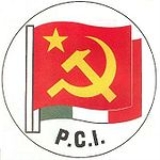
Italian Communist Party

Encyclopedia
The Italian Communist Party was a communist
political party in Italy.
The PCI was founded as Communist Party of Italy
on 21 January 1921 in Livorno
, by seceding from the Italian Socialist Party
(PSI). Amadeo Bordiga
and Antonio Gramsci
led the split. Outlawed during the Fascist regime
, the party played a major part in the Italian resistance movement
. It changed its name in 1943 to PCI and became the strongest political party of the Italian left after World War II
, attracting the support of about a third of the voters during the 1970s
. At the time it was the biggest communist party in the West (1.8 million members and 34.4% of the vote in 1976). In 1991 the PCI was disbanded and replaced by the Democratic Party of the Left
(PDS), which was accepted in both the Socialist International
and the Party of European Socialists
. The more radical members of the party left to form the Communist Refoundation Party
(PRC).
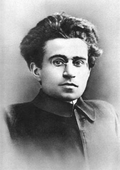 The PCI participated to its first general election in 1921
, obtaining 4.6% of the vote and 15 seats in the Chamber of Deputies. At time, it was an active but small faction within Italian political left, which was strongly led by the Italian Socialist Party
(PSI), while on international plan it was part of Soviet-led Comintern
.
In 1926, the Fascist
government of Benito Mussolini
outlawed the PCI. Although forced underground, the PCI maintained a clandestine presence within Italy during the years of the Fascist regime. Many of its leaders were also active in exile. During its first year as a banned party, Antonio Gramsci
defeated the party's left wing, led by Amadeo Bordiga
.
Gramsci replaced Bordiga's leadership at a conference in Lyon
, and issued a manifesto expressing the programmatic basis of the party. However, Gramsci soon found himself jailed by Mussolini's regime, and the leadership of the party passed to Palmiro Togliatti
. Togliatti would lead the party until it emerged from suppression in 1944 and relaunched itself as the Italian Communist Party.
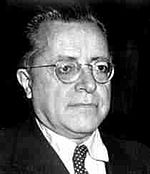 The party played a major role during the national liberation (Resistenza) and in the April of 1944 after the Svolta di Salerno ( Salerno's turn ), Togliatti agreed to cooperate with the king
so the communists took part in every government during the national liberation and constitution
al period from June 1944 to May 1947. The communists' contribution to the new Italian democratic constitution was decisive. In the first general elections of 1948 the party joined the PSI in the Popular Democratic Front
but was defeated by the Christian Democracy
party. The party gained considerable electoral success during the following years and occasionally supplied external support to centre-left
governments, although it never directly joined a government. It successfully lobbied Fiat
to set up the AvtoVAZ
(Lada) car factory in the Soviet Union
. The party did best in Emilia-Romagna
, Tuscany
and Umbria
, where it regularly won the local administrative elections, and in some of the industrialized cities of Northern Italy
.
The Soviet Union's brutal suppression of the Hungarian Revolution of 1956 created a split within the PCI. The party leadership, including Palmiro Togliatti
and Giorgio Napolitano
(who in 2006 became President of the Italian Republic
), regarded the Hungarian insurgents as counter-revolutionaries, as reported at the time in l'Unità, the official PCI newspaper. However Giuseppe Di Vittorio
, chief of the communist trade union CGIL
, repudiated the leadership position, as did prominent party member Antonio Giolitti
and Italian Socialist Party
national secretary Pietro Nenni
, a close ally of the PCI. Napolitano later hinted at doubts over the propriety of his decision. He would eventually write in From the Communist Party to European Socialism. A political autobiography (Dal Pci al socialismo europeo. Un'autobiografia politica) that he regretted his justification of the Soviet intervention, but quieted his concerns at the time for the sake of party unity and the international leadership of Soviet communism. Giolitti and Nenni went on to split with the PCI over this issue. Napolitano became a leading member of the miglioristi
faction within the PCI, which promoted a social-democratic
direction in party policy.
In the mid 1960s the U.S. State Department estimated the party membership to be approximately 1,350,000 (4.2% of the working age population, proportionally the largest communist party in the capitalist world at the time, and the largest party at all in whole western Europe with the German SPD
). The U.S. estimated the Party was receiving $40–50 million per year from the Soviets, significantly more than the $5–6 million invested by the U.S. in Italian politics.
Declassified information from Soviet archives confirms that the PCI relied on Soviet financial assistance, more so than any other Communist party supported by Moscow. The party received perhaps as much as $60 million from the end of World War II until the PCI’s break with Moscow in the early 1980s. The party used these funds mainly for organizational purposes. According to the former KGB
archivist Vasili Mitrokhin
, after the Athens Colonel Coup
in April 1967, Longo and other PCI leaders became alarmed at the possibility of a coup in Italy. These fears were not completely unfounded, as there had been two attempted coups in Italy
, Piano Solo
in 1964 and Golpe Borghese
in 1970, by neo-fascist
and military groups. The PCI’s Giorgio Amendola
formally requested Soviet assistance to prepare the party in case of such an event. The KGB drew up and implemented a plan to provide the PCI with its own intelligence and clandestine signal corps. From 1967 through 1973, PCI members were sent to East Germany and Moscow
to receive training in clandestine warfare and information gathering techniques by both the Stasi
and the KGB. Shortly before the May 1972 elections, Longo personally wrote to Leonid Brezhnev
asking for and receiving an additional $5.7 million in funding. This was on top of the $3.5 million that the Soviet Union gave the PCI in 1971. The Soviets also provided additional funding through the use of front companies providing generous contracts to PCI members.
, PCI deputy national secretary and later secretary general, took part in the international conference of the Communist parties in Moscow, where his delegation disagreed with the "official" political line, and refused to support the final report. Unexpectedly to his hosts, his speech challenged the Communist leadership in Moscow. He refused to "excommunicate" the Chinese communists, and directly told Leonid Brezhnev that the invasion of Czechoslovakia
by the Warsaw Pact
countries (which he called the "tragedy in Prague") had made clear the considerable differences within the Communist movement on fundamental questions such as national sovereignty, socialist
democracy, and the freedom of culture. At the time the PCI was the largest Communist Party in a capitalist state, garnering 34.4% of the vote in the 1976 general election
.
Relationships between the PCI and the Soviet Union gradually fell apart as the party moved away from Soviet obedience and Marxist-Leninist orthodoxy in the 1970s and 1980s, and toward Eurocommunism
and the Socialist International
. The PCI sought a collaboration with Socialist and Christian Democracy
parties (the Historic Compromise
). However, Christian Democrat party leader Aldo Moro
's kidnapping and murder by the Red Brigades
in May 1978 put an end to any hopes of such a compromise. The compromise was largely abandoned as a PCI policy in 1981. The Proletarian Unity Party
merged into the PCI in 1984.
During the Years of Lead the PCI strongly opposed the terrorism and the Red Brigades, who, in turn, murdered or wounded many PCI members or trade unionists close to the PCI. According to Mitrokhin, the party asked the Soviets to pressure the Czechoslovakian State Security (StB)
to withdraw their support to the group, which Moscow was unable or unwilling to do. This as well as the Soviet invasion of Afghanistan led to a complete break with Moscow in 1979. In 1980, the PCI refused to participate in the international conference of Communist parties in Paris although cash payments to the PCI continued until 1984.
(PDS), led by Achille Occhetto
, and the Communist Refoundation Party
(PRC), headed by Armando Cossutta
. Occhetto, leader of the PCI since 1988, stunned the party faithfully assembled in a working-class section of Bologna with a speech heralding the end of communism, a move now referred to in Italian politics as the svolta della Bolognina (Bolognina turning point). The collapse of the communist governments in the Soviet Union and Eastern Europe had convinced Occhetto that the era of Eurocommunism
was over, and he transformed the PCI into a progressive left-wing party, the PDS.
Cossutta and a third of the PCI membership refused to join the PDS, and instead founded the Communist Refoundation Party.
Communism
Communism is a social, political and economic ideology that aims at the establishment of a classless, moneyless, revolutionary and stateless socialist society structured upon common ownership of the means of production...
political party in Italy.
The PCI was founded as Communist Party of Italy
Communist Party of Italy
The Communist Party of Italy was a communist political party in Italy which existed from 1921 to 1926. That year it was outlawed by Benito Mussolini's fascist regime. In 1943, the name was changed to the Italian Communist Party.-Foundation:The forerunner of the party was the Communist Faction...
on 21 January 1921 in Livorno
Livorno
Livorno , traditionally Leghorn , is a port city on the Tyrrhenian Sea on the western edge of Tuscany, Italy. It is the capital of the Province of Livorno, having a population of approximately 160,000 residents in 2009.- History :...
, by seceding from the Italian Socialist Party
Italian Socialist Party
The Italian Socialist Party was a socialist and later social-democratic political party in Italy founded in Genoa in 1892.Once the dominant leftist party in Italy, it was eclipsed in status by the Italian Communist Party following World War II...
(PSI). Amadeo Bordiga
Amadeo Bordiga
Amadeo Bordiga was an Italian Marxist, a contributor to Communist theory, the founder of the Communist Party of Italy, a leader of the Communist International and, after World War II, leading figure of the International Communist Party.- Early life :Bordiga was born at Resina, in the province of...
and Antonio Gramsci
Antonio Gramsci
Antonio Gramsci was an Italian writer, politician, political philosopher, and linguist. He was a founding member and onetime leader of the Communist Party of Italy and was imprisoned by Benito Mussolini's Fascist regime...
led the split. Outlawed during the Fascist regime
Italian Fascism
Italian Fascism also known as Fascism with a capital "F" refers to the original fascist ideology in Italy. This ideology is associated with the National Fascist Party which under Benito Mussolini ruled the Kingdom of Italy from 1922 until 1943, the Republican Fascist Party which ruled the Italian...
, the party played a major part in the Italian resistance movement
Italian resistance movement
The Italian resistance is the umbrella term for the various partisan forces formed by pro-Allied Italians during World War II...
. It changed its name in 1943 to PCI and became the strongest political party of the Italian left after World War II
World War II
World War II, or the Second World War , was a global conflict lasting from 1939 to 1945, involving most of the world's nations—including all of the great powers—eventually forming two opposing military alliances: the Allies and the Axis...
, attracting the support of about a third of the voters during the 1970s
1970s
File:1970s decade montage.png|From left, clockwise: US President Richard Nixon doing the V for Victory sign after his resignation from office after the Watergate scandal in 1974; Refugees aboard a US naval boat after the Fall of Saigon, leading to the end of the Vietnam War in 1975; The 1973 oil...
. At the time it was the biggest communist party in the West (1.8 million members and 34.4% of the vote in 1976). In 1991 the PCI was disbanded and replaced by the Democratic Party of the Left
Democratic Party of the Left
The Democratic Party of the Left was a post-communist, democratic socialist political party in Italy.-History:...
(PDS), which was accepted in both the Socialist International
Socialist International
The Socialist International is a worldwide organization of democratic socialist, social democratic and labour political parties. It was formed in 1951.- History :...
and the Party of European Socialists
Party of European Socialists
The Party of European Socialists is a European political party led by Sergei Stanishev, former Prime Minister of Bulgaria. The PES comprises social-democratic national-level political parties primarily from Member state of the European Union, as well as other nations of the European continent. The...
. The more radical members of the party left to form the Communist Refoundation Party
Communist Refoundation Party
The Communist Refoundation Party is a communist Italian political party. Its current secretary is Paolo Ferrero....
(PRC).
Early years
Italian general election, 1921
The Italian general election of 1921 took place on 15 May 1921.The Liberal governing coalition, strengthened by the joining of Fascist candidates in the "National Blocs" , came short of a majority...
, obtaining 4.6% of the vote and 15 seats in the Chamber of Deputies. At time, it was an active but small faction within Italian political left, which was strongly led by the Italian Socialist Party
Italian Socialist Party
The Italian Socialist Party was a socialist and later social-democratic political party in Italy founded in Genoa in 1892.Once the dominant leftist party in Italy, it was eclipsed in status by the Italian Communist Party following World War II...
(PSI), while on international plan it was part of Soviet-led Comintern
Comintern
The Communist International, abbreviated as Comintern, also known as the Third International, was an international communist organization initiated in Moscow during March 1919...
.
In 1926, the Fascist
Italian Fascism
Italian Fascism also known as Fascism with a capital "F" refers to the original fascist ideology in Italy. This ideology is associated with the National Fascist Party which under Benito Mussolini ruled the Kingdom of Italy from 1922 until 1943, the Republican Fascist Party which ruled the Italian...
government of Benito Mussolini
Benito Mussolini
Benito Amilcare Andrea Mussolini was an Italian politician who led the National Fascist Party and is credited with being one of the key figures in the creation of Fascism....
outlawed the PCI. Although forced underground, the PCI maintained a clandestine presence within Italy during the years of the Fascist regime. Many of its leaders were also active in exile. During its first year as a banned party, Antonio Gramsci
Antonio Gramsci
Antonio Gramsci was an Italian writer, politician, political philosopher, and linguist. He was a founding member and onetime leader of the Communist Party of Italy and was imprisoned by Benito Mussolini's Fascist regime...
defeated the party's left wing, led by Amadeo Bordiga
Amadeo Bordiga
Amadeo Bordiga was an Italian Marxist, a contributor to Communist theory, the founder of the Communist Party of Italy, a leader of the Communist International and, after World War II, leading figure of the International Communist Party.- Early life :Bordiga was born at Resina, in the province of...
.
Gramsci replaced Bordiga's leadership at a conference in Lyon
Lyon
Lyon , is a city in east-central France in the Rhône-Alpes region, situated between Paris and Marseille. Lyon is located at from Paris, from Marseille, from Geneva, from Turin, and from Barcelona. The residents of the city are called Lyonnais....
, and issued a manifesto expressing the programmatic basis of the party. However, Gramsci soon found himself jailed by Mussolini's regime, and the leadership of the party passed to Palmiro Togliatti
Palmiro Togliatti
Palmiro Togliatti was an Italian politician and leader of the Italian Communist Party from 1927 until his death.-Early life:...
. Togliatti would lead the party until it emerged from suppression in 1944 and relaunched itself as the Italian Communist Party.
Post World War II
Victor Emmanuel III of Italy
Victor Emmanuel III was a member of the House of Savoy and King of Italy . In addition, he claimed the crowns of Ethiopia and Albania and claimed the titles Emperor of Ethiopia and King of Albania , which were unrecognised by the Great Powers...
so the communists took part in every government during the national liberation and constitution
Constitution
A constitution is a set of fundamental principles or established precedents according to which a state or other organization is governed. These rules together make up, i.e. constitute, what the entity is...
al period from June 1944 to May 1947. The communists' contribution to the new Italian democratic constitution was decisive. In the first general elections of 1948 the party joined the PSI in the Popular Democratic Front
Popular Democratic Front
The Popular Democratic Front was a coalition of Italian political parties for the Parliamentary election of 1948. It consisted of:* Italian Communist Party - communist...
but was defeated by the Christian Democracy
Christian Democracy (Italy)
Christian Democracy was a Christian democratic party in Italy. It was founded in 1943 as the ideological successor of the historical Italian People's Party, which had the same symbol, a crossed shield ....
party. The party gained considerable electoral success during the following years and occasionally supplied external support to centre-left
Centre-left
Centre-left is a political term that describes individuals, political parties or organisations such as think tanks whose ideology lies between the centre and the left on the left-right spectrum...
governments, although it never directly joined a government. It successfully lobbied Fiat
Fiat
FIAT, an acronym for Fabbrica Italiana Automobili Torino , is an Italian automobile manufacturer, engine manufacturer, financial, and industrial group based in Turin in the Italian region of Piedmont. Fiat was founded in 1899 by a group of investors including Giovanni Agnelli...
to set up the AvtoVAZ
AvtoVAZ
AvtoVAZ is the Russian automobile manufacturer formerly known as VAZ: Volzhsky Avtomobilny Zavod , but better known to the world under the trade name Lada. The company was established in the late 1960s in collaboration with Fiat...
(Lada) car factory in the Soviet Union
Soviet Union
The Soviet Union , officially the Union of Soviet Socialist Republics , was a constitutionally socialist state that existed in Eurasia between 1922 and 1991....
. The party did best in Emilia-Romagna
Emilia-Romagna
Emilia–Romagna is an administrative region of Northern Italy comprising the two historic regions of Emilia and Romagna. The capital is Bologna; it has an area of and about 4.4 million inhabitants....
, Tuscany
Tuscany
Tuscany is a region in Italy. It has an area of about 23,000 square kilometres and a population of about 3.75 million inhabitants. The regional capital is Florence ....
and Umbria
Umbria
Umbria is a region of modern central Italy. It is one of the smallest Italian regions and the only peninsular region that is landlocked.Its capital is Perugia.Assisi and Norcia are historical towns associated with St. Francis of Assisi, and St...
, where it regularly won the local administrative elections, and in some of the industrialized cities of Northern Italy
Northern Italy
Northern Italy is a wide cultural, historical and geographical definition, without any administrative usage, used to indicate the northern part of the Italian state, also referred as Settentrione or Alta Italia...
.
The Soviet Union's brutal suppression of the Hungarian Revolution of 1956 created a split within the PCI. The party leadership, including Palmiro Togliatti
Palmiro Togliatti
Palmiro Togliatti was an Italian politician and leader of the Italian Communist Party from 1927 until his death.-Early life:...
and Giorgio Napolitano
Giorgio Napolitano
Giorgio Napolitano is an Italian politician who has been the 11th President of Italy since 2006. A long-time member of the Italian Communist Party and later the Democrats of the Left, he served as President of the Chamber of Deputies from 1992 to 1994 and as Minister of the Interior from 1996 to...
(who in 2006 became President of the Italian Republic
President of the Italian Republic
The President of the Italian Republic is the head of state of Italy and, as such, is intended to represent national unity and guarantee that Italian politics comply with the Constitution. The president's term of office lasts for seven years....
), regarded the Hungarian insurgents as counter-revolutionaries, as reported at the time in l'Unità, the official PCI newspaper. However Giuseppe Di Vittorio
Giuseppe Di Vittorio
Giuseppe Di Vittorio, also known under the pseudonym Nicoletti , was an Italian syndicalist trade unionist and communist politician, one of the most influential leaders of the labor movement after World War I....
, chief of the communist trade union CGIL
Italian General Confederation of Labour
-External links:**...
, repudiated the leadership position, as did prominent party member Antonio Giolitti
Antonio Giolitti
Antonio Giolitti was an Italian politician and cabinet member. He is the grandson of Giovanni Giolitti, well-known liberal statesman of the prefascist period.-Biography:Giolitti was born in Rome....
and Italian Socialist Party
Italian Socialist Party
The Italian Socialist Party was a socialist and later social-democratic political party in Italy founded in Genoa in 1892.Once the dominant leftist party in Italy, it was eclipsed in status by the Italian Communist Party following World War II...
national secretary Pietro Nenni
Pietro Nenni
Pietro Sandro Nenni was an Italian socialist politician, the national secretary of the Italian Socialist Party and lifetime Senator since 1970. He was a recipient of the Stalin Peace Prize in 1951...
, a close ally of the PCI. Napolitano later hinted at doubts over the propriety of his decision. He would eventually write in From the Communist Party to European Socialism. A political autobiography (Dal Pci al socialismo europeo. Un'autobiografia politica) that he regretted his justification of the Soviet intervention, but quieted his concerns at the time for the sake of party unity and the international leadership of Soviet communism. Giolitti and Nenni went on to split with the PCI over this issue. Napolitano became a leading member of the miglioristi
Meliorism (politics)
Meliorism was a wing of the Italian Communist Party. Its leader was Giorgio Napolitano, and counted among its number Gerardo Chiaromonte and Emanuele Macaluso...
faction within the PCI, which promoted a social-democratic
Social democracy
Social democracy is a political ideology of the center-left on the political spectrum. Social democracy is officially a form of evolutionary reformist socialism. It supports class collaboration as the course to achieve socialism...
direction in party policy.
In the mid 1960s the U.S. State Department estimated the party membership to be approximately 1,350,000 (4.2% of the working age population, proportionally the largest communist party in the capitalist world at the time, and the largest party at all in whole western Europe with the German SPD
Social Democratic Party of Germany
The Social Democratic Party of Germany is a social-democratic political party in Germany...
). The U.S. estimated the Party was receiving $40–50 million per year from the Soviets, significantly more than the $5–6 million invested by the U.S. in Italian politics.
Declassified information from Soviet archives confirms that the PCI relied on Soviet financial assistance, more so than any other Communist party supported by Moscow. The party received perhaps as much as $60 million from the end of World War II until the PCI’s break with Moscow in the early 1980s. The party used these funds mainly for organizational purposes. According to the former KGB
KGB
The KGB was the commonly used acronym for the . It was the national security agency of the Soviet Union from 1954 until 1991, and was the premier internal security, intelligence, and secret police organization during that time.The State Security Agency of the Republic of Belarus currently uses the...
archivist Vasili Mitrokhin
Vasili Mitrokhin
Vasili Nikitich Mitrokhin was a Major and senior archivist for the Soviet Union's foreign intelligence service, the First Chief Directorate of the KGB, and co-author with Christopher Andrew of The Mitrokhin Archive: The KGB in Europe and the West, a massive account of Soviet intelligence...
, after the Athens Colonel Coup
Greek military junta of 1967-1974
The Greek military junta of 1967–1974, alternatively "The Regime of the Colonels" , or in Greece "The Junta", and "The Seven Years" are terms used to refer to a series of right-wing military governments that ruled Greece from 1967 to 1974...
in April 1967, Longo and other PCI leaders became alarmed at the possibility of a coup in Italy. These fears were not completely unfounded, as there had been two attempted coups in Italy
Italy
Italy , officially the Italian Republic languages]] under the European Charter for Regional or Minority Languages. In each of these, Italy's official name is as follows:;;;;;;;;), is a unitary parliamentary republic in South-Central Europe. To the north it borders France, Switzerland, Austria and...
, Piano Solo
Piano Solo
Piano Solo was an envisaged plot for an Italian coup in 1964, planned by then director of the military police, Giovanni De Lorenzo.The coup plans were investigated in 1967, when the journalist Eugenio Scalfari and Lino Jannuzzi uncovered the attempt in the Italian news magazine L'Espresso in May 1967...
in 1964 and Golpe Borghese
Golpe Borghese
The Golpe Borghese was a failed Italian coup d'état allegedly planned for the night of 7 or 8 December 1970. It was named after Junio Valerio Borghese, an Italian World War II commander of the notorious Xª MAS unit, the "Black Prince", convicted of war crimes, but still a hero in the eyes of many...
in 1970, by neo-fascist
Neo-Fascism
Neo-fascism is a post–World War II ideology that includes significant elements of fascism. The term neo-fascist may apply to groups that express a specific admiration for Benito Mussolini and Italian Fascism or any other fascist leader/state...
and military groups. The PCI’s Giorgio Amendola
Giorgio Amendola
Giorgio Amendola was an Italian writer and politician.Born in Rome in 1907, he was the son of Lithuanian intellectual Eva Kuhn and Giovanni Amendola, a liberal anti-fascist who died in 1926 in Cannes after having been attacked by killers hired by Benito Mussolini...
formally requested Soviet assistance to prepare the party in case of such an event. The KGB drew up and implemented a plan to provide the PCI with its own intelligence and clandestine signal corps. From 1967 through 1973, PCI members were sent to East Germany and Moscow
Moscow
Moscow is the capital, the most populous city, and the most populous federal subject of Russia. The city is a major political, economic, cultural, scientific, religious, financial, educational, and transportation centre of Russia and the continent...
to receive training in clandestine warfare and information gathering techniques by both the Stasi
Stasi
The Ministry for State Security The Ministry for State Security The Ministry for State Security (German: Ministerium für Staatssicherheit (MfS), commonly known as the Stasi (abbreviation , literally State Security), was the official state security service of East Germany. The MfS was headquartered...
and the KGB. Shortly before the May 1972 elections, Longo personally wrote to Leonid Brezhnev
Leonid Brezhnev
Leonid Ilyich Brezhnev – 10 November 1982) was the General Secretary of the Central Committee of the Communist Party of the Soviet Union , presiding over the country from 1964 until his death in 1982. His eighteen-year term as General Secretary was second only to that of Joseph Stalin in...
asking for and receiving an additional $5.7 million in funding. This was on top of the $3.5 million that the Soviet Union gave the PCI in 1971. The Soviets also provided additional funding through the use of front companies providing generous contracts to PCI members.
Enrico Berlinguer
In 1969, Enrico BerlinguerEnrico Berlinguer
Enrico Berlinguer was an Italian politician; he was national secretary of the Italian Communist Party from 1972 until his death.-Early career:...
, PCI deputy national secretary and later secretary general, took part in the international conference of the Communist parties in Moscow, where his delegation disagreed with the "official" political line, and refused to support the final report. Unexpectedly to his hosts, his speech challenged the Communist leadership in Moscow. He refused to "excommunicate" the Chinese communists, and directly told Leonid Brezhnev that the invasion of Czechoslovakia
Prague Spring
The Prague Spring was a period of political liberalization in Czechoslovakia during the era of its domination by the Soviet Union after World War II...
by the Warsaw Pact
Warsaw Pact
The Warsaw Treaty Organization of Friendship, Cooperation, and Mutual Assistance , or more commonly referred to as the Warsaw Pact, was a mutual defense treaty subscribed to by eight communist states in Eastern Europe...
countries (which he called the "tragedy in Prague") had made clear the considerable differences within the Communist movement on fundamental questions such as national sovereignty, socialist
Socialism
Socialism is an economic system characterized by social ownership of the means of production and cooperative management of the economy; or a political philosophy advocating such a system. "Social ownership" may refer to any one of, or a combination of, the following: cooperative enterprises,...
democracy, and the freedom of culture. At the time the PCI was the largest Communist Party in a capitalist state, garnering 34.4% of the vote in the 1976 general election
Italian general election, 1976
The Italian elections of 1976 were held on June 20. The seventh Parliament of republican Italy was selected. These were the first elections where 18-year-old boys and girls were allowed to vote....
.
Relationships between the PCI and the Soviet Union gradually fell apart as the party moved away from Soviet obedience and Marxist-Leninist orthodoxy in the 1970s and 1980s, and toward Eurocommunism
Eurocommunism
Eurocommunism was a trend in the 1970s and 1980s within various Western European communist parties to develop a theory and practice of social transformation that was more relevant in a Western European democracy and less aligned to the influence or control of the Communist Party of the Soviet...
and the Socialist International
Socialist International
The Socialist International is a worldwide organization of democratic socialist, social democratic and labour political parties. It was formed in 1951.- History :...
. The PCI sought a collaboration with Socialist and Christian Democracy
Christian Democracy (Italy)
Christian Democracy was a Christian democratic party in Italy. It was founded in 1943 as the ideological successor of the historical Italian People's Party, which had the same symbol, a crossed shield ....
parties (the Historic Compromise
Historic Compromise
In Italian history, the Historic Compromise was an accommodation between the Christian Democrats and the Italian Communist Party in the 1970s, after the latter embraced eurocommunism under Enrico Berlinguer. The 1978 assassination of DC leader Aldo Moro put an end to the Compromesso storico...
). However, Christian Democrat party leader Aldo Moro
Aldo Moro
Aldo Moro was an Italian politician and the 39th Prime Minister of Italy, from 1963 to 1968, and then from 1974 to 1976. He was one of Italy's longest-serving post-war Prime Ministers, holding power for a combined total of more than six years....
's kidnapping and murder by the Red Brigades
Red Brigades
The Red Brigades was a Marxist-Leninist terrorist organisation, based in Italy, which was responsible for numerous violent incidents, assassinations, and robberies during the so-called "Years of Lead"...
in May 1978 put an end to any hopes of such a compromise. The compromise was largely abandoned as a PCI policy in 1981. The Proletarian Unity Party
Proletarian Unity Party
The Proletarian Unity Party was a political party in Italy.-Origins:The PdUP was founded in the November 1972 by minority factions of two parties, the socialist Italian Socialist Party of Proletarian Unity , led by Vittorio Foa, and Silvano Miniati, and the Catholic left Political Movement of...
merged into the PCI in 1984.
During the Years of Lead the PCI strongly opposed the terrorism and the Red Brigades, who, in turn, murdered or wounded many PCI members or trade unionists close to the PCI. According to Mitrokhin, the party asked the Soviets to pressure the Czechoslovakian State Security (StB)
State Security (Czechoslovakia)
In former Czechoslovakia, State Security or StB / ŠtB, was a plainclothes secret police force from 1945 to its dissolution in 1990...
to withdraw their support to the group, which Moscow was unable or unwilling to do. This as well as the Soviet invasion of Afghanistan led to a complete break with Moscow in 1979. In 1980, the PCI refused to participate in the international conference of Communist parties in Paris although cash payments to the PCI continued until 1984.
Dissolution
In 1991 the Italian Communist Party split into the Democratic Party of the LeftDemocratic Party of the Left
The Democratic Party of the Left was a post-communist, democratic socialist political party in Italy.-History:...
(PDS), led by Achille Occhetto
Achille Occhetto
Achille Occhetto , nicknamed Akel, is an Italian political figure.-Biography:Occhetto was born in Turin. He served as the secretary-general of the Italian Communist Party between 1988 and 1994 Achille Occhetto (born 3 March 1936), nicknamed Akel, is an Italian political figure.-Biography:Occhetto...
, and the Communist Refoundation Party
Communist Refoundation Party
The Communist Refoundation Party is a communist Italian political party. Its current secretary is Paolo Ferrero....
(PRC), headed by Armando Cossutta
Armando Cossutta
-Life:Born in Milan, Cosutta joined the Italian Communist Party in 1943, and took part in the Italian resistance movement as a partisan. After World War II, he became one of the leading members of the party, representing the most pro-Soviet Union tendency; his belief in that country as the...
. Occhetto, leader of the PCI since 1988, stunned the party faithfully assembled in a working-class section of Bologna with a speech heralding the end of communism, a move now referred to in Italian politics as the svolta della Bolognina (Bolognina turning point). The collapse of the communist governments in the Soviet Union and Eastern Europe had convinced Occhetto that the era of Eurocommunism
Eurocommunism
Eurocommunism was a trend in the 1970s and 1980s within various Western European communist parties to develop a theory and practice of social transformation that was more relevant in a Western European democracy and less aligned to the influence or control of the Communist Party of the Soviet...
was over, and he transformed the PCI into a progressive left-wing party, the PDS.
Cossutta and a third of the PCI membership refused to join the PDS, and instead founded the Communist Refoundation Party.
Leadership
- Secretary: Antonio GramsciAntonio GramsciAntonio Gramsci was an Italian writer, politician, political philosopher, and linguist. He was a founding member and onetime leader of the Communist Party of Italy and was imprisoned by Benito Mussolini's Fascist regime...
(1926), Camilla RaveraCamilla RaveraCamilla Ravera was an Italian politician and the first female lifetime senator. Ravera participated in the founding of the Italian Communist Party in 1921....
(1927–1930), Palmiro TogliattiPalmiro TogliattiPalmiro Togliatti was an Italian politician and leader of the Italian Communist Party from 1927 until his death.-Early life:...
(1930–1934), Ruggero Grieco (1934–1938), Palmiro TogliattiPalmiro TogliattiPalmiro Togliatti was an Italian politician and leader of the Italian Communist Party from 1927 until his death.-Early life:...
(1938–1964), Luigi LongoLuigi Longothumb|right|Luigi Longo portrayed on a 1981 [[USSR]] postage stamp.Luigi Longo , also known as Gallo, was an Italian communist politician and secretary of the Italian Communist Party from 1964 to 1972.-Early life:...
(1964–1972), Enrico BerlinguerEnrico BerlinguerEnrico Berlinguer was an Italian politician; he was national secretary of the Italian Communist Party from 1972 until his death.-Early career:...
(1972–1984), Alessandro NattaAlessandro NattaAlessandro Natta , was an Italian politician and secretary of the Italian Communist Party from 1984 to 1988.-Before and during the World War:...
(1984–1988), Achille OcchettoAchille OcchettoAchille Occhetto , nicknamed Akel, is an Italian political figure.-Biography:Occhetto was born in Turin. He served as the secretary-general of the Italian Communist Party between 1988 and 1994 Achille Occhetto (born 3 March 1936), nicknamed Akel, is an Italian political figure.-Biography:Occhetto...
(1988–1991) - President: Luigi LongoLuigi Longothumb|right|Luigi Longo portrayed on a 1981 [[USSR]] postage stamp.Luigi Longo , also known as Gallo, was an Italian communist politician and secretary of the Italian Communist Party from 1964 to 1972.-Early life:...
(1972–1980), Alessandro NattaAlessandro NattaAlessandro Natta , was an Italian politician and secretary of the Italian Communist Party from 1984 to 1988.-Before and during the World War:...
(1989–1990), Aldo Tortorella (1990–1991)
- Party Leader in the Chamber of DeputiesItalian Chamber of DeputiesThe Italian Chamber of Deputies is the lower house of the Parliament of Italy. It has 630 seats, a plurality of which is controlled presently by liberal-conservative party People of Freedom. Twelve deputies represent Italian citizens outside of Italy. Deputies meet in the Palazzo Montecitorio. A...
: Luigi LongoLuigi Longothumb|right|Luigi Longo portrayed on a 1981 [[USSR]] postage stamp.Luigi Longo , also known as Gallo, was an Italian communist politician and secretary of the Italian Communist Party from 1964 to 1972.-Early life:...
(1946–1947), Palmiro TogliattiPalmiro TogliattiPalmiro Togliatti was an Italian politician and leader of the Italian Communist Party from 1927 until his death.-Early life:...
(1947–1964), Pietro IngraoPietro IngraoPietro Ingrao is an Italian politician, and was for many years a senior figure in the Italian Communist Party .-Political career:Ingrao was born at Lenola, in the province of Latina....
(1964–1972), Alessandro NattaAlessandro NattaAlessandro Natta , was an Italian politician and secretary of the Italian Communist Party from 1984 to 1988.-Before and during the World War:...
(1972–1979), Fernando Di Giulio (1979–1981), Giorgio NapolitanoGiorgio NapolitanoGiorgio Napolitano is an Italian politician who has been the 11th President of Italy since 2006. A long-time member of the Italian Communist Party and later the Democrats of the Left, he served as President of the Chamber of Deputies from 1992 to 1994 and as Minister of the Interior from 1996 to...
(1981–1986), Renato Zangheri (1986–1990), Giulio Quercini (1990–1992)