

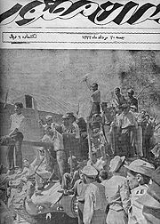
Operation Ajax

Encyclopedia
The 1953 Iranian coup d'état (known in Iran
as the 28 Mordad coup) was the overthrow
of the democratically elected
government of Iran
ian Prime Minister Mohammad Mosaddegh on 19 August 1953, orchestrated by the intelligence agencies of the United Kingdom and the United States under the name TPAJAX Project. The coup saw the transition of Mohammad-Rezā Shāh Pahlavi from a constitutional monarch
to an authoritarian
one who relied heavily on United States support to hold on to power until his own overthrow in February 1979
.
In 1951, Iran's oil industry was nationalized with near-unanimous support of Iran's parliament
in a bill introduced by Mossadegh who led the nationalist parliamentarian faction. Iran's oil had been controlled by the British-owned Anglo-Iranian Oil Company
(AIOC). Popular discontent with the AIOC began in the late 1940s, a large segment of Iran's public and a number of politicians saw the company as exploitative and a vestige of British imperialism. Despite Mosaddegh's popular support, Britain was unwilling to negotiate its single most valuable foreign asset, and instigated a worldwide boycott of Iranian oil to pressure Iran economically. Initially, Britain mobilized its military to seize control of the Abadan oil refinery
, the world's largest, but Prime Minister Clement Attlee
opted instead to tighten the economic boycott while using Iranian agents to undermine Mosaddegh's government. With a change to more conservative governments in both Britain and the United States, Churchill
and the U.S. Eisenhower administration decided to overthrow Iran's government though the predecessor U.S. Truman administration had opposed a coup.
Britain and the U.S. selected Fazlollah Zahedi
to be the prime minister of a military government that was to replace Mosaddegh's government. Subsequently, a royal decree dismissing Mosaddegh and appointing Zahedi was drawn up by the coup plotters and signed by the Shah. The Central Intelligence Agency
had successfully pressured the weak monarch to participate in the coup, while bribing street thugs, clergy, politicians and Iranian army officers to take part in a propaganda campaign against Mosaddegh and his government. At first, the coup appeared to be a failure when on the night of 15–16 August, Imperial Guard Colonel Nematollah Nassiri
was arrested while attempting to arrest Mosaddegh. The Shah fled the country the next day. On 19 August, a pro-Shah mob, paid by the CIA, marched on Mosaddegh's residence. According to the CIA's declassified documents and records, some of the most feared mobsters in Tehran
were hired by the CIA to stage pro-Shah riots on the 19th. Other CIA-paid men were brought into Tehran in buses and trucks, and took over the streets of the city. 800 people were killed during and as a direct result of the conflict. Mosaddegh was arrested, tried and convicted of treason by the Shah's military court. On 21 December 1953, he was sentenced to three years in jail, then placed under house arrest for the remainder of his life. Mosaddegh's supporters were rounded up, imprisoned, tortured or executed.
After the coup, Pahlavi ruled as an authoritarian monarch for the next 26 years, until he was overthrown in a popular revolt in 1979. The tangible benefits the United States reaped from overthrowing Iran's elected government included a share of Iran's oil wealth as well as resolute prevention of the slim possibility that the Iranian government might align itself with the Soviet Union, although the latter motivation produces controversy among historians. Washington continually supplied arms to the unpopular Shah, and the CIA-trained SAVAK
, his repressive secret police force. The coup is widely believed to have significantly contributed to anti-American sentiment in Iran and the Middle East. The 1979 Iranian Revolution
deposed the Shah and replaced the pro-Western royal dictatorship with the largely anti-Western
Islamic Republic of Iran.
in 1856–57 after which Afghanistan became independent. In 1892, the British diplomat George Curzon described Iran
as "pieces on a chessboard upon which is being played out a game for the dominion of the world.
In 1872, a representative of Baron Paul Reuter
, founder of the news agency, met with Naser al-Din Shah Qajar and agreed to fund the Persian monarch's upcoming lavish visit to Europe in return for broadly worded concessions in Persia, which was the country name through the centuries until 1935 when Reza Shah
renamed it Iran. The concession the Shah had given to Reuter was never put into effect because of violent opposition from the Persian people and from Russia.
, granted a 60-year petroleum search concession to William Knox D'Arcy
. D'Arcy paid £20,000, according to journalist-turned-historian Stephen Kinzer
, and promised equal ownership shares, with 16% of any future profit. However, the historian L.P. Elwell-Sutton wrote, in 1955, that "Persia's share was "hardly spectacular" and no money changed hands.
On 31 July 1907, D'Arcy withdrew from his private holdings in Persia. "A new agreement was signed under which he transferred to the Burmah Oil Company all his shares in the First Exploitation Company, and with them his last direct interest in the exploitation of oil in Persia." D'Arcy received 203,067 British pounds
in cash (more than ten times what the Persian monarch was supposed to have received in cash for the concession) and D'Arcy received 900,000 shares in the Burmah Oil Company, which the historian Elwell-Sutton declared was "a large sum."
In early 1908, the British-owned Burmah Oil Company decided to end its exploration for oil in Persia but on 26 May, oil came in at a depth of 1180 feet (359.7 m), "a gusher that shot fifty feet or more above the top of the rig," Elwell-Sutton wrote. "So began the industry that was to see the Royal Navy through two world wars, and to cause Persia more trouble than all the political manoeuvrings of the great powers put together."
The company grew slowly until World War I, when Persia's strategic importance led the British government to buy a controlling share in the company, essentially nationalizing British oil production in Iran. It became the Royal Navy's chief fuel source during the war.
The British angered Iranians by intervening in Iranian domestic affairs including in the Persian Constitutional Revolution (the transition from dynastic to parliamentary government).
(APOC), whereby Persia received 16 per cent of net profits.
In 1921, a military coup d'état—"widely believed to be a British attempt to enforce, at least, the spirit of the Anglo-Persian agreement" effected with the "financial and logistical support of British military personnel"—permitted the political emergence of Reza Pahlavi
, whom they enthroned as the "Shah of Iran" in 1925. The Shah modernized Persia to the advantage of the British; one result was the Persian Corridor
railroad for British military and civil transport during World War II.
In the 1930s, the Shah tried to terminate the APOC concession, but Britain would not allow it. The concession was renegotiated on terms again favorable to the British. On 21 March 1935, Pahlavi changed the name of the country from Persia to Iran. The Anglo-Persian Oil Company was then re-named the Anglo-Iranian Oil Company (AIOC).
forces and the Red Army
invaded Iran
, to secure petroleum (cf. Persian Corridor
) for the Soviet Union
's effort against the Nazis on the Eastern Front
and for the British elsewhere. Britain and the USSR deposed and exiled the pro-Nazi Shah Reza, and enthroned his 22-year-old son, Mohammad Reza Pahlavi, as the Shah of Iran.
The British secured the oilfields and the seaports.
During the war, Iran was used as a conduit for materiel
to the USSR. US forces also entered the country replacing British in operating the southern part of the Trans-Iranian Railway
.
After the war, nationalist leaders in Iran became influential by seeking a reduction in long-term foreign interventions in their country—especially the oil concession which was very profitable for Britain and not very profitable to Iran. The British-controlled AIOC refused to allow its books to be audited to determine whether the Iranian government was being paid what had been promised. British intransigence irked the Iranian population.
U.S. objectives in the Middle East remained the same between 1947 and 1952 but its strategy changed. Washington remained "publicly in solidarity and privately at odds" with Britain, its World War II ally. Britain's empire was steadily weakening, and with an eye on international crises, the U.S. re-appraised its interests and the risks of being identified with British colonial interests. "In Saudi Arabia
, to Britain's extreme disapproval, Washington endorsed the arrangement between ARAMCO and Saudi Arabia in the 50/50 accord that had reverberations throughout the region."
Britain faced the newly elected nationalist government in Iran where Mossadegh, with strong backing of the Iranian parliament, demanded more favorable concessionary arrangements, which Britain vigorously opposed.
The U.S. State Department not only rejected Britain's demand that it continue to be the primary beneficiary of Iranian oil reserves but "U.S. international oil interests were among the beneficiaries of the concessionary arrangements that followed nationalization."
U.S. reluctance to overthrow Prime Minister Mossadegh in 1951, when he was elected, faded 28 months later when Dwight D. Eisenhower
was in the White House
and John Foster Dulles
took the helm at the State Department. "Anglo-American cooperation on that occasion brought down the Iranian prime minister and reinstated a U.S.-backed shah."
Mohammad Mosaddegh attempted to negotiate with the AIOC, but the company rejected his proposed compromise. Mosaddegh's plan, based on the 1948 compromise between the Venezuela
n Government of Romulo Gallegos
and Creole Petroleum
, would divide the profits from oil 50/50 between Iran and Britain. Against the recommendation of the United States, Britain refused this proposal and began planning to undermine and overthrow the Iranian government.
That summer, American diplomat Averell Harriman went to Iran to negotiate an Anglo-Iranian compromise, asking the Shah's help; his reply was that "in the face of public opinion, there was no way he could say a word against nationalization". Harriman held a press conference in Tehran
, calling for reason and enthusiasm in confronting the "nationalization crisis". As soon as he spoke, a journalist rose and shouted: "We and the Iranian people all support Premier Mosaddegh and oil nationalization!" Everyone present began cheering and then marched out of the room; the abandoned Harriman shook his head in dismay.
The National Iranian Oil Company suffered decreased production, because of Iranian inexperience and the AIOC's orders that British technicians not work with them, thus provoking the Abadan Crisis
that was aggravated by the Royal Navy
's blockading its export markets to pressure Iran to not nationalize its petroleum. The Iranian revenues were greater, because the profits went to Iran's national treasury rather than to private, foreign oil companies. By September 1951, the British had virtually ceased Abadan oil field production, forbidden British export to Iran of key British commodities (including sugar and steel), and had frozen Iran's hard currency accounts in British banks.
The United Kingdom took its anti-nationalization case against Iran to the International Court of Justice
at The Hague
; PM Mosaddegh said the world would learn of a "cruel and imperialistic country" stealing from a "needy and naked people". Representing the AIOC, the UK lost its case. In August 1952, Iranian Prime Minister Mosaddegh invited an American oil executive to visit Iran and the Truman administration welcomed the invitation. However, the suggestion upset British Prime Minister Winston Churchill
who insisted that the U.S. not undermine his campaign to isolate Mosaddegh: "Britain was supporting the Americans in Korea, he reminded Truman, and had a right to expect Anglo-American unity on Iran."
In mid-1952, Britain's boycott of Iranian oil was devastatingly effective. British agents in Tehran "worked to subvert" the government of Mosaddegh, who sought help from President Truman and then the World Bank but to no avail. "Iranians were becoming poorer and unhappier by the day" and Mosaddegh's political coalition was fraying.
In the Majlis election in the spring of 1952, Mosaddegh "had little to fear from a free vote, since despite the country's problems, he was widely admired as a hero. A free vote, however, was not what others were planning. British agents had fanned out across the country, bribing candidates, and the regional bosses who controlled them. They hoped to fill the Majlis with deputies who would vote to depose Mosaddegh. It would be a coup carried out by seemingly legal means."
While the National Front, which often supported Mosaddegh won handily in the big cities, there was no one to monitor voting in the rural areas. Violence broke out in Abadan and other parts of the country where elections were hotly contested. Faced with having to leave Iran for The Hague where Britain was suing for control of Iranian oil, Mossadegh's cabinet voted to postpone the remainder of the election until after the return of the Iranian delegation from The Hague.
By mid-1953 a mass of resignations by Mossadegh's parliamentary supporters reduced parliament below its quorum. A referendum to dissolve parliament
and give the prime minister power to make law was submitted to voters, and it passed with 99.9 percent approval, 2,043,300 votes to 1300 votes against.
While Mosaddegh dealt with political challenge, he faced another that most Iranians considered far more urgent. The British blockade of Iranian seaports meant that Iran was left without access to markets where it could sell its oil. The embargo had the effect of causing Iran to spiral into bankruptcy. Tens of thousands had lost their jobs at the Abadan refinery, and although most understood and passionately supported the idea of nationalization, they naturally hoped that Mosaddegh would find a way to put them back to work. The only way he could do that was to sell oil."
Worried about the Britain's other interests in Iran, and believing that Iran's nationalism was Soviet-backed, Britain persuaded Secretary of State John Foster Dulles
that Iran was falling to the Soviets—effectively exploiting the American Cold War mindset. While President Harry S. Truman
was busy fighting a war with in Korea, he did not agree to overthrow the government of Prime Minister Mohammad Mosaddegh. However, in 1953, when Dwight D. Eisenhower
became president, the UK convinced him to a joint coup d'état.
As a condition for restoring the Anglo-Iranian Oil Company, the U.S. required removal of the AIOC's monopoly; five American petroleum companies, Royal Dutch Shell
, and the Compagnie Française des Pétroles, were to draw Iran's petroleum after the successful coup d'état—Operation Ajax.
As part of that, the CIA organized anti-Communist guerrillas to fight the Tudeh Party if they seized power in the chaos of Operation Ajax. Per released National Security Archive
documents, Undersecretary of State Walter Bedell Smith
reported that the CIA had agreed with Qashqai
tribal leaders, in south Iran, to establish a clandestine safe haven from which U.S.-funded guerrillas and spies could operate.
Operation Ajax's formal leader was senior CIA officer Kermit Roosevelt, Jr.
, while career agent Donald Wilber
was the operational leader, planner, and executor of the deposition of PM Mosaddegh. The coup d'état depended on the impotent Shah's dismissing the popular and powerful Prime Minister and replacing him with Gen. Fazlollah Zahedi
, with help from Col. Abbas Farzanegan
—a man agreed by the British and Americans after determining his anti-Soviet politics.
The CIA sent Major general
Norman Schwarzkopf, Sr.
to persuade the exiled Shah to return to rule Iran. Schwarzkopf trained the security forces that would become known as SAVAK
to secure the shah's hold on power.
in a covert action advocated by Secretary of State John Foster Dulles
, and implemented under the supervision of his brother Allen Dulles, the Director of Central Intelligence
. The coup was organized by the United States' CIA and the United Kingdom's MI6, two spy agencies that aided royalists and royalist elements of the Iranian army.
According to a heavily redacted CIA document released to the National Security Archive
in response to a Freedom of Information
request, "Available documents do not indicate who authorized CIA to begin planning the operation, but it almost certainly was President Eisenhower
himself. Eisenhower biographer Stephen Ambrose
has written that the absence of documentation reflected the President's style."
The CIA document then quotes from the Ambrose biography of Eisenhower:
CIA officer Kermit Roosevelt, Jr.
, the grandson of former President Theodore Roosevelt
, carried out the operation planned by CIA agent Donald Wilber
. One version of the CIA history, written by Wilber, referred to the operation as TPAJAX.
During the coup, Roosevelt and Wilber, representatives of the Eisenhower administration, bribed Iranian government officials, reporters, and businessmen. They also bribed street thugs to support the Shah and oppose Mosaddegh. The deposed Iranian leader, Mosaddegh, was taken to jail and Iranian General Fazlollah Zahedi
named himself prime minister in the new, pro-western government.
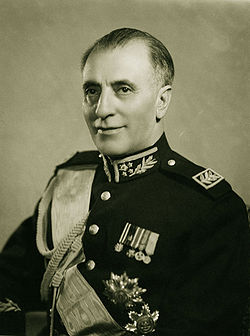
The British and American spy agencies returned the monarchy to Iran by installing the pro-western Mohammad Reza Pahlavi on the throne where his rule lasted 26 years. Pahlavi was overthrown in 1979. Masoud Kazemzadeh, associate professor of political science at the Sam Houston State University
, wrote that Pahlavi was directed by the CIA and MI6, and assisted by high-ranking Shia clerics. He wrote that the coup employed mercenaries including "prostitutes and thugs" from Tehran's red light district.
The overthrow of Iran's elected government in 1953 ensured Western control of Iran's petroleum resources and prevented the Soviet Union
from competing for Iranian oil. Some Iranian clerics cooperated with the western spy agencies because they were dissatisfied with Mosaddegh's secular government.
While the broad outlines of the Iran operation are known: the agency led a coup in 1953 that re-installed the pro-American Shah Mohammad Reza Pahlavi to the throne, where he remained until overthrown in 1979. "But the C.I.A.'s records were widely thought by historians to have the potential to add depth and clarity to a famous but little-documented intelligence operation," reporter Tim Weiner wrote in The New York Times 29 May 1997
"The Central Intelligence Agency, which has repeatedly pledged for more than five years to make public the files from its secret mission to overthrow the government of Iran in 1953, said today that it had destroyed or lost almost all the documents decades ago."
According to Donald Wilber
one of the CIA officers who planned the 1953 coup in Iran wrote an account titled, Clandestine Service History Overthrow Of Premier Mossadeq of Iran: November 1952 – August 1953. Wilber said one goal of the coup was to strengthen the Shah.
In 2000, James Risen
at The New York Times obtained the previously secret CIA version of the coup written by Wilber and summarized its contents, which includes the following.
The National Security Archive
at George Washington University
contains the full account by Wilber along with many other coup-related documents and analysis.
identified the coup d'état as "a classic case of nationalism clashing with imperialism in the Third World". He states that Secretary of State Dean Acheson
admitted the Communist threat' was a smokescreen" in responding to President Eisenhower's claim that the Tudeh party was about to assume power.
Abrahamian states that Iran's oil was the central focus of the coup, for both the British and the Americans, though "much of the discourse at the time linked it to the Cold War". Abrahamian wrote, "If Mosaddegh had succeeded in nationalizing the British oil industry in Iran, that would have set an example and was seen at that time by the Americans as a threat to U.S. oil interests throughout the world, because other countries would do the same." Mosaddegh did not want any compromise solution that allowed a degree of foreign control. Abrahamian said that Mosaddegh "wanted real nationalization, both in theory and practice".
Tirman points out that agricultural land owners were politically dominant in Iran, well into the 1960s and the monarch, Reza Pahlevi's aggressive land expropriation policies—to the benefit of himself and his supporters—resulted in the Iranian government being Iran's largest land owner. "The landlords and oil producers had new backing, moreover, as American interests were for the first time exerted in Iran. The Cold War was starting, and Soviet challenges were seen in every leftist movement. But the reformers were at root nationalists, not communists, and the issue that galvanized them above all others was the control of oil." The belief that oil was the central motivator behind the coup has been echoed in the popular media by authors such as Robert Byrd
, Alan Greenspan
, and Ted Koppel
.
However, Middle East political scientist Mark Gasiorowski
states that while, on the face of it, there is considerable merit to the argument that U.S. policymakers helped U.S. oil companies gain a share in Iranian oil production after the coup, "it seems more plausible to argue that U.S. policymakers were motivated mainly by fears of a communist takeover in Iran, and that the involvement of U.S. companies was sought mainly to prevent this from occurring. The Cold War was at its height in the early 1950s, and the Soviet Union was viewed as an expansionist power seeking world domination. Eisenhower had made the Soviet threat a key issue in the 1952 elections, accusing the Democrats of being soft on communism and of having "lost China." Once in power, the new administration quickly sought to put its views into practice."
Gasiorowski further states "the major U.S. oil companies were not interested in Iran at this time. A glut existed in the world oil market. The U.S. majors had increased their production in Saudi Arabia and Kuwait in 1951 in order to make up for the loss of Iranian production; operating in Iran would force them to cut back production in these countries which would create tensions with Saudi and Kuwaiti leaders. Furthermore, if nationalist sentiments remained high in Iran, production there would be risky. U.S. oil companies had shown no interest in Iran in 1951 and 1952. By late 1952, the Truman administration had come to believe that participation by U.S. companies in the production of Iranian oil was essential to maintain stability in Iran and keep Iran out of Soviet hands. In order to gain the participation of the major U.S. oil companies, Truman offered to scale back a large anti-trust case then being brought against them. The Eisenhower administration shared Truman's views on the participation of U.S. companies in Iran and also agreed to scale back the anti-trust case. Thus, not only did U.S. majors not want to participate in Iran at this time, it took a major effort by U.S. policymakers to persuade them to become involved."
In 2004, Gasiorowski edited a book on the coup arguing that "the climate of intense cold war rivalry between the superpowers, together with Iran's strategic vital location between the Soviet Union and the Persian Gulf oil fields, led U.S. officials to believe that they had to take whatever steps were necessary to prevent Iran from falling into Soviet hands." While "these concerns seem vastly overblown today" the pattern of "the 1945–46 Azerbaijan crisis, the consolidation of Soviet control in Eastern Europe, the communist triumph in China, and the Korean War
—and with the Red Scare
at its height in the United States" would not allow U.S. officials to risk allowing the Tudeh Party to gain power in Iran. Furthermore, "U.S. officials believed that resolving the oil dispute was essential for restoring stability in Iran, and after March 1953 it appeared that the dispute could be resolved only at the expense either of Britain or of Mosaddeq." He concludes "it was geostrategic considerations, rather than a desire to destroy Mosaddeq's movement, to establish a dictatorship in Iran or to gain control over Iran's oil, that persuaded U.S. officials to undertake the coup."
Faced with choosing between British interests and Iran, the U.S. chose Britain, Gasiorowski said. "Britain was the closest ally of the United States, and the two countries were working as partners on a wide range of vitally important matters throughout the world at this time. Preserving this close relationship was more important to U.S. officials than saving Mosaddeq's tottering regime." A year earilier, British Prime Minister Winston Churchill
used Britain's support for the U.S. in the Cold War to insist the United States not undermine his campaign to isolate Mosaddegh. "Britain was supporting the Americans in Korea, he reminded Truman
, and had a right to expect `Anglo-American unity` on Iran."
The two main winners of World War II who had been Allies
during the war became superpowers and competitors as soon as the war ended, each with their own spheres of influence and client states. After the 1953 coup, Iran became one of the client states of the United States. In his earlier book, U.S. Foreign Policy and the Shah: Building a Client State in Iran Gasiorowski identifies the client states of the United States and of the Soviet Union between 1954–1977. Gasiorowski identified Guatemala, Nicaragua, Panama, Cambodia, Iran, Indonesia, Laos, Philippines, South Korea, South Vietnam, Taiwan as strong client states of the United States and identified those that were moderately important to the U.S. as Greece, Turkey, Bolivia, Brazil, Colombia, Costa Rica, Dominican Republic, Ecuador, El Salvador, Haiti, Honduras, Paraguay, Liberia, Zaire, Israel, Jordan, Tunisia, Pakistan and Thailand. He identified Argentina, Chile, Peru, Ethiopia and Japan as "weak" client states of the United States.
Gasiorowski identified Bulgaria, Czechoslovakia, East Germany, Hungary, Poland, Rumania, Cuba, Mongolia and North Vietnam as "strong client states" of the Soviet Union, and he identified Guinea, Somalia, Egypt, Syria, Afghanistan and North Korea as moderately important client states. Mali and South Yemen were classified as weak client states of the Soviet Union.
According to Kinzer, for most Americans, the crisis in Iran became just part of the conflict between Communism and "the Free world." "A great sense of fear, particularly the fear of encirclement, shaped American consciousness during this period. ... Soviet power had already subdued Latvia, Lithuania, Estonia. Communist governments were imposed on Bulgaria and Romania in 1946, Hungary and Poland in 1947, and Czechoslovakia in 1948. Albania and Yugoslavia also turned to communism. Greek communists made a violent bid for power. Soviet soldiers blocked land routes to Berlin for sixteen months. In 1949 the Soviet Union successfully tested a nuclear weapon. That same year, pro-Western forces in China lost their civil war to communists led by Mao Zedong. From Washington, it seemed that enemies were on the march everywhere." Consequently, "the United States, challenged by what most Americans saw as a relentless communist advance, slowly ceased to view Iran as a country with a unique history that faced a unique political challenge." Some historians including Douglas Little
, Abbas Milani
and George Lenczowski
have echoed the view that fears of a communist takeover or Soviet influence motivated the U.S. to intervene.
and reflected in the book Mohammad Mosaddeq and the 1953 Coup in Iran, edited by Mark J. Gasiorowski and Malcolm Byrne, the coup caused long-lasting damage to the U.S. reputation.
The authoritarian monarch installed in the coup appreciated the coup, Kermit Roosevelt wrote in his account of the affair. "'I owe my throne to God, my people, my army and to you!' By 'you' he [the shah] meant me and the two countries—Great Britain and the United States—I was representing. We were all heroes."
On 16 June 2000, The New York Times
published the secret CIA report, "Clandestine Service History, Overthrow Of Premier Mossadeq Of Iran, November 1952 – August 1953," partly explaining the coup from CIA agent Wilber's perspective. In a related story, The New York Times reporter James Risen
penned a story revealing that Wilber's report, hidden for nearly five decades, had recently come to light.
In the summer of 2001, Ervand Abrahamian wrote in the journal Science & Society that Wilber's version of the coup was missing key information some of which was available elsewhere.
In a review of Tim Weiner
's Legacy of Ashes,
historian Michael Beschloss
wrote, "Mr. Weiner argues that a bad C.I.A. track record has encouraged many of our gravest contemporary problems... A generation of Iranians grew up knowing that the C.I.A. had installed the shah," Mr. Weiner notes. "In time, the chaos that the agency had created in the streets of Tehran would return to haunt the United States."
The administration of Dwight D. Eisenhower
considered the coup a success, but, given its blowback
, that opinion is no longer generally held, because of its "haunting and terrible legacy". In 2000, Madeleine Albright
, U.S. Secretary of State, said that intervention by the U.S. in the internal affairs of Iran was a setback for democratic government. The coup d'état was "a critical event in post-war world history" that destroyed Iran's secular parliamentary democracy, by re-installing the monarchy of the Shah, Mohammad Reza Pahlavi, as an authoritarian ruler. The coup is widely believed to have significantly contributed to the 1979 Iranian Revolution
, which deposed the pro-Western Shah and replaced the monarchy with an anti-Western Islamic Republic
.
"For many Iranians, the coup demonstrated duplicity by the United States, which presented itself as a defender of freedom but did not hesitate to use underhanded methods to overthrow a democratically elected government to suit its own economic and strategic interests", the Agence France-Presse reported.
"The world has paid a heavy price for the lack of democracy in most of the Middle East. Operation Ajax taught tyrants and aspiring tyrants that the world's most powerful governments were willing to tolerate limitless oppression as long as oppressive regimes were friendly to the West and to Western oil companies. That helped tilt the political balance in a vast region away from freedom and toward dictatorship." The United States initially considered the coup to be a triumph of Cold War
covert action, but given its blowback
, Kinzer wrote that it is difficult to imagine an outcome "that would have produced as much pain and horror over the next half century as that produced by Operation Ajax" had "American and British intelligence officers not meddled so shamelessly in (Iran"s) domestic affairs."
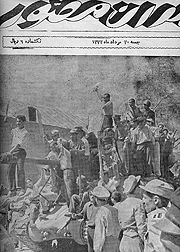 United States Supreme Court Justice William O. Douglas
, who visited Iran both before and after the coup, wrote that "When Mossadegh and Persia started basic reforms, we became alarmed. We united with the British to destroy him; we succeeded; and ever since, our name has not been an honored one in the Middle East."
as well as the (Communist) Tudeh party, and concentration of political power in the Shah and his courtiers.
The minister of Foreign Affairs and the closest associate of Mosaddegh, Hossein Fatemi
, was executed by order of the Shah's military court. The order was carried out by firing squad on 10 November 1954. According to Kinzer, "The triumphant Shah [Pahlavi] ordered the execution of several dozen military officers and student leaders who had been closely associated with Mohammad Mossadegh"
As part of the post-coup d'état political repression between 1953–1958, the Shah outlawed the National Front, and arrested most of its leaders. The Tudeh, however, bore the main brunt of the repression. The Shah's security forces arrested 4,121 Tudeh political activists including 386 civil servants, 201 college students, 165 teachers, 125 skilled workers, 80 textile workers, 60 cobblers, and 11 housewives. Forty were executed, another 14 died under torture and over 200 were sentenced to life imprisonment. The Shah's post-coup dragnet also captured 477 Tudeh members ("22 colonels, 69 majors, 100 captains, 193 lieutenants, 19 noncommissioned officers, and 63 military cadets") who were in the Iranian armed forces. After their presence was revealed, some National Front supporters complained that this Tudeh military network could have saved Mosaddegh. However, few Tudeh officers commanded powerful field units, especially tank divisions that might have countered the coup. Most of the captured Tudeh officers came from the military academies, police and medical corps. At least eleven of the captured army officers were tortured to death between 1953 and 1958.
After the 1953 coup, the Shah's government formed the SAVAK
(secret police), many of whose agents were trained in the United States. The SAVAK was given a "loose leash" to torture suspected dissidents with "brute force" that, over the years, "increased dramatically".
Another effect was sharp improvement of Iran's economy; the British-led oil embargo against Iran ended, and oil revenue increased significantly beyond the pre-nationalisation level. Despite Iran not controlling its national oil, the Shah agreed to replacing the Anglo-Iranian Oil Company with a consortium—British Petroleum and eight European and American oil companies; in result, oil revenues increased from $34 million in 1954–1955 to $181 million in 1956–1957, and continued increasing, and the United States sent development aid and advisors.
In the 1970s the Shah's government increased taxes that foreign companies were obliged to pay from 50% to 80% and royalty payments from 12.5% to 20%. At the same time the price of oil reverted to Iranian control. Oil companies now only earned 22 cents per barrel of oil.
Jacob G. Hornberger
, founder and president, of The Future of Freedom Foundation, said, "U.S. officials, not surprisingly, considered the operation one of their greatest foreign policy successes—until, that is, the enormous convulsion that rocked Iranian society with the violent ouster of the Shah and the installation of a virulently anti-American Islamic regime in 1979". According to him, "the coup, in essence, paved the way for the rise to power of the Ayatollah Ruhollah Khomeini
and all the rest that's happened right up to 9/11 and beyond".
toppling the duly elected Guatemala
n government of Jacobo Arbenz Guzmán
, which had nationalised farm land owned by the United Fruit Company
, followed the next year.
A pro-American government in Iran doubled the United States' geographic and strategic advantage in the Middle East, as Turkey
, also bordering the USSR, was part of NATO.
In 2000 U.S. Secretary of State Madeleine K. Albright, acknowledged the coup's pivotal role in the troubled relationship and "came closer to apologizing than any American official ever has before".
In June 2009, the U.S. President Barack Obama
in a speech
in Cairo
, Egypt, talked about the United States' relationship with Iran, mentioning the role of the U.S. in 1953 Iranian coup saying:
, a close associate of Mossadegh. But with the subsequent rift between the conservative Islamic establishment and the secular liberal forces, Mossadegh's work and legacy has been largely ignored by the Islamic Republic establishment. However, Mosaddegh remains a popular historical figure among Iranian opposition factions. Mosaddegh's image is one of the symbols of Iran's opposition movement, also known as the Green Movement. Kinzer writes that Mosaddegh "for most Iranians" is "the most vivid symbol of Iran's long struggle for democracy" and that modern protesters carrying a picture of Mosaddegh is the equivalent of saying "We want democracy" and "No foreign intervention".
In the Islamic Republic, remembrance of the coup is quite different than that of history books published in the West, and follows the precepts of Ayatollah Khomeini that Islamic jurists must guide the country to prevent "the influence of foreign powers". According to historian Ervand Abrahamian
, the government tries to ignore Mosaddegh as much as possible and allocates him only two pages in high school textbooks. "The mass media elevate Ayatollah Abol-Ghasem Kashani as the real leader of the oil nationalization campaign, depicting Mosaddegh as merely the ayatollah's hanger-on." This is despite the fact that Kashani came out against Mosaddegh by mid-1953 and "told a foreign correspondent that Mosaddegh had fallen because he had forgotten that the shah enjoyed extensive popular support." A month later, Kashani "went even further and declared that Mosaddegh deserved to be executed because he had committed the ultimate offense: rebelling against the shah, 'betraying' the country, and repeatedly violating the sacred law."
In the Islamic Republic of Iran, Kinzer's book All the Shah's Men
: An American Coup and the Roots of Middle East Terror has been censored of descriptions of Ayatollah Abol-Ghasem Kashani
's activities during the Anglo-American coup d'état. Mahmood Kashani, the son of Abol-Ghasem Kashani, "one of the top members of the current, ruling élite" whom the Iranian Council of Guardians has twice approved to run for the presidency, denies there was a coup d'état in 1953, saying Mosaddegh, himself, was obeying British plans: "In my opinion, Mosaddegh was the director of the British plans and implemented them ... Without a doubt Mosaddegh had the primary and essential role" in the August 1953 coup. Kashani says Mosaddegh, the British and the Americans worked against the Ayatollah Kashani to undermine the role of Shia clerics.
This allegation also is posited in the book Khaterat-e Arteshbod-e Baznesheshteh Hossein Fardoust (The Memoirs of Retired General Hossein Fardoust), published in the Islamic Republic and allegedly written by Hossein Fardoust
, a former SAVAK
officer. It claims that rather than being a mortal enemy of the British, Mohammad Mosaddegh always favored them, and his nationalisation campaign of the Anglo-Iranian Oil Company was inspired by "the British themselves". Scholar Ervand Abrahamian
suggests that the fact that Fardoust's death was announced before publication of the book may be significant, as the Islamic Republic authorities may have forced him into writing such statements under duress.
Iran
Iran , officially the Islamic Republic of Iran , is a country in Southern and Western Asia. The name "Iran" has been in use natively since the Sassanian era and came into use internationally in 1935, before which the country was known to the Western world as Persia...
as the 28 Mordad coup) was the overthrow
Coup d'état
A coup d'état state, literally: strike/blow of state)—also known as a coup, putsch, and overthrow—is the sudden, extrajudicial deposition of a government, usually by a small group of the existing state establishment—typically the military—to replace the deposed government with another body; either...
of the democratically elected
Democracy
Democracy is generally defined as a form of government in which all adult citizens have an equal say in the decisions that affect their lives. Ideally, this includes equal participation in the proposal, development and passage of legislation into law...
government of Iran
Iran
Iran , officially the Islamic Republic of Iran , is a country in Southern and Western Asia. The name "Iran" has been in use natively since the Sassanian era and came into use internationally in 1935, before which the country was known to the Western world as Persia...
ian Prime Minister Mohammad Mosaddegh on 19 August 1953, orchestrated by the intelligence agencies of the United Kingdom and the United States under the name TPAJAX Project. The coup saw the transition of Mohammad-Rezā Shāh Pahlavi from a constitutional monarch
Constitutional monarchy
Constitutional monarchy is a form of government in which a monarch acts as head of state within the parameters of a constitution, whether it be a written, uncodified or blended constitution...
to an authoritarian
Authoritarianism
Authoritarianism is a form of social organization characterized by submission to authority. It is usually opposed to individualism and democracy...
one who relied heavily on United States support to hold on to power until his own overthrow in February 1979
Iranian Revolution
The Iranian Revolution refers to events involving the overthrow of Iran's monarchy under Shah Mohammad Reza Pahlavi and its replacement with an Islamic republic under Ayatollah Ruhollah Khomeini, the leader of the...
.
In 1951, Iran's oil industry was nationalized with near-unanimous support of Iran's parliament
Majlis
' , is an Arabic term meaning "a place of sitting", used in the context of "council", to describe various types of special gatherings among common interest groups be it administrative, social or religious in countries with linguistic or cultural connections to Islamic countries...
in a bill introduced by Mossadegh who led the nationalist parliamentarian faction. Iran's oil had been controlled by the British-owned Anglo-Iranian Oil Company
Anglo-Persian Oil Company
The Anglo-Persian Oil Company was founded in 1908 following the discovery of a large oil field in Masjed Soleiman, Iran. It was the first company to extract petroleum from the Middle East...
(AIOC). Popular discontent with the AIOC began in the late 1940s, a large segment of Iran's public and a number of politicians saw the company as exploitative and a vestige of British imperialism. Despite Mosaddegh's popular support, Britain was unwilling to negotiate its single most valuable foreign asset, and instigated a worldwide boycott of Iranian oil to pressure Iran economically. Initially, Britain mobilized its military to seize control of the Abadan oil refinery
Abadan Refinery
The Abadan refinery was located in Abadan near the coast of the Persian Gulf. It was completed in 1912 and was one of world's largest oil refineries when it was destroyed in 1980 by Iraq in the Iraq-Iran war. Its nationalisation in 1951 prompted the Abadan Crisis and ultimately the toppling of the...
, the world's largest, but Prime Minister Clement Attlee
Clement Attlee
Clement Richard Attlee, 1st Earl Attlee, KG, OM, CH, PC, FRS was a British Labour politician who served as the Prime Minister of the United Kingdom from 1945 to 1951, and as the Leader of the Labour Party from 1935 to 1955...
opted instead to tighten the economic boycott while using Iranian agents to undermine Mosaddegh's government. With a change to more conservative governments in both Britain and the United States, Churchill
Winston Churchill
Sir Winston Leonard Spencer-Churchill, was a predominantly Conservative British politician and statesman known for his leadership of the United Kingdom during the Second World War. He is widely regarded as one of the greatest wartime leaders of the century and served as Prime Minister twice...
and the U.S. Eisenhower administration decided to overthrow Iran's government though the predecessor U.S. Truman administration had opposed a coup.
Britain and the U.S. selected Fazlollah Zahedi
Fazlollah Zahedi
Mohammad Fazlollah Zahedi was an Iranian general and statesman who replaced democratically elected Iranian Prime Minister Mohammed Mossadeq through a western-backed coup d'état, in which he played a major role.-Early years:Born in Hamedan in 1897, Fazlollah Zahedi was the son of Abol Hassan...
to be the prime minister of a military government that was to replace Mosaddegh's government. Subsequently, a royal decree dismissing Mosaddegh and appointing Zahedi was drawn up by the coup plotters and signed by the Shah. The Central Intelligence Agency
Central Intelligence Agency
The Central Intelligence Agency is a civilian intelligence agency of the United States government. It is an executive agency and reports directly to the Director of National Intelligence, responsible for providing national security intelligence assessment to senior United States policymakers...
had successfully pressured the weak monarch to participate in the coup, while bribing street thugs, clergy, politicians and Iranian army officers to take part in a propaganda campaign against Mosaddegh and his government. At first, the coup appeared to be a failure when on the night of 15–16 August, Imperial Guard Colonel Nematollah Nassiri
Nematollah Nassiri
General Nematollah Nassiri , was the director of SAVAK, the Iranian intelligence agency during the rule of Mohammad Reza Shah. A personal friend of the Shah, he had gained notoriety for removing democratically elected Prime Minister Mohammed Mossadegh from power...
was arrested while attempting to arrest Mosaddegh. The Shah fled the country the next day. On 19 August, a pro-Shah mob, paid by the CIA, marched on Mosaddegh's residence. According to the CIA's declassified documents and records, some of the most feared mobsters in Tehran
Tehran
Tehran , sometimes spelled Teheran, is the capital of Iran and Tehran Province. With an estimated population of 8,429,807; it is also Iran's largest urban area and city, one of the largest cities in Western Asia, and is the world's 19th largest city.In the 20th century, Tehran was subject to...
were hired by the CIA to stage pro-Shah riots on the 19th. Other CIA-paid men were brought into Tehran in buses and trucks, and took over the streets of the city. 800 people were killed during and as a direct result of the conflict. Mosaddegh was arrested, tried and convicted of treason by the Shah's military court. On 21 December 1953, he was sentenced to three years in jail, then placed under house arrest for the remainder of his life. Mosaddegh's supporters were rounded up, imprisoned, tortured or executed.
After the coup, Pahlavi ruled as an authoritarian monarch for the next 26 years, until he was overthrown in a popular revolt in 1979. The tangible benefits the United States reaped from overthrowing Iran's elected government included a share of Iran's oil wealth as well as resolute prevention of the slim possibility that the Iranian government might align itself with the Soviet Union, although the latter motivation produces controversy among historians. Washington continually supplied arms to the unpopular Shah, and the CIA-trained SAVAK
SAVAK
SAVAK was the secret police, domestic security and intelligence service established by Iran's Mohammad Reza Shah on the recommendation of the British Government and with the help of the United States' Central Intelligence Agency SAVAK (Persian: ساواک, short for سازمان اطلاعات و امنیت کشور...
, his repressive secret police force. The coup is widely believed to have significantly contributed to anti-American sentiment in Iran and the Middle East. The 1979 Iranian Revolution
Iranian Revolution
The Iranian Revolution refers to events involving the overthrow of Iran's monarchy under Shah Mohammad Reza Pahlavi and its replacement with an Islamic republic under Ayatollah Ruhollah Khomeini, the leader of the...
deposed the Shah and replaced the pro-Western royal dictatorship with the largely anti-Western
Anti-Western sentiment
Anti-Western sentiment refers to broad opposition or hostility to the people, policies, or governments in the western world. In many cases the United States, Israël and the United Kingdom are the subject of discussion or hostility...
Islamic Republic of Iran.
Nineteenth century
Throughout the nineteenth century, Iran was caught between two advancing imperial powers, Russia, which was expanding southward into the Caucasus and central Asia, and Britain, which sought to dominate the Persian Gulf, the Red Sea, and India. Between 1801 and 1814 Iran signed treaties with Britain and France with an eye toward blocking Russian expansion. After two wars with czarist Russia, from 1804–13 and 1826–28, Iran ceded large tracts of territory to Russia, establishing the modern boundaries between those countries. Britain fought a war with Iran over AfghanistanAfghanistan
Afghanistan , officially the Islamic Republic of Afghanistan, is a landlocked country located in the centre of Asia, forming South Asia, Central Asia and the Middle East. With a population of about 29 million, it has an area of , making it the 42nd most populous and 41st largest nation in the world...
in 1856–57 after which Afghanistan became independent. In 1892, the British diplomat George Curzon described Iran
as "pieces on a chessboard upon which is being played out a game for the dominion of the world.
In 1872, a representative of Baron Paul Reuter
Paul Reuter
Paul Julius Freiherr von Reuter was a German entrepreneur and later naturalized British citizen...
, founder of the news agency, met with Naser al-Din Shah Qajar and agreed to fund the Persian monarch's upcoming lavish visit to Europe in return for broadly worded concessions in Persia, which was the country name through the centuries until 1935 when Reza Shah
Reza Shah
Rezā Shāh, also known as Rezā Shāh Pahlavi and Rezā Shāh Kabir , , was the Shah of the Imperial State of Iran from December 15, 1925, until he was forced to abdicate by the Anglo-Soviet invasion of Iran on September 16, 1941.In 1925, Reza Shah overthrew Ahmad Shah Qajar, the last Shah of the Qajar...
renamed it Iran. The concession the Shah had given to Reuter was never put into effect because of violent opposition from the Persian people and from Russia.
Early petroleum development
In 1901, Mozzafar al-Din Shah Qajar, the Shah of PersiaQajar dynasty
The Qajar dynasty was an Iranian royal family of Turkic descent who ruled Persia from 1785 to 1925....
, granted a 60-year petroleum search concession to William Knox D'Arcy
William Knox D'Arcy
William Knox D'Arcy was one of the principal founders of the oil and petrochemical industry in Persia .-Early life:...
. D'Arcy paid £20,000, according to journalist-turned-historian Stephen Kinzer
Stephen Kinzer
Stephen Kinzer is a United States author and newspaper reporter. He is a veteran New York Times correspondent who has reported from more than fifty countries on five continents. During the 1980s he covered revolution and social upheaval in Central America...
, and promised equal ownership shares, with 16% of any future profit. However, the historian L.P. Elwell-Sutton wrote, in 1955, that "Persia's share was "hardly spectacular" and no money changed hands.
The (Persian) government was promised 20,000 British poundsPound sterlingThe pound sterling , commonly called the pound, is the official currency of the United Kingdom, its Crown Dependencies and the British Overseas Territories of South Georgia and the South Sandwich Islands, British Antarctic Territory and Tristan da Cunha. It is subdivided into 100 pence...
in cash and 20,000 in shares in the first company to be formed by the concessionaire. In addition it was to receive 16 per cent of the profits made by this or any other company concerned in the concession. As it turned out D'Arcy did not even have to put his hand in his pocket. The First Exploitation Company was duly formed on 21 May 1903, with an issued capital of 500,000 British pounds in 1 pound shares, 30,000 of which were presented to the Shah and 20,000 to other "leading personalities". The additional 30,000 in shares was felt to be adequate to take the place of the promised 20,000 pounds in cash, and so no cash payment was ever made. The remainder of the shares were issued in London.
On 31 July 1907, D'Arcy withdrew from his private holdings in Persia. "A new agreement was signed under which he transferred to the Burmah Oil Company all his shares in the First Exploitation Company, and with them his last direct interest in the exploitation of oil in Persia." D'Arcy received 203,067 British pounds
Pound sterling
The pound sterling , commonly called the pound, is the official currency of the United Kingdom, its Crown Dependencies and the British Overseas Territories of South Georgia and the South Sandwich Islands, British Antarctic Territory and Tristan da Cunha. It is subdivided into 100 pence...
in cash (more than ten times what the Persian monarch was supposed to have received in cash for the concession) and D'Arcy received 900,000 shares in the Burmah Oil Company, which the historian Elwell-Sutton declared was "a large sum."
In early 1908, the British-owned Burmah Oil Company decided to end its exploration for oil in Persia but on 26 May, oil came in at a depth of 1180 feet (359.7 m), "a gusher that shot fifty feet or more above the top of the rig," Elwell-Sutton wrote. "So began the industry that was to see the Royal Navy through two world wars, and to cause Persia more trouble than all the political manoeuvrings of the great powers put together."
The company grew slowly until World War I, when Persia's strategic importance led the British government to buy a controlling share in the company, essentially nationalizing British oil production in Iran. It became the Royal Navy's chief fuel source during the war.
The British angered Iranians by intervening in Iranian domestic affairs including in the Persian Constitutional Revolution (the transition from dynastic to parliamentary government).
Post-World War I
The Persians were dissatisfied with the royalty terms of the British petroleum concession, the Anglo-Persian Oil CompanyAnglo-Persian Oil Company
The Anglo-Persian Oil Company was founded in 1908 following the discovery of a large oil field in Masjed Soleiman, Iran. It was the first company to extract petroleum from the Middle East...
(APOC), whereby Persia received 16 per cent of net profits.
In 1921, a military coup d'état—"widely believed to be a British attempt to enforce, at least, the spirit of the Anglo-Persian agreement" effected with the "financial and logistical support of British military personnel"—permitted the political emergence of Reza Pahlavi
Reza Shah
Rezā Shāh, also known as Rezā Shāh Pahlavi and Rezā Shāh Kabir , , was the Shah of the Imperial State of Iran from December 15, 1925, until he was forced to abdicate by the Anglo-Soviet invasion of Iran on September 16, 1941.In 1925, Reza Shah overthrew Ahmad Shah Qajar, the last Shah of the Qajar...
, whom they enthroned as the "Shah of Iran" in 1925. The Shah modernized Persia to the advantage of the British; one result was the Persian Corridor
Persian Corridor
The Persian Corridor is the name for a supply route through Iran into Soviet Azerbaijan by which British aid and American Lend-Lease supplies were transferred to the Soviet Union during World War II.-Background:...
railroad for British military and civil transport during World War II.
In the 1930s, the Shah tried to terminate the APOC concession, but Britain would not allow it. The concession was renegotiated on terms again favorable to the British. On 21 March 1935, Pahlavi changed the name of the country from Persia to Iran. The Anglo-Persian Oil Company was then re-named the Anglo-Iranian Oil Company (AIOC).
World War II
In 1941, after the Nazi invasion of the USSR, the British and Commonwealth of NationsCommonwealth of Nations
The Commonwealth of Nations, normally referred to as the Commonwealth and formerly known as the British Commonwealth, is an intergovernmental organisation of fifty-four independent member states...
forces and the Red Army
Red Army
The Workers' and Peasants' Red Army started out as the Soviet Union's revolutionary communist combat groups during the Russian Civil War of 1918-1922. It grew into the national army of the Soviet Union. By the 1930s the Red Army was among the largest armies in history.The "Red Army" name refers to...
invaded Iran
Anglo-Soviet invasion of Iran
The Anglo-Soviet invasion of Iran was the Allied invasion of the Imperial State of Iran during World War II, by British, Commonwealth, and Soviet armed forces. The invasion from August 25 to September 17, 1941, was codenamed Operation Countenance...
, to secure petroleum (cf. Persian Corridor
Persian Corridor
The Persian Corridor is the name for a supply route through Iran into Soviet Azerbaijan by which British aid and American Lend-Lease supplies were transferred to the Soviet Union during World War II.-Background:...
) for the Soviet Union
Soviet Union
The Soviet Union , officially the Union of Soviet Socialist Republics , was a constitutionally socialist state that existed in Eurasia between 1922 and 1991....
's effort against the Nazis on the Eastern Front
Eastern Front (World War II)
The Eastern Front of World War II was a theatre of World War II between the European Axis powers and co-belligerent Finland against the Soviet Union, Poland, and some other Allies which encompassed Northern, Southern and Eastern Europe from 22 June 1941 to 9 May 1945...
and for the British elsewhere. Britain and the USSR deposed and exiled the pro-Nazi Shah Reza, and enthroned his 22-year-old son, Mohammad Reza Pahlavi, as the Shah of Iran.
The British secured the oilfields and the seaports.
During the war, Iran was used as a conduit for materiel
Materiel
Materiel is a term used in English to refer to the equipment and supplies in military and commercial supply chain management....
to the USSR. US forces also entered the country replacing British in operating the southern part of the Trans-Iranian Railway
Trans-Iranian Railway
The Trans-Iranian Railway was a major railway building project started in 1927 and completed in 1938, under the direction of the Persian monarch, Reza Shah, and entirely with indigenous capital. It links the capital Tehran with the Persian Gulf and Caspian Sea...
.
Post-World War II
The western Allies withdrew from Iran after the end of the war. The Soviet Union remained and sponsored two "People's Democratic Republic"s within Iran's borders. The resulting crisis was resolved through diplomatic efforts in the new United Nations and US support for the Iranian army to reassert control over the breakaway areas. The Soviet-Iranian oil agreement was not ratified.After the war, nationalist leaders in Iran became influential by seeking a reduction in long-term foreign interventions in their country—especially the oil concession which was very profitable for Britain and not very profitable to Iran. The British-controlled AIOC refused to allow its books to be audited to determine whether the Iranian government was being paid what had been promised. British intransigence irked the Iranian population.
U.S. objectives in the Middle East remained the same between 1947 and 1952 but its strategy changed. Washington remained "publicly in solidarity and privately at odds" with Britain, its World War II ally. Britain's empire was steadily weakening, and with an eye on international crises, the U.S. re-appraised its interests and the risks of being identified with British colonial interests. "In Saudi Arabia
Saudi Arabia
The Kingdom of Saudi Arabia , commonly known in British English as Saudi Arabia and in Arabic as as-Sa‘ūdiyyah , is the largest state in Western Asia by land area, constituting the bulk of the Arabian Peninsula, and the second-largest in the Arab World...
, to Britain's extreme disapproval, Washington endorsed the arrangement between ARAMCO and Saudi Arabia in the 50/50 accord that had reverberations throughout the region."
Britain faced the newly elected nationalist government in Iran where Mossadegh, with strong backing of the Iranian parliament, demanded more favorable concessionary arrangements, which Britain vigorously opposed.
The U.S. State Department not only rejected Britain's demand that it continue to be the primary beneficiary of Iranian oil reserves but "U.S. international oil interests were among the beneficiaries of the concessionary arrangements that followed nationalization."
U.S. reluctance to overthrow Prime Minister Mossadegh in 1951, when he was elected, faded 28 months later when Dwight D. Eisenhower
Dwight D. Eisenhower
Dwight David "Ike" Eisenhower was the 34th President of the United States, from 1953 until 1961. He was a five-star general in the United States Army...
was in the White House
White House
The White House is the official residence and principal workplace of the president of the United States. Located at 1600 Pennsylvania Avenue NW in Washington, D.C., the house was designed by Irish-born James Hoban, and built between 1792 and 1800 of white-painted Aquia sandstone in the Neoclassical...
and John Foster Dulles
John Foster Dulles
John Foster Dulles served as U.S. Secretary of State under President Dwight D. Eisenhower from 1953 to 1959. He was a significant figure in the early Cold War era, advocating an aggressive stance against communism throughout the world...
took the helm at the State Department. "Anglo-American cooperation on that occasion brought down the Iranian prime minister and reinstated a U.S.-backed shah."
1950s
In 1951, the AIOC's resistance to re-negotiating their petroleum concession—and increasing the royalty paid to Iran—created popular support for nationalizing the company. In March, the pro-Western PM Ali Razmara was assassinated; the next month, the parliament legislated the petroleum industry's nationalization, by creating the National Iranian Oil Company (NIOC). This legislation was guided by the Western-educated Dr. Mohammad Mosaddegh, then a member of the Iranian parliament and leader of the nationalization movement; by May, the Shah had appointed Mosaddegh Prime Minister.Mohammad Mosaddegh attempted to negotiate with the AIOC, but the company rejected his proposed compromise. Mosaddegh's plan, based on the 1948 compromise between the Venezuela
Venezuela
Venezuela , officially called the Bolivarian Republic of Venezuela , is a tropical country on the northern coast of South America. It borders Colombia to the west, Guyana to the east, and Brazil to the south...
n Government of Romulo Gallegos
Rómulo Gallegos
Rómulo Ángel del Monte Carmelo Gallegos Freire was a Venezuelan novelist and politician. For a period of some nine months during 1948, he was the first cleanly elected president in his country's history....
and Creole Petroleum
Creole Petroleum Corporation
The Creole Petroleum Corporation was an American oil company, formed in 1920 to produce fields on Lake Maracaibo, Venezuela. The company was acquired by Standard Oil of New Jersey in 1928. Until 1951 Creole Petroleum was the world's number one oil producer....
, would divide the profits from oil 50/50 between Iran and Britain. Against the recommendation of the United States, Britain refused this proposal and began planning to undermine and overthrow the Iranian government.
That summer, American diplomat Averell Harriman went to Iran to negotiate an Anglo-Iranian compromise, asking the Shah's help; his reply was that "in the face of public opinion, there was no way he could say a word against nationalization". Harriman held a press conference in Tehran
Tehran
Tehran , sometimes spelled Teheran, is the capital of Iran and Tehran Province. With an estimated population of 8,429,807; it is also Iran's largest urban area and city, one of the largest cities in Western Asia, and is the world's 19th largest city.In the 20th century, Tehran was subject to...
, calling for reason and enthusiasm in confronting the "nationalization crisis". As soon as he spoke, a journalist rose and shouted: "We and the Iranian people all support Premier Mosaddegh and oil nationalization!" Everyone present began cheering and then marched out of the room; the abandoned Harriman shook his head in dismay.
The National Iranian Oil Company suffered decreased production, because of Iranian inexperience and the AIOC's orders that British technicians not work with them, thus provoking the Abadan Crisis
Abadan Crisis
The Abadan Crisis occurred from 1951 to 1954, after Iran nationalised the Iranian assets of the Anglo-Iranian Oil Company and expelled Western companies from oil refineries in the city of Abadan .-Prelude:...
that was aggravated by the Royal Navy
Royal Navy
The Royal Navy is the naval warfare service branch of the British Armed Forces. Founded in the 16th century, it is the oldest service branch and is known as the Senior Service...
's blockading its export markets to pressure Iran to not nationalize its petroleum. The Iranian revenues were greater, because the profits went to Iran's national treasury rather than to private, foreign oil companies. By September 1951, the British had virtually ceased Abadan oil field production, forbidden British export to Iran of key British commodities (including sugar and steel), and had frozen Iran's hard currency accounts in British banks.
The United Kingdom took its anti-nationalization case against Iran to the International Court of Justice
International Court of Justice
The International Court of Justice is the primary judicial organ of the United Nations. It is based in the Peace Palace in The Hague, Netherlands...
at The Hague
The Hague
The Hague is the capital city of the province of South Holland in the Netherlands. With a population of 500,000 inhabitants , it is the third largest city of the Netherlands, after Amsterdam and Rotterdam...
; PM Mosaddegh said the world would learn of a "cruel and imperialistic country" stealing from a "needy and naked people". Representing the AIOC, the UK lost its case. In August 1952, Iranian Prime Minister Mosaddegh invited an American oil executive to visit Iran and the Truman administration welcomed the invitation. However, the suggestion upset British Prime Minister Winston Churchill
Winston Churchill
Sir Winston Leonard Spencer-Churchill, was a predominantly Conservative British politician and statesman known for his leadership of the United Kingdom during the Second World War. He is widely regarded as one of the greatest wartime leaders of the century and served as Prime Minister twice...
who insisted that the U.S. not undermine his campaign to isolate Mosaddegh: "Britain was supporting the Americans in Korea, he reminded Truman, and had a right to expect Anglo-American unity on Iran."
In mid-1952, Britain's boycott of Iranian oil was devastatingly effective. British agents in Tehran "worked to subvert" the government of Mosaddegh, who sought help from President Truman and then the World Bank but to no avail. "Iranians were becoming poorer and unhappier by the day" and Mosaddegh's political coalition was fraying.
In the Majlis election in the spring of 1952, Mosaddegh "had little to fear from a free vote, since despite the country's problems, he was widely admired as a hero. A free vote, however, was not what others were planning. British agents had fanned out across the country, bribing candidates, and the regional bosses who controlled them. They hoped to fill the Majlis with deputies who would vote to depose Mosaddegh. It would be a coup carried out by seemingly legal means."
While the National Front, which often supported Mosaddegh won handily in the big cities, there was no one to monitor voting in the rural areas. Violence broke out in Abadan and other parts of the country where elections were hotly contested. Faced with having to leave Iran for The Hague where Britain was suing for control of Iranian oil, Mossadegh's cabinet voted to postpone the remainder of the election until after the return of the Iranian delegation from The Hague.
By mid-1953 a mass of resignations by Mossadegh's parliamentary supporters reduced parliament below its quorum. A referendum to dissolve parliament
Iranian parliamentary dissolution referendum, 1953
A referendum on the dissolution of Parliament was held in Iran between 3 and 10 August 1953. The result saw 99.9% vote in favour of the dissolution. The government was overthrown in a coup d'état on 19 August.-Results:...
and give the prime minister power to make law was submitted to voters, and it passed with 99.9 percent approval, 2,043,300 votes to 1300 votes against.
While Mosaddegh dealt with political challenge, he faced another that most Iranians considered far more urgent. The British blockade of Iranian seaports meant that Iran was left without access to markets where it could sell its oil. The embargo had the effect of causing Iran to spiral into bankruptcy. Tens of thousands had lost their jobs at the Abadan refinery, and although most understood and passionately supported the idea of nationalization, they naturally hoped that Mosaddegh would find a way to put them back to work. The only way he could do that was to sell oil."
Worried about the Britain's other interests in Iran, and believing that Iran's nationalism was Soviet-backed, Britain persuaded Secretary of State John Foster Dulles
John Foster Dulles
John Foster Dulles served as U.S. Secretary of State under President Dwight D. Eisenhower from 1953 to 1959. He was a significant figure in the early Cold War era, advocating an aggressive stance against communism throughout the world...
that Iran was falling to the Soviets—effectively exploiting the American Cold War mindset. While President Harry S. Truman
Harry S. Truman
Harry S. Truman was the 33rd President of the United States . As President Franklin D. Roosevelt's third vice president and the 34th Vice President of the United States , he succeeded to the presidency on April 12, 1945, when President Roosevelt died less than three months after beginning his...
was busy fighting a war with in Korea, he did not agree to overthrow the government of Prime Minister Mohammad Mosaddegh. However, in 1953, when Dwight D. Eisenhower
Dwight D. Eisenhower
Dwight David "Ike" Eisenhower was the 34th President of the United States, from 1953 until 1961. He was a five-star general in the United States Army...
became president, the UK convinced him to a joint coup d'état.
Execution of Operation Ajax
Having obtained the Shah's concurrence, the CIA executed the coup. Firmans (royal decrees) dismissing Mosaddegh and appointing Zahedi were drawn up by the coup plotters and signed by the Shah. On Saturday 15 August, Colonel Nematollah Nassiri, the commander of the Imperial Guard, delivered to Mosaddegh a firman from the Shah dismissing him. Mosaddegh, who had been warned of the plot (probably by the Tudeh party) rejected the firman as a forgery and had Nassiri arrested. Mosaddegh argued at his trial after the coup that under the Iranian constitutional monarchy, the Shah had no constitutional right to issue an order for the elected Prime Minister's dismissal without Parliament's consent. The action was publicized and the Shah, fearing a popular backlash, fled to Rome, Italy. After a short exile in Italy, the CIA completed the coup against Mossadegh, and returned the Shah to Iran. Alan Dulles, the director of the CIA, flew back with the Shah from Rome to Teheran. Gen. Zahedi replaced the deposed Prime Minister Mosaddegh, who was arrested, tried, and originally sentenced to death. Mosaddegh's sentence was commuted to three years' solitary confinement in a military prison, followed by house arrest until his death.As a condition for restoring the Anglo-Iranian Oil Company, the U.S. required removal of the AIOC's monopoly; five American petroleum companies, Royal Dutch Shell
Royal Dutch Shell
Royal Dutch Shell plc , commonly known as Shell, is a global oil and gas company headquartered in The Hague, Netherlands and with its registered office in London, United Kingdom. It is the fifth-largest company in the world according to a composite measure by Forbes magazine and one of the six...
, and the Compagnie Française des Pétroles, were to draw Iran's petroleum after the successful coup d'état—Operation Ajax.
As part of that, the CIA organized anti-Communist guerrillas to fight the Tudeh Party if they seized power in the chaos of Operation Ajax. Per released National Security Archive
National Security Archive
The National Security Archive is a 501 non-governmental, non-profit research and archival institution located in the George Washington University in Washington, D.C.. Founded in 1985 by Scott Armstrong, it archives and publishes declassified U.S. government files concerning selected topics of US...
documents, Undersecretary of State Walter Bedell Smith
Walter Bedell Smith
Walter Bedell "Beetle" Smith was a senior United States Army general who served as General Dwight D. Eisenhower's chief of staff at Allied Forces Headquarters during the Tunisia Campaign and the Allied invasion of Italy...
reported that the CIA had agreed with Qashqai
Qashqai
Qashqai are the largest group of nomadic pastoralists people of Azeri descent who mainly live in the provinces of Fars, Khuzestan and southern Isfahan on the territory of modern Iran, especially around the city of Shiraz in Fars. They speak the Qashqai language which is a member of the Turkic...
tribal leaders, in south Iran, to establish a clandestine safe haven from which U.S.-funded guerrillas and spies could operate.
Operation Ajax's formal leader was senior CIA officer Kermit Roosevelt, Jr.
Kermit Roosevelt, Jr.
Kermit "Kim" Roosevelt, Jr. , was a political action officer of the Central Intelligence Agency's Directorate of Plans who coordinated the Operation Ajax, which aimed to orchestrate a coup d’état against Iran's prime minister, Mohammed Mosaddeq, and return Mohammad Reza Pahlavi, the Shah of Iran,...
, while career agent Donald Wilber
Donald Wilber
Donald Newton Wilber , American writer and spy.Wilber was the architect of the CIA project "Operation Ajax", a successful plot to overthrow the government of Iranian Prime Minister Mohammad Mossadeq. The plot replaced Iran's first democratically elected leader with a brutal dictator and monarch...
was the operational leader, planner, and executor of the deposition of PM Mosaddegh. The coup d'état depended on the impotent Shah's dismissing the popular and powerful Prime Minister and replacing him with Gen. Fazlollah Zahedi
Fazlollah Zahedi
Mohammad Fazlollah Zahedi was an Iranian general and statesman who replaced democratically elected Iranian Prime Minister Mohammed Mossadeq through a western-backed coup d'état, in which he played a major role.-Early years:Born in Hamedan in 1897, Fazlollah Zahedi was the son of Abol Hassan...
, with help from Col. Abbas Farzanegan
Abbas Farzanegan
Abbas Farzanegan served as Iran's ambassador to Saudi Arabia and 4 other countries during Mohammad-Rezā Shāh Pahlavi's reign. He has served in a variety of roles, including governor of the state of Esfahan, communications minister, and general. He was part of the plot to overthrow Mohammed...
—a man agreed by the British and Americans after determining his anti-Soviet politics.
The CIA sent Major general
Major general (United States)
In the United States Army, United States Marine Corps, and United States Air Force, major general is a two-star general-officer rank, with the pay grade of O-8. Major general ranks above brigadier general and below lieutenant general...
Norman Schwarzkopf, Sr.
Norman Schwarzkopf, Sr.
Major General Herbert Norman Schwarzkopf was the first superintendent of the New Jersey State Police. He is best known for his involvement in the Lindbergh kidnapping case. He was the father of General H...
to persuade the exiled Shah to return to rule Iran. Schwarzkopf trained the security forces that would become known as SAVAK
SAVAK
SAVAK was the secret police, domestic security and intelligence service established by Iran's Mohammad Reza Shah on the recommendation of the British Government and with the help of the United States' Central Intelligence Agency SAVAK (Persian: ساواک, short for سازمان اطلاعات و امنیت کشور...
to secure the shah's hold on power.
The coup and CIA records
The coup was carried out by the U.S. administration of Dwight D. EisenhowerDwight D. Eisenhower
Dwight David "Ike" Eisenhower was the 34th President of the United States, from 1953 until 1961. He was a five-star general in the United States Army...
in a covert action advocated by Secretary of State John Foster Dulles
John Foster Dulles
John Foster Dulles served as U.S. Secretary of State under President Dwight D. Eisenhower from 1953 to 1959. He was a significant figure in the early Cold War era, advocating an aggressive stance against communism throughout the world...
, and implemented under the supervision of his brother Allen Dulles, the Director of Central Intelligence
Director of Central Intelligence
The Office of United States Director of Central Intelligence was the head of the United States Central Intelligence Agency, the principal intelligence advisor to the President and the National Security Council, and the coordinator of intelligence activities among and between the various United...
. The coup was organized by the United States' CIA and the United Kingdom's MI6, two spy agencies that aided royalists and royalist elements of the Iranian army.
According to a heavily redacted CIA document released to the National Security Archive
National Security Archive
The National Security Archive is a 501 non-governmental, non-profit research and archival institution located in the George Washington University in Washington, D.C.. Founded in 1985 by Scott Armstrong, it archives and publishes declassified U.S. government files concerning selected topics of US...
in response to a Freedom of Information
Freedom of information
Freedom of information refers to the protection of the right to freedom of expression with regards to the Internet and information technology . Freedom of information may also concern censorship in an information technology context, i.e...
request, "Available documents do not indicate who authorized CIA to begin planning the operation, but it almost certainly was President Eisenhower
Dwight D. Eisenhower
Dwight David "Ike" Eisenhower was the 34th President of the United States, from 1953 until 1961. He was a five-star general in the United States Army...
himself. Eisenhower biographer Stephen Ambrose
Stephen Ambrose
Stephen Edward Ambrose was an American historian and biographer of U.S. Presidents Dwight D. Eisenhower and Richard Nixon. He was a long time professor of history at the University of New Orleans and the author of many best selling volumes of American popular history...
has written that the absence of documentation reflected the President's style."
The CIA document then quotes from the Ambrose biography of Eisenhower:
CIA officer Kermit Roosevelt, Jr.
Kermit Roosevelt, Jr.
Kermit "Kim" Roosevelt, Jr. , was a political action officer of the Central Intelligence Agency's Directorate of Plans who coordinated the Operation Ajax, which aimed to orchestrate a coup d’état against Iran's prime minister, Mohammed Mosaddeq, and return Mohammad Reza Pahlavi, the Shah of Iran,...
, the grandson of former President Theodore Roosevelt
Theodore Roosevelt
Theodore "Teddy" Roosevelt was the 26th President of the United States . He is noted for his exuberant personality, range of interests and achievements, and his leadership of the Progressive Movement, as well as his "cowboy" persona and robust masculinity...
, carried out the operation planned by CIA agent Donald Wilber
Donald Wilber
Donald Newton Wilber , American writer and spy.Wilber was the architect of the CIA project "Operation Ajax", a successful plot to overthrow the government of Iranian Prime Minister Mohammad Mossadeq. The plot replaced Iran's first democratically elected leader with a brutal dictator and monarch...
. One version of the CIA history, written by Wilber, referred to the operation as TPAJAX.
During the coup, Roosevelt and Wilber, representatives of the Eisenhower administration, bribed Iranian government officials, reporters, and businessmen. They also bribed street thugs to support the Shah and oppose Mosaddegh. The deposed Iranian leader, Mosaddegh, was taken to jail and Iranian General Fazlollah Zahedi
Fazlollah Zahedi
Mohammad Fazlollah Zahedi was an Iranian general and statesman who replaced democratically elected Iranian Prime Minister Mohammed Mossadeq through a western-backed coup d'état, in which he played a major role.-Early years:Born in Hamedan in 1897, Fazlollah Zahedi was the son of Abol Hassan...
named himself prime minister in the new, pro-western government.
Iranian fascists and Nazis played prominent roles in the coup regime. Gen. Fazlollah Zahedi, who had been arrested and imprisoned by the British during World War II for his attempt to establish a pro-Nazi government, was made Prime Minister on 19 August 1953. The CIA gave Zahedi about $100,000 before the coup and an additional $5 million the day after the coup to help consolidate support for the coup.
Bahram Shahrokh, a trainee of Joseph GoebbelsJoseph GoebbelsPaul Joseph Goebbels was a German politician and Reich Minister of Propaganda in Nazi Germany from 1933 to 1945. As one of Adolf Hitler's closest associates and most devout followers, he was known for his zealous oratory and anti-Semitism...
and Berlin Radio's Persian-language program announcer during the Nazi rule, became director of propaganda. Mr. Sharif-Emami, who also had spent some time in jail for his pro-Nazi activities in the 1940s, assumed several positions after 1953 coup, including Secretary General of the Oil Industry, President of the Senate, and Prime Minister (twice).
The British and American spy agencies returned the monarchy to Iran by installing the pro-western Mohammad Reza Pahlavi on the throne where his rule lasted 26 years. Pahlavi was overthrown in 1979. Masoud Kazemzadeh, associate professor of political science at the Sam Houston State University
Sam Houston State University
Sam Houston State University was founded in 1879 and is the third oldest public institution of higher learning in the State of Texas. It is located in Huntsville, Texas. It is one of the oldest purpose-built institutions for the instruction of teachers west of the Mississippi River and the first...
, wrote that Pahlavi was directed by the CIA and MI6, and assisted by high-ranking Shia clerics. He wrote that the coup employed mercenaries including "prostitutes and thugs" from Tehran's red light district.
The overthrow of Iran's elected government in 1953 ensured Western control of Iran's petroleum resources and prevented the Soviet Union
Soviet Union
The Soviet Union , officially the Union of Soviet Socialist Republics , was a constitutionally socialist state that existed in Eurasia between 1922 and 1991....
from competing for Iranian oil. Some Iranian clerics cooperated with the western spy agencies because they were dissatisfied with Mosaddegh's secular government.
While the broad outlines of the Iran operation are known: the agency led a coup in 1953 that re-installed the pro-American Shah Mohammad Reza Pahlavi to the throne, where he remained until overthrown in 1979. "But the C.I.A.'s records were widely thought by historians to have the potential to add depth and clarity to a famous but little-documented intelligence operation," reporter Tim Weiner wrote in The New York Times 29 May 1997
"The Central Intelligence Agency, which has repeatedly pledged for more than five years to make public the files from its secret mission to overthrow the government of Iran in 1953, said today that it had destroyed or lost almost all the documents decades ago."
"A historian who was a member of the C.I.A. staff in 1992 and 1993 said in an interview today that the records were obliterated by 'a culture of destruction' at the agency. The historian, Nick Cullather, said he believed that records on other major cold war covert operations had been burned, including those on secret missions in IndonesiaIndonesiaIndonesia , officially the Republic of Indonesia , is a country in Southeast Asia and Oceania. Indonesia is an archipelago comprising approximately 13,000 islands. It has 33 provinces with over 238 million people, and is the world's fourth most populous country. Indonesia is a republic, with an...
in the 1950s and a successful C.I.A.-sponsored coup in GuyanaGuyanaGuyana , officially the Co-operative Republic of Guyana, previously the colony of British Guiana, is a sovereign state on the northern coast of South America that is culturally part of the Anglophone Caribbean. Guyana was a former colony of the Dutch and of the British...
in the early 1960s.
'Iran—there's nothing', Mr. Cullather said. 'Indonesia—very little. Guyana—that was burned.
According to Donald Wilber
Donald Wilber
Donald Newton Wilber , American writer and spy.Wilber was the architect of the CIA project "Operation Ajax", a successful plot to overthrow the government of Iranian Prime Minister Mohammad Mossadeq. The plot replaced Iran's first democratically elected leader with a brutal dictator and monarch...
one of the CIA officers who planned the 1953 coup in Iran wrote an account titled, Clandestine Service History Overthrow Of Premier Mossadeq of Iran: November 1952 – August 1953. Wilber said one goal of the coup was to strengthen the Shah.
In 2000, James Risen
James Risen
James Risen is a Pulitzer Prize-winning American journalist for The New York Times who previously worked for the Los Angeles Times. He has written or co-written many articles concerning U.S...
at The New York Times obtained the previously secret CIA version of the coup written by Wilber and summarized its contents, which includes the following.
In early August, the C.I.A. stepped up the pressure. Iranian operatives pretending to be Communists threatened Muslim leaders with savage punishment if they opposed Mossadegh, seeking to stir anti-Communist sentiment in the religious community.
In addition, the secret history says, the house of at least one prominent Muslim was bombed by C.I.A. agents posing as Communists. It does not say whether anyone was hurt in this attack.
The agency was also intensifying its propaganda campaign. A leading newspaper owner was granted a personal loan of about $45,000, in the belief that this would make his organ amenable to our purposes.
But the shah remained intransigent. In an Aug. 1 meeting with General Norman SchwarzkopfNorman Schwarzkopf, Sr.Major General Herbert Norman Schwarzkopf was the first superintendent of the New Jersey State Police. He is best known for his involvement in the Lindbergh kidnapping case. He was the father of General H...
, he refused to sign the C.I.A.-written decrees firing Mr. Mossadegh and appointing General Zahedi. He said he doubted that the army would support him in a showdown.
The National Security Archive
National Security Archive
The National Security Archive is a 501 non-governmental, non-profit research and archival institution located in the George Washington University in Washington, D.C.. Founded in 1985 by Scott Armstrong, it archives and publishes declassified U.S. government files concerning selected topics of US...
at George Washington University
George Washington University
The George Washington University is a private, coeducational comprehensive university located in Washington, D.C. in the United States...
contains the full account by Wilber along with many other coup-related documents and analysis.
U.S. motives
Historians disagree on what motivated the United States to change its policy towards Iran and stage the coup. Middle East historian Ervand AbrahamianErvand Abrahamian
Ervand Abrahamian is a historian of Middle Eastern and particularly Iranian history.An Armenian born in Iran and raised in England, he received his M.A. at Oxford University and his Ph.D. at Columbia University. He teaches at the City University of New York where he is Distinguished Professor of...
identified the coup d'état as "a classic case of nationalism clashing with imperialism in the Third World". He states that Secretary of State Dean Acheson
Dean Acheson
Dean Gooderham Acheson was an American statesman and lawyer. As United States Secretary of State in the administration of President Harry S. Truman from 1949 to 1953, he played a central role in defining American foreign policy during the Cold War...
admitted the Communist threat' was a smokescreen" in responding to President Eisenhower's claim that the Tudeh party was about to assume power.
Throughout the crisis, the "communist danger" was more of a rhetorical device than a real issue—i.e. it was part of the cold-war discourse ...The Tudeh was no match for the armed tribes and the 129,000-man military. What is more, the British and Americans had enough inside information to be confident that the party had no plans to initiate armed insurrection. At the beginning of the crisis, when the Truman administration was under the impression a compromise was possible, Acheson had stressed the communist danger, and warned if Mosaddegh was not helped, the Tudeh would take over. The (British) Foreign Office had retorted that the Tudeh was no real threat. But, in August 1953, when the Foreign Office echoed the Eisenhower administration's claim that the Tudeh was about to take over, Acheson now retorted that there was no such communist danger. Acheson was honest enough to admit that the issue of the Tudeh was a smokescreen.
Abrahamian states that Iran's oil was the central focus of the coup, for both the British and the Americans, though "much of the discourse at the time linked it to the Cold War". Abrahamian wrote, "If Mosaddegh had succeeded in nationalizing the British oil industry in Iran, that would have set an example and was seen at that time by the Americans as a threat to U.S. oil interests throughout the world, because other countries would do the same." Mosaddegh did not want any compromise solution that allowed a degree of foreign control. Abrahamian said that Mosaddegh "wanted real nationalization, both in theory and practice".
Tirman points out that agricultural land owners were politically dominant in Iran, well into the 1960s and the monarch, Reza Pahlevi's aggressive land expropriation policies—to the benefit of himself and his supporters—resulted in the Iranian government being Iran's largest land owner. "The landlords and oil producers had new backing, moreover, as American interests were for the first time exerted in Iran. The Cold War was starting, and Soviet challenges were seen in every leftist movement. But the reformers were at root nationalists, not communists, and the issue that galvanized them above all others was the control of oil." The belief that oil was the central motivator behind the coup has been echoed in the popular media by authors such as Robert Byrd
Robert Byrd
Robert Carlyle Byrd was a United States Senator from West Virginia. A member of the Democratic Party, Byrd served as a U.S. Representative from 1953 until 1959 and as a U.S. Senator from 1959 to 2010...
, Alan Greenspan
Alan Greenspan
Alan Greenspan is an American economist who served as Chairman of the Federal Reserve of the United States from 1987 to 2006. He currently works as a private advisor and provides consulting for firms through his company, Greenspan Associates LLC...
, and Ted Koppel
Ted Koppel
Edward James "Ted" Koppel is an English-born American broadcast journalist, best known as the anchor for Nightline from the program's inception in 1980 until his retirement in late 2005. After leaving Nightline, Koppel worked as managing editor for the Discovery Channel before resigning in 2008...
.
However, Middle East political scientist Mark Gasiorowski
Mark Gasiorowski
Mark Gasiorowski is a political scientist and author who works at Louisiana State University in the field of Middle East politics, Third World politics, and U.S. foreign policy. He holds a joint appointment in Louisiana State University's International Studies Program. He has been a Visiting...
states that while, on the face of it, there is considerable merit to the argument that U.S. policymakers helped U.S. oil companies gain a share in Iranian oil production after the coup, "it seems more plausible to argue that U.S. policymakers were motivated mainly by fears of a communist takeover in Iran, and that the involvement of U.S. companies was sought mainly to prevent this from occurring. The Cold War was at its height in the early 1950s, and the Soviet Union was viewed as an expansionist power seeking world domination. Eisenhower had made the Soviet threat a key issue in the 1952 elections, accusing the Democrats of being soft on communism and of having "lost China." Once in power, the new administration quickly sought to put its views into practice."
Gasiorowski further states "the major U.S. oil companies were not interested in Iran at this time. A glut existed in the world oil market. The U.S. majors had increased their production in Saudi Arabia and Kuwait in 1951 in order to make up for the loss of Iranian production; operating in Iran would force them to cut back production in these countries which would create tensions with Saudi and Kuwaiti leaders. Furthermore, if nationalist sentiments remained high in Iran, production there would be risky. U.S. oil companies had shown no interest in Iran in 1951 and 1952. By late 1952, the Truman administration had come to believe that participation by U.S. companies in the production of Iranian oil was essential to maintain stability in Iran and keep Iran out of Soviet hands. In order to gain the participation of the major U.S. oil companies, Truman offered to scale back a large anti-trust case then being brought against them. The Eisenhower administration shared Truman's views on the participation of U.S. companies in Iran and also agreed to scale back the anti-trust case. Thus, not only did U.S. majors not want to participate in Iran at this time, it took a major effort by U.S. policymakers to persuade them to become involved."
In 2004, Gasiorowski edited a book on the coup arguing that "the climate of intense cold war rivalry between the superpowers, together with Iran's strategic vital location between the Soviet Union and the Persian Gulf oil fields, led U.S. officials to believe that they had to take whatever steps were necessary to prevent Iran from falling into Soviet hands." While "these concerns seem vastly overblown today" the pattern of "the 1945–46 Azerbaijan crisis, the consolidation of Soviet control in Eastern Europe, the communist triumph in China, and the Korean War
Korean War
The Korean War was a conventional war between South Korea, supported by the United Nations, and North Korea, supported by the People's Republic of China , with military material aid from the Soviet Union...
—and with the Red Scare
Red Scare
Durrell Blackwell Durrell Blackwell The term Red Scare denotes two distinct periods of strong Anti-Communism in the United States: the First Red Scare, from 1919 to 1920, and the Second Red Scare, from 1947 to 1957. The First Red Scare was about worker revolution and...
at its height in the United States" would not allow U.S. officials to risk allowing the Tudeh Party to gain power in Iran. Furthermore, "U.S. officials believed that resolving the oil dispute was essential for restoring stability in Iran, and after March 1953 it appeared that the dispute could be resolved only at the expense either of Britain or of Mosaddeq." He concludes "it was geostrategic considerations, rather than a desire to destroy Mosaddeq's movement, to establish a dictatorship in Iran or to gain control over Iran's oil, that persuaded U.S. officials to undertake the coup."
Faced with choosing between British interests and Iran, the U.S. chose Britain, Gasiorowski said. "Britain was the closest ally of the United States, and the two countries were working as partners on a wide range of vitally important matters throughout the world at this time. Preserving this close relationship was more important to U.S. officials than saving Mosaddeq's tottering regime." A year earilier, British Prime Minister Winston Churchill
Winston Churchill
Sir Winston Leonard Spencer-Churchill, was a predominantly Conservative British politician and statesman known for his leadership of the United Kingdom during the Second World War. He is widely regarded as one of the greatest wartime leaders of the century and served as Prime Minister twice...
used Britain's support for the U.S. in the Cold War to insist the United States not undermine his campaign to isolate Mosaddegh. "Britain was supporting the Americans in Korea, he reminded Truman
Harry S. Truman
Harry S. Truman was the 33rd President of the United States . As President Franklin D. Roosevelt's third vice president and the 34th Vice President of the United States , he succeeded to the presidency on April 12, 1945, when President Roosevelt died less than three months after beginning his...
, and had a right to expect `Anglo-American unity` on Iran."
The two main winners of World War II who had been Allies
Allies
In everyday English usage, allies are people, groups, or nations that have joined together in an association for mutual benefit or to achieve some common purpose, whether or not explicit agreement has been worked out between them...
during the war became superpowers and competitors as soon as the war ended, each with their own spheres of influence and client states. After the 1953 coup, Iran became one of the client states of the United States. In his earlier book, U.S. Foreign Policy and the Shah: Building a Client State in Iran Gasiorowski identifies the client states of the United States and of the Soviet Union between 1954–1977. Gasiorowski identified Guatemala, Nicaragua, Panama, Cambodia, Iran, Indonesia, Laos, Philippines, South Korea, South Vietnam, Taiwan as strong client states of the United States and identified those that were moderately important to the U.S. as Greece, Turkey, Bolivia, Brazil, Colombia, Costa Rica, Dominican Republic, Ecuador, El Salvador, Haiti, Honduras, Paraguay, Liberia, Zaire, Israel, Jordan, Tunisia, Pakistan and Thailand. He identified Argentina, Chile, Peru, Ethiopia and Japan as "weak" client states of the United States.
Gasiorowski identified Bulgaria, Czechoslovakia, East Germany, Hungary, Poland, Rumania, Cuba, Mongolia and North Vietnam as "strong client states" of the Soviet Union, and he identified Guinea, Somalia, Egypt, Syria, Afghanistan and North Korea as moderately important client states. Mali and South Yemen were classified as weak client states of the Soviet Union.
According to Kinzer, for most Americans, the crisis in Iran became just part of the conflict between Communism and "the Free world." "A great sense of fear, particularly the fear of encirclement, shaped American consciousness during this period. ... Soviet power had already subdued Latvia, Lithuania, Estonia. Communist governments were imposed on Bulgaria and Romania in 1946, Hungary and Poland in 1947, and Czechoslovakia in 1948. Albania and Yugoslavia also turned to communism. Greek communists made a violent bid for power. Soviet soldiers blocked land routes to Berlin for sixteen months. In 1949 the Soviet Union successfully tested a nuclear weapon. That same year, pro-Western forces in China lost their civil war to communists led by Mao Zedong. From Washington, it seemed that enemies were on the march everywhere." Consequently, "the United States, challenged by what most Americans saw as a relentless communist advance, slowly ceased to view Iran as a country with a unique history that faced a unique political challenge." Some historians including Douglas Little
Douglas Little
Douglas Little is an American historian specializing in American diplomatic history, twentieth century America, and United States relations with the Middle East. Currently, his research focuses on the U.S. response to radical Islam between the 1967 Six Day War and the 1979 Iranian Revolution...
, Abbas Milani
Abbas Milani
Abbas Malekzadeh Milani is an Iranian-American historian and author. Milani is a visiting professor of Political Science and the director of the Iranian Studies program at Stanford University. He is also a research fellow and co-director of the Iran Democracy Project at Stanford University's...
and George Lenczowski
George Lenczowski
George Lenczowski was a lawyer, diplomat, scholar, and Professor of Political Science, Emeritus, at the University of California, Berkeley. Lenczowski was a pioneer in his field as the founder and first chair of the Committee of Middle Eastern Studies at Berkeley...
have echoed the view that fears of a communist takeover or Soviet influence motivated the U.S. to intervene.
Blowback
According to the history based on documents released to the National Security ArchiveNational Security Archive
The National Security Archive is a 501 non-governmental, non-profit research and archival institution located in the George Washington University in Washington, D.C.. Founded in 1985 by Scott Armstrong, it archives and publishes declassified U.S. government files concerning selected topics of US...
and reflected in the book Mohammad Mosaddeq and the 1953 Coup in Iran, edited by Mark J. Gasiorowski and Malcolm Byrne, the coup caused long-lasting damage to the U.S. reputation.
"The '28 Mordad' coup, as it is known by its Persian date, was a watershed for Iran, for the Middle East and for the standing of the United States in the region. The joint U.S.-British operation ended Iran's drive to assert sovereign control over its own resources and helped put an end to a vibrant chapter in the history of the country's nationalist and democratic movements. These consequences resonated with dramatic effect in later years. When the Shah finally fell in 1979, memories of the U.S. intervention in 1953, which made possible the monarch's subsequent, and increasingly unpopular, 25-year reign intensified the anti-American character of the revolution in the minds of many Iranians."
The authoritarian monarch installed in the coup appreciated the coup, Kermit Roosevelt wrote in his account of the affair. "'I owe my throne to God, my people, my army and to you!' By 'you' he [the shah] meant me and the two countries—Great Britain and the United States—I was representing. We were all heroes."
On 16 June 2000, The New York Times
The New York Times
The New York Times is an American daily newspaper founded and continuously published in New York City since 1851. The New York Times has won 106 Pulitzer Prizes, the most of any news organization...
published the secret CIA report, "Clandestine Service History, Overthrow Of Premier Mossadeq Of Iran, November 1952 – August 1953," partly explaining the coup from CIA agent Wilber's perspective. In a related story, The New York Times reporter James Risen
James Risen
James Risen is a Pulitzer Prize-winning American journalist for The New York Times who previously worked for the Los Angeles Times. He has written or co-written many articles concerning U.S...
penned a story revealing that Wilber's report, hidden for nearly five decades, had recently come to light.
In the summer of 2001, Ervand Abrahamian wrote in the journal Science & Society that Wilber's version of the coup was missing key information some of which was available elsewhere.
The New York Times recently leaked a CIA report on the 1953 American-British overthrow of Mosaddeq, Iran's Prime Minister. It billed the report as a secret history of the secret coup, and treated it as an invaluable substitute for the U.S. files that remain inaccessible. But a reconstruction of the coup from other sources, especially from the archives of the British Foreign Office, indicates that this report is highly sanitized. It glosses over such sensitive issues as the crucial participation of the U.S. ambassador in the actual overthrow; the role of U.S. military advisers; the harnessing of local Nazis and Muslim terrorists; and the use of assassinations to destabilize the government. What is more, it places the coup in the context the Cold War rather than that of the Anglo-Iranian oil crisis—a classic case of nationalism clashing with imperialism in the Third World.
In a review of Tim Weiner
Tim Weiner
Tim Weiner is a New York Times reporter, author of two books and co-author of a third, and winner of the Pulitzer Prize and National Book Award...
's Legacy of Ashes,
historian Michael Beschloss
Michael Beschloss
Michael Richard Beschloss is an American historian. A specialist in the United States presidency, he is the author of nine books.- Early life :...
wrote, "Mr. Weiner argues that a bad C.I.A. track record has encouraged many of our gravest contemporary problems... A generation of Iranians grew up knowing that the C.I.A. had installed the shah," Mr. Weiner notes. "In time, the chaos that the agency had created in the streets of Tehran would return to haunt the United States."
The administration of Dwight D. Eisenhower
Dwight D. Eisenhower
Dwight David "Ike" Eisenhower was the 34th President of the United States, from 1953 until 1961. He was a five-star general in the United States Army...
considered the coup a success, but, given its blowback
Blowback (intelligence)
Blowback is the espionage term for the violent, unintended consequences of a covert operation that are suffered by the civil population of the aggressor government...
, that opinion is no longer generally held, because of its "haunting and terrible legacy". In 2000, Madeleine Albright
Madeleine Albright
Madeleine Korbelová Albright is the first woman to become a United States Secretary of State. She was appointed by U.S. President Bill Clinton on December 5, 1996, and was unanimously confirmed by a U.S. Senate vote of 99–0...
, U.S. Secretary of State, said that intervention by the U.S. in the internal affairs of Iran was a setback for democratic government. The coup d'état was "a critical event in post-war world history" that destroyed Iran's secular parliamentary democracy, by re-installing the monarchy of the Shah, Mohammad Reza Pahlavi, as an authoritarian ruler. The coup is widely believed to have significantly contributed to the 1979 Iranian Revolution
Iranian Revolution
The Iranian Revolution refers to events involving the overthrow of Iran's monarchy under Shah Mohammad Reza Pahlavi and its replacement with an Islamic republic under Ayatollah Ruhollah Khomeini, the leader of the...
, which deposed the pro-Western Shah and replaced the monarchy with an anti-Western Islamic Republic
Islamic republic
Islamic republic is the name given to several states in the Muslim world including the Islamic Republics of Pakistan, Iran, Afghanistan, and Mauritania. Pakistan adopted the title under the constitution of 1956. Mauritania adopted it on 28 November 1958. Iran adopted it after the 1979 Iranian...
.
"For many Iranians, the coup demonstrated duplicity by the United States, which presented itself as a defender of freedom but did not hesitate to use underhanded methods to overthrow a democratically elected government to suit its own economic and strategic interests", the Agence France-Presse reported.
"The world has paid a heavy price for the lack of democracy in most of the Middle East. Operation Ajax taught tyrants and aspiring tyrants that the world's most powerful governments were willing to tolerate limitless oppression as long as oppressive regimes were friendly to the West and to Western oil companies. That helped tilt the political balance in a vast region away from freedom and toward dictatorship." The United States initially considered the coup to be a triumph of Cold War
Cold War
The Cold War was the continuing state from roughly 1946 to 1991 of political conflict, military tension, proxy wars, and economic competition between the Communist World—primarily the Soviet Union and its satellite states and allies—and the powers of the Western world, primarily the United States...
covert action, but given its blowback
Blowback (intelligence)
Blowback is the espionage term for the violent, unintended consequences of a covert operation that are suffered by the civil population of the aggressor government...
, Kinzer wrote that it is difficult to imagine an outcome "that would have produced as much pain and horror over the next half century as that produced by Operation Ajax" had "American and British intelligence officers not meddled so shamelessly in (Iran"s) domestic affairs."
William O. Douglas
William Orville Douglas was an Associate Justice of the United States Supreme Court. With a term lasting 36 years and 209 days, he is the longest-serving justice in the history of the Supreme Court...
, who visited Iran both before and after the coup, wrote that "When Mossadegh and Persia started basic reforms, we became alarmed. We united with the British to destroy him; we succeeded; and ever since, our name has not been an honored one in the Middle East."
Iran
An immediate consequence of the coup d'état was the repression of all political dissent, specially the liberal and nationalist opposition umbrella group National FrontNational Front (Iran)
The National Front of Iran or Jebhe Melli is a Democratic, political opposition group founded by Mohammad Mossadegh and other secular Iranian leaders of Nationalist, Liberal, and Social-Democratic political orientation who had been educated in France in the late 1940s...
as well as the (Communist) Tudeh party, and concentration of political power in the Shah and his courtiers.
The minister of Foreign Affairs and the closest associate of Mosaddegh, Hossein Fatemi
Hossein Fatemi
Hossein Fatemi was a scholar, journalist, and famous politician of Iran. A close associate of Prime Minister Mohammad Mosaddegh, he proposed nationalization of Iranian oil and gas assets. Initially a journalist, he served as Foreign Affairs Minister of Iran from 1951 to 1953...
, was executed by order of the Shah's military court. The order was carried out by firing squad on 10 November 1954. According to Kinzer, "The triumphant Shah [Pahlavi] ordered the execution of several dozen military officers and student leaders who had been closely associated with Mohammad Mossadegh"
As part of the post-coup d'état political repression between 1953–1958, the Shah outlawed the National Front, and arrested most of its leaders. The Tudeh, however, bore the main brunt of the repression. The Shah's security forces arrested 4,121 Tudeh political activists including 386 civil servants, 201 college students, 165 teachers, 125 skilled workers, 80 textile workers, 60 cobblers, and 11 housewives. Forty were executed, another 14 died under torture and over 200 were sentenced to life imprisonment. The Shah's post-coup dragnet also captured 477 Tudeh members ("22 colonels, 69 majors, 100 captains, 193 lieutenants, 19 noncommissioned officers, and 63 military cadets") who were in the Iranian armed forces. After their presence was revealed, some National Front supporters complained that this Tudeh military network could have saved Mosaddegh. However, few Tudeh officers commanded powerful field units, especially tank divisions that might have countered the coup. Most of the captured Tudeh officers came from the military academies, police and medical corps. At least eleven of the captured army officers were tortured to death between 1953 and 1958.
After the 1953 coup, the Shah's government formed the SAVAK
SAVAK
SAVAK was the secret police, domestic security and intelligence service established by Iran's Mohammad Reza Shah on the recommendation of the British Government and with the help of the United States' Central Intelligence Agency SAVAK (Persian: ساواک, short for سازمان اطلاعات و امنیت کشور...
(secret police), many of whose agents were trained in the United States. The SAVAK was given a "loose leash" to torture suspected dissidents with "brute force" that, over the years, "increased dramatically".
Another effect was sharp improvement of Iran's economy; the British-led oil embargo against Iran ended, and oil revenue increased significantly beyond the pre-nationalisation level. Despite Iran not controlling its national oil, the Shah agreed to replacing the Anglo-Iranian Oil Company with a consortium—British Petroleum and eight European and American oil companies; in result, oil revenues increased from $34 million in 1954–1955 to $181 million in 1956–1957, and continued increasing, and the United States sent development aid and advisors.
In the 1970s the Shah's government increased taxes that foreign companies were obliged to pay from 50% to 80% and royalty payments from 12.5% to 20%. At the same time the price of oil reverted to Iranian control. Oil companies now only earned 22 cents per barrel of oil.
Jacob G. Hornberger
Jacob G. Hornberger
Jacob G. Hornberger is the founder and president of The Future of Freedom Foundation, a nonprofit libertarian educational foundation based in Fairfax, Virginia. He is a co-editor or contributor to eight books published by the foundation.In 1972 Hornberger received a Bachelor of Arts in economics...
, founder and president, of The Future of Freedom Foundation, said, "U.S. officials, not surprisingly, considered the operation one of their greatest foreign policy successes—until, that is, the enormous convulsion that rocked Iranian society with the violent ouster of the Shah and the installation of a virulently anti-American Islamic regime in 1979". According to him, "the coup, in essence, paved the way for the rise to power of the Ayatollah Ruhollah Khomeini
Ruhollah Khomeini
Grand Ayatollah Sayyed Ruhollah Musavi Khomeini was an Iranian religious leader and politician, and leader of the 1979 Iranian Revolution which saw the overthrow of Mohammad Reza Pahlavi, the Shah of Iran...
and all the rest that's happened right up to 9/11 and beyond".
Internationally
The 1953 coup d'état was the first time the U.S. used the CIA to overthrow a democratically elected, civil government. The Eisenhower administration viewed Operation Ajax as a success, with "immediate and far-reaching effect. Overnight, the CIA became a central part of the American foreign policy apparatus, and covert action came to be regarded as a cheap and effective way to shape the course of world events"—a coup engineered by the CIA called Operation PBSUCCESSOperation PBSUCCESS
The 1954 Guatemalan coup d'état was a covert operation organized by the United States Central Intelligence Agency to overthrow Jacobo Árbenz Guzmán, the democratically-elected President of Guatemala....
toppling the duly elected Guatemala
Guatemala
Guatemala is a country in Central America bordered by Mexico to the north and west, the Pacific Ocean to the southwest, Belize to the northeast, the Caribbean to the east, and Honduras and El Salvador to the southeast...
n government of Jacobo Arbenz Guzmán
Jacobo Arbenz Guzmán
Colonel Jacobo Árbenz Guzmán was a Guatemalan military officer and politician who served as Defense Minister of Guatemala from 1944–1951, and as President of Guatemala from 1951 to 1954....
, which had nationalised farm land owned by the United Fruit Company
United Fruit Company
It had a deep and long-lasting impact on the economic and political development of several Latin American countries. Critics often accused it of exploitative neocolonialism and described it as the archetypal example of the influence of a multinational corporation on the internal politics of the...
, followed the next year.
A pro-American government in Iran doubled the United States' geographic and strategic advantage in the Middle East, as Turkey
Turkey
Turkey , known officially as the Republic of Turkey , is a Eurasian country located in Western Asia and in East Thrace in Southeastern Europe...
, also bordering the USSR, was part of NATO.
In 2000 U.S. Secretary of State Madeleine K. Albright, acknowledged the coup's pivotal role in the troubled relationship and "came closer to apologizing than any American official ever has before".
The Eisenhower administration believed its actions were justified for strategic reasons. ... But the coup was clearly a setback for Iran's political development. And it is easy to see now why many Iranians continue to resent this intervention by America in their internal affairs.
In June 2009, the U.S. President Barack Obama
Barack Obama
Barack Hussein Obama II is the 44th and current President of the United States. He is the first African American to hold the office. Obama previously served as a United States Senator from Illinois, from January 2005 until he resigned following his victory in the 2008 presidential election.Born in...
in a speech
A New Beginning
"A New Beginning" is the name of a speech delivered by United States President Barack Obama on June 4, 2009, from the Major Reception Hall at Cairo University in Cairo, Egypt. Al-Azhar University co-hosted the event...
in Cairo
Cairo
Cairo , is the capital of Egypt and the largest city in the Arab world and Africa, and the 16th largest metropolitan area in the world. Nicknamed "The City of a Thousand Minarets" for its preponderance of Islamic architecture, Cairo has long been a centre of the region's political and cultural life...
, Egypt, talked about the United States' relationship with Iran, mentioning the role of the U.S. in 1953 Iranian coup saying:
Historical viewpoint in the Islamic Republic
Men associated with Mossadegh and his ideals dominated Iran's first post-revolutionary government. The first prime minister after the Iranian revolution was Mehdi BazarganMehdi Bazargan
Mehdi Bazargan was a prominent Iranian scholar, academic, long-time pro-democracy activist and head of Iran's interim government, making him Iran's first prime minister after the Iranian Revolution of 1979. He was the head of the first engineering department of Tehran University...
, a close associate of Mossadegh. But with the subsequent rift between the conservative Islamic establishment and the secular liberal forces, Mossadegh's work and legacy has been largely ignored by the Islamic Republic establishment. However, Mosaddegh remains a popular historical figure among Iranian opposition factions. Mosaddegh's image is one of the symbols of Iran's opposition movement, also known as the Green Movement. Kinzer writes that Mosaddegh "for most Iranians" is "the most vivid symbol of Iran's long struggle for democracy" and that modern protesters carrying a picture of Mosaddegh is the equivalent of saying "We want democracy" and "No foreign intervention".
In the Islamic Republic, remembrance of the coup is quite different than that of history books published in the West, and follows the precepts of Ayatollah Khomeini that Islamic jurists must guide the country to prevent "the influence of foreign powers". According to historian Ervand Abrahamian
Ervand Abrahamian
Ervand Abrahamian is a historian of Middle Eastern and particularly Iranian history.An Armenian born in Iran and raised in England, he received his M.A. at Oxford University and his Ph.D. at Columbia University. He teaches at the City University of New York where he is Distinguished Professor of...
, the government tries to ignore Mosaddegh as much as possible and allocates him only two pages in high school textbooks. "The mass media elevate Ayatollah Abol-Ghasem Kashani as the real leader of the oil nationalization campaign, depicting Mosaddegh as merely the ayatollah's hanger-on." This is despite the fact that Kashani came out against Mosaddegh by mid-1953 and "told a foreign correspondent that Mosaddegh had fallen because he had forgotten that the shah enjoyed extensive popular support." A month later, Kashani "went even further and declared that Mosaddegh deserved to be executed because he had committed the ultimate offense: rebelling against the shah, 'betraying' the country, and repeatedly violating the sacred law."
In the Islamic Republic of Iran, Kinzer's book All the Shah's Men
All the Shah's Men
All the Shah's Men: An American Coup and the Roots of Middle East Terror is a book written by American journalist Stephen Kinzer. The book discusses the 1953 Iranian coup d'état backed by the U.S...
: An American Coup and the Roots of Middle East Terror has been censored of descriptions of Ayatollah Abol-Ghasem Kashani
Ayatollah Abol-Ghasem Kashani
Ayatollah Seyyed Abol-Ghasem Mostafavi Kashani was a prominent Twelver Shi'a Muslim cleric and former Parliament Speaker of Iran.-Early life:...
's activities during the Anglo-American coup d'état. Mahmood Kashani, the son of Abol-Ghasem Kashani, "one of the top members of the current, ruling élite" whom the Iranian Council of Guardians has twice approved to run for the presidency, denies there was a coup d'état in 1953, saying Mosaddegh, himself, was obeying British plans: "In my opinion, Mosaddegh was the director of the British plans and implemented them ... Without a doubt Mosaddegh had the primary and essential role" in the August 1953 coup. Kashani says Mosaddegh, the British and the Americans worked against the Ayatollah Kashani to undermine the role of Shia clerics.
This allegation also is posited in the book Khaterat-e Arteshbod-e Baznesheshteh Hossein Fardoust (The Memoirs of Retired General Hossein Fardoust), published in the Islamic Republic and allegedly written by Hossein Fardoust
Hossein Fardoust
General Hossein Fardoust was a childhood friend of the last Shah of Iran, Mohammad Reza Pahlavi, and served for ten years as deputy head of SAVAK, the powerful Iranian intelligence agency....
, a former SAVAK
SAVAK
SAVAK was the secret police, domestic security and intelligence service established by Iran's Mohammad Reza Shah on the recommendation of the British Government and with the help of the United States' Central Intelligence Agency SAVAK (Persian: ساواک, short for سازمان اطلاعات و امنیت کشور...
officer. It claims that rather than being a mortal enemy of the British, Mohammad Mosaddegh always favored them, and his nationalisation campaign of the Anglo-Iranian Oil Company was inspired by "the British themselves". Scholar Ervand Abrahamian
Ervand Abrahamian
Ervand Abrahamian is a historian of Middle Eastern and particularly Iranian history.An Armenian born in Iran and raised in England, he received his M.A. at Oxford University and his Ph.D. at Columbia University. He teaches at the City University of New York where he is Distinguished Professor of...
suggests that the fact that Fardoust's death was announced before publication of the book may be significant, as the Islamic Republic authorities may have forced him into writing such statements under duress.
See also
- Abadan CrisisAbadan CrisisThe Abadan Crisis occurred from 1951 to 1954, after Iran nationalised the Iranian assets of the Anglo-Iranian Oil Company and expelled Western companies from oil refineries in the city of Abadan .-Prelude:...
- Abadan Crisis timelineAbadan Crisis timelineThe Abadan Crisis was a major event in Iranian history. It began in 1951 with the nationalization of the Anglo-Iranian Oil Company by the government of Iran, and the shutting down by the British of the Anglo-Iranian Oil Company's huge oil refinery in Abadan...
- Asadollah RashidianAsadollah RashidianAssadollah Rashidian was an Iranian national who played a critical role in the 1953 overthrow of Iranian Prime Minister Mohammed Mossadegh. He was a principal covert agent of the British Secret Intelligence Service and through him the U.S...
- CIA sponsored regime change
- Divide and ruleDivide and ruleIn politics and sociology, divide and rule is a combination of political, military and economic strategy of gaining and maintaining power by breaking up larger concentrations of power into chunks that individually have less power than the one implementing the strategy...
- Hossein FatemiHossein FatemiHossein Fatemi was a scholar, journalist, and famous politician of Iran. A close associate of Prime Minister Mohammad Mosaddegh, he proposed nationalization of Iranian oil and gas assets. Initially a journalist, he served as Foreign Affairs Minister of Iran from 1951 to 1953...
- United States and state terrorism
- Iran and state terrorism
- Special Activities DivisionSpecial Activities DivisionThe Special Activities Division is a division in the United States Central Intelligence Agency's National Clandestine Service responsible for covert operations known as "special activities"...
- Iran crisis of 1946
- White RevolutionWhite RevolutionThe White Revolution was a far-reaching series of reforms in Iran launched in 1963 by the Shah Mohammad Reza Pahlavi. Mohammad Reza Shah’s reform program was built especially to strengthen those classes that supported the traditional system...
- Iranian RevolutionIranian RevolutionThe Iranian Revolution refers to events involving the overthrow of Iran's monarchy under Shah Mohammad Reza Pahlavi and its replacement with an Islamic republic under Ayatollah Ruhollah Khomeini, the leader of the...
- List of modern conflicts in the Middle East
Books
- Abrahamian, Ervand, Iran Between Two Revolutions (Princeton University Press, 1982)
- Dorril, Stephen, Mi6: Inside the Covert World of Her Majesty's Secret Intelligence Service ISBN 978-0-7432-0379-1 (paperback is separately titled: MI6: Fifty Years of Special Operations Fourth Estate: London, a division of HarperCollins ISBN 1-85702-701-9)
- Dreyfuss, Robert, Devil's Game: How the United States Helped Unleash Fundamentalist Islam (Henry Holt and Company: 2005)
- Elm, Mostafa. Oil, Power and Principle: Iran's Oil Nationalization and Its Aftermath.(Syracuse University Press, 1994) ISBN 978-0-8156-2642-8 Documents competition between Britain and the United States for Iranian oil, both before and after the coup. Publishers WeeklyPublishers WeeklyPublishers Weekly, aka PW, is an American weekly trade news magazine targeted at publishers, librarians, booksellers and literary agents...
summary: "an impressive work of scholarship by an Iranian economist and former diplomat [showing how] the CIA-orchestrated coup, followed by U.S. backing of the dictatorial Shah, planted - Elwell-Sutton, L. P. Persian Oil: A Study in Power Politics (Lawrence and Wishart Ltd.: London) 1955. Reprinted by Greenwood Press 1976. 978-0837171227
- Farmanfarmaiyan, Manuchihr, Roxane Farmanfarmaian Blood and Oil: A Prince's Memoir of Iran, from the Shah to the Ayatollah (Random House 2005.). A cousin of Mosaddeq, Farmanfarmaiyan was the Shah's oil adviser. Sympathetic to the Shah and antagonistic to Khomeini, Farmanfarmaiyan offers many insider details of the epic battle for Iranian oil, both in Iran's historic relationship with Britain and then, after the coup, with the United States.
- Gasiorowski, Mark J. U.S. Foreign Policy and the Shah: Building a Client State in Iran (Cornell University Press: 1991). Traces the exact changes in U.S. foreign policy that led to the coup in Iran soon after the inauguration of Dwight D. EisenhowerDwight D. EisenhowerDwight David "Ike" Eisenhower was the 34th President of the United States, from 1953 until 1961. He was a five-star general in the United States Army...
; describes "the consequences of the coup for Iran's domestic politics" including "an extensive series of arrests and installation of a rigid authoritarian regime under which all forms of opposition political activity were prohibited." Documents how U.S. oil industry benefited from the coup with, for the first time, 40 percent post-coup share in Iran's oil revenue. - Gendzier, Irene. Notes From the Minefield: United States Intervention in Lebanon and the Middle East, 1945–1958 Westview Press, 1999. ISBN 978-0-8133-6689-0
- Heiss, Mary Ann, Empire and Nationhood: The United States, Great Britain, and Iranian Oil, 1950–1954, Columbia University Press,1997. ISBN 0-231-10819-2
- Kinzer, Stephen, Overthrow: America's Century of Regime Change from Hawaii to Iraq (Henry Holt and Company 2006). ISBN /9780805082401 Assesses the influence of John Foster DullesJohn Foster DullesJohn Foster Dulles served as U.S. Secretary of State under President Dwight D. Eisenhower from 1953 to 1959. He was a significant figure in the early Cold War era, advocating an aggressive stance against communism throughout the world...
on U.S. foreign policy. "Dulles was tragically mistaken in his view that the Kremlin lay behind the emergence of nationalism in the developing world. He could... claim consistency in his uncompromising opposition to every nationalist, leftist, or Marxist regime on earth." - McCoy, Alfred, A Question of Torture: CIA Interrogation, from the Cold War to the War on Terror (Metropolitan Books 2006)
- Rashid, Ahmed. Taliban: Militant Islam, Oil and Fundamentalism in Central Asia (Yale University Press 2010) ISBN 978-0-300-16368-1
- Weiner, TimTim WeinerTim Weiner is a New York Times reporter, author of two books and co-author of a third, and winner of the Pulitzer Prize and National Book Award...
. Legacy of Ashes: The History of the CIA (Doubleday 2007) ISBN 978-0-307-38900-8 - Wilber "Clandestine Service History: Overthrow of Premier Mossadeq of Iran, Nov. 1952–1953" [CIA] CS Historial Paper no. 208. March 1954.
- Yergin, DanielDaniel YerginDaniel Howard Yergin is an American author, speaker, and economic researcher. Yergin is the co-founder and chairman of Cambridge Energy Research Associates, an energy research consultancy. It was acquired by IHS Inc...
. The Prize: The Epic Quest for Oil, Money, and Power (Simon & Schuster 1991) ISBN 978-0-671-50248-5
External links
- Dr. Mohammad Mosaddeq: Symbol of Iranian Nationalism and Struggle Against Imperialism by the Iran Chamber Society
- History Channel film footage from Iran, the coup and its aftermath.
- The 1953 Coup in Iran by Professor Ervand Abrahamnian (Archived 2009-10-20) Science & Society, Vol. 65, No. 2, Summer 2001, 182–215
- 50 Years Later—a look back at the 1953 U.S.-backed coup in Iran
- The C.I.A. in Iran—The New York TimesThe New York TimesThe New York Times is an American daily newspaper founded and continuously published in New York City since 1851. The New York Times has won 106 Pulitzer Prizes, the most of any news organization...
report based on uncovered CIA documents - The Secret CIA History of the Iran Coup, 1953—Unredacted version CryptomeCryptomeCryptome is a website hosted in the United States since 1996 by independent scholars and architects John Young and Deborah Natsios that functions as a repository for information about freedom of speech, cryptography, spying, and surveillance...
- The Secret CIA History of the Iran Coup, 1953—Provided by the National Security ArchiveNational Security ArchiveThe National Security Archive is a 501 non-governmental, non-profit research and archival institution located in the George Washington University in Washington, D.C.. Founded in 1985 by Scott Armstrong, it archives and publishes declassified U.S. government files concerning selected topics of US...
- Mohammad Mosaddeq and the 1953 Coup in Iran—new book from the National Security ArchiveNational Security ArchiveThe National Security Archive is a 501 non-governmental, non-profit research and archival institution located in the George Washington University in Washington, D.C.. Founded in 1985 by Scott Armstrong, it archives and publishes declassified U.S. government files concerning selected topics of US...
reexamines the coup - How to Overthrow a Government—interview with Stephen Kinzer, author of All the Shah's Men: An American Coup and the Roots of Middle East Terror
- U.S.-Iranian Relations, the 1953 CIA Coup in Iran and the Roots of Middle East Terror—Interview with Stephen Kinzer, author of All the Shah's Men
- All The Shah's Men—interview with Steven Kinzer
- Review of All the Shah's Men by CIA staff historian David S. Robarge
- A Very Elegant Coup—critique of All the Shah's Men
- The spectre of Operation Ajax by Guardian UnlimitedGuardian Unlimitedguardian.co.uk, formerly known as Guardian Unlimited, is a British website owned by the Guardian Media Group. Georgina Henry is the editor...
- The Listening Post. 21 August 2010.