

George W. Bush administration

Encyclopedia
The presidency of George W. Bush
began on January 20, 2001, when he was inaugurated as the 43rd President of the United States of America
. The oldest son of former president George H. W. Bush
, George W. Bush was elected president in the 2000 general election
, and became the second US president whose father had held the same office (John Quincy Adams
was the first).
After two recounts, Democratic presidential candidate Vice President
Al Gore
filed a lawsuit for a third. The Supreme Court's
highly controverisal decision in Bush v. Gore
resolved the dispute. The Florida Secretary of State certified Bush as the winner of Florida. Florida's 25 electoral votes gave Bush, the Republican candidate, 271 electoral votes, enough to defeat Al Gore. Bush was re-elected in 2004
. His second term ended on January 20, 2009.
As president, Bush pushed through a $1.3 trillion tax cut
program and the No Child Left Behind Act
, and also pushed for socially conservative
efforts such as the Partial-Birth Abortion Ban Act
and faith-based welfare initiatives
. Nearly 8 million immigrants
came to the United States from 2000 to 2005 – more than in any other five-year period in the nation's history. Almost half entered illegally.
After the terrorist attacks on September 11, 2001
, Bush declared a global War on Terrorism
and, in October 2001, ordered an invasion of Afghanistan
to overthrow the Taliban, destroy Al-Qaeda
, and to capture Osama bin Laden
. In March 2003, Bush received a mandate
from the U.S. Congress to lead an invasion of Iraq
, asserting that Iraq was in violation of UN Security Council Resolution 1441
.
Bush also initiated an AIDS program
that committed $15 billion to combat AIDS
over five years. His record as a humanitarian included helping enroll as many as 29 million of Africa's poorest children in schools.
On his second full day in office, Bush reinstated the Mexico City Policy
; this policy required any non-governmental organization receiving US Government funding to refrain from performing or promoting abortion
services in other countries. Also in 2002, President Bush withdrew funding from the United Nations Population Fund
(UNFPA), a key player in promoting family planning
in the developing world.
Running as a self-styled "war president" in the midst of the Iraq War, Bush won re-election
in 2004, as his campaign
against Senator John Kerry
was successful despite controversy over Bush's prosecution of the Iraq War and his handling of the economy.
His second term was highlighted by several free trade
agreements, the Energy Policy Act of 2005
alongside a strong push for offshore and domestic drilling, the nominations of Supreme Court Justices John Roberts and Samuel Alito
, a push for Social Security
and immigration reform, a surge of troops in Iraq
, which was followed by a drop in violence, and several different economic initiatives aimed at preventing a banking system collapse, stopping foreclosures, and stimulating the economy during the recession
.
Economic Policy Actions
Domestic Policy Actions
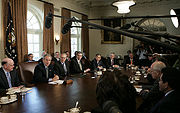 Bush's Cabinet
had included figures that were prominent in past administrations, notably former Secretary of State Colin Powell
, who had served as United States National Security Advisor under Ronald Reagan
. Former Secretary of Defense
Donald Rumsfeld
had served as White House Chief of Staff
and Secretary of Defense under Gerald Ford
; Rumsfeld's successor, Robert Gates
, served as Director of Central Intelligence
under George H.W. Bush. Vice President Dick Cheney
served as Secretary of Defense under George H. W. Bush.
Bush placed a high value on personal loyalty and, as a result, his administration had high message discipline
. He maintained a "hands-off" style of management. "I'm confident in my management style. I'm a delegator because I trust the people I've asked to join the team. I'm willing to delegate. That makes it easier to be President," he said in an interview with Diane Sawyer
on ABC
in December 2003. Critics alleged, however, that Bush was willing to overlook mistakes made by loyal subordinates.
There was only one non-Republican
in Bush's cabinet: Secretary of Transportation
Norman Mineta
, the first Asian American
cabinet secretary, who had previously served as Secretary of Commerce
under Bill Clinton
, is a Democrat
. Mineta resigned from Bush's cabinet on July 7, 2006 to pursue "other challenges". Mary Peters
, a Republican, was nominated and confirmed to succeed him as Transportation Secretary. At least one other non-Republican was apparently offered a position in the administration but declined. CNN reported that in the transition to his second term, Bush offered the positions of Ambassador to the United Nations and subsequently Secretary of Homeland Security to Senatar Joe Lieberman
, then a Democrat and currently an Independent Democrat
.
In 2006, Bush replaced long-time chief of staff Andrew Card
with Joshua Bolten and made major staff and cabinet changes with the intention of revitalizing his Administration.
On November 8, 2006 (the day after the Democrats took back Congress in the midterm elections), Bush announced plans to replace Secretary of Defense Donald Rumsfeld
with former CIA Director Robert Gates
. Gates was confirmed by the United States Senate
on December 6 and took office as the 22nd Secretary of Defense on December 18.
, was politically controversial, but widely viewed as competent. Ashcroft resigned days after Bush's 2004 re-election. Bush's second Attorney General was Alberto Gonzales
. In addition to his work on providing guidelines for detainee interrogation methods prior to his appointment, he claimed there was no right to Habeas Corpus
for detained combatants. Michael Mukasey succeeded Gonzales and was the country's 81st Attorney General.
. This nomination came under attack when evidence came to light that she had given money to an illegal immigrant from Guatemala
who lived in her home. Chavez claimed that the woman was not an employee and she had merely provided her with emergency assistance due to the domestic abuse the woman had been facing at the time. Chavez's nomination was withdrawn. Instead, Bush nominated Elaine Chao
, a former official with the administrations with Ronald Reagan and George H.W. Bush, who was confirmed by the Senate. Chao was the only member of Bush's Cabinet to serve during Bush's entire tenure as President.
, was controversial at the time of his 2001 appointment because as a senator he co-sponsored S.896, a bill to abolish the United States Department of Energy
, in 1999. Samuel Wright Bodman III, Sc.D. is the United States Secretary of Energy
and was previously Deputy Secretary of the U.S. Treasury Department.
announced his decision to resign as Secretary of Homeland Security, Bush's first choice to replace him was Bernard Kerik
, who served as Police Commissioner of the City of New York during the September 11, 2001 attacks
. Kerik's nomination raised controversy when it was discovered that he had previously hired an undocumented worker as a nanny and housekeeper. After a week, Kerik pulled his nomination and Bush went on to nominate Michael Chertoff
.
to the Supreme Court of the United States
:
to succeed Alan Greenspan
as Chairman
of the Federal Reserve. The Senate Banking Committee
recommended Bernanke's confirmation by a 13–1 voice vote
on November 16, 2005. With the full Senate's approval on January 31, 2006 by another voice vote, Bernanke was sworn in on February 1, 2006.
, Zalmay Khalilzad
, Lewis "Scooter" Libby
, Richard Perle
, former U.S. Secretary of Defense Donald Rumsfeld
, and Paul Wolfowitz
.
In 1998, members of the PNAC, including Rumsfeld and Wolfowitz, wrote to President Bill Clinton
urging him to remove Saddam Hussein
from power using US diplomatic, political and military power.
In September 2000, the PNAC issued a report entitled Rebuilding America's Defenses: Strategies, Forces, and Resources For A New Century, proceeding "from the belief that America should seek to preserve and extend its position of global leadership by maintaining the preeminence of U.S. military forces." The group stated that when diplomacy or sanctions fail, the United States must be prepared to take military action. The PNAC argued that the Cold War
deployment of forces was obsolete. Defense spending and force deployment must reflect the post–Cold War duties that US forces are obligated to perform. Constabulary duties such as peacekeeping in the Balkans
and the enforcement of the No Fly Zones
in Iraq put a strain upon, and reduced the readiness of US forces. The PNAC recommended the forward redeployment of US forces at new strategically placed permanent military bases in Southeast Europe
and Southeast Asia
. Permanent bases would ease the strain on US forces, allowing readiness to be maintained and the carrier fleet to be reduced. Furthermore, PNAC advocated that the US-globalized military should be enlarged, equipped and restructured for the "constabulary" roles associated with shaping the security in critical regions of the world.
 George W. Bush
’s environmental record began with promises as a presidential candidate to clean up power plants and reduce greenhouse gas
emissions. In a speech on September 29, 2000 in Saginaw, Michigan
, Bush pledged to commit two billion dollars to the funding of clean coal
technology research. In the same speech, he also promised to work with Congress, environmental groups and the energy industry to require a reduction of the emissions of sulfur dioxide
, nitrogen oxide
, mercury
and carbon dioxide
into the environment within a “reasonable period of time.” He would later reverse his position on that specific campaign pledge in March 2001 in a letter to Nebraska
senator Chuck Hagel
, stating that carbon dioxide was not considered a pollutant under the Clean Air Act
, and that restricting carbon dioxide emissions would lead to higher energy prices.
In 2001, Bush appointed Philip A. Cooney, a former lobbyist for the American Petroleum Institute
, to the White House Council on Environmental Equality. Cooney is known to have edited government climate reports in order to minimize the findings of scientific sources tying greenhouse gas emissions to global warming
.
In March 2001, the Bush administration announced that it would not implement the Kyoto Protocol
, an international treaty signed in 1997 in Kyoto, Japan that would require nations to reduce their greenhouse gas emissions, claiming that ratifying the treaty would create economic setbacks in the U.S. and does not put enough pressure to limit emissions from developing nations. In February 2002, Bush announced his alternative to the Kyoto Protocol, by bringing forth a plan to reduce the intensity of greenhouse gasses by 18 percent over 10 years. The intensity of greenhouse gasses specifically is the ratio of greenhouse gas emissions and economic output, meaning that under this plan, emissions would still continue to grow, but at a slower pace. Bush stated that this plan would prevent the release of 500 million metric tons of greenhouse gases, which is about the equivalent of removing 70 million cars from the road. This target would achieve this goal by providing tax credits to businesses that use renewable energy sources.
In late November 2002, the Bush Administration released proposed rule changes that would lead to increased logging
of federal forests for commercial or recreational activities by giving local forest managers the ability to open up the forests to development without requiring environmental impact assessments and without specific standards to maintain local fish and wildlife populations. The proposed changes would affect roughly 192000000 acres (776,997.1 km²) of US forests and grasslands. Administration officials claimed the changes were appropriate because existing rules, which were approved by the Clinton administration two months before Bush took office, were unclear.
In November 2004, Bush administration officials asked the United Nations
to allow US industries to use an additional 458 tons of methyl bromide, an ozone
-destroying pesticide
that was slated for elimination by the 1987 Montreal Protocol
on Substances that Deplete the Ozone Layer
. The additional increase request brings the US’s total exemption for the year 2005 to 9,400 metric tons of methyl bromide, more than all other nations’ requests combined, and well over the 7,674 metric tons used by US agribusiness
in 2002.
In January 2004, Interior Secretary Gale Norton
approved a move to open nearly 9000000 acres (36,421.7 km²) of Alaska's North Slope
to oil and gas development, citing claims from the energy industry that nearly 13 Goilbbl of oil could be extracted from the region. The North Slope
borders the Arctic National Wildlife Refuge
, a sanctuary and habitat for migratory birds, whales, seals and other wildlife. Reports from the U.S. Geological Survey, however, estimate that less than one-third of the reported 13 Goilbbl is economically recoverable in the entire 23500000 acres (95,101.2 km²) National Petroleum Reserve.
In July 2005 the Environmental Protection Agency
decided to delay the release of an annual report on fuel economy. The report shows that automakers have taken advantage of loopholes in US fuel economy regulations to manufacture vehicles that are less fuel-efficient than they were in the late 1980s. Fuel-efficiency had on average dropped six percent during that period, from 22.1 miles per gallon to 20.8 mpg. Evidence suggests that the administration’s decision to delay the report’s release was because of its potential to affect Congress’s upcoming final vote on an energy bill six years in the making, which turned a blind eye to fuel economy regulations.
In May 2006, the National Oceanic and Atmospheric Association (NOAA) allegedly blocked release of a report that suggested global warming had been a contributor to the frequency and strength of hurricanes in recent years. In February, NOAA (part of the Department of Commerce) set up a seven-member panel of climate scientists to compile the report. The panel’s chair, Ants Leema, received an e-mail from a Commerce Department official asking for the report to not be released as it needed to be made “less technical.” NOAA would later go on to say that the report was not released because it “was not complete” and was in reality not a report, but a “two-page fact sheet about the issue.”
On January 6, 2009, President Bush designated the world's largest protected marine area. The Pacific Ocean habitat includes the Mariana Trench
and the waters and corals surrounding three uninhabited islands in the Northern Mariana Islands
, Rose Atoll
in American Samoa, and seven islands along the equator.
began on January 20, 2001, when he was inaugurated as the 43rd President of the United States of America
. The oldest son of former president George H. W. Bush
, George W. Bush was elected president in the 2000 general election
, and became the second US president whose father had held the same office (John Quincy Adams
was the first).
After two recounts, Democratic presidential candidate Vice President
Al Gore
filed a lawsuit for a third. The Supreme Court's
highly controverisal decision in Bush v. Gore
resolved the dispute. The Florida Secretary of State certified Bush as the winner of Florida. Florida's 25 electoral votes gave Bush, the Republican candidate, 271 electoral votes, enough to defeat Al Gore. Bush was re-elected in 2004
. His second term ended on January 20, 2009.
As president, Bush pushed through a $1.3 trillion tax cut
program and the No Child Left Behind Act
, and also pushed for socially conservative
efforts such as the Partial-Birth Abortion Ban Act
and faith-based welfare initiatives
. Nearly 8 million immigrants
came to the United States from 2000 to 2005 – more than in any other five-year period in the nation's history. Almost half entered illegally.
After the terrorist attacks on September 11, 2001
, Bush declared a global War on Terrorism
and, in October 2001, ordered an invasion of Afghanistan
to overthrow the Taliban, destroy Al-Qaeda
, and to capture Osama bin Laden
. In March 2003, Bush received a mandate
from the U.S. Congress to lead an invasion of Iraq
, asserting that Iraq was in violation of UN Security Council Resolution 1441
.
Bush also initiated an AIDS program
that committed $15 billion to combat AIDS
over five years. His record as a humanitarian included helping enroll as many as 29 million of Africa's poorest children in schools.
On his second full day in office, Bush reinstated the Mexico City Policy
; this policy required any non-governmental organization receiving US Government funding to refrain from performing or promoting abortion
services in other countries. Also in 2002, President Bush withdrew funding from the United Nations Population Fund
(UNFPA), a key player in promoting family planning
in the developing world.
Running as a self-styled "war president" in the midst of the Iraq War, Bush won re-election
in 2004, as his campaign
against Senator John Kerry
was successful despite controversy over Bush's prosecution of the Iraq War and his handling of the economy.
His second term was highlighted by several free trade
agreements, the Energy Policy Act of 2005
alongside a strong push for offshore and domestic drilling, the nominations of Supreme Court Justices John Roberts and Samuel Alito
, a push for Social Security
and immigration reform, a surge of troops in Iraq
, which was followed by a drop in violence, and several different economic initiatives aimed at preventing a banking system collapse, stopping foreclosures, and stimulating the economy during the recession
.
Economic Policy Actions
Domestic Policy Actions
Bush's Cabinet
had included figures that were prominent in past administrations, notably former Secretary of State Colin Powell
, who had served as United States National Security Advisor under Ronald Reagan
. Former Secretary of Defense
Donald Rumsfeld
had served as White House Chief of Staff
and Secretary of Defense under Gerald Ford
; Rumsfeld's successor, Robert Gates
, served as Director of Central Intelligence
under George H.W. Bush. Vice President Dick Cheney
served as Secretary of Defense under George H. W. Bush.
Bush placed a high value on personal loyalty and, as a result, his administration had high message discipline
. He maintained a "hands-off" style of management. "I'm confident in my management style. I'm a delegator because I trust the people I've asked to join the team. I'm willing to delegate. That makes it easier to be President," he said in an interview with Diane Sawyer
on ABC
in December 2003. Critics alleged, however, that Bush was willing to overlook mistakes made by loyal subordinates.
There was only one non-Republican
in Bush's cabinet: Secretary of Transportation
Norman Mineta
, the first Asian American
cabinet secretary, who had previously served as Secretary of Commerce
under Bill Clinton
, is a Democrat
. Mineta resigned from Bush's cabinet on July 7, 2006 to pursue "other challenges". Mary Peters
, a Republican, was nominated and confirmed to succeed him as Transportation Secretary. At least one other non-Republican was apparently offered a position in the administration but declined. CNN reported that in the transition to his second term, Bush offered the positions of Ambassador to the United Nations and subsequently Secretary of Homeland Security to Senatar Joe Lieberman
, then a Democrat and currently an Independent Democrat
.
In 2006, Bush replaced long-time chief of staff Andrew Card
with Joshua Bolten and made major staff and cabinet changes with the intention of revitalizing his Administration.
On November 8, 2006 (the day after the Democrats took back Congress in the midterm elections), Bush announced plans to replace Secretary of Defense Donald Rumsfeld
with former CIA Director Robert Gates
. Gates was confirmed by the United States Senate
on December 6 and took office as the 22nd Secretary of Defense on December 18.
, was politically controversial, but widely viewed as competent. Ashcroft resigned days after Bush's 2004 re-election. Bush's second Attorney General was Alberto Gonzales
. In addition to his work on providing guidelines for detainee interrogation methods prior to his appointment, he claimed there was no right to Habeas Corpus
for detained combatants. Michael Mukasey succeeded Gonzales and was the country's 81st Attorney General.
. This nomination came under attack when evidence came to light that she had given money to an illegal immigrant from Guatemala
who lived in her home. Chavez claimed that the woman was not an employee and she had merely provided her with emergency assistance due to the domestic abuse the woman had been facing at the time. Chavez's nomination was withdrawn. Instead, Bush nominated Elaine Chao
, a former official with the administrations with Ronald Reagan and George H.W. Bush, who was confirmed by the Senate. Chao was the only member of Bush's Cabinet to serve during Bush's entire tenure as President.
, was controversial at the time of his 2001 appointment because as a senator he co-sponsored S.896, a bill to abolish the United States Department of Energy
, in 1999. Samuel Wright Bodman III, Sc.D. is the United States Secretary of Energy
and was previously Deputy Secretary of the U.S. Treasury Department.
announced his decision to resign as Secretary of Homeland Security, Bush's first choice to replace him was Bernard Kerik
, who served as Police Commissioner of the City of New York during the September 11, 2001 attacks
. Kerik's nomination raised controversy when it was discovered that he had previously hired an undocumented worker as a nanny and housekeeper. After a week, Kerik pulled his nomination and Bush went on to nominate Michael Chertoff
.
to the Supreme Court of the United States
:
to succeed Alan Greenspan
as Chairman
of the Federal Reserve. The Senate Banking Committee
recommended Bernanke's confirmation by a 13–1 voice vote
on November 16, 2005. With the full Senate's approval on January 31, 2006 by another voice vote, Bernanke was sworn in on February 1, 2006.
, Zalmay Khalilzad
, Lewis "Scooter" Libby
, Richard Perle
, former U.S. Secretary of Defense Donald Rumsfeld
, and Paul Wolfowitz
.
In 1998, members of the PNAC, including Rumsfeld and Wolfowitz, wrote to President Bill Clinton
urging him to remove Saddam Hussein
from power using US diplomatic, political and military power.
In September 2000, the PNAC issued a report entitled Rebuilding America's Defenses: Strategies, Forces, and Resources For A New Century, proceeding "from the belief that America should seek to preserve and extend its position of global leadership by maintaining the preeminence of U.S. military forces." The group stated that when diplomacy or sanctions fail, the United States must be prepared to take military action. The PNAC argued that the Cold War
deployment of forces was obsolete. Defense spending and force deployment must reflect the post–Cold War duties that US forces are obligated to perform. Constabulary duties such as peacekeeping in the Balkans
and the enforcement of the No Fly Zones
in Iraq put a strain upon, and reduced the readiness of US forces. The PNAC recommended the forward redeployment of US forces at new strategically placed permanent military bases in Southeast Europe
and Southeast Asia
. Permanent bases would ease the strain on US forces, allowing readiness to be maintained and the carrier fleet to be reduced. Furthermore, PNAC advocated that the US-globalized military should be enlarged, equipped and restructured for the "constabulary" roles associated with shaping the security in critical regions of the world.
George W. Bush
’s environmental record began with promises as a presidential candidate to clean up power plants and reduce greenhouse gas
emissions. In a speech on September 29, 2000 in Saginaw, Michigan
, Bush pledged to commit two billion dollars to the funding of clean coal
technology research. In the same speech, he also promised to work with Congress, environmental groups and the energy industry to require a reduction of the emissions of sulfur dioxide
, nitrogen oxide
, mercury
and carbon dioxide
into the environment within a “reasonable period of time.” He would later reverse his position on that specific campaign pledge in March 2001 in a letter to Nebraska
senator Chuck Hagel
, stating that carbon dioxide was not considered a pollutant under the Clean Air Act
, and that restricting carbon dioxide emissions would lead to higher energy prices.
In 2001, Bush appointed Philip A. Cooney, a former lobbyist for the American Petroleum Institute
, to the White House Council on Environmental Equality. Cooney is known to have edited government climate reports in order to minimize the findings of scientific sources tying greenhouse gas emissions to global warming
.
In March 2001, the Bush administration announced that it would not implement the Kyoto Protocol
, an international treaty signed in 1997 in Kyoto, Japan that would require nations to reduce their greenhouse gas emissions, claiming that ratifying the treaty would create economic setbacks in the U.S. and does not put enough pressure to limit emissions from developing nations. In February 2002, Bush announced his alternative to the Kyoto Protocol, by bringing forth a plan to reduce the intensity of greenhouse gasses by 18 percent over 10 years. The intensity of greenhouse gasses specifically is the ratio of greenhouse gas emissions and economic output, meaning that under this plan, emissions would still continue to grow, but at a slower pace. Bush stated that this plan would prevent the release of 500 million metric tons of greenhouse gases, which is about the equivalent of removing 70 million cars from the road. This target would achieve this goal by providing tax credits to businesses that use renewable energy sources.
In late November 2002, the Bush Administration released proposed rule changes that would lead to increased logging
of federal forests for commercial or recreational activities by giving local forest managers the ability to open up the forests to development without requiring environmental impact assessments and without specific standards to maintain local fish and wildlife populations. The proposed changes would affect roughly 192000000 acres (776,997.1 km²) of US forests and grasslands. Administration officials claimed the changes were appropriate because existing rules, which were approved by the Clinton administration two months before Bush took office, were unclear.
In November 2004, Bush administration officials asked the United Nations
to allow US industries to use an additional 458 tons of methyl bromide, an ozone
-destroying pesticide
that was slated for elimination by the 1987 Montreal Protocol
on Substances that Deplete the Ozone Layer
. The additional increase request brings the US’s total exemption for the year 2005 to 9,400 metric tons of methyl bromide, more than all other nations’ requests combined, and well over the 7,674 metric tons used by US agribusiness
in 2002.
In January 2004, Interior Secretary Gale Norton
approved a move to open nearly 9000000 acres (36,421.7 km²) of Alaska's North Slope
to oil and gas development, citing claims from the energy industry that nearly 13 Goilbbl of oil could be extracted from the region. The North Slope
borders the Arctic National Wildlife Refuge
, a sanctuary and habitat for migratory birds, whales, seals and other wildlife. Reports from the U.S. Geological Survey, however, estimate that less than one-third of the reported 13 Goilbbl is economically recoverable in the entire 23500000 acres (95,101.2 km²) National Petroleum Reserve.
In July 2005 the Environmental Protection Agency
decided to delay the release of an annual report on fuel economy. The report shows that automakers have taken advantage of loopholes in US fuel economy regulations to manufacture vehicles that are less fuel-efficient than they were in the late 1980s. Fuel-efficiency had on average dropped six percent during that period, from 22.1 miles per gallon to 20.8 mpg. Evidence suggests that the administration’s decision to delay the report’s release was because of its potential to affect Congress’s upcoming final vote on an energy bill six years in the making, which turned a blind eye to fuel economy regulations.
In May 2006, the National Oceanic and Atmospheric Association (NOAA) allegedly blocked release of a report that suggested global warming had been a contributor to the frequency and strength of hurricanes in recent years. In February, NOAA (part of the Department of Commerce) set up a seven-member panel of climate scientists to compile the report. The panel’s chair, Ants Leema, received an e-mail from a Commerce Department official asking for the report to not be released as it needed to be made “less technical.” NOAA would later go on to say that the report was not released because it “was not complete” and was in reality not a report, but a “two-page fact sheet about the issue.”
On January 6, 2009, President Bush designated the world's largest protected marine area. The Pacific Ocean habitat includes the Mariana Trench
and the waters and corals surrounding three uninhabited islands in the Northern Mariana Islands
, Rose Atoll
in American Samoa, and seven islands along the equator.
The presidency of George W. Bush
began on January 20, 2001, when he was inaugurated as the 43rd President of the United States of America
. The oldest son of former president George H. W. Bush
, George W. Bush was elected president in the 2000 general election
, and became the second US president whose father had held the same office (John Quincy Adams
was the first).
After two recounts, Democratic presidential candidate Vice President
Al Gore
filed a lawsuit for a third. The Supreme Court's
highly controverisal decision in Bush v. Gore
resolved the dispute. The Florida Secretary of State certified Bush as the winner of Florida. Florida's 25 electoral votes gave Bush, the Republican candidate, 271 electoral votes, enough to defeat Al Gore. Bush was re-elected in 2004
. His second term ended on January 20, 2009.
As president, Bush pushed through a $1.3 trillion tax cut
program and the No Child Left Behind Act
, and also pushed for socially conservative
efforts such as the Partial-Birth Abortion Ban Act
and faith-based welfare initiatives
. Nearly 8 million immigrants
came to the United States from 2000 to 2005 – more than in any other five-year period in the nation's history. Almost half entered illegally.
After the terrorist attacks on September 11, 2001
, Bush declared a global War on Terrorism
and, in October 2001, ordered an invasion of Afghanistan
to overthrow the Taliban, destroy Al-Qaeda
, and to capture Osama bin Laden
. In March 2003, Bush received a mandate
from the U.S. Congress to lead an invasion of Iraq
, asserting that Iraq was in violation of UN Security Council Resolution 1441
.
Bush also initiated an AIDS program
that committed $15 billion to combat AIDS
over five years. His record as a humanitarian included helping enroll as many as 29 million of Africa's poorest children in schools.
On his second full day in office, Bush reinstated the Mexico City Policy
; this policy required any non-governmental organization receiving US Government funding to refrain from performing or promoting abortion
services in other countries. Also in 2002, President Bush withdrew funding from the United Nations Population Fund
(UNFPA), a key player in promoting family planning
in the developing world.
Running as a self-styled "war president" in the midst of the Iraq War, Bush won re-election
in 2004, as his campaign
against Senator John Kerry
was successful despite controversy over Bush's prosecution of the Iraq War and his handling of the economy.
His second term was highlighted by several free trade
agreements, the Energy Policy Act of 2005
alongside a strong push for offshore and domestic drilling, the nominations of Supreme Court Justices John Roberts and Samuel Alito
, a push for Social Security
and immigration reform, a surge of troops in Iraq
, which was followed by a drop in violence, and several different economic initiatives aimed at preventing a banking system collapse, stopping foreclosures, and stimulating the economy during the recession
.
Economic Policy Actions
Domestic Policy Actions
Bush's Cabinet
had included figures that were prominent in past administrations, notably former Secretary of State Colin Powell
, who had served as United States National Security Advisor under Ronald Reagan
. Former Secretary of Defense
Donald Rumsfeld
had served as White House Chief of Staff
and Secretary of Defense under Gerald Ford
; Rumsfeld's successor, Robert Gates
, served as Director of Central Intelligence
under George H.W. Bush. Vice President Dick Cheney
served as Secretary of Defense under George H. W. Bush.
Bush placed a high value on personal loyalty and, as a result, his administration had high message discipline
. He maintained a "hands-off" style of management. "I'm confident in my management style. I'm a delegator because I trust the people I've asked to join the team. I'm willing to delegate. That makes it easier to be President," he said in an interview with Diane Sawyer
on ABC
in December 2003. Critics alleged, however, that Bush was willing to overlook mistakes made by loyal subordinates.
There was only one non-Republican
in Bush's cabinet: Secretary of Transportation
Norman Mineta
, the first Asian American
cabinet secretary, who had previously served as Secretary of Commerce
under Bill Clinton
, is a Democrat
. Mineta resigned from Bush's cabinet on July 7, 2006 to pursue "other challenges". Mary Peters
, a Republican, was nominated and confirmed to succeed him as Transportation Secretary. At least one other non-Republican was apparently offered a position in the administration but declined. CNN reported that in the transition to his second term, Bush offered the positions of Ambassador to the United Nations and subsequently Secretary of Homeland Security to Senatar Joe Lieberman
, then a Democrat and currently an Independent Democrat
.
In 2006, Bush replaced long-time chief of staff Andrew Card
with Joshua Bolten and made major staff and cabinet changes with the intention of revitalizing his Administration.
On November 8, 2006 (the day after the Democrats took back Congress in the midterm elections), Bush announced plans to replace Secretary of Defense Donald Rumsfeld
with former CIA Director Robert Gates
. Gates was confirmed by the United States Senate
on December 6 and took office as the 22nd Secretary of Defense on December 18.
, was politically controversial, but widely viewed as competent. Ashcroft resigned days after Bush's 2004 re-election. Bush's second Attorney General was Alberto Gonzales
. In addition to his work on providing guidelines for detainee interrogation methods prior to his appointment, he claimed there was no right to Habeas Corpus
for detained combatants. Michael Mukasey succeeded Gonzales and was the country's 81st Attorney General.
. This nomination came under attack when evidence came to light that she had given money to an illegal immigrant from Guatemala
who lived in her home. Chavez claimed that the woman was not an employee and she had merely provided her with emergency assistance due to the domestic abuse the woman had been facing at the time. Chavez's nomination was withdrawn. Instead, Bush nominated Elaine Chao
, a former official with the administrations with Ronald Reagan and George H.W. Bush, who was confirmed by the Senate. Chao was the only member of Bush's Cabinet to serve during Bush's entire tenure as President.
, was controversial at the time of his 2001 appointment because as a senator he co-sponsored S.896, a bill to abolish the United States Department of Energy
, in 1999. Samuel Wright Bodman III, Sc.D. is the United States Secretary of Energy
and was previously Deputy Secretary of the U.S. Treasury Department.
announced his decision to resign as Secretary of Homeland Security, Bush's first choice to replace him was Bernard Kerik
, who served as Police Commissioner of the City of New York during the September 11, 2001 attacks
. Kerik's nomination raised controversy when it was discovered that he had previously hired an undocumented worker as a nanny and housekeeper. After a week, Kerik pulled his nomination and Bush went on to nominate Michael Chertoff
.
to the Supreme Court of the United States
:
to succeed Alan Greenspan
as Chairman
of the Federal Reserve. The Senate Banking Committee
recommended Bernanke's confirmation by a 13–1 voice vote
on November 16, 2005. With the full Senate's approval on January 31, 2006 by another voice vote, Bernanke was sworn in on February 1, 2006.
, Zalmay Khalilzad
, Lewis "Scooter" Libby
, Richard Perle
, former U.S. Secretary of Defense Donald Rumsfeld
, and Paul Wolfowitz
.
In 1998, members of the PNAC, including Rumsfeld and Wolfowitz, wrote to President Bill Clinton
urging him to remove Saddam Hussein
from power using US diplomatic, political and military power.
In September 2000, the PNAC issued a report entitled Rebuilding America's Defenses: Strategies, Forces, and Resources For A New Century, proceeding "from the belief that America should seek to preserve and extend its position of global leadership by maintaining the preeminence of U.S. military forces." The group stated that when diplomacy or sanctions fail, the United States must be prepared to take military action. The PNAC argued that the Cold War
deployment of forces was obsolete. Defense spending and force deployment must reflect the post–Cold War duties that US forces are obligated to perform. Constabulary duties such as peacekeeping in the Balkans
and the enforcement of the No Fly Zones
in Iraq put a strain upon, and reduced the readiness of US forces. The PNAC recommended the forward redeployment of US forces at new strategically placed permanent military bases in Southeast Europe
and Southeast Asia
. Permanent bases would ease the strain on US forces, allowing readiness to be maintained and the carrier fleet to be reduced. Furthermore, PNAC advocated that the US-globalized military should be enlarged, equipped and restructured for the "constabulary" roles associated with shaping the security in critical regions of the world.
George W. Bush
’s environmental record began with promises as a presidential candidate to clean up power plants and reduce greenhouse gas
emissions. In a speech on September 29, 2000 in Saginaw, Michigan
, Bush pledged to commit two billion dollars to the funding of clean coal
technology research. In the same speech, he also promised to work with Congress, environmental groups and the energy industry to require a reduction of the emissions of sulfur dioxide
, nitrogen oxide
, mercury
and carbon dioxide
into the environment within a “reasonable period of time.” He would later reverse his position on that specific campaign pledge in March 2001 in a letter to Nebraska
senator Chuck Hagel
, stating that carbon dioxide was not considered a pollutant under the Clean Air Act
, and that restricting carbon dioxide emissions would lead to higher energy prices.
In 2001, Bush appointed Philip A. Cooney, a former lobbyist for the American Petroleum Institute
, to the White House Council on Environmental Equality. Cooney is known to have edited government climate reports in order to minimize the findings of scientific sources tying greenhouse gas emissions to global warming
.
In March 2001, the Bush administration announced that it would not implement the Kyoto Protocol
, an international treaty signed in 1997 in Kyoto, Japan that would require nations to reduce their greenhouse gas emissions, claiming that ratifying the treaty would create economic setbacks in the U.S. and does not put enough pressure to limit emissions from developing nations. In February 2002, Bush announced his alternative to the Kyoto Protocol, by bringing forth a plan to reduce the intensity of greenhouse gasses by 18 percent over 10 years. The intensity of greenhouse gasses specifically is the ratio of greenhouse gas emissions and economic output, meaning that under this plan, emissions would still continue to grow, but at a slower pace. Bush stated that this plan would prevent the release of 500 million metric tons of greenhouse gases, which is about the equivalent of removing 70 million cars from the road. This target would achieve this goal by providing tax credits to businesses that use renewable energy sources.
In late November 2002, the Bush Administration released proposed rule changes that would lead to increased logging
of federal forests for commercial or recreational activities by giving local forest managers the ability to open up the forests to development without requiring environmental impact assessments and without specific standards to maintain local fish and wildlife populations. The proposed changes would affect roughly 192000000 acres (776,997.1 km²) of US forests and grasslands. Administration officials claimed the changes were appropriate because existing rules, which were approved by the Clinton administration two months before Bush took office, were unclear.
In November 2004, Bush administration officials asked the United Nations
to allow US industries to use an additional 458 tons of methyl bromide, an ozone
-destroying pesticide
that was slated for elimination by the 1987 Montreal Protocol
on Substances that Deplete the Ozone Layer
. The additional increase request brings the US’s total exemption for the year 2005 to 9,400 metric tons of methyl bromide, more than all other nations’ requests combined, and well over the 7,674 metric tons used by US agribusiness
in 2002.
In January 2004, Interior Secretary Gale Norton
approved a move to open nearly 9000000 acres (36,421.7 km²) of Alaska's North Slope
to oil and gas development, citing claims from the energy industry that nearly 13 Goilbbl of oil could be extracted from the region. The North Slope
borders the Arctic National Wildlife Refuge
, a sanctuary and habitat for migratory birds, whales, seals and other wildlife. Reports from the U.S. Geological Survey, however, estimate that less than one-third of the reported 13 Goilbbl is economically recoverable in the entire 23500000 acres (95,101.2 km²) National Petroleum Reserve.
In July 2005 the Environmental Protection Agency
decided to delay the release of an annual report on fuel economy. The report shows that automakers have taken advantage of loopholes in US fuel economy regulations to manufacture vehicles that are less fuel-efficient than they were in the late 1980s. Fuel-efficiency had on average dropped six percent during that period, from 22.1 miles per gallon to 20.8 mpg. Evidence suggests that the administration’s decision to delay the report’s release was because of its potential to affect Congress’s upcoming final vote on an energy bill six years in the making, which turned a blind eye to fuel economy regulations.
In May 2006, the National Oceanic and Atmospheric Association (NOAA) allegedly blocked release of a report that suggested global warming had been a contributor to the frequency and strength of hurricanes in recent years. In February, NOAA (part of the Department of Commerce) set up a seven-member panel of climate scientists to compile the report. The panel’s chair, Ants Leema, received an e-mail from a Commerce Department official asking for the report to not be released as it needed to be made “less technical.” NOAA would later go on to say that the report was not released because it “was not complete” and was in reality not a report, but a “two-page fact sheet about the issue.”
On January 6, 2009, President Bush designated the world's largest protected marine area. The Pacific Ocean habitat includes the Mariana Trench
and the waters and corals surrounding three uninhabited islands in the Northern Mariana Islands
, Rose Atoll
in American Samoa, and seven islands along the equator.
On January 15, 2009, Bush gave a nationally televised farewell address in the East Room of the White House
. He discussed many of his decisions and cited the fact that he had kept the country safe since September 11, 2001 as a major accomplishment. Bush stated, "I have always acted with the best interests of our country in mind. I have followed my conscience and done what I thought was right." He also said that the United States must continue promoting human liberty, human rights, and human dignity around the world. One of his final lines was "We have faced danger and trial, and there's more ahead. But with the courage of our people and confidence in our ideals, this great nation will never tire, never falter and never fail."
George W. Bush
George Walker Bush is an American politician who served as the 43rd President of the United States, from 2001 to 2009. Before that, he was the 46th Governor of Texas, having served from 1995 to 2000....
began on January 20, 2001, when he was inaugurated as the 43rd President of the United States of America
President of the United States
The President of the United States of America is the head of state and head of government of the United States. The president leads the executive branch of the federal government and is the commander-in-chief of the United States Armed Forces....
. The oldest son of former president George H. W. Bush
George H. W. Bush
George Herbert Walker Bush is an American politician who served as the 41st President of the United States . He had previously served as the 43rd Vice President of the United States , a congressman, an ambassador, and Director of Central Intelligence.Bush was born in Milton, Massachusetts, to...
, George W. Bush was elected president in the 2000 general election
United States presidential election, 2000
The United States presidential election of 2000 was a contest between Republican candidate George W. Bush, then-governor of Texas and son of former president George H. W. Bush , and Democratic candidate Al Gore, then-Vice President....
, and became the second US president whose father had held the same office (John Quincy Adams
John Quincy Adams
John Quincy Adams was the sixth President of the United States . He served as an American diplomat, Senator, and Congressional representative. He was a member of the Federalist, Democratic-Republican, National Republican, and later Anti-Masonic and Whig parties. Adams was the son of former...
was the first).
After two recounts, Democratic presidential candidate Vice President
Vice president
A vice president is an officer in government or business who is below a president in rank. The name comes from the Latin vice meaning 'in place of'. In some countries, the vice president is called the deputy president...
Al Gore
Al Gore
Albert Arnold "Al" Gore, Jr. served as the 45th Vice President of the United States , under President Bill Clinton. He was the Democratic Party's nominee for President in the 2000 U.S. presidential election....
filed a lawsuit for a third. The Supreme Court's
Supreme Court of the United States
The Supreme Court of the United States is the highest court in the United States. It has ultimate appellate jurisdiction over all state and federal courts, and original jurisdiction over a small range of cases...
highly controverisal decision in Bush v. Gore
Bush v. Gore
Bush v. Gore, , is the landmark United States Supreme Court decision on December 12, 2000, that effectively resolved the 2000 presidential election in favor of George W. Bush. Only eight days earlier, the United States Supreme Court had unanimously decided the closely related case of Bush v...
resolved the dispute. The Florida Secretary of State certified Bush as the winner of Florida. Florida's 25 electoral votes gave Bush, the Republican candidate, 271 electoral votes, enough to defeat Al Gore. Bush was re-elected in 2004
United States presidential election, 2004
The United States presidential election of 2004 was the United States' 55th quadrennial presidential election. It was held on Tuesday, November 2, 2004. Republican Party candidate and incumbent President George W. Bush defeated Democratic Party candidate John Kerry, the then-junior U.S. Senator...
. His second term ended on January 20, 2009.
As president, Bush pushed through a $1.3 trillion tax cut
Tax cut
A tax cut is a reduction in taxes. The immediate effects of a tax cut are a decrease in the real income of the government and an increase in the real income of those whose tax rate has been lowered. Due to the perceived benefit in growing real incomes among tax payers politicians have sought to...
program and the No Child Left Behind Act
No Child Left Behind Act
The No Child Left Behind Act of 2001 is a United States Act of Congress concerning the education of children in public schools.NCLB was originally proposed by the administration of George W. Bush immediately after he took office...
, and also pushed for socially conservative
Social conservatism
Social Conservatism is primarily a political, and usually morally influenced, ideology that focuses on the preservation of what are seen as traditional values. Social conservatism is a form of authoritarianism often associated with the position that the federal government should have a greater role...
efforts such as the Partial-Birth Abortion Ban Act
Partial-Birth Abortion Ban Act
The Partial-Birth Abortion Ban Act of 2003 is a United States law prohibiting a form of late-term abortion that the Act calls "partial-birth abortion", often referred to in medical literature as intact dilation and extraction...
and faith-based welfare initiatives
White House Office of Faith-Based and Community Initiatives
The White House Office of Faith-Based and Neighborhood Partnerships, formerly the White House Office of Faith-Based and Community Initiatives is an office within the White House Office that is part of the Executive Office of the President of the United States.-Under George W. Bush:OFBCI was...
. Nearly 8 million immigrants
Immigration to the United States
Immigration to the United States has been a major source of population growth and cultural change throughout much of the history of the United States. The economic, social, and political aspects of immigration have caused controversy regarding ethnicity, economic benefits, jobs for non-immigrants,...
came to the United States from 2000 to 2005 – more than in any other five-year period in the nation's history. Almost half entered illegally.
After the terrorist attacks on September 11, 2001
September 11, 2001 attacks
The September 11 attacks The September 11 attacks The September 11 attacks (also referred to as September 11, September 11th or 9/119/11 is pronounced "nine eleven". The slash is not part of the pronunciation...
, Bush declared a global War on Terrorism
War on Terrorism
The War on Terror is a term commonly applied to an international military campaign led by the United States and the United Kingdom with the support of other North Atlantic Treaty Organisation as well as non-NATO countries...
and, in October 2001, ordered an invasion of Afghanistan
War in Afghanistan (2001–present)
The War in Afghanistan began on October 7, 2001, as the armed forces of the United States of America, the United Kingdom, Australia, and the Afghan United Front launched Operation Enduring Freedom...
to overthrow the Taliban, destroy Al-Qaeda
Al-Qaeda
Al-Qaeda is a global broad-based militant Islamist terrorist organization founded by Osama bin Laden sometime between August 1988 and late 1989. It operates as a network comprising both a multinational, stateless army and a radical Sunni Muslim movement calling for global Jihad...
, and to capture Osama bin Laden
Osama bin Laden
Osama bin Mohammed bin Awad bin Laden was the founder of the militant Islamist organization Al-Qaeda, the jihadist organization responsible for the September 11 attacks on the United States and numerous other mass-casualty attacks against civilian and military targets...
. In March 2003, Bush received a mandate
Iraq Resolution
The Iraq Resolution or the Iraq War Resolution is a joint resolution passed by the United States Congress in October 2002 as Public Law No: 107-243, authorizing military action against Iraq.-Contents:The resolution cited many factors to justify the use of military force against...
from the U.S. Congress to lead an invasion of Iraq
2003 invasion of Iraq
The 2003 invasion of Iraq , was the start of the conflict known as the Iraq War, or Operation Iraqi Freedom, in which a combined force of troops from the United States, the United Kingdom, Australia and Poland invaded Iraq and toppled the regime of Saddam Hussein in 21 days of major combat operations...
, asserting that Iraq was in violation of UN Security Council Resolution 1441
United Nations Security Council Resolution 1441
United Nations Security Council Resolution 1441 is a United Nations Security Council resolution adopted unanimously by the United Nations Security Council on November 8, 2002, offering Iraq under Saddam Hussein "a final opportunity to comply with its disarmament obligations" that had been set out...
.
Bush also initiated an AIDS program
President's Emergency Plan For AIDS Relief
The President's Emergency Plan For AIDS Relief was a commitment of $15 billion over five years from United States President George W. Bush to fight the global HIV/AIDS pandemic...
that committed $15 billion to combat AIDS
AIDS
Acquired immune deficiency syndrome or acquired immunodeficiency syndrome is a disease of the human immune system caused by the human immunodeficiency virus...
over five years. His record as a humanitarian included helping enroll as many as 29 million of Africa's poorest children in schools.
On his second full day in office, Bush reinstated the Mexico City Policy
Mexico City Policy
The Mexico City Policy, also known by critics as the Mexico City Gag Rule and the Global Gag Rule, was an intermittent United States government policy that required all non-governmental organizations that receive federal funding to refrain from performing or promoting abortion services, as a...
; this policy required any non-governmental organization receiving US Government funding to refrain from performing or promoting abortion
Abortion
Abortion is defined as the termination of pregnancy by the removal or expulsion from the uterus of a fetus or embryo prior to viability. An abortion can occur spontaneously, in which case it is usually called a miscarriage, or it can be purposely induced...
services in other countries. Also in 2002, President Bush withdrew funding from the United Nations Population Fund
United Nations Population Fund
The United Nations Population Fund is a UN organization. The work of the UNFPA involves promotion of the right of every woman, man and child to enjoy a life of health and equal opportunity. This is done through major national and demographic surveys and with population censuses...
(UNFPA), a key player in promoting family planning
Family planning
Family planning is the planning of when to have children, and the use of birth control and other techniques to implement such plans. Other techniques commonly used include sexuality education, prevention and management of sexually transmitted infections, pre-conception counseling and...
in the developing world.
Running as a self-styled "war president" in the midst of the Iraq War, Bush won re-election
United States presidential election, 2004
The United States presidential election of 2004 was the United States' 55th quadrennial presidential election. It was held on Tuesday, November 2, 2004. Republican Party candidate and incumbent President George W. Bush defeated Democratic Party candidate John Kerry, the then-junior U.S. Senator...
in 2004, as his campaign
George W. Bush presidential campaign, 2004
This article is about the presidential campaign of George W. Bush, the former President of the United States and winner of the 2004 Presidential Election. See George W. Bush for a detailed biography and information about his full presidency, and George W. Bush presidential campaign, 2000 for a...
against Senator John Kerry
John Kerry
John Forbes Kerry is the senior United States Senator from Massachusetts, the 10th most senior U.S. Senator and chairman of the Senate Foreign Relations Committee. He was the presidential nominee of the Democratic Party in the 2004 presidential election, but lost to former President George W...
was successful despite controversy over Bush's prosecution of the Iraq War and his handling of the economy.
His second term was highlighted by several free trade
Free trade
Under a free trade policy, prices emerge from supply and demand, and are the sole determinant of resource allocation. 'Free' trade differs from other forms of trade policy where the allocation of goods and services among trading countries are determined by price strategies that may differ from...
agreements, the Energy Policy Act of 2005
Energy Policy Act of 2005
The Energy Policy Act of 2005 is a bill passed by the United States Congress on July 29, 2005, and signed into law by President George W. Bush on August 8, 2005, at Sandia National Laboratories in Albuquerque, New Mexico...
alongside a strong push for offshore and domestic drilling, the nominations of Supreme Court Justices John Roberts and Samuel Alito
Samuel Alito
Samuel Anthony Alito, Jr. is an Associate Justice of the U.S. Supreme Court. He was nominated by President George W. Bush and has served on the court since January 31, 2006....
, a push for Social Security
Social Security (United States)
In the United States, Social Security refers to the federal Old-Age, Survivors, and Disability Insurance program.The original Social Security Act and the current version of the Act, as amended encompass several social welfare and social insurance programs...
and immigration reform, a surge of troops in Iraq
Iraq War troop surge of 2007
In the context of the Iraq War, the surge refers to United States President George W. Bush's 2007 increase in the number of American troops in order to provide security to Baghdad and Al Anbar Province....
, which was followed by a drop in violence, and several different economic initiatives aimed at preventing a banking system collapse, stopping foreclosures, and stimulating the economy during the recession
Late 2000s recession
The late-2000s recession, sometimes referred to as the Great Recession or Lesser Depression or Long Recession, is a severe ongoing global economic problem that began in December 2007 and took a particularly sharp downward turn in September 2008. The Great Recession has affected the entire world...
.
Major acts as president
Foreign Policy Actions- Responding to the September 11, 2001 attacksSeptember 11, 2001 attacksThe September 11 attacks The September 11 attacks The September 11 attacks (also referred to as September 11, September 11th or 9/119/11 is pronounced "nine eleven". The slash is not part of the pronunciation...
- Declaring the War on TerrorismWar on TerrorismThe War on Terror is a term commonly applied to an international military campaign led by the United States and the United Kingdom with the support of other North Atlantic Treaty Organisation as well as non-NATO countries...
- Waging the Afghanistan War against Osama bin LadenOsama bin LadenOsama bin Mohammed bin Awad bin Laden was the founder of the militant Islamist organization Al-Qaeda, the jihadist organization responsible for the September 11 attacks on the United States and numerous other mass-casualty attacks against civilian and military targets...
, Al-QaedaAl-QaedaAl-Qaeda is a global broad-based militant Islamist terrorist organization founded by Osama bin Laden sometime between August 1988 and late 1989. It operates as a network comprising both a multinational, stateless army and a radical Sunni Muslim movement calling for global Jihad...
, and the Taliban government - Waging the 2003 invasion of Iraq2003 invasion of IraqThe 2003 invasion of Iraq , was the start of the conflict known as the Iraq War, or Operation Iraqi Freedom, in which a combined force of troops from the United States, the United Kingdom, Australia and Poland invaded Iraq and toppled the regime of Saddam Hussein in 21 days of major combat operations...
and the Iraq War against Saddam HusseinSaddam HusseinSaddam Hussein Abd al-Majid al-Tikriti was the fifth President of Iraq, serving in this capacity from 16 July 1979 until 9 April 2003...
and the Ba'ath Party government- U.S.-Iraq Status of Forces AgreementU.S.-Iraq Status of Forces AgreementThe U.S.–Iraq Status of Forces Agreement is a status of forces agreement between Iraq and the United States. It establishes that U.S...
- U.S.-Iraq Status of Forces Agreement
- Waging the Afghanistan War against Osama bin Laden
- Establishing prison for terror suspects at Guantanamo Bay
- USA PATRIOT ActUSA PATRIOT ActThe USA PATRIOT Act is an Act of the U.S. Congress that was signed into law by President George W. Bush on October 26, 2001...
- Establishing the United States Department of Homeland SecurityUnited States Department of Homeland SecurityThe United States Department of Homeland Security is a cabinet department of the United States federal government, created in response to the September 11 attacks, and with the primary responsibilities of protecting the territory of the United States and protectorates from and responding to...
- Establishing the Office of the Director of National Intelligence
- Declaring the War on Terrorism
- President's Emergency Plan for AIDS ReliefPresident's Emergency Plan For AIDS ReliefThe President's Emergency Plan For AIDS Relief was a commitment of $15 billion over five years from United States President George W. Bush to fight the global HIV/AIDS pandemic...
- Dominican Republic-Central America Free Trade AgreementDominican Republic-Central America Free Trade AgreementThe Dominican Republic – Central America Free Trade Agreement, commonly called DR-CAFTA, is a free trade agreement . Originally, the agreement encompassed the United States and the Central American countries of Costa Rica, El Salvador, Guatemala, Honduras, and Nicaragua, and was called CAFTA...
Economic Policy Actions
- Responding to the Early 2000s recessionEarly 2000s recessionThe early 2000s recession was a decline in economic activity which occurred mainly in developed countries. The recession affected the European Union mostly during 2000 and 2001 and the United States mostly in 2002 and 2003. The UK, Canada and Australia avoided the recession for the most part, while...
- Economic Growth and Tax Relief Reconciliation Act of 2001Economic Growth and Tax Relief Reconciliation Act of 2001The Economic Growth and Tax Relief Reconciliation Act of 2001 , was a sweeping piece of tax legislation in the United States by President George W. Bush...
- Job Creation and Worker Assistance Act of 2002Job Creation and Worker Assistance Act of 2002The Job Creation and Worker Assistance Act of 2002 , increased carryback of net operating losses to 5 years , extended the exception under Subpart F for active financing income , and created 30 percent expensing for certain capital asset purchases .The act was signed into law by President George W...
- Jobs and Growth Tax Relief Reconciliation Act of 2003Jobs and Growth Tax Relief Reconciliation Act of 2003The Jobs and Growth Tax Relief Reconciliation Act of 2003 , was passed by the United States Congress on May 23, 2003 and signed into law by President George W. Bush on May 28, 2003...
- Economic Growth and Tax Relief Reconciliation Act of 2001
- Responding to the Late 2000s recessionLate 2000s recessionThe late-2000s recession, sometimes referred to as the Great Recession or Lesser Depression or Long Recession, is a severe ongoing global economic problem that began in December 2007 and took a particularly sharp downward turn in September 2008. The Great Recession has affected the entire world...
- Economic Stimulus Act of 2008Economic Stimulus Act of 2008The Economic Stimulus Act of 2008 was an Act of Congress providing for several kinds of economic stimuli intended to boost the United States economy in 2008 and to avert a recession, or ameliorate economic conditions. The stimulus package was passed by the U.S. House of Representatives on January...
- Public Law 110-343Public Law 110-343Public Law 110-343 is an Act of Congress signed into law by U.S. President George W. Bush, which was designed to mitigate the growing financial crisis of 2007–2010 by giving relief to so-called "Troubled Assets."...
- Div. A: Emergency Economic Stabilization Act of 2008Emergency Economic Stabilization Act of 2008The Emergency Economic Stabilization Act of 2008 The Emergency Economic Stabilization Act of 2008 The Emergency Economic Stabilization Act of 2008 (Division A of , commonly referred to as a bailout of the U.S. financial system, is a law enacted in response to the subprime mortgage crisis...
- Div. B: Energy Improvement and Extension Act of 2008
- Div. C: Tax Extenders and Alternative Minimum Tax Relief Act of 2008
- Div. A: Emergency Economic Stabilization Act of 2008
- Economic Stimulus Act of 2008
Domestic Policy Actions
- Education
- No Child Left Behind ActNo Child Left Behind ActThe No Child Left Behind Act of 2001 is a United States Act of Congress concerning the education of children in public schools.NCLB was originally proposed by the administration of George W. Bush immediately after he took office...
- No Child Left Behind Act
- Social Policy
- Partial-Birth Abortion Ban ActPartial-Birth Abortion Ban ActThe Partial-Birth Abortion Ban Act of 2003 is a United States law prohibiting a form of late-term abortion that the Act calls "partial-birth abortion", often referred to in medical literature as intact dilation and extraction...
- Establishing the White House Office of Faith-Based and Community InitiativesWhite House Office of Faith-Based and Community InitiativesThe White House Office of Faith-Based and Neighborhood Partnerships, formerly the White House Office of Faith-Based and Community Initiatives is an office within the White House Office that is part of the Executive Office of the President of the United States.-Under George W. Bush:OFBCI was...
- Partial-Birth Abortion Ban Act
- Other
- Responding to Hurricane KatrinaHurricane KatrinaHurricane Katrina of the 2005 Atlantic hurricane season was a powerful Atlantic hurricane. It is the costliest natural disaster, as well as one of the five deadliest hurricanes, in the history of the United States. Among recorded Atlantic hurricanes, it was the sixth strongest overall...
- Creation of Medicare Part DMedicare Part DMedicare Part D is a federal program to subsidize the costs of prescription drugs for Medicare beneficiaries in the United States. It was enacted as part of the Medicare Prescription Drug, Improvement, and Modernization Act of 2003 and went into effect on January 1, 2006.- Eligibility and...
- Responding to Hurricane Katrina
State of the Union Addresses
- First inaugural address (20 January 2001)
- Second inaugural address (20 January 2005)
- 2001 address (not officially a State of the Union address) (27 February 2001)
- 2002 State of the Union address (29 January 2002)
- 2003 State of the Union address (28 January 2003)
- 2004 State of the Union address (20 January 2004)
- 2005 State of the Union address (2 February 2005)
- 2006 State of the Union address (31 January 2006)
- 2007 State of the Union address (23 January 2007)
- 2008 State of the Union address (28 January 2008)
International treaties signed
George W. Bush signed several international treaties, including but not limited to:- SORTSORTThe Treaty Between the United States of America and the Russian Federation on Strategic Offensive Reductions , also known as the Treaty of Moscow, was a strategic arms reduction treaty between the United States and Russia that was in force from June 2003 until February 2011 when it was superseded...
(2002) – better known as the Moscow Treaty, the United States and Russia agreed to limit their nuclear arsenal to 1700–2200 operationally deployed warheads each. - Stockholm Convention on Persistent Organic PollutantsStockholm Convention on Persistent Organic PollutantsStockholm Convention on Persistent Organic Pollutants is an international environmental treaty, signed in 2001 and effective from May 2004, that aims to eliminate or restrict the production and use of persistent organic pollutants .- History :...
(2001) - International Cooperation on Computer Crimes (2001)
- Involvement of Children in Armed Conflict (2000)
- Sale of Children, Child Prostitution and Pornography (2000)
Major treaties withdrawn
- ABM Treaty (2002) – limited anti-ballistic missile (ABM) systems used in defending areas against missile-delivered nuclear weaponNuclear weaponA nuclear weapon is an explosive device that derives its destructive force from nuclear reactions, either fission or a combination of fission and fusion. Both reactions release vast quantities of energy from relatively small amounts of matter. The first fission bomb test released the same amount...
s between the United States and the U.S.S.R. - United Nations Population FundUnited Nations Population FundThe United Nations Population Fund is a UN organization. The work of the UNFPA involves promotion of the right of every woman, man and child to enjoy a life of health and equal opportunity. This is done through major national and demographic surveys and with population censuses...
(2002) – promoted the human right of "reproductive health", that is physical, mental, and social health in matters related to reproduction and the reproductive system.
2001
- May 26: The 2001 Bush Tax Cuts [HR 1836] (through reconciliation procedureReconciliation (United States Congress)Reconciliation is a legislative process of the United States Senate intended to allow consideration of a budget bill with debate limited to twenty hours under Senate Rules...
) - June 7: Economic Growth and Tax Relief Reconciliation Act of 2001Economic Growth and Tax Relief Reconciliation Act of 2001The Economic Growth and Tax Relief Reconciliation Act of 2001 , was a sweeping piece of tax legislation in the United States by President George W. Bush...
- September 18: Authorization for Use of Military Force Against TerroristsAuthorization for Use of Military Force Against TerroristsThe Authorization for Use of Military Force Against Terrorists , one of two resolutions commonly known as "AUMF" , was a joint resolution passed by the United States Congress on September 14, 2001, authorizing the use of United States Armed Forces against those responsible for the attacks on...
- September 28: United States-Jordan Free Trade Area Implementation ActUS-Jordan Free Trade AgreementThe United States-Jordan Free Trade Agreement was signed on October 24, 2000. It was ratified by the United States House of Representatives on July 31, 2001 by voice vote, and by voice vote in the United States Senate on December 7, 2001. President George W. Bush signed the United States-Jordan...
- October 26: USA PATRIOT ActUSA PATRIOT ActThe USA PATRIOT Act is an Act of the U.S. Congress that was signed into law by President George W. Bush on October 26, 2001...
- November 28: Internet Tax Nondiscrimination ActInternet Tax Nondiscrimination ActThe Internet Tax Nondiscrimination Act, , is the current U.S. federal law that bans Internet taxes in the United States. Signed into law on December 3, 2004, by George W. Bush, it extended until 2007 the then-current moratorium on new and discriminatory taxes on the Internet...
2002
- January 8: No Child Left Behind ActNo Child Left Behind ActThe No Child Left Behind Act of 2001 is a United States Act of Congress concerning the education of children in public schools.NCLB was originally proposed by the administration of George W. Bush immediately after he took office...
- March 9: Job Creation and Worker Assistance Act of 2002Job Creation and Worker Assistance Act of 2002The Job Creation and Worker Assistance Act of 2002 , increased carryback of net operating losses to 5 years , extended the exception under Subpart F for active financing income , and created 30 percent expensing for certain capital asset purchases .The act was signed into law by President George W...
- March 27: Bipartisan Campaign Reform Act of 2002Bipartisan Campaign Reform ActThe Bipartisan Campaign Reform Act of 2002 is a United States federal law that amended the Federal Election Campaign Act of 1971, which regulates the financing of political campaigns. Its chief sponsors were Senators Russell Feingold and John McCain...
- May 13: Farm Security and Rural Investment Act of 2002
- July 30: Sarbanes-Oxley Act of 2002
- October 16: Joint Resolution to Authorize the Use of United States Armed Forces Against Iraq
- October 29: Help America Vote ActHelp America Vote ActThe Help America Vote Act , or HAVA, is a United States federal law which passed in the House 357-48 and 92-2 in the Senate and was signed into law by President Bush on October 29, 2002. Drafted in reaction to the controversy surrounding the 2000 U.S...
- November 25: Homeland Security Act of 2002
2003
- March 11: Do-Not-Call Implementation Act
- April 30: PROTECT Act of 2003PROTECT Act of 2003The PROTECT Act of 2003 is a United States law with the stated intent of preventing child abuse. "PROTECT" is a "backronym" which stands for "Prosecutorial Remedies and Other Tools to end the Exploitation of Children Today"....
(Prosecutorial Remedies and Other Tools to end the Exploitation of Children Today Act) (see also Age of consent) - May 23 : The 2003 Bush Tax Cuts [HR 2] (through reconciliation procedureReconciliation (United States Congress)Reconciliation is a legislative process of the United States Senate intended to allow consideration of a budget bill with debate limited to twenty hours under Senate Rules...
) - May 27: United States Leadership Against HIV/AIDS, Tuberculosis and Malaria Act of 2003
- May 28: Jobs and Growth Tax Relief Reconciliation Act of 2003Jobs and Growth Tax Relief Reconciliation Act of 2003The Jobs and Growth Tax Relief Reconciliation Act of 2003 , was passed by the United States Congress on May 23, 2003 and signed into law by President George W. Bush on May 28, 2003...
- September 3: United States-Chile Free Trade Agreement Implementation Act
- September 3: United States-Singapore Free Trade Agreement Implementation ActUS-Singapore Free Trade AgreementThe United States-Singapore Free Trade Agreement was signed 6 May 2003 and ratified by the US House of Representatives on 24 July 2003 by a vote of 272-155. The US Senate ratified the bill on 31 July 2003 by a vote of 66-32. President George W. Bush signed into law the United States-Singapore Free...
- October 1: Homeland Security Appropriations Act of 2004Homeland Security Appropriations ActThe Homeland Security Appropriations Act of 2004 was a United States Act of Congress that gave the authority for the President to fund the operations of the Department of Homeland Security for each fiscal year.-History:June 2003...
- November 5: Partial-Birth Abortion Ban Act of 2003Partial-Birth Abortion Ban ActThe Partial-Birth Abortion Ban Act of 2003 is a United States law prohibiting a form of late-term abortion that the Act calls "partial-birth abortion", often referred to in medical literature as intact dilation and extraction...
- December 3: Healthy Forests Restoration Act of 2003
- December 8: Medicare Prescription Drug, Improvement, and Modernization Act of 2003Medicare Prescription Drug, Improvement, and Modernization ActThe Medicare Prescription Drug, Improvement, and Modernization Act is a federal law of the United States, enacted in 2003. It produced the largest overhaul of Medicare in the public health program's 38-year history.The MMA was signed by President George W...
- December 16: Controlling the Assault of Non-Solicited Pornography and Marketing Act (CAN-SPAM)
2004
- April 1: Unborn Victims of Violence ActUnborn Victims of Violence ActThe Unborn Victims of Violence Act of 2004 is a United States law which recognizes a "child in utero" as a legal victim, if he or she is injured or killed during the commission of any of over 60 listed federal crimes of violence...
(Laci and Conner’s Law) - July 17: United States-Morocco Free Trade Agreement Implementation Act
- August 3: United States-Australia Free Trade Agreement Implementation Act
- October 18: Homeland Security Appropriations Act of 2005Homeland Security Appropriations ActThe Homeland Security Appropriations Act of 2004 was a United States Act of Congress that gave the authority for the President to fund the operations of the Department of Homeland Security for each fiscal year.-History:June 2003...
- December 17: Intelligence Reform and Terrorism Prevention Act of 2004
2005
- February 18: Class Action Fairness Act of 2005Class Action Fairness Act of 2005The U.S. Class Action Fairness Act of 2005, 28 U.S.C. Sections 1332, 1453, and 1711–1715, expanded federal jurisdiction over many large class-action lawsuits and mass actions taken in the United States....
- April 20: Bankruptcy Reform Act of 2005
- May 11: Tax Increase Prevention and Reconciliation Act of 2005 [HR 4297] (through reconciliation procedureReconciliation (United States Congress)Reconciliation is a legislative process of the United States Senate intended to allow consideration of a budget bill with debate limited to twenty hours under Senate Rules...
) - August 2: Dominican Republic-Central America-United States Free Trade Agreement Implementation Act
- August 8: Energy Policy Act of 2005Energy Policy Act of 2005The Energy Policy Act of 2005 is a bill passed by the United States Congress on July 29, 2005, and signed into law by President George W. Bush on August 8, 2005, at Sandia National Laboratories in Albuquerque, New Mexico...
- August 10: Safe, Accountable, Flexible, and Efficient Transportation Equity Act of 2005Safe, Accountable, Flexible, Efficient Transportation Equity Act: A Legacy for UsersThe Safe, Accountable, Flexible, Efficient Transportation Equity Act: A Legacy for Users is a funding and authorization bill that governs United States federal surface transportation spending. It was signed into law by President George W. Bush on August 10, 2005, and expired as of September 30, 2009...
(SAFETEA) - October 26: Protection of Lawful Commerce in Arms ActProtection of Lawful Commerce in Arms ActThe Protection of Lawful Commerce in Arms Act was passed by the U.S. Senate on July 29, 2005, by a vote of 65-31. On October 20, 2005, it was passed by the House of Representatives 283 in favor and 144 opposed. It was signed into law on October 26, 2005, by President George W...
- December 21 : The Deficit Reduction Act of 2005 [H. Con Res. 95] (through reconciliation procedureReconciliation (United States Congress)Reconciliation is a legislative process of the United States Senate intended to allow consideration of a budget bill with debate limited to twenty hours under Senate Rules...
)
2006
- January 11: United States-Bahrain Free Trade Agreement Implementation ActUS-Bahrain Free Trade AgreementThe United States-Bahrain Free Trade Agreement was signed September 14, 2004. It was ratified by the United States House of Representatives on December 7, 2005 by 327-95, with 10 not voting. The United States Senate approved the bill on December 13, 2005 by voice vote. The President of the United...
- March 9: USA PATRIOT Improvement and Reauthorization Act
- July 27: Adam Walsh Child Protection and Safety ActAdam Walsh Child Protection and Safety ActThe Adam Walsh Child Protection and Safety Act is a federal statute that was signed into law by U.S. President George W. Bush on July 27, 2006. The Walsh Act organizes sex offenders into three tiers and mandates that Tier 3 offenders update their whereabouts every three months with lifetime...
- August 17: The Pension Protection Act of 2006Pension Protection Act of 2006The Pension Protection Act of 2006 , 120 Stat. 780, was signed into law by U.S. President George W. Bush on August 17, 2006.-Pension reform:...
- September 30: Iran Freedom and Support ActIran Freedom and Support ActThe Iran Freedom Support Act is an Act of Congress that appropriated $10 million and directed the President of the United States to spend that money in support of groups opposed to the Iranian government. Opponents claimed the bill was a first step towards a US-led invasion of the country.In...
- October 4: Department of Homeland Security Appropriations Act, 2007Department of Homeland Security Appropriations Act, 2007The Department of Homeland Security Appropriations Act, 2007 is a U.S. act signed into law by President George W. Bush on October 4, 2006. The appropriation bill appropriates about $33.8 billion in homeland security funding, nearly $1.2 billion of which will go towards fencing off the southwest...
- October 17: Military Commissions Act of 2006Military Commissions Act of 2006The United States Military Commissions Act of 2006, also known as HR-6166, was an Act of Congress signed by President George W. Bush on October 17, 2006. Drafted in the wake of the Supreme Court's decision on Hamdan v...
- October 26: Secure Fence Act of 2006Secure Fence Act of 2006On October 26, 2006 President George W. Bush signed The Secure Fence Act of 2006 into law stating, “This bill will help protect the American people. This bill will make our borders more secure. It is an important step toward immigration reform."...
2007
- May 25: U.S. Troop Readiness, Veterans' Care, Katrina Recovery, and Iraq Accountability Appropriations Act, 2007
- December 19: Energy Independence and Security Act of 2007Energy Independence and Security Act of 2007The Energy Independence and Security Act of 2007 is an Act of Congress concerning the energy policy of the United States...
2008
- January 28: National Defense Authorization Act for Fiscal Year 2008National Defense Authorization Act for Fiscal Year 2008The National Defense Authorization Act for Fiscal Year 2008 is a United States law to authorize funding for the defense of the United States and its interests abroad, for military construction, and for national security-related energy programs. In the signing statement, President George W...
- February 13: Economic Stimulus Act of 2008Economic Stimulus Act of 2008The Economic Stimulus Act of 2008 was an Act of Congress providing for several kinds of economic stimuli intended to boost the United States economy in 2008 and to avert a recession, or ameliorate economic conditions. The stimulus package was passed by the U.S. House of Representatives on January...
- October 3: Public Law 110-343Public Law 110-343Public Law 110-343 is an Act of Congress signed into law by U.S. President George W. Bush, which was designed to mitigate the growing financial crisis of 2007–2010 by giving relief to so-called "Troubled Assets."...
- Div. A: Emergency Economic Stabilization Act of 2008Emergency Economic Stabilization Act of 2008The Emergency Economic Stabilization Act of 2008 The Emergency Economic Stabilization Act of 2008 The Emergency Economic Stabilization Act of 2008 (Division A of , commonly referred to as a bailout of the U.S. financial system, is a law enacted in response to the subprime mortgage crisis...
- Div. B: Energy Improvement and Extension Act of 2008
- Div. C: Tax Extenders and Alternative Minimum Tax Relief Act of 2008
- Div. A: Emergency Economic Stabilization Act of 2008
Legislation vetoed
President Bush vetoed 12 pieces of legislation, four of which were overturned by congress:- July 19, 2006: Stem Cell Research Enactment Act of 2006
- May 1, 2007: H.R. 1591, U.S. Troop Readiness, Veterans' Care, Katrina Recovery, and Iraq Accountability Appropriations Act of 2007
- June 20, 2007: Stem Cell Research Enactment Act of 2007
- October 3, 2007: State Children's Health Insurance ProgramState Children's Health Insurance ProgramThe State Children's Health Insurance Program – later known more simply as the Children's Health Insurance Program – is a program administered by the United States Department of Health and Human Services that provides matching funds to states for health insurance to families with children...
Expansion H.R. 976 - November 2, 2007: Vetoed , Water Resources Development Act of 2007Water Resources Development Act of 2007The Water Resources Development Act of 2007 or WRDA 2007 is a United States law that reauthorized the Water Resources Development Act , and authorized flood control, navigation, and environmental projects and studies by the United States Army Corps of Engineers. However, the law does not...
. Overridden by House, 361-54 ( votes needed). Overridden by Senate, 79-14 ( needed), and enacted as over President's veto. - November 13, 2007: Vetoed , Departments of Labor, Health and Human Services, and Education, and Related Agencies Appropriations Act of 2008. Override attempt failed in House, 277-141 ( votes needed).
- December 12, 2007: Vetoed , Children's Health Insurance Program Reauthorization Act of 2007State Children's Health Insurance ProgramThe State Children's Health Insurance Program – later known more simply as the Children's Health Insurance Program – is a program administered by the United States Department of Health and Human Services that provides matching funds to states for health insurance to families with children...
. Override attempt failed in House, 260-152 (275 votes needed). - December 28, 2007: Pocket Vetoed , National Defense Authorization Act for Fiscal Year 2008National Defense Authorization Act for Fiscal Year 2008The National Defense Authorization Act for Fiscal Year 2008 is a United States law to authorize funding for the defense of the United States and its interests abroad, for military construction, and for national security-related energy programs. In the signing statement, President George W...
. A later version of the bill that changed a minor provision of which the President disapproved was quickly passed by Congress and was enacted with the President's approval as on January 28, 2008. - March 8, 2008: Vetoed , Intelligence Authorization Act for Fiscal Year 2008Intelligence Authorization Act for Fiscal Year 2008The Intelligence Authorization Act for Fiscal Year 2008 would have authorized funding levels for the 13 government intelligence agencies and increased oversight for the U.S. intelligence community. The bill would have also applied the standards in the U.S...
. Override attempt failed in House, 225-188. - May 21, 2008: Vetoed , 2007 U.S. Farm Bill. Overridden by House, 316-108 (283 votes needed). Overridden by Senate, 82-13 (64 votes needed). Enacted as over the President's veto. Due to a clerical error, this act was repealed by .
- 18 June 2008: Vetoed , 2007 U.S. Farm Bill, re-passed by Congress to correct a clerical error in HR 2419. Overridden by House, 317-109 (284 votes required). Overridden by Senate, 80-14 (63 votes needed). Enacted as over the President's veto.
- July 15, 2008: Vetoed , Medicare Improvements for Patients and Providers Act. Overridden by House, 383-41 (283 votes required.) Overridden by Senate, 70-26 (64 votes required). Enacted as over the President's veto.
Administration and cabinet
United States Cabinet
The Cabinet of the United States is composed of the most senior appointed officers of the executive branch of the federal government of the United States, which are generally the heads of the federal executive departments...
had included figures that were prominent in past administrations, notably former Secretary of State Colin Powell
Colin Powell
Colin Luther Powell is an American statesman and a retired four-star general in the United States Army. He was the 65th United States Secretary of State, serving under President George W. Bush from 2001 to 2005. He was the first African American to serve in that position. During his military...
, who had served as United States National Security Advisor under Ronald Reagan
Ronald Reagan
Ronald Wilson Reagan was the 40th President of the United States , the 33rd Governor of California and, prior to that, a radio, film and television actor....
. Former Secretary of Defense
United States Secretary of Defense
The Secretary of Defense is the head and chief executive officer of the Department of Defense of the United States of America. This position corresponds to what is generally known as a Defense Minister in other countries...
Donald Rumsfeld
Donald Rumsfeld
Donald Henry Rumsfeld is an American politician and businessman. Rumsfeld served as the 13th Secretary of Defense from 1975 to 1977 under President Gerald Ford, and as the 21st Secretary of Defense from 2001 to 2006 under President George W. Bush. He is both the youngest and the oldest person to...
had served as White House Chief of Staff
White House Chief of Staff
The White House Chief of Staff is the highest ranking member of the Executive Office of the President of the United States and a senior aide to the President.The current White House Chief of Staff is Bill Daley.-History:...
and Secretary of Defense under Gerald Ford
Gerald Ford
Gerald Rudolph "Jerry" Ford, Jr. was the 38th President of the United States, serving from 1974 to 1977, and the 40th Vice President of the United States serving from 1973 to 1974...
; Rumsfeld's successor, Robert Gates
Robert Gates
Dr. Robert Michael Gates is a retired civil servant and university president who served as the 22nd United States Secretary of Defense from 2006 to 2011. Prior to this, Gates served for 26 years in the Central Intelligence Agency and the National Security Council, and under President George H. W....
, served as Director of Central Intelligence
Director of Central Intelligence
The Office of United States Director of Central Intelligence was the head of the United States Central Intelligence Agency, the principal intelligence advisor to the President and the National Security Council, and the coordinator of intelligence activities among and between the various United...
under George H.W. Bush. Vice President Dick Cheney
Dick Cheney
Richard Bruce "Dick" Cheney served as the 46th Vice President of the United States , under George W. Bush....
served as Secretary of Defense under George H. W. Bush.
Bush placed a high value on personal loyalty and, as a result, his administration had high message discipline
Message Discipline
Message discipline is the concept that politicians and other public policy advocates should talk about what is relevant to achieve their aims, and not allow themselves to be sidetracked either by their own thoughts or the questions of press or audience...
. He maintained a "hands-off" style of management. "I'm confident in my management style. I'm a delegator because I trust the people I've asked to join the team. I'm willing to delegate. That makes it easier to be President," he said in an interview with Diane Sawyer
Diane Sawyer
Lila Diane Sawyer is the current anchor of ABC News' flagship program, ABC World News. Previously, Sawyer had been co-anchor of ABC Newss morning news program, Good Morning America ....
on ABC
American Broadcasting Company
The American Broadcasting Company is an American commercial broadcasting television network. Created in 1943 from the former NBC Blue radio network, ABC is owned by The Walt Disney Company and is part of Disney-ABC Television Group. Its first broadcast on television was in 1948...
in December 2003. Critics alleged, however, that Bush was willing to overlook mistakes made by loyal subordinates.
There was only one non-Republican
Republican Party (United States)
The Republican Party is one of the two major contemporary political parties in the United States, along with the Democratic Party. Founded by anti-slavery expansion activists in 1854, it is often called the GOP . The party's platform generally reflects American conservatism in the U.S...
in Bush's cabinet: Secretary of Transportation
United States Secretary of Transportation
The United States Secretary of Transportation is the head of the United States Department of Transportation, a member of the President's Cabinet, and fourteenth in the Presidential line of succession. The post was created with the formation of the Department of Transportation on October 15, 1966,...
Norman Mineta
Norman Mineta
Norman Yoshio Mineta, is a United States politician of the Democratic Party. Mineta most recently served in President George W. Bush's Cabinet as the United States Secretary of Transportation, the only Democratic Cabinet Secretary in the Bush administration...
, the first Asian American
Asian American
Asian Americans are Americans of Asian descent. The U.S. Census Bureau definition of Asians as "Asian” refers to a person having origins in any of the original peoples of the Far East, Southeast Asia, or the Indian subcontinent, including, for example, Cambodia, China, India, Indonesia, Japan,...
cabinet secretary, who had previously served as Secretary of Commerce
United States Secretary of Commerce
The United States Secretary of Commerce is the head of the United States Department of Commerce concerned with business and industry; the Department states its mission to be "to foster, promote, and develop the foreign and domestic commerce"...
under Bill Clinton
Bill Clinton
William Jefferson "Bill" Clinton is an American politician who served as the 42nd President of the United States from 1993 to 2001. Inaugurated at age 46, he was the third-youngest president. He took office at the end of the Cold War, and was the first president of the baby boomer generation...
, is a Democrat
Democratic Party (United States)
The Democratic Party is one of two major contemporary political parties in the United States, along with the Republican Party. The party's socially liberal and progressive platform is largely considered center-left in the U.S. political spectrum. The party has the lengthiest record of continuous...
. Mineta resigned from Bush's cabinet on July 7, 2006 to pursue "other challenges". Mary Peters
Mary Peters (politician)
Mary E. Peters served as the United States Secretary of Transportation under President George W. Bush from 2006 to 2009. She is the second woman to hold the position.-Public service career:...
, a Republican, was nominated and confirmed to succeed him as Transportation Secretary. At least one other non-Republican was apparently offered a position in the administration but declined. CNN reported that in the transition to his second term, Bush offered the positions of Ambassador to the United Nations and subsequently Secretary of Homeland Security to Senatar Joe Lieberman
Joe Lieberman
Joseph Isadore "Joe" Lieberman is the senior United States Senator from Connecticut. A former member of the Democratic Party, he was the party's nominee for Vice President in the 2000 election. Currently an independent, he remains closely affiliated with the party.Born in Stamford, Connecticut,...
, then a Democrat and currently an Independent Democrat
Independent Democrat
Independent Democrat is a term occasionally adopted by American politicians to refer to their party affiliation. Several elected officials, including members of Congress, have identified as " Independent Democrats."...
.
In 2006, Bush replaced long-time chief of staff Andrew Card
Andrew Card
Andrew Hill Card, Jr. is a Republican American politician, former United States Cabinet member, and head of President George W. Bush's White House Iraq Group. Card served as U.S. Secretary of Transportation under President George H. W. Bush and the White House Chief of Staff under George W. Bush...
with Joshua Bolten and made major staff and cabinet changes with the intention of revitalizing his Administration.
On November 8, 2006 (the day after the Democrats took back Congress in the midterm elections), Bush announced plans to replace Secretary of Defense Donald Rumsfeld
Donald Rumsfeld
Donald Henry Rumsfeld is an American politician and businessman. Rumsfeld served as the 13th Secretary of Defense from 1975 to 1977 under President Gerald Ford, and as the 21st Secretary of Defense from 2001 to 2006 under President George W. Bush. He is both the youngest and the oldest person to...
with former CIA Director Robert Gates
Robert Gates
Dr. Robert Michael Gates is a retired civil servant and university president who served as the 22nd United States Secretary of Defense from 2006 to 2011. Prior to this, Gates served for 26 years in the Central Intelligence Agency and the National Security Council, and under President George H. W....
. Gates was confirmed by the United States Senate
United States Senate
The United States Senate is the upper house of the bicameral legislature of the United States, and together with the United States House of Representatives comprises the United States Congress. The composition and powers of the Senate are established in Article One of the U.S. Constitution. Each...
on December 6 and took office as the 22nd Secretary of Defense on December 18.
Attorney General
Bush's first Attorney General, John AshcroftJohn Ashcroft
John David Ashcroft is a United States politician who served as the 79th United States Attorney General, from 2001 until 2005, appointed by President George W. Bush. Ashcroft previously served as the 50th Governor of Missouri and a U.S...
, was politically controversial, but widely viewed as competent. Ashcroft resigned days after Bush's 2004 re-election. Bush's second Attorney General was Alberto Gonzales
Alberto Gonzales
Alberto R. Gonzales was the 80th Attorney General of the United States. Gonzales was appointed to the post in February 2005 by President George W. Bush. Gonzales was the first Hispanic Attorney General in U.S. history and the highest-ranking Hispanic government official ever...
. In addition to his work on providing guidelines for detainee interrogation methods prior to his appointment, he claimed there was no right to Habeas Corpus
Habeas corpus
is a writ, or legal action, through which a prisoner can be released from unlawful detention. The remedy can be sought by the prisoner or by another person coming to his aid. Habeas corpus originated in the English legal system, but it is now available in many nations...
for detained combatants. Michael Mukasey succeeded Gonzales and was the country's 81st Attorney General.
Labor
Bush's first nomination for Secretary of Labor was Linda ChavezLinda Chavez
Linda Chavez is an American author, commentator, and radio talk show host. She is also a Fox News analyst, Chairman of the Center for Equal Opportunity, has a syndicated column that appears in newspapers nationwide each week, and sits on the Board of Directors of two Fortune 1000 companies:...
. This nomination came under attack when evidence came to light that she had given money to an illegal immigrant from Guatemala
Guatemala
Guatemala is a country in Central America bordered by Mexico to the north and west, the Pacific Ocean to the southwest, Belize to the northeast, the Caribbean to the east, and Honduras and El Salvador to the southeast...
who lived in her home. Chavez claimed that the woman was not an employee and she had merely provided her with emergency assistance due to the domestic abuse the woman had been facing at the time. Chavez's nomination was withdrawn. Instead, Bush nominated Elaine Chao
Elaine Chao
Elaine Lan Chao served as the 24th United States Secretary of Labor in the Cabinet of President George W. Bush from 2001 to 2009. She was the first Asian Pacific American woman and first Chinese American to be appointed to a President's cabinet in American history. Chao was the only cabinet...
, a former official with the administrations with Ronald Reagan and George H.W. Bush, who was confirmed by the Senate. Chao was the only member of Bush's Cabinet to serve during Bush's entire tenure as President.
Energy
Bush's first Secretary of Energy, Spencer AbrahamSpencer Abraham
Edmund Spencer Abraham is a former United States Senator from Michigan. He served as the tenth United States Secretary of Energy, serving under President George W. Bush. Abraham is one of the founders of the Federalist Society....
, was controversial at the time of his 2001 appointment because as a senator he co-sponsored S.896, a bill to abolish the United States Department of Energy
United States Department of Energy
The United States Department of Energy is a Cabinet-level department of the United States government concerned with the United States' policies regarding energy and safety in handling nuclear material...
, in 1999. Samuel Wright Bodman III, Sc.D. is the United States Secretary of Energy
United States Secretary of Energy
The United States Secretary of Energy is the head of the United States Department of Energy, a member of the President's Cabinet, and fifteenth in the presidential line of succession. The position was formed on October 1, 1977 with the creation of the Department of Energy when President Jimmy...
and was previously Deputy Secretary of the U.S. Treasury Department.
Homeland Security
When Tom RidgeTom Ridge
Thomas Joseph "Tom" Ridge is an American politician who served as a member of the United States House of Representatives , the 43rd Governor of Pennsylvania , Assistant to the President for Homeland Security , and the first United States Secretary of Homeland Security...
announced his decision to resign as Secretary of Homeland Security, Bush's first choice to replace him was Bernard Kerik
Bernard Kerik
Bernard Bailey "Bernie" Kerik is a former New York City Police Commissioner, Secretary of Homeland Security nominee, and now a federal felon. Kerik was New York City Police Commissioner from 2000 to 2001, under Mayor Rudy Giuliani. In December 2004, President George W. Bush nominated Kerik as...
, who served as Police Commissioner of the City of New York during the September 11, 2001 attacks
September 11, 2001 attacks
The September 11 attacks The September 11 attacks The September 11 attacks (also referred to as September 11, September 11th or 9/119/11 is pronounced "nine eleven". The slash is not part of the pronunciation...
. Kerik's nomination raised controversy when it was discovered that he had previously hired an undocumented worker as a nanny and housekeeper. After a week, Kerik pulled his nomination and Bush went on to nominate Michael Chertoff
Michael Chertoff
Michael Chertoff was the second United States Secretary of Homeland Security under President George W. Bush and co-author of the USA PATRIOT Act. He previously served as a judge on the United States Court of Appeals for the Third Circuit, as a federal prosecutor, and as assistant U.S. Attorney...
.
Advisors and other officials
- Deputy Secretary of DefenseUnited States Deputy Secretary of DefenseThe Deputy Secretary of Defense is the second-highest ranking official in the Department of Defense of the United States of America. The Deputy Secretary of Defense is appointed by the President, with the advice and consent of the Senate...
– Paul WolfowitzPaul WolfowitzPaul Dundes Wolfowitz is a former United States Ambassador to Indonesia, U.S. Deputy Secretary of Defense, President of the World Bank, and former dean of the Paul H. Nitze School of Advanced International Studies at Johns Hopkins University...
(2001–2005), Gordon R. EnglandGordon R. EnglandGordon Richard England is an American businessman who served as the United States Deputy Secretary of Defense and twice as United States Secretary of the Navy in the administration of U.S. President George W...
(2005–2009) - CIA DirectorDirector of the Central Intelligence AgencyDirector of the Central Intelligence Agency serves as the head of the Central Intelligence Agency, which is part of the United States Intelligence Community. The Director reports to the Director of National Intelligence . The Director is assisted by the Deputy Director of the Central...
– George TenetGeorge TenetGeorge John Tenet was the Director of Central Intelligence for the United States Central Intelligence Agency, and is Distinguished Professor in the Practice of Diplomacy at Georgetown University....
(2001–2004), John E. McLaughlinJohn E. McLaughlinJohn Edward McLaughlin is the former Deputy Director of Central Intelligence and former Acting Director of Central Intelligence. McLaughlin is an accomplished magician and lectured on magic at the 2006 International Brotherhood of Magicians Annual Convention in Miami, Florida...
(acting, 2004), Porter J. GossPorter J. GossPorter Johnston Goss is an American politician who was the first Director of National Intelligence and the last Director of Central Intelligence following the passage of the 2004 Intelligence Reform and Terrorism Prevention Act, which abolished the DCI position...
(2004–2006), Michael Hayden (2006–2009) - FBI Director – Louis FreehLouis FreehLouis Joseph Freeh was the 5th Director of the Federal Bureau of Investigation, serving from September 1993 to June 2001....
(2001), Thomas J. PickardThomas J. PickardThomas J. Pickard was an acting Director of the Federal Bureau of Investigation for 71 days in the summer of 2001 following the tenure of Director Louis Freeh. He was replaced just one week before the terrorist attacks on the World Trade Center towers and The Pentagon. Born in Woodside, Queens,...
(acting, 2001), Robert S. MuellerRobert MuellerRobert Swan Mueller III is the 6th and current Director of the United States Federal Bureau of Investigation .-Early life:...
(2001–2009) - NASA Administrator – Sean O'KeefeSean O'KeefeSean O'Keefe is the CEO of EADS North America, a subsidiary of the European aerospace firm EADS, a former Administrator of NASA, and former chancellor of Louisiana State University . O'Keefe is also a former member of the board of directors of DuPont...
(2001–2005), Michael D. GriffinMichael D. GriffinMichael Douglas Griffin is an American physicist and aerospace engineer. From April 13, 2005 to January 20, 2009 he served as Administrator of NASA, the space agency of the United States...
(2005–2009) - FAA Administrator – Marion BlakeyMarion BlakeyMarion Clifton Blakey is president and chief executive officer of the Aerospace Industries Association. AIA represents the nation’s leading manufacturers and suppliers of civil, military, and business aircraft, helicopters, unmanned aerial systems, space systems, aircraft engines, missiles,...
(2002–2007), Robert A. SturgellRobert A. SturgellRobert A. Sturgell is a former Acting Administrator of the Federal Aviation Administration , having served from September 14, 2007 to January 15, 2009. Appointed to the position on September 14, 2007 by President George W. Bush, he was never confirmed by the United States Senate...
(acting) (2007–2009) - FDA commissionerFDA commissionerThe Commissioner of Food and Drugs is the head of the Food and Drug Administration , an agency of the United States Department of Health and Human Services. The commissioner is appointed by the president of the United States with the advice and consent of the Senate...
– Mark McClellanMark McClellanMark Barr McClellan is currently the Director of the Engelberg Center for Health Care Reform, Senior Fellow in Economic Studies and Leonard D. Schaeffer Director's Chair in Health Policy Studies at the Brookings Institution in Washington, DC. McClellan served as Commissioner of the United States...
(2002–2004), Lester CrawfordLester CrawfordLester Mills Crawford is an American veterinarian and former Commissioner of Food and Drugs.Crawford resigned as head of the Food and Drug Administration in September 2005 after a stormy two-month stint...
(2005), Andrew von EschenbachAndrew von EschenbachAndrew C. von Eschenbach was the Commissioner of the United States Food and Drug Administration from 2006–2009. He became acting Commissioner on September 26, 2005, after the resignation of his predecessor Lester Crawford, and was confirmed as Commissioner by the Senate on December 7, 2006...
(2005–2009) - National Security Advisor – Condoleezza RiceCondoleezza RiceCondoleezza Rice is an American political scientist and diplomat. She served as the 66th United States Secretary of State, and was the second person to hold that office in the administration of President George W. Bush...
(2001–2005), Stephen HadleyStephen HadleyStephen John Hadley was the 21st U.S. Assistant to the President for National Security Affairs , serving under President George W. Bush....
(2005–2009) - Deputy National Security Advisor for Iraq and AfghanistanAssistant to the President and Deputy National Security Advisor for Iraq and AfghanistanThe Assistant to the President and Deputy National Security Advisor for Iraq and Afghanistan, also known by the informal expression War Czar, is a position the George W...
– Meghan O'SullivanMeghan O'SullivanMeghan L. O'Sullivan is a former deputy national security adviser on Iraq and Afghanistan and now a lecturer and senior fellow at Harvard University's John F...
(?–2007), Douglas LuteDouglas LuteDouglas Edward Lute, born November 3, 1952, is a service lieutenant general in the United States Army. On 15 May 2007, Lute was appointed by George W. Bush to serve as Assistant to the President and Deputy National Security Advisor for Iraq and Afghanistan, also known as the "War Czar", a senior...
(2007–2009) - Ambassador to the United Nations – John NegroponteJohn NegroponteJohn Dimitri Negroponte is an American diplomat. He is currently a research fellow and lecturer in international affairs at Yale University's Jackson Institute for Global Affairs...
(2001–2004), John DanforthJohn DanforthJohn Claggett "Jack" Danforth is a former United States Ambassador to the United Nations and former Republican United States Senator from Missouri. He is an ordained Episcopal priest. Danforth is married to Sally D. Danforth and has five adult children.-Education and early career:Danforth was born...
(2004); John R. BoltonJohn R. BoltonJohn Robert Bolton is an American lawyer and diplomat who has served in several Republican presidential administrations. He served as the U.S. Permanent Representative to the United Nations from August 2005 until December 2006 on a recess appointment...
(2005–2006), Zalmay KhalilzadZalmay KhalilzadZalmay Mamozy Khalilzad is a counselor at the Center for Strategic and International Studies and president of Khalilzad Associates, an international business consulting firm based in Washington, DC. He was the United States Ambassador to the United Nations under President George W. Bush...
(2007–2009) - FCC ChairmanFederal Communications CommissionThe Federal Communications Commission is an independent agency of the United States government, created, Congressional statute , and with the majority of its commissioners appointed by the current President. The FCC works towards six goals in the areas of broadband, competition, the spectrum, the...
– Michael PowellMichael Powell (politician)Michael Kevin Powell is an American Republican politician and lobbyist. He is the incoming president of the National Cable & Telecommunications Association . He was appointed to the Federal Communications Commission by President Bill Clinton on 3 November 1997. President George W. Bush designated...
(2001–2005), Kevin MartinKevin Martin (FCC)Kevin Jeffrey Martin was the Chairman of the Federal Communications Commission. He was nominated to be a commissioner by President George W. Bush on April 30, 2001, and was confirmed on May 25, 2001. On March 16, 2005, President Bush designated him as FCC chairman, to replace Michael K. Powell...
(2005–2009) - White House Deputy Chief of Staff – Joe HaginJoe HaginJoseph Whitehouse Hagin II served as White House Deputy Chief of Staff for President George W. Bush from 2001 until the week of July 20, 2008. In September 2008, he was interim CEO of Jet Support Services Inc...
(2001–2008), Joshua Bolten (2001–2003), Harriet MiersHarriet MiersHarriet Ellan Miers is an American lawyer and former White House Counsel. In 2005, she was nominated by President George W. Bush to be an Associate Justice of the U.S...
(2003–2004), Karl RoveKarl RoveKarl Christian Rove was Senior Advisor and Deputy Chief of Staff to former President George W. Bush until Rove's resignation on August 31, 2007. He has headed the Office of Political Affairs, the Office of Public Liaison, and the White House Office of Strategic Initiatives...
(2005–2007), Joel KaplanJoel KaplanJoel Kaplan was the White House Deputy Chief of Staff for Policy for U.S. President George W. Bush. The other Deputy Chief was Blake Gottesman, Deputy Chief of Staff for Operations...
(2006–2009), Blake GottesmanBlake GottesmanBlake Gottesman served as White House Deputy Chief of Staff to former U.S. President George W. Bush, becoming, at age 28, the youngest member of the Bush senior staff. He previously served in the Bush administration as personal aide and body man for the president from 2001 until 2006...
(2008–2009) - Director of National Intelligence – John NegroponteJohn NegroponteJohn Dimitri Negroponte is an American diplomat. He is currently a research fellow and lecturer in international affairs at Yale University's Jackson Institute for Global Affairs...
(2005–2007), John Michael McConnell (2007–2009) - White House CounselWhite House CounselThe White House Counsel is a staff appointee of the President of the United States.-Role:The Counsel's role is to advise the President on all legal issues concerning the President and the White House...
– Alberto R. Gonzales (2001–2005), Harriet MiersHarriet MiersHarriet Ellan Miers is an American lawyer and former White House Counsel. In 2005, she was nominated by President George W. Bush to be an Associate Justice of the U.S...
(2005–2007), Fred Fielding (2007–2009) - White House Press SecretaryWhite House Press SecretaryThe White House Press Secretary is a senior White House official whose primary responsibility is to act as spokesperson for the government administration....
– Ari FleischerAri FleischerOn May 19, 2003, he announced that he would resign during the summer, citing a desire to spend more time with his wife and to work in the private sector...
(2001–2003), Scott McClellanScott McClellanScott McClellan is a former White House Press Secretary for President George W. Bush, and author of a controversial No. 1 New York Times bestseller about the Bush Administration titled What Happened. He replaced Ari Fleischer as press secretary in July 2003 and served until May 10, 2006...
(2003–2006), Tony SnowTony SnowRobert Anthony "Tony" Snow was an American journalist, political commentator, television news anchor, syndicated columnist, radio host, musician, and the third White House Press Secretary under President George W. Bush. Snow also worked for President George H. W. Bush as chief speechwriter and...
(2006–2007), Dana PerinoDana PerinoDana Maria Perino is an American political commentator for Fox News. She served as the White House Press Secretary for President George W. Bush from September 14, 2007 to January 20, 2009...
(2007–2009) - Senior Advisor to the PresidentSenior Advisor to the PresidentSenior Advisor is a title used within the Executive Branch of the United States Government for various positions.In the Executive Office of the President of the United States, the title has been used in two different capacities:*In the George W...
– Karl RoveKarl RoveKarl Christian Rove was Senior Advisor and Deputy Chief of Staff to former President George W. Bush until Rove's resignation on August 31, 2007. He has headed the Office of Political Affairs, the Office of Public Liaison, and the White House Office of Strategic Initiatives...
(2001–2007), Barry Steven JacksonBarry Steven JacksonBarry Steven Jackson is the current chief of staff to U.S. House Speaker John Boehner. He previously served as Senior Advisor to the President for George W. Bush.-Personal:...
(2007–2009) - Chief of Staff to the Vice President of the United StatesChief of Staff to the Vice President of the United StatesThe Chief of Staff to the Vice President of the United States is the Chief of Staff position within the Office of the Vice President, part of the Executive Office of the President of the United States...
– Lewis LibbyLewis LibbyI. Lewis "Scooter" Libby is a former adviser to Vice President Dick Cheney, later disbarred and convicted of a felony....
(2001–2005), David AddingtonDavid AddingtonDavid Spears Addington , was legal counsel and chief of staff to former Vice President Dick Cheney, and is now vice president of domestic and economic policy studies at The Heritage Foundation....
(2005–2009) - Counselor to the PresidentCounselor to the PresidentThe Counselor to the President is the highest-ranking assistant to the President of the United States for communications, and a member of the Executive Office of the President of the United States. In the administration of George W. Bush, the Counselor oversaw the Communications, Media Affairs,...
– Karen HughesKaren HughesKaren Parfitt Hughes is the Global Vice Chair of Burson-Marsteller. She served as the Under Secretary of State for Public Diplomacy and Public Affairs in the U.S. Department of State with the rank of ambassador. She resides in Austin, Texas.-Early life:Born in Paris, France, she is the daughter...
(2001–2002), Dan BartlettDan BartlettDaniel Joseph Bartlett was a Counselor to the President in the Bush administration. The position was previously held by Karen Hughes, who vacated the post in 2002. On June 1, 2007, he announced his resignation and that he would be leaving the White House on July 5, 2007...
(2002–2007), Ed GillespieEd GillespieEdward W. Gillespie is an American Republican political strategist and former Counselor to the President in the George W. Bush White House. Gillespie, along with Jack Quinn, former Chief of Staff to Vice President Al Gore, founded Quinn Gillespie & Associates, a bipartisan lobbying firm...
(2007–2009)
Military nominations and appointments
- Chairman of the Joint Chiefs of StaffChairman of the Joint Chiefs of StaffThe Chairman of the Joint Chiefs of Staff is by law the highest ranking military officer in the United States Armed Forces, and is the principal military adviser to the President of the United States, the National Security Council, the Homeland Security Council and the Secretary of Defense...
– Richard B. Myers (2001 –2005), Peter PacePeter PacePeter Pace is a retired United States Marine Corps general who served as the 16th Chairman of the Joint Chiefs of Staff, the first Marine appointed to the United States' highest-ranking military office. Appointed by President George W. Bush, Pace succeeded U.S. Air Force General Richard Myers on...
(2005 –2007), Michael MullenMichael MullenMichael Glenn "Mike" Mullen is a retired United States Navy four-star admiral, who served as the 17th Chairman of the Joint Chiefs of Staff from October 1, 2007 to September 30, 2011. Mullen previously served as the Navy's 28th Chief of Naval Operations from July 22, 2005 to September 29, 2007...
(2007 –) - Chief of Staff of the United States ArmyChief of Staff of the United States ArmyThe Chief of Staff of the Army is a statutory office held by a four-star general in the United States Army, and is the most senior uniformed officer assigned to serve in the Department of the Army, and as such is the principal military advisor and a deputy to the Secretary of the Army; and is in...
– Peter SchoomakerPeter SchoomakerPeter Jan Schoomaker is a retired four-star general of the United States Army and served as the 35th Chief of Staff of the United States Army from August 1, 2003 to April 10, 2007. Schoomaker's appointment as Chief of Staff was unique in that he was recalled and came out from retirement to assume...
(2003–2007), George W. Casey, Jr. (2007 –) - Chief of Staff of the United States Air ForceChief of Staff of the United States Air ForceThe Chief of Staff of the Air Force is a statutory office held by a four-star general in the United States Air Force, and is the most senior uniformed officer assigned to serve in the Department of the Air Force, and as such is the principal military advisor and a deputy to the Secretary of the...
– John P. JumperJohn P. JumperJohn P. Jumper is a retired United States Air Force general, who served as Chief of Staff of the United States Air Force from September 6, 2001 to September 2, 2005. He retired from the Air Force on November 1, 2005. Jumper was succeeded as Chief of Staff by General T. Michael...
(2001–2005), T. Michael MoseleyT. Michael MoseleyTeed Michael Moseley, , is a retired United States Air Force General who served as the 18th Chief of Staff of the United States Air Force...
(2005–2008) - Chief of Naval OperationsChief of Naval OperationsThe Chief of Naval Operations is a statutory office held by a four-star admiral in the United States Navy, and is the most senior uniformed officer assigned to serve in the Department of the Navy. The office is a military adviser and deputy to the Secretary of the Navy...
– Michael MullenMichael MullenMichael Glenn "Mike" Mullen is a retired United States Navy four-star admiral, who served as the 17th Chairman of the Joint Chiefs of Staff from October 1, 2007 to September 30, 2011. Mullen previously served as the Navy's 28th Chief of Naval Operations from July 22, 2005 to September 29, 2007...
(2005–2007), Gary RougheadGary RougheadGary Roughead is a retired United States Navy four-star admiral who last served as the 29th Chief of Naval Operations from September 29, 2007 to September 22, 2011. He previously served as Commander, U.S. Fleet Forces Command, from May 17, 2007, to September 29, 2007. Prior to that he served as...
(2007–) - Commandant of the Marine CorpsCommandant of the Marine CorpsThe Commandant of the Marine Corps is normally the highest ranking officer in the United States Marine Corps and is a member of the Joint Chiefs of Staff...
– Michael HageeMichael HageeGeneral Michael W. Hagee was the 33rd Commandant of the United States Marine Corps , succeeding James L. Jones on January 13, 2003. He stepped down as Commandant two months before the end of his four-year term, and was succeeded by General James T. Conway on November 13, 2006...
(2003–2006), James T. ConwayJames T. ConwayJames Terry Conway is a retired United States Marine Corps four-star general who was the 34th Commandant of the Marine Corps...
(2006–2010)
Supreme Court nominations and appointments
Bush nominated the following peopleBush Supreme Court candidates
Speculation abounded over potential nominations to the Supreme Court of the United States by President George W. Bush since before his presidency....
to the Supreme Court of the United States
Supreme Court of the United States
The Supreme Court of the United States is the highest court in the United States. It has ultimate appellate jurisdiction over all state and federal courts, and original jurisdiction over a small range of cases...
:
- John G. Roberts – 2005, was first nominated for Associate Justice replacing Sandra Day O'ConnorSandra Day O'ConnorSandra Day O'Connor is an American jurist who was the first female member of the Supreme Court of the United States. She served as an Associate Justice from 1981 until her retirement from the Court in 2006. O'Connor was appointed by President Ronald Reagan in 1981...
; after the death of Chief Justice William RehnquistWilliam RehnquistWilliam Hubbs Rehnquist was an American lawyer, jurist, and political figure who served as an Associate Justice on the Supreme Court of the United States and later as the 16th Chief Justice of the United States...
, Bush nominated him for the position of Chief Justice. Confirmed: 78–22 - Harriet MiersHarriet MiersHarriet Ellan Miers is an American lawyer and former White House Counsel. In 2005, she was nominated by President George W. Bush to be an Associate Justice of the U.S...
– 2005, was nominated upon the elevation of John G. Roberts as the Chief Justice. Her nomination was later withdrawn. - Samuel AlitoSamuel AlitoSamuel Anthony Alito, Jr. is an Associate Justice of the U.S. Supreme Court. He was nominated by President George W. Bush and has served on the court since January 31, 2006....
– 2006, nominated in 2005 upon the withdrawal of Harriet MiersHarriet MiersHarriet Ellan Miers is an American lawyer and former White House Counsel. In 2005, she was nominated by President George W. Bush to be an Associate Justice of the U.S...
. Confirmed: 58-42
Court of Appeals nominations and appointments
Federal Reserve appointment
On October 24, 2005, Bush nominated Ben BernankeBen Bernanke
Ben Shalom Bernanke is an American economist, and the current Chairman of the Federal Reserve, the central bank of the United States. During his tenure as Chairman, Bernanke has overseen the response of the Federal Reserve to late-2000s financial crisis....
to succeed Alan Greenspan
Alan Greenspan
Alan Greenspan is an American economist who served as Chairman of the Federal Reserve of the United States from 1987 to 2006. He currently works as a private advisor and provides consulting for firms through his company, Greenspan Associates LLC...
as Chairman
Chairman of the Federal Reserve
The Chairman of the Board of Governors of the Federal Reserve System is the head of the central banking system of the United States. Known colloquially as "Chairman of the Fed," or in market circles "Fed Chairman" or "Fed Chief"...
of the Federal Reserve. The Senate Banking Committee
United States Senate Committee on Banking, Housing, and Urban Affairs
The United States Senate Committee on Banking, Housing, and Urban Affairs has jurisdiction over matters related to: banks and banking, price controls, deposit insurance, export promotion and controls, federal monetary policy, financial aid to commerce and industry, issuance of redemption of notes,...
recommended Bernanke's confirmation by a 13–1 voice vote
Voice vote
A voice vote is a voting method used by deliberative assemblies in which a vote is taken on a topic or motion by responding verbally....
on November 16, 2005. With the full Senate's approval on January 31, 2006 by another voice vote, Bernanke was sworn in on February 1, 2006.
Political philosophy
The guiding political philosophy of the Bush administration has been termed neoconservative. The specific elements of neoconservative leadership have been itemized in policy papers by leading members of the Project for a New American Century, and is represented in the editorial perspective of the political journal the Weekly Standard. Administration officials chosen from the membership of the Project for a New American Century (PNAC) began with the selection of the candidate for vice president, Dick Cheney. Others included Richard ArmitageRichard Armitage (politician)
Richard Lee Armitage, GCMG AC CNZM was the 13th United States Deputy Secretary of State, the second-in-command at the State Department, serving from 2001 to 2005.-Early life and military career:...
, Zalmay Khalilzad
Zalmay Khalilzad
Zalmay Mamozy Khalilzad is a counselor at the Center for Strategic and International Studies and president of Khalilzad Associates, an international business consulting firm based in Washington, DC. He was the United States Ambassador to the United Nations under President George W. Bush...
, Lewis "Scooter" Libby
Lewis Libby
I. Lewis "Scooter" Libby is a former adviser to Vice President Dick Cheney, later disbarred and convicted of a felony....
, Richard Perle
Richard Perle
Richard Norman Perle is an American political advisor, consultant, and lobbyist who began his career in government, a senior staff member to Senator Henry “Scoop” Jackson on the Senate Armed Services Committee in the 1970’s...
, former U.S. Secretary of Defense Donald Rumsfeld
Donald Rumsfeld
Donald Henry Rumsfeld is an American politician and businessman. Rumsfeld served as the 13th Secretary of Defense from 1975 to 1977 under President Gerald Ford, and as the 21st Secretary of Defense from 2001 to 2006 under President George W. Bush. He is both the youngest and the oldest person to...
, and Paul Wolfowitz
Paul Wolfowitz
Paul Dundes Wolfowitz is a former United States Ambassador to Indonesia, U.S. Deputy Secretary of Defense, President of the World Bank, and former dean of the Paul H. Nitze School of Advanced International Studies at Johns Hopkins University...
.
In 1998, members of the PNAC, including Rumsfeld and Wolfowitz, wrote to President Bill Clinton
Bill Clinton
William Jefferson "Bill" Clinton is an American politician who served as the 42nd President of the United States from 1993 to 2001. Inaugurated at age 46, he was the third-youngest president. He took office at the end of the Cold War, and was the first president of the baby boomer generation...
urging him to remove Saddam Hussein
Saddam Hussein
Saddam Hussein Abd al-Majid al-Tikriti was the fifth President of Iraq, serving in this capacity from 16 July 1979 until 9 April 2003...
from power using US diplomatic, political and military power.
In September 2000, the PNAC issued a report entitled Rebuilding America's Defenses: Strategies, Forces, and Resources For A New Century, proceeding "from the belief that America should seek to preserve and extend its position of global leadership by maintaining the preeminence of U.S. military forces." The group stated that when diplomacy or sanctions fail, the United States must be prepared to take military action. The PNAC argued that the Cold War
Cold War
The Cold War was the continuing state from roughly 1946 to 1991 of political conflict, military tension, proxy wars, and economic competition between the Communist World—primarily the Soviet Union and its satellite states and allies—and the powers of the Western world, primarily the United States...
deployment of forces was obsolete. Defense spending and force deployment must reflect the post–Cold War duties that US forces are obligated to perform. Constabulary duties such as peacekeeping in the Balkans
Balkans
The Balkans is a geopolitical and cultural region of southeastern Europe...
and the enforcement of the No Fly Zones
Iraqi no-fly zones
The Iraqi no-fly zones were a set of two separate no-fly zones , and were proclaimed by the United States, United Kingdom and France after the Gulf War of 1991 to protect the Kurdish people in northern Iraq and Shiite Muslims in the south. Iraqi aircraft were forbidden from flying inside the zones...
in Iraq put a strain upon, and reduced the readiness of US forces. The PNAC recommended the forward redeployment of US forces at new strategically placed permanent military bases in Southeast Europe
Southeast Europe
Southeast Europe or Southeastern Europe is a relatively recent political designation for the states of the Balkans. Writers such as Maria Todorova and Vesna Goldsworthy have suggested the use of the term Southeastern Europe to replace the word Balkans for the region, to minimize potential...
and Southeast Asia
Southeast Asia
Southeast Asia, South-East Asia, South East Asia or Southeastern Asia is a subregion of Asia, consisting of the countries that are geographically south of China, east of India, west of New Guinea and north of Australia. The region lies on the intersection of geological plates, with heavy seismic...
. Permanent bases would ease the strain on US forces, allowing readiness to be maintained and the carrier fleet to be reduced. Furthermore, PNAC advocated that the US-globalized military should be enlarged, equipped and restructured for the "constabulary" roles associated with shaping the security in critical regions of the world.
Environmental record
George W. Bush
George Walker Bush is an American politician who served as the 43rd President of the United States, from 2001 to 2009. Before that, he was the 46th Governor of Texas, having served from 1995 to 2000....
’s environmental record began with promises as a presidential candidate to clean up power plants and reduce greenhouse gas
Greenhouse gas
A greenhouse gas is a gas in an atmosphere that absorbs and emits radiation within the thermal infrared range. This process is the fundamental cause of the greenhouse effect. The primary greenhouse gases in the Earth's atmosphere are water vapor, carbon dioxide, methane, nitrous oxide, and ozone...
emissions. In a speech on September 29, 2000 in Saginaw, Michigan
Saginaw, Michigan
Saginaw is a city in the U.S. state of Michigan and the seat of Saginaw County. The city of Saginaw was once a thriving lumber town and manufacturing center. Saginaw and Saginaw County lie in the Flint/Tri-Cities region of Michigan...
, Bush pledged to commit two billion dollars to the funding of clean coal
Clean coal
Historically used to refer to technologies for reducing emissions of ash, sulfur, and heavy metals from coal combustion; the term is now commonly used to refer to carbon capture and storage technology...
technology research. In the same speech, he also promised to work with Congress, environmental groups and the energy industry to require a reduction of the emissions of sulfur dioxide
Sulfur dioxide
Sulfur dioxide is the chemical compound with the formula . It is released by volcanoes and in various industrial processes. Since coal and petroleum often contain sulfur compounds, their combustion generates sulfur dioxide unless the sulfur compounds are removed before burning the fuel...
, nitrogen oxide
Nitrogen oxide
Nitrogen oxide can refer to a binary compound of oxygen and nitrogen, or a mixture of such compounds:* Nitric oxide, also known as nitrogen monoxide, , nitrogen oxide* Nitrogen dioxide , nitrogen oxide...
, mercury
Mercury (element)
Mercury is a chemical element with the symbol Hg and atomic number 80. It is also known as quicksilver or hydrargyrum...
and carbon dioxide
Carbon dioxide
Carbon dioxide is a naturally occurring chemical compound composed of two oxygen atoms covalently bonded to a single carbon atom...
into the environment within a “reasonable period of time.” He would later reverse his position on that specific campaign pledge in March 2001 in a letter to Nebraska
Nebraska
Nebraska is a state on the Great Plains of the Midwestern United States. The state's capital is Lincoln and its largest city is Omaha, on the Missouri River....
senator Chuck Hagel
Chuck Hagel
Charles Timothy "Chuck" Hagel is a former United States Senator from Nebraska. A member of the Republican Party, he was first elected in 1996 and was reelected in 2002...
, stating that carbon dioxide was not considered a pollutant under the Clean Air Act
Clean Air Act (United States)
The Clean Air Act is a United States federal law enacted by Congress, and signed by President Richard Nixon on December 31, 1970 to control air pollution on a national level. It requires the Environmental Protection Agency to develop and enforce regulations to protect the general public from...
, and that restricting carbon dioxide emissions would lead to higher energy prices.
In 2001, Bush appointed Philip A. Cooney, a former lobbyist for the American Petroleum Institute
American Petroleum Institute
The American Petroleum Institute, commonly referred to as API, is the largest U.S trade association for the oil and natural gas industry...
, to the White House Council on Environmental Equality. Cooney is known to have edited government climate reports in order to minimize the findings of scientific sources tying greenhouse gas emissions to global warming
Global warming
Global warming refers to the rising average temperature of Earth's atmosphere and oceans and its projected continuation. In the last 100 years, Earth's average surface temperature increased by about with about two thirds of the increase occurring over just the last three decades...
.
In March 2001, the Bush administration announced that it would not implement the Kyoto Protocol
Kyoto Protocol
The Kyoto Protocol is a protocol to the United Nations Framework Convention on Climate Change , aimed at fighting global warming...
, an international treaty signed in 1997 in Kyoto, Japan that would require nations to reduce their greenhouse gas emissions, claiming that ratifying the treaty would create economic setbacks in the U.S. and does not put enough pressure to limit emissions from developing nations. In February 2002, Bush announced his alternative to the Kyoto Protocol, by bringing forth a plan to reduce the intensity of greenhouse gasses by 18 percent over 10 years. The intensity of greenhouse gasses specifically is the ratio of greenhouse gas emissions and economic output, meaning that under this plan, emissions would still continue to grow, but at a slower pace. Bush stated that this plan would prevent the release of 500 million metric tons of greenhouse gases, which is about the equivalent of removing 70 million cars from the road. This target would achieve this goal by providing tax credits to businesses that use renewable energy sources.
In late November 2002, the Bush Administration released proposed rule changes that would lead to increased logging
Logging
Logging is the cutting, skidding, on-site processing, and loading of trees or logs onto trucks.In forestry, the term logging is sometimes used in a narrow sense concerning the logistics of moving wood from the stump to somewhere outside the forest, usually a sawmill or a lumber yard...
of federal forests for commercial or recreational activities by giving local forest managers the ability to open up the forests to development without requiring environmental impact assessments and without specific standards to maintain local fish and wildlife populations. The proposed changes would affect roughly 192000000 acres (776,997.1 km²) of US forests and grasslands. Administration officials claimed the changes were appropriate because existing rules, which were approved by the Clinton administration two months before Bush took office, were unclear.
In November 2004, Bush administration officials asked the United Nations
United Nations
The United Nations is an international organization whose stated aims are facilitating cooperation in international law, international security, economic development, social progress, human rights, and achievement of world peace...
to allow US industries to use an additional 458 tons of methyl bromide, an ozone
Ozone
Ozone , or trioxygen, is a triatomic molecule, consisting of three oxygen atoms. It is an allotrope of oxygen that is much less stable than the diatomic allotrope...
-destroying pesticide
Pesticide
Pesticides are substances or mixture of substances intended for preventing, destroying, repelling or mitigating any pest.A pesticide may be a chemical unicycle, biological agent , antimicrobial, disinfectant or device used against any pest...
that was slated for elimination by the 1987 Montreal Protocol
Montreal Protocol
The Montreal Protocol on Substances That Deplete the Ozone Layer is an international treaty designed to protect the ozone layer by phasing out the production of numerous substances believed to be responsible for ozone depletion...
on Substances that Deplete the Ozone Layer
Ozone layer
The ozone layer is a layer in Earth's atmosphere which contains relatively high concentrations of ozone . This layer absorbs 97–99% of the Sun's high frequency ultraviolet light, which is potentially damaging to the life forms on Earth...
. The additional increase request brings the US’s total exemption for the year 2005 to 9,400 metric tons of methyl bromide, more than all other nations’ requests combined, and well over the 7,674 metric tons used by US agribusiness
Agribusiness
In agriculture, agribusiness is a generic term for the various businesses involved in food production, including farming and contract farming, seed supply, agrichemicals, farm machinery, wholesale and distribution, processing, marketing, and retail sales....
in 2002.
In January 2004, Interior Secretary Gale Norton
Gale Norton
Gale Ann Norton served as the 48th United States Secretary of the Interior from 2001 to 2006 under President George W. Bush...
approved a move to open nearly 9000000 acres (36,421.7 km²) of Alaska's North Slope
North Slope
North Slope can refer to:* Alaska North Slope* North Slope Borough, Alaska* North Slope, Tacoma, Washington* North Slope, an Inupiaq language dialect...
to oil and gas development, citing claims from the energy industry that nearly 13 Goilbbl of oil could be extracted from the region. The North Slope
North Slope
North Slope can refer to:* Alaska North Slope* North Slope Borough, Alaska* North Slope, Tacoma, Washington* North Slope, an Inupiaq language dialect...
borders the Arctic National Wildlife Refuge
Arctic National Wildlife Refuge
The Arctic National Wildlife Refuge is a national wildlife refuge in northeastern Alaska, United States. It consists of in the Alaska North Slope region. It is the largest National Wildlife Refuge in the country, slightly larger than the Yukon Delta National Wildlife Refuge...
, a sanctuary and habitat for migratory birds, whales, seals and other wildlife. Reports from the U.S. Geological Survey, however, estimate that less than one-third of the reported 13 Goilbbl is economically recoverable in the entire 23500000 acres (95,101.2 km²) National Petroleum Reserve.
In July 2005 the Environmental Protection Agency
United States Environmental Protection Agency
The U.S. Environmental Protection Agency is an agency of the federal government of the United States charged with protecting human health and the environment, by writing and enforcing regulations based on laws passed by Congress...
decided to delay the release of an annual report on fuel economy. The report shows that automakers have taken advantage of loopholes in US fuel economy regulations to manufacture vehicles that are less fuel-efficient than they were in the late 1980s. Fuel-efficiency had on average dropped six percent during that period, from 22.1 miles per gallon to 20.8 mpg. Evidence suggests that the administration’s decision to delay the report’s release was because of its potential to affect Congress’s upcoming final vote on an energy bill six years in the making, which turned a blind eye to fuel economy regulations.
In May 2006, the National Oceanic and Atmospheric Association (NOAA) allegedly blocked release of a report that suggested global warming had been a contributor to the frequency and strength of hurricanes in recent years. In February, NOAA (part of the Department of Commerce) set up a seven-member panel of climate scientists to compile the report. The panel’s chair, Ants Leema, received an e-mail from a Commerce Department official asking for the report to not be released as it needed to be made “less technical.” NOAA would later go on to say that the report was not released because it “was not complete” and was in reality not a report, but a “two-page fact sheet about the issue.”
On January 6, 2009, President Bush designated the world's largest protected marine area. The Pacific Ocean habitat includes the Mariana Trench
Mariana Trench
The Mariana Trench or Marianas Trench is the deepest part of the world's oceans. It is located in the western Pacific Ocean, to the east of the Mariana Islands. The trench is about long but has a mean width of only...
and the waters and corals surrounding three uninhabited islands in the Northern Mariana Islands
Northern Mariana Islands
The Northern Mariana Islands, officially the Commonwealth of the Northern Mariana Islands , is a commonwealth in political union with the United States, occupying a strategic region of the western Pacific Ocean. It consists of 15 islands about three-quarters of the way from Hawaii to the Philippines...
, Rose Atoll
Rose Atoll
Rose Atoll, sometimes called Rose Island or Motu O Manu by people of the nearby Manu'a Islands, is an oceanic atoll within the U.S. territory of American Samoa. It is an uninhabited wildlife refuge. It is the southernmost point in the United States. The land area is 0.214 km²...
in American Samoa, and seven islands along the equator.
Legacy
The presidency of George W. BushGeorge W. Bush
George Walker Bush is an American politician who served as the 43rd President of the United States, from 2001 to 2009. Before that, he was the 46th Governor of Texas, having served from 1995 to 2000....
began on January 20, 2001, when he was inaugurated as the 43rd President of the United States of America
President of the United States
The President of the United States of America is the head of state and head of government of the United States. The president leads the executive branch of the federal government and is the commander-in-chief of the United States Armed Forces....
. The oldest son of former president George H. W. Bush
George H. W. Bush
George Herbert Walker Bush is an American politician who served as the 41st President of the United States . He had previously served as the 43rd Vice President of the United States , a congressman, an ambassador, and Director of Central Intelligence.Bush was born in Milton, Massachusetts, to...
, George W. Bush was elected president in the 2000 general election
United States presidential election, 2000
The United States presidential election of 2000 was a contest between Republican candidate George W. Bush, then-governor of Texas and son of former president George H. W. Bush , and Democratic candidate Al Gore, then-Vice President....
, and became the second US president whose father had held the same office (John Quincy Adams
John Quincy Adams
John Quincy Adams was the sixth President of the United States . He served as an American diplomat, Senator, and Congressional representative. He was a member of the Federalist, Democratic-Republican, National Republican, and later Anti-Masonic and Whig parties. Adams was the son of former...
was the first).
After two recounts, Democratic presidential candidate Vice President
Vice president
A vice president is an officer in government or business who is below a president in rank. The name comes from the Latin vice meaning 'in place of'. In some countries, the vice president is called the deputy president...
Al Gore
Al Gore
Albert Arnold "Al" Gore, Jr. served as the 45th Vice President of the United States , under President Bill Clinton. He was the Democratic Party's nominee for President in the 2000 U.S. presidential election....
filed a lawsuit for a third. The Supreme Court's
Supreme Court of the United States
The Supreme Court of the United States is the highest court in the United States. It has ultimate appellate jurisdiction over all state and federal courts, and original jurisdiction over a small range of cases...
highly controverisal decision in Bush v. Gore
Bush v. Gore
Bush v. Gore, , is the landmark United States Supreme Court decision on December 12, 2000, that effectively resolved the 2000 presidential election in favor of George W. Bush. Only eight days earlier, the United States Supreme Court had unanimously decided the closely related case of Bush v...
resolved the dispute. The Florida Secretary of State certified Bush as the winner of Florida. Florida's 25 electoral votes gave Bush, the Republican candidate, 271 electoral votes, enough to defeat Al Gore. Bush was re-elected in 2004
United States presidential election, 2004
The United States presidential election of 2004 was the United States' 55th quadrennial presidential election. It was held on Tuesday, November 2, 2004. Republican Party candidate and incumbent President George W. Bush defeated Democratic Party candidate John Kerry, the then-junior U.S. Senator...
. His second term ended on January 20, 2009.
As president, Bush pushed through a $1.3 trillion tax cut
Tax cut
A tax cut is a reduction in taxes. The immediate effects of a tax cut are a decrease in the real income of the government and an increase in the real income of those whose tax rate has been lowered. Due to the perceived benefit in growing real incomes among tax payers politicians have sought to...
program and the No Child Left Behind Act
No Child Left Behind Act
The No Child Left Behind Act of 2001 is a United States Act of Congress concerning the education of children in public schools.NCLB was originally proposed by the administration of George W. Bush immediately after he took office...
, and also pushed for socially conservative
Social conservatism
Social Conservatism is primarily a political, and usually morally influenced, ideology that focuses on the preservation of what are seen as traditional values. Social conservatism is a form of authoritarianism often associated with the position that the federal government should have a greater role...
efforts such as the Partial-Birth Abortion Ban Act
Partial-Birth Abortion Ban Act
The Partial-Birth Abortion Ban Act of 2003 is a United States law prohibiting a form of late-term abortion that the Act calls "partial-birth abortion", often referred to in medical literature as intact dilation and extraction...
and faith-based welfare initiatives
White House Office of Faith-Based and Community Initiatives
The White House Office of Faith-Based and Neighborhood Partnerships, formerly the White House Office of Faith-Based and Community Initiatives is an office within the White House Office that is part of the Executive Office of the President of the United States.-Under George W. Bush:OFBCI was...
. Nearly 8 million immigrants
Immigration to the United States
Immigration to the United States has been a major source of population growth and cultural change throughout much of the history of the United States. The economic, social, and political aspects of immigration have caused controversy regarding ethnicity, economic benefits, jobs for non-immigrants,...
came to the United States from 2000 to 2005 – more than in any other five-year period in the nation's history. Almost half entered illegally.
After the terrorist attacks on September 11, 2001
September 11, 2001 attacks
The September 11 attacks The September 11 attacks The September 11 attacks (also referred to as September 11, September 11th or 9/119/11 is pronounced "nine eleven". The slash is not part of the pronunciation...
, Bush declared a global War on Terrorism
War on Terrorism
The War on Terror is a term commonly applied to an international military campaign led by the United States and the United Kingdom with the support of other North Atlantic Treaty Organisation as well as non-NATO countries...
and, in October 2001, ordered an invasion of Afghanistan
War in Afghanistan (2001–present)
The War in Afghanistan began on October 7, 2001, as the armed forces of the United States of America, the United Kingdom, Australia, and the Afghan United Front launched Operation Enduring Freedom...
to overthrow the Taliban, destroy Al-Qaeda
Al-Qaeda
Al-Qaeda is a global broad-based militant Islamist terrorist organization founded by Osama bin Laden sometime between August 1988 and late 1989. It operates as a network comprising both a multinational, stateless army and a radical Sunni Muslim movement calling for global Jihad...
, and to capture Osama bin Laden
Osama bin Laden
Osama bin Mohammed bin Awad bin Laden was the founder of the militant Islamist organization Al-Qaeda, the jihadist organization responsible for the September 11 attacks on the United States and numerous other mass-casualty attacks against civilian and military targets...
. In March 2003, Bush received a mandate
Iraq Resolution
The Iraq Resolution or the Iraq War Resolution is a joint resolution passed by the United States Congress in October 2002 as Public Law No: 107-243, authorizing military action against Iraq.-Contents:The resolution cited many factors to justify the use of military force against...
from the U.S. Congress to lead an invasion of Iraq
2003 invasion of Iraq
The 2003 invasion of Iraq , was the start of the conflict known as the Iraq War, or Operation Iraqi Freedom, in which a combined force of troops from the United States, the United Kingdom, Australia and Poland invaded Iraq and toppled the regime of Saddam Hussein in 21 days of major combat operations...
, asserting that Iraq was in violation of UN Security Council Resolution 1441
United Nations Security Council Resolution 1441
United Nations Security Council Resolution 1441 is a United Nations Security Council resolution adopted unanimously by the United Nations Security Council on November 8, 2002, offering Iraq under Saddam Hussein "a final opportunity to comply with its disarmament obligations" that had been set out...
.
Bush also initiated an AIDS program
President's Emergency Plan For AIDS Relief
The President's Emergency Plan For AIDS Relief was a commitment of $15 billion over five years from United States President George W. Bush to fight the global HIV/AIDS pandemic...
that committed $15 billion to combat AIDS
AIDS
Acquired immune deficiency syndrome or acquired immunodeficiency syndrome is a disease of the human immune system caused by the human immunodeficiency virus...
over five years. His record as a humanitarian included helping enroll as many as 29 million of Africa's poorest children in schools.
On his second full day in office, Bush reinstated the Mexico City Policy
Mexico City Policy
The Mexico City Policy, also known by critics as the Mexico City Gag Rule and the Global Gag Rule, was an intermittent United States government policy that required all non-governmental organizations that receive federal funding to refrain from performing or promoting abortion services, as a...
; this policy required any non-governmental organization receiving US Government funding to refrain from performing or promoting abortion
Abortion
Abortion is defined as the termination of pregnancy by the removal or expulsion from the uterus of a fetus or embryo prior to viability. An abortion can occur spontaneously, in which case it is usually called a miscarriage, or it can be purposely induced...
services in other countries. Also in 2002, President Bush withdrew funding from the United Nations Population Fund
United Nations Population Fund
The United Nations Population Fund is a UN organization. The work of the UNFPA involves promotion of the right of every woman, man and child to enjoy a life of health and equal opportunity. This is done through major national and demographic surveys and with population censuses...
(UNFPA), a key player in promoting family planning
Family planning
Family planning is the planning of when to have children, and the use of birth control and other techniques to implement such plans. Other techniques commonly used include sexuality education, prevention and management of sexually transmitted infections, pre-conception counseling and...
in the developing world.
Running as a self-styled "war president" in the midst of the Iraq War, Bush won re-election
United States presidential election, 2004
The United States presidential election of 2004 was the United States' 55th quadrennial presidential election. It was held on Tuesday, November 2, 2004. Republican Party candidate and incumbent President George W. Bush defeated Democratic Party candidate John Kerry, the then-junior U.S. Senator...
in 2004, as his campaign
George W. Bush presidential campaign, 2004
This article is about the presidential campaign of George W. Bush, the former President of the United States and winner of the 2004 Presidential Election. See George W. Bush for a detailed biography and information about his full presidency, and George W. Bush presidential campaign, 2000 for a...
against Senator John Kerry
John Kerry
John Forbes Kerry is the senior United States Senator from Massachusetts, the 10th most senior U.S. Senator and chairman of the Senate Foreign Relations Committee. He was the presidential nominee of the Democratic Party in the 2004 presidential election, but lost to former President George W...
was successful despite controversy over Bush's prosecution of the Iraq War and his handling of the economy.
His second term was highlighted by several free trade
Free trade
Under a free trade policy, prices emerge from supply and demand, and are the sole determinant of resource allocation. 'Free' trade differs from other forms of trade policy where the allocation of goods and services among trading countries are determined by price strategies that may differ from...
agreements, the Energy Policy Act of 2005
Energy Policy Act of 2005
The Energy Policy Act of 2005 is a bill passed by the United States Congress on July 29, 2005, and signed into law by President George W. Bush on August 8, 2005, at Sandia National Laboratories in Albuquerque, New Mexico...
alongside a strong push for offshore and domestic drilling, the nominations of Supreme Court Justices John Roberts and Samuel Alito
Samuel Alito
Samuel Anthony Alito, Jr. is an Associate Justice of the U.S. Supreme Court. He was nominated by President George W. Bush and has served on the court since January 31, 2006....
, a push for Social Security
Social Security (United States)
In the United States, Social Security refers to the federal Old-Age, Survivors, and Disability Insurance program.The original Social Security Act and the current version of the Act, as amended encompass several social welfare and social insurance programs...
and immigration reform, a surge of troops in Iraq
Iraq War troop surge of 2007
In the context of the Iraq War, the surge refers to United States President George W. Bush's 2007 increase in the number of American troops in order to provide security to Baghdad and Al Anbar Province....
, which was followed by a drop in violence, and several different economic initiatives aimed at preventing a banking system collapse, stopping foreclosures, and stimulating the economy during the recession
Late 2000s recession
The late-2000s recession, sometimes referred to as the Great Recession or Lesser Depression or Long Recession, is a severe ongoing global economic problem that began in December 2007 and took a particularly sharp downward turn in September 2008. The Great Recession has affected the entire world...
.
Major acts as president
Foreign Policy Actions- Responding to the September 11, 2001 attacksSeptember 11, 2001 attacksThe September 11 attacks The September 11 attacks The September 11 attacks (also referred to as September 11, September 11th or 9/119/11 is pronounced "nine eleven". The slash is not part of the pronunciation...
- Declaring the War on TerrorismWar on TerrorismThe War on Terror is a term commonly applied to an international military campaign led by the United States and the United Kingdom with the support of other North Atlantic Treaty Organisation as well as non-NATO countries...
- Waging the Afghanistan War against Osama bin LadenOsama bin LadenOsama bin Mohammed bin Awad bin Laden was the founder of the militant Islamist organization Al-Qaeda, the jihadist organization responsible for the September 11 attacks on the United States and numerous other mass-casualty attacks against civilian and military targets...
, Al-QaedaAl-QaedaAl-Qaeda is a global broad-based militant Islamist terrorist organization founded by Osama bin Laden sometime between August 1988 and late 1989. It operates as a network comprising both a multinational, stateless army and a radical Sunni Muslim movement calling for global Jihad...
, and the Taliban government - Waging the 2003 invasion of Iraq2003 invasion of IraqThe 2003 invasion of Iraq , was the start of the conflict known as the Iraq War, or Operation Iraqi Freedom, in which a combined force of troops from the United States, the United Kingdom, Australia and Poland invaded Iraq and toppled the regime of Saddam Hussein in 21 days of major combat operations...
and the Iraq War against Saddam HusseinSaddam HusseinSaddam Hussein Abd al-Majid al-Tikriti was the fifth President of Iraq, serving in this capacity from 16 July 1979 until 9 April 2003...
and the Ba'ath Party government- U.S.-Iraq Status of Forces AgreementU.S.-Iraq Status of Forces AgreementThe U.S.–Iraq Status of Forces Agreement is a status of forces agreement between Iraq and the United States. It establishes that U.S...
- U.S.-Iraq Status of Forces Agreement
- Waging the Afghanistan War against Osama bin Laden
- Establishing prison for terror suspects at Guantanamo Bay
- USA PATRIOT ActUSA PATRIOT ActThe USA PATRIOT Act is an Act of the U.S. Congress that was signed into law by President George W. Bush on October 26, 2001...
- Establishing the United States Department of Homeland SecurityUnited States Department of Homeland SecurityThe United States Department of Homeland Security is a cabinet department of the United States federal government, created in response to the September 11 attacks, and with the primary responsibilities of protecting the territory of the United States and protectorates from and responding to...
- Establishing the Office of the Director of National Intelligence
- Declaring the War on Terrorism
- President's Emergency Plan for AIDS ReliefPresident's Emergency Plan For AIDS ReliefThe President's Emergency Plan For AIDS Relief was a commitment of $15 billion over five years from United States President George W. Bush to fight the global HIV/AIDS pandemic...
- Dominican Republic-Central America Free Trade AgreementDominican Republic-Central America Free Trade AgreementThe Dominican Republic – Central America Free Trade Agreement, commonly called DR-CAFTA, is a free trade agreement . Originally, the agreement encompassed the United States and the Central American countries of Costa Rica, El Salvador, Guatemala, Honduras, and Nicaragua, and was called CAFTA...
Economic Policy Actions
- Responding to the Early 2000s recessionEarly 2000s recessionThe early 2000s recession was a decline in economic activity which occurred mainly in developed countries. The recession affected the European Union mostly during 2000 and 2001 and the United States mostly in 2002 and 2003. The UK, Canada and Australia avoided the recession for the most part, while...
- Economic Growth and Tax Relief Reconciliation Act of 2001Economic Growth and Tax Relief Reconciliation Act of 2001The Economic Growth and Tax Relief Reconciliation Act of 2001 , was a sweeping piece of tax legislation in the United States by President George W. Bush...
- Job Creation and Worker Assistance Act of 2002Job Creation and Worker Assistance Act of 2002The Job Creation and Worker Assistance Act of 2002 , increased carryback of net operating losses to 5 years , extended the exception under Subpart F for active financing income , and created 30 percent expensing for certain capital asset purchases .The act was signed into law by President George W...
- Jobs and Growth Tax Relief Reconciliation Act of 2003Jobs and Growth Tax Relief Reconciliation Act of 2003The Jobs and Growth Tax Relief Reconciliation Act of 2003 , was passed by the United States Congress on May 23, 2003 and signed into law by President George W. Bush on May 28, 2003...
- Economic Growth and Tax Relief Reconciliation Act of 2001
- Responding to the Late 2000s recessionLate 2000s recessionThe late-2000s recession, sometimes referred to as the Great Recession or Lesser Depression or Long Recession, is a severe ongoing global economic problem that began in December 2007 and took a particularly sharp downward turn in September 2008. The Great Recession has affected the entire world...
- Economic Stimulus Act of 2008Economic Stimulus Act of 2008The Economic Stimulus Act of 2008 was an Act of Congress providing for several kinds of economic stimuli intended to boost the United States economy in 2008 and to avert a recession, or ameliorate economic conditions. The stimulus package was passed by the U.S. House of Representatives on January...
- Public Law 110-343Public Law 110-343Public Law 110-343 is an Act of Congress signed into law by U.S. President George W. Bush, which was designed to mitigate the growing financial crisis of 2007–2010 by giving relief to so-called "Troubled Assets."...
- Div. A: Emergency Economic Stabilization Act of 2008Emergency Economic Stabilization Act of 2008The Emergency Economic Stabilization Act of 2008 The Emergency Economic Stabilization Act of 2008 The Emergency Economic Stabilization Act of 2008 (Division A of , commonly referred to as a bailout of the U.S. financial system, is a law enacted in response to the subprime mortgage crisis...
- Div. B: Energy Improvement and Extension Act of 2008
- Div. C: Tax Extenders and Alternative Minimum Tax Relief Act of 2008
- Div. A: Emergency Economic Stabilization Act of 2008
- Economic Stimulus Act of 2008
Domestic Policy Actions
- Education
- No Child Left Behind ActNo Child Left Behind ActThe No Child Left Behind Act of 2001 is a United States Act of Congress concerning the education of children in public schools.NCLB was originally proposed by the administration of George W. Bush immediately after he took office...
- No Child Left Behind Act
- Social Policy
- Partial-Birth Abortion Ban ActPartial-Birth Abortion Ban ActThe Partial-Birth Abortion Ban Act of 2003 is a United States law prohibiting a form of late-term abortion that the Act calls "partial-birth abortion", often referred to in medical literature as intact dilation and extraction...
- Establishing the White House Office of Faith-Based and Community InitiativesWhite House Office of Faith-Based and Community InitiativesThe White House Office of Faith-Based and Neighborhood Partnerships, formerly the White House Office of Faith-Based and Community Initiatives is an office within the White House Office that is part of the Executive Office of the President of the United States.-Under George W. Bush:OFBCI was...
- Partial-Birth Abortion Ban Act
- Other
- Responding to Hurricane KatrinaHurricane KatrinaHurricane Katrina of the 2005 Atlantic hurricane season was a powerful Atlantic hurricane. It is the costliest natural disaster, as well as one of the five deadliest hurricanes, in the history of the United States. Among recorded Atlantic hurricanes, it was the sixth strongest overall...
- Creation of Medicare Part DMedicare Part DMedicare Part D is a federal program to subsidize the costs of prescription drugs for Medicare beneficiaries in the United States. It was enacted as part of the Medicare Prescription Drug, Improvement, and Modernization Act of 2003 and went into effect on January 1, 2006.- Eligibility and...
- Responding to Hurricane Katrina
State of the Union Addresses
- First inaugural address (20 January 2001)
- Second inaugural address (20 January 2005)
- 2001 address (not officially a State of the Union address) (27 February 2001)
- 2002 State of the Union address (29 January 2002)
- 2003 State of the Union address (28 January 2003)
- 2004 State of the Union address (20 January 2004)
- 2005 State of the Union address (2 February 2005)
- 2006 State of the Union address (31 January 2006)
- 2007 State of the Union address (23 January 2007)
- 2008 State of the Union address (28 January 2008)
International treaties signed
George W. Bush signed several international treaties, including but not limited to:- SORTSORTThe Treaty Between the United States of America and the Russian Federation on Strategic Offensive Reductions , also known as the Treaty of Moscow, was a strategic arms reduction treaty between the United States and Russia that was in force from June 2003 until February 2011 when it was superseded...
(2002) – better known as the Moscow Treaty, the United States and Russia agreed to limit their nuclear arsenal to 1700–2200 operationally deployed warheads each. - Stockholm Convention on Persistent Organic PollutantsStockholm Convention on Persistent Organic PollutantsStockholm Convention on Persistent Organic Pollutants is an international environmental treaty, signed in 2001 and effective from May 2004, that aims to eliminate or restrict the production and use of persistent organic pollutants .- History :...
(2001) - International Cooperation on Computer Crimes (2001)
- Involvement of Children in Armed Conflict (2000)
- Sale of Children, Child Prostitution and Pornography (2000)
Major treaties withdrawn
- ABM Treaty (2002) – limited anti-ballistic missile (ABM) systems used in defending areas against missile-delivered nuclear weaponNuclear weaponA nuclear weapon is an explosive device that derives its destructive force from nuclear reactions, either fission or a combination of fission and fusion. Both reactions release vast quantities of energy from relatively small amounts of matter. The first fission bomb test released the same amount...
s between the United States and the U.S.S.R. - United Nations Population FundUnited Nations Population FundThe United Nations Population Fund is a UN organization. The work of the UNFPA involves promotion of the right of every woman, man and child to enjoy a life of health and equal opportunity. This is done through major national and demographic surveys and with population censuses...
(2002) – promoted the human right of "reproductive health", that is physical, mental, and social health in matters related to reproduction and the reproductive system.
2001
- May 26: The 2001 Bush Tax Cuts [HR 1836] (through reconciliation procedureReconciliation (United States Congress)Reconciliation is a legislative process of the United States Senate intended to allow consideration of a budget bill with debate limited to twenty hours under Senate Rules...
) - June 7: Economic Growth and Tax Relief Reconciliation Act of 2001Economic Growth and Tax Relief Reconciliation Act of 2001The Economic Growth and Tax Relief Reconciliation Act of 2001 , was a sweeping piece of tax legislation in the United States by President George W. Bush...
- September 18: Authorization for Use of Military Force Against TerroristsAuthorization for Use of Military Force Against TerroristsThe Authorization for Use of Military Force Against Terrorists , one of two resolutions commonly known as "AUMF" , was a joint resolution passed by the United States Congress on September 14, 2001, authorizing the use of United States Armed Forces against those responsible for the attacks on...
- September 28: United States-Jordan Free Trade Area Implementation ActUS-Jordan Free Trade AgreementThe United States-Jordan Free Trade Agreement was signed on October 24, 2000. It was ratified by the United States House of Representatives on July 31, 2001 by voice vote, and by voice vote in the United States Senate on December 7, 2001. President George W. Bush signed the United States-Jordan...
- October 26: USA PATRIOT ActUSA PATRIOT ActThe USA PATRIOT Act is an Act of the U.S. Congress that was signed into law by President George W. Bush on October 26, 2001...
- November 28: Internet Tax Nondiscrimination ActInternet Tax Nondiscrimination ActThe Internet Tax Nondiscrimination Act, , is the current U.S. federal law that bans Internet taxes in the United States. Signed into law on December 3, 2004, by George W. Bush, it extended until 2007 the then-current moratorium on new and discriminatory taxes on the Internet...
2002
- January 8: No Child Left Behind ActNo Child Left Behind ActThe No Child Left Behind Act of 2001 is a United States Act of Congress concerning the education of children in public schools.NCLB was originally proposed by the administration of George W. Bush immediately after he took office...
- March 9: Job Creation and Worker Assistance Act of 2002Job Creation and Worker Assistance Act of 2002The Job Creation and Worker Assistance Act of 2002 , increased carryback of net operating losses to 5 years , extended the exception under Subpart F for active financing income , and created 30 percent expensing for certain capital asset purchases .The act was signed into law by President George W...
- March 27: Bipartisan Campaign Reform Act of 2002Bipartisan Campaign Reform ActThe Bipartisan Campaign Reform Act of 2002 is a United States federal law that amended the Federal Election Campaign Act of 1971, which regulates the financing of political campaigns. Its chief sponsors were Senators Russell Feingold and John McCain...
- May 13: Farm Security and Rural Investment Act of 2002
- July 30: Sarbanes-Oxley Act of 2002
- October 16: Joint Resolution to Authorize the Use of United States Armed Forces Against Iraq
- October 29: Help America Vote ActHelp America Vote ActThe Help America Vote Act , or HAVA, is a United States federal law which passed in the House 357-48 and 92-2 in the Senate and was signed into law by President Bush on October 29, 2002. Drafted in reaction to the controversy surrounding the 2000 U.S...
- November 25: Homeland Security Act of 2002
2003
- March 11: Do-Not-Call Implementation Act
- April 30: PROTECT Act of 2003PROTECT Act of 2003The PROTECT Act of 2003 is a United States law with the stated intent of preventing child abuse. "PROTECT" is a "backronym" which stands for "Prosecutorial Remedies and Other Tools to end the Exploitation of Children Today"....
(Prosecutorial Remedies and Other Tools to end the Exploitation of Children Today Act) (see also Age of consent) - May 23 : The 2003 Bush Tax Cuts [HR 2] (through reconciliation procedureReconciliation (United States Congress)Reconciliation is a legislative process of the United States Senate intended to allow consideration of a budget bill with debate limited to twenty hours under Senate Rules...
) - May 27: United States Leadership Against HIV/AIDS, Tuberculosis and Malaria Act of 2003
- May 28: Jobs and Growth Tax Relief Reconciliation Act of 2003Jobs and Growth Tax Relief Reconciliation Act of 2003The Jobs and Growth Tax Relief Reconciliation Act of 2003 , was passed by the United States Congress on May 23, 2003 and signed into law by President George W. Bush on May 28, 2003...
- September 3: United States-Chile Free Trade Agreement Implementation Act
- September 3: United States-Singapore Free Trade Agreement Implementation ActUS-Singapore Free Trade AgreementThe United States-Singapore Free Trade Agreement was signed 6 May 2003 and ratified by the US House of Representatives on 24 July 2003 by a vote of 272-155. The US Senate ratified the bill on 31 July 2003 by a vote of 66-32. President George W. Bush signed into law the United States-Singapore Free...
- October 1: Homeland Security Appropriations Act of 2004Homeland Security Appropriations ActThe Homeland Security Appropriations Act of 2004 was a United States Act of Congress that gave the authority for the President to fund the operations of the Department of Homeland Security for each fiscal year.-History:June 2003...
- November 5: Partial-Birth Abortion Ban Act of 2003Partial-Birth Abortion Ban ActThe Partial-Birth Abortion Ban Act of 2003 is a United States law prohibiting a form of late-term abortion that the Act calls "partial-birth abortion", often referred to in medical literature as intact dilation and extraction...
- December 3: Healthy Forests Restoration Act of 2003
- December 8: Medicare Prescription Drug, Improvement, and Modernization Act of 2003Medicare Prescription Drug, Improvement, and Modernization ActThe Medicare Prescription Drug, Improvement, and Modernization Act is a federal law of the United States, enacted in 2003. It produced the largest overhaul of Medicare in the public health program's 38-year history.The MMA was signed by President George W...
- December 16: Controlling the Assault of Non-Solicited Pornography and Marketing Act (CAN-SPAM)
2004
- April 1: Unborn Victims of Violence ActUnborn Victims of Violence ActThe Unborn Victims of Violence Act of 2004 is a United States law which recognizes a "child in utero" as a legal victim, if he or she is injured or killed during the commission of any of over 60 listed federal crimes of violence...
(Laci and Conner’s Law) - July 17: United States-Morocco Free Trade Agreement Implementation Act
- August 3: United States-Australia Free Trade Agreement Implementation Act
- October 18: Homeland Security Appropriations Act of 2005Homeland Security Appropriations ActThe Homeland Security Appropriations Act of 2004 was a United States Act of Congress that gave the authority for the President to fund the operations of the Department of Homeland Security for each fiscal year.-History:June 2003...
- December 17: Intelligence Reform and Terrorism Prevention Act of 2004
2005
- February 18: Class Action Fairness Act of 2005Class Action Fairness Act of 2005The U.S. Class Action Fairness Act of 2005, 28 U.S.C. Sections 1332, 1453, and 1711–1715, expanded federal jurisdiction over many large class-action lawsuits and mass actions taken in the United States....
- April 20: Bankruptcy Reform Act of 2005
- May 11: Tax Increase Prevention and Reconciliation Act of 2005 [HR 4297] (through reconciliation procedureReconciliation (United States Congress)Reconciliation is a legislative process of the United States Senate intended to allow consideration of a budget bill with debate limited to twenty hours under Senate Rules...
) - August 2: Dominican Republic-Central America-United States Free Trade Agreement Implementation Act
- August 8: Energy Policy Act of 2005Energy Policy Act of 2005The Energy Policy Act of 2005 is a bill passed by the United States Congress on July 29, 2005, and signed into law by President George W. Bush on August 8, 2005, at Sandia National Laboratories in Albuquerque, New Mexico...
- August 10: Safe, Accountable, Flexible, and Efficient Transportation Equity Act of 2005Safe, Accountable, Flexible, Efficient Transportation Equity Act: A Legacy for UsersThe Safe, Accountable, Flexible, Efficient Transportation Equity Act: A Legacy for Users is a funding and authorization bill that governs United States federal surface transportation spending. It was signed into law by President George W. Bush on August 10, 2005, and expired as of September 30, 2009...
(SAFETEA) - October 26: Protection of Lawful Commerce in Arms ActProtection of Lawful Commerce in Arms ActThe Protection of Lawful Commerce in Arms Act was passed by the U.S. Senate on July 29, 2005, by a vote of 65-31. On October 20, 2005, it was passed by the House of Representatives 283 in favor and 144 opposed. It was signed into law on October 26, 2005, by President George W...
- December 21 : The Deficit Reduction Act of 2005 [H. Con Res. 95] (through reconciliation procedureReconciliation (United States Congress)Reconciliation is a legislative process of the United States Senate intended to allow consideration of a budget bill with debate limited to twenty hours under Senate Rules...
)
2006
- January 11: United States-Bahrain Free Trade Agreement Implementation ActUS-Bahrain Free Trade AgreementThe United States-Bahrain Free Trade Agreement was signed September 14, 2004. It was ratified by the United States House of Representatives on December 7, 2005 by 327-95, with 10 not voting. The United States Senate approved the bill on December 13, 2005 by voice vote. The President of the United...
- March 9: USA PATRIOT Improvement and Reauthorization Act
- July 27: Adam Walsh Child Protection and Safety ActAdam Walsh Child Protection and Safety ActThe Adam Walsh Child Protection and Safety Act is a federal statute that was signed into law by U.S. President George W. Bush on July 27, 2006. The Walsh Act organizes sex offenders into three tiers and mandates that Tier 3 offenders update their whereabouts every three months with lifetime...
- August 17: The Pension Protection Act of 2006Pension Protection Act of 2006The Pension Protection Act of 2006 , 120 Stat. 780, was signed into law by U.S. President George W. Bush on August 17, 2006.-Pension reform:...
- September 30: Iran Freedom and Support ActIran Freedom and Support ActThe Iran Freedom Support Act is an Act of Congress that appropriated $10 million and directed the President of the United States to spend that money in support of groups opposed to the Iranian government. Opponents claimed the bill was a first step towards a US-led invasion of the country.In...
- October 4: Department of Homeland Security Appropriations Act, 2007Department of Homeland Security Appropriations Act, 2007The Department of Homeland Security Appropriations Act, 2007 is a U.S. act signed into law by President George W. Bush on October 4, 2006. The appropriation bill appropriates about $33.8 billion in homeland security funding, nearly $1.2 billion of which will go towards fencing off the southwest...
- October 17: Military Commissions Act of 2006Military Commissions Act of 2006The United States Military Commissions Act of 2006, also known as HR-6166, was an Act of Congress signed by President George W. Bush on October 17, 2006. Drafted in the wake of the Supreme Court's decision on Hamdan v...
- October 26: Secure Fence Act of 2006Secure Fence Act of 2006On October 26, 2006 President George W. Bush signed The Secure Fence Act of 2006 into law stating, “This bill will help protect the American people. This bill will make our borders more secure. It is an important step toward immigration reform."...
2007
- May 25: U.S. Troop Readiness, Veterans' Care, Katrina Recovery, and Iraq Accountability Appropriations Act, 2007
- December 19: Energy Independence and Security Act of 2007Energy Independence and Security Act of 2007The Energy Independence and Security Act of 2007 is an Act of Congress concerning the energy policy of the United States...
2008
- January 28: National Defense Authorization Act for Fiscal Year 2008National Defense Authorization Act for Fiscal Year 2008The National Defense Authorization Act for Fiscal Year 2008 is a United States law to authorize funding for the defense of the United States and its interests abroad, for military construction, and for national security-related energy programs. In the signing statement, President George W...
- February 13: Economic Stimulus Act of 2008Economic Stimulus Act of 2008The Economic Stimulus Act of 2008 was an Act of Congress providing for several kinds of economic stimuli intended to boost the United States economy in 2008 and to avert a recession, or ameliorate economic conditions. The stimulus package was passed by the U.S. House of Representatives on January...
- October 3: Public Law 110-343Public Law 110-343Public Law 110-343 is an Act of Congress signed into law by U.S. President George W. Bush, which was designed to mitigate the growing financial crisis of 2007–2010 by giving relief to so-called "Troubled Assets."...
- Div. A: Emergency Economic Stabilization Act of 2008Emergency Economic Stabilization Act of 2008The Emergency Economic Stabilization Act of 2008 The Emergency Economic Stabilization Act of 2008 The Emergency Economic Stabilization Act of 2008 (Division A of , commonly referred to as a bailout of the U.S. financial system, is a law enacted in response to the subprime mortgage crisis...
- Div. B: Energy Improvement and Extension Act of 2008
- Div. C: Tax Extenders and Alternative Minimum Tax Relief Act of 2008
- Div. A: Emergency Economic Stabilization Act of 2008
Legislation vetoed
President Bush vetoed 12 pieces of legislation, four of which were overturned by congress:- July 19, 2006: Stem Cell Research Enactment Act of 2006
- May 1, 2007: H.R. 1591, U.S. Troop Readiness, Veterans' Care, Katrina Recovery, and Iraq Accountability Appropriations Act of 2007
- June 20, 2007: Stem Cell Research Enactment Act of 2007
- October 3, 2007: State Children's Health Insurance ProgramState Children's Health Insurance ProgramThe State Children's Health Insurance Program – later known more simply as the Children's Health Insurance Program – is a program administered by the United States Department of Health and Human Services that provides matching funds to states for health insurance to families with children...
Expansion H.R. 976 - November 2, 2007: Vetoed , Water Resources Development Act of 2007Water Resources Development Act of 2007The Water Resources Development Act of 2007 or WRDA 2007 is a United States law that reauthorized the Water Resources Development Act , and authorized flood control, navigation, and environmental projects and studies by the United States Army Corps of Engineers. However, the law does not...
. Overridden by House, 361-54 ( votes needed). Overridden by Senate, 79-14 ( needed), and enacted as over President's veto. - November 13, 2007: Vetoed , Departments of Labor, Health and Human Services, and Education, and Related Agencies Appropriations Act of 2008. Override attempt failed in House, 277-141 ( votes needed).
- December 12, 2007: Vetoed , Children's Health Insurance Program Reauthorization Act of 2007State Children's Health Insurance ProgramThe State Children's Health Insurance Program – later known more simply as the Children's Health Insurance Program – is a program administered by the United States Department of Health and Human Services that provides matching funds to states for health insurance to families with children...
. Override attempt failed in House, 260-152 (275 votes needed). - December 28, 2007: Pocket Vetoed , National Defense Authorization Act for Fiscal Year 2008National Defense Authorization Act for Fiscal Year 2008The National Defense Authorization Act for Fiscal Year 2008 is a United States law to authorize funding for the defense of the United States and its interests abroad, for military construction, and for national security-related energy programs. In the signing statement, President George W...
. A later version of the bill that changed a minor provision of which the President disapproved was quickly passed by Congress and was enacted with the President's approval as on January 28, 2008. - March 8, 2008: Vetoed , Intelligence Authorization Act for Fiscal Year 2008Intelligence Authorization Act for Fiscal Year 2008The Intelligence Authorization Act for Fiscal Year 2008 would have authorized funding levels for the 13 government intelligence agencies and increased oversight for the U.S. intelligence community. The bill would have also applied the standards in the U.S...
. Override attempt failed in House, 225-188. - May 21, 2008: Vetoed , 2007 U.S. Farm Bill. Overridden by House, 316-108 (283 votes needed). Overridden by Senate, 82-13 (64 votes needed). Enacted as over the President's veto. Due to a clerical error, this act was repealed by .
- 18 June 2008: Vetoed , 2007 U.S. Farm Bill, re-passed by Congress to correct a clerical error in HR 2419. Overridden by House, 317-109 (284 votes required). Overridden by Senate, 80-14 (63 votes needed). Enacted as over the President's veto.
- July 15, 2008: Vetoed , Medicare Improvements for Patients and Providers Act. Overridden by House, 383-41 (283 votes required.) Overridden by Senate, 70-26 (64 votes required). Enacted as over the President's veto.
Administration and cabinet
United States Cabinet
The Cabinet of the United States is composed of the most senior appointed officers of the executive branch of the federal government of the United States, which are generally the heads of the federal executive departments...
had included figures that were prominent in past administrations, notably former Secretary of State Colin Powell
Colin Powell
Colin Luther Powell is an American statesman and a retired four-star general in the United States Army. He was the 65th United States Secretary of State, serving under President George W. Bush from 2001 to 2005. He was the first African American to serve in that position. During his military...
, who had served as United States National Security Advisor under Ronald Reagan
Ronald Reagan
Ronald Wilson Reagan was the 40th President of the United States , the 33rd Governor of California and, prior to that, a radio, film and television actor....
. Former Secretary of Defense
United States Secretary of Defense
The Secretary of Defense is the head and chief executive officer of the Department of Defense of the United States of America. This position corresponds to what is generally known as a Defense Minister in other countries...
Donald Rumsfeld
Donald Rumsfeld
Donald Henry Rumsfeld is an American politician and businessman. Rumsfeld served as the 13th Secretary of Defense from 1975 to 1977 under President Gerald Ford, and as the 21st Secretary of Defense from 2001 to 2006 under President George W. Bush. He is both the youngest and the oldest person to...
had served as White House Chief of Staff
White House Chief of Staff
The White House Chief of Staff is the highest ranking member of the Executive Office of the President of the United States and a senior aide to the President.The current White House Chief of Staff is Bill Daley.-History:...
and Secretary of Defense under Gerald Ford
Gerald Ford
Gerald Rudolph "Jerry" Ford, Jr. was the 38th President of the United States, serving from 1974 to 1977, and the 40th Vice President of the United States serving from 1973 to 1974...
; Rumsfeld's successor, Robert Gates
Robert Gates
Dr. Robert Michael Gates is a retired civil servant and university president who served as the 22nd United States Secretary of Defense from 2006 to 2011. Prior to this, Gates served for 26 years in the Central Intelligence Agency and the National Security Council, and under President George H. W....
, served as Director of Central Intelligence
Director of Central Intelligence
The Office of United States Director of Central Intelligence was the head of the United States Central Intelligence Agency, the principal intelligence advisor to the President and the National Security Council, and the coordinator of intelligence activities among and between the various United...
under George H.W. Bush. Vice President Dick Cheney
Dick Cheney
Richard Bruce "Dick" Cheney served as the 46th Vice President of the United States , under George W. Bush....
served as Secretary of Defense under George H. W. Bush.
Bush placed a high value on personal loyalty and, as a result, his administration had high message discipline
Message Discipline
Message discipline is the concept that politicians and other public policy advocates should talk about what is relevant to achieve their aims, and not allow themselves to be sidetracked either by their own thoughts or the questions of press or audience...
. He maintained a "hands-off" style of management. "I'm confident in my management style. I'm a delegator because I trust the people I've asked to join the team. I'm willing to delegate. That makes it easier to be President," he said in an interview with Diane Sawyer
Diane Sawyer
Lila Diane Sawyer is the current anchor of ABC News' flagship program, ABC World News. Previously, Sawyer had been co-anchor of ABC Newss morning news program, Good Morning America ....
on ABC
American Broadcasting Company
The American Broadcasting Company is an American commercial broadcasting television network. Created in 1943 from the former NBC Blue radio network, ABC is owned by The Walt Disney Company and is part of Disney-ABC Television Group. Its first broadcast on television was in 1948...
in December 2003. Critics alleged, however, that Bush was willing to overlook mistakes made by loyal subordinates.
There was only one non-Republican
Republican Party (United States)
The Republican Party is one of the two major contemporary political parties in the United States, along with the Democratic Party. Founded by anti-slavery expansion activists in 1854, it is often called the GOP . The party's platform generally reflects American conservatism in the U.S...
in Bush's cabinet: Secretary of Transportation
United States Secretary of Transportation
The United States Secretary of Transportation is the head of the United States Department of Transportation, a member of the President's Cabinet, and fourteenth in the Presidential line of succession. The post was created with the formation of the Department of Transportation on October 15, 1966,...
Norman Mineta
Norman Mineta
Norman Yoshio Mineta, is a United States politician of the Democratic Party. Mineta most recently served in President George W. Bush's Cabinet as the United States Secretary of Transportation, the only Democratic Cabinet Secretary in the Bush administration...
, the first Asian American
Asian American
Asian Americans are Americans of Asian descent. The U.S. Census Bureau definition of Asians as "Asian” refers to a person having origins in any of the original peoples of the Far East, Southeast Asia, or the Indian subcontinent, including, for example, Cambodia, China, India, Indonesia, Japan,...
cabinet secretary, who had previously served as Secretary of Commerce
United States Secretary of Commerce
The United States Secretary of Commerce is the head of the United States Department of Commerce concerned with business and industry; the Department states its mission to be "to foster, promote, and develop the foreign and domestic commerce"...
under Bill Clinton
Bill Clinton
William Jefferson "Bill" Clinton is an American politician who served as the 42nd President of the United States from 1993 to 2001. Inaugurated at age 46, he was the third-youngest president. He took office at the end of the Cold War, and was the first president of the baby boomer generation...
, is a Democrat
Democratic Party (United States)
The Democratic Party is one of two major contemporary political parties in the United States, along with the Republican Party. The party's socially liberal and progressive platform is largely considered center-left in the U.S. political spectrum. The party has the lengthiest record of continuous...
. Mineta resigned from Bush's cabinet on July 7, 2006 to pursue "other challenges". Mary Peters
Mary Peters (politician)
Mary E. Peters served as the United States Secretary of Transportation under President George W. Bush from 2006 to 2009. She is the second woman to hold the position.-Public service career:...
, a Republican, was nominated and confirmed to succeed him as Transportation Secretary. At least one other non-Republican was apparently offered a position in the administration but declined. CNN reported that in the transition to his second term, Bush offered the positions of Ambassador to the United Nations and subsequently Secretary of Homeland Security to Senatar Joe Lieberman
Joe Lieberman
Joseph Isadore "Joe" Lieberman is the senior United States Senator from Connecticut. A former member of the Democratic Party, he was the party's nominee for Vice President in the 2000 election. Currently an independent, he remains closely affiliated with the party.Born in Stamford, Connecticut,...
, then a Democrat and currently an Independent Democrat
Independent Democrat
Independent Democrat is a term occasionally adopted by American politicians to refer to their party affiliation. Several elected officials, including members of Congress, have identified as " Independent Democrats."...
.
In 2006, Bush replaced long-time chief of staff Andrew Card
Andrew Card
Andrew Hill Card, Jr. is a Republican American politician, former United States Cabinet member, and head of President George W. Bush's White House Iraq Group. Card served as U.S. Secretary of Transportation under President George H. W. Bush and the White House Chief of Staff under George W. Bush...
with Joshua Bolten and made major staff and cabinet changes with the intention of revitalizing his Administration.
On November 8, 2006 (the day after the Democrats took back Congress in the midterm elections), Bush announced plans to replace Secretary of Defense Donald Rumsfeld
Donald Rumsfeld
Donald Henry Rumsfeld is an American politician and businessman. Rumsfeld served as the 13th Secretary of Defense from 1975 to 1977 under President Gerald Ford, and as the 21st Secretary of Defense from 2001 to 2006 under President George W. Bush. He is both the youngest and the oldest person to...
with former CIA Director Robert Gates
Robert Gates
Dr. Robert Michael Gates is a retired civil servant and university president who served as the 22nd United States Secretary of Defense from 2006 to 2011. Prior to this, Gates served for 26 years in the Central Intelligence Agency and the National Security Council, and under President George H. W....
. Gates was confirmed by the United States Senate
United States Senate
The United States Senate is the upper house of the bicameral legislature of the United States, and together with the United States House of Representatives comprises the United States Congress. The composition and powers of the Senate are established in Article One of the U.S. Constitution. Each...
on December 6 and took office as the 22nd Secretary of Defense on December 18.
Attorney General
Bush's first Attorney General, John AshcroftJohn Ashcroft
John David Ashcroft is a United States politician who served as the 79th United States Attorney General, from 2001 until 2005, appointed by President George W. Bush. Ashcroft previously served as the 50th Governor of Missouri and a U.S...
, was politically controversial, but widely viewed as competent. Ashcroft resigned days after Bush's 2004 re-election. Bush's second Attorney General was Alberto Gonzales
Alberto Gonzales
Alberto R. Gonzales was the 80th Attorney General of the United States. Gonzales was appointed to the post in February 2005 by President George W. Bush. Gonzales was the first Hispanic Attorney General in U.S. history and the highest-ranking Hispanic government official ever...
. In addition to his work on providing guidelines for detainee interrogation methods prior to his appointment, he claimed there was no right to Habeas Corpus
Habeas corpus
is a writ, or legal action, through which a prisoner can be released from unlawful detention. The remedy can be sought by the prisoner or by another person coming to his aid. Habeas corpus originated in the English legal system, but it is now available in many nations...
for detained combatants. Michael Mukasey succeeded Gonzales and was the country's 81st Attorney General.
Labor
Bush's first nomination for Secretary of Labor was Linda ChavezLinda Chavez
Linda Chavez is an American author, commentator, and radio talk show host. She is also a Fox News analyst, Chairman of the Center for Equal Opportunity, has a syndicated column that appears in newspapers nationwide each week, and sits on the Board of Directors of two Fortune 1000 companies:...
. This nomination came under attack when evidence came to light that she had given money to an illegal immigrant from Guatemala
Guatemala
Guatemala is a country in Central America bordered by Mexico to the north and west, the Pacific Ocean to the southwest, Belize to the northeast, the Caribbean to the east, and Honduras and El Salvador to the southeast...
who lived in her home. Chavez claimed that the woman was not an employee and she had merely provided her with emergency assistance due to the domestic abuse the woman had been facing at the time. Chavez's nomination was withdrawn. Instead, Bush nominated Elaine Chao
Elaine Chao
Elaine Lan Chao served as the 24th United States Secretary of Labor in the Cabinet of President George W. Bush from 2001 to 2009. She was the first Asian Pacific American woman and first Chinese American to be appointed to a President's cabinet in American history. Chao was the only cabinet...
, a former official with the administrations with Ronald Reagan and George H.W. Bush, who was confirmed by the Senate. Chao was the only member of Bush's Cabinet to serve during Bush's entire tenure as President.
Energy
Bush's first Secretary of Energy, Spencer AbrahamSpencer Abraham
Edmund Spencer Abraham is a former United States Senator from Michigan. He served as the tenth United States Secretary of Energy, serving under President George W. Bush. Abraham is one of the founders of the Federalist Society....
, was controversial at the time of his 2001 appointment because as a senator he co-sponsored S.896, a bill to abolish the United States Department of Energy
United States Department of Energy
The United States Department of Energy is a Cabinet-level department of the United States government concerned with the United States' policies regarding energy and safety in handling nuclear material...
, in 1999. Samuel Wright Bodman III, Sc.D. is the United States Secretary of Energy
United States Secretary of Energy
The United States Secretary of Energy is the head of the United States Department of Energy, a member of the President's Cabinet, and fifteenth in the presidential line of succession. The position was formed on October 1, 1977 with the creation of the Department of Energy when President Jimmy...
and was previously Deputy Secretary of the U.S. Treasury Department.
Homeland Security
When Tom RidgeTom Ridge
Thomas Joseph "Tom" Ridge is an American politician who served as a member of the United States House of Representatives , the 43rd Governor of Pennsylvania , Assistant to the President for Homeland Security , and the first United States Secretary of Homeland Security...
announced his decision to resign as Secretary of Homeland Security, Bush's first choice to replace him was Bernard Kerik
Bernard Kerik
Bernard Bailey "Bernie" Kerik is a former New York City Police Commissioner, Secretary of Homeland Security nominee, and now a federal felon. Kerik was New York City Police Commissioner from 2000 to 2001, under Mayor Rudy Giuliani. In December 2004, President George W. Bush nominated Kerik as...
, who served as Police Commissioner of the City of New York during the September 11, 2001 attacks
September 11, 2001 attacks
The September 11 attacks The September 11 attacks The September 11 attacks (also referred to as September 11, September 11th or 9/119/11 is pronounced "nine eleven". The slash is not part of the pronunciation...
. Kerik's nomination raised controversy when it was discovered that he had previously hired an undocumented worker as a nanny and housekeeper. After a week, Kerik pulled his nomination and Bush went on to nominate Michael Chertoff
Michael Chertoff
Michael Chertoff was the second United States Secretary of Homeland Security under President George W. Bush and co-author of the USA PATRIOT Act. He previously served as a judge on the United States Court of Appeals for the Third Circuit, as a federal prosecutor, and as assistant U.S. Attorney...
.
Advisors and other officials
- Deputy Secretary of DefenseUnited States Deputy Secretary of DefenseThe Deputy Secretary of Defense is the second-highest ranking official in the Department of Defense of the United States of America. The Deputy Secretary of Defense is appointed by the President, with the advice and consent of the Senate...
– Paul WolfowitzPaul WolfowitzPaul Dundes Wolfowitz is a former United States Ambassador to Indonesia, U.S. Deputy Secretary of Defense, President of the World Bank, and former dean of the Paul H. Nitze School of Advanced International Studies at Johns Hopkins University...
(2001–2005), Gordon R. EnglandGordon R. EnglandGordon Richard England is an American businessman who served as the United States Deputy Secretary of Defense and twice as United States Secretary of the Navy in the administration of U.S. President George W...
(2005–2009) - CIA DirectorDirector of the Central Intelligence AgencyDirector of the Central Intelligence Agency serves as the head of the Central Intelligence Agency, which is part of the United States Intelligence Community. The Director reports to the Director of National Intelligence . The Director is assisted by the Deputy Director of the Central...
– George TenetGeorge TenetGeorge John Tenet was the Director of Central Intelligence for the United States Central Intelligence Agency, and is Distinguished Professor in the Practice of Diplomacy at Georgetown University....
(2001–2004), John E. McLaughlinJohn E. McLaughlinJohn Edward McLaughlin is the former Deputy Director of Central Intelligence and former Acting Director of Central Intelligence. McLaughlin is an accomplished magician and lectured on magic at the 2006 International Brotherhood of Magicians Annual Convention in Miami, Florida...
(acting, 2004), Porter J. GossPorter J. GossPorter Johnston Goss is an American politician who was the first Director of National Intelligence and the last Director of Central Intelligence following the passage of the 2004 Intelligence Reform and Terrorism Prevention Act, which abolished the DCI position...
(2004–2006), Michael Hayden (2006–2009) - FBI Director – Louis FreehLouis FreehLouis Joseph Freeh was the 5th Director of the Federal Bureau of Investigation, serving from September 1993 to June 2001....
(2001), Thomas J. PickardThomas J. PickardThomas J. Pickard was an acting Director of the Federal Bureau of Investigation for 71 days in the summer of 2001 following the tenure of Director Louis Freeh. He was replaced just one week before the terrorist attacks on the World Trade Center towers and The Pentagon. Born in Woodside, Queens,...
(acting, 2001), Robert S. MuellerRobert MuellerRobert Swan Mueller III is the 6th and current Director of the United States Federal Bureau of Investigation .-Early life:...
(2001–2009) - NASA Administrator – Sean O'KeefeSean O'KeefeSean O'Keefe is the CEO of EADS North America, a subsidiary of the European aerospace firm EADS, a former Administrator of NASA, and former chancellor of Louisiana State University . O'Keefe is also a former member of the board of directors of DuPont...
(2001–2005), Michael D. GriffinMichael D. GriffinMichael Douglas Griffin is an American physicist and aerospace engineer. From April 13, 2005 to January 20, 2009 he served as Administrator of NASA, the space agency of the United States...
(2005–2009) - FAA Administrator – Marion BlakeyMarion BlakeyMarion Clifton Blakey is president and chief executive officer of the Aerospace Industries Association. AIA represents the nation’s leading manufacturers and suppliers of civil, military, and business aircraft, helicopters, unmanned aerial systems, space systems, aircraft engines, missiles,...
(2002–2007), Robert A. SturgellRobert A. SturgellRobert A. Sturgell is a former Acting Administrator of the Federal Aviation Administration , having served from September 14, 2007 to January 15, 2009. Appointed to the position on September 14, 2007 by President George W. Bush, he was never confirmed by the United States Senate...
(acting) (2007–2009) - FDA commissionerFDA commissionerThe Commissioner of Food and Drugs is the head of the Food and Drug Administration , an agency of the United States Department of Health and Human Services. The commissioner is appointed by the president of the United States with the advice and consent of the Senate...
– Mark McClellanMark McClellanMark Barr McClellan is currently the Director of the Engelberg Center for Health Care Reform, Senior Fellow in Economic Studies and Leonard D. Schaeffer Director's Chair in Health Policy Studies at the Brookings Institution in Washington, DC. McClellan served as Commissioner of the United States...
(2002–2004), Lester CrawfordLester CrawfordLester Mills Crawford is an American veterinarian and former Commissioner of Food and Drugs.Crawford resigned as head of the Food and Drug Administration in September 2005 after a stormy two-month stint...
(2005), Andrew von EschenbachAndrew von EschenbachAndrew C. von Eschenbach was the Commissioner of the United States Food and Drug Administration from 2006–2009. He became acting Commissioner on September 26, 2005, after the resignation of his predecessor Lester Crawford, and was confirmed as Commissioner by the Senate on December 7, 2006...
(2005–2009) - National Security Advisor – Condoleezza RiceCondoleezza RiceCondoleezza Rice is an American political scientist and diplomat. She served as the 66th United States Secretary of State, and was the second person to hold that office in the administration of President George W. Bush...
(2001–2005), Stephen HadleyStephen HadleyStephen John Hadley was the 21st U.S. Assistant to the President for National Security Affairs , serving under President George W. Bush....
(2005–2009) - Deputy National Security Advisor for Iraq and AfghanistanAssistant to the President and Deputy National Security Advisor for Iraq and AfghanistanThe Assistant to the President and Deputy National Security Advisor for Iraq and Afghanistan, also known by the informal expression War Czar, is a position the George W...
– Meghan O'SullivanMeghan O'SullivanMeghan L. O'Sullivan is a former deputy national security adviser on Iraq and Afghanistan and now a lecturer and senior fellow at Harvard University's John F...
(?–2007), Douglas LuteDouglas LuteDouglas Edward Lute, born November 3, 1952, is a service lieutenant general in the United States Army. On 15 May 2007, Lute was appointed by George W. Bush to serve as Assistant to the President and Deputy National Security Advisor for Iraq and Afghanistan, also known as the "War Czar", a senior...
(2007–2009) - Ambassador to the United Nations – John NegroponteJohn NegroponteJohn Dimitri Negroponte is an American diplomat. He is currently a research fellow and lecturer in international affairs at Yale University's Jackson Institute for Global Affairs...
(2001–2004), John DanforthJohn DanforthJohn Claggett "Jack" Danforth is a former United States Ambassador to the United Nations and former Republican United States Senator from Missouri. He is an ordained Episcopal priest. Danforth is married to Sally D. Danforth and has five adult children.-Education and early career:Danforth was born...
(2004); John R. BoltonJohn R. BoltonJohn Robert Bolton is an American lawyer and diplomat who has served in several Republican presidential administrations. He served as the U.S. Permanent Representative to the United Nations from August 2005 until December 2006 on a recess appointment...
(2005–2006), Zalmay KhalilzadZalmay KhalilzadZalmay Mamozy Khalilzad is a counselor at the Center for Strategic and International Studies and president of Khalilzad Associates, an international business consulting firm based in Washington, DC. He was the United States Ambassador to the United Nations under President George W. Bush...
(2007–2009) - FCC ChairmanFederal Communications CommissionThe Federal Communications Commission is an independent agency of the United States government, created, Congressional statute , and with the majority of its commissioners appointed by the current President. The FCC works towards six goals in the areas of broadband, competition, the spectrum, the...
– Michael PowellMichael Powell (politician)Michael Kevin Powell is an American Republican politician and lobbyist. He is the incoming president of the National Cable & Telecommunications Association . He was appointed to the Federal Communications Commission by President Bill Clinton on 3 November 1997. President George W. Bush designated...
(2001–2005), Kevin MartinKevin Martin (FCC)Kevin Jeffrey Martin was the Chairman of the Federal Communications Commission. He was nominated to be a commissioner by President George W. Bush on April 30, 2001, and was confirmed on May 25, 2001. On March 16, 2005, President Bush designated him as FCC chairman, to replace Michael K. Powell...
(2005–2009) - White House Deputy Chief of Staff – Joe HaginJoe HaginJoseph Whitehouse Hagin II served as White House Deputy Chief of Staff for President George W. Bush from 2001 until the week of July 20, 2008. In September 2008, he was interim CEO of Jet Support Services Inc...
(2001–2008), Joshua Bolten (2001–2003), Harriet MiersHarriet MiersHarriet Ellan Miers is an American lawyer and former White House Counsel. In 2005, she was nominated by President George W. Bush to be an Associate Justice of the U.S...
(2003–2004), Karl RoveKarl RoveKarl Christian Rove was Senior Advisor and Deputy Chief of Staff to former President George W. Bush until Rove's resignation on August 31, 2007. He has headed the Office of Political Affairs, the Office of Public Liaison, and the White House Office of Strategic Initiatives...
(2005–2007), Joel KaplanJoel KaplanJoel Kaplan was the White House Deputy Chief of Staff for Policy for U.S. President George W. Bush. The other Deputy Chief was Blake Gottesman, Deputy Chief of Staff for Operations...
(2006–2009), Blake GottesmanBlake GottesmanBlake Gottesman served as White House Deputy Chief of Staff to former U.S. President George W. Bush, becoming, at age 28, the youngest member of the Bush senior staff. He previously served in the Bush administration as personal aide and body man for the president from 2001 until 2006...
(2008–2009) - Director of National Intelligence – John NegroponteJohn NegroponteJohn Dimitri Negroponte is an American diplomat. He is currently a research fellow and lecturer in international affairs at Yale University's Jackson Institute for Global Affairs...
(2005–2007), John Michael McConnell (2007–2009) - White House CounselWhite House CounselThe White House Counsel is a staff appointee of the President of the United States.-Role:The Counsel's role is to advise the President on all legal issues concerning the President and the White House...
– Alberto R. Gonzales (2001–2005), Harriet MiersHarriet MiersHarriet Ellan Miers is an American lawyer and former White House Counsel. In 2005, she was nominated by President George W. Bush to be an Associate Justice of the U.S...
(2005–2007), Fred Fielding (2007–2009) - White House Press SecretaryWhite House Press SecretaryThe White House Press Secretary is a senior White House official whose primary responsibility is to act as spokesperson for the government administration....
– Ari FleischerAri FleischerOn May 19, 2003, he announced that he would resign during the summer, citing a desire to spend more time with his wife and to work in the private sector...
(2001–2003), Scott McClellanScott McClellanScott McClellan is a former White House Press Secretary for President George W. Bush, and author of a controversial No. 1 New York Times bestseller about the Bush Administration titled What Happened. He replaced Ari Fleischer as press secretary in July 2003 and served until May 10, 2006...
(2003–2006), Tony SnowTony SnowRobert Anthony "Tony" Snow was an American journalist, political commentator, television news anchor, syndicated columnist, radio host, musician, and the third White House Press Secretary under President George W. Bush. Snow also worked for President George H. W. Bush as chief speechwriter and...
(2006–2007), Dana PerinoDana PerinoDana Maria Perino is an American political commentator for Fox News. She served as the White House Press Secretary for President George W. Bush from September 14, 2007 to January 20, 2009...
(2007–2009) - Senior Advisor to the PresidentSenior Advisor to the PresidentSenior Advisor is a title used within the Executive Branch of the United States Government for various positions.In the Executive Office of the President of the United States, the title has been used in two different capacities:*In the George W...
– Karl RoveKarl RoveKarl Christian Rove was Senior Advisor and Deputy Chief of Staff to former President George W. Bush until Rove's resignation on August 31, 2007. He has headed the Office of Political Affairs, the Office of Public Liaison, and the White House Office of Strategic Initiatives...
(2001–2007), Barry Steven JacksonBarry Steven JacksonBarry Steven Jackson is the current chief of staff to U.S. House Speaker John Boehner. He previously served as Senior Advisor to the President for George W. Bush.-Personal:...
(2007–2009) - Chief of Staff to the Vice President of the United StatesChief of Staff to the Vice President of the United StatesThe Chief of Staff to the Vice President of the United States is the Chief of Staff position within the Office of the Vice President, part of the Executive Office of the President of the United States...
– Lewis LibbyLewis LibbyI. Lewis "Scooter" Libby is a former adviser to Vice President Dick Cheney, later disbarred and convicted of a felony....
(2001–2005), David AddingtonDavid AddingtonDavid Spears Addington , was legal counsel and chief of staff to former Vice President Dick Cheney, and is now vice president of domestic and economic policy studies at The Heritage Foundation....
(2005–2009) - Counselor to the PresidentCounselor to the PresidentThe Counselor to the President is the highest-ranking assistant to the President of the United States for communications, and a member of the Executive Office of the President of the United States. In the administration of George W. Bush, the Counselor oversaw the Communications, Media Affairs,...
– Karen HughesKaren HughesKaren Parfitt Hughes is the Global Vice Chair of Burson-Marsteller. She served as the Under Secretary of State for Public Diplomacy and Public Affairs in the U.S. Department of State with the rank of ambassador. She resides in Austin, Texas.-Early life:Born in Paris, France, she is the daughter...
(2001–2002), Dan BartlettDan BartlettDaniel Joseph Bartlett was a Counselor to the President in the Bush administration. The position was previously held by Karen Hughes, who vacated the post in 2002. On June 1, 2007, he announced his resignation and that he would be leaving the White House on July 5, 2007...
(2002–2007), Ed GillespieEd GillespieEdward W. Gillespie is an American Republican political strategist and former Counselor to the President in the George W. Bush White House. Gillespie, along with Jack Quinn, former Chief of Staff to Vice President Al Gore, founded Quinn Gillespie & Associates, a bipartisan lobbying firm...
(2007–2009)
Military nominations and appointments
- Chairman of the Joint Chiefs of StaffChairman of the Joint Chiefs of StaffThe Chairman of the Joint Chiefs of Staff is by law the highest ranking military officer in the United States Armed Forces, and is the principal military adviser to the President of the United States, the National Security Council, the Homeland Security Council and the Secretary of Defense...
– Richard B. Myers (2001 –2005), Peter PacePeter PacePeter Pace is a retired United States Marine Corps general who served as the 16th Chairman of the Joint Chiefs of Staff, the first Marine appointed to the United States' highest-ranking military office. Appointed by President George W. Bush, Pace succeeded U.S. Air Force General Richard Myers on...
(2005 –2007), Michael MullenMichael MullenMichael Glenn "Mike" Mullen is a retired United States Navy four-star admiral, who served as the 17th Chairman of the Joint Chiefs of Staff from October 1, 2007 to September 30, 2011. Mullen previously served as the Navy's 28th Chief of Naval Operations from July 22, 2005 to September 29, 2007...
(2007 –) - Chief of Staff of the United States ArmyChief of Staff of the United States ArmyThe Chief of Staff of the Army is a statutory office held by a four-star general in the United States Army, and is the most senior uniformed officer assigned to serve in the Department of the Army, and as such is the principal military advisor and a deputy to the Secretary of the Army; and is in...
– Peter SchoomakerPeter SchoomakerPeter Jan Schoomaker is a retired four-star general of the United States Army and served as the 35th Chief of Staff of the United States Army from August 1, 2003 to April 10, 2007. Schoomaker's appointment as Chief of Staff was unique in that he was recalled and came out from retirement to assume...
(2003–2007), George W. Casey, Jr. (2007 –) - Chief of Staff of the United States Air ForceChief of Staff of the United States Air ForceThe Chief of Staff of the Air Force is a statutory office held by a four-star general in the United States Air Force, and is the most senior uniformed officer assigned to serve in the Department of the Air Force, and as such is the principal military advisor and a deputy to the Secretary of the...
– John P. JumperJohn P. JumperJohn P. Jumper is a retired United States Air Force general, who served as Chief of Staff of the United States Air Force from September 6, 2001 to September 2, 2005. He retired from the Air Force on November 1, 2005. Jumper was succeeded as Chief of Staff by General T. Michael...
(2001–2005), T. Michael MoseleyT. Michael MoseleyTeed Michael Moseley, , is a retired United States Air Force General who served as the 18th Chief of Staff of the United States Air Force...
(2005–2008) - Chief of Naval OperationsChief of Naval OperationsThe Chief of Naval Operations is a statutory office held by a four-star admiral in the United States Navy, and is the most senior uniformed officer assigned to serve in the Department of the Navy. The office is a military adviser and deputy to the Secretary of the Navy...
– Michael MullenMichael MullenMichael Glenn "Mike" Mullen is a retired United States Navy four-star admiral, who served as the 17th Chairman of the Joint Chiefs of Staff from October 1, 2007 to September 30, 2011. Mullen previously served as the Navy's 28th Chief of Naval Operations from July 22, 2005 to September 29, 2007...
(2005–2007), Gary RougheadGary RougheadGary Roughead is a retired United States Navy four-star admiral who last served as the 29th Chief of Naval Operations from September 29, 2007 to September 22, 2011. He previously served as Commander, U.S. Fleet Forces Command, from May 17, 2007, to September 29, 2007. Prior to that he served as...
(2007–) - Commandant of the Marine CorpsCommandant of the Marine CorpsThe Commandant of the Marine Corps is normally the highest ranking officer in the United States Marine Corps and is a member of the Joint Chiefs of Staff...
– Michael HageeMichael HageeGeneral Michael W. Hagee was the 33rd Commandant of the United States Marine Corps , succeeding James L. Jones on January 13, 2003. He stepped down as Commandant two months before the end of his four-year term, and was succeeded by General James T. Conway on November 13, 2006...
(2003–2006), James T. ConwayJames T. ConwayJames Terry Conway is a retired United States Marine Corps four-star general who was the 34th Commandant of the Marine Corps...
(2006–2010)
Supreme Court nominations and appointments
Bush nominated the following peopleBush Supreme Court candidates
Speculation abounded over potential nominations to the Supreme Court of the United States by President George W. Bush since before his presidency....
to the Supreme Court of the United States
Supreme Court of the United States
The Supreme Court of the United States is the highest court in the United States. It has ultimate appellate jurisdiction over all state and federal courts, and original jurisdiction over a small range of cases...
:
- John G. Roberts – 2005, was first nominated for Associate Justice replacing Sandra Day O'ConnorSandra Day O'ConnorSandra Day O'Connor is an American jurist who was the first female member of the Supreme Court of the United States. She served as an Associate Justice from 1981 until her retirement from the Court in 2006. O'Connor was appointed by President Ronald Reagan in 1981...
; after the death of Chief Justice William RehnquistWilliam RehnquistWilliam Hubbs Rehnquist was an American lawyer, jurist, and political figure who served as an Associate Justice on the Supreme Court of the United States and later as the 16th Chief Justice of the United States...
, Bush nominated him for the position of Chief Justice. Confirmed: 78–22 - Harriet MiersHarriet MiersHarriet Ellan Miers is an American lawyer and former White House Counsel. In 2005, she was nominated by President George W. Bush to be an Associate Justice of the U.S...
– 2005, was nominated upon the elevation of John G. Roberts as the Chief Justice. Her nomination was later withdrawn. - Samuel AlitoSamuel AlitoSamuel Anthony Alito, Jr. is an Associate Justice of the U.S. Supreme Court. He was nominated by President George W. Bush and has served on the court since January 31, 2006....
– 2006, nominated in 2005 upon the withdrawal of Harriet MiersHarriet MiersHarriet Ellan Miers is an American lawyer and former White House Counsel. In 2005, she was nominated by President George W. Bush to be an Associate Justice of the U.S...
. Confirmed: 58-42
Court of Appeals nominations and appointments
Federal Reserve appointment
On October 24, 2005, Bush nominated Ben BernankeBen Bernanke
Ben Shalom Bernanke is an American economist, and the current Chairman of the Federal Reserve, the central bank of the United States. During his tenure as Chairman, Bernanke has overseen the response of the Federal Reserve to late-2000s financial crisis....
to succeed Alan Greenspan
Alan Greenspan
Alan Greenspan is an American economist who served as Chairman of the Federal Reserve of the United States from 1987 to 2006. He currently works as a private advisor and provides consulting for firms through his company, Greenspan Associates LLC...
as Chairman
Chairman of the Federal Reserve
The Chairman of the Board of Governors of the Federal Reserve System is the head of the central banking system of the United States. Known colloquially as "Chairman of the Fed," or in market circles "Fed Chairman" or "Fed Chief"...
of the Federal Reserve. The Senate Banking Committee
United States Senate Committee on Banking, Housing, and Urban Affairs
The United States Senate Committee on Banking, Housing, and Urban Affairs has jurisdiction over matters related to: banks and banking, price controls, deposit insurance, export promotion and controls, federal monetary policy, financial aid to commerce and industry, issuance of redemption of notes,...
recommended Bernanke's confirmation by a 13–1 voice vote
Voice vote
A voice vote is a voting method used by deliberative assemblies in which a vote is taken on a topic or motion by responding verbally....
on November 16, 2005. With the full Senate's approval on January 31, 2006 by another voice vote, Bernanke was sworn in on February 1, 2006.
Political philosophy
The guiding political philosophy of the Bush administration has been termed neoconservative. The specific elements of neoconservative leadership have been itemized in policy papers by leading members of the Project for a New American Century, and is represented in the editorial perspective of the political journal the Weekly Standard. Administration officials chosen from the membership of the Project for a New American Century (PNAC) began with the selection of the candidate for vice president, Dick Cheney. Others included Richard ArmitageRichard Armitage (politician)
Richard Lee Armitage, GCMG AC CNZM was the 13th United States Deputy Secretary of State, the second-in-command at the State Department, serving from 2001 to 2005.-Early life and military career:...
, Zalmay Khalilzad
Zalmay Khalilzad
Zalmay Mamozy Khalilzad is a counselor at the Center for Strategic and International Studies and president of Khalilzad Associates, an international business consulting firm based in Washington, DC. He was the United States Ambassador to the United Nations under President George W. Bush...
, Lewis "Scooter" Libby
Lewis Libby
I. Lewis "Scooter" Libby is a former adviser to Vice President Dick Cheney, later disbarred and convicted of a felony....
, Richard Perle
Richard Perle
Richard Norman Perle is an American political advisor, consultant, and lobbyist who began his career in government, a senior staff member to Senator Henry “Scoop” Jackson on the Senate Armed Services Committee in the 1970’s...
, former U.S. Secretary of Defense Donald Rumsfeld
Donald Rumsfeld
Donald Henry Rumsfeld is an American politician and businessman. Rumsfeld served as the 13th Secretary of Defense from 1975 to 1977 under President Gerald Ford, and as the 21st Secretary of Defense from 2001 to 2006 under President George W. Bush. He is both the youngest and the oldest person to...
, and Paul Wolfowitz
Paul Wolfowitz
Paul Dundes Wolfowitz is a former United States Ambassador to Indonesia, U.S. Deputy Secretary of Defense, President of the World Bank, and former dean of the Paul H. Nitze School of Advanced International Studies at Johns Hopkins University...
.
In 1998, members of the PNAC, including Rumsfeld and Wolfowitz, wrote to President Bill Clinton
Bill Clinton
William Jefferson "Bill" Clinton is an American politician who served as the 42nd President of the United States from 1993 to 2001. Inaugurated at age 46, he was the third-youngest president. He took office at the end of the Cold War, and was the first president of the baby boomer generation...
urging him to remove Saddam Hussein
Saddam Hussein
Saddam Hussein Abd al-Majid al-Tikriti was the fifth President of Iraq, serving in this capacity from 16 July 1979 until 9 April 2003...
from power using US diplomatic, political and military power.
In September 2000, the PNAC issued a report entitled Rebuilding America's Defenses: Strategies, Forces, and Resources For A New Century, proceeding "from the belief that America should seek to preserve and extend its position of global leadership by maintaining the preeminence of U.S. military forces." The group stated that when diplomacy or sanctions fail, the United States must be prepared to take military action. The PNAC argued that the Cold War
Cold War
The Cold War was the continuing state from roughly 1946 to 1991 of political conflict, military tension, proxy wars, and economic competition between the Communist World—primarily the Soviet Union and its satellite states and allies—and the powers of the Western world, primarily the United States...
deployment of forces was obsolete. Defense spending and force deployment must reflect the post–Cold War duties that US forces are obligated to perform. Constabulary duties such as peacekeeping in the Balkans
Balkans
The Balkans is a geopolitical and cultural region of southeastern Europe...
and the enforcement of the No Fly Zones
Iraqi no-fly zones
The Iraqi no-fly zones were a set of two separate no-fly zones , and were proclaimed by the United States, United Kingdom and France after the Gulf War of 1991 to protect the Kurdish people in northern Iraq and Shiite Muslims in the south. Iraqi aircraft were forbidden from flying inside the zones...
in Iraq put a strain upon, and reduced the readiness of US forces. The PNAC recommended the forward redeployment of US forces at new strategically placed permanent military bases in Southeast Europe
Southeast Europe
Southeast Europe or Southeastern Europe is a relatively recent political designation for the states of the Balkans. Writers such as Maria Todorova and Vesna Goldsworthy have suggested the use of the term Southeastern Europe to replace the word Balkans for the region, to minimize potential...
and Southeast Asia
Southeast Asia
Southeast Asia, South-East Asia, South East Asia or Southeastern Asia is a subregion of Asia, consisting of the countries that are geographically south of China, east of India, west of New Guinea and north of Australia. The region lies on the intersection of geological plates, with heavy seismic...
. Permanent bases would ease the strain on US forces, allowing readiness to be maintained and the carrier fleet to be reduced. Furthermore, PNAC advocated that the US-globalized military should be enlarged, equipped and restructured for the "constabulary" roles associated with shaping the security in critical regions of the world.
Environmental record
George W. Bush
George Walker Bush is an American politician who served as the 43rd President of the United States, from 2001 to 2009. Before that, he was the 46th Governor of Texas, having served from 1995 to 2000....
’s environmental record began with promises as a presidential candidate to clean up power plants and reduce greenhouse gas
Greenhouse gas
A greenhouse gas is a gas in an atmosphere that absorbs and emits radiation within the thermal infrared range. This process is the fundamental cause of the greenhouse effect. The primary greenhouse gases in the Earth's atmosphere are water vapor, carbon dioxide, methane, nitrous oxide, and ozone...
emissions. In a speech on September 29, 2000 in Saginaw, Michigan
Saginaw, Michigan
Saginaw is a city in the U.S. state of Michigan and the seat of Saginaw County. The city of Saginaw was once a thriving lumber town and manufacturing center. Saginaw and Saginaw County lie in the Flint/Tri-Cities region of Michigan...
, Bush pledged to commit two billion dollars to the funding of clean coal
Clean coal
Historically used to refer to technologies for reducing emissions of ash, sulfur, and heavy metals from coal combustion; the term is now commonly used to refer to carbon capture and storage technology...
technology research. In the same speech, he also promised to work with Congress, environmental groups and the energy industry to require a reduction of the emissions of sulfur dioxide
Sulfur dioxide
Sulfur dioxide is the chemical compound with the formula . It is released by volcanoes and in various industrial processes. Since coal and petroleum often contain sulfur compounds, their combustion generates sulfur dioxide unless the sulfur compounds are removed before burning the fuel...
, nitrogen oxide
Nitrogen oxide
Nitrogen oxide can refer to a binary compound of oxygen and nitrogen, or a mixture of such compounds:* Nitric oxide, also known as nitrogen monoxide, , nitrogen oxide* Nitrogen dioxide , nitrogen oxide...
, mercury
Mercury (element)
Mercury is a chemical element with the symbol Hg and atomic number 80. It is also known as quicksilver or hydrargyrum...
and carbon dioxide
Carbon dioxide
Carbon dioxide is a naturally occurring chemical compound composed of two oxygen atoms covalently bonded to a single carbon atom...
into the environment within a “reasonable period of time.” He would later reverse his position on that specific campaign pledge in March 2001 in a letter to Nebraska
Nebraska
Nebraska is a state on the Great Plains of the Midwestern United States. The state's capital is Lincoln and its largest city is Omaha, on the Missouri River....
senator Chuck Hagel
Chuck Hagel
Charles Timothy "Chuck" Hagel is a former United States Senator from Nebraska. A member of the Republican Party, he was first elected in 1996 and was reelected in 2002...
, stating that carbon dioxide was not considered a pollutant under the Clean Air Act
Clean Air Act (United States)
The Clean Air Act is a United States federal law enacted by Congress, and signed by President Richard Nixon on December 31, 1970 to control air pollution on a national level. It requires the Environmental Protection Agency to develop and enforce regulations to protect the general public from...
, and that restricting carbon dioxide emissions would lead to higher energy prices.
In 2001, Bush appointed Philip A. Cooney, a former lobbyist for the American Petroleum Institute
American Petroleum Institute
The American Petroleum Institute, commonly referred to as API, is the largest U.S trade association for the oil and natural gas industry...
, to the White House Council on Environmental Equality. Cooney is known to have edited government climate reports in order to minimize the findings of scientific sources tying greenhouse gas emissions to global warming
Global warming
Global warming refers to the rising average temperature of Earth's atmosphere and oceans and its projected continuation. In the last 100 years, Earth's average surface temperature increased by about with about two thirds of the increase occurring over just the last three decades...
.
In March 2001, the Bush administration announced that it would not implement the Kyoto Protocol
Kyoto Protocol
The Kyoto Protocol is a protocol to the United Nations Framework Convention on Climate Change , aimed at fighting global warming...
, an international treaty signed in 1997 in Kyoto, Japan that would require nations to reduce their greenhouse gas emissions, claiming that ratifying the treaty would create economic setbacks in the U.S. and does not put enough pressure to limit emissions from developing nations. In February 2002, Bush announced his alternative to the Kyoto Protocol, by bringing forth a plan to reduce the intensity of greenhouse gasses by 18 percent over 10 years. The intensity of greenhouse gasses specifically is the ratio of greenhouse gas emissions and economic output, meaning that under this plan, emissions would still continue to grow, but at a slower pace. Bush stated that this plan would prevent the release of 500 million metric tons of greenhouse gases, which is about the equivalent of removing 70 million cars from the road. This target would achieve this goal by providing tax credits to businesses that use renewable energy sources.
In late November 2002, the Bush Administration released proposed rule changes that would lead to increased logging
Logging
Logging is the cutting, skidding, on-site processing, and loading of trees or logs onto trucks.In forestry, the term logging is sometimes used in a narrow sense concerning the logistics of moving wood from the stump to somewhere outside the forest, usually a sawmill or a lumber yard...
of federal forests for commercial or recreational activities by giving local forest managers the ability to open up the forests to development without requiring environmental impact assessments and without specific standards to maintain local fish and wildlife populations. The proposed changes would affect roughly 192000000 acres (776,997.1 km²) of US forests and grasslands. Administration officials claimed the changes were appropriate because existing rules, which were approved by the Clinton administration two months before Bush took office, were unclear.
In November 2004, Bush administration officials asked the United Nations
United Nations
The United Nations is an international organization whose stated aims are facilitating cooperation in international law, international security, economic development, social progress, human rights, and achievement of world peace...
to allow US industries to use an additional 458 tons of methyl bromide, an ozone
Ozone
Ozone , or trioxygen, is a triatomic molecule, consisting of three oxygen atoms. It is an allotrope of oxygen that is much less stable than the diatomic allotrope...
-destroying pesticide
Pesticide
Pesticides are substances or mixture of substances intended for preventing, destroying, repelling or mitigating any pest.A pesticide may be a chemical unicycle, biological agent , antimicrobial, disinfectant or device used against any pest...
that was slated for elimination by the 1987 Montreal Protocol
Montreal Protocol
The Montreal Protocol on Substances That Deplete the Ozone Layer is an international treaty designed to protect the ozone layer by phasing out the production of numerous substances believed to be responsible for ozone depletion...
on Substances that Deplete the Ozone Layer
Ozone layer
The ozone layer is a layer in Earth's atmosphere which contains relatively high concentrations of ozone . This layer absorbs 97–99% of the Sun's high frequency ultraviolet light, which is potentially damaging to the life forms on Earth...
. The additional increase request brings the US’s total exemption for the year 2005 to 9,400 metric tons of methyl bromide, more than all other nations’ requests combined, and well over the 7,674 metric tons used by US agribusiness
Agribusiness
In agriculture, agribusiness is a generic term for the various businesses involved in food production, including farming and contract farming, seed supply, agrichemicals, farm machinery, wholesale and distribution, processing, marketing, and retail sales....
in 2002.
In January 2004, Interior Secretary Gale Norton
Gale Norton
Gale Ann Norton served as the 48th United States Secretary of the Interior from 2001 to 2006 under President George W. Bush...
approved a move to open nearly 9000000 acres (36,421.7 km²) of Alaska's North Slope
North Slope
North Slope can refer to:* Alaska North Slope* North Slope Borough, Alaska* North Slope, Tacoma, Washington* North Slope, an Inupiaq language dialect...
to oil and gas development, citing claims from the energy industry that nearly 13 Goilbbl of oil could be extracted from the region. The North Slope
North Slope
North Slope can refer to:* Alaska North Slope* North Slope Borough, Alaska* North Slope, Tacoma, Washington* North Slope, an Inupiaq language dialect...
borders the Arctic National Wildlife Refuge
Arctic National Wildlife Refuge
The Arctic National Wildlife Refuge is a national wildlife refuge in northeastern Alaska, United States. It consists of in the Alaska North Slope region. It is the largest National Wildlife Refuge in the country, slightly larger than the Yukon Delta National Wildlife Refuge...
, a sanctuary and habitat for migratory birds, whales, seals and other wildlife. Reports from the U.S. Geological Survey, however, estimate that less than one-third of the reported 13 Goilbbl is economically recoverable in the entire 23500000 acres (95,101.2 km²) National Petroleum Reserve.
In July 2005 the Environmental Protection Agency
United States Environmental Protection Agency
The U.S. Environmental Protection Agency is an agency of the federal government of the United States charged with protecting human health and the environment, by writing and enforcing regulations based on laws passed by Congress...
decided to delay the release of an annual report on fuel economy. The report shows that automakers have taken advantage of loopholes in US fuel economy regulations to manufacture vehicles that are less fuel-efficient than they were in the late 1980s. Fuel-efficiency had on average dropped six percent during that period, from 22.1 miles per gallon to 20.8 mpg. Evidence suggests that the administration’s decision to delay the report’s release was because of its potential to affect Congress’s upcoming final vote on an energy bill six years in the making, which turned a blind eye to fuel economy regulations.
In May 2006, the National Oceanic and Atmospheric Association (NOAA) allegedly blocked release of a report that suggested global warming had been a contributor to the frequency and strength of hurricanes in recent years. In February, NOAA (part of the Department of Commerce) set up a seven-member panel of climate scientists to compile the report. The panel’s chair, Ants Leema, received an e-mail from a Commerce Department official asking for the report to not be released as it needed to be made “less technical.” NOAA would later go on to say that the report was not released because it “was not complete” and was in reality not a report, but a “two-page fact sheet about the issue.”
On January 6, 2009, President Bush designated the world's largest protected marine area. The Pacific Ocean habitat includes the Mariana Trench
Mariana Trench
The Mariana Trench or Marianas Trench is the deepest part of the world's oceans. It is located in the western Pacific Ocean, to the east of the Mariana Islands. The trench is about long but has a mean width of only...
and the waters and corals surrounding three uninhabited islands in the Northern Mariana Islands
Northern Mariana Islands
The Northern Mariana Islands, officially the Commonwealth of the Northern Mariana Islands , is a commonwealth in political union with the United States, occupying a strategic region of the western Pacific Ocean. It consists of 15 islands about three-quarters of the way from Hawaii to the Philippines...
, Rose Atoll
Rose Atoll
Rose Atoll, sometimes called Rose Island or Motu O Manu by people of the nearby Manu'a Islands, is an oceanic atoll within the U.S. territory of American Samoa. It is an uninhabited wildlife refuge. It is the southernmost point in the United States. The land area is 0.214 km²...
in American Samoa, and seven islands along the equator.
Legacy
The presidency of George W. Bush
George W. Bush
George Walker Bush is an American politician who served as the 43rd President of the United States, from 2001 to 2009. Before that, he was the 46th Governor of Texas, having served from 1995 to 2000....
began on January 20, 2001, when he was inaugurated as the 43rd President of the United States of America
President of the United States
The President of the United States of America is the head of state and head of government of the United States. The president leads the executive branch of the federal government and is the commander-in-chief of the United States Armed Forces....
. The oldest son of former president George H. W. Bush
George H. W. Bush
George Herbert Walker Bush is an American politician who served as the 41st President of the United States . He had previously served as the 43rd Vice President of the United States , a congressman, an ambassador, and Director of Central Intelligence.Bush was born in Milton, Massachusetts, to...
, George W. Bush was elected president in the 2000 general election
United States presidential election, 2000
The United States presidential election of 2000 was a contest between Republican candidate George W. Bush, then-governor of Texas and son of former president George H. W. Bush , and Democratic candidate Al Gore, then-Vice President....
, and became the second US president whose father had held the same office (John Quincy Adams
John Quincy Adams
John Quincy Adams was the sixth President of the United States . He served as an American diplomat, Senator, and Congressional representative. He was a member of the Federalist, Democratic-Republican, National Republican, and later Anti-Masonic and Whig parties. Adams was the son of former...
was the first).
After two recounts, Democratic presidential candidate Vice President
Vice president
A vice president is an officer in government or business who is below a president in rank. The name comes from the Latin vice meaning 'in place of'. In some countries, the vice president is called the deputy president...
Al Gore
Al Gore
Albert Arnold "Al" Gore, Jr. served as the 45th Vice President of the United States , under President Bill Clinton. He was the Democratic Party's nominee for President in the 2000 U.S. presidential election....
filed a lawsuit for a third. The Supreme Court's
Supreme Court of the United States
The Supreme Court of the United States is the highest court in the United States. It has ultimate appellate jurisdiction over all state and federal courts, and original jurisdiction over a small range of cases...
highly controverisal decision in Bush v. Gore
Bush v. Gore
Bush v. Gore, , is the landmark United States Supreme Court decision on December 12, 2000, that effectively resolved the 2000 presidential election in favor of George W. Bush. Only eight days earlier, the United States Supreme Court had unanimously decided the closely related case of Bush v...
resolved the dispute. The Florida Secretary of State certified Bush as the winner of Florida. Florida's 25 electoral votes gave Bush, the Republican candidate, 271 electoral votes, enough to defeat Al Gore. Bush was re-elected in 2004
United States presidential election, 2004
The United States presidential election of 2004 was the United States' 55th quadrennial presidential election. It was held on Tuesday, November 2, 2004. Republican Party candidate and incumbent President George W. Bush defeated Democratic Party candidate John Kerry, the then-junior U.S. Senator...
. His second term ended on January 20, 2009.
As president, Bush pushed through a $1.3 trillion tax cut
Tax cut
A tax cut is a reduction in taxes. The immediate effects of a tax cut are a decrease in the real income of the government and an increase in the real income of those whose tax rate has been lowered. Due to the perceived benefit in growing real incomes among tax payers politicians have sought to...
program and the No Child Left Behind Act
No Child Left Behind Act
The No Child Left Behind Act of 2001 is a United States Act of Congress concerning the education of children in public schools.NCLB was originally proposed by the administration of George W. Bush immediately after he took office...
, and also pushed for socially conservative
Social conservatism
Social Conservatism is primarily a political, and usually morally influenced, ideology that focuses on the preservation of what are seen as traditional values. Social conservatism is a form of authoritarianism often associated with the position that the federal government should have a greater role...
efforts such as the Partial-Birth Abortion Ban Act
Partial-Birth Abortion Ban Act
The Partial-Birth Abortion Ban Act of 2003 is a United States law prohibiting a form of late-term abortion that the Act calls "partial-birth abortion", often referred to in medical literature as intact dilation and extraction...
and faith-based welfare initiatives
White House Office of Faith-Based and Community Initiatives
The White House Office of Faith-Based and Neighborhood Partnerships, formerly the White House Office of Faith-Based and Community Initiatives is an office within the White House Office that is part of the Executive Office of the President of the United States.-Under George W. Bush:OFBCI was...
. Nearly 8 million immigrants
Immigration to the United States
Immigration to the United States has been a major source of population growth and cultural change throughout much of the history of the United States. The economic, social, and political aspects of immigration have caused controversy regarding ethnicity, economic benefits, jobs for non-immigrants,...
came to the United States from 2000 to 2005 – more than in any other five-year period in the nation's history. Almost half entered illegally.
After the terrorist attacks on September 11, 2001
September 11, 2001 attacks
The September 11 attacks The September 11 attacks The September 11 attacks (also referred to as September 11, September 11th or 9/119/11 is pronounced "nine eleven". The slash is not part of the pronunciation...
, Bush declared a global War on Terrorism
War on Terrorism
The War on Terror is a term commonly applied to an international military campaign led by the United States and the United Kingdom with the support of other North Atlantic Treaty Organisation as well as non-NATO countries...
and, in October 2001, ordered an invasion of Afghanistan
War in Afghanistan (2001–present)
The War in Afghanistan began on October 7, 2001, as the armed forces of the United States of America, the United Kingdom, Australia, and the Afghan United Front launched Operation Enduring Freedom...
to overthrow the Taliban, destroy Al-Qaeda
Al-Qaeda
Al-Qaeda is a global broad-based militant Islamist terrorist organization founded by Osama bin Laden sometime between August 1988 and late 1989. It operates as a network comprising both a multinational, stateless army and a radical Sunni Muslim movement calling for global Jihad...
, and to capture Osama bin Laden
Osama bin Laden
Osama bin Mohammed bin Awad bin Laden was the founder of the militant Islamist organization Al-Qaeda, the jihadist organization responsible for the September 11 attacks on the United States and numerous other mass-casualty attacks against civilian and military targets...
. In March 2003, Bush received a mandate
Iraq Resolution
The Iraq Resolution or the Iraq War Resolution is a joint resolution passed by the United States Congress in October 2002 as Public Law No: 107-243, authorizing military action against Iraq.-Contents:The resolution cited many factors to justify the use of military force against...
from the U.S. Congress to lead an invasion of Iraq
2003 invasion of Iraq
The 2003 invasion of Iraq , was the start of the conflict known as the Iraq War, or Operation Iraqi Freedom, in which a combined force of troops from the United States, the United Kingdom, Australia and Poland invaded Iraq and toppled the regime of Saddam Hussein in 21 days of major combat operations...
, asserting that Iraq was in violation of UN Security Council Resolution 1441
United Nations Security Council Resolution 1441
United Nations Security Council Resolution 1441 is a United Nations Security Council resolution adopted unanimously by the United Nations Security Council on November 8, 2002, offering Iraq under Saddam Hussein "a final opportunity to comply with its disarmament obligations" that had been set out...
.
Bush also initiated an AIDS program
President's Emergency Plan For AIDS Relief
The President's Emergency Plan For AIDS Relief was a commitment of $15 billion over five years from United States President George W. Bush to fight the global HIV/AIDS pandemic...
that committed $15 billion to combat AIDS
AIDS
Acquired immune deficiency syndrome or acquired immunodeficiency syndrome is a disease of the human immune system caused by the human immunodeficiency virus...
over five years. His record as a humanitarian included helping enroll as many as 29 million of Africa's poorest children in schools.
On his second full day in office, Bush reinstated the Mexico City Policy
Mexico City Policy
The Mexico City Policy, also known by critics as the Mexico City Gag Rule and the Global Gag Rule, was an intermittent United States government policy that required all non-governmental organizations that receive federal funding to refrain from performing or promoting abortion services, as a...
; this policy required any non-governmental organization receiving US Government funding to refrain from performing or promoting abortion
Abortion
Abortion is defined as the termination of pregnancy by the removal or expulsion from the uterus of a fetus or embryo prior to viability. An abortion can occur spontaneously, in which case it is usually called a miscarriage, or it can be purposely induced...
services in other countries. Also in 2002, President Bush withdrew funding from the United Nations Population Fund
United Nations Population Fund
The United Nations Population Fund is a UN organization. The work of the UNFPA involves promotion of the right of every woman, man and child to enjoy a life of health and equal opportunity. This is done through major national and demographic surveys and with population censuses...
(UNFPA), a key player in promoting family planning
Family planning
Family planning is the planning of when to have children, and the use of birth control and other techniques to implement such plans. Other techniques commonly used include sexuality education, prevention and management of sexually transmitted infections, pre-conception counseling and...
in the developing world.
Running as a self-styled "war president" in the midst of the Iraq War, Bush won re-election
United States presidential election, 2004
The United States presidential election of 2004 was the United States' 55th quadrennial presidential election. It was held on Tuesday, November 2, 2004. Republican Party candidate and incumbent President George W. Bush defeated Democratic Party candidate John Kerry, the then-junior U.S. Senator...
in 2004, as his campaign
George W. Bush presidential campaign, 2004
This article is about the presidential campaign of George W. Bush, the former President of the United States and winner of the 2004 Presidential Election. See George W. Bush for a detailed biography and information about his full presidency, and George W. Bush presidential campaign, 2000 for a...
against Senator John Kerry
John Kerry
John Forbes Kerry is the senior United States Senator from Massachusetts, the 10th most senior U.S. Senator and chairman of the Senate Foreign Relations Committee. He was the presidential nominee of the Democratic Party in the 2004 presidential election, but lost to former President George W...
was successful despite controversy over Bush's prosecution of the Iraq War and his handling of the economy.
His second term was highlighted by several free trade
Free trade
Under a free trade policy, prices emerge from supply and demand, and are the sole determinant of resource allocation. 'Free' trade differs from other forms of trade policy where the allocation of goods and services among trading countries are determined by price strategies that may differ from...
agreements, the Energy Policy Act of 2005
Energy Policy Act of 2005
The Energy Policy Act of 2005 is a bill passed by the United States Congress on July 29, 2005, and signed into law by President George W. Bush on August 8, 2005, at Sandia National Laboratories in Albuquerque, New Mexico...
alongside a strong push for offshore and domestic drilling, the nominations of Supreme Court Justices John Roberts and Samuel Alito
Samuel Alito
Samuel Anthony Alito, Jr. is an Associate Justice of the U.S. Supreme Court. He was nominated by President George W. Bush and has served on the court since January 31, 2006....
, a push for Social Security
Social Security (United States)
In the United States, Social Security refers to the federal Old-Age, Survivors, and Disability Insurance program.The original Social Security Act and the current version of the Act, as amended encompass several social welfare and social insurance programs...
and immigration reform, a surge of troops in Iraq
Iraq War troop surge of 2007
In the context of the Iraq War, the surge refers to United States President George W. Bush's 2007 increase in the number of American troops in order to provide security to Baghdad and Al Anbar Province....
, which was followed by a drop in violence, and several different economic initiatives aimed at preventing a banking system collapse, stopping foreclosures, and stimulating the economy during the recession
Late 2000s recession
The late-2000s recession, sometimes referred to as the Great Recession or Lesser Depression or Long Recession, is a severe ongoing global economic problem that began in December 2007 and took a particularly sharp downward turn in September 2008. The Great Recession has affected the entire world...
.
Major acts as president
Foreign Policy Actions- Responding to the September 11, 2001 attacksSeptember 11, 2001 attacksThe September 11 attacks The September 11 attacks The September 11 attacks (also referred to as September 11, September 11th or 9/119/11 is pronounced "nine eleven". The slash is not part of the pronunciation...
- Declaring the War on TerrorismWar on TerrorismThe War on Terror is a term commonly applied to an international military campaign led by the United States and the United Kingdom with the support of other North Atlantic Treaty Organisation as well as non-NATO countries...
- Waging the Afghanistan War against Osama bin LadenOsama bin LadenOsama bin Mohammed bin Awad bin Laden was the founder of the militant Islamist organization Al-Qaeda, the jihadist organization responsible for the September 11 attacks on the United States and numerous other mass-casualty attacks against civilian and military targets...
, Al-QaedaAl-QaedaAl-Qaeda is a global broad-based militant Islamist terrorist organization founded by Osama bin Laden sometime between August 1988 and late 1989. It operates as a network comprising both a multinational, stateless army and a radical Sunni Muslim movement calling for global Jihad...
, and the Taliban government - Waging the 2003 invasion of Iraq2003 invasion of IraqThe 2003 invasion of Iraq , was the start of the conflict known as the Iraq War, or Operation Iraqi Freedom, in which a combined force of troops from the United States, the United Kingdom, Australia and Poland invaded Iraq and toppled the regime of Saddam Hussein in 21 days of major combat operations...
and the Iraq War against Saddam HusseinSaddam HusseinSaddam Hussein Abd al-Majid al-Tikriti was the fifth President of Iraq, serving in this capacity from 16 July 1979 until 9 April 2003...
and the Ba'ath Party government- U.S.-Iraq Status of Forces AgreementU.S.-Iraq Status of Forces AgreementThe U.S.–Iraq Status of Forces Agreement is a status of forces agreement between Iraq and the United States. It establishes that U.S...
- U.S.-Iraq Status of Forces Agreement
- Waging the Afghanistan War against Osama bin Laden
- Establishing prison for terror suspects at Guantanamo Bay
- USA PATRIOT ActUSA PATRIOT ActThe USA PATRIOT Act is an Act of the U.S. Congress that was signed into law by President George W. Bush on October 26, 2001...
- Establishing the United States Department of Homeland SecurityUnited States Department of Homeland SecurityThe United States Department of Homeland Security is a cabinet department of the United States federal government, created in response to the September 11 attacks, and with the primary responsibilities of protecting the territory of the United States and protectorates from and responding to...
- Establishing the Office of the Director of National Intelligence
- Declaring the War on Terrorism
- President's Emergency Plan for AIDS ReliefPresident's Emergency Plan For AIDS ReliefThe President's Emergency Plan For AIDS Relief was a commitment of $15 billion over five years from United States President George W. Bush to fight the global HIV/AIDS pandemic...
- Dominican Republic-Central America Free Trade AgreementDominican Republic-Central America Free Trade AgreementThe Dominican Republic – Central America Free Trade Agreement, commonly called DR-CAFTA, is a free trade agreement . Originally, the agreement encompassed the United States and the Central American countries of Costa Rica, El Salvador, Guatemala, Honduras, and Nicaragua, and was called CAFTA...
Economic Policy Actions
- Responding to the Early 2000s recessionEarly 2000s recessionThe early 2000s recession was a decline in economic activity which occurred mainly in developed countries. The recession affected the European Union mostly during 2000 and 2001 and the United States mostly in 2002 and 2003. The UK, Canada and Australia avoided the recession for the most part, while...
- Economic Growth and Tax Relief Reconciliation Act of 2001Economic Growth and Tax Relief Reconciliation Act of 2001The Economic Growth and Tax Relief Reconciliation Act of 2001 , was a sweeping piece of tax legislation in the United States by President George W. Bush...
- Job Creation and Worker Assistance Act of 2002Job Creation and Worker Assistance Act of 2002The Job Creation and Worker Assistance Act of 2002 , increased carryback of net operating losses to 5 years , extended the exception under Subpart F for active financing income , and created 30 percent expensing for certain capital asset purchases .The act was signed into law by President George W...
- Jobs and Growth Tax Relief Reconciliation Act of 2003Jobs and Growth Tax Relief Reconciliation Act of 2003The Jobs and Growth Tax Relief Reconciliation Act of 2003 , was passed by the United States Congress on May 23, 2003 and signed into law by President George W. Bush on May 28, 2003...
- Economic Growth and Tax Relief Reconciliation Act of 2001
- Responding to the Late 2000s recessionLate 2000s recessionThe late-2000s recession, sometimes referred to as the Great Recession or Lesser Depression or Long Recession, is a severe ongoing global economic problem that began in December 2007 and took a particularly sharp downward turn in September 2008. The Great Recession has affected the entire world...
- Economic Stimulus Act of 2008Economic Stimulus Act of 2008The Economic Stimulus Act of 2008 was an Act of Congress providing for several kinds of economic stimuli intended to boost the United States economy in 2008 and to avert a recession, or ameliorate economic conditions. The stimulus package was passed by the U.S. House of Representatives on January...
- Public Law 110-343Public Law 110-343Public Law 110-343 is an Act of Congress signed into law by U.S. President George W. Bush, which was designed to mitigate the growing financial crisis of 2007–2010 by giving relief to so-called "Troubled Assets."...
- Div. A: Emergency Economic Stabilization Act of 2008Emergency Economic Stabilization Act of 2008The Emergency Economic Stabilization Act of 2008 The Emergency Economic Stabilization Act of 2008 The Emergency Economic Stabilization Act of 2008 (Division A of , commonly referred to as a bailout of the U.S. financial system, is a law enacted in response to the subprime mortgage crisis...
- Div. B: Energy Improvement and Extension Act of 2008
- Div. C: Tax Extenders and Alternative Minimum Tax Relief Act of 2008
- Div. A: Emergency Economic Stabilization Act of 2008
- Economic Stimulus Act of 2008
Domestic Policy Actions
- Education
- No Child Left Behind ActNo Child Left Behind ActThe No Child Left Behind Act of 2001 is a United States Act of Congress concerning the education of children in public schools.NCLB was originally proposed by the administration of George W. Bush immediately after he took office...
- No Child Left Behind Act
- Social Policy
- Partial-Birth Abortion Ban ActPartial-Birth Abortion Ban ActThe Partial-Birth Abortion Ban Act of 2003 is a United States law prohibiting a form of late-term abortion that the Act calls "partial-birth abortion", often referred to in medical literature as intact dilation and extraction...
- Establishing the White House Office of Faith-Based and Community InitiativesWhite House Office of Faith-Based and Community InitiativesThe White House Office of Faith-Based and Neighborhood Partnerships, formerly the White House Office of Faith-Based and Community Initiatives is an office within the White House Office that is part of the Executive Office of the President of the United States.-Under George W. Bush:OFBCI was...
- Partial-Birth Abortion Ban Act
- Other
- Responding to Hurricane KatrinaHurricane KatrinaHurricane Katrina of the 2005 Atlantic hurricane season was a powerful Atlantic hurricane. It is the costliest natural disaster, as well as one of the five deadliest hurricanes, in the history of the United States. Among recorded Atlantic hurricanes, it was the sixth strongest overall...
- Creation of Medicare Part DMedicare Part DMedicare Part D is a federal program to subsidize the costs of prescription drugs for Medicare beneficiaries in the United States. It was enacted as part of the Medicare Prescription Drug, Improvement, and Modernization Act of 2003 and went into effect on January 1, 2006.- Eligibility and...
- Responding to Hurricane Katrina
State of the Union Addresses
- First inaugural address (20 January 2001)
- Second inaugural address (20 January 2005)
- 2001 address (not officially a State of the Union address) (27 February 2001)
- 2002 State of the Union address (29 January 2002)
- 2003 State of the Union address (28 January 2003)
- 2004 State of the Union address (20 January 2004)
- 2005 State of the Union address (2 February 2005)
- 2006 State of the Union address (31 January 2006)
- 2007 State of the Union address (23 January 2007)
- 2008 State of the Union address (28 January 2008)
International treaties signed
George W. Bush signed several international treaties, including but not limited to:- SORTSORTThe Treaty Between the United States of America and the Russian Federation on Strategic Offensive Reductions , also known as the Treaty of Moscow, was a strategic arms reduction treaty between the United States and Russia that was in force from June 2003 until February 2011 when it was superseded...
(2002) – better known as the Moscow Treaty, the United States and Russia agreed to limit their nuclear arsenal to 1700–2200 operationally deployed warheads each. - Stockholm Convention on Persistent Organic PollutantsStockholm Convention on Persistent Organic PollutantsStockholm Convention on Persistent Organic Pollutants is an international environmental treaty, signed in 2001 and effective from May 2004, that aims to eliminate or restrict the production and use of persistent organic pollutants .- History :...
(2001) - International Cooperation on Computer Crimes (2001)
- Involvement of Children in Armed Conflict (2000)
- Sale of Children, Child Prostitution and Pornography (2000)
Major treaties withdrawn
- ABM Treaty (2002) – limited anti-ballistic missile (ABM) systems used in defending areas against missile-delivered nuclear weaponNuclear weaponA nuclear weapon is an explosive device that derives its destructive force from nuclear reactions, either fission or a combination of fission and fusion. Both reactions release vast quantities of energy from relatively small amounts of matter. The first fission bomb test released the same amount...
s between the United States and the U.S.S.R. - United Nations Population FundUnited Nations Population FundThe United Nations Population Fund is a UN organization. The work of the UNFPA involves promotion of the right of every woman, man and child to enjoy a life of health and equal opportunity. This is done through major national and demographic surveys and with population censuses...
(2002) – promoted the human right of "reproductive health", that is physical, mental, and social health in matters related to reproduction and the reproductive system.
2001
- May 26: The 2001 Bush Tax Cuts [HR 1836] (through reconciliation procedureReconciliation (United States Congress)Reconciliation is a legislative process of the United States Senate intended to allow consideration of a budget bill with debate limited to twenty hours under Senate Rules...
) - June 7: Economic Growth and Tax Relief Reconciliation Act of 2001Economic Growth and Tax Relief Reconciliation Act of 2001The Economic Growth and Tax Relief Reconciliation Act of 2001 , was a sweeping piece of tax legislation in the United States by President George W. Bush...
- September 18: Authorization for Use of Military Force Against TerroristsAuthorization for Use of Military Force Against TerroristsThe Authorization for Use of Military Force Against Terrorists , one of two resolutions commonly known as "AUMF" , was a joint resolution passed by the United States Congress on September 14, 2001, authorizing the use of United States Armed Forces against those responsible for the attacks on...
- September 28: United States-Jordan Free Trade Area Implementation ActUS-Jordan Free Trade AgreementThe United States-Jordan Free Trade Agreement was signed on October 24, 2000. It was ratified by the United States House of Representatives on July 31, 2001 by voice vote, and by voice vote in the United States Senate on December 7, 2001. President George W. Bush signed the United States-Jordan...
- October 26: USA PATRIOT ActUSA PATRIOT ActThe USA PATRIOT Act is an Act of the U.S. Congress that was signed into law by President George W. Bush on October 26, 2001...
- November 28: Internet Tax Nondiscrimination ActInternet Tax Nondiscrimination ActThe Internet Tax Nondiscrimination Act, , is the current U.S. federal law that bans Internet taxes in the United States. Signed into law on December 3, 2004, by George W. Bush, it extended until 2007 the then-current moratorium on new and discriminatory taxes on the Internet...
2002
- January 8: No Child Left Behind ActNo Child Left Behind ActThe No Child Left Behind Act of 2001 is a United States Act of Congress concerning the education of children in public schools.NCLB was originally proposed by the administration of George W. Bush immediately after he took office...
- March 9: Job Creation and Worker Assistance Act of 2002Job Creation and Worker Assistance Act of 2002The Job Creation and Worker Assistance Act of 2002 , increased carryback of net operating losses to 5 years , extended the exception under Subpart F for active financing income , and created 30 percent expensing for certain capital asset purchases .The act was signed into law by President George W...
- March 27: Bipartisan Campaign Reform Act of 2002Bipartisan Campaign Reform ActThe Bipartisan Campaign Reform Act of 2002 is a United States federal law that amended the Federal Election Campaign Act of 1971, which regulates the financing of political campaigns. Its chief sponsors were Senators Russell Feingold and John McCain...
- May 13: Farm Security and Rural Investment Act of 2002
- July 30: Sarbanes-Oxley Act of 2002
- October 16: Joint Resolution to Authorize the Use of United States Armed Forces Against Iraq
- October 29: Help America Vote ActHelp America Vote ActThe Help America Vote Act , or HAVA, is a United States federal law which passed in the House 357-48 and 92-2 in the Senate and was signed into law by President Bush on October 29, 2002. Drafted in reaction to the controversy surrounding the 2000 U.S...
- November 25: Homeland Security Act of 2002
2003
- March 11: Do-Not-Call Implementation Act
- April 30: PROTECT Act of 2003PROTECT Act of 2003The PROTECT Act of 2003 is a United States law with the stated intent of preventing child abuse. "PROTECT" is a "backronym" which stands for "Prosecutorial Remedies and Other Tools to end the Exploitation of Children Today"....
(Prosecutorial Remedies and Other Tools to end the Exploitation of Children Today Act) (see also Age of consent) - May 23 : The 2003 Bush Tax Cuts [HR 2] (through reconciliation procedureReconciliation (United States Congress)Reconciliation is a legislative process of the United States Senate intended to allow consideration of a budget bill with debate limited to twenty hours under Senate Rules...
) - May 27: United States Leadership Against HIV/AIDS, Tuberculosis and Malaria Act of 2003
- May 28: Jobs and Growth Tax Relief Reconciliation Act of 2003Jobs and Growth Tax Relief Reconciliation Act of 2003The Jobs and Growth Tax Relief Reconciliation Act of 2003 , was passed by the United States Congress on May 23, 2003 and signed into law by President George W. Bush on May 28, 2003...
- September 3: United States-Chile Free Trade Agreement Implementation Act
- September 3: United States-Singapore Free Trade Agreement Implementation ActUS-Singapore Free Trade AgreementThe United States-Singapore Free Trade Agreement was signed 6 May 2003 and ratified by the US House of Representatives on 24 July 2003 by a vote of 272-155. The US Senate ratified the bill on 31 July 2003 by a vote of 66-32. President George W. Bush signed into law the United States-Singapore Free...
- October 1: Homeland Security Appropriations Act of 2004Homeland Security Appropriations ActThe Homeland Security Appropriations Act of 2004 was a United States Act of Congress that gave the authority for the President to fund the operations of the Department of Homeland Security for each fiscal year.-History:June 2003...
- November 5: Partial-Birth Abortion Ban Act of 2003Partial-Birth Abortion Ban ActThe Partial-Birth Abortion Ban Act of 2003 is a United States law prohibiting a form of late-term abortion that the Act calls "partial-birth abortion", often referred to in medical literature as intact dilation and extraction...
- December 3: Healthy Forests Restoration Act of 2003
- December 8: Medicare Prescription Drug, Improvement, and Modernization Act of 2003Medicare Prescription Drug, Improvement, and Modernization ActThe Medicare Prescription Drug, Improvement, and Modernization Act is a federal law of the United States, enacted in 2003. It produced the largest overhaul of Medicare in the public health program's 38-year history.The MMA was signed by President George W...
- December 16: Controlling the Assault of Non-Solicited Pornography and Marketing Act (CAN-SPAM)
2004
- April 1: Unborn Victims of Violence ActUnborn Victims of Violence ActThe Unborn Victims of Violence Act of 2004 is a United States law which recognizes a "child in utero" as a legal victim, if he or she is injured or killed during the commission of any of over 60 listed federal crimes of violence...
(Laci and Conner’s Law) - July 17: United States-Morocco Free Trade Agreement Implementation Act
- August 3: United States-Australia Free Trade Agreement Implementation Act
- October 18: Homeland Security Appropriations Act of 2005Homeland Security Appropriations ActThe Homeland Security Appropriations Act of 2004 was a United States Act of Congress that gave the authority for the President to fund the operations of the Department of Homeland Security for each fiscal year.-History:June 2003...
- December 17: Intelligence Reform and Terrorism Prevention Act of 2004
2005
- February 18: Class Action Fairness Act of 2005Class Action Fairness Act of 2005The U.S. Class Action Fairness Act of 2005, 28 U.S.C. Sections 1332, 1453, and 1711–1715, expanded federal jurisdiction over many large class-action lawsuits and mass actions taken in the United States....
- April 20: Bankruptcy Reform Act of 2005
- May 11: Tax Increase Prevention and Reconciliation Act of 2005 [HR 4297] (through reconciliation procedureReconciliation (United States Congress)Reconciliation is a legislative process of the United States Senate intended to allow consideration of a budget bill with debate limited to twenty hours under Senate Rules...
) - August 2: Dominican Republic-Central America-United States Free Trade Agreement Implementation Act
- August 8: Energy Policy Act of 2005Energy Policy Act of 2005The Energy Policy Act of 2005 is a bill passed by the United States Congress on July 29, 2005, and signed into law by President George W. Bush on August 8, 2005, at Sandia National Laboratories in Albuquerque, New Mexico...
- August 10: Safe, Accountable, Flexible, and Efficient Transportation Equity Act of 2005Safe, Accountable, Flexible, Efficient Transportation Equity Act: A Legacy for UsersThe Safe, Accountable, Flexible, Efficient Transportation Equity Act: A Legacy for Users is a funding and authorization bill that governs United States federal surface transportation spending. It was signed into law by President George W. Bush on August 10, 2005, and expired as of September 30, 2009...
(SAFETEA) - October 26: Protection of Lawful Commerce in Arms ActProtection of Lawful Commerce in Arms ActThe Protection of Lawful Commerce in Arms Act was passed by the U.S. Senate on July 29, 2005, by a vote of 65-31. On October 20, 2005, it was passed by the House of Representatives 283 in favor and 144 opposed. It was signed into law on October 26, 2005, by President George W...
- December 21 : The Deficit Reduction Act of 2005 [H. Con Res. 95] (through reconciliation procedureReconciliation (United States Congress)Reconciliation is a legislative process of the United States Senate intended to allow consideration of a budget bill with debate limited to twenty hours under Senate Rules...
)
2006
- January 11: United States-Bahrain Free Trade Agreement Implementation ActUS-Bahrain Free Trade AgreementThe United States-Bahrain Free Trade Agreement was signed September 14, 2004. It was ratified by the United States House of Representatives on December 7, 2005 by 327-95, with 10 not voting. The United States Senate approved the bill on December 13, 2005 by voice vote. The President of the United...
- March 9: USA PATRIOT Improvement and Reauthorization Act
- July 27: Adam Walsh Child Protection and Safety ActAdam Walsh Child Protection and Safety ActThe Adam Walsh Child Protection and Safety Act is a federal statute that was signed into law by U.S. President George W. Bush on July 27, 2006. The Walsh Act organizes sex offenders into three tiers and mandates that Tier 3 offenders update their whereabouts every three months with lifetime...
- August 17: The Pension Protection Act of 2006Pension Protection Act of 2006The Pension Protection Act of 2006 , 120 Stat. 780, was signed into law by U.S. President George W. Bush on August 17, 2006.-Pension reform:...
- September 30: Iran Freedom and Support ActIran Freedom and Support ActThe Iran Freedom Support Act is an Act of Congress that appropriated $10 million and directed the President of the United States to spend that money in support of groups opposed to the Iranian government. Opponents claimed the bill was a first step towards a US-led invasion of the country.In...
- October 4: Department of Homeland Security Appropriations Act, 2007Department of Homeland Security Appropriations Act, 2007The Department of Homeland Security Appropriations Act, 2007 is a U.S. act signed into law by President George W. Bush on October 4, 2006. The appropriation bill appropriates about $33.8 billion in homeland security funding, nearly $1.2 billion of which will go towards fencing off the southwest...
- October 17: Military Commissions Act of 2006Military Commissions Act of 2006The United States Military Commissions Act of 2006, also known as HR-6166, was an Act of Congress signed by President George W. Bush on October 17, 2006. Drafted in the wake of the Supreme Court's decision on Hamdan v...
- October 26: Secure Fence Act of 2006Secure Fence Act of 2006On October 26, 2006 President George W. Bush signed The Secure Fence Act of 2006 into law stating, “This bill will help protect the American people. This bill will make our borders more secure. It is an important step toward immigration reform."...
2007
- May 25: U.S. Troop Readiness, Veterans' Care, Katrina Recovery, and Iraq Accountability Appropriations Act, 2007
- December 19: Energy Independence and Security Act of 2007Energy Independence and Security Act of 2007The Energy Independence and Security Act of 2007 is an Act of Congress concerning the energy policy of the United States...
2008
- January 28: National Defense Authorization Act for Fiscal Year 2008National Defense Authorization Act for Fiscal Year 2008The National Defense Authorization Act for Fiscal Year 2008 is a United States law to authorize funding for the defense of the United States and its interests abroad, for military construction, and for national security-related energy programs. In the signing statement, President George W...
- February 13: Economic Stimulus Act of 2008Economic Stimulus Act of 2008The Economic Stimulus Act of 2008 was an Act of Congress providing for several kinds of economic stimuli intended to boost the United States economy in 2008 and to avert a recession, or ameliorate economic conditions. The stimulus package was passed by the U.S. House of Representatives on January...
- October 3: Public Law 110-343Public Law 110-343Public Law 110-343 is an Act of Congress signed into law by U.S. President George W. Bush, which was designed to mitigate the growing financial crisis of 2007–2010 by giving relief to so-called "Troubled Assets."...
- Div. A: Emergency Economic Stabilization Act of 2008Emergency Economic Stabilization Act of 2008The Emergency Economic Stabilization Act of 2008 The Emergency Economic Stabilization Act of 2008 The Emergency Economic Stabilization Act of 2008 (Division A of , commonly referred to as a bailout of the U.S. financial system, is a law enacted in response to the subprime mortgage crisis...
- Div. B: Energy Improvement and Extension Act of 2008
- Div. C: Tax Extenders and Alternative Minimum Tax Relief Act of 2008
- Div. A: Emergency Economic Stabilization Act of 2008
Legislation vetoed
President Bush vetoed 12 pieces of legislation, four of which were overturned by congress:- July 19, 2006: Stem Cell Research Enactment Act of 2006
- May 1, 2007: H.R. 1591, U.S. Troop Readiness, Veterans' Care, Katrina Recovery, and Iraq Accountability Appropriations Act of 2007
- June 20, 2007: Stem Cell Research Enactment Act of 2007
- October 3, 2007: State Children's Health Insurance ProgramState Children's Health Insurance ProgramThe State Children's Health Insurance Program – later known more simply as the Children's Health Insurance Program – is a program administered by the United States Department of Health and Human Services that provides matching funds to states for health insurance to families with children...
Expansion H.R. 976 - November 2, 2007: Vetoed , Water Resources Development Act of 2007Water Resources Development Act of 2007The Water Resources Development Act of 2007 or WRDA 2007 is a United States law that reauthorized the Water Resources Development Act , and authorized flood control, navigation, and environmental projects and studies by the United States Army Corps of Engineers. However, the law does not...
. Overridden by House, 361-54 ( votes needed). Overridden by Senate, 79-14 ( needed), and enacted as over President's veto. - November 13, 2007: Vetoed , Departments of Labor, Health and Human Services, and Education, and Related Agencies Appropriations Act of 2008. Override attempt failed in House, 277-141 ( votes needed).
- December 12, 2007: Vetoed , Children's Health Insurance Program Reauthorization Act of 2007State Children's Health Insurance ProgramThe State Children's Health Insurance Program – later known more simply as the Children's Health Insurance Program – is a program administered by the United States Department of Health and Human Services that provides matching funds to states for health insurance to families with children...
. Override attempt failed in House, 260-152 (275 votes needed). - December 28, 2007: Pocket Vetoed , National Defense Authorization Act for Fiscal Year 2008National Defense Authorization Act for Fiscal Year 2008The National Defense Authorization Act for Fiscal Year 2008 is a United States law to authorize funding for the defense of the United States and its interests abroad, for military construction, and for national security-related energy programs. In the signing statement, President George W...
. A later version of the bill that changed a minor provision of which the President disapproved was quickly passed by Congress and was enacted with the President's approval as on January 28, 2008. - March 8, 2008: Vetoed , Intelligence Authorization Act for Fiscal Year 2008Intelligence Authorization Act for Fiscal Year 2008The Intelligence Authorization Act for Fiscal Year 2008 would have authorized funding levels for the 13 government intelligence agencies and increased oversight for the U.S. intelligence community. The bill would have also applied the standards in the U.S...
. Override attempt failed in House, 225-188. - May 21, 2008: Vetoed , 2007 U.S. Farm Bill. Overridden by House, 316-108 (283 votes needed). Overridden by Senate, 82-13 (64 votes needed). Enacted as over the President's veto. Due to a clerical error, this act was repealed by .
- 18 June 2008: Vetoed , 2007 U.S. Farm Bill, re-passed by Congress to correct a clerical error in HR 2419. Overridden by House, 317-109 (284 votes required). Overridden by Senate, 80-14 (63 votes needed). Enacted as over the President's veto.
- July 15, 2008: Vetoed , Medicare Improvements for Patients and Providers Act. Overridden by House, 383-41 (283 votes required.) Overridden by Senate, 70-26 (64 votes required). Enacted as over the President's veto.
Administration and cabinet
United States Cabinet
The Cabinet of the United States is composed of the most senior appointed officers of the executive branch of the federal government of the United States, which are generally the heads of the federal executive departments...
had included figures that were prominent in past administrations, notably former Secretary of State Colin Powell
Colin Powell
Colin Luther Powell is an American statesman and a retired four-star general in the United States Army. He was the 65th United States Secretary of State, serving under President George W. Bush from 2001 to 2005. He was the first African American to serve in that position. During his military...
, who had served as United States National Security Advisor under Ronald Reagan
Ronald Reagan
Ronald Wilson Reagan was the 40th President of the United States , the 33rd Governor of California and, prior to that, a radio, film and television actor....
. Former Secretary of Defense
United States Secretary of Defense
The Secretary of Defense is the head and chief executive officer of the Department of Defense of the United States of America. This position corresponds to what is generally known as a Defense Minister in other countries...
Donald Rumsfeld
Donald Rumsfeld
Donald Henry Rumsfeld is an American politician and businessman. Rumsfeld served as the 13th Secretary of Defense from 1975 to 1977 under President Gerald Ford, and as the 21st Secretary of Defense from 2001 to 2006 under President George W. Bush. He is both the youngest and the oldest person to...
had served as White House Chief of Staff
White House Chief of Staff
The White House Chief of Staff is the highest ranking member of the Executive Office of the President of the United States and a senior aide to the President.The current White House Chief of Staff is Bill Daley.-History:...
and Secretary of Defense under Gerald Ford
Gerald Ford
Gerald Rudolph "Jerry" Ford, Jr. was the 38th President of the United States, serving from 1974 to 1977, and the 40th Vice President of the United States serving from 1973 to 1974...
; Rumsfeld's successor, Robert Gates
Robert Gates
Dr. Robert Michael Gates is a retired civil servant and university president who served as the 22nd United States Secretary of Defense from 2006 to 2011. Prior to this, Gates served for 26 years in the Central Intelligence Agency and the National Security Council, and under President George H. W....
, served as Director of Central Intelligence
Director of Central Intelligence
The Office of United States Director of Central Intelligence was the head of the United States Central Intelligence Agency, the principal intelligence advisor to the President and the National Security Council, and the coordinator of intelligence activities among and between the various United...
under George H.W. Bush. Vice President Dick Cheney
Dick Cheney
Richard Bruce "Dick" Cheney served as the 46th Vice President of the United States , under George W. Bush....
served as Secretary of Defense under George H. W. Bush.
Bush placed a high value on personal loyalty and, as a result, his administration had high message discipline
Message Discipline
Message discipline is the concept that politicians and other public policy advocates should talk about what is relevant to achieve their aims, and not allow themselves to be sidetracked either by their own thoughts or the questions of press or audience...
. He maintained a "hands-off" style of management. "I'm confident in my management style. I'm a delegator because I trust the people I've asked to join the team. I'm willing to delegate. That makes it easier to be President," he said in an interview with Diane Sawyer
Diane Sawyer
Lila Diane Sawyer is the current anchor of ABC News' flagship program, ABC World News. Previously, Sawyer had been co-anchor of ABC Newss morning news program, Good Morning America ....
on ABC
American Broadcasting Company
The American Broadcasting Company is an American commercial broadcasting television network. Created in 1943 from the former NBC Blue radio network, ABC is owned by The Walt Disney Company and is part of Disney-ABC Television Group. Its first broadcast on television was in 1948...
in December 2003. Critics alleged, however, that Bush was willing to overlook mistakes made by loyal subordinates.
There was only one non-Republican
Republican Party (United States)
The Republican Party is one of the two major contemporary political parties in the United States, along with the Democratic Party. Founded by anti-slavery expansion activists in 1854, it is often called the GOP . The party's platform generally reflects American conservatism in the U.S...
in Bush's cabinet: Secretary of Transportation
United States Secretary of Transportation
The United States Secretary of Transportation is the head of the United States Department of Transportation, a member of the President's Cabinet, and fourteenth in the Presidential line of succession. The post was created with the formation of the Department of Transportation on October 15, 1966,...
Norman Mineta
Norman Mineta
Norman Yoshio Mineta, is a United States politician of the Democratic Party. Mineta most recently served in President George W. Bush's Cabinet as the United States Secretary of Transportation, the only Democratic Cabinet Secretary in the Bush administration...
, the first Asian American
Asian American
Asian Americans are Americans of Asian descent. The U.S. Census Bureau definition of Asians as "Asian” refers to a person having origins in any of the original peoples of the Far East, Southeast Asia, or the Indian subcontinent, including, for example, Cambodia, China, India, Indonesia, Japan,...
cabinet secretary, who had previously served as Secretary of Commerce
United States Secretary of Commerce
The United States Secretary of Commerce is the head of the United States Department of Commerce concerned with business and industry; the Department states its mission to be "to foster, promote, and develop the foreign and domestic commerce"...
under Bill Clinton
Bill Clinton
William Jefferson "Bill" Clinton is an American politician who served as the 42nd President of the United States from 1993 to 2001. Inaugurated at age 46, he was the third-youngest president. He took office at the end of the Cold War, and was the first president of the baby boomer generation...
, is a Democrat
Democratic Party (United States)
The Democratic Party is one of two major contemporary political parties in the United States, along with the Republican Party. The party's socially liberal and progressive platform is largely considered center-left in the U.S. political spectrum. The party has the lengthiest record of continuous...
. Mineta resigned from Bush's cabinet on July 7, 2006 to pursue "other challenges". Mary Peters
Mary Peters (politician)
Mary E. Peters served as the United States Secretary of Transportation under President George W. Bush from 2006 to 2009. She is the second woman to hold the position.-Public service career:...
, a Republican, was nominated and confirmed to succeed him as Transportation Secretary. At least one other non-Republican was apparently offered a position in the administration but declined. CNN reported that in the transition to his second term, Bush offered the positions of Ambassador to the United Nations and subsequently Secretary of Homeland Security to Senatar Joe Lieberman
Joe Lieberman
Joseph Isadore "Joe" Lieberman is the senior United States Senator from Connecticut. A former member of the Democratic Party, he was the party's nominee for Vice President in the 2000 election. Currently an independent, he remains closely affiliated with the party.Born in Stamford, Connecticut,...
, then a Democrat and currently an Independent Democrat
Independent Democrat
Independent Democrat is a term occasionally adopted by American politicians to refer to their party affiliation. Several elected officials, including members of Congress, have identified as " Independent Democrats."...
.
In 2006, Bush replaced long-time chief of staff Andrew Card
Andrew Card
Andrew Hill Card, Jr. is a Republican American politician, former United States Cabinet member, and head of President George W. Bush's White House Iraq Group. Card served as U.S. Secretary of Transportation under President George H. W. Bush and the White House Chief of Staff under George W. Bush...
with Joshua Bolten and made major staff and cabinet changes with the intention of revitalizing his Administration.
On November 8, 2006 (the day after the Democrats took back Congress in the midterm elections), Bush announced plans to replace Secretary of Defense Donald Rumsfeld
Donald Rumsfeld
Donald Henry Rumsfeld is an American politician and businessman. Rumsfeld served as the 13th Secretary of Defense from 1975 to 1977 under President Gerald Ford, and as the 21st Secretary of Defense from 2001 to 2006 under President George W. Bush. He is both the youngest and the oldest person to...
with former CIA Director Robert Gates
Robert Gates
Dr. Robert Michael Gates is a retired civil servant and university president who served as the 22nd United States Secretary of Defense from 2006 to 2011. Prior to this, Gates served for 26 years in the Central Intelligence Agency and the National Security Council, and under President George H. W....
. Gates was confirmed by the United States Senate
United States Senate
The United States Senate is the upper house of the bicameral legislature of the United States, and together with the United States House of Representatives comprises the United States Congress. The composition and powers of the Senate are established in Article One of the U.S. Constitution. Each...
on December 6 and took office as the 22nd Secretary of Defense on December 18.
Attorney General
Bush's first Attorney General, John AshcroftJohn Ashcroft
John David Ashcroft is a United States politician who served as the 79th United States Attorney General, from 2001 until 2005, appointed by President George W. Bush. Ashcroft previously served as the 50th Governor of Missouri and a U.S...
, was politically controversial, but widely viewed as competent. Ashcroft resigned days after Bush's 2004 re-election. Bush's second Attorney General was Alberto Gonzales
Alberto Gonzales
Alberto R. Gonzales was the 80th Attorney General of the United States. Gonzales was appointed to the post in February 2005 by President George W. Bush. Gonzales was the first Hispanic Attorney General in U.S. history and the highest-ranking Hispanic government official ever...
. In addition to his work on providing guidelines for detainee interrogation methods prior to his appointment, he claimed there was no right to Habeas Corpus
Habeas corpus
is a writ, or legal action, through which a prisoner can be released from unlawful detention. The remedy can be sought by the prisoner or by another person coming to his aid. Habeas corpus originated in the English legal system, but it is now available in many nations...
for detained combatants. Michael Mukasey succeeded Gonzales and was the country's 81st Attorney General.
Labor
Bush's first nomination for Secretary of Labor was Linda ChavezLinda Chavez
Linda Chavez is an American author, commentator, and radio talk show host. She is also a Fox News analyst, Chairman of the Center for Equal Opportunity, has a syndicated column that appears in newspapers nationwide each week, and sits on the Board of Directors of two Fortune 1000 companies:...
. This nomination came under attack when evidence came to light that she had given money to an illegal immigrant from Guatemala
Guatemala
Guatemala is a country in Central America bordered by Mexico to the north and west, the Pacific Ocean to the southwest, Belize to the northeast, the Caribbean to the east, and Honduras and El Salvador to the southeast...
who lived in her home. Chavez claimed that the woman was not an employee and she had merely provided her with emergency assistance due to the domestic abuse the woman had been facing at the time. Chavez's nomination was withdrawn. Instead, Bush nominated Elaine Chao
Elaine Chao
Elaine Lan Chao served as the 24th United States Secretary of Labor in the Cabinet of President George W. Bush from 2001 to 2009. She was the first Asian Pacific American woman and first Chinese American to be appointed to a President's cabinet in American history. Chao was the only cabinet...
, a former official with the administrations with Ronald Reagan and George H.W. Bush, who was confirmed by the Senate. Chao was the only member of Bush's Cabinet to serve during Bush's entire tenure as President.
Energy
Bush's first Secretary of Energy, Spencer AbrahamSpencer Abraham
Edmund Spencer Abraham is a former United States Senator from Michigan. He served as the tenth United States Secretary of Energy, serving under President George W. Bush. Abraham is one of the founders of the Federalist Society....
, was controversial at the time of his 2001 appointment because as a senator he co-sponsored S.896, a bill to abolish the United States Department of Energy
United States Department of Energy
The United States Department of Energy is a Cabinet-level department of the United States government concerned with the United States' policies regarding energy and safety in handling nuclear material...
, in 1999. Samuel Wright Bodman III, Sc.D. is the United States Secretary of Energy
United States Secretary of Energy
The United States Secretary of Energy is the head of the United States Department of Energy, a member of the President's Cabinet, and fifteenth in the presidential line of succession. The position was formed on October 1, 1977 with the creation of the Department of Energy when President Jimmy...
and was previously Deputy Secretary of the U.S. Treasury Department.
Homeland Security
When Tom RidgeTom Ridge
Thomas Joseph "Tom" Ridge is an American politician who served as a member of the United States House of Representatives , the 43rd Governor of Pennsylvania , Assistant to the President for Homeland Security , and the first United States Secretary of Homeland Security...
announced his decision to resign as Secretary of Homeland Security, Bush's first choice to replace him was Bernard Kerik
Bernard Kerik
Bernard Bailey "Bernie" Kerik is a former New York City Police Commissioner, Secretary of Homeland Security nominee, and now a federal felon. Kerik was New York City Police Commissioner from 2000 to 2001, under Mayor Rudy Giuliani. In December 2004, President George W. Bush nominated Kerik as...
, who served as Police Commissioner of the City of New York during the September 11, 2001 attacks
September 11, 2001 attacks
The September 11 attacks The September 11 attacks The September 11 attacks (also referred to as September 11, September 11th or 9/119/11 is pronounced "nine eleven". The slash is not part of the pronunciation...
. Kerik's nomination raised controversy when it was discovered that he had previously hired an undocumented worker as a nanny and housekeeper. After a week, Kerik pulled his nomination and Bush went on to nominate Michael Chertoff
Michael Chertoff
Michael Chertoff was the second United States Secretary of Homeland Security under President George W. Bush and co-author of the USA PATRIOT Act. He previously served as a judge on the United States Court of Appeals for the Third Circuit, as a federal prosecutor, and as assistant U.S. Attorney...
.
Advisors and other officials
- Deputy Secretary of DefenseUnited States Deputy Secretary of DefenseThe Deputy Secretary of Defense is the second-highest ranking official in the Department of Defense of the United States of America. The Deputy Secretary of Defense is appointed by the President, with the advice and consent of the Senate...
– Paul WolfowitzPaul WolfowitzPaul Dundes Wolfowitz is a former United States Ambassador to Indonesia, U.S. Deputy Secretary of Defense, President of the World Bank, and former dean of the Paul H. Nitze School of Advanced International Studies at Johns Hopkins University...
(2001–2005), Gordon R. EnglandGordon R. EnglandGordon Richard England is an American businessman who served as the United States Deputy Secretary of Defense and twice as United States Secretary of the Navy in the administration of U.S. President George W...
(2005–2009) - CIA DirectorDirector of the Central Intelligence AgencyDirector of the Central Intelligence Agency serves as the head of the Central Intelligence Agency, which is part of the United States Intelligence Community. The Director reports to the Director of National Intelligence . The Director is assisted by the Deputy Director of the Central...
– George TenetGeorge TenetGeorge John Tenet was the Director of Central Intelligence for the United States Central Intelligence Agency, and is Distinguished Professor in the Practice of Diplomacy at Georgetown University....
(2001–2004), John E. McLaughlinJohn E. McLaughlinJohn Edward McLaughlin is the former Deputy Director of Central Intelligence and former Acting Director of Central Intelligence. McLaughlin is an accomplished magician and lectured on magic at the 2006 International Brotherhood of Magicians Annual Convention in Miami, Florida...
(acting, 2004), Porter J. GossPorter J. GossPorter Johnston Goss is an American politician who was the first Director of National Intelligence and the last Director of Central Intelligence following the passage of the 2004 Intelligence Reform and Terrorism Prevention Act, which abolished the DCI position...
(2004–2006), Michael Hayden (2006–2009) - FBI Director – Louis FreehLouis FreehLouis Joseph Freeh was the 5th Director of the Federal Bureau of Investigation, serving from September 1993 to June 2001....
(2001), Thomas J. PickardThomas J. PickardThomas J. Pickard was an acting Director of the Federal Bureau of Investigation for 71 days in the summer of 2001 following the tenure of Director Louis Freeh. He was replaced just one week before the terrorist attacks on the World Trade Center towers and The Pentagon. Born in Woodside, Queens,...
(acting, 2001), Robert S. MuellerRobert MuellerRobert Swan Mueller III is the 6th and current Director of the United States Federal Bureau of Investigation .-Early life:...
(2001–2009) - NASA Administrator – Sean O'KeefeSean O'KeefeSean O'Keefe is the CEO of EADS North America, a subsidiary of the European aerospace firm EADS, a former Administrator of NASA, and former chancellor of Louisiana State University . O'Keefe is also a former member of the board of directors of DuPont...
(2001–2005), Michael D. GriffinMichael D. GriffinMichael Douglas Griffin is an American physicist and aerospace engineer. From April 13, 2005 to January 20, 2009 he served as Administrator of NASA, the space agency of the United States...
(2005–2009) - FAA Administrator – Marion BlakeyMarion BlakeyMarion Clifton Blakey is president and chief executive officer of the Aerospace Industries Association. AIA represents the nation’s leading manufacturers and suppliers of civil, military, and business aircraft, helicopters, unmanned aerial systems, space systems, aircraft engines, missiles,...
(2002–2007), Robert A. SturgellRobert A. SturgellRobert A. Sturgell is a former Acting Administrator of the Federal Aviation Administration , having served from September 14, 2007 to January 15, 2009. Appointed to the position on September 14, 2007 by President George W. Bush, he was never confirmed by the United States Senate...
(acting) (2007–2009) - FDA commissionerFDA commissionerThe Commissioner of Food and Drugs is the head of the Food and Drug Administration , an agency of the United States Department of Health and Human Services. The commissioner is appointed by the president of the United States with the advice and consent of the Senate...
– Mark McClellanMark McClellanMark Barr McClellan is currently the Director of the Engelberg Center for Health Care Reform, Senior Fellow in Economic Studies and Leonard D. Schaeffer Director's Chair in Health Policy Studies at the Brookings Institution in Washington, DC. McClellan served as Commissioner of the United States...
(2002–2004), Lester CrawfordLester CrawfordLester Mills Crawford is an American veterinarian and former Commissioner of Food and Drugs.Crawford resigned as head of the Food and Drug Administration in September 2005 after a stormy two-month stint...
(2005), Andrew von EschenbachAndrew von EschenbachAndrew C. von Eschenbach was the Commissioner of the United States Food and Drug Administration from 2006–2009. He became acting Commissioner on September 26, 2005, after the resignation of his predecessor Lester Crawford, and was confirmed as Commissioner by the Senate on December 7, 2006...
(2005–2009) - National Security Advisor – Condoleezza RiceCondoleezza RiceCondoleezza Rice is an American political scientist and diplomat. She served as the 66th United States Secretary of State, and was the second person to hold that office in the administration of President George W. Bush...
(2001–2005), Stephen HadleyStephen HadleyStephen John Hadley was the 21st U.S. Assistant to the President for National Security Affairs , serving under President George W. Bush....
(2005–2009) - Deputy National Security Advisor for Iraq and AfghanistanAssistant to the President and Deputy National Security Advisor for Iraq and AfghanistanThe Assistant to the President and Deputy National Security Advisor for Iraq and Afghanistan, also known by the informal expression War Czar, is a position the George W...
– Meghan O'SullivanMeghan O'SullivanMeghan L. O'Sullivan is a former deputy national security adviser on Iraq and Afghanistan and now a lecturer and senior fellow at Harvard University's John F...
(?–2007), Douglas LuteDouglas LuteDouglas Edward Lute, born November 3, 1952, is a service lieutenant general in the United States Army. On 15 May 2007, Lute was appointed by George W. Bush to serve as Assistant to the President and Deputy National Security Advisor for Iraq and Afghanistan, also known as the "War Czar", a senior...
(2007–2009) - Ambassador to the United Nations – John NegroponteJohn NegroponteJohn Dimitri Negroponte is an American diplomat. He is currently a research fellow and lecturer in international affairs at Yale University's Jackson Institute for Global Affairs...
(2001–2004), John DanforthJohn DanforthJohn Claggett "Jack" Danforth is a former United States Ambassador to the United Nations and former Republican United States Senator from Missouri. He is an ordained Episcopal priest. Danforth is married to Sally D. Danforth and has five adult children.-Education and early career:Danforth was born...
(2004); John R. BoltonJohn R. BoltonJohn Robert Bolton is an American lawyer and diplomat who has served in several Republican presidential administrations. He served as the U.S. Permanent Representative to the United Nations from August 2005 until December 2006 on a recess appointment...
(2005–2006), Zalmay KhalilzadZalmay KhalilzadZalmay Mamozy Khalilzad is a counselor at the Center for Strategic and International Studies and president of Khalilzad Associates, an international business consulting firm based in Washington, DC. He was the United States Ambassador to the United Nations under President George W. Bush...
(2007–2009) - FCC ChairmanFederal Communications CommissionThe Federal Communications Commission is an independent agency of the United States government, created, Congressional statute , and with the majority of its commissioners appointed by the current President. The FCC works towards six goals in the areas of broadband, competition, the spectrum, the...
– Michael PowellMichael Powell (politician)Michael Kevin Powell is an American Republican politician and lobbyist. He is the incoming president of the National Cable & Telecommunications Association . He was appointed to the Federal Communications Commission by President Bill Clinton on 3 November 1997. President George W. Bush designated...
(2001–2005), Kevin MartinKevin Martin (FCC)Kevin Jeffrey Martin was the Chairman of the Federal Communications Commission. He was nominated to be a commissioner by President George W. Bush on April 30, 2001, and was confirmed on May 25, 2001. On March 16, 2005, President Bush designated him as FCC chairman, to replace Michael K. Powell...
(2005–2009) - White House Deputy Chief of Staff – Joe HaginJoe HaginJoseph Whitehouse Hagin II served as White House Deputy Chief of Staff for President George W. Bush from 2001 until the week of July 20, 2008. In September 2008, he was interim CEO of Jet Support Services Inc...
(2001–2008), Joshua Bolten (2001–2003), Harriet MiersHarriet MiersHarriet Ellan Miers is an American lawyer and former White House Counsel. In 2005, she was nominated by President George W. Bush to be an Associate Justice of the U.S...
(2003–2004), Karl RoveKarl RoveKarl Christian Rove was Senior Advisor and Deputy Chief of Staff to former President George W. Bush until Rove's resignation on August 31, 2007. He has headed the Office of Political Affairs, the Office of Public Liaison, and the White House Office of Strategic Initiatives...
(2005–2007), Joel KaplanJoel KaplanJoel Kaplan was the White House Deputy Chief of Staff for Policy for U.S. President George W. Bush. The other Deputy Chief was Blake Gottesman, Deputy Chief of Staff for Operations...
(2006–2009), Blake GottesmanBlake GottesmanBlake Gottesman served as White House Deputy Chief of Staff to former U.S. President George W. Bush, becoming, at age 28, the youngest member of the Bush senior staff. He previously served in the Bush administration as personal aide and body man for the president from 2001 until 2006...
(2008–2009) - Director of National Intelligence – John NegroponteJohn NegroponteJohn Dimitri Negroponte is an American diplomat. He is currently a research fellow and lecturer in international affairs at Yale University's Jackson Institute for Global Affairs...
(2005–2007), John Michael McConnell (2007–2009) - White House CounselWhite House CounselThe White House Counsel is a staff appointee of the President of the United States.-Role:The Counsel's role is to advise the President on all legal issues concerning the President and the White House...
– Alberto R. Gonzales (2001–2005), Harriet MiersHarriet MiersHarriet Ellan Miers is an American lawyer and former White House Counsel. In 2005, she was nominated by President George W. Bush to be an Associate Justice of the U.S...
(2005–2007), Fred Fielding (2007–2009) - White House Press SecretaryWhite House Press SecretaryThe White House Press Secretary is a senior White House official whose primary responsibility is to act as spokesperson for the government administration....
– Ari FleischerAri FleischerOn May 19, 2003, he announced that he would resign during the summer, citing a desire to spend more time with his wife and to work in the private sector...
(2001–2003), Scott McClellanScott McClellanScott McClellan is a former White House Press Secretary for President George W. Bush, and author of a controversial No. 1 New York Times bestseller about the Bush Administration titled What Happened. He replaced Ari Fleischer as press secretary in July 2003 and served until May 10, 2006...
(2003–2006), Tony SnowTony SnowRobert Anthony "Tony" Snow was an American journalist, political commentator, television news anchor, syndicated columnist, radio host, musician, and the third White House Press Secretary under President George W. Bush. Snow also worked for President George H. W. Bush as chief speechwriter and...
(2006–2007), Dana PerinoDana PerinoDana Maria Perino is an American political commentator for Fox News. She served as the White House Press Secretary for President George W. Bush from September 14, 2007 to January 20, 2009...
(2007–2009) - Senior Advisor to the PresidentSenior Advisor to the PresidentSenior Advisor is a title used within the Executive Branch of the United States Government for various positions.In the Executive Office of the President of the United States, the title has been used in two different capacities:*In the George W...
– Karl RoveKarl RoveKarl Christian Rove was Senior Advisor and Deputy Chief of Staff to former President George W. Bush until Rove's resignation on August 31, 2007. He has headed the Office of Political Affairs, the Office of Public Liaison, and the White House Office of Strategic Initiatives...
(2001–2007), Barry Steven JacksonBarry Steven JacksonBarry Steven Jackson is the current chief of staff to U.S. House Speaker John Boehner. He previously served as Senior Advisor to the President for George W. Bush.-Personal:...
(2007–2009) - Chief of Staff to the Vice President of the United StatesChief of Staff to the Vice President of the United StatesThe Chief of Staff to the Vice President of the United States is the Chief of Staff position within the Office of the Vice President, part of the Executive Office of the President of the United States...
– Lewis LibbyLewis LibbyI. Lewis "Scooter" Libby is a former adviser to Vice President Dick Cheney, later disbarred and convicted of a felony....
(2001–2005), David AddingtonDavid AddingtonDavid Spears Addington , was legal counsel and chief of staff to former Vice President Dick Cheney, and is now vice president of domestic and economic policy studies at The Heritage Foundation....
(2005–2009) - Counselor to the PresidentCounselor to the PresidentThe Counselor to the President is the highest-ranking assistant to the President of the United States for communications, and a member of the Executive Office of the President of the United States. In the administration of George W. Bush, the Counselor oversaw the Communications, Media Affairs,...
– Karen HughesKaren HughesKaren Parfitt Hughes is the Global Vice Chair of Burson-Marsteller. She served as the Under Secretary of State for Public Diplomacy and Public Affairs in the U.S. Department of State with the rank of ambassador. She resides in Austin, Texas.-Early life:Born in Paris, France, she is the daughter...
(2001–2002), Dan BartlettDan BartlettDaniel Joseph Bartlett was a Counselor to the President in the Bush administration. The position was previously held by Karen Hughes, who vacated the post in 2002. On June 1, 2007, he announced his resignation and that he would be leaving the White House on July 5, 2007...
(2002–2007), Ed GillespieEd GillespieEdward W. Gillespie is an American Republican political strategist and former Counselor to the President in the George W. Bush White House. Gillespie, along with Jack Quinn, former Chief of Staff to Vice President Al Gore, founded Quinn Gillespie & Associates, a bipartisan lobbying firm...
(2007–2009)
Military nominations and appointments
- Chairman of the Joint Chiefs of StaffChairman of the Joint Chiefs of StaffThe Chairman of the Joint Chiefs of Staff is by law the highest ranking military officer in the United States Armed Forces, and is the principal military adviser to the President of the United States, the National Security Council, the Homeland Security Council and the Secretary of Defense...
– Richard B. Myers (2001 –2005), Peter PacePeter PacePeter Pace is a retired United States Marine Corps general who served as the 16th Chairman of the Joint Chiefs of Staff, the first Marine appointed to the United States' highest-ranking military office. Appointed by President George W. Bush, Pace succeeded U.S. Air Force General Richard Myers on...
(2005 –2007), Michael MullenMichael MullenMichael Glenn "Mike" Mullen is a retired United States Navy four-star admiral, who served as the 17th Chairman of the Joint Chiefs of Staff from October 1, 2007 to September 30, 2011. Mullen previously served as the Navy's 28th Chief of Naval Operations from July 22, 2005 to September 29, 2007...
(2007 –) - Chief of Staff of the United States ArmyChief of Staff of the United States ArmyThe Chief of Staff of the Army is a statutory office held by a four-star general in the United States Army, and is the most senior uniformed officer assigned to serve in the Department of the Army, and as such is the principal military advisor and a deputy to the Secretary of the Army; and is in...
– Peter SchoomakerPeter SchoomakerPeter Jan Schoomaker is a retired four-star general of the United States Army and served as the 35th Chief of Staff of the United States Army from August 1, 2003 to April 10, 2007. Schoomaker's appointment as Chief of Staff was unique in that he was recalled and came out from retirement to assume...
(2003–2007), George W. Casey, Jr. (2007 –) - Chief of Staff of the United States Air ForceChief of Staff of the United States Air ForceThe Chief of Staff of the Air Force is a statutory office held by a four-star general in the United States Air Force, and is the most senior uniformed officer assigned to serve in the Department of the Air Force, and as such is the principal military advisor and a deputy to the Secretary of the...
– John P. JumperJohn P. JumperJohn P. Jumper is a retired United States Air Force general, who served as Chief of Staff of the United States Air Force from September 6, 2001 to September 2, 2005. He retired from the Air Force on November 1, 2005. Jumper was succeeded as Chief of Staff by General T. Michael...
(2001–2005), T. Michael MoseleyT. Michael MoseleyTeed Michael Moseley, , is a retired United States Air Force General who served as the 18th Chief of Staff of the United States Air Force...
(2005–2008) - Chief of Naval OperationsChief of Naval OperationsThe Chief of Naval Operations is a statutory office held by a four-star admiral in the United States Navy, and is the most senior uniformed officer assigned to serve in the Department of the Navy. The office is a military adviser and deputy to the Secretary of the Navy...
– Michael MullenMichael MullenMichael Glenn "Mike" Mullen is a retired United States Navy four-star admiral, who served as the 17th Chairman of the Joint Chiefs of Staff from October 1, 2007 to September 30, 2011. Mullen previously served as the Navy's 28th Chief of Naval Operations from July 22, 2005 to September 29, 2007...
(2005–2007), Gary RougheadGary RougheadGary Roughead is a retired United States Navy four-star admiral who last served as the 29th Chief of Naval Operations from September 29, 2007 to September 22, 2011. He previously served as Commander, U.S. Fleet Forces Command, from May 17, 2007, to September 29, 2007. Prior to that he served as...
(2007–) - Commandant of the Marine CorpsCommandant of the Marine CorpsThe Commandant of the Marine Corps is normally the highest ranking officer in the United States Marine Corps and is a member of the Joint Chiefs of Staff...
– Michael HageeMichael HageeGeneral Michael W. Hagee was the 33rd Commandant of the United States Marine Corps , succeeding James L. Jones on January 13, 2003. He stepped down as Commandant two months before the end of his four-year term, and was succeeded by General James T. Conway on November 13, 2006...
(2003–2006), James T. ConwayJames T. ConwayJames Terry Conway is a retired United States Marine Corps four-star general who was the 34th Commandant of the Marine Corps...
(2006–2010)
Supreme Court nominations and appointments
Bush nominated the following peopleBush Supreme Court candidates
Speculation abounded over potential nominations to the Supreme Court of the United States by President George W. Bush since before his presidency....
to the Supreme Court of the United States
Supreme Court of the United States
The Supreme Court of the United States is the highest court in the United States. It has ultimate appellate jurisdiction over all state and federal courts, and original jurisdiction over a small range of cases...
:
- John G. Roberts – 2005, was first nominated for Associate Justice replacing Sandra Day O'ConnorSandra Day O'ConnorSandra Day O'Connor is an American jurist who was the first female member of the Supreme Court of the United States. She served as an Associate Justice from 1981 until her retirement from the Court in 2006. O'Connor was appointed by President Ronald Reagan in 1981...
; after the death of Chief Justice William RehnquistWilliam RehnquistWilliam Hubbs Rehnquist was an American lawyer, jurist, and political figure who served as an Associate Justice on the Supreme Court of the United States and later as the 16th Chief Justice of the United States...
, Bush nominated him for the position of Chief Justice. Confirmed: 78–22 - Harriet MiersHarriet MiersHarriet Ellan Miers is an American lawyer and former White House Counsel. In 2005, she was nominated by President George W. Bush to be an Associate Justice of the U.S...
– 2005, was nominated upon the elevation of John G. Roberts as the Chief Justice. Her nomination was later withdrawn. - Samuel AlitoSamuel AlitoSamuel Anthony Alito, Jr. is an Associate Justice of the U.S. Supreme Court. He was nominated by President George W. Bush and has served on the court since January 31, 2006....
– 2006, nominated in 2005 upon the withdrawal of Harriet MiersHarriet MiersHarriet Ellan Miers is an American lawyer and former White House Counsel. In 2005, she was nominated by President George W. Bush to be an Associate Justice of the U.S...
. Confirmed: 58-42
Court of Appeals nominations and appointments
Federal Reserve appointment
On October 24, 2005, Bush nominated Ben BernankeBen Bernanke
Ben Shalom Bernanke is an American economist, and the current Chairman of the Federal Reserve, the central bank of the United States. During his tenure as Chairman, Bernanke has overseen the response of the Federal Reserve to late-2000s financial crisis....
to succeed Alan Greenspan
Alan Greenspan
Alan Greenspan is an American economist who served as Chairman of the Federal Reserve of the United States from 1987 to 2006. He currently works as a private advisor and provides consulting for firms through his company, Greenspan Associates LLC...
as Chairman
Chairman of the Federal Reserve
The Chairman of the Board of Governors of the Federal Reserve System is the head of the central banking system of the United States. Known colloquially as "Chairman of the Fed," or in market circles "Fed Chairman" or "Fed Chief"...
of the Federal Reserve. The Senate Banking Committee
United States Senate Committee on Banking, Housing, and Urban Affairs
The United States Senate Committee on Banking, Housing, and Urban Affairs has jurisdiction over matters related to: banks and banking, price controls, deposit insurance, export promotion and controls, federal monetary policy, financial aid to commerce and industry, issuance of redemption of notes,...
recommended Bernanke's confirmation by a 13–1 voice vote
Voice vote
A voice vote is a voting method used by deliberative assemblies in which a vote is taken on a topic or motion by responding verbally....
on November 16, 2005. With the full Senate's approval on January 31, 2006 by another voice vote, Bernanke was sworn in on February 1, 2006.
Political philosophy
The guiding political philosophy of the Bush administration has been termed neoconservative. The specific elements of neoconservative leadership have been itemized in policy papers by leading members of the Project for a New American Century, and is represented in the editorial perspective of the political journal the Weekly Standard. Administration officials chosen from the membership of the Project for a New American Century (PNAC) began with the selection of the candidate for vice president, Dick Cheney. Others included Richard ArmitageRichard Armitage (politician)
Richard Lee Armitage, GCMG AC CNZM was the 13th United States Deputy Secretary of State, the second-in-command at the State Department, serving from 2001 to 2005.-Early life and military career:...
, Zalmay Khalilzad
Zalmay Khalilzad
Zalmay Mamozy Khalilzad is a counselor at the Center for Strategic and International Studies and president of Khalilzad Associates, an international business consulting firm based in Washington, DC. He was the United States Ambassador to the United Nations under President George W. Bush...
, Lewis "Scooter" Libby
Lewis Libby
I. Lewis "Scooter" Libby is a former adviser to Vice President Dick Cheney, later disbarred and convicted of a felony....
, Richard Perle
Richard Perle
Richard Norman Perle is an American political advisor, consultant, and lobbyist who began his career in government, a senior staff member to Senator Henry “Scoop” Jackson on the Senate Armed Services Committee in the 1970’s...
, former U.S. Secretary of Defense Donald Rumsfeld
Donald Rumsfeld
Donald Henry Rumsfeld is an American politician and businessman. Rumsfeld served as the 13th Secretary of Defense from 1975 to 1977 under President Gerald Ford, and as the 21st Secretary of Defense from 2001 to 2006 under President George W. Bush. He is both the youngest and the oldest person to...
, and Paul Wolfowitz
Paul Wolfowitz
Paul Dundes Wolfowitz is a former United States Ambassador to Indonesia, U.S. Deputy Secretary of Defense, President of the World Bank, and former dean of the Paul H. Nitze School of Advanced International Studies at Johns Hopkins University...
.
In 1998, members of the PNAC, including Rumsfeld and Wolfowitz, wrote to President Bill Clinton
Bill Clinton
William Jefferson "Bill" Clinton is an American politician who served as the 42nd President of the United States from 1993 to 2001. Inaugurated at age 46, he was the third-youngest president. He took office at the end of the Cold War, and was the first president of the baby boomer generation...
urging him to remove Saddam Hussein
Saddam Hussein
Saddam Hussein Abd al-Majid al-Tikriti was the fifth President of Iraq, serving in this capacity from 16 July 1979 until 9 April 2003...
from power using US diplomatic, political and military power.
In September 2000, the PNAC issued a report entitled Rebuilding America's Defenses: Strategies, Forces, and Resources For A New Century, proceeding "from the belief that America should seek to preserve and extend its position of global leadership by maintaining the preeminence of U.S. military forces." The group stated that when diplomacy or sanctions fail, the United States must be prepared to take military action. The PNAC argued that the Cold War
Cold War
The Cold War was the continuing state from roughly 1946 to 1991 of political conflict, military tension, proxy wars, and economic competition between the Communist World—primarily the Soviet Union and its satellite states and allies—and the powers of the Western world, primarily the United States...
deployment of forces was obsolete. Defense spending and force deployment must reflect the post–Cold War duties that US forces are obligated to perform. Constabulary duties such as peacekeeping in the Balkans
Balkans
The Balkans is a geopolitical and cultural region of southeastern Europe...
and the enforcement of the No Fly Zones
Iraqi no-fly zones
The Iraqi no-fly zones were a set of two separate no-fly zones , and were proclaimed by the United States, United Kingdom and France after the Gulf War of 1991 to protect the Kurdish people in northern Iraq and Shiite Muslims in the south. Iraqi aircraft were forbidden from flying inside the zones...
in Iraq put a strain upon, and reduced the readiness of US forces. The PNAC recommended the forward redeployment of US forces at new strategically placed permanent military bases in Southeast Europe
Southeast Europe
Southeast Europe or Southeastern Europe is a relatively recent political designation for the states of the Balkans. Writers such as Maria Todorova and Vesna Goldsworthy have suggested the use of the term Southeastern Europe to replace the word Balkans for the region, to minimize potential...
and Southeast Asia
Southeast Asia
Southeast Asia, South-East Asia, South East Asia or Southeastern Asia is a subregion of Asia, consisting of the countries that are geographically south of China, east of India, west of New Guinea and north of Australia. The region lies on the intersection of geological plates, with heavy seismic...
. Permanent bases would ease the strain on US forces, allowing readiness to be maintained and the carrier fleet to be reduced. Furthermore, PNAC advocated that the US-globalized military should be enlarged, equipped and restructured for the "constabulary" roles associated with shaping the security in critical regions of the world.
Environmental record
George W. Bush
George Walker Bush is an American politician who served as the 43rd President of the United States, from 2001 to 2009. Before that, he was the 46th Governor of Texas, having served from 1995 to 2000....
’s environmental record began with promises as a presidential candidate to clean up power plants and reduce greenhouse gas
Greenhouse gas
A greenhouse gas is a gas in an atmosphere that absorbs and emits radiation within the thermal infrared range. This process is the fundamental cause of the greenhouse effect. The primary greenhouse gases in the Earth's atmosphere are water vapor, carbon dioxide, methane, nitrous oxide, and ozone...
emissions. In a speech on September 29, 2000 in Saginaw, Michigan
Saginaw, Michigan
Saginaw is a city in the U.S. state of Michigan and the seat of Saginaw County. The city of Saginaw was once a thriving lumber town and manufacturing center. Saginaw and Saginaw County lie in the Flint/Tri-Cities region of Michigan...
, Bush pledged to commit two billion dollars to the funding of clean coal
Clean coal
Historically used to refer to technologies for reducing emissions of ash, sulfur, and heavy metals from coal combustion; the term is now commonly used to refer to carbon capture and storage technology...
technology research. In the same speech, he also promised to work with Congress, environmental groups and the energy industry to require a reduction of the emissions of sulfur dioxide
Sulfur dioxide
Sulfur dioxide is the chemical compound with the formula . It is released by volcanoes and in various industrial processes. Since coal and petroleum often contain sulfur compounds, their combustion generates sulfur dioxide unless the sulfur compounds are removed before burning the fuel...
, nitrogen oxide
Nitrogen oxide
Nitrogen oxide can refer to a binary compound of oxygen and nitrogen, or a mixture of such compounds:* Nitric oxide, also known as nitrogen monoxide, , nitrogen oxide* Nitrogen dioxide , nitrogen oxide...
, mercury
Mercury (element)
Mercury is a chemical element with the symbol Hg and atomic number 80. It is also known as quicksilver or hydrargyrum...
and carbon dioxide
Carbon dioxide
Carbon dioxide is a naturally occurring chemical compound composed of two oxygen atoms covalently bonded to a single carbon atom...
into the environment within a “reasonable period of time.” He would later reverse his position on that specific campaign pledge in March 2001 in a letter to Nebraska
Nebraska
Nebraska is a state on the Great Plains of the Midwestern United States. The state's capital is Lincoln and its largest city is Omaha, on the Missouri River....
senator Chuck Hagel
Chuck Hagel
Charles Timothy "Chuck" Hagel is a former United States Senator from Nebraska. A member of the Republican Party, he was first elected in 1996 and was reelected in 2002...
, stating that carbon dioxide was not considered a pollutant under the Clean Air Act
Clean Air Act (United States)
The Clean Air Act is a United States federal law enacted by Congress, and signed by President Richard Nixon on December 31, 1970 to control air pollution on a national level. It requires the Environmental Protection Agency to develop and enforce regulations to protect the general public from...
, and that restricting carbon dioxide emissions would lead to higher energy prices.
In 2001, Bush appointed Philip A. Cooney, a former lobbyist for the American Petroleum Institute
American Petroleum Institute
The American Petroleum Institute, commonly referred to as API, is the largest U.S trade association for the oil and natural gas industry...
, to the White House Council on Environmental Equality. Cooney is known to have edited government climate reports in order to minimize the findings of scientific sources tying greenhouse gas emissions to global warming
Global warming
Global warming refers to the rising average temperature of Earth's atmosphere and oceans and its projected continuation. In the last 100 years, Earth's average surface temperature increased by about with about two thirds of the increase occurring over just the last three decades...
.
In March 2001, the Bush administration announced that it would not implement the Kyoto Protocol
Kyoto Protocol
The Kyoto Protocol is a protocol to the United Nations Framework Convention on Climate Change , aimed at fighting global warming...
, an international treaty signed in 1997 in Kyoto, Japan that would require nations to reduce their greenhouse gas emissions, claiming that ratifying the treaty would create economic setbacks in the U.S. and does not put enough pressure to limit emissions from developing nations. In February 2002, Bush announced his alternative to the Kyoto Protocol, by bringing forth a plan to reduce the intensity of greenhouse gasses by 18 percent over 10 years. The intensity of greenhouse gasses specifically is the ratio of greenhouse gas emissions and economic output, meaning that under this plan, emissions would still continue to grow, but at a slower pace. Bush stated that this plan would prevent the release of 500 million metric tons of greenhouse gases, which is about the equivalent of removing 70 million cars from the road. This target would achieve this goal by providing tax credits to businesses that use renewable energy sources.
In late November 2002, the Bush Administration released proposed rule changes that would lead to increased logging
Logging
Logging is the cutting, skidding, on-site processing, and loading of trees or logs onto trucks.In forestry, the term logging is sometimes used in a narrow sense concerning the logistics of moving wood from the stump to somewhere outside the forest, usually a sawmill or a lumber yard...
of federal forests for commercial or recreational activities by giving local forest managers the ability to open up the forests to development without requiring environmental impact assessments and without specific standards to maintain local fish and wildlife populations. The proposed changes would affect roughly 192000000 acres (776,997.1 km²) of US forests and grasslands. Administration officials claimed the changes were appropriate because existing rules, which were approved by the Clinton administration two months before Bush took office, were unclear.
In November 2004, Bush administration officials asked the United Nations
United Nations
The United Nations is an international organization whose stated aims are facilitating cooperation in international law, international security, economic development, social progress, human rights, and achievement of world peace...
to allow US industries to use an additional 458 tons of methyl bromide, an ozone
Ozone
Ozone , or trioxygen, is a triatomic molecule, consisting of three oxygen atoms. It is an allotrope of oxygen that is much less stable than the diatomic allotrope...
-destroying pesticide
Pesticide
Pesticides are substances or mixture of substances intended for preventing, destroying, repelling or mitigating any pest.A pesticide may be a chemical unicycle, biological agent , antimicrobial, disinfectant or device used against any pest...
that was slated for elimination by the 1987 Montreal Protocol
Montreal Protocol
The Montreal Protocol on Substances That Deplete the Ozone Layer is an international treaty designed to protect the ozone layer by phasing out the production of numerous substances believed to be responsible for ozone depletion...
on Substances that Deplete the Ozone Layer
Ozone layer
The ozone layer is a layer in Earth's atmosphere which contains relatively high concentrations of ozone . This layer absorbs 97–99% of the Sun's high frequency ultraviolet light, which is potentially damaging to the life forms on Earth...
. The additional increase request brings the US’s total exemption for the year 2005 to 9,400 metric tons of methyl bromide, more than all other nations’ requests combined, and well over the 7,674 metric tons used by US agribusiness
Agribusiness
In agriculture, agribusiness is a generic term for the various businesses involved in food production, including farming and contract farming, seed supply, agrichemicals, farm machinery, wholesale and distribution, processing, marketing, and retail sales....
in 2002.
In January 2004, Interior Secretary Gale Norton
Gale Norton
Gale Ann Norton served as the 48th United States Secretary of the Interior from 2001 to 2006 under President George W. Bush...
approved a move to open nearly 9000000 acres (36,421.7 km²) of Alaska's North Slope
North Slope
North Slope can refer to:* Alaska North Slope* North Slope Borough, Alaska* North Slope, Tacoma, Washington* North Slope, an Inupiaq language dialect...
to oil and gas development, citing claims from the energy industry that nearly 13 Goilbbl of oil could be extracted from the region. The North Slope
North Slope
North Slope can refer to:* Alaska North Slope* North Slope Borough, Alaska* North Slope, Tacoma, Washington* North Slope, an Inupiaq language dialect...
borders the Arctic National Wildlife Refuge
Arctic National Wildlife Refuge
The Arctic National Wildlife Refuge is a national wildlife refuge in northeastern Alaska, United States. It consists of in the Alaska North Slope region. It is the largest National Wildlife Refuge in the country, slightly larger than the Yukon Delta National Wildlife Refuge...
, a sanctuary and habitat for migratory birds, whales, seals and other wildlife. Reports from the U.S. Geological Survey, however, estimate that less than one-third of the reported 13 Goilbbl is economically recoverable in the entire 23500000 acres (95,101.2 km²) National Petroleum Reserve.
In July 2005 the Environmental Protection Agency
United States Environmental Protection Agency
The U.S. Environmental Protection Agency is an agency of the federal government of the United States charged with protecting human health and the environment, by writing and enforcing regulations based on laws passed by Congress...
decided to delay the release of an annual report on fuel economy. The report shows that automakers have taken advantage of loopholes in US fuel economy regulations to manufacture vehicles that are less fuel-efficient than they were in the late 1980s. Fuel-efficiency had on average dropped six percent during that period, from 22.1 miles per gallon to 20.8 mpg. Evidence suggests that the administration’s decision to delay the report’s release was because of its potential to affect Congress’s upcoming final vote on an energy bill six years in the making, which turned a blind eye to fuel economy regulations.
In May 2006, the National Oceanic and Atmospheric Association (NOAA) allegedly blocked release of a report that suggested global warming had been a contributor to the frequency and strength of hurricanes in recent years. In February, NOAA (part of the Department of Commerce) set up a seven-member panel of climate scientists to compile the report. The panel’s chair, Ants Leema, received an e-mail from a Commerce Department official asking for the report to not be released as it needed to be made “less technical.” NOAA would later go on to say that the report was not released because it “was not complete” and was in reality not a report, but a “two-page fact sheet about the issue.”
On January 6, 2009, President Bush designated the world's largest protected marine area. The Pacific Ocean habitat includes the Mariana Trench
Mariana Trench
The Mariana Trench or Marianas Trench is the deepest part of the world's oceans. It is located in the western Pacific Ocean, to the east of the Mariana Islands. The trench is about long but has a mean width of only...
and the waters and corals surrounding three uninhabited islands in the Northern Mariana Islands
Northern Mariana Islands
The Northern Mariana Islands, officially the Commonwealth of the Northern Mariana Islands , is a commonwealth in political union with the United States, occupying a strategic region of the western Pacific Ocean. It consists of 15 islands about three-quarters of the way from Hawaii to the Philippines...
, Rose Atoll
Rose Atoll
Rose Atoll, sometimes called Rose Island or Motu O Manu by people of the nearby Manu'a Islands, is an oceanic atoll within the U.S. territory of American Samoa. It is an uninhabited wildlife refuge. It is the southernmost point in the United States. The land area is 0.214 km²...
in American Samoa, and seven islands along the equator.
Legacy
On January 15, 2009, Bush gave a nationally televised farewell address in the East Room of the White House
White House
The White House is the official residence and principal workplace of the president of the United States. Located at 1600 Pennsylvania Avenue NW in Washington, D.C., the house was designed by Irish-born James Hoban, and built between 1792 and 1800 of white-painted Aquia sandstone in the Neoclassical...
. He discussed many of his decisions and cited the fact that he had kept the country safe since September 11, 2001 as a major accomplishment. Bush stated, "I have always acted with the best interests of our country in mind. I have followed my conscience and done what I thought was right." He also said that the United States must continue promoting human liberty, human rights, and human dignity around the world. One of his final lines was "We have faced danger and trial, and there's more ahead. But with the courage of our people and confidence in our ideals, this great nation will never tire, never falter and never fail."
See also
- George W. Bush's first term to second term cabinet reorganizationGeorge W. Bush's first term to second term cabinet reorganizationWithin a week after the 2004 United States Presidential Election, several members of President George W. Bush's cabinet announced their resignation in what major media outlets and Bush himself called the White House shakeup...
- Domestic policy of the George W. Bush administrationDomestic policy of the George W. Bush administrationThis article discusses the domestic policy of the George W. Bush Administration, from January 20, 2001 to January 20, 2009, when the Administration ended.- Domestic security :...
External links
- George W. Bush Administration Appointee Directory
- George W. Bush Administration Nominations by Name or Date
- The Bush Years: High and Low Points – slideshow by The First PostThe First PostThe First Post is a British daily online news magazine based in London. It was launched in August 2005. It publishes news, current affairs, lifestyle, opinion, arts and sports pages, and it features an online games arcade and a cinema featuring short films, virals, trailers and eyewitness news...
- George W. Bush Presidency – collection of academic articles on the Bush Presidency.