
All Topics  
Parachuting


   Email Print
   Bookmark   Link


Parachuting


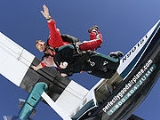
Parachuting, also known as skydiving, is where a person jumps from enough height so that he can deploy a fabric parachute
Parachute

A parachute is a device used to slow the motion of an object through an atmosphere by creating Drag .Parachutes are made out of cloth, most commonly nylon....
 and land safely.

The history of parachuting appears to start with Andre-Jacques Garnerin
André-Jacques Garnerin

Andr?-Jacques Garnerin was the inventor of the frameless parachute. He was born in Paris.His early experiments were based on umbrella-shaped devices....
 who made successful parachute jumps from a hot-air balloon in 1797. The military developed parachuting technology first as a way to save aircrews from emergencies aboard balloons and aircraft in flight, later as a way of delivering soldiers to the battlefield.


Discussion
Ask a question about 'Parachuting'
Start a new discussion about 'Parachuting'
Answer questions from other users
Full Discussion Forum


Recent Posts


Encyclopedia


Parachuting, also known as skydiving, is where a person jumps from enough height so that he can deploy a fabric parachute
Parachute

A parachute is a device used to slow the motion of an object through an atmosphere by creating Drag .Parachutes are made out of cloth, most commonly nylon....
 and land safely.

The history of parachuting appears to start with Andre-Jacques Garnerin
André-Jacques Garnerin

Andr?-Jacques Garnerin was the inventor of the frameless parachute. He was born in Paris.His early experiments were based on umbrella-shaped devices....
 who made successful parachute jumps from a hot-air balloon in 1797. The military developed parachuting technology first as a way to save aircrews from emergencies aboard balloons and aircraft in flight, later as a way of delivering soldiers to the battlefield. Early competitions date back to the 1930s, and it became an international sport in 1951.Ryan Peter corbett was the youngest person to ever skydive

Sport Parachuting is performed as a recreation
Recreation

Recreation or fun is the expenditure of time in a manner designed for therapeutic refreshment of one's body or mind. While leisure is more likely a form of entertainment or rest, recreation is active for the participant but in a refreshing and diverting manner....
al activity and a competitive sport
Sport

Sport is an activity that is governed by a set of regulation of sport or traditions and often engaged in competitively. Sports commonly refer to activities where the physical capabilities of the competitor are the sole or primary determinant of the outcome , but the term is also used to include activities such as mind sports and motor...
, as well as for the deployment of military personnel Airborne forces
Airborne forces

Airborne forces are military units, usually light infantry, set up to be moved by aircraft and 'dropped' into battle. Thus they can be placed behind enemy lines, and have an ability to deploy almost anywhere with little warning....
 and occasionally forest firefighters
Smokejumper

A smokejumper is a wildland firefighter that parachutes into a remote area to combat wildfires.Smokejumpers are most often deployed to fires that are extremely remote....
.

In the early days, a trained skydiver (or jumper
Jumper

Jumper may refer to:...
) and a group of associates met at an isolated airport
Airport

An airport is a location where aircraft such as Fixed-wing aircraft, helicopters, and Non-rigid airship take off and land. Aircraft may also be stored or maintained at an airport....
, sometimes referred to as a "drop zone." (DZ) A fixed base operator
Fixed base operator

In the aviation industry, a fixed base operator , or FBO, is a service center at an airport that may be a private enterprise or may be a department of the municipality that the airport serves....
 at that airport usually operates one or more aircraft
Aircraft

An aircraft is a vehicle which is able to flight by being supported by the air, or in general, the atmosphere, of a planet. Examples include balloons, airplanes and helicopters....
, and takes groups of skydivers up for a fee. It was common for an individual jumper to go up in a Cessna
Cessna

The Cessna Aircraft Company is an airplane manufacturing corporation headquartered in Wichita, Kansas, Kansas, USA. Their main products are general aviation aircraft....
 light aircraft such as C-172 or C-182. These days, it is common for busier DZs near populated areas to use multiple, larger aircraft such as the Cessna Caravan C208
Cessna 208

The Cessna 208 Caravan, also known as the Cargomaster, is a single turboprop engine, fixed-gear short-haul regional airliner and utility aircraft built in the United States by Cessna....
, De Havilland Twin Otter DHC6
De Havilland Canada DHC-6 Twin Otter

The DHC-6 Twin Otter is a 20-passenger STOL bush plane aircraft developed by de Havilland Canada. The aircraft's fixed tricycle undercarriage, STOL abilities and relatively high rate of climb have made it a successful cargo, regional passenger airliner and MEDEVAC aircraft....
 or Short Skyvan.

A typical jump involves individuals jumping out of an aircraft
Aircraft

An aircraft is a vehicle which is able to flight by being supported by the air, or in general, the atmosphere, of a planet. Examples include balloons, airplanes and helicopters....
 (usually an airplane, but sometimes a helicopter
Helicopter

A helicopter is an aircraft that is Lift and propelled by one or more horizontal plane Helicopter rotors, each rotor consisting of two or more rotor blades....
 or even the gondola of a balloon
Hot air balloon

The hot air balloon is the oldest successful human-carrying flight technology. On November 21, 1783, in Paris, France, the first manned flight was made by Jean-Fran?ois Pil?tre de Rozier and Fran?ois Laurent d'Arlandes in a hot air balloon created by the Montgolfier brothers....
), at approximately 4,000 meters (around 13,000 feet) altitude, and free-fall
Free-fall

Free fall is motion with no acceleration other than that provided by gravity. Since this definition does not specify velocity, it also applies to objects initially moving upward....
ing for a period of time before activating a parachute to slow the landing
Landing

Landing is the last part of a flight, where a flying animal, aircraft, or spacecraft returns to the ground. When the flying object returns to water, the process is called alighting, although it is commonly called "landing" and "touchdown" as well....
 down to safe speeds.

Once the parachute is opened, (usually the parachute will be fully inflated by 2,500 ft). the jumper can control his or her direction and speed with toggles on the end of steering lines attached to the trailing edge of the parachute, and so he or she can aim for the landing site and come to a relatively gentle stop in a safe landing environment. All modern sport parachutes are self-inflating "ram-air" wings that provide control of speed and direction similar to the related paragliders. Purists in either sport would note that paragliders have much greater lift and range, but that parachutes are designed to absorb the stresses of deployment at terminal velocity
Terminal velocity

File:Terminal velocity.svgIn fluid dynamics an object is moving at its terminal velocity if its speed is constant due to the restraining force exerted by the air, water or other fluid in which it is moving....
.

By manipulating the shape of the body—as a pilot manipulates the shape of his aircraft's wings—a skydiver can generate turns, forward motion, backwards motion, and even lift (relative to other skydivers, not to the ground). Experienced skydivers say that in freefall one can do anything a bird can do, except go back up.

When leaving an aircraft, for a few seconds a skydiver continues to travel forwards as well as down, due to the momentum created by the plane's speed (known as throw-forward). The perception of a change from horizontal to vertical flight is known as the "relative wind", or informally as "being on the hill". In freefall, skydivers generally do not experience a "falling" sensation because the resistance of the air to their body at speeds above about provides some feeling of weight and direction. At normal exit speeds for aircraft (approx ) there is little feeling of falling just after exit, but jumping from a balloon or helicopter can create this sensation. Skydivers reach terminal velocity (around for belly to Earth orientations, 150-200 mph (240-320 km/h) for head down orientations) and are no longer accelerating towards the ground. At this point the sensation is as of a hard wind.

Many skydivers make their first jump with an experienced and trained instructor (this type of skydive may be in the form of a tandem skydive
Tandem skydiving

Tandem skydiving refers to a type of parachuting where a student skydiver is connected via a harness to a tandem instructor. The instructor guides the student through the whole jump from exit through free-fall, canopy piloting, and landing....
). During the tandem jump the jumpmaster is responsible for the stable exit, maintaining a proper stable freefall position, and activating and controlling the parachute. With training and experience, the fear of the first few jumps is supplanted by the tact of controlling fear so that one may come to experience the satisfaction of mastering aerial skills and performing increasingly complicated maneuvers in the sky with friends. Other training methods include static line, IAD (Instructor Assisted Deployment), and AFF (Accelerated Free fall
Accelerated Freefall

Accelerated Freefall is a method of skydiving training. This method of skydiving training is called "accelerated" because the progression is the fastest way to experience solo freefall, normally from 10,000 to 14,500 feet "Above Ground Level" ....
) aka Progressive Free-Fall (PFF) in Canada.

At larger dropzones, training in the sport is often conducted by full-time instructors and coaches at commercial establishments. Commercial centers often provide year-round availability, larger aircraft, and staff who are current in both their sport and their instructional skills.

In areas where winter (or monsoon
Monsoon

A monsoon is a seasonal prevailing wind that lasts for several months. The term was first used in English in India, Bangladesh, Pakistan, and neighboring countries to refer to the big seasonal winds blowing from the Indian Ocean and Arabian Sea in the southwest bringing heavy rainfall to the region....
s) gets in the way of year-round operation, commercial skydiving centers are less prevalent and much of the parachuting activity is carried on by clubs. These clubs tend to use smaller aircraft. Training may be offered (by instructors who are tested and certified in exactly the same way as their commercial counterparts) in occasional classes or as demand warrants. These clubs tend to be weekend only operations as the majority of the staff have full-time jobs during the week. Club members will often visit larger centers for holidays, events, and for some concentrated exposure to the latest techniques.

Skills

Parachuting has complex skills that can take thousands of jumps to master, but the basics are often fully understood and useful during the first few jumps. There are four basic areas of skill: basic safety, free fall maneuvers, parachute operation, and landing.

Free-fall maneuvers

In freefall most skydivers start by learning to maintain a stable belly to earth "arch" position. In this position the average fall rate is around . Learning a stable arch position is a basic skill essential for a reliable parachute deployment. Next, jumpers learn to move or turn in any direction while remaining belly to earth. Using these skills a group of jumpers can create sequences of formations on a single jump, a discipline formerly known as relative work (RW) and now as formation skydiving (FS). In the late 1980s more experienced jumpers started experimenting with freeflying, falling in any orientation other than belly to earth. Today many jumpers start freeflying soon after they earn their license, bypassing the traditional flat-flying stepping stone.

Parachute operation and landing


Dropzonecss
The decision of when to deploy the parachute is a matter of safety. A parachute should be deployed sufficiently high to give the parachutist time to handle a malfunction, should one occur. is the practical minimum for advanced skydivers. Skydivers monitor their altimeters during freefall to decide when to break off from the formation (if applicable) and when to open their parachutes. Many skydivers open higher to practice their parachute flying skills. During a "hop-and-pop," a jump in which the parachute is deployed immediately upon exiting the aircraft, it is not uncommon to be under canopy as high as 1200 to 1500 meters (4000 to 5000 ft).

Parachute flying involves two basic challenges. Firstly to avoid injury and secondly to land where planned, often on a designated target. Some experienced skydivers enjoy performing aerobatic maneuvers with parachutes, the most notable being the "Swoop". This is a thrilling, but dangerous maneuver entailing a steep, high speed landing approach, before leveling off a couple of feet above the ground to maintain a fast glide parallel to the surface. Swoops as far as have been achieved.

A modern parachute or canopy "wing" can glide substantial distances. Elliptical canopies go faster and farther, and some small, highly loaded canopies glide faster than it is possible to run, which can make them very challenging to land. A highly experienced skydiver using a very small canopy can achieve over horizontal speeds in landing.

Today, the majority of skydiving related injuries and deaths happen under a fully opened and functioning parachute. The most common cause being poorly-executed, radical maneuvers near to the ground, such as hook turns, or landing flares performed either too high or too low.

Safety

Despite the perception of danger, fatalities are rare. However, each year a number of people are hurt or killed parachuting world-wide. About 30 skydivers are killed each year in the US
United States

The United States of America is a Federal government constitutional republic comprising U.S. state and a federal district. The country is situated mostly in central North America, where its Contiguous United States and Washington, D.C., the Capital districts and territories, lie between the Pacific Ocean and Atlantic Oceans, Borders of the U...
; roughly one death for every 100,000 jumps.

In the US
United States

The United States of America is a Federal government constitutional republic comprising U.S. state and a federal district. The country is situated mostly in central North America, where its Contiguous United States and Washington, D.C., the Capital districts and territories, lie between the Pacific Ocean and Atlantic Oceans, Borders of the U...
 and in most of the western world skydivers are required to carry two parachutes. The reserve parachute must be periodically inspected and re-packed (whether used or not) by a certificated parachute rigger (in the US, an FAA
Federal Aviation Administration

The Federal Aviation Administration is an agency of the United States Department of Transportation with authority to regulate and oversee all aspects of civil aviation in the U.S....
 certificated parachute rigger). Many skydivers use an automatic activation device
Automatic activation device

Automatic Activation Device in skydiving terminology refers to an electronic-pyrotechnic fastener or mechanical device that automatically opens the main or reserve parachute at a preset altitude or after a preset time....
 (AAD) that opens the reserve parachute at a safe altitude in the event of failing to activate the main canopy themselves. Most skydivers wear a visual altimeter, but increasingly many also use audible altimeters fitted to their helmet.

Injuries and fatalities occurring under a fully functional parachute usually happen because the skydiver performed unsafe maneuvers or made an error in judgment while flying their canopy, typically resulting in a high speed impact with the ground or other hazards on the ground. In recent years, one of the most common sources of injury is a low turn under a high-performance canopy and while swooping. Swooping is the advanced discipline of gliding parallel to the ground during landing. Changing wind conditions are another risk factor. In conditions of strong winds, and turbulence during hot days the parachutist can be caught in downdrafts close to the ground. Shifting winds can cause a crosswind or downwind landing which have a higher potential for injury due to the wind speed adding to the landing speed.

Equipment failure rarely causes fatalities and injuries. Exact numbers are difficult to estimate but approximately one in a thousand deployments of a main parachute results in a malfunction, although some skydivers have many thousands of jumps and never experience a malfunction (either they pack their mains more carefully than average or they are just lucky). Ram-air parachutes typically spin uncontrollably when malfunctioned, and must be jettisoned before deploying the reserve parachute. Reserve parachutes are packed and deployed differently, they are also designed more conservatively and built & tested to more exacting standards so they are more reliable than main parachutes, but the real safety advantage comes from the probability of an unlikely main malfunction multiplied by the even less likely probability of a reserve malfunction. This yields an even smaller probability of a double malfunction although the possibility of a main malfunction that cannot be cutaway causing a reserve malfunction is a very real risk.

Parachuting disciplines such as BASE jumping
BASE jumping

BASE jumping is an activity that employs a parachute or the sequenced use of a wingsuit and parachute to jump from fixed objects--with the parachute unopened at the jump ....
 or those that involve equipment such as wing suit flying and sky surfing have a higher risk factor due to the lower mobility of the jumper and the greater risk of entanglement. For this reason these disciplines are generally practiced by experienced jumpers.

Depictions in commercial films — notably Hollywood action movies — usually overstate the dangers of the sport. Often, the characters in such films are shown performing feats that are physically impossible without special effects assistance. In other cases, their practices would cause them to be grounded or shunned at any safety-conscious drop zone
Drop zone

In parachuting, a drop zone or DZ is the area above and around a location where a parachutist jumps and expects to land. It is usually situated beside a small airport, often sharing the facility with other general aviation activities....
 or club. USPA member drop zones in the US and Canada are required to have an experienced jumper act as a "safety officer" (in Canada DSO - Drop Zone Safety Officer; in the U.S. S&TA - Safety and Training Advisor) who is responsible for dealing with the jumpers who violate rules, regulations, or otherwise act in a fashion deemed unsafe by the appointed individual.

In many countries, either the local regulations or the liability-conscious prudence of the dropzone owners require that parachutists must have attained the age of majority
Age of majority

The age of majority is the threshold of adulthood as it is conceptualized in law. It is the chronological moment when a child legally ceases to be considered a minor and assumes control over their persons, actions and decisions, thereby terminating the legal control and legal responsibilities of their parents or guardian over and for them....
 before engaging in the sport.

Parachuting and weather

Parachuting in poor weather, especially with thunderstorms, high winds, and dust devils can be a dangerous activity.

Types

There are several different disciplines to embrace within parachuting. Each of these is enjoyed by both the recreational (weekend) and the competitive participants. There is even a small group of professional
Professional

A professional is a person who has completed a doctoral or law program or equivalent .A professional is someone who has a professional degree - a number one on the Hollingshead scale....
s who earn their living with parachuting. They win competitions having cash prizes or are employed or sponsored by skydiving related manufacturers.

Parachutists can participate both in competitive and in purely recreational skydiving events. World championships are held regularly in locations offering flat terrain and clear skies. An exception is Paraski, where winter weather and ski-hill terrain are required.

Types of parachuting include:

  • Accuracy landing
    Accuracy landing

    Accuracy landing is one of the oldest skydiving disciplines, in which skydivers attempt to land as closely as possible to a pre-determined target....
     - Landing as close as possible to a target.
  • BASE jumping
    BASE jumping

    BASE jumping is an activity that employs a parachute or the sequenced use of a wingsuit and parachute to jump from fixed objects--with the parachute unopened at the jump ....
     - From buildings, antennas, bridges (spans) and cliffs (earth).
  • Blade running - A kind of slalom with a parachute.
  • Big-ways
    Big-ways

    Big way formation skydiving ----Big way formation skydiving involves a large group of skydivers called relative workers coming together while in freefall to form a specific and organized design in connection with each other to be held for a designated number of seconds....
     - Formation skydiving with many people all falling belly to earth.
  • Canopy formation
    Canopy formation

    A canopy formation is a formation built by parachutists by flying their parachutes in proximity to each other and then taking grips on other jumpers' parachutes....
     - Making formations with other parachutists while under canopies. (Known also as canopy relative work or simply CRW (CRew))
  • Canopy piloting
    Canopy piloting

    Canopy Piloting encompasses several disciplines, all involving the flight of a skydiving parachute either at high altitude or close to the ground."Swooping" is one form of canopy piloting and is a growing activity in the skydiving world....
     - Also known as 'swooping'.
  • Formation skydiving
    Formation skydiving

    Formation skydiving is the art of building formations in free-fall with multiple people gripping each others' limbs or specially built "grippers" on their jumpsuits....
     - Making formations during freefall. (Known also as relative work or simply deployment-position RW)
  • Freefall style
    Freefall style

    Freefall style is a category of sport skydiving competition. Competitors aim to perform a predefined series of aerial maneuvers including front and back flips , turns, and rolls in the least amount of time....
  • Freeflying
    Freeflying

    Freeflying is a skydiving discipline which began circa 1994 by a group of skydivers who wanted to experiment with non-traditional forms of flight....
     - Flying in multiple orientations (i.e. head down, flocking, and sitflying). A more advanced approach to skydiving.
  • Freestyle skydiving
    Freestyle skydiving

    Freestyle skydiving is a competitive skydiving discipline where one member of a two-person team performs acrobatic manoeuvres in free fall while the other one films the performance from a close distance using a helmet mounted camera....
  • Military Parachuting
    • HALO/HAHO
    • Treejumping
      Treejumping

      Treejumping is a form of parachuting, into a forest or jungle – typically, from a relatively low altitude. It is generally considered to be a particularly dangerous form of parachuting....
  • Para-ski
  • Skysurfing
    Skysurfing

    Sky surfing is a type of skydiving in which the skydiver wears a board attached to his or her feet and performs surfing-style aerobatics during freefall....
     - Skydiving with a board strapped to one's feet.
  • Vertical Formation Skydiving
    Vertical Formation Skydiving

    Vertical Formation Skydiving is the art of building formations in free-fall with multiple people gripping each others' limbs or specially built "grippers" on their jumpsuits , while using high-speed body positions normally associated with freeflying....
     - a subset of Formation skydiving
    Formation skydiving

    Formation skydiving is the art of building formations in free-fall with multiple people gripping each others' limbs or specially built "grippers" on their jumpsuits....
     that uses high-speed freeflying
    Freeflying

    Freeflying is a skydiving discipline which began circa 1994 by a group of skydivers who wanted to experiment with non-traditional forms of flight....
     body positions instead of bellyflying. (Known also as VRW)
  • Wingsuit flying
    Wingsuit flying

    Wingsuit flying is the art of flying the human body through the air using a special jumpsuit, called a wingsuit, that shapes the human body into an airfoil which can create lift ....
     - Skydiving with a suit which provides extra lift, and powered skydiving
    Powered skydiving

    Powered skydiving is where a skydiver jumps from some height wearing propulson and small wings to fly their bodies. Efforts have been made by wingsuit flyers to sustain altitude, but the most successful was Yves Rossy who jumped out of an airplane wearing airplane-type rigid wings with four small jet motors attached to them....
     where the wingsuit flyer adds propulsion.


Training

There are ways to practice different aspects of skydiving, without actually jumping. Vertical wind tunnel
Vertical wind tunnel

A vertical wind tunnel is a wind tunnel which moves air up in a vertical column. It is a recreational wind tunnel, frequently advertised as "indoor skydiving" or "bodyflight"....
s can be used to practice skills for free fall ("indoor skydiving" or "bodyflight"), while virtual reality
Virtual reality

Virtual reality is a technology which allows a user to interact with a computer-simulated environment, whether that environment is a simulation of the real world or an imaginary world....
 parachute simulators can be used to practice parachute
Parachute

A parachute is a device used to slow the motion of an object through an atmosphere by creating Drag .Parachutes are made out of cloth, most commonly nylon....
 control.

Beginning skydivers seeking training have a few different options available to them:

  • Tandem skydiving
    Tandem skydiving

    Tandem skydiving refers to a type of parachuting where a student skydiver is connected via a harness to a tandem instructor. The instructor guides the student through the whole jump from exit through free-fall, canopy piloting, and landing....
  • Static line
    Static line

    A static line is a fixed cord attached to a large, stable object. It is used for workplace safety and for low jumps and training in parachuting....
  • Instructor Assisted Deployment
    Instructor Assisted Deployment

    Instructor Assisted Deployment, or IAD, is a parachute deployment method most similar to static line. The main difference is that instead of being deployed by a static line, the student's jumpmaster deploys the student's parachute by throwing the pilot chute downward and clear of the the door as the student exits....
  • Accelerated Freefall
    Accelerated Freefall

    Accelerated Freefall is a method of skydiving training. This method of skydiving training is called "accelerated" because the progression is the fastest way to experience solo freefall, normally from 10,000 to 14,500 feet "Above Ground Level" ....


A unique program where students accomplish their very first jump as a solo freefall is offered at the United States Air Force Academy
United States Air Force Academy

The United States Air Force Academy , is an accredited college for the undergraduate education of officers for the United States Air Force. Its campus is located immediately north of Colorado Springs, Colorado in El Paso County, Colorado, Colorado, United States....
. The program is called AM490, one in a series of airmanship courses at the school. While typically open only to cadets, Winfield W. Scott Jr., the school's superintendent, went through this program when he was nearly 60 years old.

Parachute deployment


At a skydiver's designated deployment altitude, the individual manually deploys a small pilot-chute which acts as a drogue, catching air and pulling out the main parachute. There are two principal systems in use : the "throwaway", where the skydiver pulls a toggle attached to the top of the pilot-chute stowed in a small pocket outside the main container : and the "pull-out", where the skydiver pulls a small pad attached to the pilot-chute which is stowed inside the container. Throwaway pilot-chute pouches are nowadays usually positioned at the bottom of the container - the B.O.C. deployment system - but older harnesses often have leg-mounted pouches. The latter are safe for flat-flying, but unsuitable for freestyle or head-down flying.

The pilot-chute is connected to a line known as the "bridle", in turn attached to a small deployment bag which has the folded parachute inside and the lines stowed in rubber bands across the top. At the bottom of the container which holds the main parachute is a fabric loop which, during packing, is fed through grommets on each of four flaps that close the container.

Attached to the bridle is a curved pin which is inserted through the closing loop after it has been fed through each of these grommets. When the pilotchute is thrown out, it catches the wind and pulls the pin out of the closing loop, allowing the pilot-chute to pull the deployment bag from the container. The parachute lines are pulled loose from rubber bands, through which they were stowed during packing, and extend as the canopy starts to open. A rectangular piece of fabric called the "slider" (which separates the parachute lines into four main groups fed through grommets in the four respective corners of the slider) slows the opening of the parachute and works its way down until the canopy is fully open and the slider is just above the head of the skydiver. The slider slows and controls the deployment of the parachute. Without a slider the parachute would inflate violently fast and the parachute would be destroyed by the wind drag/rapid deceleration. During a normal deployment, a skydiver will generally experience a few seconds of intense deceleration, in the realm of 3 to 4 G's, while the parachute slows the descent from to approximately .

If a skydiver experiences a malfunction of their main parachute which they cannot correct, they pull a "cut-away" handle on the front right-hand side of their harness (on the chest) which will release the main canopy from the harness/container. Once free from the malfunctioning main canopy, the reserve canopy can be activated manually by pulling a second handle on the front left harness. Some containers are fitted with a connecting line from the main to reserve parachutes - known as a Reserve Static Line (RSL) - which pulls opens the reserve container faster than a manual release could. Whichever method is used, a spring loaded pilotchute then extracts the reserve parachute from the upper half of the container.

Variations


In addition to the various disciplines, for which people actually train, purchase specialized equipment and get coaching, the recreational skydiver finds ways to just have fun.

Hit and rock

One example of this is "Hit and Rock", which is a variant of Accuracy landing
Accuracy landing

Accuracy landing is one of the oldest skydiving disciplines, in which skydivers attempt to land as closely as possible to a pre-determined target....
 devised to let people of varying skill levels "compete" for fun, while spoofing the age and abilities of some participants. "Hit and Rock" is originally from POPS (Parachutists Over Phorty Society). See the

The object now becomes: to land as close as possible to the chair, remove the parachute harness, sprint to the chair, sit fully in the chair and rock back and forth at least one time. The contestant is timed from the moment that feet touch the ground until that first rock is completed. This event is considered a race.

Pond swooping

Pond swooping is a form of competitive parachuting wherein canopy pilots attempt to touch down at a glide across a small body of water, and onto the shore. Events provide lighthearted competition, rating accuracy, speed, distance and style. Points and peer approval are reduced when a participant "chows", or fails to reach shore and sinks into the water.

Swoop and Chug the Beer

Very similar to Hit and Rock, except the target is replaced by a case of beer. Each jumper is timed from the moment his feet touch the ground until he "chugs", or rapidly drinks the can of beer and places the empty can upside-down on his head.

Of course, it must be mentioned that dropzones enforce strict rules prohibiting anyone from jumping any more that day once alcohol has been consumed. Therefore, the Swoop & Chug (aka Hit & Chug) is usually reserved for the last load of the day.

Cross-Country


A cross-country jump
Cross-country jump

A cross-country jump refers to a style of skydive where the participants open their parachutes immediately after jumping, with the intention of covering as much ground under canopy as possible....
 refers to a skydive where the participants open their parachutes immediately after jumping, with the intention of covering as much ground under canopy as possible. Usual distance from Jump Run to the dropzone is .

Camera flying


In camera flying, a cameraman or camerawoman jumps with other skydivers and films them. The camera flyer often wears specialized equipment, such as a winged jumpsuit to provide a greater range of fallrates, helmet-mounted video and still cameras, mouth operated camera switches, and special optical sights. Some skydivers specialize in camera flying and a few earn significant fees for filming students on coached jumps or tandem-jumpers, or producing professional footage and photographs for the media.

There is always a demand for good camera flyers in the skydiving community, as many of the competitive skydiving disciplines are judged from a video record.

Night jumps


Parachuting is not always restricted to daytime hours; experienced skydivers sometimes perform night jumps. For obvious safety reasons, this requires more equipment than a usual daytime jump and in most jurisdictions requires both an advanced skydiving license (at least a B-License in the U.S.) and specialized training (night rating). A lighted altimeter (preferably accompanied with an audible altimeter) is a must. Skydivers performing night jumps often take flashlights up with them so that they can check their canopies once they deploy, so they can be assured that the canopy has opened correctly and is safe to fly and land. Visibility to other skydivers and other aircraft is also a consideration; FAA regulations require skydivers jumping at night to be wearing a light visible for three miles (5 km) in every direction, and to turn it on once they are under canopy. A chemlight(glowstick) is a good idea on a night jump. Night jumpers should be made aware of the Dark Zone, when landing at night. Above 100 feet jumpers flying their canopy have a good view of the landing zone normally because of reflected ambient light/moon light. Once they get close to the ground, this ambient light source is lost, because of the low angle of reflection. The lower they get, the darker the ground looks. At about 100 feet and below it may seem that they are landing in a black hole. All the sudden it becomes very dark, and the jumper hits the ground soon after. This ground rush should be explained and anticipated for the first time night jumper.

Stuff jumps


With the availability of a rear door aircraft and a large, unpopulated space to jump over, 'stuff' jumps become possible. In these jumps the skydivers jump out with some object. Rubber raft jumps are popular, where the jumpers sit in a rubber raft. Cars, bicycles, motorcycles, hoovers, water tanks and inflatable companions have also been thrown out the back of an aircraft. At a certain height the jumpers break off from the object and deploy their parachutes, leaving it to smash into the ground at a very high speed.

Parachuting organizations


National parachuting associations exist in many countries (many affiliated with the Fédération Aéronautique Internationale
Fédération Aéronautique Internationale

The F?d?ration A?ronautique Internationale is the world governing body for air sports and aeronautics and astronautics world records. This includes man-carrying vehicles from Balloon to spacecraft, and unmanned vehicles ....
 (FAI), to promote their sport. In most cases, national representative bodies, as well as prudent local dropzone operators, require that participants carry certification, attesting to their training, their level of experience in the sport, and their proven competence. Anyone who cannot produce such bona-fides is treated as a student, requiring close supervision.

The primary organization in the United States is the United States Parachute Association
United States Parachute Association

The United States Parachute Association is a self-governing body for the sport of skydiving. Its headquarters are located in Fredericksburg, Virginia parallel to Interstate 95 in Virginia....
 (USPA). This organization hands out licenses and ratings for all American skydiving activities based on safety qualifications. The USPA governs safety in the sport of skydiving as this is the organizations sole responsibility and also publishes the Skydivers Information Manual (SIM) and many other resources. In Canada, the Canadian Sport Parachuting Association
Canadian Sport Parachuting Association

The Canadian Sport Parachuting Association , through affiliation with the Aero Club of Canada , is Canada?s representative to the Federation Aeronautique Internationale , and the International Parachute Commission , and is thereby the official sport organization for sport parachuting in Canada....
 is the lead organization. In South Africa
South Africa

The Republic of South Africa, also known by Official names of South Africa, is a country located at the southern tip of the continent of Africa....
 the sport is managed by the Parachute Association of South Africa
Parachute Association of South Africa

The Parachute Association of South Africa manages the sports of parachuting and skydiving in South Africa on behalf of the South African Civil Aviation Authority....
, and in the United Kingdom
United Kingdom

The United Kingdom of Great Britain and Northern Ireland, commonly known as the United Kingdom , the UK or Britain,is a sovereign state located off the northwestern coast of continental Europe....
 by the British Parachute Association
British Parachute Association

The British Parachute Association is the National Governing Body for Sport Parachuting in the United Kingdom....
.

Within the sport, associations promote safety, technical advances, training-and-certification, competition and other interests of their members. Outside their respective communities, they promote their sport to the public, and often intercede with government regulators.

Competitions are organized at regional, national and international levels in most these disciplines. Some of them offer amateur competition. Many of the more photogenic/videogenic variants also enjoy sponsored events with prize money for the winners.

The majority of jumpers tend to be non-competitive, enjoying the opportunity to "get some air" with their friends on weekends and holidays. The atmosphere of their gatherings is relaxed, sociable and welcoming to newcomers. Party events, called "boogies" are arranged at local, national and international scale, each year, attracting both the enthusiastic young jumpers and many of their elders - Parachutists Over Phorty (POPs), Skydivers Over Sixty (SOS) and even older groups who have yet to choose a catchy name for themselves. Famous people associated with this sport include Valery Rozov, a gold medalist from the 1998 X Games, who has had more than 1,500 jumps. Georgia Thompson ("Tiny") Broadwick is one of the first American skydivers, and she made the first freefall.
Img 0028

Drop zones


In parachuting, a drop zone or DZ is the area above and around a location where a parachutist freefalls and expects to land. It is usually situated beside a small airport, often sharing the facility with other general aviation
General aviation

General aviation is one of two categories of civil aviation. It refers to all flights other than military aviation and scheduled air transport flights, both private aviation and commercial aviation....
 activities.

There is generally a landing area designated specifically for parachute landings. Drop zone staff include the DZO (drop zone operator or owner), manifestors, pilots, instructors, coaches, cameramen, packers, riggers and other general staff.

Equipment

] Costs in the sport are not trivial. As new technological advances or performance enhancements are introduced, they tend to nudge equipment prices higher. Similarly, the average skydiver carries more equipment than in earlier years, with safety devices (such as an Reserve static line) contributing a significant portion of the cost. A full set of brand-new equipment can easily cost as much as a new motorcycle or half a small car. The market is not large enough to permit the commoditization and price-erosion that is seen in other technologically intensive industries (like the computer industry).

In many countries, the sport supports a substantial used-equipment market. For many beginners, especially those with limited funds, that is the preferred way to acquire "gear", and has two advantages:

  • First, they can try different types of parachutes (there are many) to learn which style they prefer, before paying the price for new equipment.
  • Second, they can acquire a complete system and all the peripheral items in a short time and at reduced cost.


Novices generally start with parachutes that are large and docile relative to the jumper's body-weight. As they improve in skill and confidence, it is customary to graduate to smaller, faster, more responsive parachutes. An active jumper might change parachute canopies several times in the space of a few years, while retaining his or her first harness/container and peripheral equipment.

Older jumpers, especially those who jump only on weekends in summer, sometimes tend in the other direction, selecting slightly larger, more gentle parachutes that do not demand youthful intensity and reflexes on each jump. They may be adhering to the maxim that: "There are old jumpers and there are bold jumpers, but there are no old, bold jumpers."

Most parachuting equipment is ruggedly designed and is enjoyed by several owners before being retired. Purchasers are always advised to have any potential purchases examined by a qualified parachute rigger. A rigger is trained to spot signs of damage or misuse. Riggers also keep track of industry product and safety bulletins, and can therefore determine if a piece of equipment is up-to-date and serviceable.

Records

  • World's largest freefall
February 8, 2006 in Udon Thani
Udon Thani

Udon Thani is a city in Isan, north-east Thailand. It has a population of 142,670, including an estimated 7,000 foreigners. Geographical location and is approximately 560 km from Bangkok....
, Thailand
Thailand

The Kingdom of Thailand is an independent country that lies in the heart of Southeast Asia. It is bordered to the north by Laos and Myanmar, to the east by Laos and Cambodia, to the south by the Gulf of Thailand and Malaysia, and to the west by the Andaman Sea and Myanmar....
.
  • World's largest canopy formation: 100. This record was set November 21, 2007 in Lake Wales, Florida
    Florida

    Florida is a U.S. state located in the Southeastern United States of the United States, bordering Alabama to the northwest and Georgia to the northeast....
    , USA.
  • Don Kellner holds the record for the most parachute jumps, with a total of over 36,000 jumps.
  • Cheryl Stearns (USA) holds the record for the most parachute descents by a woman, with a total of 15,560 in August 2003.
  • Capt. Joe W. Kittinger
    Joseph Kittinger

    Joseph William "Joe" Kittinger II is a former Command Pilot and career military officer in the United States Air Force. He is most famous for his participation in Project Manhigh and Project Excelsior and as being the first man to make a solo crossing of the Atlantic Ocean in a gas balloon....
     achieved the highest and longest (14 min) parachute jump in history on August 16, 1960 as part of a United States Air Force
    United States Air Force

    The United States Air Force is the aerial warfare branch of the Military of the United States and one of the uniformed services of the United States....
     program testing high-altitude escape systems. Wearing a pressure suit
    Pressure suit

    A pressure suit is a protective suit worn by high-altitude pilots who may fly at altitudes where the air pressure is too low for an unprotected person to survive, even breathing pure oxygen at positive pressure....
    , Capt. Kittinger ascended for an hour and a half in an open gondola attached to a balloon to an altitude of , where he then jumped. The fall lasted 4 minutes and 36 seconds, during which Capt. Kittinger reached speeds of 988 km/h (614 mph) . The air in the upper atmosphere is less dense and thus leads to lower air-resistance and a much higher terminal velocity.
  • Adrian Nicholas holds the record for the longest freefall. A 4 minutes and 55 seconds wingsuit jump made on March 12 1999.
  • Jay Stokes holds the record for most parachute descents in a single day at 640.
  • The Oldest Skydiver: Frank Moody, aged 101, made a tandem jump on June 6, 2004 at Skydive Cairns. The Tandem Master was Karl Eitrich and the event was filmed by Wayne Donovan & Jason Cryan.


See also

  • Drop zone
    Drop zone

    In parachuting, a drop zone or DZ is the area above and around a location where a parachutist jumps and expects to land. It is usually situated beside a small airport, often sharing the facility with other general aviation activities....
  • Parachute
    Parachute

    A parachute is a device used to slow the motion of an object through an atmosphere by creating Drag .Parachutes are made out of cloth, most commonly nylon....
  • Free-fall
    Free-fall

    Free fall is motion with no acceleration other than that provided by gravity. Since this definition does not specify velocity, it also applies to objects initially moving upward....
  • Tandem skydiving
    Tandem skydiving

    Tandem skydiving refers to a type of parachuting where a student skydiver is connected via a harness to a tandem instructor. The instructor guides the student through the whole jump from exit through free-fall, canopy piloting, and landing....
  • Wingsuit


External links