

Islamism

Encyclopedia
Islamism also , lit., "Political Islam" is set of ideologies
holding that Islam
is not only a religion
but also a political system
. Islamism is a controversial term, and definitions of it sometimes vary. Leading Islamist thinkers emphasized the enforcement of Sharia
(Islamic law); of pan-Islamic political unity; and of the elimination of non-Muslim, particularly Western
military, economic, political, social, or cultural influences in the Muslim world
, which they believe to be incompatible with Islam.
Some observers suggest Islamism's tenets are less strict, and can be defined as a form of identity politics
or "support for [Muslim] identity, authenticity, broader regionalism, revivalism, [and] revitalization of the community".
Many of those described as "Islamists" oppose the use of the term, and claim that their political beliefs and goals are simply an expression of Islamic religious belief. Similarly, some experts favor the term activist Islam, militant Islam, or political Islam instead.
Central figures of modern Islamism include Sayyid Qutb
, Hasan al-Banna, Abul Ala Maududi
, Taqiuddin al-Nabhani
, Ayatollah Ruhollah Khomeini
.
Islamism takes different forms and spans a wide range of strategies and tactics, and thus is not a united movement
.
Moderate reformists who accept and work within the democratic process include the Justice and Development Party of Turkey
, Tunisian
author and reformer Rashid Al-Ghannouchi and Malaysian opposition leader Anwar Ibrahim
. The Islamist group Hezbollah in Lebanon
participates in both elections and armed attacks, seeking to abolish the state of Israel
.
Groups such as the Jamaat-e-Islami
of Pakistan and the Sudanese Brotherhood
favored a top-down road to power by military coup d'état
. The radical Islamists al-Qaeda
and Egyptian Islamic Jihad reject entirely democracy
and self-proclaimed Muslims
they find overly moderate, and preach violent jihad
, urging and conducting attacks on a religious basis. This is not of the normal religion, and is responded to with outrage by the public.
Another major division within Islamism is between the fundamentalist "guardians of the tradition" of the Salafism or Wahhabi movement, and the "vanguard of change" centered on the Muslim Brotherhood
. Olivier Roy
argues that "Sunni pan-Islamism underwent a remarkable shift in the second half of the 20th century" when the Muslim Brotherhood
movement and focus on Islamistation of pan-Arabism
was eclipsed by the Salafi
movement with its emphasis on "sharia rather than the building of Islamic institutions," and rejection of Shia Islam.
. Earliest known use of the term identified by the Oxford English Dictionary
is 1747. By the turn of the twentieth century it had begun to be displaced by the shorter and purely Arabic term Islam and by 1938, when Orientalist scholars completed The Encyclopaedia of Islam, seems to have virtually disappeared from the English language.
The term Islamism is considered to have first begun to acquire its contemporary connotations in French academia between the late 1970s and late 1980s. From French, it began to migrate to the English language in the mid-1980s, and in recent years has largely displaced the term Islamic fundamentalism
in academic circles.
The use of the term Islamism was at first "a marker for scholars more likely to sympathize" with new Islamic movements; however, as the term gained popularity it became more specifically associated with political groups such as the Taliban or the Algerian Armed Islamic Group
, as well as with highly publicized acts of violence.
"Islamists" who have spoken out against the use of the term insisting they are merely "Muslims", include Ayatollah
Mohammad Hussein Fadlallah, the spiritual mentor of Hizbullah, and Abbassi Madani
, leader of the Algerian Islamic Salvation Front
.
A 2003 article in Middle East Quarterly states:
 The concept Islamism is controversial, not just because it posits a political role for Islam, but also because its supporters believe their views merely reflect Islam, while the contrary idea that Islam is, or can be, apolitical is an error. Scholars and observers who do not believe that Islam is a political ideology include Fred Halliday
, John Esposito
and Muslim intellectuals like Javed Ahmad Ghamidi.
Islamists have asked the question, "If Islam is a way of life, how can we say that those who want to live by its principles in legal, social, political, economic, and political spheres of life are not Muslims, but Islamists and believe in Islamism, not [just] Islam?" Similarly, a writer for the International Crisis Group
maintains that "the conception of 'political Islam'" is a creation of Americans to explain the Iranian Islamic Revolution
. In reality, apolitical Islam was an historical fluke of the "shortlived heyday of secular Arab nationalism between 1945 and 1970," and it is quietist
/non-political Islam, not Islamism, that requires explanation
On the other hand, Muslim-owned and run media have used the terms "Islamist" and "Islamism" — as distinguished from Muslim and Islam — to distinguish groups such as the Islamic Salvation Front
in Algeria or Jamaa Islamiya
in Egypt, which actively seek to implement Islamic law, from mainstream Muslim groups.
Another source distinguishes Islamist from Islamic "by the fact that the latter refers to a religion and culture in existence over a millennium, whereas the first is a political/religious phenomenon linked to the great events of the 20th century". Islamists have, at least at times, defined themselves as "Islamiyyoun/Islamists" to differentiate themselves from "Muslimun/Muslims".
According to historian Bernard Lewis
, Islamism, (or as he terms it "activist" Islam), along with "quietism," form two "particular ... political traditions" in Islam.
, Eastern Europe
and many parts of Asia
; however "the simple fact is that political Islam currently reigns as the most powerful ideological force across the Muslim world today".
Even some of those who see Islamism as fraught with contradictions believe "the socioeconomic realities that sustained the Islamist wave are still here and are not going to change: poverty, uprootedness, crises in values and identities, the decay of the educational systems, the North-South opposition, and the problem of immigrant integration into the host societies".
The strength of Islamism draws from the strength of religiosity in general in the Muslim world. Compared to Western societies, "[w]hat is striking about the Islamic world is that ... it seems to have been the least penetrated by irreligion
".
Where other peoples may look to the physical or social sciences for answers in areas which their ancestors regarded as best left to scripture, in the Muslim world, religion has become more encompassing, not less, as "in the last few decades, it has been the fundamentalists who have increasingly represented the cutting edge of the culture".
In Egypt and the rest of the Muslim world "the word secular, a label proudly worn 30 years ago, is shunned" and "used to besmirch" political foes.
The small secular opposition parties "cannot compare" with Islamists in terms of "doggedness, courage," "risk-taking" or "organizational skills".
Moderate strains of Islamism have been described as "competing in the democratic public square in places like Turkey and Indonesia. In Morocco
, the Islamist Justice and Development Party
(PJD) supported King Muhammad VI
's "Mudawana", a "startlingly progressive family law" which grants women the right to a divorce, raises the minimum age for marriage to 18, and, in the event of separation, stipulates equal distribution of property.
Islamists in Egypt and other Muslim countries have been described as "not politically dominant today, but ... extremely influential. ... They determine how one dresses, what one eats. In these areas, they are incredibly successful. ... Even if the Islamists never come to power, they have transformed their countries."
ways, including its political ways.
, and non-Afghan veteran of the war returned home with their prestige, "experience, ideology, and weapons", and had considerable impact.
Although now a strong opponent of Israel's existence, Hamas
has been called "Israel
's creation." In the 1970s and 1980s Israel tolerated and supported the group as preferable to the secular and then more powerful al-Fatah and the PLO.
Egyptian president Anwar Sadat
, in his struggle against leftists, released Islamists from prison and welcomed home exiles in tacit exchange for political support. His "encouraging of the emergence of the Islamist movement" was said to have been "imitated by many other Muslim leaders in the years that followed." This "gentlemen's agreement" ceased in 1975 but not before Islamists completely dominated university student unions. Islamists later assassinated Sadat and went on to form a formidable insurgency
in Egypt in the 1990.) The French government has also been reported to have promoted Islamist preachers "in the hope of channeling Muslim energies into zones of piety and charity."
Yet,
Throughout the Muslim world, religious institutions for people both young and old, from children's maddrassas
to high-level scholarships received Saudi funding,
"books, scholarships, fellowships, and mosques" (for example, "more than 1500 mosque
s were built and paid for with money obtained from public Saudi funds over the last 50 years"), along with training in the Kingdom for the preachers and teachers who went on to teach and work at these universities, schools, mosques, etc.
The funding was also used to reward journalists and academics who followed the Saudis' strict interpretation of Islam; and satellite campuses were built around Egypt for Al Azhar, the world's oldest and most influential Islamic university.
The interpretation of Islam promoted by this funding was the strict, conservative Saudi-based Wahhabism
or Salafism. In its harshest form it preached that Muslims should not only "always oppose" infidels "in every way," but "hate them for their religion ... for Allah's sake," that democracy
"is responsible for all the horrible wars of the 20th century," that Shia and other non-Wahhabi Muslims were infidels
, etc. While this effort has by no means converted all, or even most, Muslims to the Wahhabist interpretation of Islam, it has done much to overwhelm more moderate local interpretations, and has set the Saudi-interpretation of Islam as the "gold standard" of religion in Muslims' minds.
, but did just the opposite. In 1979 the Grand Mosque
in Mecca
Saudi Arabia
was seized by an armed fundamentalist group and held for over a week. Scores were killed, including many pilgrim bystanders in a gross violation of one of the most holy sites in Islam (and one where arms and violence are strictly forbidden).
Instead of prompting a backlash against the movement from which the attackers originated, however, Saudi Arabia, already very conservative, responded by shoring up its fundamentalist credentials with even more Islamic restrictions. Crackdowns followed on everything from shopkeepers who did not close for salah and newspapers that published pictures of women, to the selling of dolls, teddy bears (images of animate objects are considered haraam
), and dog food (dogs are considered unclean).
In other Muslim countries, blame for and wrath against the seizure was directed not against fundamentalists, but against Islamic fundamentalism's foremost geopolitical enemy – the United States. Ayatollah Khomeini sparked attacks on American embassies when he announced:
, Turkey
, Bangladesh
, India
, the UAE, Pakistan
, and Kuwait
. The US Embassy in Libya
was burned by protesters chanting pro-Khomeini slogans and the embassy in Islamabad
, Pakistan was burned to the ground.
. It is exempt from government crackdowns in the Muslim world (and often in the non-Muslim world) by virtue of its sacredness. "It is in the mosque where [Islamists] canvas neighbourhoods in the course of providing social services, spread their political messages and campaign for votes where permitted to participate."
, "are well known for providing shelters, educational assistance, free or low cost medical clinics, housing assistance to students from out of town, student advisory groups, facilitation of inexpensive mass marriage ceremonies to avoid prohibitively costly dowry demands, legal assistance, sports facilities, and women's groups." All this compares very favourably against incompetent, inefficient, or neglectful governments whose commitment to social justice is limited to rhetoric.
, specifically the religiously-oriented nationalism that emerged in the Third World in the 1970s: "resurgent Hinduism
in India
, ultra-Orthodox Judaism
in Israel
, militant Buddhism in Sri Lanka
, resurgent Sikh nationalism
in the Punjab
, 'Liberation Theology
' of Catholicism
in Latin America
, and of course, Islamism in the Muslim world." (This is distinguished from ethnic or linguistic-based nationalism which Islamism opposes.) These all challenged Westernized ruling elites on behalf of 'authenticity' and tradition.
, and for innovations to Islam (bid'ah
), notwithstanding Islamists' proclaimed opposition to any such innovation.
After the failure of the Indian Mutiny some of Shah Waliullah's followers turned to more peaceful methods of preserving the Islamic heritage and founded the Dar al-Ulum
seminary in 1867 in the town of Deoband
. From the school developed the Deobandi movement
which became the largest philosophical movement
of traditional Islamic thought in the subcontinent and led to the establishment of thousands of madrasah
s throughout modern-day India
, Pakistan
and Bangladesh
. Today, Deobandism is represented in Pakistan by the Jamiat Ulema-e-Islam
organization/political party and its splinter groups.
 The end of the 19th century saw the dismemberment of most of the Muslim Ottoman Empire
by non-Muslim European colonial powers. The empire spent massive sums on Western civilian and military technology to try to modernize and compete with the encroaching European powers, and in the process went deep into debt to these powers.
In this context, the publications of Jamal ad-din al-Afghani (1837–97), Muhammad Abduh
(1849–1905) and Rashid Rida
(1865–1935) preached Islamic alternatives to the political, economic, and cultural decline of the empire. Muhammad Abduh and Rashid Rida formed the beginning of the Salafist movement, as well as the Islamic modernist/secularist movement.
Their ideas included the creation of a truly Islamic society under sharia law, and the rejection of taqlid
, the blind imitation of earlier authorities, which they believed deviated from the true messages of Islam. Unlike some later Islamists, Salafists strongly emphasized the restoration of the Caliphate
.
, and then after independence from Britain
, in Pakistan
. Trained as a lawyer he chose the profession of journalism, and wrote about contemporary issues and most importantly about Islam and Islamic law.
In the struggle for the creation of a separate Muslim state in South Asia Maudidi and his party first opposed the establishment of the state of Pakistan but later supported the idea. He was an inspirational figure for modern Islamist groups in South Asia and elsewhere.
Maududi founded the Jamaat-e-Islami
party in 1941 and remained its leader until 1972. Although Maududi was educated at Deobandi institution(s) his party is a long-time rival of the Deobandi party/group Jamiat Ulema-e-Islam
.
Maududi had much more impact through his writing than through his political organising. His extremely influential book,Towards Understanding Islam (Risalat Diniyat in Arabic
), placed Islam in a modern context and influenced not only conservative ulema
but liberal modernisers such as al-Faruqi, whose "Islamisation of Knowledge" carried forward some of Maududi's key principles.
Maududi believed that Islam was all emcompassing "Everything in the universe is 'Muslim' for it obeys God by submission to His laws... The man who denies God is called Kafir
(concealer) because he conceals by his disbelief what is inherent in his nature and embalmed in his own soul."
Maududi also believed that Muslim society could not be Islamic without Sharia, and Islam required the establishment of an Islamic state. This state should be a "theo-democracy," based on the principles of: tawhid
(unity of God), risala
(prophethood) and khilafa (caliphate).
Although Maududi talked about Islamic revolution, he was both less revolutionary and less politically/economically populist than later Islamists like Qutb.
it sought Islamic revival through preaching and also by providing basic community services including schools, mosques, and workshops.
Like Maududi, Al Banna believed in the necessity of government rule based on Shariah law implemented gradually and by persuasion, and of eliminating all non-Muslim imperialist influence in the Muslim world. Jihad
was declared against European colonial powers.
Some elements of the Brotherhood, though perhaps against orders, did engage in violence against the government, and its founder Al-Banna was assassinated in 1949 in retaliation for the assassination of Egypt's premier Mahmud Fami Naqrashi three months earlier. The Brotherhood has suffered periodic repression in Egypt and has been banned several times, in 1948 and several years later following confrontations with Egyptian president Gamal Abdul Nasser, who jailed thousands of members for several years.
In recent years its status has usually been described as "semi-legal." Despite periodic repression, the Brotherhood has become one of the most influential movements in the Islamic world, particularly in the Arab world
. Along with being the only opposition group in Egypt able to field candidates during elections, (which pundits estimate would receive at least 30% of the vote in free elections), it has fostered several offshoot organizations in many other countries.
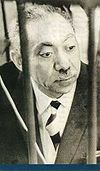 Maududi's political ideas influenced Sayyid Qutb
, one of the key philosophers of Islamism, and a leading member of the Muslim Brotherhood
movement. Qutb believed things had reached such a state that the Muslim community had literally ceased to exist. It "has been extinct for a few centuries," having reverted to Godless ignorance (Jahiliyya).
To eliminate jahiliyya, Qutb argued Sharia
, or Islamic law, must be established. Sharia law was not only accessible to humans and essential to the existence of Islam
, but also all-encompassing, precluding "evil and corrupt" non-Islamic ideologies like socialism, nationalism, or liberal democracy.
Qutb preached that Muslims must engage in a two-pronged attack of converting individuals while also waging jihad
to forcibly eliminate the "structures" of Jahiliyya – not only from the Islamic homeland but from the face of the earth.
Qutb was both a member of the brotherhood and enormously influential in the Muslim world at large. Qutb is considered by some to be "the founding father and leading theoretician" of modern jihadis, such as Osama bin Laden
. Ironically, the Muslim Brotherhood in Egypt and in Europe has not embraced his vision of armed jihad, something for which they have been denounced by more radical Islamists.
A steep and steady decline in the popularity and credibility of both secular and nationalist politics ensued. Ba'athism
, Arab Socialism
, and Arab Nationalism
suffered, and Islamist movements inspired by Mawlana Maududi, and Sayyid Qutb
gained ground.
) was established among the Shia of Iran
. In a major shock to the rest of the world, Ayatollah
Ruhollah Khomeini
led the Iranian Revolution of 1979 to overthrow the oil-rich, well-armed, Westernized and pro-American secular monarchy ruled by Shah Muhammad Reza Pahlavi.
Khomeini's beliefs were similar to Sunni Islamic thinkers like Mawdudi and Qutb:
He believed that imitation of the early Muslims and the restoration of Sharia
law were essential to Islam, that secular, Westernizing Muslims were actually agents of the West serving Western interests, and that the "plundering" of Muslim lands was part of a long-term conspiracy against Islam by the Christian West.
But they also differed:
While initial enthusiasm for the Iranian revolution in the Muslim world was intense, it has waned as "purges, executions, and atrocities tarnished its image".
As a model for potential Islamic states, the Islamic Republic has been partially successful in achieving its goals: ridding Iran of corruption, poverty and political oppression could not been achieved, while Sharia was implemented into the law. Internally, it has been modestly successful in increasing literacy and health care.
It has also maintained its hold on power in Iran in spite of the US economic sanctions
, and has created or assisted like-minded Shia Islamist groups in Iraq (SCIRI
) and Lebanon (Hezbollah), (two Muslim countries that also have large Shiite populations).
During the 2006 Israel-Lebanon conflict
, the Iranian government enjoyed something of a resurgence in popularity amongst the predominantly Sunni "Arab street," due to its support for Hezbollah and to President Mahmoud Ahmadinejad's vehement opposition to the United States and his call that Israel
shall vanish.
Early in the history of the state of Pakistan, a resolution (the Objectives Resolution
) was adopted proclaiming
In July 1977 General Zia-ul-Haq overthrew Prime Minister Ali Bhutto's regime in Pakistan. Ali Bhutto, a leftist in political competition with Islamists, had banned alcohol, horse-racing, and nightclubs, and announced that the "sharia would be fully applied" within six months, shortly before he was overthrown. Ul-Haq was much more committed to Islamism, and "Islamization
" or implementation of Islamic law (AKA sharia
), became a cornerstone of his eleven-year military dictatorship and Islamism became his "official state ideology". An admirer of Mawdudi, Mawdudi's party Jamaat-e-Islami
became the "regime's ideological arm", and its members prospered under ul-Haq.
Under his rule the Ahmadi
Community was severely persecuted by various Islamist movements, who grew in numbers and influence.
In Pakistan this Islamization from above was "probably" more complete "than under any other regime except those in Iran and Sudan," but Ul-Haq was also criticized by some Islamists for imposing "symbols" rather than substance, and using Islamization to legitimize his means of seizing power. The program was a dramatic reversal of the traditional secularism
of Pakistan's founding Muslim League
and its leader Mohammad Ali Jinnah, but unlike neighboring Iran, ul-Haq's policies were intended to "avoid revolutionary excess", and not to strain relations with his American and Persian Gulf state allies.
Ul-Haq was killed in 1988 but Islamization remains an important element in Pakistani politics and society.
) against an anti-religious superpower, galvanized thousands of Muslims around the world to send aid and sometimes to go themselves to fight jihad
. Leading this pan-Islamic effort was Palestinian sheikh Abdullah Yusuf Azzam. While the military effectiveness of these "Afghan Arabs
" was marginal, Azzam's group is said to have organized paramilitary training for more than 20,000 Muslim recruits, from about 20 countries around the world.
When the Soviet Union abandoned the Marxist Najibullah regime and withdrew from Afghanistan in 1989 (the regime finally fell in 1992), the victory was seen by many Muslims as the triumph of Islamic faith over superior military power and technology that could be duplicated elsewhere.
The "veterans of the guerrilla campaign" returning home to Algeria
, Egypt
and other countries "with their experience, ideology, and weapons," were often eager to continue armed jihad.
The collapse of the Soviet Union itself in 1991, was seen by many Islamists, including Bin Laden, as the defeat of a superpower at the hands of Islam, the $6 billion in aid given by the US to the mujahideen having nothing to do with the victory. As bin Laden opined: "[T]he US has no mentionable role" in "the collapse of the Soviet Union ... rather the credit goes to God and the mujahidin" of Afghanistan.
, which brought several hundred thousand US and allied non-Muslim military personnel to Saudi Arabian soil to put an end to Saddam Hussein
's occupation of Kuwait. Prior to 1990 Saudi Arabia played an important role in restraining the many Islamist groups that received its aid. But Saddam embraced Islamic rhetoric and attacked Saudi Arabia, his enemy in the war, for violating Islamic unity and its role as custodian of the two holy cities by allowing non-Muslims on its soil (traditional Muslim belief holds that non-Muslims must not be allowed on the Arabian peninsula), and he also accused the Kingdom of being a puppet of the west.
These attacks resonated with conservative Muslims and the problem did not go away with Saddam's defeat either, since American troops remained stationed in the kingdom, and a defacto cooperation with the Palestinian-Israeli peace process developed. Saudi Arabia attempted to compensate for its loss of prestige among these groups by repressing those domestic Islamists who attacked it (bin Laden being a prime example), and increasing aid to Islamic groups (Islamist madrassas around the world and even aiding some violent Islamist groups) that did not, but its pre-war influence on behalf of moderation was greatly reduced. One result of this was a campaign of attacks on government officials and tourists in Egypt
, a bloody civil war in Algeria and Osama bin Laden
's terror attacks climaxing in 9/11 attack
.
) did, however, develop and they pursued a more radical direction. By the 1970s, the Brotherhood had renounced violence as a means of achieving its goals.
The path of violence and military struggle was then taken up by the Egyptian Islamic Jihad organization responsible for the assassination of Anwar Sadat
in 1981. Unlike earlier anti-colonial movements, Islamic Jihad directed its attacks against what it believed were "apostate" leaders of Muslim states, leaders who held secular leanings or who had introduced or promoted Western/foreign ideas and practices into Islamic societies. Its views were outlined in a pamphlet written by Muhammad Abd al-Salaam Farag, in which he states:
Another of the Egyptian groups which employed violence in their struggle for Islamic order was al-Gama'a al-Islamiyya
(Islamic Group). Victims of their campaign against the Egyptian state in the 1990s included the head of the counter-terrorism police (Major General Raouf Khayrat), a parliamentary speaker (Rifaat al-Mahgoub), dozens of European tourists and Egyptian bystanders, and over 100 Egyptian police. Ultimately the campaign to overthrow the government was unsuccessful, and the major jihadi group, Jamaa Islamiya (or al-Gama'a al-Islamiyya
), renounced violence in 2003. Other lesser known groups include the Islamic Liberation Party, Al-Najun min al-nar and Al-Takfir wa al-Hijra and these groups have variously been involved in activities such as attempted assassinations of political figures, arson of video shops and attempted takeovers of government buildings.
had an Islamist regime under the leadership of Hassan al-Turabi
. His National Islamic Front
first gained influence when strongman General Gaafar al-Nimeiry invited members to serve in his government in 1979. Turabi built a powerful economic base with money from foreign Islamist banking systems, especially those linked with Saudi Arabia. He also recruited and built a cadre of influential loyalists by placing sympathetic students in the university and military academy while serving as minister of education.
After al-Nimeiry was overthrown in 1985 the party did poorly in national elections but in 1989 it was able to overthrow the elected post-al-Nimeiry government with the help of the military. Turabi was noted for his commitment to the democratic process and a liberal government before coming to power, but strict application of sharia
law, and an intensification of the long-running war in southern Sudan, human rights abuses, once in power. The NIF regime also harbored Osama bin Laden
for a time (before 9/11), and worked to unify Islamist opposition to the American attack on Iraq in the 1991 Gulf War
.
After Sudanese intelligence services were implicated in an assassination attempt on the President of Egypt, UN economic sanctions were imposed on Sudan, a very poor country, and Turabi fell from favor. He was imprisoned for a time in 2004-5. Some of the NIF policies, such as the war with the non-Muslim south, have been reversed, though the National Islamic Front (now named the National Congress Party
) still holds considerable power in the Sudanese government.
) in Algeria. Founded as a broad Islamist coalition in 1989 it was led by Abbassi Madani, and a charismatic radical young preacher, Ali Belhadj. Taking advantage of liberalization by the unpopular ruling leftist/nationalist FLN regime, it used its preaching to advocate the establishment of a legal system following Sharia
law, education in Arabic rather than French, and gender segregation, with women staying home to alleviate the high rate of unemployment among young Algerian men. The FIS won sweeping victories in local elections and it was going to win national elections in 1991 when voting was canceled by a military coup d'état.
As Islamists took up arms to overthrow the regime, the FIS's leaders were arrested and it became overshadowed by Islamist guerilla groups particularly the Islamic Salvation Army, MIA and Armed Islamic Group
(or GIA). A bloody and devastating civil war
ensued in which between 150,000 and 200,000 people were killed over the next decade. Civilians – including foreigners, University academics, intellectuals, writers, journalists, and medical doctors – were targeted by Islamist extremists. although government forces were also accused of killing civilians and of manipulating the brutal takfir
i GIA
The civil war was not a victory for Islamism. By 2002 the main guerrilla groups had either been destroyed or had surrendered. The popularity of Islamist parties has declined to the point that "the Islamist candidate, Abdallah Jaballah, came a distant third with 5% of the vote"
in the 2004 presidential election.

In Afghanistan the mujahideen's victory did not lead to justice and prosperity but to a vicious and destructive civil war between warlords, making Afghanistan one of the poorest countries on earth. In 1996, a new movement known as the Taliban, rose to power, defeated most of the warlords and took over roughly 80% of Afghanistan.
The Taliban were spawned by the thousands of madrasah
s the Deobandi
movement established for impoverished Afghan refugees and supported by governmental and religious groups in neighboring Pakistan.
The Taliban differed from other Islamist movements to the point where they might be more properly described as Islamic fundamentalist
or neofundamentalist, interested in spreading "an idealized and systematized version of village customs to an entire country." Despite Afghanistan's great poverty, they had little interest in social, economic and technological development – at one time explaining that "we Muslims believe God the Almighty will feed everybody one way or another."
Their ideology was also described as being influenced by Pashtunwali tribal law, Wahhabism
, and the jihadism
pan-Islamism
of their guest Osama bin Laden
.
The Taliban considered "politics" to be against Sharia
and thus did not hold elections. They were led by Mullah Mohammed Omar
who was given the title "Amir al-Mu'minin" or Commander of the Faithful, and a pledge of loyalty by several hundred Taliban-selected Pashtun
clergy in April 1996. Like most Islamists, the Taliban enforced strict prohibitions on women, but these were so severe – for example effectively forbidding most employment and schooling – that they created an international outcry.
The Taliban also banned other activities – music, TV, videos, photographs, pigeons, kite-flying, beard-trimming, etc. – and for the energy and the resources which they used to enforce the bans, including hundreds perhaps thousands of religious police officers armed with "whips, long sticks and Kalashnikovs."
The Taliban also opposed Shi'ism and have been accused by human rights groups of indiscriminately killing thousands of Shia. They were also overwhelmingly Pashtun and were accused of not sharing power with the approximately 60% of Afghans who belonged to other ethnic groups. (see: Taliban#Ideology)
The Taliban's hosting of Osama bin Laden
, despite the attacks he organized against the United States, led to an American-organized attack against which drove them from power following the 9/11 attacks.
Taliban are still very much alive and fighting a vigorous insurgency from bases in the frontier regions of Pakistan with suicide bombings and armed attacks being launched against NATO, Afghan government targets and civilians.
(Islamic Group) of Egypt, Islamist groups in Algeria, Hamas
and Islamic Jihad
in Gaza and the West Bank, and Osama bin Laden
and his al-Qaeda
group.
Both Muslims and non-Muslims have been among the targets and victims. Some of the groups have proudly proclaimed the attacks, others have been silent or denied involvement.
Justification for attacks on Muslims often comes as takfir
, an implicit death threat since under traditional Sharia law the punishment for apostasy in Islam
is death. Justification for attacks on non-Muslims is often the allegation that the targets had "waged war against God," are occupiers of Muslim land, or tourists unwelcome on Muslim land.
Suicide or "martyrdom operations" are a lethal technique among radical Islamists, sometimes motivated by the much disputed explanation that "God will give" those who kill themselves in the path of jihad
70 or 72 female "virgins
" and "everlasting happiness."
Religious or sectarian attacks in situations where Islamists are active have been particularly serious following 2004. In Iraq, 8,262 people were killed in terror attacks in 2005 and 13,340 in 2006, although not all of theses casualties came from attacks by Islamist groups. Islamist or fundamentalist attacks are also on the increase in Afghanistan and in Pakistan, where hundreds have been killed in 2006 and 2007, although in both countries not all of the attacks have been on civilians.
, founded in 1953 by an Islamic Qadi
(judge) Taqiuddin al-Nabhani
. HT is unique from most other Islamist movements in that the party focuses not on local issues or on providing social services, but on unifying the Muslim world under its vision of a new Islamic caliphate
spanning from North Africa and the Middle East to much of central and South Asia.
To this end it has drawn up and published a constitution for its proposed caliphate state. The constitution's 187 articles specify specific policies such as sharia
law, a "unitary ruling system" headed by a caliph elected by Muslims, an economy based on the gold standard
, public ownership of utilities, public transport, and energy resources, and Arabic as the "sole language of the State."
In its focus on the Caliphate, HT takes a different view of Muslim history than some other Islamists such as Muhammad Qutb
. HT sees Islam's pivotal turning point as occurring not with the death of Ali
, or one of the other four rightly guided Caliphs
in the 7th century, but with the 1918 or 1922 abolition of the Ottoman Caliphate
.
This is believed to have ended the true Islamic system, something for which it blames "the disbelieving (Kafir) colonial powers" working through Turkish modernist Mustafa Kemal Atatürk
.
HT does not engage in armed jihad
or vote-getting, but works to take power through "ideological struggle" to change Muslim public opinion, and in particular through elites who will "facilitate" a "change of the government," i.e. launch a bloodless coup
. It allegedly attempted and failed such coups in 1968 and 1969 in Jordan
, and in 1974 in Egypt
, and is now banned in both countries. But many HT members have gone on to join terrorist groups and many Jihadi terrorists have cited HT as their key influence.
The party is sometimes described as "Leninist" and "rigidly controlled by its central leadership," with its estimated one million members required to spend "at least two years studying party literature under the guidance of mentors (Murshid
)" before taking "the party oath." HT is particularly active in the ex-soviet republics of Central Asia
and in Europe
.
In the UK
its rallies have drawn thousands of Muslims, and the party is said to have outpaced the Muslim Brotherhood in both membership and radicalism. But it has suffered key defections in recent years and their support base is declining fast.
 In Turkey
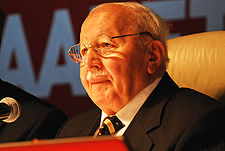
, there is a strong Islamist tradition among political parties. Necmettin Erbakan
was the leader of the Islamist parties, National Order Party
(Milli Nizam Partisi), National Salvation Party
(Milli Selamet Partisi), Welfare Party
(Refah Partisi) which all have been banned by the constitutional court for its anti-secular activities, he is also a member of the Felicity Party (Saadet Partisi).
Ismet Özel
, an ex-Marxist convert and the most prominent Islamist intellectual, argued that it was Atatürk's reforms that, ironically Islamicized Turkey by forcing people to internalize and value their religious identity and not simply take it for granted as in the past. He has drawn upon his knowledge of Western philosophy, Marxist sociology, and radical Islamist political theory to advocate a modern Islamic perspective that does not hesitate to criticize genuine societal ills while simultaneously remaining faithful to the ethical values and spiritual dimensions of religion. He says "As a political system in Turkey, socialism is possible, Turkism is probable, Islam is certain."
has over 600,000 Muslim
s, (most of South Asian origins and concentrated in the East London
boroughs of Newham
, Tower Hamlets and Waltham Forest), and among them are some Muslims with a strong Islamist outlook. Their presence, combined with a perceived British policy of allowing them free rein, heightened by exposés such as the 2007 Channel 4 documentary programme Undercover Mosque
, has given rise to the term Londonistan
. Following the 9/11 attacks, however, Abu Hamza al-Masri
, the imam
of the Finsbury Park Mosque
, and others were interned without charge which has caused many Islamists to leave the UK to avoid internment.
A February 2006 demonstration in London protesting the Jyllands-Posten Muhammad cartoons
, featured banners calling for Muslims to "Behead those who insult Islam
." Five of the protesters were later arrested.
Among the proportion of Muslims who hold the position that Western military involvement in Afghanistan and Iraq justify attacks on civilians in Western countries (often considered to be terrorism
), include the perpetrators of several bombing and planned bombing, the most deadly being the 7 July 2005 London bombings
.
programs conducted by the State Department. There have been calls to create an independent agency in the U.S. with a specific mission of undermining Islamism and jihadism. Christian Whiton, an official in the George W. Bush administration
, called for a new agency focused on the nonviolent practice of "political warfare" aimed at undermining the ideology. U.S. Defense Secretary Robert Gates called for establishing something similar to the defunct U.S. Information Agency, which was charged with undermining the communist ideology during the Cold War
.
A considerable effort has been made against West
ern targets, especially the United States
. The United States, in particular, was made an Islamist target because of its support for Israel and its presence on Saudi Arabian soil, perceptions of aggression against Muslims in Iraq and Afghanistan and because of its support of the pro-American anti-democratic regimes such as Egypt, Saudi Arabia and Bahrain.
In addition, some Islamists have concentrated their activity against Israel; nearly all Islamists view Israel as hostile to their cause. Osama bin Laden was one such figure who believed that the violent attacks were of necessity due to the historical conflict between Muslims and Jews.
The moderate Muhammadiyah
movement in Indonesia has stated that it is concerned with "far more important issues than the application of Sharia," namely strengthening the education, health, economy and society the country, a task they maintain represents "the greater Shari'a" or path of God.
Other moderate Islamist groups include the Justice and Development Party
(PJD) in Morocco
, which supports Mohammad VI's "Mudawana," a progressive family law which grants women the right to a divorce, raises the minimum age for marriage to 18 and, in the event of separation, stipulates equal distribution of property.
Ideologies of parties
This is a list of political ideologies. Many political parties base their political action and election program on an ideology. In social studies, a political ideology is a certain ethical set of ideals, principles, doctrines, myths or symbols of a social movement, institution, class, and or large...
holding that Islam
Islam
Islam . The most common are and . : Arabic pronunciation varies regionally. The first vowel ranges from ~~. The second vowel ranges from ~~~...
is not only a religion
Religion
Religion is a collection of cultural systems, belief systems, and worldviews that establishes symbols that relate humanity to spirituality and, sometimes, to moral values. Many religions have narratives, symbols, traditions and sacred histories that are intended to give meaning to life or to...
but also a political system
Political system
A political system is a system of politics and government. It is usually compared to the legal system, economic system, cultural system, and other social systems...
. Islamism is a controversial term, and definitions of it sometimes vary. Leading Islamist thinkers emphasized the enforcement of Sharia
Sharia
Sharia law, is the moral code and religious law of Islam. Sharia is derived from two primary sources of Islamic law: the precepts set forth in the Quran, and the example set by the Islamic prophet Muhammad in the Sunnah. Fiqh jurisprudence interprets and extends the application of sharia to...
(Islamic law); of pan-Islamic political unity; and of the elimination of non-Muslim, particularly Western
Western world
The Western world, also known as the West and the Occident , is a term referring to the countries of Western Europe , the countries of the Americas, as well all countries of Northern and Central Europe, Australia and New Zealand...
military, economic, political, social, or cultural influences in the Muslim world
Muslim world
The term Muslim world has several meanings. In a religious sense, it refers to those who adhere to the teachings of Islam, referred to as Muslims. In a cultural sense, it refers to Islamic civilization, inclusive of non-Muslims living in that civilization...
, which they believe to be incompatible with Islam.
Some observers suggest Islamism's tenets are less strict, and can be defined as a form of identity politics
Identity politics
Identity politics are political arguments that focus upon the self interest and perspectives of self-identified social interest groups and ways in which people's politics may be shaped by aspects of their identity through race, class, religion, sexual orientation or traditional dominance...
or "support for [Muslim] identity, authenticity, broader regionalism, revivalism, [and] revitalization of the community".
Many of those described as "Islamists" oppose the use of the term, and claim that their political beliefs and goals are simply an expression of Islamic religious belief. Similarly, some experts favor the term activist Islam, militant Islam, or political Islam instead.
Central figures of modern Islamism include Sayyid Qutb
Sayyid Qutb
Sayyid Qutb was an Egyptian author, educator, Islamist theorist, poet, and the leading member of the Egyptian Muslim Brotherhood in the 1950s and '60s....
, Hasan al-Banna, Abul Ala Maududi
Abul Ala Maududi
Syed Abul A'ala Maududi , also known as Molana or Shaikh Syed Abul A'ala Mawdudi, was a Sunni Pakistani journalist, theologian, Muslim revivalist leader and political philosopher, and a major 20th century Islamist thinker. He was also a prominent political figure in Pakistan and was the first...
, Taqiuddin al-Nabhani
Taqiuddin al-Nabhani
Taqiuddin al-Nabhani was the founder of the Islamic political party Hizb ut-Tahrir.He died aged 68 in 1977.- Philosophy and Theology :Nabhani in his books 'Thought' and 'System of Islam' placed...
, Ayatollah Ruhollah Khomeini
Ruhollah Khomeini
Grand Ayatollah Sayyed Ruhollah Musavi Khomeini was an Iranian religious leader and politician, and leader of the 1979 Iranian Revolution which saw the overthrow of Mohammad Reza Pahlavi, the Shah of Iran...
.
Definitions
Islamism has been defined as:- "the belief that Islam should guide social and political as well as personal life",
- "the [Islamic] ideology that guides society as a whole and that [teaches] law must be in conformity with the Islamic sharia",
- an unsustainably flexible movement of ... everything to everyone: an alternative social provider to the poor masses; an angry platform for the disillusioned young; a loud trumpet-call announcing `a return to the pure religion` to those seeking an identity; a "progressive, moderate religious platform` for the affluent and liberal; ... and at the extremes, a violent vehicle for rejectionists and radicals.
- an Islamic "movement that seeks cultural differentiation from the West and reconnection with the pre-colonial symbolic universe",
- "the organised political trend, owing its modern origin to the founding of the Muslim Brotherhood in Egypt in 1928, that seeks to solve modern political problems by reference to Muslim texts",
- "the whole body of thought which seeks to invest society with Islam which may be integrationist, but may also be traditionalist, reform-minded or even revolutionary",
- "the active assertion and promotion of beliefs, prescriptions, laws or policies that are held to be Islamic in character,"
- a movement of "Muslims who draw upon the belief, symbols, and language of Islam to inspire, shape, and animate political activity;" which may contain moderate, tolerant, peaceful activists, and/or those who "preach intolerance and espouse violence."
- a term "used by outsiders to denote a strand of activity which they think justifies their misconception of Islam as something rigid and immobile, a mere tribal affiliation."
Islamism takes different forms and spans a wide range of strategies and tactics, and thus is not a united movement
Pan-Islamism
Pan-Islamism is a political movement advocating the unity of Muslims under one Islamic state — often a Caliphate. As a form of religious nationalism, Pan-Islamism differentiates itself from other pan-nationalistic ideologies, for example Pan-Arabism, by excluding culture and ethnicity as primary...
.
Moderate reformists who accept and work within the democratic process include the Justice and Development Party of Turkey
Justice and Development Party (Turkey)
The Justice and Development Party , abbreviated JDP in English and AK PARTİ or AKP in Turkish, is a centre-right political party in Turkey. The party is the largest in Turkey, with 327 members of parliament...
, Tunisian
Demographics of Tunisia
The majority of modern Tunisians are Arab-Berber orArabized Berber, and are speakers of Tunisian Arabic. However, there is also a small population of Berbers located in the Jabal Dahar mountains in the South East and on the island of Jerba...
author and reformer Rashid Al-Ghannouchi and Malaysian opposition leader Anwar Ibrahim
Anwar Ibrahim
Anwar bin Ibrahim is a Malaysian politician who served as Malaysian Deputy Prime Minister from 1993 to 1998. Early in his career, Anwar was a close ally of Prime Minister Mahathir bin Mohamad but subsequently emerged as the most prominent critic of Mahathir's government.In 1999, he was sentenced...
. The Islamist group Hezbollah in Lebanon
Lebanon
Lebanon , officially the Republic of LebanonRepublic of Lebanon is the most common term used by Lebanese government agencies. The term Lebanese Republic, a literal translation of the official Arabic and French names that is not used in today's world. Arabic is the most common language spoken among...
participates in both elections and armed attacks, seeking to abolish the state of Israel
Israel
The State of Israel is a parliamentary republic located in the Middle East, along the eastern shore of the Mediterranean Sea...
.
Groups such as the Jamaat-e-Islami
Jamaat-e-Islami
This article is about Jamaat-e-Islami Pakistan. For other organizations of similar name see Jamaat-e-Islami The Jamaat-e-Islami , is a Pro-Muslim political party in Pakistan...
of Pakistan and the Sudanese Brotherhood
Hassan al-Turabi
Dr. Hassan 'Abd Allah al-Turabi , commonly called Hassan al-Turabi , is a religious and Islamist political leader in Sudan, who may have been instrumental in institutionalizing sharia in the northern part of the...
favored a top-down road to power by military coup d'état
Coup d'état
A coup d'état state, literally: strike/blow of state)—also known as a coup, putsch, and overthrow—is the sudden, extrajudicial deposition of a government, usually by a small group of the existing state establishment—typically the military—to replace the deposed government with another body; either...
. The radical Islamists al-Qaeda
Al-Qaeda
Al-Qaeda is a global broad-based militant Islamist terrorist organization founded by Osama bin Laden sometime between August 1988 and late 1989. It operates as a network comprising both a multinational, stateless army and a radical Sunni Muslim movement calling for global Jihad...
and Egyptian Islamic Jihad reject entirely democracy
Democracy
Democracy is generally defined as a form of government in which all adult citizens have an equal say in the decisions that affect their lives. Ideally, this includes equal participation in the proposal, development and passage of legislation into law...
and self-proclaimed Muslims
Takfir
In Islamic law, takfir or takfeer refers to the practice of one Muslim declaring another Muslim an unbeliever or kafir...
they find overly moderate, and preach violent jihad
Jihad
Jihad , an Islamic term, is a religious duty of Muslims. In Arabic, the word jihād translates as a noun meaning "struggle". Jihad appears 41 times in the Quran and frequently in the idiomatic expression "striving in the way of God ". A person engaged in jihad is called a mujahid; the plural is...
, urging and conducting attacks on a religious basis. This is not of the normal religion, and is responded to with outrage by the public.
Another major division within Islamism is between the fundamentalist "guardians of the tradition" of the Salafism or Wahhabi movement, and the "vanguard of change" centered on the Muslim Brotherhood
Muslim Brotherhood
The Society of the Muslim Brothers is the world's oldest and one of the largest Islamist parties, and is the largest political opposition organization in many Arab states. It was founded in 1928 in Egypt by the Islamic scholar and schoolteacher Hassan al-Banna and by the late 1940s had an...
. Olivier Roy
Olivier Roy
Olivier Roy is professor at the European University Institute in Florence, Italy. He was previously a research director at the French National Center for Scientific Research and a lecturer for both the School for Advanced Studies in the Social Sciences and the Institut d'Études Politiques de...
argues that "Sunni pan-Islamism underwent a remarkable shift in the second half of the 20th century" when the Muslim Brotherhood
Muslim Brotherhood
The Society of the Muslim Brothers is the world's oldest and one of the largest Islamist parties, and is the largest political opposition organization in many Arab states. It was founded in 1928 in Egypt by the Islamic scholar and schoolteacher Hassan al-Banna and by the late 1940s had an...
movement and focus on Islamistation of pan-Arabism
Pan-Arabism
Pan-Arabism is an ideology espousing the unification--or, sometimes, close cooperation and solidarity against perceived enemies of the Arabs--of the countries of the Arab world, from the Atlantic Ocean to the Arabian Sea. It is closely connected to Arab nationalism, which asserts that the Arabs...
was eclipsed by the Salafi
Salafi
A Salafi come from Sunni Islam is a follower of an Islamic movement, Salafiyyah, that is supposed to take the Salaf who lived during the patristic period of early Islam as model examples...
movement with its emphasis on "sharia rather than the building of Islamic institutions," and rejection of Shia Islam.
History of usage
The term Islamism was coined in eighteenth-century France as a way of referring to IslamIslam
Islam . The most common are and . : Arabic pronunciation varies regionally. The first vowel ranges from ~~. The second vowel ranges from ~~~...
. Earliest known use of the term identified by the Oxford English Dictionary
Oxford English Dictionary
The Oxford English Dictionary , published by the Oxford University Press, is the self-styled premier dictionary of the English language. Two fully bound print editions of the OED have been published under its current name, in 1928 and 1989. The first edition was published in twelve volumes , and...
is 1747. By the turn of the twentieth century it had begun to be displaced by the shorter and purely Arabic term Islam and by 1938, when Orientalist scholars completed The Encyclopaedia of Islam, seems to have virtually disappeared from the English language.
The term Islamism is considered to have first begun to acquire its contemporary connotations in French academia between the late 1970s and late 1980s. From French, it began to migrate to the English language in the mid-1980s, and in recent years has largely displaced the term Islamic fundamentalism
Islamic fundamentalism
Islamic fundamentalism is a term used to describe religious ideologies seen as advocating a return to the "fundamentals" of Islam: the Quran and the Sunnah. Definitions of the term vary. According to Christine L...
in academic circles.
The use of the term Islamism was at first "a marker for scholars more likely to sympathize" with new Islamic movements; however, as the term gained popularity it became more specifically associated with political groups such as the Taliban or the Algerian Armed Islamic Group
Armed Islamic Group
The Armed Islamic Group is an Islamist organisation that wants to overthrow the Algerian government and replace it with an Islamic state...
, as well as with highly publicized acts of violence.
"Islamists" who have spoken out against the use of the term insisting they are merely "Muslims", include Ayatollah
Ayatollah
Ayatollah is a high ranking title given to Usuli Twelver Shī‘ah clerics. Those who carry the title are experts in Islamic studies such as jurisprudence, ethics, and philosophy and usually teach in Islamic seminaries. The next lower clerical rank is Hojatoleslam wal-muslemin...
Mohammad Hussein Fadlallah, the spiritual mentor of Hizbullah, and Abbassi Madani
Abbassi Madani
Dr. Abbassi Madani was born in 1931 at Diyar Ben Aissa, Sidi Okba . He was the President of the Islamic Salvation Front in Algeria...
, leader of the Algerian Islamic Salvation Front
Islamic Salvation Front
The Islamic Salvation Front is an outlawed Islamist political party in Algeria.-Goals:...
.
A 2003 article in Middle East Quarterly states:
Relation with Islam
Fred Halliday
Frederick Halliday, FBA was an Irish writer and academic specialising in International Relations and the Middle East, with particular reference to the Cold War, Iran, and the Arabian peninsula.-Biography:Born in Dublin, Ireland in 1946 to an English father, businessman Arthur Halliday, and an...
, John Esposito
John Esposito
John Louis Esposito is a professor of International Affairs and Islamic Studies at Georgetown University...
and Muslim intellectuals like Javed Ahmad Ghamidi.
Islamists have asked the question, "If Islam is a way of life, how can we say that those who want to live by its principles in legal, social, political, economic, and political spheres of life are not Muslims, but Islamists and believe in Islamism, not [just] Islam?" Similarly, a writer for the International Crisis Group
International Crisis Group
The International Crisis Group is an international, non-profit, non-governmental organization whose mission is to prevent and resolve deadly conflicts around the world through field-based analyses and high-level advocacy.-History:...
maintains that "the conception of 'political Islam'" is a creation of Americans to explain the Iranian Islamic Revolution
Iranian Revolution
The Iranian Revolution refers to events involving the overthrow of Iran's monarchy under Shah Mohammad Reza Pahlavi and its replacement with an Islamic republic under Ayatollah Ruhollah Khomeini, the leader of the...
. In reality, apolitical Islam was an historical fluke of the "shortlived heyday of secular Arab nationalism between 1945 and 1970," and it is quietist
Political Quietism
Political quietism, defined as the withdrawal from political affairs or skepticism that mere mortals can establish true Islamic government, has been described as a tendency or school in Islam.-Overview:...
/non-political Islam, not Islamism, that requires explanation
On the other hand, Muslim-owned and run media have used the terms "Islamist" and "Islamism" — as distinguished from Muslim and Islam — to distinguish groups such as the Islamic Salvation Front
Islamic Salvation Front
The Islamic Salvation Front is an outlawed Islamist political party in Algeria.-Goals:...
in Algeria or Jamaa Islamiya
Al-Gama'a al-Islamiyya
Al-Gama'a al-Islamiyya is an Egyptian Islamist movement, and is considered a terrorist organization by the United States, European Union and Egyptian governments...
in Egypt, which actively seek to implement Islamic law, from mainstream Muslim groups.
Another source distinguishes Islamist from Islamic "by the fact that the latter refers to a religion and culture in existence over a millennium, whereas the first is a political/religious phenomenon linked to the great events of the 20th century". Islamists have, at least at times, defined themselves as "Islamiyyoun/Islamists" to differentiate themselves from "Muslimun/Muslims".
According to historian Bernard Lewis
Bernard Lewis
Bernard Lewis, FBA is a British-American historian, scholar in Oriental studies, and political commentator. He is the Cleveland E. Dodge Professor Emeritus of Near Eastern Studies at Princeton University...
, Islamism, (or as he terms it "activist" Islam), along with "quietism," form two "particular ... political traditions" in Islam.
Influence
Few observers contest the influence of Islamism. Following the collapse of the Soviet Union, political movements based on the liberal ideology of free expression and democratic rule have led the opposition in other parts of the world such as Latin AmericaLatin America
Latin America is a region of the Americas where Romance languages – particularly Spanish and Portuguese, and variably French – are primarily spoken. Latin America has an area of approximately 21,069,500 km² , almost 3.9% of the Earth's surface or 14.1% of its land surface area...
, Eastern Europe
Eastern Europe
Eastern Europe is the eastern part of Europe. The term has widely disparate geopolitical, geographical, cultural and socioeconomic readings, which makes it highly context-dependent and even volatile, and there are "almost as many definitions of Eastern Europe as there are scholars of the region"...
and many parts of Asia
Asia
Asia is the world's largest and most populous continent, located primarily in the eastern and northern hemispheres. It covers 8.7% of the Earth's total surface area and with approximately 3.879 billion people, it hosts 60% of the world's current human population...
; however "the simple fact is that political Islam currently reigns as the most powerful ideological force across the Muslim world today".
Even some of those who see Islamism as fraught with contradictions believe "the socioeconomic realities that sustained the Islamist wave are still here and are not going to change: poverty, uprootedness, crises in values and identities, the decay of the educational systems, the North-South opposition, and the problem of immigrant integration into the host societies".
The strength of Islamism draws from the strength of religiosity in general in the Muslim world. Compared to Western societies, "[w]hat is striking about the Islamic world is that ... it seems to have been the least penetrated by irreligion
Irreligion
Irreligion is defined as an absence of religion or an indifference towards religion. Sometimes it may also be defined more narrowly as hostility towards religion. When characterized as hostility to religion, it includes antitheism, anticlericalism and antireligion. When characterized as...
".
Where other peoples may look to the physical or social sciences for answers in areas which their ancestors regarded as best left to scripture, in the Muslim world, religion has become more encompassing, not less, as "in the last few decades, it has been the fundamentalists who have increasingly represented the cutting edge of the culture".
In Egypt and the rest of the Muslim world "the word secular, a label proudly worn 30 years ago, is shunned" and "used to besmirch" political foes.
The small secular opposition parties "cannot compare" with Islamists in terms of "doggedness, courage," "risk-taking" or "organizational skills".
Moderate strains of Islamism have been described as "competing in the democratic public square in places like Turkey and Indonesia. In Morocco
Morocco
Morocco , officially the Kingdom of Morocco , is a country located in North Africa. It has a population of more than 32 million and an area of 710,850 km², and also primarily administers the disputed region of the Western Sahara...
, the Islamist Justice and Development Party
Justice and Development Party
The name Justice and Development Party is used by a several political parties:* Justice and Development Party * Justice and Development Party * Justice and Development Party * Justice and Development Party...
(PJD) supported King Muhammad VI
Mohammed VI of Morocco
Mohammed VI is the present King of Morocco and Amir al-Mu'minin . He ascended to the throne on 23 July 1999 upon the death of his father.-Education:...
's "Mudawana", a "startlingly progressive family law" which grants women the right to a divorce, raises the minimum age for marriage to 18, and, in the event of separation, stipulates equal distribution of property.
Islamists in Egypt and other Muslim countries have been described as "not politically dominant today, but ... extremely influential. ... They determine how one dresses, what one eats. In these areas, they are incredibly successful. ... Even if the Islamists never come to power, they have transformed their countries."
Alienation from the West
Muslim alienation from WesternWestern world
The Western world, also known as the West and the Occident , is a term referring to the countries of Western Europe , the countries of the Americas, as well all countries of Northern and Central Europe, Australia and New Zealand...
ways, including its political ways.
- The memory in Muslim societies of the many centuries of "cultural and institutional success" of Islamic civilization that have created an "intense resistance to an alternative 'civilizational order'", such as Western civilization,
Outside Islamdom, Christian
ChristianA Christian is a person who adheres to Christianity, an Abrahamic, monotheistic religion based on the life and teachings of Jesus of Nazareth as recorded in the Canonical gospels and the letters of the New Testament...
missionariesMissionaryA missionary is a member of a religious group sent into an area to do evangelism or ministries of service, such as education, literacy, social justice, health care and economic development. The word "mission" originates from 1598 when the Jesuits sent members abroad, derived from the Latin...
from EuropeEuropeEurope is, by convention, one of the world's seven continents. Comprising the westernmost peninsula of Eurasia, Europe is generally 'divided' from Asia to its east by the watershed divides of the Ural and Caucasus Mountains, the Ural River, the Caspian and Black Seas, and the waterways connecting...
usually succeeded in making converts. Whether for spiritual reasons or for material ones, substantial numbers of Native AmericanIndigenous peoples of the AmericasThe indigenous peoples of the Americas are the pre-Columbian inhabitants of North and South America, their descendants and other ethnic groups who are identified with those peoples. Indigenous peoples are known in Canada as Aboriginal peoples, and in the United States as Native Americans...
, Africans, HinduHinduHindu refers to an identity associated with the philosophical, religious and cultural systems that are indigenous to the Indian subcontinent. As used in the Constitution of India, the word "Hindu" is also attributed to all persons professing any Indian religion...
s, Buddhists, and Confucians accepted the GospelGospelA gospel is an account, often written, that describes the life of Jesus of Nazareth. In a more general sense the term "gospel" may refer to the good news message of the New Testament. It is primarily used in reference to the four canonical gospels of Matthew, Mark, Luke, and John...
s. But Muslims did not."
- The proximity of the core of the Muslim world to Europe and Christendom where it first conquered and then was conquered. IberiaAl-AndalusAl-Andalus was the Arabic name given to a nation and territorial region also commonly referred to as Moorish Iberia. The name describes parts of the Iberian Peninsula and Septimania governed by Muslims , at various times in the period between 711 and 1492, although the territorial boundaries...
in the seventh century, the CrusadesCrusadesThe Crusades were a series of religious wars, blessed by the Pope and the Catholic Church with the main goal of restoring Christian access to the holy places in and near Jerusalem...
which began in the eleventh century, then for centuries the Ottoman EmpireOttoman EmpireThe Ottoman EmpireIt was usually referred to as the "Ottoman Empire", the "Turkish Empire", the "Ottoman Caliphate" or more commonly "Turkey" by its contemporaries...
, were all fields of war between Europe and Islam.
- The Islamic world was aware of European fear and hatred:
For almost a thousand years, from the first Moorish landing in Spain to the second Turkish siege of Vienna, Europe was under constant threat from Islam. In the early centuries it was a double threat — not only of invasion and conquest, but also of conversion and assimilation. All but the easternmost provinces of the Islamic realm had been taken from Christian rulers, and the vast majority of the first Muslims west of Iran and Arabia were converts from Christianity ... Their loss was sorely felt and it heightened the fear that a similar fate was in store for Europe.
- and also felt its own anger and resentment at the much more recent technological superiority of westerners who,
are the perpetual teachers; we, the perpetual students. Generation after generation, this asymmetry has generated an inferiority complex
Inferiority complexAn inferiority complex, in the fields of psychology and psychoanalysis, is a feeling that one is inferior to others in some way. Such feelings can arise from an imagined or actual inferiority in the afflicted person...
, forever exacerbated by the fact that their innovations progress at a faster pace than we can absorb them. ... The best tool to reverse the inferiority complex to a superiority complexSuperiority complexSuperiority complex refers to an exaggerated feeling of being superior to others. The term was coined by Alfred Adler , as part of his School of Individual psychology...
... Islam would give the whole culture a sense of dignity.
- For Islamists, the primary threat of the West is cultural rather than political or economic. Cultural dependency robs one of faith and identity and thus destroys Islam and the Islamic community (ummahUmmahUmmah is an Arabic word meaning "community" or "nation." It is commonly used to mean either the collective nation of states, or the whole Arab world...
) far more effectively than political rule.
- The end of the Cold WarCold WarThe Cold War was the continuing state from roughly 1946 to 1991 of political conflict, military tension, proxy wars, and economic competition between the Communist World—primarily the Soviet Union and its satellite states and allies—and the powers of the Western world, primarily the United States...
and Soviet occupation of Afghanistan has eliminated the common atheist CommunistCommunismCommunism is a social, political and economic ideology that aims at the establishment of a classless, moneyless, revolutionary and stateless socialist society structured upon common ownership of the means of production...
enemy uniting some religious Muslims and the capitalist west.
Patronage of the West
During the 1970s and sometimes later, Western and pro-Western governments often supported sometimes fledgling Islamists and Islamist groups that later came to be seen as dangerous enemies. Islamists were considered bulwarks against—what were thought to be at the time—more dangerous leftist/communist/nationalist insurgents/opposition, which Islamists were correctly seen as opposing. The US spent billions of dollars to aid the mujahideen Muslim Afghanistan enemies of the Soviet UnionSoviet Union
The Soviet Union , officially the Union of Soviet Socialist Republics , was a constitutionally socialist state that existed in Eurasia between 1922 and 1991....
, and non-Afghan veteran of the war returned home with their prestige, "experience, ideology, and weapons", and had considerable impact.
Although now a strong opponent of Israel's existence, Hamas
Hamas
Hamas is the Palestinian Sunni Islamic or Islamist political party that governs the Gaza Strip. Hamas also has a military wing, the Izz ad-Din al-Qassam Brigades...
has been called "Israel
Israel
The State of Israel is a parliamentary republic located in the Middle East, along the eastern shore of the Mediterranean Sea...
's creation." In the 1970s and 1980s Israel tolerated and supported the group as preferable to the secular and then more powerful al-Fatah and the PLO.
Egyptian president Anwar Sadat
Anwar Sadat
Muhammad Anwar al-Sadat was the third President of Egypt, serving from 15 October 1970 until his assassination by fundamentalist army officers on 6 October 1981...
, in his struggle against leftists, released Islamists from prison and welcomed home exiles in tacit exchange for political support. His "encouraging of the emergence of the Islamist movement" was said to have been "imitated by many other Muslim leaders in the years that followed." This "gentlemen's agreement" ceased in 1975 but not before Islamists completely dominated university student unions. Islamists later assassinated Sadat and went on to form a formidable insurgency
Terrorism in Egypt
Terrorism in Egypt refers to terrorist attacks in Egypt, many of them linked to Islamic extremism. Targets have included government officials, police, tourists and the Christian minority...
in Egypt in the 1990.) The French government has also been reported to have promoted Islamist preachers "in the hope of channeling Muslim energies into zones of piety and charity."
Resurgence of Islam
- The resurgence of Islamic devotion and the attraction to things Islamic can be traced to several events. A tenet of the Quran is that Islam will deliver victory and success. For example 23:1: "Successful indeed are the believers"; Sura 9:14 "Fight them and God will punish them at your hands ... God will make you victorious over them"; 22:40: "God will certainly aid those who aid His (cause): for verily God is Full of Strength, Exalted in Might."
Yet,
by the end of World War I, there was scarcely such a thing left as a Muslim state not dominated by the Christian West. How could this happen? Only two answers were possible. Either the claims of Islam were false and the Christian or post-Christian West had finally come up with another system that was superior, or Islam had failed through not being true to itself.
Obviously, a redoubling of faith and devotion by Muslims was called for to reverse this tide.
- The connection between the lack of an Islamic spirit and the lack of victory was underscored by the disastrous defeat of Arab nationalist-led armies fighting under the slogan "Land, Sea and Air" in the 1967 Six Day War, compared to the (perceived) near-victory of the Yom Kippur WarYom Kippur WarThe Yom Kippur War, Ramadan War or October War , also known as the 1973 Arab-Israeli War and the Fourth Arab-Israeli War, was fought from October 6 to 25, 1973, between Israel and a coalition of Arab states led by Egypt and Syria...
six years later. In that war the military's slogan was "God is Great".
- Along with the Yom Kippur War came the Arab oil embargo1973 oil crisisThe 1973 oil crisis started in October 1973, when the members of Organization of Arab Petroleum Exporting Countries or the OAPEC proclaimed an oil embargo. This was "in response to the U.S. decision to re-supply the Israeli military" during the Yom Kippur war. It lasted until March 1974. With the...
where the (Muslim) Persian Gulf oil-producing states' dramatic decision to cut back on production and quadruple the price of oil, made the terms oil, Arabs and Islam synonymous – with power – in the world, and especially in the Muslim world's public imagination. Many Muslims believe as Saudi Prince Saud al Faisal did that the hundreds of billions of dollars in wealth obtained from the Persian Gulf's huge oil deposits were nothing less than a gift from God to the Islamic faithful.
- As the Islamic revivalIslamic revivalIslamic revival refers to a revival of the Islamic religion throughout the Islamic world, that began roughly sometime in 1970s and is manifested in greater religious piety, and community feeling, and in a growing adoption of Islamic culture, dress, terminology, separation of the sexes, and values...
gained momentum, governments such as Egypt's, which had previously repressed (and was still continuing to repress) Islamists, joined the bandwagon. They banned alcohol and flooded the airwaves with religious programming, giving the movement even more exposure.
Saudi Arabian funding
Starting in the mid-1970s the Islamic resurgence was funded by an abundance of money from Saudi Arabian oil exports. The tens of billions of dollars in "petro-Islam" largess obtained from the recently heightened price of oil funded an estimated "90% of the expenses of the entire faith."Throughout the Muslim world, religious institutions for people both young and old, from children's maddrassas
Madrasah
Madrasah is the Arabic word for any type of educational institution, whether secular or religious...
to high-level scholarships received Saudi funding,
"books, scholarships, fellowships, and mosques" (for example, "more than 1500 mosque
Mosque
A mosque is a place of worship for followers of Islam. The word is likely to have entered the English language through French , from Portuguese , from Spanish , and from Berber , ultimately originating in — . The Arabic word masjid literally means a place of prostration...
s were built and paid for with money obtained from public Saudi funds over the last 50 years"), along with training in the Kingdom for the preachers and teachers who went on to teach and work at these universities, schools, mosques, etc.
The funding was also used to reward journalists and academics who followed the Saudis' strict interpretation of Islam; and satellite campuses were built around Egypt for Al Azhar, the world's oldest and most influential Islamic university.
The interpretation of Islam promoted by this funding was the strict, conservative Saudi-based Wahhabism
Wahhabism
Wahhabism is a religious movement or a branch of Islam. It was developed by an 18th century Muslim theologian from Najd, Saudi Arabia. Ibn Abdul Al-Wahhab advocated purging Islam of what he considered to be impurities and innovations...
or Salafism. In its harshest form it preached that Muslims should not only "always oppose" infidels "in every way," but "hate them for their religion ... for Allah's sake," that democracy
Democracy
Democracy is generally defined as a form of government in which all adult citizens have an equal say in the decisions that affect their lives. Ideally, this includes equal participation in the proposal, development and passage of legislation into law...
"is responsible for all the horrible wars of the 20th century," that Shia and other non-Wahhabi Muslims were infidels
Apostasy in Islam
Apostasy in Islam is commonly defined in Islam as the rejection in word or deed of one's former religion by a person who was previously a follower of Islam...
, etc. While this effort has by no means converted all, or even most, Muslims to the Wahhabist interpretation of Islam, it has done much to overwhelm more moderate local interpretations, and has set the Saudi-interpretation of Islam as the "gold standard" of religion in Muslims' minds.
Grand Mosque Seizure
The strength of the Islamist movement was manifest in an event which might have seemed sure to turn Muslim public opinion against fundamentalismFundamentalism
Fundamentalism is strict adherence to specific theological doctrines usually understood as a reaction against Modernist theology. The term "fundamentalism" was originally coined by its supporters to describe a specific package of theological beliefs that developed into a movement within the...
, but did just the opposite. In 1979 the Grand Mosque
Masjid al-Haram
Al-Masjid al-Ḥarām is the largest mosque in the world. Located in the city of Mecca, it surrounds the Kaaba, the place which Muslims worldwide turn towards while performing daily prayers and is Islam's holiest place...
in Mecca
Mecca
Mecca is a city in the Hijaz and the capital of Makkah province in Saudi Arabia. The city is located inland from Jeddah in a narrow valley at a height of above sea level...
Saudi Arabia
Saudi Arabia
The Kingdom of Saudi Arabia , commonly known in British English as Saudi Arabia and in Arabic as as-Sa‘ūdiyyah , is the largest state in Western Asia by land area, constituting the bulk of the Arabian Peninsula, and the second-largest in the Arab World...
was seized by an armed fundamentalist group and held for over a week. Scores were killed, including many pilgrim bystanders in a gross violation of one of the most holy sites in Islam (and one where arms and violence are strictly forbidden).
Instead of prompting a backlash against the movement from which the attackers originated, however, Saudi Arabia, already very conservative, responded by shoring up its fundamentalist credentials with even more Islamic restrictions. Crackdowns followed on everything from shopkeepers who did not close for salah and newspapers that published pictures of women, to the selling of dolls, teddy bears (images of animate objects are considered haraam
Haraam
Haraam is an Arabic term meaning "forbidden", or "sacred". In Islam it is used to refer to anything that is prohibited by the word of Allah in the Qur'an or the Hadith Qudsi. Haraam is the highest status of prohibition given to anything that would result in sin when a Muslim commits it...
), and dog food (dogs are considered unclean).
In other Muslim countries, blame for and wrath against the seizure was directed not against fundamentalists, but against Islamic fundamentalism's foremost geopolitical enemy – the United States. Ayatollah Khomeini sparked attacks on American embassies when he announced:
It is not beyond guessing that this is the work of criminal American imperialism and international Zionismdespite the fact that the object of the fundamentalists' revolt was the Kingdom of Saudi Arabia, America's major ally in the region. Anti-American demonstrations followed in the Philippines
Philippines
The Philippines , officially known as the Republic of the Philippines , is a country in Southeast Asia in the western Pacific Ocean. To its north across the Luzon Strait lies Taiwan. West across the South China Sea sits Vietnam...
, Turkey
Turkey
Turkey , known officially as the Republic of Turkey , is a Eurasian country located in Western Asia and in East Thrace in Southeastern Europe...
, Bangladesh
Bangladesh
Bangladesh , officially the People's Republic of Bangladesh is a sovereign state located in South Asia. It is bordered by India on all sides except for a small border with Burma to the far southeast and by the Bay of Bengal to the south...
, India
India
India , officially the Republic of India , is a country in South Asia. It is the seventh-largest country by geographical area, the second-most populous country with over 1.2 billion people, and the most populous democracy in the world...
, the UAE, Pakistan
Pakistan
Pakistan , officially the Islamic Republic of Pakistan is a sovereign state in South Asia. It has a coastline along the Arabian Sea and the Gulf of Oman in the south and is bordered by Afghanistan and Iran in the west, India in the east and China in the far northeast. In the north, Tajikistan...
, and Kuwait
Kuwait
The State of Kuwait is a sovereign Arab state situated in the north-east of the Arabian Peninsula in Western Asia. It is bordered by Saudi Arabia to the south at Khafji, and Iraq to the north at Basra. It lies on the north-western shore of the Persian Gulf. The name Kuwait is derived from the...
. The US Embassy in Libya
Libya
Libya is an African country in the Maghreb region of North Africa bordered by the Mediterranean Sea to the north, Egypt to the east, Sudan to the southeast, Chad and Niger to the south, and Algeria and Tunisia to the west....
was burned by protesters chanting pro-Khomeini slogans and the embassy in Islamabad
Islamabad
Islamabad is the capital of Pakistan and the tenth largest city in the country. Located within the Islamabad Capital Territory , the population of the city has grown from 100,000 in 1951 to 1.7 million in 2011...
, Pakistan was burned to the ground.
Dissatisfaction with the status quo
- The original heart of the Muslim world – the Arab worldArab worldThe Arab world refers to Arabic-speaking states, territories and populations in North Africa, Western Asia and elsewhere.The standard definition of the Arab world comprises the 22 states and territories of the Arab League stretching from the Atlantic Ocean in the west to the Arabian Sea in the...
– has been afflicted with economic stagnationEconomic stagnationEconomic stagnation or economic immobilism, often called simply stagnation or immobilism, is a prolonged period of slow economic growth , usually accompanied by high unemployment. Under some definitions, "slow" means significantly slower than potential growth as estimated by experts in macroeconomics...
. For example it has been estimated that the exports of FinlandFinlandFinland , officially the Republic of Finland, is a Nordic country situated in the Fennoscandian region of Northern Europe. It is bordered by Sweden in the west, Norway in the north and Russia in the east, while Estonia lies to its south across the Gulf of Finland.Around 5.4 million people reside...
, a European country of five million, exceeded those of the entire 260 million-strong Arab world, excluding oil revenue. This economic stagnation is argued to have commenced with the demise of the Ottoman Caliphate in 1924, with trade networks being disrupted and societies torn apart with the creation of new nation states; prior to this, the Middle East had a diverse and growing economy and more general prosperity.
- Strong population growth combined with economic stagnation has created urban conglomerations in CairoCairoCairo , is the capital of Egypt and the largest city in the Arab world and Africa, and the 16th largest metropolitan area in the world. Nicknamed "The City of a Thousand Minarets" for its preponderance of Islamic architecture, Cairo has long been a centre of the region's political and cultural life...
, IstanbulIstanbulIstanbul , historically known as Byzantium and Constantinople , is the largest city of Turkey. Istanbul metropolitan province had 13.26 million people living in it as of December, 2010, which is 18% of Turkey's population and the 3rd largest metropolitan area in Europe after London and...
, TehranTehranTehran , sometimes spelled Teheran, is the capital of Iran and Tehran Province. With an estimated population of 8,429,807; it is also Iran's largest urban area and city, one of the largest cities in Western Asia, and is the world's 19th largest city.In the 20th century, Tehran was subject to...
, KarachiKarachiKarachi is the largest city, main seaport and the main financial centre of Pakistan, as well as the capital of the province of Sindh. The city has an estimated population of 13 to 15 million, while the total metropolitan area has a population of over 18 million...
, DhakaDhakaDhaka is the capital of Bangladesh and the principal city of Dhaka Division. Dhaka is a megacity and one of the major cities of South Asia. Located on the banks of the Buriganga River, Dhaka, along with its metropolitan area, had a population of over 15 million in 2010, making it the largest city...
, and JakartaJakartaJakarta is the capital and largest city of Indonesia. Officially known as the Special Capital Territory of Jakarta, it is located on the northwest coast of Java, has an area of , and a population of 9,580,000. Jakarta is the country's economic, cultural and political centre...
each with well over 12 million citizens, millions of them young and unemployed or underemployed. Such a demographic, alienated from the westernizedWesternizationWesternization or Westernisation , also occidentalization or occidentalisation , is a process whereby societies come under or adopt Western culture in such matters as industry, technology, law, politics, economics, lifestyle, diet, language, alphabet,...
ways of the urban elite, but uprooted from the comforts and more passive traditions of the villages they came from, is understandably favourably disposed to an Islamic system promising a better world – an ideology providing an "emotionally familiar basis for group identity, solidarity, and exclusion; an acceptable basis for legitimacy and authority; an immediately intelligible formulation of principles for both a critique of the present and a program for the future."
Shelter of the mosque
While dictatorial regimes can preempt opposition nationalist or socialist campaigns by closing down their networks and headquarters, the centre for Islamist political organizing is the mosqueMosque
A mosque is a place of worship for followers of Islam. The word is likely to have entered the English language through French , from Portuguese , from Spanish , and from Berber , ultimately originating in — . The Arabic word masjid literally means a place of prostration...
. It is exempt from government crackdowns in the Muslim world (and often in the non-Muslim world) by virtue of its sacredness. "It is in the mosque where [Islamists] canvas neighbourhoods in the course of providing social services, spread their political messages and campaign for votes where permitted to participate."
Charitable work
Islamist movements such as the Muslim BrotherhoodMuslim Brotherhood
The Society of the Muslim Brothers is the world's oldest and one of the largest Islamist parties, and is the largest political opposition organization in many Arab states. It was founded in 1928 in Egypt by the Islamic scholar and schoolteacher Hassan al-Banna and by the late 1940s had an...
, "are well known for providing shelters, educational assistance, free or low cost medical clinics, housing assistance to students from out of town, student advisory groups, facilitation of inexpensive mass marriage ceremonies to avoid prohibitively costly dowry demands, legal assistance, sports facilities, and women's groups." All this compares very favourably against incompetent, inefficient, or neglectful governments whose commitment to social justice is limited to rhetoric.
Power of identity politics
Islamism can also be described as part of identity politicsIdentity politics
Identity politics are political arguments that focus upon the self interest and perspectives of self-identified social interest groups and ways in which people's politics may be shaped by aspects of their identity through race, class, religion, sexual orientation or traditional dominance...
, specifically the religiously-oriented nationalism that emerged in the Third World in the 1970s: "resurgent Hinduism
Hindu nationalism
Hindu nationalism has been collectively referred to as the expressions of social and political thought, based on the native spiritual and cultural traditions of historical India...
in India
India
India , officially the Republic of India , is a country in South Asia. It is the seventh-largest country by geographical area, the second-most populous country with over 1.2 billion people, and the most populous democracy in the world...
, ultra-Orthodox Judaism
Haredi Judaism
Haredi or Charedi/Chareidi Judaism is the most conservative form of Orthodox Judaism, often referred to as ultra-Orthodox. A follower of Haredi Judaism is called a Haredi ....
in Israel
Israel
The State of Israel is a parliamentary republic located in the Middle East, along the eastern shore of the Mediterranean Sea...
, militant Buddhism in Sri Lanka
Origins of the Sri Lankan civil war
The origins of the Sri Lankan Civil War lie in the continuous political rancor between the majority Sinhalese and the minority Tamils. According to Jonathan Spencer, a social anthropologist from the School of Social and Political Studies of the University of Edinburgh, the war is an outcome of how...
, resurgent Sikh nationalism
Jarnail Singh Bhindranwale
Jarnail Singh Bhindranwale was the leader of the Damdami Taksal, a Sikh religious group based in India, who supported implementation of the Anandpur Sahib Resolution. In 1981, Bhindranwale was arrested for his suspected involvement in the murder of Jagat Narain, the proprietor of the Hind...
in the Punjab
Punjab region
The Punjab , also spelled Panjab |water]]s"), is a geographical region straddling the border between Pakistan and India which includes Punjab province in Pakistan and the states of the Punjab, Haryana, Himachal Pradesh, Chandigarh and some northern parts of the National Capital Territory of Delhi...
, 'Liberation Theology
Liberation theology
Liberation theology is a Christian movement in political theology which interprets the teachings of Jesus Christ in terms of a liberation from unjust economic, political, or social conditions...
' of Catholicism
Catholicism
Catholicism is a broad term for the body of the Catholic faith, its theologies and doctrines, its liturgical, ethical, spiritual, and behavioral characteristics, as well as a religious people as a whole....
in Latin America
Latin America
Latin America is a region of the Americas where Romance languages – particularly Spanish and Portuguese, and variably French – are primarily spoken. Latin America has an area of approximately 21,069,500 km² , almost 3.9% of the Earth's surface or 14.1% of its land surface area...
, and of course, Islamism in the Muslim world." (This is distinguished from ethnic or linguistic-based nationalism which Islamism opposes.) These all challenged Westernized ruling elites on behalf of 'authenticity' and tradition.
Criticism
Islamism, or elements of Islamism, have been criticised for: repression of free expression and individual rights, rigidity, hypocrisy, lack of true understanding of Islam, misinterpreting the Quran and SunnahSunnah
The word literally means a clear, well trodden, busy and plain surfaced road. In the discussion of the sources of religion, Sunnah denotes the practice of Prophet Muhammad that he taught and practically instituted as a teacher of the sharī‘ah and the best exemplar...
, and for innovations to Islam (bid'ah
Bid'ah
Bid‘ah is any type of innovation in Islam. It linguistically means "innovation, novelty, heretical doctrine, heresy". In contrast to the English term "innovation", in Arabic, the word bid'ah generally carries a negative connotation...
), notwithstanding Islamists' proclaimed opposition to any such innovation.
Predecessor movements
Some Islamic revivalist movements and leaders pre-dating Islamism include- Shaikh Ahmad SirhindiAhmad SirhindiImām Rabbānī Shaykh Ahmad al-Farūqī al-Sirhindī was an Indian Islamic scholar from Punjab, a Hanafi jurist, and a prominent member of the Naqshbandī Sufi order. He is described as Mujaddid Alf Thānī, meaning the "reviver of the second millennium", for his work in rejuvenating Islam and opposing...
(~1564–1624) was part of "a reassertion of orthodoxy within SufismSufismSufism or ' is defined by its adherents as the inner, mystical dimension of Islam. A practitioner of this tradition is generally known as a '...
" and was known to his followers as the 'renovator of the second millennium'. It has been said of Sirhindi that he 'gave to Indian Islam the rigid and conservative stamp it bears today.'
- Ibn Taymiyyah, a Syrian Islamic jurist during the 13th and 14th centuries who is often quoted by contemporary Islamists. Ibn Taymiyya argued against the shirking of ShariaShariaSharia law, is the moral code and religious law of Islam. Sharia is derived from two primary sources of Islamic law: the precepts set forth in the Quran, and the example set by the Islamic prophet Muhammad in the Sunnah. Fiqh jurisprudence interprets and extends the application of sharia to...
law, and against practices such as the celebration of Muhammad's birthday or the construction of mosques around the tombs of Sufi sheikhs, believing that these were unacceptable borrowings from Christianity: Many Muslims 'do not even know of the Christian origins of these practices.'
- Shah WaliullahShah WaliullahShah Waliullah Muhaddith Dehlvi was an Islamic scholar and reformer. He was born during the reign of Aurangzeb. He worked for the revival of Muslim rule and intellectual learning in South Asia, during a time of waning Muslim power...
of India and Muhammad ibn Abd-al-WahhabMuhammad ibn Abd-al-WahhabMuhammad Ibn Abd-al-Wahhab was an influential Sunni Muslim scholar.-Childhood and Early Life:...
of Arabia were contemporaries who met each other while studying in MeccaMeccaMecca is a city in the Hijaz and the capital of Makkah province in Saudi Arabia. The city is located inland from Jeddah in a narrow valley at a height of above sea level...
. Muhammad ibn Abd-al-WahhabMuhammad ibn Abd-al-WahhabMuhammad Ibn Abd-al-Wahhab was an influential Sunni Muslim scholar.-Childhood and Early Life:...
advocated doing away with the later accretions like grave worship and getting back to the letter and the spirit of Islam as preached and practiced by MuhammadMuhammadMuhammad |ligature]] at U+FDF4 ;Arabic pronunciation varies regionally; the first vowel ranges from ~~; the second and the last vowel: ~~~. There are dialects which have no stress. In Egypt, it is pronounced not in religious contexts...
. He went on to found WahhabismWahhabismWahhabism is a religious movement or a branch of Islam. It was developed by an 18th century Muslim theologian from Najd, Saudi Arabia. Ibn Abdul Al-Wahhab advocated purging Islam of what he considered to be impurities and innovations...
. Shah Waliullah was a forerunner of reformists like Muhammad AbduhMuhammad AbduhMuhammad Abduh was an Egyptian jurist, religious scholar and liberal reformer, regarded as the founder of Islamic Modernism...
in his belief that there was "a constant need for new ijtihadIjtihadIjtihad is the making of a decision in Islamic law by personal effort , independently of any school of jurisprudence . as opposed to taqlid, copying or obeying without question....
as the Muslim community progressed and expanded and new generations had to cope with new problems" and in his interest in the social and economic problems of the poor.
- Sayyid Ahmad Barelvi was a disciple and successor of Shah Waliullah's son and emphasized the 'purification' of Islam from un-Islamic beliefs and practices. He anticipated modern Islamists by leading a jihadJihadJihad , an Islamic term, is a religious duty of Muslims. In Arabic, the word jihād translates as a noun meaning "struggle". Jihad appears 41 times in the Quran and frequently in the idiomatic expression "striving in the way of God ". A person engaged in jihad is called a mujahid; the plural is...
movement and attempted to create an Islamic state with strict enforcement of Islamic law. While he waged jihad against SikhSikhA Sikh is a follower of Sikhism. It primarily originated in the 15th century in the Punjab region of South Asia. The term "Sikh" has its origin in Sanskrit term शिष्य , meaning "disciple, student" or शिक्ष , meaning "instruction"...
s in North-Western India, his followers fought the British after his death and allied itself with the Indian Mutiny.
After the failure of the Indian Mutiny some of Shah Waliullah's followers turned to more peaceful methods of preserving the Islamic heritage and founded the Dar al-Ulum
Dar al-Ulum
The Egyptian Dar al-Ulum is an educational institution designed to produce students with both an Islamic and modern secondary education. It began as a means to introduce those in mosque colleges to new knowledge emanating from the West...
seminary in 1867 in the town of Deoband
Deoband
Deoband is a city and a municipal board in Saharanpur district in the state of Uttar Pradesh, India. It is located in the upper Doab region of Uttar Pradesh. Deoband used to be surrounded by dense forests, and was believed to be the abode of the Goddess Durga, according to one tradition this is...
. From the school developed the Deobandi movement
Deobandi
Deobandi is a movement of Sunni Islam. The movement began at Darul Uloom Deoband in Deoband, India, where its foundation was laid on 30 May 1866.-History:...
which became the largest philosophical movement
Philosophical movement
A philosophical movement is either the appearance or increased popularity of a specific school of philosophy, or a fairly broad but identifiable sea-change in philosophical thought on a particular subject...
of traditional Islamic thought in the subcontinent and led to the establishment of thousands of madrasah
Madrasah
Madrasah is the Arabic word for any type of educational institution, whether secular or religious...
s throughout modern-day India
India
India , officially the Republic of India , is a country in South Asia. It is the seventh-largest country by geographical area, the second-most populous country with over 1.2 billion people, and the most populous democracy in the world...
, Pakistan
Pakistan
Pakistan , officially the Islamic Republic of Pakistan is a sovereign state in South Asia. It has a coastline along the Arabian Sea and the Gulf of Oman in the south and is bordered by Afghanistan and Iran in the west, India in the east and China in the far northeast. In the north, Tajikistan...
and Bangladesh
Bangladesh
Bangladesh , officially the People's Republic of Bangladesh is a sovereign state located in South Asia. It is bordered by India on all sides except for a small border with Burma to the far southeast and by the Bay of Bengal to the south...
. Today, Deobandism is represented in Pakistan by the Jamiat Ulema-e-Islam
Jamiat Ulema-e-Islam
The Jamiat Ulema-e-Islam is a political party in Pakistan. It formed a combined government in national elections in 2002 and 2008...
organization/political party and its splinter groups.
Early history
Ottoman Empire
The Ottoman EmpireIt was usually referred to as the "Ottoman Empire", the "Turkish Empire", the "Ottoman Caliphate" or more commonly "Turkey" by its contemporaries...
by non-Muslim European colonial powers. The empire spent massive sums on Western civilian and military technology to try to modernize and compete with the encroaching European powers, and in the process went deep into debt to these powers.
In this context, the publications of Jamal ad-din al-Afghani (1837–97), Muhammad Abduh
Muhammad Abduh
Muhammad Abduh was an Egyptian jurist, religious scholar and liberal reformer, regarded as the founder of Islamic Modernism...
(1849–1905) and Rashid Rida
Rashid Rida
Muhammad Rashid Rida is said to have been "one of the most influential scholars and jurists of his generation" and the "most prominent disciple of Muhammad Abduh"...
(1865–1935) preached Islamic alternatives to the political, economic, and cultural decline of the empire. Muhammad Abduh and Rashid Rida formed the beginning of the Salafist movement, as well as the Islamic modernist/secularist movement.
Their ideas included the creation of a truly Islamic society under sharia law, and the rejection of taqlid
Taqlid
Taqlid or taklid is an Arabic term in Islamic legal terminology connoting "imitation", that is; following the decisions of a religious authority without necessarily examining the scriptural basis or reasoning of that decision, such as accepting and following the verdict of scholars of...
, the blind imitation of earlier authorities, which they believed deviated from the true messages of Islam. Unlike some later Islamists, Salafists strongly emphasized the restoration of the Caliphate
Caliphate
The term caliphate, "dominion of a caliph " , refers to the first system of government established in Islam and represented the political unity of the Muslim Ummah...
.
Sayyid Abul Ala Maududi
Sayyid Abul Ala Maududi was a "alumni" and an important early twentieth-century figure in the Islamic revival in IndiaIndia
India , officially the Republic of India , is a country in South Asia. It is the seventh-largest country by geographical area, the second-most populous country with over 1.2 billion people, and the most populous democracy in the world...
, and then after independence from Britain
United Kingdom
The United Kingdom of Great Britain and Northern IrelandIn the United Kingdom and Dependencies, other languages have been officially recognised as legitimate autochthonous languages under the European Charter for Regional or Minority Languages...
, in Pakistan
Pakistan
Pakistan , officially the Islamic Republic of Pakistan is a sovereign state in South Asia. It has a coastline along the Arabian Sea and the Gulf of Oman in the south and is bordered by Afghanistan and Iran in the west, India in the east and China in the far northeast. In the north, Tajikistan...
. Trained as a lawyer he chose the profession of journalism, and wrote about contemporary issues and most importantly about Islam and Islamic law.
In the struggle for the creation of a separate Muslim state in South Asia Maudidi and his party first opposed the establishment of the state of Pakistan but later supported the idea. He was an inspirational figure for modern Islamist groups in South Asia and elsewhere.
Maududi founded the Jamaat-e-Islami
Jamaat-e-Islami
This article is about Jamaat-e-Islami Pakistan. For other organizations of similar name see Jamaat-e-Islami The Jamaat-e-Islami , is a Pro-Muslim political party in Pakistan...
party in 1941 and remained its leader until 1972. Although Maududi was educated at Deobandi institution(s) his party is a long-time rival of the Deobandi party/group Jamiat Ulema-e-Islam
Jamiat Ulema-e-Islam
The Jamiat Ulema-e-Islam is a political party in Pakistan. It formed a combined government in national elections in 2002 and 2008...
.
Maududi had much more impact through his writing than through his political organising. His extremely influential book,Towards Understanding Islam (Risalat Diniyat in Arabic
Arabic language
Arabic is a name applied to the descendants of the Classical Arabic language of the 6th century AD, used most prominently in the Quran, the Islamic Holy Book...
), placed Islam in a modern context and influenced not only conservative ulema
Ulema
Ulama , also spelt ulema, refers to the educated class of Muslim legal scholars engaged in the several fields of Islamic studies. They are best known as the arbiters of shari‘a law...
but liberal modernisers such as al-Faruqi, whose "Islamisation of Knowledge" carried forward some of Maududi's key principles.
Maududi believed that Islam was all emcompassing "Everything in the universe is 'Muslim' for it obeys God by submission to His laws... The man who denies God is called Kafir
Kafir
Kafir is an Arabic term used in a Islamic doctrinal sense, usually translated as "unbeliever" or "disbeliever"...
(concealer) because he conceals by his disbelief what is inherent in his nature and embalmed in his own soul."
Maududi also believed that Muslim society could not be Islamic without Sharia, and Islam required the establishment of an Islamic state. This state should be a "theo-democracy," based on the principles of: tawhid
Tawhid
Tawhid is the concept of monotheism in Islam. It is the religion's most fundamental concept and holds God is one and unique ....
(unity of God), risala
Risala
Risāla means "message" in Arabic. It is also an Islamic term that has a broader meaning.- Islamic term :The Message is sometimes a way to refer to Islam. In the Islamic context, ar-Risāla means scriptures revealed from God through a Messenger to the people...
(prophethood) and khilafa (caliphate).
Although Maududi talked about Islamic revolution, he was both less revolutionary and less politically/economically populist than later Islamists like Qutb.
Muslim Brotherhood
Roughly contemporaneous with Maududi was the founding of the Muslim Brotherhood in Ismailiyah, Egypt in 1928 by Hassan al Banna. His was arguably the first, largest and most influential modern Islamic political/religious organization. Under the motto "the Qur'an is our constitution,"it sought Islamic revival through preaching and also by providing basic community services including schools, mosques, and workshops.
Like Maududi, Al Banna believed in the necessity of government rule based on Shariah law implemented gradually and by persuasion, and of eliminating all non-Muslim imperialist influence in the Muslim world. Jihad
Jihad
Jihad , an Islamic term, is a religious duty of Muslims. In Arabic, the word jihād translates as a noun meaning "struggle". Jihad appears 41 times in the Quran and frequently in the idiomatic expression "striving in the way of God ". A person engaged in jihad is called a mujahid; the plural is...
was declared against European colonial powers.
Some elements of the Brotherhood, though perhaps against orders, did engage in violence against the government, and its founder Al-Banna was assassinated in 1949 in retaliation for the assassination of Egypt's premier Mahmud Fami Naqrashi three months earlier. The Brotherhood has suffered periodic repression in Egypt and has been banned several times, in 1948 and several years later following confrontations with Egyptian president Gamal Abdul Nasser, who jailed thousands of members for several years.
In recent years its status has usually been described as "semi-legal." Despite periodic repression, the Brotherhood has become one of the most influential movements in the Islamic world, particularly in the Arab world
Arab world
The Arab world refers to Arabic-speaking states, territories and populations in North Africa, Western Asia and elsewhere.The standard definition of the Arab world comprises the 22 states and territories of the Arab League stretching from the Atlantic Ocean in the west to the Arabian Sea in the...
. Along with being the only opposition group in Egypt able to field candidates during elections, (which pundits estimate would receive at least 30% of the vote in free elections), it has fostered several offshoot organizations in many other countries.
Sayyid Qutb
Sayyid Qutb
Sayyid Qutb was an Egyptian author, educator, Islamist theorist, poet, and the leading member of the Egyptian Muslim Brotherhood in the 1950s and '60s....
, one of the key philosophers of Islamism, and a leading member of the Muslim Brotherhood
Muslim Brotherhood
The Society of the Muslim Brothers is the world's oldest and one of the largest Islamist parties, and is the largest political opposition organization in many Arab states. It was founded in 1928 in Egypt by the Islamic scholar and schoolteacher Hassan al-Banna and by the late 1940s had an...
movement. Qutb believed things had reached such a state that the Muslim community had literally ceased to exist. It "has been extinct for a few centuries," having reverted to Godless ignorance (Jahiliyya).
To eliminate jahiliyya, Qutb argued Sharia
Sharia
Sharia law, is the moral code and religious law of Islam. Sharia is derived from two primary sources of Islamic law: the precepts set forth in the Quran, and the example set by the Islamic prophet Muhammad in the Sunnah. Fiqh jurisprudence interprets and extends the application of sharia to...
, or Islamic law, must be established. Sharia law was not only accessible to humans and essential to the existence of Islam
Islam
Islam . The most common are and . : Arabic pronunciation varies regionally. The first vowel ranges from ~~. The second vowel ranges from ~~~...
, but also all-encompassing, precluding "evil and corrupt" non-Islamic ideologies like socialism, nationalism, or liberal democracy.
Qutb preached that Muslims must engage in a two-pronged attack of converting individuals while also waging jihad
Jihad
Jihad , an Islamic term, is a religious duty of Muslims. In Arabic, the word jihād translates as a noun meaning "struggle". Jihad appears 41 times in the Quran and frequently in the idiomatic expression "striving in the way of God ". A person engaged in jihad is called a mujahid; the plural is...
to forcibly eliminate the "structures" of Jahiliyya – not only from the Islamic homeland but from the face of the earth.
Qutb was both a member of the brotherhood and enormously influential in the Muslim world at large. Qutb is considered by some to be "the founding father and leading theoretician" of modern jihadis, such as Osama bin Laden
Osama bin Laden
Osama bin Mohammed bin Awad bin Laden was the founder of the militant Islamist organization Al-Qaeda, the jihadist organization responsible for the September 11 attacks on the United States and numerous other mass-casualty attacks against civilian and military targets...
. Ironically, the Muslim Brotherhood in Egypt and in Europe has not embraced his vision of armed jihad, something for which they have been denounced by more radical Islamists.
Six Day War of 1967
The quick and decisive defeat of the Arab troops during the Six-Day War by Israeli troops constituted a pivotal event in the Arab Muslim world. The defeat along with economic stagnation in the defeated countries, was blamed on the Arab nationalism of the ruling regimes.A steep and steady decline in the popularity and credibility of both secular and nationalist politics ensued. Ba'athism
Ba'athism
Ba'athism is an Arab nationalist ideology that promotes the development and creation of an Arab nation through the leadership of a vanguard party over a progressive revolutionary state. The ideology is officially based on the theories of Zaki al-Arsuzi , Michel Aflaq and Salah al-Din al-Bitar...
, Arab Socialism
Arab socialism
Arab socialism is a political ideology based on an amalgamation of Pan-Arabism and socialism. Arab socialism is distinct from the much broader tradition of socialist thought in the Arab world, which predates Arab socialism by as much as fifty years...
, and Arab Nationalism
Arab nationalism
Arab nationalism is a nationalist ideology celebrating the glories of Arab civilization, the language and literature of the Arabs, calling for rejuvenation and political union in the Arab world...
suffered, and Islamist movements inspired by Mawlana Maududi, and Sayyid Qutb
Sayyid Qutb
Sayyid Qutb was an Egyptian author, educator, Islamist theorist, poet, and the leading member of the Egyptian Muslim Brotherhood in the 1950s and '60s....
gained ground.
Islamic Republic in Iran
The first Modern Islamic state (with the possible exception of Zia's PakistanPakistan
Pakistan , officially the Islamic Republic of Pakistan is a sovereign state in South Asia. It has a coastline along the Arabian Sea and the Gulf of Oman in the south and is bordered by Afghanistan and Iran in the west, India in the east and China in the far northeast. In the north, Tajikistan...
) was established among the Shia of Iran
Iran
Iran , officially the Islamic Republic of Iran , is a country in Southern and Western Asia. The name "Iran" has been in use natively since the Sassanian era and came into use internationally in 1935, before which the country was known to the Western world as Persia...
. In a major shock to the rest of the world, Ayatollah
Ayatollah
Ayatollah is a high ranking title given to Usuli Twelver Shī‘ah clerics. Those who carry the title are experts in Islamic studies such as jurisprudence, ethics, and philosophy and usually teach in Islamic seminaries. The next lower clerical rank is Hojatoleslam wal-muslemin...
Ruhollah Khomeini
Ruhollah Khomeini
Grand Ayatollah Sayyed Ruhollah Musavi Khomeini was an Iranian religious leader and politician, and leader of the 1979 Iranian Revolution which saw the overthrow of Mohammad Reza Pahlavi, the Shah of Iran...
led the Iranian Revolution of 1979 to overthrow the oil-rich, well-armed, Westernized and pro-American secular monarchy ruled by Shah Muhammad Reza Pahlavi.
Khomeini's beliefs were similar to Sunni Islamic thinkers like Mawdudi and Qutb:
He believed that imitation of the early Muslims and the restoration of Sharia
Sharia
Sharia law, is the moral code and religious law of Islam. Sharia is derived from two primary sources of Islamic law: the precepts set forth in the Quran, and the example set by the Islamic prophet Muhammad in the Sunnah. Fiqh jurisprudence interprets and extends the application of sharia to...
law were essential to Islam, that secular, Westernizing Muslims were actually agents of the West serving Western interests, and that the "plundering" of Muslim lands was part of a long-term conspiracy against Islam by the Christian West.
But they also differed:
- As a Shia, the early Muslims whom Khomeini looked to were AliAli' |Ramaḍān]], 40 AH; approximately October 23, 598 or 600 or March 17, 599 – January 27, 661).His father's name was Abu Talib. Ali was also the cousin and son-in-law of the Islamic prophet Muhammad, and ruled over the Islamic Caliphate from 656 to 661, and was the first male convert to Islam...
ibn Abī Tālib and Husayn ibn AliHusayn ibn AliHussein ibn ‘Alī ibn Abī Ṭālib was the son of ‘Alī ibn Abī Ṭālib and Fātimah Zahrā...
, not Caliphs Abu BakrAbu BakrAbu Bakr was a senior companion and the father-in-law of the Islamic prophet Muhammad. He ruled over the Rashidun Caliphate from 632-634 CE when he became the first Muslim Caliph following Muhammad's death...
, OmarOmarOmar can refer to:-Name:* Omar , including a list of people with the given name or surname Omar, Omer or Umar as well-Places:* Omar, Konar, a village in Afghanistan...
or UthmanUthmanUthman ibn Affan was one of the companions of Islamic prophet, Muhammad. He played a major role in early Islamic history as the third Sunni Rashidun or Rightly Guided Caliph....
. - Khomeini talked not about restoring the CaliphateCaliphateThe term caliphate, "dominion of a caliph " , refers to the first system of government established in Islam and represented the political unity of the Muslim Ummah...
, but about establishing an Islamic state where the leading role was taken by Islamic jurists (ulamaUlama-In Islam:* Ulema, also transliterated "ulama", a community of legal scholars of Islam and its laws . See:**Nahdlatul Ulama **Darul-uloom Nadwatul Ulama **Jamiatul Ulama Transvaal**Jamiat ul-Ulama -Other:...
) as the successors of Shia ImamsImamah (Shi'a twelver doctrine)Imāmah means "leadership" and it is a part of the Shi'a theology. The Twelve Imams are the spiritual and political successors to Muhammad, the Prophet of Islam, in the Twelver or Ithna Ashariya branch of Shia Islam....
until the MahdiMuhammad al-MahdiMuḥammad ibn al-Ḥasan al-Mahdī is believed by Twelver Shī‘a Muslims to be the Mahdī, an ultimate savior of humankind and the final Imām of the Twelve Imams...
returned from occultation. His concept of velayat-e-faqih ("guardianship of the [Islamic] jurist"), held that the leading Shia Muslim cleric in society – which Khomeini and his followers believed to be himself – should serve as head of state in order to protect or "guard" Islam and Sharia law from "innovation" and "anti-Islamic laws" passed "by sham parliaments." - The revolution was influenced by MarxismMarxismMarxism is an economic and sociopolitical worldview and method of socioeconomic inquiry that centers upon a materialist interpretation of history, a dialectical view of social change, and an analysis and critique of the development of capitalism. Marxism was pioneered in the early to mid 19th...
through Islamist thought and also by writings that sought either to counter Marxism (Muhammad Baqir al-SadrMuhammad Baqir al-SadrShahid-e-Khamis Grand Ayatollah Mohammad Baqir al-Sadr was an Iraqi Shi'a cleric, a philosopher, and ideological founder of Islamic Dawa Party born in al-Kazimiya, Iraq. He is the father-in-law of Muqtada al-Sadr and cousin of both Mohammad Sadeq al-Sadr and Imam Musa as-Sadr...
's work) or to integrate socialism and Islamism (Ali ShariatiAli ShariatiAli Shariati was an Iranian revolutionary and sociologist, who focused on the sociology of religion. He is held as one of the most influential Iranian intellectuals of the 20th century and has been called the 'ideologue of the Iranian Revolution'.-Biography:Ali....
's work). A strong wing of the revolutionary leadership was made up of leftists or "radical populists", such as Ali Akbar Mohtashami-PurAli Akbar Mohtashami-PurHojatoleslam Ali-Akbar Mohtashamipur or Mohtashemi is a Twelver Shia Hojatoleslam cleric who was active in the 1979 Iranian Revolution and later became interior minister of the Islamic Republic of Iran He is "seen as a founder of the Hezbollah movement in Lebanon" and one of the "radical .....
.
While initial enthusiasm for the Iranian revolution in the Muslim world was intense, it has waned as "purges, executions, and atrocities tarnished its image".
As a model for potential Islamic states, the Islamic Republic has been partially successful in achieving its goals: ridding Iran of corruption, poverty and political oppression could not been achieved, while Sharia was implemented into the law. Internally, it has been modestly successful in increasing literacy and health care.
It has also maintained its hold on power in Iran in spite of the US economic sanctions
United States-Iran relations
Political relations between Iran and the United States began in the mid-to-late 19th century. Initially, while Iran was very wary of British and Russian colonial interests during the Great Game, the United States was seen as a more trustworthy Western power, and the Americans Arthur Millspaugh and...
, and has created or assisted like-minded Shia Islamist groups in Iraq (SCIRI
Sciri
Sciri may refer to:*Scirii, people*SCIRI, the Supreme Council for the Islamic Revolution in Iraq...
) and Lebanon (Hezbollah), (two Muslim countries that also have large Shiite populations).
During the 2006 Israel-Lebanon conflict
2006 Israel-Lebanon conflict
The 2006 Lebanon War, also called the 2006 Israel-Hezbollah War and known in Lebanon as the July War #Other uses|Tammūz]]) and in Israel as the Second Lebanon War , was a 34-day military conflict in Lebanon, northern Israel and the Israeli-occupied territories. The principal parties were Hezbollah...
, the Iranian government enjoyed something of a resurgence in popularity amongst the predominantly Sunni "Arab street," due to its support for Hezbollah and to President Mahmoud Ahmadinejad's vehement opposition to the United States and his call that Israel
Israel
The State of Israel is a parliamentary republic located in the Middle East, along the eastern shore of the Mediterranean Sea...
shall vanish.
Pakistan
Zia-ul-Haq's IslamizationZia-ul-Haq's Islamization
On December 2, 1978, General Muhammad Zia-ul-Haq delivered a nationwide address on the occasion of the first day of the Hijra calendar. He did this in order to usher in an Islamic system to Pakistan...
Early in the history of the state of Pakistan, a resolution (the Objectives Resolution
Objectives Resolution
The Objectives Resolution was a resolution adopted on 12 March 1949 by the Constituent Assembly of Pakistan. The resolution, proposed by the Prime Minister, Liaquat Ali Khan, proclaimed that the future constitution of Pakistan would not be modelled entirely on a European pattern, but on the...
) was adopted proclaiming
"Sovereignty belongs to Allah alone but He has delegated it to the State of Pakistan through its people for being exercised within the limits prescribed by Him as a sacred trust" (12 March 1949)
In July 1977 General Zia-ul-Haq overthrew Prime Minister Ali Bhutto's regime in Pakistan. Ali Bhutto, a leftist in political competition with Islamists, had banned alcohol, horse-racing, and nightclubs, and announced that the "sharia would be fully applied" within six months, shortly before he was overthrown. Ul-Haq was much more committed to Islamism, and "Islamization
Zia-ul-Haq's Islamization
On December 2, 1978, General Muhammad Zia-ul-Haq delivered a nationwide address on the occasion of the first day of the Hijra calendar. He did this in order to usher in an Islamic system to Pakistan...
" or implementation of Islamic law (AKA sharia
Sharia
Sharia law, is the moral code and religious law of Islam. Sharia is derived from two primary sources of Islamic law: the precepts set forth in the Quran, and the example set by the Islamic prophet Muhammad in the Sunnah. Fiqh jurisprudence interprets and extends the application of sharia to...
), became a cornerstone of his eleven-year military dictatorship and Islamism became his "official state ideology". An admirer of Mawdudi, Mawdudi's party Jamaat-e-Islami
Jamaat-e-Islami
This article is about Jamaat-e-Islami Pakistan. For other organizations of similar name see Jamaat-e-Islami The Jamaat-e-Islami , is a Pro-Muslim political party in Pakistan...
became the "regime's ideological arm", and its members prospered under ul-Haq.
Under his rule the Ahmadi
Ahmadiyya Muslim Community
The Ahmadiyya Muslim Community is the larger of two communities that arose from the Ahmadiyya movement founded in 1889 in India by Mirza Ghulam Ahmad of Qadian . The original movement split into two factions soon after the death of the founder...
Community was severely persecuted by various Islamist movements, who grew in numbers and influence.
In Pakistan this Islamization from above was "probably" more complete "than under any other regime except those in Iran and Sudan," but Ul-Haq was also criticized by some Islamists for imposing "symbols" rather than substance, and using Islamization to legitimize his means of seizing power. The program was a dramatic reversal of the traditional secularism
Secularism
Secularism is the principle of separation between government institutions and the persons mandated to represent the State from religious institutions and religious dignitaries...
of Pakistan's founding Muslim League
Muslim League (Pakistan)
Muslim League was the original successor of All India Muslim League that led the Pakistan Movement achieving an independent nation. After formation of Pakistan, the party was renamed to Muslim League which came to an end soon after Qaid-e-Azam's death on the first marshal law in 1958.-History:On...
and its leader Mohammad Ali Jinnah, but unlike neighboring Iran, ul-Haq's policies were intended to "avoid revolutionary excess", and not to strain relations with his American and Persian Gulf state allies.
Ul-Haq was killed in 1988 but Islamization remains an important element in Pakistani politics and society.
Afghanistan
In 1979 the Soviet Union deployed its 40th Army into Afghanistan, attempting to suppress an Islamic rebellion against an allied Marxist regime in the Afghan Civil War. The conflict, pitting indigenous impoverished Muslims (mujahideenMujahideen
Mujahideen are Muslims who struggle in the path of God. The word is from the same Arabic triliteral as jihad .Mujahideen is also transliterated from Arabic as mujahedin, mujahedeen, mudžahedin, mudžahidin, mujahidīn, mujaheddīn and more.-Origin of the concept:The beginnings of Jihad are traced...
) against an anti-religious superpower, galvanized thousands of Muslims around the world to send aid and sometimes to go themselves to fight jihad
Jihad
Jihad , an Islamic term, is a religious duty of Muslims. In Arabic, the word jihād translates as a noun meaning "struggle". Jihad appears 41 times in the Quran and frequently in the idiomatic expression "striving in the way of God ". A person engaged in jihad is called a mujahid; the plural is...
. Leading this pan-Islamic effort was Palestinian sheikh Abdullah Yusuf Azzam. While the military effectiveness of these "Afghan Arabs
Afghan Arabs
Afghan Arabs were Arab and other Muslim Islamist mujahideen who came to Afghanistan during and following the Soviet-Afghan War to help fellow Muslims fight Soviets and pro-Soviet Afghans....
" was marginal, Azzam's group is said to have organized paramilitary training for more than 20,000 Muslim recruits, from about 20 countries around the world.
When the Soviet Union abandoned the Marxist Najibullah regime and withdrew from Afghanistan in 1989 (the regime finally fell in 1992), the victory was seen by many Muslims as the triumph of Islamic faith over superior military power and technology that could be duplicated elsewhere.
The "veterans of the guerrilla campaign" returning home to Algeria
Algeria
Algeria , officially the People's Democratic Republic of Algeria , also formally referred to as the Democratic and Popular Republic of Algeria, is a country in the Maghreb region of Northwest Africa with Algiers as its capital.In terms of land area, it is the largest country in Africa and the Arab...
, Egypt
Egypt
Egypt , officially the Arab Republic of Egypt, Arabic: , is a country mainly in North Africa, with the Sinai Peninsula forming a land bridge in Southwest Asia. Egypt is thus a transcontinental country, and a major power in Africa, the Mediterranean Basin, the Middle East and the Muslim world...
and other countries "with their experience, ideology, and weapons," were often eager to continue armed jihad.
The collapse of the Soviet Union itself in 1991, was seen by many Islamists, including Bin Laden, as the defeat of a superpower at the hands of Islam, the $6 billion in aid given by the US to the mujahideen having nothing to do with the victory. As bin Laden opined: "[T]he US has no mentionable role" in "the collapse of the Soviet Union ... rather the credit goes to God and the mujahidin" of Afghanistan.
Persian Gulf War
Another factor in the early 1990s that worked to radicalize the Islamist movement was the Gulf WarGulf War
The Persian Gulf War , commonly referred to as simply the Gulf War, was a war waged by a U.N.-authorized coalition force from 34 nations led by the United States, against Iraq in response to Iraq's invasion and annexation of Kuwait.The war is also known under other names, such as the First Gulf...
, which brought several hundred thousand US and allied non-Muslim military personnel to Saudi Arabian soil to put an end to Saddam Hussein
Saddam Hussein
Saddam Hussein Abd al-Majid al-Tikriti was the fifth President of Iraq, serving in this capacity from 16 July 1979 until 9 April 2003...
's occupation of Kuwait. Prior to 1990 Saudi Arabia played an important role in restraining the many Islamist groups that received its aid. But Saddam embraced Islamic rhetoric and attacked Saudi Arabia, his enemy in the war, for violating Islamic unity and its role as custodian of the two holy cities by allowing non-Muslims on its soil (traditional Muslim belief holds that non-Muslims must not be allowed on the Arabian peninsula), and he also accused the Kingdom of being a puppet of the west.
These attacks resonated with conservative Muslims and the problem did not go away with Saddam's defeat either, since American troops remained stationed in the kingdom, and a defacto cooperation with the Palestinian-Israeli peace process developed. Saudi Arabia attempted to compensate for its loss of prestige among these groups by repressing those domestic Islamists who attacked it (bin Laden being a prime example), and increasing aid to Islamic groups (Islamist madrassas around the world and even aiding some violent Islamist groups) that did not, but its pre-war influence on behalf of moderation was greatly reduced. One result of this was a campaign of attacks on government officials and tourists in Egypt
Al-Gama'a al-Islamiyya
Al-Gama'a al-Islamiyya is an Egyptian Islamist movement, and is considered a terrorist organization by the United States, European Union and Egyptian governments...
, a bloody civil war in Algeria and Osama bin Laden
Osama bin Laden
Osama bin Mohammed bin Awad bin Laden was the founder of the militant Islamist organization Al-Qaeda, the jihadist organization responsible for the September 11 attacks on the United States and numerous other mass-casualty attacks against civilian and military targets...
's terror attacks climaxing in 9/11 attack
September 11, 2001 attacks
The September 11 attacks The September 11 attacks The September 11 attacks (also referred to as September 11, September 11th or 9/119/11 is pronounced "nine eleven". The slash is not part of the pronunciation...
.
Jihad movements of Egypt
While Qutb's ideas became increasingly radical during his imprisonment prior to his execution in 1966, the leadership of the Brotherhood, led by Hasan al-Hudaybi, remained moderate and interested in political negotiation and activism. Fringe or splinter movements inspired by the final writings of Qutb in the mid-1960s (particularly the manifesto "Milestones," aka Ma'alim fi-l-TariqMa'alim fi-l-Tariq
Ma'alim fi al-Tariq, also Ma'alim fi'l-tareeq, or Milestones, first published in 1964, is a short book by Egyptian Islamist author Sayyid Qutb in which he lays out a plan and makes a call to action to re-create the Muslim world on strictly Qur'anic grounds, casting off what Qutb calls Jahiliyyah,...
) did, however, develop and they pursued a more radical direction. By the 1970s, the Brotherhood had renounced violence as a means of achieving its goals.
The path of violence and military struggle was then taken up by the Egyptian Islamic Jihad organization responsible for the assassination of Anwar Sadat
Anwar Sadat
Muhammad Anwar al-Sadat was the third President of Egypt, serving from 15 October 1970 until his assassination by fundamentalist army officers on 6 October 1981...
in 1981. Unlike earlier anti-colonial movements, Islamic Jihad directed its attacks against what it believed were "apostate" leaders of Muslim states, leaders who held secular leanings or who had introduced or promoted Western/foreign ideas and practices into Islamic societies. Its views were outlined in a pamphlet written by Muhammad Abd al-Salaam Farag, in which he states:
...there is no doubt that the first battlefield for jihad is the extermination of these infidel leaders and to replace them by a complete Islamic Order...
Another of the Egyptian groups which employed violence in their struggle for Islamic order was al-Gama'a al-Islamiyya
Al-Gama'a al-Islamiyya
Al-Gama'a al-Islamiyya is an Egyptian Islamist movement, and is considered a terrorist organization by the United States, European Union and Egyptian governments...
(Islamic Group). Victims of their campaign against the Egyptian state in the 1990s included the head of the counter-terrorism police (Major General Raouf Khayrat), a parliamentary speaker (Rifaat al-Mahgoub), dozens of European tourists and Egyptian bystanders, and over 100 Egyptian police. Ultimately the campaign to overthrow the government was unsuccessful, and the major jihadi group, Jamaa Islamiya (or al-Gama'a al-Islamiyya
Al-Gama'a al-Islamiyya
Al-Gama'a al-Islamiyya is an Egyptian Islamist movement, and is considered a terrorist organization by the United States, European Union and Egyptian governments...
), renounced violence in 2003. Other lesser known groups include the Islamic Liberation Party, Al-Najun min al-nar and Al-Takfir wa al-Hijra and these groups have variously been involved in activities such as attempted assassinations of political figures, arson of video shops and attempted takeovers of government buildings.
Sudan
For many years SudanSudan
Sudan , officially the Republic of the Sudan , is a country in North Africa, sometimes considered part of the Middle East politically. It is bordered by Egypt to the north, the Red Sea to the northeast, Eritrea and Ethiopia to the east, South Sudan to the south, the Central African Republic to the...
had an Islamist regime under the leadership of Hassan al-Turabi
Hassan al-Turabi
Dr. Hassan 'Abd Allah al-Turabi , commonly called Hassan al-Turabi , is a religious and Islamist political leader in Sudan, who may have been instrumental in institutionalizing sharia in the northern part of the...
. His National Islamic Front
National Islamic Front
The National Islamic Front is the Islamist political organization founded and led by Dr. Hassan al-Turabi that has influenced the Sudanese government since 1979, and dominated it since 1989...
first gained influence when strongman General Gaafar al-Nimeiry invited members to serve in his government in 1979. Turabi built a powerful economic base with money from foreign Islamist banking systems, especially those linked with Saudi Arabia. He also recruited and built a cadre of influential loyalists by placing sympathetic students in the university and military academy while serving as minister of education.
After al-Nimeiry was overthrown in 1985 the party did poorly in national elections but in 1989 it was able to overthrow the elected post-al-Nimeiry government with the help of the military. Turabi was noted for his commitment to the democratic process and a liberal government before coming to power, but strict application of sharia
Sharia
Sharia law, is the moral code and religious law of Islam. Sharia is derived from two primary sources of Islamic law: the precepts set forth in the Quran, and the example set by the Islamic prophet Muhammad in the Sunnah. Fiqh jurisprudence interprets and extends the application of sharia to...
law, and an intensification of the long-running war in southern Sudan, human rights abuses, once in power. The NIF regime also harbored Osama bin Laden
Osama bin Laden
Osama bin Mohammed bin Awad bin Laden was the founder of the militant Islamist organization Al-Qaeda, the jihadist organization responsible for the September 11 attacks on the United States and numerous other mass-casualty attacks against civilian and military targets...
for a time (before 9/11), and worked to unify Islamist opposition to the American attack on Iraq in the 1991 Gulf War
Gulf War
The Persian Gulf War , commonly referred to as simply the Gulf War, was a war waged by a U.N.-authorized coalition force from 34 nations led by the United States, against Iraq in response to Iraq's invasion and annexation of Kuwait.The war is also known under other names, such as the First Gulf...
.
After Sudanese intelligence services were implicated in an assassination attempt on the President of Egypt, UN economic sanctions were imposed on Sudan, a very poor country, and Turabi fell from favor. He was imprisoned for a time in 2004-5. Some of the NIF policies, such as the war with the non-Muslim south, have been reversed, though the National Islamic Front (now named the National Congress Party
National Congress (Sudan)
The National Congress or National Congress Party ' is the governing official political party of Sudan. It is headed by Omar al-Bashir, who has been President of Sudan since he seized power in a military coup on 30 June 1989, and began institutionalizing Sharia law at a national level...
) still holds considerable power in the Sudanese government.
Algeria
An Islamist movement influenced by Salafism and the jihad in Afghanistan, as well as the Muslim Brotherhood, was the FIS or Front Islamique de Salut (the Islamic Salvation FrontIslamic Salvation Front
The Islamic Salvation Front is an outlawed Islamist political party in Algeria.-Goals:...
) in Algeria. Founded as a broad Islamist coalition in 1989 it was led by Abbassi Madani, and a charismatic radical young preacher, Ali Belhadj. Taking advantage of liberalization by the unpopular ruling leftist/nationalist FLN regime, it used its preaching to advocate the establishment of a legal system following Sharia
Sharia
Sharia law, is the moral code and religious law of Islam. Sharia is derived from two primary sources of Islamic law: the precepts set forth in the Quran, and the example set by the Islamic prophet Muhammad in the Sunnah. Fiqh jurisprudence interprets and extends the application of sharia to...
law, education in Arabic rather than French, and gender segregation, with women staying home to alleviate the high rate of unemployment among young Algerian men. The FIS won sweeping victories in local elections and it was going to win national elections in 1991 when voting was canceled by a military coup d'état.
As Islamists took up arms to overthrow the regime, the FIS's leaders were arrested and it became overshadowed by Islamist guerilla groups particularly the Islamic Salvation Army, MIA and Armed Islamic Group
Armed Islamic Group
The Armed Islamic Group is an Islamist organisation that wants to overthrow the Algerian government and replace it with an Islamic state...
(or GIA). A bloody and devastating civil war
Algerian Civil War
The Algerian Civil War was an armed conflict between the Algerian government and various Islamist rebel groups which began in 1991. It is estimated to have cost between 150,000 and 200,000 lives, in a population of about 25,010,000 in 1990 and 31,193,917 in 2000.More than 70 journalists were...
ensued in which between 150,000 and 200,000 people were killed over the next decade. Civilians – including foreigners, University academics, intellectuals, writers, journalists, and medical doctors – were targeted by Islamist extremists. although government forces were also accused of killing civilians and of manipulating the brutal takfir
Takfir
In Islamic law, takfir or takfeer refers to the practice of one Muslim declaring another Muslim an unbeliever or kafir...
i GIA
Armed Islamic Group
The Armed Islamic Group is an Islamist organisation that wants to overthrow the Algerian government and replace it with an Islamic state...
The civil war was not a victory for Islamism. By 2002 the main guerrilla groups had either been destroyed or had surrendered. The popularity of Islamist parties has declined to the point that "the Islamist candidate, Abdallah Jaballah, came a distant third with 5% of the vote"
in the 2004 presidential election.
Afghanistan Taliban
In Afghanistan the mujahideen's victory did not lead to justice and prosperity but to a vicious and destructive civil war between warlords, making Afghanistan one of the poorest countries on earth. In 1996, a new movement known as the Taliban, rose to power, defeated most of the warlords and took over roughly 80% of Afghanistan.
The Taliban were spawned by the thousands of madrasah
Madrasah
Madrasah is the Arabic word for any type of educational institution, whether secular or religious...
s the Deobandi
Deobandi
Deobandi is a movement of Sunni Islam. The movement began at Darul Uloom Deoband in Deoband, India, where its foundation was laid on 30 May 1866.-History:...
movement established for impoverished Afghan refugees and supported by governmental and religious groups in neighboring Pakistan.
The Taliban differed from other Islamist movements to the point where they might be more properly described as Islamic fundamentalist
Islamic fundamentalism
Islamic fundamentalism is a term used to describe religious ideologies seen as advocating a return to the "fundamentals" of Islam: the Quran and the Sunnah. Definitions of the term vary. According to Christine L...
or neofundamentalist, interested in spreading "an idealized and systematized version of village customs to an entire country." Despite Afghanistan's great poverty, they had little interest in social, economic and technological development – at one time explaining that "we Muslims believe God the Almighty will feed everybody one way or another."
Their ideology was also described as being influenced by Pashtunwali tribal law, Wahhabism
Wahhabism
Wahhabism is a religious movement or a branch of Islam. It was developed by an 18th century Muslim theologian from Najd, Saudi Arabia. Ibn Abdul Al-Wahhab advocated purging Islam of what he considered to be impurities and innovations...
, and the jihadism
Jihadism
Jihadism is a term to describe the renewed focus on armed jihad in radical Islamic fundamentalism....
pan-Islamism
Pan-Islamism
Pan-Islamism is a political movement advocating the unity of Muslims under one Islamic state — often a Caliphate. As a form of religious nationalism, Pan-Islamism differentiates itself from other pan-nationalistic ideologies, for example Pan-Arabism, by excluding culture and ethnicity as primary...
of their guest Osama bin Laden
Osama bin Laden
Osama bin Mohammed bin Awad bin Laden was the founder of the militant Islamist organization Al-Qaeda, the jihadist organization responsible for the September 11 attacks on the United States and numerous other mass-casualty attacks against civilian and military targets...
.
The Taliban considered "politics" to be against Sharia
Sharia
Sharia law, is the moral code and religious law of Islam. Sharia is derived from two primary sources of Islamic law: the precepts set forth in the Quran, and the example set by the Islamic prophet Muhammad in the Sunnah. Fiqh jurisprudence interprets and extends the application of sharia to...
and thus did not hold elections. They were led by Mullah Mohammed Omar
Mohammed Omar
Mullah Mohammed Omar , often simply called Mullah Omar, is the leader of the Taliban movement that operates in Afghanistan. He was Afghanistan's de facto head of state from 1996 to late 2001, under the official title "Head of the Supreme Council"...
who was given the title "Amir al-Mu'minin" or Commander of the Faithful, and a pledge of loyalty by several hundred Taliban-selected Pashtun
Pashtun people
Pashtuns or Pathans , also known as ethnic Afghans , are an Eastern Iranic ethnic group with populations primarily between the Hindu Kush mountains in Afghanistan and the Indus River in Pakistan...
clergy in April 1996. Like most Islamists, the Taliban enforced strict prohibitions on women, but these were so severe – for example effectively forbidding most employment and schooling – that they created an international outcry.
The Taliban also banned other activities – music, TV, videos, photographs, pigeons, kite-flying, beard-trimming, etc. – and for the energy and the resources which they used to enforce the bans, including hundreds perhaps thousands of religious police officers armed with "whips, long sticks and Kalashnikovs."
The Taliban also opposed Shi'ism and have been accused by human rights groups of indiscriminately killing thousands of Shia. They were also overwhelmingly Pashtun and were accused of not sharing power with the approximately 60% of Afghans who belonged to other ethnic groups. (see: Taliban#Ideology)
The Taliban's hosting of Osama bin Laden
Osama bin Laden
Osama bin Mohammed bin Awad bin Laden was the founder of the militant Islamist organization Al-Qaeda, the jihadist organization responsible for the September 11 attacks on the United States and numerous other mass-casualty attacks against civilian and military targets...
, despite the attacks he organized against the United States, led to an American-organized attack against which drove them from power following the 9/11 attacks.
Taliban are still very much alive and fighting a vigorous insurgency from bases in the frontier regions of Pakistan with suicide bombings and armed attacks being launched against NATO, Afghan government targets and civilians.
Attacks on civilians
Some Islamist groups call for and/or engage in attacks on not only police/military enemies, but non-combatants as well. These groups include several mentioned above: al-Gama'a al-IslamiyyaAl-Gama'a al-Islamiyya
Al-Gama'a al-Islamiyya is an Egyptian Islamist movement, and is considered a terrorist organization by the United States, European Union and Egyptian governments...
(Islamic Group) of Egypt, Islamist groups in Algeria, Hamas
Hamas
Hamas is the Palestinian Sunni Islamic or Islamist political party that governs the Gaza Strip. Hamas also has a military wing, the Izz ad-Din al-Qassam Brigades...
and Islamic Jihad
Islamic Jihad Movement in Palestine
The Islamic Jihad Movement in Palestine known in the West as simply Palestinian Islamic Jihad , is a small Palestinian militant organization. The group has been labelled as a terrorist group by the United States, the European Union, the United Kingdom, Japan, Canada, Australia and Israel...
in Gaza and the West Bank, and Osama bin Laden
Osama bin Laden
Osama bin Mohammed bin Awad bin Laden was the founder of the militant Islamist organization Al-Qaeda, the jihadist organization responsible for the September 11 attacks on the United States and numerous other mass-casualty attacks against civilian and military targets...
and his al-Qaeda
Al-Qaeda
Al-Qaeda is a global broad-based militant Islamist terrorist organization founded by Osama bin Laden sometime between August 1988 and late 1989. It operates as a network comprising both a multinational, stateless army and a radical Sunni Muslim movement calling for global Jihad...
group.
Both Muslims and non-Muslims have been among the targets and victims. Some of the groups have proudly proclaimed the attacks, others have been silent or denied involvement.
Justification for attacks on Muslims often comes as takfir
Takfir
In Islamic law, takfir or takfeer refers to the practice of one Muslim declaring another Muslim an unbeliever or kafir...
, an implicit death threat since under traditional Sharia law the punishment for apostasy in Islam
Apostasy in Islam
Apostasy in Islam is commonly defined in Islam as the rejection in word or deed of one's former religion by a person who was previously a follower of Islam...
is death. Justification for attacks on non-Muslims is often the allegation that the targets had "waged war against God," are occupiers of Muslim land, or tourists unwelcome on Muslim land.
Suicide or "martyrdom operations" are a lethal technique among radical Islamists, sometimes motivated by the much disputed explanation that "God will give" those who kill themselves in the path of jihad
Jihad
Jihad , an Islamic term, is a religious duty of Muslims. In Arabic, the word jihād translates as a noun meaning "struggle". Jihad appears 41 times in the Quran and frequently in the idiomatic expression "striving in the way of God ". A person engaged in jihad is called a mujahid; the plural is...
70 or 72 female "virgins
Houri
In Islam, the ḥūr or ḥūrīyah are commonly translated as " companions of equal age ", "lovely eyed", of "modest gaze", "pure beings" or "companions pure" of paradise, denoting humans and jinn who enter paradise after being recreated anew in the hereafter...
" and "everlasting happiness."
Religious or sectarian attacks in situations where Islamists are active have been particularly serious following 2004. In Iraq, 8,262 people were killed in terror attacks in 2005 and 13,340 in 2006, although not all of theses casualties came from attacks by Islamist groups. Islamist or fundamentalist attacks are also on the increase in Afghanistan and in Pakistan, where hundreds have been killed in 2006 and 2007, although in both countries not all of the attacks have been on civilians.
Hizb ut-Tahrir
An influential international Islamist movement is the 'party' Hizb ut-TahrirHizb ut-Tahrir
Hizb ut-Tahrir is an international Sunni. pan-Islamic political organisation but keeps it open for all including shias,some of its beliefs are against sunni school of thought, whose goal is for all Muslim countries to unify as an Islamic state or caliphate ruled by Islamic law and with a caliph...
, founded in 1953 by an Islamic Qadi
Qadi
Qadi is a judge ruling in accordance with Islamic religious law appointed by the ruler of a Muslim country. Because Islam makes no distinction between religious and secular domains, qadis traditionally have jurisdiction over all legal matters involving Muslims...
(judge) Taqiuddin al-Nabhani
Taqiuddin al-Nabhani
Taqiuddin al-Nabhani was the founder of the Islamic political party Hizb ut-Tahrir.He died aged 68 in 1977.- Philosophy and Theology :Nabhani in his books 'Thought' and 'System of Islam' placed...
. HT is unique from most other Islamist movements in that the party focuses not on local issues or on providing social services, but on unifying the Muslim world under its vision of a new Islamic caliphate
Caliphate
The term caliphate, "dominion of a caliph " , refers to the first system of government established in Islam and represented the political unity of the Muslim Ummah...
spanning from North Africa and the Middle East to much of central and South Asia.
To this end it has drawn up and published a constitution for its proposed caliphate state. The constitution's 187 articles specify specific policies such as sharia
Sharia
Sharia law, is the moral code and religious law of Islam. Sharia is derived from two primary sources of Islamic law: the precepts set forth in the Quran, and the example set by the Islamic prophet Muhammad in the Sunnah. Fiqh jurisprudence interprets and extends the application of sharia to...
law, a "unitary ruling system" headed by a caliph elected by Muslims, an economy based on the gold standard
Gold standard
The gold standard is a monetary system in which the standard economic unit of account is a fixed mass of gold. There are distinct kinds of gold standard...
, public ownership of utilities, public transport, and energy resources, and Arabic as the "sole language of the State."
In its focus on the Caliphate, HT takes a different view of Muslim history than some other Islamists such as Muhammad Qutb
Muhammad Qutb
Muhammad Qutb, , is an Islamist author, scholar and teacher best known as the younger brother of the Egyptian Islamist thinker Sayyid Qutb...
. HT sees Islam's pivotal turning point as occurring not with the death of Ali
Ali
' |Ramaḍān]], 40 AH; approximately October 23, 598 or 600 or March 17, 599 – January 27, 661).His father's name was Abu Talib. Ali was also the cousin and son-in-law of the Islamic prophet Muhammad, and ruled over the Islamic Caliphate from 656 to 661, and was the first male convert to Islam...
, or one of the other four rightly guided Caliphs
Rashidun
The Rightly Guided Caliphs or The Righteous Caliphs is a term used in Sunni Islam to refer to the first four Caliphs who established the Rashidun Caliphate. The concept of "Rightly Guided Caliphs" originated with the Abbasid Dynasty...
in the 7th century, but with the 1918 or 1922 abolition of the Ottoman Caliphate
Ottoman Caliphate
The Ottoman Caliphate, under the Ottoman Dynasty of the Ottoman Empire inherited the responsibility of the Caliphate from the Mamluks of Egypt....
.
This is believed to have ended the true Islamic system, something for which it blames "the disbelieving (Kafir) colonial powers" working through Turkish modernist Mustafa Kemal Atatürk
Mustafa Kemal Atatürk
Mustafa Kemal Atatürk was an Ottoman and Turkish army officer, revolutionary statesman, writer, and the first President of Turkey. He is credited with being the founder of the Republic of Turkey....
.
HT does not engage in armed jihad
Jihad
Jihad , an Islamic term, is a religious duty of Muslims. In Arabic, the word jihād translates as a noun meaning "struggle". Jihad appears 41 times in the Quran and frequently in the idiomatic expression "striving in the way of God ". A person engaged in jihad is called a mujahid; the plural is...
or vote-getting, but works to take power through "ideological struggle" to change Muslim public opinion, and in particular through elites who will "facilitate" a "change of the government," i.e. launch a bloodless coup
Coup d'état
A coup d'état state, literally: strike/blow of state)—also known as a coup, putsch, and overthrow—is the sudden, extrajudicial deposition of a government, usually by a small group of the existing state establishment—typically the military—to replace the deposed government with another body; either...
. It allegedly attempted and failed such coups in 1968 and 1969 in Jordan
Jordan
Jordan , officially the Hashemite Kingdom of Jordan , Al-Mamlaka al-Urduniyya al-Hashemiyya) is a kingdom on the East Bank of the River Jordan. The country borders Saudi Arabia to the east and south-east, Iraq to the north-east, Syria to the north and the West Bank and Israel to the west, sharing...
, and in 1974 in Egypt
Egypt
Egypt , officially the Arab Republic of Egypt, Arabic: , is a country mainly in North Africa, with the Sinai Peninsula forming a land bridge in Southwest Asia. Egypt is thus a transcontinental country, and a major power in Africa, the Mediterranean Basin, the Middle East and the Muslim world...
, and is now banned in both countries. But many HT members have gone on to join terrorist groups and many Jihadi terrorists have cited HT as their key influence.
The party is sometimes described as "Leninist" and "rigidly controlled by its central leadership," with its estimated one million members required to spend "at least two years studying party literature under the guidance of mentors (Murshid
Murshid
Murshid is Arabic for "guide" or "teacher". Particularly in Sufism it refers to a Sufi teacher. The term is used by other branches of Islam as well, e.g. by the Nizaris, the main school of Ismā‘īlī Shiites....
)" before taking "the party oath." HT is particularly active in the ex-soviet republics of Central Asia
Central Asia
Central Asia is a core region of the Asian continent from the Caspian Sea in the west, China in the east, Afghanistan in the south, and Russia in the north...
and in Europe
Europe
Europe is, by convention, one of the world's seven continents. Comprising the westernmost peninsula of Eurasia, Europe is generally 'divided' from Asia to its east by the watershed divides of the Ural and Caucasus Mountains, the Ural River, the Caspian and Black Seas, and the waterways connecting...
.
In the UK
United Kingdom
The United Kingdom of Great Britain and Northern IrelandIn the United Kingdom and Dependencies, other languages have been officially recognised as legitimate autochthonous languages under the European Charter for Regional or Minority Languages...
its rallies have drawn thousands of Muslims, and the party is said to have outpaced the Muslim Brotherhood in both membership and radicalism. But it has suffered key defections in recent years and their support base is declining fast.
Turkey
Turkey
Turkey , known officially as the Republic of Turkey , is a Eurasian country located in Western Asia and in East Thrace in Southeastern Europe...
, there is a strong Islamist tradition among political parties. Necmettin Erbakan
Necmettin Erbakan
Necmettin Erbakan was a Turkish engineer, academic, politician , who was the Prime Minister of Turkey from 1996 until 1997. He was Turkey's first Islamist Prime Minister...
was the leader of the Islamist parties, National Order Party
National Order Party
National Order Party was a Islamist political party in Turkey, which adopted the National View ideology. It was founded on 26 January 1970 by Necmettin Erbakan...
(Milli Nizam Partisi), National Salvation Party
National Salvation Party
The National Salvation Party was an Islamist political party in Turkey founded on 11 October 1972 as the successor of the banned National Order Party . The party was led by Necmettin Erbakan...
(Milli Selamet Partisi), Welfare Party
Welfare Party
The Welfare Party was an Islamist political party in Turkey. It was founded by Ali Türkmen, Ahmet Tekdal and Necmettin Erbakan in Ankara in 1983 as heir to two earlier parties, Milli Nizam Partisi and Milli Selamet Partisi , which were banned from politics...
(Refah Partisi) which all have been banned by the constitutional court for its anti-secular activities, he is also a member of the Felicity Party (Saadet Partisi).
Ismet Özel
Ismet Özel
İsmet Özel is a Turkish poet and scholar.-Early years:Özel is the sixth child of a police officer from Söke. He attended his primary and secondary school in Kastamonu, Çankırı and Ankara...
, an ex-Marxist convert and the most prominent Islamist intellectual, argued that it was Atatürk's reforms that, ironically Islamicized Turkey by forcing people to internalize and value their religious identity and not simply take it for granted as in the past. He has drawn upon his knowledge of Western philosophy, Marxist sociology, and radical Islamist political theory to advocate a modern Islamic perspective that does not hesitate to criticize genuine societal ills while simultaneously remaining faithful to the ethical values and spiritual dimensions of religion. He says "As a political system in Turkey, socialism is possible, Turkism is probable, Islam is certain."
London
Greater LondonGreater London
Greater London is the top-level administrative division of England covering London. It was created in 1965 and spans the City of London, including Middle Temple and Inner Temple, and the 32 London boroughs. This territory is coterminate with the London Government Office Region and the London...
has over 600,000 Muslim
Muslim
A Muslim, also spelled Moslem, is an adherent of Islam, a monotheistic, Abrahamic religion based on the Quran, which Muslims consider the verbatim word of God as revealed to prophet Muhammad. "Muslim" is the Arabic term for "submitter" .Muslims believe that God is one and incomparable...
s, (most of South Asian origins and concentrated in the East London
East End of London
The East End of London, also known simply as the East End, is the area of London, England, United Kingdom, east of the medieval walled City of London and north of the River Thames. Although not defined by universally accepted formal boundaries, the River Lea can be considered another boundary...
boroughs of Newham
London Borough of Newham
The London Borough of Newham is a London borough formed from the towns of West Ham and East Ham, within East London.It is situated east of the City of London, and is north of the River Thames. According to 2006 estimates, Newham has one of the highest ethnic minority populations of all the...
, Tower Hamlets and Waltham Forest), and among them are some Muslims with a strong Islamist outlook. Their presence, combined with a perceived British policy of allowing them free rein, heightened by exposés such as the 2007 Channel 4 documentary programme Undercover Mosque
Undercover Mosque
Undercover Mosque is a documentary programme produced by the independent television company hardcash productions for the Channel 4 series Dispatches which first aired on 15 January 2007 in the UK. The film caused a furore in Britain and the world press due to the content of the released footage...
, has given rise to the term Londonistan
Londonistan (term)
Londonistan is a pejorative sobriquet in use by parts of the media referring to the British capital of London and the British Government's alleged tolerance of the presence of various Islamist groups in London and other major cities of Britain as long as they carry out their controversial...
. Following the 9/11 attacks, however, Abu Hamza al-Masri
Abu Hamza al-Masri
Abu Hamza al-Masri is an Egyptian Sunni activist known for his preaching of a violent and politicised interpretation of Islam, also known as militant Islamism or jihadism...
, the imam
Imam (Sunni Islam)
In Sunni Islam, an imam khatib is a leader, often the worship leader of a mosque and the Muslim community. This compound title is merely a common combination of two elementary offices: leader of the congregational prayer, which in larger mosques is performed at the times of all daily prayers; and...
of the Finsbury Park Mosque
Finsbury Park Mosque
North London Central Mosque in Finsbury Park, London was built in the 1990s to serve the large Muslim population in the area. It has a capacity of 1,800 people....
, and others were interned without charge which has caused many Islamists to leave the UK to avoid internment.
A February 2006 demonstration in London protesting the Jyllands-Posten Muhammad cartoons
Jyllands-Posten Muhammad cartoons controversy
The Jyllands-Posten Muhammad cartoons controversy began after 12 editorial cartoons, most of which depicted the Islamic prophet Muhammad, were published in the Danish newspaper Jyllands-Posten on 30 September 2005...
, featured banners calling for Muslims to "Behead those who insult Islam
Islam
Islam . The most common are and . : Arabic pronunciation varies regionally. The first vowel ranges from ~~. The second vowel ranges from ~~~...
." Five of the protesters were later arrested.
Among the proportion of Muslims who hold the position that Western military involvement in Afghanistan and Iraq justify attacks on civilians in Western countries (often considered to be terrorism
Terrorism
Terrorism is the systematic use of terror, especially as a means of coercion. In the international community, however, terrorism has no universally agreed, legally binding, criminal law definition...
), include the perpetrators of several bombing and planned bombing, the most deadly being the 7 July 2005 London bombings
7 July 2005 London bombings
The 7 July 2005 London bombings were a series of co-ordinated suicide attacks in the United Kingdom, targeting civilians using London's public transport system during the morning rush hour....
.
Counter-response
Several governments, including the U.S. government have engaged in efforts to counter Islamism, or violent Islamism, since 2001. These efforts were centered in the U.S. around public diplomacyPublic diplomacy
In international relations, public diplomacy or people's diplomacy, broadly speaking, is the communication with foreign publics to establish a dialogue designed to inform and influence. There is no one definition of Public Diplomacy, and may be easier described than easily defined as definitions...
programs conducted by the State Department. There have been calls to create an independent agency in the U.S. with a specific mission of undermining Islamism and jihadism. Christian Whiton, an official in the George W. Bush administration
George W. Bush administration
The presidency of George W. Bush began on January 20, 2001, when he was inaugurated as the 43rd President of the United States of America. The oldest son of former president George H. W. Bush, George W...
, called for a new agency focused on the nonviolent practice of "political warfare" aimed at undermining the ideology. U.S. Defense Secretary Robert Gates called for establishing something similar to the defunct U.S. Information Agency, which was charged with undermining the communist ideology during the Cold War
Cold War
The Cold War was the continuing state from roughly 1946 to 1991 of political conflict, military tension, proxy wars, and economic competition between the Communist World—primarily the Soviet Union and its satellite states and allies—and the powers of the Western world, primarily the United States...
.
Other countries
Malaysia is described as a "soft" Islamist state, whereas Iran is considered a "hard" Islamist state.A considerable effort has been made against West
West
West is a noun, adjective, or adverb indicating direction or geography.West is one of the four cardinal directions or compass points. It is the opposite of east and is perpendicular to north and south.By convention, the left side of a map is west....
ern targets, especially the United States
United States
The United States of America is a federal constitutional republic comprising fifty states and a federal district...
. The United States, in particular, was made an Islamist target because of its support for Israel and its presence on Saudi Arabian soil, perceptions of aggression against Muslims in Iraq and Afghanistan and because of its support of the pro-American anti-democratic regimes such as Egypt, Saudi Arabia and Bahrain.
In addition, some Islamists have concentrated their activity against Israel; nearly all Islamists view Israel as hostile to their cause. Osama bin Laden was one such figure who believed that the violent attacks were of necessity due to the historical conflict between Muslims and Jews.
The moderate Muhammadiyah
Muhammadiyah
Muhammadiyah is an Islamic organization in Indonesia. Muhammadiyah, literally means "followers of Muhammad"...
movement in Indonesia has stated that it is concerned with "far more important issues than the application of Sharia," namely strengthening the education, health, economy and society the country, a task they maintain represents "the greater Shari'a" or path of God.
Other moderate Islamist groups include the Justice and Development Party
Justice and Development Party
The name Justice and Development Party is used by a several political parties:* Justice and Development Party * Justice and Development Party * Justice and Development Party * Justice and Development Party...
(PJD) in Morocco
Morocco
Morocco , officially the Kingdom of Morocco , is a country located in North Africa. It has a population of more than 32 million and an area of 710,850 km², and also primarily administers the disputed region of the Western Sahara...
, which supports Mohammad VI's "Mudawana," a progressive family law which grants women the right to a divorce, raises the minimum age for marriage to 18 and, in the event of separation, stipulates equal distribution of property.
Parties of non-state movements
| Country or scope | Movement/s |
|---|---|
 International International |
Al-Qaida Hizb ut-Tahrir Hizb ut-Tahrir Hizb ut-Tahrir is an international Sunni. pan-Islamic political organisation but keeps it open for all including shias,some of its beliefs are against sunni school of thought, whose goal is for all Muslim countries to unify as an Islamic state or caliphate ruled by Islamic law and with a caliph... |
 Afghanistan Afghanistan |
Taliban Hezb-e-Islami Gulbuddin Hezb-e-Islami Gulbuddin The Hezb-e-Islami Gulbuddin is an Afghan islamist political party.The original Hezb-e-Islami was founded in 1977 by Gulbuddin Hekmatyar who is now the head of HIG. The other faction is headed by Mulavi Younas Khalis who split with Hekmatyar and established his own Hezbi Islami in 1979... |
 Algeria Algeria |
Groupe Islamique Armé Armed Islamic Group The Armed Islamic Group is an Islamist organisation that wants to overthrow the Algerian government and replace it with an Islamic state... Islamic Salvation Front Islamic Salvation Front The Islamic Salvation Front is an outlawed Islamist political party in Algeria.-Goals:... Groupe Salafiste pour la Prédication et le Combat Movement of Society for Peace Movement of Society for Peace The Movement for the Society of Peace is an Islamist party in Algeria, led until his 2003 death by Mahfoud Nahnah. Its current leader is Bouguerra Soltani. It is aligned with the international Muslim Brotherhood... Al Qaeda in the Islamic Maghreb also in Morocco, Tunisia, Mauritania, Mali, Niger and Libya |
 Bahrain Bahrain |
Al Wefaq Al Wefaq Al Wefaq National Islamic Society , also known as the Islamic National Accord Association, is a Bahraini political society, and the largest party in the Bahrain, both in terms of its membership and its results at the polls... (Shia) Al Asalah Al Asalah The Al Asalah Islamic Society is the main Salafist political party in Bahrain, with four MPs after 2006's general election .The party is the political wing of the Islamic Education Society... (Sunni) |
 Bangladesh Bangladesh |
HuJI HUJI Huji or HUJI may refer to:*Hebrew University of Jerusalem, university in Israel*Harkat-ul-Jihad-al-Islami, Islamic fundamentalist organization*Hukou system , household registration system in mainland China and the Republic of China... |
 Mainland China Mainland China |
East Turkestan Liberation Organization East Turkestan Liberation Organization The East Turkestan Liberation Organization is a secessionist Uyghur organization that advocates an independent state called "East Turkestan" in the Western Chinese territory known as Xinjiang... East Turkestan independence movement East Turkestan independence movement The East Turkestan independence movement is a broad term that refers to advocates of an independent, self-governing East Turkestan in the region now known as Xinjiang, an autonomous region in the People's Republic of China.-Historical background:... |
 Egypt Egypt |
Muslim Brotherhood Muslim Brotherhood The Society of the Muslim Brothers is the world's oldest and one of the largest Islamist parties, and is the largest political opposition organization in many Arab states. It was founded in 1928 in Egypt by the Islamic scholar and schoolteacher Hassan al-Banna and by the late 1940s had an... Gama'at IslamiyaLabour Party Socialist Labour Party (Egypt) The Islamic Labour Party, previously the Socialist Labour Party , is an Islamist Egyptian political party. It is currently suspended.- Platform :The party platform calls for:... Egyptian Islamic Jihad |
 Finland Finland |
Finnish Islamic Party Finnish Islamic Party Finnish Islamic Party is a registered political association in Finland, that aims for the status of a registered political party. It was founded in September 2007 by a former KGB spy Abdullah Tammi. Its founders are Finnish converts to Islam.... |
 Indonesia Indonesia |
Nahdlatul UlamaMuhammadiyah Muhammadiyah Muhammadiyah is an Islamic organization in Indonesia. Muhammadiyah, literally means "followers of Muhammad"... United Development Party United Development Party The United Development Party , sometimes translated as Development Unity Party is a political party in Indonesia. It is an islamic party and currently led by Suryadharma Ali.-Origins:... Prosperous Justice Party Jemaah Islamiyah Jemaah Islamiyah Jemaah Islamiah , is a Southeast Asian militant Islamic organization dedicated to the establishment of a Daulah Islamiyah in Southeast Asia incorporating Indonesia, Malaysia, the southern Philippines, Singapore and Brunei... |
 Jordan Jordan |
Muslim Brotherhood |
 Lebanon Lebanon |
Hezbollah (Shia) Islamic Jihad Organization Islamic Jihad Organization The Islamic Jihad Organization – IJO or Organisation du Jihad Islamique in French, but best known as ‘Islamic Jihad’ for short, was a fundamentalist Shia group known for its activities in the 1980s during the Lebanese Civil War... (Sunni) |
 India India |
SIMI Students Islamic Movement of India The Students Islamic Movement of India is an Islamic student organization that was formed in Aligarh, Uttar Pradesh, in April 1977. The stated mission of SIMI is the ‘liberation of India’ from Western materialistic cultural influence and to convert its Muslim society to live according to Muslim... |
 Iraq Iraq |
Islamic Movement in Kurdistan Islamic Group of Kurdistan Islamic Group Kurdistan Islamic Group of Kurdistan/Irak is an Islamist movement in Iraqi Kurdistan. It practices the method of “ Sunnah and Jamaa’h” Established by Ali Bapir in May 2001. Bapir is a former member of the Islamic Movement of Kurdistan... Islamic Union of Kurdistan Kurdistan Islamic Union Kurdistan Islamic Union is an Islamist party in Iraqi Kurdistan is in principle independent and is directly responsible for policy matters. The party has close ties to the Muslim Brotherhood.-Events:... SCIRI Sciri Sciri may refer to:*Scirii, people*SCIRI, the Supreme Council for the Islamic Revolution in Iraq... |
 Iran Iran |
Khabat Khabat The Revolutionary Khabat Organization of the Iranian Kurdistan, usually called Khabat is a Kurdish nationalist opposition group in Iran which seeks autonomy for Iranian Kurdistan.-History:... Jundullah |
 Israel Israel |
Islamic Movement in Israel Islamic Movement in Israel The Islamic Movement in Israel is a movement that aims to advocate Islam among Israeli Arabs. It operates on three levels: religious , social and anti-Zionist... |
 Kyrgyzstan Kyrgyzstan |
Ata-Zhurt Ata-Zhurt Ata-Zhurt, sometimes Ata-Jurt, , or Fatherland, is a political party in Kyrgyzstan. Its political base is in the south of the country, but the party is headquartered in the capital Bishkek... |
 Libya Libya |
Libyan Islamic Fighting Group Libyan Islamic Fighting Group Libyan Islamic Movement formerly known as The Libyan Islamic Fighting Group also known as Al-Jama’a al-Islamiyyah al-Muqatilah bi-Libya is a group active in Libya which played a key role in deposing Colonel Muammar Gaddafi's regime, allying itself with the National Transitional Council.However... ((Muslim brotherhood)) |
 Malaysia Malaysia |
Pan-Malaysian Islamic Party |
 Mali Mali |
|
 Niger Niger |
|
 Nigeria Nigeria |
|
 Pakistan Pakistan |
Jamaat-e-Islami Jamaat-e-Islami This article is about Jamaat-e-Islami Pakistan. For other organizations of similar name see Jamaat-e-Islami The Jamaat-e-Islami , is a Pro-Muslim political party in Pakistan... Jamaat-ul-MujahideenLashkar-e-Taiba Lashkar-e-Taiba Lashkar-e-Taiba – also transliterated as Lashkar-i-Tayyaba, Lashkar-e-Tayyaba, Lashkar-e-Tayyiba, Lashkar-i-Taiba, Lashkar Taiba or LeT – is one of the largest and most active militant Islamist terrorist organizations in South Asia, operating mainly from Pakistan.It was founded by Hafiz Muhammad... HUJI Harkat-ul-Jihad-al-Islami Harkat-ul-Jihad-al-Islami is an Islamic fundamentalist organization most active in South Asian countries of Pakistan, Bangladesh and India since the early 1990s. It was banned in Bangladesh in 2005. The operational commander of HuJI, Ilyas Kashmiri, was reportedly killed in a U.S. Predator drone... MMA Muttahida Majlis-e-Amal Muttahida Majlis-e-Amal is a coalition of Islamist parties that was formed in 2002 to electorally challenge the Pakistan Parliament's incumbent parties... Tehreek-e-Taliban Pakistan Sipah-e-Sahaba Pakistan Sipah-e-Sahaba Pakistan Sipah-e-Sahaba Pakistan is a militant Sunni Deobandi organization, and a formerly registered Pakistani political party, established in the early 1980s in Jhang by Maulana Haq Nawaz Jhangvi its stated goal is to primarily to deter major Shia influence in Pakistan in the wake of the Iranian... |
 Palestinian territories Palestinian territories |
Hamas Hamas Hamas is the Palestinian Sunni Islamic or Islamist political party that governs the Gaza Strip. Hamas also has a military wing, the Izz ad-Din al-Qassam Brigades... Islamic Jihad Movement in Palestine Islamic Jihad Movement in Palestine The Islamic Jihad Movement in Palestine known in the West as simply Palestinian Islamic Jihad , is a small Palestinian militant organization. The group has been labelled as a terrorist group by the United States, the European Union, the United Kingdom, Japan, Canada, Australia and Israel... |
 Philippines Philippines |
Moro Islamic Liberation Front Moro Islamic Liberation Front The Moro Islamic Liberation Front is an Islamist group located in the southern Philippines. It is one of two Islamic militant groups, the other being the Abu Sayyaf, that are fighting against Government of the Philippines... Moro National Liberation Front Moro National Liberation Front The Moro National Liberation Front is a political organization that was founded by Nur Misuari in 1969. The MNLF struggles against the Philippine Government to achieve independence of the Bangsamoro Land... Abu Sayyaf Abu Sayyaf Abu Sayyaf also known as al-Harakat al-Islamiyya is one of several military Islamist separatist groups based in and around the southern Philippines, in Bangsamoro where for almost 30 years various Muslim groups have been engaged in an insurgency for an independent province in the country... |
 Russia Russia |
Caucasian Mujhedeen Caucasian Front (Chechen War) The Caucasian Front also called Caucasus Front or the Caucasian Mujahadeen, was formally established in May 2005 as an Islamic structural unit of the Chechen Republic of Ichkeria's armed forces by the decree of the separatist President of Chechnya Abdul-Halim Sadulayev during the Second Chechen... |
 Saudi Arabia Saudi Arabia |
Hezbollah Al-Hejaz also in Bahrain (Shia) (Sunni) |
 Somalia Somalia |
Islamic Courts Union Al-Shabaab Al-Shabaab (Somalia) Harakat al-Shabaab al-Mujahideen , more commonly known as al-Shabaab , is a terrorist group of militants fighting to overthrow the government of Somalia. As of 2011, the group controls large swathes of the southern parts of Somalia, where it is said to have imposed its own strict form of Sharia law... Hizbul Islam Ahlu Sunna Waljama'a Ahlu Sunna Waljama'a Ahlu Sunna Waljama'a or ASWJ is a Somali paramilitary group consisting of moderate Sufis opposed to the radical islamist group Al-Shabaab. They are fighting to prevent strict sharia and Wahhabism from being imposed on Somalia and protecting the country's Sunni-Sufi traditions and generally... |
 Sudan Sudan |
|
 Syria Syria |
Muslim Brotherhood (Sunni) |
 Thailand Thailand |
Patani United Liberation Organization Patani United Liberation Organization The Patani United Liberation Organization or PULO is one of the active separatist movements calling for a free and independent Patani... |
 Turkey Turkey |
Great Eastern Islamic Raiders' Front Great Eastern Islamic Raiders' Front The Great Eastern Islamic Raiders' Front is an Islamic militant organization which follows the Büyük Doğu ideology of Necip Fazıl Kısakürek, a well-known Turkish author, poet and Islamist ideologue... Turkish Hezbollah Turkish Islamic Jihad Turkish Islamic Jihad The Turkish Islamic Jihad is an Islamic Jihad organization. The group has never publicly told a specific ideology, but their name implies a fundamentalist Islamic orientation... |
 United Kingdom United Kingdom |
Ahlus Sunnah wal Jamaah Ahlus Sunnah wal Jamaah (organisation) For the Islamic Muslim Arabic term see Ahlus Sunnah wal JamaahAhlus Sunnah wal Jamaah is an Islamic organisation operating in the United Kingdom, intended to be a successor to the banned Al-Muhajiroun organisation. Founded in November 2005 in north London, its head is "Simon" Sulayman Keeler... |
 Uzbekistan Uzbekistan |
Islamic Movement of Uzbekistan Islamic Movement of Uzbekistan The Islamic Movement of Uzbekistan is a militant Islamist group formed in 1991 by the Islamic ideologue Tahir Yuldashev, and former Soviet paratrooper Juma Namangani—both ethnic Uzbeks from the Fergana Valley... currently operates mainly in Pakistan, but with goals in Kyrgzstan as well |
 Yemen Yemen |
Islamic Jihad of Yemen Islamic Jihad of Yemen The Islamic Jihad of Yemen is an al Qaeda terrorist affiliate that claimed responsibility for the 2008 American Embassy attack in Yemen... Al-Shabab al-Muminin Al-Islah Al-Islah The Yemeni Congregation for Reform, frequently called Islah or Al-Islah, , is the main opposition party in Yemen. At the last legislative elections, 27 April 2003, the party won 22.6 % of the popular vote and 46 out of 301 seats.-Foundation:... Al Qaeda in the Arabian Peninsula |
Further reading
- Ankerl, Guy Coexisting Contemporary Civilizations: Arabo-Muslim, Bharati, Chinese and Western. INU Press,Geneva, 2000. ISBN 978-2-88155-004-1
- Hassan, RiazRiaz HassanRiaz Hassan AM, FASSA is an Australian Research Council Professorial Fellow and Emeritus Professor in the Department of Sociology, Flinders University....
Inside Muslim Minds Melbourne University Press, 2008 - Hassan, RiazRiaz HassanRiaz Hassan AM, FASSA is an Australian Research Council Professorial Fellow and Emeritus Professor in the Department of Sociology, Flinders University....
Faithlines: Muslim Conceptions of Islam and Society Oxford University Press, 2002 - "On Suicide Bombings" by Talal Asad
- A Fundamental Fear: Eurocentrism and Emergence of Islamism' by S. Sayyid, London: Zed Press.
- The Al Qaeda Connection: International Terrorism, Organized Crime, And the Coming Apocalypse by Paul L. WilliamsPaul L. WilliamsPaul L. Williams is an American author, journalist, and consultant. He was also an adjunct professor of humanities and philosophy at Wilkes University and The University of Scranton....
- The War for Muslim Minds by Gilles KepelGilles KepelGilles Kepel is a French political scientist, specialist of the Islam and contemporary Arab world. He is Professor at the Institute of Political Studies in Paris and member of the Institut Universitaire de France....
- Gilles KepelGilles KepelGilles Kepel is a French political scientist, specialist of the Islam and contemporary Arab world. He is Professor at the Institute of Political Studies in Paris and member of the Institut Universitaire de France....
, The Roots of Radical Islam London: SaqiSaqi BooksSaqi Books is an independent UK publisher co-founded in 1984 by author and feminist Mai Ghoussoub to "print quality academic and general interest books on the Middle East". It now claims to be "the UK's largest publisher of Middle Eastern and Arabic titles"...
, 2005 (originally published in French as Le Prophete et Pharaon, 1984) - Fethullah Gulen's Thoughts on State, Democracy, Politics, Terrorism
- Paul BermanPaul BermanPaul Berman is an American writer. His articles have been published in numerous periodicals, such as: The New Republic, The New York Times Book Review and Slate...
: Terror And Liberalism W. W. Norton & Company, New York 2003 - Robert DreyfussRobert DreyfussRobert Dreyfuss is a freelance investigative journalist whose work has appeared in The Nation, Rolling Stone, Mother Jones, The American Prospect, and other progressive publications. His work also appears on line at TomPaine.com....
: Devil's Game: How the United States Helped Unleash Fundamentalist Islam. Henry Holt/Metropolitan Books, November 2005 - Philip S. KhouryPhilip S. KhouryPhilip S. Khoury is an historian of the Middle East, presently Associate Provost and Ford International Professor of History at the Massachusetts Institute of Technology . He is also Chairman of the Board of Trustees of the American University of Beirut....
:, "Islamic Revival and the Crisis of the Secular State in the Arab World: an Historical Appraisal." in Arab Resources: The Transformation of a Society. ed. I. Ibrahim. London: Croom Helm, 1983. - Mandaville, Peter: "Transnational Muslim Politics", (2001), London: Routledge.
- Bernard LewisBernard LewisBernard Lewis, FBA is a British-American historian, scholar in Oriental studies, and political commentator. He is the Cleveland E. Dodge Professor Emeritus of Near Eastern Studies at Princeton University...
: The Emergence of Modern Turkey London, Oxford University Press, 1961 - Beverley Milton-Edwards: Islamic fundamentalism since 1945. London: Routledge, 2005
- Nazih Ayubi, Political Islam (London: Routledge, 1991).
- John EspositoJohn EspositoJohn Louis Esposito is a professor of International Affairs and Islamic Studies at Georgetown University...
, Voices of Resurgent Islam Oxford: Oxford University Press, 1983. - John EspositoJohn EspositoJohn Louis Esposito is a professor of International Affairs and Islamic Studies at Georgetown University...
, The Islamic Threat: Myth or Reality Oxford: Oxford University Press 1992. - John EspositoJohn EspositoJohn Louis Esposito is a professor of International Affairs and Islamic Studies at Georgetown University...
and Yvonne Yazbeck Haddad, Islam, Gender, and Social Change. - Fred HallidayFred HallidayFrederick Halliday, FBA was an Irish writer and academic specialising in International Relations and the Middle East, with particular reference to the Cold War, Iran, and the Arabian peninsula.-Biography:Born in Dublin, Ireland in 1946 to an English father, businessman Arthur Halliday, and an...
, Islam and the Myth of Confrontation London: I.B. Tauris, 1996. - Khomeini, Ruhollah (1981). Algar, Hamid (translator and editor). Islam and Revolution: Writing and Declarations of Imam Khomeini. Berkeley: Mizan Press.
- Mayer, Ann Elizabeth, "The Fundamentalist Impact on Law, Politics and Constitution in Iran, Pakistan and the Sudan", In: Fundamentalism and the State, Martin Marty & S. Appleby (eds.)
External links
- Evaluating the Islamist movement – written by Greg Noakes, an American Muslim who works at the Washington Report
- Islamist.Com Documenting the rise of Islam and Islamists on the world stage. Lots of links on Islamist political prisoners
- Islamism, fascism and terrorism (Part 1)
- Qantara.de-Dossier: Islamism Asabiyya: Re-Interpreting Value Change in Globalized Societies Why Europe has to offer a better deal towards its Muslim communities. A quantitative analysis of open international data