
All Topics  
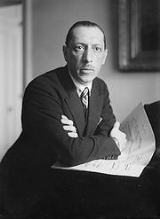
Igor Stravinsky

 
Igor Stravinsky

   Email Print
   Bookmark   Link


Igor Stravinsky


Igor Fyodorovich Stravinsky () ( – 6 April 1971) was a Russia
Russia

Russia , or the Russian Federation , is a list of countries spanning more than one continent country extending over much of northern Eurasia....
n-born composer
Composer

A composer is a person who creates music, usually in the medium of musical notation, for interpretation and performance. The level of distinction between composers and other musicians varies, which affects issues such as copyright and the deference given to individual interpretations of a particular piece of music....
, considered by many to be the most influential composer of 20th century music. He was a quintessentially cosmopolitan
Cosmopolitanism

Cosmopolitanism is the idea that all of human race belongs to a single community, possibly based on a shared morality. This is contrasted with Communitarianism theories, in particular the ideologies of patriotism and nationalism....
 Russian who was named by Time magazine
Time (magazine)

Time is a weekly United States newsmagazine, similar to Newsweek and U.S. News & World Report. A European edition is published from London....
 as one of the 100 most influential people of the century. In addition to the recognition he received for his compositions, he also achieved fame as a pianist and a conductor
Conducting

Conducting is the act of directing a musical performance by way of visible gestures. Orchestras, choirs, concert bands and other musical ensembles often have conductors....
, often at the premieres of his works.

Stravinsky's compositional career was notable for its stylistic diversity.


Discussion
Ask a question about 'Igor Stravinsky'
Start a new discussion about 'Igor Stravinsky'
Answer questions from other users
Full Discussion Forum


Recent Posts


Quotations


Composers combine notes, that's all.

Igor Stravinsky and Robert Craft (1982). Dialogues, p.52.

My music is best understood by children and animals.

Igor Stravinsky. The Observer, Oct 8, 1961

Music's exclusive function is to structure the flow of time and keep order in it.

Quoted by Géza Szamosi, The Twin Dimensions: Inventing Time and Space (New York, 1986), p. 232

One has a nose. The nose scents and it chooses. An artist is simply a kind of pig snouting truffles.

1962, quoted in Andriessen and Schoenberger, The Apollonian Clockwork (1989). Oxford: Oxford University Press.

What I cannot follow are the manic-depressive fluctuations from total control to no control, from the serialization of all elements to chance.

Igor Stravinsky and Robert Craft (1982). Themes and Conclusions, p.33. Berkley: University of California Press.

The trouble with music appreciation in general is that people are taught to have too much respect for music; they should be taught to love it instead.

Igor Stravinsky. "Subject: Music", New York Times Magazine, 9/27/64


Encyclopedia


Igor Fyodorovich Stravinsky () ( – 6 April 1971) was a Russia
Russia

Russia , or the Russian Federation , is a list of countries spanning more than one continent country extending over much of northern Eurasia....
n-born composer
Composer

A composer is a person who creates music, usually in the medium of musical notation, for interpretation and performance. The level of distinction between composers and other musicians varies, which affects issues such as copyright and the deference given to individual interpretations of a particular piece of music....
, considered by many to be the most influential composer of 20th century music. He was a quintessentially cosmopolitan
Cosmopolitanism

Cosmopolitanism is the idea that all of human race belongs to a single community, possibly based on a shared morality. This is contrasted with Communitarianism theories, in particular the ideologies of patriotism and nationalism....
 Russian who was named by Time magazine
Time (magazine)

Time is a weekly United States newsmagazine, similar to Newsweek and U.S. News & World Report. A European edition is published from London....
 as one of the 100 most influential people of the century. In addition to the recognition he received for his compositions, he also achieved fame as a pianist and a conductor
Conducting

Conducting is the act of directing a musical performance by way of visible gestures. Orchestras, choirs, concert bands and other musical ensembles often have conductors....
, often at the premieres of his works.

Stravinsky's compositional career was notable for its stylistic diversity. He first achieved international fame with three ballets commissioned
Commission (art)

In art, a commission is the hiring and payment for the creation of a piece, often on behalf of another.In classical music, Musical ensembles are often said to commission pieces from composers, wherein the ensemble secures the composer's payment from private or public organizations or donors....
 by the impresario Sergei Diaghilev
Sergei Diaghilev

Sergei Pavlovich Diaghilev , also referred to as Serge, was a Russian people art critic, patron, ballet impresario and founder of the Ballets Russes from which many famous dancers and choreographers would later arise....
 and performed by Diaghilev's Ballets Russes
Ballets Russes

The Ballets Russes was an itinerant ballet company which performed under the directorship of Sergei Diaghilev between 1909 and 1929. Some of their places of residence included the Th??tre Mogador and the Th??tre du Ch?telet, though they worked in many countries, including England, the U.S.A., and Spain....
 (Russian Ballets): L'Oiseau de feu ("The Firebird")
The Firebird

The Firebird is a 1910 ballet by Igor Stravinsky and choreographed by Michel Fokine. The ballet is based on Russian folk tales of the Firebird that is both a blessing and a curse to its captor....
 (1910), Petrushka (1911/1947), and Le Sacre du printemps ("The Rite of Spring")
The Rite of Spring

The Rite of Spring, commonly referred to by its original French language title, Le Sacre du Printemps is a ballet with music by the Russian composer Igor Stravinsky, original choreography by Vaslav Nijinsky, and original set design and costumes by archaeologist and painter Nicholas Roerich, all under impresario Serge Diaghilev....
 (1913). The Rite, whose premiere provoked a riot, transformed the way in which subsequent composers thought about rhythmic structure, and was largely responsible for Stravinky's enduring reputation as a musical revolutionary, pushing the boundaries of musical design.

After this first Russian phase Stravinsky turned to neoclassicism
Neoclassicism (music)

Neoclassicism in music was a 20th century development, particularly popular in the period between the two World Wars, in which composers drew inspiration from music of the 18th century, though some of the inspiring canon was drawn as much from the Baroque music period as the Classical music era period ? for this reason, music which draws infl...
 in the 1920s. The works from this period tended to make use of traditional musical forms (concerto grosso
Concerto grosso

The concerto grosso is a form of baroque music in which the musical material is passed between a small group of soloists and full orchestra ....
, fugue
Fugue

In music, a fugue is a type of counterpoint composition or technique of composition for a fixed number of melody, normally referred to as "voices"....
, symphony
Symphony

A symphony is a musical composition, often extended and usually for orchestra. "Symphony" does not imply a specific form. Many symphonies are tonality works in four movement with the first in sonata form, and this is often described by music theorists as the structure of a "Classical period " symphony, although even some symphonies by the ac...
), frequently concealed a vein of intense emotion beneath a surface appearance of detachment or austerity, and often paid tribute to the music of earlier masters, for example J. S. Bach
Johann Sebastian Bach

Johann Sebastian Bach was a German composer and organ whose sacred and secular works for choir, orchestra, and solo instruments drew together the strands of the Baroque music period and brought it to its ultimate maturity....
 and Tchaikovsky
Pyotr Ilyich Tchaikovsky

Pyotr Ilyich Tchaikovsky – ) was a Russian composer of the Romantic music era. He wrote some of the most popular concert and theatrical music in the current classical repertoire, including the ballets Swan Lake and Nutcracker, the 1812 Overture, his Piano Concerto No....
.

In the 1950s he adopted serial
Serialism

In music, serialism is a technique for Musical composition#A musical composition that uses Set to describe Aspect of music, and allows the Permutation of those sets....
 procedures, using the new techniques over his last twenty years. Stravinsky's compositions of this period share traits with all of his earlier output: rhythmic energy, the construction of extended melodic ideas out of a few two- or three-note cells, and clarity of form, of instrumentation, and of utterance.

He also published a number of books throughout his career, almost always with the aid of a collaborator, sometimes uncredited. In his 1936 autobiography, Chronicles of My Life, written with the help of Alexis Roland-Manuel
Alexis Roland-Manuel

Alexis Roland-Manuel was a France composer and critic, though he is remembered mainly for his work in the latter area.He was born Roland Alexis Manuel L?vy in Paris, to a family of Belgian and Jewish origins....
, Stravinsky included his infamous statement that "music is, by its very nature, essentially powerless to express anything at all." With Roland-Manuel and Pierre Souvtchinsky he wrote his 1939–40 Harvard University
Harvard University

Harvard University is a private university in Cambridge, Massachusetts, Massachusetts, United States, and a member of the Ivy League. Founded in 1636 by the colonial Massachusetts legislature, Harvard is the Colonial Colleges institution of higher learning in the United States....
 Charles Eliot Norton Lectures
Charles Eliot Norton Lectures

The Charles Eliot Norton Professorship of Poetry at Harvard University was established in 1925 as an annual lectureship in "poetry in the broadest sense" and named for the university's former professor of fine arts....
, which were delivered in French and later collected under the title in 1942 (translated in 1947 as Poetics of Music). Several interviews in which the composer spoke to Robert Craft
Robert Craft

Robert Lawson Craft is an United States Conducting and writer. He is best known for his intimate working friendship with Igor Stravinsky, a relationship which resulted in a number of recordings and books....
 were published as Conversations with Igor Stravinsky. They collaborated on five further volumes over the following decade.

Biography


Russia

Stravinsky was born in Oranienbaum
Lomonosov, Russia

Lomonosov is a types of settlements in Russia under the jurisdiction of Saint Petersburg, Russia, situated on the southern coast of the Gulf of Finland, 40 km west of St. Petersburg itself....
 (renamed Lomonosov in 1948), Russia
Russia

Russia , or the Russian Federation , is a list of countries spanning more than one continent country extending over much of northern Eurasia....
 and brought up in Saint Petersburg
Saint Petersburg

Saint Petersburg is a types of inhabited localities in Russia and a federal subjects of Russia of Russia located on the Neva River at the head of the Gulf of Finland on the Baltic Sea....
, to a Ukrainian
Ukraine

Ukraine is a country in Eastern Europe. It is bordered by Russia to the east; Belarus to the north; Poland, Slovakia, and Hungary to the west; Romania and Moldova to the southwest; and the Black Sea and Sea of Azov to the south....
 father and a Russian mother. His childhood, he recalled in his autobiography, was troubled: "I never came across anyone who had any real affection for me." His father, Fyodor Stravinsky
Fyodor Stravinsky

Fyodor Ignatievich Stravinsky , - ) was a Russian-Ukrainians basso opera singer and actor. He was the father of Igor Stravinsky and the grandfather of Soulima Stravinsky....
, was a bass singer at the Mariinsky Theater in Saint Petersburg, and the young Stravinsky began piano lessons and later studied music theory and attempted some composition. In 1890, Stravinsky saw a performance of Tchaikovsky's
Pyotr Ilyich Tchaikovsky

Pyotr Ilyich Tchaikovsky – ) was a Russian composer of the Romantic music era. He wrote some of the most popular concert and theatrical music in the current classical repertoire, including the ballets Swan Lake and Nutcracker, the 1812 Overture, his Piano Concerto No....
 ballet The Sleeping Beauty at the Mariinsky Theater; the performance, his first exposure to an orchestra, mesmerized him. At fourteen, he had mastered Mendelssohn
Felix Mendelssohn

Jakob Ludwig Felix Mendelssohn Bartholdy, born, and generally known in English-speaking countries, as Felix Mendelssohn was a Germany composer, pianist, organist and conducting of the early Romantic music period....
's Piano Concerto in G minor
Piano Concerto No. 1 (Mendelssohn)

Felix Mendelssohn's Piano Concerto No. 1 in G minor was written in 1830–1831, around the same time as his Symphony No. 4 , and premiered in Munich in October 1831....
, and the next year, he finished a piano reduction of one of Alexander Glazunov's
Alexander Glazunov

Aleksandr Konstantinovich Glazunov was a Russian composer, music teacher and Conducting. He served as director of the Saint Petersburg Conservatory between 1905 and 1928 and was also instrumental in the reorganization of the institute into the Petrograd Conservatory, then the Leningrad Conservatory, following the October Revolution....
 string quartets.

Despite his enthusiasm for music, his parents expected him to become a lawyer. Stravinsky enrolled to study law
LAW

LAW may refer to:* Anti-tank warfare, e.g. the US Army M72 LAW or the British Army LAW 80*Palestinian Society for the Protection of Human Rights ...
 at the University of Saint Petersburg in 1901, but was ill-suited for it, attending fewer than fifty class sessions in four years. After the death of his father in 1902, he had already begun spending more time on his musical studies. Because of the closure of the university in the spring of 1905, in the aftermath of Bloody Sunday
Bloody Sunday (1905)

Bloody Sunday was an incident on in Saint Petersburg, Russia, where unarmed, peaceful demonstrators marching to present a petition to Tsar Nicholas II of Russia were gunned down by the Leib Guard....
, Stravinsky was prevented from taking his law finals, and received only a half-course diploma, in April 1906. Thereafter, he concentrated on music. On the advice of Nikolai Rimsky-Korsakov
Nikolai Rimsky-Korsakov

Nikolai Andreyevich Rimsky-Korsakov , also Nikolay, Nicolai, and Rimsky-Korsakoff, was a Russian composer, and a member of the group of composers known as "The Five." Noted particularly for a predilection for folk and fairy-tale subjects as well as his extraordinary skill in orchestration, his best known orchestral compositions...
, probably the leading Russian composer of the time, he decided not to enter the Saint Petersburg Conservatoire; instead, in 1905, he began to take twice-weekly private tutelage from Rimsky-Korsakov, who became like a second father to him.

In 1905 he was betrothed to his cousin Katerina Nossenko, whom he had known since early childhood. They were married on 23 January 1906, and their first two children, Fyodor and Ludmilla, were born in 1907 and 1908 respectively.

In 1909, his (Fireworks), was performed in Saint Petersburg, where it was heard by Sergei Diaghilev
Sergei Diaghilev

Sergei Pavlovich Diaghilev , also referred to as Serge, was a Russian people art critic, patron, ballet impresario and founder of the Ballets Russes from which many famous dancers and choreographers would later arise....
, the director of the Ballets Russes
Ballets Russes

The Ballets Russes was an itinerant ballet company which performed under the directorship of Sergei Diaghilev between 1909 and 1929. Some of their places of residence included the Th??tre Mogador and the Th??tre du Ch?telet, though they worked in many countries, including England, the U.S.A., and Spain....
 in Paris
Paris

Paris is the Capital of France and the country's largest city. It is situated on the river Seine, in northern France, at the heart of the ?le-de-France Regions of France ....
. Diaghilev was sufficiently impressed to commission Stravinsky to carry out some orchestrations, and then to compose a full-length ballet score, L'Oiseau de feu ("The Firebird")
The Firebird

The Firebird is a 1910 ballet by Igor Stravinsky and choreographed by Michel Fokine. The ballet is based on Russian folk tales of the Firebird that is both a blessing and a curse to its captor....
.

Switzerland


Stravinsky travelled to Paris in 1910 to attend the premiere of The Firebird. His family soon joined him, and decided to remain in the West for a time. He moved to Switzerland
Switzerland

Switzerland is a landlocked Swiss Alps country of roughly 7.7 million people in Western Europe with an area of 41,285 km?. Switzerland is a federal republic consisting of 26 states called Cantons of Switzerland....
, where he lived until 1920 in Clarens
Clarens, Switzerland

Clarens is a small village in the municipality of Montreux, in the canton of Vaud, in Switzerland.Here the Russian composer Igor Stravinsky wrote his ballets The Rite of Spring and Pulcinella , and Tchaikovsky his Violin Concerto in march 1878....
 and Lausanne
Lausanne

Lausanne is a city in Romandy, the French language-speaking part of Switzerland, situated on the shores of Lake Geneva , and facing ?vian-les-Bains and with the Jura mountains to its north-west....
. During this time he composed three further works for the Ballets Russes—Petrushka (1911), written in Lausanne, and Le Sacre du printemps ("The Rite of Spring")
The Rite of Spring

The Rite of Spring, commonly referred to by its original French language title, Le Sacre du Printemps is a ballet with music by the Russian composer Igor Stravinsky, original choreography by Vaslav Nijinsky, and original set design and costumes by archaeologist and painter Nicholas Roerich, all under impresario Serge Diaghilev....
 (1913) and Pulcinella
Pulcinella (ballet)

Pulcinella is a ballet by Igor Stravinsky based on an 18th-century play ? Pulcinella is a character originating from Commedia dell'arte. The ballet premiered in Paris on 15 May, 1920 under the baton of Ernest Ansermet....
, both written in Clarens.

While the Stravinskys were in Switzerland, their second son, Soulima
Soulima Stravinsky

Sviatoslav Soulima Stravinsky was a Switzerland-United States pianist, composer and musicology of Ukrainian descent. As a pianist, he was considered an important interpreter of the works of his father, Igor Stravinsky, but as a composer he was overshadowed by his father, just as the sons of Johann Sebastian Bach were by their father....
 (who later became a minor composer), was born in 1910; and their second daughter, Maria Milena, was born in 1913. During this last pregnancy, Katerina was found to have tuberculosis
Tuberculosis

Tuberculosis is a common and often deadly infectious disease caused by mycobacterium, mainly Mycobacterium tuberculosis . Tuberculosis usually attacks the lungs but can also affect the central nervous system, the lymphatic system, the circulatory system, the genitourinary system, the gastrointestinal system, bones, joints, and even the...
, and she was placed in a Swiss sanatorium for her confinement. After a brief return to Russia in July 1914 to collect research materials for Les Noces
Les Noces

Les noces by Igor Stravinsky, is a dance cantata, or ballet with Singers....
, Stravinsky left his homeland and returned to Switzerland just before the outbreak of World War I
World War I

World War I, or the First World War , was a global military conflict which involved the Great powers, organized into two opposing military alliances: the Allies of World War I and the Central Powers....
 brought about the closure of the borders. He was not to return to Russia for nearly fifty years. Stravinsky was one of the few Eastern Orthodox or Russian Orthodox community representatives living in Switzerland at that time and is still remembered as such in Switzerland to date.

He had a significant artistic relationship with the Swiss philanthropist Werner Reinhart
Werner Reinhart

Werner Reinhart was a Swiss industrialist, philanthropist, amateur clarinettist, and patron of composers and writers, particularly Igor Stravinsky and Rainer Maria Rilke....
. He approached Reinhart for financial assistance when he was writing Histoire du soldat
Histoire du soldat

Histoire du soldat is a 1918 Theater work "to be read, played, and danced" set to music by Igor Stravinsky. The libretto, which is based on a Russian folk tale, was written in French language by the Swiss universalist writer Charles Ferdinand Ramuz....
 (The Soldier’s Tale). The first performance was conducted by Ernest Ansermet
Ernest Ansermet

Ernest Alexandre Ansermet was a Switzerland Conducting....
 on 28 September 1918, at the Theatre Municipal de Lausanne
Lausanne

Lausanne is a city in Romandy, the French language-speaking part of Switzerland, situated on the shores of Lake Geneva , and facing ?vian-les-Bains and with the Jura mountains to its north-west....
. Werner Reinhart sponsored and to a large degree underwrote this performance. In gratitude, Stravinsky dedicated the work to Reinhart, and even gave him the original manuscript. Reinhart continued his support of Stravinsky’s work in 1919 by funding a series of concerts of his recent chamber music. These included a suite of five numbers from The Soldier’s Tale, arranged for clarinet, violin, and piano, which was a nod to Reinhart, who was an excellent amateur clarinettist. The suite was first performed on 8 November 1919, in Lausanne, long before the better-known suite for the seven original instruments became widely known. In gratitude for Reinhart’s ongoing support, Stravinsky dedicated his Three Pieces for Clarinet (composed October-November 1918) to Reinhart. Reinhart later founded a music library of Stravinskiana at his home in Winterthur
Winterthur

Winterthur is a city in the Cantons of Switzerland of Zurich in northern Switzerland. It has the country's List of cities in Switzerland#Major agglomerations by population with an estimate of more than 100,000 people....
.

France

Stravinsky moved to France
France

France , officially the French Republic , is a country whose Metropolitan France is located in Western Europe and that also comprises various Overseas departments and territories of France....
 in 1920, where he formed a business and musical relationship with the French piano manufacturer Pleyel. Pleyel essentially acted as his agent in collecting mechanical royalties for his works, and in return provided him with a monthly income and a studio space in which to work and to entertain friends and business acquaintances.

Stravinsky also arranged (and to some extent re-composed) many of his early works for the Pleyela, Pleyel's brand of player piano
Player piano

The player piano is a self-playing piano, containing a pneumatic mechanism that plays on the piano action pre-programmed music via perforated piano rolls....
. Stravinsky did so in a way that made full use of the piano's 88 notes, without regard for the number or span of human fingers and hands. These were not recorded rolls, but were instead marked up from a combination of manuscript fragments and handwritten notes by the French musician, Jacques Larmanjat (musical director of Pleyel's roll department). Stravinsky later claimed that his intention had been to give listeners a definitive version of the performances of his music, but since the rolls were not recordings, it is difficult to see how effective this intention could have been in practice. While many of these works are now part of the standard repertoire, at the time many orchestras found his music beyond their capabilities and unfathomable. Major compositions issued on Pleyela piano roll
Piano roll

A piano roll is the music storage medium used to operate the player piano, pianola or a reproducing piano. The piano roll was the first medium which could be produced and copied industrially and made it possible to provide the customer with actual music fast and easily....
s include The Rite of Spring, Petrushka, Firebird, and Song of the Nightingale. During the 1920s he also recorded Duo-Art rolls for the Aeolian Company in both London and New York, not all of which survive.

After a short stay near Paris
Paris

Paris is the Capital of France and the country's largest city. It is situated on the river Seine, in northern France, at the heart of the ?le-de-France Regions of France ....
, Stravinsky moved with his family to the south of France. He returned to Paris in 1934, to live at the rue Faubourg-St.Honoré. Stravinsky later remembered this as his last and unhappiest European address; his wife's tuberculosis infected his eldest daughter Ludmila, and Stravinsky himself. Ludmila died in 1938, Katerina in the following year. Stravinsky spent five months in hospital, during which time his mother also died.

Although his marriage to Katerina endured for 33 years, the true love of his life, and later his partner until his death, was the woman who became his second wife Vera de Bosset
Vera de Bosset

Vera de Bosset Soudeikine was a long-term mistress and ultimately second wife of the Russian composer Igor Stravinsky, who married her in 1940 after the death of his first wife Katerina Nossenko....
 (1888-1982). When Stravinsky met Vera in Paris in February 1921, she was married to the painter and stage designer Serge Sudeikin
Serge Sudeikin

Sergey Yurievich Sudeikin, also known as Serge Soudeikine , was a Russian artist and set-designer associated with the Ballets Russes and the Metropolitan Opera....
, however they soon began an affair which led to her leaving her husband. From then until Katerina's death from cancer in 1939, Stravinsky led a double life, spending some of his time with his first family and the rest with Vera. Katerina soon learned of the relationship and accepted it as inevitable and permanent.

During his latter years in Paris, Stravinsky had developed professional relationships with key people in the United States
United States

The United States of America is a Federal government constitutional republic comprising U.S. state and a federal district. The country is situated mostly in central North America, where its Contiguous United States and Washington, D.C., the Capital districts and territories, lie between the Pacific Ocean and Atlantic Oceans, Borders of the U...
; he was already working on the Symphony in C
Symphony in C (Stravinsky)

The Symphony in C is a work by Russian expatriate composer Igor Stravinsky.The Symphony was written between 1938 and 1940 on a commission from American philanthropist Mrs....
 for the Chicago Symphony Orchestra, and had agreed to lecture at Harvard during the academic year of 1939-40. When World War II
World War II

World War II, or the Second World War , was a global military conflict which involved a Participants in World War II, including all of the great powers, organised into two opposing military alliances: the Allies of World War II and the Axis powers....
 broke out in September 1939, Stravinsky moved to the United States. Vera followed him early in the next year and they were married in Bedford, MA, USA, on 9 March 1940.

America

Stravinsky settled down in the Los Angeles
Los Ángeles

Los ?ngeles is the Capital of the Biob?o Province, in the municipality of the same name, in Regions of Chile VIII , in the center-south of Chile....
 area (1260 North Wetherly Drive, West Hollywood) where, in the end, he spent more time as a resident than any other city during his lifetime. He became a naturalized citizen
United States nationality law

Article_I_of_the_US_Constitution#Enumerated_powers of the United States Constitution expressly gives the United States Congress the power to establish a uniform rule of naturalization....
 in 1946. Stravinsky had adapted to life in France, but moving to America at the age of 58 was a very different prospect. For a time, he preserved a ring of emigré
Émigré

?migr? is a French language term that literally refers to a person who has "migrated out," but often carries a connotation of politico-social self-exile....
 Russian friends and contacts, but eventually found that this did not sustain his intellectual and professional life. He was drawn to the growing cultural life of Los Angeles, especially during World War II, when so many writers, musicians, composers, and conductors settled in the area; these included Otto Klemperer
Otto Klemperer

Otto Klemperer was a German-born Conducting and composer. He is widely regarded as one of the greatest conductors of the 20th century....
, Thomas Mann
Thomas Mann

Paul Thomas Mann was a German literature, short story writer, social critic, philanthropist, essayist, and 1929 Nobel Prize for Literature, known for his series of highly symbolic and irony epic novels and novellas, noted for their insight into the psychology of the artist and the intellectual....
, Franz Werfel
Franz Werfel

Franz Werfel was an Austrian people-Bohemian novelist, playwright, and poet....
, George Balanchine
George Balanchine

George Balanchine , born Giorgi Melitonis dze Balanchivadze in Saint Petersburg, Russia, to Georgians parents, was one of the 20th century's foremost choreographers, a pioneer of ballet in the United States, co-founder and balletmaster of New York City Ballet: his work created modern ballet, based on his deep knowledge of classical for...
 and Arthur Rubinstein
Arthur Rubinstein

Arthur Rubinstein Knight Commander of the Order of the British Empire was a Poland-United States pianist who is widely considered as one of the greatest pianists of the 20th century....
. He lived fairly near to Arnold Schoenberg
Arnold Schoenberg

Arnold Schoenberg was an Austrian and later American composer, associated with the expressionist movement in German poetry and art, and leader of the Second Viennese School....
, though he did not have a close relationship with him. Bernard Holland notes that he was especially fond of British writers who often visited him in Beverly Hills, "like W. H. Auden
W. H. Auden

Wystan Hugh Auden who signed his works W. H. Auden, was an Anglo-American poet, regarded by many as one of the greatest writers of the 20th century....
, Christopher Isherwood
Christopher Isherwood

Christopher William Bradshaw Isherwood was an Anglo-American novelist....
, Dylan Thomas
Dylan Thomas

Dylan Marlais Thomas was a Welsh people poet who wrote exclusively in English. In addition to poetry, he wrote short stories and scripts for film and radio, which he often performed himself....
 (who shared the composer's taste for hard spirits) and, especially, Aldous Huxley
Aldous Huxley

Aldous Leonard Huxley was an English writer and one of the most prominent members of the famous Huxley family. He spent the later part of his life in the United States, living in Los Angeles from 1937 until his death in 1963....
, with whom Stravinsky spoke in French." He settled into life in Los Angeles and sometimes conducted concerts with the Los Angeles Philharmonic
Los Angeles Philharmonic

The Los Angeles Philharmonic is an United States orchestra based in Los Angeles, California, California, United States. It has a regular season of concerts from October through June at the Walt Disney Concert Hall, and a summer season at the Hollywood Bowl from July through September....
 at the famous Hollywood Bowl
Hollywood Bowl

The Hollywood Bowl is a famous modern amphitheatre in the Hollywood area of Los Angeles, California, USA, that is used primarily for music performances....
 as well as throughout the U.S. When he planned to write an opera with W. H. Auden, the need to acquire more familiarity with the English
English language

English is a West Germanic language that originated in Anglo-Saxon England and has lingua franca status in many parts of the world as a result of the military, economic, scientific, political and cultural influence of the British Empire in the 18th, 19th and early 20th centuries and that of the United States from the mid 20th century onwa...
-speaking world coincided with his meeting the conductor and musicologist Robert Craft
Robert Craft

Robert Lawson Craft is an United States Conducting and writer. He is best known for his intimate working friendship with Igor Stravinsky, a relationship which resulted in a number of recordings and books....
. Craft lived with Stravinsky until the composer's death, acting as interpreter, chronicler, assistant conductor, and factotum
Factotum

Factotum is the second novel by United States author Charles Bukowski, published in 1975. The plot follows Henry Chinaski, Bukowski's alter ego, who has been rejected from the World War II conscription and instead makes his way from one menial job to the next ....
 for countless musical and social tasks.

On April 15, 1940, Stravinsky's unconventional major seventh chord in his arrangement of the Star-Spangled Banner led to his arrest by the Boston police for violating a federal law that prohibited the reharmonization of the National Anthem.

In 1959, Stravinsky was awarded the Sonning Award, Denmark's highest musical honour. In 1962, he accepted an invitation to return to Leningrad
Leningrad

Leningrad is the former name of Saint Petersburg, Russia.Leningrad may also refer to:* Leningrad Oblast, a federal subject of Russia* Soviet helicopter carrier Leningrad, of the Soviet Navy...
 (today known as Saint Petersburg) for a series of concerts. He spent more than two hours speaking with Soviet leader Nikita Khrushchev
Nikita Khrushchev

Nikita Sergeyevich Khrushchev served as General Secretary of the Communist Party of the Soviet Union of the Communist Party of the Soviet Union from 1953 to 1964, following the death of Joseph Stalin, and Premier of the Soviet Union from 1958 to 1964....
, who urged him to return to the Soviet Union
Soviet Union

The Union of Soviet Socialist Republics was a Constitution of the Soviet Union socialist state that existed in Eurasia from 1922 to 1991.The name is a translation of the , romanization of Russian Soyuz Sovetskikh Sotsialisticheskikh Respublik, abbreviated ????, SSSR....
. Despite the invitation, Stravinsky remained settled in the West.

Stravinskygrave
In 1969, he moved to New York
New York

The State of New York is a U.S. state in the Mid-Atlantic States and Northeastern United States regions of the United States and is the nation's List of U.S....
 where he lived his last years at Essex House
Jumeirah Essex House

The Jumeirah Essex House is a luxury hotel located on Central Park South in Manhattan. Built in 1931 as the Park Tower hotel, it is situated across the street from the southern border of Central Park and is convenient to both the stylish shops on Fifth Avenue and the nightlife of both Broadway and the Upper West Side....
. Two years later, he died at the age of 88 in New York City and was buried in Venice
Venice

Venice is a city in northern Italy, the capital city of the Italian regions Veneto, a population of 271,251 . Together with Padua, Italy, the city is included in the Padua-Venice Metropolitan Area ....
 on the cemetery island of San Michele
San Michele

San Michele is the Italian people name of the Archangel Michael .Derived from the angel's name, it is the name of various locations and churches in Italy, the most well-known being...
. His grave is close to the tomb of his long-time collaborator Sergei Diaghilev
Sergei Diaghilev

Sergei Pavlovich Diaghilev , also referred to as Serge, was a Russian people art critic, patron, ballet impresario and founder of the Ballets Russes from which many famous dancers and choreographers would later arise....
. Stravinsky's professional life had encompassed most of the 20th century, including many of its modern classical music styles, and he influenced composers both during and after his lifetime. He has a star on the Hollywood Walk of Fame
Hollywood Walk of Fame

The Hollywood Walk of Fame is a sidewalk along Hollywood Boulevard and Vine Street in Hollywood, Los Angeles, California, USA, that serves as an entertainment hall of fame....
 at 6340 Hollywood Boulevard and posthumously received the Grammy Award
Grammy Award

The Grammy Awards ?or Grammys?are presented annually by the National Academy of Recording Arts and Sciences of the United States for outstanding achievements in the music industry....
 for Lifetime Achievement
Grammy Lifetime Achievement Award

The Grammy Award Lifetime Achievement Award is awarded by the National Academy of Recording Arts and Sciences to "performers who, during their lifetimes, have made creative contributions of outstanding artistic significance to the field of recording" ....
 in 1987.

Personality

Stravinsky displayed an inexhaustible desire to explore and learn about art, literature, and life. This desire manifested itself in several of his Paris collaborations. Not only was he the principal composer for Sergei Diaghilev
Sergei Diaghilev

Sergei Pavlovich Diaghilev , also referred to as Serge, was a Russian people art critic, patron, ballet impresario and founder of the Ballets Russes from which many famous dancers and choreographers would later arise....
's Ballets Russes, but he also collaborated with Pablo Picasso
Pablo Picasso

Pablo Diego Jos? Francisco de Paula Juan Nepomuceno Mar?a de los Remedios Cipriano de la Sant?sima Trinidad Ruiz y Picasso was a Spanish people Painting, drawing, and Sculpture....
 (Pulcinella
Pulcinella (ballet)

Pulcinella is a ballet by Igor Stravinsky based on an 18th-century play ? Pulcinella is a character originating from Commedia dell'arte. The ballet premiered in Paris on 15 May, 1920 under the baton of Ernest Ansermet....
, 1920), Jean Cocteau
Jean Cocteau

Jean Maurice Eug?ne Cl?ment Cocteau was a French poet, novelist, dramatist, designer, boxing manager, playwright and filmmaker. Along with other Surrealists of his generation Cocteau grappled with the "algebra" of verbal codes old and new, mise en sc?ne language and technologies of modernism to create a paradox: a classical avant-garde....
 (1927) and George Balanchine
George Balanchine

George Balanchine , born Giorgi Melitonis dze Balanchivadze in Saint Petersburg, Russia, to Georgians parents, was one of the 20th century's foremost choreographers, a pioneer of ballet in the United States, co-founder and balletmaster of New York City Ballet: his work created modern ballet, based on his deep knowledge of classical for...
 (1928). His taste in literature was wide, and reflected his constant desire for new discoveries. The texts and literary sources for his work began with a period of interest in Russian folklore
Folklore

Folklore is the body of expressive culture, including tales, music, dance, legends, oral history, proverbs, jokes, superstitions, customs, and so forth within a particular population comprising the traditions of that culture, subculture, or group ....
, progressed to classical authors and the Latin liturgy
Roman Rite

The liturgy of the Catholic Church of Rome is called the Roman Rite. The quite distinct term Latin Rite usually refers not to a liturgical rite but to the particular Church within the Roman Catholic Church that was sometimes referred to also as the Patriarchate of the West....
, and moved on to contemporary France (André Gide
André Gide

Andr? Paul Guillaume Gide was a France author and winner of the Nobel Prize in literature in 1947. Gide's career ranged from its beginnings in the Symbolism movement, to the advent of Anti-imperialism between the two World Wars....
, in Persephone) and eventually English literature, including Auden, T. S. Eliot
T. S. Eliot

'Thomas Stearns Eliot', Order of Merit , was a poet, dramatist, and literary critic. He received the Nobel Prize in Literature in 1948. Among his most famous writings are the poems The Love Song of J....
 and medieval English verse. At the end of his life, he set Hebrew
Hebrew language

Hebrew is a Semitic languages of the Afro-Asiatic languages. Modern Hebrew is spoken by more than seven million people in Israel and Classical Hebrew is used for prayer or study in Jews communities around the world....
 scripture
Hebrew Bible

The term Hebrew Bible is a generic reference to those books of the Bible originally written mostly in Biblical Hebrew with some Biblical Aramaic....
 in Abraham and Isaac.

Stravinsky Picasso
Patronage was never far away. In the early 1920s, Leopold Stokowski
Leopold Stokowski

Leopold Stokowski was a famous orchestral conducting, well known for his free-hand performing style that spurned the traditional baton and for obtaining a characteristically sumptuous sound from many of the great orchestras he conducted....
 gave Stravinsky regular support through a pseudonymous "benefactor". The composer was also able to attract commissions: most of his work from The Firebird onwards was written for specific occasions and was paid for generously.

Stravinsky proved adept at playing the part of "man of the world", acquiring a keen instinct for business matters and appearing relaxed and comfortable in many of the world's major cities. Paris
Paris

Paris is the Capital of France and the country's largest city. It is situated on the river Seine, in northern France, at the heart of the ?le-de-France Regions of France ....
, Venice
Venice

Venice is a city in northern Italy, the capital city of the Italian regions Veneto, a population of 271,251 . Together with Padua, Italy, the city is included in the Padua-Venice Metropolitan Area ....
, Berlin
Berlin

Berlin is the Capital of Germany city and one of sixteen States of Germany of Germany. With a population of 3.4 million within its city limits, Berlin is the country's largest city....
, London
London

London is the capital of both England and the United Kingdom, and the most populous municipality in the European Union. An important settlement for two millennia, History of London goes back to its founding by the Roman Empire....
, Amsterdam
Amsterdam

Amsterdam is the Capital of the Netherlands and List of cities in the Netherlands with over 100,000 people of the Netherlands, located in the Provinces of the Netherlands of North Holland in the west of the country....
 and New York City
New York City

The City of New York is the List of United States cities by population in the United States, while the New York metropolitan area ranks among the List of urban areas by population....
 all hosted successful appearances as pianist and conductor. Most people who knew him through dealings connected with performances spoke of him as polite, courteous and helpful. For example, Otto Klemperer
Otto Klemperer

Otto Klemperer was a German-born Conducting and composer. He is widely regarded as one of the greatest conductors of the 20th century....
, who knew Arnold Schoenberg
Arnold Schoenberg

Arnold Schoenberg was an Austrian and later American composer, associated with the expressionist movement in German poetry and art, and leader of the Second Viennese School....
 well, said that he always found Stravinsky much more co-operative and easy to deal with. At the same time, he had a marked disregard for those he perceived to be his social inferiors: Robert Craft
Robert Craft

Robert Lawson Craft is an United States Conducting and writer. He is best known for his intimate working friendship with Igor Stravinsky, a relationship which resulted in a number of recordings and books....
 was embarrassed by his habit of tapping a glass with a fork and loudly demanding attention in restaurants.

Although a notorious philanderer (who was rumoured to have affairs with high-profile partners such as Coco Chanel
Coco Chanel

Gabrielle Bonheur "Coco" Chanel was a pioneering French fashion designer whose modernist philosophy, menswear-inspired fashions, and pursuit of expensive simplicity made her an important figure in 20th-century fashion....
), Stravinsky was also a family man who devoted considerable amounts of his time and expenditure to his sons and daughters.

Stravinsky was also a devout member of the Russian Orthodox Church
Russian Orthodox Church

The Russian Orthodox Church ; or The Moscow Patriarchate , also known as the Orthodox Christian Church of Russia, is a body of Christianity who constitute an Autocephaly Eastern Orthodox Church under the jurisdiction of the List of Metropolitans and Patriarchs of Moscow, in full communion with the other Eastern Orthodox Churches....
 all throughout his life, remarking at one time, "Music praises God. Music is well or better able to praise him than the building of the church and all its decoration; it is the Church's greatest ornament."

Stylistic periods

Stravinsky's career may be divided roughly into three stylistic periods.

'Russian' Period (c.1908-1919)

The first period (excluding some early minor works) began with Feu d'artifice and achieved prominence with the three ballets
Ballet (music)

Ballet as a musical form is a musical composition intended for Ballet. The same music can be used for several different ballet Choreography....
 composed for Diaghilev. These three works have several characteristics in common: they are scored for an extremely large orchestra; they use Russian folk
Folk music

Folk music can have a number of different meanings, including:* Traditional music: The original meaning of the term "folk music" was synonymous with the term "Traditional music", also often including World Music and Roots music; the term "Traditional music" was given its more specific meaning to distinguish it from the other definition...
 themes and motifs; and they are influenced by Rimsky-Korsakov's imaginative scoring and instrumentation. They also exhibit considerable stylistic development: from the , which emphasizes certain tendencies in Rimsky-Korsakov and features pandiatonicism conspicuously in the third movement, to the use of polytonality
Polytonality

The musical use of more than one key simultaneity is polytonality. Bitonality is the use of only two different keys at the same time.A well-known, controversial example is the fanfare at the beginning of the second tableau of Igor Stravinsky's ballet, Petrushka....
 in Petrushka, and the intentionally brutal polyrhythms and dissonances of .

The first of the ballets, , is noted for its imaginative orchestration
Orchestration

Orchestration is the study or practice of writing music for an orchestra or of adapting for orchestra music composed for another medium. It only gradually over the course of music history came to be regarded as a compositional art in itself....
, evident at the outset from the introduction in 12/8 meter, which exploits the low register of the double bass. Petrushka, the first of Stravinsky's ballets to draw on folk mythology
Mythology

The word mythology refers to a body of folklore/myths/legends that a particular culture believes to be true and that often use the supernatural to interpret natural events and to explain the nature of the universe and humanity....
, is also distinctively scored. In the third ballet, The Rite of Spring, the composer attempted to depict musically the brutality of pagan Russia, which inspired the violent motifs that recur throughout the work. To this day its vision of pagan rituals, enacted in an imaginary ancient Russia continues to dazzle and overwhelm audiences. Once again, Stravinsky's originality is evident: the opening theme, played on a bassoon at the very top of its register, has become one of the most famous passages in Western art music, as has the pulsing syncopated eighth-note motif in the strings, its accents marked by horn
Horn (instrument)

The horn is a brass instrument consisting of about of tubing wrapped into a coil with a flared bell. It is descended from the natural horn and is informally known as the French horn....
.

If Stravinsky's stated intention was "to send them all to hell", then he may have rated the 1913 premiere of as a success: it is among the most famous classical music riot
Classical music riot

A classical music riot is violent, disorderly behavior that occurs upon the premiere of a controversial piece of european classical music. The usual respectful and sedate manner of classical music audiences means that any sort of rough behavior, ranging from catcalls to shoving, can be seen as a comparative 'riot'....
s, and Stravinsky referred to it frequently as a "scandale" in his autobiography. There were reports of fistfights among the audience, and the need for a police presence during the second act. The real extent of the tumult, however, is open to debate, and these reports may be apocryphal.

Stravinsky later commented about the première of The Rite: "As for the actual performance, I am not in a position to judge, as I left the auditorium at the first bars of the prelude, which had at once evoked derisive laughter. I was disgusted. These demonstrations, at first isolated, soon became general, provoking counter-demonstrations and very quickly developing into a terrific uproar. During the whole performance I was at Nijinsky
Nijinsky

Nijinsky can refer to:*Vaslav Nijinsky ballet dancer and choreographer*Nijinsky about the eponymous dancer starring Alan Bates and produced by Harry Saltzman...
's side in the wings. He was standing on a chair, screaming 'Sixteen, seventeen, eighteen'--they had their own method of counting to keep time. Naturally the poor dancers could hear nothing by reason of the row in the auditorium and the sound of their own dance-steps. I had to hold Nijinsky by his clothes, for he was furious, and ready to dash on to the stage at any moment and create a scandal. Diaghilev kept ordering the electricians to turn the lights on or off, hoping in that way to put a stop to the noise. That is all I can remember about that first performance."

Other pieces from this period include: (The Nightingale); Renard (1916); (1918); and (The Wedding) (1923).

Neoclassical Period (c.1920-1954)

The next phase of Stravinsky's compositional style extended from roughly 1920 to about 1954, when he began using serial techniques. Pulcinella
Pulcinella (ballet)

Pulcinella is a ballet by Igor Stravinsky based on an 18th-century play ? Pulcinella is a character originating from Commedia dell'arte. The ballet premiered in Paris on 15 May, 1920 under the baton of Ernest Ansermet....
 (1920) and the Octet (1923) for wind instruments are Stravinsky's first compositions to feature his re-examination of the classical music of Mozart
Wolfgang Amadeus Mozart

Wolfgang Amadeus Mozart Mozart showed prodigious ability from his earliest childhood in Salzburg. Already competent on keyboard and violin, he composed from the age of five and performed before European royalty; at seventeen he was engaged as a court musician in Salzburg, but grew restless and traveled in search of a better position, always...
 and Bach
Johann Sebastian Bach

Johann Sebastian Bach was a German composer and organ whose sacred and secular works for choir, orchestra, and solo instruments drew together the strands of the Baroque music period and brought it to its ultimate maturity....
 and their contemporaries. For this "neo-classical
Neoclassicism (music)

Neoclassicism in music was a 20th century development, particularly popular in the period between the two World Wars, in which composers drew inspiration from music of the 18th century, though some of the inspiring canon was drawn as much from the Baroque music period as the Classical music era period ? for this reason, music which draws infl...
" style Stravinsky abandoned the large orchestras demanded by the ballets, and turned instead largely to wind instruments, the piano, and choral and chamber works.

Other works such as (1927), (1928, for the Russian Ballet) and the Dumbarton Oaks
Concerto in E-flat (Dumbarton Oaks)

Concerto in E-flat is a chamber concerto by Igor Stravinsky, named for the Dumbarton Oaks estate of Robert Woods Bliss in Washington, DC, who commissioned it for his thirtieth wedding anniversary....
 Concerto (1937–38) continued this re-thinking of eighteenth-century musical styles.

Works from this period include the three symphonies: the (Symphony of Psalms) (1930), Symphony in C (1940) and Symphony in Three Movements (1945). Apollon, Persephone (1933) and Orpheus (1947) exemplify not only Stravinsky's return to music of the Classical period, but also his exploration of themes from the ancient Classical world such as Greek mythology
Greek mythology

Greek mythology is the body of myths and legends belonging to the Ancient Greece concerning their List of Greek mythological figures#Immortals and Greek hero cult, Cosmology#Metaphysical cosmology, and the origins and significance of their own cult and ritual practices....
.

Stravinsky completed his last neo-classical work, the opera The Rake's Progress
The Rake's Progress

The Rake's Progress is an opera in three acts and an epilogue by Igor Stravinsky. The libretto written by W. H. Auden and Chester Kallman is based loosely on the eight paintings and engravings A Rake's Progress of William Hogarth, which Stravinsky had seen on May 2, 1947, in a Chicago exhibition....
, in 1951, to a libretto by W. H. Auden
W. H. Auden

Wystan Hugh Auden who signed his works W. H. Auden, was an Anglo-American poet, regarded by many as one of the greatest writers of the 20th century....
 based on the etchings of Hogarth
William Hogarth

William Hogarth was a major England painting, Printmaking, pictorial satire, Social criticism and editorial cartoonist who has been credited with pioneering western sequential art....
. It was almost ignored after it was staged by the Metropolitan Opera
Metropolitan Opera

The Metropolitan Opera Association of New York City, founded in April 1880, is a major presenter of all types of opera including Grand Opera. Peter Gelb is the company's general manager and James Levine is music director....
 in 1953. It was presented by the Santa Fe Opera
Santa Fe Opera

The Santa Fe Opera is an American opera company, located north of Santa Fe, New Mexico in the U.S. state of New Mexico, headquartered on a former guest ranch of ....
 in its first season in 1957 with Stravinsky in attendance, and this marked the beginning of his long association with the company. The music is direct but quirky; it borrows from classic tonal harmony but also interjects surprising dissonances; it features Stravinsky's trademark off-rhythms; and it harks back to the operas and themes of Monteverdi
Claudio Monteverdi

Claudio Giovanni Antonio Monteverdi , was an Italian composer, viol, and singer.Monteverdi's work, often regarded as revolutionary, marked the transition from the music of the Renaissance music to that of the Baroque music....
, Gluck
Christoph Willibald Gluck

Christoph Willibald Ritter von Gluck was an opera composer of the early classical period. After many years at the Habsburg court at Vienna, Gluck brought about the practical reform of opera's dramaturgical practices that many intellectuals had been campaigning for over the years....
 and Mozart
Wolfgang Amadeus Mozart

Wolfgang Amadeus Mozart Mozart showed prodigious ability from his earliest childhood in Salzburg. Already competent on keyboard and violin, he composed from the age of five and performed before European royalty; at seventeen he was engaged as a court musician in Salzburg, but grew restless and traveled in search of a better position, always...
. The opera was revived by the Metropolitan Opera in 1997.

Serial Period (1954-1968)

Stravinsky began using serial
Serialism

In music, serialism is a technique for Musical composition#A musical composition that uses Set to describe Aspect of music, and allows the Permutation of those sets....
 compositional techniques, including dodecaphony, the twelve-tone technique originally devised by Arnold Schoenberg
Arnold Schoenberg

Arnold Schoenberg was an Austrian and later American composer, associated with the expressionist movement in German poetry and art, and leader of the Second Viennese School....
, in the early 1950s (after Schoenberg's death). Robert Craft
Robert Craft

Robert Lawson Craft is an United States Conducting and writer. He is best known for his intimate working friendship with Igor Stravinsky, a relationship which resulted in a number of recordings and books....
 encouraged this undertaking.

He first experimented with non-twelve-tone serial technique in small-scale vocal and chamber works such as the Cantata (1952), Septet (1953), and Three Songs from Shakespeare (1953), and his first composition to be fully based on these non-twelve-tone serial techniques is In Memoriam Dylan Thomas (1954). Agon (1954–57) is his first work to include a twelve-tone series, and (1955) is his first piece to contain a movement entirely based on a tone row
Tone row

In music, a tone row or note row , also series and set, refers to a non-repetitive ordering of the twelve notes of the chromatic scale....
 ("Surge, aquilo"). Stravinsky later expanded his use of dodecaphony in works including Threni (1958), A Sermon, a Narrative, and a Prayer (1961), and The Flood
The Flood (Stravinsky)

The Flood: A musical play is a short biblical drama by Igor Stravinsky on the allegory of Noah, originally written as a television opera in response to a commission by CBS....
 (1962), which are based on biblical texts.

Agon, written from 1954 to 1957, is a ballet choreographed for twelve dancers. It is an important transitional composition between Stravinsky's neo-classical period and his serial style. Some numbers of Agon are reminiscent of the "white-note" tonality of his neo-classic period, while others (for example Bransle Gay) display his re-interpretation of serial methods.

Innovation and influence

"One of music's truly epochal innovators", the most important aspect of Stravinsky's work aside from his technical innovations, including in rhythm and harmony, is the, "changing face," of his compositional style while always "retaining a distinctive, essential identity". He himself was inspired by different cultures, languages and literatures. As a consequence, his influence on composers both during his lifetime and after his death was, and remains, considerable. "No other composer of the twentieth century exerted such a pervasive influence or dominated his art in the way that Stravinsky did during his five-decade musical career".

Composition

Stravinsky's use of motivic development
Motif (music)

In music, a motif or motive is a perceivable or salience recurring fragment or succession of notes that may be used to construct the entirety or parts of complete melody and theme s....
 (the use of musical figures that are repeated in different guises throughout a composition or section of a composition) included additive motivic development. This is where notes are subtracted or added to a motif without regard to the consequent changes in meter. A similar technique may be found as early as the sixteenth century, for example in the music of Cipriano de Rore
Cipriano de Rore

Cipriano de Rore was a Franco-Flemish school composer of the Renaissance music, active in Italy. Not only was he central representative of the generation of Franco-Flemish composers after Josquin des Prez who went to live and work in Italy, but he was one of the most prominent composers of madrigals in the middle of the 16th century....
, Orlandus Lassus
Orlande de Lassus

Orlande de Lassus was a France-Flanders composer of late Renaissance music. Along with Giovanni Pierluigi da Palestrina , he is today considered to be the chief representative of the mature polyphony style of the Franco-Flemish School, and he was the most famous and influential musician in Europe at the end of the 16th century....
, Carlo Gesualdo
Carlo Gesualdo

Carlo Gesualdo, known as Gesualdo da Venosa , Prince of Venosa and Count of Conza, was an Italian music composer, lutenist and nobleman of the late Renaissance music....
, and Giovanni de Macque
Giovanni de Macque

Giovanni de Macque was a Dutch School composer of the late Renaissance music and early Baroque music, who spent almost his entire life in Italy....
, music with which Stravinsky exhibited considerable familiarity.

The Rite of Spring is also notable for its relentless use of ostinati
Ostinato

In music, an Ostinato is a motif or phrase which is persistently repetition in the same musical voice. The repeating idea may be a rhythmic pattern, part of a tune, or a complete melody....
; for example, in the eighth note ostinato on strings accented by eight horns
Horn (instrument)

The horn is a brass instrument consisting of about of tubing wrapped into a coil with a flared bell. It is descended from the natural horn and is informally known as the French horn....
 in the section Auguries of Spring (Dances of the Young Girls). The work also contains passages where several ostinati clash against one another.

Rhythm

Stravinsky was noted for his distinctive use of rhythm
Rhythm

Rhythm is the variation of the length and accentuation of a series of sounds or other events....
, especially in The Rite of Spring.

According to Philip Glass
Philip Glass

Philip Glass is an American music composer. He is considered one of the most influential composers of the late-20th century and is widely acknowledged as a composer who has brought art music to the public ....
:

the idea of pushing the rhythms across the bar lines [...] led the way [...] the rhythmic structure of music became much more fluid and in a certain way spontaneous


Glass also praises Stravinsky's "primitive, offbeat rhythmic drive".

According to Andrew J. Browne, "Stravinsky is perhaps the only composer who has raised rhythm in itself to the dignity of art."

Stravinsky's rhythm and vitality greatly influenced composer Aaron Copland
Aaron Copland

Aaron Copland was an American classical music composer of concert and film music, as well as an accomplished pianist. Instrumental in forging a distinctly American style of composition, he was widely known as "the dean of American composers." Copland's music achieved a balance between modernism music and American folk styles....
.

Neoclassicism

Stravinsky's first neo-classical works were the ballet Pulcinella of 1920, and the stripped-down and delicately scored Octet for winds of 1923. Stravinsky may have been preceded in his use of neoclassical devices by earlier composers such as Erik Satie
Erik Satie

Alfred ?ric Leslie Satie was a France composer and pianist. Starting with his first composition in 1884, he signed his name as Erik Satie....
. By the late 1920s and 1930s, the use by composers of neoclassicism had become widespread.

Quotation

Stravinsky continued a long tradition, stretching back at least to the fifteenth century in the form of the quodlibet
Quodlibet

A quodlibet is a piece of music combining several different melody, usually popular tunes, in counterpoint and often a light-hearted, humorous manner....
 and parody mass
Parody mass

A parody mass is a musical setting of the mass , typically from the 16th century, that uses multiple voices of another pre-existing piece of music, such as a fragment of a motet or a secular chanson, as part of its melodic material....
, by composing pieces which elaborate on individual works by earlier composers. An early example of this is his Pulcinella
Pulcinella (ballet)

Pulcinella is a ballet by Igor Stravinsky based on an 18th-century play ? Pulcinella is a character originating from Commedia dell'arte. The ballet premiered in Paris on 15 May, 1920 under the baton of Ernest Ansermet....
 of 1920, in which he used music which at the time was attributed to Giovanni Pergolesi
Giovanni Battista Pergolesi

Giovanni Battista Pergolesi was an Italy composer, violinist and organ ....
  as source material, at times quoting it directly and at other times reinventing it. He developed the technique further in the ballet The Fairy's Kiss of 1928, based on the music—mostly piano pieces—of Tchaikovsky
Pyotr Ilyich Tchaikovsky

Pyotr Ilyich Tchaikovsky – ) was a Russian composer of the Romantic music era. He wrote some of the most popular concert and theatrical music in the current classical repertoire, including the ballets Swan Lake and Nutcracker, the 1812 Overture, his Piano Concerto No....
. Later examples of comparable musical transformations include Stravinsky's use of Schubert in Circus Polka
Circus Polka

Circus Polka: For a Young Elephant is an instrumental written by Igor Stravinsky in 1942. He composed it for a ballet production the Russian-born choreographer of Georgia extraction George Balanchine did for Ringling Bros....
 (1942) and Happy Birthday to You
Happy Birthday to You

"Happy Birthday to You", also known more simply as "Happy Birthday", is a traditional song that is sung to celebrate the birthday. According to the 1998 Guinness Book of World Records, "Happy Birthday to You" is the most well recognized song in the English language, followed by "For He's a Jolly Good Fellow" and "Auld Lang Syne"....
 in Greeting Prelude (1955).

Folk material

In Stravinsky stripped folk themes to their most basic melodic outlines, and often contorted them beyond recognition with added notes, and other techniques including inversion
Inversion (music)

In music theory, the word inversion has several meanings. There are inverted chords, inverted melodies, inverted intervals, and inverted voices....
 and diminution
Diminution

Diminution, from Italian diminuimento, is a musical term used to mean different things in the context of interval , scales, chord or note values....
.

Orchestra

Like many of the late romantic composers
Romantic music

In music, romanticism is a term, often considered misleading, and concept derived from literature traditionally defined by attributes including, "interest in nature, medieval chivalry, mysticism, [and] remoteness [ Social alienation and Solitude]"....
, Stravinsky often called for huge orchestral forces, especially in the early ballets. His first breakthrough The Firebird
The Firebird

The Firebird is a 1910 ballet by Igor Stravinsky and choreographed by Michel Fokine. The ballet is based on Russian folk tales of the Firebird that is both a blessing and a curse to its captor....
 proved him the equal of Nikolai Rimsky-Korsakov
Nikolai Rimsky-Korsakov

Nikolai Andreyevich Rimsky-Korsakov , also Nikolay, Nicolai, and Rimsky-Korsakoff, was a Russian composer, and a member of the group of composers known as "The Five." Noted particularly for a predilection for folk and fairy-tale subjects as well as his extraordinary skill in orchestration, his best known orchestral compositions...
 and lit the "fuse under the instrumental make up of the 19th century orchestra". In The Firebird he took the orchestra apart and analyzed it. The Rite of Spring on the other hand has been characterized by Aaron Copland
Aaron Copland

Aaron Copland was an American classical music composer of concert and film music, as well as an accomplished pianist. Instrumental in forging a distinctly American style of composition, he was widely known as "the dean of American composers." Copland's music achieved a balance between modernism music and American folk styles....
 as the foremost orchestral achievement in 20th century.

Stravinsky also wrote for unique combinations of instruments in smaller ensembles, chosen for their precise tone colours. For example, Histoire du soldat
Histoire du soldat

Histoire du soldat is a 1918 Theater work "to be read, played, and danced" set to music by Igor Stravinsky. The libretto, which is based on a Russian folk tale, was written in French language by the Swiss universalist writer Charles Ferdinand Ramuz....
 (The Soldier's Tale) is scored for clarinet
Clarinet

The clarinet is a musical instrument in the woodwind family. The name derives from adding the suffix -et meaning little to the Italian word clarino meaning a particular type of trumpet, as the first clarinets had a strident tone similar to that of a trumpet....
, bassoon
Bassoon

The bassoon is a woodwind instrument in the double reed family that typically plays music written in the Bass and tenor registers, and occasionally higher....
, cornet
Cornet

Not to be confused with coronetThe cornet is a brass instrument very similar to the trumpet, distinguished by its conical Bore , compact shape, and mellower tone quality....
, trombone
Trombone

The trombone is a musical instrument in the brass instrument family. Like all brass instruments, it is a lip-reed aerophone: sound is produced when the player?s vibrating lips cause the air column inside the instrument to vibrate....
, violin
Violin

The violin is a Bow string instrument with four strings usually tuned in perfect fifths. It is the smallest and highest-pitched member of the violin family of string instruments, which also includes the viola and cello....
, double bass
Double bass

The double bass or contrabass is the largest and lowest-pitched Bow string instrument used in the modern orchestra. It is a standard member of the string section of the orchestra and smaller string musical ensembles in European classical music....
 and percussion
Percussion instrument

A percussion instrument is any object which produces a sound by being hit with an implement, shaken, rubbed, scraped, or by any other action which sets the object into vibration....
, a strikingly unusual combination for 1918.

Stravinsky occasionally exploited the extreme ranges of instruments, most famously at the opening of the Rite of Spring where Stravinsky uses the extreme upper reaches of the bassoon to simulate the symbolic "awakening" of a spring morning.

Reception

Erik Satie
Erik Satie

Alfred ?ric Leslie Satie was a France composer and pianist. Starting with his first composition in 1884, he signed his name as Erik Satie....
 wrote an article about Igor Stravinsky that was published in Vanity Fair
Vanity Fair (magazine)

Vanity Fair is an American magazine of culture, fashion, and politics published by Cond? Nast Publications....
 (1922). Satie had met Stravinsky for the first time in 1910. Satie's attitude towards the Russian composer is marked by deference, as can be seen from the letters he wrote him in 1922, preparing for the Vanity Fair article. With a touch of irony, he concluded one of these letters "I admire you: are you not the Great Stravinsky? I am but little Erik Satie." In the published article, Satie argued that measuring the "greatness" of an artist by comparing him to other artists, as if speaking about some "truth", is illusory: every piece of music should be judged on its own merits, not by comparing it to the standards of other composers. That was exactly what Jean Cocteau
Jean Cocteau

Jean Maurice Eug?ne Cl?ment Cocteau was a French poet, novelist, dramatist, designer, boxing manager, playwright and filmmaker. Along with other Surrealists of his generation Cocteau grappled with the "algebra" of verbal codes old and new, mise en sc?ne language and technologies of modernism to create a paradox: a classical avant-garde....
 had done, when commenting deprecatingly on Stravinsky in his 1918 book .

According to the Musical Times in 1923:
All the signs indicate a strong reaction against the nightmare of noise and eccentricity that was one of the legacies of the war.... What has become of the works that made up the program of the Stravinsky concert which created such a stir a few years ago? Practically the whole lot are already on the shelf, and they will remain there until a few jaded neurotics once more feel a desire to eat ashes and fill their belly with the east wind.


In 1935, American composer Marc Blitzstein
Marc Blitzstein

Marc Blitzstein was an United States composer.Born in Philadelphia, Pennsylvania, Pennsylvania to Jewish parents, among his works were The Cradle Will Rock, whose premiere was directed by Orson Welles, the opera Regina , an adaptation of Lillian Hellman's The Little Foxes, the Broadway theatre Musical theater Juno based on...
 compared Stravinsky to Jacopo Peri
Jacopo Peri

Jacopo Peri was an Italy composer and singer of the transitional period between the Renaissance music and Baroque music styles, and is often called the inventor of opera....
 and C. P. E. Bach, conceding that "There is no denying the greatness of Stravinsky. It is just that he is not great enough". Blitzstein's Marxist
Marxism

Marxism is the political philosophy and practice derived from the work of Karl Marx and Friedrich Engels. Marxism holds at its core a Marxist analysis of Critique of capitalism and a theory of social change....
 position is that Stravinsky's wish was to "divorce music from other streams of life," which is "symptomatic of an escape from reality", resulting in a "loss of stamina his new works show", naming specifically Apollo, the Capriccio, and Le Baiser de la fée.

Composer Constant Lambert
Constant Lambert

Leonard Constant Lambert was a United Kingdom composer and Conducting....
 described pieces such as (The Soldier's Tale) as containing "essentially cold-blooded abstraction". Lambert continued, "melodic fragments in are completely meaningless themselves. They are merely successions of notes that can conveniently be divided into groups of three, five, and seven and set against other mathematical groups", and he described the cadenza for solo drums as "musical purity...achieved by a species of musical castration". He compared Stravinsky's choice of "the drabbest and least significant phrases" to Gertrude Stein
Gertrude Stein

Gertrude Stein was an American writer who spent most of her life in France, and who became a catalyst in the development of modern art and Modernist literature....
's: "Everyday they were gay there, they were regularly gay there everyday" ("Helen Furr and Georgine Skeene", 1922), "whose effect would be equally appreciated by someone with no knowledge of English whatsoever".

In his book Philosophy of Modern Music (1949), Theodor Adorno called Stravinsky an acrobat, a civil servant, a tailor's dummy, hebephrenic, psychotic, infantile, fascist, and devoted to making money. Part of the composer's error, in Adorno's view, was his neo-classicism, but more important was his music's "pseudomorphism of painting," playing off (time-space) rather than (time-duration) of Henri Bergson
Henri Bergson

Henri-Louis Bergson was a French philosophy, influential in the first half of the 20th century....
. "One trick characterizes all of Stravinsky's formal endeavors: the effort of his music to portray time as in a circus tableau and to present time complexes as though they were spatial. This trick, however, soon exhausts itself." His "rhythmic procedures closely resemble the schema of catatonic conditions. In certain schizophrenics, the process by which the motor apparatus becomes independent leads to infinite repetition of gestures or words, following the decay of the ego."

Stravinsky's reception in Russia and the USSR went back and forth. Performances of his music stopped from around 1933 until the early 1960s, at which point the official position became that one must appreciate Stravinsky.

According to Paul Griffith's The Rake's Progress "gives justification in terms of human psychology, and of the realities of the world, for that obsessional need to repeat and return".

While Stravinsky's music has been criticized for its range of styles scholars had, "gradually begun to perceive unifying elements in Stravinsky's music," by the 1980s including a, "'seriousness' of 'tone' or of 'purpose'".

Recordings

Igor Stravinsky found recordings a practical and useful tool in preserving his own thoughts on the interpretation of his music. As a conductor of his own music, he recorded primarily for Columbia Records
Columbia Records

Columbia Records is an American record label founded in 1888.Columbia is the oldest surviving brand name in pre-recorded sound, being the first record company to produce pre-recorded records as opposed to blank cylinders....
, beginning in 1928 with a performance of the original suite from The Firebird and concluding in 1967 with the 1945 suite from the same ballet. In the late 1940s, he made several recordings for RCA Victor at the Republic Studios in Los Angeles. Although most of his recordings were made with studio musicians, he also worked with the Chicago Symphony Orchestra
Chicago Symphony Orchestra

The Chicago Symphony Orchestra is an American orchestra based in Chicago, Illinois. It is one of the five American orchestras commonly referred to as the "Big Five "....
, the Cleveland Orchestra
Cleveland Orchestra

The Cleveland Orchestra is an American orchestra based in Cleveland, Ohio, Ohio. It is one of the five American orchestras commonly referred to as the "Big Five "....
, the CBC Symphony Orchestra
Canadian Broadcasting Corporation

The Canadian Broadcasting Corporation , a Canada crown corporation, is the country?s national public radio and television broadcaster. In French, it is called la Soci?t? Radio-Canada ....
, the New York Philharmonic Orchestra, and the Royal Philharmonic Orchestra
Royal Philharmonic Orchestra

The Royal Philharmonic Orchestra is a British orchestra based in London. It tours widely, and is sometimes referred to as "Britain's national orchestra"....
.

During his lifetime, Stravinsky appeared on several telecasts, including the world premiere of The Flood
The Flood (Stravinsky)

The Flood: A musical play is a short biblical drama by Igor Stravinsky on the allegory of Noah, originally written as a television opera in response to a commission by CBS....
 on CBS
CBS

CBS Broadcasting Inc. is an American radio network and television network. The name is derived from the initials of Columbia Broadcasting System, its former legal name....
 television. Numerous films and videos of the composer have been preserved. His associate Robert Craft participated in a documentary, released on home video, which featured extensive clips of the composer.

Further reading

    • (subscription access)**


External links

  • Glass, Philip
    Philip Glass

    Philip Glass is an American music composer. He is considered one of the most influential composers of the late-20th century and is widely acknowledged as a composer who has brought art music to the public ....
    . 1999.
  • Hazlewood, Charles
    Charles Hazlewood

    Charles Matthew Egerton Hazlewood is a United Kingdom conductor and broadcaster on music.After school at Christ's Hospital, Hazlewood gained an organ scholarship to Keble College, Oxford University in 1986....
    . [n.d.]
  • Keeping Score: Revolutions in Music: Stravinsky's Rite of Spring
  • Simeone, Lisa, with Robert Craft
    Robert Craft

    Robert Lawson Craft is an United States Conducting and writer. He is best known for his intimate working friendship with Igor Stravinsky, a relationship which resulted in a number of recordings and books....
     and Philip Glass
    Philip Glass

    Philip Glass is an American music composer. He is considered one of the most influential composers of the late-20th century and is widely acknowledged as a composer who has brought art music to the public ....
    .
  • van den Toorn, Pieter C. 1987.


Recordings

  • Piano works performed by Alberto Cobo:


  • Piano works performed by Felipe Martins:
    • Arr. for Piano Solo by Sam Raphling


  • Three Pieces for Solo Clarinet, performed by Ted Gurch, clarinet:


  • Les Noces performed on pianola by Rex Lawson