


Existentialism

Encyclopedia
Existentialism is a term applied to a school of 19th- and 20th-century philosophers who, despite profound doctrinal differences, shared the belief that philosophical thinking begins with the human subject—not merely the thinking subject, but the acting, feeling, living human individual. In existentialism, the individual's starting point is characterized by what has been called "the existential attitude", or a sense of disorientation and confusion in the face of an apparently meaningless or absurd world. Many existentialists have also regarded traditional systematic or academic philosophies, in both style and content, as too abstract and remote from concrete human experience.
The early 19th century philosopher Søren Kierkegaard
is widely regarded as the father of existentialism. He maintained that the individual is solely responsible for giving his or her own life meaning
and for living that life passionately and sincerely
, in spite of many existential obstacles and distractions including despair, angst
, absurdity
, alienation, and boredom
.
Subsequent existentialist philosophers retain the emphasis on the individual, but differ, in varying degrees, on how one achieves and what constitutes a fulfilling life, what obstacles must be overcome, and what external and internal factors are involved, including the potential consequences of the existence
or non-existence
of God. Existentialism became fashionable in the post-World War
years as a way to reassert the importance of human individuality and freedom.
and Friedrich Nietzsche
. In the 20th century, the German philosopher Martin Heidegger
(starting from Husserl's phenomenology) influenced other existentialist philosophers such as Jean-Paul Sartre
, Simone de Beauvoir
and (absurdist
) Albert Camus
. Fyodor Dostoyevsky and Franz Kafka
also described existentialist themes in their literary works. Although there are some common tendencies among "existentialist" thinkers, there are major differences and disagreements among them (for example, the divide between atheist existentialists
like Sartre and theistic
existentialists like Martin Buber
and Paul Tillich
); not all of them accept the validity of the term as applied to their own work.
in the mid-1940s and adopted by Jean-Paul Sartre
who, on October 29, 1945, discussed his own existentialist position in a lecture to the Club Maintenant in Paris. The lecture was published as L'existentialisme est un humanisme, a short book which did much to popularize existentialist thought.
The label has been applied retrospectively to other philosophers for whom existence and, in particular, human existence were key philosophical topics. Martin Heidegger
had made human existence (Dasein) the focus of his work since the 1920s, and Karl Jaspers
had called his philosophy "Existenzphilosophie" in the 1930s. Both Heidegger and Jaspers had been influenced by the Danish philosopher Søren Kierkegaard
. For Kierkegaard, the crisis of human existence had been a major theme. He came to be regarded as the first existentialist, and has been called the "father of existentialism". In fact he was the first to explicitly make existential questions a primary focus in his philosophy. In retrospect, other writers have also implicitly discussed existentialist themes throughout the history of philosophy and literature. Due to the exposure of existentialist themes over the decades, when society was officially introduced to existentialism, the term became quite popular almost immediately.
Examples of works by philosophers, writers and theologians who might be considered forerunners of existentialism include:
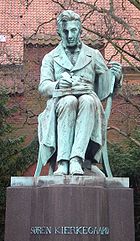 As early as 1835 in a letter to his friend Peter Wilhelm Lund
, the Danish philosopher Søren Kierkegaard
wrote one of his first existentially sensitive passages.
The early thoughts of Kierkegaard would be formalized in his prolific philosophical and theological writings, many of which would later form the modern foundation of 20th century existentialism.
and Friedrich Nietzsche
were two of the first philosophers considered fundamental to the existentialist movement, though neither used the term "existentialism" and it is unclear whether they would have supported the existentialism of the 20th century. They focused on subjective human experience rather than the objective truths of mathematics and science, which they believed were too detached or observational to truly get at the human experience. Like Pascal
, they were interested in people's quiet struggle with the apparent meaninglessness of life and the use of diversion to escape from boredom. Unlike Pascal, Kierkegaard and Nietzsche also considered the role of making free choices, particularly regarding fundamental values and beliefs, and how such choices change the nature and identity of the chooser. Kierkegaard's knight of faith
and Nietzsche's Übermensch
are representative of people who exhibit Freedom
, in that they define the nature of their own existence. Nietzsche's idealized individual invents his or her own values and creates the very terms under which they excel. By contrast, Kierkegaard was a Christian, but one who argued that objective certainty of religious truths was not only impossible, but would eliminate the passionate life required of a Christian who must make a leap of faith
to believe in the paradox of the God-man Christ. Kierkegaard and Nietzsche were also precursors to other intellectual movements, including postmodernism
, nihilism
, and various strands of psychology
.
and the Russian Fyodor Dostoyevsky. Dostoyevsky's Notes from Underground
portrays a man unable to fit into society and unhappy with the identities he creates for himself. Jean-Paul Sartre
, in his book on existentialism Existentialism is a Humanism, quoted Dostoyevsky's The Brothers Karamazov
as an example of existential crisis
. Sartre attributes Ivan Karamazov's claim, "If God did not exist, all things would be permitted," to Dostoyevsky himself. Others of Dostoyevsky's novels covered issues raised in existentialist philosophy while presenting story lines divergent from secular existentialism: for example, in Crime and Punishment
the protagonist Raskolnikov experiences an existential crisis and then moves toward a Christian Orthodox worldview similar to that advocated by Dostoyevsky himself.
The Spanish philosopher Miguel de Unamuno y Jugo, in his 1913 book The Tragic Sense of Life in Men and Nations, emphasized the life of "flesh and bone" as opposed to that of abstract rationalism. Unamuno rejected systematic philosophy in favor of the individual's quest for faith. He retained a sense of the tragic, even absurd nature of the quest, symbolized by his enduring interest in Cervantes
' fictional character Don Quixote. A novelist, poet and dramatist as well as philosophy professor at the University of Salamanca, Unamuno's short story about a priest's crisis of faith, "Saint Manuel the Good, Martyr
" has been collected in anthologies of existentialist fiction. Another Spanish thinker, Ortega y Gasset, writing in 1914, held that the human existence must always be defined as the individual person combined with the concrete circumstances of his life: "Yo soy yo y mis circunstancias" ("I am myself and my circumstances"). Sartre likewise believed that human existence is not an abstract matter, but is always situated ("en situación").
Although Martin Buber
wrote his major philosophical works in German, and studied and taught at the Universities of Berlin and Frankfurt
, he stands apart from the mainstream of German philosophy. Born into a Jewish family in Vienna in 1878, he was also a scholar of Jewish culture and involved at various times in Zionism
and Hasidism. In 1938, he moved permanently to Jerusalem. His best-known philosophical work was the short book I and Thou
, published in 1922. For Buber, the fundamental fact of human existence, too readily overlooked by scientific rationalism and abstract philosophical thought, is "man with man", a dialogue which takes place in the so-called "sphere of between" ("das Zwischenmenschliche").
Two Ukrainian/Russian thinkers, Lev Shestov
and Nikolai Berdyaev
, became well known as existentialist thinkers during their post-Revolutionary exiles in Paris. Shestov, born into a Ukrainian-Jewish family in Kiev, had launched an attack on rationalism and systematization in philosophy as early as 1905 in his book of aphorisms All Things Are Possible.
Berdyaev, also from Kiev but with a background in the Eastern Orthodox Church, drew a radical distinction between the world of spirit and the everyday world of objects. Human freedom, for Berdyaev, is rooted in the realm of spirit, a realm independent of scientific notions of causation. To the extent the individual human being lives in the objective world, he is estranged from authentic spiritual freedom. "Man" is not to be interpreted naturalistically, but as a being created in God's image, an originator of free, creative acts. He published a major work on these themes, The Destiny of Man, in 1931.
Gabriel Marcel
, long before coining the term "existentialism", introduced important existentialist themes to a French audience in his early essay "Existence and Objectivity" (1925) and in his Metaphysical Journal (1927). A dramatist as well as a philosopher, Marcel found his philosophical starting point in a condition of metaphysical alienation; the human individual searching for harmony in a transient life. Harmony, for Marcel, was to be sought through "secondary reflection", a "dialogical" rather than "dialectical" approach to the world, characterized by "wonder and astonishment" and open to the "presence" of other people and of God rather than merely to "information" about them. For Marcel, such presence implied more than simply being there (as one thing might be in the presence of another thing); it connoted "extravagant" availability, and the willingness to put oneself at the disposal of the other.
Marcel contrasted "secondary reflection" with abstract, scientific-technical "primary reflection" which he associated with the activity of the abstract Cartesian
ego. For Marcel, philosophy was a concrete activity undertaken by a sensing, feeling human being incarnate — embodied — in a concrete world. Although Jean-Paul Sartre
adopted the term "existentialism" for his own philosophy in the 1940s, Marcel's thought has been described as "almost diametrically opposed" to that of Sartre. Unlike Sartre, Marcel was a Christian, and became a Catholic convert in 1929.
In Germany, the psychologist and philosopher Karl Jaspers
— who later described existentialism as a "phantom" created by the public, — called his own thought, heavily influenced by Kierkegaard and Nietzsche — Existenzphilosophie. For Jaspers, "Existenz-philosophy is the way of thought by means of which man seeks to become himself...This way of thought does not cognize objects, but elucidates and makes actual the being of the thinker."
Jaspers, a professor at the University of Heidelberg
, was acquainted with Martin Heidegger
, who held a professorship at Marburg
before acceding to Husserl's chair at Freiburg
in 1928. They held many philosophical discussions, but later became estranged over Heidegger's support of National Socialism. They shared an admiration for Kierkegaard, and in the 1930s Heidegger lectured extensively on Nietzsche. Nevertheless, the extent to which Heidegger should be considered an existentialist is debatable. In Being and Time
he presented a method of rooting philosophical explanations in human existence (Dasein) to be analysed in terms of existential categories (existentiale); and this has led many commentators to treat him as an important figure in the existentialist movement.
and Albert Camus
, who wrote best-selling novels, plays and widely read journalism as well as theoretical texts. These years also saw the growing reputation of Heidegger's book Being and Time
outside of Germany.
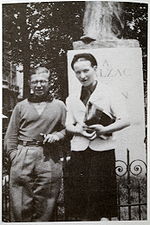 Sartre dealt with existentialist themes in his 1938 novel Nausea and the short stories in his 1939 collection The Wall
, and had published his treatise on existentialism, Being and Nothingness in 1943, but it was in the two years following the liberation of Paris from the German occupying forces that he and his close associates — Camus, Simone de Beauvoir, Maurice Merleau-Ponty, and others — became internationally famous as the leading figures of a movement known as existentialism. In a very short space of time, Camus and Sartre in particular became the leading public intellectuals of post-war France, achieving by the end of 1945 "a fame that reached across all audiences." Camus was an editor of the most popular leftist (former French Resistance
) newspaper Combat
; Sartre launched his journal of leftist thought, Les Temps Modernes
, and two weeks later gave the widely reported lecture on existentialism and secular humanism
to a packed meeting of the Club Maintenant. Beauvoir wrote that "not a week passed without the newspapers discussing us"; existentialism became "the first media craze of the postwar era."
By the end of 1947, Camus' earlier fiction and plays had been reprinted, his new play Caligula
had been performed and his novel The Plague
published; the first two novels of Sartre's The Roads to Freedom
trilogy had appeared, as had Beauvoir's novel The Blood of Others
. Works by Camus and Sartre were already appearing in foreign editions. The Paris-based existentialists had become famous.
Sartre had traveled to Germany in 1930 to study the phenomenology of Edmund Husserl
and Martin Heidegger
, and he included critical comments on their work in his major treatise Being and Nothingness. Heidegger's thought had also become known in French philosophical circles through its use by Alexandre Kojève
in explicating Hegel in a series of lectures given in Paris in the 1930s. The lectures were highly influential; members of the audience included not only Sartre and Merleau-Ponty, but Raymond Queneau
, Georges Bataille
, Louis Althusser
, André Breton
and Jacques Lacan
. A selection from Heidegger's Being and Time
was published in French in 1938, and his essays began to appear in French philosophy journals.
 Heidegger read Sartre's work and was initially impressed, commenting: "Here for the first time I encountered an independent thinker who, from the foundations up, has experienced the area out of which I think. Your work shows such an immediate comprehension of my philosophy as I have never before encountered." Later, however, in response to a question posed by his French follower Jean Beaufret
, Heidegger distanced himself from Sartre's position and existentialism in general in his Letter on Humanism. Heidegger's reputation continued to grow in France during the 1950s and 1960s. In the 1960s, Sartre attempted to reconcile existentialism and Marxism
in his work Critique of Dialectical Reason
. A major theme throughout his writings was freedom and responsibility.
Camus was a friend of Sartre, until their falling-out, and wrote several works with existential themes including The Rebel, The Stranger
, The Myth of Sisyphus
, and Summer in Algiers. Camus, like many others, rejected the existentialist label, and considered his works to be concerned with facing the absurd. In the titular book, Camus uses the analogy of the Greek myth of Sisyphus
to demonstrate the futility of existence. In the myth, Sisyphus is condemned for eternity to roll a rock up a hill, but when he reaches the summit, the rock will roll to the bottom again. Camus believes that this existence is pointless but that Sisyphus ultimately finds meaning and purpose in his task, simply by continually applying himself to it. The first half of the book contains an extended rebuttal of what Camus took to be existentialist philosophy in the works of Kierkegaard, Shestov, Heidegger, and Jaspers.
Simone de Beauvoir
, an important existentialist who spent much of her life as Sartre's partner, wrote about feminist and existentialist ethics in her works, including The Second Sex
and The Ethics of Ambiguity
. Although often overlooked due to her relationship with Sartre, de Beauvoir integrated existentialism with other forms of thinking such as feminism, unheard of at the time, resulting in alienation from fellow writers such as Camus.
Paul Tillich
, an important existentialist theologian following Kierkegaard and Karl Barth
, applied existentialist concepts to Christian theology
, and helped introduce existential theology
to the general public. His seminal work The Courage to Be follows Kierkegaard's analysis of anxiety and life's absurdity, but puts forward the thesis that modern humans must, via God, achieve selfhood in spite of life's absurdity. Rudolf Bultmann
used Kierkegaard's and Heidegger's philosophy of existence to demythologize Christianity by interpreting Christian mythical concepts into existentialist concepts.
Maurice Merleau-Ponty
, an existential phenomenologist
, was for a time a companion of Sartre. His understanding of Husserl's phenomenology was far greater than that of Merleau-Ponty's fellow existentialists. It has been said that his work Humanism and Terror greatly influenced Sartre. However, in later years they were to disagree irreparably, dividing many existentialists such as de Beauvoir, who sided with Sartre.
Colin Wilson
, an English writer, published his study The Outsider
in 1956, initially to critical acclaim. In this book and others (e.g. Introduction to the New Existentialism), he attempted to reinvigorate what he perceived as a pessimistic philosophy and bring it to a wider audience. He was not, however, academically trained, and his work was attacked by professional philosophers for lack of rigor and critical standards.
. The term "existentialism" is used both for philosophical concepts and for literary works, as well as being a label applied to various works by others. The exact meaning depends on the particular writer, and some writers objected to the notion of being called "existentialists" as an attempt to restrict their ideas into a pre-defined category.
The early 19th century philosopher Søren Kierkegaard
, posthumously regarded as the father of existentialism, maintained that the individual has the sole responsibility for giving one's own life meaning and with living life passionately and sincerely, in spite of many obstacles and distractions including despair, angst
, absurdity
, choice
, boredom
, and death
. Subsequent existential philosophers retain the emphasis on the subjective individual, but differ, in varying degrees, on how one achieves a fulfilling life, what obstacles must be overcome, and what external and internal factors are involved, including the potential consequences of the existence
or non-existence
of God. Some existentialists considered the meaning of life to be based in faith, while others noted self-determined goals. Existentialism became fashionable after World War II
, as a way to reassert the importance of human individuality and freedom. As such, many existential philosophers did not consider themselves existentialists as they did not want to be associated to or typecast with other philosophers' conception of existentialism.
In general, existentialism has been described as a set of ideas to categorize human existence, beyond the traditional ancient philosophies and scientific method
. Specific variations of those ideas are described below, under: Concepts.
What these conditions are is better understood in light of the meaning of the word "existence," which comes from the Latin "existere," meaning "to stand out" (according to the OED, "existere" translates as "come into being"; the other definition presented here allows for a slanted view and false implications as seen in the following passage.) Humans exist in a state of distance from the world that they nonetheless remain in the midst of. This distance is what enables humans to project meaning into the disinterested world of in-itselfs. This projected meaning remains fragile, constantly facing breakdown for any reason — from a tragedy to a particularly insightful moment. In such a breakdown, humans are put face to face with the naked meaninglessness of the world, and the results can be devastating.
It is in relation to the concept of the devastating awareness of meaninglessness that Albert Camus
claimed that "there is only one truly serious philosophical problem, and that is suicide" in his The Myth of Sisyphus
. Although "prescriptions" against the possibly deleterious consequences of these kinds of encounters vary, from Kierkegaard's religious "stage" to Camus' insistence on persevering in spite of absurdity, the concern with helping people avoid living their lives in ways that put them in the perpetual danger of having everything meaningful break down is common to most existentialist philosophers. The possibility of having everything meaningful break down poses a threat of quietism, which is inherently against the existentialist philosophy. It has been said that the possibility of suicide makes all humans existentialists.
, which means that the actual life of the individual is what constitutes what could be called his or her "essence" instead of there being a predetermined essence that defines what it is to be a human. Thus, the human beings – through their own consciousness
– create their own values and determine a meaning to their life. Although it was Sartre who explicitly coined the phrase, similar notions can be found in the thought of many existentialist philosophers from Kierkegaard, to Heidegger.
It is often claimed in this context that a person defines him or herself, which is often perceived as stating that they can "wish" to be something — anything, a bird, for instance — and then be it. According to most existentialist philosophers, however, this would constitute an inauthentic existence. Instead, the phrase should be taken to say that the person is (1) defined only insofar as he or she acts and (2) that he or she is responsible for his or her actions. For example, someone who acts cruelly towards other people is, by that act, defined as a cruel person. Furthermore, by this action of cruelty such persons are themselves responsible for their new identity (a cruel person). This is as opposed to their genes, or 'human nature', bearing the blame.
As Sartre puts it in his Existentialism is a Humanism: "man first of all exists, encounters himself, surges up in the world – and defines himself afterwards." Of course, the more positive, therapeutic aspect of this is also implied: A person can choose to act in a different way, and to be a good person instead of a cruel person. Here it is also clear that since humans can choose to be either cruel or good, they are, in fact, neither of these things essentially.
, sometimes called dread, anxiety or even anguish
is a term that is common to many existentialist thinkers. It is generally held to be a negative feeling arising from the experience of human freedom and responsibility. The archetypal example is the experience one has when standing on a cliff where one not only fears falling off it, but also dreads the possibility of throwing oneself off. In this experience that "nothing is holding me back", one senses the lack of anything that predetermines one to either throw oneself off or to stand still, and one experiences one's own freedom.
It can also be seen in relation to the previous point how angst is before nothing, and this is what sets it apart from fear which has an object. While in the case of fear, one can take definitive measures to remove the object of fear, in the case of angst, no such "constructive" measures are possible. The use of the word "nothing" in this context relates both to the inherent insecurity about the consequences of one's actions, and to the fact that, in experiencing one's freedom as angst, one also realizes that one will be fully responsible for these consequences; there is no thing in a person (their genes, for instance) that acts in their stead, and that they can "blame" if something goes wrong.
Not every choice is perceived as having dreadful possible consequences (and, it can be claimed, human lives would be unbearable if every choice facilitated dread), but that doesn't change the fact that freedom remains a condition of every action. One of the most extensive treatments of the existentialist notion of Angst is found in Søren Kierkegaard
's monumental work Begrebet Angest.
In Kierkegaard's Judge Vilhelm's account in Either/Or
, making choices without allowing one's values to confer differing values to the alternatives, is, in fact, choosing not to make a choice — to flip a coin, as it were, and to leave everything to chance. This is considered to be a refusal to live in the consequence of one's freedom; an inauthentic existence. As such, existentialist freedom isn't situated in some kind of abstract space where everything is possible: since people are free, and since they already exist in the world, it is implied that their freedom is only in this world, and that it, too, is restricted by it.
What is not implied in this account of existential freedom, however, is that one's values are immutable; a consideration of one's values may cause one to reconsider and change them. A consequence of this fact is that one is not only responsible for one's actions, but also for the values one holds. This entails that a reference to common values doesn't excuse the individual's actions: Even though these are the values of the society the individual is part of, they are also her/his own in the sense that she/he could choose them to be different at any time. Thus, the focus on freedom in existentialism is related to the limits of the responsibility one bears as a result of one's freedom: the relationship between freedom and responsibility is one of interdependency, and a clarification of freedom also clarifies that for which one is responsible.
, a concept defined by Sartre in Being and Nothingness as that "in-itself" of which humans are in the mode of not being. This can be more easily understood when considering it in relation to the temporal dimension of past: One's past is what one is in the sense that it co-constitutes oneself. However, to say that one is only one's past would be to ignore a large part of reality (the present and the future), while saying that one's past is only what one was would entirely detach it from them now. A denial of one's own concrete past constitutes an inauthentic lifestyle, and the same goes for all other kinds of facticity (having a body (e.g. one that doesn't allow a person to run faster than the speed of sound), identity, values, etc.).
Facticity is both a limitation and a condition of freedom. It is a limitation in that a large part of one's facticity consists of things one couldn't have chosen (birthplace, etc.), but a condition in the sense that one's values most likely will depend on it. However, even though one's facticity is "set in stone" (as being past, for instance), it cannot determine a person: The value ascribed to one's facticity is still ascribed to it freely by that person. As an example, consider two men, one of whom has no memory of his past and the other remembers everything. They have both committed many crimes, but the first man, knowing nothing about this, leads a rather normal life while the second man, feeling trapped by his own past, continues a life of crime, blaming his own past for "trapping" him in this life. There is nothing essential about his committing crimes, but he ascribes this meaning to his past.
However, to disregard one's facticity when one, in the continual process of self-making, project
s oneself into the future, would be to put oneself in denial of oneself, and would thus be inauthentic. In other words, the origin of one's projection will still have to be one's facticity, although in the mode of not being it (essentially). Another aspect of facticity is that it entails angst, both in the sense that freedom "produces" angst when limited by facticity, and in the sense that the lack of the possibility of having facticity to "step in" for one to take responsibility for something one has done also produces angst.
What is meant by authenticity
is that in acting, one should act as oneself, not as One acts or as one's genes or any other essence require. The authentic act is one that is in accordance with one's freedom. Of course, as a condition of freedom is facticity, this includes one's facticity, but not to the degree that this facticity can in any way determine one's choices (in the sense that one could then blame one's background for making the choice one made). The role of facticity in relation to authenticity involves letting one's actual values come into play when one makes a choice (instead of, like Kierkegaard's Aesthete, "choosing" randomly), so that one also takes responsibility for the act instead of choosing either-or without allowing the options to have different values.
In contrast to this, the inauthentic is the denial to live in accordance with one's freedom. This can take many forms, from pretending choices are meaningless or random, through convincing oneself that some form of determinism
is true, to a sort of "mimicry" where one acts as "One should." How "One" should act is often determined by an image one has of how one such as oneself (say, a bank manager, lion tamer, prostitute, etc.) acts. This image usually corresponds to some sort of social norm, but this does not mean that all acting in accordance with social norms is inauthentic: The main point is the attitude one takes to one's own freedom and responsibility, and the extent to which one acts in accordance with this freedom.
What sets the existentialist notion of despair apart from the dictionary definition is that existentialist despair is a state one is in even when he isn't overtly in despair. So long as a person's identity depends on qualities that can crumble, he is considered to be in perpetual despair. And as there is, in Sartrean terms, no human essence found in conventional reality on which to constitute the individual's sense of identity, despair is a universal human condition. As Kierkegaard defines it in his Either/or
: "Any life-view with a condition outside it is despair." In other words, it is possible to be in despair without despairing.
The Other (when written with a capital "o") is a concept more properly belonging to phenomenology and its account of intersubjectivity
. However, the concept has seen widespread use in existentialist writings, and the conclusions drawn from it differ slightly from the phenomenological accounts. The experience of the Other is the experience of another free subject who inhabits the same world as a person does. In its most basic form, it is this experience of the Other that constitutes intersubjectivity and objectivity. To clarify, when one experiences someone else, and this Other person experiences the world (the same world that a person experiences), only from "over there", the world itself is constituted as objective in that it is something that is "there" as identical for both of the subjects; a person experiences the other person as experiencing the same as he or she does. This experience of the Other's look is what is termed the Look (sometimes the Gaze).
While this experience, in its basic phenomenological sense, constitutes the world as objective, and oneself as objectively existing subjectivity (one experiences oneself as seen in the Other's Look in precisely the same way that one experiences the Other as seen by him, as subjectivity), in existentialism, it also acts as a kind of limitation of one's freedom. This is because the Look tends to objectify what it sees. As such, when one experiences oneself in the Look, one doesn't experience oneself as nothing (no thing), but as something. Sartre's own example of a man peeping at someone through a keyhole can help clarify this: at first, this man is entirely caught up in the situation he is in; he is in a pre-reflexive state where his entire consciousness is directed at what goes on in the room. Suddenly, he hears a creaking floorboard behind him, and he becomes aware of himself as seen by the Other. He is thus filled with shame for he perceives himself as he would perceive someone else doing what he was doing, as a Peeping Tom. The Look is then co-constitutive of one's facticity.
Another characteristic feature of the Look is that no Other really needs to have been there: It is quite possible that the creaking floorboard was nothing but the movement of an old house; the Look isn't some kind of mystical telepathic experience of the actual way the other sees one (there may also have been someone there, but he could have not noticed that the person was there). It is only one's perception of the way another might perceive him.
and positivism
. That is, they argue against definitions of human beings as primarily rational. Rather, existentialists look at where people find meaning. Existentialism asserts that people actually make decisions based on the meaning to them rather than rationally. The rejection of reason as the source of meaning is a common theme of existentialist thought, as is the focus on the feelings of anxiety
and dread
that we feel in the face of our own radical freedom
and our awareness of death. Kierkegaard saw strong rationality as a mechanism humans use to counter their existential anxiety
, their fear of being in the world: "If I can believe that I am rational and everyone else is rational then I have nothing to fear and no reason to feel anxious about being free." However, Kierkegaard advocated rationality as means to interact with the objective world (e.g. in the natural sciences), but when it comes to existential problems, reason is insufficient: "Human reason has boundaries".
Like Kierkegaard, Sartre saw problems with rationality, calling it a form of "bad faith", an attempt by the self to impose structure on a world of phenomena — "the Other" — that is fundamentally irrational and random. According to Sartre, rationality and other forms of bad faith hinder people from finding meaning in freedom. To try to suppress their feelings of anxiety and dread, people confine themselves within everyday experience, Sartre asserts, thereby relinquishing their freedom and acquiescing to being possessed in one form or another by "the Look" of "the Other" (i.e. possessed by another person — or at least one's idea of that other person). In a similar vein, Camus believed that society and religion falsely teach humans that "the Other" has order and structure.What does this have to do with reason? For Camus, when an individual's consciousness, longing for order, collides with the Other's lack of order, a third element is born: absurdity.
Because of the world's absurdity, at any point in time, anything can happen to anyone, and a tragic event could plummet someone into direct confrontation with the Absurd. The notion of the absurd has been prominent in literature throughout history. Søren Kierkegaard
, Franz Kafka
, Fyodor Dostoyevsky and many of the literary works of Jean-Paul Sartre
and Albert Camus
contain descriptions of people who encounter the absurdity of the world. Albert Camus
studied the issue of "the absurd" in his essay The Myth of Sisyphus.
and existentialism are distinct philosophies, they are often confused with one another. A primary cause of confusion is that Friedrich Nietzsche
is an important philosopher in both fields, but also the existentialist insistence on the absurd and the inherent meaninglessness of the world. Existentialist philosophers often stress the importance of Angst
as signifying the absolute lack of any objective ground for action, a move that is often reduced to a moral
or an existential nihilism. A pervasive theme in the works of existentialist philosophy, however, is to persist through encounters with the absurd, as seen in Camus
' The Myth of Sisyphus ("One must imagine Sisyphus happy"), and it is only very rarely that existentialist philosophers dismiss morality or one's self-created meaning: Kierkegaard regained a sort of morality in the religious (although he wouldn't himself agree that it was ethical; the religious suspends the ethical), and Sartre
's final words in Being and Nothingness are "All these questions, which refer us to a pure and not an accessory (or impure) reflection, can find their reply only on the ethical plane. We shall devote to them a future work." Hence, existentialists believe that one can create value and meaning, whilst nihilists will deny this.
criticised Existentialism, especially Being and Nothingness (1943), by Jean-Paul Sartre, for projecting anxiety and meaninglessness onto the nature of existence itself: "Insofar as Existentialism is a philosophical doctrine, it remains an idealistic doctrine: it hypostatizes
specific historical conditions of human existence into ontological and metaphysical characteristics. Existentialism thus becomes part of the very ideology which it attacks, and its radicalism is illusory". In 1946, Sartre already had replied to Marxist criticism of Existentialism in the lecture Existentialism is a humanism. In Jargon of Authenticity, Theodor Adorno criticised Heidegger's philosophy, especially his use of language, as a mystifying ideology of advanced, industrial society, and its power structure.
In Letter on Humanism, Heidegger criticized Sartre's existentialism:
Logical positivists, such as Carnap and Ayer
, say Existentialists frequently are confused about the verb "to be" in their analyses of "being". They argue that the verb is transitive, and pre-fixed to a predicate
(e.g., an apple is red): without a predicate, the word is meaningless.
) meant existentialism "was as much a literary phenomenon as a philosophical one." Among existentialist writers were Parisians Jean Genet
, André Gide
, André Malraux
, and playwright Samuel Beckett
, the Norwegian Knut Hamsun
, and the Romanian friends Eugène Ionesco
and Emil Cioran
. Prominent artists such as the Abstract Expressionists
Jackson Pollock
, Arshile Gorky
, and Willem de Kooning
have been understood in existentialist terms, as have filmmakers such as Jean-Luc Godard
and Ingmar Bergman
.
's 1950 fantasy-erotic film Un chant d'amour
shows two inmates in solitary cells whose only contact is through a hole in their cell wall, who are spied on by the prison warden. Reviewer James Travers calls the film a "...visual poem evoking homosexual desire and existentialist suffering" which "... conveys the bleakness of an existence in a godless universe with painful believability"; he calls it "... probably the most effective fusion of existentialist philosophy and cinema."
Stanley Kubrick
's 1957 anti-war film Paths of Glory
"illustrates, and even illuminates...existentialism" by examining the "necessary absurdity of the human condition" and the "horror of war". The film tells the story of a fictional World War I French army regiment which is ordered to attack an impregnable German stronghold; when the attack fails, three soldiers are chosen at random, court-martialed by a "kangaroo court", and executed by firing squad. The film examines existentialist ethics, such as the issue of whether objectivity is possible and the "problem of authenticity".
On the lighter side, the British comedy troupe Monty Python
have explored existentialist themes throughout their works, from many of the sketches in their original television show, Monty Python's Flying Circus
, to their 1983 film Monty Python's The Meaning of Life. Of the many adjectives (some listed in the introduction above) that might indicate an existential tone, the one utilized the most by the group is that of the absurd. Another related comedy would be Office Space
.
Some contemporary films dealing with existentialist issues include Fight Club
, I ♥ Huckabees, Waking Life
, The Matrix
, Ordinary People
and Life in a Day
. Likewise, films throughout the 20th century such as The Seventh Seal
, Ikiru
, Taxi Driver
, High Noon
, Easy Rider
, One Flew Over the Cuckoo's Nest
, A Clockwork Orange
, Groundhog Day
, Apocalypse Now
, Badlands
, and Blade Runner
also have existentialist qualities. Notable directors known for their existentialist films include Ingmar Bergman
, François Truffaut
, Jean-Luc Godard
, Michelangelo Antonioni
, Akira Kurosawa
, Stanley Kubrick
, Andrei Tarkovsky
, Hideaki Anno
and Woody Allen
. Charlie Kaufman
's Synecdoche, New York
focuses on the protagonist's desire to find existential meaning as he sees its end.
and existentialist elements. Books such as Do Androids Dream of Electric Sheep? (1968) (now republished as Blade Runner
) by Philip K. Dick and Fight Club
by Chuck Palahniuk
all distort the line between reality and appearance while simultaneously espousing strong existentialist themes. Ideas from such thinkers as Fyodor Dostoyevsky, Michel Foucault
, Franz Kafka
, Friedrich Nietzsche
, Herbert Marcuse
, Gilles Deleuze
, and Eduard von Hartmann permeate the works of artists such as Chuck Palahniuk
, David Lynch
, Crispin Glover
, and Charles Bukowski
, and one often finds in their works a delicate balance between distastefulness and beauty.
wrote No Exit
in 1944
, an existentialist play
originally published in French as Huis Clos (meaning In Camera or "behind closed doors") which is the source of the popular quote, "Hell is other people." (In French, "l'enfer, c'est les autres"). The play begins with a Valet leading a man into a room that the audience soon realizes is in hell. Eventually he is joined by two women. After their entry, the Valet leaves and the door is shut and locked. All three expect to be tortured, but no torturer arrives. Instead, they realize they are there to torture each other, which they do effectively, by probing each other's sins, desires, and unpleasant memories.
Existentialist themes are displayed in the Theatre of the Absurd
, notably in Samuel Beckett
's Waiting for Godot
, in which two men divert themselves while they wait expectantly for someone (or something) named Godot who never arrives. They claim Godot to be an acquaintance but in fact hardly know him, admitting they would not recognize him if they saw him. Samuel Beckett, once asked who or what Godot is, replied, "If I knew, I would have said so in the play." To occupy themselves they eat, sleep, talk, argue, sing, play games, exercise
, swap hats, and contemplate suicide
—anything "to hold the terrible silence at bay". The play "exploits several archetypal forms and situations, all of which lend themselves to both comedy and pathos
." The play also illustrates an attitude toward human experience on earth: the poignancy, oppression, camaraderie, hope, corruption, and bewilderment of human experience that can only be reconciled in mind and art of the absurdist. The play examines questions such as death, the meaning of human existence and the place of God in human existence.
Tom Stoppard
's Rosencrantz & Guildenstern Are Dead
is an absurdist
tragicomedy
first staged at the Edinburgh Festival Fringe in 1966. The play expands upon the exploits of two minor characters from Shakespeare's
Hamlet
. Comparisons have also been drawn to Samuel Beckett
's Waiting For Godot
, for the presence of two central characters who almost appear to be two halves of a single character. Many plot features are similar as well: the characters pass time by playing Questions
, impersonating other characters, and interrupting each other or remaining silent for long periods of time. The two characters are portrayed as two clowns or fools in a world that is beyond their understanding. They stumble through philosophical arguments while not realizing the implications, and muse on the irrationality and randomness of the world.
Jean Anouilh
's Antigone
also presents arguments founded on existentialist ideas. It is a tragedy inspired by Greek mythology and the play of the same name (Antigone, by Sophocles) from the 5th century B.C. In English, it is often distinguished from its antecedent by being pronounced in its original French form, approximately "Ante-GŌN." The play was first performed in Paris on 6 February 1944, during the Nazi occupation of France. Produced under Nazi censorship, the play is purposefully ambiguous with regards to the rejection of authority (represented by Antigone) and the acceptance of it (represented by Creon). The parallels to the French Resistance and the Nazi occupation have been drawn. Antigone rejects life as desperately meaningless but without affirmatively choosing a noble death. The crux of the play is the lengthy dialogue concerning the nature of power, fate, and choice, during which Antigone says that she is "... disgusted with [the]...promise of a humdrum happiness"; she states that she would rather die than live a mediocre existence.
Critic Martin Esslin
in his book Theatre of the Absurd pointed out how many contemporary playwrights such as Samuel Beckett
, Eugène Ionesco
, Jean Genet
, and Arthur Adamov
wove into their plays the existentialist belief that we are absurd beings loose in a universe empty of real meaning. Esslin noted that many of these playwrights demonstrated the philosophy better than did the plays by Sartre and Camus. Though most of such playwrights, subsequently labeled "Absurdist" (based on Esslin's book), denied affiliations with existentialism and were often staunchly anti-philosophical (for example Ionesco often claimed he identified more with 'Pataphysics or with Surrealism
than with existentialism), the playwrights are often linked to existentialism based on Esslin's observation.
s, which are a response to a question he is asked. After he tells the parable, he returns the question to the individual
.
An existentialist reading of the Bible would demand that the reader recognize that he is an existing subject
studying the words more as a recollection of possible events. This is in contrast to looking at a collection of "truths" which are outside and unrelated to the reader, but may develop a sense of reality/God. Such a reader is not obligated to follow the commandments as if an external agent is forcing them upon him, but as though they are inside him and guiding him from inside. This is the task Kierkegaard takes up when he asks: "Who has the more difficult task: the teacher who lectures on earnest things a meteor's distance from everyday life-or the learner who should put it to use?" From an existentialist perspective, the Bible would not become an authority in an individual's life until that individual authorizes the Bible to be such. Existentialism has had a significant influence on theology, notably on postmodern Christianity
and on theologians and religious thinkers such as Nikolai Berdyaev
, Karl Barth
, Paul Tillich
, Wilfrid Desan
and John Macquarrie
.
, Freud's closest associate for 20 years. Without awareness of the writings of Rank, Ludwig Binswanger
was influenced by Freud
, Edmund Husserl
, Heidegger
and Sartre
. A later figure was Viktor Frankl
, who briefly met Freud
and studied with Jung
as a young man. His logotherapy
can be regarded as a form of existentialist therapy. The existentialists would also influence social psychology
, antipositivist micro-sociology
, symbolic interactionism
, and post-structuralism
, with the work of thinkers such as Georg Simmel
and Michel Foucault
.
An early contributor to existentialist psychology in the United States was Rollo May
, who was strongly influenced by Kierkegaard and Otto Rank
. One of the most prolific writers on techniques and theory of existentialist psychology in the USA is Irvin D. Yalom
. Yalom states that
A more recent contributor to the development of a European version of existentialist psychotherapy is the British-based Emmy van Deurzen
.
Anxiety's importance in existentialism makes it a popular topic in psychotherapy
. Therapists often offer existentialist philosophy
as an explanation for anxiety. The assertion is that anxiety is manifested of an individual's complete freedom to decide, and complete responsibility for the outcome of such decisions. Psychotherapists using an existentialist approach believe that a patient can harness his anxiety and use it constructively. Instead of suppressing anxiety, patients are advised to use it as grounds for change. By embracing anxiety as inevitable, a person can use it to achieve his full potential in life. Humanistic psychology
also had major impetus from existentialist psychology and shares many of the fundamental tenets. Terror management theory
, based on the writings of Ernest Becker
and Otto Rank
, is a developing area of study within the academic study of psychology. It looks at what researchers claim to be the implicit emotional reactions of people that occur when they are confronted with the knowledge they will eventually die.
Journals and articles
Existential psychotherapy
The early 19th century philosopher Søren Kierkegaard
Søren Kierkegaard
Søren Aabye Kierkegaard was a Danish Christian philosopher, theologian and religious author. He was a critic of idealist intellectuals and philosophers of his time, such as Georg Wilhelm Friedrich Hegel, Friedrich Wilhelm Joseph Schelling and Karl Wilhelm Friedrich Schlegel...
is widely regarded as the father of existentialism. He maintained that the individual is solely responsible for giving his or her own life meaning
Meaning (existential)
In existentialism, meaning is understood as the worth of life. Meaning in existentialism is unlike typical conceptions of "the meaning of life", because it is descriptive. Due to the method of existentialism, prescriptive or declarative statements about meaning are unjustified. Meaning is only...
and for living that life passionately and sincerely
Authenticity (philosophy)
Authenticity is a technical term in existentialist philosophy, and is also used in the philosophy of art and psychology. In philosophy, the conscious self is seen as coming to terms with being in a material world and with encountering external forces, pressures and influences which are very...
, in spite of many existential obstacles and distractions including despair, angst
Angst
Angst is an English, German, Danish, Norwegian and Dutch word for fear or anxiety . It is used in English to describe an intense feeling of apprehension, anxiety or inner turmoil...
, absurdity
Absurdism
In philosophy, "The Absurd" refers to the conflict between the human tendency to seek value and meaning in life and the human inability to find any...
, alienation, and boredom
Boredom
Boredom is an emotional state experienced when an individual is without any activity or is not interested in their surroundings. The first recorded use of the word boredom is in the novel Bleak House by Charles Dickens, written in 1852, in which it appears six times, although the expression to be a...
.
Subsequent existentialist philosophers retain the emphasis on the individual, but differ, in varying degrees, on how one achieves and what constitutes a fulfilling life, what obstacles must be overcome, and what external and internal factors are involved, including the potential consequences of the existence
Christian existentialism
Christian existentialism describes a group of writings that take a philosophically existentialist approach to Christian theology. The school of thought is often traced back to the work of the Danish philosopher and theologian considered the father of existentialism, Søren Kierkegaard...
or non-existence
Atheist existentialism
Atheist existentialism or atheistic existentialism is a kind of existentialism which strongly diverged from the Christian works of Søren Kierkegaard and has developed within the context of an atheistic worldview....
of God. Existentialism became fashionable in the post-World War
World war
A world war is a war affecting the majority of the world's most powerful and populous nations. World wars span multiple countries on multiple continents, with battles fought in multiple theaters....
years as a way to reassert the importance of human individuality and freedom.
History
Existentialism was foreshadowed by 19th century philosophers Søren KierkegaardSøren Kierkegaard
Søren Aabye Kierkegaard was a Danish Christian philosopher, theologian and religious author. He was a critic of idealist intellectuals and philosophers of his time, such as Georg Wilhelm Friedrich Hegel, Friedrich Wilhelm Joseph Schelling and Karl Wilhelm Friedrich Schlegel...
and Friedrich Nietzsche
Friedrich Nietzsche
Friedrich Wilhelm Nietzsche was a 19th-century German philosopher, poet, composer and classical philologist...
. In the 20th century, the German philosopher Martin Heidegger
Martin Heidegger
Martin Heidegger was a German philosopher known for his existential and phenomenological explorations of the "question of Being."...
(starting from Husserl's phenomenology) influenced other existentialist philosophers such as Jean-Paul Sartre
Jean-Paul Sartre
Jean-Paul Charles Aymard Sartre was a French existentialist philosopher, playwright, novelist, screenwriter, political activist, biographer, and literary critic. He was one of the leading figures in 20th century French philosophy, particularly Marxism, and was one of the key figures in literary...
, Simone de Beauvoir
Simone de Beauvoir
Simone-Ernestine-Lucie-Marie Bertrand de Beauvoir, often shortened to Simone de Beauvoir , was a French existentialist philosopher, public intellectual, and social theorist. She wrote novels, essays, biographies, an autobiography in several volumes, and monographs on philosophy, politics, and...
and (absurdist
Absurdism
In philosophy, "The Absurd" refers to the conflict between the human tendency to seek value and meaning in life and the human inability to find any...
) Albert Camus
Albert Camus
Albert Camus was a French author, journalist, and key philosopher of the 20th century. In 1949, Camus founded the Group for International Liaisons within the Revolutionary Union Movement, which was opposed to some tendencies of the Surrealist movement of André Breton.Camus was awarded the 1957...
. Fyodor Dostoyevsky and Franz Kafka
Franz Kafka
Franz Kafka was a culturally influential German-language author of short stories and novels. Contemporary critics and academics, including Vladimir Nabokov, regard Kafka as one of the best writers of the 20th century...
also described existentialist themes in their literary works. Although there are some common tendencies among "existentialist" thinkers, there are major differences and disagreements among them (for example, the divide between atheist existentialists
Atheist existentialism
Atheist existentialism or atheistic existentialism is a kind of existentialism which strongly diverged from the Christian works of Søren Kierkegaard and has developed within the context of an atheistic worldview....
like Sartre and theistic
Theism
Theism, in the broadest sense, is the belief that at least one deity exists.In a more specific sense, theism refers to a doctrine concerning the nature of a monotheistic God and God's relationship to the universe....
existentialists like Martin Buber
Martin Buber
Martin Buber was an Austrian-born Jewish philosopher best known for his philosophy of dialogue, a form of religious existentialism centered on the distinction between the I-Thou relationship and the I-It relationship....
and Paul Tillich
Paul Tillich
Paul Johannes Tillich was a German-American theologian and Christian existentialist philosopher. Tillich was one of the most influential Protestant theologians of the 20th century...
); not all of them accept the validity of the term as applied to their own work.
Origins
The term "existentialism" seems to have been coined by the French philosopher Gabriel MarcelGabriel Marcel
Gabriel Honoré Marcel was a French philosopher, a leading Christian existentialist, and author of about 30 plays.He focused on the modern individual's struggle in a technologically dehumanizing society...
in the mid-1940s and adopted by Jean-Paul Sartre
Jean-Paul Sartre
Jean-Paul Charles Aymard Sartre was a French existentialist philosopher, playwright, novelist, screenwriter, political activist, biographer, and literary critic. He was one of the leading figures in 20th century French philosophy, particularly Marxism, and was one of the key figures in literary...
who, on October 29, 1945, discussed his own existentialist position in a lecture to the Club Maintenant in Paris. The lecture was published as L'existentialisme est un humanisme, a short book which did much to popularize existentialist thought.
The label has been applied retrospectively to other philosophers for whom existence and, in particular, human existence were key philosophical topics. Martin Heidegger
Martin Heidegger
Martin Heidegger was a German philosopher known for his existential and phenomenological explorations of the "question of Being."...
had made human existence (Dasein) the focus of his work since the 1920s, and Karl Jaspers
Karl Jaspers
Karl Theodor Jaspers was a German psychiatrist and philosopher who had a strong influence on modern theology, psychiatry and philosophy. After being trained in and practicing psychiatry, Jaspers turned to philosophical inquiry and attempted to discover an innovative philosophical system...
had called his philosophy "Existenzphilosophie" in the 1930s. Both Heidegger and Jaspers had been influenced by the Danish philosopher Søren Kierkegaard
Søren Kierkegaard
Søren Aabye Kierkegaard was a Danish Christian philosopher, theologian and religious author. He was a critic of idealist intellectuals and philosophers of his time, such as Georg Wilhelm Friedrich Hegel, Friedrich Wilhelm Joseph Schelling and Karl Wilhelm Friedrich Schlegel...
. For Kierkegaard, the crisis of human existence had been a major theme. He came to be regarded as the first existentialist, and has been called the "father of existentialism". In fact he was the first to explicitly make existential questions a primary focus in his philosophy. In retrospect, other writers have also implicitly discussed existentialist themes throughout the history of philosophy and literature. Due to the exposure of existentialist themes over the decades, when society was officially introduced to existentialism, the term became quite popular almost immediately.
Examples of works by philosophers, writers and theologians who might be considered forerunners of existentialism include:
- BuddhaGautama BuddhaSiddhārtha Gautama was a spiritual teacher from the Indian subcontinent, on whose teachings Buddhism was founded. In most Buddhist traditions, he is regarded as the Supreme Buddha Siddhārtha Gautama (Sanskrit: सिद्धार्थ गौतम; Pali: Siddhattha Gotama) was a spiritual teacher from the Indian...
's teachings, - Saint AugustineAugustine of HippoAugustine of Hippo , also known as Augustine, St. Augustine, St. Austin, St. Augoustinos, Blessed Augustine, or St. Augustine the Blessed, was Bishop of Hippo Regius . He was a Latin-speaking philosopher and theologian who lived in the Roman Africa Province...
in his ConfessionsConfessions (St. Augustine)Confessions is the name of an autobiographical work, consisting of 13 books, by St. Augustine of Hippo, written between AD 397 and AD 398. Modern English translations of it are sometimes published under the title The Confessions of St...
, - William Shakespeare's HamletHamletThe Tragical History of Hamlet, Prince of Denmark, or more simply Hamlet, is a tragedy by William Shakespeare, believed to have been written between 1599 and 1601...
, - Blaise PascalBlaise PascalBlaise Pascal , was a French mathematician, physicist, inventor, writer and Catholic philosopher. He was a child prodigy who was educated by his father, a tax collector in Rouen...
's PenséesPenséesThe Pensées represented a defense of the Christian religion by Blaise Pascal, the renowned 17th century philosopher and mathematician. Pascal's religious conversion led him into a life of asceticism, and the Pensées was in many ways his life's work. "Pascal's Wager" is found here...
, which examined "nothingness", not just in science, but with regard to the human condition. - VoltaireVoltaireFrançois-Marie Arouet , better known by the pen name Voltaire , was a French Enlightenment writer, historian and philosopher famous for his wit and for his advocacy of civil liberties, including freedom of religion, free trade and separation of church and state...
's CandideCandideCandide, ou l'Optimisme is a French satire first published in 1759 by Voltaire, a philosopher of the Age of Enlightenment. The novella has been widely translated, with English versions titled Candide: or, All for the Best ; Candide: or, The Optimist ; and Candide: or, Optimism... - Henry David ThoreauHenry David ThoreauHenry David Thoreau was an American author, poet, philosopher, abolitionist, naturalist, tax resister, development critic, surveyor, historian, and leading transcendentalist...
's WaldenWaldenWalden is an American book written by noted Transcendentalist Henry David Thoreau...
The 19th century
Peter Wilhelm Lund
Peter Wilhelm Lund was a Danish paleontologist, zoologist, archeologist and who spent most of his life working and living in Brazil...
, the Danish philosopher Søren Kierkegaard
Søren Kierkegaard
Søren Aabye Kierkegaard was a Danish Christian philosopher, theologian and religious author. He was a critic of idealist intellectuals and philosophers of his time, such as Georg Wilhelm Friedrich Hegel, Friedrich Wilhelm Joseph Schelling and Karl Wilhelm Friedrich Schlegel...
wrote one of his first existentially sensitive passages.
The early thoughts of Kierkegaard would be formalized in his prolific philosophical and theological writings, many of which would later form the modern foundation of 20th century existentialism.
Kierkegaard and Nietzsche
Søren KierkegaardSøren Kierkegaard
Søren Aabye Kierkegaard was a Danish Christian philosopher, theologian and religious author. He was a critic of idealist intellectuals and philosophers of his time, such as Georg Wilhelm Friedrich Hegel, Friedrich Wilhelm Joseph Schelling and Karl Wilhelm Friedrich Schlegel...
and Friedrich Nietzsche
Friedrich Nietzsche
Friedrich Wilhelm Nietzsche was a 19th-century German philosopher, poet, composer and classical philologist...
were two of the first philosophers considered fundamental to the existentialist movement, though neither used the term "existentialism" and it is unclear whether they would have supported the existentialism of the 20th century. They focused on subjective human experience rather than the objective truths of mathematics and science, which they believed were too detached or observational to truly get at the human experience. Like Pascal
Blaise Pascal
Blaise Pascal , was a French mathematician, physicist, inventor, writer and Catholic philosopher. He was a child prodigy who was educated by his father, a tax collector in Rouen...
, they were interested in people's quiet struggle with the apparent meaninglessness of life and the use of diversion to escape from boredom. Unlike Pascal, Kierkegaard and Nietzsche also considered the role of making free choices, particularly regarding fundamental values and beliefs, and how such choices change the nature and identity of the chooser. Kierkegaard's knight of faith
Knight of faith
The knight of faith is an individual who has placed complete faith in himself and in God and can act freely and independently from the world. The 19th century Danish philosopher Søren Kierkegaard vicariously discusses the knight of faith in several of his pseudonymic works, with the most in-depth...
and Nietzsche's Übermensch
Übermensch
The Übermensch is a concept in the philosophy of Friedrich Nietzsche. Nietzsche posited the Übermensch as a goal for humanity to set for itself in his 1883 book Thus Spoke Zarathustra ....
are representative of people who exhibit Freedom
Free will
"To make my own decisions whether I am successful or not due to uncontrollable forces" -Troy MorrisonA pragmatic definition of free willFree will is the ability of agents to make choices free from certain kinds of constraints. The existence of free will and its exact nature and definition have long...
, in that they define the nature of their own existence. Nietzsche's idealized individual invents his or her own values and creates the very terms under which they excel. By contrast, Kierkegaard was a Christian, but one who argued that objective certainty of religious truths was not only impossible, but would eliminate the passionate life required of a Christian who must make a leap of faith
Leap of faith
A leap of faith, in its most commonly used meaning, is the act of believing in or accepting something intangible or unprovable, or without empirical evidence...
to believe in the paradox of the God-man Christ. Kierkegaard and Nietzsche were also precursors to other intellectual movements, including postmodernism
Postmodernism
Postmodernism is a philosophical movement evolved in reaction to modernism, the tendency in contemporary culture to accept only objective truth and to be inherently suspicious towards a global cultural narrative or meta-narrative. Postmodernist thought is an intentional departure from the...
, nihilism
Nihilism
Nihilism is the philosophical doctrine suggesting the negation of one or more putatively meaningful aspects of life. Most commonly, nihilism is presented in the form of existential nihilism which argues that life is without objective meaning, purpose, or intrinsic value...
, and various strands of psychology
Psychology
Psychology is the study of the mind and behavior. Its immediate goal is to understand individuals and groups by both establishing general principles and researching specific cases. For many, the ultimate goal of psychology is to benefit society...
.
Dostoyevsky and Kafka
Two of the first literary authors important to existentialism were the Czech Franz KafkaFranz Kafka
Franz Kafka was a culturally influential German-language author of short stories and novels. Contemporary critics and academics, including Vladimir Nabokov, regard Kafka as one of the best writers of the 20th century...
and the Russian Fyodor Dostoyevsky. Dostoyevsky's Notes from Underground
Notes from Underground
Notes from Underground is an 1864 short novel by Fyodor Dostoyevsky. Notes is considered by many to be the first existentialist novel...
portrays a man unable to fit into society and unhappy with the identities he creates for himself. Jean-Paul Sartre
Jean-Paul Sartre
Jean-Paul Charles Aymard Sartre was a French existentialist philosopher, playwright, novelist, screenwriter, political activist, biographer, and literary critic. He was one of the leading figures in 20th century French philosophy, particularly Marxism, and was one of the key figures in literary...
, in his book on existentialism Existentialism is a Humanism, quoted Dostoyevsky's The Brothers Karamazov
The Brothers Karamazov
The Brothers Karamazov is the final novel by the Russian author Fyodor Dostoyevsky. Dostoyevsky spent nearly two years writing The Brothers Karamazov, which was published as a serial in The Russian Messenger and completed in November 1880...
as an example of existential crisis
Existential crisis
An existential crisis is a stage of development at which an individual questions the very foundations of his or her life: whether his or her life has any meaning, purpose or value...
. Sartre attributes Ivan Karamazov's claim, "If God did not exist, all things would be permitted," to Dostoyevsky himself. Others of Dostoyevsky's novels covered issues raised in existentialist philosophy while presenting story lines divergent from secular existentialism: for example, in Crime and Punishment
Crime and Punishment
Crime and Punishment is a novel by the Russian author Fyodor Dostoyevsky. It was first published in the literary journal The Russian Messenger in twelve monthly installments during 1866. It was later published in a single volume. This is the second of Dostoyevsky's full-length novels following his...
the protagonist Raskolnikov experiences an existential crisis and then moves toward a Christian Orthodox worldview similar to that advocated by Dostoyevsky himself.
Early 20th century
In the first decades of the 20th century, a number of philosophers and writers had explored existentialist ideas, the only difference was in the name.The Spanish philosopher Miguel de Unamuno y Jugo, in his 1913 book The Tragic Sense of Life in Men and Nations, emphasized the life of "flesh and bone" as opposed to that of abstract rationalism. Unamuno rejected systematic philosophy in favor of the individual's quest for faith. He retained a sense of the tragic, even absurd nature of the quest, symbolized by his enduring interest in Cervantes
Cervantes
-People:*Alfonso J. Cervantes , mayor of St. Louis, Missouri*Francisco Cervantes de Salazar, 16th-century man of letters*Ignacio Cervantes, Cuban composer*Jorge Cervantes, a world-renowned expert on indoor, outdoor, and greenhouse cannabis cultivation...
' fictional character Don Quixote. A novelist, poet and dramatist as well as philosophy professor at the University of Salamanca, Unamuno's short story about a priest's crisis of faith, "Saint Manuel the Good, Martyr
San Manuel Bueno, Mártir
San Manuel Bueno, mártir is a novella by Miguel de Unamuno . It experiments with changes of narrator as well as minimalism of action and of description, and as such has been described as a nivola, a literary genre invented by Unamuno to describe his work...
" has been collected in anthologies of existentialist fiction. Another Spanish thinker, Ortega y Gasset, writing in 1914, held that the human existence must always be defined as the individual person combined with the concrete circumstances of his life: "Yo soy yo y mis circunstancias" ("I am myself and my circumstances"). Sartre likewise believed that human existence is not an abstract matter, but is always situated ("en situación").
Although Martin Buber
Martin Buber
Martin Buber was an Austrian-born Jewish philosopher best known for his philosophy of dialogue, a form of religious existentialism centered on the distinction between the I-Thou relationship and the I-It relationship....
wrote his major philosophical works in German, and studied and taught at the Universities of Berlin and Frankfurt
Frankfurt
Frankfurt am Main , commonly known simply as Frankfurt, is the largest city in the German state of Hesse and the fifth-largest city in Germany, with a 2010 population of 688,249. The urban area had an estimated population of 2,300,000 in 2010...
, he stands apart from the mainstream of German philosophy. Born into a Jewish family in Vienna in 1878, he was also a scholar of Jewish culture and involved at various times in Zionism
Zionism
Zionism is a Jewish political movement that, in its broadest sense, has supported the self-determination of the Jewish people in a sovereign Jewish national homeland. Since the establishment of the State of Israel, the Zionist movement continues primarily to advocate on behalf of the Jewish state...
and Hasidism. In 1938, he moved permanently to Jerusalem. His best-known philosophical work was the short book I and Thou
I and Thou
Ich und Du, usually translated as I and Thou, is a book by Martin Buber, published in 1923, and first translated to English in 1937.-Premise:Buber's main proposition is that we may address existence in two ways:...
, published in 1922. For Buber, the fundamental fact of human existence, too readily overlooked by scientific rationalism and abstract philosophical thought, is "man with man", a dialogue which takes place in the so-called "sphere of between" ("das Zwischenmenschliche").
Two Ukrainian/Russian thinkers, Lev Shestov
Lev Shestov
Lev Isaakovich Shestov , born Yehuda Leyb Schwarzmann , was a Ukrainian/Russian existentialist philosopher. Born in Kiev on , he emigrated to France in 1921, fleeing from the aftermath of the October Revolution. He lived in Paris until his death on November 19, 1938.- Life :Shestov was born Lev...
and Nikolai Berdyaev
Nikolai Berdyaev
Nikolai Alexandrovich Berdyaev was a Russian religious and political philosopher.-Early life and education:Berdyaev was born in Kiev into an aristocratic military family. He spent a solitary childhood at home, where his father's library allowed him to read widely...
, became well known as existentialist thinkers during their post-Revolutionary exiles in Paris. Shestov, born into a Ukrainian-Jewish family in Kiev, had launched an attack on rationalism and systematization in philosophy as early as 1905 in his book of aphorisms All Things Are Possible.
Berdyaev, also from Kiev but with a background in the Eastern Orthodox Church, drew a radical distinction between the world of spirit and the everyday world of objects. Human freedom, for Berdyaev, is rooted in the realm of spirit, a realm independent of scientific notions of causation. To the extent the individual human being lives in the objective world, he is estranged from authentic spiritual freedom. "Man" is not to be interpreted naturalistically, but as a being created in God's image, an originator of free, creative acts. He published a major work on these themes, The Destiny of Man, in 1931.
Gabriel Marcel
Gabriel Marcel
Gabriel Honoré Marcel was a French philosopher, a leading Christian existentialist, and author of about 30 plays.He focused on the modern individual's struggle in a technologically dehumanizing society...
, long before coining the term "existentialism", introduced important existentialist themes to a French audience in his early essay "Existence and Objectivity" (1925) and in his Metaphysical Journal (1927). A dramatist as well as a philosopher, Marcel found his philosophical starting point in a condition of metaphysical alienation; the human individual searching for harmony in a transient life. Harmony, for Marcel, was to be sought through "secondary reflection", a "dialogical" rather than "dialectical" approach to the world, characterized by "wonder and astonishment" and open to the "presence" of other people and of God rather than merely to "information" about them. For Marcel, such presence implied more than simply being there (as one thing might be in the presence of another thing); it connoted "extravagant" availability, and the willingness to put oneself at the disposal of the other.
Marcel contrasted "secondary reflection" with abstract, scientific-technical "primary reflection" which he associated with the activity of the abstract Cartesian
René Descartes
René Descartes ; was a French philosopher and writer who spent most of his adult life in the Dutch Republic. He has been dubbed the 'Father of Modern Philosophy', and much subsequent Western philosophy is a response to his writings, which are studied closely to this day...
ego. For Marcel, philosophy was a concrete activity undertaken by a sensing, feeling human being incarnate — embodied — in a concrete world. Although Jean-Paul Sartre
Jean-Paul Sartre
Jean-Paul Charles Aymard Sartre was a French existentialist philosopher, playwright, novelist, screenwriter, political activist, biographer, and literary critic. He was one of the leading figures in 20th century French philosophy, particularly Marxism, and was one of the key figures in literary...
adopted the term "existentialism" for his own philosophy in the 1940s, Marcel's thought has been described as "almost diametrically opposed" to that of Sartre. Unlike Sartre, Marcel was a Christian, and became a Catholic convert in 1929.
In Germany, the psychologist and philosopher Karl Jaspers
Karl Jaspers
Karl Theodor Jaspers was a German psychiatrist and philosopher who had a strong influence on modern theology, psychiatry and philosophy. After being trained in and practicing psychiatry, Jaspers turned to philosophical inquiry and attempted to discover an innovative philosophical system...
— who later described existentialism as a "phantom" created by the public, — called his own thought, heavily influenced by Kierkegaard and Nietzsche — Existenzphilosophie. For Jaspers, "Existenz-philosophy is the way of thought by means of which man seeks to become himself...This way of thought does not cognize objects, but elucidates and makes actual the being of the thinker."
Jaspers, a professor at the University of Heidelberg
Heidelberg
-Early history:Between 600,000 and 200,000 years ago, "Heidelberg Man" died at nearby Mauer. His jaw bone was discovered in 1907; with scientific dating, his remains were determined to be the earliest evidence of human life in Europe. In the 5th century BC, a Celtic fortress of refuge and place of...
, was acquainted with Martin Heidegger
Martin Heidegger
Martin Heidegger was a German philosopher known for his existential and phenomenological explorations of the "question of Being."...
, who held a professorship at Marburg
Marburg
Marburg is a city in the state of Hesse, Germany, on the River Lahn. It is the main town of the Marburg-Biedenkopf district and its population, as of March 2010, was 79,911.- Founding and early history :...
before acceding to Husserl's chair at Freiburg
Freiburg
Freiburg im Breisgau is a city in Baden-Württemberg, Germany. In the extreme south-west of the country, it straddles the Dreisam river, at the foot of the Schlossberg. Historically, the city has acted as the hub of the Breisgau region on the western edge of the Black Forest in the Upper Rhine Plain...
in 1928. They held many philosophical discussions, but later became estranged over Heidegger's support of National Socialism. They shared an admiration for Kierkegaard, and in the 1930s Heidegger lectured extensively on Nietzsche. Nevertheless, the extent to which Heidegger should be considered an existentialist is debatable. In Being and Time
Being and Time
Being and Time is a book by the German philosopher Martin Heidegger. Although written quickly, and despite the fact that Heidegger never completed the project outlined in the introduction, it remains his most important work and has profoundly influenced 20th-century philosophy, particularly...
he presented a method of rooting philosophical explanations in human existence (Dasein) to be analysed in terms of existential categories (existentiale); and this has led many commentators to treat him as an important figure in the existentialist movement.
After the Second World War
Following the Second World War, existentialism became a well-known and significant philosophical and cultural movement, mainly through the public prominence of two French writers, Jean-Paul SartreJean-Paul Sartre
Jean-Paul Charles Aymard Sartre was a French existentialist philosopher, playwright, novelist, screenwriter, political activist, biographer, and literary critic. He was one of the leading figures in 20th century French philosophy, particularly Marxism, and was one of the key figures in literary...
and Albert Camus
Albert Camus
Albert Camus was a French author, journalist, and key philosopher of the 20th century. In 1949, Camus founded the Group for International Liaisons within the Revolutionary Union Movement, which was opposed to some tendencies of the Surrealist movement of André Breton.Camus was awarded the 1957...
, who wrote best-selling novels, plays and widely read journalism as well as theoretical texts. These years also saw the growing reputation of Heidegger's book Being and Time
Being and Time
Being and Time is a book by the German philosopher Martin Heidegger. Although written quickly, and despite the fact that Heidegger never completed the project outlined in the introduction, it remains his most important work and has profoundly influenced 20th-century philosophy, particularly...
outside of Germany.
The Wall (Book)
The Wall by Jean-Paul Sartre, a collection of short stories published in 1939 containing the eponymous story "The Wall", is considered one of the author's greatest existentialist works of fiction...
, and had published his treatise on existentialism, Being and Nothingness in 1943, but it was in the two years following the liberation of Paris from the German occupying forces that he and his close associates — Camus, Simone de Beauvoir, Maurice Merleau-Ponty, and others — became internationally famous as the leading figures of a movement known as existentialism. In a very short space of time, Camus and Sartre in particular became the leading public intellectuals of post-war France, achieving by the end of 1945 "a fame that reached across all audiences." Camus was an editor of the most popular leftist (former French Resistance
French Resistance
The French Resistance is the name used to denote the collection of French resistance movements that fought against the Nazi German occupation of France and against the collaborationist Vichy régime during World War II...
) newspaper Combat
Combat (newspaper)
Combat was a French newspaper created during the Second World War. Originally a clandestine newspaper of the Resistance, it was headed by Albert Ollivier, Jean Bloch-Michel, Georges Altschuler and, most of all, Albert Camus, Jean-Paul Sartre, André Malraux, Emmanuel Mounier, and then Raymond Aron...
; Sartre launched his journal of leftist thought, Les Temps Modernes
Les Temps modernes
The first issue of Les Temps modernes , the most important cultural review of the period after World War II, appeared in October 1945. It was known as the review of Jean-Paul Sartre. It was named for a film by Charlie Chaplin...
, and two weeks later gave the widely reported lecture on existentialism and secular humanism
Secular humanism
Secular Humanism, alternatively known as Humanism , is a secular philosophy that embraces human reason, ethics, justice, and the search for human fulfillment...
to a packed meeting of the Club Maintenant. Beauvoir wrote that "not a week passed without the newspapers discussing us"; existentialism became "the first media craze of the postwar era."
By the end of 1947, Camus' earlier fiction and plays had been reprinted, his new play Caligula
Caligula (play)
Caligula is a play written by Albert Camus, begun in 1938 and published for the first time in May 1944 by Éditions Gallimard. The play was later the subject of numerous revisions. It was part of what the author called the "Cycle of the Absurd", with the novel The Outsider and the essay The Myth...
had been performed and his novel The Plague
The Plague
The Plague is a novel by Albert Camus, published in 1947, that tells the story of medical workers finding solidarity in their labour as the Algerian city of Oran is swept by a plague. It asks a number of questions relating to the nature of destiny and the human condition...
published; the first two novels of Sartre's The Roads to Freedom
The Roads to Freedom
The Roads to Freedom is a series of novels by Jean-Paul Sartre. Intended as a tetralogy, it was left incomplete with only three of the planned four volumes published....
trilogy had appeared, as had Beauvoir's novel The Blood of Others
The Blood of Others
The Blood of Others is a novel by the French existentialist Simone de Beauvoir first published in 1945 and depicting the lives of several characters in Paris leading up to and during the Second World War. The novel explores themes of freedom and responsibility.-Plot summary:In German-occupied...
. Works by Camus and Sartre were already appearing in foreign editions. The Paris-based existentialists had become famous.
Sartre had traveled to Germany in 1930 to study the phenomenology of Edmund Husserl
Edmund Husserl
Edmund Gustav Albrecht Husserl was a philosopher and mathematician and the founder of the 20th century philosophical school of phenomenology. He broke with the positivist orientation of the science and philosophy of his day, yet he elaborated critiques of historicism and of psychologism in logic...
and Martin Heidegger
Martin Heidegger
Martin Heidegger was a German philosopher known for his existential and phenomenological explorations of the "question of Being."...
, and he included critical comments on their work in his major treatise Being and Nothingness. Heidegger's thought had also become known in French philosophical circles through its use by Alexandre Kojève
Alexandre Kojève
Alexandre Kojève was a Russian-born French philosopher and statesman whose philosophical seminars had an immense influence on twentieth-century French philosophy, particularly via his integration of Hegelian concepts into continental philosophy...
in explicating Hegel in a series of lectures given in Paris in the 1930s. The lectures were highly influential; members of the audience included not only Sartre and Merleau-Ponty, but Raymond Queneau
Raymond Queneau
Raymond Queneau was a French poet and novelist and the co-founder of Ouvroir de littérature potentielle .-Biography:Born in Le Havre, Seine-Maritime, Queneau was the only child of Auguste Queneau and Joséphine Mignot...
, Georges Bataille
Georges Bataille
Georges Bataille was a French writer. His multifaceted work is linked to the domains of literature, anthropology, philosophy, economy, sociology and history of art...
, Louis Althusser
Louis Althusser
Louis Pierre Althusser was a French Marxist philosopher. He was born in Algeria and studied at the École Normale Supérieure in Paris, where he eventually became Professor of Philosophy....
, André Breton
André Breton
André Breton was a French writer and poet. He is known best as the founder of Surrealism. His writings include the first Surrealist Manifesto of 1924, in which he defined surrealism as "pure psychic automatism"....
and Jacques Lacan
Jacques Lacan
Jacques Marie Émile Lacan was a French psychoanalyst and psychiatrist who made prominent contributions to psychoanalysis and philosophy, and has been called "the most controversial psycho-analyst since Freud". Giving yearly seminars in Paris from 1953 to 1981, Lacan influenced France's...
. A selection from Heidegger's Being and Time
Being and Time
Being and Time is a book by the German philosopher Martin Heidegger. Although written quickly, and despite the fact that Heidegger never completed the project outlined in the introduction, it remains his most important work and has profoundly influenced 20th-century philosophy, particularly...
was published in French in 1938, and his essays began to appear in French philosophy journals.
Jean Beaufret
Jean Beaufret was a French philosopher and Germanist tremendously influential in the reception of Martin Heidegger's work in France....
, Heidegger distanced himself from Sartre's position and existentialism in general in his Letter on Humanism. Heidegger's reputation continued to grow in France during the 1950s and 1960s. In the 1960s, Sartre attempted to reconcile existentialism and Marxism
Marxism
Marxism is an economic and sociopolitical worldview and method of socioeconomic inquiry that centers upon a materialist interpretation of history, a dialectical view of social change, and an analysis and critique of the development of capitalism. Marxism was pioneered in the early to mid 19th...
in his work Critique of Dialectical Reason
Critique of Dialectical Reason
Critique of Dialectical Reason, , was the last of Jean-Paul Sartre's major philosophical works...
. A major theme throughout his writings was freedom and responsibility.
Camus was a friend of Sartre, until their falling-out, and wrote several works with existential themes including The Rebel, The Stranger
The Stranger (novel)
The Stranger or The Outsider is a novel by Albert Camus published in 1942. Its theme and outlook are often cited as examples of existentialism, though Camus did not consider himself an existentialist; in fact, its content explores various philosophical schools of thought, including absurdism, as...
, The Myth of Sisyphus
The Myth of Sisyphus
The Myth of Sisyphus is a philosophical essay by Albert Camus. It comprises about 120 pages and was published originally in 1942 in French as Le Mythe de Sisyphe; the English translation by Justin O'Brien followed in 1955....
, and Summer in Algiers. Camus, like many others, rejected the existentialist label, and considered his works to be concerned with facing the absurd. In the titular book, Camus uses the analogy of the Greek myth of Sisyphus
Sisyphus
In Greek mythology Sisyphus was a king punished by being compelled to roll an immense boulder up a hill, only to watch it roll back down, and to repeat this throughout eternity...
to demonstrate the futility of existence. In the myth, Sisyphus is condemned for eternity to roll a rock up a hill, but when he reaches the summit, the rock will roll to the bottom again. Camus believes that this existence is pointless but that Sisyphus ultimately finds meaning and purpose in his task, simply by continually applying himself to it. The first half of the book contains an extended rebuttal of what Camus took to be existentialist philosophy in the works of Kierkegaard, Shestov, Heidegger, and Jaspers.
Simone de Beauvoir
Simone de Beauvoir
Simone-Ernestine-Lucie-Marie Bertrand de Beauvoir, often shortened to Simone de Beauvoir , was a French existentialist philosopher, public intellectual, and social theorist. She wrote novels, essays, biographies, an autobiography in several volumes, and monographs on philosophy, politics, and...
, an important existentialist who spent much of her life as Sartre's partner, wrote about feminist and existentialist ethics in her works, including The Second Sex
The Second Sex
The Second Sex is one of the best-known works of the French existentialist Simone de Beauvoir. It is a work on the treatment of women throughout history and often regarded as a major work of feminist literature and the starting point of second-wave feminism. Beauvoir researched and wrote the book...
and The Ethics of Ambiguity
The Ethics of Ambiguity
The Ethics of Ambiguity is Simone de Beauvoir's second major non-fiction work, nearly twice as long as her first, Pyrrhus and Cineas...
. Although often overlooked due to her relationship with Sartre, de Beauvoir integrated existentialism with other forms of thinking such as feminism, unheard of at the time, resulting in alienation from fellow writers such as Camus.
Paul Tillich
Paul Tillich
Paul Johannes Tillich was a German-American theologian and Christian existentialist philosopher. Tillich was one of the most influential Protestant theologians of the 20th century...
, an important existentialist theologian following Kierkegaard and Karl Barth
Karl Barth
Karl Barth was a Swiss Reformed theologian whom critics hold to be among the most important Christian thinkers of the 20th century; Pope Pius XII described him as the most important theologian since Thomas Aquinas...
, applied existentialist concepts to Christian theology
Christian theology
- Divisions of Christian theology :There are many methods of categorizing different approaches to Christian theology. For a historical analysis, see the main article on the History of Christian theology.- Sub-disciplines :...
, and helped introduce existential theology
Neo-orthodoxy
Neo-orthodoxy, in Europe also known as theology of crisis and dialectical theology,is an approach to theology in Protestantism that was developed in the aftermath of the First World War...
to the general public. His seminal work The Courage to Be follows Kierkegaard's analysis of anxiety and life's absurdity, but puts forward the thesis that modern humans must, via God, achieve selfhood in spite of life's absurdity. Rudolf Bultmann
Rudolf Bultmann
Rudolf Karl Bultmann was a German theologian of Lutheran background, who was for three decades professor of New Testament studies at the University of Marburg...
used Kierkegaard's and Heidegger's philosophy of existence to demythologize Christianity by interpreting Christian mythical concepts into existentialist concepts.
Maurice Merleau-Ponty
Maurice Merleau-Ponty
Maurice Merleau-Ponty was a French phenomenological philosopher, strongly influenced by Karl Marx, Edmund Husserl and Martin Heidegger in addition to being closely associated with Jean-Paul Sartre and Simone de Beauvoir...
, an existential phenomenologist
Existential phenomenology
Existential phenomenology is a philosophical current inspired by Martin Heidegger's 1927 work Sein und Zeit and influenced by the existential work of Søren Kierkegaard and the phenomenological work of Edmund Husserl....
, was for a time a companion of Sartre. His understanding of Husserl's phenomenology was far greater than that of Merleau-Ponty's fellow existentialists. It has been said that his work Humanism and Terror greatly influenced Sartre. However, in later years they were to disagree irreparably, dividing many existentialists such as de Beauvoir, who sided with Sartre.
Colin Wilson
Colin Wilson
Colin Henry Wilson is a prolific English writer who first came to prominence as a philosopher and novelist. Wilson has since written widely on true crime, mysticism and other topics. He prefers calling his philosophy new existentialism or phenomenological existentialism.- Early biography:Born and...
, an English writer, published his study The Outsider
The Outsider (Colin Wilson)
The Outsider is a non-fiction book by Colin Wilson first published in 1956.Through the works and lives of various artists - including H. G. Wells , Franz Kafka, Albert Camus, Jean-Paul Sartre, T. S. Eliot, Ernest Hemingway, Harley Granville-Barker , Hermann Hesse, T. E...
in 1956, initially to critical acclaim. In this book and others (e.g. Introduction to the New Existentialism), he attempted to reinvigorate what he perceived as a pessimistic philosophy and bring it to a wider audience. He was not, however, academically trained, and his work was attacked by professional philosophers for lack of rigor and critical standards.
What is existentialism?
Existentialism refers to a set of ideas about human existence, beyond the terms used in ancient philosophy and objective scienceScience
Science is a systematic enterprise that builds and organizes knowledge in the form of testable explanations and predictions about the universe...
. The term "existentialism" is used both for philosophical concepts and for literary works, as well as being a label applied to various works by others. The exact meaning depends on the particular writer, and some writers objected to the notion of being called "existentialists" as an attempt to restrict their ideas into a pre-defined category.
The early 19th century philosopher Søren Kierkegaard
Søren Kierkegaard
Søren Aabye Kierkegaard was a Danish Christian philosopher, theologian and religious author. He was a critic of idealist intellectuals and philosophers of his time, such as Georg Wilhelm Friedrich Hegel, Friedrich Wilhelm Joseph Schelling and Karl Wilhelm Friedrich Schlegel...
, posthumously regarded as the father of existentialism, maintained that the individual has the sole responsibility for giving one's own life meaning and with living life passionately and sincerely, in spite of many obstacles and distractions including despair, angst
Angst
Angst is an English, German, Danish, Norwegian and Dutch word for fear or anxiety . It is used in English to describe an intense feeling of apprehension, anxiety or inner turmoil...
, absurdity
Absurdism
In philosophy, "The Absurd" refers to the conflict between the human tendency to seek value and meaning in life and the human inability to find any...
, choice
Free will
"To make my own decisions whether I am successful or not due to uncontrollable forces" -Troy MorrisonA pragmatic definition of free willFree will is the ability of agents to make choices free from certain kinds of constraints. The existence of free will and its exact nature and definition have long...
, boredom
Boredom
Boredom is an emotional state experienced when an individual is without any activity or is not interested in their surroundings. The first recorded use of the word boredom is in the novel Bleak House by Charles Dickens, written in 1852, in which it appears six times, although the expression to be a...
, and death
Death
Death is the permanent termination of the biological functions that sustain a living organism. Phenomena which commonly bring about death include old age, predation, malnutrition, disease, and accidents or trauma resulting in terminal injury....
. Subsequent existential philosophers retain the emphasis on the subjective individual, but differ, in varying degrees, on how one achieves a fulfilling life, what obstacles must be overcome, and what external and internal factors are involved, including the potential consequences of the existence
Christian existentialism
Christian existentialism describes a group of writings that take a philosophically existentialist approach to Christian theology. The school of thought is often traced back to the work of the Danish philosopher and theologian considered the father of existentialism, Søren Kierkegaard...
or non-existence
Atheist existentialism
Atheist existentialism or atheistic existentialism is a kind of existentialism which strongly diverged from the Christian works of Søren Kierkegaard and has developed within the context of an atheistic worldview....
of God. Some existentialists considered the meaning of life to be based in faith, while others noted self-determined goals. Existentialism became fashionable after World War II
World War II
World War II, or the Second World War , was a global conflict lasting from 1939 to 1945, involving most of the world's nations—including all of the great powers—eventually forming two opposing military alliances: the Allies and the Axis...
, as a way to reassert the importance of human individuality and freedom. As such, many existential philosophers did not consider themselves existentialists as they did not want to be associated to or typecast with other philosophers' conception of existentialism.
In general, existentialism has been described as a set of ideas to categorize human existence, beyond the traditional ancient philosophies and scientific method
Scientific method
Scientific method refers to a body of techniques for investigating phenomena, acquiring new knowledge, or correcting and integrating previous knowledge. To be termed scientific, a method of inquiry must be based on gathering empirical and measurable evidence subject to specific principles of...
. Specific variations of those ideas are described below, under: Concepts.
Focus on concrete existence
Existentialist thinkers focus on the question of concrete human existence and the conditions of this existence rather than hypothesizing a human essence, stressing that the human essence is determined through life choices. However, even though the concrete individual existence must have priority in existentialism, certain conditions are commonly held to be "endemic" to human existence.What these conditions are is better understood in light of the meaning of the word "existence," which comes from the Latin "existere," meaning "to stand out" (according to the OED, "existere" translates as "come into being"; the other definition presented here allows for a slanted view and false implications as seen in the following passage.) Humans exist in a state of distance from the world that they nonetheless remain in the midst of. This distance is what enables humans to project meaning into the disinterested world of in-itselfs. This projected meaning remains fragile, constantly facing breakdown for any reason — from a tragedy to a particularly insightful moment. In such a breakdown, humans are put face to face with the naked meaninglessness of the world, and the results can be devastating.
It is in relation to the concept of the devastating awareness of meaninglessness that Albert Camus
Albert Camus
Albert Camus was a French author, journalist, and key philosopher of the 20th century. In 1949, Camus founded the Group for International Liaisons within the Revolutionary Union Movement, which was opposed to some tendencies of the Surrealist movement of André Breton.Camus was awarded the 1957...
claimed that "there is only one truly serious philosophical problem, and that is suicide" in his The Myth of Sisyphus
The Myth of Sisyphus
The Myth of Sisyphus is a philosophical essay by Albert Camus. It comprises about 120 pages and was published originally in 1942 in French as Le Mythe de Sisyphe; the English translation by Justin O'Brien followed in 1955....
. Although "prescriptions" against the possibly deleterious consequences of these kinds of encounters vary, from Kierkegaard's religious "stage" to Camus' insistence on persevering in spite of absurdity, the concern with helping people avoid living their lives in ways that put them in the perpetual danger of having everything meaningful break down is common to most existentialist philosophers. The possibility of having everything meaningful break down poses a threat of quietism, which is inherently against the existentialist philosophy. It has been said that the possibility of suicide makes all humans existentialists.
Existence precedes essence
A central proposition of existentialism is that existence precedes essenceEssence
In philosophy, essence is the attribute or set of attributes that make an object or substance what it fundamentally is, and which it has by necessity, and without which it loses its identity. Essence is contrasted with accident: a property that the object or substance has contingently, without...
, which means that the actual life of the individual is what constitutes what could be called his or her "essence" instead of there being a predetermined essence that defines what it is to be a human. Thus, the human beings – through their own consciousness
Consciousness
Consciousness is a term that refers to the relationship between the mind and the world with which it interacts. It has been defined as: subjectivity, awareness, the ability to experience or to feel, wakefulness, having a sense of selfhood, and the executive control system of the mind...
– create their own values and determine a meaning to their life. Although it was Sartre who explicitly coined the phrase, similar notions can be found in the thought of many existentialist philosophers from Kierkegaard, to Heidegger.
It is often claimed in this context that a person defines him or herself, which is often perceived as stating that they can "wish" to be something — anything, a bird, for instance — and then be it. According to most existentialist philosophers, however, this would constitute an inauthentic existence. Instead, the phrase should be taken to say that the person is (1) defined only insofar as he or she acts and (2) that he or she is responsible for his or her actions. For example, someone who acts cruelly towards other people is, by that act, defined as a cruel person. Furthermore, by this action of cruelty such persons are themselves responsible for their new identity (a cruel person). This is as opposed to their genes, or 'human nature', bearing the blame.
As Sartre puts it in his Existentialism is a Humanism: "man first of all exists, encounters himself, surges up in the world – and defines himself afterwards." Of course, the more positive, therapeutic aspect of this is also implied: A person can choose to act in a different way, and to be a good person instead of a cruel person. Here it is also clear that since humans can choose to be either cruel or good, they are, in fact, neither of these things essentially.
Angst
"Existential" AngstAngst
Angst is an English, German, Danish, Norwegian and Dutch word for fear or anxiety . It is used in English to describe an intense feeling of apprehension, anxiety or inner turmoil...
, sometimes called dread, anxiety or even anguish
Anguish
Anguish is a term used in philosophy, often as a translation from the German Angst. It is a paramount feature of existentialist philosophy, in which anguish is often understood as the experience of an utterly free being in a world with zero absolutes...
is a term that is common to many existentialist thinkers. It is generally held to be a negative feeling arising from the experience of human freedom and responsibility. The archetypal example is the experience one has when standing on a cliff where one not only fears falling off it, but also dreads the possibility of throwing oneself off. In this experience that "nothing is holding me back", one senses the lack of anything that predetermines one to either throw oneself off or to stand still, and one experiences one's own freedom.
It can also be seen in relation to the previous point how angst is before nothing, and this is what sets it apart from fear which has an object. While in the case of fear, one can take definitive measures to remove the object of fear, in the case of angst, no such "constructive" measures are possible. The use of the word "nothing" in this context relates both to the inherent insecurity about the consequences of one's actions, and to the fact that, in experiencing one's freedom as angst, one also realizes that one will be fully responsible for these consequences; there is no thing in a person (their genes, for instance) that acts in their stead, and that they can "blame" if something goes wrong.
Not every choice is perceived as having dreadful possible consequences (and, it can be claimed, human lives would be unbearable if every choice facilitated dread), but that doesn't change the fact that freedom remains a condition of every action. One of the most extensive treatments of the existentialist notion of Angst is found in Søren Kierkegaard
Søren Kierkegaard
Søren Aabye Kierkegaard was a Danish Christian philosopher, theologian and religious author. He was a critic of idealist intellectuals and philosophers of his time, such as Georg Wilhelm Friedrich Hegel, Friedrich Wilhelm Joseph Schelling and Karl Wilhelm Friedrich Schlegel...
's monumental work Begrebet Angest.
Freedom
The existentialist concept of freedom is often misunderstood as a sort of liberum arbitrium where almost anything is possible and where values are inconsequential to choice and action. This interpretation of the concept is often related to the insistence on the absurdity of the world and the assumption that there exists no relevant or absolutely good or bad values. However, that there are no values to be found in the world in-itself does not mean that there are no values: We are usually brought up with certain values, and even though we cannot justify them ultimately, they will be "our" values.In Kierkegaard's Judge Vilhelm's account in Either/Or
Either/Or
Published in two volumes in 1843, Either/Or is an influential book written by the Danish philosopher Søren Kierkegaard, exploring the aesthetic and ethical "phases" or "stages" of existence....
, making choices without allowing one's values to confer differing values to the alternatives, is, in fact, choosing not to make a choice — to flip a coin, as it were, and to leave everything to chance. This is considered to be a refusal to live in the consequence of one's freedom; an inauthentic existence. As such, existentialist freedom isn't situated in some kind of abstract space where everything is possible: since people are free, and since they already exist in the world, it is implied that their freedom is only in this world, and that it, too, is restricted by it.
What is not implied in this account of existential freedom, however, is that one's values are immutable; a consideration of one's values may cause one to reconsider and change them. A consequence of this fact is that one is not only responsible for one's actions, but also for the values one holds. This entails that a reference to common values doesn't excuse the individual's actions: Even though these are the values of the society the individual is part of, they are also her/his own in the sense that she/he could choose them to be different at any time. Thus, the focus on freedom in existentialism is related to the limits of the responsibility one bears as a result of one's freedom: the relationship between freedom and responsibility is one of interdependency, and a clarification of freedom also clarifies that for which one is responsible.
Facticity
A concept closely related to freedom is that of facticityFacticity
Facticity has a multiplicity of meanings from "factuality" and "contingency" to the intractable conditions of human existence.The term is first used by Fichte and has a variety of meanings...
, a concept defined by Sartre in Being and Nothingness as that "in-itself" of which humans are in the mode of not being. This can be more easily understood when considering it in relation to the temporal dimension of past: One's past is what one is in the sense that it co-constitutes oneself. However, to say that one is only one's past would be to ignore a large part of reality (the present and the future), while saying that one's past is only what one was would entirely detach it from them now. A denial of one's own concrete past constitutes an inauthentic lifestyle, and the same goes for all other kinds of facticity (having a body (e.g. one that doesn't allow a person to run faster than the speed of sound), identity, values, etc.).
Facticity is both a limitation and a condition of freedom. It is a limitation in that a large part of one's facticity consists of things one couldn't have chosen (birthplace, etc.), but a condition in the sense that one's values most likely will depend on it. However, even though one's facticity is "set in stone" (as being past, for instance), it cannot determine a person: The value ascribed to one's facticity is still ascribed to it freely by that person. As an example, consider two men, one of whom has no memory of his past and the other remembers everything. They have both committed many crimes, but the first man, knowing nothing about this, leads a rather normal life while the second man, feeling trapped by his own past, continues a life of crime, blaming his own past for "trapping" him in this life. There is nothing essential about his committing crimes, but he ascribes this meaning to his past.
However, to disregard one's facticity when one, in the continual process of self-making, project
Project
A project in business and science is typically defined as a collaborative enterprise, frequently involving research or design, that is carefully planned to achieve a particular aim. Projects can be further defined as temporary rather than permanent social systems that are constituted by teams...
s oneself into the future, would be to put oneself in denial of oneself, and would thus be inauthentic. In other words, the origin of one's projection will still have to be one's facticity, although in the mode of not being it (essentially). Another aspect of facticity is that it entails angst, both in the sense that freedom "produces" angst when limited by facticity, and in the sense that the lack of the possibility of having facticity to "step in" for one to take responsibility for something one has done also produces angst.
Authenticity and inauthenticity
The theme of authentic existence is common to many existentialist thinkers. It is often taken to mean that one has to "find oneself" and then live in accordance with this self. A common misunderstanding is that the self is something one can find if one looks hard enough, that one's true self is substantial.What is meant by authenticity
Authenticity (philosophy)
Authenticity is a technical term in existentialist philosophy, and is also used in the philosophy of art and psychology. In philosophy, the conscious self is seen as coming to terms with being in a material world and with encountering external forces, pressures and influences which are very...
is that in acting, one should act as oneself, not as One acts or as one's genes or any other essence require. The authentic act is one that is in accordance with one's freedom. Of course, as a condition of freedom is facticity, this includes one's facticity, but not to the degree that this facticity can in any way determine one's choices (in the sense that one could then blame one's background for making the choice one made). The role of facticity in relation to authenticity involves letting one's actual values come into play when one makes a choice (instead of, like Kierkegaard's Aesthete, "choosing" randomly), so that one also takes responsibility for the act instead of choosing either-or without allowing the options to have different values.
In contrast to this, the inauthentic is the denial to live in accordance with one's freedom. This can take many forms, from pretending choices are meaningless or random, through convincing oneself that some form of determinism
Determinism
Determinism is the general philosophical thesis that states that for everything that happens there are conditions such that, given them, nothing else could happen. There are many versions of this thesis. Each of them rests upon various alleged connections, and interdependencies of things and...
is true, to a sort of "mimicry" where one acts as "One should." How "One" should act is often determined by an image one has of how one such as oneself (say, a bank manager, lion tamer, prostitute, etc.) acts. This image usually corresponds to some sort of social norm, but this does not mean that all acting in accordance with social norms is inauthentic: The main point is the attitude one takes to one's own freedom and responsibility, and the extent to which one acts in accordance with this freedom.
Despair
Commonly defined as a loss of hope, Despair in existentialism is more specifically related to the reaction to a breakdown in one or more of the defining qualities of one's self or identity. If a person is invested in being a particular thing, such as a bus driver or an upstanding citizen, and then finds his being-thing compromised, they would normally be found in state of despair—a hopeless state. For example, an athlete who loses his legs in an accident may despair if he has nothing else to fall back on, nothing on which to rely for his identity. He finds himself unable to be that which defined his being.What sets the existentialist notion of despair apart from the dictionary definition is that existentialist despair is a state one is in even when he isn't overtly in despair. So long as a person's identity depends on qualities that can crumble, he is considered to be in perpetual despair. And as there is, in Sartrean terms, no human essence found in conventional reality on which to constitute the individual's sense of identity, despair is a universal human condition. As Kierkegaard defines it in his Either/or
Either/Or
Published in two volumes in 1843, Either/Or is an influential book written by the Danish philosopher Søren Kierkegaard, exploring the aesthetic and ethical "phases" or "stages" of existence....
: "Any life-view with a condition outside it is despair." In other words, it is possible to be in despair without despairing.
The Other and the Look
This concept of the 'Other' has been most comprehensively used by feminist existentialist Simone de Beauvoir. She used this concept in great detail in her feminist book "The Second Sex" to show how, despite women's sincere efforts at proving themselves as human beings firmly established in their own rights, men continue to relegate to them a status of a lower, inferior "other". It is in this context that this feminist-existential term has to be understood.The Other (when written with a capital "o") is a concept more properly belonging to phenomenology and its account of intersubjectivity
Intersubjectivity
Intersubjectivity is a term used in philosophy, psychology, sociology and anthropology to describe a condition somewhere between subjectivity and objectivity, one in which a phenomenon is personally experienced but by more than one subject....
. However, the concept has seen widespread use in existentialist writings, and the conclusions drawn from it differ slightly from the phenomenological accounts. The experience of the Other is the experience of another free subject who inhabits the same world as a person does. In its most basic form, it is this experience of the Other that constitutes intersubjectivity and objectivity. To clarify, when one experiences someone else, and this Other person experiences the world (the same world that a person experiences), only from "over there", the world itself is constituted as objective in that it is something that is "there" as identical for both of the subjects; a person experiences the other person as experiencing the same as he or she does. This experience of the Other's look is what is termed the Look (sometimes the Gaze).
While this experience, in its basic phenomenological sense, constitutes the world as objective, and oneself as objectively existing subjectivity (one experiences oneself as seen in the Other's Look in precisely the same way that one experiences the Other as seen by him, as subjectivity), in existentialism, it also acts as a kind of limitation of one's freedom. This is because the Look tends to objectify what it sees. As such, when one experiences oneself in the Look, one doesn't experience oneself as nothing (no thing), but as something. Sartre's own example of a man peeping at someone through a keyhole can help clarify this: at first, this man is entirely caught up in the situation he is in; he is in a pre-reflexive state where his entire consciousness is directed at what goes on in the room. Suddenly, he hears a creaking floorboard behind him, and he becomes aware of himself as seen by the Other. He is thus filled with shame for he perceives himself as he would perceive someone else doing what he was doing, as a Peeping Tom. The Look is then co-constitutive of one's facticity.
Another characteristic feature of the Look is that no Other really needs to have been there: It is quite possible that the creaking floorboard was nothing but the movement of an old house; the Look isn't some kind of mystical telepathic experience of the actual way the other sees one (there may also have been someone there, but he could have not noticed that the person was there). It is only one's perception of the way another might perceive him.
Reason
Emphasizing action, freedom, and decision as fundamental, existentialists oppose themselves to rationalismRationalism
In epistemology and in its modern sense, rationalism is "any view appealing to reason as a source of knowledge or justification" . In more technical terms, it is a method or a theory "in which the criterion of the truth is not sensory but intellectual and deductive"...
and positivism
Positivism
Positivism is a a view of scientific methods and a philosophical approach, theory, or system based on the view that, in the social as well as natural sciences, sensory experiences and their logical and mathematical treatment are together the exclusive source of all worthwhile information....
. That is, they argue against definitions of human beings as primarily rational. Rather, existentialists look at where people find meaning. Existentialism asserts that people actually make decisions based on the meaning to them rather than rationally. The rejection of reason as the source of meaning is a common theme of existentialist thought, as is the focus on the feelings of anxiety
Anxiety
Anxiety is a psychological and physiological state characterized by somatic, emotional, cognitive, and behavioral components. The root meaning of the word anxiety is 'to vex or trouble'; in either presence or absence of psychological stress, anxiety can create feelings of fear, worry, uneasiness,...
and dread
Angst
Angst is an English, German, Danish, Norwegian and Dutch word for fear or anxiety . It is used in English to describe an intense feeling of apprehension, anxiety or inner turmoil...
that we feel in the face of our own radical freedom
Free will
"To make my own decisions whether I am successful or not due to uncontrollable forces" -Troy MorrisonA pragmatic definition of free willFree will is the ability of agents to make choices free from certain kinds of constraints. The existence of free will and its exact nature and definition have long...
and our awareness of death. Kierkegaard saw strong rationality as a mechanism humans use to counter their existential anxiety
Existential crisis
An existential crisis is a stage of development at which an individual questions the very foundations of his or her life: whether his or her life has any meaning, purpose or value...
, their fear of being in the world: "If I can believe that I am rational and everyone else is rational then I have nothing to fear and no reason to feel anxious about being free." However, Kierkegaard advocated rationality as means to interact with the objective world (e.g. in the natural sciences), but when it comes to existential problems, reason is insufficient: "Human reason has boundaries".
Like Kierkegaard, Sartre saw problems with rationality, calling it a form of "bad faith", an attempt by the self to impose structure on a world of phenomena — "the Other" — that is fundamentally irrational and random. According to Sartre, rationality and other forms of bad faith hinder people from finding meaning in freedom. To try to suppress their feelings of anxiety and dread, people confine themselves within everyday experience, Sartre asserts, thereby relinquishing their freedom and acquiescing to being possessed in one form or another by "the Look" of "the Other" (i.e. possessed by another person — or at least one's idea of that other person). In a similar vein, Camus believed that society and religion falsely teach humans that "the Other" has order and structure.
The Absurd
The notion of the Absurd contains the idea that there is no meaning to be found in the world beyond what meaning we give to it. This meaninglessness also encompasses the amorality or "unfairness" of the world. This contrasts with "karmic" ways of thinking in which "bad things don't happen to good people"; to the world, metaphorically speaking, there is no such thing as a good person or a bad thing; what happens happens, and it may just as well happen to a "good" person as to a "bad" person.Because of the world's absurdity, at any point in time, anything can happen to anyone, and a tragic event could plummet someone into direct confrontation with the Absurd. The notion of the absurd has been prominent in literature throughout history. Søren Kierkegaard
Søren Kierkegaard
Søren Aabye Kierkegaard was a Danish Christian philosopher, theologian and religious author. He was a critic of idealist intellectuals and philosophers of his time, such as Georg Wilhelm Friedrich Hegel, Friedrich Wilhelm Joseph Schelling and Karl Wilhelm Friedrich Schlegel...
, Franz Kafka
Franz Kafka
Franz Kafka was a culturally influential German-language author of short stories and novels. Contemporary critics and academics, including Vladimir Nabokov, regard Kafka as one of the best writers of the 20th century...
, Fyodor Dostoyevsky and many of the literary works of Jean-Paul Sartre
Jean-Paul Sartre
Jean-Paul Charles Aymard Sartre was a French existentialist philosopher, playwright, novelist, screenwriter, political activist, biographer, and literary critic. He was one of the leading figures in 20th century French philosophy, particularly Marxism, and was one of the key figures in literary...
and Albert Camus
Albert Camus
Albert Camus was a French author, journalist, and key philosopher of the 20th century. In 1949, Camus founded the Group for International Liaisons within the Revolutionary Union Movement, which was opposed to some tendencies of the Surrealist movement of André Breton.Camus was awarded the 1957...
contain descriptions of people who encounter the absurdity of the world. Albert Camus
Albert Camus
Albert Camus was a French author, journalist, and key philosopher of the 20th century. In 1949, Camus founded the Group for International Liaisons within the Revolutionary Union Movement, which was opposed to some tendencies of the Surrealist movement of André Breton.Camus was awarded the 1957...
studied the issue of "the absurd" in his essay The Myth of Sisyphus.
Relation to Nihilism
Though nihilismNihilism
Nihilism is the philosophical doctrine suggesting the negation of one or more putatively meaningful aspects of life. Most commonly, nihilism is presented in the form of existential nihilism which argues that life is without objective meaning, purpose, or intrinsic value...
and existentialism are distinct philosophies, they are often confused with one another. A primary cause of confusion is that Friedrich Nietzsche
Friedrich Nietzsche
Friedrich Wilhelm Nietzsche was a 19th-century German philosopher, poet, composer and classical philologist...
is an important philosopher in both fields, but also the existentialist insistence on the absurd and the inherent meaninglessness of the world. Existentialist philosophers often stress the importance of Angst
Angst
Angst is an English, German, Danish, Norwegian and Dutch word for fear or anxiety . It is used in English to describe an intense feeling of apprehension, anxiety or inner turmoil...
as signifying the absolute lack of any objective ground for action, a move that is often reduced to a moral
Moral nihilism
Moral nihilism is the meta-ethical view that nothing is moral or immoral. For example, a moral nihilist would say that killing someone, for whatever reason, is neither inherently right nor inherently wrong...
or an existential nihilism. A pervasive theme in the works of existentialist philosophy, however, is to persist through encounters with the absurd, as seen in Camus
Albert Camus
Albert Camus was a French author, journalist, and key philosopher of the 20th century. In 1949, Camus founded the Group for International Liaisons within the Revolutionary Union Movement, which was opposed to some tendencies of the Surrealist movement of André Breton.Camus was awarded the 1957...
' The Myth of Sisyphus ("One must imagine Sisyphus happy"), and it is only very rarely that existentialist philosophers dismiss morality or one's self-created meaning: Kierkegaard regained a sort of morality in the religious (although he wouldn't himself agree that it was ethical; the religious suspends the ethical), and Sartre
Jean-Paul Sartre
Jean-Paul Charles Aymard Sartre was a French existentialist philosopher, playwright, novelist, screenwriter, political activist, biographer, and literary critic. He was one of the leading figures in 20th century French philosophy, particularly Marxism, and was one of the key figures in literary...
's final words in Being and Nothingness are "All these questions, which refer us to a pure and not an accessory (or impure) reflection, can find their reply only on the ethical plane. We shall devote to them a future work." Hence, existentialists believe that one can create value and meaning, whilst nihilists will deny this.
Criticism
Herbert MarcuseHerbert Marcuse
Herbert Marcuse was a German Jewish philosopher, sociologist and political theorist, associated with the Frankfurt School of critical theory...
criticised Existentialism, especially Being and Nothingness (1943), by Jean-Paul Sartre, for projecting anxiety and meaninglessness onto the nature of existence itself: "Insofar as Existentialism is a philosophical doctrine, it remains an idealistic doctrine: it hypostatizes
Hypostatic abstraction
Hypostatic abstraction in mathematical logic, also known as hypostasis or subjectal abstraction, is a formal operation that transforms an assertion to a relation; for example "Honey is sweet" is transformed into "Honey has sweetness"...
specific historical conditions of human existence into ontological and metaphysical characteristics. Existentialism thus becomes part of the very ideology which it attacks, and its radicalism is illusory". In 1946, Sartre already had replied to Marxist criticism of Existentialism in the lecture Existentialism is a humanism. In Jargon of Authenticity, Theodor Adorno criticised Heidegger's philosophy, especially his use of language, as a mystifying ideology of advanced, industrial society, and its power structure.
In Letter on Humanism, Heidegger criticized Sartre's existentialism:
Existentialism says existence precedes essence. In this statement he is taking existentia and essentia according to their metaphysical meaning, which, from Plato's time on, has said that essentia precedes existentia. Sartre reverses this statement. But the reversal of a metaphysical statement remains a metaphysical statement. With it, he stays with metaphysics, in oblivion of the truth of Being.
Logical positivists, such as Carnap and Ayer
Alfred Ayer
Sir Alfred Jules "Freddie" Ayer was a British philosopher known for his promotion of logical positivism, particularly in his books Language, Truth, and Logic and The Problem of Knowledge ....
, say Existentialists frequently are confused about the verb "to be" in their analyses of "being". They argue that the verb is transitive, and pre-fixed to a predicate
Predicate (grammar)
There are two competing notions of the predicate in theories of grammar. Traditional grammar tends to view a predicate as one of two main parts of a sentence, the other being the subject, which the predicate modifies. The other understanding of predicates is inspired from work in predicate calculus...
(e.g., an apple is red): without a predicate, the word is meaningless.
Cultural movement and influence
The term existentialism was first adopted as a self-reference in the 1940s and 1950s by Jean-Paul Sartre, and the widespread use of literature as a means of disseminating their ideas by Sartre and his associates (notably novelist Albert CamusAlbert Camus
Albert Camus was a French author, journalist, and key philosopher of the 20th century. In 1949, Camus founded the Group for International Liaisons within the Revolutionary Union Movement, which was opposed to some tendencies of the Surrealist movement of André Breton.Camus was awarded the 1957...
) meant existentialism "was as much a literary phenomenon as a philosophical one." Among existentialist writers were Parisians Jean Genet
Jean Genet
Jean Genet was a prominent and controversial French novelist, playwright, poet, essayist, and political activist. Early in his life he was a vagabond and petty criminal, but later took to writing...
, André Gide
André Gide
André Paul Guillaume Gide was a French author and winner of the Nobel Prize in literature in 1947. Gide's career ranged from its beginnings in the symbolist movement, to the advent of anticolonialism between the two World Wars.Known for his fiction as well as his autobiographical works, Gide...
, André Malraux
André Malraux
André Malraux DSO was a French adventurer, award-winning author, and statesman. Having traveled extensively in Indochina and China, Malraux was noted especially for his novel entitled La Condition Humaine , which won the Prix Goncourt...
, and playwright Samuel Beckett
Samuel Beckett
Samuel Barclay Beckett was an Irish avant-garde novelist, playwright, theatre director, and poet. He wrote both in English and French. His work offers a bleak, tragicomic outlook on human nature, often coupled with black comedy and gallows humour.Beckett is widely regarded as among the most...
, the Norwegian Knut Hamsun
Knut Hamsun
Knut Hamsun was a Norwegian author, who was awarded the Nobel Prize in Literature in 1920. He was praised by King Haakon VII of Norway as Norway's soul....
, and the Romanian friends Eugène Ionesco
Eugène Ionesco
Eugène Ionesco was a Romanian and French playwright and dramatist, and one of the foremost playwrights of the Theatre of the Absurd...
and Emil Cioran
Emil Cioran
-Early life:Emil M. Cioran was born in Răşinari, Sibiu County, which was part of Austria-Hungary at the time. His father, Emilian Cioran, was a Romanian Orthodox priest, while his mother, Elvira Cioran , was originally from Veneţia de Jos, a commune near Făgăraş.After studying humanities at the...
. Prominent artists such as the Abstract Expressionists
Abstract expressionism
Abstract expressionism was an American post–World War II art movement. It was the first specifically American movement to achieve worldwide influence and put New York City at the center of the western art world, a role formerly filled by Paris...
Jackson Pollock
Jackson Pollock
Paul Jackson Pollock , known as Jackson Pollock, was an influential American painter and a major figure in the abstract expressionist movement. During his lifetime, Pollock enjoyed considerable fame and notoriety. He was regarded as a mostly reclusive artist. He had a volatile personality, and...
, Arshile Gorky
Arshile Gorky
Arshile Gorky was an Armenian-born American painter who had a seminal influence on Abstract Expressionism. As such, his works were often speculated to have been informed by the suffering and loss he experienced of the Armenian genocide.-Early life:...
, and Willem de Kooning
Willem de Kooning
Willem de Kooning was a Dutch American abstract expressionist artist who was born in Rotterdam, the Netherlands....
have been understood in existentialist terms, as have filmmakers such as Jean-Luc Godard
Jean-Luc Godard
Jean-Luc Godard is a French-Swiss film director, screenwriter and film critic. He is often identified with the 1960s French film movement, French Nouvelle Vague, or "New Wave"....
and Ingmar Bergman
Ingmar Bergman
Ernst Ingmar Bergman was a Swedish director, writer and producer for film, stage and television. Described by Woody Allen as "probably the greatest film artist, all things considered, since the invention of the motion picture camera", he is recognized as one of the most accomplished and...
.
Film and video
The French director Jean GenetJean Genet
Jean Genet was a prominent and controversial French novelist, playwright, poet, essayist, and political activist. Early in his life he was a vagabond and petty criminal, but later took to writing...
's 1950 fantasy-erotic film Un chant d'amour
Un Chant d'Amour
A Song of Love is French writer Jean Genet's only film, which he directed in 1950. Because of its explicit homosexual content, the 26-minute movie was long banned and even disowned by Genet later in his life....
shows two inmates in solitary cells whose only contact is through a hole in their cell wall, who are spied on by the prison warden. Reviewer James Travers calls the film a "...visual poem evoking homosexual desire and existentialist suffering" which "... conveys the bleakness of an existence in a godless universe with painful believability"; he calls it "... probably the most effective fusion of existentialist philosophy and cinema."
Stanley Kubrick
Stanley Kubrick
Stanley Kubrick was an American film director, writer, producer, and photographer who lived in England during most of the last four decades of his career...
's 1957 anti-war film Paths of Glory
Paths of Glory
Paths of Glory is a 1957 American anti-war film by Stanley Kubrick based on the novel of the same name by Humphrey Cobb. Set during World War I, the film stars Kirk Douglas as Colonel Dax, the commanding officer of French soldiers who refused to continue a suicidal attack...
"illustrates, and even illuminates...existentialism" by examining the "necessary absurdity of the human condition" and the "horror of war". The film tells the story of a fictional World War I French army regiment which is ordered to attack an impregnable German stronghold; when the attack fails, three soldiers are chosen at random, court-martialed by a "kangaroo court", and executed by firing squad. The film examines existentialist ethics, such as the issue of whether objectivity is possible and the "problem of authenticity".
On the lighter side, the British comedy troupe Monty Python
Monty Python
Monty Python was a British surreal comedy group who created their influential Monty Python's Flying Circus, a British television comedy sketch show that first aired on the BBC on 5 October 1969. Forty-five episodes were made over four series...
have explored existentialist themes throughout their works, from many of the sketches in their original television show, Monty Python's Flying Circus
Monty Python's Flying Circus
Monty Python’s Flying Circus is a BBC TV sketch comedy series. The shows were composed of surreality, risqué or innuendo-laden humour, sight gags and observational sketches without punchlines...
, to their 1983 film Monty Python's The Meaning of Life. Of the many adjectives (some listed in the introduction above) that might indicate an existential tone, the one utilized the most by the group is that of the absurd. Another related comedy would be Office Space
Office Space
Office Space is a 1999 American comedy film satirizing work life in a typical 1990s software company. Written and directed by Mike Judge, it focuses on a handful of individuals fed up with their jobs portrayed by Ron Livingston, Jennifer Aniston, Gary Cole, David Herman, Ajay Naidu, and Diedrich...
.
Some contemporary films dealing with existentialist issues include Fight Club
Fight Club (film)
Fight Club is a 1999 American film based on the 1996 novel of the same name by Chuck Palahniuk. The film was directed by David Fincher and stars Edward Norton, Brad Pitt and Helena Bonham Carter. Norton plays the unnamed protagonist, an "everyman" who is discontented with his white-collar job...
, I ♥ Huckabees, Waking Life
Waking Life
Waking Life is an American animated film , directed by Richard Linklater and released in 2001. The entire film was shot using digital video and then a team of artists using computers drew stylized lines and colors over each frame.The film focuses on the nature of dreams, consciousness, and...
, The Matrix
The Matrix
The Matrix is a 1999 science fiction-action film written and directed by Larry and Andy Wachowski, starring Keanu Reeves, Laurence Fishburne, Carrie-Anne Moss, Joe Pantoliano, and Hugo Weaving...
, Ordinary People
Ordinary People
Ordinary People is a 1980 American drama film that marked the directorial debut of Robert Redford. It stars Donald Sutherland, Mary Tyler Moore, Judd Hirsch and Timothy Hutton....
and Life in a Day
Life in a Day
Life in a Day may refer to:*Life in a Day , a 1979 album by Simple Minds*"Life in a Day" , a 2003 single by I Am Kloot*Life in a Day , a science-fiction film*Life in a Day , a documentary film...
. Likewise, films throughout the 20th century such as The Seventh Seal
The Seventh Seal
The Seventh Seal is a 1957 Swedish film written and directed by Ingmar Bergman. Set during the Black Death, it tells of the journey of a medieval knight and a game of chess he plays with the personification of Death , who has come to take his life. Bergman developed the film from his own play...
, Ikiru
Ikiru
is a 1952 Japanese film co-written and directed by Akira Kurosawa. The film examines the struggles of a minor Tokyo bureaucrat and his final quest for meaning. The film stars Takashi Shimura as Kanji Watanabe.-Plot:...
, Taxi Driver
Taxi Driver
Taxi Driver is a 1976 American drama film directed by Martin Scorsese and written by Paul Schrader. The film is set in New York City, soon after the Vietnam War. The film stars Robert De Niro and features Jodie Foster, Harvey Keitel, and Cybill Shepherd. The film was nominated for four Academy...
, High Noon
High Noon
High Noon is a 1952 American Western film directed by Fred Zinnemann and starring Gary Cooper and Grace Kelly. The film tells in real time the story of a town marshal forced to face a gang of killers by himself...
, Easy Rider
Easy Rider
Easy Rider is a 1969 American road movie written by Peter Fonda, Dennis Hopper, and Terry Southern, produced by Fonda and directed by Hopper. It tells the story of two bikers who travel through the American Southwest and South with the aim of achieving freedom...
, One Flew Over the Cuckoo's Nest
One Flew Over the Cuckoo's Nest (film)
One Flew Over the Cuckoo's Nest is a 1975 American drama film directed by Miloš Forman and based on the 1962 novel of the same name by Ken Kesey....
, A Clockwork Orange
A Clockwork Orange (film)
A Clockwork Orange is a 1971 film adaptation of Anthony Burgess's 1962 novel of the same name. It was written, directed and produced by Stanley Kubrick...
, Groundhog Day
Groundhog Day (film)
Groundhog Day is a 1993 American comedy film directed by Harold Ramis, starring Bill Murray and Andie MacDowell. It was written by Ramis and Danny Rubin, based on a story by Rubin....
, Apocalypse Now
Apocalypse Now
Apocalypse Now is a 1979 American war film set during the Vietnam War, produced and directed by Francis Ford Coppola. The central character is US Army special operations officer Captain Benjamin L. Willard , of MACV-SOG, an assassin sent to kill the renegade and presumed insane Special Forces...
, Badlands
Badlands (film)
Badlands is a 1973 American crime drama film written and directed by Terrence Malick, starring Martin Sheen and Sissy Spacek. Warren Oates and Ramon Bieri are also featured. Malick has a small speaking part although he does not receive an acting credit...
, and Blade Runner
Blade Runner
Blade Runner is a 1982 American science fiction film directed by Ridley Scott and starring Harrison Ford, Rutger Hauer, and Sean Young. The screenplay, written by Hampton Fancher and David Peoples, is loosely based on the novel Do Androids Dream of Electric Sheep? by Philip K...
also have existentialist qualities. Notable directors known for their existentialist films include Ingmar Bergman
Ingmar Bergman
Ernst Ingmar Bergman was a Swedish director, writer and producer for film, stage and television. Described by Woody Allen as "probably the greatest film artist, all things considered, since the invention of the motion picture camera", he is recognized as one of the most accomplished and...
, François Truffaut
François Truffaut
François Roland Truffaut was an influential film critic and filmmaker and one of the founders of the French New Wave. In a film career lasting over a quarter of a century, he remains an icon of the French film industry. He was also a screenwriter, producer, and actor working on over twenty-five...
, Jean-Luc Godard
Jean-Luc Godard
Jean-Luc Godard is a French-Swiss film director, screenwriter and film critic. He is often identified with the 1960s French film movement, French Nouvelle Vague, or "New Wave"....
, Michelangelo Antonioni
Michelangelo Antonioni
Michelangelo Antonioni, Cavaliere di Gran Croce OMRI was an Italian modernist film director, screenwriter, editor and short story writer.- Personal life :...
, Akira Kurosawa
Akira Kurosawa
was a Japanese film director, producer, screenwriter and editor. Regarded as one of the most important and influential filmmakers in the history of cinema, Kurosawa directed 30 filmsIn 1946, Kurosawa co-directed, with Hideo Sekigawa and Kajiro Yamamoto, the feature Those Who Make Tomorrow ;...
, Stanley Kubrick
Stanley Kubrick
Stanley Kubrick was an American film director, writer, producer, and photographer who lived in England during most of the last four decades of his career...
, Andrei Tarkovsky
Andrei Tarkovsky
Andrei Arsenyevich Tarkovsky was a Soviet and Russian filmmaker, writer, film editor, film theorist, theatre and opera director, widely regarded as one of the finest filmmakers of the 20th century....
, Hideaki Anno
Hideaki Anno
is a Japanese animation and film director. Anno is best known for his work on the popular anime series Neon Genesis Evangelion. His style has come to be defined by the touches of postmodernism that he injects into his work, as well as the thorough portrayal of characters' thoughts and emotions,...
and Woody Allen
Woody Allen
Woody Allen is an American screenwriter, director, actor, comedian, jazz musician, author, and playwright. Allen's films draw heavily on literature, sexuality, philosophy, psychology, Jewish identity, and the history of cinema...
. Charlie Kaufman
Charlie Kaufman
Charles Stuart "Charlie" Kaufman is an American screenwriter, producer, and director. His film work includes Being John Malkovich, Human Nature, Adaptation, Eternal Sunshine of the Spotless Mind and Synecdoche, New York...
's Synecdoche, New York
Synecdoche, New York
Synecdoche, New York is a 2008 American drama film written and directed by Charlie Kaufman, and starring Philip Seymour Hoffman. It was Kaufman's directorial debut.The film premiered in competition at the 61st Annual Cannes Film Festival on May 23, 2008...
focuses on the protagonist's desire to find existential meaning as he sees its end.
Literature
Existentialist perspectives are also found in literature to varying degrees. Jean-Paul Sartre's 1938 novel Nausea was "steeped in Existential ideas", and is considered an accessible way of grasping his philosophical stance. Since 1970, much cultural activity in art, cinema, and literature contains postmodernistPostmodernism
Postmodernism is a philosophical movement evolved in reaction to modernism, the tendency in contemporary culture to accept only objective truth and to be inherently suspicious towards a global cultural narrative or meta-narrative. Postmodernist thought is an intentional departure from the...
and existentialist elements. Books such as Do Androids Dream of Electric Sheep? (1968) (now republished as Blade Runner
Blade Runner
Blade Runner is a 1982 American science fiction film directed by Ridley Scott and starring Harrison Ford, Rutger Hauer, and Sean Young. The screenplay, written by Hampton Fancher and David Peoples, is loosely based on the novel Do Androids Dream of Electric Sheep? by Philip K...
) by Philip K. Dick and Fight Club
Fight Club (novel)
Fight Club is a 1996 novel by Chuck Palahniuk. It follows the experiences of an unnamed protagonist struggling with insomnia. Inspired by his doctor's exasperated remark that insomnia is not suffering, he finds relief by impersonating a seriously ill person in several support groups...
by Chuck Palahniuk
Chuck Palahniuk
Charles Michael "Chuck" Palahniuk is an American transgressional fiction novelist and freelance journalist. He is best known for the award-winning novel Fight Club, which was later made into a film directed by David Fincher and starring Brad Pitt, Edward Norton, and Helena Bonham Carter...
all distort the line between reality and appearance while simultaneously espousing strong existentialist themes. Ideas from such thinkers as Fyodor Dostoyevsky, Michel Foucault
Michel Foucault
Michel Foucault , born Paul-Michel Foucault , was a French philosopher, social theorist and historian of ideas...
, Franz Kafka
Franz Kafka
Franz Kafka was a culturally influential German-language author of short stories and novels. Contemporary critics and academics, including Vladimir Nabokov, regard Kafka as one of the best writers of the 20th century...
, Friedrich Nietzsche
Friedrich Nietzsche
Friedrich Wilhelm Nietzsche was a 19th-century German philosopher, poet, composer and classical philologist...
, Herbert Marcuse
Herbert Marcuse
Herbert Marcuse was a German Jewish philosopher, sociologist and political theorist, associated with the Frankfurt School of critical theory...
, Gilles Deleuze
Gilles Deleuze
Gilles Deleuze , was a French philosopher who, from the early 1960s until his death, wrote influentially on philosophy, literature, film, and fine art. His most popular works were the two volumes of Capitalism and Schizophrenia: Anti-Oedipus and A Thousand Plateaus , both co-written with Félix...
, and Eduard von Hartmann permeate the works of artists such as Chuck Palahniuk
Chuck Palahniuk
Charles Michael "Chuck" Palahniuk is an American transgressional fiction novelist and freelance journalist. He is best known for the award-winning novel Fight Club, which was later made into a film directed by David Fincher and starring Brad Pitt, Edward Norton, and Helena Bonham Carter...
, David Lynch
David Lynch
David Keith Lynch is an American filmmaker, television director, visual artist, musician and occasional actor. Known for his surrealist films, he has developed his own unique cinematic style, which has been dubbed "Lynchian", and which is characterized by its dream imagery and meticulous sound...
, Crispin Glover
Crispin Glover
Crispin Hellion Glover is an American film actor, director and screenwriter, recording artist, publisher, and author. Glover is known for portraying eccentric people on screen such as George McFly in Back to the Future, Layne in River's Edge, unfriendly recluse Rubin Farr in Rubin and Ed, the...
, and Charles Bukowski
Charles Bukowski
Henry Charles Bukowski was an American poet, novelist and short story writer. His writing was influenced by the social, cultural and economic ambience of his home city of Los Angeles...
, and one often finds in their works a delicate balance between distastefulness and beauty.
Theatre
Jean-Paul SartreJean-Paul Sartre
Jean-Paul Charles Aymard Sartre was a French existentialist philosopher, playwright, novelist, screenwriter, political activist, biographer, and literary critic. He was one of the leading figures in 20th century French philosophy, particularly Marxism, and was one of the key figures in literary...
wrote No Exit
No Exit
No Exit is a 1944 existentialist French play by Jean-Paul Sartre. The original French title is Huis Clos, the French equivalent of the legal term in camera, referring to a private discussion behind closed doors; English translations have also been performed under the titles In Camera, No Way Out...
in 1944
1944 in literature
The year 1944 in literature involved some significant new books.-New books:*Samuel Hopkins Adams – Canal Town*Jorge Amado – Terras do Sem Fim *Saul Bellow – Dangling Man*Jorge Luis Borges – Fictions...
, an existentialist play
Play (theatre)
A play is a form of literature written by a playwright, usually consisting of scripted dialogue between characters, intended for theatrical performance rather than just reading. There are rare dramatists, notably George Bernard Shaw, who have had little preference whether their plays were performed...
originally published in French as Huis Clos (meaning In Camera or "behind closed doors") which is the source of the popular quote, "Hell is other people." (In French, "l'enfer, c'est les autres"). The play begins with a Valet leading a man into a room that the audience soon realizes is in hell. Eventually he is joined by two women. After their entry, the Valet leaves and the door is shut and locked. All three expect to be tortured, but no torturer arrives. Instead, they realize they are there to torture each other, which they do effectively, by probing each other's sins, desires, and unpleasant memories.
Existentialist themes are displayed in the Theatre of the Absurd
Theatre of the Absurd
The Theatre of the Absurd is a designation for particular plays of absurdist fiction, written by a number of primarily European playwrights in the late 1940s, 1950s, and 1960s, as well as to the style of theatre which has evolved from their work...
, notably in Samuel Beckett
Samuel Beckett
Samuel Barclay Beckett was an Irish avant-garde novelist, playwright, theatre director, and poet. He wrote both in English and French. His work offers a bleak, tragicomic outlook on human nature, often coupled with black comedy and gallows humour.Beckett is widely regarded as among the most...
's Waiting for Godot
Waiting for Godot
Waiting for Godot is an absurdist play by Samuel Beckett, in which two characters, Vladimir and Estragon, wait endlessly and in vain for someone named Godot to arrive. Godot's absence, as well as numerous other aspects of the play, have led to many different interpretations since the play's...
, in which two men divert themselves while they wait expectantly for someone (or something) named Godot who never arrives. They claim Godot to be an acquaintance but in fact hardly know him, admitting they would not recognize him if they saw him. Samuel Beckett, once asked who or what Godot is, replied, "If I knew, I would have said so in the play." To occupy themselves they eat, sleep, talk, argue, sing, play games, exercise
Physical exercise
Physical exercise is any bodily activity that enhances or maintains physical fitness and overall health and wellness. It is performed for various reasons including strengthening muscles and the cardiovascular system, honing athletic skills, weight loss or maintenance, as well as for the purpose of...
, swap hats, and contemplate suicide
Suicide
Suicide is the act of intentionally causing one's own death. Suicide is often committed out of despair or attributed to some underlying mental disorder, such as depression, bipolar disorder, schizophrenia, alcoholism, or drug abuse...
—anything "to hold the terrible silence at bay". The play "exploits several archetypal forms and situations, all of which lend themselves to both comedy and pathos
Pathos
Pathos represents an appeal to the audience's emotions. Pathos is a communication technique used most often in rhetoric , and in literature, film and other narrative art....
." The play also illustrates an attitude toward human experience on earth: the poignancy, oppression, camaraderie, hope, corruption, and bewilderment of human experience that can only be reconciled in mind and art of the absurdist. The play examines questions such as death, the meaning of human existence and the place of God in human existence.
Tom Stoppard
Tom Stoppard
Sir Tom Stoppard OM, CBE, FRSL is a British playwright, knighted in 1997. He has written prolifically for TV, radio, film and stage, finding prominence with plays such as Arcadia, The Coast of Utopia, Every Good Boy Deserves Favour, Professional Foul, The Real Thing, and Rosencrantz and...
's Rosencrantz & Guildenstern Are Dead
Rosencrantz & Guildenstern Are Dead
Rosencrantz and Guildenstern Are Dead is an absurdist, existentialist tragicomedy by Tom Stoppard, first staged at the Edinburgh Festival Fringe in 1966. The play expands upon the exploits of two minor characters from Shakespeare's Hamlet, the courtiers Rosencrantz and Guildenstern...
is an absurdist
Theatre of the Absurd
The Theatre of the Absurd is a designation for particular plays of absurdist fiction, written by a number of primarily European playwrights in the late 1940s, 1950s, and 1960s, as well as to the style of theatre which has evolved from their work...
tragicomedy
Tragicomedy
Tragicomedy is fictional work that blends aspects of the genres of tragedy and comedy. In English literature, from Shakespeare's time to the nineteenth century, tragicomedy referred to a serious play with either a happy ending or enough jokes throughout the play to lighten the mood.-Classical...
first staged at the Edinburgh Festival Fringe in 1966. The play expands upon the exploits of two minor characters from Shakespeare's
William Shakespeare
William Shakespeare was an English poet and playwright, widely regarded as the greatest writer in the English language and the world's pre-eminent dramatist. He is often called England's national poet and the "Bard of Avon"...
Hamlet
Hamlet
The Tragical History of Hamlet, Prince of Denmark, or more simply Hamlet, is a tragedy by William Shakespeare, believed to have been written between 1599 and 1601...
. Comparisons have also been drawn to Samuel Beckett
Samuel Beckett
Samuel Barclay Beckett was an Irish avant-garde novelist, playwright, theatre director, and poet. He wrote both in English and French. His work offers a bleak, tragicomic outlook on human nature, often coupled with black comedy and gallows humour.Beckett is widely regarded as among the most...
's Waiting For Godot
Waiting for Godot
Waiting for Godot is an absurdist play by Samuel Beckett, in which two characters, Vladimir and Estragon, wait endlessly and in vain for someone named Godot to arrive. Godot's absence, as well as numerous other aspects of the play, have led to many different interpretations since the play's...
, for the presence of two central characters who almost appear to be two halves of a single character. Many plot features are similar as well: the characters pass time by playing Questions
Questions (game)
Questions is a game that is played by participants maintaining a dialogue of asking questions back and forth for as long as possible, without making any declarative statements. Play begins when the first player serves by asking a question . The second player must respond to the question with...
, impersonating other characters, and interrupting each other or remaining silent for long periods of time. The two characters are portrayed as two clowns or fools in a world that is beyond their understanding. They stumble through philosophical arguments while not realizing the implications, and muse on the irrationality and randomness of the world.
Jean Anouilh
Jean Anouilh
Jean Marie Lucien Pierre Anouilh was a French dramatist whose career spanned five decades. Though his work ranged from high drama to absurdist farce, Anouilh is best known for his 1943 play Antigone, an adaptation of Sophocles' Classical drama, that was seen as an attack on Marshal Pétain's...
's Antigone
Antigone (Anouilh play)
Jean Anouilh's play Antigone is a tragedy inspired by Greek mythology and the play of the same name from the fifth century B.C...
also presents arguments founded on existentialist ideas. It is a tragedy inspired by Greek mythology and the play of the same name (Antigone, by Sophocles) from the 5th century B.C. In English, it is often distinguished from its antecedent by being pronounced in its original French form, approximately "Ante-GŌN." The play was first performed in Paris on 6 February 1944, during the Nazi occupation of France. Produced under Nazi censorship, the play is purposefully ambiguous with regards to the rejection of authority (represented by Antigone) and the acceptance of it (represented by Creon). The parallels to the French Resistance and the Nazi occupation have been drawn. Antigone rejects life as desperately meaningless but without affirmatively choosing a noble death. The crux of the play is the lengthy dialogue concerning the nature of power, fate, and choice, during which Antigone says that she is "... disgusted with [the]...promise of a humdrum happiness"; she states that she would rather die than live a mediocre existence.
Critic Martin Esslin
Martin Esslin
Martin Julius Esslin OBE was a Hungarian-born English producer and playwright dramatist, journalist, adaptor and translator, critic, academic scholar and professor of drama best known for coining the term "Theatre of the Absurd" in his work of that name...
in his book Theatre of the Absurd pointed out how many contemporary playwrights such as Samuel Beckett
Samuel Beckett
Samuel Barclay Beckett was an Irish avant-garde novelist, playwright, theatre director, and poet. He wrote both in English and French. His work offers a bleak, tragicomic outlook on human nature, often coupled with black comedy and gallows humour.Beckett is widely regarded as among the most...
, Eugène Ionesco
Eugène Ionesco
Eugène Ionesco was a Romanian and French playwright and dramatist, and one of the foremost playwrights of the Theatre of the Absurd...
, Jean Genet
Jean Genet
Jean Genet was a prominent and controversial French novelist, playwright, poet, essayist, and political activist. Early in his life he was a vagabond and petty criminal, but later took to writing...
, and Arthur Adamov
Arthur Adamov
Arthur Adamov was a playwright, one of the foremost exponents of the Theatre of the Absurd.Adamov was born in Kislovodsk in Russia to a wealthy Armenian family, which lost its wealth in 1917...
wove into their plays the existentialist belief that we are absurd beings loose in a universe empty of real meaning. Esslin noted that many of these playwrights demonstrated the philosophy better than did the plays by Sartre and Camus. Though most of such playwrights, subsequently labeled "Absurdist" (based on Esslin's book), denied affiliations with existentialism and were often staunchly anti-philosophical (for example Ionesco often claimed he identified more with 'Pataphysics or with Surrealism
Surrealism
Surrealism is a cultural movement that began in the early 1920s, and is best known for the visual artworks and writings of the group members....
than with existentialism), the playwrights are often linked to existentialism based on Esslin's observation.
Existentialism and Christianity
Christ's teachings had an indirect style, in which his point is often left unsaid for the purpose of letting the single individual confront the truth on their own. This is evident in his parableParable
A parable is a succinct story, in prose or verse, which illustrates one or more instructive principles, or lessons, or a normative principle. It differs from a fable in that fables use animals, plants, inanimate objects, and forces of nature as characters, while parables generally feature human...
s, which are a response to a question he is asked. After he tells the parable, he returns the question to the individual
Individual
An individual is a person or any specific object or thing in a collection. Individuality is the state or quality of being an individual; a person separate from other persons and possessing his or her own needs, goals, and desires. Being self expressive...
.
An existentialist reading of the Bible would demand that the reader recognize that he is an existing subject
Subject (philosophy)
In philosophy, a subject is a being that has subjective experiences, subjective consciousness or a relationship with another entity . A subject is an observer and an object is a thing observed...
studying the words more as a recollection of possible events. This is in contrast to looking at a collection of "truths" which are outside and unrelated to the reader, but may develop a sense of reality/God. Such a reader is not obligated to follow the commandments as if an external agent is forcing them upon him, but as though they are inside him and guiding him from inside. This is the task Kierkegaard takes up when he asks: "Who has the more difficult task: the teacher who lectures on earnest things a meteor's distance from everyday life-or the learner who should put it to use?" From an existentialist perspective, the Bible would not become an authority in an individual's life until that individual authorizes the Bible to be such. Existentialism has had a significant influence on theology, notably on postmodern Christianity
Postmodern Christianity
Postmodern Christianity is an outlook of Christianity that is closely associated with the body of writings known as postmodern philosophy. Although it is a relatively recent development in the Christian religion, some Christian postmodernists assert that their style of thought has an affinity with...
and on theologians and religious thinkers such as Nikolai Berdyaev
Nikolai Berdyaev
Nikolai Alexandrovich Berdyaev was a Russian religious and political philosopher.-Early life and education:Berdyaev was born in Kiev into an aristocratic military family. He spent a solitary childhood at home, where his father's library allowed him to read widely...
, Karl Barth
Karl Barth
Karl Barth was a Swiss Reformed theologian whom critics hold to be among the most important Christian thinkers of the 20th century; Pope Pius XII described him as the most important theologian since Thomas Aquinas...
, Paul Tillich
Paul Tillich
Paul Johannes Tillich was a German-American theologian and Christian existentialist philosopher. Tillich was one of the most influential Protestant theologians of the 20th century...
, Wilfrid Desan
Wilfrid Desan
Wilfrid Desan was a professor in philosophy best known for introducing French existentialism and especially the thought of Jean-Paul Sartre to the United States. He was a native of Belgium who emigrated to the United States in 1948, where he gained a doctorate from Harvard University in 1951 and...
and John Macquarrie
John Macquarrie
John Macquarrie FBA TD was a Scottish theologian and philosopher, the author of Principles of Christian Theology and Jesus Christ in Modern Thought...
.
Existentialist psychoanalysis and psychotherapy
A major offshoot of existentialism as a philosophy is existentialist psychology and psychoanalysis, which first crystallized in the work of Otto RankOtto Rank
Otto Rank was an Austrian psychoanalyst, writer, teacher and therapist. Born in Vienna as Otto Rosenfeld, he was one of Sigmund Freud's closest colleagues for 20 years, a prolific writer on psychoanalytic themes, an editor of the two most important analytic journals, managing director of Freud's...
, Freud's closest associate for 20 years. Without awareness of the writings of Rank, Ludwig Binswanger
Ludwig Binswanger
Ludwig Binswanger was a Swiss psychiatrist and pioneer in the field of existential psychology...
was influenced by Freud
Sigmund Freud
Sigmund Freud , born Sigismund Schlomo Freud , was an Austrian neurologist who founded the discipline of psychoanalysis...
, Edmund Husserl
Edmund Husserl
Edmund Gustav Albrecht Husserl was a philosopher and mathematician and the founder of the 20th century philosophical school of phenomenology. He broke with the positivist orientation of the science and philosophy of his day, yet he elaborated critiques of historicism and of psychologism in logic...
, Heidegger
Martin Heidegger
Martin Heidegger was a German philosopher known for his existential and phenomenological explorations of the "question of Being."...
and Sartre
Jean-Paul Sartre
Jean-Paul Charles Aymard Sartre was a French existentialist philosopher, playwright, novelist, screenwriter, political activist, biographer, and literary critic. He was one of the leading figures in 20th century French philosophy, particularly Marxism, and was one of the key figures in literary...
. A later figure was Viktor Frankl
Viktor Frankl
Viktor Emil Frankl M.D., Ph.D. was an Austrian neurologist and psychiatrist as well as a Holocaust survivor. Frankl was the founder of logotherapy, which is a form of Existential Analysis, the "Third Viennese School of Psychotherapy"...
, who briefly met Freud
Sigmund Freud
Sigmund Freud , born Sigismund Schlomo Freud , was an Austrian neurologist who founded the discipline of psychoanalysis...
and studied with Jung
Carl Jung
Carl Gustav Jung was a Swiss psychiatrist and the founder of Analytical Psychology. Jung is considered the first modern psychiatrist to view the human psyche as "by nature religious" and make it the focus of exploration. Jung is one of the best known researchers in the field of dream analysis and...
as a young man. His logotherapy
Logotherapy
Logotherapy was developed by neurologist and psychiatrist Viktor Frankl. It is considered the "Third Viennese School of Psychotherapy" after Freud's psychoanalysis and Adler's individual psychology. It is a type of existentialist analysis that focuses on a will to meaning as opposed to Adler's...
can be regarded as a form of existentialist therapy. The existentialists would also influence social psychology
Social psychology
Social psychology is the scientific study of how people's thoughts, feelings, and behaviors are influenced by the actual, imagined, or implied presence of others. By this definition, scientific refers to the empirical method of investigation. The terms thoughts, feelings, and behaviors include all...
, antipositivist micro-sociology
Sociology
Sociology is the study of society. It is a social science—a term with which it is sometimes synonymous—which uses various methods of empirical investigation and critical analysis to develop a body of knowledge about human social activity...
, symbolic interactionism
Symbolic interactionism
Symbolic Interaction, also known as interactionism, is a sociological theory that places emphasis on micro-scale social interaction to provide subjective meaning in human behavior, the social process and pragmatism.-History:...
, and post-structuralism
Post-structuralism
Post-structuralism is a label formulated by American academics to denote the heterogeneous works of a series of French intellectuals who came to international prominence in the 1960s and '70s...
, with the work of thinkers such as Georg Simmel
Georg Simmel
Georg Simmel was a major German sociologist, philosopher, and critic.Simmel was one of the first generation of German sociologists: his neo-Kantian approach laid the foundations for sociological antipositivism, asking 'What is society?' in a direct allusion to Kant's question 'What is nature?',...
and Michel Foucault
Michel Foucault
Michel Foucault , born Paul-Michel Foucault , was a French philosopher, social theorist and historian of ideas...
.
An early contributor to existentialist psychology in the United States was Rollo May
Rollo May
Rollo May was an American existential psychologist. He authored the influential book Love and Will during 1969. He is often associated with both humanistic psychology and existentialist philosophy. May was a close friend of the theologian Paul Tillich...
, who was strongly influenced by Kierkegaard and Otto Rank
Otto Rank
Otto Rank was an Austrian psychoanalyst, writer, teacher and therapist. Born in Vienna as Otto Rosenfeld, he was one of Sigmund Freud's closest colleagues for 20 years, a prolific writer on psychoanalytic themes, an editor of the two most important analytic journals, managing director of Freud's...
. One of the most prolific writers on techniques and theory of existentialist psychology in the USA is Irvin D. Yalom
Irvin D. Yalom
Irvin David Yalom , M.D., is an author of fiction and nonfiction, Emeritus Professor of Psychiatry at Stanford University, an existentialist, and accomplished psychotherapist.-Life and Work:...
. Yalom states that
Aside from their reaction against Freud's mechanistic, deterministic model of the mind and their assumption of a phenomenological approach in therapy, the existentialist analysts have little in common and have never been regarded as a cohesive ideological school. These thinkers - who include Ludwig Binswanger, Medard BossMedard BossMedard Boss was a Swiss psychoanalytic psychiatrist who developed a form of psychotherapy known as Daseinsanalysis, which was largely based on the existential-phenomenological philosophy of friend and mentor Martin Heidegger. During his medical studies he was strongly influenced by the...
, Eugène MinkowskiEugène MinkowskiEugène Minkowski was a French psychiatrist, born in Saint Petersburg, Russia.Minkowski proposed that psychopathology should always be interpreted taking into account the personal experience of time. The main concepts created by Minkowski included the ideas of "vital contact with reality" and...
, V.E. Gebsattel, Roland Kuhn, G. Caruso, F.T. Buytendijk, G. Bally and Victor Frankl - were almost entirely unknown to the American psychotherapeutic community until Rollo May's highly influential 1985 book Existence - and especially his introductory essay - introduced their work into this country.
A more recent contributor to the development of a European version of existentialist psychotherapy is the British-based Emmy van Deurzen
Emmy van Deurzen
Emmy van Deurzen is an existential therapist and honorary Professor at the University of Sheffield...
.
Anxiety's importance in existentialism makes it a popular topic in psychotherapy
Psychotherapy
Psychotherapy is a general term referring to any form of therapeutic interaction or treatment contracted between a trained professional and a client or patient; family, couple or group...
. Therapists often offer existentialist philosophy
Philosophy
Philosophy is the study of general and fundamental problems, such as those connected with existence, knowledge, values, reason, mind, and language. Philosophy is distinguished from other ways of addressing such problems by its critical, generally systematic approach and its reliance on rational...
as an explanation for anxiety. The assertion is that anxiety is manifested of an individual's complete freedom to decide, and complete responsibility for the outcome of such decisions. Psychotherapists using an existentialist approach believe that a patient can harness his anxiety and use it constructively. Instead of suppressing anxiety, patients are advised to use it as grounds for change. By embracing anxiety as inevitable, a person can use it to achieve his full potential in life. Humanistic psychology
Humanistic psychology
Humanistic psychology is a psychological perspective which rose to prominence in the mid-20th century, drawing on the work of early pioneers like Carl Rogers and the philosophies of existentialism and phenomenology...
also had major impetus from existentialist psychology and shares many of the fundamental tenets. Terror management theory
Terror management theory
Terror Management Theory , in social psychology, states that all human behavior is motivated by the fear of mortality. The theory purports to help explain human activity both at the individual and societal level...
, based on the writings of Ernest Becker
Ernest Becker
Ernest Becker was a cultural anthropologist and interdisciplinary scientific thinker and writer. He is noted for his 1974 Pulitzer Prize-winning book, The Denial of Death.-Early life:...
and Otto Rank
Otto Rank
Otto Rank was an Austrian psychoanalyst, writer, teacher and therapist. Born in Vienna as Otto Rosenfeld, he was one of Sigmund Freud's closest colleagues for 20 years, a prolific writer on psychoanalytic themes, an editor of the two most important analytic journals, managing director of Freud's...
, is a developing area of study within the academic study of psychology. It looks at what researchers claim to be the implicit emotional reactions of people that occur when they are confronted with the knowledge they will eventually die.
See also
- Abandonment (existentialism)Abandonment (existentialism)Abandonment or forlornness is a central idea of atheist existentialism put forward by Jean-Paul Sartre. According to this theory, God does not exist and existence therefore has no intrinsic purpose or meaning. Humanity has been abandoned in the world and each must create his or her own meaning and...
- ExistentiellExistentiellIn English translations, the word rendered "existentiell" was, with the philosophical meaning discussed in this article, first used by Martin Heidegger. Though it is not commonly used in philosophy outside of discussions of Heidegger's seminal work Being and Time, it is important to understand...
- Human, All Too Human (TV series)Human, All Too Human (TV series)Human, All Too Human is a three-part 1999 documentary television series produced by the BBC. It follows the lives of three prominent European philosophers: Friedrich Nietzsche, Martin Heidegger, and Jean-Paul Sartre...
- The Ister (film)
- LightnessLightnessLightness is a philosophical concept most closely associated with continental philosophy and existentialism, which is used in ontology. The term "lightness" varies in usage but is differentiated from physical weight, such as "the lightness of balsa wood"...
- List of existentialists
- Meaning (existential)Meaning (existential)In existentialism, meaning is understood as the worth of life. Meaning in existentialism is unlike typical conceptions of "the meaning of life", because it is descriptive. Due to the method of existentialism, prescriptive or declarative statements about meaning are unjustified. Meaning is only...
External links
Introductions- Friesian interpretation of Existentialism
- Stanford Encyclopedia of Philosophy: Existentialism
- "Existentialism is a Humanism", a lecture given by Jean-Paul Sartre
- The Existential Primer
- Buddhists, Existentialists and Situationists: Waking up in Waking Life
Journals and articles
- Stirrings Still: The International Journal of Existential Literature
- Existential Analysis published by The Society for Existential Analysis
Existential psychotherapy
- International Society for Existential Therapy
- HPSY.RU — Existential & humanistic psychology History of existential psychology's development in former Soviet nations