

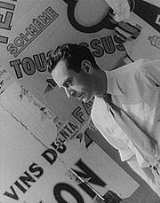
Man Ray

Encyclopedia
Man Ray born Emmanuel Radnitzky, was an American
artist
who spent most of his career in Paris, France. Perhaps best described simply as a modernist, he was a significant contributor to both the Dada
and Surrealist
movements, although his ties to each were informal. Best known in the art world for his avant-garde
photography
, Man Ray produced major works in a variety of media and considered himself a painter
above all. He was also a renowned fashion
and portrait
photographer. He is noted for his photogram
s, which he renamed "rayographs" after himself.
While appreciation for Man Ray's work beyond his fashion and portrait photography was slow in coming during his lifetime, especially in his native United States, his reputation has grown steadily in the decades since.
In 1999, ARTnews
magazine named him one of the 25 most influential artists of the 20th century, citing his groundbreaking photography as well as "his explorations of film, painting
, sculpture
, collage
, assemblage
, and prototypes of what would eventually be called performance art
and conceptual art
" and saying "Man Ray offered artists in all media an example of a creative intelligence that, in its 'pursuit of pleasure and liberty,'"—Man Ray's stated guiding principles—"unlocked every door it came to and walked freely where it would."
Man Ray was born Emmanuel Radnitzky in South Philadelphia
, Pennsylvania
, USA in 1890, the eldest child of recent Russian Jewish
immigrants. The family would eventually include another son and two daughters, the youngest born shortly after they settled in the Williamsburg
section of Brooklyn
, New York
, in 1897. In early 1912, the Radnitzky family changed their surname to Ray, a name selected by Man Ray's brother, in reaction to the ethnic discrimination and anti-Semitism
prevalent at that time. Emmanuel, who was called "Manny" as a nickname, changed his first name to Man at this time, and gradually began to use Man Ray as his combined single name.
Man Ray's father was a garment factory worker who also ran a small tailoring business out of the family home, enlisting his children from an early age. Man Ray's mother enjoyed making the family's clothes from her own designs and inventing patchwork
items from scraps of fabric. Despite Man Ray's desire to disassociate himself from his family background, this experience left an enduring mark on his art. Tailor's dummies, flat irons, sewing machines, needles, pins, threads, swatches of fabric, and other items related to clothing and sewing appear at every stage of his work and in almost every medium. Art historians have also noted similarity in his collage and painting techniques to those used in making clothing.
Mason Klein, curator of an exhibition of Man Ray's work at the Jewish Museum
entitled “Alias Man Ray: The Art of Reinvention," suggests that Man Ray may have been "the first Jewish avant-garde artist."
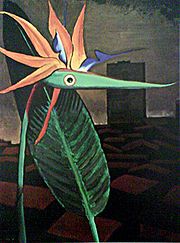 Man Ray displayed artistic and mechanical ability from childhood. His education at Boys' High School from 1904 to 1908 provided him with a solid grounding in drafting
and other basic art techniques. At the same time, he educated himself with frequent visits to the local art museums, where he studied the works of the Old Masters. After graduation from high school, he was offered a scholarship
to study architecture
but chose to pursue a career as an artist instead. However much this decision disappointed his parents' aspirations to upward mobility and assimilation, they nevertheless rearranged the family's modest living quarters so that Man Ray could use a room as his studio. He stayed for the next four years, working steadily toward being a professional painter, while earning money as a commercial artist and technical illustrator at several Manhattan
companies.
From the surviving examples of his work from this period, it appears he attempted mostly paintings and drawings in 19th-century styles. He was already an avid admirer of avant-garde art of the time, such as the European modernists he saw at Alfred Stieglitz
's "291
" gallery and works by the Ashcan School
, but, with a few exceptions, was not yet able to integrate these new trends into his own work. The art classes he sporadically attended—including stints at the National Academy of Design
and the Art Students League
—were of little apparent benefit to him, until he enrolled in the Ferrer School
in the autumn of 1912, thus beginning a period of intense and rapid artistic development.
and in galleries showing contemporary works from Europe, Man Ray's early paintings display facets of cubism
. Upon befriending Marcel Duchamp
who was interested in showing movement in static paintings, his works begin to depict movement of the figures, for example in the repetitive positions of the skirts of the dancer in The Rope Dancer Accompanies Herself with Shadows (1916).
In 1915, Man Ray had his first solo show of paintings and drawings. His first proto-Dada object, an assemblage titled Self-Portrait, was exhibited the following year. He produced his first significant photographs in 1918.
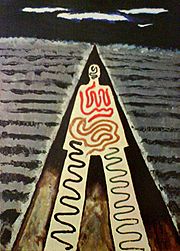 Abandoning conventional painting, Man Ray involved himself with Dada
, a radical anti-art movement, started making objects, and developed unique mechanical and photographic methods of making images. For the 1918 version of Rope Dancer he combined a spray-gun technique with a pen drawing. Again, like Duchamp, he made "readymades
"—objects selected by the artist, sometimes modified and presented as art. His Gift
readymade (1921) is a flatiron
with metal tacks attached to the bottom, and Enigma of Isidore Ducasse is an unseen object (a sewing machine) wrapped in cloth and tied with cord. Another work from this period, Aerograph (1919), was done with airbrush on glass.
In 1920 Ray helped Duchamp make his first machine and one of the earliest examples of kinetic art
, the Rotary Glass Plates composed of glass plates turned by a motor. That same year Man Ray, Katherine Dreier and Duchamp founded the Société Anonyme
, an itinerant collection which in effect was the first museum of modern art
in the U.S.
Ray teamed up with Duchamp to publish the one issue of New York Dada in 1920. Man Ray expressed that "dada's experimentation was no match for the wild and chaotic streets of New York, and he wrote that "Dada cannot live in New York. All New York is dada, and will not tolerate a rival." Man Ray moved to Paris in 1921.
Man Ray met his first wife, the Belgian poet Adon Lacroix, in 1913 in New York. They married in 1914, separated in 1919, and were formally divorced in 1937.
quarter favored by many artists. Shortly after arriving in Paris, he met and fell in love with Kiki de Montparnasse (Alice Prin
), an artists' model and celebrated character in Paris bohemian circles. Kiki was Man Ray's companion for most of the 1920s. She became the subject of some of his most famous photographic images and starred in his experimental films. In 1929 he began a love affair with the Surrealist photographer Lee Miller
.
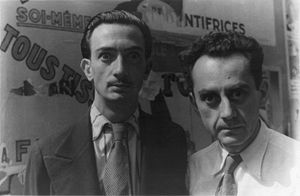 For the next 20 years in Montparnasse, Man Ray made his mark on the art of photography
. Significant members of the art world, such as James Joyce
, Gertrude Stein
, Jean Cocteau
, Bridget Bate Tichenor
, and Antonin Artaud
posed for his camera.
With Jean Arp
, Max Ernst
, André Masson
, Joan Miró
, and Pablo Picasso
, Man Ray was represented in the first Surrealist
exhibition at the Galerie Pierre in Paris in 1925. Works from this period include a metronome with an eye, originally titled Object to Be Destroyed
. Another important work from this part of Man Ray's life is the Violon d'Ingres, a stunning photograph of Kiki de Montparnasse, styled after the painter/musician, Ingres
. This work is a popular example of how Man Ray could juxtapose disparate elements in his photography in order to generate meaning.
In 1934, surrealist artist Méret Oppenheim
, known for her fur-covered teacup, posed nude for Man Ray in what became a well-known series of photographs depicting her standing next to a printing press
.
Together with Lee Miller
, who was his photography assistant and lover, Man Ray reinvented the photographic technique of solarization
. He also created a technique using photogram
s he called rayographs, which he described as "pure dadaism".
Man Ray directed a number of influential avant-garde
short films, known as Cinéma Pur
, such as Le Retour à la Raison
(2 mins, 1923); Emak-Bakia
(16 mins, 1926); L'Étoile de Mer
(15 mins, 1928); and Les Mystères du Château de Dé (27 mins, 1929). Man Ray also assisted Marcel Duchamp with the cinematography of his film Anemic Cinema
(1926), and personally manned the camera on Fernand Léger
's Ballet Mécanique
(1924). Man Ray also appeared in René Clair
's film Entr'acte
(1924), in a brief scene playing chess
with Duchamp.
Duchamp, Man Ray, and Francis Picabia
were friends as well as collaborators, connected by their experimental, entertaining, and innovative art.
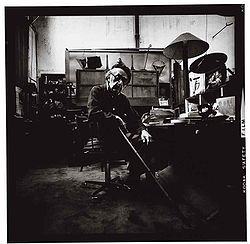 Later in life, Man Ray returned to the United States, having been forced to leave Paris due to the dislocations of the Second World War
. He lived in Los Angeles, California
from 1940 until 1951. A few days after arriving in Los Angeles, Man Ray met Juliet Browner, a first generation American of Rumanian-Jewish lineage; a trained dancer and experienced artists' model. They began living together almost immediately, and married in 1946 in a double wedding with their friends Max Ernst
and Dorothea Tanning
. However, he called Montparnasse home and he returned there.
In 1963 he published his autobiography, Self-Portrait, which was republished in 1999 (ISBN 0-8212-2474-3).
He died in Paris on November 18, 1976 of a lung infection, and was interred in the Cimetière du Montparnasse, Paris. His epitaph
reads: unconcerned, but not indifferent. When Juliet Browner died in 1991, she was interred in the same tomb. Her epitaph reads, together again. Juliet set up a trust for his work and made many donations of his work to museums.
United States
The United States of America is a federal constitutional republic comprising fifty states and a federal district...
artist
Artist
An artist is a person engaged in one or more of any of a broad spectrum of activities related to creating art, practicing the arts and/or demonstrating an art. The common usage in both everyday speech and academic discourse is a practitioner in the visual arts only...
who spent most of his career in Paris, France. Perhaps best described simply as a modernist, he was a significant contributor to both the Dada
Dada
Dada or Dadaism is a cultural movement that began in Zurich, Switzerland, during World War I and peaked from 1916 to 1922. The movement primarily involved visual arts, literature—poetry, art manifestoes, art theory—theatre, and graphic design, and concentrated its anti-war politics through a...
and Surrealist
Surrealism
Surrealism is a cultural movement that began in the early 1920s, and is best known for the visual artworks and writings of the group members....
movements, although his ties to each were informal. Best known in the art world for his avant-garde
Avant-garde
Avant-garde means "advance guard" or "vanguard". The adjective form is used in English to refer to people or works that are experimental or innovative, particularly with respect to art, culture, and politics....
photography
Photography
Photography is the art, science and practice of creating durable images by recording light or other electromagnetic radiation, either electronically by means of an image sensor or chemically by means of a light-sensitive material such as photographic film...
, Man Ray produced major works in a variety of media and considered himself a painter
Painting
Painting is the practice of applying paint, pigment, color or other medium to a surface . The application of the medium is commonly applied to the base with a brush but other objects can be used. In art, the term painting describes both the act and the result of the action. However, painting is...
above all. He was also a renowned fashion
Fashion photography
Fashion photography is a genre of photography devoted to displaying clothing and other fashion items. Fashion photography is most often conducted for advertisements or fashion magazines such as Vogue, Vanity Fair, or Elle...
and portrait
Portrait
thumb|250px|right|Portrait of [[Thomas Jefferson]] by [[Rembrandt Peale]], 1805. [[New-York Historical Society]].A portrait is a painting, photograph, sculpture, or other artistic representation of a person, in which the face and its expression is predominant. The intent is to display the likeness,...
photographer. He is noted for his photogram
Photogram
A photogram is a photographic image made without a camera by placing objects directly onto the surface of a photo-sensitive material such as photographic paper and then exposing it to light. The result is a negative shadow image varying in tone, depending on the transparency of the objects used...
s, which he renamed "rayographs" after himself.
While appreciation for Man Ray's work beyond his fashion and portrait photography was slow in coming during his lifetime, especially in his native United States, his reputation has grown steadily in the decades since.
In 1999, ARTnews
ARTnews
ARTnews is an arts magazine based in New York, founded by James Clarence Hyde in 1902 as Hyde’s Weekly Art News. It is published 11 times a year.ARTnews covers all art, from ancient to Post-modernism...
magazine named him one of the 25 most influential artists of the 20th century, citing his groundbreaking photography as well as "his explorations of film, painting
Painting
Painting is the practice of applying paint, pigment, color or other medium to a surface . The application of the medium is commonly applied to the base with a brush but other objects can be used. In art, the term painting describes both the act and the result of the action. However, painting is...
, sculpture
Sculpture
Sculpture is three-dimensional artwork created by shaping or combining hard materials—typically stone such as marble—or metal, glass, or wood. Softer materials can also be used, such as clay, textiles, plastics, polymers and softer metals...
, collage
Collage
A collage is a work of formal art, primarily in the visual arts, made from an assemblage of different forms, thus creating a new whole....
, assemblage
Assemblage (art)
Assemblage is an artistic process. In the visual arts, it consists of making three-dimensional or two-dimensional artistic compositions by putting together found objects...
, and prototypes of what would eventually be called performance art
Performance art
In art, performance art is a performance presented to an audience, traditionally interdisciplinary. Performance may be either scripted or unscripted, random or carefully orchestrated; spontaneous or otherwise carefully planned with or without audience participation. The performance can be live or...
and conceptual art
Conceptual art
Conceptual art is art in which the concept or idea involved in the work take precedence over traditional aesthetic and material concerns. Many of the works, sometimes called installations, of the artist Sol LeWitt may be constructed by anyone simply by following a set of written instructions...
" and saying "Man Ray offered artists in all media an example of a creative intelligence that, in its 'pursuit of pleasure and liberty,'"—Man Ray's stated guiding principles—"unlocked every door it came to and walked freely where it would."
Background and early life
From the time he began attracting attention as an artist until his death more than sixty years later, Man Ray allowed little of his early life or family background to be known to the public, even refusing to acknowledge that he ever had a name other than Man Ray.Man Ray was born Emmanuel Radnitzky in South Philadelphia
South Philadelphia
South Philadelphia, nicknamed South Philly, is the section of Philadelphia bounded by South Street to the north, the Delaware River to the east and south, and the Schuylkill River to the west.-History:...
, Pennsylvania
Pennsylvania
The Commonwealth of Pennsylvania is a U.S. state that is located in the Northeastern and Mid-Atlantic regions of the United States. The state borders Delaware and Maryland to the south, West Virginia to the southwest, Ohio to the west, New York and Ontario, Canada, to the north, and New Jersey to...
, USA in 1890, the eldest child of recent Russian Jewish
History of the Jews in Russia and the Soviet Union
The vast territories of the Russian Empire at one time hosted the largest populations of Jews in the diaspora. Within these territories the Jewish community flourished and developed many of modern Judaism's most distinctive theological and cultural traditions, while also facing periods of...
immigrants. The family would eventually include another son and two daughters, the youngest born shortly after they settled in the Williamsburg
Williamsburg, Brooklyn
Williamsburg is a neighborhood in the New York City borough of Brooklyn, bordering Greenpoint to the north, Bedford-Stuyvesant to the south, Bushwick to the east and the East River to the west. The neighborhood is part of Brooklyn Community Board 1. The neighborhood is served by the NYPD's 90th ...
section of Brooklyn
Brooklyn
Brooklyn is the most populous of New York City's five boroughs, with nearly 2.6 million residents, and the second-largest in area. Since 1896, Brooklyn has had the same boundaries as Kings County, which is now the most populous county in New York State and the second-most densely populated...
, New York
New York
New York is a state in the Northeastern region of the United States. It is the nation's third most populous state. New York is bordered by New Jersey and Pennsylvania to the south, and by Connecticut, Massachusetts and Vermont to the east...
, in 1897. In early 1912, the Radnitzky family changed their surname to Ray, a name selected by Man Ray's brother, in reaction to the ethnic discrimination and anti-Semitism
Anti-Semitism
Antisemitism is suspicion of, hatred toward, or discrimination against Jews for reasons connected to their Jewish heritage. According to a 2005 U.S...
prevalent at that time. Emmanuel, who was called "Manny" as a nickname, changed his first name to Man at this time, and gradually began to use Man Ray as his combined single name.
Man Ray's father was a garment factory worker who also ran a small tailoring business out of the family home, enlisting his children from an early age. Man Ray's mother enjoyed making the family's clothes from her own designs and inventing patchwork
Patchwork
Patchwork or "pieced work" is a form of needlework that involves sewing together pieces of fabric into a larger design. The larger design is usually based on repeat patterns built up with different colored shapes. These shapes are carefully measured and cut, straight-sided, basic geometric shapes...
items from scraps of fabric. Despite Man Ray's desire to disassociate himself from his family background, this experience left an enduring mark on his art. Tailor's dummies, flat irons, sewing machines, needles, pins, threads, swatches of fabric, and other items related to clothing and sewing appear at every stage of his work and in almost every medium. Art historians have also noted similarity in his collage and painting techniques to those used in making clothing.
Mason Klein, curator of an exhibition of Man Ray's work at the Jewish Museum
Jewish Museum (New York)
The Jewish Museum of New York, an art museum and repository of cultural artifacts, is the leading Jewish museum in the United States. With over 26,000 objects, it contains the largest collection of art and Jewish culture outside of museums in Israel. The museum is housed at 1109 Fifth Avenue, in...
entitled “Alias Man Ray: The Art of Reinvention," suggests that Man Ray may have been "the first Jewish avant-garde artist."
First artistic endeavors
Technical drawing
Technical drawing, also known as drafting or draughting, is the act and discipline of composing plans that visually communicate how something functions or has to be constructed.Drafting is the language of industry....
and other basic art techniques. At the same time, he educated himself with frequent visits to the local art museums, where he studied the works of the Old Masters. After graduation from high school, he was offered a scholarship
Scholarship
A scholarship is an award of financial aid for a student to further education. Scholarships are awarded on various criteria usually reflecting the values and purposes of the donor or founder of the award.-Types:...
to study architecture
Architecture
Architecture is both the process and product of planning, designing and construction. Architectural works, in the material form of buildings, are often perceived as cultural and political symbols and as works of art...
but chose to pursue a career as an artist instead. However much this decision disappointed his parents' aspirations to upward mobility and assimilation, they nevertheless rearranged the family's modest living quarters so that Man Ray could use a room as his studio. He stayed for the next four years, working steadily toward being a professional painter, while earning money as a commercial artist and technical illustrator at several Manhattan
Manhattan
Manhattan is the oldest and the most densely populated of the five boroughs of New York City. Located primarily on the island of Manhattan at the mouth of the Hudson River, the boundaries of the borough are identical to those of New York County, an original county of the state of New York...
companies.
From the surviving examples of his work from this period, it appears he attempted mostly paintings and drawings in 19th-century styles. He was already an avid admirer of avant-garde art of the time, such as the European modernists he saw at Alfred Stieglitz
Alfred Stieglitz
Alfred Stieglitz was an American photographer and modern art promoter who was instrumental over his fifty-year career in making photography an accepted art form...
's "291
Little Galleries of the Photo-Secession
291 is the commonly known name for an internationally famous art gallery that was located at 291 Fifth Avenue in New York City from 1905 to 1917. Originally known as the "Little Galleries of the Photo-Secession", the gallery was created and managed by photographer Alfred Stieglitz.The gallery is...
" gallery and works by the Ashcan School
Ashcan School
The Ashcan School, also called the Ash Can School, is defined as a realist artistic movement that came into prominence in the United States during the early twentieth century, best known for works portraying scenes of daily life in New York's poorer neighborhoods. The movement grew out of a group...
, but, with a few exceptions, was not yet able to integrate these new trends into his own work. The art classes he sporadically attended—including stints at the National Academy of Design
National Academy of Design
The National Academy Museum and School of Fine Arts, founded in New York City as the National Academy of Design – known simply as the "National Academy" – is an honorary association of American artists founded in 1825 by Samuel F. B. Morse, Asher B. Durand, Thomas Cole, Martin E...
and the Art Students League
Art Students League of New York
The Art Students League of New York is an art school located on West 57th Street in New York City. The League has historically been known for its broad appeal to both amateurs and professional artists, and has maintained for over 130 years a tradition of offering reasonably priced classes on a...
—were of little apparent benefit to him, until he enrolled in the Ferrer School
Modern School (United States)
The Modern Schools, also called Ferrer Schools, were United States schools, established in the early twentieth century, that were modeled after the Escuela Moderna of Francesc Ferrer i Guàrdia, the Catalan educator and anarchist...
in the autumn of 1912, thus beginning a period of intense and rapid artistic development.
New York
Living in New York City, influenced by what he saw at the 1913 Armory ShowArmory Show
Many exhibitions have been held in the vast spaces of U.S. National Guard armories, but the Armory Show refers to the 1913 International Exhibition of Modern Art that was organized by the Association of American Painters and Sculptors...
and in galleries showing contemporary works from Europe, Man Ray's early paintings display facets of cubism
Cubism
Cubism was a 20th century avant-garde art movement, pioneered by Pablo Picasso and Georges Braque, that revolutionized European painting and sculpture, and inspired related movements in music, literature and architecture...
. Upon befriending Marcel Duchamp
Marcel Duchamp
Marcel Duchamp was a French artist whose work is most often associated with the Dadaist and Surrealist movements. Considered by some to be one of the most important artists of the 20th century, Duchamp's output influenced the development of post-World War I Western art...
who was interested in showing movement in static paintings, his works begin to depict movement of the figures, for example in the repetitive positions of the skirts of the dancer in The Rope Dancer Accompanies Herself with Shadows (1916).
In 1915, Man Ray had his first solo show of paintings and drawings. His first proto-Dada object, an assemblage titled Self-Portrait, was exhibited the following year. He produced his first significant photographs in 1918.
Dada
Dada or Dadaism is a cultural movement that began in Zurich, Switzerland, during World War I and peaked from 1916 to 1922. The movement primarily involved visual arts, literature—poetry, art manifestoes, art theory—theatre, and graphic design, and concentrated its anti-war politics through a...
, a radical anti-art movement, started making objects, and developed unique mechanical and photographic methods of making images. For the 1918 version of Rope Dancer he combined a spray-gun technique with a pen drawing. Again, like Duchamp, he made "readymades
Readymades of Marcel Duchamp
The readymades of Marcel Duchamp are ordinary manufactured objects that the artist selected and modified, as an antidote to what he called "retinal art". By simply choosing the object and repositioning or joining, titling and signing it, the object became art...
"—objects selected by the artist, sometimes modified and presented as art. His Gift
The Gift (sculpture)
The Gift is an early readymade by Man Ray , consisting of an iron with fourteen thumb tacks glued to its sole, made in 1921 in Paris....
readymade (1921) is a flatiron
Flatiron
Flatiron or flat iron can mean several things:*An old term for a clothes iron*A wedge-shaped building:**The Flatiron Building in New York City, for which the surrounding Flatiron District is named...
with metal tacks attached to the bottom, and Enigma of Isidore Ducasse is an unseen object (a sewing machine) wrapped in cloth and tied with cord. Another work from this period, Aerograph (1919), was done with airbrush on glass.
In 1920 Ray helped Duchamp make his first machine and one of the earliest examples of kinetic art
Kinetic art
Kinetic art is art that contains moving parts or depends on motion for its effect. The moving parts are generally powered by wind, a motor or the observer. Kinetic art encompasses a wide variety of overlapping techniques and styles.-Kinetic sculpture:...
, the Rotary Glass Plates composed of glass plates turned by a motor. That same year Man Ray, Katherine Dreier and Duchamp founded the Société Anonyme
Société Anonyme (art)
Société Anonyme, Inc. was an art organization founded in 1920 by Katherine Dreier, Man Ray and Marcel Duchamp. The society sponsored lectures, concerts, publications, and exhibitions of modern art, including the International Exhibition of Modern Art at the Brooklyn Museum in 1926...
, an itinerant collection which in effect was the first museum of modern art
Modern art
Modern art includes artistic works produced during the period extending roughly from the 1860s to the 1970s, and denotes the style and philosophy of the art produced during that era. The term is usually associated with art in which the traditions of the past have been thrown aside in a spirit of...
in the U.S.
Ray teamed up with Duchamp to publish the one issue of New York Dada in 1920. Man Ray expressed that "dada's experimentation was no match for the wild and chaotic streets of New York, and he wrote that "Dada cannot live in New York. All New York is dada, and will not tolerate a rival." Man Ray moved to Paris in 1921.
Man Ray met his first wife, the Belgian poet Adon Lacroix, in 1913 in New York. They married in 1914, separated in 1919, and were formally divorced in 1937.
Paris
In July 1921, Man Ray went to live and work in Paris, France, and soon settled in the MontparnasseMontparnasse
Montparnasse is an area of Paris, France, on the left bank of the river Seine, centred at the crossroads of the Boulevard du Montparnasse and the Rue de Rennes, between the Rue de Rennes and boulevard Raspail...
quarter favored by many artists. Shortly after arriving in Paris, he met and fell in love with Kiki de Montparnasse (Alice Prin
Alice Prin
Alice Ernestine Prin , nicknamed Queen of Montparnasse, and often known as Kiki de Montparnasse, was a French artist model, nightclub singer, actress, memoirist, and painter. She flourished in, and helped define, the liberated, early 1920s culture of Paris.- Early life :Alice Prin was born in...
), an artists' model and celebrated character in Paris bohemian circles. Kiki was Man Ray's companion for most of the 1920s. She became the subject of some of his most famous photographic images and starred in his experimental films. In 1929 he began a love affair with the Surrealist photographer Lee Miller
Lee Miller
Elizabeth 'Lee' Miller, Lady Penrose was an American photographer. Born in Poughkeepsie, New York in 1907, she was a successful fashion model in New York City in the 1920s before going to Paris where she became an established fashion and fine art photographer...
.
Photography
Photography is the art, science and practice of creating durable images by recording light or other electromagnetic radiation, either electronically by means of an image sensor or chemically by means of a light-sensitive material such as photographic film...
. Significant members of the art world, such as James Joyce
James Joyce
James Augustine Aloysius Joyce was an Irish novelist and poet, considered to be one of the most influential writers in the modernist avant-garde of the early 20th century...
, Gertrude Stein
Gertrude Stein
Gertrude Stein was an American writer, poet and art collector who spent most of her life in France.-Early life:...
, Jean Cocteau
Jean Cocteau
Jean Maurice Eugène Clément Cocteau was a French poet, novelist, dramatist, designer, playwright, artist and filmmaker. His circle of associates, friends and lovers included Kenneth Anger, Pablo Picasso, Jean Hugo, Jean Marais, Henri Bernstein, Marlene Dietrich, Coco Chanel, Erik Satie, María...
, Bridget Bate Tichenor
Bridget Bate Tichenor
Bridget Bate Tichenor , also known as Bridget Tichenor or B.B.T., was a Mexican surrealist painter of fantastic art in the school of magic realism and a fashion editor...
, and Antonin Artaud
Antonin Artaud
Antoine Marie Joseph Artaud, more well-known as Antonin Artaud was a French playwright, poet, actor and theatre director...
posed for his camera.
With Jean Arp
Jean Arp
Jean Arp / Hans Arp was a German-French, or Alsatian, sculptor, painter, poet and abstract artist in other media such as torn and pasted paper....
, Max Ernst
Max Ernst
Max Ernst was a German painter, sculptor, graphic artist, and poet. A prolific artist, Ernst was one of the primary pioneers of the Dada movement and Surrealism.-Early life:...
, André Masson
André Masson
André-Aimé-René Masson was a French artist.-Biography:Masson was born in Balagny-sur-Thérain, Oise, but was brought up in Belgium. He began his study of art at the age of eleven in Brussels, at the Académie Royale des Beaux-Arts under the guidance of Constant Montald, and later he studied in Paris...
, Joan Miró
Joan Miró
Joan Miró i Ferrà was a Spanish Catalan painter, sculptor, and ceramicist born in Barcelona.Earning international acclaim, his work has been interpreted as Surrealism, a sandbox for the subconscious mind, a re-creation of the childlike, and a manifestation of Catalan pride...
, and Pablo Picasso
Pablo Picasso
Pablo Diego José Francisco de Paula Juan Nepomuceno María de los Remedios Cipriano de la Santísima Trinidad Ruiz y Picasso known as Pablo Ruiz Picasso was a Spanish expatriate painter, sculptor, printmaker, ceramicist, and stage designer, one of the greatest and most influential artists of the...
, Man Ray was represented in the first Surrealist
Surrealism
Surrealism is a cultural movement that began in the early 1920s, and is best known for the visual artworks and writings of the group members....
exhibition at the Galerie Pierre in Paris in 1925. Works from this period include a metronome with an eye, originally titled Object to Be Destroyed
Object to Be Destroyed
Object to Be Destroyed is a work by American artist Man Ray, originally created in 1923. The work, destroyed in 1957, consisted of a metronome with a photograph of an eye attached to its swinging arm. It was remade in multiple copies in later years, and renamed Indestructible Object...
. Another important work from this part of Man Ray's life is the Violon d'Ingres, a stunning photograph of Kiki de Montparnasse, styled after the painter/musician, Ingres
Jean Auguste Dominique Ingres
Jean-Auguste-Dominique Ingres was a French Neoclassical painter. Although he considered himself to be a painter of history in the tradition of Nicolas Poussin and Jacques-Louis David, by the end of his life it was Ingres's portraits, both painted and drawn, that were recognized as his greatest...
. This work is a popular example of how Man Ray could juxtapose disparate elements in his photography in order to generate meaning.
In 1934, surrealist artist Méret Oppenheim
Méret Oppenheim
-External links:**** http://www.artchive.com/artchive/M/man_ray.html...
, known for her fur-covered teacup, posed nude for Man Ray in what became a well-known series of photographs depicting her standing next to a printing press
Printing press
A printing press is a device for applying pressure to an inked surface resting upon a print medium , thereby transferring the ink...
.
Together with Lee Miller
Lee Miller
Elizabeth 'Lee' Miller, Lady Penrose was an American photographer. Born in Poughkeepsie, New York in 1907, she was a successful fashion model in New York City in the 1920s before going to Paris where she became an established fashion and fine art photographer...
, who was his photography assistant and lover, Man Ray reinvented the photographic technique of solarization
Solarisation
Solarisation is a phenomenon in photography in which the image recorded on a negative or on a photographic print is wholly or partially reversed in tone. Dark areas appear light or light areas appear dark...
. He also created a technique using photogram
Photogram
A photogram is a photographic image made without a camera by placing objects directly onto the surface of a photo-sensitive material such as photographic paper and then exposing it to light. The result is a negative shadow image varying in tone, depending on the transparency of the objects used...
s he called rayographs, which he described as "pure dadaism".
Man Ray directed a number of influential avant-garde
Avant-garde
Avant-garde means "advance guard" or "vanguard". The adjective form is used in English to refer to people or works that are experimental or innovative, particularly with respect to art, culture, and politics....
short films, known as Cinéma Pur
Cinema pur
Cinéma Pur was an avant-garde film movement birthed in Paris in the 1920s and 30s. The term was first coined by Henri Chomette to define a cinema that focused on the pure elements of film like form, light, motion, visual composition, and rhythm, something he accomplished in his shorts Reflets de...
, such as Le Retour à la Raison
Le Retour à la Raison
Le Retour à la Raison is a 1923 film directed by Man Ray. It consists of animated textures, Rayographs and the torso of Kiki of Montparnasse .-Sources:*Flicks - March 2001 ; Chris Dashiell -External links:* *...
(2 mins, 1923); Emak-Bakia
Emak-Bakia
Emak-Bakia is a 1926 film directed by Man Ray. Subtitled as a cinépoéme, it features many filming techniques used by Man Ray, including Rayographs, double exposures, soft focus and ambiguous features.-Synopsis:...
(16 mins, 1926); L'Étoile de Mer
L'Étoile de mer
L'Étoile de mer is a 1928 film directed by Man Ray. The film is based on a script by Robert Desnos and depicts a couple acting through scenes that are shot out of focus.-Synopsis:...
(15 mins, 1928); and Les Mystères du Château de Dé (27 mins, 1929). Man Ray also assisted Marcel Duchamp with the cinematography of his film Anemic Cinema
Anemic Cinema
Anemic Cinema or Anémic Cinéma is a Dadaist, surrealist, or experimental film made by Marcel Duchamp. The film depicts whirling animated drawings -- which Duchamp called Rotoreliefs -- alternated with puns in French. Duchamp signed the film with his alter ego name of Rrose Sélavy.Rotoreliefs were...
(1926), and personally manned the camera on Fernand Léger
Fernand Léger
Joseph Fernand Henri Léger was a French painter, sculptor, and filmmaker. In his early works he created a personal form of Cubism which he gradually modified into a more figurative, populist style...
's Ballet Mécanique
Ballet mécanique
Ballet Mécanique was a project by the American composer George Antheil and the filmmaker/artists Fernand Léger and Dudley Murphy. Although the film was intended to use Antheil's score as a soundtrack, the two parts were not brought together until the 1990s. As a composition, Ballet Mécanique is...
(1924). Man Ray also appeared in René Clair
René Clair
René Clair born René-Lucien Chomette, was a French filmmaker.-Biography:He was born in Paris and grew up in the Les Halles quarter. He attended the Lycée Montaigne and the Lycée Louis-le-Grand. During World War I, he served as an ambulance driver. After the war, he started a career as a journalist...
's film Entr'acte
Entr'acte (film)
Entr'acte is a 1924 French short film directed by René Clair, which premiered as an entr'acte for the Ballets Suédois production Relâche at the Théâtre des Champs-Élysées in Paris. Relâche is based on a book and with settings by Francis Picabia, produced by Rolf de Maré, and with choreography by...
(1924), in a brief scene playing chess
Chess
Chess is a two-player board game played on a chessboard, a square-checkered board with 64 squares arranged in an eight-by-eight grid. It is one of the world's most popular games, played by millions of people worldwide at home, in clubs, online, by correspondence, and in tournaments.Each player...
with Duchamp.
Duchamp, Man Ray, and Francis Picabia
Francis Picabia
Francis Picabia was a French painter, poet, and typographist, associated with both the Dada and Surrealist art movements.- Early life :...
were friends as well as collaborators, connected by their experimental, entertaining, and innovative art.
Later life
World War II
World War II, or the Second World War , was a global conflict lasting from 1939 to 1945, involving most of the world's nations—including all of the great powers—eventually forming two opposing military alliances: the Allies and the Axis...
. He lived in Los Angeles, California
Los Angeles, California
Los Angeles , with a population at the 2010 United States Census of 3,792,621, is the most populous city in California, USA and the second most populous in the United States, after New York City. It has an area of , and is located in Southern California...
from 1940 until 1951. A few days after arriving in Los Angeles, Man Ray met Juliet Browner, a first generation American of Rumanian-Jewish lineage; a trained dancer and experienced artists' model. They began living together almost immediately, and married in 1946 in a double wedding with their friends Max Ernst
Max Ernst
Max Ernst was a German painter, sculptor, graphic artist, and poet. A prolific artist, Ernst was one of the primary pioneers of the Dada movement and Surrealism.-Early life:...
and Dorothea Tanning
Dorothea Tanning
Dorothea Tanning is an American painter, printmaker, sculptor and writer. She has also designed sets and costumes for ballet and theatre.-Biography:...
. However, he called Montparnasse home and he returned there.
In 1963 he published his autobiography, Self-Portrait, which was republished in 1999 (ISBN 0-8212-2474-3).
He died in Paris on November 18, 1976 of a lung infection, and was interred in the Cimetière du Montparnasse, Paris. His epitaph
Epitaph
An epitaph is a short text honoring a deceased person, strictly speaking that is inscribed on their tombstone or plaque, but also used figuratively. Some are specified by the dead person beforehand, others chosen by those responsible for the burial...
reads: unconcerned, but not indifferent. When Juliet Browner died in 1991, she was interred in the same tomb. Her epitaph reads, together again. Juliet set up a trust for his work and made many donations of his work to museums.
By Man Ray
- "It has never been my object to record my dreams, just the determination to realize them." (Julien Levy exhibition catalog, April 1945.)
- "There is no progress in art, any more than there is progress in making love. There are simply different ways of doing it." (1948 essay, "To Be Continued, Unnoticed".)
- "To create is divine, to reproduce is human." ("Originals Graphic Multiples", circa 1968; published in Objets de Mon Affection, 1983.)
- "I paint what cannot be photographed, that which comes from the imagination or from dreams, or from an unconscious drive. I photograph the things that I do not wish to paint, the things which already have an existence." (Undated interview, circa 1970s; published in Man Ray: Photographer, 1981.)
- "I have been accused of being a joker. But the most successful art to me involves humor." (Undated interview, circa 1970s; published in Man Ray: Photographer, 1981.)
- "An original is a creation motivated by desire. Any reproduction of an originals motivated by necessity. It is marvelous that we are the only species that creates gratuitous forms. To create is divine, to reproduce is human."
- "Of course, there will always be those who look only at technique, who ask 'how', while others of a more curious nature will ask 'why'. Personally, I have always preferred inspiration to information."
- “I do not photograph nature. I photograph my visions.”
About Man Ray
- "MAN RAY, n.m. synon. de Joie jouer jouir." (Translation: "MAN RAY, masculine noun, synonymous with joy, to play, to enjoy.") — Marcel DuchampMarcel DuchampMarcel Duchamp was a French artist whose work is most often associated with the Dadaist and Surrealist movements. Considered by some to be one of the most important artists of the 20th century, Duchamp's output influenced the development of post-World War I Western art...
, as the opening epigram for Man Ray's memoir Self-Portrait, 1963.
- "With him you could try anything—there was nothing you were told not to do, except spill the chemicals. With Man Ray, you were free to do what your imagination conjured, and that kind of encouragement was wonderful." — Artist and photographer, Naomi Savage, Man Ray's niece and protégée, in a 2000 newspaper interview.
- "Man Ray is a youthful alchemist forever in quest of the painter's philosopher's stonePhilosopher's stoneThe philosopher's stone is a legendary alchemical substance said to be capable of turning base metals into gold or silver. It was also sometimes believed to be an elixir of life, useful for rejuvenation and possibly for achieving immortality. For many centuries, it was the most sought-after goal...
. May he never find it, as that would bring an end to his experimentations which are the very condition of living art expression." — Adolf Wolff, "Art Notes", International 8, no. 1 (January 1914), p. 21.
- "[Man Ray was] a kind of short man who looked a little like Mr. PeepersMr. PeepersMr. Peepers is an American television sitcom that aired on NBC from July 3, 1952 to June 12, 1955.-Overview:Mr. Peepers starred Wally Cox as Jefferson City's junior high school science teacher Robinson J. Peepers...
, spoke slowly with a slight Brooklynese accent, and talked so you could never tell when he was kidding." — Brother-in-law Joseph Browner on his first impression of the artist; quoted in the Fresno Bee, August 26, 1990.
Selected books by Man Ray
- Man Ray and Tristan Tzara (1922). Champs délicieux: album de photographies. Paris: [Société générale d'imprimerie et d'édition].
- Man Ray (1926). Revolving doors, 1916-1917: 10 planches. Paris: Éditions Surrealistes.
- Man Ray (1934). Man Ray: photographs, 1920–1934, Paris. Hartford, CT: James Thrall Soby.
- Éluard, Paul, and Man Ray (1935). Facile. Paris: Éditions G.L.M.
- Man Ray and André Breton (1937). La photographie n'est pas l'art. Paris: Éditions G.L.M.
- Man Ray and Paul Éluard (1937). Les mains libres: dessins. Paris: Éditions Jeanne Bucher.
- Man Ray (1948). Alphabet for adults. Beverly Hills, CA: Copley Galleries.
- Man Ray (1963). Self portrait. London: Andre Deutsch.
- Man Ray and L. Fritz Gruber (1963). Portraits. Gütersloh, Germany: Sigbert Mohn Verlag.
External links
- Works by Man Ray -- Official Licensing Archive. Searchable. Over 1,000 photos here.
- Man Ray Trust
- A biography of the artist Man Ray from the J. Paul Getty MuseumJ. Paul Getty MuseumThe J. Paul Getty Museum, a program of the J. Paul Getty Trust, is an art museum. It has two locations, one at the Getty Center in Los Angeles, California, and one at the Getty Villa in Pacific Palisades, Los Angeles, California...
- Brief biography of Man Ray by the Biography Resource Center, Gale Group
- Collection of Man Ray short films
- Man Ray letters and album, 1922-1976. Research Library at the Getty Research Institute. Los Angeles, California. A significant ensemble of letters and writings by or addressed to Man Ray, collected and safeguarded by his sister Elsie Ray Siegler and her daughter Naomi Savage. The letters from Man Ray are addressed to Siegler and Savage and provide a rich chronicle of his personal and professional life from 1922-1976. Letters to Man Ray are from Dada and Surrealist artists and authors, and document the dynamic artistic and literary scenes of the immediate pre- and post-the World War II period in the United States. An album of predominately handwritten manuscripts supplements the letters by offering Man Ray’s thoughts on a range of artistic issues.
- Webpage of the exhibition "Man Ray" in: Museo del Banco de la República, Bogotá, Colombia