

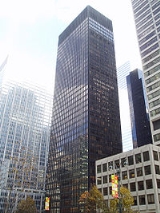
Seagram Building

Encyclopedia
The Seagram Building is a skyscraper
, located at 375 Park Avenue
, between 52nd Street
and 53rd Street
in Midtown Manhattan
, New York City
. It was designed by Ludwig Mies van der Rohe
, in collaboration with Philip Johnson
. Severud Associates were the structural engineering consultants. The building stands 516 feet tall with 38 stories, and was completed in 1958. It stands as one of the finest examples of the functionalist
aesthetic and a masterpiece of corporate modernism
. It was designed as the headquarters for the Canadian distillers Joseph E. Seagram's & Sons
with the active interest of Phyllis Lambert
, the daughter of Samuel Bronfman
, Seagram's CEO.
in which it was built, had enormous influences on American
architecture
. One of the style's characteristic traits was to express or articulate
the structure of buildings externally. It was a style that argued that the functional utility of the building’s structural elements when made visible, could supplant a formal decorative articulation; and more honestly converse with the public than any system of applied ornamentation.
A building's structural elements should be visible, Mies thought. The Seagram Building, like virtually all large buildings of the time, was built of a steel frame
, from which non-structural glass walls
were hung. Mies would have preferred the steel frame to be visible to all; however, American building codes required that all structural steel
be covered in a fireproof material, usually concrete
, because improperly protected steel columns or beams may soften and fail in confined fires. Concrete hid the structure of the building — something Mies wanted to avoid at all costs — so Mies used non-structural bronze-toned I-beam
s to suggest structure instead. These are visible from the outside of the building, and run vertically, like mullions, surrounding the large glass windows. This method of construction using an interior reinforced concrete
shell to support a larger non-structural edifice has since become commonplace. As designed, the building used 1,500 tons of bronze in its construction.
On completion, the construction costs of Seagram made it the world's most expensive skyscraper at the time, due to the use of expensive quality materials and lavish interior decoration including bronze, travertine
, and marble
. The interior was designed to assure cohesion with the external features, repeated in the glass and bronze furnishings and decorative scheme.
Another interesting feature of the Seagram Building is the window blind
s. As was common with International style architects, Mies wanted the building to have a uniform appearance. One aspect of a façade
which Mies disliked, was the disordered irregularity when window blinds are drawn. Inevitably, people using different windows will draw blinds to different heights, making the building appear disorganized. To reduce this disproportionate appearance, Mies specified window blinds which only operated in three positions – fully open, halfway open/closed, or fully closed.
According to Severud Associates, the structural engineering
consultants, it was the first tall building to use high strength bolted connections, the first tall building to combine a braced frame with a moment frame, one of the first tall buildings to use a vertical truss bracing system and the first tall building to employ a composite steel and concrete lateral frame.
, which sits just across Park Avenue
, set the architectural style for skyscrapers in New York
for several decades. It appears as a simple bronze
box, set back from Park Avenue by a large, open granite
plaza
. Mies intended to create an urban open space in front of the building, despite the luxuriousness of the idea, and it became a very popular gathering area indeed. In 1961, when New York City
enacted a major revision to its 1916 Zoning Resolution
, the nation's first comprehensive Zoning Resolution, it offered incentives for developers to install "privately owned public spaces" which were meant to emulate that of the Seagram's Building; the following 40 years of development in Manhattan
did so with relatively little success.
The Seagram Building's plaza was also the site of a landmark planning study by William H. Whyte
, the American sociologist. The film, Social Life of Small Urban Spaces, produced in conjunction with the Municipal Art Society
of New York, records the daily patterns of people socializing around the plaza. It shows how people actually use space, varying from the supposed intent of the architects.
.
Skyscraper
A skyscraper is a tall, continuously habitable building of many stories, often designed for office and commercial use. There is no official definition or height above which a building may be classified as a skyscraper...
, located at 375 Park Avenue
Park Avenue (Manhattan)
Park Avenue is a wide boulevard that carries north and southbound traffic in New York City borough of Manhattan. Through most of its length, it runs parallel to Madison Avenue to the west and Lexington Avenue to the east....
, between 52nd Street
52nd Street (Manhattan)
52nd Street is a long one-way street traveling west to east across Midtown Manhattan.-Jazz center:The blocks of 52nd Street between Fifth Avenue and Seventh Avenue were renowned in the mid-20th century for the abundance of jazz clubs and lively street life...
and 53rd Street
53rd Street (Manhattan)
53rd Street is a midtown cross street in the New York City borough of Manhattan, that contains buildings such as the Citicorp Building. It is 1.83 miles long. The street runs westbound from Sutton Place across most of the island's width, ending at DeWitt Clinton Park at Eleventh Avenue...
in Midtown Manhattan
Midtown Manhattan
Midtown Manhattan, or simply Midtown, is an area of Manhattan, New York City home to world-famous commercial zones such as Rockefeller Center, Broadway, and Times Square...
, New York City
New York City
New York is the most populous city in the United States and the center of the New York Metropolitan Area, one of the most populous metropolitan areas in the world. New York exerts a significant impact upon global commerce, finance, media, art, fashion, research, technology, education, and...
. It was designed by Ludwig Mies van der Rohe
Ludwig Mies van der Rohe
Ludwig Mies van der Rohe was a German architect. He is commonly referred to and addressed as Mies, his surname....
, in collaboration with Philip Johnson
Philip Johnson
Philip Cortelyou Johnson was an influential American architect.In 1930, he founded the Department of Architecture and Design at the Museum of Modern Art in New York City, and later , as a trustee, he was awarded an American Institute of Architects Gold Medal and the first Pritzker Architecture...
. Severud Associates were the structural engineering consultants. The building stands 516 feet tall with 38 stories, and was completed in 1958. It stands as one of the finest examples of the functionalist
Functionalism (architecture)
Functionalism, in architecture, is the principle that architects should design a building based on the purpose of that building. This statement is less self-evident than it first appears, and is a matter of confusion and controversy within the profession, particularly in regard to modern...
aesthetic and a masterpiece of corporate modernism
Modern architecture
Modern architecture is generally characterized by simplification of form and creation of ornament from the structure and theme of the building. It is a term applied to an overarching movement, with its exact definition and scope varying widely...
. It was designed as the headquarters for the Canadian distillers Joseph E. Seagram's & Sons
Seagram
The Seagram Company Ltd. was a large corporation headquartered in Montreal, Quebec, Canada that was the largest distiller of alcoholic beverages in the world. Toward the end of its independent existence it also controlled various entertainment and other business ventures...
with the active interest of Phyllis Lambert
Phyllis Lambert
Phyllis Barbara Lambert CC, GOQ, OAL, FRAIC, FRSC, RCA is a Canadian philanthropist and member of the Bronfman family....
, the daughter of Samuel Bronfman
Samuel Bronfman
Samuel Bronfman, was a Canadian business magnate and philanthropist. He founded Distillers Corporation Limited, and is a member of the Canadian Jewish family dynasty, the Bronfman family.-Early life:...
, Seagram's CEO.
Architecture
This structure, and the International styleInternational style (architecture)
The International style is a major architectural style that emerged in the 1920s and 1930s, the formative decades of Modern architecture. The term originated from the name of a book by Henry-Russell Hitchcock and Philip Johnson, The International Style...
in which it was built, had enormous influences on American
United States
The United States of America is a federal constitutional republic comprising fifty states and a federal district...
architecture
Architecture
Architecture is both the process and product of planning, designing and construction. Architectural works, in the material form of buildings, are often perceived as cultural and political symbols and as works of art...
. One of the style's characteristic traits was to express or articulate
Articulation (architecture)
Articulation, in art and architecture, is a method of styling the joints in the formal elements of architectural design. Through degrees of articulation, each part is united with the whole work by means of a joint in such a way that the joined parts are put together in styles ranging from...
the structure of buildings externally. It was a style that argued that the functional utility of the building’s structural elements when made visible, could supplant a formal decorative articulation; and more honestly converse with the public than any system of applied ornamentation.
A building's structural elements should be visible, Mies thought. The Seagram Building, like virtually all large buildings of the time, was built of a steel frame
Steel frame
Steel frame usually refers to a building technique with a "skeleton frame" of vertical steel columns and horizontal -beams, constructed in a rectangular grid to support the floors, roof and walls of a building which are all attached to the frame...
, from which non-structural glass walls
Curtain wall
A curtain wall is an outer covering of a building in which the outer walls are non-structural, but merely keep out the weather. As the curtain wall is non-structural it can be made of a lightweight material reducing construction costs. When glass is used as the curtain wall, a great advantage is...
were hung. Mies would have preferred the steel frame to be visible to all; however, American building codes required that all structural steel
Structural steel
Structural steel is steel construction material, a profile, formed with a specific shape or cross section and certain standards of chemical composition and mechanical properties...
be covered in a fireproof material, usually concrete
Concrete
Concrete is a composite construction material, composed of cement and other cementitious materials such as fly ash and slag cement, aggregate , water and chemical admixtures.The word concrete comes from the Latin word...
, because improperly protected steel columns or beams may soften and fail in confined fires. Concrete hid the structure of the building — something Mies wanted to avoid at all costs — so Mies used non-structural bronze-toned I-beam
I-beam
-beams, also known as H-beams, W-beams , rolled steel joist , or double-T are beams with an - or H-shaped cross-section. The horizontal elements of the "" are flanges, while the vertical element is the web...
s to suggest structure instead. These are visible from the outside of the building, and run vertically, like mullions, surrounding the large glass windows. This method of construction using an interior reinforced concrete
Reinforced concrete
Reinforced concrete is concrete in which reinforcement bars , reinforcement grids, plates or fibers have been incorporated to strengthen the concrete in tension. It was invented by French gardener Joseph Monier in 1849 and patented in 1867. The term Ferro Concrete refers only to concrete that is...
shell to support a larger non-structural edifice has since become commonplace. As designed, the building used 1,500 tons of bronze in its construction.
On completion, the construction costs of Seagram made it the world's most expensive skyscraper at the time, due to the use of expensive quality materials and lavish interior decoration including bronze, travertine
Travertine
Travertine is a form of limestone deposited by mineral springs, especially hot springs. Travertine often has a fibrous or concentric appearance and exists in white, tan, and cream-colored varieties. It is formed by a process of rapid precipitation of calcium carbonate, often at the mouth of a hot...
, and marble
Marble
Marble is a metamorphic rock composed of recrystallized carbonate minerals, most commonly calcite or dolomite.Geologists use the term "marble" to refer to metamorphosed limestone; however stonemasons use the term more broadly to encompass unmetamorphosed limestone.Marble is commonly used for...
. The interior was designed to assure cohesion with the external features, repeated in the glass and bronze furnishings and decorative scheme.
Another interesting feature of the Seagram Building is the window blind
Window blind
A window blind is a type of window coverings. There are many different kinds of window blinds, using different systems and materials. A typical window blind is made with slats of fabric, wood, plastic or metal that adjust by rotating from an open position to a closed position by allowing slats to...
s. As was common with International style architects, Mies wanted the building to have a uniform appearance. One aspect of a façade
Facade
A facade or façade is generally one exterior side of a building, usually, but not always, the front. The word comes from the French language, literally meaning "frontage" or "face"....
which Mies disliked, was the disordered irregularity when window blinds are drawn. Inevitably, people using different windows will draw blinds to different heights, making the building appear disorganized. To reduce this disproportionate appearance, Mies specified window blinds which only operated in three positions – fully open, halfway open/closed, or fully closed.
Structure
The 38-story structure combines a steel moment frame and a steel and reinforced concrete core for lateral stiffness. The concrete core shear walls extend up to the 17th floor, and diagonal core bracing (shear trusses) extends to the 29th floor.According to Severud Associates, the structural engineering
Structural engineering
Structural engineering is a field of engineering dealing with the analysis and design of structures that support or resist loads. Structural engineering is usually considered a specialty within civil engineering, but it can also be studied in its own right....
consultants, it was the first tall building to use high strength bolted connections, the first tall building to combine a braced frame with a moment frame, one of the first tall buildings to use a vertical truss bracing system and the first tall building to employ a composite steel and concrete lateral frame.
Plaza
The Seagram Building and Lever HouseLever House
Lever House, designed by Gordon Bunshaft of Skidmore, Owings and Merrill and located at 390 Park Avenue in New York City, is the quintessential and seminal glass-box skyscraper built in the International style according to the design principles of Ludwig Mies van der Rohe. Completed in 1952, it was...
, which sits just across Park Avenue
Park Avenue (Manhattan)
Park Avenue is a wide boulevard that carries north and southbound traffic in New York City borough of Manhattan. Through most of its length, it runs parallel to Madison Avenue to the west and Lexington Avenue to the east....
, set the architectural style for skyscrapers in New York
New York
New York is a state in the Northeastern region of the United States. It is the nation's third most populous state. New York is bordered by New Jersey and Pennsylvania to the south, and by Connecticut, Massachusetts and Vermont to the east...
for several decades. It appears as a simple bronze
Bronze
Bronze is a metal alloy consisting primarily of copper, usually with tin as the main additive. It is hard and brittle, and it was particularly significant in antiquity, so much so that the Bronze Age was named after the metal...
box, set back from Park Avenue by a large, open granite
Granite
Granite is a common and widely occurring type of intrusive, felsic, igneous rock. Granite usually has a medium- to coarse-grained texture. Occasionally some individual crystals are larger than the groundmass, in which case the texture is known as porphyritic. A granitic rock with a porphyritic...
plaza
Plaza
Plaza is a Spanish word related to "field" which describes an open urban public space, such as a city square. All through Spanish America, the plaza mayor of each center of administration held three closely related institutions: the cathedral, the cabildo or administrative center, which might be...
. Mies intended to create an urban open space in front of the building, despite the luxuriousness of the idea, and it became a very popular gathering area indeed. In 1961, when New York City
New York City
New York is the most populous city in the United States and the center of the New York Metropolitan Area, one of the most populous metropolitan areas in the world. New York exerts a significant impact upon global commerce, finance, media, art, fashion, research, technology, education, and...
enacted a major revision to its 1916 Zoning Resolution
1916 Zoning Resolution
The New York City 1916 Zoning Resolution was a measure adopted primarily to stop massive buildings such as the Equitable Building from preventing light and air from reaching the streets below...
, the nation's first comprehensive Zoning Resolution, it offered incentives for developers to install "privately owned public spaces" which were meant to emulate that of the Seagram's Building; the following 40 years of development in Manhattan
Manhattan
Manhattan is the oldest and the most densely populated of the five boroughs of New York City. Located primarily on the island of Manhattan at the mouth of the Hudson River, the boundaries of the borough are identical to those of New York County, an original county of the state of New York...
did so with relatively little success.
The Seagram Building's plaza was also the site of a landmark planning study by William H. Whyte
William H. Whyte
William Hollingsworth "Holly" Whyte was an American urbanist, organizational analyst, journalist and people-watcher.Whyte was born in West Chester, Pennsylvania in 1917 and died in New York City in 1999. An early graduate of St. Andrew's School in Middletown, Delaware, he graduated from Princeton...
, the American sociologist. The film, Social Life of Small Urban Spaces, produced in conjunction with the Municipal Art Society
Municipal Art Society
The Municipal Art Society of New York, founded in 1893, is a non-profit membership organization that fights for intelligent urban planning, design and preservation through education, dialogue and advocacy in New York City....
of New York, records the daily patterns of people socializing around the plaza. It shows how people actually use space, varying from the supposed intent of the architects.
Brasserie
The building is the location of Brasserie, designed by Diller + ScofidioDiller Scofidio + Renfro
Diller Scofidio + Renfro is a New York City-based interdisciplinary design studio that integrates architecture, the visual arts, and the performing arts. Originally founded by Elizabeth Diller and Ricardo Scofidio in 1979, the firm is particularly well known for its interdisciplinary approach to...
.
Further reading
- Dirk Stichweh: New York Skyscrapers. Prestel Publishing, Munich 2009, ISBN 3791340549