
All Topics  
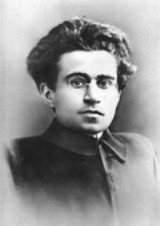
Antonio Gramsci

 
Antonio Gramsci

   Email Print
   Bookmark   Link


Antonio Gramsci


Antonio Gramsci (January 22, 1891 – April 27, 1937) was an Italian philosopher, writer, politician
Politician

A politician is an individual who is involved in influencing public decision making through the influence of politics or a person who influences the way a society is governed....
 and political theorist. A founding member and onetime leader of the Communist Party of Italy
Communist Party of Italy

The Communist Party of Italy was an Italian political party which existed from 1921 to 1926. Although its political experience is part of the story of the Italian Communist Party, it was a different entity....
, he was imprisoned by Benito Mussolini
Benito Mussolini

Benito Amilcare Andrea Mussolini, Order of the Bath Sovereign Military Order of Malta Order of the Tower and Sword was an Italy politician who led the National Fascist Party and is credited with being one of the key figures in the creation of Fascism....
's Fascist regime. His writings are heavily concerned with the analysis of culture and political leadership and he is notable as a highly original thinker within the Marxist tradition. He is renowned for his concept of cultural hegemony
Cultural hegemony

Cultural hegemony is the philosophic and sociologic concept, originated by the Marxism philosopher Antonio Gramsci, denoting that a culturally-diverse society can be ruled , by one of its social classes, partly through imposed ?common sense? ? quotidian ?shared beliefs? used as the foundation for complex systems of political, social,...
 as a means of maintaining the state in a capitalist
Capitalism

Capitalism is an economic system in which wealth, and the means of producing wealth, are private property and controlled rather than commonly, publicly, or state-owned and controlled....
 society.

Early life Gramsci was born in Ales
Ales (Sardinia)

Ales is a small town in the Provinces of Italy of Oristano on the island of Sardinia in the Mediterranean Sea. It lies on the eastern slopes of Mt....
, Italy, on the island of Sardinia
Sardinia

Sardinia is the Mediterranean islands#By area island in the Mediterranean Sea . The area of Sardinia is . The island is surrounded by the France island of Corsica, the Italian Peninsula, Tunisia and the Balearic Islands....
.


Discussion
Ask a question about 'Antonio Gramsci'
Start a new discussion about 'Antonio Gramsci'
Answer questions from other users
Full Discussion Forum


Quotations


All men are intellectuals: but not all men have in society the function of intellectuals.

: Prison Notebooks

History is at once freedom and necessity.

: Prison Notebooks

The crisis consists precisely in the fact that the old is dying and the new cannot be born; in this interregnum a great variety of morbid symptoms appear.

: Prison Notebooks


Encyclopedia


Antonio Gramsci (January 22, 1891 – April 27, 1937) was an Italian philosopher, writer, politician
Politician

A politician is an individual who is involved in influencing public decision making through the influence of politics or a person who influences the way a society is governed....
 and political theorist. A founding member and onetime leader of the Communist Party of Italy
Communist Party of Italy

The Communist Party of Italy was an Italian political party which existed from 1921 to 1926. Although its political experience is part of the story of the Italian Communist Party, it was a different entity....
, he was imprisoned by Benito Mussolini
Benito Mussolini

Benito Amilcare Andrea Mussolini, Order of the Bath Sovereign Military Order of Malta Order of the Tower and Sword was an Italy politician who led the National Fascist Party and is credited with being one of the key figures in the creation of Fascism....
's Fascist regime. His writings are heavily concerned with the analysis of culture and political leadership and he is notable as a highly original thinker within the Marxist tradition. He is renowned for his concept of cultural hegemony
Cultural hegemony

Cultural hegemony is the philosophic and sociologic concept, originated by the Marxism philosopher Antonio Gramsci, denoting that a culturally-diverse society can be ruled , by one of its social classes, partly through imposed ?common sense? ? quotidian ?shared beliefs? used as the foundation for complex systems of political, social,...
 as a means of maintaining the state in a capitalist
Capitalism

Capitalism is an economic system in which wealth, and the means of producing wealth, are private property and controlled rather than commonly, publicly, or state-owned and controlled....
 society.

Life


Early life

Gramsci was born in Ales
Ales (Sardinia)

Ales is a small town in the Provinces of Italy of Oristano on the island of Sardinia in the Mediterranean Sea. It lies on the eastern slopes of Mt....
, Italy, on the island of Sardinia
Sardinia

Sardinia is the Mediterranean islands#By area island in the Mediterranean Sea . The area of Sardinia is . The island is surrounded by the France island of Corsica, the Italian Peninsula, Tunisia and the Balearic Islands....
. He was the fourth of seven sons of Francesco Gramsci, a low-level official. He was of Albanian
Albanians

The Albanian people , from southeast Europe, live in Albania and neighbouring countries and speak the Albanian language. About half of Albanians live in Albania, with other large groups residing in Kosovo, the Republic of Macedonia, Serbia, and Montenegro....
 descent, his father's family was Arbëreshë
Arbëreshë

Arb?resh? are an ethnic Albanians community living in Italy, especially the regions of Calabria and Sicily. The Arb?resh? have their own distinct culture and even have been able to keep their Albanian identity over the centuries....
 and the family name was related to Gramsh
Gramsh

Gramsh is a town in central Albania, the capital of the Gramsh District, which borders the district of Pogradec District to the east. Its population is estimated at 11,556 ....
, an Albanian town. Francesco's financial difficulties and troubles with the police forced the family to move about through several villages in Sardinia until they finally settled in Ghilarza
Ghilarza

Ghilarza is a comune in the Province of Oristano in the Italy region Sardinia, located about 100 km north of Cagliari and about 30 km northeast of Oristano....
.

In 1898 Francesco was convicted of embezzlement
Embezzlement

Embezzlement is the act of dishonestly appropriating or secreting assets, usually financial in nature, by one or more individuals to whom such assets have been entrusted....
, unjustly it turned out, and imprisoned, reducing his family to destitution and forcing the young Antonio to abandon his schooling and work at various casual jobs until his father's release in 1904. The boy suffered from health problems: a malformation of the spine owing to a childhood accident left him hunch-backed and underdeveloped, while he was also plagued by various internal disorders throughout his life.

Gramsci completed secondary school in Cagliari
Cagliari

Cagliari is the capital of the island of Sardinia, a region of Italy. Cagliari's Sardinian name Casteddu literally means the castle. It has about 160,000 inhabitants, or about 500,000 including the suburbs : Elmas, Assemini, Capoterra, Selargius, Sestu, Monserrato, Quartucciu, Quartu Sant'Elena....
, where he lodged with his elder brother Gennaro, a former soldier whose time on the mainland had made him a militant socialist. However, Gramsci's sympathies at the time did not lie with socialism, but rather with the grievances of impoverished Sardinian peasants and miners, who saw their neglect as a result of the privileges enjoyed by the rapidly industrialising North
Northern Italy

Northern Italy comprises two areas belonging to Italian NUTS level 1 regions:*North-West : Aosta Valley, Piedmont, Lombardy, Liguria;*North-East : Friuli-Venezia Giulia, Veneto, Trentino-Alto Adige/S?dtirol, Emilia-Romagna....
 and who tended to turn to Sardinian nationalism
Nationalism

Nationalism refers to an ideology, a feeling, a form of culture, or a social movement that focuses on the nation. While there is significant debate over the historical origins of nations, nearly all Expert accept that nationalism, at least as an ideology and social movement, is a Modernity phenomenon originating in Europe....
 as a response.

Turin

A brilliant student, in 1911 Gramsci won a scholarship that allowed him to study at the University of Turin
University of Turin

The University of Turin is a university in the city of Turin in the Piedmont region of north-western Italy. It is considered the 4th most important university in Italy....
, sitting the exam at the same time as future cohort Palmiro Togliatti
Palmiro Togliatti

Palmiro Togliatti was an italy politician, the leader of the Italian Communist Party from 1927 until his death in 1964....
. At Turin
Turín

Tur?n is a municipality in the Ahuachap?n Department Departments of El Salvador of El Salvador....
, he read literature and took a keen interest in linguistics
Linguistics

Linguistics is the science study of natural language. Linguistics encompasses a number of sub-fields. An important topical division is between the study of language structure and the study of Meaning ....
, which he studied under Matteo Bartoli
Matteo Bartoli

Matteo Giulio Bartoli was an Italy linguist from Istria . He studied at the University of Vienna and was a professor at the University of Turin from 1907 until his death....
. Gramsci found the city at the time going through a process of industrialization
Industrialization

Industrialization is the process of social and economic change whereby a human group is transformed from a pre-industrial society into an industry one....
, with the Fiat
Fiat

Fiat S.p.A. Fiat based cars are constructed all around the world?the largest concern outside Italy is in Brazil . It also has factories in Argentina and Poland....
 and Lancia
Lancia

Lancia Automobiles S.p.A. is an Italy automobile manufacturer founded in 1906 by Vincenzo Lancia and which became part of the Fiat in 1969. The company has a long history of producing distinctive cars and also has a strong rally heritage....
 factories recruiting workers from poorer regions. Trade unions became established, and the first industrial social conflicts started to emerge. Gramsci had a close involvement with these developments, frequenting socialist circles as well as associating with Sardinian emigrants, which gave him continuity with his native culture. His worldview shaped by both his earlier experiences in Sardinia and his environment on the mainland, Gramsci joined the Italian Socialist Party
Italian Socialist Party

The Italian Socialist Party was a democratic socialism/Social democracy political party founded in Genoa in 1892. Once the dominant leftist party in Italy, it was eclipsed in status by the Italian Communist Party following World War II....
 in late 1913.

Despite showing talent for his studies, Gramsci's financial problems and poor health, as well as his growing political commitment, forced him to abandon his education in early 1915. By this time, he had acquired an extensive knowledge of history and philosophy. At university, he had come into contact with the thought of Antonio Labriola
Antonio Labriola

Antonio Labriola was an Italy Marxism theoretician. Although an academic Philosophy and never an active member of any Marxist political party, his thought exerted influence on many political theorists in Italy during the early 20th century, including the founder of the Italian Liberal Party , Benedetto Croce and one of the leaders of the Ita...
, Rodolfo Mondolfo, Giovanni Gentile
Giovanni Gentile

Giovanni Gentile was an Italy neo-Hegelian Idealist philosopher, a peer of Benedetto Croce. He described himself as 'the philosopher of Fascism', and ghostwriter Doctrine of Fascism for Benito Mussolini....
 and, most importantly, Benedetto Croce
Benedetto Croce

Benedetto Croce was an Italy critic, idealist philosophy philosopher, and politician. He wrote on numerous topics, including philosophy of history and aesthetics, and was a prominent Liberalism, although he opposed laissez-faire free trade....
, possibly the most widely respected Italian intellectual of his day. Such thinkers espoused a brand of Hegelian Marxism to which Labriola had given the name "philosophy of praxis". Though Gramsci would later use this phrase to escape the prison censors, his relationship with this current of thought was ambiguous throughout his career.

From 1914 onward Gramsci's writings for socialist newspapers such as Il Grido del Popolo earned him a reputation as a notable journalist
Journalist

A journalist is a person who practices journalism, the gathering and dissemination of information about current events, trends, issues, and people while striving for viewpoints that aren't biased....
, and in 1916 he became co-editor of the Piedmont
Piedmont

Piedmont is one of the 20 Regions of Italy. It has an area of 25,399 km? and a population of about 4.4 million. The capital is Turin. The main local dialect is Piedmontese....
 edition of Avanti!
Avanti! (Italian newspaper)

Avanti! is an Italy daily newspaper, born as the official voice of the Italian Socialist Party, published since December 25, 1896. It took its name from its Germany counterpart Vorw?rts....
, the Socialist Party official organ. An articulate and prolific writer of political theory, Gramsci proved a formidable commentator, writing on all aspects of Turin's social and political life.

Gramsci was, at this time, also involved in the education and organisation of Turin workers: he spoke in public for the first time in 1916 and gave talks on topics such as Romain Rolland
Romain Rolland

Romain Rolland was a France dramatist, essayist, art historian, mystic and pacifist who was awarded the Nobel Prize for Literature in 1915....
, the French Revolution
Revolution

A revolution is a fundamental social change in power or organizational structures that takes place in a relatively short period of time....
, the Paris Commune
Paris Commune

The Paris Commune was a government that briefly ruled Paris from March 28 to May 28, 1871. It existed before the split between Anarchism and Socialism, and is hailed by both as the first seizure of power by the working class....
 and the emancipation of women
Feminism

Feminism is the belief that women should have equal political, social, sexual, intellectual and economic rights to men. It involves various movements, Theory, and philosophies, all concerned with issues of gender difference, that advocate equality for women and that campaign for women's rights and interests....
. In the wake of the arrest of Socialist Party leaders that followed the revolutionary riots of August 1917, Gramsci became one of Turin's leading socialists when he was both elected to the party's Provisional Committee and made editor of Il Grido del Popolo.

In April 1919 with Togliatti, Angelo Tasca and Umberto Terracini Gramsci set up the weekly newspaper L'Ordine Nuovo (The New Oreder). In October of the same year, despite being divided into various hostile factions, the Socialist Party moved by a large majority to join the Third International. The L'Ordine Nuovo group was seen by Vladimir Lenin
Vladimir Lenin

Vladimir Ilyich Lenin , born Vladimir Ilyich Ulyanov and also known by the pseudonyms V.I. Lenin and N. Lenin, was a Russians revolutionary, a Bolshevik Communism politician, the principal leader of the October Revolution and the first head of the USSR....
 as closest in orientation to the Bolsheviks, and it received his backing against the anti-parliamentary programme of the extreme left Amadeo Bordiga
Amadeo Bordiga

Amadeo Bordiga was an Italy Marxism, a contributor to communism theory, the founder of the Communist Party of Italy, a leader of the Communist International and, after World War II, leading figure of the International Communist Party....
.

Amongst the various tactical debates that took place within the party, Gramsci's group was mainly distinguished by its advocacy of workers' councils, which had come into existence in Turin spontaneously during the large strikes of 1919 and 1920. For Gramsci these councils were the proper means of enabling workers to take control of the task of organising production. Although he believed his position at this time to be in keeping with Lenin's policy of "All power to the Soviets", his stance was attacked by Bordiga for betraying a syndicalist tendency influenced by the thought of Georges Sorel
Georges Sorel

Georges Eug?ne Sorel was a French philosopher and theorist of revolutionary syndicalism....
 and Daniel DeLeon. By the time of the defeat of the Turin workers in spring 1920, Gramsci was almost alone in his defence of the councils.

In the PCI

The failure of the workers' councils to develop into a national movement led Gramsci to believe that a Communist Party in the Leninist sense was needed. The group around L'Ordine Nuovo declaimed incessantly against the PSI's centrist leadership and ultimately allied with Bordiga's far larger "abstentionist" faction. On January 21, 1921, in the town of Livorno
Livorno

Livorno or Leghorn is a port city on the Tyrrhenian Sea on the western edge of Tuscany, Italy. It is the Capital of the Province of Livorno and the third-largest port on the western coast of Italy, having a population of approximately 170,000 residents as of the year 2007....
, the Communist Party of Italy
Communist Party of Italy

The Communist Party of Italy was an Italian political party which existed from 1921 to 1926. Although its political experience is part of the story of the Italian Communist Party, it was a different entity....
 (Partito Comunista d'Italia - PCI) was founded. Gramsci supported against Bordiga
Amadeo Bordiga

Amadeo Bordiga was an Italy Marxism, a contributor to communism theory, the founder of the Communist Party of Italy, a leader of the Communist International and, after World War II, leading figure of the International Communist Party....
 the Arditi del Popolo
Arditi del Popolo

The Arditi del Popolo was an Italian militant anti-fascist group founded at the end of June 1921 to resist the rise of Benito Mussolini's National Fascist Party and the violence of the Blackshirts paramilitaries....
, a militant anti-fascist group which struggled against the Blackshirts
Blackshirts

The Blackshirts were Fascism paramilitary groups in History of Italy as a monarchy and in the World Wars during the period immediately following World War I and until the end of World War II....
.

Gramsci would be a leader of the party from its inception but was subordinate to Bordiga, whose emphasis on discipline, centralism and purity of principles dominated the party's programme until the latter lost the leadership in 1924.

In 1922 Gramsci travelled to Russia as a representative of the new party. Here, he met Julia Schucht, a young violinist whom Gramsci later married and by whom he had two sons.

The Russian mission coincided with the advent of Fascism
Fascism

Fascism is a Political radicalism, Authoritarianism Nationalism ideology that aims to create a single-party state with a government led by a dictator who seeks national unity and development by requiring individuals to subordinate self-interest to the collective interest of the nation or Race ....
 in Italy, and Gramsci returned with instructions to foster, against the wishes of the PCI leadership, a united front of leftist parties against fascism. Such a front would ideally have had the PCI at its centre, through which Moscow would have controlled all the leftist forces, but others disputed this potential supremacy: socialists did have a certain tradition in Italy too, while the communist party seemed relatively young and too radical. Many believed that an eventual coalition led by communists would have functioned too remotely from political debate, and thus would have run the risk of isolation.

In late 1922 and early 1923, Benito Mussolini
Benito Mussolini

Benito Amilcare Andrea Mussolini, Order of the Bath Sovereign Military Order of Malta Order of the Tower and Sword was an Italy politician who led the National Fascist Party and is credited with being one of the key figures in the creation of Fascism....
's government embarked on a campaign of repression against the opposition parties, arresting most of the PCI leadership, including Bordiga. At the end of 1923, Gramsci travelled from Moscow to Vienna
Vienna

Vienna is the Capital of Republic of Austria and also one of the nine states of Austria. Vienna is Austria's primary city, with a population of about 1.7 million...
, where he tried to revive a party torn by factional strife.

In 1924 Gramsci, now recognised as head of the PCI, gained election as a deputy for the Veneto
Veneto

Veneto or Venetia , is one of the 20 Regions of Italy of Italy. Its population is about 4.8 million, and its capital is Venice. Once the cradle of the renowned Republic of Venice, then a land of mass emigration, Veneto is today among the wealthiest and most industrialized regions of Italy....
. He started organising the launch of the official newspaper of the party, called L'Unità
L'Unità

l'Unit? is an Italy left-wing newspaper, originally founded as official newspaper of the Italian Communist Party and today strictly linked to the Italian Democratic Party ....
 (Unity), living in Rome while his family stayed in Moscow. At its Lyons Congress in January 1926, Gramsci's theses calling for a united front to restore democracy to Italy were adopted by the party.

In 1926 Joseph Stalin
Joseph Stalin

Joseph Stalin was the General Secretary of the Communist Party of the Soviet Union's Central Committee of the Communist Party of the Soviet Union from 1922 until his death in 1953....
's manoeuvres inside the Bolshevik party moved Gramsci to write a letter to the Comintern
Comintern

The 'Comintern' was an international Communism organization founded in Moscow in March 1919. The International intended to fight "by all available means, including armed force, for the overthrow of the international bourgeoisie and for the creation of an international Soviet republic as a transition stage to the complete abolition of the Sta...
, in which he deplored opposition led by Leon Trotsky
Leon Trotsky

Leon Trotsky , born Lev Davidovich Bronstein , was a Bolshevik revolutionary and Marxism theorist. He was one of the leaders of the Russian October Revolution, second only to Lenin....
, but also underlined some presumed faults of the leader. Togliatti, in Moscow as a representative of the party, received the letter, opened it, read it, and decided not to deliver it. This caused a difficult conflict between Gramsci and Togliatti which they never completely resolved.

Imprisonment

On November 9, 1926 the Fascist government enacted a new wave of emergency laws, taking as a pretext an alleged attempt on Mussolini's life that had occurred several days earlier. The fascist police arrested Gramsci, despite his parliamentary immunity
Parliamentary immunity

Parliamentary immunity, also known as legislative immunity, is a system in which members of the parliament or legislature are granted partial immunity from prosecution....
, and brought him to Regina Coeli, the famous Roman prison. At his trial, Gramsci's prosecutor famously stated, "For twenty years we must stop this brain from functioning". He received an immediate sentence of 5 years in confinement
Confinement

Confinement may refer to either* civil confinement for Psychosis* color confinement, the physical principle explaining the non-observation of color charged particles like free quarks...
 (on the remote island of Ustica
Ustica

Ustica is the name of a small island, about 9 kilometer across, situated 52 km north of Capo Gallo, Italy in the Tyrrhenian Sea. Roughly 1,300 people live in the comune of the same name....
); the following year he received a sentence of 20 years of prison (in Turi, near Bari
Bari

Bari is the capital city of the province of Bari and of the Apulia region, on the Adriatic sea, in Italy. It is the second economic centre of mainland Southern Italy and is well known as a port and university city, as well as the city of Saint Nicholas....
). His condition caused him to suffer from constantly declining health, and he received an individual cell and little assistance. In 1932, a project for exchanging political prisoner
Political prisoner

A political prisoner is someone held in prison or otherwise detained, perhaps under house arrest, for his or her involvement in Politics....
s (including Gramsci) between Italy and the Soviet Union failed. In 1934 his health deteriorated severely and he gained conditional freedom, after having already visited some hospitals in Civitavecchia
Civitavecchia

Civitavecchia is a town and comune of the province of Rome in the central Italy region of Latium. A Port on the Tyrrhenian Sea, it is located 80 kilometers west-north-west of Rome, across the Mignone river....
, Formia
Formia

Formia is a city in the province of Latina, on the Mediterranean Sea coast of Lazio . It is located halfway between Rome and Naples, and lies on the Roman-era Appian Way....
 and Rome. He died in Rome at the age of 46, shortly after being released from prison; he is buried in the Protestant Cemetery
Protestant Cemetery, Rome

The Protestant Cemetery , officially called the Cimitero acattolico and often referred to as the Cimitero degli Inglesi is a cemetery in Rome, located near Porta San Paolo alongside the Pyramid of Cestius, a small-scale Egyptian-style Egyptian pyramids built in 30 BC as a tomb and later incorporated into the section of the Au...
 there.

In an interview with archbishop Luigi de Magistris
Luigi de Magistris

Luigi de Magistris may refer to:*Luigi de Magistris , an Italian Roman Catholic archbishop*Luigi de Magistris , an Italian magistrate...
, former head of the Apostolic Penitentiary of the Holy See, which deals with confessions and forgiveness of sins, he stated that during Gramsci's final illness, he "returned to the faith of his infancy" and "died taking the sacraments." However Italian State documents on his death show that no religious official was sent for or received by Gramsci. Other witness accounts of his death also do not mention any conversion to Catholicism or renouncement by Gramsci of his socialist ideals.

Thought

Gramsci is seen by many as one of the most important Marxist thinkers of the twentieth century, in particular as a key thinker in the development of Western Marxism
Western Marxism

Western Marxism is a term used to describe a wide variety of Marxist theory based in Western Europe and Central Europe , in contrast with philosophy in the Soviet Union....
. He wrote more than 30 notebooks and 3000 pages of history and analysis during his imprisonment. These writings, known as the Prison Notebooks, contain Gramsci's tracing of Italian history
History of Italy

Italy, united in 1861, has significantly contributed to the culture and social development of the entire Mediterranean Sea area. Important cultures and civilizations have existed there since prehistoric times....
 and nationalism, as well as some ideas in Marxist theory, critical theory
Critical theory

In the humanities and social sciences, critical theory is the examination and critique of society and literature, drawing from knowledge across social sciences and humanities disciplines....
 and educational theory associated with his name, such as:

  • Cultural hegemony
    Cultural hegemony

    Cultural hegemony is the philosophic and sociologic concept, originated by the Marxism philosopher Antonio Gramsci, denoting that a culturally-diverse society can be ruled , by one of its social classes, partly through imposed ?common sense? ? quotidian ?shared beliefs? used as the foundation for complex systems of political, social,...
     as a means of maintaining the capitalist
    Capitalism

    Capitalism is an economic system in which wealth, and the means of producing wealth, are private property and controlled rather than commonly, publicly, or state-owned and controlled....
     state.
  • The need for popular workers' education to encourage development of intellectuals from the working class
    Working class

    Working class is a term used in academic sociology and in ordinary conversation to describe, depending on context and speaker, those employed in specific fields or types of work....
    .
  • The distinction between political society (the police, the army, legal system, etc.) which dominates directly and coercively, and civil society
    Civil society

    Civil society is composed of the totality of voluntary civic and social organizations and institutions that form the basis of a functioning society as opposed to the force-backed structures of a state and commercial institutions of the market....
     (the family, the education system, trade unions, etc.) where leadership is constituted through ideology or by means of consent.
  • 'Absolute historicism
    Historicism

    Historicism refers to philosophy theories that include one or both of two claims:# that there is an organic succession of developments, a notion also known as historism , and/or;...
    '.
  • The critique of economic determinism
    Economic determinism

    Economic determinism is the theory which attributes primacy to the economic structure over politics in the development of philosophy of history....
    .
  • The critique of philosophical materialism
    Materialism

    The philosophy of materialism holds that the only thing that can be truly proven to existence is matter, and is considered a form of physicalism....
    .


Hegemony

Hegemony
Hegemony

Hegemony first denoted the dominance of a Greek city-state over other city-states, then denoted the dominance of one nation over others. The political scientist Antonio Gramsci developed the former conceptions to identify the dominance of one social class over the other social classes in a society by means of cultural hegemony....
 was a concept previously used by Marxists such as Vladimir Ilyich Lenin to indicate the political leadership of the working-class in a democratic revolution, but developed by Gramsci into an acute analysis to explain why the 'inevitable' socialist revolution predicted by orthodox Marxism had not occurred by the early 20th century. Capitalism, it seemed, was even more entrenched than ever. Capitalism, Gramsci suggested, maintained control not just through violence and political and economic coercion, but also ideologically
Ideology

An ideology is a set of aims and ideas, especially in politics. An ideology can be thought of as a comprehensive vision, as a way of looking at things , as in common sense and several philosophical tendencies , or a set of ideas proposed by the dominant class of a society to all members of this society....
, through a hegemonic culture
Cultural hegemony

Cultural hegemony is the philosophic and sociologic concept, originated by the Marxism philosopher Antonio Gramsci, denoting that a culturally-diverse society can be ruled , by one of its social classes, partly through imposed ?common sense? ? quotidian ?shared beliefs? used as the foundation for complex systems of political, social,...
 in which the values of the bourgeoisie
Bourgeoisie

Bourgeoisie is a classification used in analyzing human societies to describe a social class of people. Historically, the bourgeoisie comes from the middle or merchant classes of the Middle Ages, whose status or power came from employment, education, and wealth, as distinguished from those whose power came from being born into an aristocrati...
 became the 'common sense
Common sense

For the pamphlet by Thomas Paine see Common Sense . For use with Wikipedia see WP:COMMON SENSE.Common sense , based on a strict interpretation of the term, consists of what people in common would agree on: that which they "sense" as their common natural understanding....
' values of all. Thus a consensus culture developed in which people in the working-class identified their own good with the good of the bourgeoisie, and helped to maintain the status quo rather than revolting.

The working class needed to develop a culture of its own, which would overthrow the notion that bourgeois values represented 'natural' or 'normal' values for society, and would attract the oppressed and intellectual classes to the cause of the proletariat. Lenin held that culture was 'ancillary' to political objectives but for Gramsci it was fundamental to the attainment of power that cultural hegemony be achieved first. In Gramsci's view, any class that wishes to dominate in modern conditions has to move beyond its own narrow ‘economic-corporate’ interests, to exert intellectual and moral leadership, and to make alliances and compromises with a variety of forces. Gramsci calls this union of social forces a ‘historic bloc’, taking a term from Georges Sorel
Georges Sorel

Georges Eug?ne Sorel was a French philosopher and theorist of revolutionary syndicalism....
. This bloc forms the basis of consent to a certain social order, which produces and re-produces the hegemony of the dominant class through a nexus of institutions, social relations and ideas. In this manner, Gramsci developed a theory that emphasized the importance of the superstructure
Superstructure

A superstructure is an upward extension of an existing structure above a baseline. This term is applied both to physical structures like buildings, bridges or ships and to conceptual structures as well ....
 in both maintaining and fracturing relations of the base
Base (politics)

In politics, the term base refers to a group of voters who almost always support a single political party's candidates for election office. Base voters are very unlikely to vote for the candidate of an opposing party, regardless of the specific views each candidate holds....
.

Gramsci stated that, in the West, bourgeois cultural values were tied to religion, and therefore much of his polemic against hegemonic culture is aimed at religious norms and values. He was impressed by the power Roman Catholicism had over men's minds and the care the Church had taken to prevent an excessive gap developing between the religion of the learned and that of the less educated. Gramsci believed that it was Marxism's task to marry the purely intellectual critique of religion found in Renaissance humanism
Renaissance humanism

Renaissance humanism was a European intellectual movement that was a crucial component of the Renaissance, beginning in Florence in the last years of the 14th century....
 to the elements of the Reformation
Protestant Reformation

The Protestant Reformation was a Christian reform movement in Europe. It is thought to have begun in 1517 with Martin Luther's Ninety-Five Theses and may be considered to have ended with the Peace of Westphalia in 1648....
 that had appealed to the masses. For Gramsci, Marxism could supersede religion only if it met people's spiritual needs, and to do so people would have to recognize it as an expression of their own experience.

For Gramsci, hegemonic dominance ultimately relied on coercion, and in a "crisis of authority" the "masks of consent" slip away, revealing the fist of force.

Intellectuals and education

Gramsci gave much thought to the question of the role of intellectuals in society. Famously, he stated that all men are intellectuals, in that all have intellectual and rational faculties, but not all men have the social function of intellectuals. He claimed that modern intellectuals were not simply talkers, but directors and organisers who helped build society and produce hegemony by means of ideological apparatuses such as education and the media
Mass media

Mass media is a term used to denote a section of the media specifically envisioned and designed to reach a mainstream such as the population of a nation state....
. Furthermore, he distinguished between a 'traditional' intelligentsia
Intelligentsia

The intelligentsia is a social class of people engaged in complex mental and creative labor directed to the development and dissemination of culture, encompassing intellectuals and social groups close to them ....
 which sees itself (wrongly) as a class apart from society, and the thinking groups which every class produces from its own ranks 'organically'. Such 'organic' intellectuals do not simply describe social life in accordance with scientific rules, but rather articulate
Articulation (sociology)

In sociology, articulation labels the process by which particular social classes appropriation cultural forms and practices for their own use. The term appears to have originated from the work of Antonio Gramsci, specifically from his conception of superstructure....
, through the language of culture, the feelings and experiences which the masses could not express for themselves. The need to create a working-class culture relates to Gramsci's call for a kind of education that could develop working-class intellectuals, who would not simply introduce Marxist ideology from without the proletariat, but rather renovate and make critical of the status quo the already existing intellectual activity of the masses. His ideas about an education system for this purpose correspond with the notion of critical pedagogy
Critical pedagogy

Critical pedagogy is a teaching approach that attempts to help students question and challenge domination, and the beliefs and practices that dominate....
 and popular education
Popular education

Popular education is at the crossroads between politics and pedagogy, and strongly relies on the democratic ideal of the Age of Enlightenment, which considered public education as a main tool of individual and collective emancipation, and thus the necessary conditions of autonomy, in accordance to Immanuel Kant's Was Ist Aufkl?rung? , pub...
 as theorized and practised in later decades by Paulo Freire
Paulo Freire

Paulo Freire was a Brazilian educator and influential theorist of critical pedagogy....
 in Brazil, and have much in common with the thought of Frantz Fanon
Frantz Fanon

Frantz Fanon was a psychiatrist, philosophy, revolutionary, and author from Martinique. He was influential in the field of post-colonial studies and was perhaps the pre-eminent thinker of the 20th century on the issue of decolonization and the psychopathology of colonization....
. For this reason, partisans of adult and popular education consider Gramsci an important voice to this day.

State and civil society

Gramsci's theory of hegemony is tied to his conception of the capitalist state, which he claims rules through force plus consent. The state is not to be understood in the narrow sense of the government; instead, Gramsci divides it between 'political society', which is the arena of political institutions and legal constitutional control, and 'civil society
Civil society

Civil society is composed of the totality of voluntary civic and social organizations and institutions that form the basis of a functioning society as opposed to the force-backed structures of a state and commercial institutions of the market....
', which is commonly seen as the 'private' or 'non-state' sphere, including the economy. The former is the realm of force and the latter of consent. He stresses, however, that the division is purely conceptual and that the two, in reality, often overlap.

Gramsci claims that under modern capitalism, the bourgeoisie
Bourgeoisie

Bourgeoisie is a classification used in analyzing human societies to describe a social class of people. Historically, the bourgeoisie comes from the middle or merchant classes of the Middle Ages, whose status or power came from employment, education, and wealth, as distinguished from those whose power came from being born into an aristocrati...
 can maintain its economic control by allowing certain demands made by trade unions and mass political parties within civil society to be met by the political sphere. Thus, the bourgeoisie engages in 'passive revolution' by going beyond its immediate economic interests and allowing the forms of its hegemony to change. Gramsci posits that movements such as reformism
Reformism

Socialism reformism is the belief that gradual Democracy changes in a society can ultimately change a society's fundamental economic relations and political structures....
 and fascism
Fascism

Fascism is a Political radicalism, Authoritarianism Nationalism ideology that aims to create a single-party state with a government led by a dictator who seeks national unity and development by requiring individuals to subordinate self-interest to the collective interest of the nation or Race ....
, as well as the 'scientific management
Scientific management

Scientific management is a theory of management that Analysis and Synthesis workflows, improving labour productivity. The core ideas of the theory were developed by Frederick Winslow Taylor in the 1880s and 1890s, and were first published in his monographs, Shop Management and The Principles of Scientific Management ....
' and assembly line
Assembly line

An assembly line is a manufacturing process in which parts are added to a product in a sequential manner using optimally planned logistics to create a finished product much faster than with handcrafting-type methods....
 methods of Frederick Taylor
Frederick Winslow Taylor

Frederick Winslow Taylor , widely known as F. W. Taylor, was an United States mechanical engineer who sought to improve industrial efficiency....
 and Henry Ford
Henry Ford

Henry Ford was the United States founder of the Ford Motor Company and father of modern assembly lines used in mass production. His introduction of the Model T History of the automobile revolutionized transportation and American industry....
 respectively, are examples of this.

Drawing from Machiavelli
Niccolò Machiavelli

Niccol? di Bernardo dei Machiavelli is the philosopher, writer, and Italian politician considered the founder of modern political science. As a Renaissance Man, he was a Diplomacy, Political philosophy, musician, poet, and playwright, but, foremost, he was a Civil Servant of the Florence....
, he argues that 'The Modern Prince' - the revolutionary party - is the force that will allow the working-class to develop organic intellectuals and an alternative hegemony within civil society. For Gramsci, the complex nature of modern civil society means that the only tactic capable of undermining bourgeois hegemony and leading to socialism is a 'war of position' (analogous to trench warfare
Trench warfare

Trench warfare is a form of warfare where both combatants have fortified positions and fighting lines are static. Trench warfare arose when a revolution in fire power was not matched by similar advances in mobility , resulting in a slow and grueling form of defense-oriented warfare in which both sides constructed elaborate and heavily arme...
); this war of position would then give way to a 'war of movement' (or frontal attack). Gramsci saw 'war of movement' as being exemplified by the storming of the Winter Palace
Winter Palace

The Winter Palace in Saint Petersburg, Russia, was, from 1732 to 1917, the official residence of the Russian Tsars. Situated between the Palace Embankment and the Palace Square, adjacent to the site of Peter I of Russia's original Winter Palace, the present and fourth Winter Palace was built and altered almost continuously between the late...
 during the Russian Revolution.

Despite his claim that the lines between the two may be blurred, Gramsci rejects the state-worship that results from identifying political society with civil society, as was done by the Jacobins
Jacobin (politics)

In the context of the French Revolution, a Jacobin originally meant a member of the Jacobin Club , but even at that time, the term Jacobins had been popularly applied to all promulgators of revolutionary opinions....
 and Fascists. He believes the proletariat's historical task is to create a 'regulated society' and defines the 'withering away of the state' as the full development of civil society's ability to regulate itself.

Historicism

Gramsci, like the early Marx
Karl Marx

Karl Heinrich Marx was a Germanphilosophy, political economy, historian, sociologist, humanism, political theorist and revolutionary credited as the founder of communism....
, was an emphatic proponent of historicism
Historicism

Historicism refers to philosophy theories that include one or both of two claims:# that there is an organic succession of developments, a notion also known as historism , and/or;...
. In Gramsci's view, all meaning derives from the relation between human practical activity (or "praxis") and the "objective" historical and social processes of which it is a part. Ideas cannot be understood outside their social and historical context, apart from their function and origin. The concepts by which we organise our knowledge of the world do not derive primarily from our relation to things, but rather from the social relations between the users of those concepts. As a result, there is no such thing as an unchanging "human nature
Human nature

Human nature is the concept that there are a set of characteristics, including ways of thinking, feeling and acting, that all 'normal' human beings have in common....
", but only an idea of such which varies historically. Furthermore, philosophy and science do not "reflect" a reality independent of man, but rather are only "true" in that they express the real developmental trend of a given historical situation.

For the majority of Marxists, truth was truth no matter when and where it is known, and scientific knowledge (which included Marxism) accumulated historically as the advance of truth in this everyday sense. On this view, Marxism could not be said to not belong to the illusory realm of the superstructure because it is a science. In contrast, Gramsci believed Marxism was "true" in the socially pragmatic sense, in that by articulating the class consciousness
Class consciousness

Overview Class consciousness, literally, is consciousness of one's social class or economic rank in society. From the perspective of Marxist theory, it refers to the self-awareness or lack thereof, of a particular class, its capacity to act in its own rational interests, or a measure or assessment of the extent to which an individual o...
 of the proletariat
Proletariat

The proletariat is a term used to identify a lower social class; a member of such a class is proletarian. Originally it was identified as those people who had no wealth other than their sons....
, it expressed the "truth" of its times better than any other theory. This anti-scientistic
Scientism

The term scientism is used to describe the view that natural science has authority over all other interpretations of life, such as philosophy, religious, mythical, Spirituality, or humanism explanations, and over other fields of inquiry, such as the social sciences....
 and anti-positivist
Positivism

Positivism is a philosophy which holds that the only authentic knowledge is that based on actual sense experience. Such knowledge can come only from affirmation of theories through strict scientific method....
 stance was indebted to the influence of Benedetto Croce
Benedetto Croce

Benedetto Croce was an Italy critic, idealist philosophy philosopher, and politician. He wrote on numerous topics, including philosophy of history and aesthetics, and was a prominent Liberalism, although he opposed laissez-faire free trade....
. However, it should be underlined that Gramsci's was an "absolute historicism" that broke with the Hegelian and idealist tenor of Croce's thinking and its tendency to secure a metaphysical synthesis in historical "destiny". Though Gramsci repudiates the charge, his historical account of truth has been criticised as a form of relativism
Relativism

Relativism is the idea that some elements or aspects of experience or culture are relative to, i.e., dependent on, other elements or aspects.Common statements that might be considered relativistic include...
.

Critique of "economism"

In a famous pre-prison article entitled "The Revolution against Das Kapital
Das Kapital

is an extensive treatise on political economy written in German language by Karl Marx and edited in part by Friedrich Engels. The book is a critical analysis of capitalism....
", Gramsci claimed that the October Revolution in Russia had invalidated the idea that socialist revolution had to await the full development of capitalist forces of production
Productive forces

Productive forces, "productive powers" or "forces of production" [in German, Produktivkr?fte] is a central concept in Marxism and historical materialism....
. This reflected his view that Marxism was not a determinist
Determinism

Determinism is the philosophy proposition that every event, including human cognition and behavior, decision and action, is causality determined by an unbroken chain of prior occurrences. With numerous historical debates, many varieties and philosophical positions on the subject of determinism exist from traditions throughout...
 philosophy. The principle of the causal "primacy" of the forces of production, he held, was a misconception of Marxism. Both economic changes and cultural changes are expressions of a "basic historical process", and it is difficult to say which sphere has primacy over the other. The fatalistic
Fatalism

Fatalism is a philosophical doctrine emphasizing the subjugation of all events or actions to destiny or inevitable predetermination.Fatalism generally refers to several of the following ideas:...
 belief, widespread within the workers’ movement
Labour movement

The term labour movement or labor movement is a broad term for the development of a collective organization of working class, to campaign in their own interest for better treatment from their employers and political governments, in particular through the implementation of labour and employment law....
 in its earliest years, that it would inevitably triumph due to "historical laws", was, in Gramsci's view, a product of the historical circumstances of an oppressed class restricted mainly to defensive action, and was to be abandoned as a hindrance once the working-class became able to take the initiative. Because Marxism is a "philosophy of praxis", it cannot rely on unseen "historical laws" as the agents of social change. History is defined by human praxis and therefore includes human will. Nonetheless, will-power cannot achieve anything it likes in any given situation: when the consciousness of the working-class reaches the stage of development necessary for action, historical circumstances will be encountered which cannot be arbitrarily altered. It is not, however, predetermined by historical inevitability as to which of several possible developments will take place as a result.

His critique of economism
Economic determinism

Economic determinism is the theory which attributes primacy to the economic structure over politics in the development of philosophy of history....
 also extended to that practiced by the syndicalists of the Italian trade unions. He believed that many trade unionists had settled for a reformist, gradualist approach in that they had refused to struggle on the political front in addition to the economic front. While Gramsci envisioned the trade unions as one organ of a counter-hegemonic force in capitalist society, the trade union leaders simply saw these organizations as a means to improve conditions within the existing structure. Gramsci referred to the views of these trade unionists as "vulgar economism", which he equated to covert reformism and even liberalism.

Critique of Materialism

By virtue of his belief that human history and collective praxis determine whether any philosophical question is meaningful or not, Gramsci's views run contrary to the metaphysical
Metaphysics

Metaphysics investigates principles of reality transcending those of any particular science. cosmology and ontology are traditional branches of metaphysics....
 materialism
Materialism

The philosophy of materialism holds that the only thing that can be truly proven to existence is matter, and is considered a form of physicalism....
 and 'copy' theory of perception advanced by Engels
Friedrich Engels

Friedrich Engels was a German Social science and Philosophy, who developed Communism alongside his better-known collaborator, Karl Marx, co-authoring The Communist Manifesto ....
 and Lenin, though he does not explicitly state this. For Gramsci, Marxism does not deal with a reality that exists in and for itself, independent of humanity. The concept of an objective
Objectivity (philosophy)

For other uses of "objectivity", see Objectivity Objectivity is both an important and very difficult concept to pin down in philosophy. While there is no universally accepted articulation of objectivity, a proposition is generally considered to be objectively true when its truth conditions are "mind-independent"—that is, not the r...
 universe outside of human history and human praxis was, in his view, analogous to belief in God
God

God is a deity in theism and deism religions and other belief systems, representing either the sole deity in monotheism, or a principal deity in polytheism....
; there could be no objectivity, but only a universal intersubjectivity
Intersubjectivity

Intersubjectivity is something which is shared by two or more Subject ....
 to be established in a future communist society. Natural history was thus only meaningful in relation to human history. On his view philosophical materialism, like primitive common sense, resulted from a lack of critical thought, and could not, as Lenin claimed, be said to oppose religious superstition. Despite this, Gramsci resigned himself to the existence of this arguably cruder form of Marxism: the proletariat's status as a dependent class meant that Marxism, as its philosophy, could often only be expressed in the form of popular superstition and common sense. Nonetheless, it was necessary to effectively challenge the ideologies of the educated classes, and to do so Marxists must present their philosophy in a more sophisticated guise, and attempt to genuinely understand their opponents’ views.

Influence

Although Gramsci's thought emanates from the organized left, he has also become an important figure in current academic discussions within cultural studies
Cultural studies

Cultural studies is an academic discipline which combines political economy, communication, sociology, social theory, literary theory, Media influence, film theory, cultural anthropology, philosophy, museum studies and art history/art criticism to study culture phenomena in various societies....
 and critical theory
Critical theory

In the humanities and social sciences, critical theory is the examination and critique of society and literature, drawing from knowledge across social sciences and humanities disciplines....
. Political theorists from the center and the right have also found insight in his concepts; his idea of hegemony, for example, has become widely cited. His influence is particularly strong in contemporary political science, on the subject of the prevalence of neoliberal
Neoliberalism

Neoliberalism is a political philosophy, actually a continuance and redefinition of classical liberalism, influenced by the neoclassical economics....
 thinking among political elites, in the form of Neo-gramscianism
Neo-Gramscianism

Neo-Gramscianism is a relatively new approach to the study of International Relations and the Global Political Economy that explores the interface of ideas, institutions and material capabilities as they shape the specific contours of the state formation....
. His work also heavily influenced intellectual discourse on popular culture and scholarly popular culture studies
Popular culture studies

Popular culture studies is the academic discipline studying popular culture. It is generally considered as a combination of communication studies and cultural studies....
 in whom many have found the potential for political or ideological resistance to dominant government and business interests.

His critics charge him with fostering a notion of power struggle through ideas. They find the Gramscian approach to philosophical analysis, reflected in current academic controversies, to be in conflict with open-ended, liberal inquiry grounded in apolitical readings of the classics of Western culture. To credit or blame Gramsci for the travails of current academic politics is an odd turn of history, since Gramsci himself was never an academic, and was in fact deeply intellectually engaged with Italian culture, history, and current liberal thought.

As a socialist, Gramsci's legacy has been disputed. Togliatti, who led the Party (renamed as Italian Communist Party
Italian Communist Party

The Italian Communist Party emerged as the Communist Party of Italy by seceding from the Italian Socialist Party at their congress on 21 January 1921 at Livorno....
, PCI) after World War II and whose gradualist approach was a forerunner to Eurocommunism
Eurocommunism

Eurocommunism was a new trend in the 1970s and 1980s within various Western European communism parties to develop a theory and practice of social transformation that was more relevant in a Western European democracy and less aligned to the partyline of the Communist Party of the Soviet Union....
, claimed that the PCI's practices during this period were congruent with Gramscian thought. Others, however, have argued that Gramsci was a Left Communist
Left communism

Left communism is the range of Communism viewpoints held by the Communist Left, which opposes the political ideas of the Bolsheviks from a position that is asserted to be more authentically Marxism and Proletariat than the views of Leninism held by the Communist International after its first two Congresses....
, who would likely have been expelled from his Party if prison had not prevented him from regular contact with Moscow during the leadership of Joseph Stalin
Joseph Stalin

Joseph Stalin was the General Secretary of the Communist Party of the Soviet Union's Central Committee of the Communist Party of the Soviet Union from 1922 until his death in 1953....
.

Influences on Gramsci's thought

  • Niccolò Machiavelli
    Niccolò Machiavelli

    Niccol? di Bernardo dei Machiavelli is the philosopher, writer, and Italian politician considered the founder of modern political science. As a Renaissance Man, he was a Diplomacy, Political philosophy, musician, poet, and playwright, but, foremost, he was a Civil Servant of the Florence....
     — 16th century Italian writer who greatly influenced Gramsci's theory of the state.
  • Karl Marx
    Karl Marx

    Karl Heinrich Marx was a Germanphilosophy, political economy, historian, sociologist, humanism, political theorist and revolutionary credited as the founder of communism....
     — philosopher, historian, economist and founder of Marxism.
  • Antonio Labriola
    Antonio Labriola

    Antonio Labriola was an Italy Marxism theoretician. Although an academic Philosophy and never an active member of any Marxist political party, his thought exerted influence on many political theorists in Italy during the early 20th century, including the founder of the Italian Liberal Party , Benedetto Croce and one of the leaders of the Ita...
     — Italy's first notable Marxist theorist, believed Marxism's main feature was the nexus it established between history and philosophy.
  • Georges Sorel
    Georges Sorel

    Georges Eug?ne Sorel was a French philosopher and theorist of revolutionary syndicalism....
     — French syndicalist writer who rejected the inevitability of historical progress.
  • Vilfredo Pareto
    Vilfredo Pareto

    Vilfredo Federico Damaso Pareto , born Wilfried Fritz Pareto, was an Italy industrialist, sociologist, economist, and philosopher, who developed a somewhat jaundiced view of the human enterprise....
     — Italian economist and sociologist, known for his theory on mass and elite interaction.
  • Henri Bergson
    Henri Bergson

    Henri-Louis Bergson was a French philosophy, influential in the first half of the 20th century....
     — French philosopher.
  • Benedetto Croce
    Benedetto Croce

    Benedetto Croce was an Italy critic, idealist philosophy philosopher, and politician. He wrote on numerous topics, including philosophy of history and aesthetics, and was a prominent Liberalism, although he opposed laissez-faire free trade....
     — Italian liberal, anti-Marxist and idealist philosopher whose thought Gramsci subjected to careful and thorough critique.


Later thinkers influenced by Gramsci


Gramsci's influence in popular culture


Music:

  • Gramsci Melodic
    Gramsci Melodic

    Gramsci Melodic is an art-house rock band based in Pittsburgh, PA.The band was started in 2006 by singer/guitarist Martin Rubeo....
     - American (Pittsburgh) synthpop
    Synthpop

    Synthpop is a subgenre of New Wave music and pop music in which the synthesizer is the dominant musical instrument. It is most closely associated with the era between the late 1970s and early to middle 1980s, although it has continued to exist and develop ever since....
     band
  • Scritti Politti
    Scritti Politti

    Scritti Politti are a United Kingdom band , originally formed in 1978 in Leeds, Yorkshire, England. Scritti Politti is now primarily a musical vehicle for singer-songwriter Green Gartside , who is the founding member and only member of the band to have remained throughout the group's history....
     - Scottish alternative
    Alternative

    Alternatives are objects or actions, where the choice of one excludes choosing the other. Alternative may also refer to:...
     band


See also

  • Reformism
    Reformism

    Socialism reformism is the belief that gradual Democracy changes in a society can ultimately change a society's fundamental economic relations and political structures....
  • Superstructure
    Superstructure

    A superstructure is an upward extension of an existing structure above a baseline. This term is applied both to physical structures like buildings, bridges or ships and to conceptual structures as well ....
  • Articulation (sociology)
    Articulation (sociology)

    In sociology, articulation labels the process by which particular social classes appropriation cultural forms and practices for their own use. The term appears to have originated from the work of Antonio Gramsci, specifically from his conception of superstructure....
  • Risorgimento
  • Praxis School
    Praxis School

    The Praxis school was a Marxist Humanism philosophical movement. It originated in Zagreb and Belgrade in the SFR Yugoslavia, during the 1960s....
  • Liberation theology
    Liberation theology

    Liberation theology is a school of theology within Christianity, particularly in the Roman Catholic Church. It emphasizes the Christian mission to bring justice to the poor and oppressed, particularly through political activism....
  • Abahlali baseMjondolo
    Abahlali baseMjondolo

    Abahlali baseMjondolo is a shack-dwellers' movement in South Africa. The movement grew out of a road blockade organized from the Kennedy_Road,_Durban shack settlement in the city of Durban in early 2005 and now operates across the provinces of KwaZulu-Natal and in Cape Town....
  • Treatment Action Campaign
    Treatment Action Campaign

    The Treatment Action Campaign is a South African AIDS activist organization which was founded by the HIV-positive activist Zackie Achmat in 1998....


Endnotes


Sources


External links

  • . TELOS
    TELOS (journal)

    TELOS is an academic journal published in the United States. It was founded in May 1968 to provide the New Left with a coherent theoretical perspective....
     59 (Spring 1984). New York: