
All Topics  
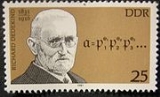
Richard Dedekind

 
Richard Dedekind

   Email Print
   Bookmark   Link


Richard Dedekind


Julius Wilhelm Richard Dedekind (October 6, 1831 – February 12, 1916) was a German
Germany

Germany , officially the Federal Republic of Germany , is a country in Central Europe. It is bordered to the north by the North Sea, Denmark, and the Baltic Sea; to the east by Poland and the Czech Republic; to the south by Austria and Switzerland; and to the west by France, Luxembourg, Belgium, and the Netherlands....
 mathematician
Mathematics

Mathematics is the study of quantity, structure, space, change, and related topics of pattern and form. Mathematicians seek out patterns whether found in numbers, space, natural science, computers, imaginary abstractions, or elsewhere....
 who did important work in abstract algebra
Abstract algebra

Abstract algebra is the subject area of mathematics that studies algebraic structures, such as group , ring , field , module , vector spaces, and algebra over a field....
, algebraic number theory
Algebraic number theory

In mathematics, algebraic number theory is a major branch of number theory which studies the algebraic structures related to algebraic integers....
 and the foundations of the real number
Real number

In mathematics, the real numbers may be described informally in several different ways. The real numbers include both rational numbers, such as 42 and −23/129, and irrational numbers, such as pi and the square root of two; or, a real number can be given by an infinite decimal representation, such as 2.4871773339...., where the digits co...
s.

kind was the youngest of four children of Julius Levin Ulrich Dedekind. As an adult, he never employed the names Julius Wilhelm. He was born, lived most of his life, and died in Braunschweig (often called "Brunswick" in English).

In 1848, he entered the Collegium Carolinum in Braunschweig, where his father was an administrator, obtaining a solid grounding in mathematics.


Discussion
Ask a question about 'Richard Dedekind'
Start a new discussion about 'Richard Dedekind'
Answer questions from other users
Full Discussion Forum


Recent Posts


Encyclopedia


Julius Wilhelm Richard Dedekind (October 6, 1831 – February 12, 1916) was a German
Germany

Germany , officially the Federal Republic of Germany , is a country in Central Europe. It is bordered to the north by the North Sea, Denmark, and the Baltic Sea; to the east by Poland and the Czech Republic; to the south by Austria and Switzerland; and to the west by France, Luxembourg, Belgium, and the Netherlands....
 mathematician
Mathematics

Mathematics is the study of quantity, structure, space, change, and related topics of pattern and form. Mathematicians seek out patterns whether found in numbers, space, natural science, computers, imaginary abstractions, or elsewhere....
 who did important work in abstract algebra
Abstract algebra

Abstract algebra is the subject area of mathematics that studies algebraic structures, such as group , ring , field , module , vector spaces, and algebra over a field....
, algebraic number theory
Algebraic number theory

In mathematics, algebraic number theory is a major branch of number theory which studies the algebraic structures related to algebraic integers....
 and the foundations of the real number
Real number

In mathematics, the real numbers may be described informally in several different ways. The real numbers include both rational numbers, such as 42 and −23/129, and irrational numbers, such as pi and the square root of two; or, a real number can be given by an infinite decimal representation, such as 2.4871773339...., where the digits co...
s.

Life

Dedekind was the youngest of four children of Julius Levin Ulrich Dedekind. As an adult, he never employed the names Julius Wilhelm. He was born, lived most of his life, and died in Braunschweig (often called "Brunswick" in English).

In 1848, he entered the Collegium Carolinum in Braunschweig, where his father was an administrator, obtaining a solid grounding in mathematics. In 1850, he entered the University of Göttingen. Dedekind studied number theory
Number theory

Number theory is the branch of pure mathematics concerned with the properties of numbers in general, and integers in particular, as well as the wider classes of problems that arise from their study....
 under Moritz Stern. Gauss
Carl Friedrich Gauss

Johann Carl Friedrich Gauss. was a Germans mathematician and scientist who contributed significantly to many fields, including number theory, statistics, mathematical analysis, Differential geometry and topology, geodesy, electrostatics, astronomy and optics....
 was still teaching, although mostly at an elementary level, and Dedekind became his last student. Dedekind received his doctorate in 1852, for a thesis titled Über die Theorie der Eulerschen Integrale ("On the Theory of Eulerian integrals"). This thesis did not reveal the talent evident on almost every page Dedekind later wrote.

At that time, the University of Berlin, not Göttingen, was the leading center for mathematical research in Germany. Thus Dedekind went to Berlin for two years of study, where he and Riemann
Bernhard Riemann

Georg Friedrich Bernhard Riemann was a Germany mathematics who made important contributions to mathematical analysis and differential geometry, some of them paving the way for the later development of general relativity....
 were contemporaries; they were both awarded the habilitation
Habilitation

Habilitation is the highest academic qualification a person can achieve by their own pursuit in certain European and Asian countries. Earned after obtaining a research doctorate , the habilitation requires the candidate to write a postdoctoral thesis based on independent scholarly accomplishments, reviewed by and defended before an academic c...
 in 1854. Dedekind returned to Göttingen to teach as a Privatdozent, giving courses on probability
Probability

Probability, or wikt:chance, is a way of expressing knowledge or belief that an Event will occur or has occurred. In mathematics the concept has been given an exact meaning in probability theory, that is used extensively in such areas of study as mathematics, statistics, finance, gambling, science, and philosophy to draw conclusions about t...
 and geometry
Geometry

Geometry arose as the field of knowledge dealing with spatial relationships. Geometry was one of the two fields of pre-modern mathematics, the other being the study of numbers....
. He studied for a while with Dirichlet
Johann Peter Gustav Lejeune Dirichlet

Johann Peter Gustav Lejeune Dirichlet was a Germany mathematician credited with the modern "formal" definition of a function .His family hailed from the town of Richelette in Belgium, from which his surname "Lejeune Dirichlet" was derived....
, and they became close friends. Because of lingering weaknesses in his mathematical knowledge, he studied elliptic
Elliptic function

In complex analysis, a mathematical discipline, an elliptic function is a function defined on the complex plane that is periodic function in two directions ....
 and abelian function
Abelian variety

In mathematics, particularly in algebraic geometry, complex analysis and number theory, an Abelian variety is a projective variety that is also an algebraic group, i.e., has a group law that can be defined by regular functions....
s. Yet he was also the first at Göttingen to lecture on Galois theory
Galois theory

In mathematics, more specifically in abstract algebra, Galois theory, named after ?variste Galois, provides a connection between field theory and group theory....
. Around this time, he became one of the first to understand the fundamental importance of the notion of groups
Group (mathematics)

In mathematics, a group is an algebraic structure consisting of a set together with an Binary operation that combines any two of its element to form a third element....
 for algebra
Algebra

Algebra is a branch of mathematics concerning the study of structure , relation , and quantity. Together with geometry, mathematical analysis, combinatorics, and number theory, algebra is one of the main branches of mathematics....
 and arithmetic
Arithmetic

Arithmetic or arithmetics is the oldest and most elementary branch of mathematics, used by almost everyone, for tasks ranging from simple day-to-day counting to advanced science and business calculations....
.

In 1858, he began teaching at the Polytechnic in Zürich
Zürich

Z?rich is the largest city in Switzerland and the capital of the canton of Z?rich. The city is Switzerland's main commercial and cultural centre and sometimes called the Cultural Capital of Switzerland, the political capital of Switzerland being Berne....
. When the Collegium Carolinum was upgraded to a Technische Hochschule
Technische Hochschule

Technische Hochschule is, what an Institute of Technology used to be called in German language speaking countries, before most of them changed their name to Technische Universit?t in the 1970s....
 (Institute of Technology) in 1862, Dedekind returned to his native Braunschweig, where he spent the rest of his life, teaching at the Institute. He retired in 1894, but did occasional teaching and continued to publish. He never married, instead living with his unmarried sister Julia.

Dedekind was elected to the Academies of Berlin (1880) and Rome, and to the Paris Académie des Sciences (1900). He received honorary doctorates from the universities of Oslo
University of Oslo

The University of Oslo is the List of oldest universities in continuous operation#Oldest Universities by Region .28post 1500.29, largest and most prestigious university in Norway, situated in the Norwegian capital of Oslo....
, Zurich
University of Zurich

The University of Zurich , located in the city of Zurich, is the largest university in Switzerland, with over 24,000 students. It was founded in 1833 from the existing colleges of theology, law, medicine and a new Faculty of philosophy....
, and Braunschweig.

Work

While teaching calculus for the first time at the Polytechnic, Dedekind came up with the notion now called a Dedekind cut
Dedekind cut

In mathematics, a Dedekind cut, named after Richard Dedekind, in a totally ordered set S is a partition of a set of it into two non-empty parts, , such that A is closed downwards and B is closed upwards, and A contains no greatest element....
 (German
German language

German is a West Germanic languages, thus related to and classified alongside English language and Dutch language. It is one of the world's world language and the most widely spoken mother tongue in the European Union....
: Schnitt), now a standard definition of the real numbers. The idea behind a cut is that an irrational number
Irrational number

In mathematics, an irrational number is any real number that is not a rational number ? that is, it is a number which cannot be expressed as a fraction m/n, where m and n are integers, with n non-zero....
 divides the rational number
Rational number

In mathematics, a rational number is a number which can be expressed as a quotient of two integers. Non-integer rational numbers are usually written as the vulgar fraction , where b is not 0 ....
s into two classes (sets), with all the members of one class (upper) being strictly greater than all the members of the other (lower) class. For example, the square root of 2 puts all the negative numbers and the numbers whose squares are less than 2 into the lower class, and the positive numbers whose squares are greater than 2 into the upper class. Every location on the number line continuum contains either a rational or an irrational number. Thus there are no empty locations, gaps, or discontinuities. Dedekind published his thoughts on irrational numbers and Dedekind cut
Dedekind cut

In mathematics, a Dedekind cut, named after Richard Dedekind, in a totally ordered set S is a partition of a set of it into two non-empty parts, , such that A is closed downwards and B is closed upwards, and A contains no greatest element....
s in his pamphlet "Stetigkeit und irrationale Zahlen" ("Continuity and irrational numbers"); in modern terminology, Vollständigkeit, completeness
Complete space

In mathematical analysis, a metric space M is said to be complete if every Cauchy sequence of points in M has a limit that is also in M or alternatively if every Cauchy sequence in M converges in M....
.

In 1874, while on holiday in Interlaken
Interlaken

Interlaken is a Municipalities of Switzerland in the district of Interlaken in the Cantons of Switzerland of Canton of Berne in Switzerland, a well-known tourist destination in the Bernese Oberland....
, Dedekind met Cantor
Georg Cantor

Georg Ferdinand Ludwig Philipp Cantor was a Germany mathematician, born in Russia. He is best known as the creator of set theory, which has become a foundations of mathematics in mathematics....
. Thus began an enduring relationship of mutual respect, and Dedekind became one of the very first mathematicians to admire Cantor's work on infinite sets, proving a valued ally in Cantor's battles with Kronecker
Leopold Kronecker

Leopold Kronecker was a Germany mathematician and logician who argued that arithmetic and Mathematical analysis must be founded on "whole numbers", saying, "God made the integers; all else is the work of man" ....
, who was philosophically opposed to Cantor's transfinite numbers.

If there existed a one-to-one correspondence between two sets, Dedekind said that the two sets were "similar." He invoked similarity to give the first precise definition of an infinite set
Dedekind-infinite set

In mathematics, a set A is Dedekind-infinite if some proper subset B of A is equinumerous to A. Explicitly, this means that there is a bijective function from A onto some proper subset B of A....
: a set is infinite when it is "similar to a proper part of itself," in modern terminology, is equinumerous to one of its proper subsets
Subset

In mathematics, especially in set theory, a Set A is a subset of a set B if A is "contained" inside B. Notice that A and B may coincide....
. (This is known as Dedekind's theorem.) Thus the set N of natural number
Natural number

In mathematics, a natural number can mean either an element of the Set = *n = = ? = ? ...
s can be shown to be similar to the subset of N whose members are the square
Square (algebra)

In algebra, the square of a number is that number multiplication by itself. To square a quantity is to multiply it by itself.Its notation is a superscripted "2"; a number x squared is written as x?....
s of every member of N, (N ? N2):

N    1  2  3  4  5  6  7  8  9 10 ...             ?           N2   1  4  9 16 25 36 49 64 81 100 ...

Dedekind edited the collected works of Dirichlet, Gauss
Carl Friedrich Gauss

Johann Carl Friedrich Gauss. was a Germans mathematician and scientist who contributed significantly to many fields, including number theory, statistics, mathematical analysis, Differential geometry and topology, geodesy, electrostatics, astronomy and optics....
, and Riemann. Dedekind's study of Dirichlet's work was what led him to his later study of algebraic number field
Algebraic number field

In mathematics, an algebraic number field F is a finite, field extension of the field of rational numbers Q. Thus F is a field that contains Q and has finite Hamel dimension, when considered as a vector space over Q....
s and ideal
Ideal (ring theory)

In ring theory, a branch of abstract algebra, an ideal is a special subset of a ring . The ideal concept generalizes in an appropriate way some important properties of integers like "even number" or "multiple of 3"....
s. In 1863, he published Dirichlet's lectures on number theory
Number theory

Number theory is the branch of pure mathematics concerned with the properties of numbers in general, and integers in particular, as well as the wider classes of problems that arise from their study....
 as Vorlesungen über Zahlentheorie
Vorlesungen über Zahlentheorie

is a textbook of number theory written by Germany mathematicians Johann Peter Gustav Lejeune Dirichlet and Richard Dedekind, and published in 1863....
 ("Lectures on Number Theory") about which it has been written that:
"Although the book is assuredly based on Dirichlet's lectures, and although Dedekind himself referred to the book throughout his life as Dirichlet's, the book itself was entirely written by Dedekind, for the most part after Dirichlet's death." (Edwards 1983)


The 1879 and 1894 editions of the Vorlesungen included supplements introducing the notion of an ideal
Ideal (ring theory)

In ring theory, a branch of abstract algebra, an ideal is a special subset of a ring . The ideal concept generalizes in an appropriate way some important properties of integers like "even number" or "multiple of 3"....
, fundamental to ring theory. (The word "Ring", introduced later by Hilbert, does not appear in Dedekind's work.) Dedekind defined an ideal as a subset of a set of numbers, composed of algebraic integer
Algebraic integer

This article deals with the ring of complex numbers integral over Z. For the general notion of algebraic integer, see Integrality.In number theory, an algebraic integer is a complex number that is a root of some monic polynomial with integer coefficients....
s that satisfy polynomial equations with integer
Integer

The integers are natural numbers including 0 and their negative and non-negative numberss . They are numbers that can be written without a fractional or decimal component, and fall within the set ....
 coefficients. The concept underwent further development in the hands of Hilbert and, especially, of Emmy Noether
Emmy Noether

Amalie Emmy Noether, , was a German mathematician known for her groundbreaking contributions to abstract algebra and theoretical physics. Described by Albert Einstein and others as the most important woman in the history of mathematics, she revolutionized the theories of ring , field , and algebra over a field....
. Ideals generalize Ernst Eduard Kummer's ideal number
Ideal number

In mathematics an ideal number is an algebraic integer which represents an ideal in the ring of integers of a number field; the idea was developed by Ernst Kummer, and led to Richard Dedekind's definition of ideal s for ring s....
s, devised as part of Kummer's 1843 attempt to prove Fermat's Last Theorem
Fermat's Last Theorem

Fermat's Last Theorem is the name of the statement in number theory that states that:or, more precisely:In 1637 Pierre de Fermat wrote, in his copy of Claude Gaspard Bachet de M?ziriac's translation of the famous Arithmetica of Diophantus, "I have a truly marvellous proof of this proposition which this margin is too narrow to con...
. (Thus Dedekind can be said to have been Kummer's most important disciple.) In an 1882 article, Dedekind and Heinrich Martin Weber applied ideals to Riemann surface
Riemann surface

In mathematics, particularly in complex analysis, a Riemann surface, first studied by and named after Bernhard Riemann, is a one-dimensional complex manifold....
s, giving an algebraic proof of the Riemann-Roch theorem.

Dedekind made other contributions to algebra
Abstract algebra

Abstract algebra is the subject area of mathematics that studies algebraic structures, such as group , ring , field , module , vector spaces, and algebra over a field....
. For instance, around 1900, he wrote the first papers on modular lattice
Modular lattice

In the branch of mathematics called order theory, a modular lattice is a lattice that satisfies the following self-dual condition:Modular law: x = b implies x ?  =  ? b....
s.

In 1888, he published a short monograph titled Was sind und was sollen die Zahlen? ("What are numbers and what should they be?" Ewald 1996: 790), which included his definition of an infinite set
Dedekind-infinite set

In mathematics, a set A is Dedekind-infinite if some proper subset B of A is equinumerous to A. Explicitly, this means that there is a bijective function from A onto some proper subset B of A....
. He also proposed an axiom
Axiom

In traditional logic, an axiom or postulate is a proposition that is not proved or demonstrated but considered to be either self-evidence, or subject to necessary decision....
atic foundation for the natural number
Natural number

In mathematics, a natural number can mean either an element of the Set = *n = = ? = ? ...
s, whose primitive notions were one
1 (number)

1 is a number, number names, and the name of the glyph representing that number.It represents a single entity, the unit of counting or measurement....
 and the successor function. The following year, Peano
Giuseppe Peano

Giuseppe Peano was an Italy mathematician, whose work was of exceptional philosopher value. The author of over 200 books and papers, he was a founder of mathematical logic and set theory, to which he contributed much notation....
, citing Dedekind, formulated an equivalent but simpler set of axioms
Peano axioms

In mathematical logic, the Peano axioms, also known as the Dedekind?Peano axioms or the Peano postulates, are a set of axioms for the natural numbers presented by the 19th century Italian people mathematician Giuseppe Peano....
, now the standard ones.

See also

  • Dedekind domain
    Dedekind domain

    In abstract algebra, a Dedekind domain or Dedekind ring, named after Richard Dedekind, is an integral domain in which every nonzero proper ideal factors into a product...
  • Dedekind eta function
    Dedekind eta function

    The Dedekind eta function, named after Richard Dedekind, is a function defined on the upper half-plane of complex numbers, where the imaginary part is positive....
  • Dedekind-infinite set
    Dedekind-infinite set

    In mathematics, a set A is Dedekind-infinite if some proper subset B of A is equinumerous to A. Explicitly, this means that there is a bijective function from A onto some proper subset B of A....
  • Dedekind sum
    Dedekind sum

    In mathematics, Dedekind sums, named after Richard Dedekind, are certain sums of products of a sawtooth function s, and are given by a function D of three integer variables....
  • Dedekind zeta function
    Dedekind zeta function

    In mathematics, the Dedekind zeta function is a Dirichlet series defined for any algebraic number field , and denoted where is a complex variable....
  • Ideal (ring theory)
    Ideal (ring theory)

    In ring theory, a branch of abstract algebra, an ideal is a special subset of a ring . The ideal concept generalizes in an appropriate way some important properties of integers like "even number" or "multiple of 3"....
  • Ideal number
    Ideal number

    In mathematics an ideal number is an algebraic integer which represents an ideal in the ring of integers of a number field; the idea was developed by Ernst Kummer, and led to Richard Dedekind's definition of ideal s for ring s....
  • Vorlesungen über Zahlentheorie
    Vorlesungen über Zahlentheorie

    is a textbook of number theory written by Germany mathematicians Johann Peter Gustav Lejeune Dirichlet and Richard Dedekind, and published in 1863....


Bibliography

Primary literature in English:
  • 1890. "Letter to Keferstein" in Jean van Heijenoort
    Jean Van Heijenoort

    Jean Louis Maxime Van Heijenoort was a pioneer historian of mathematical logic. He was also a personal secretary to Leon Trotsky from 1932 to 1939, and from then until 1947, an American Trotskyist activist....
    , 1967. A Source Book in Mathematical Logic, 1879-1931. Harvard Univ. Press: 98-103.
  • 1963 (1901). Essays on the Theory of Numbers. Beman, W. W., ed. and trans. Dover. Contains English translations of and Was sind und was sollen die Zahlen?
  • 1996. Theory of Algebraic Integers. Stillwell, John, ed. and trans. Cambridge Uni. Press. A translation of Über die Theorie der ganzen algebraischen Zahlen.
  • Ewald, William B., ed., 1996. From Kant to Hilbert: A Source Book in the Foundations of Mathematics, 2 vols. Oxford Uni. Press.
    • 1854. "On the introduction of new functions in mathematics," 754-61.
    • 1872. "Continuity and irrational numbers," 765-78. (translation of Stetigkeit...)
    • 1888. What are numbers and what should they be?, 787-832. (translation of Was sind und...)
    • 1872-82, 1899. Correspondence with Cantor, 843-77, 930-40.


Secondary:
  • Edwards, H. M., 1983, "Dedekind's invention of ideals," Bull. London Math. Soc. 15: 8-17.*Gillies, Douglas A., 1982. Frege, Dedekind, and Peano on the foundations of arithmetic. Assen, Netherlands: Van Gorcum.
  • Ivor Grattan-Guinness
    Ivor Grattan-Guinness

    Ivor Grattan-Guinness is a historian of mathematics and logic.He gained his Bachelor degree as a Mathematics Scholar at Wadham College, Oxford, got an M.Sc in Mathematical Logic and the Philosophy of Science at the London School of Economics in 1966....
    , 2000. The Search for Mathematical Roots 1870-1940. Princeton Uni. Press.


There is an of the secondary literature on Dedekind. Also consult Stillwell's "Introduction" to Dedekind (1996).

External links

  • at the Internet Archive
    Internet Archive

    The Internet Archive is a nonprofit organization dedicated to building and maintaining a free and openly accessible online digital library, including an archive site of the World Wide Web....
    .