

Expressionism

Encyclopedia

Modernism
Modernism, in its broadest definition, is modern thought, character, or practice. More specifically, the term describes the modernist movement, its set of cultural tendencies and array of associated cultural movements, originally arising from wide-scale and far-reaching changes to Western society...
movement
Art movement
An art movement is a tendency or style in art with a specific common philosophy or goal, followed by a group of artists during a restricted period of time, or, at least, with the heyday of the movement defined within a number of years...
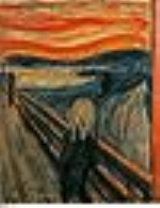
, initially in poetry and painting, originating in Germany at the beginning of the 20th century. Its typical trait is to present the world solely from a subjective perspective, distorting it radically for emotional effect in order to evoke moods or ideas. Expressionist artists sought to express meaning or emotional experience rather than physical reality.
Expressionism was developed as an avant-garde
Avant-garde
Avant-garde means "advance guard" or "vanguard". The adjective form is used in English to refer to people or works that are experimental or innovative, particularly with respect to art, culture, and politics....
style before the First World War. It remained popular during the Weimar Republic
Weimar culture
Weimar culture was a flourishing of the arts and sciences that happened during the Weimar Republic...
, particularly in Berlin. The style extended to a wide range of the arts
The arts
The arts are a vast subdivision of culture, composed of many creative endeavors and disciplines. It is a broader term than "art", which as a description of a field usually means only the visual arts. The arts encompass visual arts, literary arts and the performing arts – music, theatre, dance and...
, including painting
Painting
Painting is the practice of applying paint, pigment, color or other medium to a surface . The application of the medium is commonly applied to the base with a brush but other objects can be used. In art, the term painting describes both the act and the result of the action. However, painting is...
, literature
Literature
Literature is the art of written works, and is not bound to published sources...
, theatre, dance
Dance
Dance is an art form that generally refers to movement of the body, usually rhythmic and to music, used as a form of expression, social interaction or presented in a spiritual or performance setting....
, film
German Expressionism
German Expressionism refers to a number of related creative movements beginning in Germany before the First World War that reached a peak in Berlin, during the 1920s...
, architecture
Expressionist architecture
Expressionist architecture was an architectural movement that developed in Europe during the first decades of the 20th century in parallel with the expressionist visual and performing arts....
and music
Expressionism (music)
,Expressionism as a musical genre is difficult to exactly define. It is, however, one of the most important movements of 20th Century music. The three central figures of musical expressionism are Arnold Schoenberg and his pupils, Anton Webern and Alban Berg, the so-called Second Viennese...
.
The term is sometimes suggestive of emotional angst
Angst
Angst is an English, German, Danish, Norwegian and Dutch word for fear or anxiety . It is used in English to describe an intense feeling of apprehension, anxiety or inner turmoil...
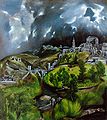
. In a general sense, painters such as Matthias Grünewald
Matthias Grünewald
Matthias Grünewald or "Mathis" , "Gothart" or "Neithardt" , , was a German Renaissance painter of religious works, who ignored Renaissance classicism to continue the expressive and intense style of late medieval Central European art into the 16th century.Only ten paintings—several consisting...
and El Greco
El Greco
El Greco was a painter, sculptor and architect of the Spanish Renaissance. "El Greco" was a nickname, a reference to his ethnic Greek origin, and the artist normally signed his paintings with his full birth name in Greek letters, Δομήνικος Θεοτοκόπουλος .El Greco was born on Crete, which was at...
are sometimes termed expressionist, though in practice the term is applied mainly to 20th-century works. The Expressionist emphasis on individual perspective has been characterized as a reaction to positivism
Positivism
Positivism is a a view of scientific methods and a philosophical approach, theory, or system based on the view that, in the social as well as natural sciences, sensory experiences and their logical and mathematical treatment are together the exclusive source of all worthwhile information....
and other artistic styles such as naturalism and impressionism
Impressionism
Impressionism was a 19th-century art movement that originated with a group of Paris-based artists whose independent exhibitions brought them to prominence during the 1870s and 1880s...
.
Origin of the term
The term was invented by Czech art historian Antonín Matějček in 1910 as the opposite of impressionismImpressionism
Impressionism was a 19th-century art movement that originated with a group of Paris-based artists whose independent exhibitions brought them to prominence during the 1870s and 1880s...
: "An Expressionist wishes, above all, to express himself... (an Expressionist rejects) immediate perception and builds on more complex psychic
Psyche (psychology)
The word psyche has a long history of use in psychology and philosophy, dating back to ancient times, and has been one of the fundamental concepts for understanding human nature from a scientific point of view. The English word soul is sometimes used synonymously, especially in older...
structures... Impressions and mental images that pass through mental peoples soul as through a filter which rids them of all substantial accretions to produce their clear essence [...and] are assimilated and condense into more general forms, into types, which he transcribes through simple short-hand formulae and symbols." (Gordon, 1987)

Die Brücke
Die Brücke was a group of German expressionist artists formed in Dresden in 1905, after which the Brücke Museum in Berlin was named. Founding members were Fritz Bleyl, Erich Heckel, Ernst Ludwig Kirchner and Karl Schmidt-Rottluff. Later members were Emil Nolde, Max Pechstein and Otto Mueller...
and Der Blaue Reiter
Der Blaue Reiter
Der Blaue Reiter was a group of artists from the Neue Künstlervereinigung München in Munich, Germany. The group was founded by a number of Russian emigrants, including Wassily Kandinsky, Alexej von Jawlensky, Marianne von Werefkin, and native German artists, such as Franz Marc, August Macke and...
groups.
Philosopher Friedrich Nietzsche
Friedrich Nietzsche
Friedrich Wilhelm Nietzsche was a 19th-century German philosopher, poet, composer and classical philologist...
had a role in originating modern Expressionism. In the publication The Birth of Tragedy
The Birth of Tragedy
The Birth of Tragedy from the Spirit of Music is a 19th-century work of dramatic theory by the German philosopher Friedrich Nietzsche. It was reissued in 1886 as The Birth of Tragedy, Or: Hellenism and Pessimism ...
, Nietzsche presented his theory of the ancient dualism between two types of aesthetic experience—the Apollonian and the Dionysian; a dualism between the plastic "art of sculpture", of lyrical
Lyric poetry
Lyric poetry is a genre of poetry that expresses personal and emotional feelings. In the ancient world, lyric poems were those which were sung to the lyre. Lyric poems do not have to rhyme, and today do not need to be set to music or a beat...
dream-inspiration, identity (the principium individuationis), order, regularity, and calm repose; and, on the other hand, the non-plastic "art of music", of intoxication, forgetfulness, chaos, and the ecstatic dissolution of identity in the collective. Nietzsche argues that classical tragedy
Tragedy
Tragedy is a form of art based on human suffering that offers its audience pleasure. While most cultures have developed forms that provoke this paradoxical response, tragedy refers to a specific tradition of drama that has played a unique and important role historically in the self-definition of...
is formed generally by both principles (later, he argues, it degenerates as Socratic reason replaces the Apollonian principle). The basic characteristics of Expressionism are Dionysian: bold colours, distorted forms-in-dissolution, two-dimensional, without perspective.
Protestant Reformation
The Protestant Reformation was a 16th-century split within Western Christianity initiated by Martin Luther, John Calvin and other early Protestants. The efforts of the self-described "reformers", who objected to the doctrines, rituals and ecclesiastical structure of the Roman Catholic Church, led...
, German Peasants' War
German Peasants' War
The German Peasants' War or Great Peasants' Revolt was a widespread popular revolt in the German-speaking areas of Central Europe, 1524–1526. At its height in the spring and summer of 1525, the conflict involved an estimated 300,000 peasants: contemporary estimates put the dead at 100,000...
, Eight Years' War, and Spanish Occupation of the Netherlands, when the rape
Rape
Rape is a type of sexual assault usually involving sexual intercourse, which is initiated by one or more persons against another person without that person's consent. The act may be carried out by physical force, coercion, abuse of authority or with a person who is incapable of valid consent. The...
, pillage and disaster associated with periods of chaos and oppression are presented in the documents of the printmaker. Often the work is unimpressive aesthetically, yet has the capacity to cause the viewer to experience strong emotions with the drama and often horror
Horror fiction
Horror fiction also Horror fantasy is a philosophy of literature, which is intended to, or has the capacity to frighten its readers, inducing feelings of horror and terror. It creates an eerie atmosphere. Horror can be either supernatural or non-supernatural...
of the scenes depicted.
Expressionism has been likened to Baroque
Baroque
The Baroque is a period and the style that used exaggerated motion and clear, easily interpreted detail to produce drama, tension, exuberance, and grandeur in sculpture, painting, literature, dance, and music...
by critics such as art historian Michel Ragon and German philosopher Walter Benjamin
Walter Benjamin
Walter Bendix Schönflies Benjamin was a German-Jewish intellectual, who functioned variously as a literary critic, philosopher, sociologist, translator, radio broadcaster and essayist...
. According to Alberto Arbasino
Alberto Arbasino
Alberto Arbasino is an Italian writer and essayist.-Biography:Arbasino was born at Voghera, southern Lombardy. He studied at the University of Milan where he graduated in law. Later he worked as journalist for magazines such as Il Mondo and the newspaper La Repubblica...
, a difference between the two is that "Expressionism doesn't shun the violently unpleasant effect, while baroque does. Expressionism throws some terrific 'fuck you's, baroque doesn't. Baroque is well-mannered."
Visual artists
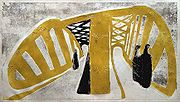
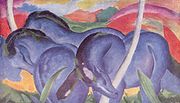
- Australia: Sidney NolanSidney NolanSir Sidney Robert Nolan OM, AC was one of Australia's best-known painters and printmakers.-Early life:Nolan was born in Carlton, a suburb of Melbourne, on 22 April 1917. He was the eldest of four children. His family later moved to St Kilda. Nolan attended the Brighton Road State School and...
, Charles BlackmanCharles BlackmanCharles Blackman is one of the best known Australian artists still living today, especially for the famous Schoolgirl and Alice in Wonderland series of the 1950s...
, John PercevalJohn PercevalJohn de Burgh Perceval AO was a well-known Australian artist. Perceval was the last surviving member of a group known as the Angry Penguins who redefined Australian art in the 1940s...
, Albert TuckerAlbert Tucker (artist)Albert Lee Tucker , a pivotal Australian artist, was a member of the Heide Circle, a group of leading modernist artists and writers that centred on the art patrons John and Sunday Reed, whose home, "Heide", located in Bulleen, near Heidelberg , was a haven for the group...
and Joy HesterJoy HesterJoy St Clair Hester was an Australian artist who played an important, though sometimes underrated, role in the development of Australian modernism, though her works could also be considered Abstract Expressionism.... - Austria: Egon SchieleEgon SchieleEgon Schiele was an Austrian painter. A protégé of Gustav Klimt, Schiele was a major figurative painter of the early 20th century. His work is noted for its intensity, and the many self-portraits the artist produced...
, Oskar KokoschkaOskar KokoschkaOskar Kokoschka was an Austrian artist, poet and playwright best known for his intense expressionistic portraits and landscapes.-Biography:...
and Alfred KubinAlfred KubinAlfred Leopold Isidor Kubin was an Austrian printmaker, illustrator and occasional writer. Kubin is considered an important representative of Symbolism and Expressionism.-Biography:... - Belgium: Constant PermekeConstant PermekeConstant Permeke was a Belgian painter and sculptor who is considered the leading figure of Flemish expressionism.Permeke was born in Antwerp but when he was six years old the family moved to Ostend, where his father became curator of the Municipal Museum of Arts. Permeke went to school in Bruges...
, Gustave De SmetGustave De SmetGustave De Smet was a Belgian expressionist painter.Having first adopted the "luminist" style of Emile Claus, he came under the influence of expressionism and cubism during World War I....
, Frits Van den BergheFrits Van den BergheFrits Van den Berghe was a Belgian expressionist painter.He was born at Ghent. Like his friends Constant Permeke and Gustave De Smet, he first adopted the late-impressionist style of Emile Claus, but converted to expressionism during World War I....
, James EnsorJames EnsorJames Sidney Edouard, Baron Ensor was a Flemish-Belgian painter and printmaker, an important influence on expressionism and surrealism who lived in Ostend for almost his entire life...
, Albert ServaesAlbert ServaesAlbert Servaes was a Belgian expressionist painter. He was part of the first Latem school of painting which focused on Mystical Realism, but became a founder of Belgian expressionism later in life. He became known for his religious works, typically showing the suffering of Jesus Christ, which...
, Floris JespersFloris JespersFloris Jespers was a Belgian Avant-garde painter.After his graduation from the Antwerp Academy of Fine Arts, he hooked up with the poet Paul Van Ostaijen and joined the Antwerp avant-garde movement of the 1920s...
and Albert Droesbeke. - Brazil: Anita MalfattiAnita MalfattiAnita Catarina Malfatti is heralded as the first Brazilian artist to introduce European and American forms of Modernism to Brazil...
, Cândido PortinariCândido PortinariCandido Portinari was one of the most important Brazilian painters and also a prominent and influential practitioner of the neo-realism style in painting....
, Di Cavalcanti and Lasar SegallLasar SegallThe artist Lasar Segall was a Brazilian Jewish painter, engraver and sculptor born in Lithuania. Segall's work is derived from impressionism, expressionism and modernism...
. - Finland: Tyko Sallinen, Alvar CawénAlvar CawénFrans Alvar Alfred Cawén was a Finnish expressionist painter. He was born in Korpilahti and studied at the Academy of Fine Arts between 1905 and 1907 and in Paris between 1908 and 1909....
, Juho Mäkelä and Wäinö AaltonenWäinö AaltonenWäinö Valdemar Aaltonen was a Finnish artist and sculptor. The Chambers Biographical Dictionary describes him as "one of the leading Finnish sculptors".He was born to a tailor in the village of Marttila, Finland...
. - France: Georges RouaultGeorges RouaultGeorges Henri Rouault[p] was a French Fauvist and Expressionist painter, and printmaker in lithography and etching.-Childhood and education:Rouault was born in Paris into a poor family...
, Georges GimelGeorges GimelGeorges Gimel , was a French expressionist painter of portraits, landscapes, mountain landscapes, still lifes and flowers. He was also a wood carver, lithographer, illustrator, set designer, sculptor, and enamel painter....
, Gen PaulGen PaulGen Paul , was a French painter and engraver.-Biography:Born as Eugène Paul in a house in Montmartre on the Rue Lepic painted by Van Gogh, he began drawing and painting as a child. His father died when he was only ten years old and Gen Paul was trained to work in decorative furnishings...
and Chaim SoutineChaim SoutineChaïm Soutine was a Jewish painter from Belarus. Soutine made a major contribution to the expressionist movement while living in Paris.... - Germany: Ernst BarlachErnst BarlachErnst Barlach was a German expressionist sculptor, printmaker and writer. Although he was a supporter of the war in the years leading to World War I, his participation in the war made him change his position, and he is mostly known for his sculptures protesting against the war...
, Max BeckmannMax BeckmannMax Beckmann was a German painter, draftsman, printmaker, sculptor, and writer. Although he is classified as an Expressionist artist, he rejected both the term and the movement...
, Fritz BleylFritz BleylHilmar Friedrich Wilhelm Bleyl, known as Fritz Bleyl, was a German artist of the Expressionist school, and one of the four founders of artist group Die Brücke . He designed graphics for the group including, for their first show, a poster, which was banned by the police...
, Heinrich CampendonkHeinrich CampendonkHeinrich Campendonk was a Dutch painter of German birth.He was born in Krefeld. He was a member of the Der Blaue Reiter group, from 1911 to 1912. When the Nazi regime came to power in 1933, he was among the many modernists condemned as degenerate artists, and prohibited from exhibiting...
, Otto DixOtto DixWilhelm Heinrich Otto Dix was a German painter and printmaker, noted for his ruthless and harshly realistic depictions of Weimar society and the brutality of war. Along with George Grosz, he is widely considered one of the most important artists of the Neue Sachlichkeit.-Early life and...
, Conrad FelixmüllerConrad FelixmüllerConrad Felixmüller was a German Expressionist painter. Born in as Conrad Felix Müller, he chose Felixmüller as his nom d'artiste....
, George GroszGeorge GroszGeorg Ehrenfried Groß was a German artist known especially for his savagely caricatural drawings of Berlin life in the 1920s...
, Erich HeckelErich HeckelErich Heckel was a German painter and printmaker, and a founding member of the Die Brücke group which existed 1905-1913.-Biography:Heckel was born in Döbeln . His parents were born in Saxony...
, Carl HoferCarl HoferKarl Christian Ludwig Hofer or Carl Hofer was a German expressionist painter. One of the most prominent painters of expressionism, he never was a member of one of the expressionist painting groups, like "Die Brücke", who influenced him...
, Ernst Ludwig KirchnerErnst Ludwig KirchnerErnst Ludwig Kirchner was a German expressionist painter and printmaker and one of the founders of the artists group Die Brücke or "The Bridge", a key group leading to the foundation of Expressionism in 20th century art. He volunteered for army service in the First World War, but soon suffered a...
, Käthe KollwitzKäthe KollwitzKäthe Kollwitz was a German painter, printmaker, and sculptor whose work offered an eloquent and often searing account of the human condition in the first half of the 20th century...
, Wilhelm LehmbruckWilhelm LehmbruckWilhelm Lehmbruck was a German sculptor.- Biography :Born in Duisburg, he studied sculpture arts at the academy of arts in Düsseldorf and contributed to an exhibition at the Grand Palais in Paris. From 1910–1914 he lived in Paris, where he met Modigliani, Brancusi, and Archipenko...
, Elfriede Lohse-WächtlerElfriede Lohse-WächtlerElfriede Lohse Wächtler was a German painter of the avant-garde whose works were banned as "degenerate art", and in some cases destroyed, by the Third Reich. She was killed in a former psychiatric institution at Sonnenstein castle in Pirna under Action T4, a forced euthanasia program of Nazi Germany...
, August MackeAugust MackeAugust Macke was one of the leading members of the German Expressionist group Der Blaue Reiter . He lived during a particularly innovative time for German art which saw the development of the main German Expressionist movements as well as the arrival of the successive avant-garde movements which...
, Franz MarcFranz MarcFranz Marc was a German painter and printmaker, one of the key figures of the German Expressionist movement...
, Ludwig MeidnerLudwig MeidnerLudwig Meidner was a German expressionist painter and printmaker born in Bernstadt, Silesia. He was apprenticed to a stonemason, but the apprenticeship was not completed. He studied at the Royal School of Art in Breslau and, from 1906-07 at the Julien and Cormon Academies in Paris where he met...
, Paula Modersohn-BeckerPaula Modersohn-BeckerPaula Modersohn-Becker was a German painter and one of the most important representatives of early expressionism. In a brief career, cut short by an embolism at the age of 31, she created a number of groundbreaking images of great intensity.-Life and work:Paula Becker was born and grew up in...
, Otto MuellerOtto MuellerOtto Mueller or Müller was a German painter and printmaker of the Die Brücke expressionist movement.-Life and work:...
, Gabriele MünterGabriele MünterGabriele Münter was a German expressionist painter who was at the forefront of the Munich avant-garde in the early 20th century. Artists and writers associated with German Expressionism shared a rebellious attitude toward the materialism and mores of German imperial and bourgeois society...
, Rolf NeschRolf NeschRolf Nesch was an expressionist artist, especially noted for his printmaking. Born in Germany, he moved to Norway following the Nazi takeover in 1933.-Career:...
, Emil NoldeEmil NoldeEmil Nolde was a German painter and printmaker. He was one of the first Expressionists, a member of Die Brücke, and is considered to be one of the great oil painting and watercolour painters of the 20th century. He is known for his vigorous brushwork and expressive choice of colors...
, Max PechsteinMax PechsteinHermann Max Pechstein was a German expressionist painter and printmaker, and a member of Die Brücke group.-Life and career:...
and Karl Schmidt-RottluffKarl Schmidt-RottluffKarl Schmidt-Rottluff was a German expressionist painter and printmaker, and a member of Die Brücke.-Life and work:...
. - Hungary: Tivadar Kosztka Csontváry
- Iceland: Einar HákonarsonEinar HákonarsonEinar Hákonarson is one of Iceland's best known artists. He is an expressionistic and figurative painter who brought the figure back into Icelandic painting in 1968. He is a pioneer in the Icelandic art scene and art education...
- Ireland: Jack B. Yeats
- Indonesia: AffandiAffandiAffandi was born in Cirebon, West Java, as the son of R. Koesoema, who was a surveyor at a local sugar factory. Affandi finished his upper secondary school in Jakarta, but he forsook his study for the desire to become an artist. Affandi taught himself how to paint since 1934...
- Italy: Emilio Giuseppe DossenaEmilio Giuseppe DossenaEmilio Giuseppe Dossena was an Italian painter who was born in Cavenago d'Adda, Italy and died in Milan, Italy...
- Mexico: Mathias GoeritzMathias GoeritzMathias Goeritz - August 4, 1990 in Mexico City) was a well-known Mexican painter and sculptor of German origin...
(German émigré to Mexico), Rufino TamayoRufino TamayoRufino Tamayo was a Mexican painter of Zapotec heritage, born in Oaxaca de Juárez, Mexico. Tamayo was active in the mid-20th century in Mexico and New York, painting figurative abstraction with surrealist influences.... - Netherlands: Charles Eyck, Willem HofhuizenWillem HofhuizenWillem Hofhuizen was a Dutch Expressionist painter.-Life:Wilhelmus Johannes Maria Hofhuizen was born in Amsterdam on 27 July 1915 but a few years later his parents moved to Roermond, where Willem spent his childhood at the Kapellerlaan...
, Jaap Min, Jan SluytersJan SluytersJohannes Carolus Bernardus Sluijters was a Dutch painter.Sluijters was a leading pioneer of various post-impressionist movements in the Netherlands. He experimented with several styles, including fauvism and cubism, finally settling on a colorful expressionism...
, Vincent van GoghVincent van GoghVincent Willem van Gogh , and used Brabant dialect in his writing; it is therefore likely that he himself pronounced his name with a Brabant accent: , with a voiced V and palatalized G and gh. In France, where much of his work was produced, it is...
, Jan WiegersJan WiegersJan Wiegers was a Dutch expressionist painter.Wiegers was educated as a sculptor at the Academie Minerva in Groningen, but he also studied painting at the Academies of Rotterdam under A. H. R...
and Hendrik Werkman - Norway: Edvard MunchEdvard MunchEdvard Munch was a Norwegian Symbolist painter, printmaker and an important forerunner of expressionist art. His best-known composition, The Scream, is part of a series The Frieze of Life, in which Munch explored the themes of love, fear, death, melancholia, and anxiety.- Childhood :Edvard Munch...
, Kai FjellKai FjellKai Breder Fjell was a Norwegian painter, printmaker and scenographer.- Biography :Fjell was born on a farm in the village Skoger near Drammen, Norway. His father was the farmer and painter Conrad Bendiks Fjeld.... - Poland: Henryk GotlibHenryk GotlibHenryk Gotlib , was a Polish-born painter, draughtsman, printmaker, and writer, who settled in England and made a significant contribution to modern British art. He was profoundly influenced by Rembrandt, and the European Expressionist painters.“There was never any doubt of Gotlib’s stature in the...
- Portugal: Mário EloyMário EloyMário Eloy was a Portuguese expressionist painter.Eloy was born in Lisboa. His style shows the influence of painters like van Gogh, Picasso and, mostly, from the German expressionist painting, that he admired during his staying in Germany, from 1927 to 1932, specially Carl Hofer.After returning...
, Amadeo de Souza CardosoAmadeo de Souza CardosoAmadeo de Souza Cardoso was a Portuguese artist, working in the style of the vanguard of his time. Although he lived a short life, his workmanship was legendary.- Life :He was born in Mancelos, a parish of Amarante... - Russia: Wassily KandinskyWassily KandinskyWassily Wassilyevich Kandinsky was an influential Russian painter and art theorist. He is credited with painting the first purely-abstract works. Born in Moscow, Kandinsky spent his childhood in Odessa. He enrolled at the University of Moscow, studying law and economics...
, Marc ChagallMarc ChagallMarc Chagall Art critic Robert Hughes referred to Chagall as "the quintessential Jewish artist of the twentieth century."According to art historian Michael J...
, Alexej von JawlenskyAlexej von JawlenskyAlexej Georgewitsch von Jawlensky was a Russian expressionist painter active in Germany. He was a key member of the New Munich Artist's Association , Der Blaue Reiter group and later the Die Blaue Vier .-Life and work:Alexej von Jawlensky was born in Torzhok, a town in Tver...
, Natalia GoncharovaNatalia GoncharovaNatalia Sergeevna Goncharova was a Russian avant-garde artist , painter, costume designer, writer, illustrator, and set designer. Her great-aunt was Natalia Pushkina, wife of the poet Alexander Pushkin.-Life and work:...
, Konrad MagiKonrad MägiKonrad Vilhelm Mägi was an Estonian landscape painter. He was one of the most colour-sensitive Estonian painters of the first decades of the 20th century, and Mägi's works on motives of the island of Saaremaa are the first modern Estonian nature paintings.Mägi received his elementary art...
, Eduard WiiraltEduard WiiraltEduard Wiiralt was an Estonian artist.Eduard Wiiralt was born near St. Petersburg as the son of Estonian parents who worked on a Russian country estate...
, Mstislav DobuzhinskyMstislav DobuzhinskyMstislav Valerianovich Dobuzhinsky or Dobujinsky was a Russian-Lithuanian artist noted for his cityscapes conveying the explosive growth and decay of the early twentieth-century city....
, and Marianne von WerefkinMarianne von WerefkinMarianne von Werefkin , born Marianna Wladimirowna Werewkina , was a Russian-Swiss Expressionist painter.-Life and career:...
(Russian-born, later active in Switzerland). - Switzerland: Carl Eugen KeelCarl Eugen KeelCarl Eugen Keel was a Swiss painter. He is principally known for his woodcuts, usually portraying town life, and often hand-coloured. Less well known are his oil paintings, watercolours, wood carvings and wrought iron sculptures.-References:...
, Cuno AmietCuno AmietCuno Amiet was a Swiss painter, illustrator, graphic artist and sculptor. As the first Swiss painter to give precedence to colour in composition, he was a pioneer of modern art in Switzerland.-Biography:...
, Paul KleePaul KleePaul Klee was born in Münchenbuchsee, Switzerland, and is considered both a German and a Swiss painter. His highly individual style was influenced by movements in art that included expressionism, cubism, and surrealism. He was, as well, a student of orientalism... - USA: Ivan AlbrightIvan AlbrightIvan Le Lorraine Albright was an American magic realist painter and artist, most renowned for his self-portraits, character studies, and still lifes.-Youth:...
, Milton AveryMilton AveryMilton Avery was an American modern painter. Born in Altmar, New York, he moved to Connecticut in 1898 and later to New York City.-Biography:...
, George BiddleGeorge BiddleGeorge Biddle was an American artist best known for his social realism, combat art, and his strong advocacy of government-sponsored art projects...
, Hyman BloomHyman BloomHyman Bloom was a painter. His work is influenced by his Jewish heritage, Eastern religions as well as artists including Altdorfer, Grunewald, Caravaggio, Rembrandt, William Blake, Rudolph Bresdin, J.M.W...
, Peter BlumePeter BlumePeter Blume was an American painter and sculptor. His work contained elements of folk art, precisionism, Parisian Purism, Cubism, and Surrealism.-Biography:...
, Charles Burchfield, David BurliukDavid BurliukDavid Davidovich Burliuk was a Russian avant-garde artist of Ukrainian origin , book illustrator, publicist, and author associated with Russian Futurism...
, Stuart DavisStuart Davis (painter)Stuart Davis , was an early American modernist painter. He was well known for his jazz influenced, proto pop art paintings of the 1940s and 1950s, bold, brash, and colorful as well as his ashcan pictures in the early years of the 20th century.-Biography:He was born in Philadelphia to Edward Wyatt...
, Elaine de KooningElaine de KooningElaine de Kooning was an Abstract Expressionist, Figurative Expressionist painter in the post-World War II era and editorial associate for Art News magazine...
, Willem de KooningWillem de KooningWillem de Kooning was a Dutch American abstract expressionist artist who was born in Rotterdam, the Netherlands....
, Beauford DelaneyBeauford DelaneyBeauford Delaney was an American modernist painter.-Early life:Beauford Delaney was born in Knoxville, Tennessee, USA, in 1901. Delaney’s parents were prominent and respected members of Knoxville's black community. His father Samuel was both a barber and a Methodist minister...
, Arthur G. Dove, Norris EmbryNorris EmbryNorris Embry was an American neo-expressionist artist born on January 14, 1921 in Louisville, Kentucky.He grew up in East Orange, New Jersey outside New York City and Evanston, Illinois in the Chicago area, attending public schools through high school. Later, he studied at St. John's College in...
, Philip EvergoodPhilip EvergoodPhilip Howard Francis Dixon Evergood was an American painter, etcher, lithographer, sculptor, illustrator and writer. He was particularly active during the Depression and World War II era.-Life:...
, Kahlil Gibran, William GropperWilliam GropperWilliam Victor "Bill" Gropper , was a U.S. cartoonist, painter, lithographer, and muralist. A committed radical, Gropper is best known for the political work which he contributed to such left wing publications as The Revolutionary Age, The Liberator, The New Masses, The Worker, and The Morning...
, Philip GustonPhilip GustonPhilip Guston was a notable painter and printmaker in the New York School, which included many of the Abstract expressionists, such as Jackson Pollock and Willem De Kooning...
, Marsden HartleyMarsden HartleyMarsden Hartley was an American Modernist painter, poet, and essayist.-Early life and education:Hartley was born in Lewiston, Maine, where his English parents had settled. He was the youngest of nine children. His mother died when he was eight, and his father remarried four years later to Martha...
, Albert KotinAlbert KotinAlbert Kotin belonged to the early generation of New York School Abstract Expressionist artists whose artistic innovation by the 1950s had been recognized across the Atlantic, including Paris...
, Yasuo KuniyoshiYasuo Kuniyoshiwas an American painter, photographer and printmaker born in Okayama, Japan.He migrated to America in 1906, a year later began studying at the Los Angeles School of Art and Design. In 1935 he was awarded the Guggenheim Fellowship. He taught at the Art Students League of New York in New York City...
, Rico LebrunRico LebrunRico Lebrun was an Italy-born, Italian-American painter and sculptor.-Biography :Lebrun was born on December 10, 1900 in Naples, Italy. His formal art education consisted of attending technical school and art classes at night, studying the Old Masters in museums, and assisting fresco painters...
, Jack LevineJack LevineJack Levine was an American Social Realist painter and printmaker best known for his satires on modern life, political corruption, and biblical narratives.-Biography:...
, Alfred Henry MaurerAlfred Henry MaurerAlfred Henry Maurer was an American modernist painter. He exhibited his work in avant-garde circles internationally and in New York City during the early 20th century.-Biography:...
, Alice NeelAlice NeelAlice Neel was an American artist known for her oil on canvas portraits of friends, family, lovers, poets, artists and strangers...
, Abraham RattnerAbraham RattnerAbraham Rattner was an American artist, best known for his richly colored paintings, often with religious subject matter. During World War I, he served in France with the U.S. Army as a camouflage artist.-Early life:...
, Ben ShahnBen ShahnBen Shahn was a Lithuanian-born American artist. He is best known for his works of social realism, his left-wing political views, and his series of lectures published as The Shape of Content.-Biography:...
, Harry ShoulbergHarry ShoulbergHarry Shoulberg was an American expressionist painter.He was known to be among the early group of WPA artists working in the screen print medium, as well as oil.-Biography:...
, Joseph StellaJoseph StellaJoseph Stella was an Italian-born, American Futurist painter best known for his depictions of industrial America. He is associated with the American Precisionism movement of the 1910s-1940s....
, Harry SternbergHarry SternbergHarry Sternberg was an American painter, printmaker and educator. He was born in New York City on July 19, 1904 and died in Escondido, California on November 27, 2001.-Childhood, family life, and education:...
, Henry Ossawa TannerHenry Ossawa TannerHenry Ossawa Tanner was an African American artist best known for his style of painting. He was the first African American painter to gain international acclaim.-Education:...
, Dorothea TanningDorothea TanningDorothea Tanning is an American painter, printmaker, sculptor and writer. She has also designed sets and costumes for ballet and theatre.-Biography:...
, Max WeberMax Weber (artist)For the social theorist and philosopher, see Max WeberMax Weber was a Jewish-American painter who worked in the style of cubism before migrating to Jewish themes towards the end of his life.-Biography:...
, Hale WoodruffHale WoodruffHale Aspacio Woodruff was an African American artist known for his murals, paintings, and prints. One example of his work, the three-panel Amistad Mutiny murals , can be found at Talladega College in Talladega County, Alabama...
and Karl ZerbeKarl ZerbeKarl Zerbe was a German-born American painter.The works of Karl Zerbe are significant because they record "the response of a distinguished artist of basically European sensibility to the physical and cultural scene of the New World".-Biography :Karl Zerbe was born in Berlin, Germany.The family...
Expressionist groups of painters
The style originated principally in Germany and Austria. There were a number of groups of Expressionist painters, including Der Blaue ReiterDer Blaue Reiter
Der Blaue Reiter was a group of artists from the Neue Künstlervereinigung München in Munich, Germany. The group was founded by a number of Russian emigrants, including Wassily Kandinsky, Alexej von Jawlensky, Marianne von Werefkin, and native German artists, such as Franz Marc, August Macke and...
and Die Brücke
Die Brücke
Die Brücke was a group of German expressionist artists formed in Dresden in 1905, after which the Brücke Museum in Berlin was named. Founding members were Fritz Bleyl, Erich Heckel, Ernst Ludwig Kirchner and Karl Schmidt-Rottluff. Later members were Emil Nolde, Max Pechstein and Otto Mueller...
. Der Blaue Reiter (The Blue Rider, named for a magazine) was based in Munich and Die Brücke was based originally in Dresden
Dresden
Dresden is the capital city of the Free State of Saxony in Germany. It is situated in a valley on the River Elbe, near the Czech border. The Dresden conurbation is part of the Saxon Triangle metropolitan area....
(although some members later relocated to Berlin
Berlin
Berlin is the capital city of Germany and is one of the 16 states of Germany. With a population of 3.45 million people, Berlin is Germany's largest city. It is the second most populous city proper and the seventh most populous urban area in the European Union...
). Die Brücke was active for a longer period than Der Blaue Reiter, which was only together for a year (1912). The Expressionists had many influences, among them Edvard Munch
Edvard Munch
Edvard Munch was a Norwegian Symbolist painter, printmaker and an important forerunner of expressionist art. His best-known composition, The Scream, is part of a series The Frieze of Life, in which Munch explored the themes of love, fear, death, melancholia, and anxiety.- Childhood :Edvard Munch...
, Vincent van Gogh
Vincent van Gogh
Vincent Willem van Gogh , and used Brabant dialect in his writing; it is therefore likely that he himself pronounced his name with a Brabant accent: , with a voiced V and palatalized G and gh. In France, where much of his work was produced, it is...
, and African art
African art
African art constitutes one of the most diverse legacies on earth. Though many casual observers tend to generalize "traditional" African art, the continent is full of people, societies, and civilizations, each with a unique visual special culture. The definition also includes the art of the African...
. They were also aware of the work being done by the Fauves
Fauvism
Fauvism is the style of les Fauves , a short-lived and loose group of early twentieth-century Modern artists whose works emphasized painterly qualities and strong colour over the representational or realistic values retained by Impressionism...
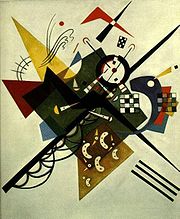
in Paris, who influenced Expressionism's tendency toward arbitrary colours and jarring compositions. In reaction and opposition to French Impressionism, which emphasized the rendering of the visual appearance of objects, Expressionist artists sought to portray emotions and subjective interpretations. It was not important to reproduce an aesthetically pleasing impression of the artistic subject matter, they felt, but rather to represent vivid emotional reactions by powerful colours and dynamic compositions. Kandinsky, the main artist of Der Blaue Reiter group, believed that with simple colours and shapes the spectator could perceive the moods and feelings in the paintings, a theory that encouraged him towards increased abstraction.
The ideas of German expressionism influenced the work of American artist Marsden Hartley
Marsden Hartley
Marsden Hartley was an American Modernist painter, poet, and essayist.-Early life and education:Hartley was born in Lewiston, Maine, where his English parents had settled. He was the youngest of nine children. His mother died when he was eight, and his father remarried four years later to Martha...
, who met Kandinsky in Germany in 1913. In late 1939, at the beginning of World War II
World War II
World War II, or the Second World War , was a global conflict lasting from 1939 to 1945, involving most of the world's nations—including all of the great powers—eventually forming two opposing military alliances: the Allies and the Axis...
, New York
New York
New York is a state in the Northeastern region of the United States. It is the nation's third most populous state. New York is bordered by New Jersey and Pennsylvania to the south, and by Connecticut, Massachusetts and Vermont to the east...
received a great number of major European artists. After the war, Expressionism influenced many young American artists. Norris Embry
Norris Embry
Norris Embry was an American neo-expressionist artist born on January 14, 1921 in Louisville, Kentucky.He grew up in East Orange, New Jersey outside New York City and Evanston, Illinois in the Chicago area, attending public schools through high school. Later, he studied at St. John's College in...
(1921–1981) studied with Oskar Kokoschka
Oskar Kokoschka
Oskar Kokoschka was an Austrian artist, poet and playwright best known for his intense expressionistic portraits and landscapes.-Biography:...
in 1947 and during the next 43 years produced a large body of work in the Expressionist tradition. Norris Embry has been termed "the first American German Expressionist". Other American artists of the late 20th and early 21st century have developed distinct styles that may be considered part of Expressionism. Another prominent artist who came from the German Expressionist "school" was Bremen-born Wolfgang Degenhardt
Wolfgang Degenhardt
Wolfgang Degenhardt was an artist, prominent in Newcastle located in the Hunter Valley area of New South Wales, Australia. Husband of Irene Degenhardt, who still lives in Newcastle today....
. After working as a commercial artist in Bremen, he migrated to Australia in 1954 and became quite well known in the Hunter Valley region.
American Expressionism and American Figurative Expressionism
American Figurative Expressionism
According to Marilyn Stokstad, the art historian:-Early Expressionistic movements:Expressionistic movements before and after 1910 were developed by three artists' groups:• The Fauves • Die Brücke • Der Blaue Reiter...
, particularly the Boston
Boston
Boston is the capital of and largest city in Massachusetts, and is one of the oldest cities in the United States. The largest city in New England, Boston is regarded as the unofficial "Capital of New England" for its economic and cultural impact on the entire New England region. The city proper had...
figurative
Figurative art
Figurative art, sometimes written as figurativism, describes artwork—particularly paintings and sculptures—which are clearly derived from real object sources, and are therefore by definition representational.-Definition:...
expressionism, were an integral part of American modernism
American modernism
American modernism like modernism in general is a trend of thought that affirms the power of human beings to create, improve, and reshape their environment, with the aid of scientific knowledge, technology and practical experimentation, and is thus in its essence both progressive and optimistic...
around the Second World War.
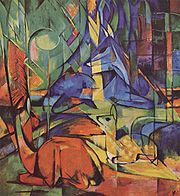
Karl Zerbe
Karl Zerbe was a German-born American painter.The works of Karl Zerbe are significant because they record "the response of a distinguished artist of basically European sensibility to the physical and cultural scene of the New World".-Biography :Karl Zerbe was born in Berlin, Germany.The family...
, Hyman Bloom
Hyman Bloom
Hyman Bloom was a painter. His work is influenced by his Jewish heritage, Eastern religions as well as artists including Altdorfer, Grunewald, Caravaggio, Rembrandt, William Blake, Rudolph Bresdin, J.M.W...
, Jack Levine
Jack Levine
Jack Levine was an American Social Realist painter and printmaker best known for his satires on modern life, political corruption, and biblical narratives.-Biography:...
, David Aronson, Philip Guston
Philip Guston
Philip Guston was a notable painter and printmaker in the New York School, which included many of the Abstract expressionists, such as Jackson Pollock and Willem De Kooning...
. The Boston figurative Expressionists post World War II were increasingly marginalized by the development of abstract expressionism
Abstract expressionism
Abstract expressionism was an American post–World War II art movement. It was the first specifically American movement to achieve worldwide influence and put New York City at the center of the western art world, a role formerly filled by Paris...
centered in New York City
New York City
New York is the most populous city in the United States and the center of the New York Metropolitan Area, one of the most populous metropolitan areas in the world. New York exerts a significant impact upon global commerce, finance, media, art, fashion, research, technology, education, and...
.
After World War II, figurative expressionism influenced worldwide a large number of artists and styles. Thomas B. Hess wrote that "the ‘New figurative painting’ which some have been expecting as a reaction against Abstract Expressionism was implicit in it at the start, and is one of its most lineal continuities."
- New York Figurative ExpressionismNew York Figurative ExpressionismNew York Figurative Expressionism of the 1950s represented a trend where "diverse New York artists countered the prevailing abstract mode to work with the figure."-Categories of figurative expressionist modes:...
of the 1950s represented New York figurative artists such as Robert Beauchamp, Elaine de KooningElaine de KooningElaine de Kooning was an Abstract Expressionist, Figurative Expressionist painter in the post-World War II era and editorial associate for Art News magazine...
, Robert Goodnough, Grace HartiganGrace HartiganGrace Hartigan was an American Abstract Expressionist painter of the New York School in the 1950s.-Biography and early career:...
, Lester JohnsonLester JohnsonLester Roland Johnson was a U.S. Representative from Wisconsin.-Biography:Born in Brandon, Wisconsin, Johnson attended the public schools and Lawrence University from 1919 to 1921....
, Alex KatzAlex KatzAlex Katz is an American figurative artist associated with the Pop art movement. In particular, he is known for his paintings, sculptures, and prints and is represented by numerous galleries internationally.-Life and work:...
, George McNeil, Jan Muller, Fairfield PorterFairfield PorterFairfield Porter was an American painter and art critic. He was the brother of photographer Eliot Porter and the brother-in-law of federal Reclamation Commissioner Michael W. Straus....
, Gregorio PrestopinoGregorio PrestopinoGregorio Prestopino, was an American artist, according to the art historian Irma B. Jaffe:one of the major American painters who refused to reject the image, has devoted his career to depicting the human condition with a warmth tempered only by honesty.-Biography:Prestopino was born in New York...
, Larry RiversLarry RiversLarry Rivers was an American artist, musician, filmmaker and occasional actor. Rivers resided and maintained studios in New York City, Southampton, New York and Zihuatanejo, Mexico.-Biography:...
and Bob ThompsonBob Thompson (painter)Bob Thompson was an African-American figurative painter known for his bold and colorful canvases, whose compositions were appropriated from the Old Masters. He was very prolific in his eight-year career, producing over 1000 works before his death in Rome, Italy in 1966. The Whitney Museum in New...
. - Lyrical AbstractionLyrical AbstractionLyrical Abstraction is either of two related but distinctly separate trends in Post-war Modernist painting, and a third definition is the usage as a descriptive term. It is a descriptive term characterizing a type of abstract painting related to Abstract Expressionism; in use since the 1940s...
, TachismeTachismeTachisme is a French style of abstract painting popular in the 1940s and 1950s. It is often considered to be the European equivalent to abstract expressionism...
of the 1940s and 1950s in Europe represented by artists such as Georges MathieuGeorges MathieuGeorges Mathieu is a French painter in the style of lyrical abstraction.-Biography:He was born in Boulogne-sur-Mer, France, and gained an international reputation in the 1950s as a leading Abstract Expressionist. His large paintings are created very rapidly and impulsively...
, Hans HartungHans HartungHans Hartung was a German-French painter, known for his gestural abstract style. He was also a decorated World War II veteran of the French Foreign Legion.-Life:...
, Nicolas de StaëlNicolas de StaëlNicolas de Staël was a painter known for his use of a thick impasto and his highly abstract landscape painting...
and others. - Bay Area Figurative Movement represented by early figurative expressionists from the San Francisco area Elmer BischoffElmer BischoffElmer Nelson Bischoff was a visual artist in the San Francisco Bay Area.Bischoff, along with Richard Diebenkorn and David Park, was part of the post-World War II generation of artists who started as abstract painters and found their way back to figurative art.-Biography:Elmer Bischoff, second...
Richard DiebenkornRichard DiebenkornRichard Diebenkorn was a well-known 20th century American painter. His early work is associated with Abstract expressionism and the Bay Area Figurative Movement of the 1950s and 1960s. His later work were instrumental to his achievement of worldwide acclaim.-Biography:Richard Clifford Diebenkorn Jr...
, and David ParkDavid ParkDavid Park was a painter and a pioneer of the Bay Area Figurative School of painting during the 1950s.-Biography:...
. The movement from 1950 to 1965 was joined by Theophilus BrownTheophilus BrownWilliam Theophilus Brown is an American artist born in Moline, Illinois. He became prominent as a member of the Bay Area Figurative Movement.-Background and career:...
, Paul WonnerPaul WonnerPaul John Wonner was an American artist who was born in Tucson, Arizona. He received a B.A. in 1952, an M.A. in 1953, and an M.L.S. in 1955―all from the University of California, Berkeley...
, James Weeks, Hassel Smith, Nathan OliveiraNathan OliveiraNathan Oliveira was an American painter, printmaker, and sculptor, born in Oakland, California to Portuguese parents...
, Bruce McGaw, Joan BrownJoan BrownJoan Brown was an American figurative painter who lived and worked in Northern California. She was a notable member of the "second generation" of the Bay Area Figurative Movement....
, Manuel NeriManuel NeriManuel Neri is an American sculptor, painter, and printmaker and a notable member of the "second generation" of the Bay Area Figurative Movement.- Biography :...
, Joan Savo and Roland Peterson. - Abstract ExpressionismAbstract expressionismAbstract expressionism was an American post–World War II art movement. It was the first specifically American movement to achieve worldwide influence and put New York City at the center of the western art world, a role formerly filled by Paris...
of the 1950s represented American artists such as Louise BourgeoisLouise BourgeoisLouise Joséphine Bourgeois , was a renowned French-American artist and sculptor, best known for her contributions to both modern and contemporary art, and for her spider structures, titled Maman, which resulted in her being nicknamed the Spiderwoman...
, Hans BurkhardtHans BurkhardtHans Gustav Burkhardt was a Swiss American abstract expressionist.-Life and work:In 1924 he emigrated from Basel, Switzerland to New York. He shared Arshile Gorky's studio from 1929 to 1936...
, Mary CalleryMary CalleryMary Callery was an American artist known for her Modern and Abstract Expressionist sculpture. She was part of the New York School art movement of the 1940s, '50s and '60s....
, Nicolas CaroneNicolas CaroneNicolas Carone belonged to the early generation of New York School Abstract Expressionist artists whose artistic innovation by the 1950s had been recognized across the Atlantic, including Paris...
, Willem de KooningWillem de KooningWillem de Kooning was a Dutch American abstract expressionist artist who was born in Rotterdam, the Netherlands....
, Jackson PollockJackson PollockPaul Jackson Pollock , known as Jackson Pollock, was an influential American painter and a major figure in the abstract expressionist movement. During his lifetime, Pollock enjoyed considerable fame and notoriety. He was regarded as a mostly reclusive artist. He had a volatile personality, and...
, and others that participated with figurative expressionism. - In the United States and Canada, Lyrical AbstractionLyrical AbstractionLyrical Abstraction is either of two related but distinctly separate trends in Post-war Modernist painting, and a third definition is the usage as a descriptive term. It is a descriptive term characterizing a type of abstract painting related to Abstract Expressionism; in use since the 1940s...
beginning during the late 1960s and the 1970s. Characterized by the work of Dan ChristensenDan ChristensenDan Christensen, the American abstract painter, was born in Cozad, Nebraska on October 6, 1942, he died in Easthampton, New York on January 20, 2007....
, Peter YoungPeter Young (artist)Peter Young, is an American painter who was born in Pittsburgh, Pa, January 2, 1940. He is primarily known for his abstract paintings that have been widely exhibited in the United States and in Europe since the 1960s. His work is associated with Minimal Art, Post-minimalism, and Lyrical Abstraction...
, Ronnie LandfieldRonnie LandfieldRonnie Landfield is an American abstract painter. During his early career from the mid-1960s through the 1970s his paintings were associated with Lyrical Abstraction, , and he was represented by the David Whitney Gallery and the André Emmerich Gallery.Landfield is...
, Ronald DavisRonald DavisRonald Davis , born 1937, is an American painter whose work is associated with Geometric abstraction, Abstract Illusionism, Lyrical Abstraction, Hard-edge painting, Shaped canvas painting, Color field painting, and 3D Computer Graphics...
, Larry Poons, Walter Darby BannardWalter Darby BannardWalter Darby Bannard , also known as Darby Bannard, is an American abstract painter.Bannard attended Phillips Exeter Academy and Princeton University, where he struck up a friendship and working relationship with Frank Stella, which continued after graduation and eventuated in the extreme...
, Charles ArnoldiCharles ArnoldiCharles Arnoldi, also known as Chuck Arnoldi and as Charles Arthur Arnoldi is an American painter, sculptor and printmaker. He was born April 10, 1946 in Dayton, Ohio....
, Pat LipskyPat LipskyPat Lipsky is an American painter associated with Lyrical Abstraction, Color Field Painting, and Geometric abstraction.-Education:Lipsky grew up in New York City...
and many others. - Neo-expressionismNeo-expressionismNeo-expressionism is a style of modern painting and sculpture that emerged in the late 1970s and dominated the art market until the mid-1980s...
was an international revival style that began in the late 1970s and included artists from many nations:- Germany: Anselm KieferAnselm KieferAnselm Kiefer is a German painter and sculptor. He studied with Joseph Beuys and Peter Dreher during the 1970s. His works incorporate materials such as straw, ash, clay, lead, and shellac...
and Georg BaselitzGeorg BaselitzGeorg Baselitz is a German painter who studied in the former East Germany, before moving to what was then the country of West Germany...
and others; - USA: Jean-Michel BasquiatJean-Michel BasquiatJean-Michel Basquiat was an American artist. His career in art began as a graffiti artist in New York City in the late 1970s, and in the 1980s produced Neo-expressionist painting.-Early life:...
, Eric FischlEric FischlEric Fischl is an American painter, sculptor and printmaker.-Early life:Fischl was born in New York City and grew up on suburban Long Island; his family moved to Phoenix, Arizona in 1967...
, David SalleDavid SalleDavid Salle is an American painter who helped define postmodern sensibility by combining figuration with a varied pictorial language of multi-imagery...
and Julian SchnabelJulian SchnabelJulian Schnabel is an American artist and filmmaker. In the 1980s, Schnabel received international media attention for his "plate paintings"—large-scale paintings set on broken ceramic plates....
; - CubaCubaThe Republic of Cuba is an island nation in the Caribbean. The nation of Cuba consists of the main island of Cuba, the Isla de la Juventud, and several archipelagos. Havana is the largest city in Cuba and the country's capital. Santiago de Cuba is the second largest city...
: Pablo CarrenoPablo CarrenoPablo Carreno is an Expressionist artist who was born in 1941 and raised in Havana, Cuba. He emigrated to the United States of America in 1964.-Biography:Pablo Carreno speaks little of his childhood save for his own obsession with drawing and painting...
; - France: Rémi Blanchard, Hervé Di RosaHervé Di RosaHervé Di Rosa is a French painter.Born in Sète, France, Hervé Di Rosa is a French painter who brings to life the unique characters who populate his work through the making of paintings, sculptures, installations, animation movies, editions, portraying these unique individuals. In America we had...
and others; - ItalyItalyItaly , officially the Italian Republic languages]] under the European Charter for Regional or Minority Languages. In each of these, Italy's official name is as follows:;;;;;;;;), is a unitary parliamentary republic in South-Central Europe. To the north it borders France, Switzerland, Austria and...
: Francesco ClementeFrancesco ClementeFrancesco Clemente is an Italian and American contemporary artist. Influenced by thinkers as diverse as Gregory Bateson, William Blake, Allen Ginsberg, and J Krishnamurti, the art of Francesco Clemente is inclusive and nomadic, crossing many borders, intellectual and geographical.Dividing his time...
, Sandro ChiaSandro ChiaSandro Chia is an Italian painter and sculptor.A native of Florence, he was a key member of the Italian Transavanguardia movement, along with fellow countrymen Francesco Clemente, Mimmo Paladino, Nicola De Maria, and Enzo Cucchi....
and Enzo CucchiEnzo CucchiEnzo Cucchi is an Italian painter. A native of Morro d'Alba, province of Ancona, he was a key member of the Italian Transavanguardia movement, along with fellow countrymen Francesco Clemente, Mimmo Paladino, Nicola De Maria, and Sandro Chia...
; - England: David HockneyDavid HockneyDavid Hockney, CH, RA, is an English painter, draughtsman, printmaker, stage designer and photographer, who is based in Bridlington, Yorkshire and Kensington, London....
, Frank AuerbachFrank AuerbachFrank Helmut Auerbach is a painter born in Germany although he has been a naturalised British citizen since 1947.-Biography:Auerbach was born in Berlin, the son of Max Auerbach, a patent lawyer, and Charlotte Nora Burchardt, who had trained as an artist...
and Leon KossoffLeon KossoffLeon Kossoff is a British expressionist painter, known for portraits, life drawings and cityscapes of London, England.... - BelarusBelarusBelarus , officially the Republic of Belarus, is a landlocked country in Eastern Europe, bordered clockwise by Russia to the northeast, Ukraine to the south, Poland to the west, and Lithuania and Latvia to the northwest. Its capital is Minsk; other major cities include Brest, Grodno , Gomel ,...
: Natalia ChernogolovaNatalia ChernogolovaNatalia Chernogolova is a Belarusian artist.She was born on 15 May 1954 in Zhitkovichi, Gormel Region, USSR . She graduated from the Minsk School of Art in 1976 and went on to study in the Art and Drawing Department of the Pedagogical Institute in Vitebsk, graduating in 1982...
- Germany: Anselm Kiefer
In other arts
The Expressionist movement included other types of culture, including dance, sculpture, cinema and theatre.Dance
Exponents of expressionist dance included Mary WigmanMary Wigman
Mary Wigman was a German dancer, choreographer, and dance instructor.A pioneer of expressionist dance, her work was hailed for bringing the deepest of existential experiences to the stage...
, Rudolf von Laban, and Pina Bausch
Pina Bausch
Philippina "Pina" Bausch was a German performer of modern dance, choreographer, dance teacher and ballet director...
.
Sculpture
Some sculptorsSculpture
Sculpture is three-dimensional artwork created by shaping or combining hard materials—typically stone such as marble—or metal, glass, or wood. Softer materials can also be used, such as clay, textiles, plastics, polymers and softer metals...
used the Expressionist style, as for example Ernst Barlach
Ernst Barlach
Ernst Barlach was a German expressionist sculptor, printmaker and writer. Although he was a supporter of the war in the years leading to World War I, his participation in the war made him change his position, and he is mostly known for his sculptures protesting against the war...
. Other expressionist artists known mainly as painters, such as Erich Heckel
Erich Heckel
Erich Heckel was a German painter and printmaker, and a founding member of the Die Brücke group which existed 1905-1913.-Biography:Heckel was born in Döbeln . His parents were born in Saxony...
, also worked with sculpture.
Cinema
There was an Expressionist style in the cinema, important examples of which are Robert WieneRobert Wiene
Robert Wiene was an important film director of the German silent cinema.Robert Wiene was born in Breslau, as the elder son of the successful theatre actor Carl Wiene. His younger brother Conrad also became an actor, but Robert Wiene at first studied law at the University of Berlin. In 1908 he also...
's The Cabinet of Dr. Caligari (1920), The Golem: How He Came Into the World
The Golem: How He Came Into the World
The Golem: How He Came Into the World is a 1920 silent horror film by Paul Wegener. It was directed by Carl Boese and Wegener, written by Wegener and Henrik Galeen, and starred Wegener as the golem. The script was adapted from the 1915 novel The Golem by Gustav Meyrink...
(1920), Fritz Lang
Fritz Lang
Friedrich Christian Anton "Fritz" Lang was an Austrian-American filmmaker, screenwriter, and occasional film producer and actor. One of the best known émigrés from Germany's school of Expressionism, he was dubbed the "Master of Darkness" by the British Film Institute...
's Metropolis
Metropolis (film)
Metropolis is a 1927 German expressionist film in the science-fiction genre directed by Fritz Lang. Produced in Germany during a stable period of the Weimar Republic, Metropolis is set in a futuristic urban dystopia and makes use of this context to explore the social crisis between workers and...
(1927) and F. W. Murnau's Nosferatu, a Symphony of Horror
Nosferatu, eine Symphonie des Grauens
is a classic 1922 German Expressionist horror film, directed by F. W. Murnau, starring Max Schreck as the vampire Count Orlok...
(1922) and The Last Laugh (1924). The term "expressionist" is also sometimes used to refer to stylistic devices thought to resemble those of German Expressionism, such as Film Noir
Film noir
Film noir is a cinematic term used primarily to describe stylish Hollywood crime dramas, particularly those that emphasize cynical attitudes and sexual motivations. Hollywood's classic film noir period is generally regarded as extending from the early 1940s to the late 1950s...
cinematography or the style of several of the films of Ingmar Bergman
Ingmar Bergman
Ernst Ingmar Bergman was a Swedish director, writer and producer for film, stage and television. Described by Woody Allen as "probably the greatest film artist, all things considered, since the invention of the motion picture camera", he is recognized as one of the most accomplished and...
. More generally, the term expressionism can be used to describe cinematic styles of great artifice, such as the technicolor melodramas of Douglas Sirk
Douglas Sirk
Douglas Sirk was a Danish-German film director best known for his work in Hollywood melodramas in the 1950s.-Life and work:...
or the sound and visual design of David Lynch
David Lynch
David Keith Lynch is an American filmmaker, television director, visual artist, musician and occasional actor. Known for his surrealist films, he has developed his own unique cinematic style, which has been dubbed "Lynchian", and which is characterized by its dream imagery and meticulous sound...
's films.
Literature
In literature, the novels of Franz KafkaFranz Kafka
Franz Kafka was a culturally influential German-language author of short stories and novels. Contemporary critics and academics, including Vladimir Nabokov, regard Kafka as one of the best writers of the 20th century...
are often described as Expressionist. Expressionist poetry also flourished, mainly in the German-speaking countries. The most influential Expressionist poets were Georg Trakl
Georg Trakl
Georg Trakl was an Austrian poet. He is considered one of the most important Austrian Expressionists.- Life and work :Trakl was born and lived the first 18 years of his life in Salzburg, Austria...
, Georg Heym
Georg Heym
Georg Heym was a German writer. He is particularly known for his poetry, representative of early Expressionism.- Life :...
, Ernst Stadler
Ernst Stadler
Ernst Stadler was a German Expressionist poet. He was born in Colmar, Alsace-Lorraine and educated in Strasbourg and Oxford; in 1906 he was awarded a Rhodes Scholarship to study at Magdalen College, Oxford....
, Gottfried Benn
Gottfried Benn
Gottfried Benn was a German essayist, novelist, and expressionist poet. A doctor of medicine, he became an early admirer, and later a critic, of the National Socialist revolution...
and August Stramm
August Stramm
August Stramm was a German poet and playwright who is considered one of the first of the expressionists. He also served in the German Army and was killed in action during World War I....
.
Theatre
There was a concentrated Expressionist style in early 20th-century German theatre, of which Georg KaiserGeorg Kaiser
Friedrich Carl Georg Kaiser, called Georg Kaiser, was a German dramatist.-Biography:Kaiser was born at Magdeburg....
and Ernst Toller
Ernst Toller
Ernst Toller was a left-wing German playwright, best known for his Expressionist plays and serving as President of the short-lived Bavarian Soviet Republic, for six days.- Biography :...
were the most famous playwrights. Other notable Expressionist dramatists included Reinhard Sorge, Walter Hasenclever
Walter Hasenclever
Walter Hasenclever was a German Expressionist poet and playwright.-Biography:...
, Hans Henny Jahnn
Hans Henny Jahnn
Hans Henny Jahnn was a German playwright, novelist, and organ-builder.As a playwright, he wrote: Pastor Ephraim Magnus , which The Cambridge Guide to Theatre describes as a nihilistic, Expressionist play "stuffed with perversities and sado-masochistic motifs"; Coronation of Richard III ;...
, and Arnolt Bronnen
Arnolt Bronnen
Arnolt Bronnen was an Austrian playwright and director.Bronnen's most famous play is the Expressionist drama Parricide ; its première production is notable, among other things, for being that from which Bronnen's friend, the young Bertolt Brecht in an early stage of his directing career, withdrew,...
. They considered Swedish playwright August Strindberg
August Strindberg
Johan August Strindberg was a Swedish playwright, novelist, poet, essayist and painter. A prolific writer who often drew directly on his personal experience, Strindberg's career spanned four decades, during which time he wrote over 60 plays and more than 30 works of fiction, autobiography,...
and German actor and dramatist Frank Wedekind
Frank Wedekind
Benjamin Franklin Wedekind , usually known as Frank Wedekind, was a German playwright...
as precursors of their dramaturgical
Dramaturgy
Dramaturgy is the art of dramatic composition and the representation of the main elements of drama on the stage. Dramaturgy is a distinct practice separate from play writing and directing, although a single individual may perform any combination of the three. Some dramatists combine writing and...
experiments. During the 1920s, Expressionism enjoyed a brief period of popularity in American theatre, including plays by Eugene O'Neill
Eugene O'Neill
Eugene Gladstone O'Neill was an American playwright and Nobel laureate in Literature. His poetically titled plays were among the first to introduce into American drama techniques of realism earlier associated with Russian playwright Anton Chekhov, Norwegian playwright Henrik Ibsen, and Swedish...
(The Hairy Ape
The Hairy Ape
-Plot :The play tells the story of a brutish, unthinking laborer known as Yank, as he searches for a sense of belonging in a world controlled by the rich...
, The Emperor Jones
The Emperor Jones
The Emperor Jones is a 1920 play by American dramatist Eugene O'Neill which tells the tale of Brutus Jones, an African-American man who kills a man, goes to prison, escapes to a Caribbean island, and sets himself up as emperor...
and The Great God Brown), Sophie Treadwell
Sophie Treadwell
Sophie Treadwell , was a leading American playwright and journalist of the first half of the 20th century. Among her prominent works are Machinal and Intimations For Saxophone...
(Machinal
Machinal
Machinal is a play written by American playwright and journalist Sophie Treadwell, inspired by the real life case of convicted and executed murderess Ruth Snyder...
) and Elmer Rice
Elmer Rice
Elmer Rice was an American playwright. He received the Pulitzer Prize for Drama for his 1929 play, Street Scene.-Early years:...
(The Adding Machine
The Adding Machine
The Adding Machine is a 1923 play by Elmer Rice; it has been called "... a landmark of American Expressionism, reflecting the growing interest in this highly subjective and nonrealistic form of modern drama." The story focuses on Mr. Zero, an accountant at a large, faceless company. After 25 years...
).
Oskar Kokoschka
Oskar Kokoschka
Oskar Kokoschka was an Austrian artist, poet and playwright best known for his intense expressionistic portraits and landscapes.-Biography:...
's 1909 playlet, Murderer, The Hope of Women is often termed the first expressionist drama. In it, an unnamed man and woman struggle for dominance. The man brands the woman; she stabs and imprisons him. He frees himself and she falls dead at his touch. As the play ends, he slaughters all around him (in the words of the text) "like mosquitoes." The extreme simplification of characters to mythic types, choral effects, declamatory dialogue and heightened intensity all would become characteristic of later expressionist plays. The young Paul Hindemith
Paul Hindemith
Paul Hindemith was a German composer, violist, violinist, teacher, music theorist and conductor.- Biography :Born in Hanau, near Frankfurt, Hindemith was taught the violin as a child...
created an operatic version
Mörder, Hoffnung der Frauen
Mörder, Hoffnung der Frauen is an opera in one act by Paul Hindemith, with a German libretto by Oskar Kokoschka based on his play written in 1907....
of this play, which premiered in 1921.
Expressionist plays often dramatise the spiritual awakening and sufferings of their protagonists. Some utilise an episodic
Epic poetry
An epic is a lengthy narrative poem, ordinarily concerning a serious subject containing details of heroic deeds and events significant to a culture or nation. Oral poetry may qualify as an epic, and Albert Lord and Milman Parry have argued that classical epics were fundamentally an oral poetic form...
dramatic structure
Dramatic structure
Dramatic structure is the structure of a dramatic work such as a play or film. Many scholars have analyzed dramatic structure, beginning with Aristotle in his Poetics...
and are known as Stationendramen (station plays), modeled on the presentation of the suffering and death of Jesus
Jesus
Jesus of Nazareth , commonly referred to as Jesus Christ or simply as Jesus or Christ, is the central figure of Christianity...
in the Stations of the Cross
Stations of the Cross
Stations of the Cross refers to the depiction of the final hours of Jesus, and the devotion commemorating the Passion. The tradition as chapel devotion began with St...
. August Strindberg
August Strindberg
Johan August Strindberg was a Swedish playwright, novelist, poet, essayist and painter. A prolific writer who often drew directly on his personal experience, Strindberg's career spanned four decades, during which time he wrote over 60 plays and more than 30 works of fiction, autobiography,...
had pioneered this form with his autobiographical trilogy To Damascus
To Damascus
To Damascus , also known as The Road to Damascus, is a trilogy of plays by the Swedish playwright August Strindberg. The first two parts were published in 1898, with the third following in 1904...
.
The plays often dramatise the struggle against bourgeois values and established authority, often personified by the Father. In Sorge's The Beggar
The Beggar
The Beggar is a 1965 novella by Naguib Mahfouz about the failure to find meaning in existence. It is set in post-revolutionary Cairo during the time of Gamal Abdel Nasser.-Plot summary:...
, (Der Bettler), the young hero's mentally ill father raves about the prospect of mining the riches of Mars and is finally poisoned by his son. In Bronnen's Parricide
Parricide
Parricide is defined as:*the act of murdering one's father , mother or other close relative, but usually not children ....
(Vatermord), the son stabs his tyrannical father to death, only to have to fend off the frenzied sexual overtures of his mother.
In Expressionist drama, the speech is either expansive and rhapsodic, or clipped and telegraphic. Director Leopold Jessner
Leopold Jessner
Leopold Jessner was a noted producer and director of German Expressionist theater and cinema. His first film, Hintertreppe , is considered a major turning point which paved the way for the later German Expressionist experiments of German filmmakers F.W. Murnau, Fritz Lang, and G.W...
became famous for his expressionistic productions, often set on stark, steeply raked flights of stairs (having borrowed the idea from the Symbolist
Symbolism (arts)
Symbolism was a late nineteenth-century art movement of French, Russian and Belgian origin in poetry and other arts. In literature, the style had its beginnings with the publication Les Fleurs du mal by Charles Baudelaire...
director and designer, Edward Gordon Craig
Edward Gordon Craig
Edward Henry Gordon Craig , sometimes known as Gordon Craig, was an English modernist theatre practitioner; he worked as an actor, director and scenic designer, as well as developing an influential body of theoretical writings...
.
Music
Arnold SchoenbergArnold Schoenberg
Arnold Schoenberg was an Austrian composer, associated with the expressionist movement in German poetry and art, and leader of the Second Viennese School...
, Anton Webern
Anton Webern
Anton Webern was an Austrian composer and conductor. He was a member of the Second Viennese School. As a student and significant follower of Arnold Schoenberg, he became one of the best-known exponents of the twelve-tone technique; in addition, his innovations regarding schematic organization of...
and Alban Berg
Alban Berg
Alban Maria Johannes Berg was an Austrian composer. He was a member of the Second Viennese School with Arnold Schoenberg and Anton Webern, and produced compositions that combined Mahlerian Romanticism with a personal adaptation of Schoenberg's twelve-tone technique.-Early life:Berg was born in...
, the members of the Second Viennese School
Second Viennese School
The Second Viennese School is the group of composers that comprised Arnold Schoenberg and his pupils and close associates in early 20th century Vienna, where he lived and taught, sporadically, between 1903 and 1925...
, wrote pieces described as Expressionist
Expressionism (music)
,Expressionism as a musical genre is difficult to exactly define. It is, however, one of the most important movements of 20th Century music. The three central figures of musical expressionism are Arnold Schoenberg and his pupils, Anton Webern and Alban Berg, the so-called Second Viennese...
(Schoenberg also made Expressionist paintings). Later composers, such as Ernst Krenek
Ernst Krenek
Ernst Krenek was an Austrian of Czech origin and, from 1945, American composer. He explored atonality and other modern styles and wrote a number of books, including Music Here and Now , a study of Johannes Ockeghem , and Horizons Circled: Reflections on my Music...
, are often considered as a part of the Expressionist style of music. What distinguished these composers from their contemporaries (such as Maurice Ravel
Maurice Ravel
Joseph-Maurice Ravel was a French composer known especially for his melodies, orchestral and instrumental textures and effects...
, George Gershwin
George Gershwin
George Gershwin was an American composer and pianist. Gershwin's compositions spanned both popular and classical genres, and his most popular melodies are widely known...
and Igor Stravinsky
Igor Stravinsky
Igor Fyodorovich Stravinsky ; 6 April 1971) was a Russian, later naturalized French, and then naturalized American composer, pianist, and conductor....
) is that Expressionist composers used atonality self-consciously to free their work from traditional tonality. They also sought to express the subconscious, the 'inner necessity' and suffering through their dissonant
Consonance and dissonance
In music, a consonance is a harmony, chord, or interval considered stable, as opposed to a dissonance , which is considered to be unstable...
musical language. Erwartung
Erwartung
Erwartung , Op.17 is a one-act opera by Arnold Schoenberg to a libretto by Marie Pappenheim. Composed in 1909, it was not premiered until June 6, 1924 in Prague conducted by Alexander Zemlinsky with Marie Gutheil-Schoder as the soprano. The work takes the unusual form of a monologue for solo...
and Die Glückliche Hand, by Schoenberg, and Wozzeck
Wozzeck
Wozzeck is the first opera by the Austrian composer Alban Berg. It was composed between 1914 and 1922 and first performed in 1925. The opera is based on the drama Woyzeck left incomplete by the German playwright Georg Büchner at his death. Berg attended the first production in Vienna of Büchner's...
, an opera by Alban Berg
Alban Berg
Alban Maria Johannes Berg was an Austrian composer. He was a member of the Second Viennese School with Arnold Schoenberg and Anton Webern, and produced compositions that combined Mahlerian Romanticism with a personal adaptation of Schoenberg's twelve-tone technique.-Early life:Berg was born in...
(based on the play Woyzeck
Woyzeck
Woyzeck is a stage play written by Georg Büchner. He left the work incomplete at his death, but it has been variously and posthumously "finished" by a variety of authors, editors and translators. Woyzeck has become one of the most performed and influential plays in the German theatre...
by Georg Büchner
Georg Büchner
Karl Georg Büchner was a German dramatist and writer of poetry and prose. He was the brother of physician and philosopher Ludwig Büchner. Büchner's talent is generally held in great esteem in Germany...
), are examples of Expressionist works.
Architecture
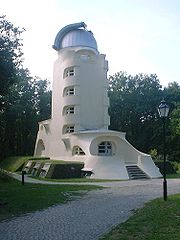
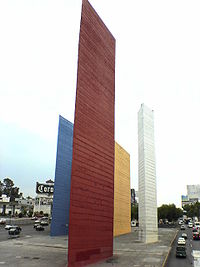
Bruno Taut
Bruno Julius Florian Taut , was a prolific German architect, urban planner and author active during the Weimar period....
's Glass Pavilion
Glass Pavilion
The Glass Pavilion, built in 1914 and designed by Bruno Taut, was a prismatic glass dome structure at the Cologne Deutscher Werkbund Exhibition. The structure was a brightly colored landmark of the exhibition, and was constructed using concrete and glass. The concrete structure had inlaid colored...
of the Cologne
Cologne
Cologne is Germany's fourth-largest city , and is the largest city both in the Germany Federal State of North Rhine-Westphalia and within the Rhine-Ruhr Metropolitan Area, one of the major European metropolitan areas with more than ten million inhabitants.Cologne is located on both sides of the...
Werkbund Exhibition (1914)
Werkbund Exhibition (1914)
The first Werkbund Exhibition of 1914 was held at Rheinpark in Cologne, Germany. Bruno Taut's best-known building, the prismatic dome of the Glass Pavilion of which only black and white images survive today, was in reality a brightly colored landmark. Walter Gropius and Adolf Meyer designed a model...
, and Erich Mendelsohn
Erich Mendelsohn
Erich Mendelsohn was a Jewish German architect, known for his expressionist architecture in the 1920s, as well as for developing a dynamic functionalism in his projects for department stores and cinemas.-Early life:...
's Einstein Tower
Einstein Tower
The Einstein Tower is an astrophysical observatory in the Albert Einstein Science Park in Potsdam, Germany built by Erich Mendelsohn. It was built on the summit of the Potsdam Telegraphenberg to house a solar telescope designed by the astronomer Erwin Finlay-Freundlich...
in Potsdam
Potsdam
Potsdam is the capital city of the German federal state of Brandenburg and part of the Berlin/Brandenburg Metropolitan Region. It is situated on the River Havel, southwest of Berlin city centre....
, Germany completed in 1921. The interior of Hans Poelzig
Hans Poelzig
Hans Poelzig was a German architect, painter and set designer.-Life:Poelzig was born in Berlin in 1869 to the countess Clara Henrietta Maria Poelzig while she was married to George Acland Ames, an Englishman...
's Berlin theatre (the Grosse Schauspielhaus), designed for the director Max Reinhardt
Max Reinhardt (theatre director)
----Max Reinhardt was an Austrian theater and film director and actor.-Biography:...
, is also cited sometimes. The influential architectural critic and historian Sigfried Giedion
Sigfried Giedion
Sigfried Giedion was a Bohemia-born Swiss historian and critic of architecture....
, in his book Space, Time and Architecture (1941), dismissed Expressionist architecture as a part of the development of functionalism
Functionalism (architecture)
Functionalism, in architecture, is the principle that architects should design a building based on the purpose of that building. This statement is less self-evident than it first appears, and is a matter of confusion and controversy within the profession, particularly in regard to modern...
. In Mexico, in 1953, German émigré Mathias Goeritz
Mathias Goeritz
Mathias Goeritz - August 4, 1990 in Mexico City) was a well-known Mexican painter and sculptor of German origin...
, published the "Arquitectura Emocional" (Architecture emotional) manifesto with which he declared that "architecture's principal function is emotion". Modern Mexican architect Luis Barragán
Luis Barragán
Luis Barragán Morfin was a Mexican architect. He was self-trained.-Early life:Educated as an engineer, he graduated from the Escuela Libre de Ingenieros in Guadalajara in 1923 and was self-trained as an architect.After graduation, he travelled through Spain, France , and...
adopted the term that influenced his work. The two of them collaborated in the project Torres de Satélite
Torres de Satélite
The Torres de Satélite are located in Ciudad Satélite, in the northern part of Naucalpan, Mexico. One of the country's first urban sculptures of great dimensions, had its planning started in 1957 with the ideas of renowned Mexican architect Luis Barragán, painter Jesús Reyes Ferreira and...
(1957–58) guided by Goeritz's principles of Arquitectura Emocional. It was only during the 1970s that Expressionism in architecture came to be re-evaluated more positively.
Further reading
- Antonín Matějček cited in Gordon, Donald E. (1987). Expressionism: Art and Ideas, p. 175. New Haven: Yale University PressYale University PressYale University Press is a book publisher founded in 1908 by George Parmly Day. It became an official department of Yale University in 1961, but remains financially and operationally autonomous....
. - Jonah F. Mitchell (Berlin, 2003). Doctoral thesis Expressionism between Western modernism and Teutonic Sonderweg. Courtesy of the author.
- Friedrich NietzscheFriedrich NietzscheFriedrich Wilhelm Nietzsche was a 19th-century German philosopher, poet, composer and classical philologist...
(1872). The Birth of Tragedy Out of The Spirit of Music. Trans. Clifton P. Fadiman. New York: Dover, 1995. ISBN 0486285154. - Judith Bookbinder, Boston modern: figurative expressionism as alternative modernism, (Durham, N.H. : University of New Hampshire Press; Hanover: University Press of New England, ©2005.) ISBN 1584654880 9781584654889
- Bram Dijkstra, American expressionism: art and social change, 1920-1950, (New York : H.N. Abrams, in association with the Columbus Museum of Art, 2003.) ISBN 0810942313 9780810942318
- Ditmar Elger Expressionism-A Revolution in German Art ISBN 978-3-8228-3194-6
- Paul Schimmel and Judith E Stein, The Figurative fifties : New York figurative expressionism, The Other Tradition (Newport Beach, California : Newport Harbor Art Museum : New York : Rizzoli, 1988.) ISBN 0847809420 9780847809424 0917493125 9780917493126
- Marika Herskovic, American Abstract and Figurative Expressionism: Style Is Timely Art Is Timeless (New York School Press, 2009.) ISBN 9780967799421.
- Lakatos Gabriela Luciana, Expressionism Today, University of Art and Design Cluj Napoca, 2011
External links
- Hottentots in tails A turbulent history of the group by Christian Saehrendt at signandsight.com
- German Expressionism A free resource with paintings from German expressionists (high-quality).