
All Topics  
Mass production


   Email Print
   Bookmark   Link


Mass production


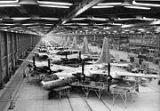
Mass production (also called flow production, repetitive flow production, series production, or serial production) is the production of large amounts of standardized products, including and especially on assembly line
Assembly line

An assembly line is a manufacturing process in which parts are added to a product in a sequential manner using optimally planned logistics to create a finished product much faster than with handcrafting-type methods....
s. The concepts of mass production are applied to various kinds of products, from fluids and particulates handled in bulk (such as food, fuel, chemicals, and mined minerals) to discrete solid parts (such as fasteners) to assemblies of such parts (such as household appliances and automobiles).

Mass production was popularized in the early 20th century by Henry Ford
Henry Ford

Henry Ford was the United States founder of the Ford Motor Company and father of modern assembly lines used in mass production. His introduction of the Model T History of the automobile revolutionized transportation and American industry....
's Ford Motor Company
Ford Motor Company

The Ford Motor Company is an United States multinational corporation and the world's List of automobile manufacturers#World Motor Vehicle Production by Manufacturer based on worldwide vehicle sales, following Toyota, General Motors, and Volkswagen Group....
, which introduced electric motors to the then-well-known technique of chain or sequential production and, in the process, began a new era often called the "second industrial revolution." Ford's contribution to mass production was synthetic in nature, collating and improving upon existing methods of sequential production and applying electric power to them, resulting in extremely-high-throughput, continuous-flow mass production, making the Model T affordable and, as such, an instant hit.

Mass production of assemblies typically uses electric-motor-powered moving tracks or conveyor belts to move partially complete products to workers, who perform simple repetitive tasks.


Discussion
Ask a question about 'Mass production'
Start a new discussion about 'Mass production'
Answer questions from other users
Full Discussion Forum


Encyclopedia


Mass production (also called flow production, repetitive flow production, series production, or serial production) is the production of large amounts of standardized products, including and especially on assembly line
Assembly line

An assembly line is a manufacturing process in which parts are added to a product in a sequential manner using optimally planned logistics to create a finished product much faster than with handcrafting-type methods....
s. The concepts of mass production are applied to various kinds of products, from fluids and particulates handled in bulk (such as food, fuel, chemicals, and mined minerals) to discrete solid parts (such as fasteners) to assemblies of such parts (such as household appliances and automobiles).

Mass production was popularized in the early 20th century by Henry Ford
Henry Ford

Henry Ford was the United States founder of the Ford Motor Company and father of modern assembly lines used in mass production. His introduction of the Model T History of the automobile revolutionized transportation and American industry....
's Ford Motor Company
Ford Motor Company

The Ford Motor Company is an United States multinational corporation and the world's List of automobile manufacturers#World Motor Vehicle Production by Manufacturer based on worldwide vehicle sales, following Toyota, General Motors, and Volkswagen Group....
, which introduced electric motors to the then-well-known technique of chain or sequential production and, in the process, began a new era often called the "second industrial revolution." Ford's contribution to mass production was synthetic in nature, collating and improving upon existing methods of sequential production and applying electric power to them, resulting in extremely-high-throughput, continuous-flow mass production, making the Model T affordable and, as such, an instant hit.

Mass production of assemblies typically uses electric-motor-powered moving tracks or conveyor belts to move partially complete products to workers, who perform simple repetitive tasks. It improves on earlier high-throughput, continuous-flow mass production made possible by the steam engine.

Mass production of fluid and particulate matter typically involves pipes with pumps or augers to transfer partially complete product between vessels.

Mass production is capital intensive
Capital intensity

Capital intensity is the term in economics for the amount of fixed or real Capital present in relation to other factors of production, especially labor....
 and energy intensive, as it uses a high proportion of machinery and energy in relation to workers. It is also usually automated to the highest extent possible. With fewer labour costs and a faster rate of production, capital and energy are increased while total expenditure per unit of product is decreased. However, the machinery that is needed to set up a mass production line (such as robot
Robot

A robot is a virtual or mechanical artificial agent. In practice, it is usually an Electromechanics which, by its appearance or movements, conveys a sense that it has Intention or Agency of its own....
s and machine press
Machine press

Sorry, no overview for this topic
es) is so expensive that there must be some assurance that the product is to be successful to attain profits.

One of the descriptions of mass production is that the craftsmanship is in the workbench itself, not the training of the worker; for example, rather than having a skilled worker measure every dimension of each part of the product against the plans or the other parts as it is being formed, there are jigs
Jig (tool)

A jig is any of a large class of tools in woodworking, metalworking, and some other crafts that help to control the location or motion of a tool....
 and gauge blocks that are ready at hand to ensure that the part is made to fit this set-up. It has already been checked that the finished part will be to specifications to fit all the other finished parts - and it will be made more quickly, with no time spent on finishing the parts to fit one another. This is the specialized capital required for mass production; each workbench is different and each set of tools at each workbench limited to those necessary to make one part. As each of these parts is uniformly and consistently constructed, interchangeability of components is thus another hallmark of mass produced goods.

Use of assembly lines in mass production

Mass production systems are usually organized into assembly line
Assembly line

An assembly line is a manufacturing process in which parts are added to a product in a sequential manner using optimally planned logistics to create a finished product much faster than with handcrafting-type methods....
s. The assemblies pass by on a conveyor, or if they are heavy, hung from an overhead monorail.

In a factory for a complex product, rather than one assembly line, there may be many auxiliary assembly lines feeding sub-assemblies (i.e. car engines or seats) to a backbone "main" assembly line. A diagram of a typical mass-production factory looks more like the skeleton of a fish than a single line.

Advantages and disadvantages

The economies of mass production come from several sources. The primary cause is a reduction of nonproductive effort of all types. In craft production, the craftsman must bustle about a shop, getting parts and assembling them. He must locate and use many tools many times for varying tasks. In mass production, each worker repeats one or a few related tasks that use the same tool to perform identical or near-identical operations on a stream of products. The exact tool and parts are always at hand, having been moved down the assembly line consecutively. The worker spends little or no time retrieving and/or preparing materials and tools, and so the time taken to manufacture a product using mass production is shorter than when using traditional methods.

The probability of human error and variation is also reduced, as tasks are predominantly carried out by machinery. A reduction in labour costs, as well as an increased rate of production, enables a company to produce a larger quantity of one product at a lower cost than using traditional, non-linear methods.

However, mass production is inflexible because it is difficult to alter a design or production process after a production line is implemented. Also, all products produced on one production line will be identical or very similar, and introducing variety to satisfy individual tastes is not easy. However, some variety can be achieved by applying different finishes and decorations at the end of the production line if necessary.

Vertical integration

Vertical integration

In microeconomics and management, the term vertical integration describes a style of management control. Vertically integrated companies are united through a hierarchy with a common owner....
 is a business practice that involves gaining complete control over a product's production, from raw materials to final assembly.

In the age of mass production, this caused shipping and trade problems in that shipping systems were unable to transport huge volumes of finished automobiles (in Henry Ford's case) without causing damage, and also government policies imposed trade barriers on finished units.

History


Although the Ford Motor Company brought mass production to new heights, it was a synthesizer and extrapolator of ideas rather than being the first creator of mass production. Ships had been mass-produced using pre-manufactured parts
American system of manufacturing

The American system of manufacturing involves semi-skilled labor using machine tools and Stencils to make standardized, identical, interchangeable parts, manufactured to a tolerance ....
 and assembly line
Assembly line

An assembly line is a manufacturing process in which parts are added to a product in a sequential manner using optimally planned logistics to create a finished product much faster than with handcrafting-type methods....
s in Venice
Venice

Venice is a city in northern Italy, the capital city of the Italian regions Veneto, a population of 271,251 . Together with Padua, Italy, the city is included in the Padua-Venice Metropolitan Area ....
 several hundred years earlier. The Venice Arsenal
Venetian Arsenal

The Venetian Arsenal is a shipyard and naval depot that played a leading role in Venetian empire-building. It was one of the most important areas of Venice, lying in the Castello, Venice sestiere ....
 apparently produced nearly one ship every day, in what was effectively the world's first factory
Factory

A factory or manufacturing plant is an industry building where workers manufacturing Good or supervise machines Process Manufacturing one product into another....
 which, at its height, employed 16,000 people.

Mass production in the publishing industry has been commonplace since Johannes Gutenberg
Johannes Gutenberg

Johannes Gensfleisch zur Laden zum Gutenberg was a Germany goldsmith and printer who is credited with being the first European to use movable type printing, in around 1439, and the global inventor of the mechanical printing press....
's Bible
Gutenberg Bible

The Gutenberg Bible is a printed version of the Latin Vulgate translation of the Bible that was printed by Johannes Gutenberg, in Mainz, Germany in the fifteenth century....
 was published using a printing press
Printing press

A printing press is a mechanical device for applying pressure to an inked surface resting upon a medium , thereby transferring an image. The mechanical systems involved were first assembled in Germany by the goldsmith Johannes Gutenberg around 1439, based on existing screw-presses used to press cloth, grapes etc., and possibly to print wood...
 in the mid-1400s.

During the Industrial Revolution
Industrial Revolution

The Industrial Revolution was a period in the late 18th and early 19th centuries when major changes in agriculture, manufacturing, production, and transportation had a profound effect on the socioeconomics and cultural conditions in United Kingdom....
 simple mass production techniques were used at the Portsmouth Block Mills
Portsmouth Block Mills

The Portsmouth Block Mills form part of the Portsmouth Dockyard at Portsmouth, Hampshire, England, and were built during the Napoleonic Wars to supply the British Royal Navy with pulley block s....
 to manufacture ships' pulley blocks for the Royal Navy
Royal Navy

The Royal Navy of the United Kingdom is the oldest of the British Armed Forces . From the mid-18th century until well into the 20th century, it was the most powerful navy in the world, playing a key part in establishing the British Empire as the dominant world power from 1815 until the early 1940s....
 during the Napoleonic Wars
Napoleonic Wars

The Napoleonic Wars were a series of conflicts involving Napoleon I of France First French Empire and changing sets of European allies and opposing coalitions that ran from 1803 to 1815....
. These were also used in the manufacture of clocks and watches, and in the manufacture of small arms.

During the American Civil War
American Civil War

The American Civil War , also known as the War Between the States and several Naming the American Civil War, was a civil war in the United States....
 the Springfield Armory
Springfield Armory

This is an article about the US Government Arsenal. For the contemporary commercial manufacturer see Springfield Armory, Inc.The Springfield Armory was the primary center for the manufacture of United States military small arms and the site of many important technological advances in gun manufacture....
 started to mass produce guns, using interchangeable parts
Interchangeable parts

Interchangeable parts are components of any device designed to specifications which ensure that they will fit within any device of the same type....
 on a large scale. The interchangeable part in manufacturing gun was strongly advocated by Eli Whitney. For this reason, the term Armory practice is occasionally used to refer to mass production. Soon after the war the American System of Watch Manufacturing
American System of Watch Manufacturing

In the mid 19th century Aaron Lufkin Dennison became inspired by the manufacturing techniques of the Springfield Armory at Springfield, Mass. The "armory practice" was mainly based on a strict system of organization, the extensive use of the machine shop and a control system based on gauges....
 showed that these techniques could be successfully applied even when very high precision was required. Later, in the 1890s, dollar watch
Dollar watch

A dollar watch was a pocket watch or later, a wristwatch, that sold for about one dollar.The sale of such watches began in 1892 by the watchmakers Ingersoll, Waterbury, and New Haven....
es traded off lower precision for much lower manufacturing costs.

Taking a look back at the history of American manufacturing, the key features of mass production were the perfect interchangeability of parts in the goods produced, long production runs and large quantity of outputs that were homogeneous. These key features were developed out of the earlier non-mechanized factory system known as the American system.

While the preceding American system of manufacturing
American system of manufacturing

The American system of manufacturing involves semi-skilled labor using machine tools and Stencils to make standardized, identical, interchangeable parts, manufactured to a tolerance ....
 relied on steam power, mass production factories were electrified
Electrification

Electrification refers to the modification of a system so that it operates using electricity....
 and used sophisticated machinery. Adoption of these techniques coincided with the birth of the second industrial revolution in the US and its emergence as the dominant industrial superpower in the 20th century. Countries that were quick to follow in its wake (e.g. Germany and Japan) enjoyed high rates of growth.

French political thinker and historian, Alexis de Tocqueville
Alexis de Tocqueville

Alexis-Charles-Henri Cl?rel de Tocqueville was a French political philosophy and historian best known for his Democracy in America and The Old Regime and the Revolution ....
 identified one of the key reasons mass production was able to succeed so quickly in America, namely that of the homogeneous consumer base. De Tocqueville wrote in his Democracy in America
Democracy in America

De la d?mocratie en Am?rique is a Western canon France text by Alexis de Tocqueville on the United States in the 1830s and its strengths and weaknesses....
 (1835) that "The absence in the United States of those vast accumulations of wealth
Wealth

Wealth is an abundance of valuable material possessions or resources. The word is derived from the old English wela, which is from an Indo-European word stem....
 which favor the expenditures of large sums on articles of mere luxury... impact to the productions of American industry a character distinct from that of other countries' industries. [Production is geared toward] articles suited to the wants of the whole people".

See also

  • Batch production
    Batch production

    The primary characteristic of batch production is that all components are completed at a workstation before they move to the next one. Batch production is popular in bakeries and in the manufacture of sports shoes, pharmaceutical ingredients, inks, paints and adhesives....
  • Craft production
    Craft production

    Craft production is the process of manufacturing by hand with or without the aid of tools. The term Craft production refers to a manufacturing technique applied in the hobbies of Handicraft but was also the common method of manufacture in the pre-industrial world....
  • Fast moving consumer goods
    Fast Moving Consumer Goods

    Fast Moving Consumer Goods , are products that are sold quickly at relatively low cost. Though the absolute profit made on FMCG products is relatively small, they generally sell in large quantities, so the cumulative profit on such products can be large....
  • Industrial Design
    Industrial design

    Industrial design is an applied art whereby the aesthetics and usability of mass-produced Product may be improved for marketability and Manufacturing....
  • Injection molding
  • Job production
    Job production

    Job production involves producing a one-off product for a specific customer. Job production is most often associated with small firms but large firms use job production too....
  • Just In Time
  • Large-scale
  • Lean manufacturing
    Lean manufacturing

    Lean manufacturing or lean production, which is often known simply as "Lean", is a production practice that considers the expenditure of resources for any goal other than the creation of value for the end customer to be wasteful, and thus a target for elimination....
  • Manufacturing
    Manufacturing

    Manufacturing is the use of machine, tool and labor to make things for use or sale. The term may refer to a range of human activity, from handicraft to high tech, but is most commonly applied to Industry production, in which raw material are transformed into finished good on a large scale....
  • Mass market
    Mass market

    The mass market is a general business term describing the largest group of consumers for a specified industry product. It is the opposite extreme of the term niche market....
  • Pilot plant
    Pilot plant

    File:Pg166 bioreactor.jpgA pilot plant is a small chemical plant which is operated to generate information about the behavior of the system for use in design of larger facilities....
  • Plastics
  • Production, costs, and pricing
    Production, costs, and pricing

    In microeconomics, industrial organization is the field which describes the behavior of firms in the marketplace with regard to production, pricing, employment and other decisions....
  • Product cycle